
Classic Wheels
Gallery 1
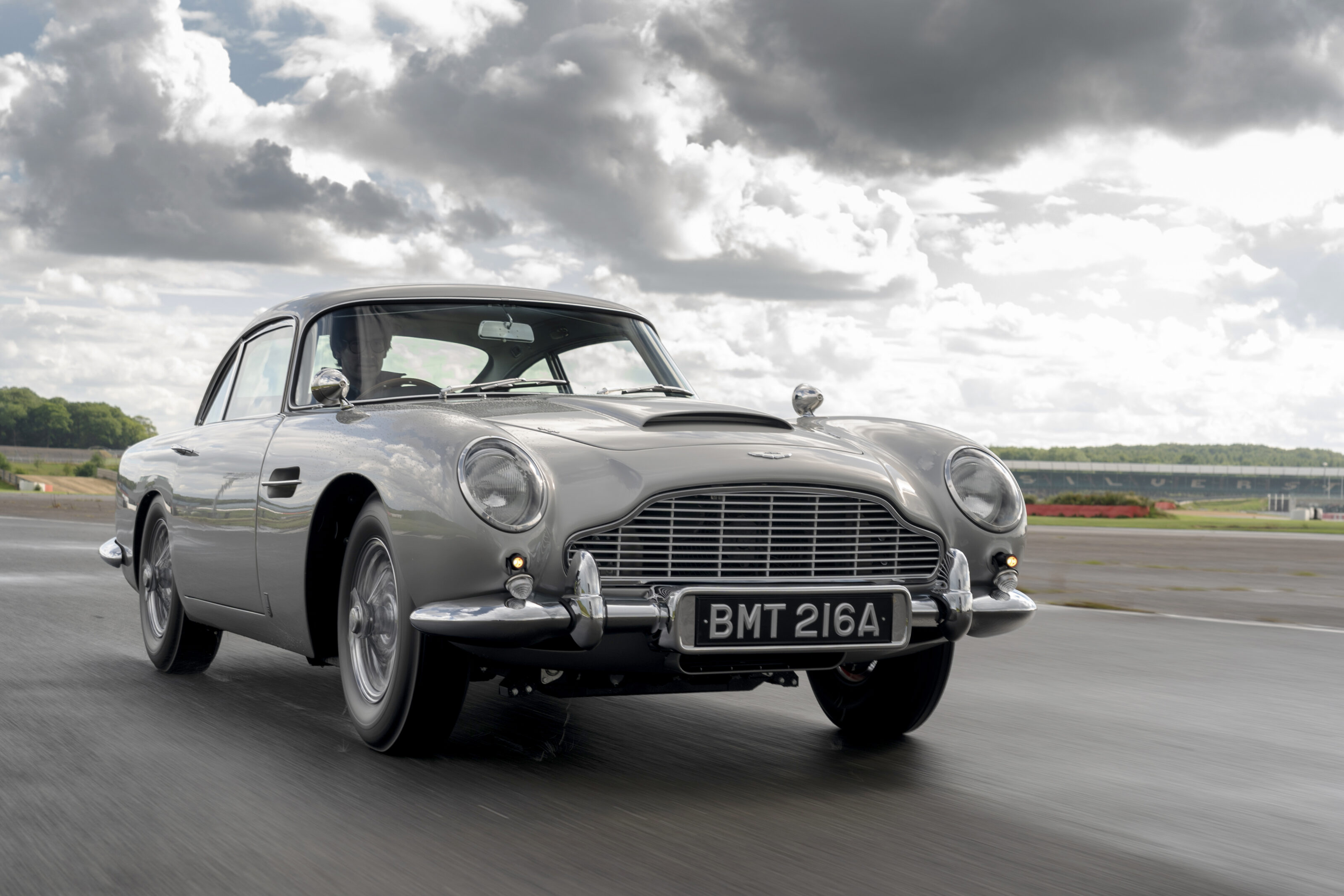
Now that Robert Pattinson has been officially unveiled as the next 007, we thought it would be a good time to revisit Wheels’ experience in the Aston Sean Connery drove in Goldfinger. Well, one of them, anyway. Widely regarded as one of, if not the, greatest James Bond car ever, the roadgoing superstar might not have featured working Browning machine guns, but it was mightily impressive nonetheless…
First published in the October 2006 issue of Wheels magazine, Australia’s best car mag since 1953. Subscribe here and gain access to 12 issues for $109 plus online access to every Wheels issue since 1953.
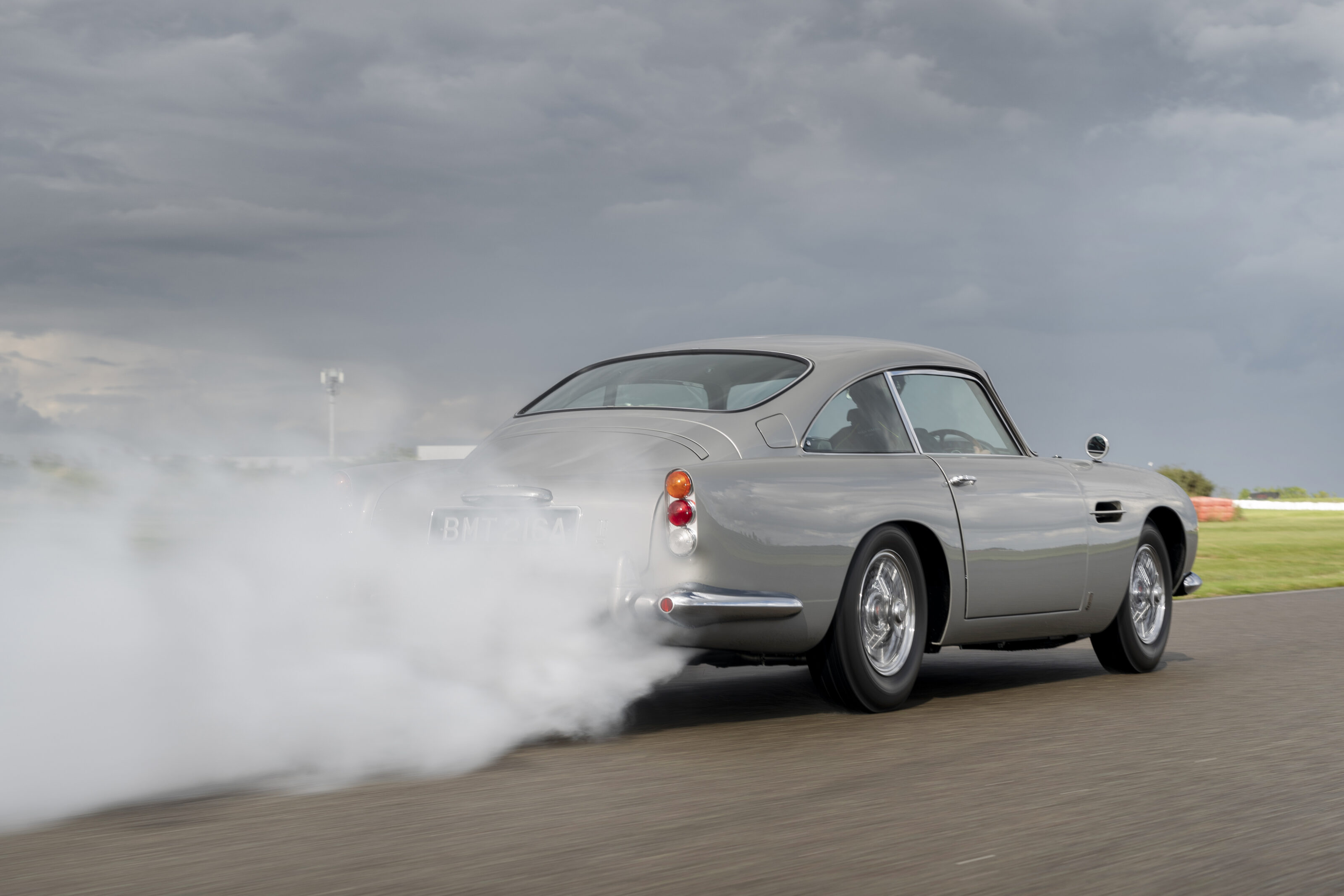
A classified location, one hour before dawn. The temperature several degrees below zero. A truck halts, doors are flung open, and a ramp hits the road with a startling clatter. Inside the trailer, a 40-year-old engine turns over sleepily before exploding into life. Through a curtain of white smoke, a familiar shape reverses towards me.
2
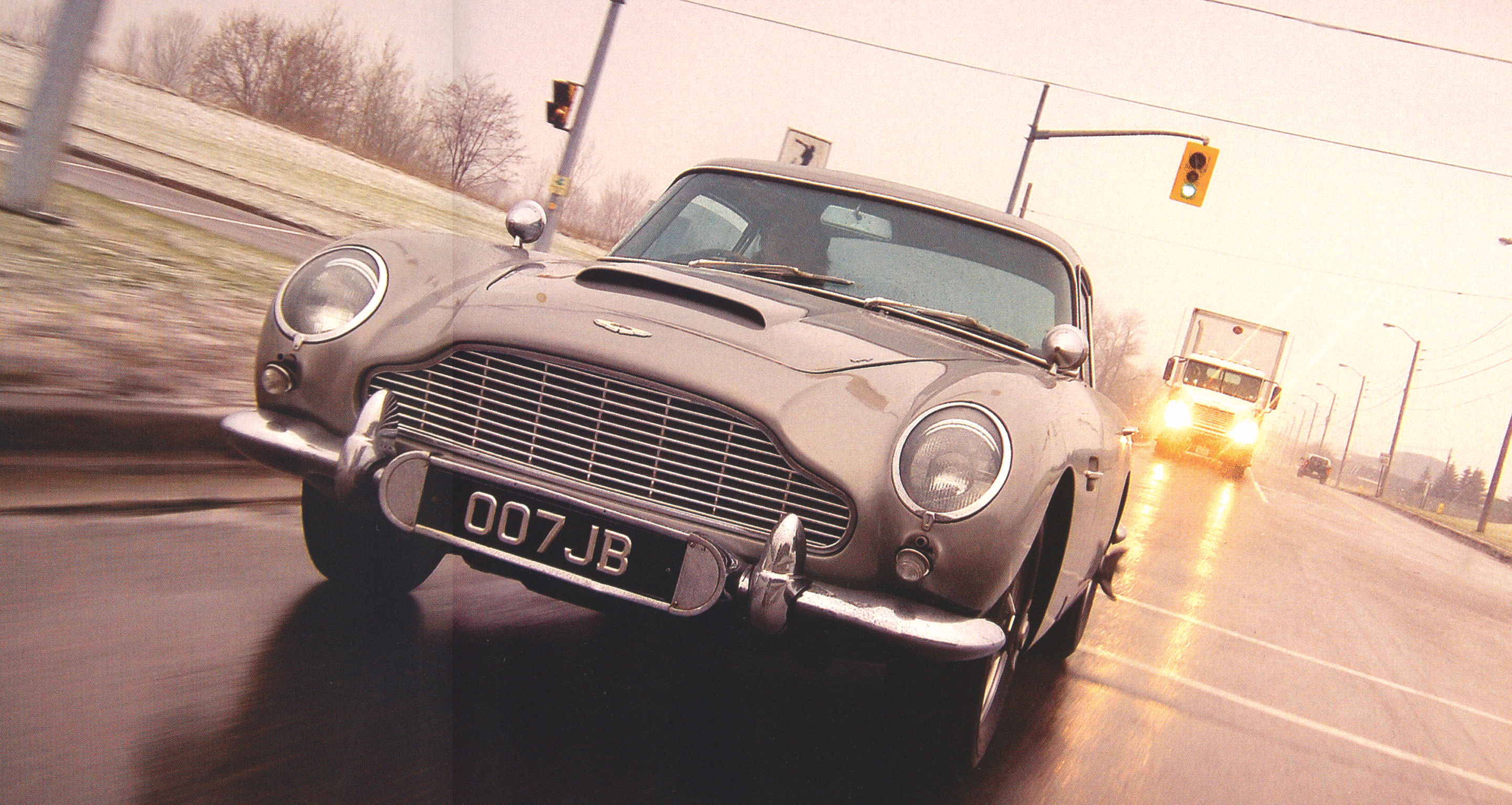
Commander James Bond’s Aston Martin DB5 is, for an entire generation of perpetual schoolboys, the ultimate car. This morning, I’m driving it home, back to Bond’s birthplace – a place so secret, only a few of 007’s most devoted fans even know it ever existed.
The ultimate Bond gadget, the DB5 made its screen debut in Goldfinger, appeared again in Thunderball, and to this day remains, arguably, the world’s most famous movie car.
A fast, elegant coupe with stylish Silver Birch paintwork, the Aston Martin was a desirable machine before Q got carried away with the optional extras. But, with onboard machine guns, an ejector seat, a tyre-slasher, a bulletproof shield and Sean Connery at his suave ’60s peak behind the wheel, it became an instant icon.
In that pre-CGI (computer-generated imagery) era, special effects couldn’t be faked digitally. They were built for real. Back in 1964, Goldfinger’s production company Eon originally ordered just one gadget-equipped ‘effects car’ at a cost of £25,000 – five times the showroom price of a normal DB5 – and one standard ‘road car’ for moving shots.
2
But, with the film’s success, Eon realised the car was becoming as big a star as Sean Connery, and commissioned two identical, fully-functioning gadget cars for publicity and promotional work. The original Goldfinger effects car was stolen from a Florida aircraft hanger in 1997, never to be seen again, and now just three Bond DB5s remain in existence.
“The last time one was sold was 1986. And it’ll be a long time before the other two cars come up for sale,” says Terrance Lubzon of RM Auctions, the Canadian specialists behind the forthcoming sale of this car this time around.
Originally bought by Sir Anthony Bamford, head of the JCB digger empire, the DB5 was sold to a Tennessee museum, where it has remained on display, locked in a steel mesh cage, for 35 years. The car has just over 17,000 miles (27,358 kilometres) on the clock.
“It’s original,” says Terrance. “It’s in perfect running condition … never been touched.”
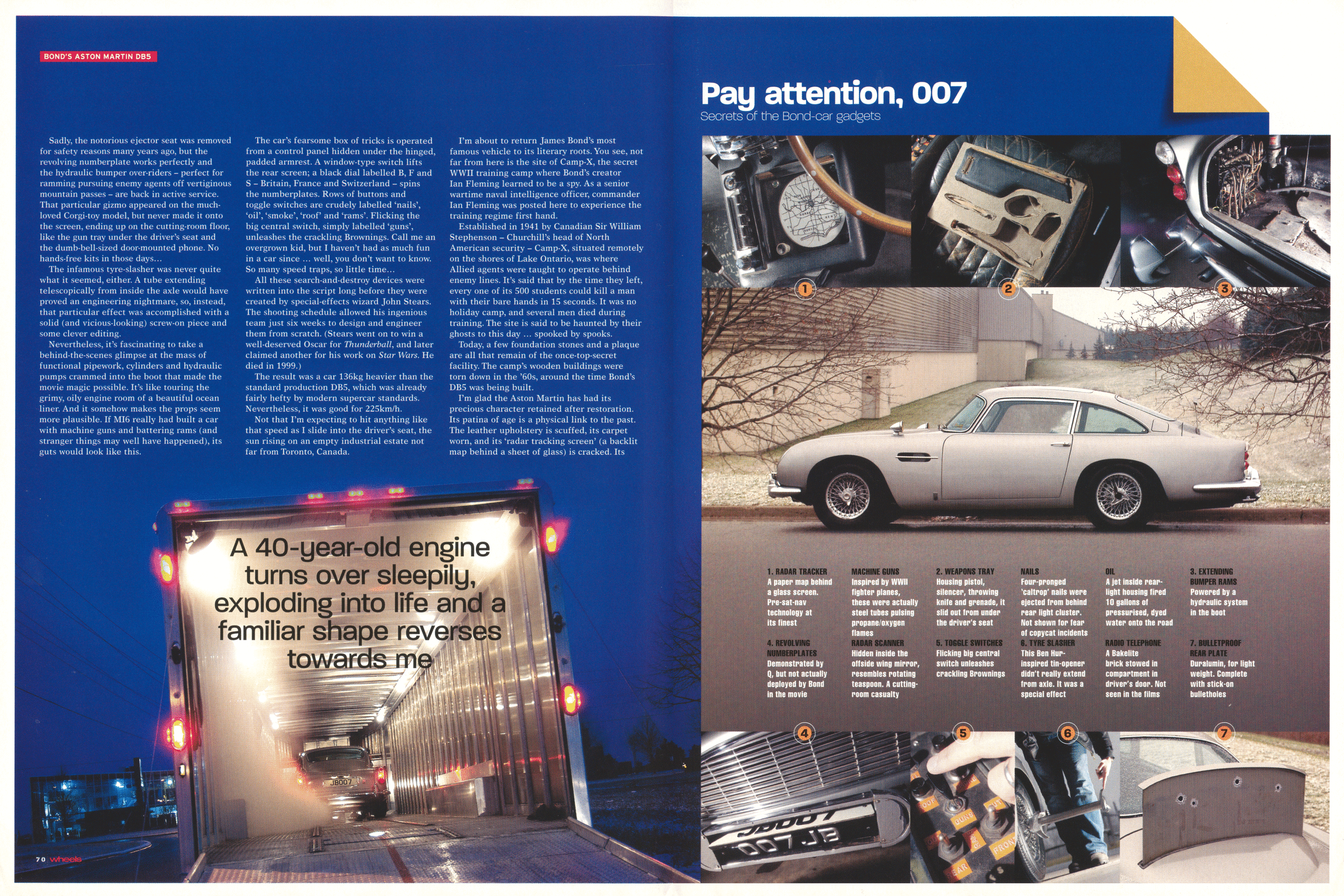
Apart, that is, from a little careful tinkering by RM’s in-house restoration experts to bring 007’s neglected hardware back to life. They fixed the electric motors, raising the retractable ‘bulletproof’ rear shield (it’s flimsy duralumin alloy, really), and the oxygen and propane-powered mechanism firing the dummy Browning machine guns that protrude from behind the front sidelights.
3
Sadly, the notorious ejector seat was removed for safety reasons many years ago, but the revolving numberplate works perfectly and the hydraulic bumper over-riders – perfect for ramming pursuing enemy agents off vertiginous mountain passes – are back in active service. That particular gizmo appeared on the much-loved Corgi-toy model, but never made it onto the screen, ending up on the cutting-room floor like the gun tray under the driver’s seat and the dumb-bell-sized door-mounted phone. No hands-free kits in those days…
The infamous tyre-slasher was never quite what it seemed, either. A tube extending telescopically from inside the axle would have proved an engineering nightmare, so, instead, that particular effect was accomplished with a solid (and vicious-looking) screw-on piece and some clever editing.
Nevertheless, it’s fascinating to take a behind-the-scenes glimpse at the mass of functional pipework, cylinders and hydraulic pumps crammed into the boot that made the movie magic possible. It’s like touring the grimy, oily engine room of a beautiful ocean liner. And it somehow makes the props seem more plausible. If MI6 really had built a car with machine guns and battering rams (and stranger things may well have happened), its guts would look like this.
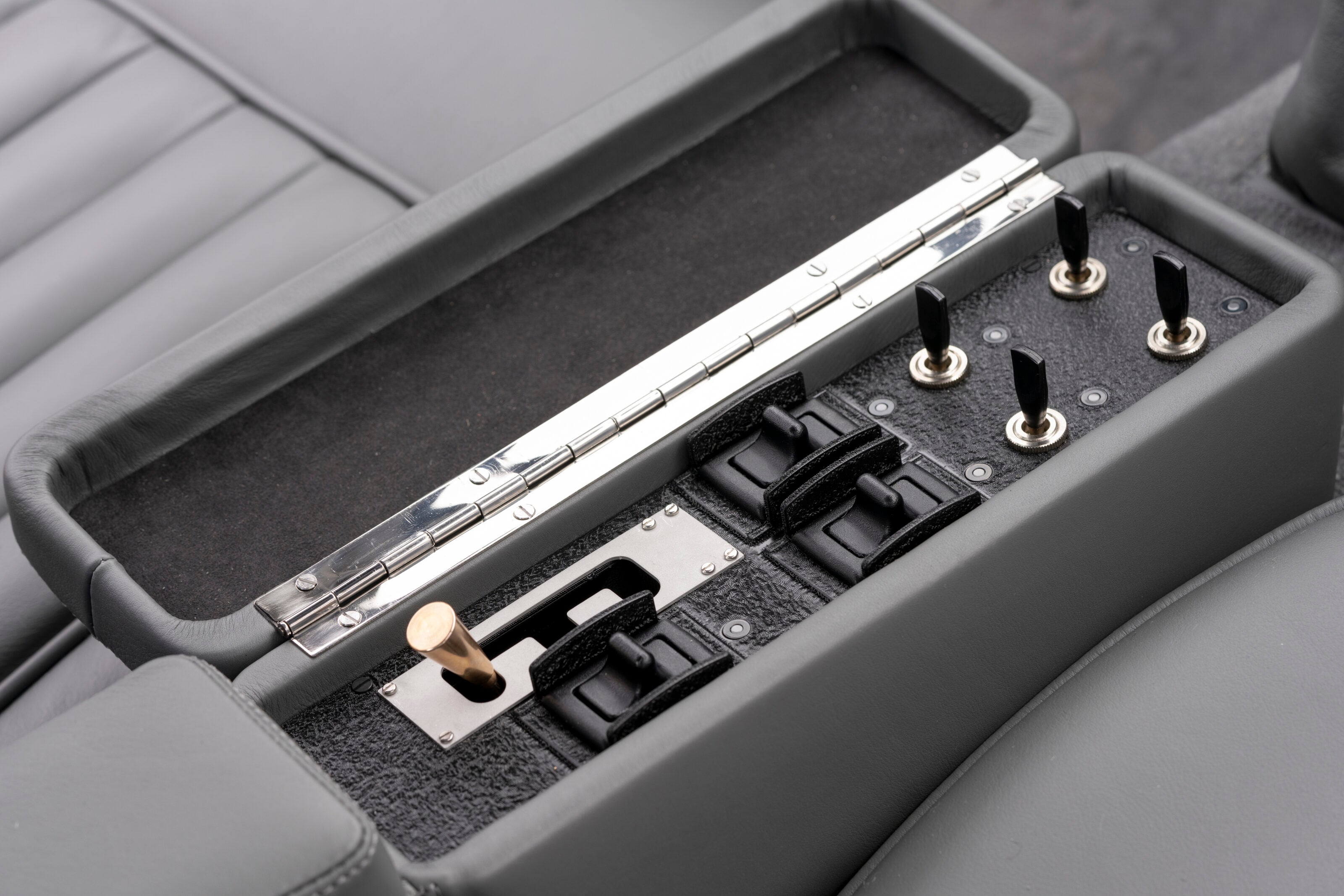
The car’s fearsome box of tricks is operated from a control panel hidden under the hinged, padded armrest. A window-type switch lifts the rear screen; a black dial labelled B, F and S – Britain, France and Switzerland – spins the numberplates. Rows of buttons and toggle switches are crudely labelled ‘nails’, ‘oil’, ‘smoke’, ‘roof’ and ‘rams’. Flicking the big central switch, simply labelled ‘guns’, unleashes the crackling Brownings. Call me an overgrown kid, but I haven’t had as much fun in a car since … well, you don’t want to know. So many speed traps, so little time…
4
All these search-and-destroy devices were written into the script long before they were created by special-effects wizard John Stears. The shooting schedule allowed his ingenious team just six weeks to design and engineer them from scratch. (Stears went on to win a well-deserved Oscar for Thunderball, and later claimed another for his work on Star Wars. He died in 1999.)
The result was a car 136kg heavier than the standard production DB5, which was already fairly hefty by modern supercar standards. Nevertheless, it was good for 225km/h.
Not that I’m expecting to hit anything like that speed as I slide into the driver’s seat, the sun rising on an empty industrial estate not far from Toronto, Canada.
I’m about to return James Bond’s most famous vehicle to its literary roots. You see, not far from here is the site of Camp-X, the secret WWII training camp where Bond’s creator Ian Fleming learned to be a spy. As a senior wartime naval intelligence officer, commander Ian Fleming was posted here to experience the training regime first hand.
6
Established in 1941 by Canadian Sir William Stephenson – Churchill’s head of North American security – Camp-X, situated remotely on the shores of Lake Ontario, was where Allied agents were taught to operate behind enemy lines. It’s said that by the time they left, every one of its 500 students could kill a man with their bare hands in 15 seconds. It was no holiday camp, and several men died during training. The site is said to be haunted by their ghosts to this day … spooked by spooks.
Today, a few foundation stones and a plaque are all that remain of the once-top-secret facility. The camp’s wooden buildings were torn down in the ’60s, around the time Bond’s DB5 was being built.
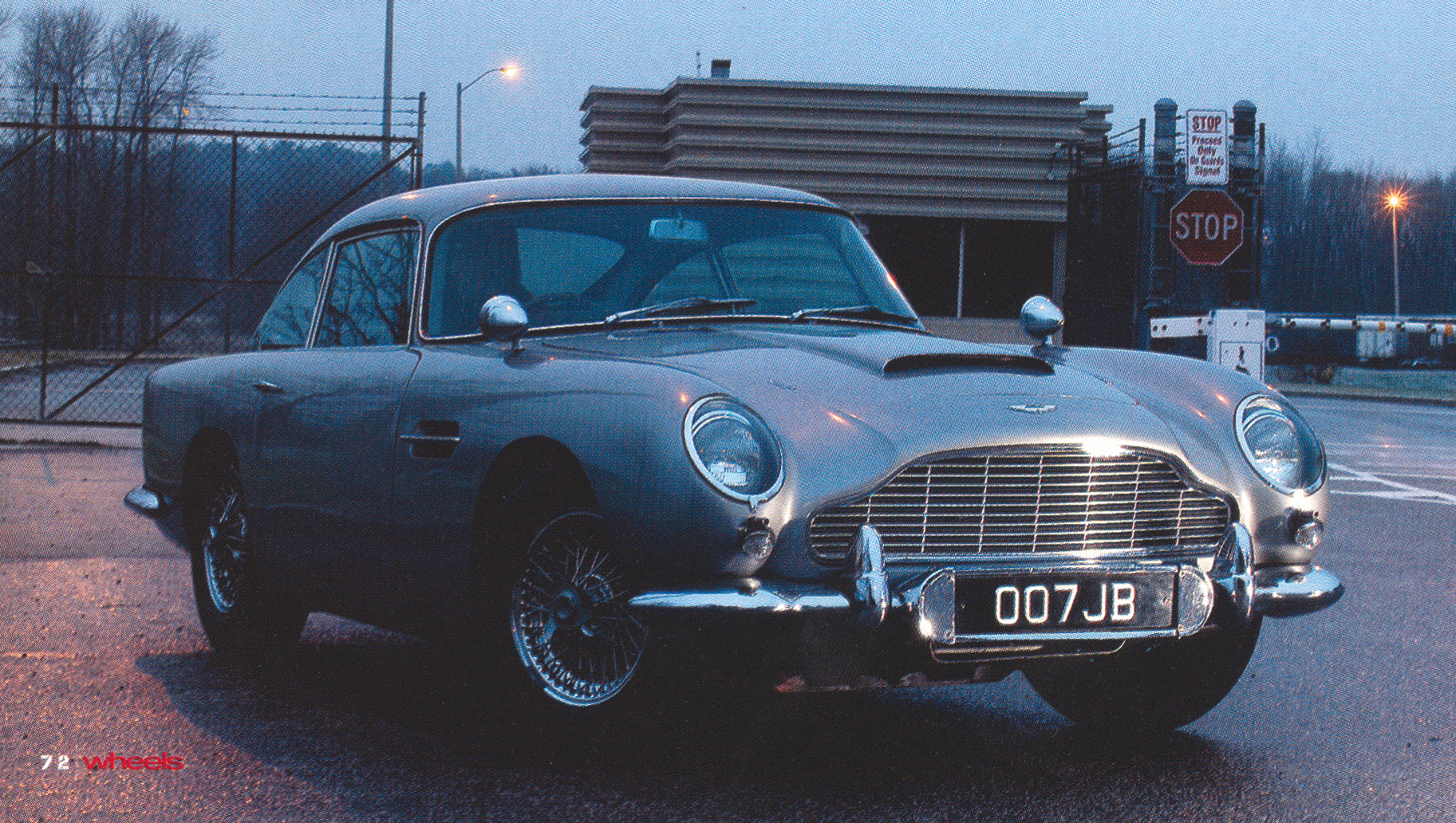
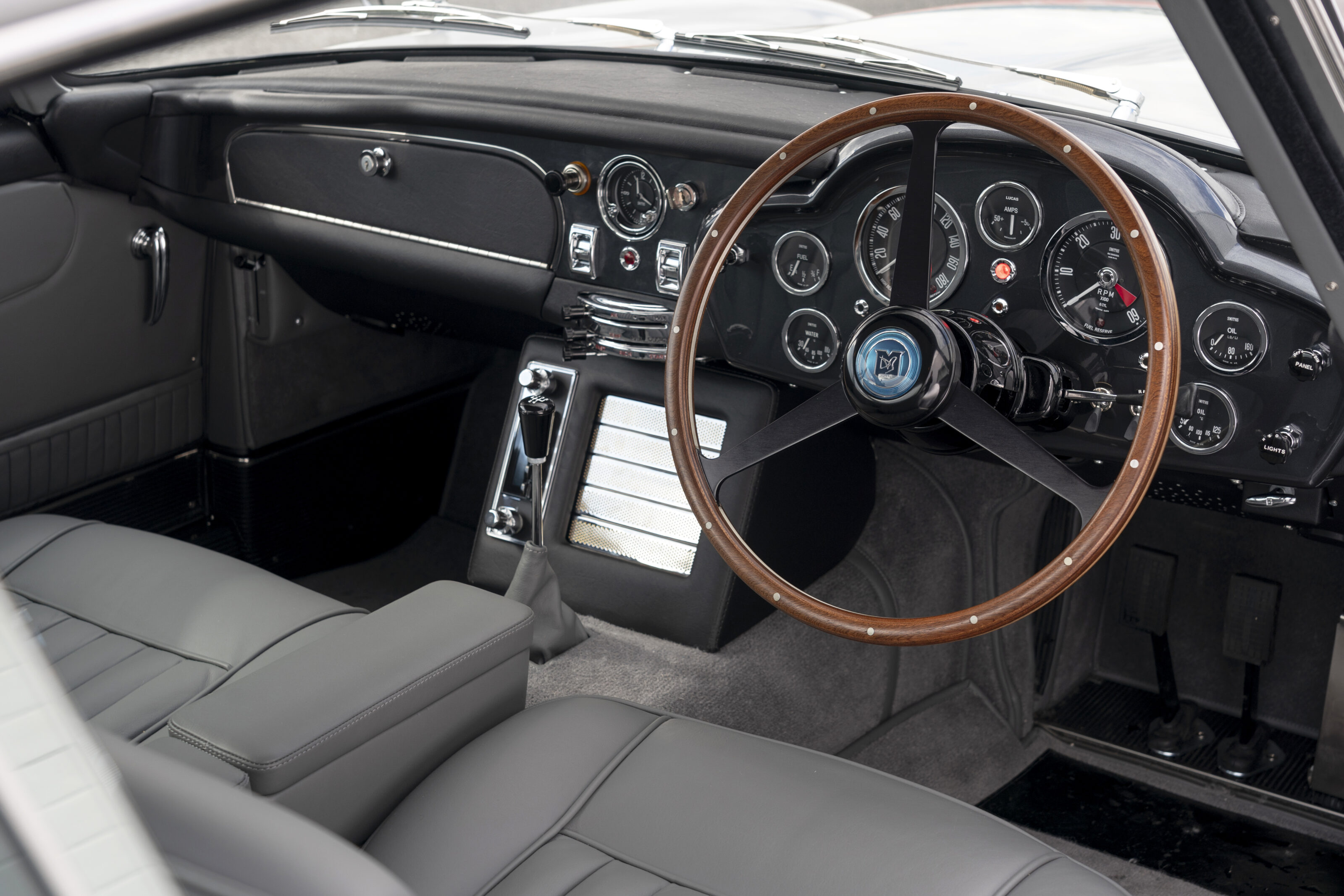
I’m glad the Aston Martin has had its precious character retained after restoration. Its patina of age is a physical link to the past. The leather upholstery is scuffed, its carpet worn, and its ‘radar tracking screen’ (a backlit map behind a sheet of glass) is cracked. Its massive steering wheel feels thin and impossibly delicate, the wood riveted to its skinny rim seems to come apart in my fingers as I turn it. I can see daylight through the car’s deteriorated door rubbers, and the brakes feel like they’re fashioned from teak. The silver paint is bubbling faintly along the edge of the long bonnet, and there’s a ding in the boot lid.
However, four decades after its construction, this powerful, heavy-steering Aston still drives like the magnificent sports car it always was. It’s the real deal. However well-intentioned, a clumsy restoration would be a crime worthy of arch-enemy Auric Goldfinger himself.
4
I pull up on a windswept patch of high ground overlooking the forbidding grey waters of Lake Ontario. Now called Intrepid Park, this is exactly where the espionage academy once stood.
I’m here to rendezvous with the local historian and author of Inside Camp-X, Lynn-Philip Hodgson. He appears wearing suitably sinister dark glasses, but when he spots the Aston Martin, they can’t hide his delight. It was watching Goldfinger in 1964, and reading spymaster Sir William Stephenson’s biography A Man Called Intrepid, that ignited his interest in Camp-X.
“The book mentioned a training camp, but it didn’t say where. So, I had to go find it. It turned out I was living only five kilometres away,” says Lynn.
Having spent over 30 years tracking down agents who trained here in explosives, weapons, unarmed combat and the art of silent killing, Lynn has built up a detailed picture of life behind the heavily guarded barbed-wire fences.
“If you watch Dr No, as they train the agents while Q walks Bond through the camp – that’s Camp-X,” he says. “Ian Fleming obviously got all of that from his observations here. Bang on. It was exactly like that.”
Hodgson is absolutely convinced that Fleming conceived the James Bond character at the Canadian spy school.
5
“Major Paul Dehn, an instructor at Camp-X, was a screenplay writer before the war and he befriended Ian Fleming here,” he says. “And I’m sure Fleming said to Paul Dehn, ‘You know I’ve got this concept I’m thinking of working on after the war.’ And I’m sure Paul Dehn must have said to him, ‘If you ever do it, I’ll write the screenplay for you.’ Because he did it!”
He did, too. Dehn’s post-war writing credits included Goldfinger. But if that is where 007’s character was born, where did Fleming get the name Bond, James Bond?
Before we say goodbye, Lynn directs me to Avenue Road in Toronto and the private house in which Fleming was billeted during his stay in Canada.
Half an hour later, I park the DB5, kill the engine and look around. Across the street is an imposing disused church. It’s the church of Bond, says the sign outside … St James Bond.
As for the DB5, it is later sold to a Swiss collector for US$2.1 million at RM Auctions’ Arizona Biltmore sale. Fittingly, the winning bidder’s identity remains a mystery.
What happened to the four James Bond DB5s?
DP-216-1: The actual special-effects car seen in Goldfinger. Aston stripped out the gizmos and sold it anonymously. Later retro-fitted with mock-up gadgets, it was sold to US collector Anthony Pugliese by Sotheby’s in 1986 for US275K.Itstheftinthe’90sresultedinaUS4m insurance payout. It remains missing.
DB5-1486-R: Driven in Goldfinger and Thunderball, this original ‘road car’ – used for filming fast road sequences – has been owned by American Jerry Lee since 1969. Since the disappearance of DP/216/1, this is the most valuable of the four Bond DB5s.
DB5-2017-R: This publicity car spent many years encased in glass in a Canadian restaurant, pulling in the punters as a novelty exhibit. Now on show at the Dutch National Motor Museum.
DB5-2008-R: ‘Our’ show car has been held at the Smoky Mountain Car Museum in Tennessee, USA, since 1975. Sold at auction in 2006, for US$2.1 million.
Follow WhichCar/Wheels on Google
Click the button below to make WhichCar by Wheels a preferred source for your news.

We recommend
-
 Features
How three Aston Martin DBSs were wrecked for a James Bond film: classic MOTOR
One man trashed three Aston Martins and lived. His name is Bond, James Bond
-
 News
Jaguar’s stillborn supercar revived for James Bond
Reports surface Jaguar will build C-X75 and join Aston Martin’s DB10 in upcoming Bond film
