Classic Wheels
Gallery 1
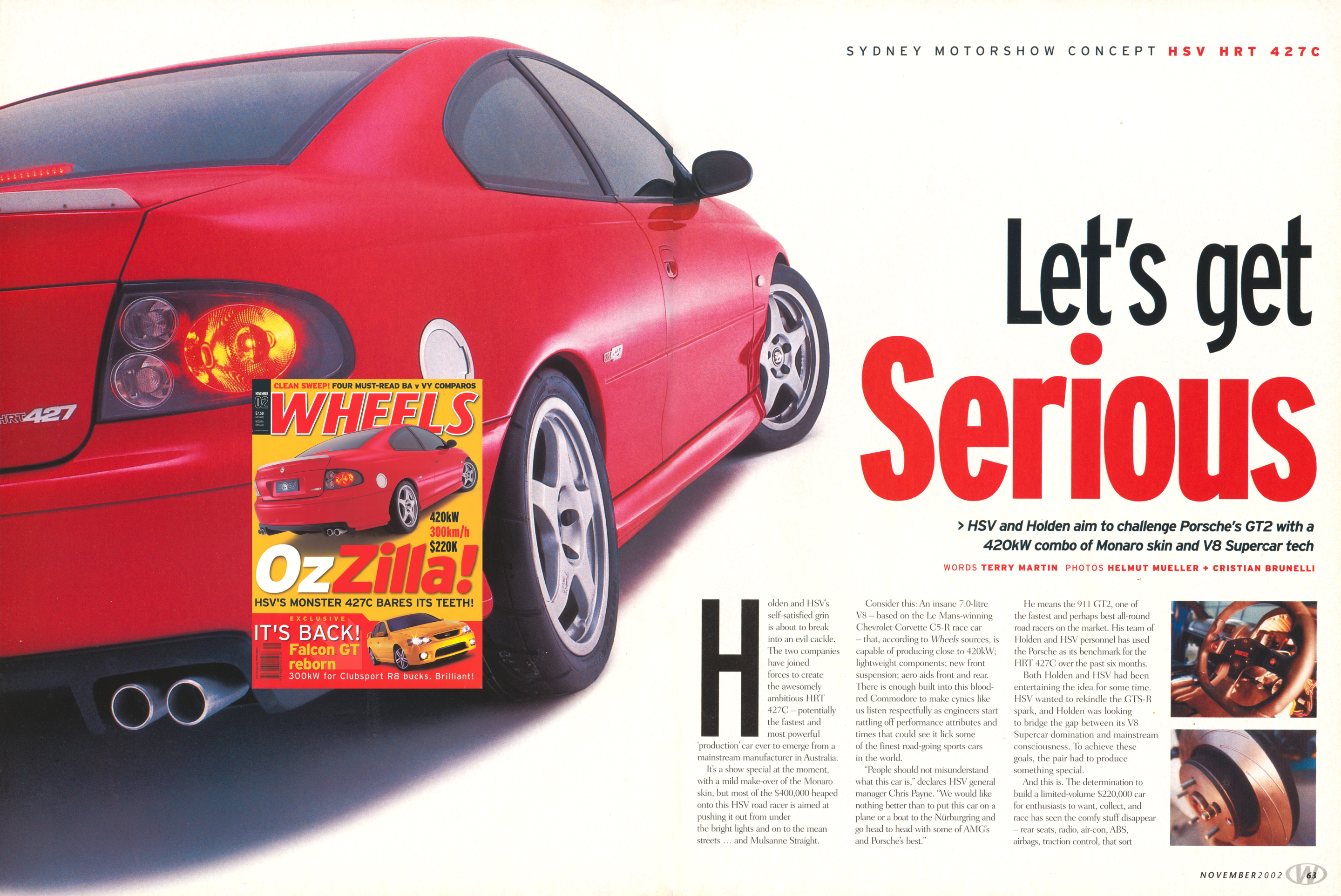
The 427C had a short but thrilling life after it was unveiled at the Sydney Motor Show in 2002. The racing version went on to win two Bathurst 24 Hours races but dreams of Aussies driving a V8 Supercar-light production version died on the vine thanks to its price tag of around $200,000.
First published in the November 2002 issue of Wheels magazine, Australia’s best car mag since 1953. Subscribe here and gain access to 12 issues for $109 plus online access to every Wheels issue ever printed.
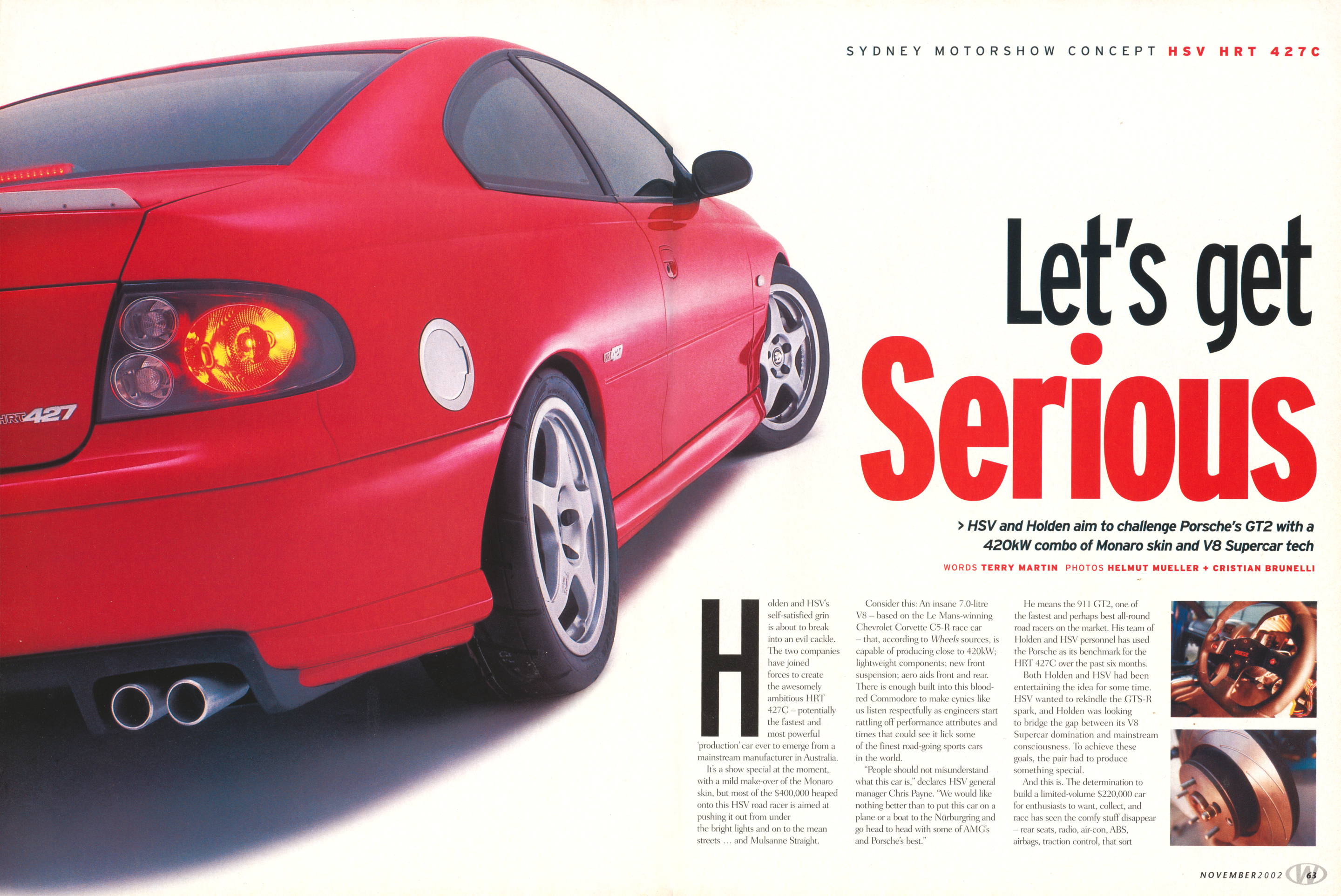
Holden and HSV’s self-satisfied grin is about to break into an evil cackle. The two companies have joined forces to create the awesomely ambitious HRT 427C – potentially the fastest and most powerful ‘production’ car ever to emerge from a mainstream manufacturer in Australia.
It’s a show special at the moment, with a mild make-over of the Monaro skin, but most of the $400,000 heaped onto this HSV road racer is aimed at pushing it out from under the bright lights and on to the mean streets … and Mulsanne Straight.
1
Consider this: An insane 7.0-litre V8 – based on the Le Mans-winning Chevrolet Corvette C5-R race car – that, according to Wheels sources, is capable of producing close to 420kW; lightweight components; new front suspension; aero aids front and rear. There is enough built into this blood-red Commodore to make cynics like us listen respectfully as engineers start rattling off performance attributes and times that could see it lick some of the finest road-going sports cars in the world.
“People should not misunderstand what this car is,” declares HSV general manager Chris Payne. “We would like nothing better than to put this car on a plane or a boat to the Nürburgring and go head to head with some of AMG’s and Porsche’s best.”
He means the 911 GT2, one of the fastest and perhaps best all-round road racers on the market. His team of Holden and HSV personnel has used the Porsche as its benchmark for the HRT 427C over the past six months.
Both Holden and HS\/ had been entertaining the idea for some time. HSV wanted to rekindle the GTS-R spark, and Holden was looking to bridge the gap between its VS Supercar domination and mainstream consciousness. To achieve these goals, the pair had to produce something special.
And this is. The determination to build a limited-volume $220,000 car for enthusiasts to want, collect, and race has seen the comfy stuff disappear – rear seats, radio, air-con, ABS, airbags, traction control, that sort of thing – and substantial engineering improvements made across the board in collaboration with the Holden Racing Team.
3
There’s much more to this car than a massive meat-and-potatoes clonk. Stuff like a carbonfibre bonnet, magnesium cliff housing, race-inspired double A-arm front suspension, front air splitter, and a full race interior with rollcage are listed.
As for the engine, the C5-R is the biggest, strongest and most powerful of all Chev Gen IIIs, displacing 427 cubic inches and reckoned to produce around 420 kilowatts at 6000rpm, stirring memories of American big-blocks from the ’60s and, for the rest of us, prompting the inevitable question: What’II she do?
When this ink hit paper, no-one had driven the car. The showpiece was being shown and the test mule was still in bits on the workshop floor. With a 1574kg kerb weight, Wheels‘ own engineering assessments suggest the 427C will reach 100km/h from standstill in under four seconds, pass the quarter mile in high elevens at a speed in excess of 210km/h, and shouldn’t stop accelerating until it goes beyond 300km/h. With those times, think Porsche GT2, Ferrari F5O, Benz SL55 AMC. Think Holden? ‘That’s where we want [the 427C] to be,” asserts HSVs advanced engineering chief, Brad Dunstan. “That’s where we want to live.”
I SEE RED
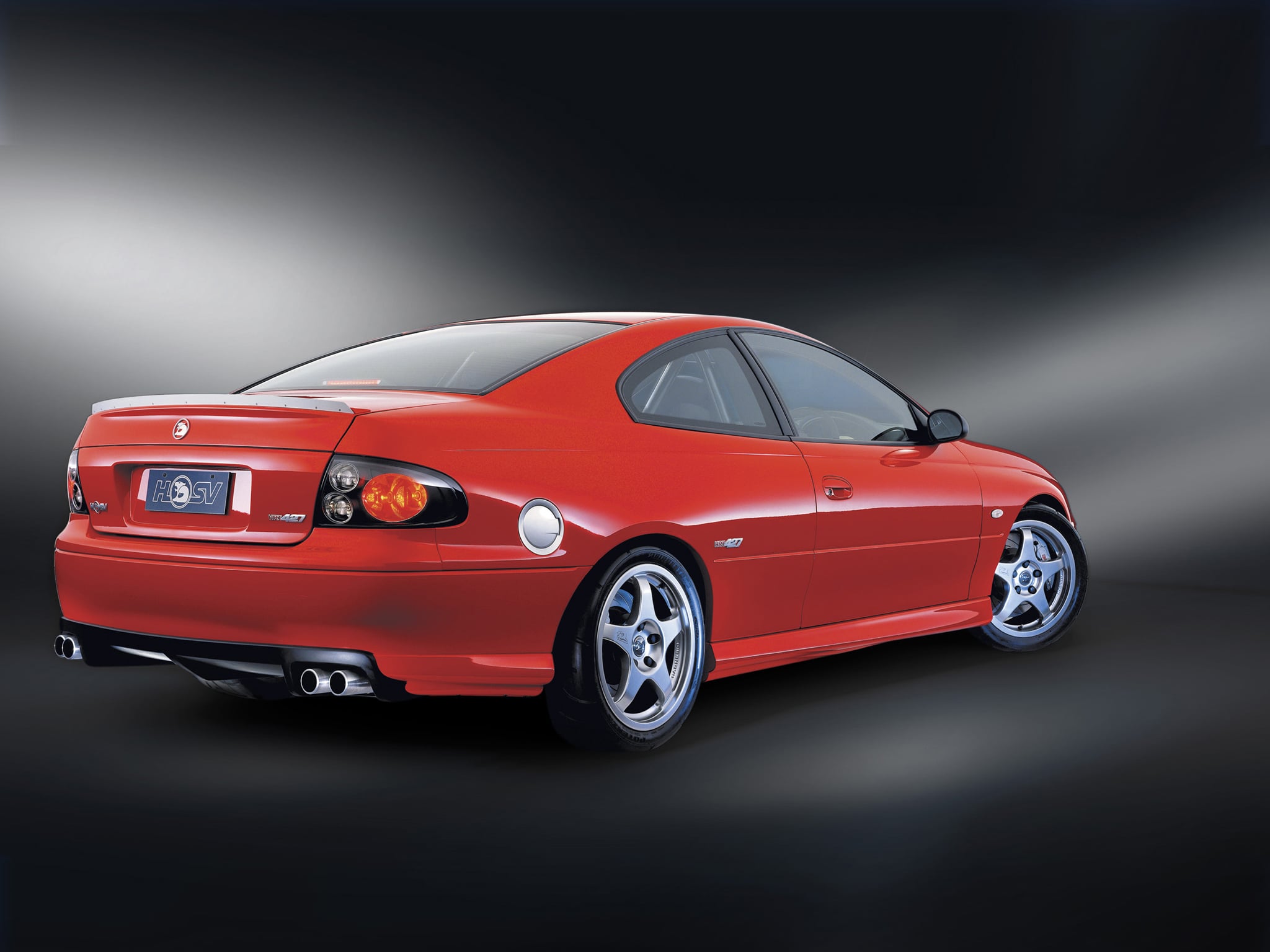
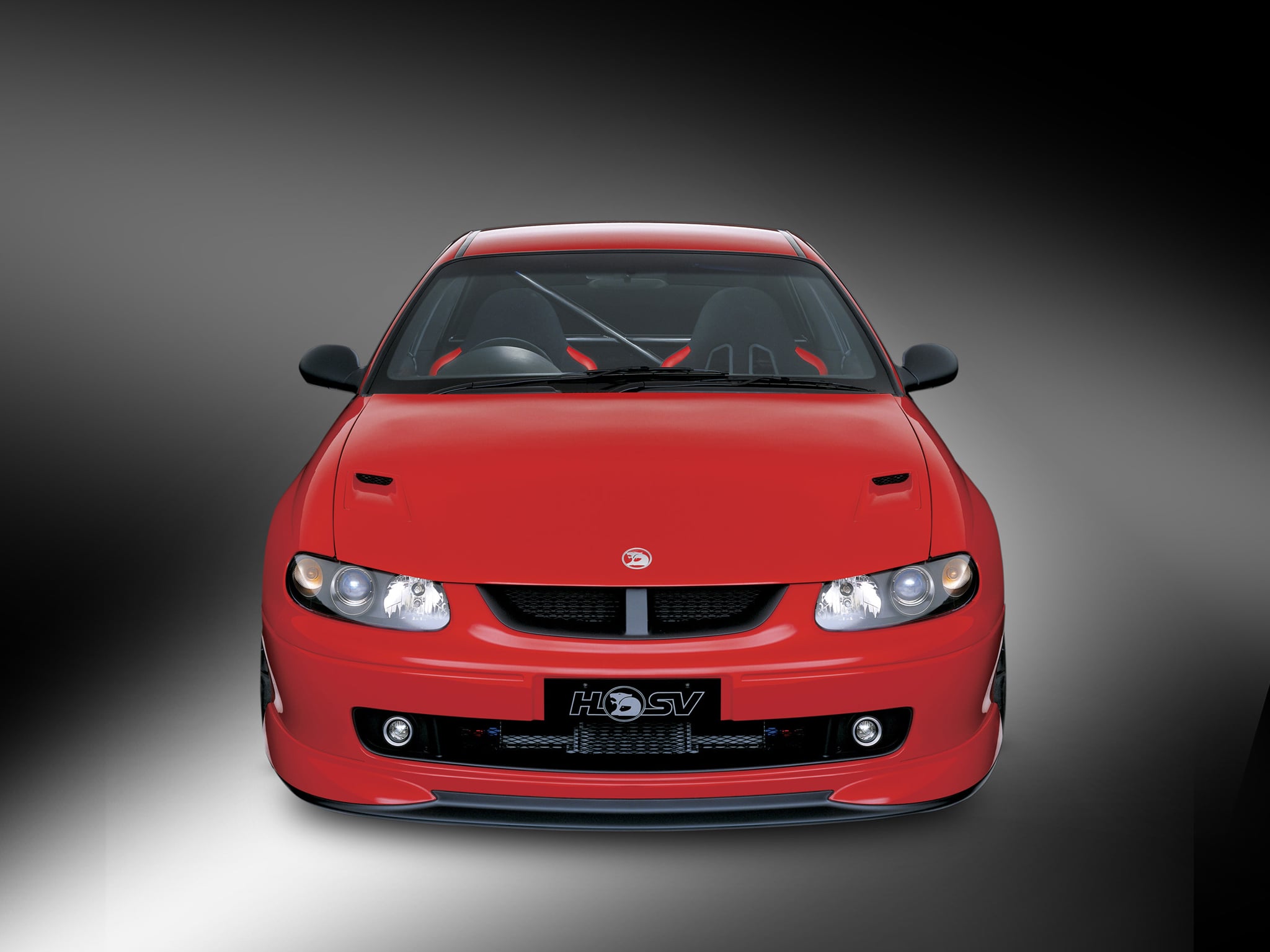
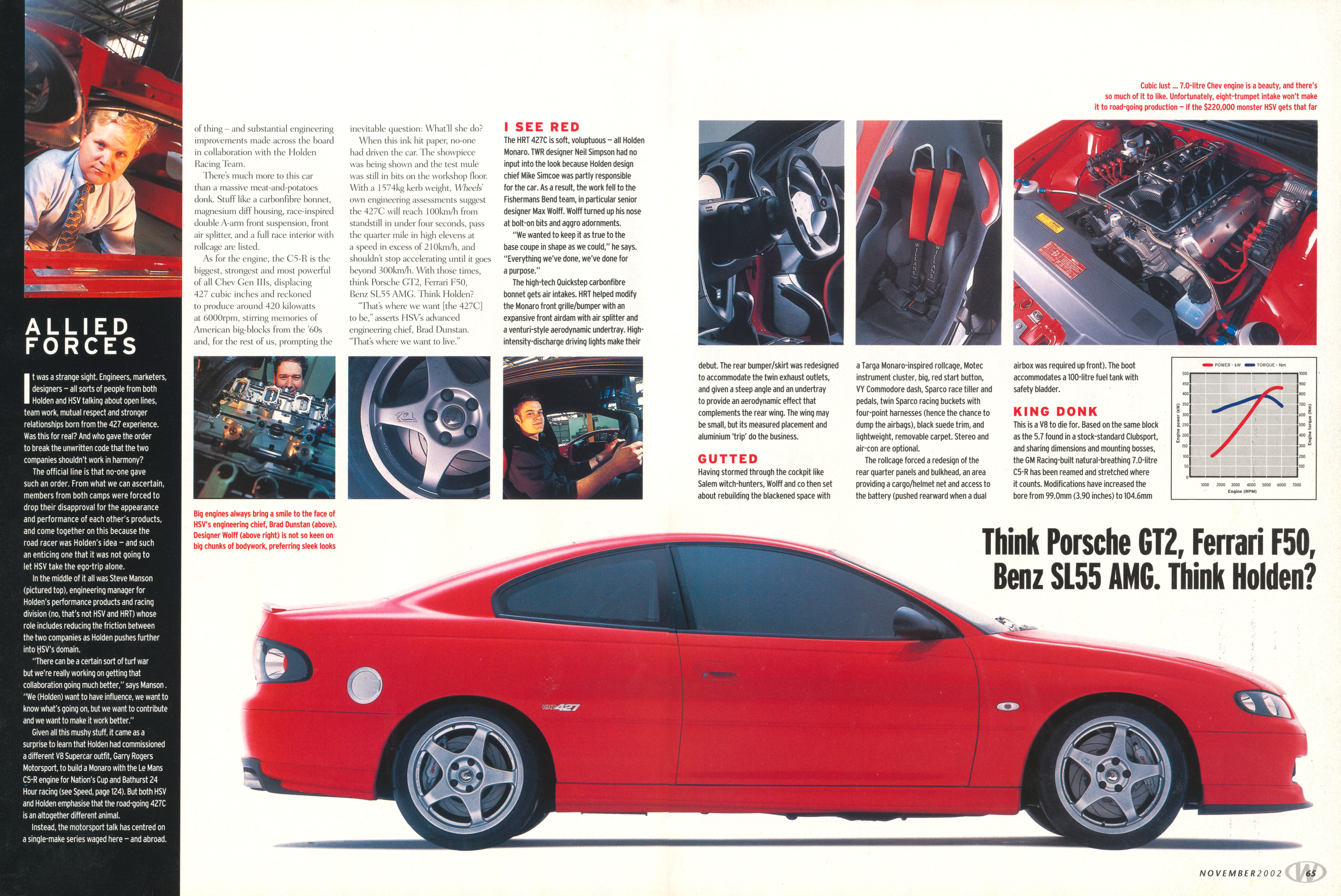
The HRT 427C is soft, voluptuous – all Holden Monaro. TWR designer Neil Simpson had no input into the look because Holden design chief Mike Simcoe was partly responsible for the car. As a result, the work fell to the Fishermans Bend team, in particular senior designer Max Wolff. Wolff turned up his nose at bolt-on bits and aggro adornments.
“We wanted to keep it as true to the base coupe in shape as we could,” he says. “Everything we’ve done, we’ve done for a purpose.”
The high-tech Quickstep carbonfibre bonnet gets air intakes. HRT helped modify the Monaro front grille/bumper with an expansive front airdam with air splitter and a venturi-style aerodynamic undertray. High-intensity-discharge driving lights make their debut. The rear bumper/skirt was redesigned to accommodate the twin exhaust outlets, and given a steep angle and an undertray to provide an aerodynamic effect that complements the rear wing. The wing may be small, but its measured placement and aluminium ‘trip’ do the business.
1
GUTTED
Having stormed through the cockpit like Salem witch-hunters, Wolff and co then set about rebuilding the blackened space with a Targa Monaro-inspired rollcage, Motec instrument cluster, big, red start button, VY Commodore dash, Sparco race tiller and pedals, twin Sparco racing buckets with four-point harnesses (hence the chance to dump the airbags), black suede trim, and lightweight, removable carpet. Stereo and air-con are optional.
The rollcage forced a redesign of the rear quarter panels and bulkhead, an area providing a cargo/helmet net and access to the battery (pushed rearward when a dual airbox was required up front). The boot accommodates a 100-litre fuel tank with safety bladder.
1
KING DONK
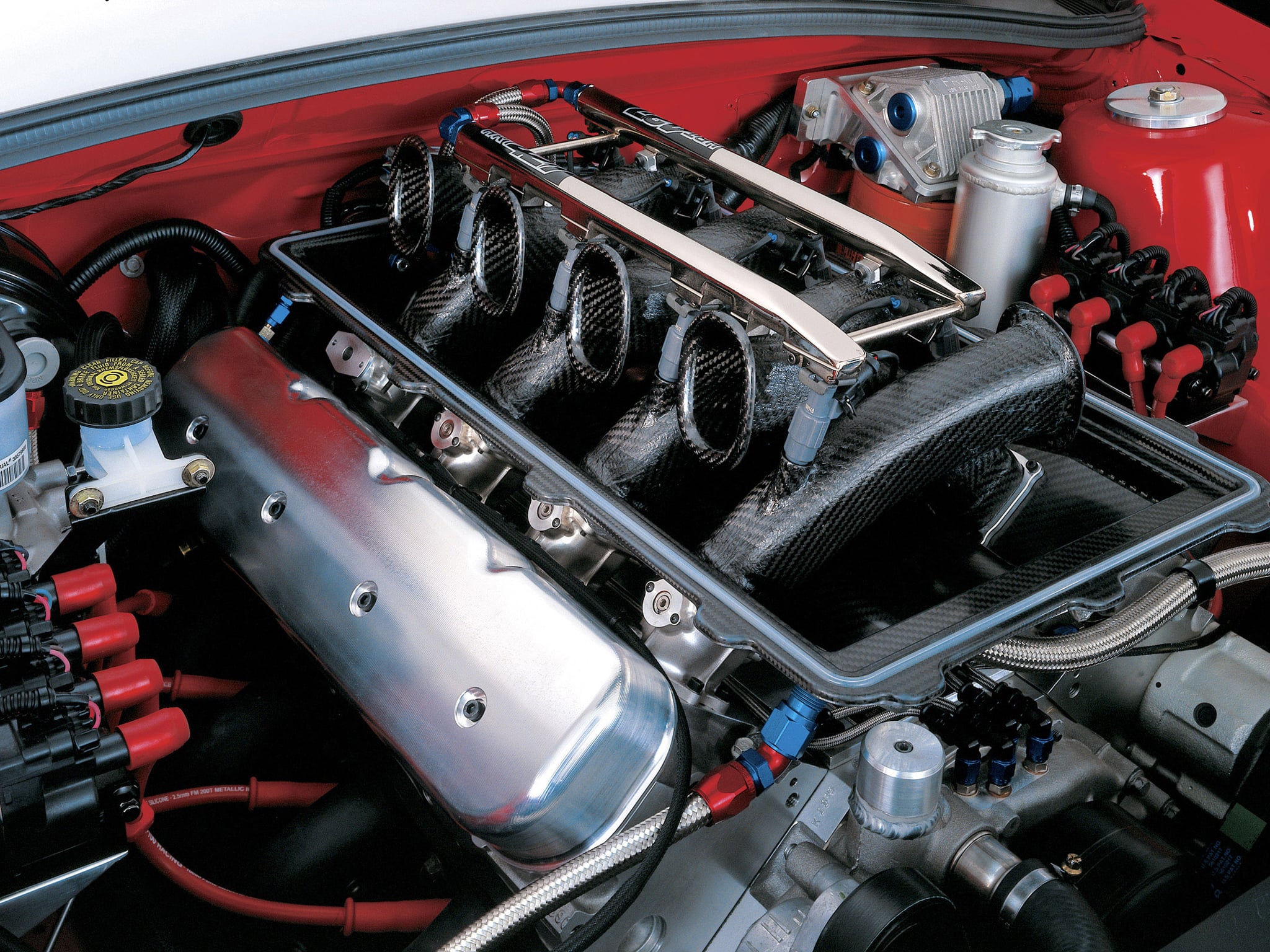
This is a V8 to die for. Based on the same block as the 5.7 found in a stock-standard Clubsport, and sharing dimensions and mounting bosses, the GM Racing-built natural-breathing 7.0-litre C5-R has been reamed and stretched where it counts. Modifications have increased the bore from 99.0mm (3.90 inches) to 104.6mm (4.12in), while the stroke is set at 101.6mm (4.0in), up from 92.0mm (3.60in).
Other impressive bits about the block include its higher-grade aluminium, removable cylinder sleeves, billet-steel main bearing caps, and, for added strength, stud-mounted cylinder heads. The latter are CNC-machined aluminium, designed to cope with the increased airflow stemming from the bigger displacement and higher operating speed. The eight individual throttle bodies with trumpets look a treat, though come production they would be substituted for an LS6 manifold – as seen on the Corvette Z06 coupe – to pass emission regs.
Word is that the dry-sump V8 will produce near-on 420kW at 6000rpm (redline is 6400rpm) and a stomach-churning 780Nm at 4800rpm. A cheaper, alternative power source would be the long anticipated 6.2-litre V8 – though now we’ve eyeballed the C5-R, it would be cruel to see it go.
1
TRANSMISSION
The 427’s six-speed manual might be a T56, but this is no run-of-the-mill Tremec. Known as the M12, the gearbox uses the Corvette Z06’s ratios and triple-cone synchronisers on first and second (doubles are used on third to sixth). With the 4.11:1 diff, the engineers are running a stress-resistant nine-inch gear, set in a lightweight magnesium housing. A single-plate clutch, rated to 900Nm, was chosen ahead of double-plate options, and the driveshaft was found out the back at HRT – it’s the same one used in the race team’s V8 Supercars.
SUSPENSION
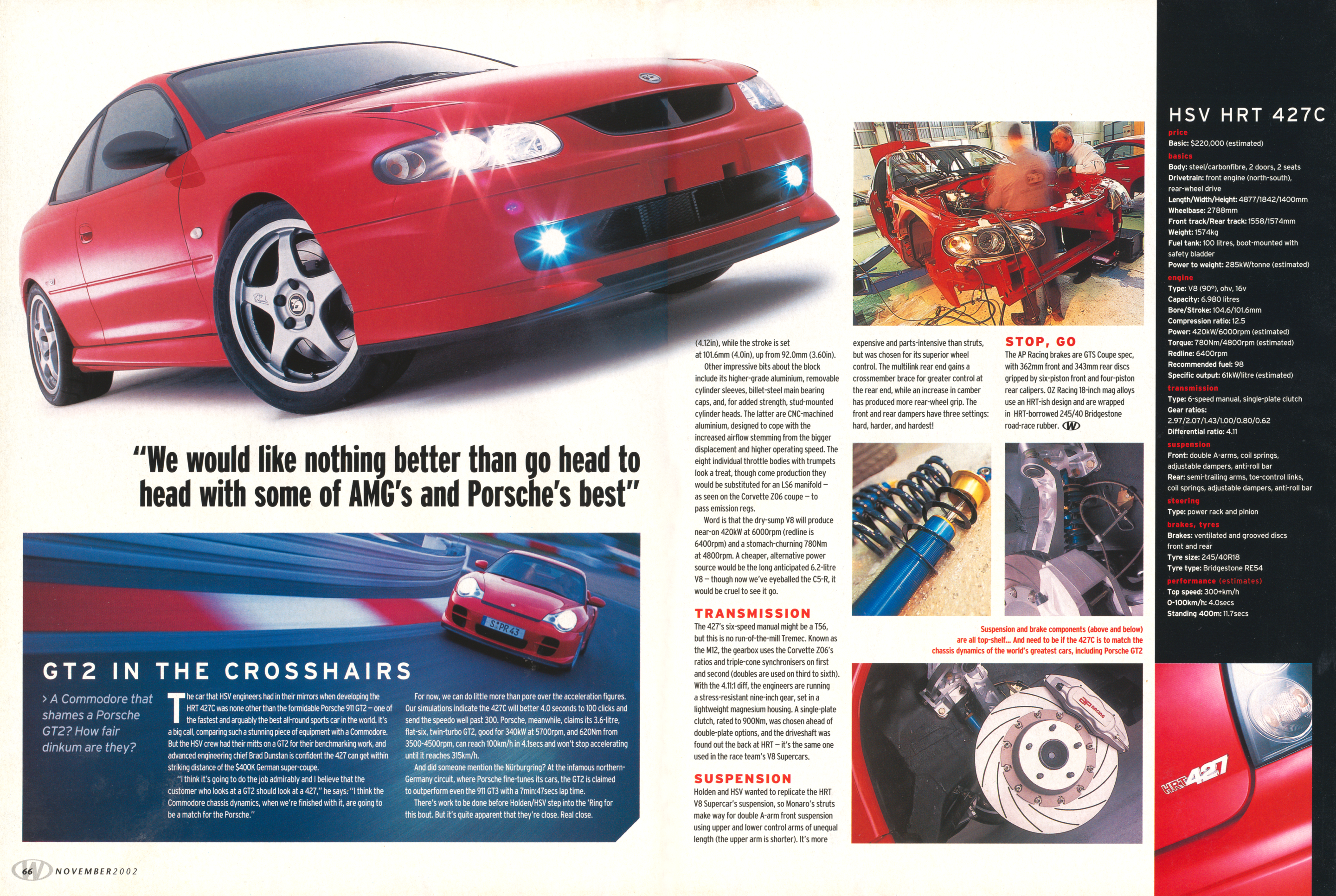
Holden and HSV wanted to replicate the HRT V8 Supercar’s suspension, so the Monaro’s struts make way for double A-arm front suspension using upper and lower control arms of unequal length (the upper arm is shorter). It’s more expensive and parts-intensive than struts, but was chosen for its superior wheel control. The multilink rear end gains a crossmember brace for greater control at the rear end, while an increase in camber has produced more rear-wheel grip. The front and rear dampers have three settings: hard, harder, and hardest!
4
STOP, GO
The AP Racing brakes are GTS Coupe spec, with 362mm front and 343mm rear discs gripped by six-piston front and four-piston rear calipers. OZ Racing l8-inch mag alloys use an HRT-ish design and are wrapped in HRT-borrowed 245/40 Bridgestone road-race rubber.
GT2 IN THE CROSSHAIRS
The car that HSV engineers had in their mirrors when developing the HRT 427C was none other than the formidable Porsche 911 GT2 – one of the fastest and arguably the best all-round sports car in the world. It’s a big call, comparing such a stunning piece of equipment with a Commodore. But the HSV crew had their mitts on a GT2 for their benchmarking work, and advance engineering chief Brad Dunstan is confident the 427 can get within striking distance of the $400K German super-coupe.
“I think it’s going to do the job admirably and I believe that the customer who looks at a GT2 should look at a 427,” he says. “I think the Commodore chassis dynamics, when we’re finished with it, are going to be a match for the Porsche.
For now, we can do little more than pore over the acceleration figures. Our simulations indicate that the 427C will better 4.0 seconds to 100 clicks and send the speedo well past 300. Porsche, meanwhile, claims its 3.6-litre, flat-six, twin-turbo GT2, good for 340kW at 5700rpm, and 620Nm from 3500-4500rpm, can reach 100km/h in 4.1 secs and won’t stop accelerating until it reaches 315km/h.
And did someone mention the Nürburgring? At the infamous northern-Germany circuit, where Porsche fine-tunes its cars, the GT2 is claimed to outperform even the 911 GT3 with a 7min:47secs lap time.
There’s work to be done before the Holden/HSV steps into the ’Ring for this bout. But it’s quite apparent that they’re close. Real close.
Follow WhichCar/Wheels on Google
Click the button below to make WhichCar by Wheels a preferred source for your news.

We recommend
-
 News
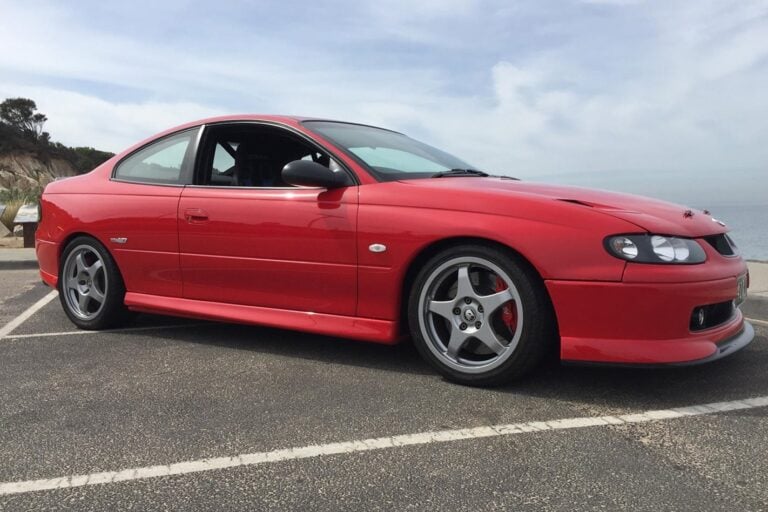
NewsOne-off HSV HRT 427 Monaro hits the market for $750K
Want to own a mega-rare piece of Australian motoring history? You’d better have deep pockets…
-
 News
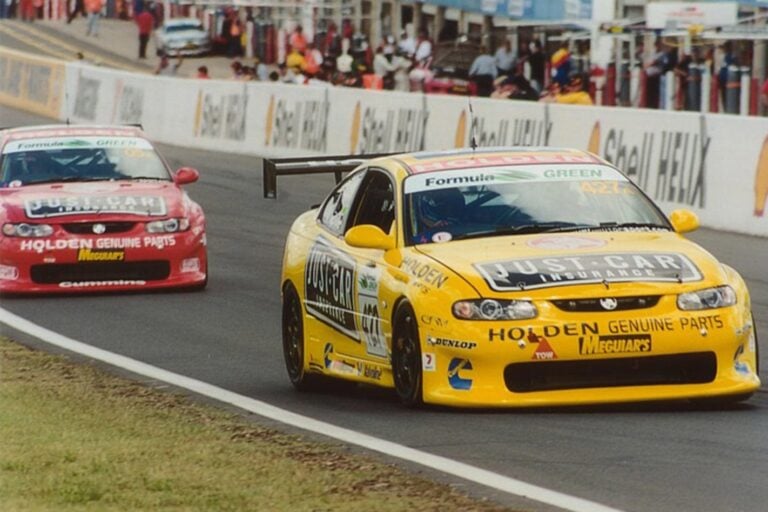
NewsThe last Aussie-built Monaro: Garry Rogers' final Holden Monaro 427C
Retired racer will build ‘the last Aussie Holden’ to celebrate a golden era of racing