
Classic Wheels

Gallery 1
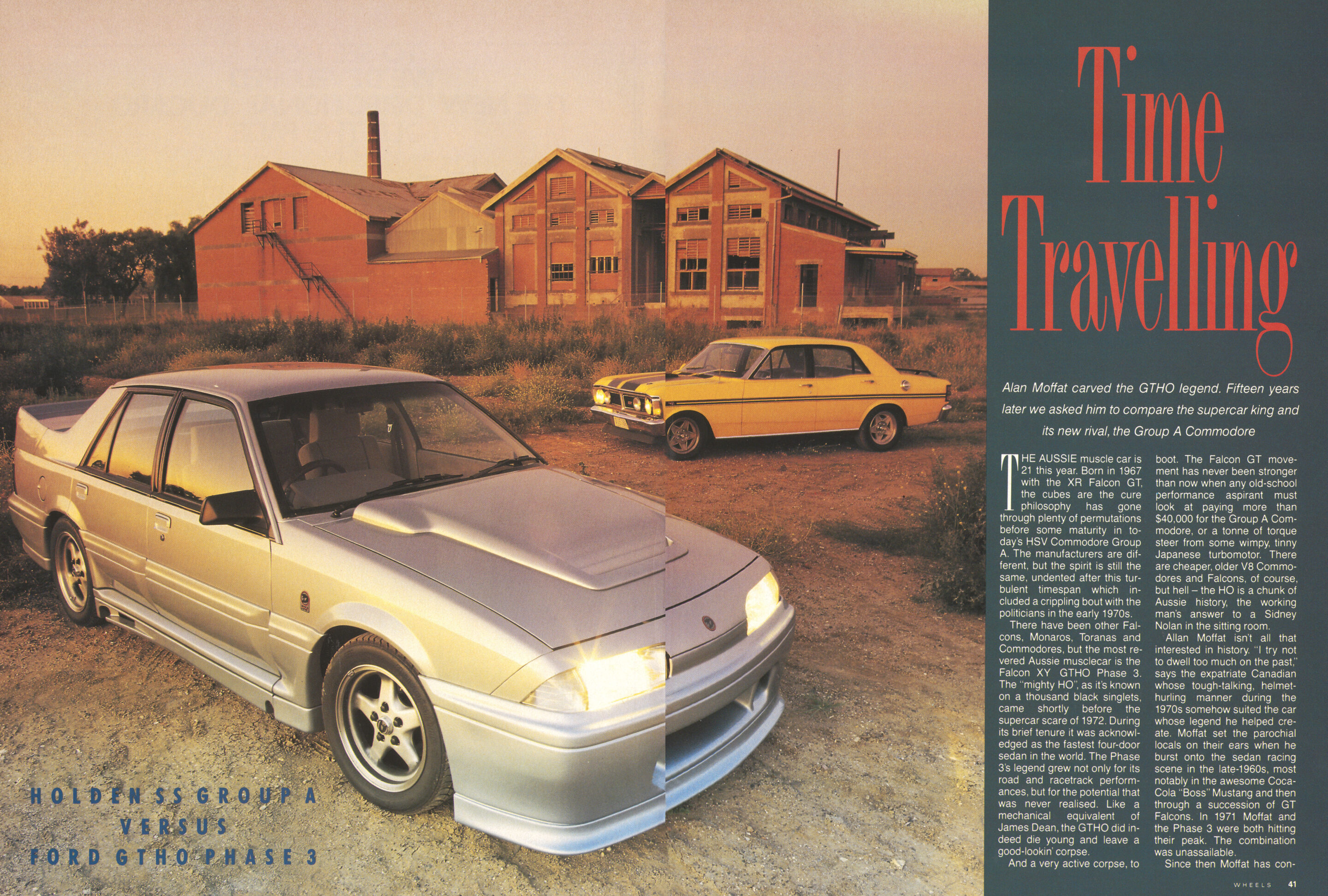
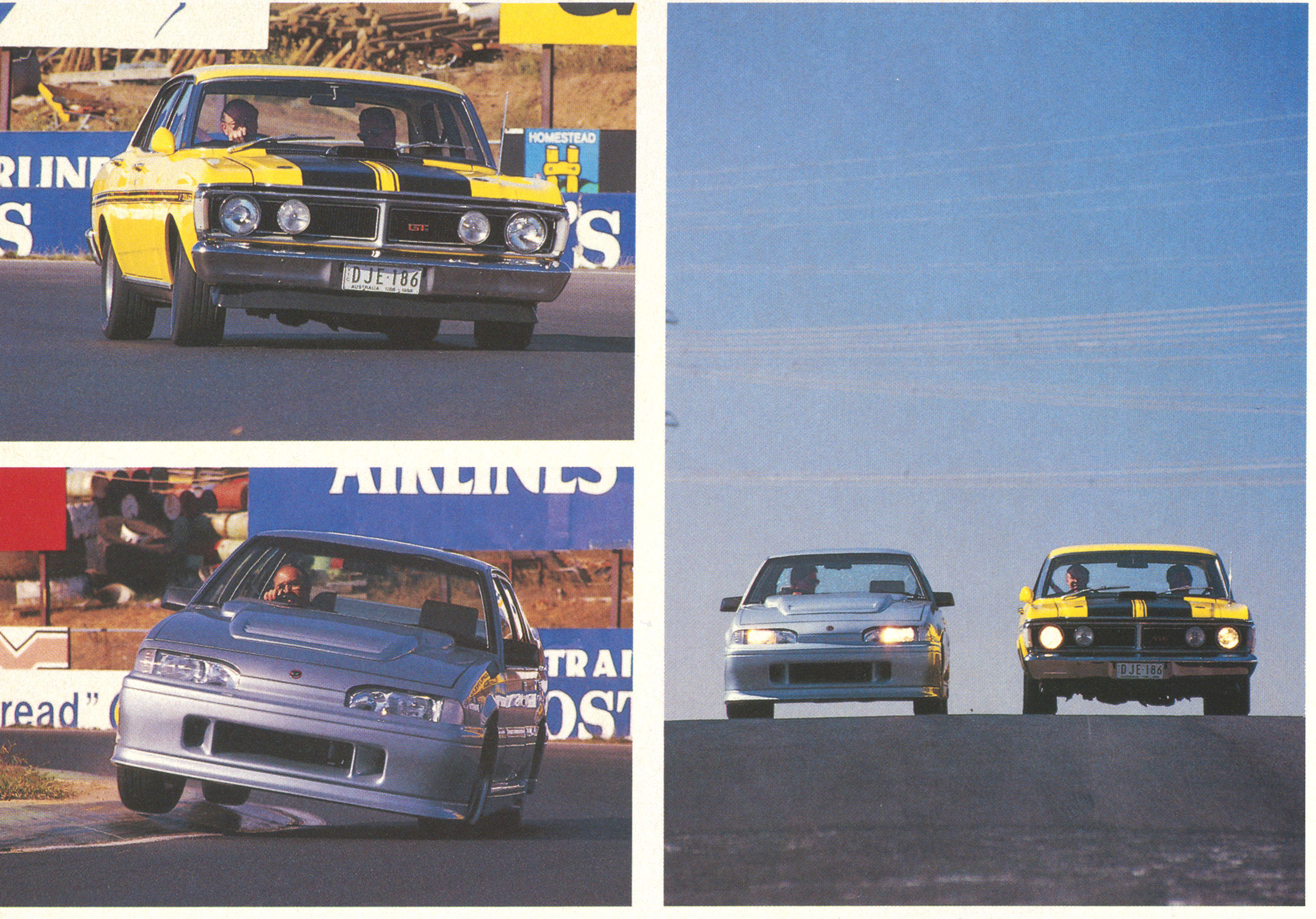
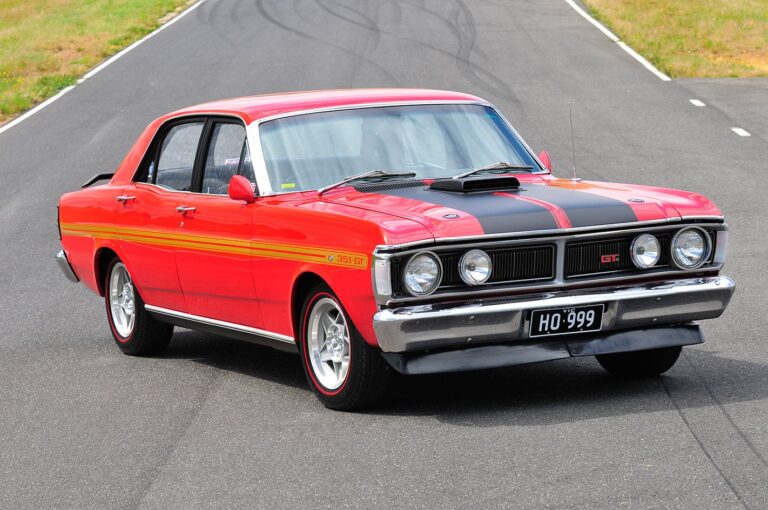
The Ford Falcon GTHO Phase III is the undisputed icon of Aussie muscle cars. It faced off with a far younger challenger in the form of the Group A in 1988, and both were in very sure hands…
First published in the April 1988 issue of Wheels magazine, Australia’s best car mag since 1953. Subscribe here and gain access to 12 issues for $109 plus online access to every Wheels issue since 1953.
The Aussie muscle car is 21 this year. Born in 1967 with the XR Falcon GT, the cubes are the cure philosophy has gone through plenty of permutations before some maturity in today’s HSV Commodore Group A. The manufacturers are different, but the spirit is still the same, undented after this turbulent timespan which included a crippling bout with the politicians in the early 1970s.
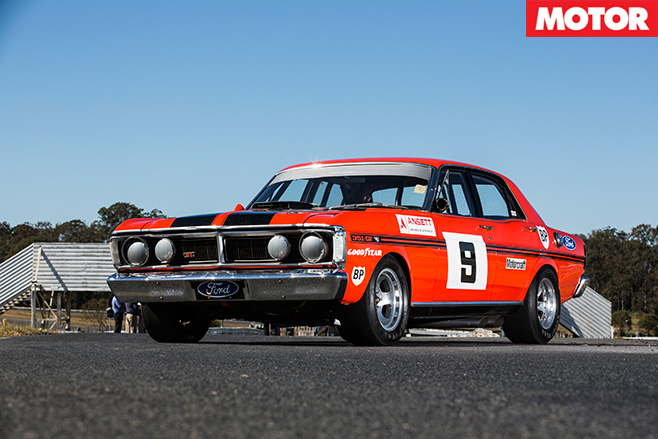
There have been other Falcons, Monaros, Toranas and Commodores, but the most revered Aussie musclecar is the Falcon XY GTHO Phase 3. The “mighty HO”, as it’s known on a thousand black singlets, came shortly before the supercar scare of 1972. During its brief tenure it was acknowledged as the fastest four-door sedan in the world. The Phase 3’s legend grew not only for its road and and racetrack performances, but for the potential that was never realised. Like a mechanical equivalent of James Dean, the GTHO did indeed die young and leave a good-lookin’ corpse.
3
And a very active corpse, to boot. The Falcon GT movement has never been stronger than now when any old-school performance aspirant must look at paying more than $40,000 for the Group A Commodore, or a tonne of torque steer from some wimpy, tinny Japanese turbomotor. There are cheaper, older V8 Commodores and Falcons, of course, but hell – the HO is a chunk of Aussie history, the working man’s answer to a Sidney Nolan in the sitting room.
Allan Moffat isn’t all that interested in history. “I try not to dwell too much on the past,” says the expatriate Canadian whose tough-talking, helmet-hurling manner during the 1970s somehow suited the car whose legend he helped create. Moffat set the parochial locals on their ears when he burst onto the sedan racing scene in the late-1960s, most notably in the awesome Coca-Cola “Boss” Mustang and then through a succession of GT Falcons. In 1971 Moffat and the Phase three were both hitting their peak. The combination was unassailable.
Since then Moffat has continued along his controversial path by adopting the Mazda RX7 and whipping it into a race winner; then further shocking his former Ford fans by signing to drive the Group A Commodores, firstly with and then without Peter Brock. Moff and Toff had races to win and, like the man said, he tries not to dwell on the past.
We invited him to drive the HSV Group A back-to-back with a healthy example of the Phase 3 HO. We figured Moff was the man to comment on both generations of supercar; after all, his prime years have spanned those of the Aussie muscle car’s existence.
The Main Man responded that it might be interesting to drive a GTHO; Jeez, it’d been 15 years since Moffat last had a steer in one. Not raced. Just drove. Mott hadn’t set foot near a HO since 73. Sentiment dies real young in Saskatchewan.
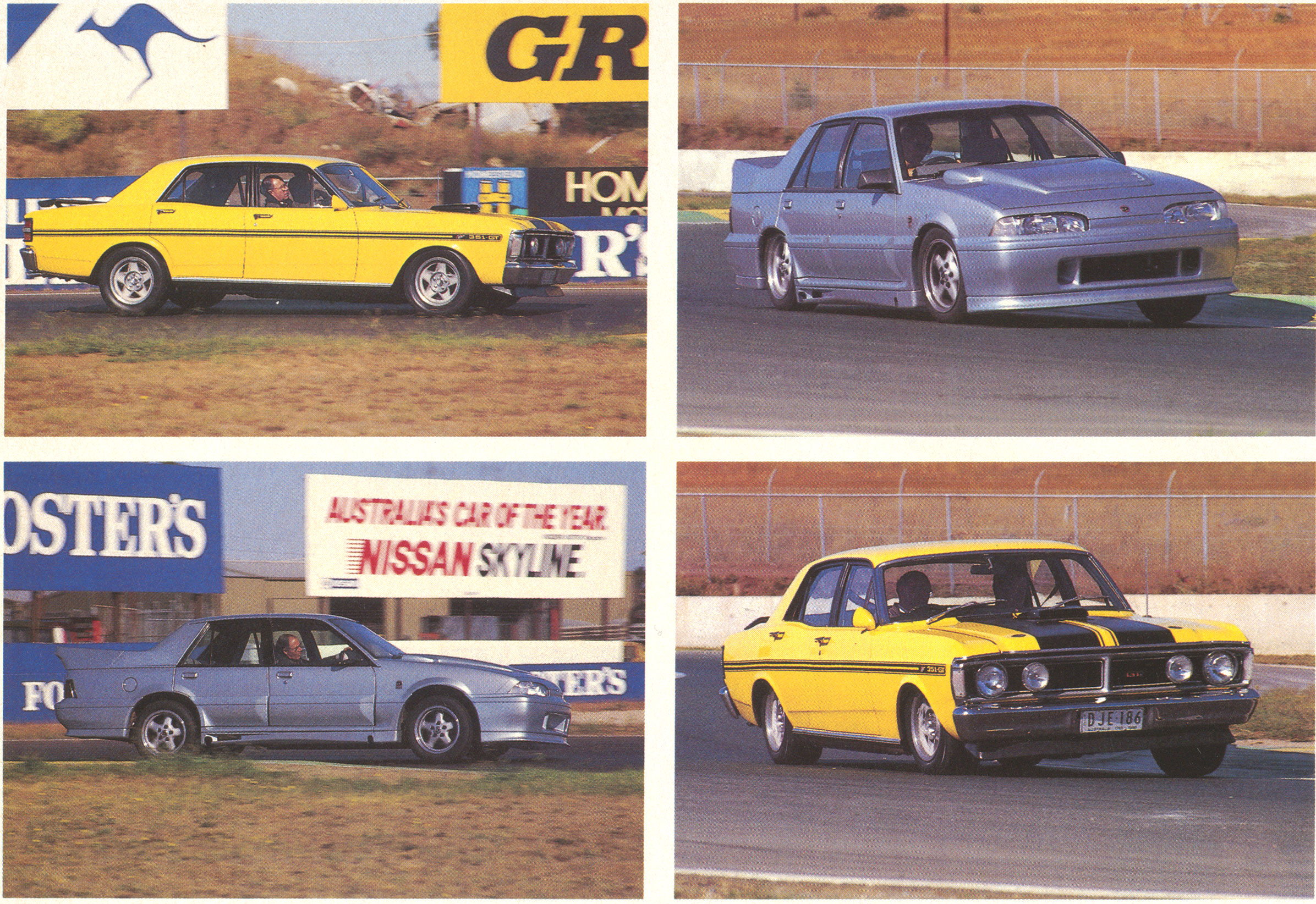
It was no big deal. Moffat hadn’t driven the new Group A, either. Moffat, the man who run and won in both the GTHO Phase 3 and, 14 years later, the Commodore Group A at Spa, reinforced his impartiality by arriving at the circuit driving a delivery van. Not the flashest of weapons lying around at his Toorak headquarters, but the local lads who had clustered around the Shell yellow Phase 3 still responded as though Moffat had stepped into a 17-Year timewarp and onto the HardieFerodo podium. Notepads, business cards, the guts of a cigarette packet were thrust under Moffat’s nose. “It’s for my sister, Mr Moffat. Uh, her name’s Dave.”
2
The most vocal Phase 3 fans are usually those who either weren’t around or were only in nappies during the car’s heyday. Many of them, reared on a diet of Cortinas and XE Fairmonts, would never have had the instant automotive history lesson that the XY taught.
They would have crawled into the GTHO Phase 3 and noticed the two big dials surrounded by fake chrome and fake woodgrain; the tacho on the left prescribing a seemingly impossible redline of 6000 rpm and the speedo on the right an equally suicidal top speed of 140 mph. They would have marvelled at ergonomics apparently designed around contemporary cultural representatives like Skull Murphy, Killer Karl Kowalski and Big Artie Beetson. And they would then have appreciated the intended physique of those who were required to use the Phase 3’s clutch pedal two dozen times a lap at Bathurst while also summoning strength – both physical and spiritual – to their right leg at the end of Conrod Straight every three minutes.
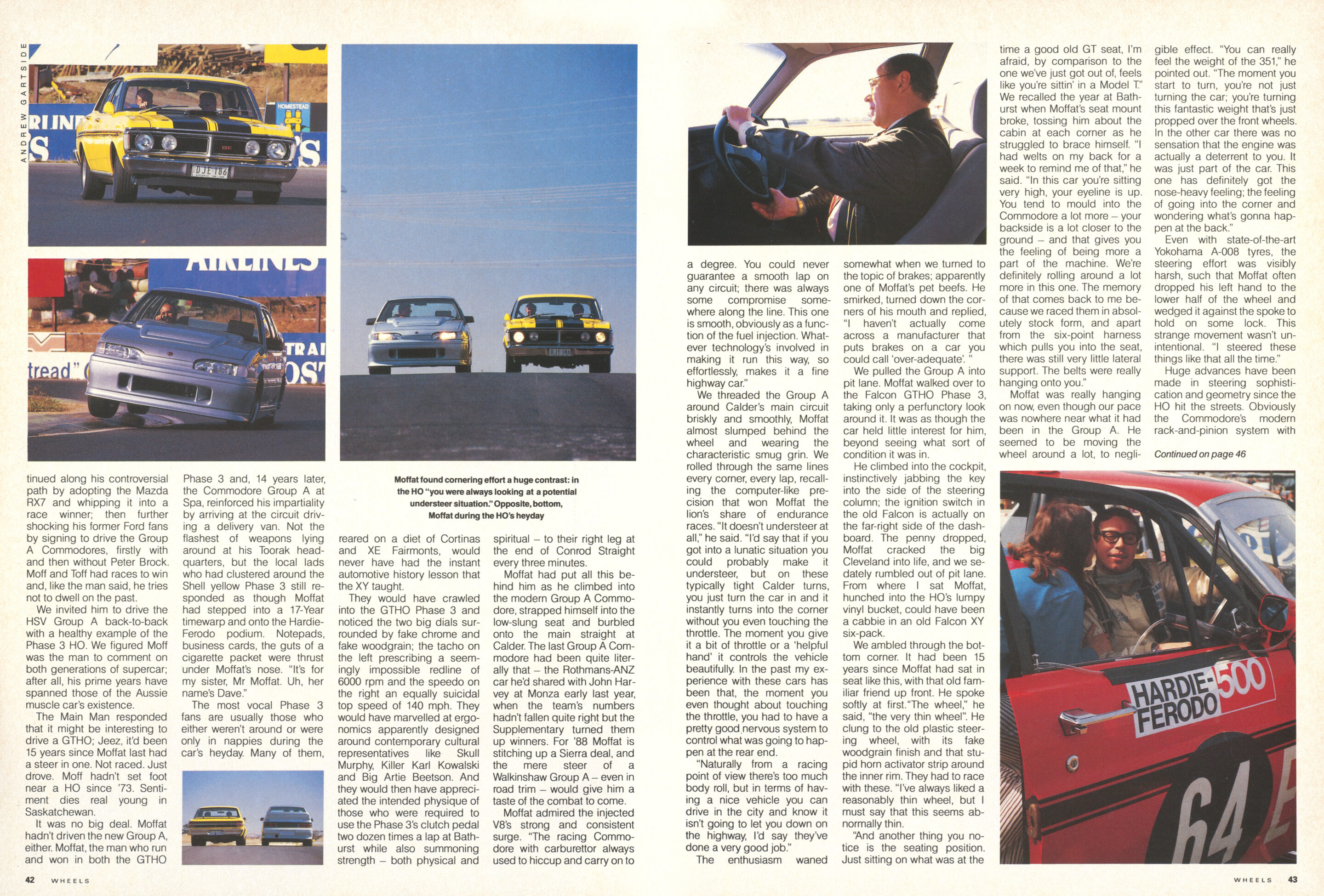
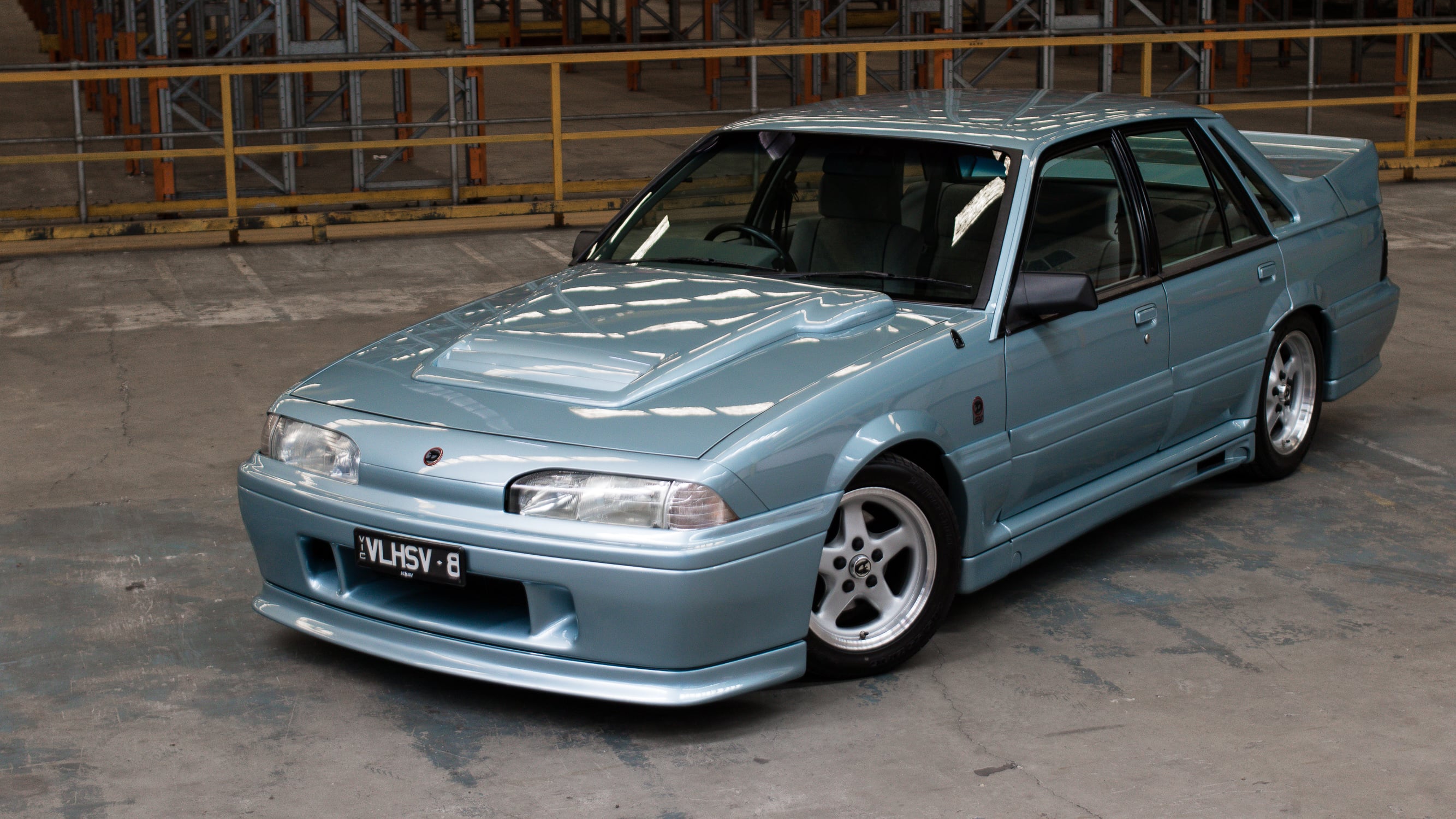
Moffat had put all this behind him as he climbed into the modern Group A Commodore, strapped himself into the low-slung seat and burbled onto the main straight at Calder. The last Group A Commodore had been quite literally that – the Rothmans-ANZ car he’d shared with John Harvey at Monza early last year, when the team’s numbers hadn’t fallen quite right but the Supplementary turned them up winners. For ’88 Moffat is stitching up a Sierra deal, and the mere steer of a Walkinshaw Group A – even in road trim – would give him a taste of the combat to come.
2
Moffat admired the injected V8’s strong and consistent surge. “The racing Commodore with carburettor always used to hiccup and carry on to a degree. You could never guarantee a smooth lap on any circuit; there was always some compromise somewhere along the line. This one is smooth, obviously as a function of the fuel injection. Whatever technology’s involved in making it run this way, so effortlessly, makes it a fine highway car.”
We threaded the Group A around Calder’s main circuit briskly and smoothly, Moffat almost slumped behind the wheel and wearing the characteristic smug grin. We rolled through the same lines every corner, every lap, recalling the computer-like precision that won Moffat the lion’s share of endurance races. “It doesn’t understeer at all,” he said. ”I’d say that if you got into a lunatic situation you could probably make it understeer, but on these typically tight Calder turns, you just turn the car in and it instantly turns into the corner without you even touching the throttle. The moment you give it a bit of throttle or a ‘helpful hand’ it controls the vehicle beautifully. In the past my experience with these cars has been that, the moment you even thought about touching the throttle, you had to have a pretty good nervous system to control what was going to happen at the rear end.
“Naturally from a racing point of view there’s too much body roll, but in terms of having a nice vehicle you can drive in the city and know it isn’t going to let you down on the highway, I’d say they’ve done a very good job.”
The enthusiasm waned somewhat when we turned to the topic of brakes; apparently one of Moffat’s pet beefs. He smirked, turned down the corners of his mouth and replied, “I haven’t actually come across a manufacturer that puts brakes on a car you could call ‘over-adequate’.”
3
We pulled the Group A into pit lane. Moffat walked over to the Falcon GTHO Phase 3, taking only a perfunctory look around it. It was as though the car held little interest for him, beyond seeing what sort of condition it was in.
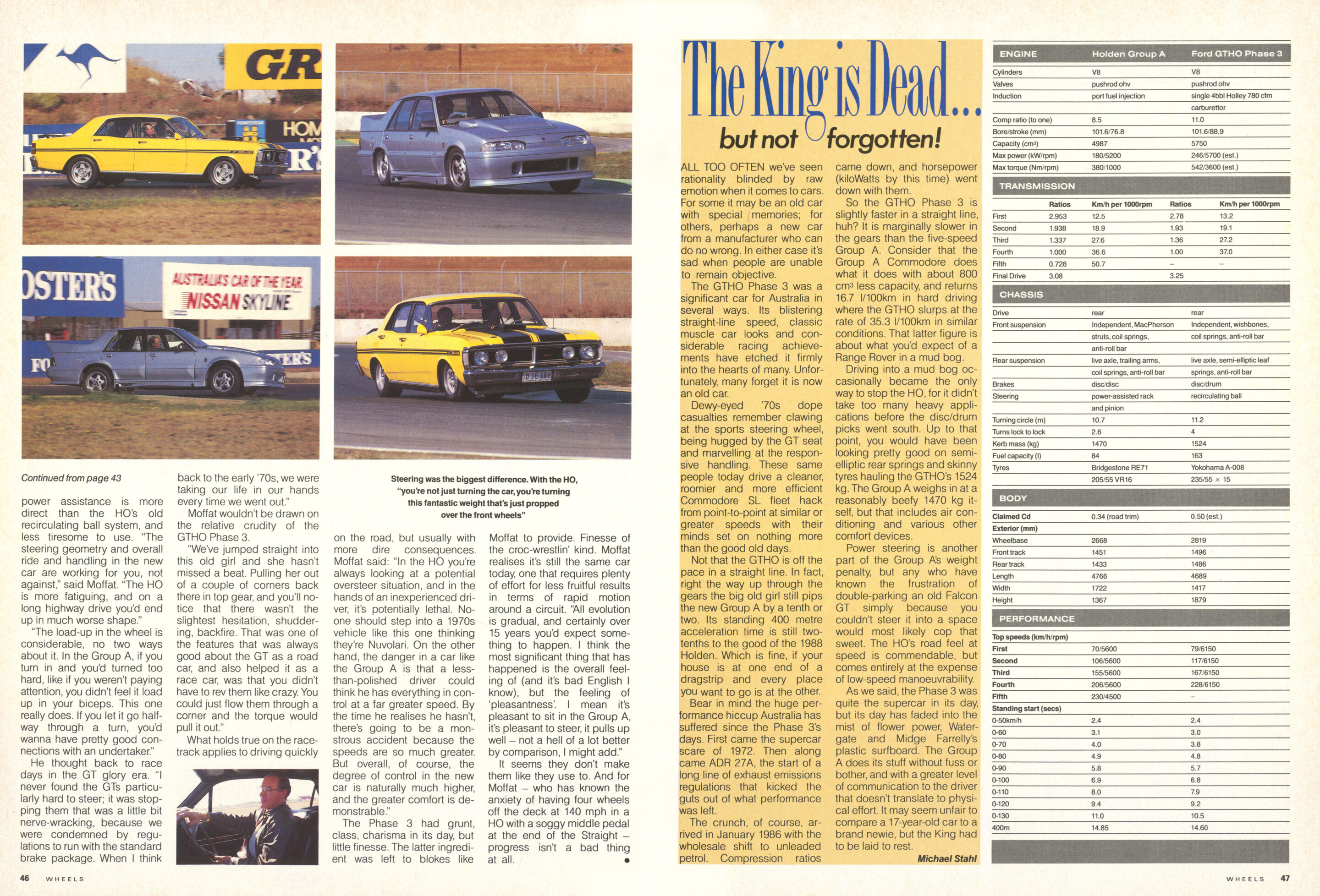
He climbed into the cockpit, instinctively jabbing the key into the side of the steering column; the ignition switch in the old Falcon is actually on the far-right side of the dashboard. The penny dropped, Moffat cracked the big Cleveland into life, and we sedately rumbled out of pit lane. From where I sat Moffat, hunched into the HO’s lumpy vinyl bucket, could have been a cabbie in an old Falcon XY six-pack.
We ambled through the bottom corner. It had been 15 years since Moffat had sat in a seat like this, with that old familiar friend up front. He spoke softly at first. “The wheel,” he said, “the very thin wheel”. He clung to the old plastic steering wheel, with its fake woodgrain finish and that stupid horn activator strip around the inner rim. They had to race with these. “I’ve always liked a reasonably thin wheel, but I must say that this seems abnormally thin.
“And another thing you notice is the seating position. Just sitting on what was at the time a good old GT seat, I’m afraid, by comparison to the one we’ve just got out of, feels like you’re sittin’ in a Model T.” We recalled the year at Bathurst when Moffat’s seat mount broke, tossing him about the cabin at each corner as he struggled to brace himself. “I had welts on my back for a week to remind me of that,” he said. “In this car you’re sitting very high, your eyeline is up. You tend to mould into the Commodore a lot more – your backside is a lot closer to the ground – and that gives you the feeling of being more a part of the machine. We’re definitely rolling around a lot more in this one. The memory of that comes back to me because we raced them in absolutely stock form, and apart from the six-point harness which pulls you into the seat, there was still very little lateral support. The belts were really hanging onto you.”
Moffat was really hanging on now, even though our pace was nowhere near what it had been in the Group A. He seemed to be moving the wheel around a lot, to negligible effect. “You can really feel the weight of the 351,” he pointed out. “The moment you start to turn, you’re not just turning the car; you’re turning this fantastic weight that’s just propped over the front wheels. In the other car there was no sensation that the engine was actually a deterrent to you. It was just part of the car. This one has definitely got the nose-heavy feeling; the feeling of going into the corner and wondering what’s gonna happen at the back.”
3
Even with state-of-the-art Yokohama A-008 tyres, the steering effort was visibly harsh, such that Moffat often dropped his left hand to the lower half of the wheel and wedged it against the spoke to hold on some lock. This strange movement wasn’t unintentional.”I steered these things like that all the time.”
Huge advances have been made in steering sophistication and geometry since the HO hit the streets. Obviously the Commodore’s modern rack-and-pinion system with power assistance is more direct than the HO’s old recirculating ball system, and less tiresome to use. “The steering geometry and overall ride and handling in the new car are working for you, not against,” said Moffat. ”The HO is more fatiguing, and on a long highway drive you’d end up in much worse shape.
“The load-up in the wheel is considerable, no two ways about it. In the Group A, if you turn in and you’d turned too hard, like if you weren’t paying attention, you didn’t feel it load up in your biceps. This one really does. If you let it go halfway through a turn, you’d wanna have pretty good connections with an undertaker.”
He thought back to race days in the GT glory era. “I never found the GTs particularly hard to steer; it was stopping them that was a little bit nerve-wracking, because we were condemned by regulations to run with the standard brake package. When I think back to the early ’70s, we were taking our life in our hands every time we went out.”
Moffat wouldn’t be drawn on the relative crudity of the GTHO Phase 3.
“We’ve jumped straight into this old girl and she hasn’t missed a beat. Pulling her out of a couple of corners back there in top gear, and you’ll notice that there wasn’t the slightest hesitation, shuddering, backfire. That was one of the features that was always good about the GT as a road car, and also helped it as a race car, was that you didn’t have to rev them like crazy. You could just flow them through a corner and the torque would pull it out.”
What holds true on the racetrack applies to driving quickly on the road, but usually with more dire consequences. Moffat said: “In the HO you’re always looking at a potential oversteer situation, and in the hands of an inexperienced driver, it’s potentially lethal. No one should step into a 1970s vehicle like this one thinking they’re Nuvolari. On the other hand, the danger in a car like the Group A is that a less-than-polished driver could think he has everything in control at a far greater speed. By the time he realises he hasn’t, there’s going to be a monstrous accident because the speeds are so much greater. But overall, of course, the degree of control in the new car is naturally much higher, and the greater comfort is demonstrable.”
5
The Phase 3 had grunt, class, charisma in its day, but little finesse. The latter ingredient was left to blokes like Moffat to provide. Finesse of the croc-wrestlin’ kind. Moffat realises it’s still the same car today, one that requires plenty of effort for less fruitful results in terms of rapid motion around a circuit. “AII evolution is gradual, and certainly over 15 years you’d expect something to happen. I think the most significant thing that has happened is the overall feeling of (and it’s bad English I know), but the feeling of ‘pleasantness’. I mean it’s pleasant to sit in the Group A, it’s pleasant to steer, it pulls up well – not a hell of a lot better by comparison, I might add.”
It seems they don’t make them like they used to. And for Moffat – who has known the anxiety of having four wheels off the deck at 140 mph in an HO with a soggy middle pedal at the end of the Straight – progress isn’t a bad thing at all.
The King is Dead… but not forgotten!
All too often we’ve seen rationality blinded by raw emotion when it comes to cars. For some it may be an old car with special memories; for others, perhaps a new car from a manufacturer who can do no wrong. In either case it’s sad when people are unable to remain objective.
The GTHO Phase 3 was a significant car for Australia in several ways. Its blistering straight-line speed, classic muscle car looks and considerable racing achievements have etched it firmly into the hearts of many. Unfortunately, many forget it is now an old car.
Dewy-eyed ’70s dope casualties remember clawing at the sports steering wheel, being hugged by the GT seat and marvelling at the responsive handling. These same people today drive a cleaner, roomier and more efficient Commodore SL fleet hack from point-to-point at similar or greater speeds with their minds set on nothing more than the good old days.
Not that the GTHO is off the pace in a straight line. In fact, right the way up through the gears the big old girl still pips the new Group A by a tenth or two. Its standing 400 metre acceleration time is still two-tenths to the good of the 1988 Holden. Which is fine, if your house is at one end of a dragstrip and every place you want to go is at the other.
Bear in mind the huge performance hiccup Australia has suffered since the Phase 3’s days. First came the supercar scare of 1972. Then along came ADR 27 A, the start of a long line of exhaust emissions regulations that kicked the guts out of what performance was left.
4
The crunch, of course, arrived in January 1986 with the wholesale shift to unleaded petrol. Compression ratios came down, and horsepower (kiloWatts by this time) went down with them.
So the GTHO Phase 3 is slightly faster in a straight line, huh? It is marginally slower in the gears than the five-speed Group A. Consider that the Group A Commodore does what it does with about 800cm3 less capacity, and returns 16.7L/100km in hard driving where the GTHO slurps at the rate of 35.3L/100km in similar conditions. That latter figure is about what you’d expect of a Range Rover in a mud bog. Driving into a mud bog occasionally became the only way to stop the HO, for it didn’t take too many heavy applications before the disc/drum picks went south. Up to that point. you would have been looking pretty good on semielliptic rear springs and skinny tyres hauling the GTHO’s 1524 kg. The Group A weighs in at a reasonably beefy 1470 kg itself, but that includes air conditioning and various other comfort devices.
Power steering is another part of the Group A’s weight penalty, but any who have known the frustration of double-parking an old Falcon GT simply because you couldn’t steer it into a space would most likely cop that sweet. The HO’s road feel at speed is commendable, but comes entirely at the expense of low-speed manoeuvrability.
As we said, the Phase 3 was quite the supercar in its day, but its day has faded into the mist of flower power, Watergate and Midge Farrelly’s plastic surfboard. The Group A does its stuff without fuss or bother, and with a greater level of communication to the driver that doesn’t translate to physical effort. It may seem unfair to compare a 17-year-old car to a brand newie, but the King had to be laid to rest.
Follow WhichCar/Wheels on Google
Click the button below to make WhichCar by Wheels a preferred source for your news.

We recommend
-
 News
This 1971 Ford GTHO Phase III just sold for $350,000
An Aussie icon went under the hammer today but it fell well short of previous auction results
-
 Features
1971 Ford Falcon XY GT-HO Phase III: Quick History Lesson
Built to dominate Bathurst and demoralise Holden, for many the Phase III remains the greatest Australian car ever built
