
News
Gallery 1
Standing in an empty parking space to prevent another motorist from using it might seem like a clever way to secure a spot for a friend, but the practice could leave pedestrians facing a fine.
Transport for NSW has taken to Facebook to clarify the rules surrounding the controversial habit, warning that attempting to reserve a parking bay by physically occupying it can be both illegal and dangerous.
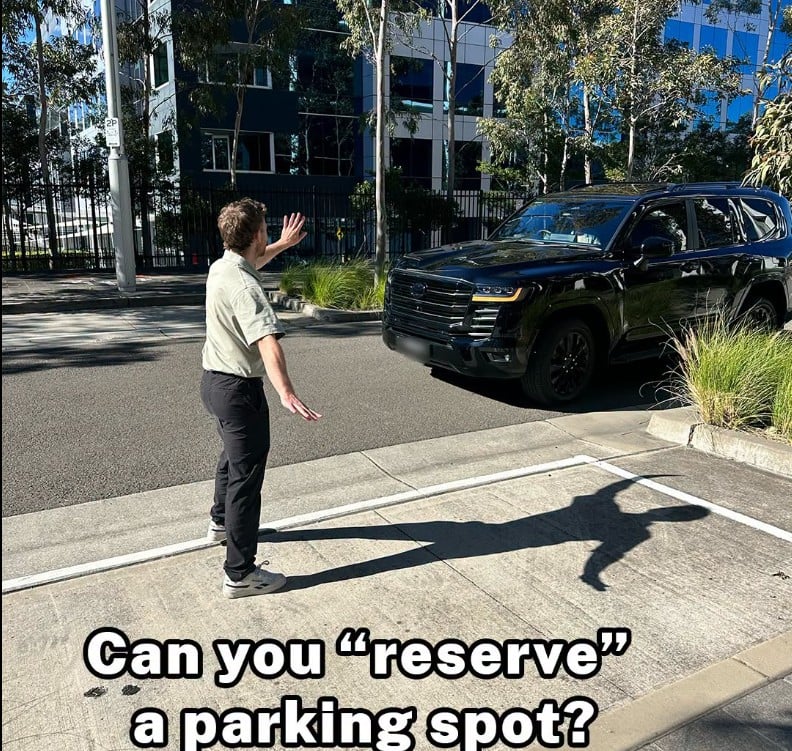
Accompanying an image of a man standing in an empty parking space as a vehicle approaches, the authority delivered a blunt message to motorists and pedestrians.
“Short answer is, no! You can’t ‘reserve’ or ‘mind’ a parking space for your mate,” Transport for NSW wrote.
The department explained that pedestrians who deliberately block vehicles from entering a parking space risk breaching road rules designed to prevent traffic hazards.
Under Rule 236 of the NSW Road Rules, pedestrians must not create a traffic hazard by stepping into a driver’s path or unreasonably obstructing the movement of motorists or other pedestrians.
1
Both offences can attract an infringement penalty of $94 in NSW.
The warning follows ongoing disputes over parking etiquette, particularly in busy shopping precincts, residential streets and other locations where available spaces can be difficult to find.
However, the rules do not mean that simply standing in an empty parking bay is automatically illegal. The critical issue is whether a pedestrian deliberately obstructs a driver or creates a traffic hazard.
Similar restrictions apply across Australia, although the penalties vary considerably between jurisdictions, reported Yahoo News.
In Victoria, the maximum penalty is $209, while Western Australia lists a $100 fine. Queensland’s infringement penalty is $69, compared with $63 in South Australia.
Tasmania imposes a $53.25 infringement penalty for unreasonably obstructing a driver, while the equivalent offence in the ACT attracts a $218 fine.
Although the precise wording and enforcement arrangements differ between states and territories, the underlying principle is consistent: pedestrians cannot deliberately interfere with traffic or place themselves in danger to secure a parking space.
Transport for NSW summed up the behaviour as a “dodgy move”, reminding pedestrians that saving a spot for a friend could ultimately prove more expensive than finding somewhere else to park.
Follow WhichCar/Wheels on Google
Click the button below to make WhichCar by Wheels a preferred source for your news.


We recommend
-
 News
NewsHow a very common car accessory can get you hit with a $420 fine and three demerit points
Aussies who park outside would be crazy not to use the solar screen accessory this summer – but it could also attract a shocking fine.
-
 News
NewsSeatbelt fines explode by almost 700 per cent in one Aussie state as AI cameras fuel rise across the country
New technology is filling government coffers at an incredible rate as seatbelt fines skyrocket.
