
Hydrogen power technology, and its green motoring prospects, have fallen by the wayside of late in the wake of lithium ion’s growing ‘alt-power’ prominence.
But fuel-cell tech is far from dead. A case in point is the A7 h-tron, Audi’s fourth generation of hydrogen-tech development. Audi’s latest zero emissions powertrain approach has turned away from more traditional liquid hydrogen methodology and towards compressed hydrogen.
And it’s no mere pipedream. During a recent trip to Ingolstadt, Audi flung us the key to one of its A7 h-tron prototypes – road-registered in its homeland – for a surprisingly brisk punt around the Deutsch countryside.
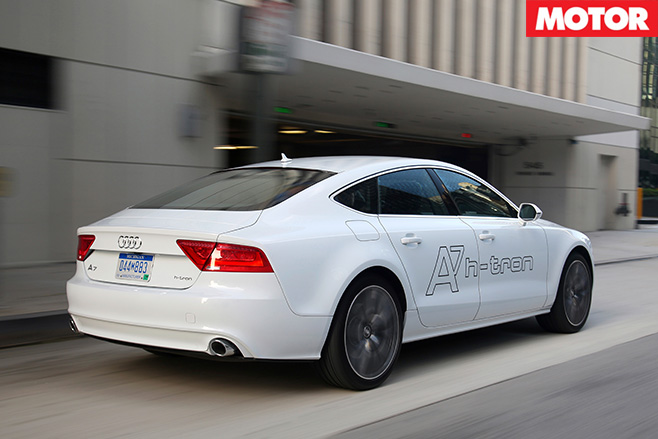
The downside? Add an 8.8kW/h battery pack and there’s an additional 300kg over a 3.0TDI quattro A7; making the h-tron almost 2000kg. The upside, though, is a nominal 170kW and 540Nm.
It gets better. There’s no transmission, just a fixed single-gear mechanism between the motors and wheels, eliminating parasitic powertrain losses. Better still, each motor can overboost up to 114kW in bursts, creating a 228kW power peak available at the wheels.
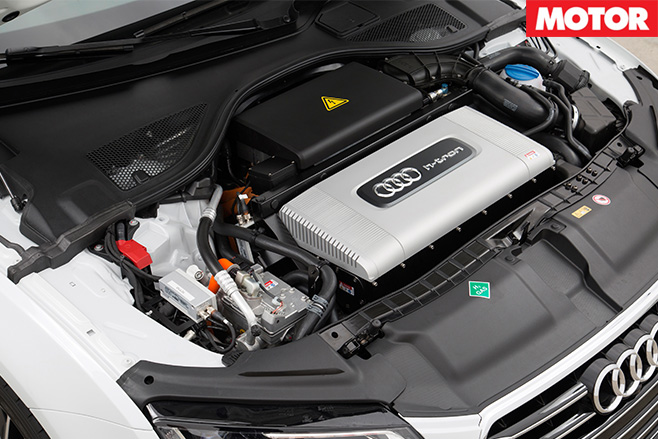
Performance? On twisty back roads there are ample herbs under foot. It’s the sort of energy you might otherwise associate with a healthy turbodiesel. But there’s no rattle on start, no engine thrum on the move.
Sonically, the Sportback is as silent as any other electric car at low speeds. And the compressor could easily be mistaken for the whoosh of a small turbocharger. Top speed, too, is a very handy 180km/h.
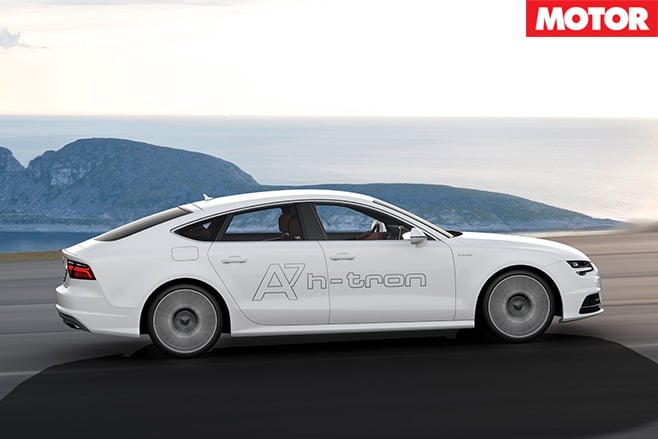
How normal is it to drive? Put it this way: if you were to guess what powertrain you were driving without prior knowledge, you’d guess it was a turbo petrol with some magical instant torque boost. Or, perhaps, a very quiet diesel. You can’t tell it’s a fuel-cell car.
And if a motoring scribe attuned to dissecting differences in powertrain feel can’t guess, the average motorist will never tell the difference. That, really, is the biggest win for the prototype that emits nothing bar water vapour from its twin tailpipes.
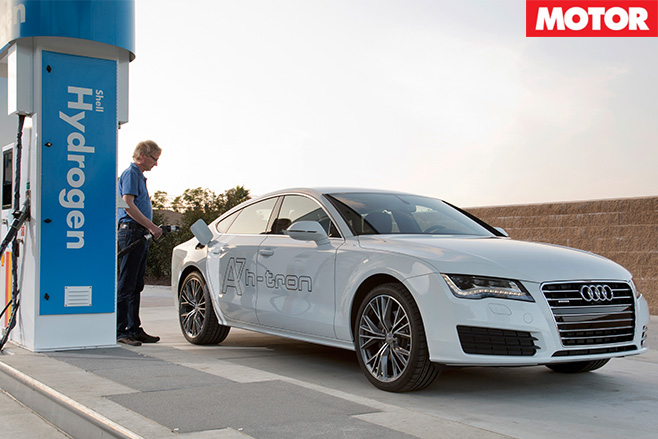
Whether there’ll be broader infrastructure in the future to support commercialised fuel-cell motoring, though, is the biggest question mark.
4 out of 5 stars
Specs Engine: 2 x electric motors Power: 170kW (228kW in overboost) Torque: 540Nm Weight 1950kg 0-100km/h: 7.9sec (claimed) Price: N/A
ASTON Martin will launch a factory-backed assault on the 2017 Bathurst 12 Hour, with the company’s boss one of the drivers.
Wheels can exclusively reveal that Aston Martin boss Andy Palmer will campaign a single car at next year’s event alongside one of Aston Martin’s factory GT3 drivers. A local recruit, as yet unnamed, is also likely to join the Aston line-up.
“I’m planning on racing in it [the 12 Hour] next year,” Palmer told Wheels at the Geneva Motor Show. “I’m personally going to be driving, and I don’t believe we’ve publically announced it. Well, until now.
“For me it has always been one of those dreams to go and race at Bathurst and now there’s an opportunity to go and do it next year.”
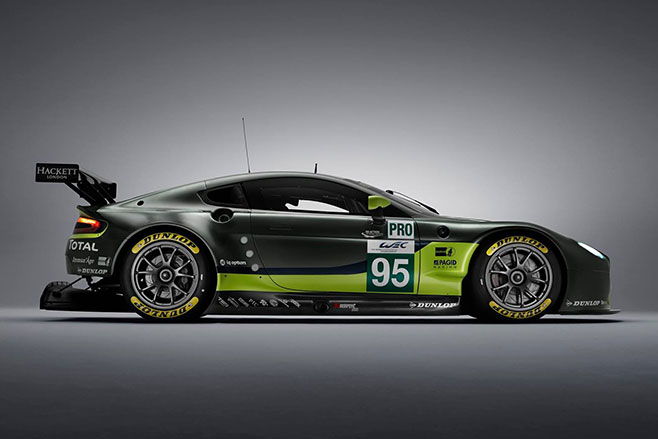
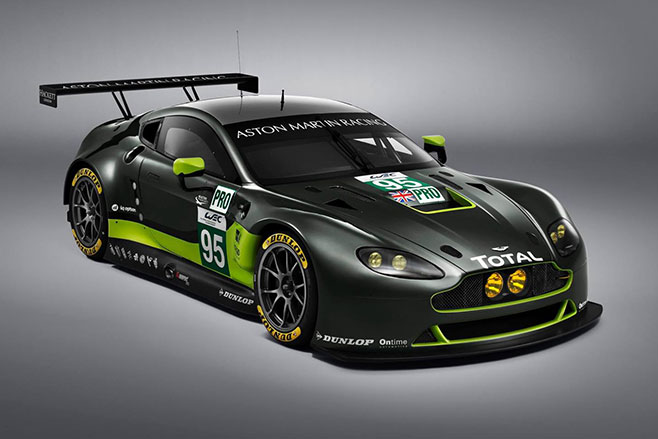
He ruled out racing the brand’s new DB11, shown at the Geneva show, saying Vantage would remain the British brand’s racing car of choice. Aston recently revealed its new V8 Vantage GTE (pictured), which will contest this year’s World Endurance Championship and 24 Hours of Le Mans. There it will challenge the likes of Porsche, Ford and Ferrari for class honours.
“It’ll be a factory team,” said Palmer. “I don’t think we’ll team up with any local teams. We may bring in a local driver but we’ll work that out. We’ve started to put a team together.
“We’ll find a good Aussie to help us along; there are plenty of them.”
As for who else will fill the driver’s seat alongside Palmer, a factory Aston driver is the logical choice. Interestingly, New Zealander Richie Stanaway is one of the drivers on Aston’s roster.
“I’m not going there [to Bathurst] for outright honours, I’m going to survive!” he said. “We’re going there for the experience.”
Next year’s Bathurst 12 Hour won’t be the first factory excursion that Aston Martin has made to the home of Australian motorsport. Several Wheels readers reported in mid-February that an Aston Martin DB11 development prototype sent here for testing had visited the track for a recce.
What stands out?
The Volvo XC90 is an exceptionally comfortable, seven-seat, luxury SUV that pampers passengers in all three seat rows. It is a big car but goes and handles very well, and attends in thorough Volvo fashion to safety. All-wheel drive adds security on slippery surfaces.
What might bug me?
If you have ordered the optional air-suspension, feeling giddy over rough roads. The air-suspended car allows lots of unsettling body movement at highway speeds. At low speeds it’s much better, but the standard suspension is the pick.Having to spend $650 to add Apple CarPlay/Android Auto smartphone mirroring to the infotainment system, which is a standard feature in plenty of more affordable cars.Driving at 80km/h on the space-saver spare, until you can fix your full-sized flat tyre.The litany of warning tones from the safety systems. The alerts can be helpful, but you do hear them a lot – and not always when you’re in danger.
What body styles are there?
Five-door, seven-seat SUV only.Every XC90 drives all four wheels. The XC90 is classed as a large SUV, higher priced.
What features does every Volvo XC90 have?
CCruise control, rear parking sensors and a reversing camera. Satellite navigation, displayed on a 9.0-inch central touchscreen that works even if you’re wearing gloves. Aux and USB inputs, and Bluetooth connectivity for audio streaming. Voice control of the sat-nav and sound.A leather-trimmed steering wheel, from which you can operate the cruise control and sound system. A 12.3-inch digital instrument panel.Leather upholstery on all seven seats, and power adjustment of both front seats. A power-raising tailgate.Four-zone climate control air-conditioning, which allows the driver, front passenger and second-row passengers to set their preferred temperatures. Cupholders and climate control vents for third-row passengers.Long-lasting LED headlamps that shine into corners when you turn the wheel, and dip automatically for oncoming drivers. Windscreen wipers that operate automatically when it rains.Roof rails, which make it easier to fit roof-mounted luggage systems.Drive-mode selection with Dynamic, Eco and Off-road settings, which adjust how heavy the steering feels and how dramatically your pressing the accelerator affects the car. In Off-road mode, the accelerator response is less sensitive, to help you crawl the car over treacherous terrain.Automatic emergency braking that works at city speeds, which Volvo calls City Safety. The system warns you of an impending frontal collision (typically with a car ahead that has slowed suddenly), and if you do not react it will brake for you, either avoiding the crash or reducing your impact speed.Lane Departure Warning, which alerts you if you begin to drift out of your lane (a sign of fatigue). Road Sign Information, which displays the most recent speed limit sign, for example, on the digital instrument panel.Electronic stability control, which can help control a skid. All new cars must have this feature.Seven airbags. (To find out where they are placed, please open the review section “What about safety?”)The XC90 is covered by a three-year, 100,000km warranty.
Which engine uses least fuel, and why wouldn’t I choose it?
The twin-turbocharged 2.0-litre diesel four-cylinder that powers D5 models is the more fuel efficient of the two conventional engines available in an XC90, consuming 6.2 litres/100km on the official test cycle (city and country combined).One reason you might not choose this engine is that you expect you would be using your XC90 most of the time for shopping and school runs – short trips around town. The diesel is fitted with a particulate filter that prevents soot getting into the atmosphere, and to keep it clean you need to spend 20 minutes at highway speed every week or two.Another reason you might not choose the diesel is that you want the sharper response of the petrol alternative. The 2.0-litre supercharged and turbocharged petrol four-cylinder fitted to XC90 T6 models uses 8.5 litres/100km on the official test – still a good figure for this sort of car.Both engines are very good, with much more pull than you’d expect from their size. They are smooth and quiet, but come to life when you’re driving them fast.Expect real-world fuel consumption to be 30-50 percent higher on average, if you use the performance available.A third powertrain option expected in the second quarter of 2016 pairs the 2.0 litre petrol engine with an electric motor. The result is the XC90 T8 hybrid, which on the official test consumes only 2.1 litres/100km. However, that figure relies on the battery contributing energy. Over long journeys, expect the XC90 T8 to consume about as much fuel as the petrol T6.Every XC90 comes with an eight-speed automatic transmission.
What key features do I get if I spend more?
The least costly XC90s, the Momentum models, come with 19-inch alloy wheels. (Smaller, 18-inch wheels, on tyres with deeper sidewalls, are a no-cost option: these will ride more comfortably).Spend more for an XC90 Inscription and wheel diameter increases to 20 inches, while the tyres get significantly wider and lower in profile – mainly for a sportier look, but also adding grip on dry surfaces. Upholstery is in a more sumptuous Nappa leather. And there is smart-key entry, which allows you to unlock the car without removing the key from your pocket or bag. The tailgate opens hands-free when your foot triggers a sensor beneath it.You also get some more active safety aids: Collision Warning Mitigation Support, front and rear, and Intellisafe Surround, including Blind Spot Information System with Cross Traffic Alert. (For an explanation of how these help, please open the review section “What about safety?”)Pay marginally more again for an XC90 R-Design and you get a package adapted slightly for more spirited driving, while giving up the smart-key entry and hands-free tailgate. There’s a choice between Contour and R-Design Contour seats, which provide progressively deeper bolsters each side of you, to help hold you in place around corners. You also gain the option of Nubuck or perforated Nappa leather upholstery. The R-Design comes with shift-paddles mounted on the steering wheel, and carbonfibre-look inlays across the centre console, dash and doors.Most XC90 features can be ordered on any version, either at no cost or for an additional sum. For example, the less bolstered Nappa Comfort seats that come with an XC90 Inscription are a no-cost option on R-Design, and an extra-cost option on the non-Nappa Momentum. And you can add smart-key entry and a hands-free tailgate to Momentum or R-Design for about $1000.Other extra-cost options include a very expensive but brilliant sound system from Bowers & Wilkins. You can order Apple CarPlay (which puts your iPhone screen on the touchscreen). An optional head-up display projects speed and other information close to the driver’s line of sight.A further option on all models is air-suspension, which replaces the standard steel springs with air cushions. The idea is to provide a more comfortable ride, but it also allows you to lower the rear of the car 50mm via a button on the dash – making it easier to load heavy items.You can choose from several interior colour combinations. There’s also an array of alloy wheel designs, and on R-Design you can order wheels of up to 22-inch diameter.
Does any upgrade have a down side?
The optional 21-inch and (on R-Design) 22-inch wheels use lower-profile tyres that not only will be more expensive than those on the smaller wheels but are not likely to last as long. As well, they bring a less comfortable ride (because there is less cushioning air between the wheel and the road).The optional air suspension affects the XC90’s handling, with more body roll and a less composed manner in corners. The car is sharper and more fun to drive on the regular suspension, and the benefit in ride comfort from the air springs is small.Ice White is the only standard colour on Momentum and Inscription: all others cost extra. The R-Design also offers Passion Red as standard, and a greater number of extra-cost colours.
How comfortable is the XC90?
The XC90 is very comfortable, with a roomy cabin. Front seats provide excellent support on long trips. The driver sits quite high, and controls are easy to reach and use.Second and third row seating is also excellent, and the XC90’s sporty styling does not detract from the experience inside. The good glasshouse brings everyone a fine view of what’s passing by, leaving little chance you’ll feel hemmed in. The cabin is quiet, isolating you well from unwelcome external noises.The optional premium audio systems cost a lot, but provide a rich, all-encompassing musical experience that is almost unmatched in a car.
What about safety in a Volvo XC90?
The XC90 has seven airbags: two in front of the driver and front passenger; side airbags to protect front occupants from side impacts; a driver’s knee airbag; and head-protecting curtain airbags down each side that protect even the third-row passengers.Some cars at this price level supply a further two side airbags, to protect the upper bodies of rear occupants from side impacts. However, Volvo says the XC90’s cabin is strong enough to make these unhelpful.Among the active safety aids on every XC90 are city-speed auto braking, a driver fatigue alert, and an alert that prods you if you are drifting out of your lane. Unusually, the auto braking also works at intersections, to prevent your turning into the path of an oncoming car.The XC90 Momentum adds the Intellisafe Surround pack, which brings Blind Spot Information (a light in the side mirrors warns you of vehicles alongside out of view), and Cross Traffic Alert (which alerts you, when reversing, to cars crossing behind).Intellisafe Surround also gives you Rear Collision Warning with braking at a standstill. This looks for cars approaching too fast from the rear, and flashes the indicators should it find one. If it thinks you are about to be rear-ended, it tensions your seatbelts and applies the brakes, to reduce your potential for injury.The Australasian New Car Assessment Program (ANCAP) has given the Volvo XC90 the maximum possible five-star safety rating.
I like driving – will I enjoy this car?
You will enjoy driving the XC90: for driving pleasure, and especially among large SUVs, it’s a standout.The 2.0-litre supercharged and turbocharged petrol engine is the star, with its punchy, responsive character. It’s so good that it makes you wonder whether Volvo has sneaked a much bigger engine under the bonnet.Turbo-diesel versions also feel very driveable and strong, even when carrying a big load or towing. The diesel is an excellent engine, but the petrol is more entertaining.With either engine you will enjoy great handling and roadholding, and precise steering.That’s as long as you don’t option the air-suspension. XC90s with this feature feel less sure-footed than those on the regular suspension, and on bumpy roads move your body around more inside the cabin. That makes them not only less comfortable but also harder to steer, and slower point-to-point.The all-wheel drive system on the XC90 helps it maintain drive on snowy or otherwise slippery sealed roads, on gravel roads and on smooth tracks. The car does not have the ground clearance, underbody protection or low range gearing it would need for rough off-roading. And if you were to get a flat tyre while off the beaten track, you would have to struggle home on the skinny space-saver spare.
How is life in the rear seats?
It’s great. Second row seats are just as good as those at the front, and they too slide and tilt. The seating is more than broad enough for three adults, with plenty of room for heads and legs.Rear passengers on either side can set different climate control temperatures, and have excellent door-bins for storing stuff.The middle-row also has integrated child-seat bolsters. A portion of the seat base can be raised and locked into place, positioning small children more correctly for seatbelts and thus removing the need to carry around booster seats.The XC90’s third-row is the real deal also, and best in class. Instead of token, temporary looking pop-ups, these seats are very supportive and exquisitely trimmed in leather. There is enough space for two adults, and even on long and arduous journeys this would be a pleasant area for children. There are air-conditioning vents dedicated to this row, too, and speakers so that the music doesn’t get lost.
How is it for carrying stuff?
The XC90 has one of the most practical load areas of any vehicle on sale. Every seat can be folded individually, including the front passenger seat, and (to make loading easier) even the driver’s seat. All fold completely flat, for an uninterrupted load floor.There’s a 451-litre luggage area when all three seat rows are in use. That can be extended to 1152 litres with the third-row seats folded flat, and an enormous 1951 litres with the second row seats down also.A foot-triggered, hands-free opener for the powered tailgate is standard on XC90 Inscriptions and an option on the other versions.Legal towing capacity is 2250kg – not bad for a road-oriented big SUV. The XC90 could easily tow a jet-ski, a single horse float or a weekend trailer, for example.
Where does Volvo make the XC90?
The Volvo XC90 is made in Sweden.
What might I miss that similar cars have?
If you were keen on getting a big boat or caravan, perhaps a legal towing limit higher than the XC90’s 2250kg. The Audi Q7, along with several less costly seven-seaters such as the Ford Everest, can tow 3500kg.The other thing to keep in mind is that like many European makers, Volvo charges you extra for optional features that are standard on many less costly cars. For example, keyless entry and start is an extra-cost option on any XC90 but the Inscriptions. And adaptive cruise control – which maintains a safe distance from the car in front at highway speeds – is an extra-cost option on any XC90.Among other cars you might consider are the Lexus RX, Jeep Grand Cherokee, Mercedes GLE, Volkswagen Touareg, and BMW X5.
I like this car, but I can’t choose which version. Can you help?
The petrol-fuelled T6 Momentum provides the most compelling mix of driving enjoyment, fuel efficiency and features for the price.
Are there plans to update the XC90 soon?
The current XC90 was introduced in August 2015 as an all-new model. It won’t be replaced this decade. Expect an additional model – the T8 petrol-electric hybrid – to arrive in the second quarter of 2016, with a mild update likely about 2018.
Arriving fashionably late to the booming baby SUV party is the Toyota C-HR, the Japanese brand’s response to the all-conquering Mazda CX-3 and the Honda HR-V.
Looking surprisingly reminiscent of the striking concept cars on which the design is based, the production version shown at the Geneva Motor Show is sure to turn heads when it arrives Down Under in early 2017.
Toyota has developed a 1.2-litre turbocharged four-cylinder engine for the C-HR, the first in a new line of highly efficient, turbocharged, small capacity motors. The new 1.2 produces 85kW and 185Nm. Rumours suggest a 2.0-litre petrol engine may be added to the range.

Like the Mazda CX-3, front-wheel and all-wheel drive C-HR models will be offered with either a six-speed manual or CVT auto transmission. Standard features include a reversing camera and auto emergency braking.
Details on local spec and pricing will have to wait until closer to the Australian launch, but a starting price in the low $20k bracket would be an important thing for Toyota to achieve given the stiff competition in the segment.
For a brand new car from a brand new firm, the E10 shoulders much expectation.
Conceptually, it causes much stroking of the beard: beneath that doorless cabin is a slender aluminium architecture which plays backbone to a carbonfibre composite tub and a subframe that houses, in the case of this range-topping E10 S, a 186kW 2.0-litre Ford EcoBoost engine.
The bloodline also fascinates, it being the product of a Norfolk-based firm helmed mostly by frustrated Lotus and Caterham ship-jumpers. The fruit of the company’s 24-month journey so far is a production-ready, road-registered and craftily-priced vehicle. Better still, the technical expertise on-hand has resulted in something unique, with no doors, no roof and an optional windscreen.
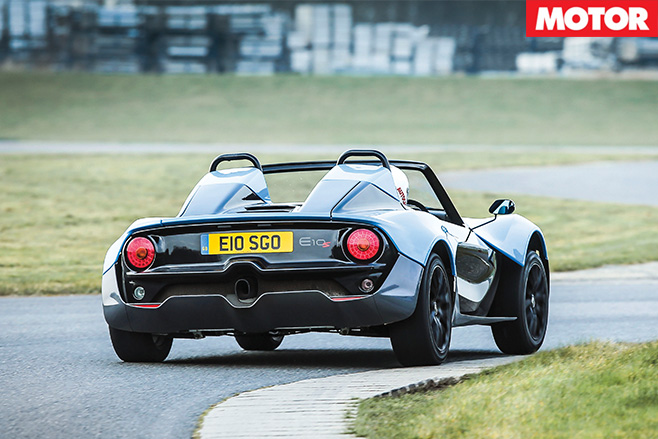
While Zenos may have left the engine tune alone, the EcoBoost’s turbo has been rendered a gulping, hissing monster – it comes online so early, even gentle throttle inputs have it sucking oxygen from your ears.
That noise signals the E10’s defining party trick: an almost lag-free, industrial bungee rope of peak twist. Madly, it has a torque-to-weight ratio well in excess of that of a Porsche 911 Turbo. The thing to get all incredulous about, however, is the way this manifests at the back axle. The mechanical grip coaxed from each Avon is exemplary and, in dry weather, the chassis splices just the right sort of nonchalance into its hectic getaways.
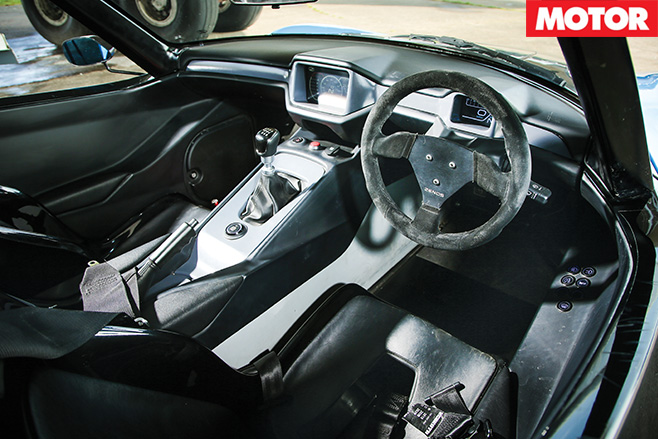
The E10’s ability to give you the confidence to push on one minute, and then satisfy the senses the next, suggests a level of completeness that Zenos had no right to reach within two years.
It isn’t entirely there yet. An Atom is more adjustable and deeply thrilling, a Caterham more involving at the limit and a Lotus more sophisticated. But the E10 slots in among them at a level that usually requires years of try, fail and try again.
And while there are absolutely no plans to bring the Zenos to Australia that we know of, UK car nuts will be pleased to see it’s priced to pull in buyers who baulk at the cost of its rivals. Time will tell if it pays off, but Zenos looks and feels like the real deal.
4 out of 5 stars
Specs Engine 1999cc inline-4, DOHC, 16v, turbo Power 186kW @ 7000rpm Torque 400Nm @ 2500rpm Weight 725kg 0-97km/h 4.0sec (claimed) Price £29,995 (AU$60K approx.)
As the smallest of Audi’s jacked up vehicles the Q2 will lock horns with the Mercedes-Benz GLA and offer another premium option for buyers attracted to the increasingly popular small SUV form factor.
The Geneva Motor Show provided the first proper look at the Audi Q2. It’s rugged and sporty design noticeably smaller than the Audi Q3, the next size up in Audi’s Q range. Audi’s Head of Design Marc Lichte says, “The car exhibits an independent character within the Q family.”
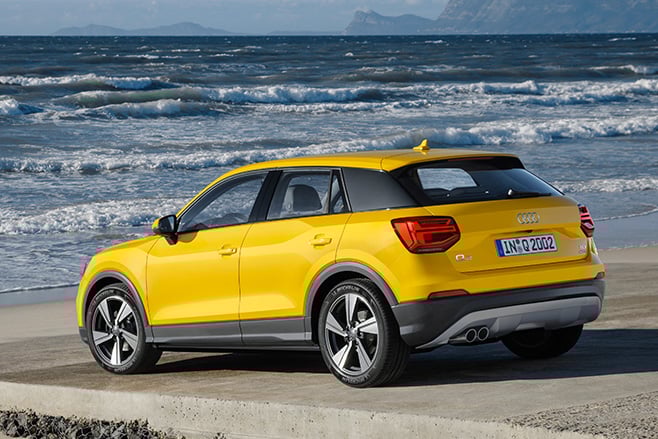
The Q2 will be available in Australia in the first part of 2017. It is to be sold internationally with a selection of six different engines; a 1.0-litre three-cylinder petrol engine, 1.4-litre and 2.0-litre four-cylinder petrol engines, and three four-cylinder diesel engines with capacities of 1.6- and 2.0-litres with power outputs from 85 kW to 140 kW.
The local model line-up, pricing and specification details will be announced closer to launch. Expect to pay around $35,000 and up.
Audi promises a level of included tech on par with its full-size models. Audi’s multimedia interface will be standard with a large dash-mounted display. The ‘Virtual Cockpit’ digital instrument display as seen in TT and Q7 will be optional, as is a head up display.
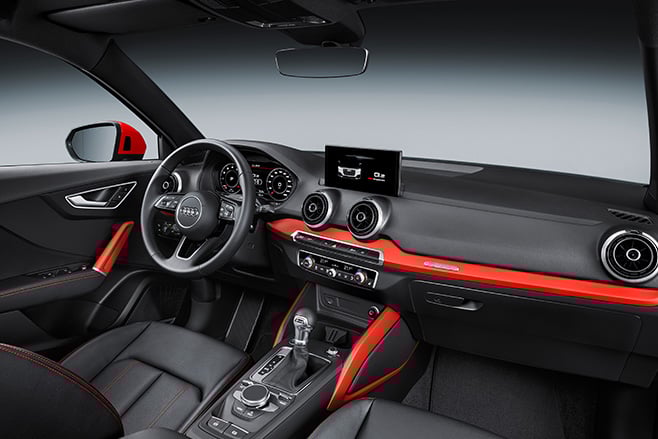
Driver assistance technology for the Q2 includes an auto emergency braking system that recognises critical situations with other vehicles and pedestrians. Adaptive cruise control, traffic jam assist, lane departure warning, lane keeping assistant, and parking/cross-traffic assist are all featured as standard.
NOT DOING THE RESEARCH
Research is an important part of any major purchase. You wouldn’t buy a house without researching the area, would you?
People even shop around for the best price on everyday items including clothes and computer games. So why wouldn’t you do the same for your car?
Unless you’ve got plenty of spare cash to buy a car for the sake of buying a car – rather than it being a necessity – research is your most important step. Don’t settle for a car based on looks. Research what car best suits your budget, and what features you can get to suit your lifestyle.
MUST-HAVES VERSUS NICE-TO-HAVES
We’re all guilty of spending money on something because we think it’s a good deal, or because it looks pretty, only for it to never see the light of day. When it comes to buying a car, those ‘nice-to-haves’ can add up and quickly blow the budget.
Before you start shopping, write down a list of things you absolutely need – two extra seats, satellite navigation, dual climate control, automatic braking.
Then write another list of things that are considered ‘nice-to-haves’. From this list you can establish which manufacturer offers the best price for the most appropriate add-ons and whether these non-compulsory extras are affordable.
TEST DRIVE QUICKIES
Driving around the block isn’t enough to get a real feel for a car. Ask to borrow the car from a dealer for as long as you can and drive it in varying conditions; take it on a highway and listen out for things that might annoy you.
You wouldn’t buy a house without giving it a good looking over, would you?
FALLING FOR THE FEATURES
Going back to the house analogy – I’ve recently started looking for a new rental place. My non-negotiable list started out with two bathrooms, lots of natural light and plenty of space within the constraints of my budget.
But the more inspections I go to, the more my list grows – now I want all of the above, but throw in a decent kitchen, an extra room or study, a bath, and outdoor space. The more you look the more certain things become necessities.
But unless you’ve got an endless supply of money, don’t fall for this trick. Your budget will blow way out, or you’ll find yourself settling in areas that were once important.
RUSHING THE PURCHASE
The more you rush into buying a car, the more likely you are to make a mistake. Who else remembers that expensive pair of jeans purchased out of desperation, only to realise they gape at the back, ride up the front and force you to walk like R2-D2 from Star Wars?
BREAKING THE BUDGET
Set a budget and don’t get fooled by shiny features. There’s nothing stopping you from setting a budget range: the ‘ideal budget’ and the ‘max budget’. And whatever you do, don’t exceed the max budget!
When buying a car, it’s easy to get persuaded into getting various features and technologies that sound cool but might send your car spiralling out of control. Trust us, once the new-car smell wears off, you’ll still be stuck with those monthly repayments.
FINANCING AND INSURANCE
When it comes to financing, shop around and see what’s out there and what other institutions offer before you settle. You do the same for every other type of loan, so your car loan should be no different. Convenience isn’t always the best.
The same goes for insurance. It all comes back to point one – research, research, research!
SETTLE FOR THE EXTRAS
Most of the profit for dealers comes from the optional extras, so you can be sure they’ll try to push them on you.
While we think there are many extras out there that are worthwhile, don’t settle for what you’re told you need – if you’re going to fork out for something extra, make sure it’s an accessory you’re going to use.
There’s no point paying for a car that can drive itself if you’re never prepared to give up the controls.
The Centenario is a fusion of all the things that sit at the heart of Lamborghini in a celebration of its founder’s legacy, merging heritage with modernism.
“The Centenario is a car that perfectly combines tradition and innovation,” Automobili Lamborghini President and CEO Stephan Winkelmann said. “It looks to the future while honouring the legend that is Ferruccio Lamborghini”
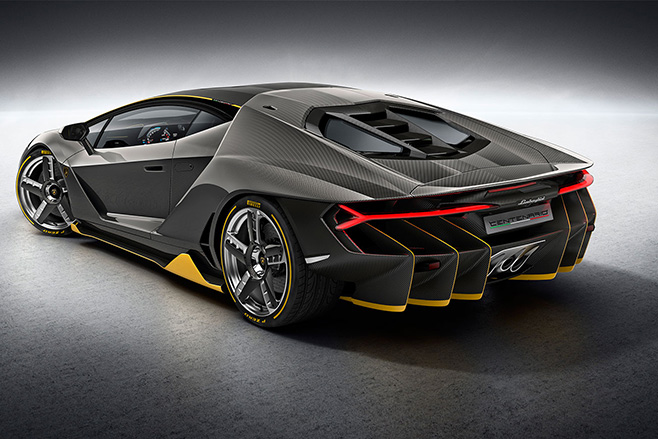
With only 40 Centenarios in production (20 coupes and 20 roadsters), the limited edition V12-powered Lamborghini was sold out before it even reached its official unveiling at the 2016 Geneva motor show, despite its AU$2.65 million price tag.
By looking at the Centenario, it’s unquestionably Lamborghini – aero-enhancing fins, air-vents built into the hood, yellow side skirts, and the automatically extending wing that appears at high speeds. The panels are built from carbon fibre to ensure the Centenario is as light as possible to give it a weight of 1519kg and it features Lambo’s most powerful V1 engine ever built making 566kW.
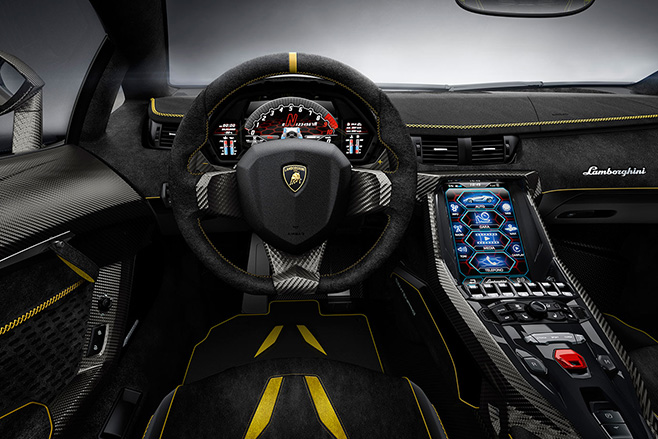
Aside from all the techy stuff, which you can read here at MOTOR there are some cool features we thought worth mentioning in case you decided you wanted to spend your millions on trying to buy this off an existing owner.
Power comes from a 3.0-litre twin-turbocharged six-cylinder making 272kW and 500Nm. Fans of classic M cars will be pleased to see the availability of a six-speed manual gearbox. A seven-speed automatic dual clutch transmission (DCT) is also offered.
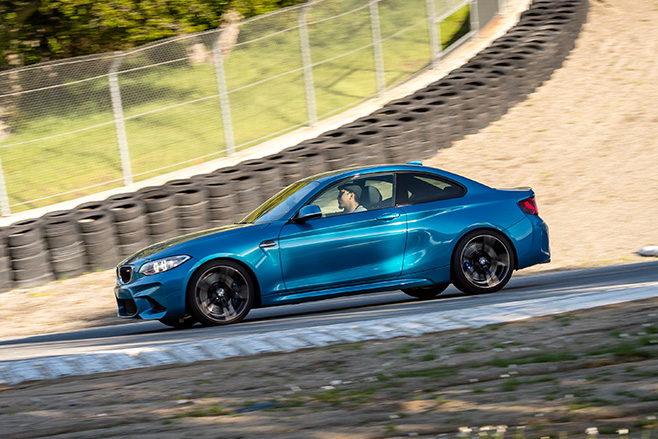
The M2’s body shape is noticeably wider than other 2 Series Coupes. Its front and rear guards have been flared to accommodate the larger wheel and tyre package and give the compact coupe its muscular stance.
The M2 features much of theM3 and M4’s technology, shoehorned into the smaller 2 Series Coupe frame. It’s a potent performance machine and rear-wheel drive challenger to the Audi RS3, Mercedes-AMG CLA45 and Golf R.
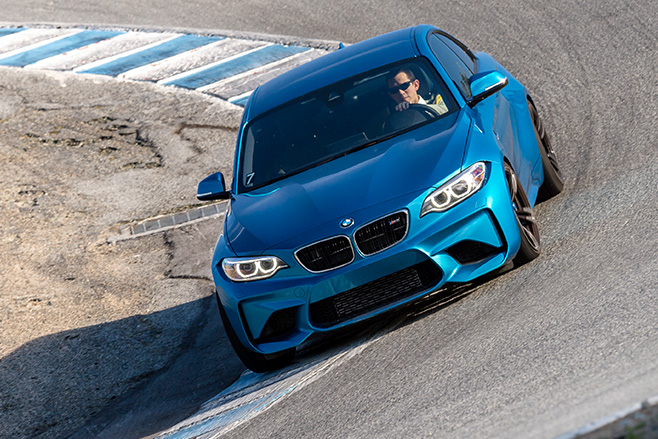
Start price for the M2 Pure is $89,900 with a manual transmission only. The fully-featured M2 starts at $98,900 with manual or DCT transmission. As well as the DCT gearbox option, the extra $9000 gets buyers electric and heated front seats, adaptive headlights with auto high beam, a premium Harmon-Kardon stereo and an alarm system.
Standard equipment includes; 19-inch alloy wheels, leather trim, 8.8-inch display with premium satellite navigation and real-time traffic info, and BMW’s Driving Assistant package with parking aids, lane departure warning and pedestrian warning system.
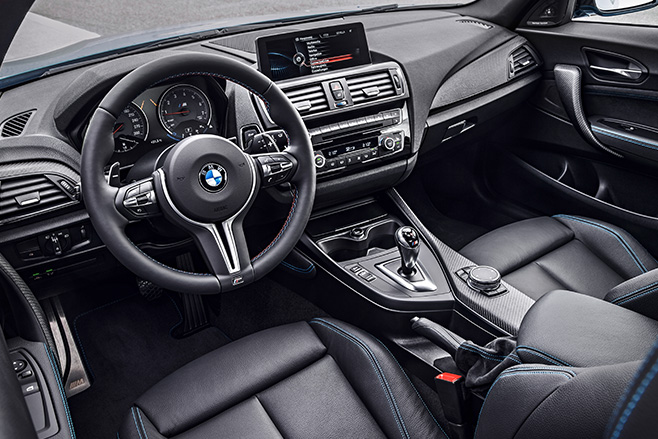
BMW has integrated a new GoPro app into the M2’s infotainment system allowing drivers to access video and photo functions of a GoPro camera via Bluetooth, using the car’s dashboard display and iDrive controller.
Demand has been huge since the M2 was announced. Pre-orders are blowing out to the end of 2016 and beyond. If you want one, best get on the phone fast.
History lesson: back in 2003, Mazda made a coupe version of the NB MX-5 for the Japanese market.
A limited number were built and offered with the a 1.6-litre or 1.8-litre engine and both a manual or automatic transmission. The fixed metal roof added around 10kg to the car’s weight, but increased the drop top’s structural rigidity and improved the handling.
This month, MOTOR is dreaming up an ND MX-5 coupe. The new MX-5 is the most aggressively styled incarnation to date with sharp lines, bulging shoulders and piercing headlights. Add a fixed double-bubble roof for extra torsional rigidity, a set of slick alloys and a power bump and you’ve got one hell of a Toyota 86 competitor.
C’mon Mazda, you know it makes sense.
TRACK OPTION The MX-5 coupe can be optioned with a half cage, bucket seats with race harnesses, fire extinguisher and radio and air-con deletes for track-day heroes hell-bent on shaving tenths. Think of it as a Cayman GT4 for a quarter of the price.
UNDER COVER You lose the wind-in-your-hair roadster experience but gain extra chassis rigidity, better handling and improved refinement. Its driving focus will garner the MX-5 even more cred amongst purists.
BLACK MARKET The coupe comes with two engine options: a 1.5-litre turbo four banger tuned to 150kW and a 129kW/420Nm 2.2-litre turbodiesel torque monster fed by the black pump. A six-speed manual is the only transmission option.
PLAYING DRESS-UPS A front lip, side skirts and mirrors made from faux carbon are subtle bodykit enhancements that help keep weight gain to a minimum and bolster the coupe’s reputation as the sportiest of the already able MX-5 range.
WHEEL WORK The coupe swaps the standard car’s 16-inch alloys for fatter 17s to give a meaner look and extra tyre width. Wider rubber will give the chassis the grip required to handle the extra power from the force-fed engines.
STOP RIGHT NOW Bigger brakes from the Mazda 3 range will be fitted to the powered-up MX-5 coupe. The stoppers aren’t pretty but they’ll get the job done, and will help keep costs down.
