
Big things were expected of VW’s new Polo GTI at this year’s Bang for your Bucks.
After all, this is the updated version of the car that turned the BFYB formula on its head so comprehensively it called the future of the event into question; its back-to-back wins in 2011-12 were by such a margin that at the time it didn’t look like anything would ever be able to beat it.
It’s a measure of the evolution of the performance car game, then, that VW’s latest pocket rocket managed ‘only’ third in class at BFYB 2015, despite, on paper, offering a stronger case than ever. As rivals downsize, the Polo GTI has gone the other way, increasing capacity from 1.4 litres to 1.8, albeit ditching one form of forced induction with only a turbocharger now present.
Power is up to 141kW and torque increases by a massive 70Nm if you specify a manual gearbox, the result of which is a stunning 6.36sec to 100km/h (over three-tenths faster than the pessimistic claim) and 14.61sec quarter, quicker than all bar the XR6 Turbo and S1 Sportback.
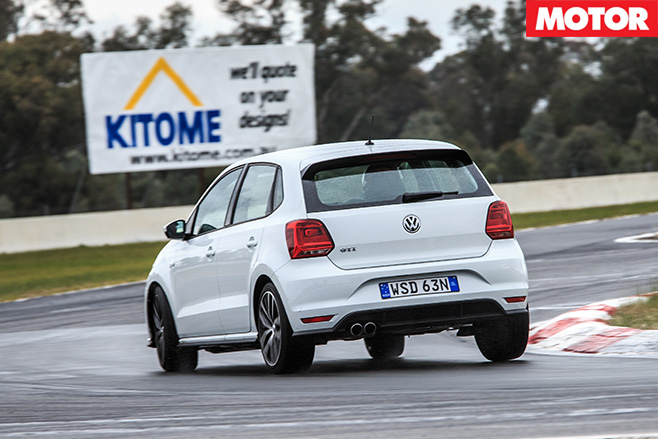
Its 1:05.50 lap time trailed both the Fiesta ST and Clio RS (albeit only just), which suggests whatever it was gaining on the straights it was losing in the corners.
Its 105.69km/h minimum speed through Winton’s long sweeper was last-in-class, though 53.00km/h through the tight turn nine was competitive. Regardless of its speed, however, in general the judges felt that it failed to match its Ford and Renault competition in terms of driver appeal.
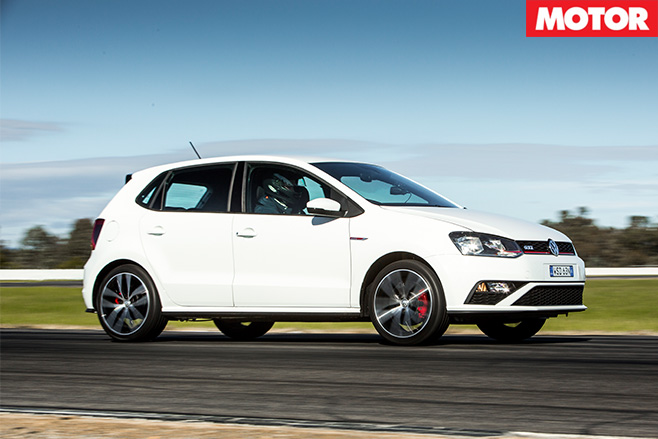
It could be fairly argued that the racetrack isn’t the Polo GTI’s natural habitat, but it must be said that while the Fiesta ST and Clio RS shine when taken to the track, the VW is entertaining up to a point, but beyond that it all gets a bit scrappy. Make no mistake, it’s still a polished performer, but all that torque easily overwhelms the front tyres, dragging the nose wide.
There’s little that can be done about it, either, as if there’s one thing that holds the Polo back, it’s the lack of chassis adjustability. It’s not completely inert, but neither is it particularly keen to involve the rear end, though even if it was, the non-switchable ESP would soon kill any fun.
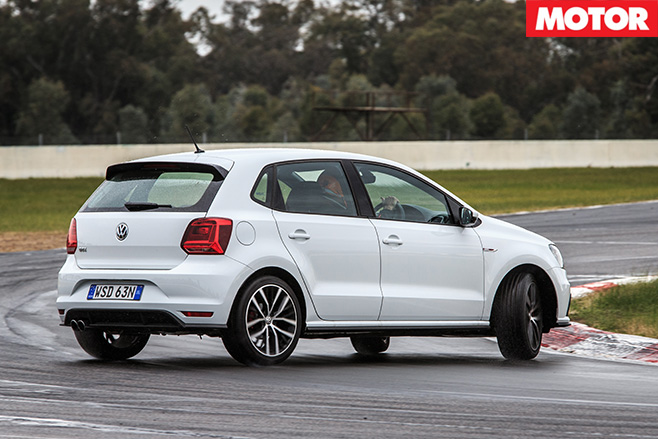
In some ways the new Polo GTI is the muscle car of the small hatch class, as silly as that sounds. Capable of dominating its rivals in a straight line, it’s not quite as capable or rewarding in the corners. Would the adaptive dampers recently announced as standard on MY16 Polo GTIs have been enough to make the difference? We’ll have to wait until next year to find out.
0-100km/h – 6.36sec (3rd) 0-400m – 14.61sec @ 157.14km/h (3rd) Lap time – 1:45.5sec (7th)
Overall Scoring
Bang Index – 108.7 Price – $27,490 Bucks Index – 127.9 BFYB Index – 176.5
Judges’ Rankings
Campbell 5th – “Class act road car that love to let its hair down on track. It’s got oomph.”
Morley 5th – “Bucks the trend of small engines in hot-hatches. And the better for it.”
Newman 6th – “The muscle car of the mini hatch brigade; mega grunt.”
Spinks 5th – “Suave yet muscular. A little hatch that punches hard.”
Luffy 2nd – “You can definitely see that it shares the same DNA as the Golf R; it’s like a mini version of it. It does everything very similar to its big brother, but it just doesn’t have the power, refinement and mechanical grip as it’s a much smaller car. It’s still a beautiful car to drive. It’s easy to drive on the limit and it gives you confidence to push on.”
In last year’s Bang for your Buck, the Clio RS herded an elephant out of the room – that we kinda preferred the old, high-revving version – by taking class honours in the $0-50K category.
The reluctance to offer a manual ’box as an alternative to the standard auto is still a bit Dumbo, but no-one was disappointed to see this track-loving hatch back at Winton.
Its chances of overcoming its 2014 nemesis – the Fiesta ST – weren’t done any harm when it posted even better performance figures this time around. But there was a three-fold problem. Not only were a revitalised Polo GTI and anniversary-candle-blowing 208 GTI getting in on the act, the Ford fared better against the clock.
The ST closed its 0-100km/h deficit from four-tenths to just four-hundredths, and even reversed positions in the quarter-mile and, most crucially, the lap.
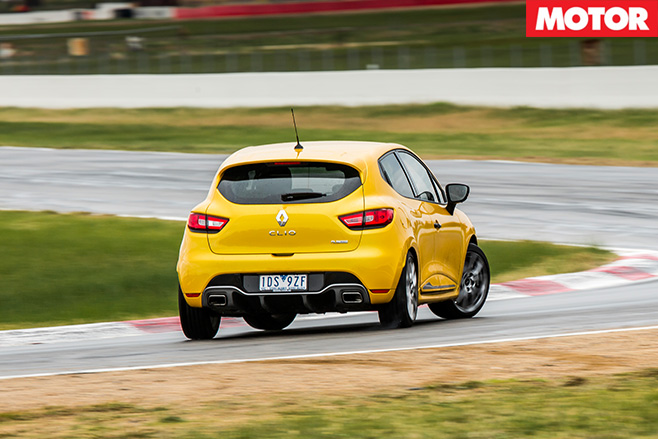
Clio’s best hope was for the judges to counter these statistical losses with gains through their seat-of-the-pants votes. And there’s plenty to admire – once you unleash the Clio RS’s potential by activating Race Mode (via the red centre console button) to disengage ESC and force the use the paddleshift levers.
The paddles are nonsensically fixed to the steering column, making shifts awkward if there’s any rotation on the wheel, though at least the auto holds chosen gears. Just try not to think too much about the old 197 and its rev-hungry atmo 2.0-litre: there’s a shorter journey to redline, so instead enjoy the 1.6L turbo’s extra punch.
The new RS Clio’s chassis is also not quite as responsive, but adopt a half-glass-full mentality and it’s easy to savour the precise and hefty steering, the high levels of traction and grip, and a throttle-adjustable balance that makes the Clio RS fun to guide through corners.
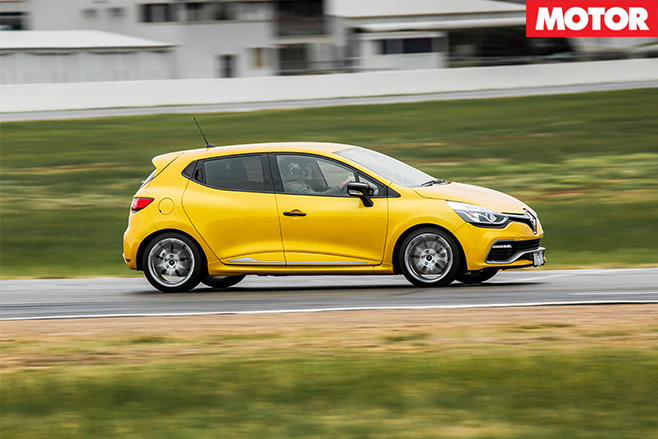
Still, four of the five judges ranked Renault’s smallest hot-hatch in their Top 3s, and the Clio’s Bang-Price ratio resulted in fourth overall.
So no podium let alone a cup for the Clio RS this year. That’s perhaps something not to mention in the halls of Viry Chatillon, Renault Sport’s HQ, though it does have another Trophy – the Clio RS220 – on the way.
0-100km/h – 6.93sec (7th) 0-400m – 14.95sec @ 154.41km/h (8th) Lap time – 1:45.4sec (6th)
Overall Scoring
Bang Index – 107.8 Price – $29,490 Bucks Index – 119.2 BFYB Index – 169.7
Judges’ Rankings
Campbell 3rd – “Truly talented chassis is begging—begging— for a manual.”
Morley 3rd – “But for a proper gearbox, would’ve finished higher.”
Newman 2nd – “Still great on track, still needs a manual ’box.”
Spinks 2nd – “Fixed paddles a major faux pas, but steering and handling trés bon.”
Luffy 4th – “It’s a lot of fun, but the chassis is let down by the tyres. The car probably has more grip and potential with slightly better tyres under it. The paddles being mounted to the steering column and not the steering wheel takes getting used to, especially through the tight stuff as you have to take your hands off the wheel mid-corner to change gears. Also, the brakes don’t inspire confidence.”
Jump straight from the Astra GTC to this car, the VXR, and you can immediately see, smell and feel where some of the extra money has gone.
Okay, so 13-large is a fair old chunk of wedge, but even so, the VXR is a much more complete performance car. Very complete, as it turns out.
The secret is that the bits and pieces that make up the VXR also happen to work pretty well together. Balance, it’s called. The VXR, isn’t the fastest car in a straight line here, and its 0-100km/h time of 6.58 seconds didn’t get it onto the standing-start podium. Nor did its 400m time of 14.8 at 158km/h (in fact, it was closer to mid-field across the quarter).
Part of that, however, is probably down to gearing that was a fraction longer than most of the rest and a tad too long for the technical Winton layout. At, say, Philip Island, it would doubtless be a different story, but at Winton, the VXR remains more or less a second and third-gear proposition. Mind you, the 80-120km/h in-gear run of 4.09 was pretty handy and backs up the flexibility of the turbomotor.
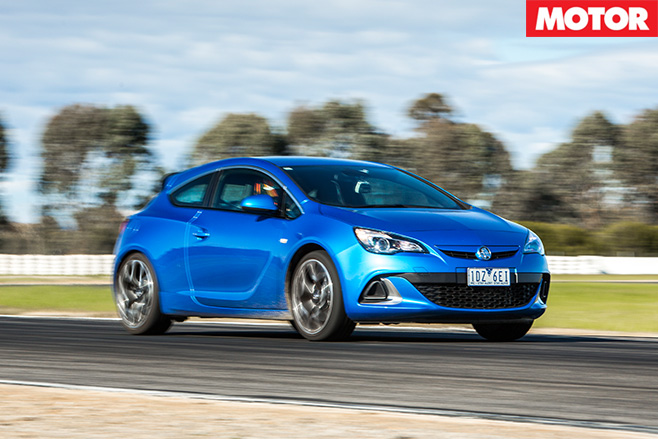
The view that corner speed is a big part of all this is supported by the VXR’s apex speed at Turn Five of 112km/h; the fastest of this category. It felt it, too, and you could also discern that same corner-speed thing helping by sling-shotting you out the other side with more velocity on board.
In fact, despite those non-podium acceleration times we were talking about, the VXR’s top speed at any point on the Winton circuit was bested only by the XR6 Turbo’s (168 versus 172) with daylight third. And that’s purely down to being able to fire out of a corner with the wheels turning faster than the opposition. Simple.
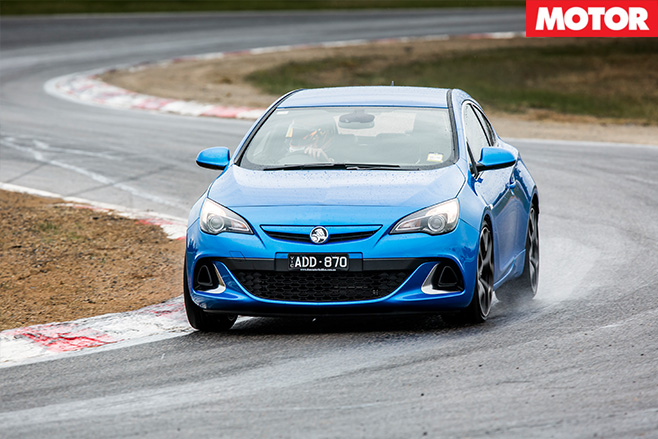
0-100km/h – 6.58sec (4th) 0-400m – 14.83sec @ 157.97km/h (6th) Lap time – 1:42.1sec (1st)
Overall Scores
Bang Index – 132.3 Price – $39,990 Bucks Index – 87.9 BFYB Index – 167.3
Judges’ Rankings
Campbell 6th – “Fast and planted. So much so, anyone who can get it to oversteer deserves a trophy.”
Morley 4th – “Opel, Holden, doesn’t matter. Works regardless of badge.”
Newman 5th – “Only interested in speed, but it’s damn good at it.”
Spinks 6th – “Welcome back! Could be more playful but loves track-work.”
Luffy 5th – “This car is effortless, confidence inspiring and easy to drive on the limit. It feels like it has a very wide platform under it as it’s very stable through the fast stuff and good on the change of direction. If anything it does it all too easily, which takes away a bit of the fun element. But this gives you the confidence to push on because it doesn’t have any frightening moments.”
Speculation persists that some time down the track the XR6 Turbo will do the equivalent of the XR8 and grab the more powerful engine from its now-defunct FPV offshoot.
In this case, it’s the F6 Typhoon rather than GT. But that’s (potentially) another day, another Buck. Ford’s turbocharged six-cylinder Falcon has been a V8 hunter since it came on-boost in 2002, though of course that also included shooting its own eight-cylinder sibling in the foot.
The tables are now turned – quite literally when it comes to performance figures. The XR8 elbow-dropped the Turbo by half a second in the 0-100 sprint, clotheslined it over 400m by eight-tenths, gave it an in-gear forearm smash from 80-120km/h by seven-tenths before jumping off the ropes to deliver the ultimate, submission-inducing smackdown with a lap 2.7 seconds faster.
Only when it came to pummeling the brake pedal did the XR6T edge its in-house rival in a notable exercise. Even then, its one-metre advantage had more to do with the XR8’s extra mass. More telling is that the exhaust-recirculating XR6 pulled up barely any quicker than the XR6 inhaling merely through its nostrils.
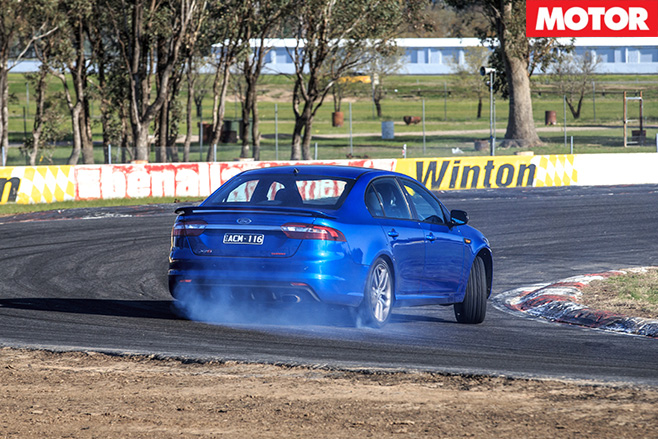
Dynamically overall, the XR6T also feels more country-touring sedan than Touring Car Championship racer. The handling is quite rolly and the force-fed Falcon proved through Winton’s Turn 1 chicane that it’s not particularly adept at transferring weight.
It was enough for this blow-in to controversially relegate the blown Falcon below the standard XR6 in the judges’ rankings, though before you shout “Poms should stick to hatchbacks” there was also dep-ed Scotty preferring the latter’s trade-off of speed for greater finesse.
It’s also interesting to note the boggo XR6 carried higher apex speeds through turns 5 and 9. Powering out of corners, however, reveals there’s good traction when you’re looking for a clean stopwatch lap … or achievable oversteer if you want to have some fun sending more of the engine’s 533Nm to the rear wheels.
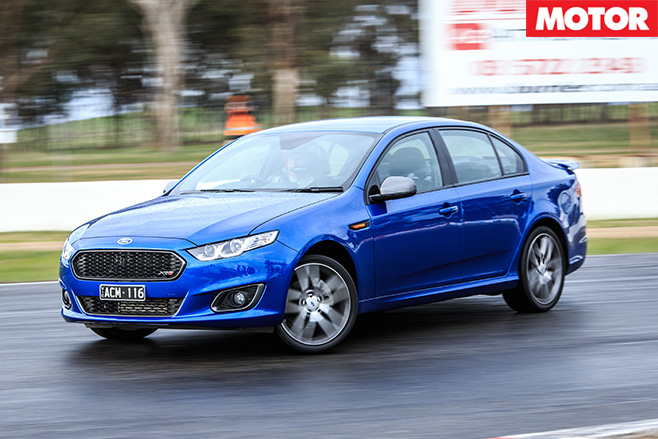
With the 0-100km/h, 0-400m, 80-120km/h and lap v-max among its scalps in the $0-50K bracket – plus a fourth-quickest lap – a second-highest Bang Index countered a second-lowest Price Index to position the Turbo in a credible 6th against its heavily hatch-biased opposition.
Difficult to imagine a rebranded Typhoon not faring even better, but over to Ford Australia…
0-100km/h – 5.39sec (1st) 0-400m – 13.64sec @ 171.92km/h (1st) Lap time – 1:43.3sec (4th)
Overall scores
Bang Index – 137.4 Price – $43,490 Bucks Index – 80.8 BFYB Index – 166.5
Judges’ Rankings
Campbell 7th – “It’s not really interested in behaving. But it’ll happily show off its real talent for tyre vaporisation.”
Morley 9th – “Farewell old pal. Shame you weren’t brought up to date.”
Newman 8th – “Not sure the turbo adds much apart from the ability to destroy tyres.”
Spinks 13th – “Doesn’t need any more grunt but does need more in the brakes department.”
Luffy 7th – “Went into limp mode with three corners to go, which I think is related to the oil temperature. But, it’s a fantastic engine with so much low-down torque and it’s really driveable. Like the XR6, however, it lacks feel at the front end through turns. Ergonomically, you feel like you’re sitting on the car and that you’re not actually a part of it. And the brakes definitely aren’t up to the job.”
As a big fan of the Audi S3, I was really expecting big things from the S1.
I mean, it might be based on the A1, but look at the stuff Audi has thrown at the little guy: Namely a two-litre engine and its Quattro all-wheel-drive set-up. And a price-tag that j-u-s-t squeaks in under our 50K cut-off. So it’d better be good.
First impressions are good; the interior looks pretty suave in an Audi kind of way and I really liked the splashes of body colour on the seat-backs and centre-console. Fire it up and the engine feels about right for its claimed 170kW of poke although I’m not sure I can account for all claimed 370Nm. But it is a perky, playful engine even if it’s not exactly what you’d class as fiery. But the six-speed box is a treat and, thank goodness, Audi hasn’t switched exclusively to the two-pedal DSG set-up that, admittedly, its buyers seem to prefer.
Perky? Playful? Maybe that is selling it a bit short, because with a 0-100 time of 6.3 and a 400m run of 14.3, the S1 is hardly soft. The turbo mid-range is also a big factor, too, and the 80-120km/h time of under four seconds puts it up there with the best of them. Maybe it’s simply that the engine itself is so smooth and refined that it doesn’t feel like you’re really thrashing its spuds off, but this will also ensure that it’s a better than average performer as an interstater.
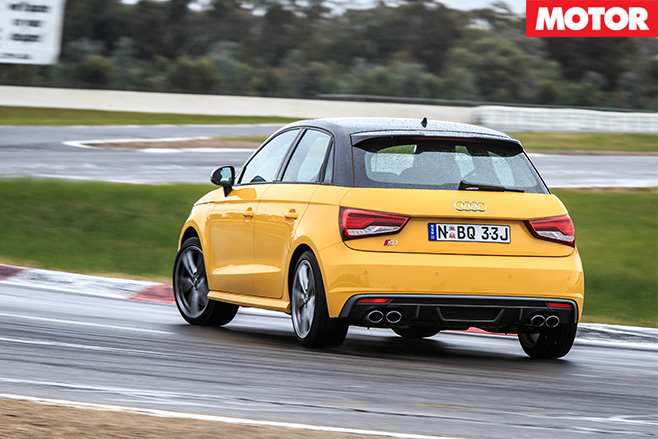
But drive it as such and it is definitely on the quick side with a lap-time of 1.04 dead which places it firmly in the silver-medal position in its category around Winton. But check out its turn-five speed: Its 110.3 kliks drops it to about fifth out of 13. Outright top speed at Winton, meanwhile, was a fourth-outright 164.78 kliks.
And when you line those ducks up, you can see that the S1 relies more on its straight-line pace than its corner speed and, blow me down, but that’s exactly how it feels to drive.
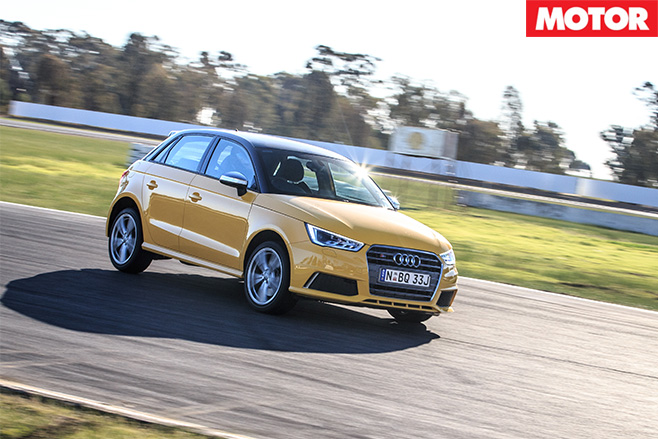
Beyond that, I could use a bit more seat support and a bit more change than the $10 I’ll get from my $50,000. See, bang notwithstanding, the bucks things doesn’t really stack up in this case.
0-100km/h – 6.25sec (2nd) 0-400m – 14.32sec @ 160.55km/h (2nd) Lap time – 1:44.1 (3rd)
Overall Scores
Bang Index – 123.3 Price – $49,990 Bucks Index – 70.3 BFYB Index – 147.9
Judges’ Rankings
Campbell 4th – “It does fast, it does fun, and it’s good at both. But at the same time it sort of excels at neither.”
Morley 7th – “Tiny body with everything thrown at it. Result, too.”
Newman 4th – “Enjoyably playful, but not as feisty as it could (should?) be.”
Spinks 3rd – “A fun little imp without being quite the devil we’d like it to be.”
Luffy 6th – “It has so much character, and you can throw it around and slide it in the tight stuff. The moment you get back on the throttle, however, it bunkers down and gets on with the job. Ergonomically it’s really nice. It’s a lot of fun without being scary, so you have confidence that it won’t do anything silly. But you can still push it and get the most out of it quite easily.”
If the RS275 Trophy R is a riot on the racetrack, the GT220 is more a civilised protest march – unfurling banners ‘shouting’: What do we want? Performance! How do we want it? Erm, not too hardcore.
Renault’s stopover variant on the long-haul price trip between base and flagship Meganes first arrived locally in 2013 in wagon form but makes an entrance here with the same formula in a different body style – five-door hatch.
That makes it even more the RS-Lite, even with the extra practicality of two rear doors. Out on the track, the RS275’s 2.0-litre four-cylinder engine is still enjoyable even in detuned state – down 33kW and 20Nm to 162kW (the 220hp referenced by the badge) and 340Nm.
It’s rev-happy, pulls strongly and sounds rorty – and satisfying to manipulate via the six-speed manual with its slick shifts and well-judged ratios. The GT220 isn’t embarrassed by the RS275 in many of BFYB’s performance measures, either – less than a second slower to 100km/h and still capable of a sub-15sec 400m sprint.
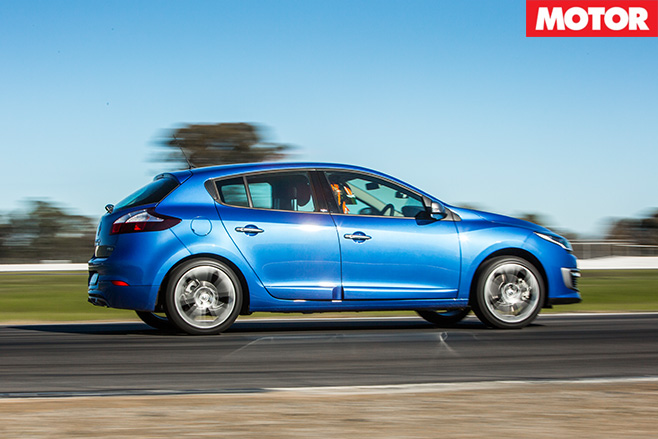
The absence of the 275’s Brembo brakes reduces bite and feel, though it’s the lack of any torque-management devices deployed to the front wheels that hurts the GT the most.
If the RS Megane’s mechanical limited-slip diff allows you to depart an apex like being fired out of a cannon, the GT misfires on the limit by either understeering or being tripped up by its non-switchable stability control. There’s also more noticeable torque steer under urgent acceleration when running straighter.
The GT220 isn’t bereft of balance, though, as you’d expect from a suspension that has still been fettled by those RenaultSport boffins. And the steering is praiseworthy for its weighting and accuracy.
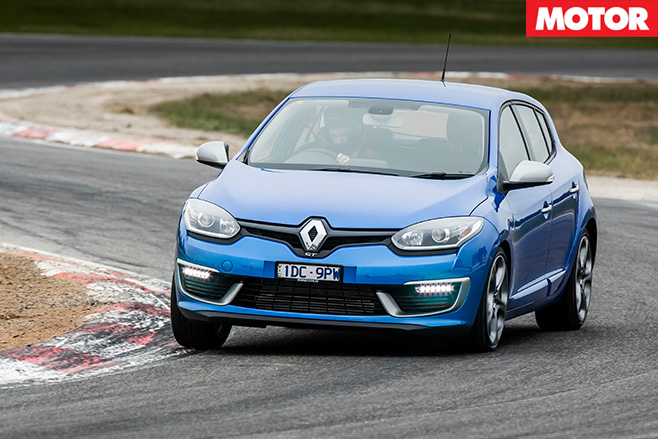
Running all the numbers through our BFYB formulas that make Stephen Hawkins’ A Brief History of Time easier to read than The Cat in the Hat … and the GT’s Bang Index was short of the Clio RS’s before even considering comparisons with the Megane RS.
Its Golf GTI-baiting $35,990 starting price, however, also ensured this halfway-house Megane finished in an appropriately mid-pack position.
And when you want to take to the streets – rather than the track – the GT is also the more comfortable Megane.
0-100km/h – 7.05sec (9th) 0-400m – 14.98sec @ 156.77km/h (9th) Lap time – 1:47.2sec (11th)
Overall Scoring
Bang Index – 95.3 Price – $35,490 Bucks Index – 99.0 BFYB Index – 145.6
Judges’ Rankings
Campbell 9th – “Delightfully rorty engine but playful chassis sadly strangled by that ESP”
Morley 6th – “Surprised me, this one. A compromise that isn’t one.”
Newman 10th – “Super keen to play, but fun stifled by electronics.”
Spinks 7th – “A worthy middle ground between regular Megane and hot-shoe RS.”
Luffy 9th – “I’m sick of seeing GT badges on cars that aren’t worthy. You can’t turn the stability control all the way off, so it limits performance. If there’s something that’s going to limit the performance so much, then why put a GT on it? The car has great potential, but without the ability to turn the electronics off you can’t explore the limits of the car. Don’t market it as something that it’s not.”
Haven’t I seen your face before? Oh yeah, that’s right; last time you were badged as an Opel.
But it seems the car-buying public didn’t understand and now you’re back with a Holden badge and a slashed price-tag. This, apparently, will fix everything. I swear, I will never understand marketing.
Thing is, I don’t think I’ll ever understand the Astra GTC as a performance car of any real sort. I guess you could say it has decent balance, but that’s probably more a function of not having a whole lot of poke to upset the handling applecart in the first place. Thing is, the Astra is a difficult car to get a flow happening on the track.
The brakes seem over-sensitive and want to pitch you through the screen when you get even remotely serious about poking them. The steering, however, is the opposite and just never has too much to say to you. Throw that lot together and it just seems harder than it should be to get the Astra into any sort of a groove at Winton. Which would explain its 1.06:8 (and that, I think, says more about Luffy than the GTC).
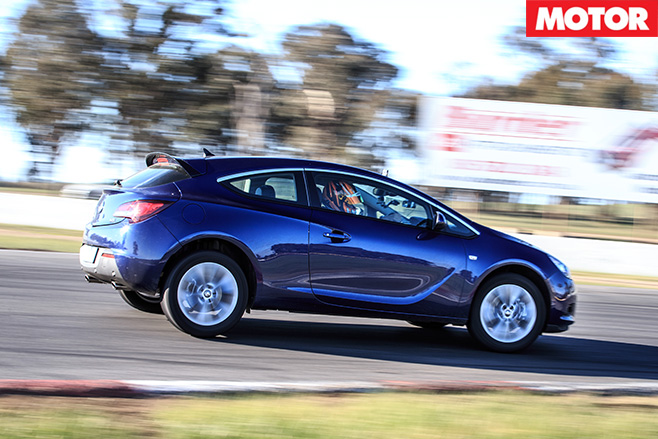
Don’t take my word for it, though, check out the acceleration times. From rest, the GTC requires 7.75 seconds to get to 100 and then finally drags itself past 400m in 15.5; second slowest and with the second-slowest lowest terminal velocity of 147.9km/h.
That speculation that the thing doesn’t flow is backed up by the lap-time, but more deeply explained by the lacklustre Winton V-max of 155.5km/h and a Turn-five apex speed of 106.8 kliks, when the cheaper Fiesta ST was hauling past the same point at almost 111 km/h.
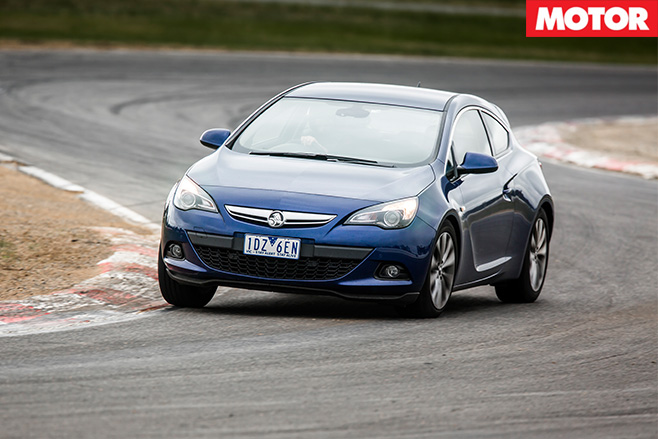
The front seats are good, though, but I’m damned if I can see out the back of this thing with its slitty little side windows and steeply raked hatch. Of course, you could argue that anybody who wants a truly quick Holden Astra can always stump up the $40K for a VXR. And, to be honest, that’s probably a fair assessment.
0-100km/h – 7.75sec (13th) 0-400m – 15.51sec @ 147.91km/h (12th) Lap time – 1:46.8sec (10th)
Overall scores
Bang Index – 62.3 Price – $26,990 Bucks Index – 130.2 BFYB Index – 141.0
Judges’ Rankings
Campbell 11th – “Soft, slow, probably a decent road car. But on track it seems to be asking, ‘what on earth am I doing here?”
Morley 12th – “Oh Brother: what art thou?”
Newman 11th – “Capable, but a little soft and lacks excitement.”
Spinks 8th – “Likeable in many ways but too soft for track attacks.”
Luffy 12th – “It doesn’t profess to be a top-of-the-range performance model, but the amount of front-end grip and turn-in was pleasantly surprising. It doesn’t have the power to back it up, but the chassis balance is really good. You can bomb into a sweeper as hard as you want and know that it’s going to want to turn at the mid-corner point. It’s not the fastest car out there, but it doesn’t pretend to be.”
Hyundai’s sportiest car has been sporty rather than sports since it stepped onto the scene in 2012 as an asymmetrical anomaly in the hatchback universe.
This is Series II of the car featuring one driver’s door and two passenger-side doors, though, and as ever the brand’s local tuning team has rolled one of its imported models onto the hoist again in an effort to give ride and handling a lift.
Increased front spring rates are introduced to counter the simultaneous reduction in the size of the front anti-roll bar, and new dampers come in as a result of the car’s revised balance – all in the name of getting the Veloster into and out of corners more effectively. There’s also an updated steering rack, and 10mm-wider rubber.
Result? Clear improvements. The more tuneable electric steering is less stodgy and more consistent, if still silent on the communication front. (And again don’t bother playing around with the Flex Steer modes; stick to Normal.) The Veloster Turbo grips well in demanding corners, and tries a bit harder to give the driver something to work with.
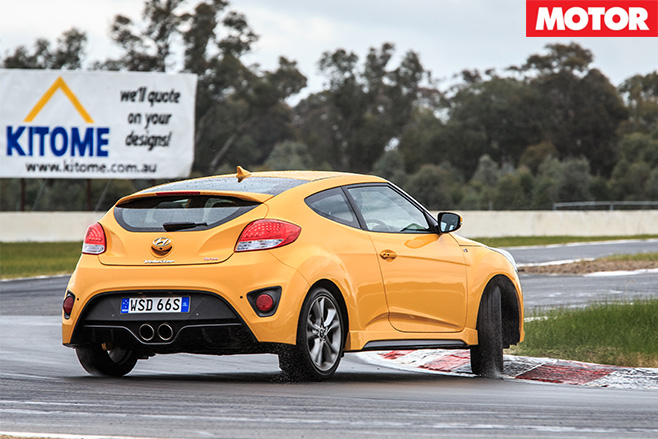
The only change under the bonnet is a $2500 option to have the 1.6-litre turbo four mated to a new seven-speed dual-clutch auto. Here, we had the carry-over six-speed manual that helps its Buck cause by dropping $3K to sit below $30K – at $29,990.
That does mean more bang for your buck even if the engine retains its outputs of 150kW and 265Nm. Still half-decent numbers, even if Peugeot’s 308 GT and 208 GTI 30th get more out of their 1.6L turbo fours.
It’s not the most refined engine under duress, though, and was one of the most prone to lag in our turbo-dominated field. And even a meaty mid-range struggles to help the relatively lardy, 1.3-tonne Veloster achieve greater velocity.
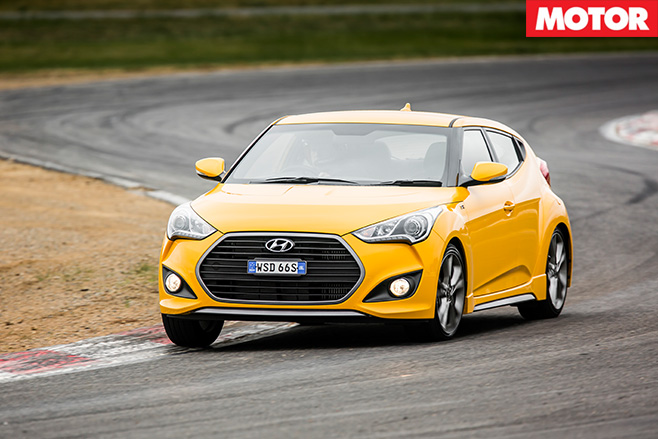
Expect more improvements to come, but for now the Veloster Turbo remains more visual than visceral.
0-100km/h – 7.38sec (10th) 0-400m – 15.28sec @ 148.21km/h (10th) Lap time – 1:47.3 (12th)
Overall Scoring
Index – 65.2 Price – $29,990 Bucks Index – 117.2 BFYB Index – 134.2
Judges’ Rankings
Campbell 12th – “It tries hard to thrill you. But ultimately it’s still pretty slow, and a bit dull.”
Morley 8th – “You can’t always see where money has been saved. You can here, though.”
Newman 12th – “A definite improvement; could be a good beginner’s track car.”
Spinks 12th – “Generates decent pace without quite getting the pulse racing.”
Luffy 11th – “It’s surprising how quick it was, but it was also disappointing that it misses mark when it comes to the basics. It doesn’t give enough feedback through the steering wheel, and it doesn’t feel like it wants to push on. It’s getting there, but it’s not quite a hot hatch. It’s missing the little attention-to-detail things, which puts it behind some of the other cars here.”
Personally, I have a few issues with the XR6 in a bang-for-your-bucks sense.
The first of these is the well documented driving position which, for somebody like me with a basketballer’s torso and a jockey’s legs, just does not work. And then, once I am in and sitting in what passes for a comfortable position, all that cheap plastic and old-fashioned trim starts to haunt me.
Not that the latter matters too much here at BFYB, but what does matter is that the Falcon just aint that fast. Oh, and there are no paddle-shifters for the tranny.
The motor is reasonably refined and it sounds pretty good, too, and, in fairness, it isn’t too shabby across the quarter mile with a 14.7. But in the bendy stuff, it ceases to impress. The big guy feels pretty vague on turn-in and while you know for sure there are wheels under you (as suggested by the lack of sparks and scraping noises) you’re a better man than me if you can tell where the front pair is pointing at any given time.
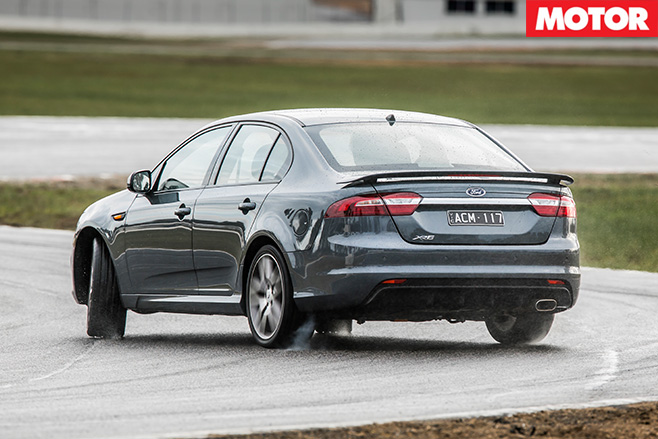
The proof of this is in the turn-five apex speed column, where the XR6 bobbed and weaved through at just 107km/h; down among the speeds recorded by the warm hatches. The slower turn-nine saw the XR6 punch through a bit closer to the pack, but still nowhere near the podium.
Another large part of the Falc’s problems lies in its brakes. Frankly, they’re rubbish in this context. There’s next to no feel and the pedal needs an almighty push to get things happening.
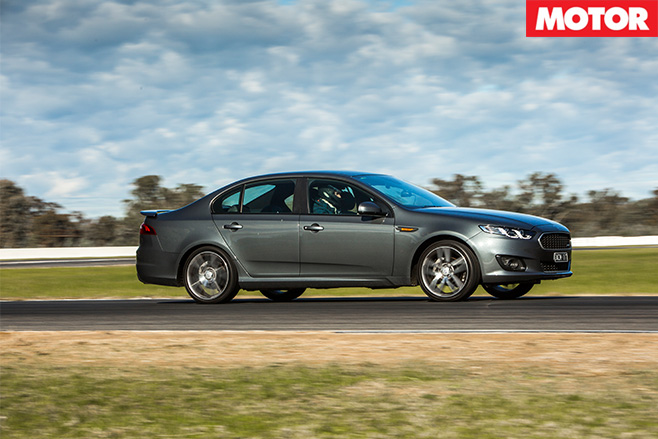
Okay, so with its muscled-up big-bro, the XR6T, in the same category mix, this was never going to be an easy mission for the XR6. And while it makes for an admirable road car, when push comes to Bang, the atmo Falcon emerges not as a high-performance five-seater, but rather as a very comfortable way to go not very fast.
0-100km/h – 6.66sec (6th) 0-400m – 14.78sec @ 160.10km/h (4th) Lap time – 1:47.1 (10th)
Overall scores
Bang Index – 74.8 Price – $36,090 Bucks Index – 97.4 BFYB Index – 128.0
Judges’ Rankings
Campbell 8th – “Feels confused to find itself on a track, but up for a play. Where’s the nearest Hertz?”
Morley 13th – “A comfy way to go not very fast.”
Newman 7th – “Love this thing. Not a track car but so balanced.”
Spinks 11th – “The lesser XR in theory but not so much in practice.”
Luffy 13th – “For a big car it does well around the circuit’s tight confines, but it lacks a bit of steering feel through the twistys. Ergonomically (just like the XR6T) you feel like you sit on the car and not in the car. So you don’t feel a part of the actual car, which detracts from the whole driving experience. It’s also too tall in its gearing for this circuit.”
My French is limited to just enough words to get me into trouble and not quite enough to get me back out again.
Peugeot’s relationship with ergonomics seems to be ringing the same bell. Wouldn’t matter, for instance, how clear and concise the 308’s gauges were, because most people, from their normal seated position, can’t see ‘em.
That’s thanks to that must-be-French arrangement that places the dials right behind the tiller. Oh, and the backwards tach? Didn’t work in the Aston V8, didn’t work in the Bertone X/19, so why does Peugeot think it’ll work here? C’mon…
Thigs didn’t improve for me once I’d fired the GT up and ventured beyond pit-wall. We just didn’t get on. I returned to the pits grumbling. It was young Newman who reckoned I was being harsh.
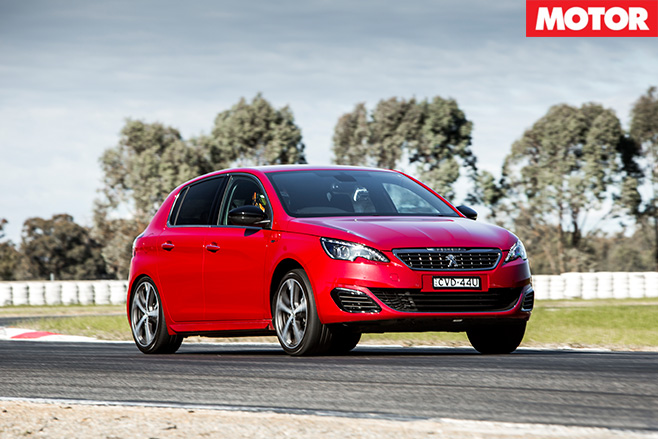
The numbers, just for starter, don’t paint a real rosy picture. Nought to 100 takes 7.7 agonising seconds (the Citroen is quicker for Pete’s sake) and the 400m consumes 15.5 valuable ticks. Terminal velocity tells the sorry tale, too; just 149.9km/h at the end of those 400m.
So was it any better around the corners? Yes, actually, and its speed through the sweeper was a further-up-the-field 108km/h. Not great, not terrible. But here’s the big surprise: Through the slow Turn Nine, the 306 GT was the fastest car under 50K at BFYB this year. Say again. Yep, way faster than anything else in its category.
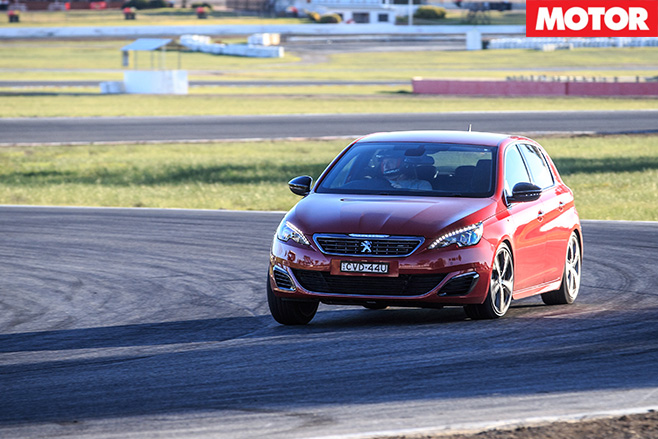
But I’m sticking to my original guns for the most part. The controls are definitely a bit light and I could use a bit more feel through the wheel and pedals. In fact, not knowing how hard to hit the picks at the end of each straight was the main concern and the thing that prevented a flowing lap. And, as such, judging entry speed became just as hit and miss. Sometimes I got lucky, sometimes I didn’t. The statement that Luffy didn’t have this problem is balanced by my assertion that your abilities are probably closer to mine than they are to W. Luff’s.
0-100km/h – 7.70sec (12th) 0-400m – 15.50sec @ 149.40km/h (11th) Lap time – 1:2.90sec (=7th)
Overall Scoring
Bang Index – 80.6 Price – $41,990 Bucks Index – 83.7 BFYB Index – 123.1
Judges’ Rankings
Campbell 10th – “There’s talent in there for sure, but it certainly errs closer to planted than playful.”
Morley 11th – “Please don’t let the 308 GTi be this with more poke.”
Newman 9th – “Not fast, but engine’s keen and chassis is foolproof.”
Spinks 10th – “Not a bad steer, but leaves plenty of room for GTi version to occupy.”
Luffy 8th – “It’s really well balanced on the limit and it gives a lot of feedback. It’s probably a little bit soft when changing directions, and there’s a lot of wheelspin on the inside front, but it’s very direct in its steering. It has really good brakes and it’s good over the bumps. It’s just a nice all-round package.”
