
Most cars in the Bathurst 12-Hour field would stop traffic if parked on your street. There is nothing quite like watching them battle on Mt Panorama.
IT’S SOMEWHERE around lap 163 that you find yourself checking not just your watch, but your reality.
The motor race has just passed the 1000-kilometre mark that is so familiar to this place, yet this race is only just past its halfway mark. And it’s not yet midday.
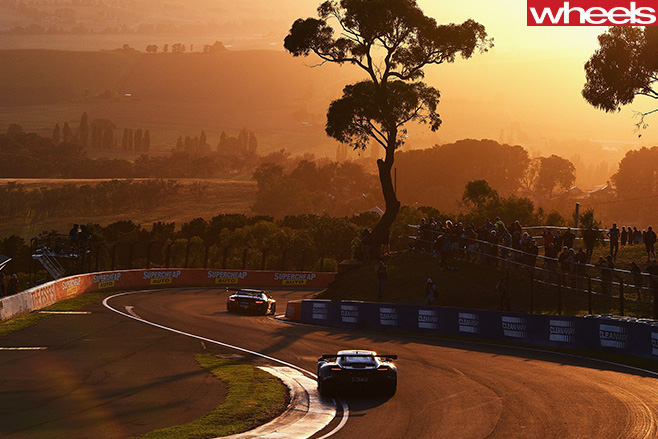
After the conclusion of this year’s Liqui-Moly Bathurst 12 Hour yesterday, these international GT3 cars are now officially the fastest things on Mt Panorama. Sensational Kiwi star Shane van Gisbergen (McLaren 650S) electrified the mountain in Saturday’s qualifying with a 2m01.286.
Only German star Rene Rast (Audi R8 LMS), a late replacement for injured 12 Hour regular Craig Lowndes, and “amateur” ace Warren Luff (McLaren 650S) also dipped into the 2m01s, in a session that suggested times had moved on by up to 1.5 seconds in just 12 months.
The 2015 race winning Nissan GT-R, this year piloted by Rick Kelly/Katsumasa Chiyo/Florian Strauss, could qualify no better than 13th this year, 10 places down on its 2015 grid position.
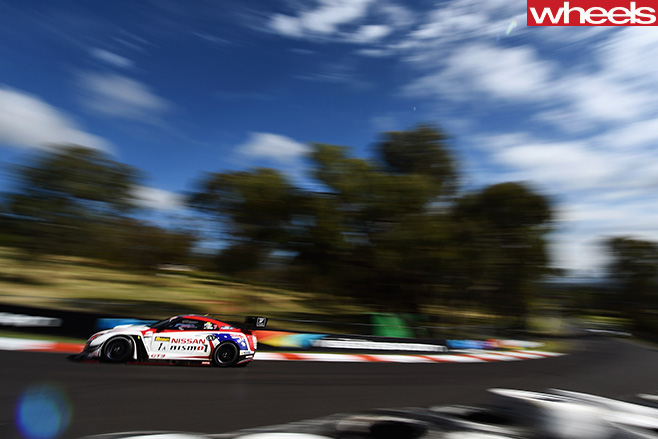
Such disparate cars and configurations are brought together under a “Balance of Performance” that adjusts factors such as inlet restrictor sizes, kerb weights and aerodynamics to keep competition tight.
The car that claimed the highest top speed on Conrod Straight, at 306.5km/h, was none of these exotics but the Australian-made, 1965-throwback, Daytona Sportscars Coupe.
The pro-am nature of the GT category, in which an unseeded driver must be included, has also evolved at the three-driver Bathurst biggie. Typically, in the past a gentleman car owner would be joined by two paid pros.
Now, increasingly, a pro team will own the car and hire two pros and an amateur – the latter of the calibre of a Luff, or Jonathon Webb (partnering van Gisbergen) or Alex Davison. Indeed, there were probably as many international drivers as locals in this year’s race.
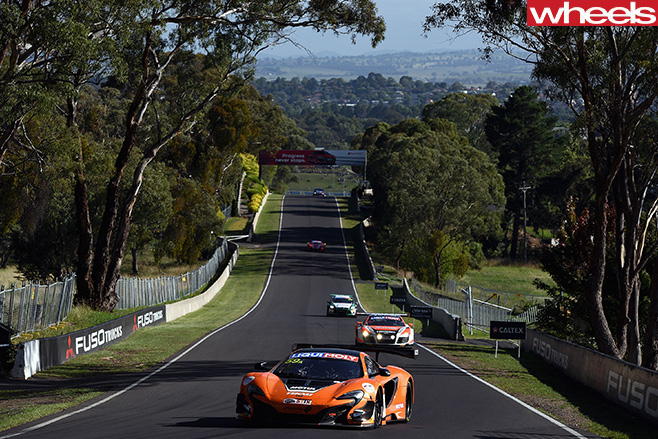
Former F1 driver and 2014 winner Mika Salo (Ferrari 458) was a very early casualty, tangling with Nick Percat (Lamborghini Gallardo). As special as the headlamps coursing over Mt Panorama was the glowing approach of the 6:30am sunrise over the twinkling township of Bathurst.
But it’s all about the cars. At the one-hour mark, not long after sunrise, five marques accounted for the top six places, namely McLaren, Mercedes, Audi, Bentley and Nissan. Van Gisbergen laid down a stonking 2m.01,56 lap – quicker than anyone else had managed in qualifying – setting a new lap record. Luff’s stirring run in third place, highest Michelin-shod driver in a Pirelli vs Michelin stoush, ended when he clouted the wall at the Dipper.

The van Gisbergen/Alvaro Parente/Jonathon Webb McLaren, meanwhile, had been through the wringer, at one point even cutting out completely on Pit Straight. Parente somehow Ctrl-Alt-Deleted and the McLaren reignited, like nothing had happened. Best-laid plans of various teams went awry through a record 13 pace car periods.
After a similarly unlucky 13 pit stops, more than any other car in the top 10, the race would belong to the McLaren and the Kiwi driver whose motto is ‘race anything’. It was a hugely popular win, in front of a claimed three-day crowd of 37,000, a 15 per cent increase on 2015.
That’s owed in no small part to the event’s now being promoted (rather than boycotted) by the V8 Supercar organisation.
GT: Cool Giz does the biz at Bathurst
AN ON-TRACK stop and re-boot, and a cruel penalty for speeding in the pit lane, failed to steal away a stunning victory for McLaren in yesterday’s annual Liqui-Moly Bathurst 12 Hour sports endurance race.
Shane van Gisbergen, Alvaro Parente and Jonathan Webb scored a deserved victory for the British marque at Mount Panorama.
Kiwi van Gisbergen heightened the excitement in the closing laps by managing the gap to the hard-driving Katsumasa Chiyo in the Nissan GT-R, showing a sense of theatre by allow the Japanese to close to with 1.2s at the flag.
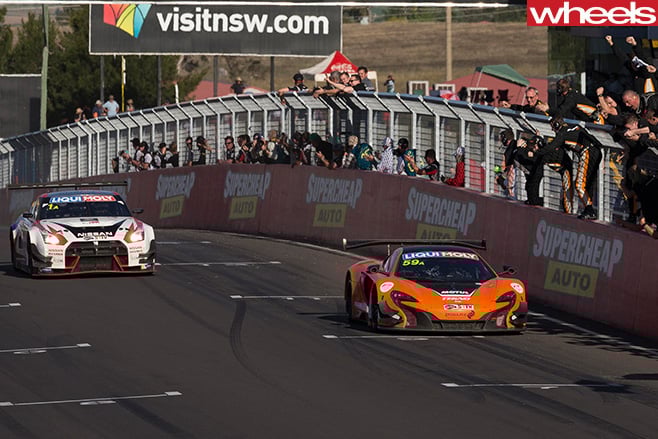
“I had a good agreement with Garth [Tander] and Luffy [Warren Luff] in the morning that we would just cruise along and then after three laps we would start pushing once it was all up to temperature. Then some Euro kid came along flashing his headlights. So it was cool, started pushing but there were kangaroos coming out and there were warnings every lap so, I am a Kiwi and I am not used to that either, but it was cool.”
A cool, awesome race for the winner then.
Denied a repeat Nissan win, Chiyo, Rick Kelly and Florian Strauss nevertheless fought tenaciously for second with Bentley Team M-Sport’s Matt Bell, Steven Kane and Guy Smith, who finished third.
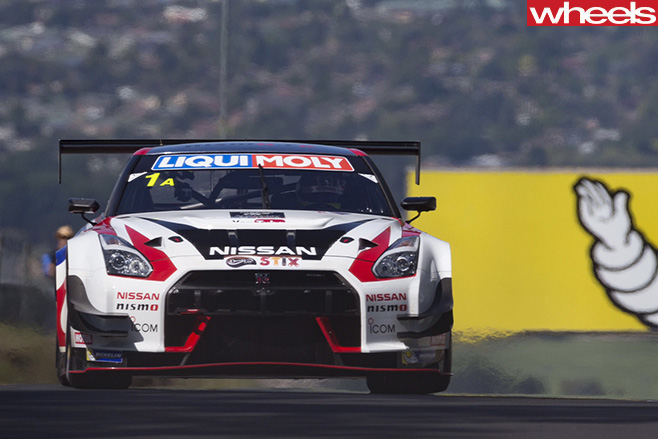
Twenty of the 36 starters made it to the end, but only four remained on the lead lap. Nick Percat (Lamborghini) and Mika Salo (Ferrari) clashed on the opening lap at turn two, Finn Salo scathing of the local’s driving. The Lambo was out instantly while the 2014-winning Ferrari was parked after 63 laps.
The Jamec Audi crashed after a tyre failed and the Objective Racing McLaren slammed the wall at the dipper after just two hours.
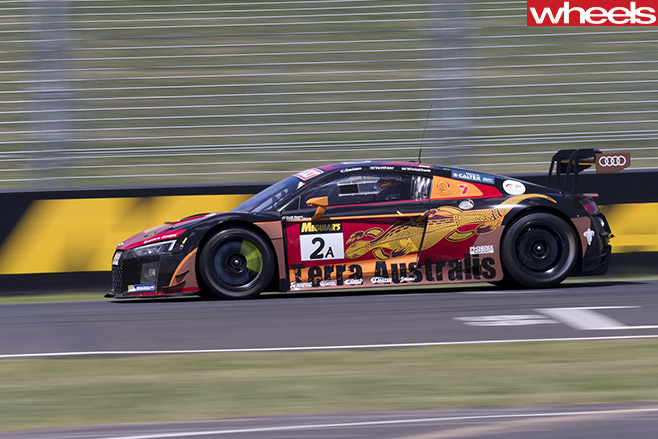
Five brands finished in the first five places, with an Audi R8 and an Erebus Mercedes SLS completing the first fistful.
The winning McLaren suffered a very modern computer glitch when it stopped on track exiting the circuit’s final corner. Portuguese driver Parente was forced to re-set the car while his team-mates looked on anxiously, before resuming.
The bigger blow came when van Gisbergen was hit with a drive-through penalty for pit lane speeding when he began his final stint. Tellingly though, van Gisbergen did not go a lap down. Sensible strategy and help from safety cars – and fast lap times – returned the #59 car to the front.
Van Gisbergen also recorded a new outright lap record of the Bathurst circuit at 2m01.567s – the fastest ever recorded in a race at the famous circuit.
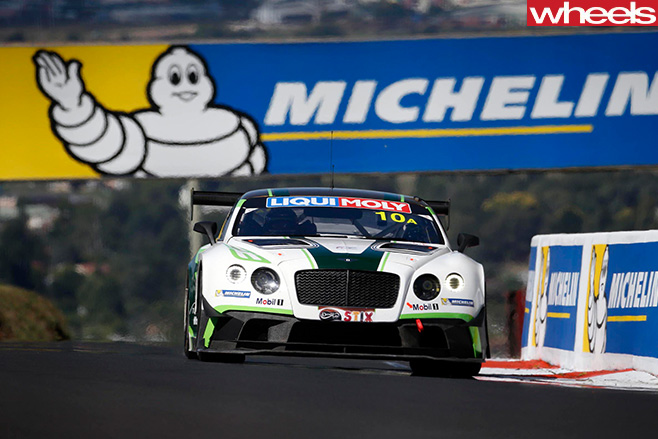
On a weekend of records, the leaders set a new high mark of 297 laps (1845km) completed and there were also a record 29 lead changes among eight cars.
The Grove Porsche 997 GT3 Cup car , shared by reigning Le Mans winner Earl Bamber, V8 ace Scott McLaughlin and car owner Stephen Grove, started slowly but surged to the class lead early in the morning and was never headed – ultimately winning their class by a mammoth 15 laps.
All-Aussie team MARC Cars Australia completed a 1-2-3 sweep of the BM Pro Invitational class with Aaron Seton – son of Glenn Seton – teaming with Jake Camilleri and Morgan Haber to win the class by nine laps.
Rick Kelly loved his experience in the “other” Great Race and was more than captivated with team-mate Chiyo’s ability in the Nissan GT-R. “…at the end his pace was quicker than what I got out of the car during qualifying which shows the cars capability and Chiyo’s capability. I don’t’ think there would have been another hundredth in the car to what he got out of it. I think we need to check the mirrors for some paint he was that close in some places which is really impressive. The high risk places around here he has nailed and same for the low risk…he definitely has the track under control, and I think that goes for a lot of the field,” Kelly said.
“You look at how strong a lot of the really great teams are from overseas and drivers from overseas – they come here get the track nailed pretty quickly.
“So I think it really opens up our eyes to drivers overseas for the 1000 here in October because the quality of driver internationally is outstanding and now they have experience at our home track so they could certainly be assets for us in the future.”
Sounds like Chiyo-san has a Bathurst 1000 gig in October…
F1: Circuits are the new punching bag
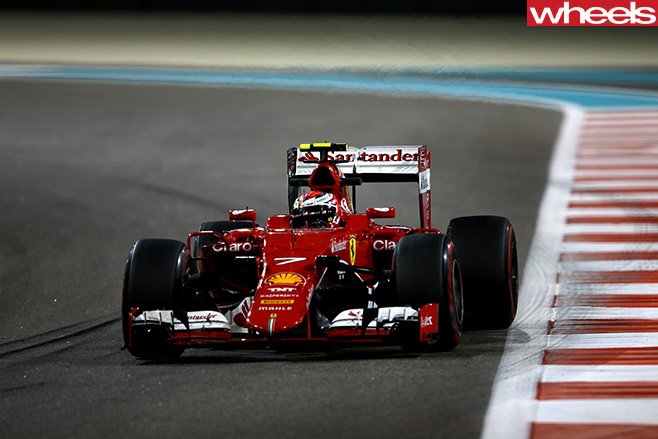
Here’s another: today’s circuits are too sanitised and lack the character of the much-missed older venues.
Kimi Raikkonen is the latest to lament having to race on the newer F1 circuits laid out by Bernie Ecclestone’s favourite track designer, Hermann Tilke, the candid Finnish star tossing in a postscript that he misses Imola, Magny Cours and other venues discarded from the calendar.
The modern circuits have copped a panning from more experienced drivers and long-time followers of the sport bemoaning their lack of character.
Raikkonen has described many of the newer tracks as being “made up of Tilke corners”.
Tilke created Austria’s A1 Ring, Sepang, Bahrain, Shanghai, Singapore’s Marina Bay Circuit, Abu Dhabi’s Yas Marina Circuit, Austin’s COTA and Russia’s Sochi Autodrom.
He was also responsible for venues that came and quickly went from the F1 calendar – Istanbul Park, the Valencia street circuit, Korea, and India’s circuit. Tilke was also involved in the creation of the forthcoming Baku City Circuit, which will host the first Grand Prix of Europe to be held in Azerbaijan in June.
One of the more experienced drivers on the grid, having made his F1 debut back in 2001, Raikkonen’s career span has seen him witness the demise of more traditional circuits on the schedule, including Magny-Cours, Imola and the Nurburgring.
Raikkonen isn’t about to bite off the hand that feeds him but he is honest enough to suggest the modern new venues carry the unmistakable stamp of Ecclestone’s designer du jour, Tilke.
“When we go to a new track, we know what to expect,” he told Finnish publication Turun Sanomat. “They all look the same. There are no trees or anything else in the landscape. Of course, each track is always a little bit different, and each corner at the track is a little bit different, but ultimately the new tracks are made up of Tilke corners.”
Raikkonen took particular aim at the Korean International Circuit, no longer hosting a grand prix, labelling it the worst of the venues.
He did suggest that another Tilke design, the Istanbul Park circuit, home to the Turkish GP between 2005 and 2011, was a “nice” track.
Of course, Ecclestone has priorities other than satisfying race drivers. Character and the driving challenge are not keys. Most important is the promoter’s ability to pay the fee for the circus, followed by facilities for the VIPs…
F1: Magnussen in at Renault, Maldonado out
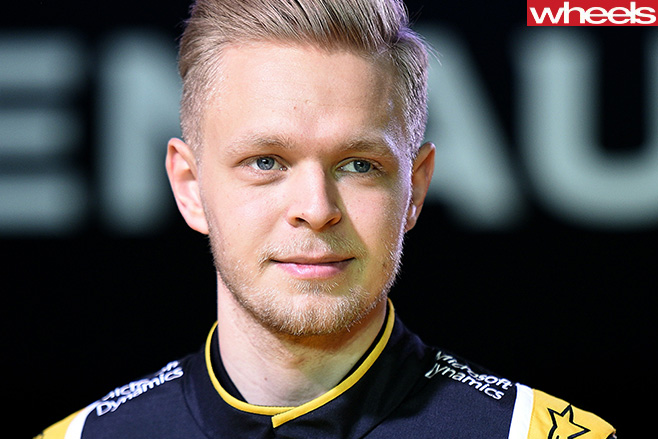
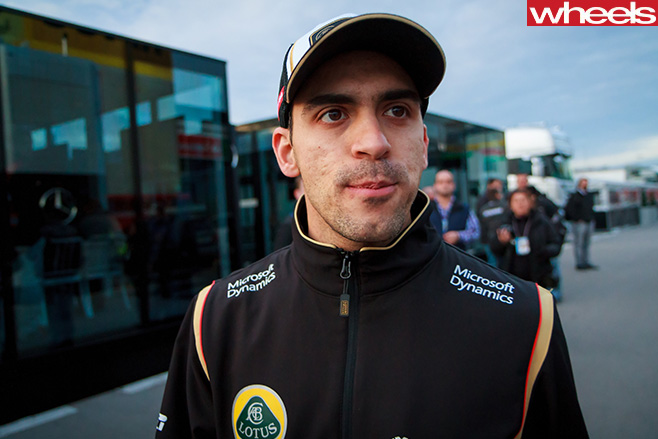
The late conclusion of Renault’s deal to return to F1 with its takeover of Lotus at first appeared to mean it would be forced to inherit two already signed drivers, Jolyon Palmer and Pastor Maldonado, who were a long way short of the pace and experience needed to return the French marque to glory.
Palmer replaced the much improved Romain Grosjean, who – rattled by the uncertainty over the team’s future – grabbed a slot at start-up squad Haas. Maldonado’s deal including bringing Venezuelan oil money in abundance.
Palmer could develop into a good driver but Maldonado’s record of crashing, with a career highlight of a single F1 win, was hardly inspiring for the Renault people and their hopes of returning to competitiveness with their own full factory team.
But just when it seemed Renault would need to wait at least a year to grab a proven star to lead the renaissance, the perfect legal reason to dump Maldonado emerged when the oil sponsor money was late.
Magnussen will be ultra-keen to seize his chance this time around after recent shabby treatment from McLaren. His brief career has been a roller coaster ride. He scored a podium on debut at the Australian Grand Prix in 2014 but was relegated to test/reserve driver status for 2015. Then he was unceremoniously fired last October. On his birthday.
Magnussen was concerned that he may not be given another chance. But opportunity and timing are often bedfellows in motor sport. The McLaren sacking may well be the best thing to happen to Magnussen if the Renault car proves to be reasonably fast and reliable – things the McLaren Hondas are not.
Magnussen’s brief previous stint in F1 showed fleeting promise. If nurtured properly, he could be on the road to redemption, dragging Renault along too.
UTES: Changes reflect harsher realities
THE iconic Australian V8 Ute Series has been stirred and shaken by a structural change for the 2016 season. Fear not, though: it will be back this year.
Australian V8 Ute Racing Pty Ltd, the company which represents the 16 Ford and 16 Holden shareholders competing in the series, will be voluntarily wound up, effective immediately.
This will allow a new entity or structure which effectively releases the 32 current shareholders from the sometimes crushing financial obligation to compete at every round of an eight-round series
“The commercial market has tightened significantly over the past 18 months,” explained Australian V8 Ute chairman Peter Henry. “It’s clear that all 32 shareholders are not in a financial position to compete in 2016 and a number have asked to be released from their current obligation. The only way we can release shareholders from the company structure and the obligation to compete at every round is to effectively voluntarily wind up the current structure.”
The category is working with CAMS on the handover of the Category Management Agreement and to secure a sustainable model that will see the series continue as a key support category to V8 Supercars in 2016, without the need for all 32 shareholders to commit financially to the category and turn up at every round.
INDY 500: Matt Brabham cranks up Aussie assault
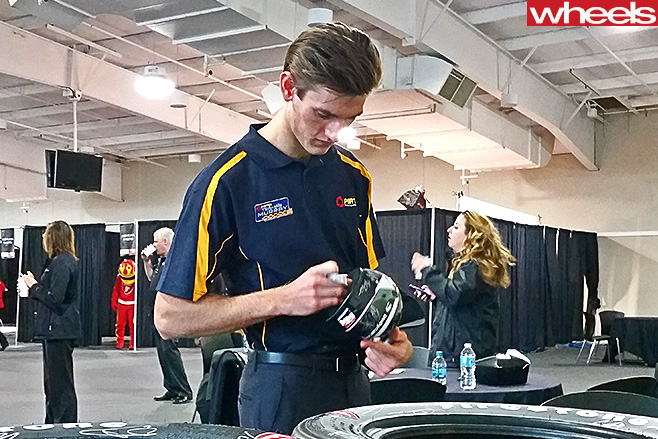
The embryonic PIRTEK Team Murray’s driver was introduced as part of 2016 IndyCar Series field although at this stage only his start in the Indy 500 has been confirmed.
At the Indianapolis Motor Speedway, Brabham participated in numerous interviews with the IndyCar press corps as well as having his official medical to ensure he was fit to take part in the race.
The entry of Brabham into the 500 under the PIRTEK Team Murray banner has created a great deal of interest both in Australia and in the USA, where he was born. His is a big media story in light of the family history at the Brickyard, where his father Geoff and grandfather Jack are fondly remembered.
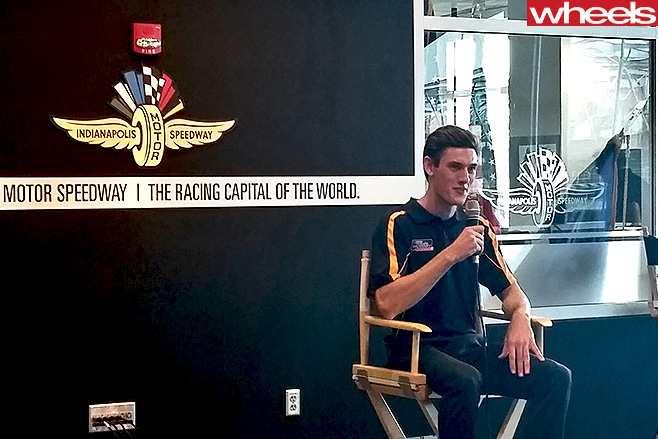
Following the official launch, he attended a dinner at the home of Mark Miles, CEO of the Indianapolis Motor Speedway.
The 500 Rookie also took part in his first full IndyCar driver briefing on Wednesday as part of the pre-season gathering.
Brabham senses momentum is building for the 100th 500 and now feels he is well on the way to drive in the greatest race on the planet.
“There was a lot of talk among everyone about the 100th race, the connections involved and the history of the Indianapolis 500,” said Brabham.
Sir Jack Brabham started the Indy 500 on four occasions and Geoff Brabham competed in 10 of the 99 races held so far.
GT: Walkinshaw Group expands to Porsche
FOLLOWING its reduction in V8 Supercars entries to two HRT cars for 2016, the Walkinshaw Group has continued its different business focus with a decision to enter the latest Porsche 911 GT3 R in the growing Australian GT category.
The Walkinshaw-run Porsche, an outright contender in the category internationally, will arrive here in the coming months with drivers yet to be named.
Owner of the Walkinshaw Group Ryan Walkinshaw said Porsche’s history in endurance racing was unrivalled and he believed there was no better partner to be allied with.
“The GT3 category has enjoyed much success globally and is at the forefront of motorsport around the world – we are looking forward to being a part of that as a factory supported team,” Walkinshaw said.
“My family has a rich history in endurance racing and under the Porsche brand the Tom Walkinshaw Racing (TWR) designed Porsche WSC-95 won Le Mans 24-hour races in 1996 and 1997.”
Welcoming the Walkinshaw involvement with the new Porsche, spokesman for Porsche Cars Australia Paul Ellis said: “It is critical for Porsche to have a strong presence in GT racing in Asia Pacific beyond the already successful one-make Carrera Cup championships in the region.”
Walkinshaw Group is looking to build on its previous racing success, having won the 2014 Australian Rally Championship with Scott Pedder at the wheel.
The Goldilocks zone is the precious distance from which a habitable planet orbits its sun.
Too close and you’ll sweat like you’re wearing a vest of cocaine in an Indonesian airport. Too far, and she’s a bit cold. Give us the middle, the 20-degree bit, thanks. Cars are the same.
A Toyota 86 is a little undercooked to some, while a Koenigsegg One:1 could be too hot to enjoy; not that I’ve driven one, but 1000kW and rear-drive doesn’t earn you a hall pass around the laws of physics. Some, too, find a base 911 Carrera a little vanilla while a 911 Turbo too much. Enter GTS – the Goldilocks 911.
It’s basically a Carrera S with a grind of pepper and some make-up. Breathing mods like a more aggro intake cam and tweaked inlet ports extract an extra 22kW from the 3.8-litre flat-six, power now 316kW, although torque is unchanged at 440Nm.
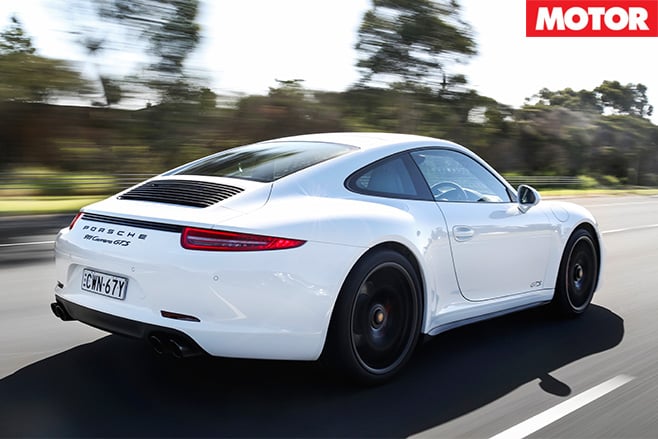
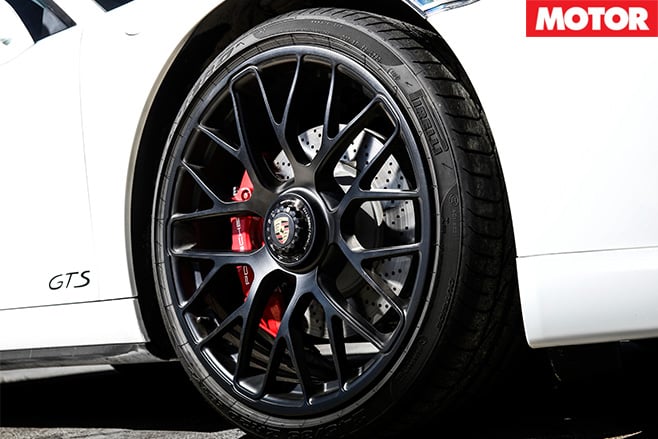
Meanwhile out back, mega 11.5-inch-wide rear rims wear 305/30 Pirelli P-Zeroes. The GTS, too, uses the widebody from the Carrera 4, so those hips, which wouldn’t look out of place in Zoo Weekly, are 44mm wider than a Carrera S. Rear track, too, is also 44mm wider, lending the GTS a mega stance and making it one inappropriately gorgeous 991 911.
The extra engine paprika means the manual GTS is a bee’s dick quicker than the manual Carrera S. Porsche claims 0-100km/h in 4.4 seconds, 0-200km/h in 14.3sec. A manual Carrera S does 4.5sec and 14.4sec. But both are slower than their PDK equivalents; the PDK 911 GTS does 4.0sec and 13.5sec, obviously helped by launch control.
Never mind, though, because the gearshift in the manual GTS, which Porsche recently tweaked, is beautifully accurate and mechanical, although for lovers of buttery gearshifts, it does feel like it’s been lubricated with graphite powder rather than grease.
The GTS’s driving position, like all 991 911s, is literally perfect, with generous room for limbs, great visibility and uncomplicated ergonomics. The seats are firmly padded and flawlessly sculpted, and the interior drips in Alcantara (that said, our test car did have $17K of interior options).
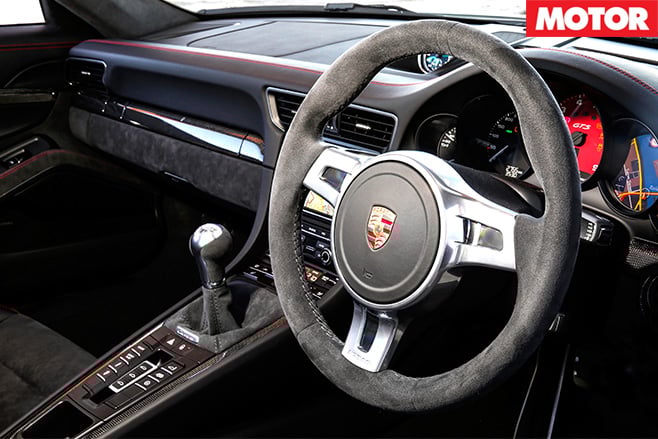
Meanwhile the ride for a sports car is excellent. The GTS feels softly sprung with a buoyancy over big bumps tempered by buttery damping. There is a firmness, sure, probably due to the fact you’re on 30-profile tyres and 20-inch wheels, but the ride is perfectly comfortable for the daily grind.
Unfortunately, on a 100km/h Aussie road (where you’ll be seeing just 1900rpm in seventh gear) those big Pirelli P-Zeroes penetrate the cabin with roaring road noise. Fortunately the stereo makes a nice sound. But the exhaust is even nicer.
The gears in the GTS, like the Carrera S and other Porsches, are crazy tall. First gear, at 7800rpm, is 75km/h. Top of second is 130km/h. Top of third, your licence will be shivering in your wallet. But despite pinching gears from the Starship Enterprise the 911 GTS pulls through them with a powerful and satisfying thrust. She’s fast.
There’s incredible, almost unbelievable grip, too, on the road. Owing to tremendous suspension performance, the 911 GTS is spooky in that the faster you barrel into a corner, the more grip is magically revealed. After taking one corner at what feels like seven-tenths, you bowl through the next at what logically should then be eight-tenths.
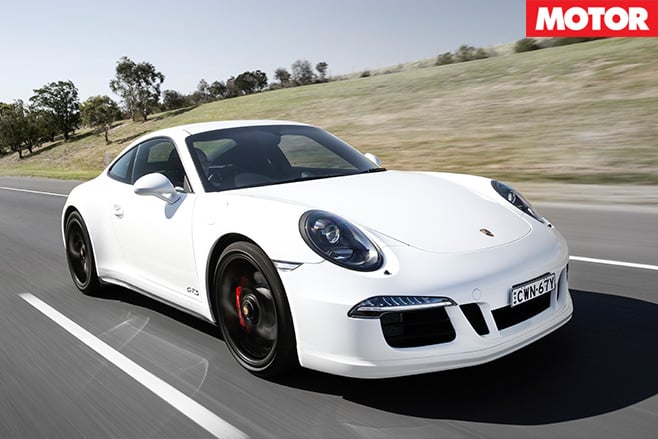
On the road, the 911 GTS is easy to drive fast but its ultimate limit is positively stratospheric and requires skill, and balls, just to kiss, let alone dance around. At this point, you are going seriously, seriously fast and if you hit an unexpected slick of gravel mid-corner, you’re in big trouble. And you can’t help but feel aware there’s several hundred kilos in the boot.
The GTS, like other 911s, is not a car in which you suddenly double brake pressure as a fast corner tightens. You need to put this thing on a track to properly, and safely, appreciate its on-limit behaviour.
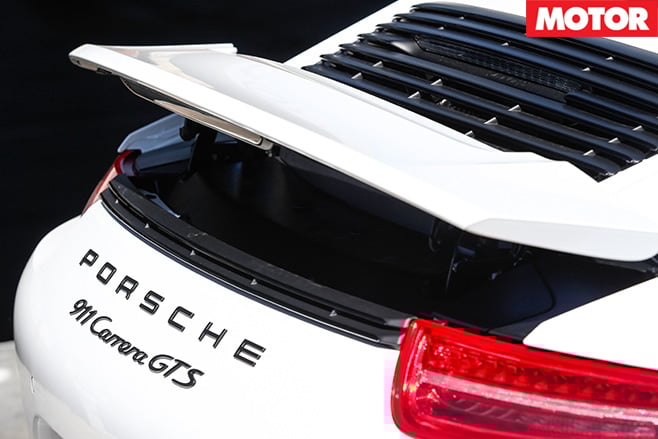
The engine is a total sweetheart anywhere on the tacho. If you want to go full throttle in seventh gear at 40km/h, the engine will groan, and wonder what the hell you’re doing, but it’ll haul without fuss or splutter.
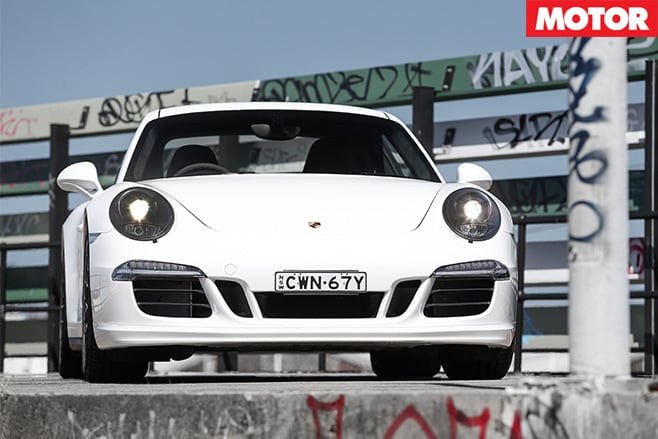
And we’re so glad, and lucky, it exists, because god knows the days of the naturally-aspirated, manual 911 are severely numbered.
5 out of 5 stars
Specs
Engine: 3800cc flat-six, DOHC, 24v Power: 316kW @ 7500rpm Torque: 440Nm @ 5750rpm Weight: 1425kg 0-100km/h: 4.4sec (claimed) Price: $268,700
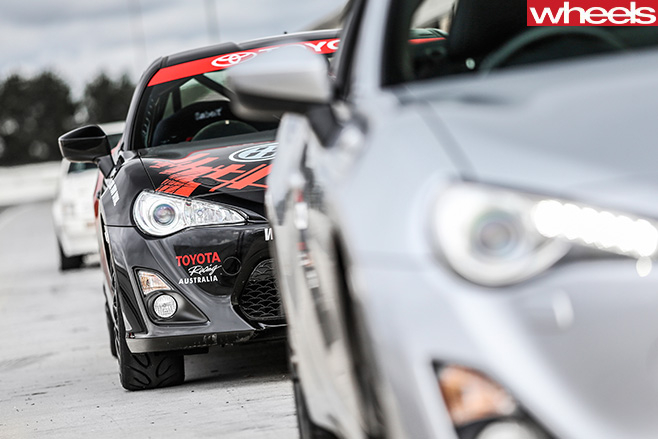
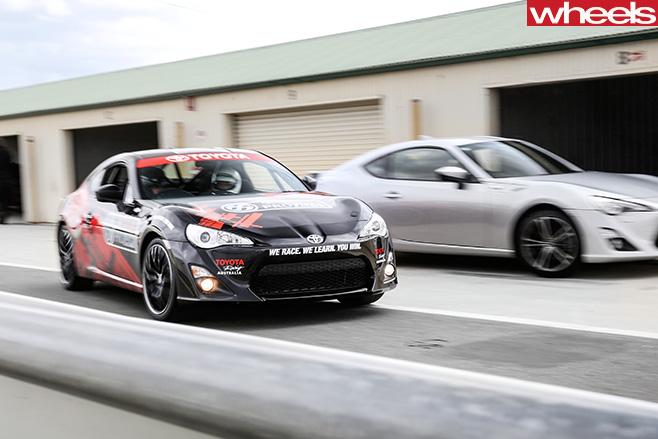
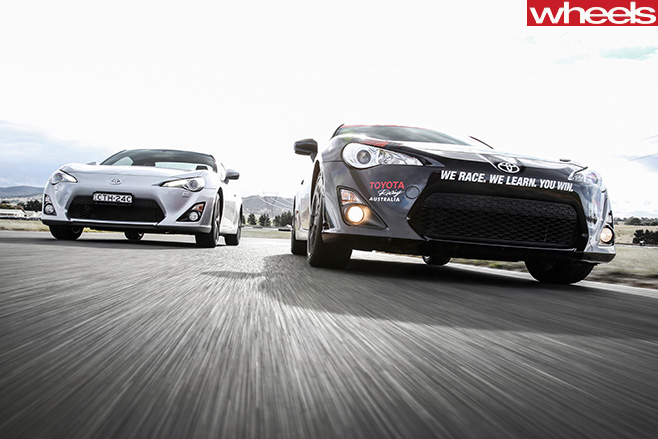
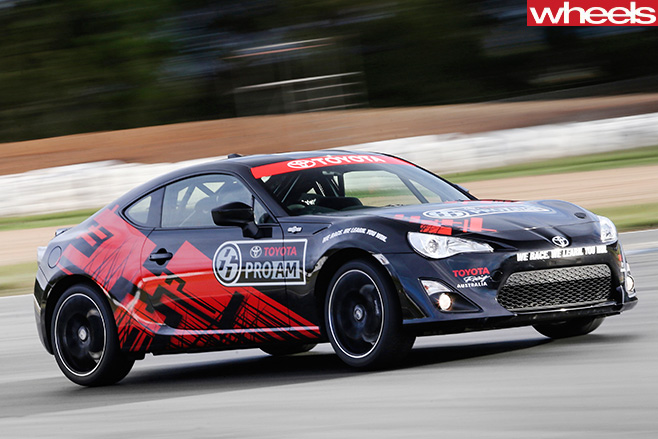
Toyota is transforming its 86 sports car into an affordable track weapon for a one-make series in 2016. We pit the road car against the racing 86 to see if it’s earned its stripes.
MOTORSPORT is an addictive and often scarily costly beast. Not everyone can be a member of the lucky sperm club. The wannabes have gotta think smart; seek out the dollar-effective paths to places where the budding racer can holler: “Look at me, I’m bloody good.”
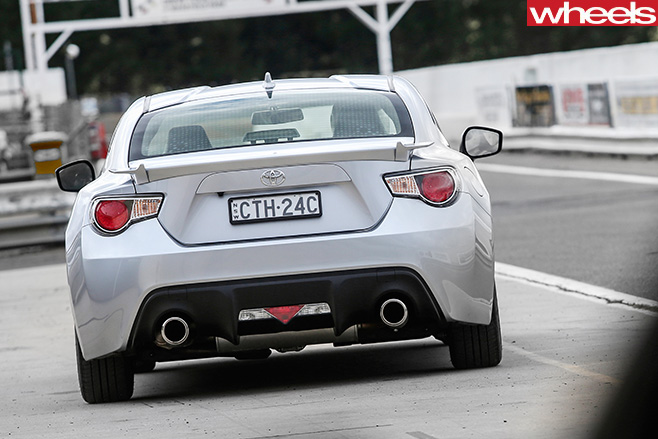
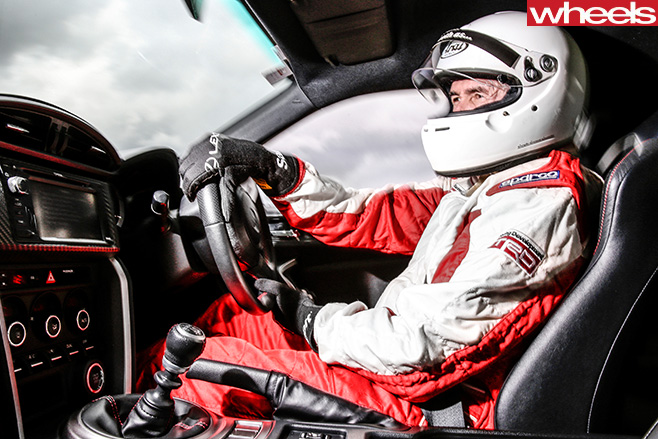
We’re at Wakefield Park Raceway, where the engineering team led by champion driver Neal Bates is finalising the control specification for the 86 coupe to be used in next year’s Toyota 86 Racing Series. My mission is to compare the standard road-going Toyota 86 GTS with the prototype race car. How great are the differences? The series surely has potential, but will it interest the talent-spotters?
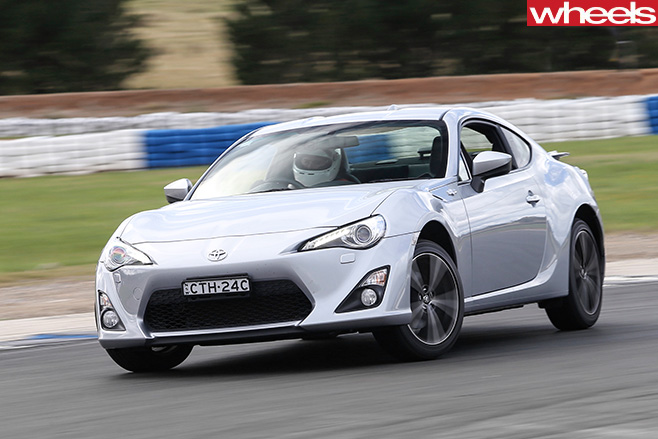
The road car’s weak point on the track is its standard rubber. Turn in too aggressively and the fronts lose adhesion and that legendary balance is replaced with understeer, at least until grip returns and you can use the throttle to kick out the tail and aim the 86 where you want it to go. The lack of torque (which peaks at an almost ridiculous 6600rpm) is noted. The engine is raspy and reasonably keen but the chassis could clearly handle much more from under the bonnet.
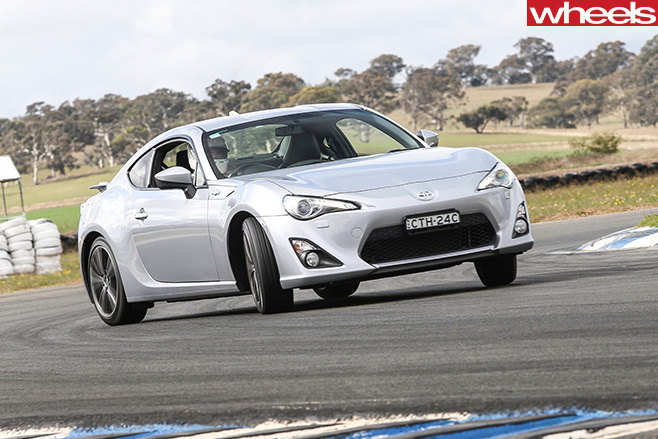
Now for the race prototype. I’m looking forward to this. It’s been too long since I’ve grabbed the wheel of a proper track car.
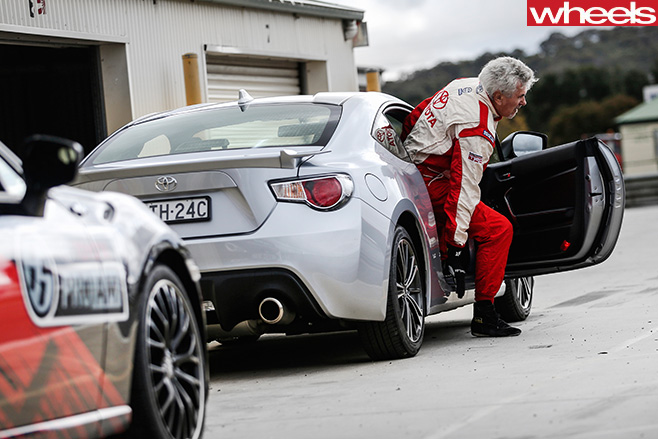
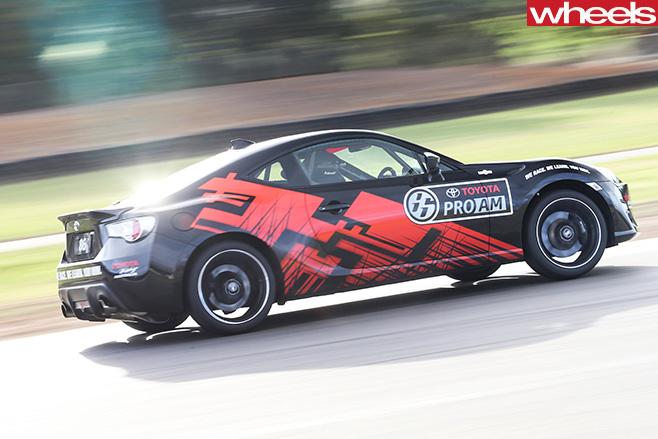
Immediately I’m impressed by the extra urge, and on the fly it’s loud yet pleasant. The introduction of Motec M150 ECU mapping (which also includes enriching the mixture to better protect the engine) and the mods from the manifolding back have upped the grunt and response. It’s no rocket, but energetic enough for a production-based racer, with dynamics and grip to match. It’s certainly more nimble than a V8 Supercar; maybe more like a Mazda RX-7 of the Group C era.
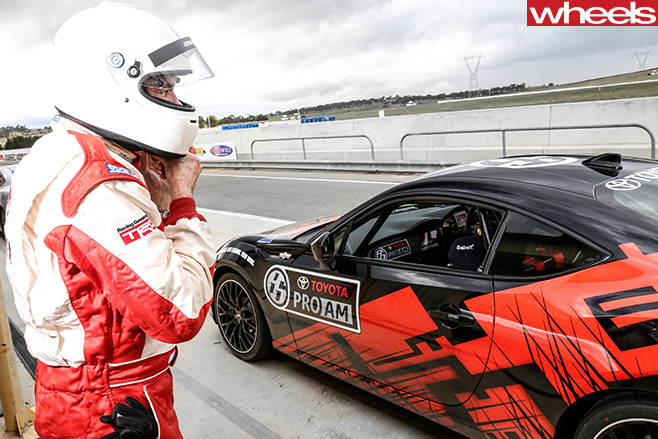
And I’m loving the aurals. Curiously, though, the 86 racer doesn’t sound much like it’s got a horizontally opposed engine, even though it retains the production 2.0-litre Subaru flat-four. Thanks to equal-length header design exhaust and a natural resonance, the noise from the pipes is like a bizarre, distinctive mix of rotary and upright piston engine. The race car engine doesn’t discharge that characteristic offbeat exhaust throb. It positively howls. A full herd of racing 86s should lift grandstand roofs.
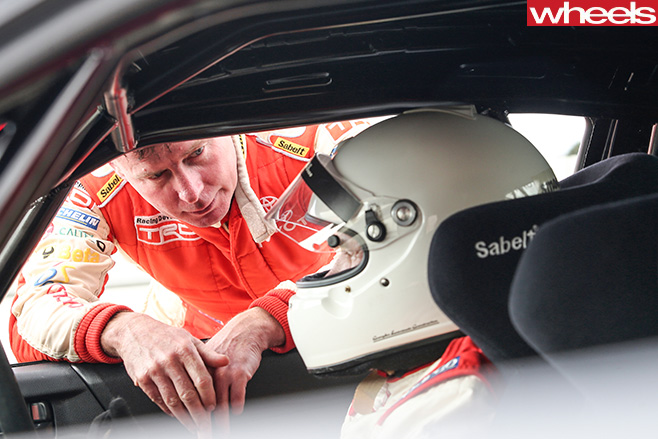
“We want young drivers to learn a lot from the series and not go broke doing it,” explains Neal Bates, who is responsible for the development work. So no force-fed engine mods that would generate lots more power and torque but put unnatural stresses on gearboxes. Instead, the modifications gel sweetly, each contributing in an honest way to a faster, still reliable machine true to its engineering philosophy.
Changes to the suspension (strut front and coil-over rear) are minimal because the standard 86 handles sweetly, but enough to leave the impression that this is a serious track machine. Massaged to suit the modded 86 chassis and attendant roll cage, plus race-spec tyres and brakes, the mandatory handling pack (less than $3000) sourced from MCA Suspension includes stiffer springs and adjustable dampers with 13 positions for bump and rebound. Front camber is driver-adjustable, with a setting of just above three degrees likely to be the popular pick.
Tyre choice was always going to be a crucial element in the race package; the standard Michelin, a competent all-rounder on the street, would not last long on a track. Back-to-backing a selection of different brands has taken much of Bates’ track time and head space. A tyre with predictable yet modest grip levels would put the emphasis on smart driving. Overdriving would usher in mistakes, making overtaking easier. Slicks were ruled out for these reasons, plus the prospect of grippier rubber provoking wheel bearing issues.
I like what I’m feeling from the brake/suspension/tyre package, and in particular the Dunlop rubber. Yes, it does give up if you get too ambitious at turn-in or with the throttle, but I’m not working the steering as vigorously as with the production 86, and the sliding is not as flamboyant. It’s easier to get an easy, metronomic rhythm going.
Data taken from both cars confirm our seat-of-the-Calvin-Kleins impressions, even with the occasional light sprinkle of rain perhaps affecting our scientific rigour. While the Motec data logger has reduced an exciting, instinctual and raw experience – that of driving a race car as fast as possible – into a mass of crazy, confusing, wriggly lines, engineer Stephen Dean magically turns them back into a meaningful story.
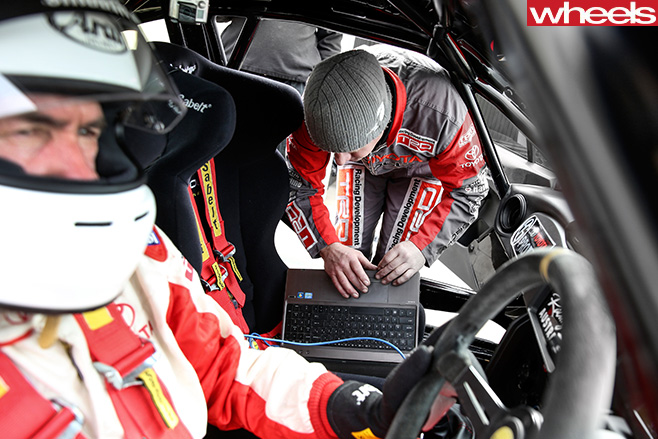
“Throttle pedal traces for the road car show you had to wait longer to get on the throttle exiting corners, with more corrections needed to balance wheel slip, and that you had to lift off earlier into the corners,” he explains. I nod knowingly, managing a sadly inept job of hiding a look of incredulity. “Average throttle position for the lap in the road car is 63.5 percent, and the race car is 76.5 percent – a large difference around such a short 2.2km track with few straight sections.”
Because it powers-up faster with better traction, this translates into higher terminal speeds on the straights, with the enhanced braking allowing the driver to stomp the pedal later and harder than in the road car. Data analysis reveals the race brakes retain their consistency for longer than the road car’s. Both cars appear to be activating the anti-lock system.
The race 86 is 4.1km/h faster than the road car down the front straight, and 14.5km/h quicker through third-gear first turn. Up the hill at Turn Two it hits 135.9km/h to the regular 86’s 127.7km/h. Heading downhill, the racer is exactly 10km/h faster and maintains a clear advantage in second gear through the left-hand Turn Six. Along the back straight, the track car goes 5.9km/h quicker, but then is beaten by the road car through the tightening, off-camber final corner. The Motec tattletale reveals I got caught out over the bumps, getting too hard into the ABS, then compounding the felony by staying on the stoppers while waiting for the car to settle, leading to the lower apex speed. The GPS trace also shows a wider line through the corner. Bad me.
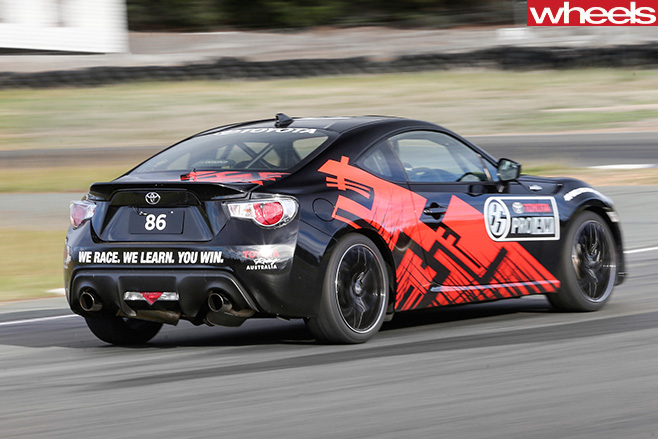
THOUGH it’s an ‘affordable’ and ‘grassroots’ race series to start in 2016, the Toyota 86 Racing Series will appear at selected, mainly marquee, rounds of the V8 Supercars Championship. The big time. Yes, the drivers will be tossed straight into the spotlight at tracks like Sandown and Bathurst in front of large crowds and a live TV audience. No place to hide, but the chance to shine.
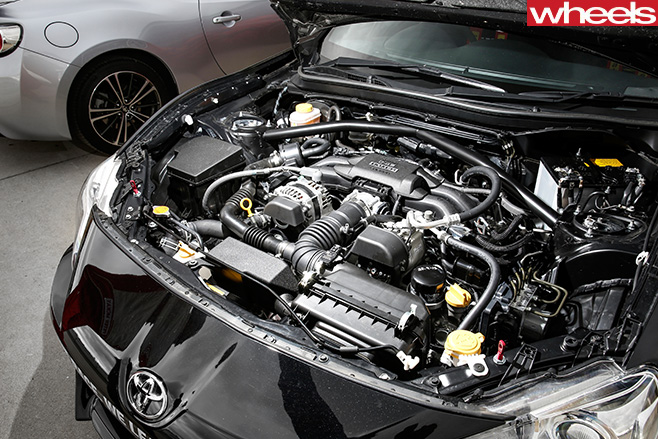
Credibility is at stake if the race car does not hit its objectives. Toyota wants it to maintain the fun-first philosophy of the production version but imbued with a harder edge for the track. It also needs to be reliable, cheap to run, demanding of the drivers and, ultimately, uncork something dramatic for spectators and viewers.
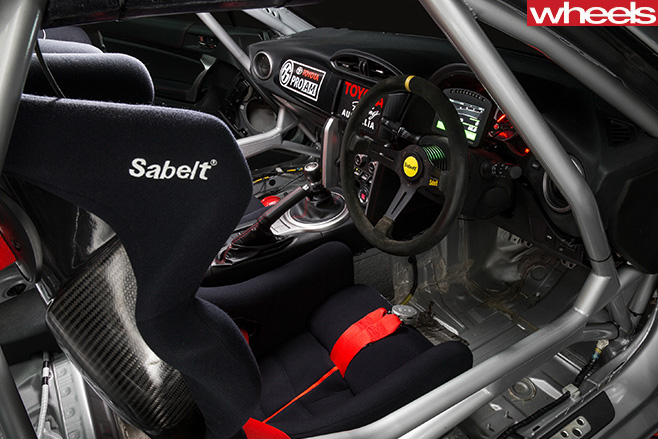
Up to five rounds are anticipated for the inaugural Toyota 86 Racing Series, the ‘pro-am’ show spiced up with the involvement of as many as five professional drivers each race weekend. The selected pros, chosen for their mentoring skills as well as their profile, will provide an on-track yardstick for the wannabes.
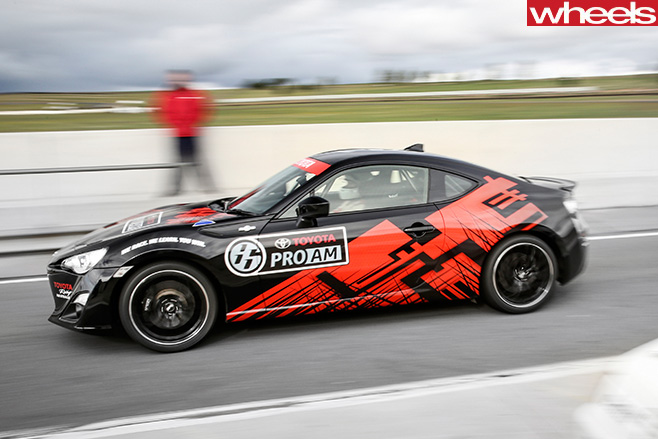
Toyota also has a scheme to give successful locals the chance to contest a global run-off with competitors from similar 86 race series in Japan, Germany and New Zealand.
The inspiration: Toyota’s AE86 racecar
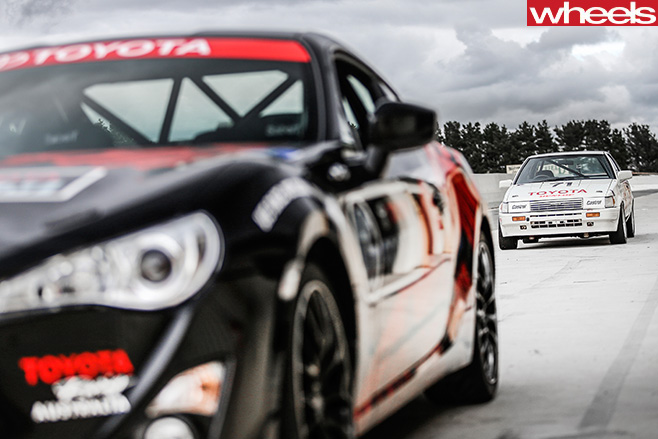
An ex-Toyota Team Australia AE86 – the 1988 Bathurst 1000 class winner – was on hand at Wakefield Park (above). After a few laps, Wheels was reminded that you should never go back to old girlfriends, or revisit old racecars. While redolent of fun times past, it drinks too much, is noisy, recalcitrant, and looks its age.
Why Neal Bates?
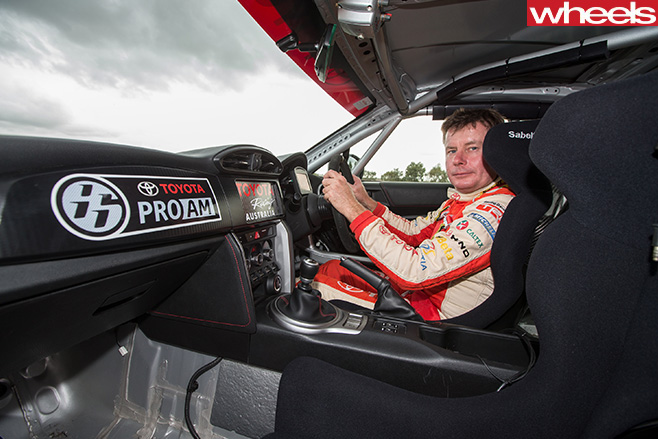
Bates is a four-time Australian rally champ, but less well known is his engineering proficiency. He has owned and run his own race/rally prep business Neal Bates Motorsport since 1991. Handily for the development of the 86 for this one-make series, Bates is also an accomplished tarmac racer, with a Bathurst 1000 class win and Targa Tasmania victory to his name.
Key performance figures
| Performance | Toyota 86 race car | Toyota 86 GTS manual |
| Fastest lap | 1min 09.8sec | 1min 14.9sec |
| Max lateral G | 1.56 | 1.08 |
| Average throttle position in one lap | 76.5% | 63.5% |
| Top speed achieved | 147.9km/h | 142.0km/h |
Wakefield park hot lap
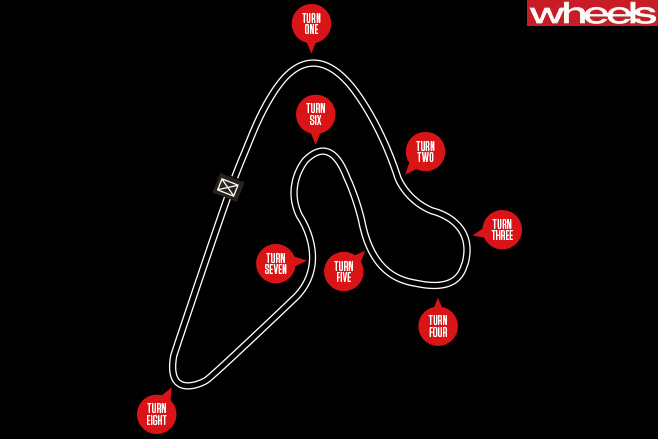
| Hot lap turns | Toyota 86 race car | Toyota 86 GTS manual |
| TURN ONE | 124.3km/h | 109.8km/h |
| TURN TWO | 135.9km/h | 127.7km/h |
| TURN THREE | 114.6km/h | 98.7km/h |
| TURN FOUR | 103.4km/h | 91.8km/h |
| TURN FIVE | 137.5km/h | 130.9km/h |
| TURN SIX | 111.4km/h | 107.5km/h |
| TURN SEVEN | 130.8km/h | 124.8km/h |
| TURN EIGHT | 84.3km/h | 91.6km/h |
Track transition: Eight key changes
BRAKES Pedal feel and stopping performance noticeably enhanced by AP Racing Pro 5000 package with four-pot front calipers and two-pot rears, with bigger rotors.
EXHAUST Sounds brash and growly like a track weapon should. More importantly, bespoke extractors and exhaust contribute to handy 22 percent power and 20 percent torque boost.
TYRES 18-inch 40-series Dunlop Direzza Sport Z2 is road-and-track rubber with improved lateral and braking grip but still with excellent wear qualities. Not bad in the wet, too.
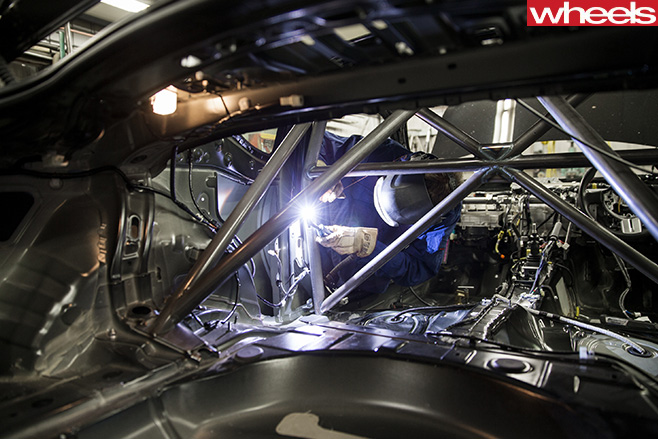
SAFETY Carpet, air-con and cabin trim removed; CAMS-approved roll cage, five-point harness, fire extinguisher added.
DATA LOGGING Optional $3388 Motec C125 race-logging kit/display with programmable shift lights, GPS for track map/lap times, engine warning lights (oil pressure, temperature) or other driver alerts.
HANDLING MCA front and rear damper/spring package with broad adjustability to soften the 86 for wet track conditions, or firm it up for the fastest circuit in Australia, Mount Panorama.
ENGINE MANAGEMENT Motec has remapped and ‘locked’ the EMS so competitors can’t make their own tweaks. Importantly, competitors retain access to data on cornering speeds, braking points, throttle inputs, etc.
AERO Because the two eligible variants, GT and GTS, have different rear wings, a trim TRD spoiler (not fitted to the earlier silver prototype pictured on these pages) is mandated.
SPECS
Model: Toyota 86 GTS Engine: 1998cc flat-four, 16v, dohc Max power: 147kW @ 7000rpm Max torque: 205Nm @ 6400- 6600rpm Transmission: 6-speed manual Weight: 1275kg 0-100km/h: 7.6sec Fuel economy: 7.8L/100km (official), 24.6L/100km (track) Price: $35,990
Model: Toyota 86 race car Engine: 1998cc flat-four, 16v, dohc Max power: 179kW @ 7500rpm Max torque: 246Nm @ 5500-6800 rpm Transmission: 6-speed manual Weight: 1180 kg 0-100km/h: 7.4sec Economy: 31.5L/100km (on track) Price: $100,000 for car and first year racing (estimated)
MOTOR is at the 2016 Bathurst 12 Hour and we’ll be bringing you updates throughout the weekend. Check back over today and tomorrow for all the action.
Sunday 6:00pm – Victory for Shane Van Gisbergen, Jonathon Webb and Alvaro Parente in the 2016 Bathurst 12 Hour! Van Gisbergen withstood a late charge from Katsumasa Chiyo in the NISMO GT-R GT3 which saw his advantage whittled down from 12 seconds to just 1.2sec at the line.
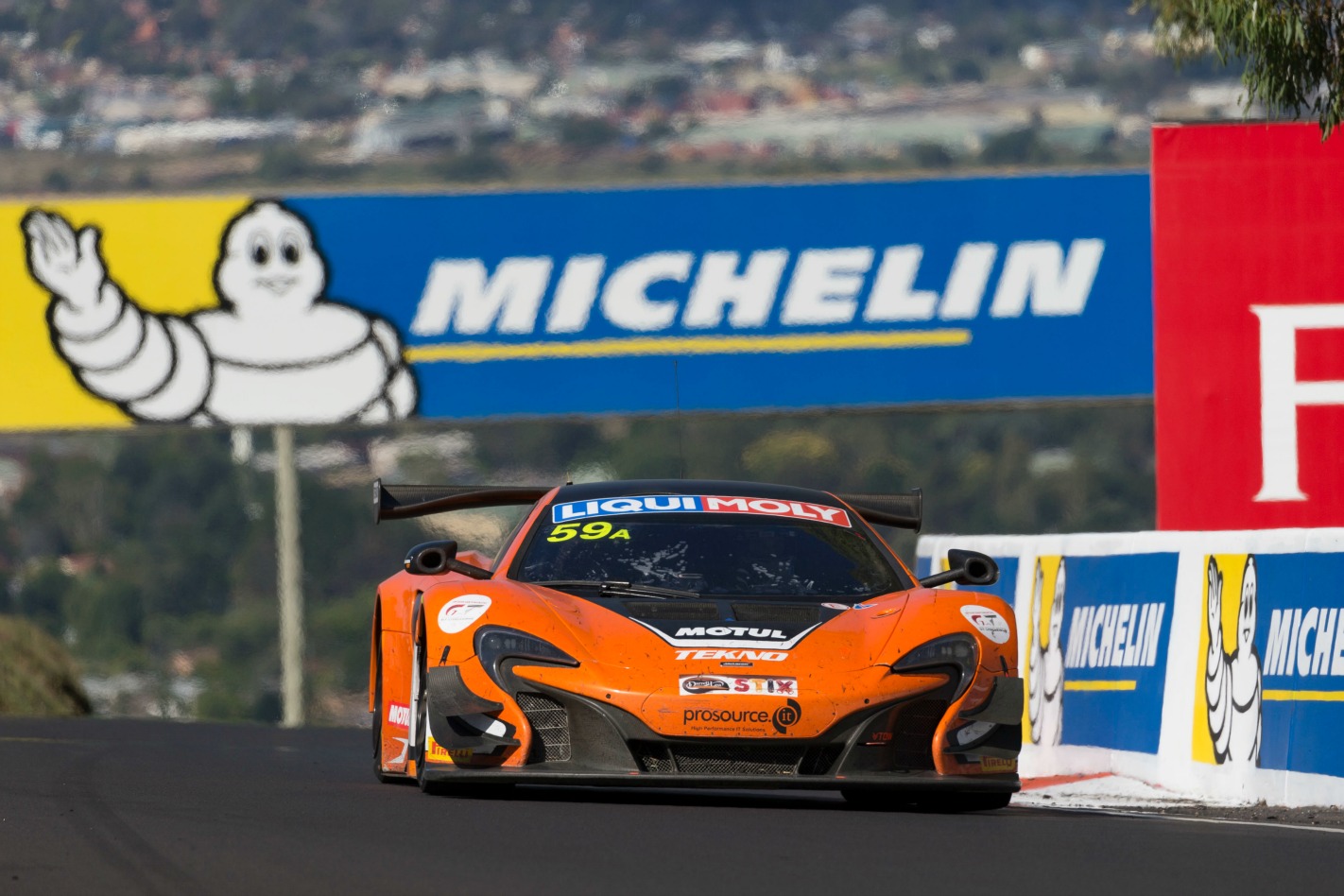
The final step of the podium was occupied by the Bentley of Matt Bell, Steven Kane and Guy Smith, a just reward for their efforts after being cruelly robbed of a podium on the last corner in 2015.
Following the Bentley home were the Phoenix Racing Audi R8 LMS and Erebus Motorsport Mercedes-Benz SLS GT3 to make it five different manufacturers in the top five places.
Sunday 5:10pm – The final pit stops are done and it’s now a straight race to the flag. Shane Van Gisbergen leads from the NISMO GT-R of Katsumasa Chiyo by around 12 seconds. Just 30min remain.
Sunday 4:30pm – With just under 90mins to run, the top three cars are, unbelievably identical to the three cars that were fighting for the win in the closing stages of the 2015 race. The NISMO GT-R GT3 driven by Katsumasa Chiyo leads from Laurens Vanthoor in an Audi R8 LMS with Guy Smith in the Bentley hot on his heels.
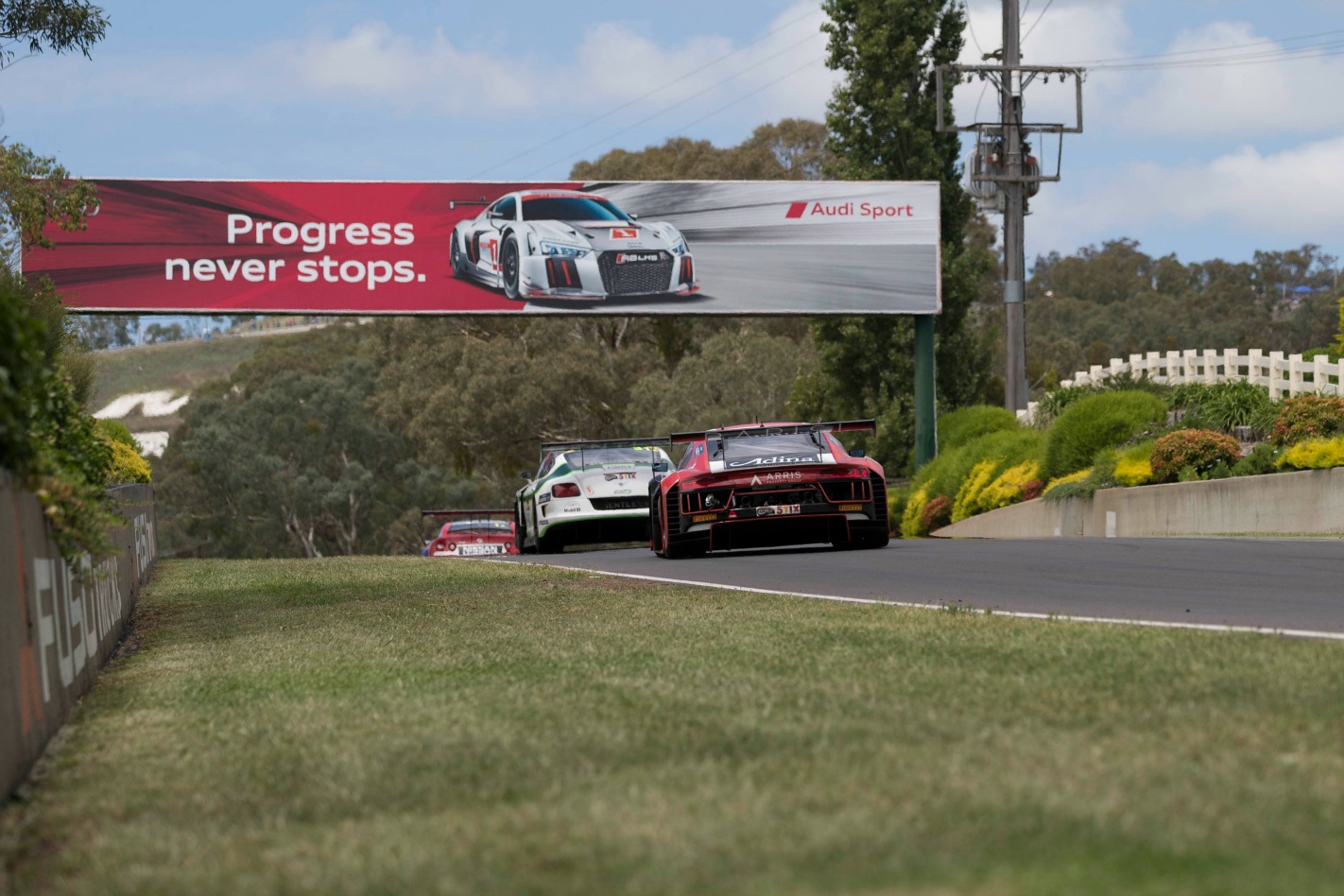
Sunday 1:50pm – The second Erebus Motorsport Mercedes-Benz SLS has managed to get back on the lead lap and, as predicted, another safety car has bunched the field up tightly.
The Phoenix Racing Audi R8 LMS has also managed to put itself back on the lead lap and is now a contender, though out out of phase with the cars around it on pit stops.
Sunday 1:00pm – The McLaren 650S GT3 of Tony Quinn is out of the running after squeezing the Lamborghini of Roger Lago heading into Griffin’s Bend and being forced into a spin. The deployment of the safety car condensed the field and an accident involving one of the MARC Touring Cars forced another stoppage shortly after.
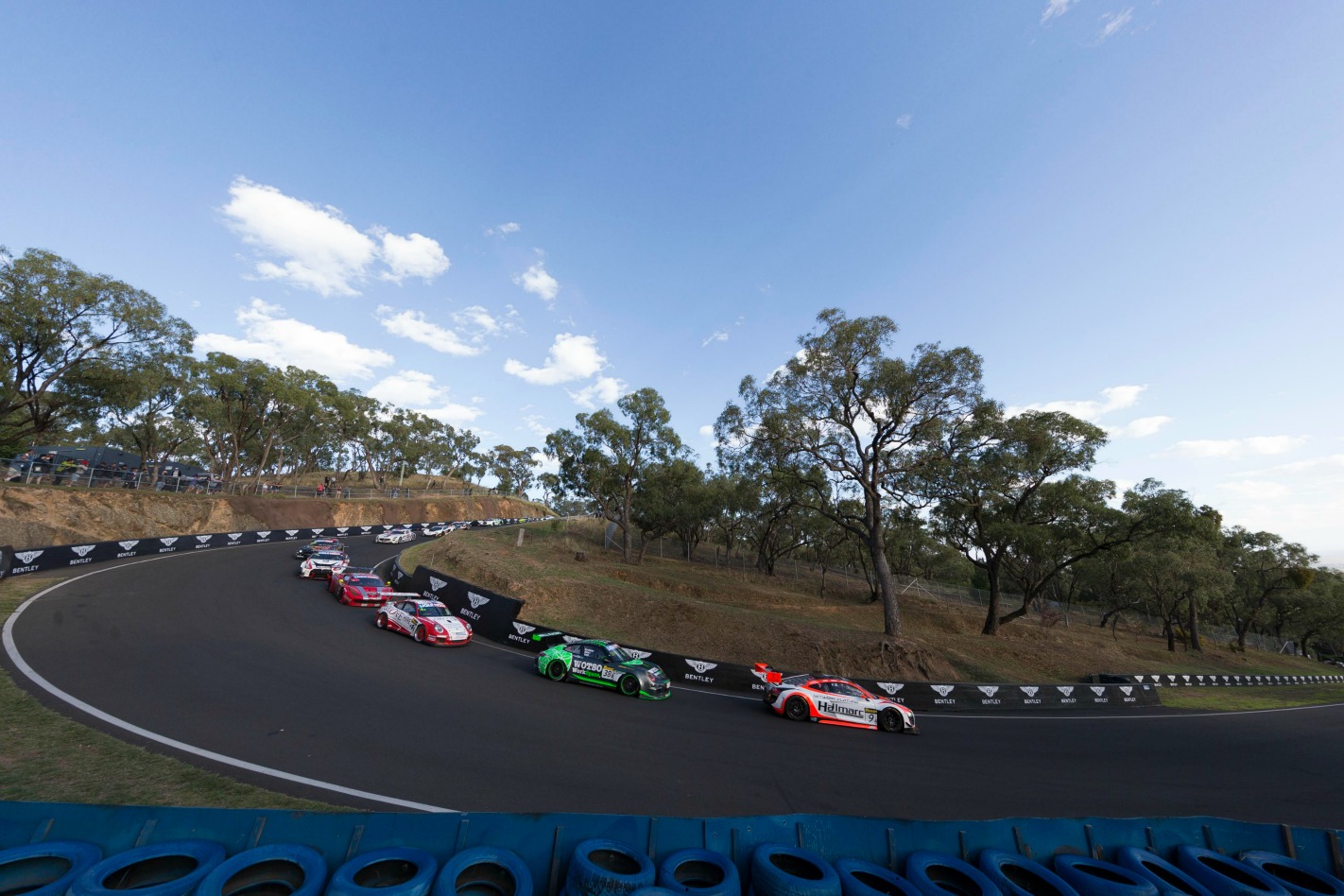
Sunday 12:30pm – We’re past the halfway mark and the cars have already completed over 170 laps, more than an entire Bathurst 1000. The NISMO GT-R GT3 is leading with Rick Kelly on board, followed in quick succession by Thomas Jaeger (Mercedes-Benz SLS AMG), Guy Smith (Bentley), and the McLarens of Alvaro Parete and Tony Quinn.
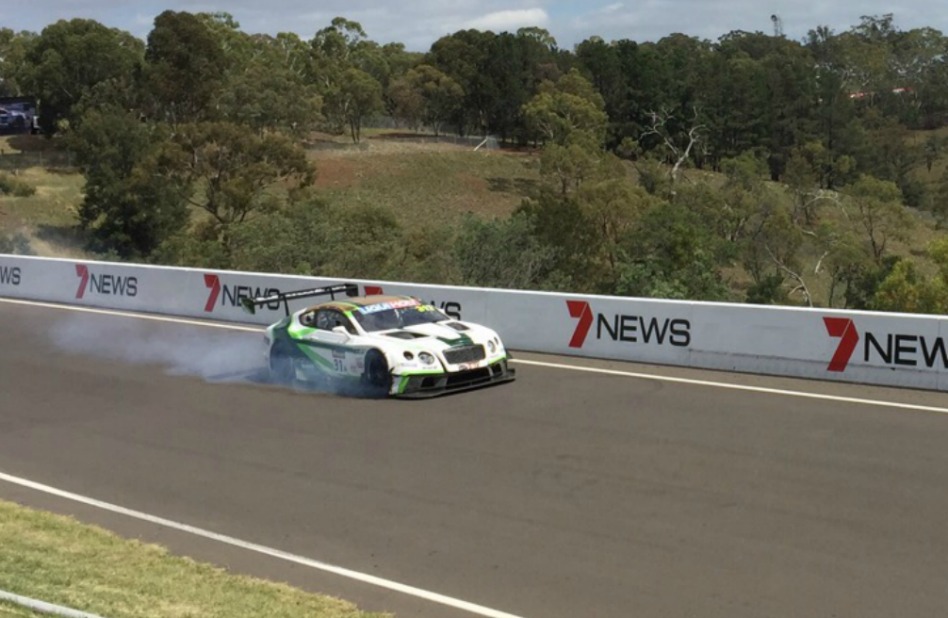
Sunday 9:20am – The race continues to evolve but the exact make up of the leaderboard is difficult to know as various cars are running different strategies. The Tekno Autosports McLaren 650S, currently driven by Portuguese driver Alvaro Parente, is back in front and punching out 2:01sec lap times, two seconds faster than any other car.
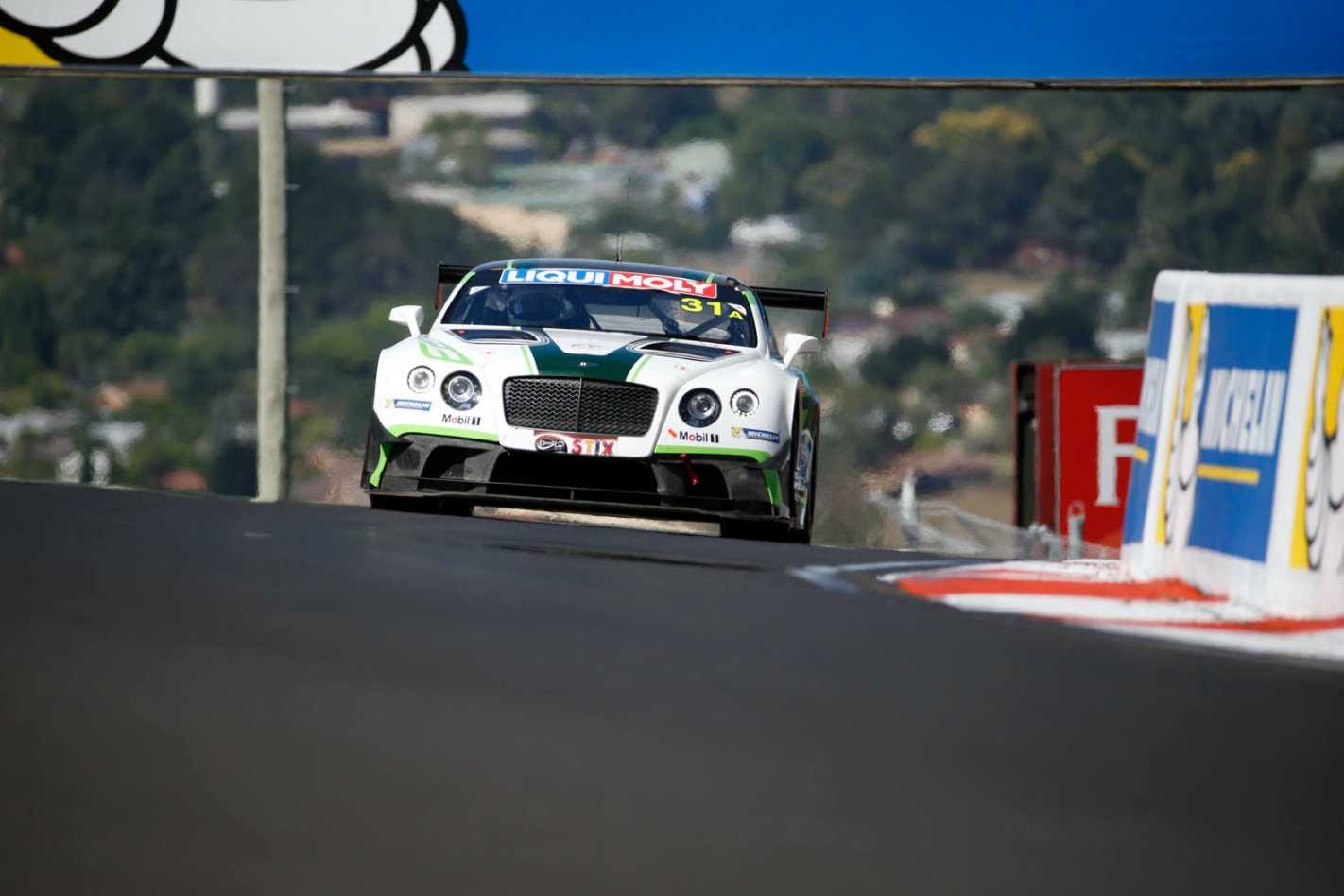
Bad news also for Maranello Motorsport. After the first lap spin it is now out of the race due to unrepairable suspension damage.
Sunday 8:30am – As the three-hour mark approaches it’s all change at the top of the 2016 Bathurst 12 Hour leaderboard. The NISMO GT-R GT3, driven by defending champion Florian Strauss, now leads after the Tekno Autosport McLaren 650S, now driven by Alvaro Parente, was forced to pit under green flag conditions.
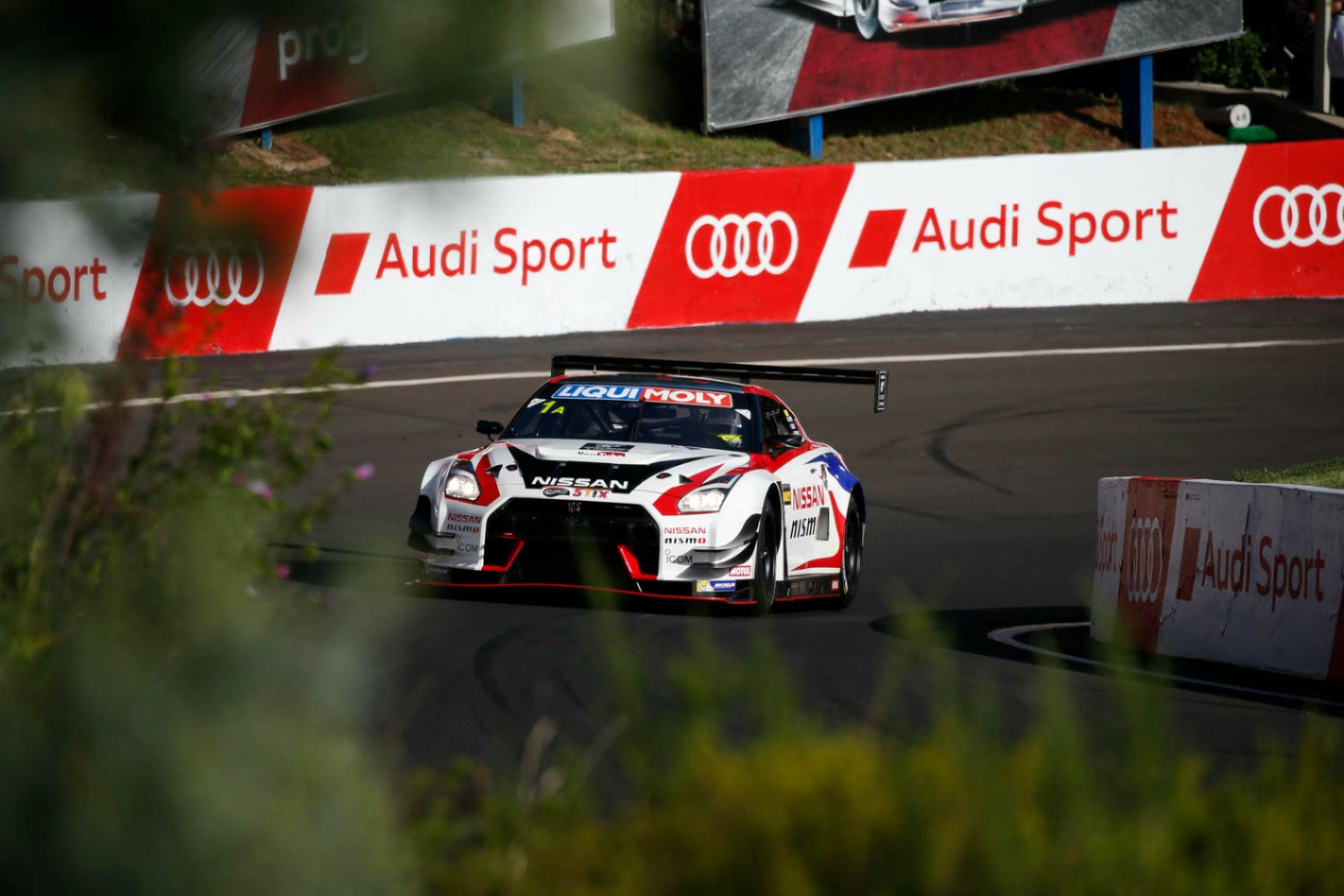
Attrition has been high over the past hour or so, with Christopher Mies in the Jamec Pem Audi R8 LMS suffered a tyre blowout on Conrod Straight then Warren Luff crashed out of second place in the Objective Racing McLaren 650S after making a small mistake heading down the mountain.
Sunday 7:15am – An hour and a half down in the 2016 Bathurst 12 Hour and the first round of pit stops has now played out. Pole sitter Shane Van Gisbergen continues to lead in the Tekno Autosport McLaren 650S GT3 but the gap to Warren Luff in a similar McLaren is just one second.
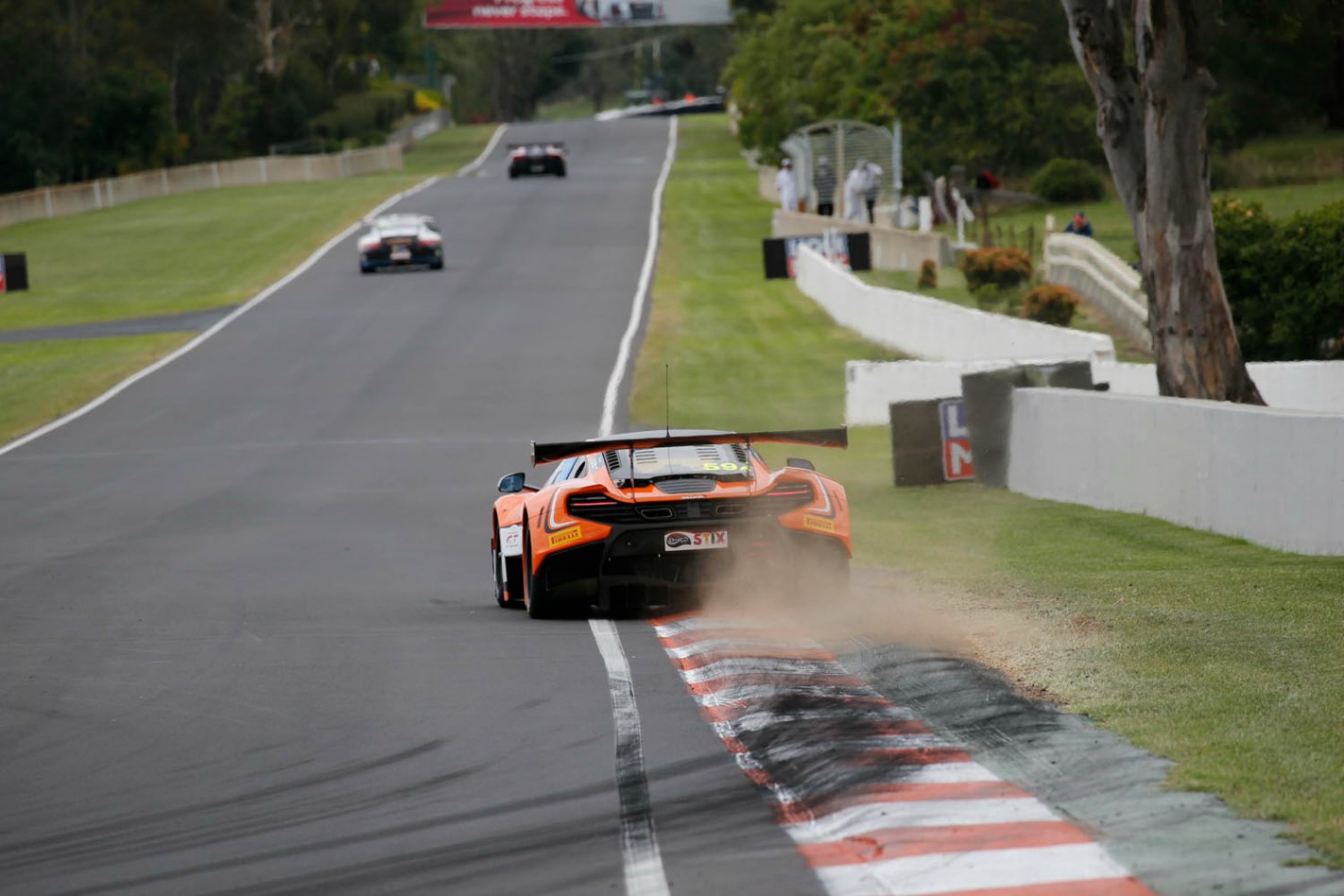
Sunday 5:45am – The blow of a 3:50am alarm call is softened by the sight of dawn at Mount Panorama. Even at this early hour fans are streaming into the circuit and it’s safe to assume this year will smash all previous attendance records. It should be a cracking race.
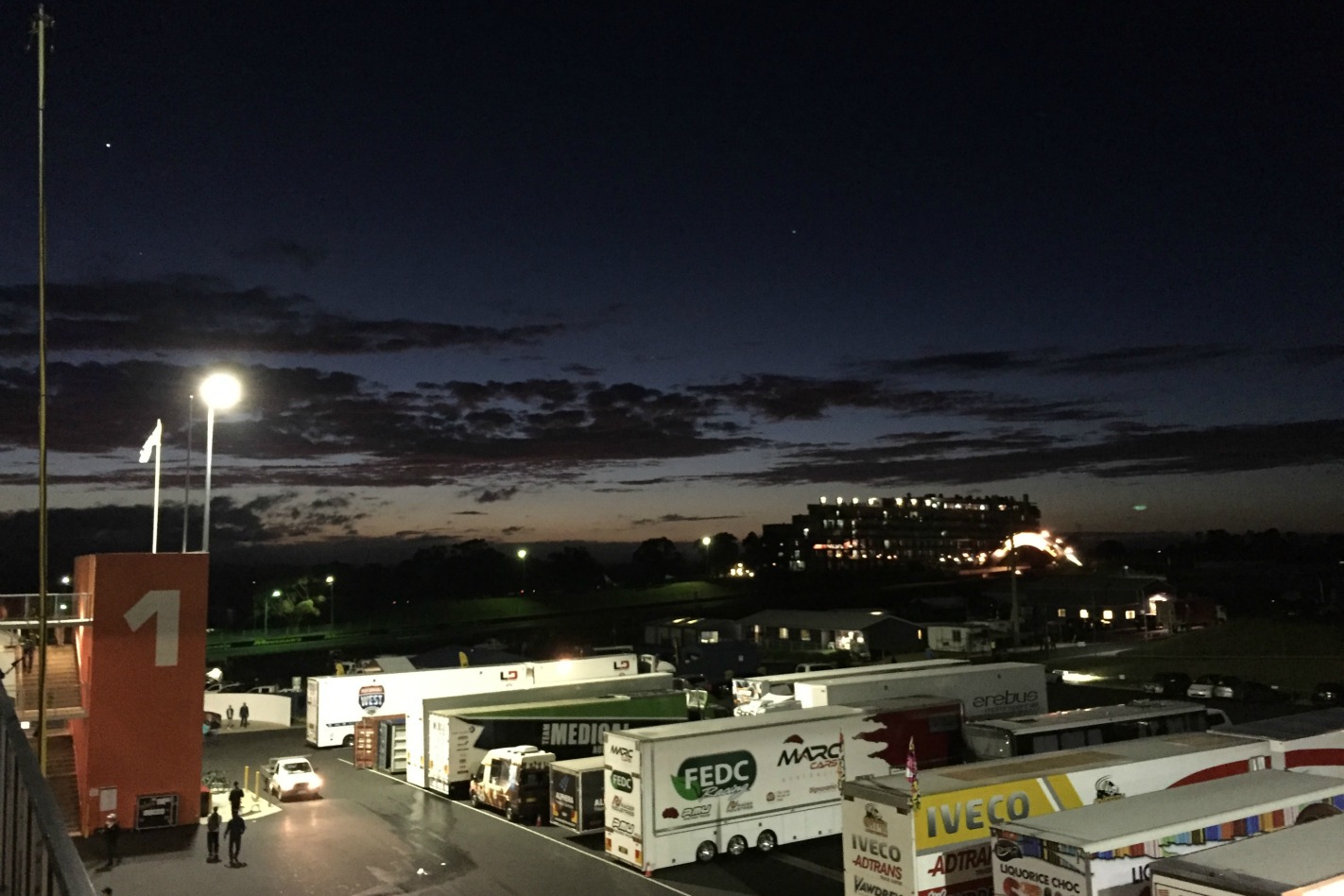
The leading Bentley lines up in seventh, while last year’s champion NISMO GT-R GT3 will start in 13th.
Saturday 1:38pm – With half of first qualifying done Shane Van Gisbergen in the Tekno Autosports McLaren 650S GT3 has just fired in an incredible 2:01.591 to go 1.16sec faster than his nearest competitor. The lap record is long gone, just how fast can they go?
Saturday 1:06pm – First qualifying has kicked off and almost immediately come to a halt following a spin by Benny Simonson in the Ferrari 458 GT3.
The pace at the front is unbelievably fast with the top three cars in Practice 5 besting Laurens Vanthoor’s 2015 pole time of 2:02.5521.
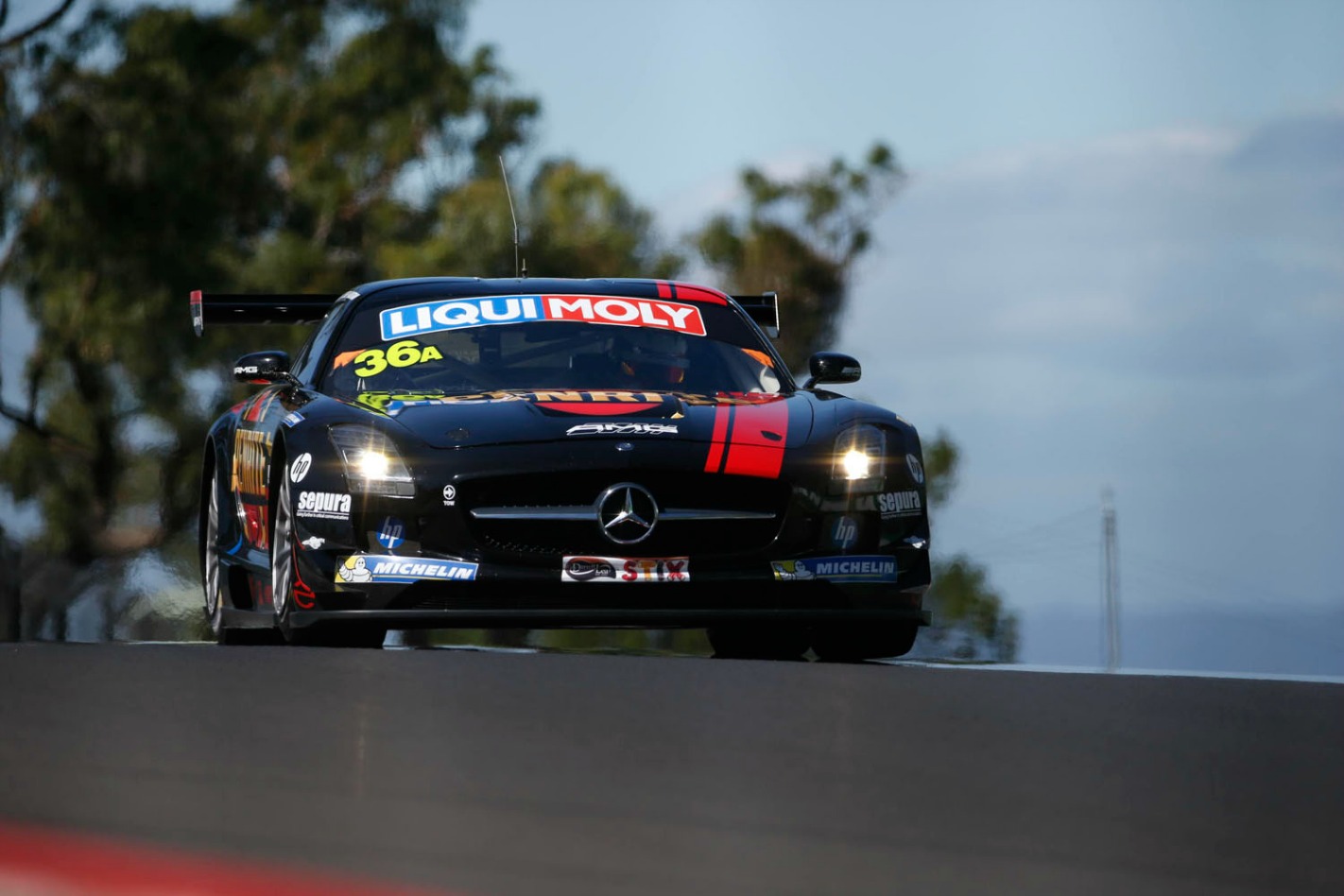
With five different manufacturers represented in the top nine cars, which are all separated by just over a second, it’s set to be a tight fight at the front.
Love ’em or loathe ’em, everybody seems to want a coupe SUV. Few could have predicted that sticking a coupe, a hatchback and an SUV into an automotive food blender would result in modern motoring’s must-have set of wheels, but it’s a strange world we live in.
BMW beat everybody to the punch with the full-size X6 and once again it’s ahead of the curve by downsizing the concept and producing the X4; a fastback version of its mid-size X3 SUV. Looks are always a matter of personal taste, but it appears dropping down a segment does help matters.
It’s certainly no svelte beauty but, wearing the M-Sport kit and 20-inch rims, it is better proportioned and more aggressive than the bulbous and ungainly X6. The inevitable M version might even look quite cool. That slicked-back roofline doesn’t impact too badly on rear headroom – a lanky six-foot-four mate fit in the back (just) – but it destroys rear vision by creating rear-three-quarter blind spots you could hide a semi-trailer in.
Compared to a 3 series Touring, the X4’s luggage capacity is identical with the rear seats up (500L v 495L) but slightly less with the rear seats folded (1400L plays 1500L). No doubt at this point you’re probably expecting us to just tell you to buy the regular 3 series wagon. But not so fast: BMW has seen this one coming.
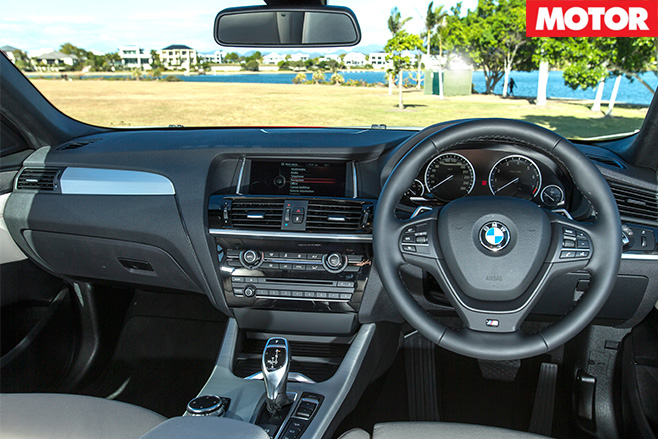
So what’s it like? Well, 225kW and 400Nm mightn’t sound like much from a 3.0-litre turbocharged six these days, but allied to ZF’s superb eight-speed auto it’s plenty to motivate 1815kg of X4, though it doesn’t feel as fast as its 5.5sec 0-100km/h claim suggests.
In terms of handling there are two ways to look at it: it’s either amazing for an SUV or reasonably good for something with sporty pretensions. Drive it smoothly and the pace you can carry is quite incredible, but as you’d expect, push harder and it starts feeling big, heavy and a bit sooky.
It’s hard to judge these faux-wheel drives. Despite BMW’s attempts to justify its existence, rationally the X4 makes little sense, yet it will still sell like mad. We’d much rather have an optioned-up 328i Touring, but we suspect that no potential X4 buyer would share our preference.
3 out of 5 stars
Specs
Engine: 2979cc inline-6, DOHC, 24v, turbo Power: 225kW @ 5800-6500rpm Torque: 400Nm @ 1200-5000rpm Weight: 1815kg 0-100km/h: 5.5sec (claimed) Price: $87,430
Parallel parks can be tricky, and when there’s a line of traffic waiting for you to slot into that tight spot they’re undeniably stressful. Worst of all, just when you think you’ve got the park nailed you hear a horrendous sound; a sound that can be caused by only one thing – alloy wheel against concrete kerb. Ouch.
Subaru knows your pain, and its engineers have come to your rescue. The new WRX Premium and WRX STI Premium now include a package of innovative systems, or ‘proactive safety technologies’, that Subaru calls Vision Assist.
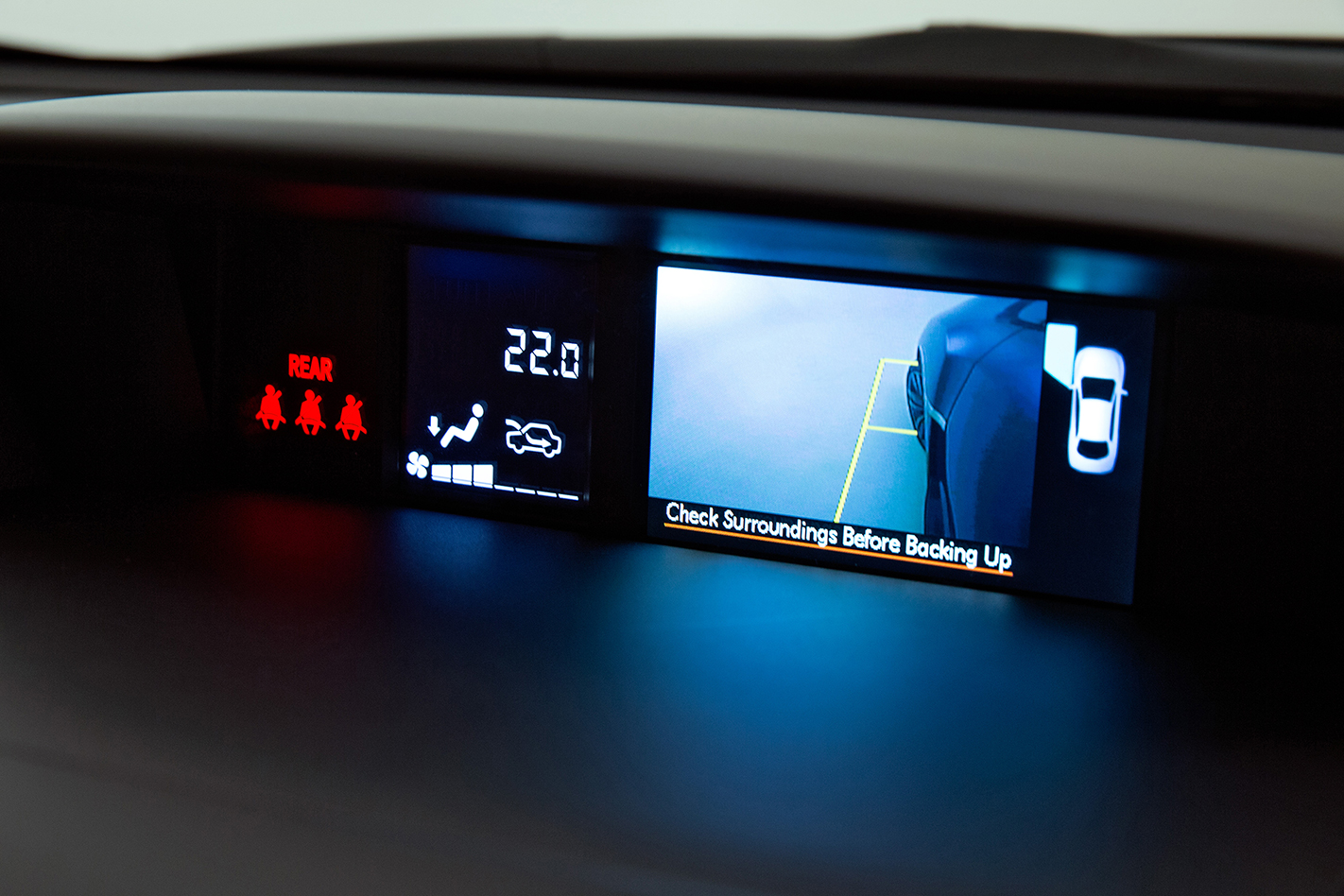
We reckon the coolest part of Vision Assist is a thing called Side View Monitor. Take a look at the video above to get a better idea of what it is and how it works.
To sum it up, Subaru has placed a video camera in the bottom of the kerb-side rear vision mirror. When you select reverse gear, or tap the SVM button on the dashboard, the view from that camera is shown on a screen allowing you to see exactly where the front wheel is in relation to the kerb. You’ll never ‘gutter rash’ a wheel again.
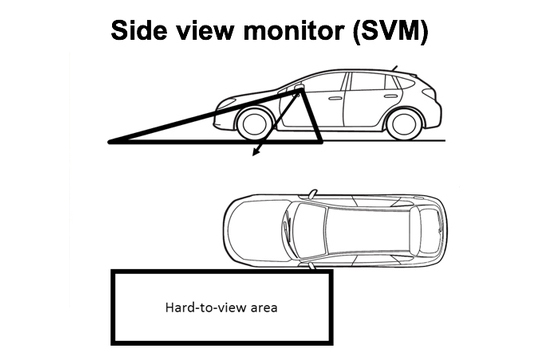
Other manufacturers have introduced similar systems like the bird’s-eye view parking cameras found in several new vehicles. Subaru has taken a different approach with Side View Monitor and we think it has the potential to be even more helpful.
The other technologies featured in Vision Assist are Blind Spot Monitoring, Lane Change Assist and Rear Cross Traffic Alert.
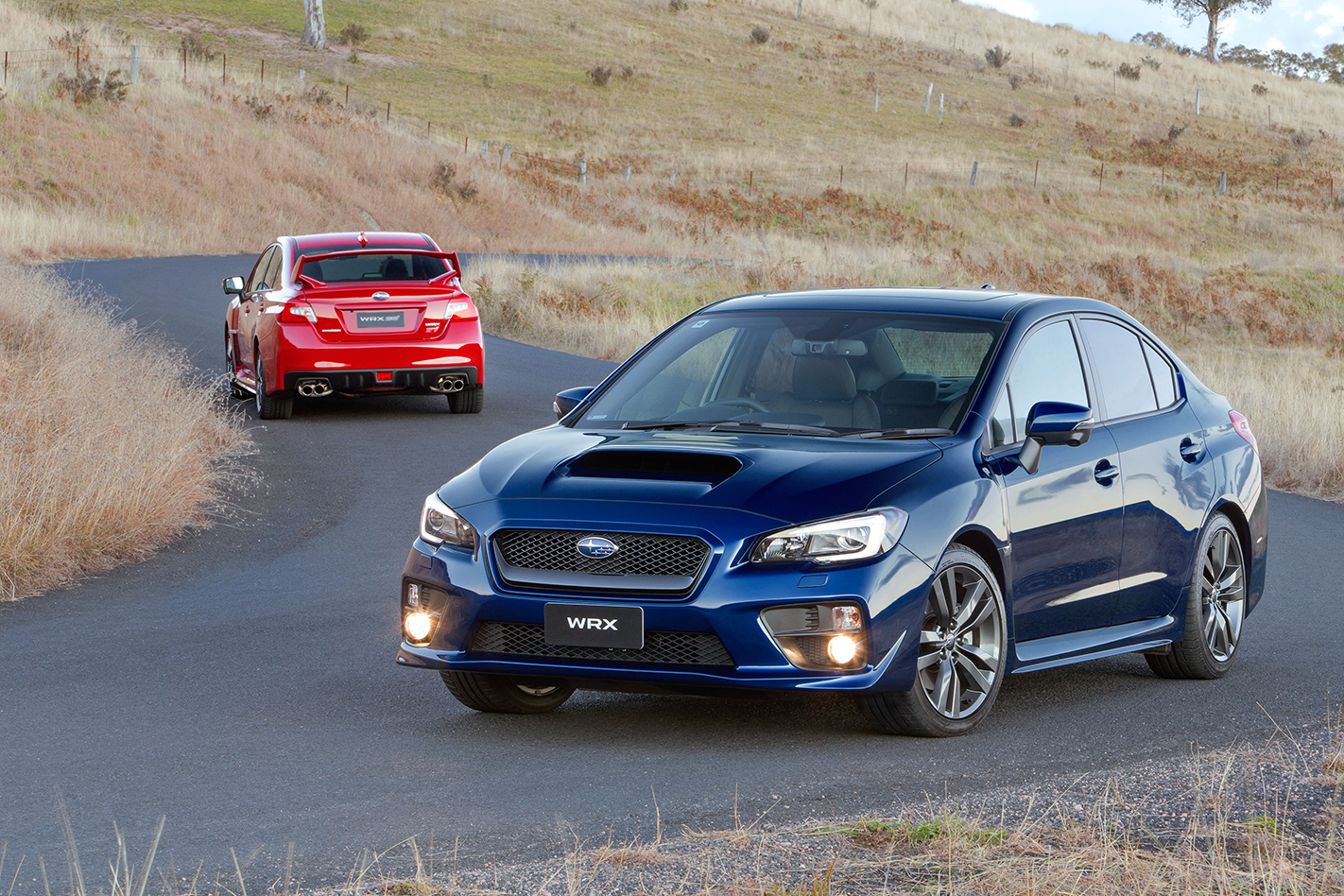
When talk turns to Japanese dominance at Australia’s most famous racetrack, it’s likely to be Nissan that springs to mind.
And not without reason: after all, its R32 GT-R won back-to-back Bathurst 1000s in 1991 and 1992, before adding to the tally in 2015 with victory in the Bathurst 12-Hour with its R35 GT-R GT3.
But as Nissan’s dominance of the Australian Touring Car Championship came to an end in 1992, another Japanese manufacturer was forging a Bathurst legacy of its own. Ironically, it was Nissan’s success at Australian motorsport’s highest level that opened the door for Mazda to establish itself as a major player at Mount Panorama.
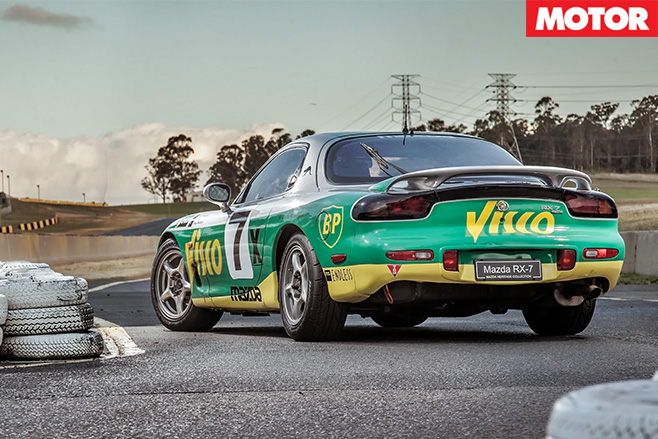
Despite a short lead-up, the first race attracted a stellar cast, with luminaries such as Colin Bond, Peter Brock and Kent Youlden driving semi-factory cars from Toyota, Holden and Ford respectively. Peter Fitzgerald, Allan Grice and Nigel Arkell won the inaugural event in a Toyota Supra Turbo.
The successful debut led to a huge surge in interest, with entries exploding from just 24 in 1991 to over 50 for 1992. Many of these were with official manufacturer support, including BMW, Ford, Peugeot, Citroen (yes, really), Saab (yes, REALLY!) and, of course, Mazda.
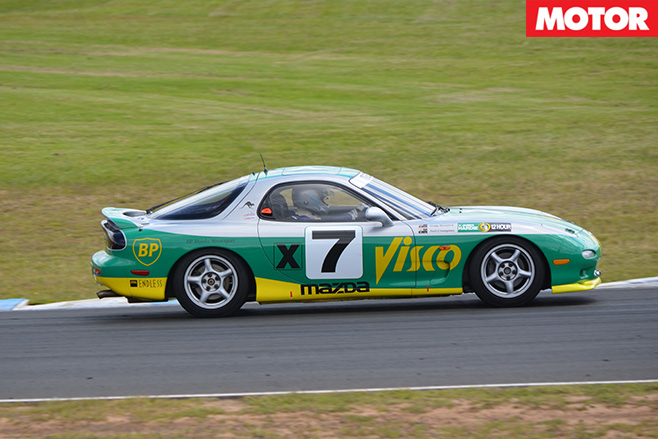
Mazda’s line-up was lower key, with John Bowe and Gregg Hansford driving the number seven car and Charlie O’Brien, Garry Waldon and Mark Gibbs sharing number 17. Their steeds would be the newly-introduced third-generation RX-7.
Mazda motorsport manager, Allan Horsley, had driven the car in Japan and deemed it the perfect platform on which to mount a Bathurst challenge. “I test drove it at a circuit over there just to see what it was like, which was brilliant, and from there we decided to race it,” Horsley recalls.
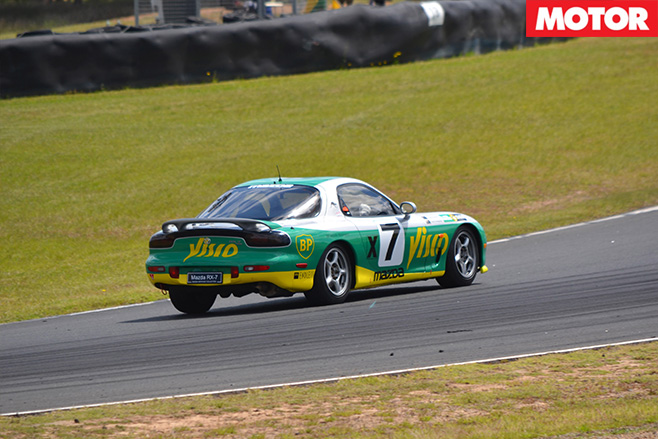
The car proved an ideal match for long-distance production car racing, taking three straight wins at the Bathurst 12-Hour from 1992-’94 and another in SP form in 1995 when the event moved from Bathurst to Eastern Creek.
The car pictured here is the winner from 1994 that was driven by Neil Crompton and Gregg Hansford. Crompton’s a bit like Australia’s version of Martin Brundle – an extremely accomplished racing driver who is now perhaps better known for his broadcasting abilities.
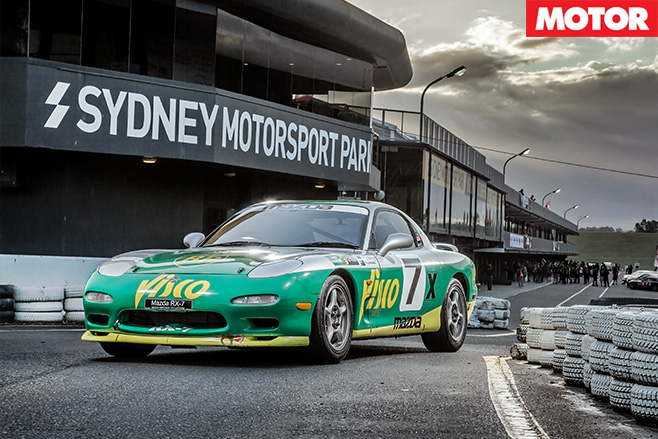
Unsurprisingly, given its winning pedigree, Crompton has fond memories of the little Japanese sportscar. “It was really good actually; its handling behaviour was very, very good. Everything from pretty much The Cutting to Forrest’s Elbow was just fabulous.” Horsley agrees. “The strong points were that you could drive it flat all the time, just never back off.”
Thankfully, we don’t need to take their word for it, as Mazda chucked MOTOR the keys to its thoroughbred for a quick session at Sydney Motorsport Park. And it will be quick in both meanings of the word, as while we have an unrestricted track in front of us, our time with the car is limited to five minutes. Best get going then.
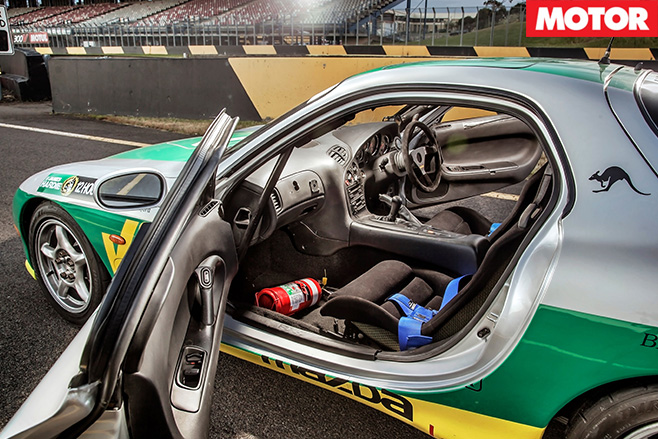
Thumbs up from the marshal and a clear track awaits. We’ve just an out lap and an in lap, so no time to waste. Thankfully, the car is already warm so the accelerator meets the carpet as we exit pit lane. First impressions are that while it might have been considered almost a ‘supercar’ in the early 90s, by today’s standards the RX-7 is not a particularly fast car.
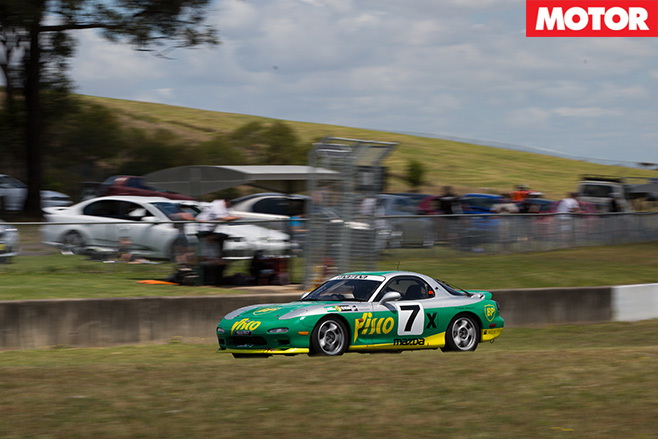
Unsurprisingly, MOTOR tested the RX-7 on a number of occasions when new, recording 0-100km/h in 6.29sec and 0-400m in 14.56sec at 154.1km/h in a January 1993 comparison test against the Mitsubishi 3000GT, Nissan R32 GT-R and Nissan 300ZX.
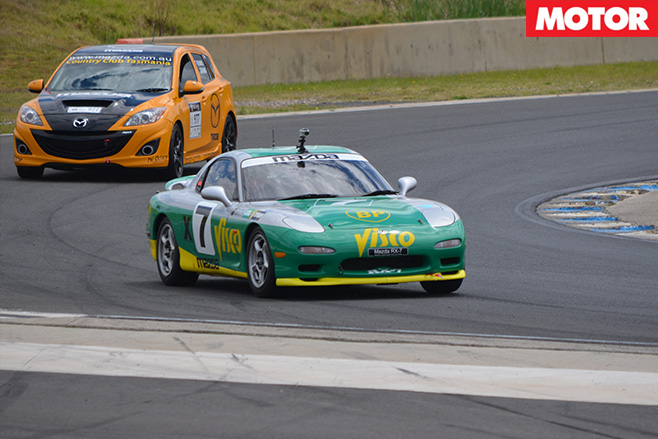
Crompton also remembers that while the car had plenty of strengths, straight-line pace wasn’t one of them. “No, it certainly didn’t whip the head back when you stood on the throttle, but what you had to do was drive it like a smaller capacity car. It was all about rolling speed, so if you allowed it to bog down…that was going to cost you lap time.”
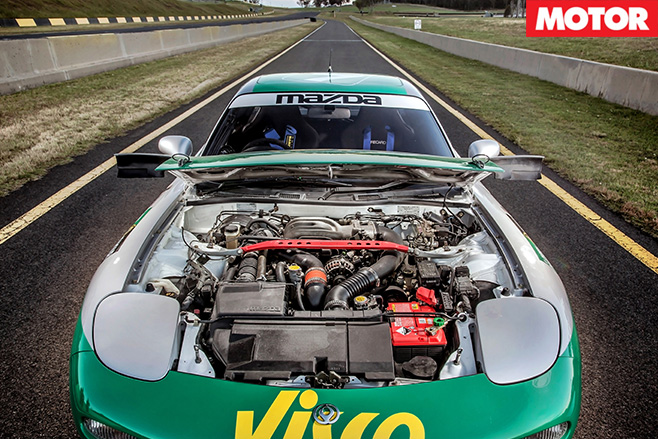
By now we’re approaching turn one and the first turn of the steering wheel is all it takes to suggest that this RX-7 might be the friendliest car I’ve ever driven at speed.
Any concerns about not being able to exploit the car in the allotted time immediately evaporate as the lightweight Mazda pours itself into the long, sweeping turns of SMP’s GP circuit with perfect balance.
It’s rare that you drive a car on track and don’t need to make allowances; perhaps you have to be careful not to induce understeer, or maybe lots of power makes wheelspin and oversteer a constant threat.
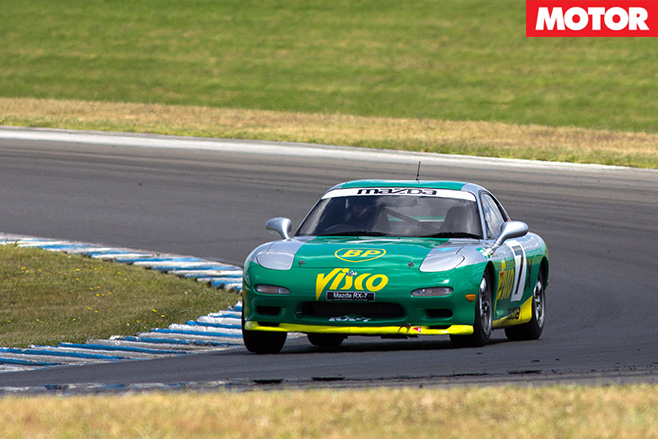
“[The RX-7 was] obviously very good in its baseline weight distribution, but we did a lot of work to make it driver-friendly. I couldn’t honestly tell you how many test days we did… we’d just trundle out to Oran Park and pound around with the car.”
Crompton remembers that the only aspect of the car that needed care was the brakes. “They were quite good, but you couldn’t just jam your size 10 on them or eventually they’d suffer.” Unusually, the ABS was left connected, as Horsley says that even with the stellar driving cast he’d assembled, the car was a lot slower with it disconnected.
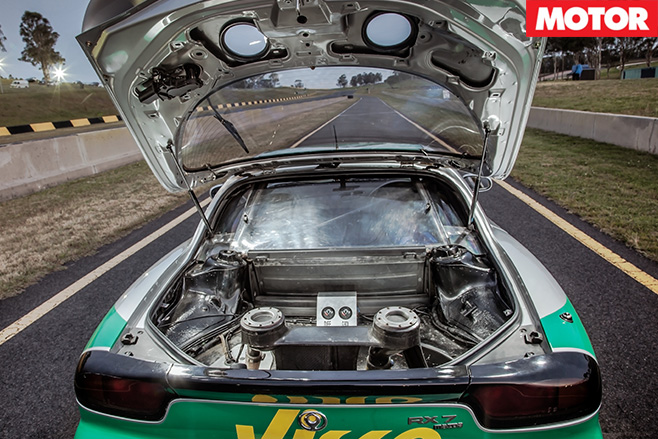
The sight of the chequered flag is a crushing disappointment, as this tantalising taste of the RX-7’s abilities has been enough to crave more time behind the wheel of Mazda’s only real high-performance sportscar. Another 11 hours and 55 minutes should be just about sufficient.
4.5 out of 5 stars
| u00a0 | MAZDA RX-7 |
| Body | 2-door, 2-seat coupe |
| Drive | rear-wheel |
| Engine | 1308cc twin-rotor, twin-turbo |
| Bore/Stroke | N/A |
| compression | 9.0:1 |
| power | 176kW @ 6500rpm |
| torque | 295Nm @ 5000rpm |
| power/weight | 134kW/tonne |
| transmission | 5-speed manual |
| weight | 1310kg |
| Suspension | double A-arms, coil springs, anti-roll bar |
| L/W/H | 4280/1750/1230mm |
| Wheelbase | 2425mm |
Tracks | 1460/1460mm (f/r) |
| Steering | hydraulically-assisted rack-and-pinion |
| Brakes | 294mm ventilated discs, 4-piston calipers (f); 294mm ventilated discs, single-piston floating calipers (r) |
| Wheels | 16 x 8.0-inch (f/r) |
| Tyres | 225/50 R16 92V (f/r); Direzza Sport D1 |
| Price | $73,000 (1993) |
| Positives | Perfect chassis balance; incredible communcation; provenance |
| Negatives | Not particularly fast; we didnu2019t get to drive it for 12 hours straight |
Where SUV models traditionally play dirty simply of the offroad kind, this Audi RS Q3 Performance is throwing mud around in power-game circles.
Adding a ‘Performance’ version to an RS model range seems tautological but it has become Audi’s latest thing to do – first with RS6 Avant and RS7 Sportback last year, and now with its smallest SUV model.
Since the RS Q3 shares its 2.5-litre turbocharged five-cylinder engine with the RS3, it’s perhaps little surprise that eventually the older SUV would absorb the increased power outputs of the newer hatchback.
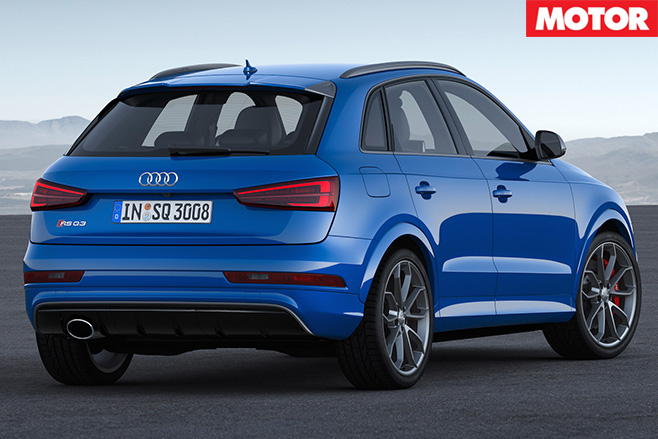
The RS Q3 Performance sprints from zero to 100km/h in a claimed 4.4 seconds, which is four-tenths speedier than before and only a tenth off the RS3’s claim.
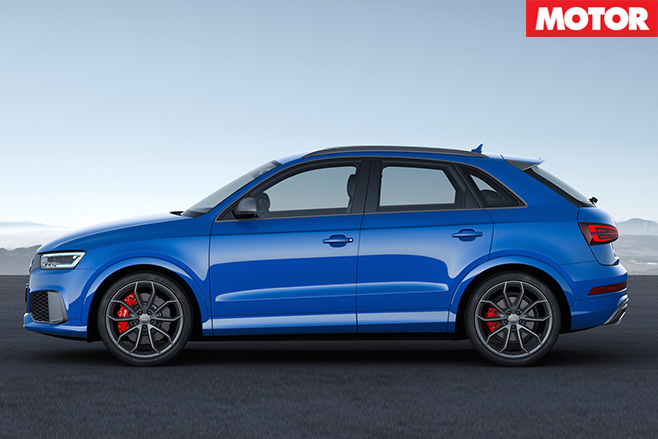
While fixed sports suspension remains standard on the RS Q3 Performance, three-mode adaptive chassis technology is optional as per the standard version. Likewise 20-inch alloy wheels are included, though the new edition exclusively gets ‘titanium look’ exterior trim and availability of Ascari blue metallic paint teamed with part-blue seats and stitching in an optional design package.
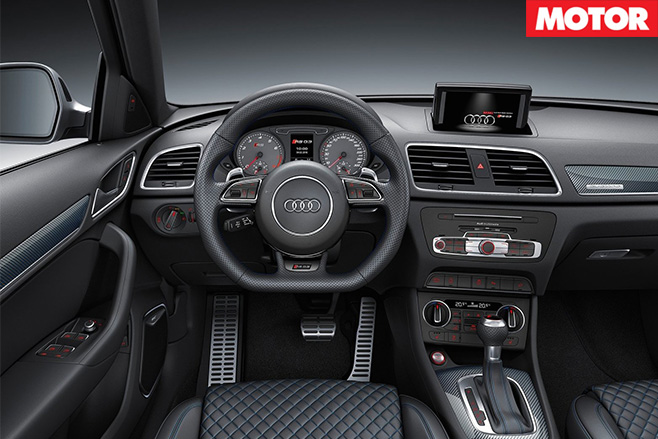
The RS Q3 Performance will officially debut at the Geneva motor show in the first week of March, and is confirmed for an Australian arrival “before the end of 2016” for an unspecified premium over the $81,510 regular model.
Australian engineer Chris Dyer is returning to Formula 1 as part of the newly reborn Renault F1 team.
The Victorian former Holden Racing Team engineer will head Renault’s vehicle performance group, which is responsible for suspension and brake development as well as simulation work.
Dyer was a key part of Ferrari’s success during the early-to-mid 2000s, acting as Michael Schumacher’s race engineer during his 2003 and 2004 title seasons before winning another title with Kimi Raikkonen in 2007.
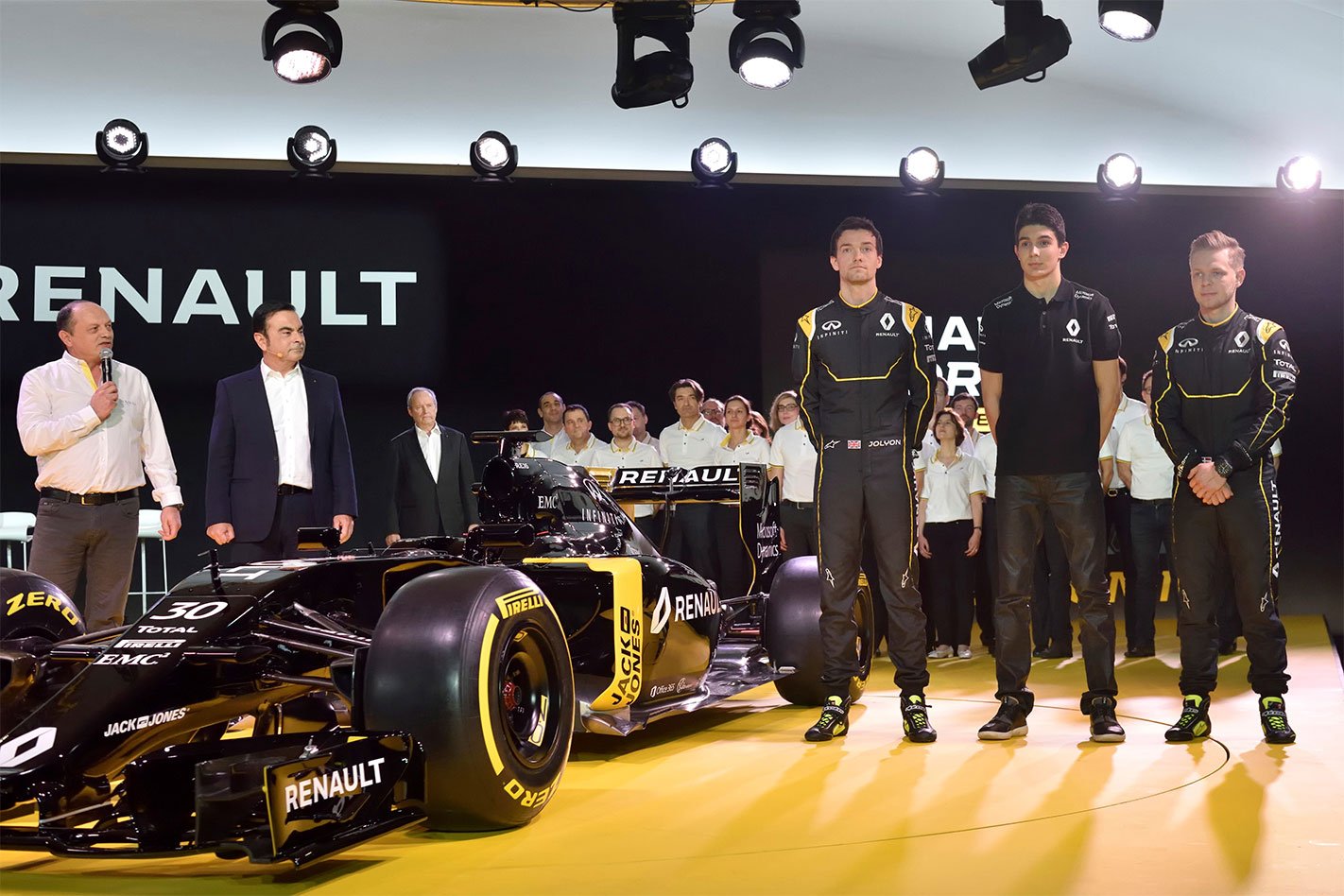
Renault is the first team to unveil its 2016 F1 challenger, which will be driven by Jolyon Palmer and Kevin Magnussen after Pastor Maldonado’s promised sponsorship money failed to materialise.
The 2016 F1 season kicks off in Melbourne on March 18.
