Like Ferrari and red, blue has been an icon of sorts for Subaru. And now for Australia, it’s poised to go hyper.
Subaru Australia has announced it will paint 300 cars in limited edition Hyper Blue paint before they arrive down under.
The paint, which is decidedly brighter than the firm’s well known World Rally hue, will be thrown on 200 WRX Premium, 50 WRX STI Premium and 50 BRZ models.
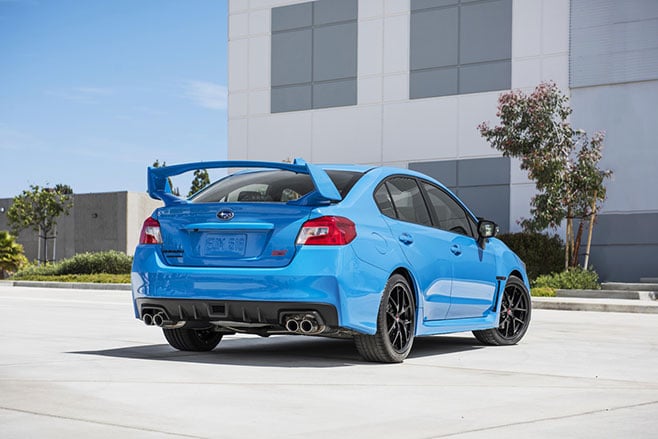
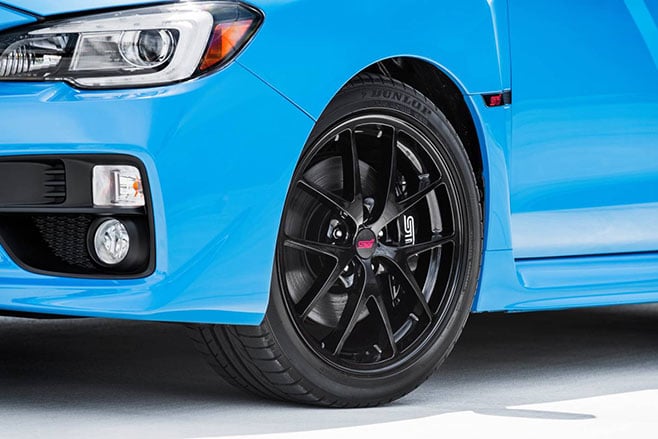
As photos show, US-spec Hyper Blue special editions match their paint to black finish alloys. They also score model unique blue stitching on seats, steering wheel, floor mats, and shifter boot.
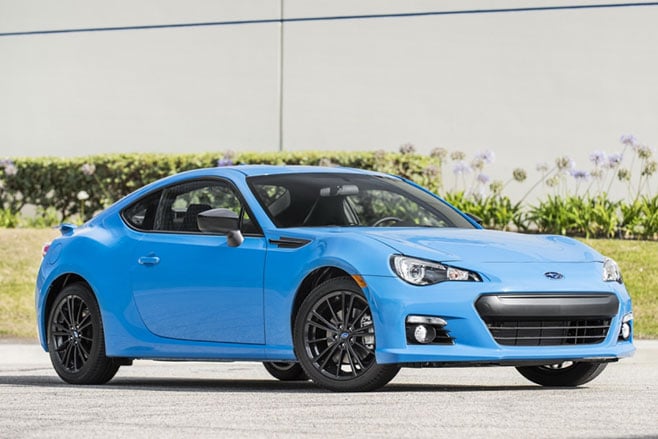
Whether local models will receive the same treatment, and at what price, is not yet known. Subaru saying it will reveal local specification and pricing when the vehicles are launched on October 1.
We pit the Mercedes-AMG GT S supercar against the Porsche GT3, bring you exclusive details of the new 300kW Holden Commodore, and compare five family-sized SUVs.
- The new Mercedes-AMG GT S supercar takes on the Porsche GT3, in the track comparison Mercedes dared us to do.
- Exclusive details of the new 300kW Holden Commodore, which will gain a Chevrolet sourced 6.2 litre V8 engine with its Series II update.
- Five family sized SUVs tested: Ford Territory vs Hyundai Santa Fe, Kia Sorento, Nissan Pathfinder and Toyota Kluger, in a seven-seater comparison review with a surprise winner.
- We go drifting on ice with HSV owners; drive what will be world’s most expensive SUV, the forthcoming Bentley Bentayga; and take the playful Mazda MX-5 convertible sports car for its first spin in Australia.
A man must experience at least two things in his life: a 911 Turbo’s launch control, and the haunted animal of an engine that lives in the middle of an Audi R8 V10 Plus.
Say we plonked you in a 911 Turbo driver’s seat, throttle pinned under your right foot, 5600rpm summoned, staring down a straight bit of road, da-da-da-da-da on the rev limiter. Lift your left foot off the brake. There’s a pause for a nanosecond as the car prepares to smack you in the face with 383kW. Then boom.
As if jerked hard by giant rope, the Turbo explodes forward, front wheels spinning, squatting hard over its rear axle. For the first fraction of a second, it feels like all four wheels have leapt off the ground.
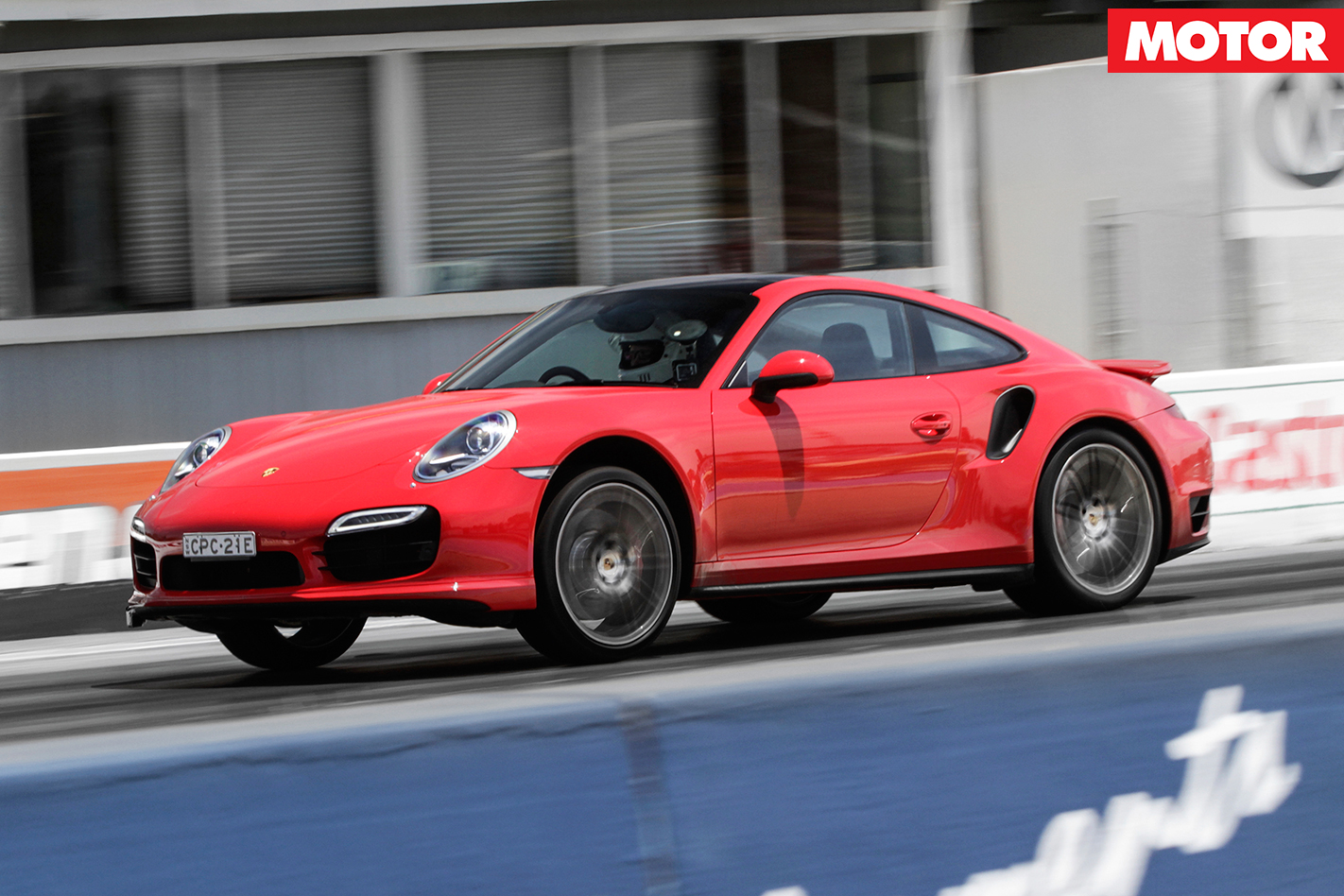
Keeping your foot in it, you’ll hit 100km/h in 3.07sec, 200km/h in 10.3sec. 0-400m is crushed in 10.98 seconds.
And at other speeds, it’s impossible to acclimatise yourself to the titanic thrust available under your right foot – 710Nm available from just 2100rpm. Full throttle is like igniting two enormous rocket boosters attached to the sides of the car.
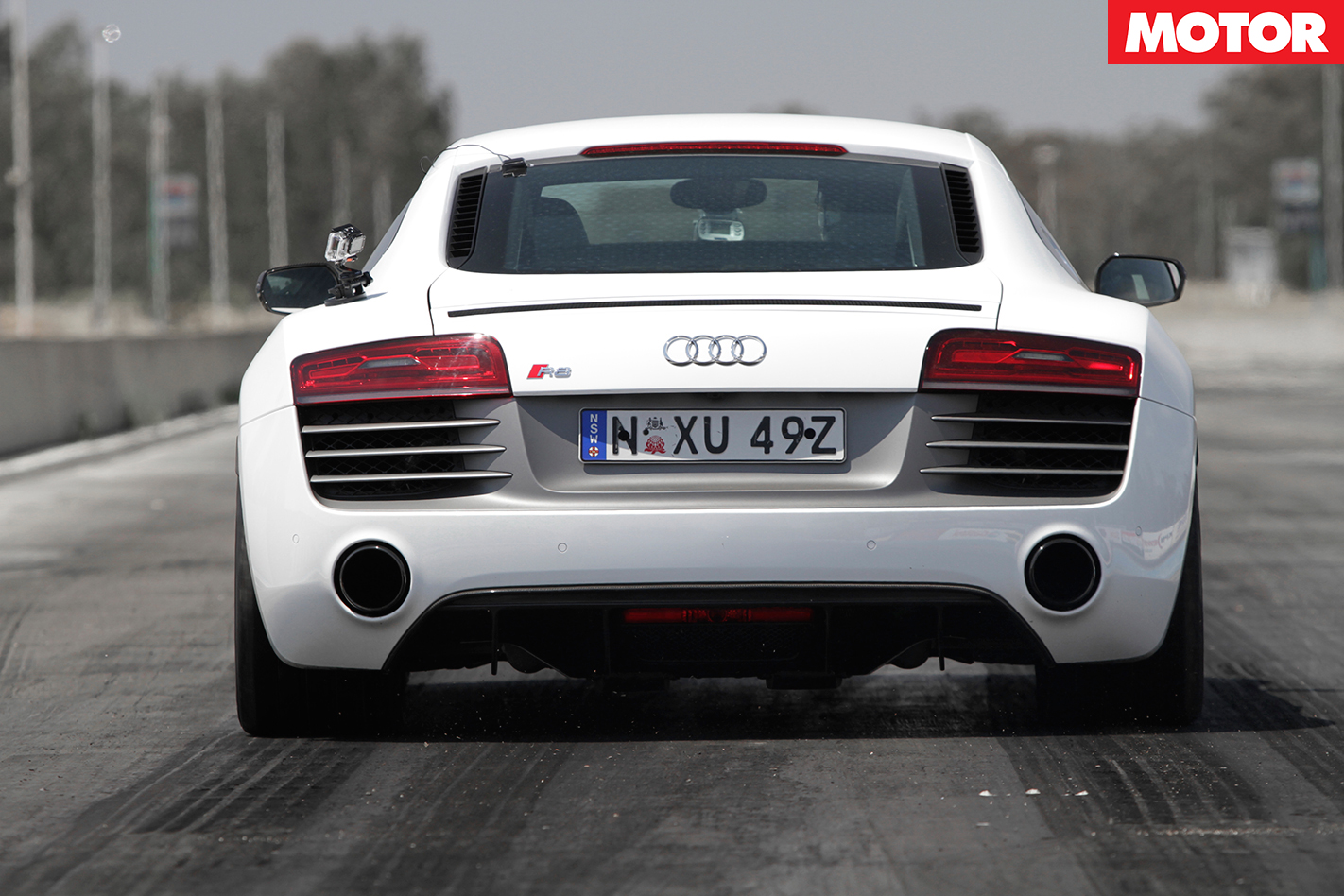
At Performance Car of the Year 2013, we were spellbound by the R8 V10 Plus and crowned it winner. Deservedly, too; it’s a nine-out-of-10 car, and we were all stunned by its 11.48sec quarter mile. The R8 is a hooligan.
The 911 Turbo makes it feel a bit, well, slow. We thought this might happen. At the PCOTY judges roundtable, we pondered the outcome if the new 911 Turbo or GT3 were there to challenge the R8.
Now the 911 Turbo is in Australia, we can explore this further. And can confirm first blood to the Turbo for acceleration.
Of course, it’s not all about, that, though. When it comes to cars, some of you like to attract attention like you’re cropdusting a busy footpath with $100 notes. Each to their own.
Though it’s now nine years old (!) the R8 looks as dramatic as the day it was unveiled. Parked next to it, the Porsche looks classier and understated. But don’t worry, attention-seekers – it still attracts eyeballs like it’s fluoro green, and on fire.
They’re both quite small cars, too, giving the illusion in photos that they’re bigger than they actually are. Pull open the R8’s angular door and you have to duck your head to fit through the low, small-ish opening.
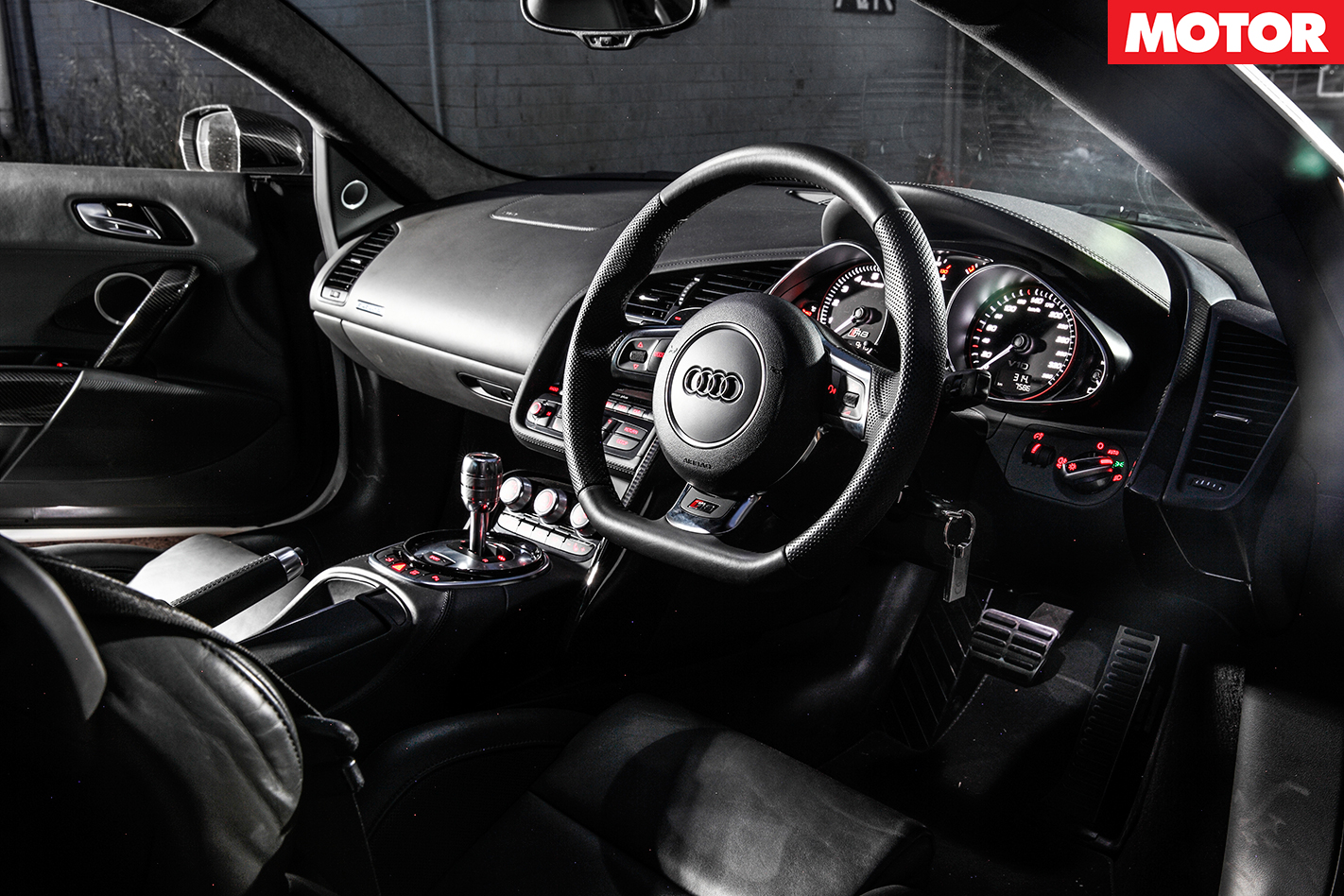
If the R8’s starter motor didn’t sound like the Terminator stirring his morning coffee, and if the engine didn’t idle like a sports bike whose balls have dropped, it would be rather unspectacular indeed.
Until you notice the R8’s dramatic gearknob, looking like it was flogged from the cockpit of the Millennium Falcon, a solid rod of an otherworldly metal, thick, heavy and cold, feeling tight, precise and mechanical as you grab Drive.
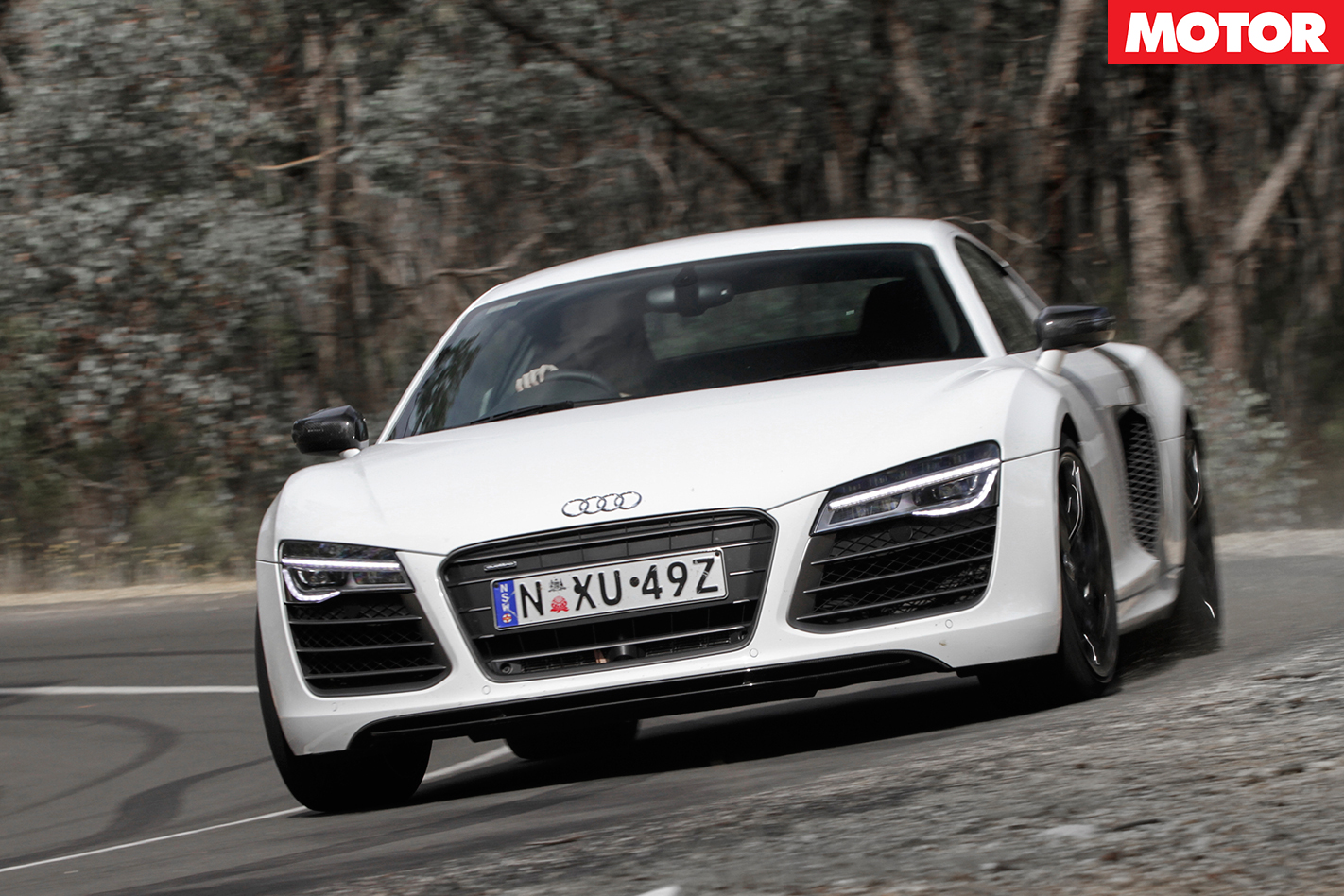
Pootling around town, though, the R8 is very behaved. While the damping rate is fixed (adaptive dampers are available on the standard R8 V10, but not the Plus) the ride isn’t shocking. The new S-tronic dual-clutch ’box is miles more pleasant than the clunky, cantankerous old R-tronic, too. And visibility is generous. Supercars shouldn’t be so easy to park.
Given the seats fit like corsets and are about as comfortable as sitting in a bodybuilder’s lap, you wouldn’t sanely commute to work in the R8, though, and only men with marbles rattling around in their heads would drive it long-distance.
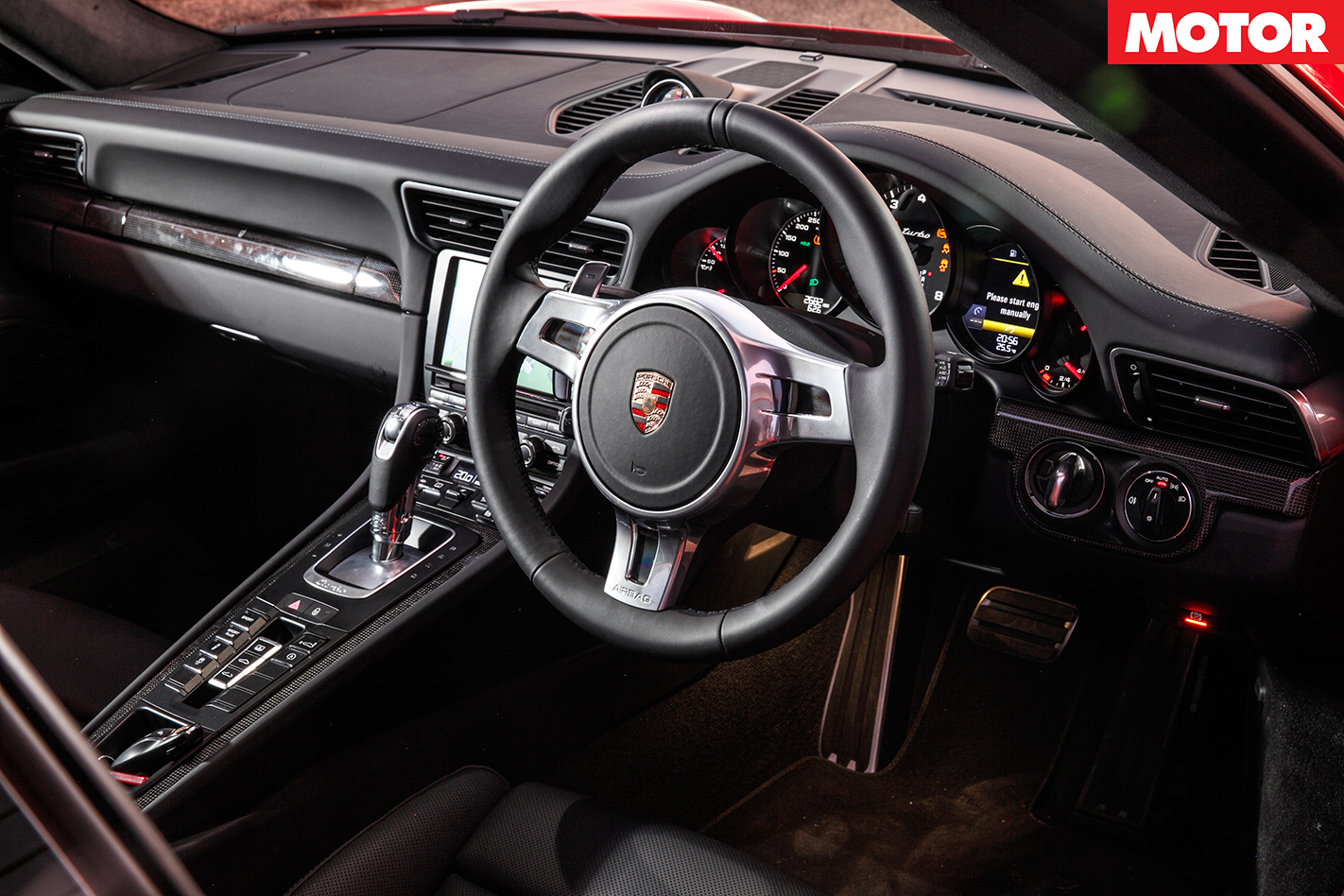
Owing to its youth, the 911 has more niceties like keyless entry (though no push-button start; there’s an unusual, key-like knob on the dash behind the steering wheel you turn to start the car). And it’s distinctive 911: tacho in ya face, steep dashboard, and a perfect driving position.
If someone dangled the keys to each in front of you and said drive from Sydney to Melbourne, you’d take the Porsche. But, if standing at the foot of a closed alpine road, a 911 Turbo and an R8 V10 Plus to choose from, you might chew through the whites of a few fingernails before arriving at a decision.
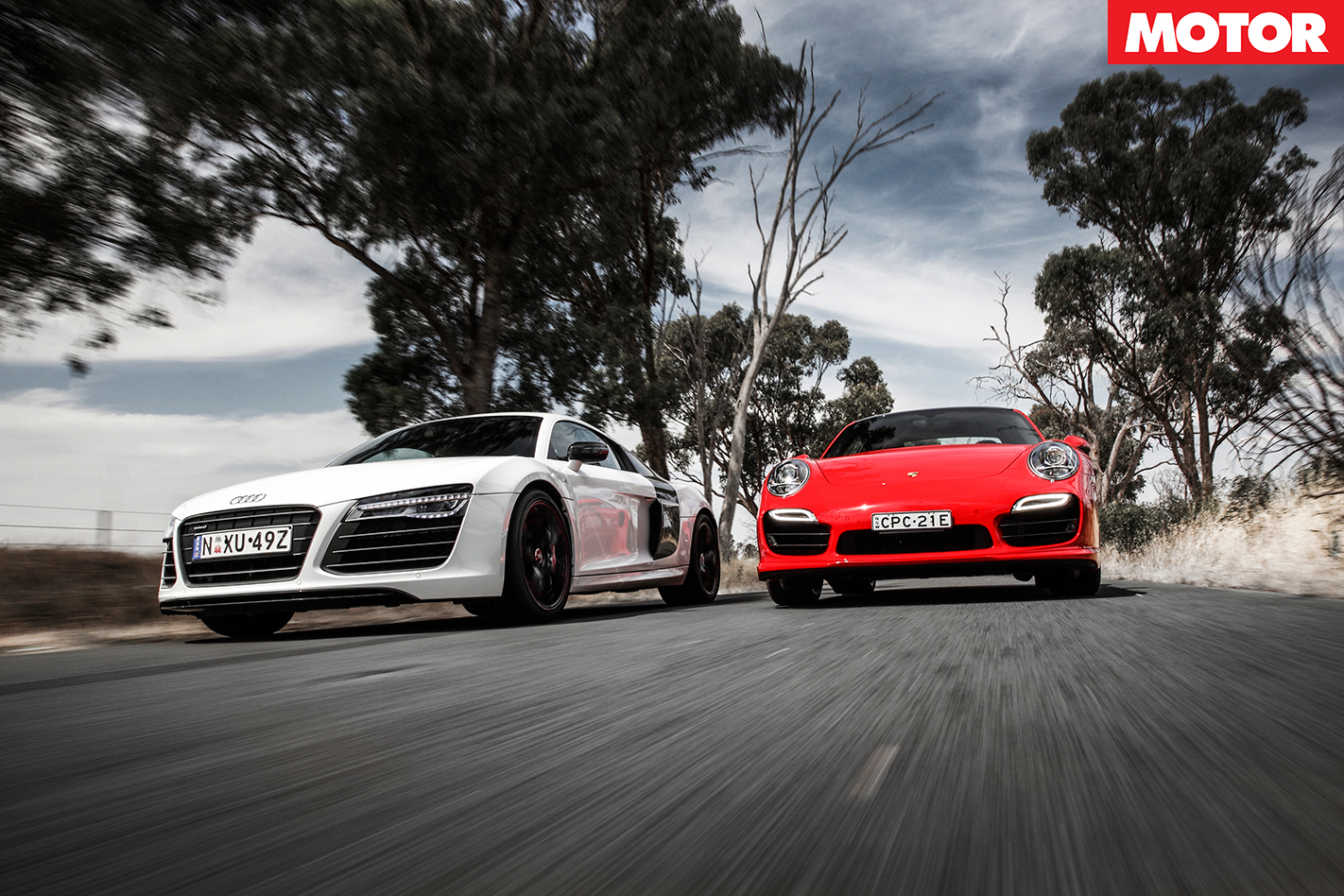
Bury the gas and the 911 bolts, mentally, on a seemingly ceaseless supply of low-down, turbo torque. Light turbo whistle transitions to a roaring, bassy hiss in the higher revs, where the flat-six starts to sing a little. You feel your hands tightening around the steering wheel. You have to pay attention. It’s effing fast.
The cornering speeds are berserk. It’s not until you start pushing that you realise there’s even more grip and ability than you first thought. Until then, though, you might be impressed by the Turbo’s pace, but you could be forgiven for craving a little more character and playfulness.
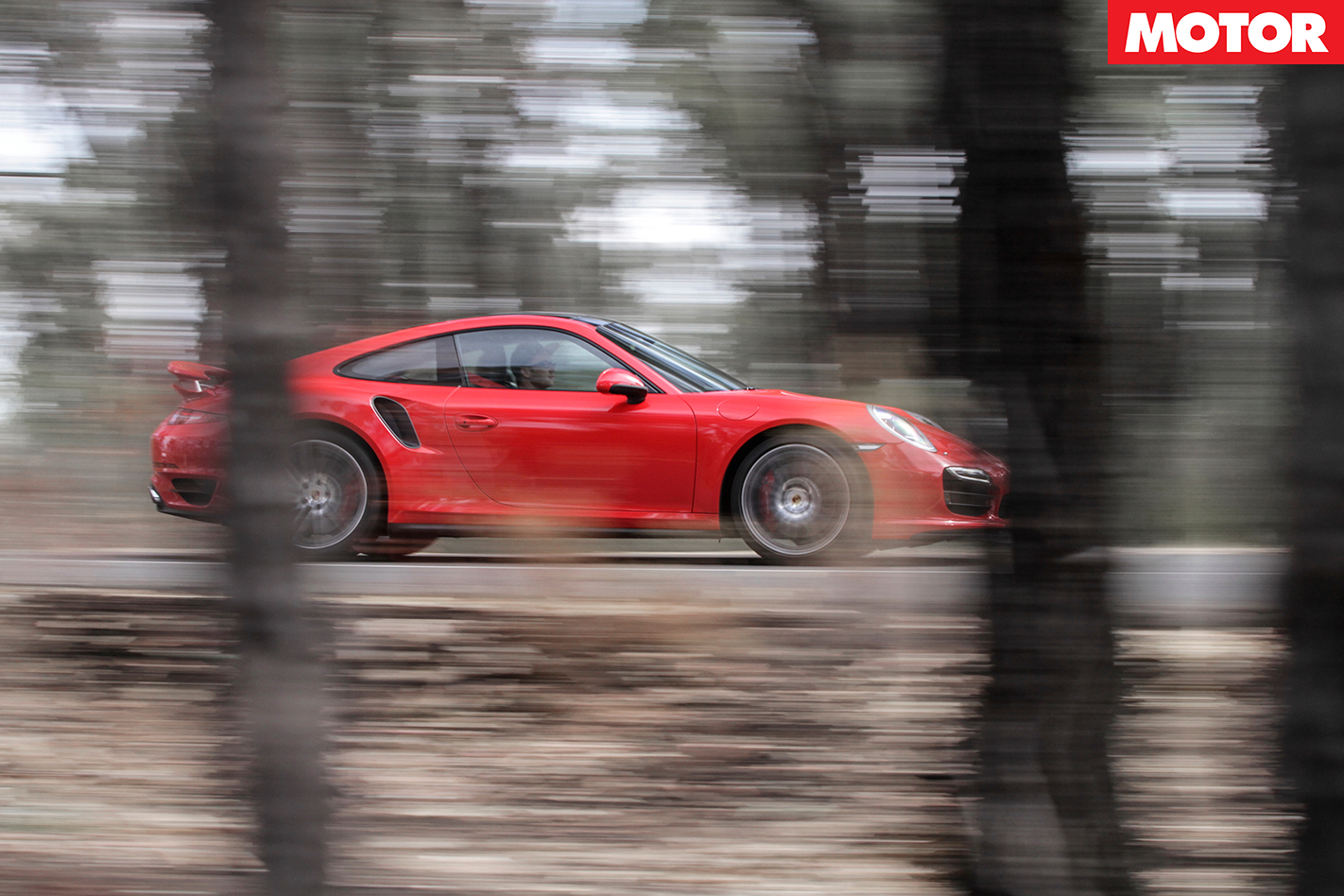
Then you get a bit of confidence and push harder. And you start to ‘get it’.
It’s tippy-toeing towards the limit, music off, tyres occasionally letting out a little squeal, that the 911 reveals its full talent – superbly balanced (you’d never think the engine is in the boot), mega amounts of grip, urging you to go faster and faster. Chassis-wise, it is a hugely gifted car.
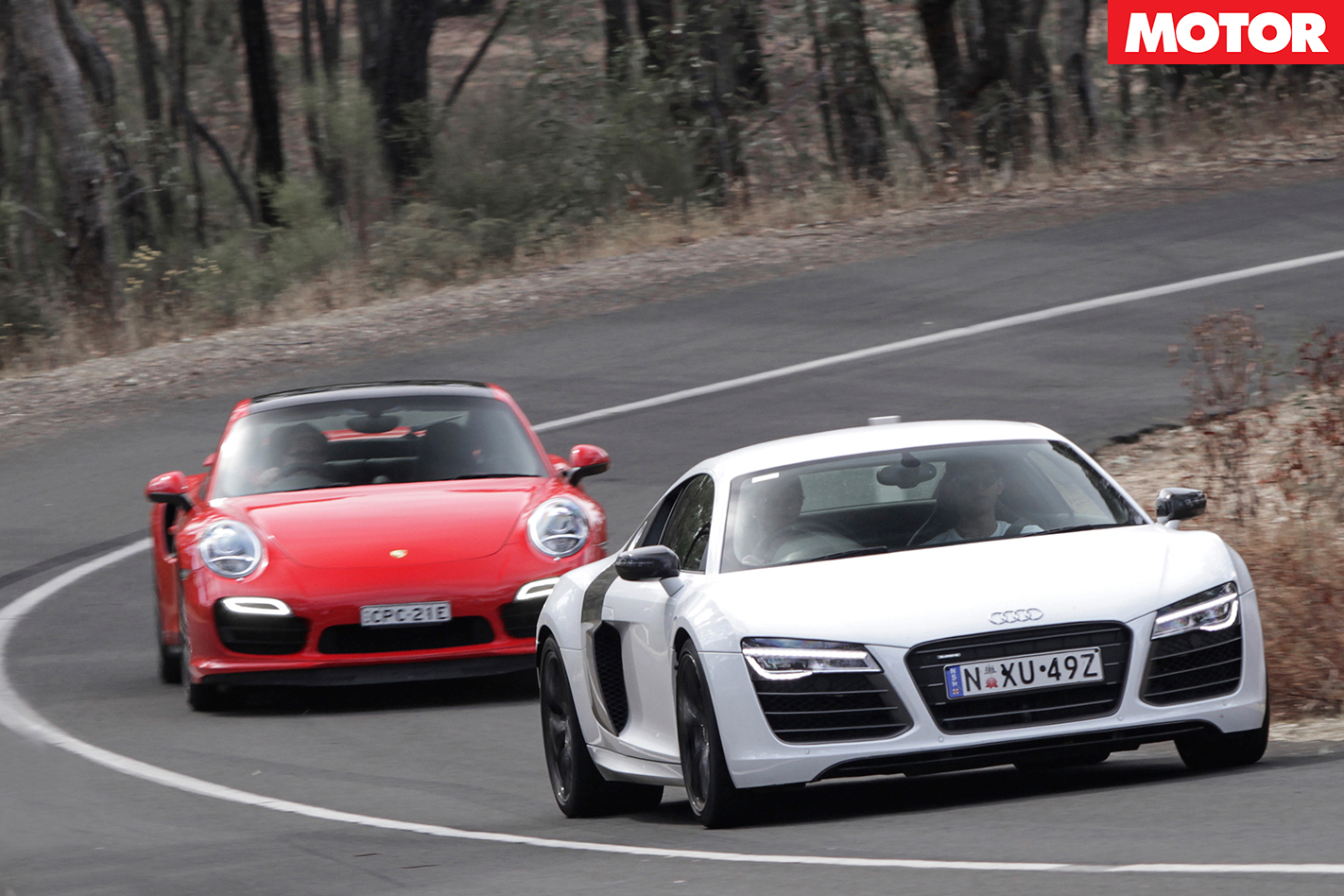
In the slow stuff, too, the 911 is unbeatable – you tip in and realise you could’ve gone a third faster. It pivots on its all-wheel steering like a hand reaching from the heavens, picking it up, turning it 90 degrees and plonking its spinning wheels back on the bitumen.
I’ve never driven a car that can carry so much speed into a hairpin – so capable of diving in and punching out of it again. You could never criticise the Turbo for a lack of grip.
But even at these speeds, the Turbo’s absolute limit is elusive. It’s like scaling a mountain for the first time – you think you’re near the top, but when you get close, the summit reveals itself to be another 300 metres away.
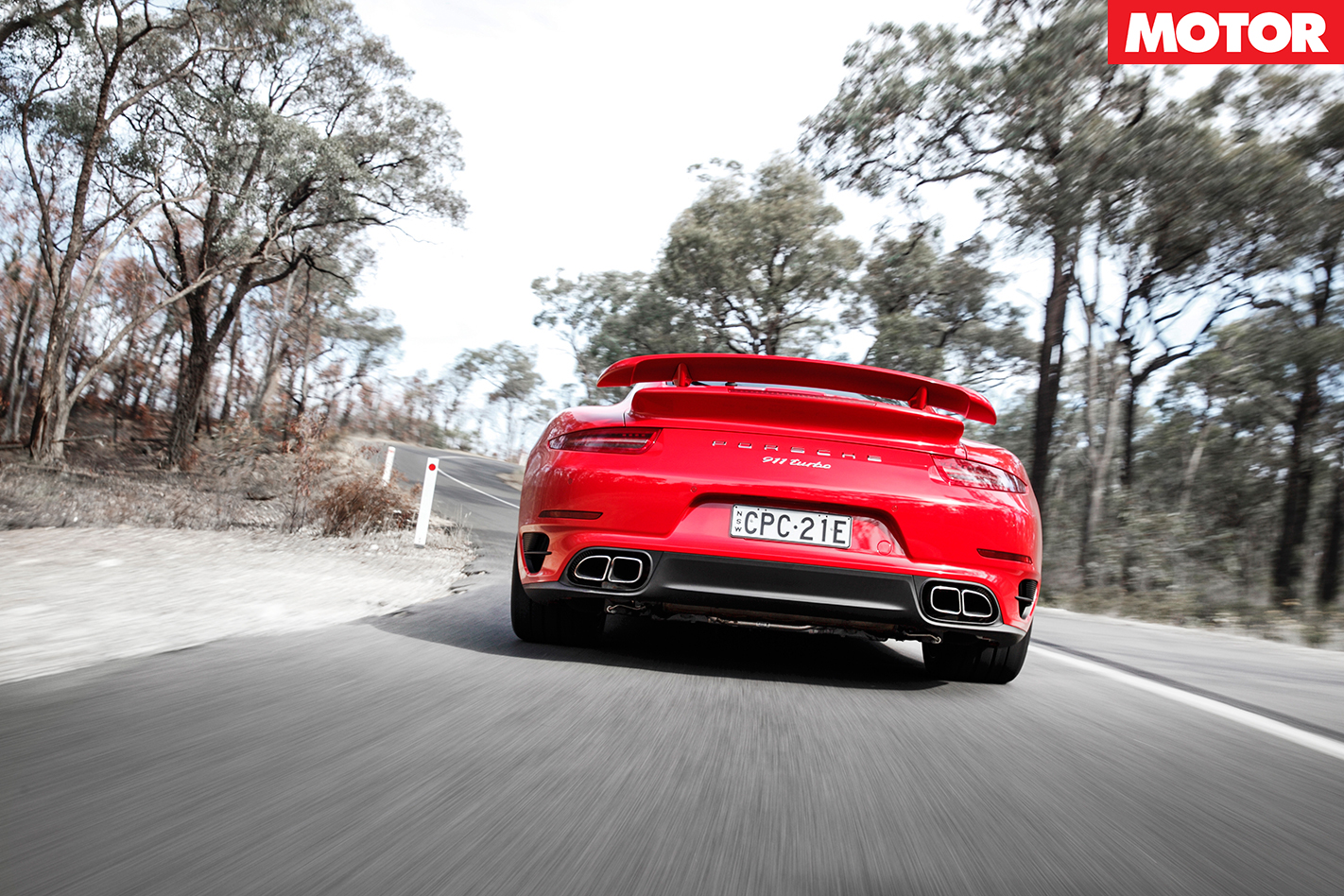
But while it’s superbly impressive, the 911 doesn’t have the supercar-drama of the R8. It sounds good, but you almost find yourself wishing there was a menu in the centre screen where you could turn the turbo roar down a bit and crank up the exhaust note. (Which is why Porsche makes the GT3, we suppose.)
In wanting it to be perfect, you might also find yourself yearning for just a tiny bit more feedback through the steering wheel. And perhaps more of a tactile pluck to the gear paddles. But that’s it.
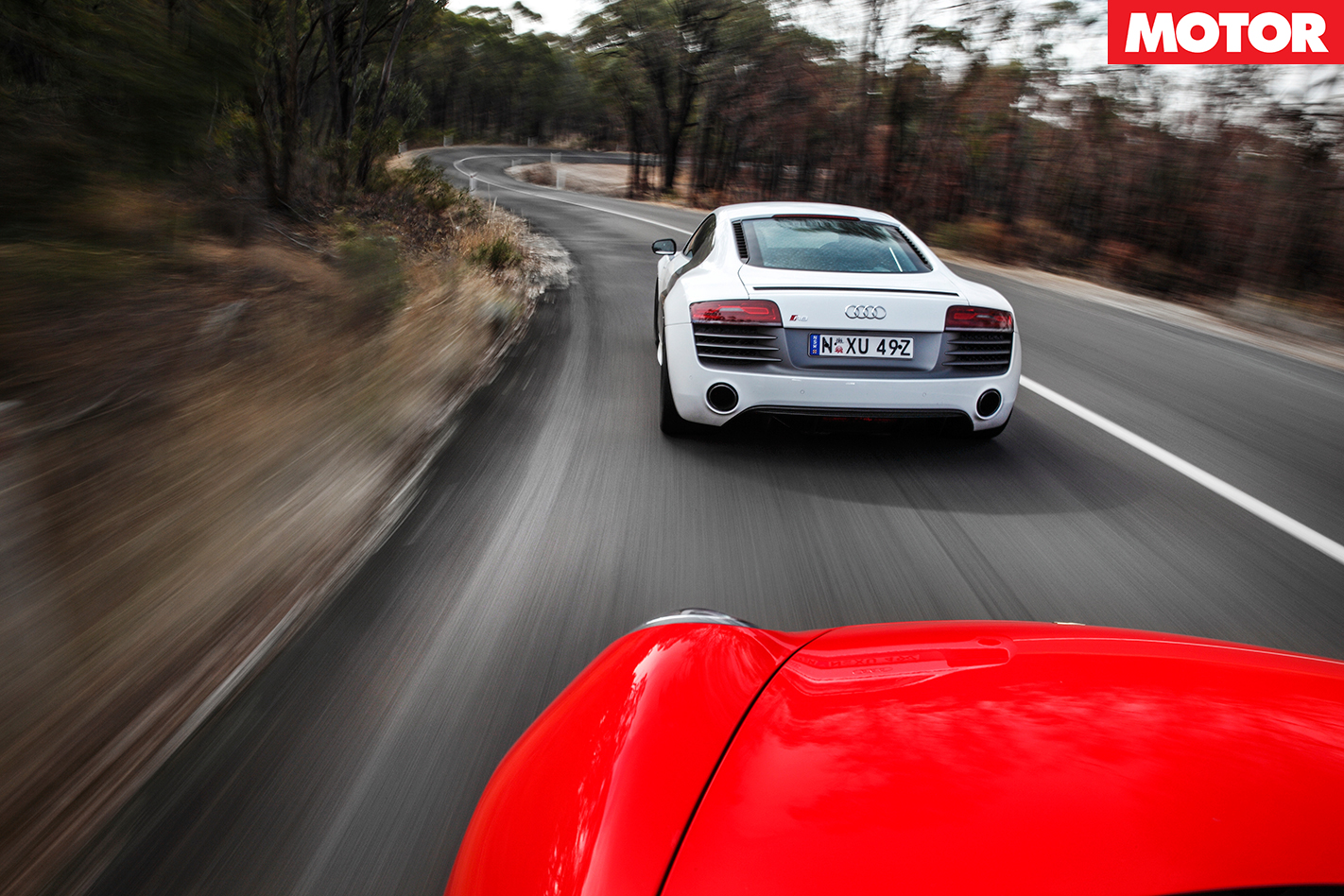
Particularly given it makes its perhaps modest 540Nm at a high 6500rpm. You certainly have to rev the R8 to get the most out of it compared to the Turbo. Not that that’s a bad thing.
The first time you floor the R8 and wind out that shrieking, clean-revving V10 to just shy of 9000rpm, and feel its howl vibrate through your bones, you’ll need to pull over and calm yourself down.
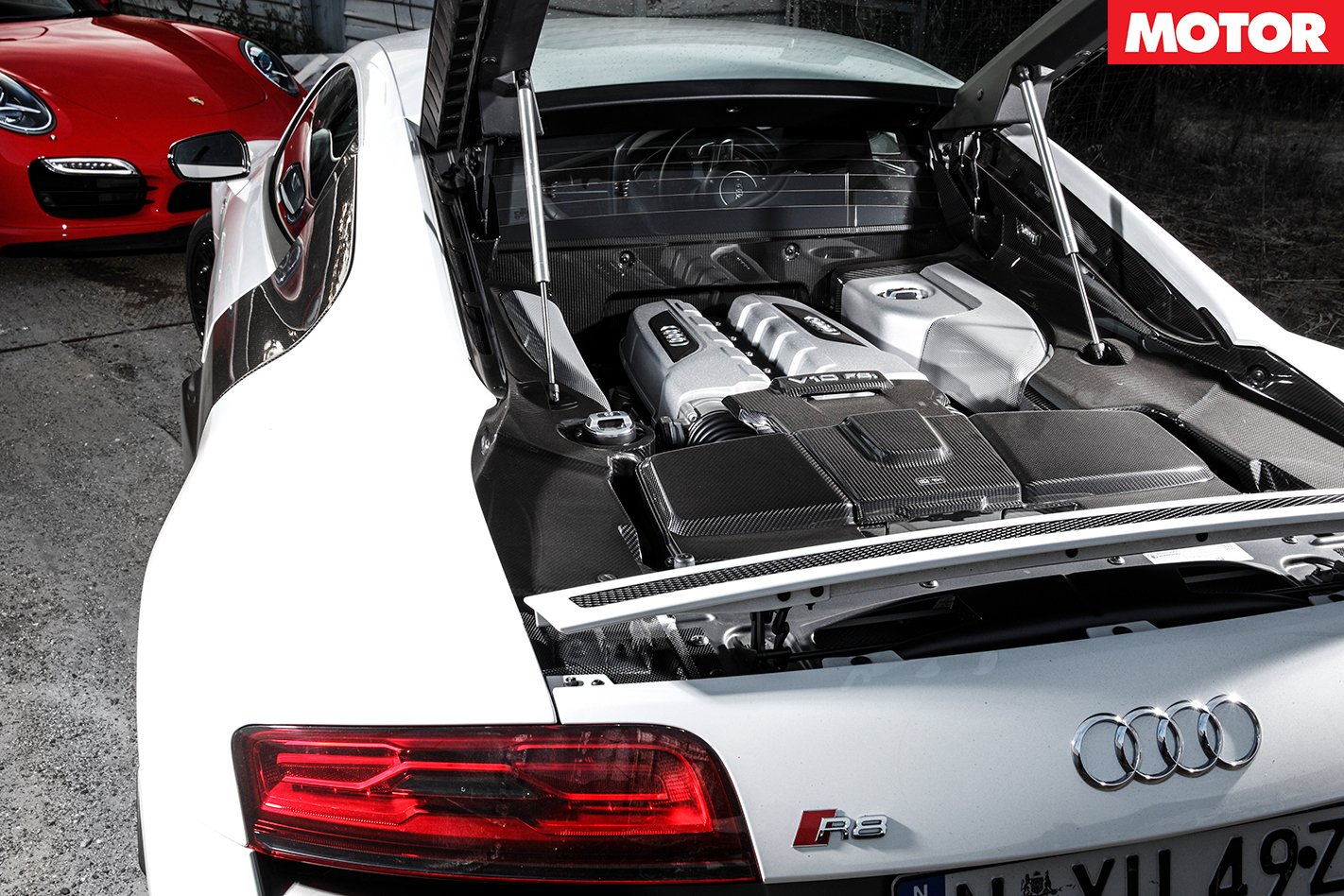
It gets even better when you hit the ‘Sport’ button. The R8 spares you of the bamboozling buffet of electronic settings you’ll find in other modern performance cars. The damper rate is fixed and so is the steering weighting (unlike, say, an RS5). You press ‘Sport’. And go.
The effect is something like, imagine you could plug your brain and nervous system directly into the car’s engine, like something out of the Matrix, so that you were physically connected to the car beyond just sitting in it. That’s what it’s like to drive an R8 V10 fast – particularly with the new, dual-clutch S-tronic ’box.
Within reason, the new transmission will obey your every command. You want to kiss the 8600rpm limiter? Sure. You want another gear? Pluck the right-hand paddle with a solid click and in imperceptible milliseconds, the revs have dropped, another gear is ready and, your foot buried in the carpet, you continue roaring forward on an uninterrupted wave of thrust.
The accuracy of the engine and gearbox is incredible, as if Audi outsourced their design and manufacture to a precision watchmaker. For theatre, for sheer driver entertainment, the R8’s engine and gearbox make it a more spectacular car than the 911 Turbo. The R8 is also more playful, and much easier to find its limit.
Up comes a corner in the R8. You are going rather fast, yes, but you can trust the brake pedal. You’ll never feel brakes with the bite and power as those on the Plus. Enormous six-pot front calipers clamp 380mm carbon-ceramic discs.
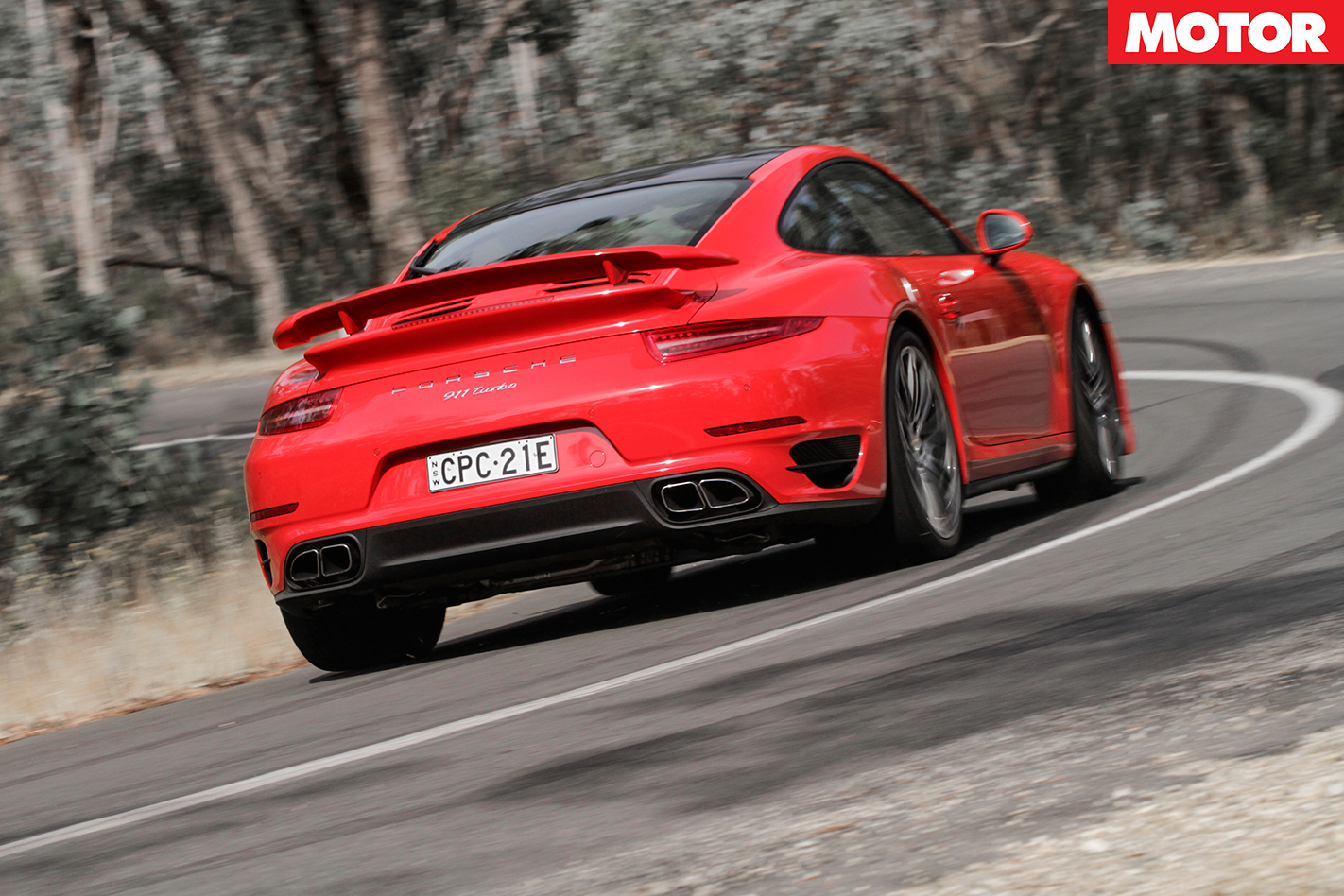
Pluck down gears, the V10 barking crisply as it blips with each downchange, and tip in. Immediately, you notice plenty of feedback through the wheel, and plenty of grip and point, but the rack could be faster; in the really tight stuff, you have to shuffle your hands around the wheel a bit. It’s 3.2 turns lock-to-lock – fairly slow by today’s standards.
Go too fast and you’ll feel the R8’s front wheels giving up a little easier than you might have first expected, too, particularly if you’ve just stepped out of a 911 Turbo. It will understeer and, if you’ve really overcooked it, almost surprisingly badly.
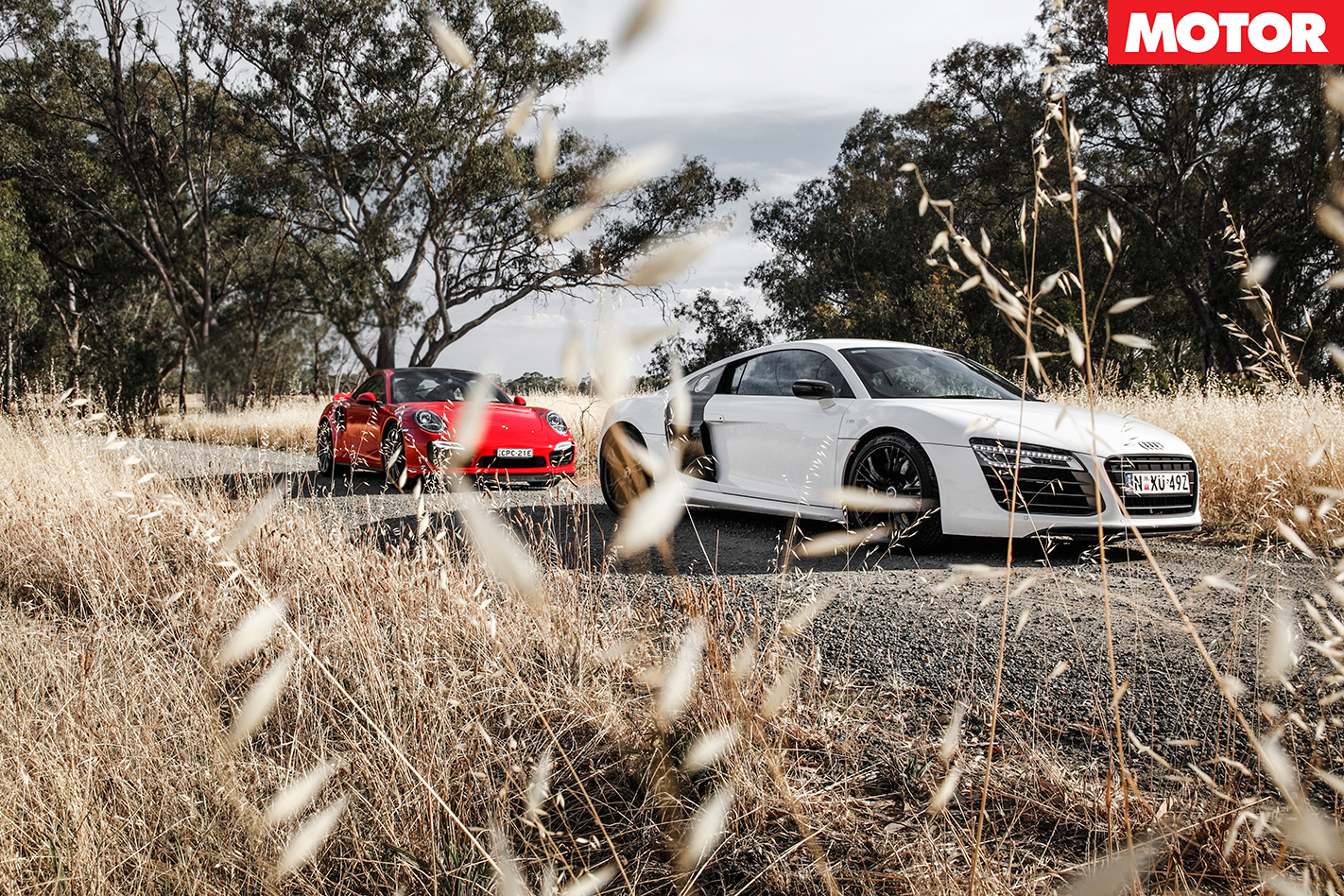
Where the Turbo demands focus and attention because of the lunatic speed you’re travelling, the R8 needs your concentration because its handling seems more affected by the physics of having the engine in the middle, challenging you to find ways around the understeer.
It dares you to stay on the brake while turning, to encourage a little more front bite, and in the ballsy, faster corners (like at Broadford, when we were there for PCOTY) it tests your patience on the throttle.
Get greedy on the gas and you’ll lift the R8’s nose, causing push. Likewise, if you’re greedy on the brake on corner entry, the R8 will very quickly try to swap ends on you in traditional midship-style.
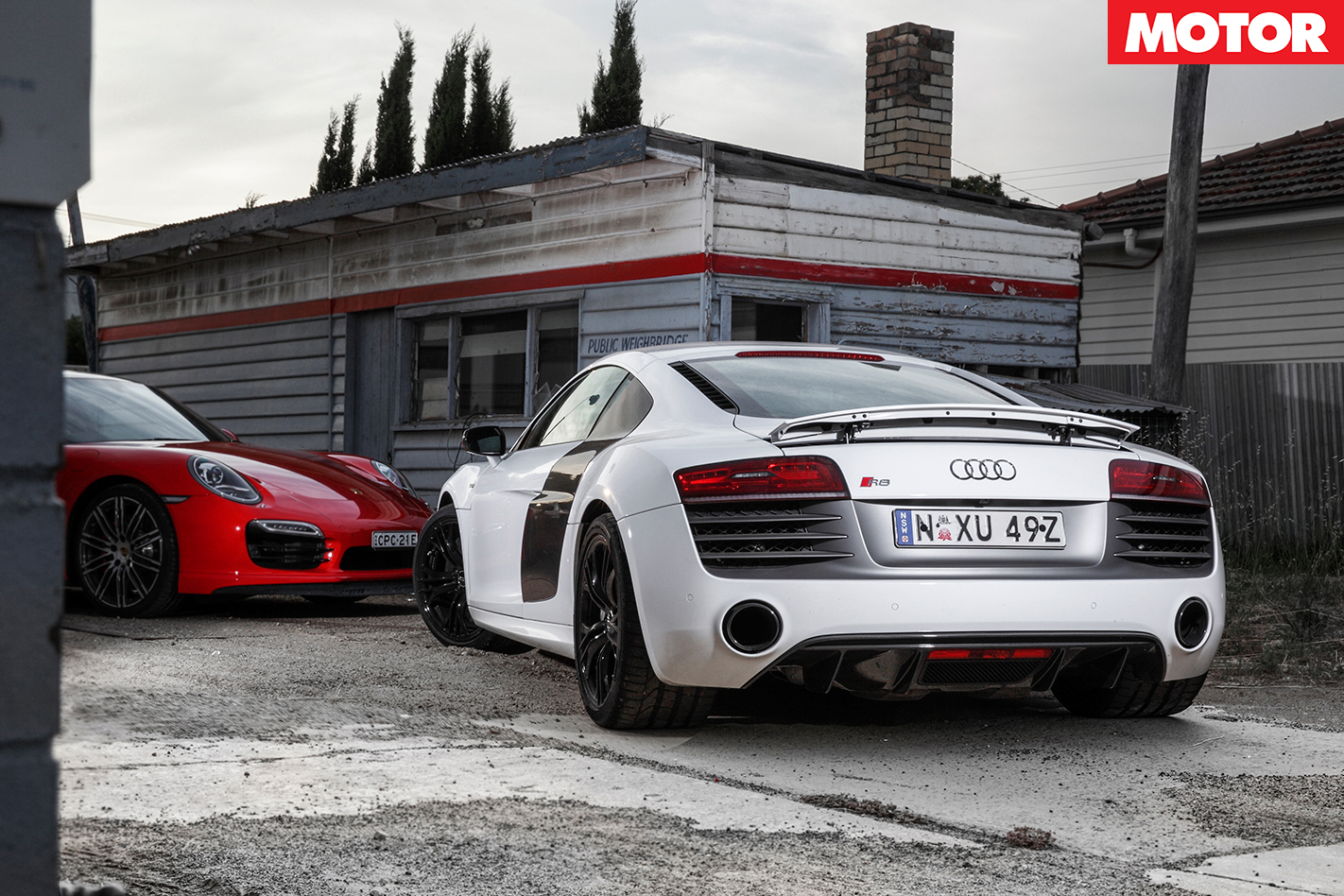
So, say you hide a strange, unfulfilled curiosity to try motorcycling but are put off by the danger. You have $408K to blow and a spare spot in your garage. You own a second car that’s quiet, rides softly, in which you could commute to work, road-trip, and with a boot that inspires IKEA visits. If this is you, take the R8.
Save it for sunny weekends. It’s dramatic to look at, stunningly engaging to drive, stupidly fast, loud, theatrical, bewitching. It’s two Yamaha R1s stitched together, with a roof and two seats. You’ll flog it up a mountain road, get to the top, climb out and, hands trembling, suddenly want a cigarette, even if you don’t smoke.
But, like a sports bike, it’s not entirely comfortable, or practical, and its interior is modestly-appointed for a $408K car. You lock it in the garage, save it for weekends and commute to work in your other, more comfortable car.
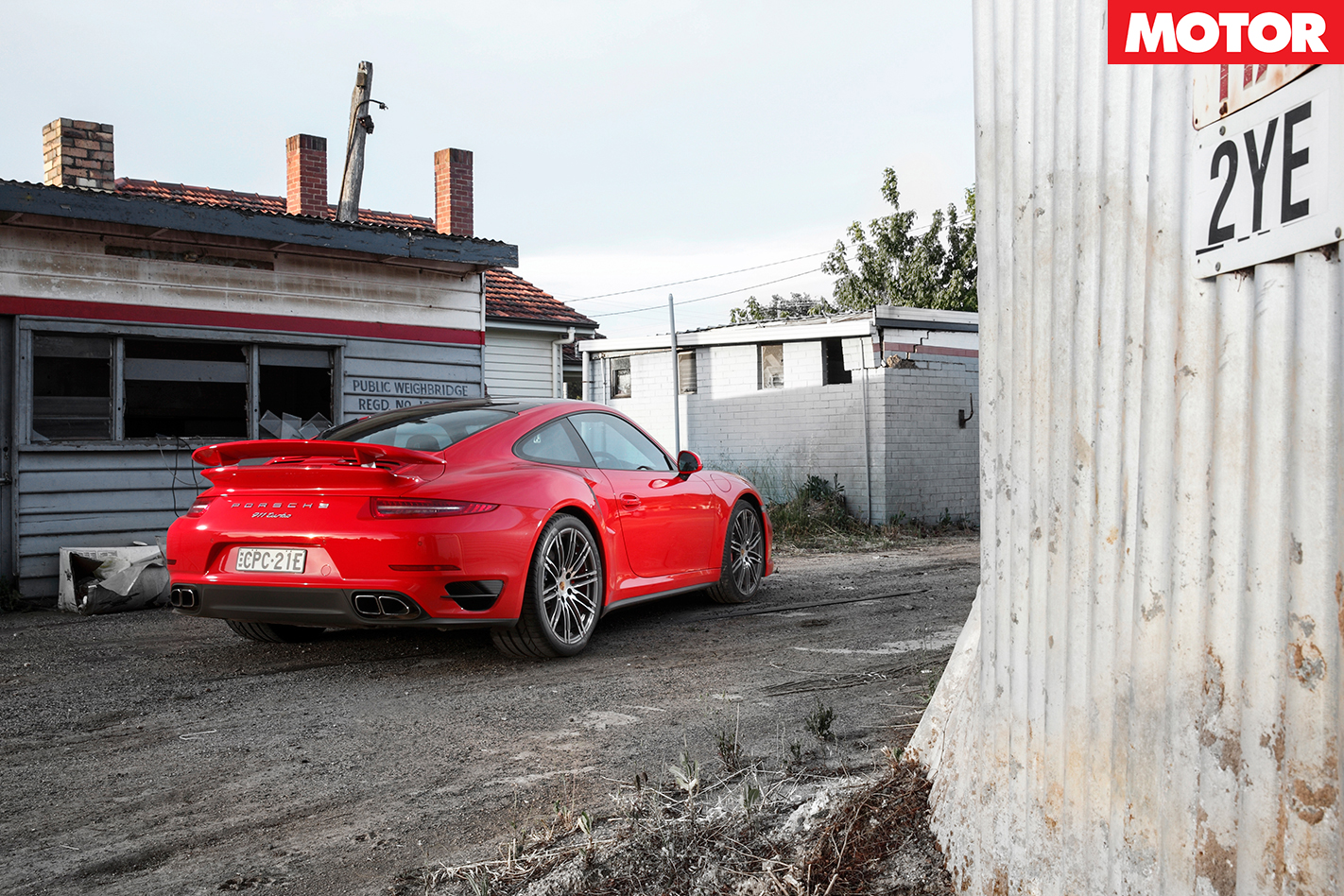
It’ll force you to become a better driver just so you might, one day, have the courage to turn the ESP all the way off and dance near its supremely impressive limits. It’s genuinely pleasant enough for daily use. It’s also $48K cheaper than the R8.
And while you must – must! – drive an R8 V10 before you die, it’s more important you experience the 911 Turbo’s launch control. It’s utterly otherworldly. You’ll be changed.
This weekend the V8 Supercar circus returns to Sydney Motorsport Park, which last year played host to one of the best post-race celebrations ever seen.
Kiwi wet weather master Shane Van Gisbergen took victory and decided to celebrate in his usual flamboyant style, the Tekno Autosports VF Commodore howling against its rev limiter as it swung from lock-to-lock on the slippery track.
Van Gisbergen is something of a master of the victory celebration. As a regular participant in national drifting events both in Australia and New Zealand, his car control is something else, as demonstrated at Darwin in 2011.
However, what made the SMP race unusual is that second- and third-placed Chaz Mostert and Jamie Whincup decided to join in the fun, treating spectators and viewers to an incredible display of car control.While sliding a 470kW Commodore or Falcon on a wet racetrack might sound easy, the truth is race cars aren’t designed to operate sideways – with a very small amount of steering lock, the line between looking like a hero and ending up red-faced in the grass is a fine one.
Let’s hope this weekend’s racing offers up a similar spectacle!
Get your free weekly report from the world of fast cars – subscribe to the MOTOR newsletter!
A DOZEN years ago, nobody would have foreseen the fall of CDs, the rise of The Greens, or Matthew McConaughey’s career-defining turn in True Detective – a true McConaissance!
The same applies to SUVs, which from a low base back then are now closing in on passenger-car market share to be the dominant force. Like their on-limit handling once was, the tipping point is coming sooner than you might think.
And nowhere is that truer than in Audi’s case, where its Q5 – the long-reigning medium-sized premium SUV – comfortably outsells the A4 range that begat it.
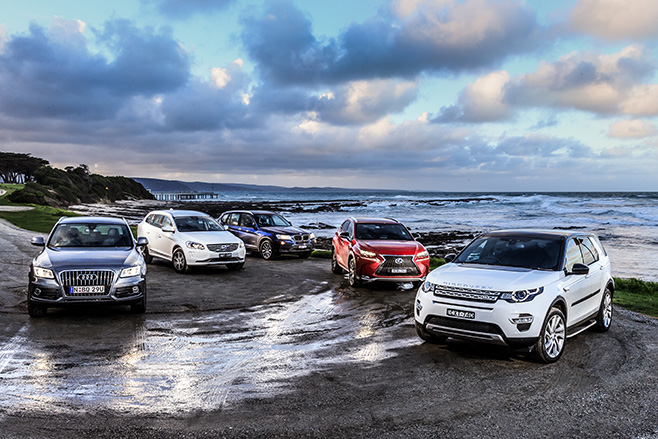
The Ingolstadt brand’s position is under threat, however, with no fewer than three all-new or facelifted foes driving interest in a class that has grown by more than 25 percent this year alone. Enter the box-fresh Land Rover Discovery Sport and Lexus NX, joining Volvo’s XC60, revamped in late 2013, and the model that established this niche 11 years ago, BMW’s X3.
Hottest right now is the supply constrained Disco Sport, attracting waiting times of nine months and counting. Replacing the forgotten Freelander, Tata-owned Land Rover has based it on a heavily modified version of Ford’s EUCD (Mondeo) platform also underpinning the Range Rover Evoque that so obviously inspired this newcomer’s handsome styling.
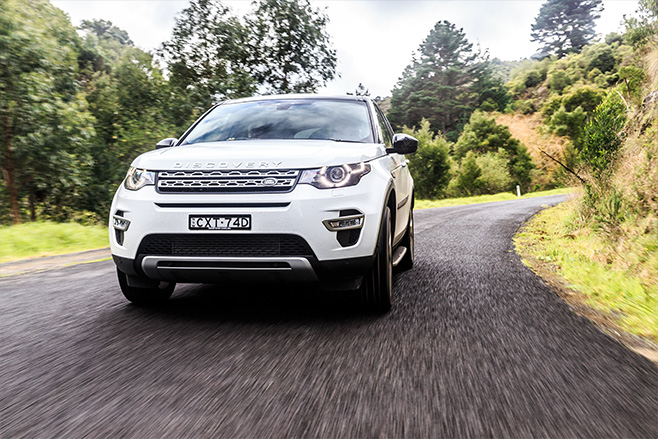
While matching every SUV here with its unibody construction, five-seat wagon practicality and family friendly cargo flexibility, satellite navigation, climate control, Bluetooth connectivity, a rear-view camera, electrification for the driver’s seat and tailgate, and an idle-stop system, the Disco Sport also standardises Autonomous Emergency Braking (as does the XC60 that pioneered it), leather upholstery and five USB ports. But the Disco Sport is Robinson Crusoe here in also delivering Land Rover’s proper off-road-enhancing Terrain Response tech with Hill Descent Control.
Additionally, on top of the usual HSE Luxury features like heated/vented front seats, hi-def sat-nav, digital radio, auto high beam and xenon headlights, ours boasted a third-row seating option ($1990), Meridian audio upgrade with rear-seat video entertainment ($5500), panoramic glass roof ($1800), 20-inch rims ($1500), contrasting roof ($920) and sundry other extras. Result? $82,460. Throw in the ugly dealer-fit door rub strips, side steps and towbar fitted to the test car and you’re pushing past $85K…
Audi’s Q5 equivalent is the 2.0 TDI quattro Sport Edition. For a tenner under $70,000 (or $71,797 thanks to blind-spot warning, lane-change alert, adaptive cruise control, xenon headlights and heated front seats), it brings sports buckets and 19-inch alloys to a comprehensive equipment set, though the Four-Ringed German’s AEB is AWOL, betraying the Audi’s seven birthdays way more than its still-attractive styling.
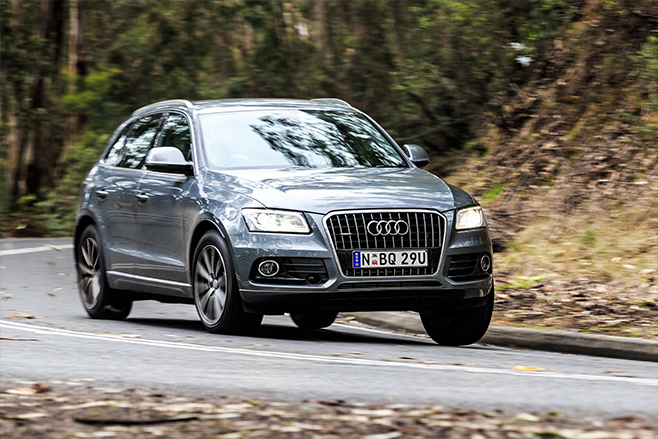
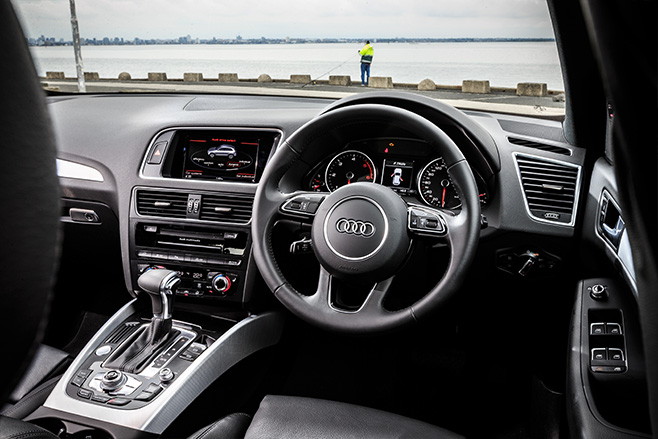
Let’s start with the last one. Audi, please step up. While the Q5’s A4/A5-esque dash might appear dated and overly familiar, with a scattered array of buttons, the fundamentals are nigh-on perfect since everything works as intended. Unwavering consistency rules. Crisp instruments, superb comfort on enveloping seats, ample space (aided by sliding rear cushions), seductively tactile surfaces and a lush feel to every operation are key cabin hallmarks.
Honed in the Evoque, the Disco Sport’s ‘cool’ cabin themes centre around simplicity infused with a clean and contemporary look that is totally on-brand. From the elegant steering wheel and large central touchscreen to the classy controls, multitude of smartphone/tablet attachments and gorgeous leather seats that allow for a sporty, low-set driving position, there’s enough style and substance here to make a Range Rover owner question their purchasing wisdom.
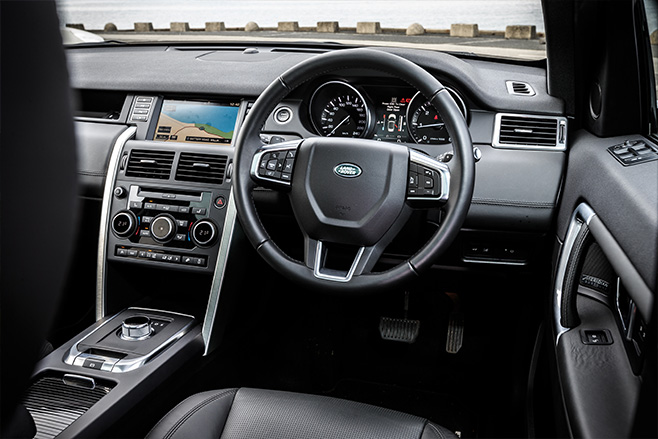
And remember, the Disco Sport can also be a 5+2 seater, though it is strictly kids-only. Stupidly, third-row access is only possible from the driver’s side, exposing a weird left-hand-drive bias in this UK-made vehicle. While we’re fussing, the touchscreen infotainment operation is fiddly and slow, cabin plastics quality varies, and the novelty of the rise-and-twist cylindrical transmission lever wore off last decade.
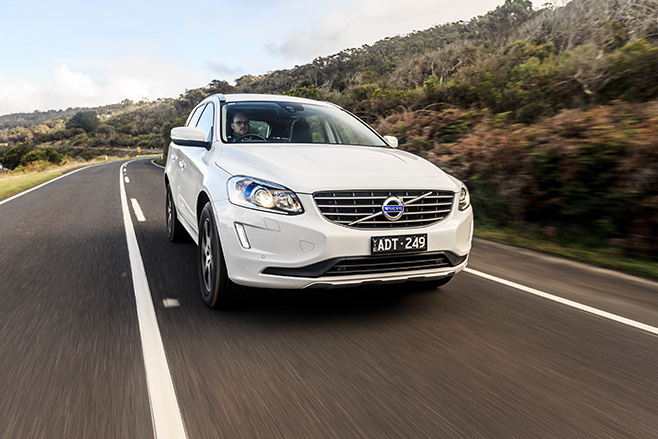
‘Cushy’ ably sums up the Volvo’s likeable interior, brandishing unmatched solidity and cohesiveness. Smooth surfaces, rubberised switches, brushed metal, stitched leather… it’s like a sophisticated dominatrix’s kitchen inside.
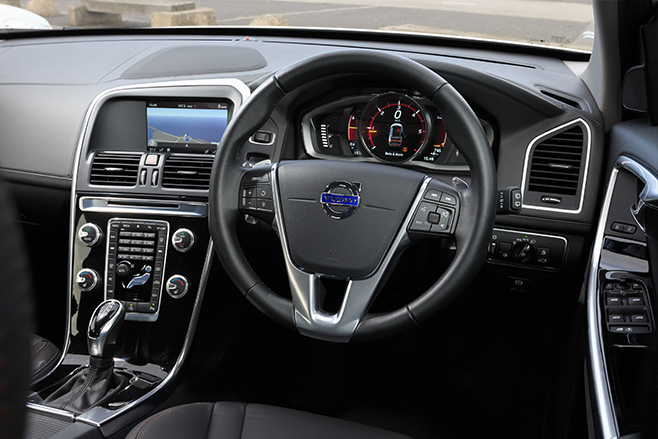
That four adults can travel painlessly in sumptuous seats that literally hug you for hours on end further heightens what remains an enticingly business class cabin experience. Less welcome are the XC60’s massively thick B-pillars that could elicit claustrophobia in a caterpillar, not to mention smallish door apertures, the triangular pitch of the side windows that eats into headroom, and a ride that never quite settles. More on that later.
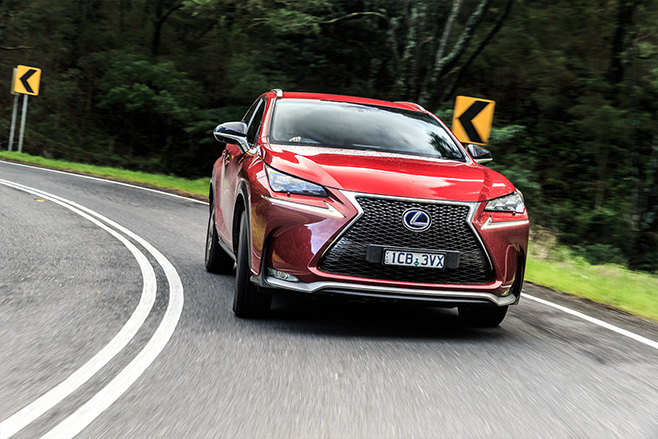
Smaller in every major dimension including wheelbase, the Lexus is never going to win the space race, particularly when its battery and electric motor gubbins hide beneath its rear quarters, resulting in nosebleed-section second-row seating. So welcome to ‘cosy’ then. Kids should love it.
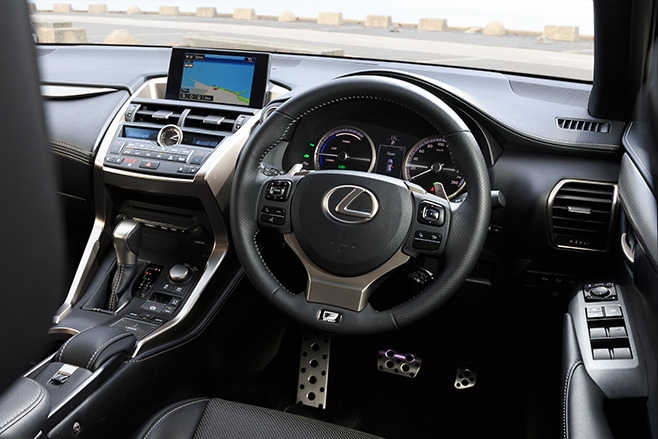
Despite an almost oppressive amount of funereal trim in the F-Sport, the NX isn’t actually cramped. Also, its unique and intriguing fascia design, super-soft leather seats and fanatical build quality deserve credit. Proudly Japanese in presentation and texture, even the somewhat messy switchgear makes sense with greater exposure. Just don’t get us started on the diabolical finger-touch controller. We do like the Volvo-style changeable dials, however, which go from goodie-two-shoes charge-meter to devilish tacho at a single press.
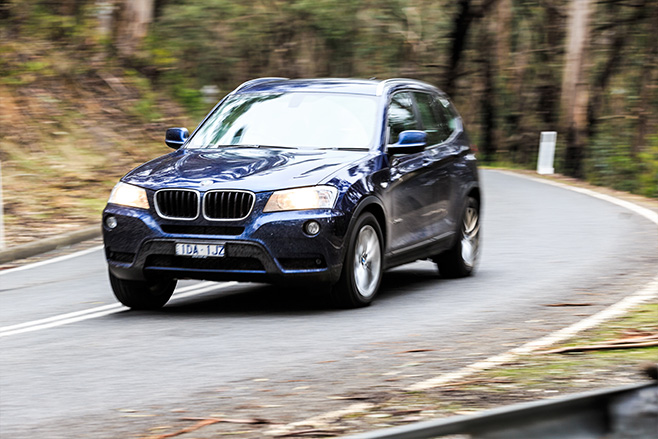
It gets worse for the BMW’s passengers, who must endure an annoyingly fidgety ride, as well as a rear seat suffering from insufficient cushion support (resulting in splayed-leg syndrome), a hard and overly reclined backrest, and some embarrassing fit and trim (un)finish issues.
Only an excellent driving position, a logical iDrive controller, crystal-clear dials and a voluminous boot save the day for the X3. Well, those plus points and its revvy 135kW/270Nm 2.0-litre four-cylinder turbo-petrol engine.
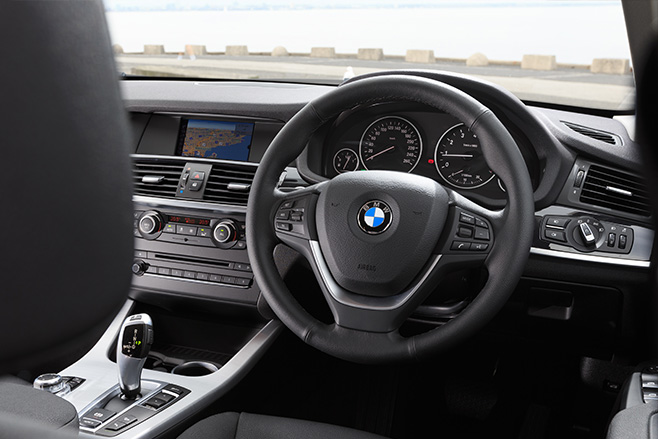
Having driven the first-rate 140kW/400Nm 2.0-litre turbo-diesel alternative, we reckon the latter would feel even more muscular through the mid-range, while bettering its petrol brethren’s hefty 12.3L/100km test average. Based on BMW’s lab versus real-world figures, we calculate the 25kg-heavier xDrive 20d would save close to 4L/100km, putting it right up there with the thrifty Volvo at an estimated 8.5L/100km.
The X3 also remains faithful to recent BMW practice with its zombie-like low-speed steering feel. The helm only resuscitates once you’re pedalling briskly, finally connecting the driver with reasonably crisp and controlled turn-in. In dry and smooth conditions, fun and agility are back on the menu, but the X3’s Dunlop 245/50R18 tyres lack grip on wet roads. Worst of all, their run-flat construction contributes to a perennially pattery motion that exposes just how unsettled the X3’s ride can be on poor surfaces. If you’re keen on the BMW, adaptive dampers and better rubber should be option-box essentials.
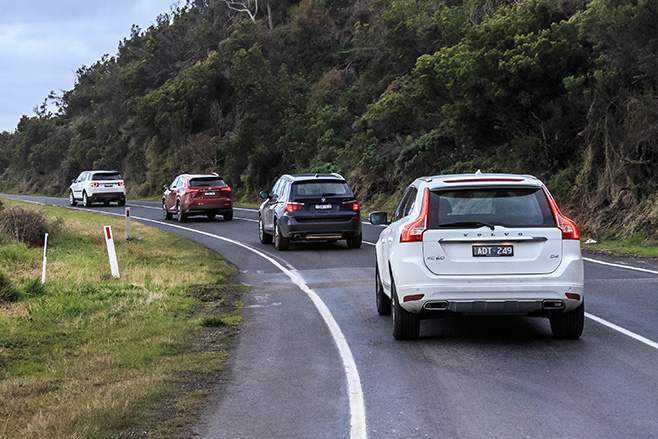
If performance and economy are paramount, the front-drive XC60 D4 is the SUV for you, overcoming its 30kg weight penalty and limited traction to match the X3 xDrive 20i’s sprint time. But once into triple digits, the swift Swede pulls ahead emphatically – 0.7sec quicker to 120km/h, 2.0sec to 140, and an incredible 4.7sec clear by 160.
As far as diesels go, Volvo’s 133kW/400Nm 2.0-litre four-cylinder Drive-E unit soars. There’s some torque steer at low speeds and on wet surfaces but it’s within manageable limits, and it feels downright vigorous shifting between intelligently spaced ratios. Make no mistake, there’s real velvety fire behind the ageing Volvo’s visage.
While the Volvo’s 8.1L/100km average isn’t spectacular, the next best of 9.2 (Audi) and 10.1 (Lexus) were significantly thirstier. On the flipside, however, the XC60 suffered the longest braking distance from 100km/h to zero – 39 metres against a test-best of 36.7 for the grippy Q5.
While on the topic of steering and ride issues… hello, Lexus. Always numb and artificial in feel – does Sega supply the hardware? – the NX is simply not interested in fostering meaningful man/machine connections. And that’s a shame because the NX300h’s chassis is actually a competent one, with decent balance and fluidity until it’s hurried. Then the overly zealous stability wardens stick their boots in after just a whiff of traction loss, cutting power and fun with ham-fisted authoritarianism. A weirdly grabby regenerative braking system fuels further dynamic alienation.
Equally annoying, the NX’s ride – on 18s like the other dynamic disappointments, coincidentally – jostles passengers about, though thankfully with less force than the uncomfortable BMW. But what’s most cloying about the NX’s deficiencies is that flush Toyota chose to inflict a 10-year-old RAV4 chassis (albeit heavily modified) and other parts-bin bits into this booming category, rather than spending the time and money necessary to make the NX great.
Still, positives abound. Powered by a 147kW/210Nm 2.5-litre Atkinson-cycle series parallel petrol/electric hybrid unit (just like Camry), driving all four wheels via a droney six-step CVT transmission, the NX scores a thumbs-up for overcoming its heft (the group’s worst at 1800kg) to keep sight of the punchy XC60 and X3.
Assisted by a seamlessly activated 50kW motor electrifying the rear axle, it can hustle along at a cracking pace, building up speed effortlessly – and surreptitiously, so beware – all while averaging 10.1L/100km, which is impressive considering the Lexus’s Rubenesque mass.
Both the Q5 and Disco Sport are lumbered with ageing and soon-to-croak turbo-diesels. In the Audi’s case, it’s the VW Group’s long-lived 130kW/380Nm 2.0-litre TDI, while the Land Rover at least has a bit more oomph on its side thanks to a 140kW/420Nm PSA/Ford unit. Both predominantly drive the front wheels via a seven-speed dual-clutch and nine-speed torque-converter auto respectively.
The issue with both are levels of off-the-line lag that just isn’t an issue in the other vehicles here. Nothing really helps the interminable hesitation before the torque comes cascading through to the wheels. Disabling the (equally lethargic) idle-stop system on the British SUV helps a little, but ultimately these two suffer disappointingly doughy acceleration response, as their comparatively modest 0-100km/h times reveal (Q5: 9.6sec; Disco: 9.9sec).
With nine gear ratios to play with, the Land Rover does feel slightly sprightlier once the diesel hits its stride, and if you can keep the revs in the sweet spot, a quite robust turn of speed is possible in both. At least a Q5 buyer has the option of a potent V6 turbo-diesel alternative (3.0 TDI and SQ5). Until it scores all-new Ingenium engines in 2016, this SD4 is as good as it gets for the Disco Sport diesel-wise.
Moving on to the Audi’s dynamics, while it feels a bit removed from the action at commuting speeds, its steering gels beautifully once a bit more action is demanded, supported by an exceptionally planted chassis and superlative levels of grip. Impervious to weather conditions, no rival here comes close to being as surefooted. That it was accompanied by a supple ride quality is the cherry on top. Clearly Ingolstadt has been chipping away at improving its best-seller.
In contrast, the Disco Sport is a bit of a misnomer, for while there has never been a more playful and dynamic Land Rover of this ilk, its steering is too light, there’s noticeable bodyroll, and at times its front end washes out too soon, yet it delivers greater dynamic pleasure when the going is good. In some ways, the Q5 and Disco Sport meet at the same point coming from different directions because the British SUV’s helm is sharp and reactive at low speeds (with just 2.4 turns lock-to-lock) whereas the Audi’s feels asleep.
In many ways, the NX300h deserves a look-in, despite its uninspired dynamics and unsettled ride. If your commute is over smooth, relatively straight roads, you’ll probably love its relaxed ways – just like a hit of Valium – but its packaging limitations and design compromises mean it’s an SUV for undemanding couples hooked by its ‘Hybrid’ allure.
The Volvo is almost as big a shock as the BMW, but in a much more satisfying way. A true Viking’s heart, a strong body, lovely interior, unparalleled safety and strong value help combat its lumpy suspension and wooden steering. If neither of those points matter, soak up the Swedish salubriousness and smile.
Despite Australia’s ongoing love affair with the Audi Q5, it has never been a Wheels favourite, yet it very nearly caused an upset here, on the strength of its 85 percent-plus consistency.
Meanwhile, as handsome, spacious, accessible and versatile as Land Rover’s Discovery Sport is, it suffered from a few technical glitches on this test – a spell in limp-home mode, a dodgy idle-stop system that completely shut down the entire vehicle on two occasions, and a recalcitrant touchscreen that sometimes refused to obey orders.
That Land Rover had a seven-year head start over Audi and failed to convincingly run away with this comparison is a warning that, until the Disco Sport scores all-new drivetrains, it’s only just in front of the pack. The fact that Audi’s next-gen Q5 isn’t due here until at least 2017 buys Land Rover some time, but that car may be a giant-slayer. And so might Mercedes’ forthcoming GLC, now less than six months away.
Here’s the real killer result, though: Despite their inexorable rise over the last decade, we’d still prefer the lighter, cheaper, more efficient and more fun BMW 3 Series Touring, Audi A4 Avant, Volvo V60, Lexus IS and Jaguar XE over any of their medium SUV offshoots. If only everyone felt the same way.
Sign up here to receive the latest round-up of Wheels news, reviews and video highlights straight to your inbox each week.
ADELAIDE will become the nation’s crash test dummy for self-driving cars later this year. But its move may be too little, too late, the architect of the first trials of the technology in Australia admits.
Speaking to Wheels in an exclusive interview just a day after announcing South Australia would test self-driving vehicles on its roads in early November, Transport and Infrastructure Minister Stephen Mullighan said the nation’s laws were already blocking new driver assist technologies from arriving here.
“A car which can detect a sign on the side of the road and that that’s the speed limit, and it can govern itself accordingly, that’s obviously a good thing,” Mullighan says. “This is the sort of thing we need to get cracking with.
“Not having those technologies offered to the Australian market, it’s a shame for convenience’s sake,” he says. “It’s costing us, socially and economically, what is likely to be very significant amounts going forward as we see the benefits of these autonomous capabilities come into markets from car manufacturers.”
However, Mullighan says Australia will also need to change its design rules that, at the moment, act like a handbrake on emerging driver assist technologies rather than encouraging their adoption.
November’s trials, using a self-driving Volvo XC90, will help the state identify what it will need to do in terms of modifying infrastructure such as speed signs and road surface line markings, to pave the way for autonomous cars that will be as comfortable on our roads as they are in any other major city worldwide.
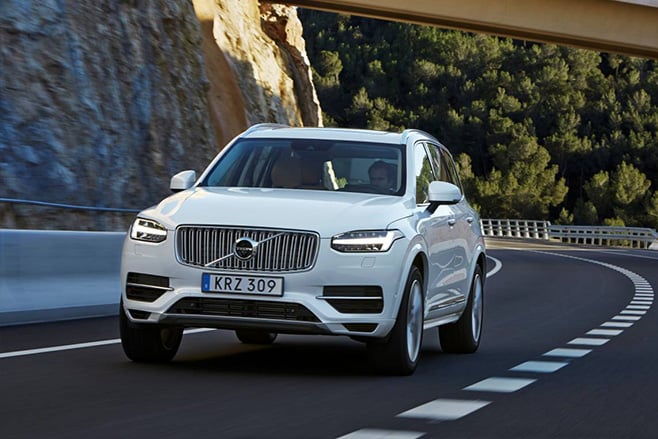
But Mullighan admits the trials will do little to change the fortunes of tens of thousands of the state’s automotive workers, both at Holden and at car parts suppliers, who will lose their jobs once Australian manufacturing is switched off in late 2017.
Like the drivers who will free up time behind the wheel, the South Australian government has much to gain from the self-driving shift.
As well as the obvious road safety benefits from fewer crashes related to human error, Mullighan says smart roads such as Adelaide’s newly developed Southern Expressway (which will host the trials) would become more efficient at moving traffic, meaning the state would need to spend less hard-to-find cash on improving or building new road infrastructure to cope with congestion.
“The research varies on what the potential congestion benefits are to our road network, but some estimates are as high as being able to accommodate up to four or five times the number of vehicles on our roads with the current road network capacity, which for people with the responsibility of funding and maintaining our roads is obviously … that poses a tremendous benefit,” he said.
The next step for the government, Mullighan said, would be convincing other Australian states and technologies to also change their road rules, so that a self-driving South Australian car did not suddenly become illegal if it strayed over the border.
Changing Direction
AS WELL as studying how autonomous cars will interact with Adelaide’s roads, the South Australian government is keen to gain a sense of how we are likely to change the way we use vehicles when they can drive themselves.
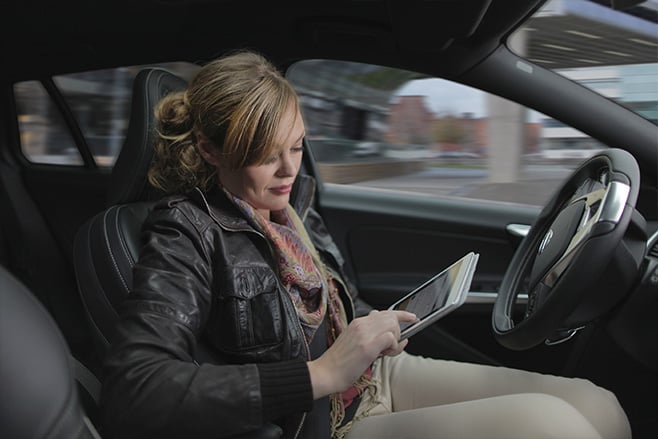
Mullighan sees cars becoming more “productive”, with the potential for commuters to do work instead of concentrating on their driving, and performing multiple tasks throughout the day such as running the children to school or taking elderly people to the doctor.
One thing he is a bit cold on, though, is the suggestion by some studies that autonomous cars could be able to travel at much higher speeds on roads than conventional vehicles
“I think we have to be realistic in that we’re looking at a gradual integration of these vehicles on our roads, and you can imagine the sorts of complexities and difficulties in having a speed limit which applied to one vehicle, and a different speed limit which applied to the next one behind it,” he says.
“So I think there will come a time some way down the track in the future when these are the vast majority if not all of the fleet in Australia, but that is some time off.”
Let’s take a selfie
Tesla Model S
TESLA is expected to switch on more of its dormant autonomous car functions in Australia with a software update due in the next few months. Most of the Californian electric car maker’s vehicles sold here have the self-drive hardware in place, waiting for laws to catch up.
Google car
DEVELOPED from modified road-going cars and in reality more a battery-powered pod than a road-going vehicle, Google’s US-only experiment is the most advanced self-driving project so far. It has a steering wheel only because California’s politicians said it had to have one.
Project Titan
THE so-called Apple Car is fuelled more by speculation and rumour than by hydrogen or electricity. The signs, such as poaching key car industry heavyweights and clandestine BMW factory visits, all point to the iCar being a real-world project. The lack of a car, though, says no.
Volvo XC90
SWEDISH carmaker Volvo has built its own small village inside a proving ground to help it shape its self-aware cars. Volvo has been at the cutting edge of the tech’s development, testing a daisy chain of cars that follow the leader at high speed, and even remote self-parking.
Sign up here to receive the latest round-up of Wheels news, reviews and video highlights straight to your inbox each week.
At the WhichCar office, we just love brand new cars. It’s our life. But we understand it can be tough work finding your next dream ride. Well we’re here to make that process easier. So if you’re sick of your car and want something shiny and new, we’re giving away a brand-spanking-new Mercedes A180 to one lucky Melbourne driver.
We’ve asked our friends Fifi & Dave from hit1019 The Fox to help us find a winner. Fifi & Dave will secretly select one lucky entry and, abracadabra, your old car will be replaced with a new Merc.
ENTRIES TO THIS COMPETITION HAVE NOW CLOSED. WINNER WILL BE ANNOUNCED AUGUST 31, 2015.
Click here to read about the Mercedes-Benz A-Class range, or the A180 specifications.
*Entries are restricted to residents of Victoria.
The self-driving car may seem like a thing of the future, but automated tech is more fact than fiction these days. Okay, so the hover board and flying car are still a fair way off, but all modern cars in today’s showrooms have some level of automation.
There are brake assist systems that push the pedal much harder than your foot if you suddenly hit the skids; stability control systems that send or pull back power from individual wheels after grip is lost; and radar cruise control and crash avoidance systems that can sense an impending collision and automatically brake or even try to steer away from the impact. There are also a few (quite affordable) cars that can perform a perfect parallel park all by themselves.
It’s only a matter of time before we will see higher levels of automation filter through to production. But do we actually need the driverless car?
Ask anyone without the means to drive a car – for example, the disabled and the elderly – and the answer would be a resounding yes. If our vehicles had a total level of automation, these people could enjoy the freedom that a vehicle brings.
Some may argue that there are taxis and buses to fill these needs. But a car allows you get away on a spur-of-the-moment road trip without needing to pay a stranger to chauffer you.
For those perfectly capable of operating a car, freedom comes in the form of time. As our transport networks struggle to keep up with the demand of a burgeoning population, the trip to and from work can take up a substantial portion of each day. If we were driven by our vehicles, we could get more work done, get more sleep, or even have time to read that dog-eared novel that only seems to come out on holidays.
Not to mention almost eliminating the three biggest killers on our roads today. A car isn’t going to get drunk or take drugs, it doesn’t get tired, and it could be programmed not to speed or break the road rules in any way.
Universities, manufacturers and businesses such as Google have been testing autonomous vehicles for several years now. The latter is aiming to release its first self-driving production car as soon as 2017 – the same year as Audi, Toyota and Volvo are scheduled to release semi-autonomous sedans.
These autonomous cars, currently in the testing process, rely on sensors combined with GPS technology to constantly scan its position and calculate the best way forward. The sensors in the Google Lexus SUVs and two-seat prototype cars claim to detect objects two football fields away in every direction. These are not just big objects like people and other cars, but ‘fluttering plastic shopping bags and rogue birds’. The GPS technology, combined with predictive software which forecasts the trajectory of other cars (and those pesky birds), allegedly enables the vehicle to navigate the streets safely.
The Google cars have ticked over 1.6 million kilometres of autonomous testing, mainly in the US and always with a human behind the wheel as a safety net, and it hasn’t been flawless.
One of the test vehicles famously crashed near Google HQ in 2011. And, as recently as last month, there was a minor bingle at an intersection. Of the 12 “reported” crashes that Google’s put its hand up for, it claims none were the result of autonomous driving and all but one were the result of other distracted drivers rear-ending the test cars.
Manufacturers including Audi and Volvo are also claiming a zero at-fault crash rate through their testing processes. And so it should be – the only way this kind of tech could work on a large scale, and be accepted by the public, is through a flawless network, with each car perfectly synced with other vehicles and its surroundings.
If this happens, and we give up control of our cars, what would happen in the event of a hardware or software malfunction? If the network went down, if someone hacked the system, or there was any kind of glitch, then we might really see some carnage.
The Google prototype car doesn’t even have pedals or a wheel, as it is designed to transport its passengers around in complete autonomous comfort; this means lounge seating and plenty of legroom. This means the driver can’t intervene if there is an impending accident, or move the car out of the way if one did occur.
The post-accident blame game would then play out with interesting results. Who would be liable: the manufacturer, software developer, or the hapless passenger?
The network on which autonomous cars will run, and the supporting infrastructure to sustain it, would not only need to be created and installed over time in every corner of the country, but it would have to be absolutely infallible. People would have to trust it implicitly.
This is the main reason why the driverless car is not around the corner; we humans simply aren’t ready – physically or emotionally – to hand over control of the wheel.
PLUS
- Striking design is an Audi hallmark and it’s not lost on its smallest offering, in 2015 updated form it also welcomes new headlights borrowed from the brutal $50K S1 and a slightly redesigned front bumper.
- We love its high-street look and the ability to customise it, especially with something like the optional black roof dome.
- The range of engines are smooth and are matched to Audi’s quick-shifting 7-speed.
- Its steering is great, and feels made of high German quality.
- Around town, and out about country roads, the Audi A1 rides comfortably, and avoids feeling brittle like some small cars do.
- Its high belt line and B-pillars compromise its over-shoulder visibility from the driver’s seat
- Rear seats are raised and rob cabin of headroom for passengers.
- Style costs, you’re entry ticket to the range $27K for the 1.0-litre triple-pot engine A1, which is the same price as its rival range-toppers.
- Dual-clutch transmission doesn’t gel well with the system that turns the engine off at traffic lights, so it requires concentrated pedal input to get going smoothly.
- Full house 1.8-litre engine A1 isn’t a performance hatch, despite its whopping price.
Click here to find out more about the Audi A1 Sportback.
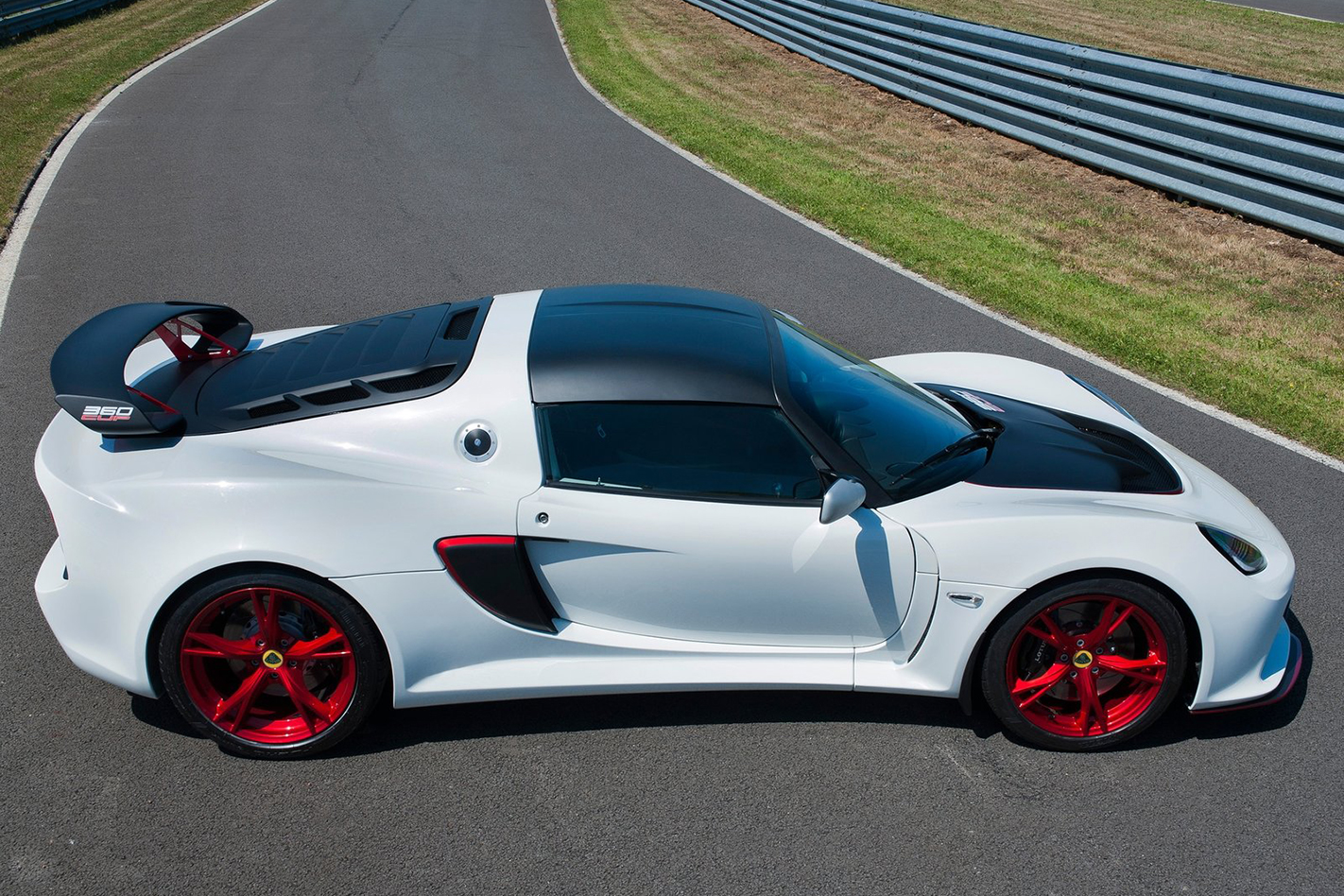
The Lotus Exige isn’t the most obvious Biggest Loser candidate, but the 360 Cup limited edition has dropped another 42kg anyway.
Now tipping the scales at just 1130kg, the Exige 360 Cup gives the 3.5-litre supercharged V6 engine even less work to do than before. Just for good measure, the Toyota-based donk has been given a 7kW hike to 265kW, though 400Nm is unchanged.
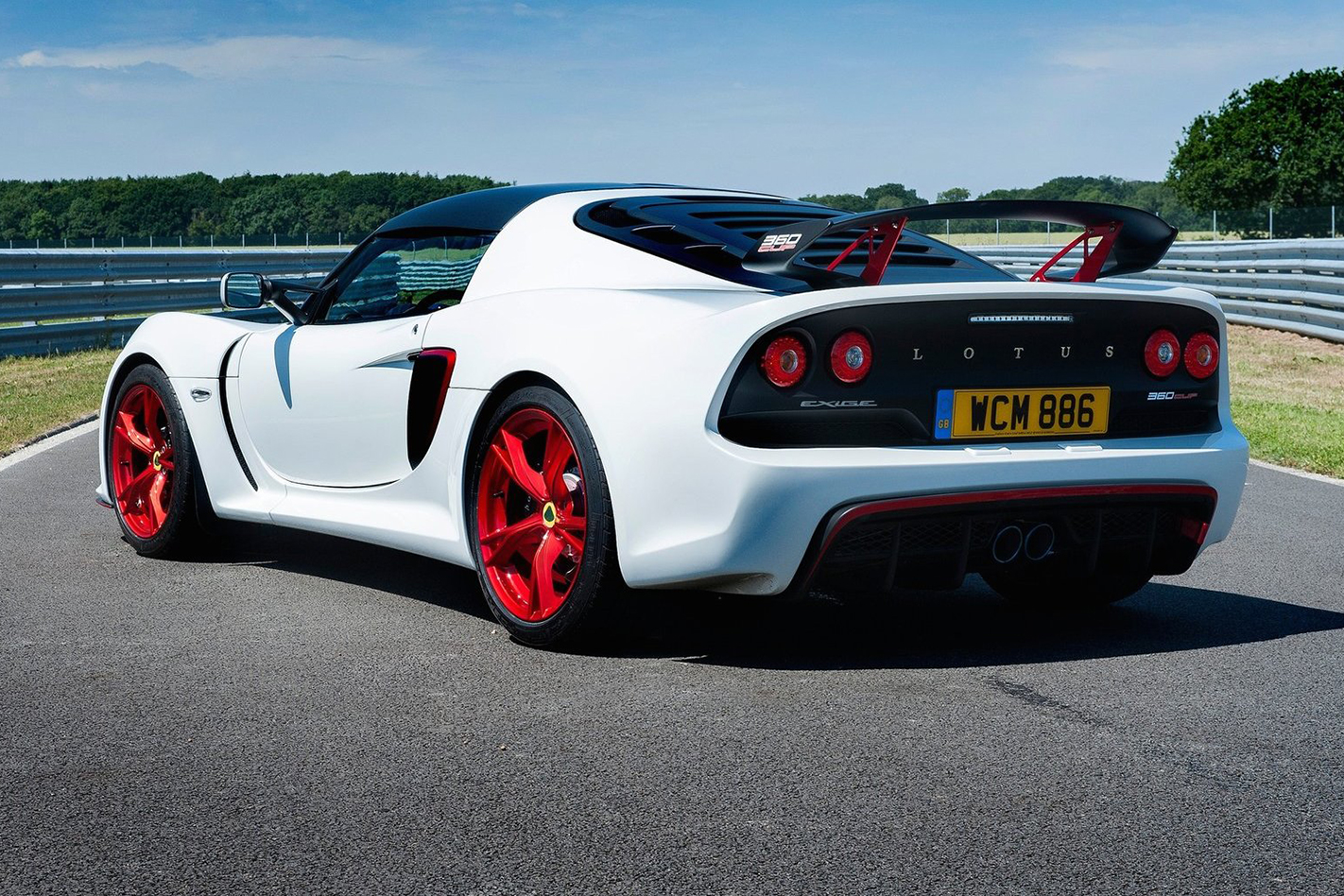
New light-weight parts include a front access panel, and rear louvre and tail-gate, while the interior has mostly been stripped – not that the Exige was a place of excess before.
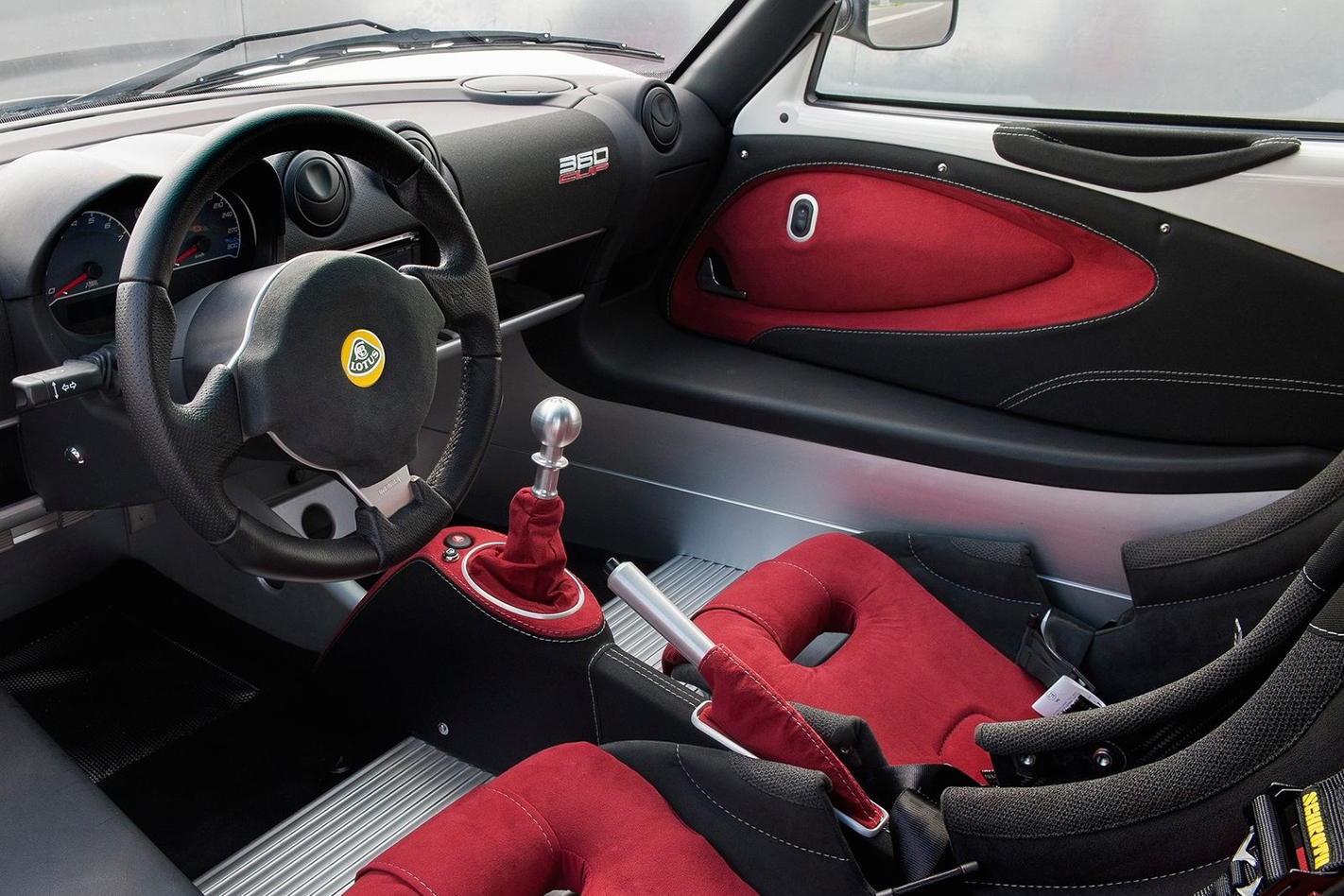
Befitting of its tag as a track-focused Lotus Motorsport Cup model, available optionally are Ohlins race dampers, adjustable anti-roll bar, fire extinguisher and electrical cut-off, FIA-approved carbon seats and a removable steering wheel. Air conditioning, too, sits on the extras list.