
WHETHER THE string-backed glove purists recognise the fact or not, the Holden Sandman is the “sports car” of the seventies and in marketing terms is the automotive equivalent of the MG TC.
Of course, this isn’t to say that they are remotely similar as cars- obviously they’re poles apart – but the point is that they appeal to essentially the same youthful buyers.
Traditionalists will argue this until the last remaining TC is finally restored and we wouldn’t expect them to do anything else; but the facts are that since the sports car died an unnatural death in Australia sales of panel vans, four-wheel drives and even trail bikes have shown a remarkable upswing. You can take it from us that this search for alternative forms of fun transport is no coincidence. The kids still want wheels that set them apart from their more conservative peers who are happy to live with a staid four-door sedan.
Everybody, and especially the manufacturers, has been surprised by the way sales of panel vans have zoomed up the best-seller lists over the past four years. Ford under-estimated demand for its Escort van by an amazing 400 percent and Holden panel van sales have grown dramatically, from being a poor relative to the utility to the point where they outsell the ute by two to one. So far as the cat makers are concerned, the panel van has now gathered around it a certain mark of respectability although it’s a respectability that isn’t shared by the more mature members of society, but that’s quite another story.
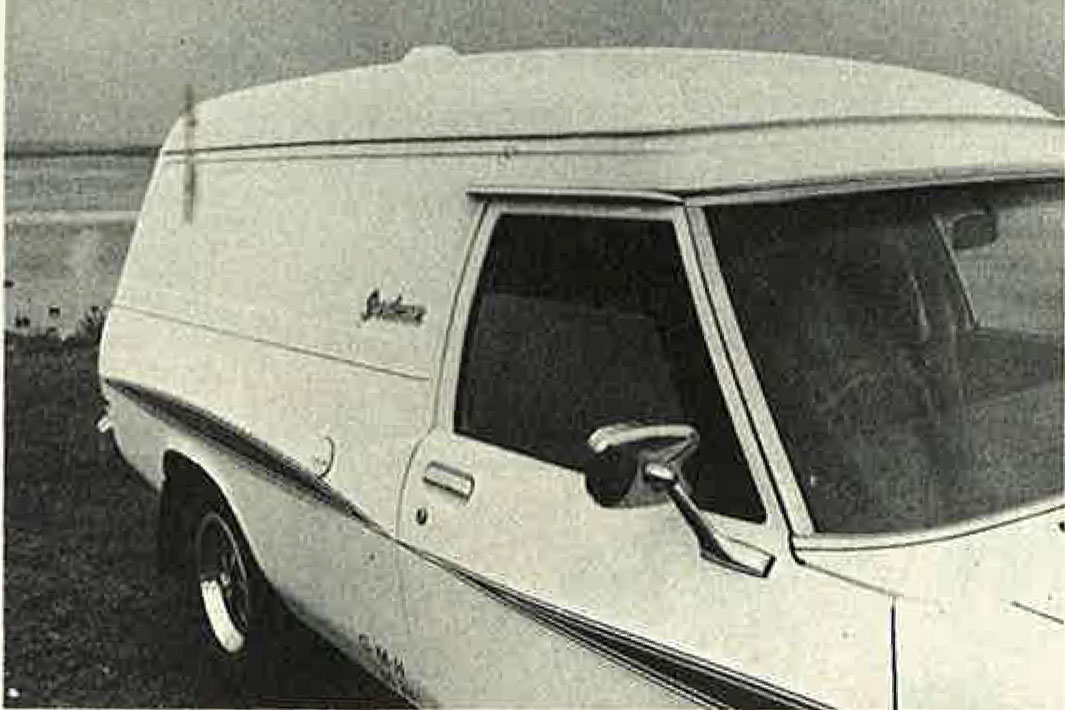
The panel van really arrived when the manufacturers woke up and started to sell jazzed-up versions. So it was for the Escort Little Ripper – any suggestion that this project began life as an exercise which enabled Ford to get rid of over 1000 obsolete cartridge tape players is only conjecture- and is now for The General’s Sandman. The Sandman is to the Holden panel van (and utility) what the GT was to the Falcon or the GTR to the Torana. In theory, at least, it is the sporting expression of the panel van philosophy.
The reality, after 10 days’ motoring, is that the sport is best confined to the mattress in the rear compartment rather than on the road. It is almost as if somebody took an MG TC as the ultimate in sports motoring and decided to make something that was totally anti-TC.
The fact that the Sandman comes off the production line as a commercial vehicle isn’t the greatest start, simply because it means the van is stuck with all the design limitations that involves. And there are plenty.
For sedan drivers and even more so for rag-top owners, the most important basic fault with a panel van is obvious and yet it is one of the major reasons for their success. The sheer lack of visibility comes as a shock to most people and we would have to say that driving a panel van requires a whole new driving technique based on the fact that visibility to the rear and over the driver’s shoulder is almost nil, even with the exterior side mirrors perfectly adjusted. Sedan drivers should be made aware that panel vans change lanes more by courage and intuition than knowledge of what is going on around them.
But those vast sheet metal sides that make a van a positive menace in traffic are exactly the same bits of sheet metal that give the van the privacy that is so important to the young buyers. We can only hope that the present trend to windows (with curtains, of course) continues.
Apart from obvious changes that have occurred over 30 years of automotive development the TC and Sandman have many similarities … on paper. They both have complete sets of instruments – the MG with complete calibrations and the Holden with none on the minor gauges – sports steering wheels with drilled spokes, bucket seats and four-speed gearboxes.
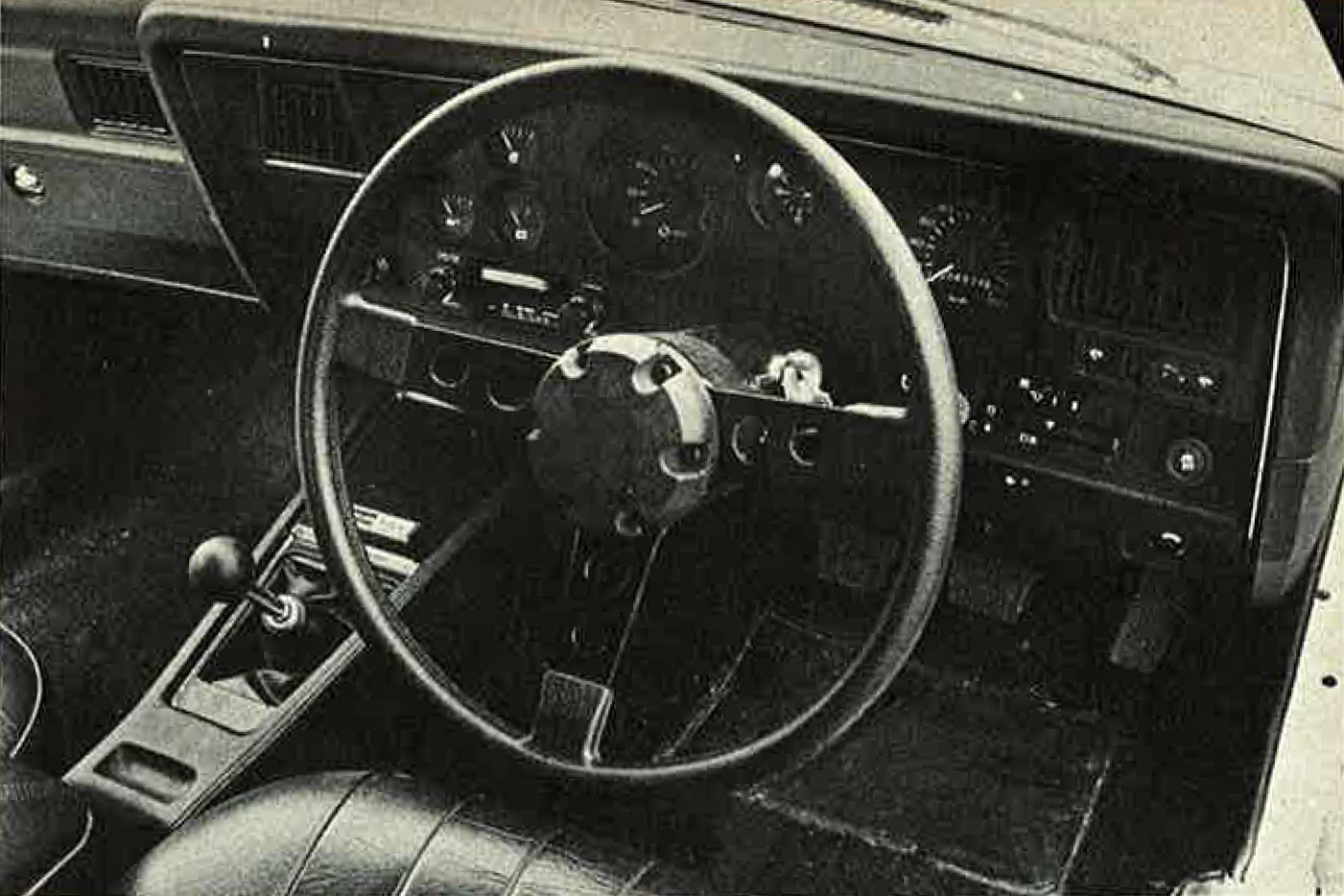
But the Holden makes concessions to comfort that would not have been tolerated by TC drivers and has been softened to the point where it makes only a superficial attempt at being genuinely “sporty”. Even the previously mentioned features, that are a must on any car with pretensions of doing the right thing by the driver, fail to deliver the goods.
The sporting three-spoke steering wheel controls a steering box that has been deliberately low geared in order to make the steering lighter when parking. The ratio is now 25:1 on all Holdens (apart from the GTS) without power steering (it was 20:1) and rivals the Falcon in terms of indirectness. HQ/HJ Holdens have always understeered to excess and the latest move simply emphasises the fact. Sadly, the steering remains heavy, with the ER 70 radial ply tyres which are fitted to the Sandman.
The General’s four-speed gearboxes are well-known both because of their unsuitable ratios and by the heaviness of the gearchange. Where the TC’s ratios were chosen to take full advantage of the small foul”-cylinder engine’s power and torque characteristics, the Sandman’s ratios seem designed to restrict driver enjoyment. Second gear is so close to first that we found that the natural and smooth way of driving the van was to go from first to third gear and to only use second gear from a roll start.
The 4.2-litre VS engine fitted to the test car performed adequately but it lacked the kind of sparkling acceleration we have come to expect from an engine of this size. Most buyers would be better off spending the extra $100 and going the whole hog to the five-litre VS, which with its four-barrel carburettor gives better performance and is capable of achieving better fuel consumption.
We put down the standing 400 m in 17.8 seconds and, would you believe, it was just as fast using only three of the four forward speeds?
Because it’s a panel van the front bucket seats won’t recline – who cares, did you say, with all that room in the back? – but they are also restricted in their rearward travel and this means the gap between the steering wheel and the front of the cushion is limited and makes sliding in behind the wheel difficult if you are anything more than average in height.
Although the steering does its best to put you off, the semi-elliptic leaf springs fitted to the panel van and utility versions of the HQ/HJ- along with the longer Statesman/Station wagon wheelbase – gives it superior handling to the sedan versions with their four-link, coil-spring set-up. There is some body lurching but the tail remains fairly flat and it takes a decent bump to throw it off line. The ride, too, is smooth and comfortable without being wishy-washy and there is a commendable lack of road and suspension noise.
All of which is probably useless information to the average panel van buyer who is more interested in the tail end of the car. That’s where the action is, after all.
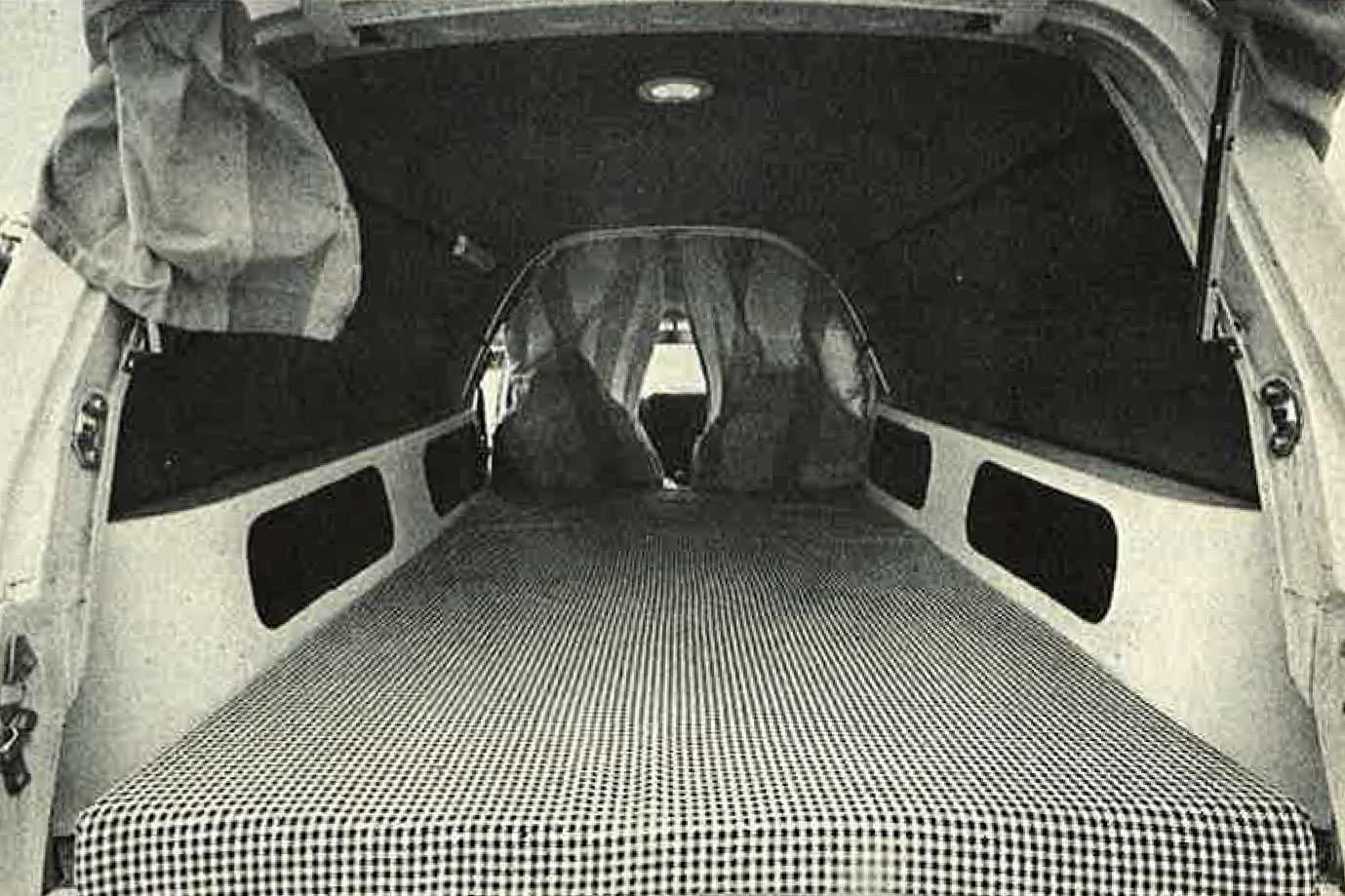
Landcruiser conversions converted the GMH test van into something more than just an average Sandman. For $606 (including sales tax) you get a plywood floor with vinyl covering to protect the mattress, fibreglass side units for minor luggage, front and rear curtains, a roof vent to stop the windows fogging up, two fluorescent lights, a carpeted tail gate so you don’t skin your bird’s knees and plywood upper side trims.
Going by some of the vans we’ve seen and featured in WHEELS, it is very much a basic conversion and about the starting point for anybody who really wants to set themselves up properly. Of course, you could find a mouldy old mattress from home and stick it in the back but it doesn’t have the same class.
The next question is why Sandman and not just a straight Holden panel van? The Sandman bit goes for $822.52, if you want to be exact, and it plays a big part in providing you with all the comforts of home. You get the carpets, full length headlining, a console shift for the four-speed gearbox, armrests on the doors, bucket seats, GTS instruments, big fat radials, GTS appearance gear and the usual range of decals and stripes.
Actually, those tyres mean that the van’s carrying capacity is reduced from 14 cwt to 10 cwt but that’s probably not going to worry the average Sandman owner.
Nothing we can say is going to convince prospective van buyers that they might be better off with a station wagon or something they can see out of, like a Kombi. And our pointing out the limitations of the concept is to show our lack of understanding for the growing demand for such vehicles. Actually, we do understand but still find it hard to accept that those vast areas of sheet metal are really necessary.
As a car, the Sandman isn’t especially marvellous but then we could say the same things about a Holden sedan optioned up exactly the same way. And as a concept the panel van is here to stay, the pity of it is that no manufacturer has come up with the perfect compromise between the conventional panel van and the Kombi-style models. When that happens, as surely it must, stand by for the greatest rush the car business has seen in years. Maybe that’s what the MGA was to the TC.
Van-tastic Sandman: The MG TC of the’70s was first published in Wheels in May, 1976
THE closure of Toyota’s Australian manufacturing facilities in late 2017 spells the end of the unique-to-Australia Aurion nameplate.
Created in 2007 to topple the Holden Commodore and Ford Falcon dominance of the local six-cylinder market, the Aurion took the V6 Camry and gave it a new nose and tail for the indigenous moniker.
Toyota insiders have told Wheels that the nameplate will be dumped as Australia reverts to the same Camry V6 as the rest of the globe once local production winds up in 2017.
Yet the Aurion is gearing up for a swansong with a mid-year facelift to coincide with the biggest ever mid-life update to its Camry stablemate.
The Aurion’s final act won’t carry the new sheetmetal that transforms the look of Toyota’s best-selling sedan (third overall), instead getting a minor design tweak to grilles and bumpers.
Toyota will continue with two distinct Aurion looks – the more formal luxury aesthetic and the more aggressive Sportivo versions.
The chrome-clad base and luxury grades will be given revised bumpers and a new chrome grille with bolder horizontal bars.
But it’s the Sportivos that will get the bulk of the visual changes. New bumpers front and rear will make the faux air vents look more integrated and give the Aurion a more cohesive look.
Inside, too, the visual changes will be minor, but Toyota will inject more tech into the Aurion.
Digital radio will flow through to all models, joining the Falcon as the only large cars with DAB.
There’s also driver assistance safety technology to build on the blind-spot monitor and lane-departure warning systems already offered.
Under the skin, the Aurion’s familiar 200kW/336Nm 3.5-litre V6 will carry on unchanged, as it has since 2007, though there will suspension tweaks.
SIX AND OUT
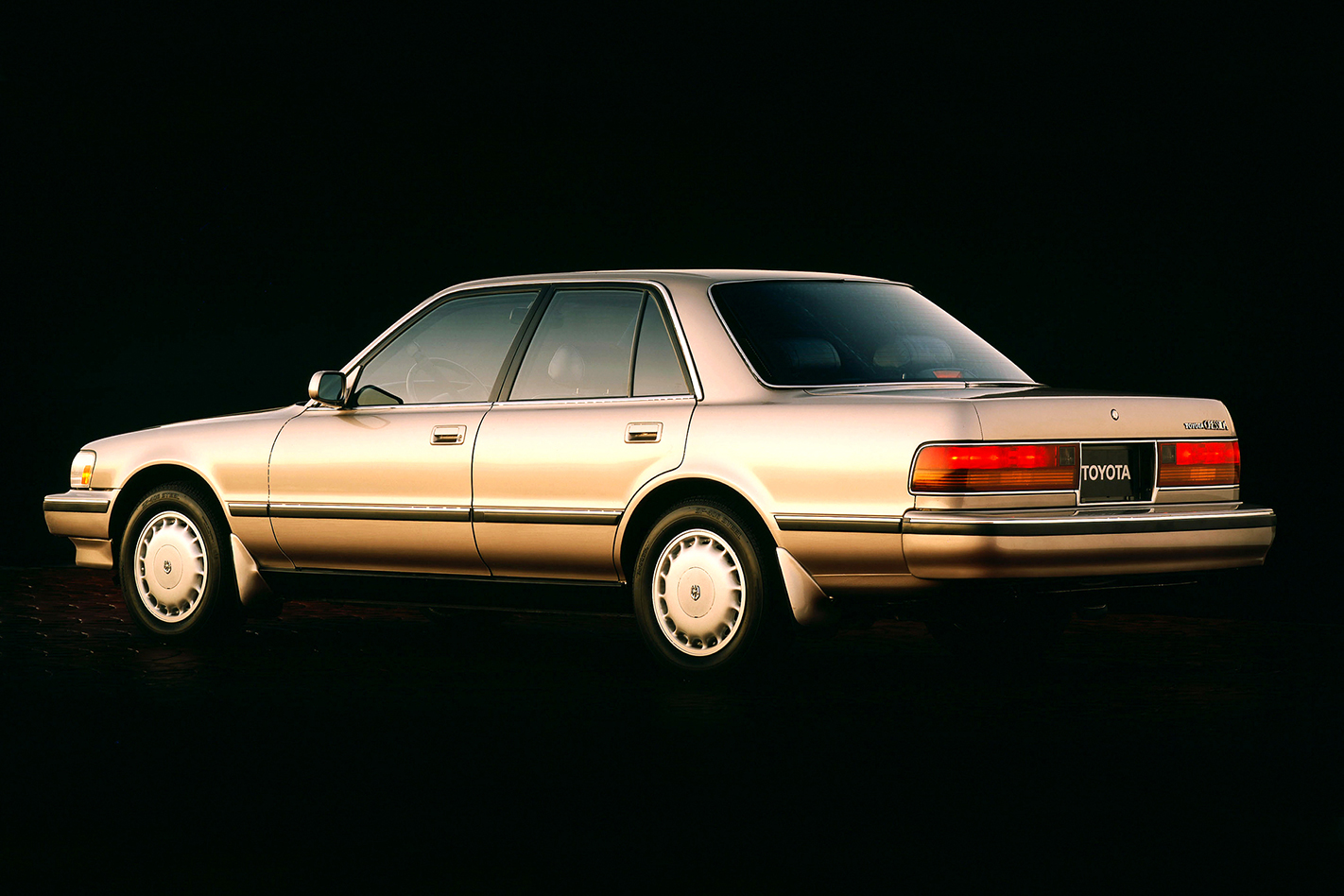
TOYOTA six-cylinder sedans have never taken off in Australia, although some have had a loyal following. The last of the rear-drivers, the Cressida (pictured above), is still missed and loved by many.
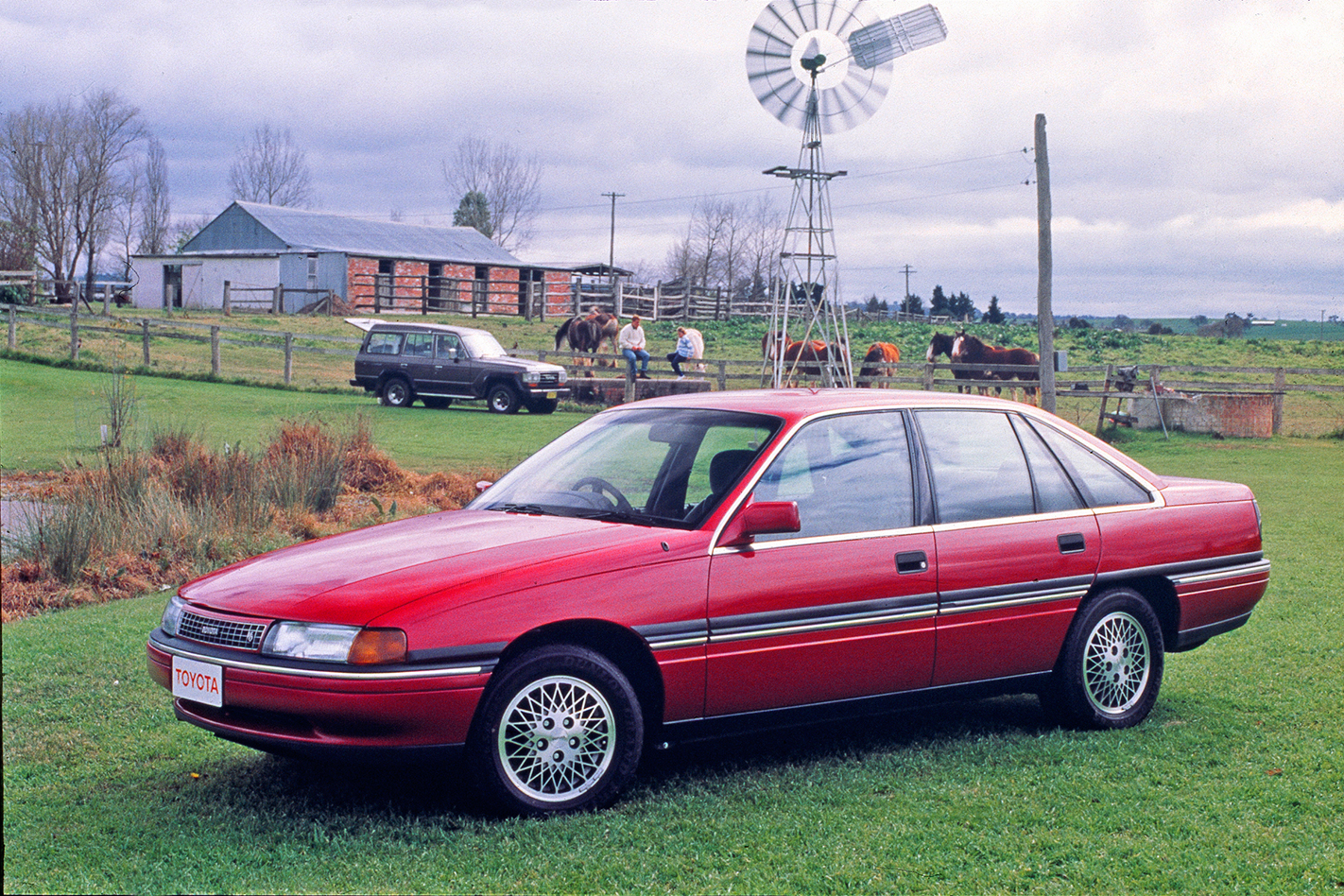
The Lexcen – a rebadged version of the VN-VR Commodore – was as forgetful as the McRib burger and New Coke. Then there was the Avalon, a crudely styled Camry that missed the mark, yet it became the forerunner to the more accomplished Aurion.
It’s news to make baby-boomers jump for joy – the Holden Sandman is officially back!
Four decades after the original Sandman became an Aussie icon, Holden has today announced it is resurrecting the brand in the form of a $2950 sticker pack for current VF SV6 and SS-V models.
Available in Ute or Sportwagon body styles, the 2015 Sandman Special Edition boasts 20-inch gloss black wheels, black exterior trim and roof racks, and Sandman decals, dashboard stitching, sunshades and floor mats.
Buyers will have three colours to choose from – Heron white, Nitrate Silver or Phantom Black – but it’s the options list that will bring a smile to Sandman diehards.
Only two options are offered: an orange rear shagpile rug (Sportwagon only) and orange sheepskin seat inserts.
The 2015 Sandman will go on sale in June, but what do you think? Can the modern incarnation live up to the legend?
SELF-doubt, testing restrictions and a failure to understand modern V8 Supercars are the reasons given by two-times V8 champion Marcos Ambrose for withdrawing from driving after just two rounds of his comeback season.
Speaking publically for the first time since last week’s shock announcement, Ambrose rubbished rumours he plans to return to NASCAR or even retire completely.
Ambrose said he will contest this year’s V8 Supercar endurance races, including Bathurst, as a co-driver at the very least. He will also do the Friday ‘co-driver’ sessions at selected V8 Supercar sprint events.
“There’s no NASCAR on the horizon,” Ambrose said today.
“I love racing cars, that’s what I do for a living, but the team can’t wait for a driver to get reacclimatised.
“Races cost money, serious money, and as a minimum I will be doing the co-driver races for them and the co-driver testing during the race weekends and we’ll just see how it goes.”
Ambrose admitted he has struggled to understand how to extract the best from a modern V8 Supercar, a racing car that, with the introduction of new Car of the Future regulations, has changed drastically since he last raced in the category a decade ago.
“The feel that I’m getting from the car is not what it used to be and so I came to the conclusion, and a fairly solid one, was that to lead the team forward you need to keep improving engineering the car. You need to ultimately deliver race results and the expectation on me to deliver that when DJR Team Penske need it now, you know, it’s not synced together.”
The 38-year-old Tasmanian’s lack of results in the opening races of the season has also caused him to doubt his ability to be a lead V8 Supercar driver.
“I love racing cars, but what wasn’t fun was having this doubt that I could lead the team forward like I was expected to. That’s been the challenge for me personally and that’s been the big issue. Even if I was running 20th but could feel the car like I need to, I wouldn’t be having this conversation.”
Ambrose also blamed testing restrictions and limited practice time for his inability to race at the front.
“Testing restrictions, tyre restrictions, the weekend formats are pretty condensed, and so I’m learning on the fly. I’m learning in race conditions, then you throw in the fact that these cars are very difficult to pass and so qualifying really dominates the race results.”
The result-driven nature of motor sport and harsh financial realities also played a factor in Ambrose’s decision.
“You can’t lose a year in this game for a driver to get re-acclimatised.
“We’ve got Roger Penske to come to Australia to compete in our series – we want to do as well as we can for him.”
Ambrose will be replaced by youngster Scott Pye for the foreseeable future, but the 38-year-old didn’t rule out a return to full-time driving this season.
“We’ll jump in this car when the time’s appropriate and time will tell us when that should be, depending on how Scott goes in the car,” Ambrose said.
“But certainly for me personally, it just slows it down in 2015 and we can reassess as we go.”
Holden famed Sandman badge will return to showrooms in June, though nothing like 2000’s Mambo-styled, VU-based panel van concept car.
Instead, the 2015 Sandman Special Edition range taps the spirit of the 1974 HQ panel vane and ute originals, offering a number of trim and appearance updates to the current Commodore Sportwagon and Ute lines.
To be offered in essentially SV6 and SS-V spec, the new-new Sandman adds a blackout treatment to the regular 20-inch wheels design, front guard vents, front fascia trim and roof racks.
And, of course, a set of retro-drenched Sandman graphics and stripes you could spot from Mars.
Inside, ‘Sandmen’ get unique dash stitching, floor mats, sun shades, a build plate and, the cornerstones of the package, lairy bright orange sheepskin seat covers and (Sportwagon-only) shagpile cargo mats.
Available in three colour schemes based around black, white and silver body colours, the 2015 Sandman Special Edition asks for a premium $2950 above regular SV6 and SS-V pricepoints.
While cynics will sneer at its ‘sticker-pack’ format, the Sandman is no less ‘special’ than the ’70s original produced throughout the ’70s across HQ, HJ, HX and HZ ranges and brings a cheeky sense of old-school fun to the VF-based crop.
Further, the 260kW/517Nm SS-V version in particular represents an enticing step-off point for old-school customisation and personalization in a thoroughly contemporary large load- or family-hauler.
Get your free weekly report from the world of fast cars – subscribe to the MOTOR newsletter!
More than just a fuel miser, Mercedes-Benz’s rechargeable C-Class throws extra performance into the hybrid mix.
WHAT IS IT? Yet another C-Class model, but one with a major enviro focus. This time it’s a four-cylinder petrol teamed with a 60kW electric motor claimed to make it the most fuel-efficient in its class.
WHY WE’RE TESTING IT The C350e will be the first of three Mercedes plug-in hybrids to go on sale in Australia before the end of 2015 and we had an opportunity to get behind the wheel in San Francisco ahead of its local launch.
MAIN RIVALS None directly compete in terms of a plug-in hybrid vehicle, but the BMW Active Hybrid 3, Lexus IS300h and Infiniti Q50 Hybrid do similar fuel-saving things.
THE WHEELS VERDICT We’ll reserve final judgement on its fuel saving ways until we drive it locally, but on first blush it seems the “V6 power with three-cylinder consumption” sales pitch isn’t far off the mark.
PLUS: Enviro credentials for short trips; torquey performance; C-Class elegance MINUS: Short electric-only range; weight of hybrid system; price premium
THE WHEELS REVIEW WHEN it comes to breadth of talent, the Mercedes C-Class stretches itself wide. Volume-selling four-cylinder models kick off a range that has upped its luxury game over the past decade, while the C63 thumps hard for anyone chasing Porsche performance for less money.
Yet it’s taken until now for Benz’s top seller to be offered with a plug-in hybrid engine, something getting increasing attention in the US, and a drivetrain configuration becoming more important in an era of intense CO2 scrutiny.
With the imminent arrival of the C350e, Mercedes has trumped its Japanese and European rivals with a hybrid that can also be recharged for electric-only driving.
Electric-only range is limited to a claimed 31km (our experience suggests you can knock 20 percent off that in regular driving), but for many that will comfortably do the kid run and fill the boot with shopping.
In gentle driving, the 60kW electric motor comfortably does all the work, though if you squeeze the throttle too far the 2.0-litre petrol four breaks the silence with a dull drone for added boost.
There are four hybrid modes, three of them tailored to European cities that call for zero emissions in CBDs.
The E-Mode is interesting, though, because it brings a throttle feel that noticeably stiffens once you approach the point where the petrol engine will kick in; it’s designed to make it easy to keep the car running purely on electricity while still providing easy access to full hoof when required.
And while 60kW may not sound like much to shift a luxury mid-sizer, there’s a healthy 340Nm surge of torque when you first squeeze the pedal.
But there’s plenty to shift in the 350e – 1705kg – and that’s about 220kg more than a C250, with most of it residing behind the rear seat, at least helping adjust the weight balance.
Only occasionally is there an overly aggressive downshift or grumble as the engine comes to life.
Cruising, there’s the usual C-Class refinement and hushed comfort. But launch it at some tighter bends and the 17-inch Pirellis can let out a yelp as it gently deviates wide.
Riding on the air suspension system that will be standard on Oz-delivered cars, it’s a controlled but compliant affair in Comfort mode. Dial up Sport and there’s more pitter-patter from smaller bumps, but the quicker recovery and more planted high-speed feel make it the pick for tighter twists.
Most of the C practicality is intact, with the exception of boot space. A shelf-like compartment behind the rear seats reduces boot space by 145 litres to 335. It’ll only be noticed on airport pick-up runs or if you pile the family on board for a week away.
There are mouthfuls of C-Class flavour bursting through elsewhere, from the elegant cabin to the hushed driving experience.
SPECS Model: Mercedes-Benz C350e Engine: 1991cc 4cyl, dohc, 16v, turbo; 60kW electric motor Max power: 155kW @ 5500rpm (petrol engine); 205kW total output Max torque: 350Nm @ 1200-1400rpm (petrol engine); 600Nm total output Transmission: 7-speed auto Kerb weight: 1705kg 0-100km/h: 5.9sec (claimed) Economy: TBC Price: $80,000-plus (estimated) On sale: Late 2015
MERCEDES-BENZ is embarking on an electric car strategy it admits will do little to kick along its record Australian sales but will position it for future regulatory changes and establish it as a producer of rechargeable vehicles.
The German carmaker is expanding its hybrid range to include a trio of plug-in hybrids that can be recharged from household powerpoints and drive purely on electricity for about 30 kilometres.
However, Mercedes-Benz Australia has stopped short of committing to the 10-strong range of plug-in hybrid partial electric models being developed for global markets, instead saying it will investigate opportunities “on a case-by-case basis”.
The plug-in hybrids to be offered initially will be a C-Class, S-Class and upcoming new GLE-Class (the just-released replacement for the ML), giving Mercedes-Benz rechargeable versions of its most popular sedan, benchmark limousine and family SUV.
“This is a long-term strategy for us; this will be our future,” corporate communications manager Jerry Stamoulis said, indicating the brand does not really know how many plug-in vehicles it will sell early on.
“Once government incentives catch up, once infrastructure catches up, we’ll be ready with the best possible product in the market.”
Mercedes-Benz has sold hybrid models for a few years, but they’ve had diesel engines and not included plug-in functionality.
The new plug-in hybrid models allow the car to be recharged and driven purely on electricity, albeit for relatively short distances.
The C-Class has a 60kW electric motor and a four-cylinder turbo-petrol, while the S-Class gets an 85kW motor and a V6 turbo-petrol. In both, the petrol engine kicks in if the driver wants more power – all with the aim of a best-of-both-worlds approach.
Rivals Audi and BMW already have plug-in hybrid offerings, while relative newcomer Tesla has an electric vehicle intended to tempt buyers away from traditional luxury brands.
Mercedes-Benz is pinning its hopes on its advanced plug-in technology.
“No competitor offers more intelligence and efficiency,” said Franz Nietfeld, the Mercedes-Benz program chief for high-voltage systems. “Bringing down CO2 is one of the company’s main goals.”
He said that, as well as the electric motor built into the gearbox and battery pack behind the rear seats, a large part of the system was the “intelligent software” for management of the drivetrain.
“Take for example our predictive operating strategy,” Nietfeld said. “In standard driving mode the vehicle will control the split between electric, driving boost and recuperation and combustion engine in order to ensure the maximum comfort and the minimum consumption.”
The Mercedes plug-in hybrid models have four main driving modes: hybrid for most driving situations; E-Mode to use electricity only where possible; E-Save for saving the battery charge for later use; and Charge Mode, which runs the petrol engine until the batteries are charged.
What debuted as Aston Martin’s new Vantage GT3 last month in Geneva is now the Vantage GT12 after Porsche and its lawyers had something to say about naming rights.
According to a report on grrc.goodwood.com something of a legal tussle has been going on for months between Aston Martin and Porsche for the rights to the GT3 nameplate, despite the race-infused nomenclature making a public debut on the latest Vantage model just weeks ago.
Aston Martin ceded to Porsche’s request for the model now to be known as the Vantage GT12, a rare if perhaps unprecedented situation in motoring where a name change has occurred so late in a model commercial cycle given the limited-edition weapons-grade road-race Aston is said to be sold out.
Porsche, of course, has been using the GT3 name on its most circuit-savvy 911 variant since 1999, thus having right of ownership.
Meanwhile, Aston Martin has argued – not unreasonably – that it didn’t pinch ‘GT3’ from Stuttgart but from the international FIA racing category.
Despite the ammunition that various other carmakers had applied GT3 (and GT3R) to road car predating Porsche’s own halo road car, Aston Martin is said to have voluntarily affected the change of model name.
To reinforce its newly adopted GT12 branding, Aston Martin will also apply it to its thoroughbred Vantage racecars.
Get your free weekly report from the world of fast cars – subscribe to the MOTOR newsletter!
THE Australian V8 Supercars Series circus moves to Tasmania’s Symmons Plains Raceway this weekend with heightened interest in the performance of Scott Pye, the very able substitute for local hero Marcos Ambrose.
Ambrose’s shock call to step down from as driver of the DJR Team Penske #17 Falcon FG X has triggered many thousands of column centimetres and many hours of panel talk time – with the picture no clearer than it was at the time of the shock announcement on March 17.
But as the teams get set for the Symmons weekend, Dick Johnson has mounted an aggressive defence of Ambrose and his star driver’s call to hand over the car to Scott Pye after just two race meetings this year.
Johnson told Wheels that, yes, Marcos is disappointed with his results so far, even though no one should have expected him to come back here after nine seasons in NASCAR and beat up Jamie Whincup et al straight out of the box.
He insists Ambrose should be praised for his guts and honesty.
“He has got balls to do this [announce he’s sitting out Symmons and perhaps more races],” declared Johnson.
“How many race drivers do you know have admitted they’re not fast enough?” Johnson is also impressed that Ambrose didn’t shirk calling Roger Penske and Tim Cindric in the States to tell them of his decision.
Johnson suggested that the Ambrose hiatus came about because the driver is simply unsure whether he or elements in the car or team are the problem.
After identical Prodrive Falcons dominated the AGP with four wins from four starts, it would be especially bold to suggest the car is the problem.
Had the team been running two identical Falcons this season, drawing conclusions would have been a rather more simple matter for Ambrose.
“It’s his way of flushing out any ‘impurities’,” Johnson explained. The well-regarded Pye is a known quality in the car. He bagged two top 10 results at Symmons last season with DJR.
“If he qualifies and races about where Ambrose did in the opening round of the championship in Adelaide, then it’s fair to assume the speed problem can be blamed on something or someone other than the driver.”
Johnson says that rather than slam Ambrose, the critics should be aiming at the failure of the V8 Supercars’ regulations to give outsiders (and Ambrose has been away for nearly a decade) a chance to get to grips with the very different beast that is a V8 Supercar.
He is critical of a system that does not allow the returning Ambrose – and, before him, internationals Alex Premat, Maro Engel and Robert Dahgren – extended private testing to get them on the pace quickly.
Johnson is urging the series to create a process of easing in drivers from outside before it burns any more marquee names.
“Marcos has to get miles in the car away from the spotlight and the current silly system of so little testing doesn’t make exceptions for cases like him, Engel, Premat and the others.
“These are not easy cars to get the hang of, and they’ve changed since Marcos was racing them last time. It’s a very competitive series – less than one second can cover the whole field.
“If we want to encourage drivers from outside to race in V8 Supercars we have to make [testing] allowances so they can get up to speed.”
But the Ford legend finished the chat with Wheels with an encouraging prediction, saying that, while he’s heard all the speculation to the contrary, he has no doubt that Ambrose will be back in a DJR Team Penske Falcon.
“Marcos hasn’t lost it. He’s got everything he had when he raced V8s before.
“And he’s not a quitter. He’ll be back.”
The lingering question is…when?
OTHER POINTS TO PONDER AT SYMMONS
• Will the blinding speed of the two Prodrive Falcons At Albert Park make the boat trip across Bass Strait?
• Buoyed by his Clipsal triumph, HRT’s James Courtney is talking loudly and often about winning the championship. Is he guilty of a premature prediction?
• Holdens currently own the first six championship positions, with Ford’s Mark Winterbottom the best of the rest in seventh.
• Will Scott McLaughlin and his Volvo rediscover the mojo conspicuously missing at Albert Park?
• Some big names languishing in the points – McLaughlin, David Reynolds, Nick Percat, Will Davison, Lee Holdsworth…
• Symmons Plains is first championship round not to be shown live on free-to-air. Instead it’s a one-hour highlights package on Ten at 4pm. High anxiety along pit lane about the likely ratings…
CHAMPIONSHIP POINTS
1. James Courtney 258pts 2. Fabian Coulthard 241pts 3. Garth Tander 237pts 4. Shane Van Gisbergen 222pts 5. Jamie Whincup 216pts 6. Craig Lowndes 208pts 7. Mark Winterbottom 202pts 8. Rick Kelly 177pts 9. Jason Bright 161pts 10. Todd Kelly 143pts 11. Tim Slade 135pts 12. Marcos Ambrose 125pts 13. David Reynolds 120pts 14. David Wall 114pts 15. Dale Wood 110pts 16. Tim Blanchard 102pts 17. Nick Percat 101pts 18. Scott McLaughlin 93pts 19. James Moffat 84pts 20. Andre Heimgartner 82pts 21. Lee Holdsworth 81pts 22. Chaz Mostert 69pts 23. Michael Caruso 59pts 24. Will Davison 48pts 25. Ashley Walsh 42pts
MORE details of Ford’s big-shouldered adventure wagon have been revealed, with the Ford Everest seven-seater wagon gaining advanced driver-assist tech from the related facelifted Ranger pick-up, and then some in the war against the Toyota Prado, Holden Colorado and Isuzu MU-X.
Out in September, the Thai-built, body-on-frame, dual-purpose crossover will offer active safety gear including adaptive cruise control, lane-keeping assistance and a driver impairment monitor, as well as blind spot monitoring that sounds an alarm if you’re about to back from a car park into oncoming traffic, automatic parking, and curve control, which alters the throttle and stability/traction controls to help keep the vehicle from going off-piste if a turn is taken too quickly.
To keep the body-on-frame wagon quiet, the Everest will also use active noise cancelling boosted by masses of sound-deadening material throughout the vehicle.
Revised versions of the 2.2-litre four-cylinder and 3.2-litre five-cylinder turbo-diesels serving the Ranger will power the Everest, in 118kW/385Nm and 147kW/470Nm outputs respectively. Though Ford recognises the demand for petrol-powered alternatives, none are in the pipeline.
Only one transmission – a six-speed auto – will be available in rear- or four-wheel-drive configurations, with the latter benefiting from a low-range transfer case, on-demand torque distribution, 225mm of off-road enhancing ground clearance and the ability to wade through 800mm of water.
A Land Rover-style Terrain Management System with four off-road settings was devised for 4WD variants, switching between Normal, Snow/Gravel/Grass, Sand, and Rock.
Steering is via the facelifted Ranger’s electric power assisted rack and pinion system, while the suspension consists of MacPherson-type struts up front and coil springs with Watt’s linkage out back.
Less adventurous buyers might appreciate the luxuries of a dual-pane sunroof, leather upholstery, electrically operated tailgate and power-folding third-row seat – the last two being firsts in the segment, according to Ford.
Also cribbed from the revised Ranger will be the Everest’s horizontal-look dashboard, brandishing an eight-inch touchscreen, Bluetooth connectivity and Ford’s SYNC 2 voice-activated controls.
Finally, folding rows two and three will liberate up to 2010 litres of luggage capacity, with the payload rated at 750kg.
Everest is expected to price from the low-$40,000 mark, stretching to the mid-$60K mark for the highly specified Titanium 4WD.
