
THE Renault Kadjar has been confirmed as the French maker’s third SUV and is set to lock horns with the Hyundai Santa Fe, Honda CR-V and Ford Kuga. It will be revealed at the 2015 Geneva motor show in March before it goes in sale in Europe in late 2015.
Billed by Renault as ‘Captur’s big brother’, the Kadjar takes styling cues from the DeZir concept and will be built in Renault-Nissan’s Palencia, Spain, factory where the Megane is manufactured, using the same CMF platform as both the Renault hatch and the British-built Qashqai. Renault says that it’s not a replacement for the Koleos, one of the slowest-selling SUVs currently on sale in Australia, but sits between the new Clio-based Captur and the Koleos.
The Kadjar’s dimensions back this up: it’s 4.45 m long, 1.8m wide and 1.6m high which makes it nearly identical in proportions to the Qashqai, and marginally smaller than the Koleos. Oh, and the name Kadjar? If you thought Qashqai was a weird one, Renault says that ‘Kad’ was inspired by ‘quad’, and that ‘Jar’ is a nod to the French word for ‘agile’ which is ‘jaillir’. Right…
Kadjar won’t simply be a rebadged Qashqai, however, as the Koleos – which is based on the previous generation Nissan X-Trail – shows. Apart from distinctive styling, it should offer a completely different interior, including its own plastics, fit and finish, as well as equipment levels to avoid cannibalising the hugely successful Qashqai, Nissan’s best-selling passenger vehicle in Australia in 2014*.
Offering front or all-wheel drive options, the main drivetrain choices for Europe are four-cylinder engines in 1.5-litre turbo-diesel and 1.6-litre turbo petrol varieties.
“For us the Kadjar is unconfirmed, the business case is being worked on, but at this point of time there is no clear decision about any launch in this market,”Renault Australia managing director, Justin Hocevar, told Wheels at the launch of the Captur in Melbourne this week.
Given the popularity and increasing sales success of the SUV, it seems a mere formality that Kadjir will go on sale here, most likely arriving in 2016.
*Qashqai was sold in Australia as Dualis until 2014; combined sales of Dualis and its Qashqai replacement total 10,613 making it the best-selling Nissan passenger vehicle for the year. Pulsar, with 10,515, was the top-selling Nissan individual nameplate.
WHAT IS IT?
Based on the same architecture as the 2008 E71 original, the second X6 is more of the same – a hunched-backed, high-riding five-door SUV with plenty of power, toys and attitude. Everything you see and touch has changed, but the fundamentals are much the same as before.
WHY WE’RE TESTING IT
The only big luxury ‘SUV coupe’ now that the Range Rover Sport has matured into a proper X5 rival, the second-gen BMW X6 will enjoy the market to itself for a few months until Mercedes’ GLE Coupe fronts up to give it some real competition. A thorough redesign rather than an all-new vehicle, has BMW done enough to keep buyers interested?
MAIN RIVALS
Range Rover Sport, Porsche Macan, Audi SQ5, Infiniti QX70
THE WHEELS VERDICT
Arguably even less pretty than its provocative predecessor, the 2015 X6 is a classic case of change for change’s sake, regurgitating the same old recipe in a near-identical new suit. The improved specification, updated multimedia system and slight efficiency gains count for something, but the pioneering SUV coupe seems to be treading water.
PLUS: Handling, performance, speed, cabin architecture, ease of entry, better spec MINUS: Design, poor packaging, lack of any real “Efficient Dynamics” progress
THE WHEELS REVIEW
LIKE Porsche, there are two BMWs. One that makes fun drivers cars (like the 2 Series and M5) and one that drives funds from SUVs (think X3 or X6).
Say what you will about its hyper-aggressive design, but the latter’s been a cash cow for Munich since launching in 2008, exceeding sales forecasts by 75 percent. Now, 260,000 units later (2600 in Oz), the second-gen version has landed.
Just like the F15 X5 that begat it, much of the F16 X6’s underpinnings carry over beneath the restyled skin, including the wheelbase, MacPherson strut front suspension and multi-link rear. Worthwhile improvements include adaptive dampers and air suspension availability, radar cruise control with ‘Stop and Go’, active steering, autonomous emergency braking, lane-departure warning, blind-spot alert and automatic parking systems.
Along with a $10K-plus premium, more challenging styling and inferior cabin packaging, the newcomer differs from its X5 donor by offering fewer variants – specifically a trio of turbo diesel (190kW/560Nm 30d from $115,400, 230kW/630Nm 40d twin-turbo from $128,400 and 280kW/740Nm M50d triple-turbo from $157,900) and a pair of petrol (225kW/400Nm 35i from $120,700 and 330kW/650Nm 50i from $151,600) AWDs. Incredibly, all bar the (4.4-litre V8) 50i boast a 3.0-litre straight six.
All fare better than before with slightly more oomph, less thirst and fewer emissions, thanks chiefly to the combination of idle stop engines, regenerative braking, better airflow properties, a tiny weight drop and revised ZF eight-speed automatic transmission.
Frankly, none are anything less than seductively impressive to drive, from the stronger-than-anticipated acceleration and silky refinement of the torquey 30d that 70 percent of customers will choose, to the guided missile that is the 50i that only a fraction will buy despite it hitting 100km/h in a 911 Carrera-equalling 4.8 seconds.
Additionally, we’re pleasantly surprised at how responsive the electric steering is, making the BMW feel more planted and controlled than any 2.1-tonne SUV has any right to. In our symphonic 50i fitted with Adaptive M Sport suspension, the handling and grip simply astounded.
But here’s the catch. Now every X6 features 20-inch wheels minimum, and so the ride oscillates between patchy and punishing over rougher roads, interspersed with intermittent droning. They probably also caused some persistent door rattles, while disappointing trim imperfections undermined our 30d’s quality aspirations.
So while the latest X6 treads water by faithfully mimicking the last one, there’s probably enough fresh bling to keep the faithful and their cash rolling in. And that’s fine with us, as long as it keeps funding future 235is, i3s and M4s.
2015 BMW X6 SPECS
Model: BMW X6 xDrive30d Engine: 2993cc 6cyl, dohc, 24v turbo-diesel Max power: 190kW @ 4000rpm Max torque: 560Nm @ 1500-3000rpm Transmission: 8-speed automatic Weight: 2065kg 0-100km/h: 6.7sec (claimed) Fuel economy: 6.0L/100km Price: $115,400 On sale: Now
A PROTOTYPE of Japan’s reborn Porsche 911-fighter, the Honda NSX supercar, has been spied a long way from its home in the US – right here in Australia.
Images of the hybrid mid-mounted coupe caught by sharp-eyed readers have flooded into Wheels over the weekend after a heavily camouflaged left-hand-drive engineering mule was spotted creeping through Alice Springs in central Australia.
This image from Michael Robertson shows that apart from the camo stickers, the Alice-based NSX is very close to the production model shown at Detroit last month as part of its global reveal.
The Australian testing program appears to be so top secret that, when asked what the aluminium spaceframe NSX was doing here, Honda Australia would only say that it could not comment on what it regarded as spy images of the car.
Believed to be in Australia for hot weather testing while its Ohio development base shivers under a blanket of US winter snow, the Northern Territory location is also home to Australia’s only open speed limit where Honda’s testers can wring out the NSX’s mid-mounted V6 engine and the three lithium-ion battery fuelled electric motors that help to provide drive to all four wheels.
Little is known about the NSX’s performance figures ahead of the car’s US launch expected later this year. However, we do know the direct-injected six-pot likes to drink premium fuel.
Combined engine power is rumoured to peak at around 400kW. According to Jason Wright, another Wheels reader who snapped images of the NSX, whatever rests under the super car’s shapely body sounds the business, described as having “very throaty and impressive acceleration” as it fled the cameras.
Seen any other camo-clad cars lately? Let us know at [email protected].
Meet the front-engine, front-wheel drive GT-R Nissan hopes will win Le Mans.
Nissan unveiled its new GT-R LM NISMO in front of a massive global audience at Super Bowl XLIX just hours ago.
There’s scant information on NISMO’s new front-drive racer at this stage, aside from the fact there’s a 3.0-litre, twin-turbo, petrol engine in the front. And, incredibly, sending power to the front wheels through monster 13-inch-wide front tyres. Without any power to deal with, the rear wheels are 9-inch wide.
The GT-R LM will also feature KERS, although exactly what kind of system is not yet clear.
The last time Nissan raced at La Sarthe was 16 years ago. NISMO President Shoichi Miyatani said greater technical freedom in sports car racing gave his LMP1 engineers more room to innovate.
“Sustainability is at the top of our agenda and the technical regulations for Le Mans give us the freedom to pursue new ideas in this area,” he said.
“Our record at Le Mans is third place overall so we have unfinished business there. We want to win and we have the knowledge to do that – for our customers, our employees and our fans. The competition is exceptionally strong and we are excited by the challenge.”
Nissan secretly began testing the new car in Arizona last year, with final validation continuing this week at the Circuit of the Americas in Texas.
Its new LMP1 car will contest the FIA World Endurance Championship which kicks off at Silverstone on April 12.
Nissan’s announced just one driver so far, former Peugeot and Audi factory ace Marc Gene. The others will need to be guns, given the last front-engine Le Mans victory was in, err, 1962.
As for a front-drive victory? In the modern Le Mans era there’s never been a front-drive LMP1 car.
Suddenly, we can’t wait until Le Mans 2015.
NISSAN GT-R LM NISMO: QUICK SPECS
Engine: 3.0-litre twin-turbo petrol V6 Gearbox: Five-speed sequential Driving position: Right-hand drive Brakes: Six-pot front, four-pot rear Wheels: 16×13-inch (front), 16×9-inch (rear), forged magnesium Minimum weight: 880kg Length: 4.645m Width: 1.9m Height: 1.03m
F1: Improved power pack for Ricciardo
DANIEL Ricciardo is heartened by news from Renault that the French engine supplier has given its Formula One hybrid power pack a substantial overhaul in time for the new season, which kicked off officially with testing in Jerez, Spain overnight.
Renault Sport boss Cyril Abiteboul has indicated it has resulted in big improvements in performance and reliability.
Though he is unsure about the gains his rivals, in particular Mercedes-Benz and Ferrari, have made in the off season, Abiteboul believes Renault has closed much of the deficit (to 2014 pacesetter Mercedes).
“We estimated there was a gap of about 60bhp with our engine compared to the Mercedes at the end of the 2014 season,” Abiteboul told Canal +. “We hope to close this gap by half from the start of the season in Melbourne.”
Renault has targeted five wins this season from the two teams it supplies – Red Bull and Toro Rosso – two more than last year, when Ricciardo posted all three Renault victories.
Engine suppliers have been given the freedom to change up to 48 percent of their power units for the 2015 championship, with the mods allowed at any time during the season.
Renault has elected to take most of the freedoms now, upgrading every system and sub-system. The ICE (internal combustion engine), turbocharger and battery have been redesigned.
Ricciardo has nominated McLaren, now powered by a Honda hybrid, as the combo everyone will be looking at in Melbourne.
The West Aussie understands his own hopes rest with any gains Renault has made, but remains bullish that he can make Merc pair Lewis Hamilton and Nico Rosberg work hard for their points. Ricciardo also tips Williams to be strong again.
Ferrari had made a major design overhaul for its new SF15-T and technical director James Allison says its race pace will no longer be compromised by the power unit struggling to recover as much energy as its rivals.
Allison said that early last season the Ferrari drivers found it hard to get the ideal throttle response and that recoverable electrical power levels were not on par with its competition.
F1: Testing times
SEBASTIAN Vettel posted the fastest time for his new team, Ferrari, when Formula One broke out its new cars at the first official pre-season test for 2015 in Spain overnight.
Only seven teams (and drivers) took to the Jerez circuit. Force India failed to show, while Lotus was at the track but still bolting together its new E23 Hybrid.
Dan Ricciardo finished the first day fourth-quickest in the Red Bull RB11, which made an eye-catching debut in a striking black and white “dazzle” livery, similar to those used to camouflage prototype road cars.
Separating Vettel and Ricciardo were Marcus Ericsson (Sauber) and Nico Rosberg (Mercedes-Benz).
Rosberg was the busiest driver, completing 157 laps – more than twice as many as any of the other six drivers – showing the upgraded Merc is reliable.
Clearly struggling was Fernando Alonso in the new Honda-powered McLaren. He managed just six laps all day.
SPORTS CARS: Huge Bathurst 12 Hour looms
SOME of the classiest driving talent in international motor sport is heading for Mount Panorama for next Sunday’s 2015 Liqui-Moly Bathurst 12 Hour.
Mika Salo, Ivan Capelli, David Brabham, Andrea Montermini, Stephane Ortelli, Guy Smith, Oliver Gavin, Patrick Long and Markus Winkelhock are among the record 55-car entry (29 in the glamour GT3 category that will fight for outright honours).
No shortage of mechanical glamour, either, with McLaren, Bentley, Mercedes AMG, Audi, Lamborghini, Ferrari, Porsche, Nissan and Aston Martin.
The drivers in the entry account for 246 F1 starts, three outright and 17 class victories in the 24 Hours of Le Mans, 10 American Le Mans Series drivers titles (outright and class) and six Sebring 12-Hour class or outright victories.
International drivers hail from 15 different nations, including Great Britain, Ireland, Scotland, Spain, France, Germany, Italy, United States, Finland, Japan, Switzerland, Hong Kong, New Zealand and Belgium.
John Bowe, the most experienced driver in the field with 10 starts in the 12 Hour and two wins, is now aboard a Bentley with Le Mans winner Brabham and car owner Peter Edwards.
Craig Baird brings his bounty of 12 one-make Porsche championships to the M Motorsport Lamborghini and will team up with one of Australia’s very best, three-time Bathurst 1000 winner Steven Richards.
The winner of the very first Bathurst 12-Hour race back in 1991, Peter Fitzgerald, makes his return to the Mountain this year, one of eight former winners in the line-up.
SPORTS CARS: Lexus to join the GT3 throng
NUMBERS of homologated models in the booming international GT3 sports car category continues to grow with the imminent track debut of the Lexus RC F.
Lexus Racing is developing an RC F GT3 F for the global stage, weighing just 1250kg and with a 397kW version of the RC F’s V8 engine.
Lexus Australia’s managing director Sean Hanley hopes the Lexus brand will go racing here. The annual Bathurst 12 Hour and the Australian GT Championship appear to be favoured as affordable options.
USF2000: Two Aussies racing in Indy feeder program
YOUNG Australian drivers Anthony Martin and Jordan Lloyd will race for Indiana-based John Cummiskey Racing in the 2015 US F2000 Championship, a feeder series to Indycars and the Indianapolis 500.
Martin, 19, was the 2013 West Australian Formula Ford Champion and Rookie of the Year, and 2014 championship runner-up.
Lloyd, also 19, finished second in the hotly contested Australian Formula Ford Series, scoring a season-high six wins.
Both are racing in the US thanks to the strong mentoring efforts of Mark Larkham’s Australian Motor Sport Academy.
Team owner John Cummiskey is an industry veteran with more than 25 years of top-level Indycar racing experience working with Penske, Team Green/Andretti Green, Newman Haas, Dragon Racing and Ganassi Racing.
Cummiskey said the two young Aussies impressed at a December test in New Orleans, both working well with engineer Louis D’Agostino.
“We now have two rising Australian talents on our squad, and I again want to thank Mark Larkham from the Australian Motor Sport Academy for all of his efforts in helping to put us together,” he said.
USF2000 is the first official step on the Mazda Road to Indy, a ladder system which offers scholarships to drivers at every level to assist in progression to the Pro Mazda Championship, Indy Lights and the IndyCar Series.
The BMW X7 has been confirmed for the Australian market as Munich’s rival to the forthcoming Audi Q8 and Mercedes GLS-Class. The biggest SUV BMW’s made yet, the X7 will be a dedicated seven-seater and sit on a lengthened version of the current X5/X6 SUV platform.
Speaking to Wheels at the launch of the second-generation X6, the head of product and planning, Shawn Ticehurst, said that he is extremely keen to see the seven-seater SUV.
“We’re very excited about the X7,” he said. “We still don’t know much about it yet … but it will be a great addition to the line-up. We’re looking forward to seeing it.”
Set for an international premiere in 2017 ahead of a global rollout during the following year, the X7 will be manufactured in South Carolina, USA, alongside all of the brand’s other crossovers bar the German-made X1.
While the X5 has long been available with seven seats, it’s more of the 5+2 configuration that doesn’t offer significant accommodation for adults, limiting its carrying capacity to children.
The X7 will have a longer wheelbase than the X5’s (which is 2933mm) and will stretch the X5’s 4900mm length to around 5100mm.
Reports suggest the X7 will be similar in concept to Mercedes-Benz’s philosophically similar GL-Class/GLS-Class seven-seater flagship, which is basically a stretched version of the M-Class/GLE-Class SUV – with the main difference being that BMW won’t fall into the confusing badge trap like its Swabian compatriot.
Why is the Bavarian brand bothering with such a beast? SUV sales continue to boom globally, with dealers in the US, China, Russia and the Middle East crying out for a properly spacious seven-seater X-series crossover.
2015 is already shaping up to be big year for the large luxury SUV segment, with the arrival of the second-generation Volvo XC90 and Audi Q7, as well as the GLS-Class facelift.
BMW chairman Norbert Reithofer announced the coming of the X7 last March, along with news that the US Spartanburg plant is undergoing a US$1 billion upgrade to help boost production from 300,000 to 450,000 units annually. The facility is currently the largest exporter of US-built vehicles in the world.
Alongside the evergreen X5, the other X-series models currently built there are the X3 and its X4 SUV Coupe spinoff, as well as the last two generations of X6.
Speculation is also building that the X7’s XXL underpinnings and possible relationship with the all-new G01 7 Series out at the end of the year may also spawn a Rolls-Royce offshoot.
Five family sedans take five different approaches to the same challenges. Which works best?
Can’t wait to see the final scores? Jump to the verdict now.
REMEMBER the scene from that Keanu Reeves cult flick filmed in Sydney? When Neo starts to believe, everything turns to tumbling green letters and he “sees the Matrix”? That’s how I feel right now. Stretched before me in the morning gloom sit five family sedans that moments ago had appeared as disparate as a schizophrenic’s memoirs. Then the penny dropped and the past, present and future of the Australian motoring industry collided.
You can still buy a traditional, indigenous family sedan for the same money as an imported mid-sizer.
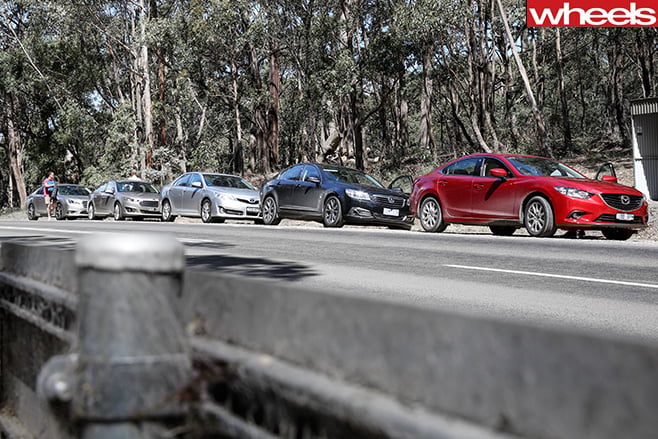
Five family cars, five recipes
Every car here follows a different recipe, be it a naturally aspirated or turbo four-pot, a V6 or boxer six, with a mix of front-drive, rear-drive and all-wheel drive. The one thing these sedans share is a $40K price tag, all five landing within a couple of grand of one another thanks to big price cuts at Ford and Subaru.
Subaru’s sixth-generation Liberty is a whopping $14K cheaper than its predecessor in this 3.6R Premium guise, and to say it carries big expectations, particularly for Wheels readers, is an understatement. As a two-time Car of the Year winner, the Liberty nameplate was once renowned for its Euro-bashing dynamics and unique Japanese character stemming from a combination of horizontally opposed engines and all-wheel drive.
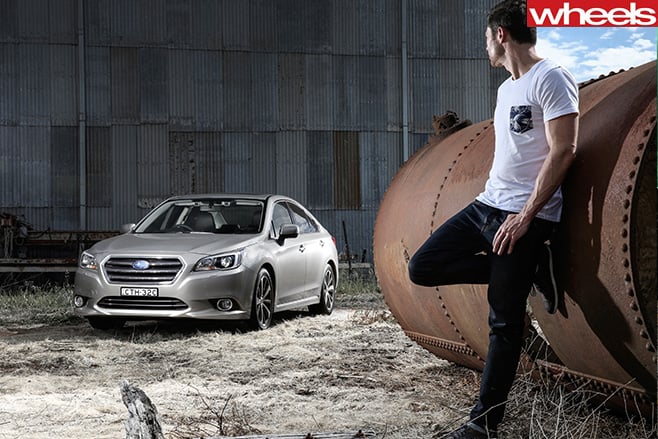
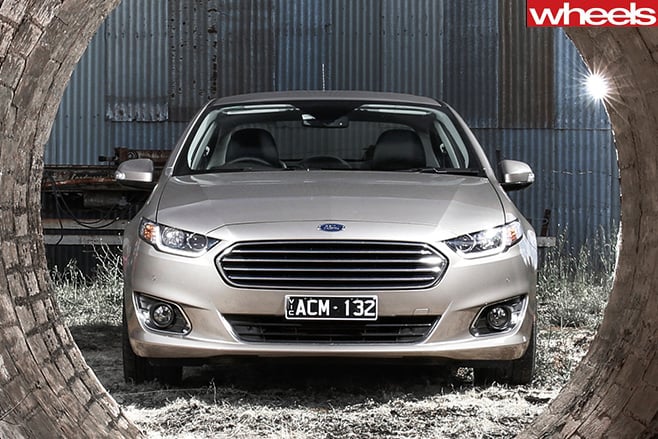
As does Ford’s FG-X Falcon. Its $40,100 price tag is $6225 less than the outgoing FG, meaning Ford’s G6E Ecoboost has never made more sense, nor looked so good. It is undoubtedly one of the best-looking variants in the refreshed FG-X range thanks to its elegant chrome grille, crisp LED-encrusted nose and fashionable 18-inch alloys.
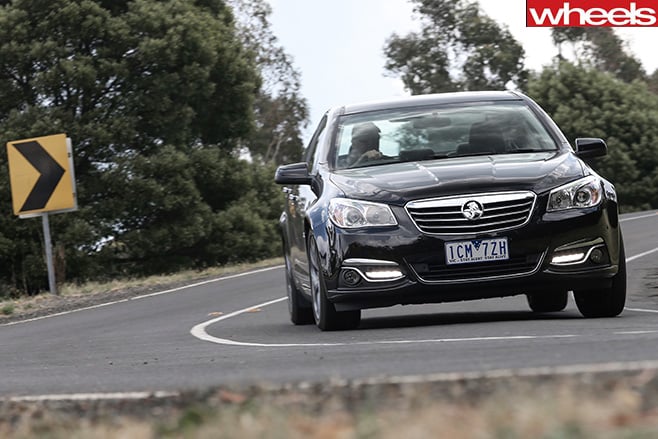
Ford hopes the repositioned G6E will steal sales from its freshly updated mortal enemy, Holden’s excellent Calais. Now sporting minor equipment upgrades and a new, more progressive steering calibration, the Calais continues to be the sweet spot of the VF range. Not only does its sumptuous ride, muscular performance and modern interior make it one of Australia’s most convincing family sedans, it’s Wheels’ benchmark for this five-seat class.
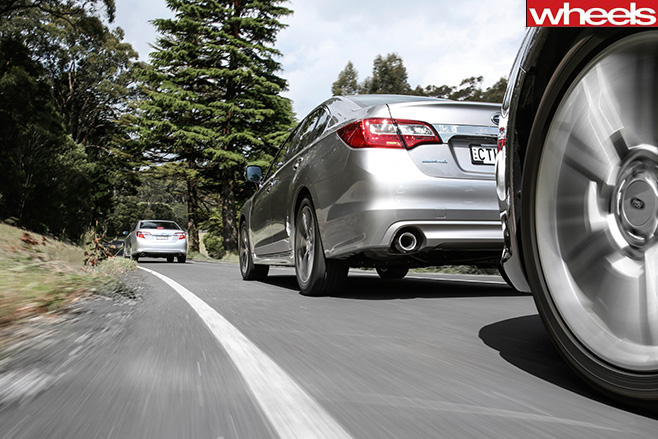
Floor it: here’s what happens
It’s a motley crew of high achievers then, but it’s the Subaru, and its huge weight of expectation, that garners the most interest when we meet at the drag strip. Boasting a carryover 191kW/350Nm 3.6-litre horizontally opposed six, the biggest mechanical change to the streamlined Liberty range is its transmission, which is now CVT only. Intuitive, refined and unobtrusive, it’s a drivetrain best summed up in one word: smooth. Even in high temperatures that saw the other four cars struggle to match their personal bests, the Liberty came close to its 7.2sec 0-100km/h claim with a sprint of 7.3sec and a 400m time of 15.3sec. Subaru’s premium drivetrain feels strong and never rushed, yet as punchy and flexible as it is, it’s still no match for the big Aussie V6 in the Calais.
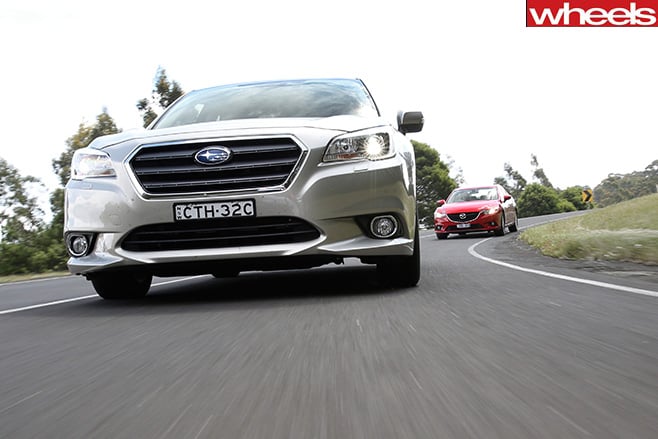
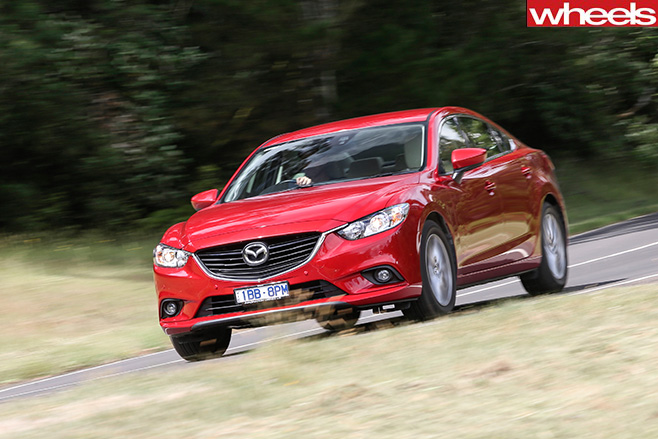
On paper, the Toyota is a facsimile of the Mazda – both have atmo fours of the same capacity and front-wheel drive – yet when it comes to performance, engagement and character, the two Japanese cars are poles apart. Where the Mazda is rorty and muscular, the Toyota feels lacklustre at the strip. It’s by far the slowest of the group, both from a standing start and on the move, with the Camry’s 80-120km/h time of 6.4sec a full second slower than the 6’s and almost two seconds slower than the quickest car here, the Calais (4.5sec).
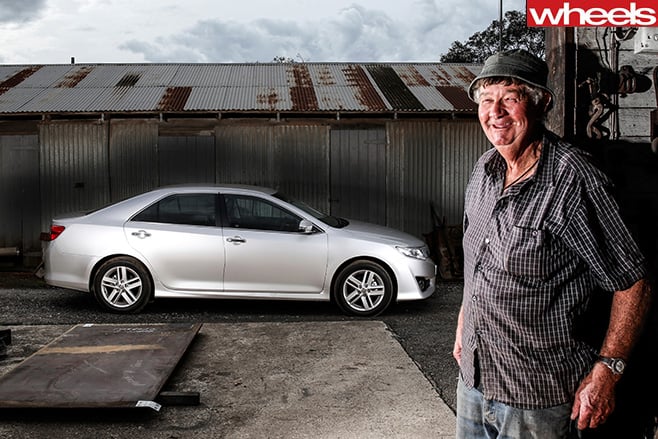
However, it would be wrong to dismiss the Camry’s drivetrain as insipid. In isolation, Toyota’s locally made 2.5-litre four is liveable, and while its performance is middle of the road at best, in city traffic the Camry does not feel underpowered.
Let’s get into the country
There is a place where the Toyota exceeds expectations, though – country Aussie roads. Granted, when you first slip behind the Camry’s cheap-feeling, oversized steering wheel, initial impressions aren’t positive. You sit on flat leather seats in a cabin dominated by hard plastics and cheap fonts. It’s easily the least polished interior here and has a hire-car ambience that betrays what Camrys so often do.
Things don’t improve much at slow speed, either. The unladen urban ride isn’t great, with a knobbliness you don’t expect, and its heavily weighted steering feels cumbersome and lazy, with a slow rack (3.2 turns lock-to-lock) often demanding armfuls of lock. Push through this on the open road, though, and you’ll discover that beneath the steering’s lethargy and the ride’s lack of low-speed absorbency, there’s a sweet chassis you can actually lean on. It has a fundamental balance that rewards the more you push, which is something few Camry drivers are likely to discover. For a car that most will buy for its space and A-to-B dependability, it’s a disappointing reality that the less you ask of the Camry, the less it gives.
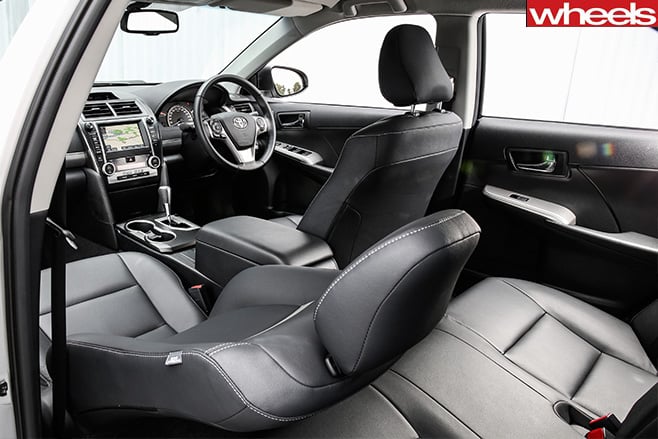
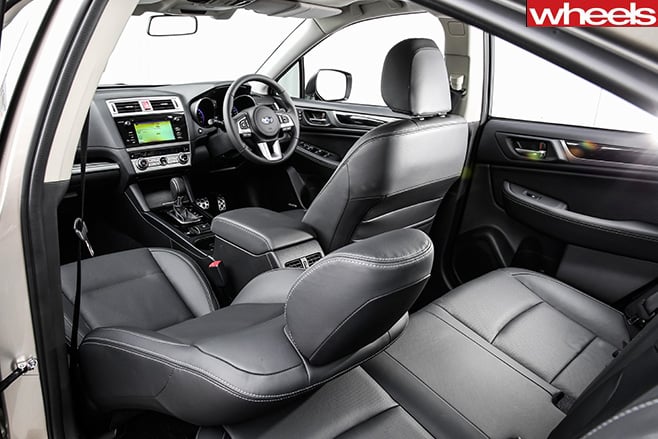
The opposite applies with the Subaru. Drive the Liberty on the freeway or quiet country roads and you’re almost overwhelmed by its smoothness. The ride on 18-inch wheels is reasonably supple, its drivetrain is hushed and, thanks to a deep glasshouse and an A-pillar that’s now 50mm further forward, vision is excellent. But where the Liberty excels superficially, things unravel the harder you drive.
The Liberty struggles to absorb sharp imperfections on rough Aussie roads, and the steering, which feels well weighted on the freeway, if rather numb, suddenly feels too light at the straight ahead and almost anaesthetised. Of course, Subaru’s much touted all-wheel-drive system means the Liberty has loads of grip, but any confidence this brings is eroded by the dead steering and unsettled body control. What the sixth-gen Liberty lacks is the crispness of feedback and lightness of touch that made its distant predecessors so rewarding, meaning that at the limit it feels aloof rather than encouraging.
Things couldn’t be more different in the Mazda. Where the Liberty shields you from the action, everything in the 6 is in your face, from its ride and handling to its road noise and engine rasp. It feels connected and unashamedly sporty, with a ride that’s noticeably firmer but also controlled and deft in its bump absorption and compliance. A well-sorted chassis and keen steering boost driver confidence, yet the 6 is far from perfect. It’s easily the noisiest of the group, with high amounts of tyre roar and wind rustle from the mirrors, and while the steering is mostly well weighted, it can feel mushy and inconsistent off centre. The lack of a Sport mode, especially in a car that champions sporting pretensions, is another oversight and one exposed on the winding roads of our test route, where it was possible to catch the engine out in tight, uphill corners. Still, the 6 always feels invigorating, a character trait shared by the Ford.
The Falcon’s gem of a drivetrain shaves weight from its nose and surprises with its engaging character and sparkling performance. Push the G6E hard and the lighter four-pot engine is immediately obvious through a pointy front end and light steering that’s communicative and so responsive it verges on nervous. Take the time to acclimatise, though, and the Falcon rewards you with a chassis balance and body control that, while clearly engineered towards comfort, can also be fun. Admittedly, the crisp steering can feel overly light at the limit, but the G6E blends a level of performance and connection that, dynamically at least, is almost ideal for Australian roads.
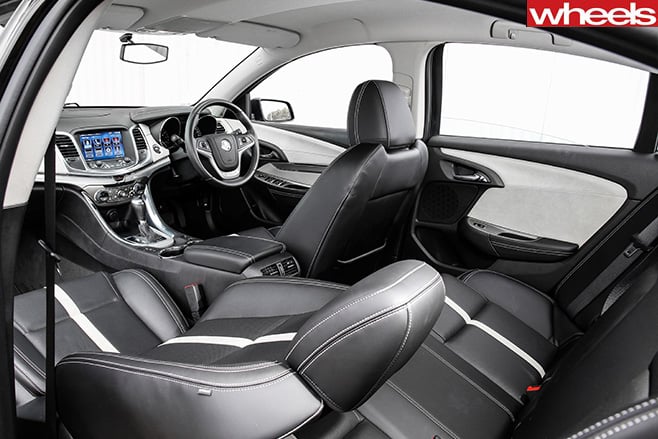
However, the Falcon still can’t match the dynamic verve and suppleness of the most polished car here, the Calais. Boasting ride quality and body control that are both first class, the Calais is quiet and forgiving on coarse, pot-marked roads yet, thanks to its muscular V6 and superb balance, is engaging enough to offer real driver involvement. Improved steering weighting and progression from straight ahead fixes what was a minor achilles heel in the original VF, with the Calais boasting an excellent handling package honed for Aussie conditions.
So, how happy will your passengers be?
The Holden is the best all-rounder here, and not just dynamically. Practically spot-on in its packaging, the Calais has the most comfortable seats front and rear, is the quietest, and also the most technically advanced thanks to its reversing camera, blind-spot monitoring and auto park assist. And as far as interiors go, the Calais is in a class of its own. Beautifully appointed and with a near-ideal driving position, the Calais’s interior ambience transcends what you expect from a $40K car and totally outshines its Falcon rival.
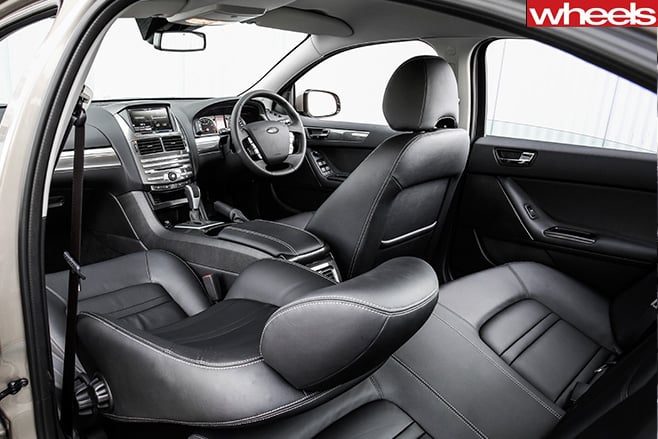
Climb into the G6E and it’s clear the interior is where Ford skimped the most when it came to the new FG-X range. Yes, the Blue Oval’s new SYNC2 infotainment system brings a much-needed dose of modernity, but there’s no escaping the G6E’s inherent FG-ness. You get the same messy central stack, unfortunate plastics and, worse, the same flawed driving position where you sit too high and the wheel is too low, meaning you need to tilt the seat rearwards to compensate. It’s a seven-year-old interior that feels like a seven-year-old interior, with none of the textural or packaging finesse you get in the Calais, nor the same level of comfort.
Still, in terms of space the Falcon outclasses the Mazda. Despite riding on a near identical wheelbase (2838 vs 2830mm), the 6 feels cramped and compromised against the big, airy Aussie. The 6’s interior has vastly superior fit and finish, and rear headroom is still decent despite its sloping roofline, but for all its emphasis on style, the 6 isn’t sexy enough to make up for its compromised packaging.
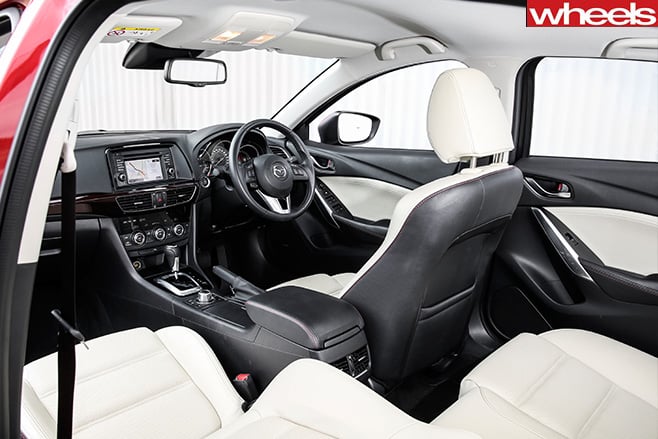
Despite its lacklustre dynamics, it’s inside where the Liberty claws back some ground. Open, spacious and beautifully appointed, the Liberty’s interior is one of Subaru’s best in years, combining a neatness and quality of materials, with an intuitive and beautifully integrated 5.0-inch LCD display. Passenger room front and rear is improved, despite the wheelbase remaining unchanged at 2750mm, while cabin refinement, especially at freeway speeds, is impressive. Only flat and comparatively unsupportive seats let down the Liberty’s interior.
If only the Camry had so few foibles. It’s inside where the Camry falls behind more than any other area with its inexpensive materials, clumsy ergonomics and dated infotainment system failing to emulate the polish of the other four. Admittedly, a hefty reskin later this year may address these issues, but for now the ageing Camry’s lack of design flair, personality and, surprisingly, efficiency (on test the four-cylinder Camry drank 11.4L/100km, a number only marginally better than the V6 Calais’s 11.6L/100km) sees it trail its family sedan rivals. Honest and unassuming it may be, but that isn’t enough in 2014. Not for 40 grand.
Calais leads, Camry trails. And the rest?
Camry’s defeat is far from a whitewash, though. It’s damning for Subaru that there are areas, such as country-road ride and body control, where its new Liberty is outclassed by the Camry, a result no one would have predicted at the start of this test. With its disinterested dynamics, lumpy suspension tune and hefty 12.6L/100km thirst, the Liberty 3.6R Premium has become a slick showroom car that triumphs its value-for-money credentials over its ability to be a dynamic flagship for Subaru. A Euro-killer it’s not.
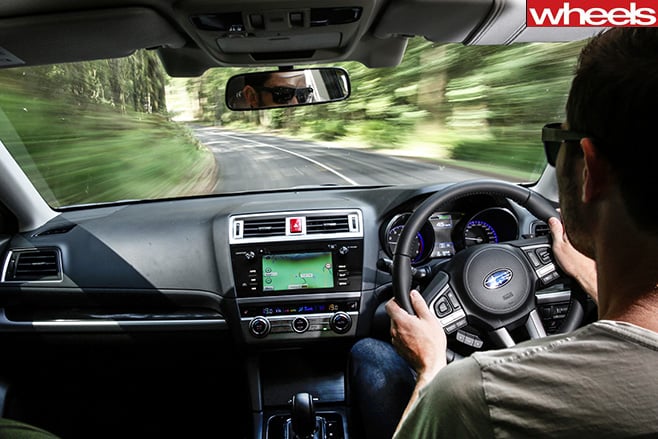
There’s no denying that everything Ford has touched on the new G6E is an improvement. It looks premium (on the outside), rides beautifully and, thanks to its torquey turbo four-pot and impressive agility, conveys an eagerness and sportiness that surpasses its cushy, family-barge image.
But, try as it might, it just can’t escape the flaws inherited from the FG. With Ford having so little money to spend, the reality is the FG-X was never going to be anything more than fresh tinsel on an ageing tree. And if you drive enthusiastically like we did, don’t expect class-leading economy, either. Still, in this spec, we could understand why someone would make a heart-over-head decision and buy the Falcon G6E Ecoboost over the Mazda.
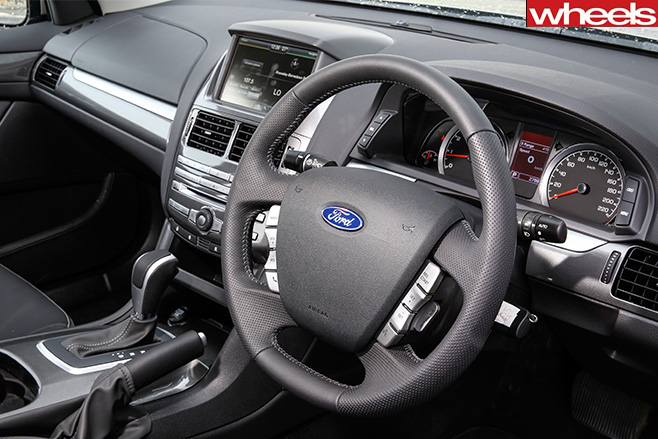
Head and shoulders above the others when it comes to packaging, refinement and interior comfort, it’s almost impossible to find something the Calais doesn’t do well. Its vocal V6 sounds unrefined when driven hard, but it’s gutsy enough that you can simply waft along on its torque, while enjoying its surprising economy.
As an overall package, the Calais decimates its rivals, with an enticing blend of economy, value and effortless performance that not only makes it the best variant in Holden’s VF range, but by extension the best family car ever made in Australia.
Value equation
CAR manufacturers love to sex up their press cars by ticking every option in the catalogue, but not here. Each model in this quintet is stock standard, with the only options being premium paint on the Holden and Camry and floor mats in the Mazda.
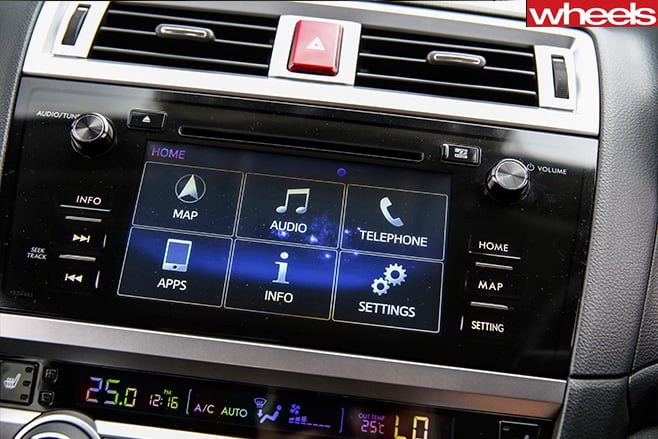
Ford, Toyota and Subaru include auto wipers, while only the Toyota and Holden have blind-spot monitoring. The Calais also offers Auto Park Assist, but misses out on sat-nav (a $750 option), which is standard across the other four.
Verdict
Ford Falcon G6E Ecoboost
Price as tested: $41,110
NCAP rating: 5 stars (Aus)
Fuel economy: 11.7L/100km (test average)
Acceleration: 0-100km/h: 7.3sec (tested)
Plus: Engaging, punchy turbo four; keen dynamics; direct steering; nice ride
Minus: Inherited FG flaws; old interior; engine thirsty when driven hard
Verdict: 7.0/10
Holden Calais
Price as tested: $41,430
NCAP rating: 5 stars (Aus)
Fuel economy: 11.6L/100km (test average)
Acceleration: 0-100km/h: 7.1sec (tested)
Plus: Luscious ride and handling; premium interior; all-round polish; great value
Minus: V6 sounds raucous at high revs; doesn’t get steering wheel paddles
Verdict: 8.5/10
Mazda 6 Touring
Price as tested: $39,170
NCAP rating: 5 stars (Aus)
Fuel economy: 9.4L/100km (test average)
Acceleration: 0-100km/h: 8.1sec (tested)
Plus: Sporty, engaging character; excellent driving position; chassis balance
Minus: Road noise; shallow boot; patchy interior; auto needs a ‘sport’ mode
Verdict: 7.5/10
Subaru Liberty 3.6R
Price as tested: $41,990
NCAP rating: 5 stars (Aus)
Fuel economy: 12.6L/100km (test average)
Acceleration: 0-100km/h: 7.3sec (tested)
Plus: Silky-smooth drivetrain; interior quality; refinement; newfound value
Minus: Lacks involvement and character; numb steering; economy; ride
Verdict: 6.0/10
Toyota Camry Atara SL
Price as tested: $40,440
NCAP rating: 5 stars (Aus)
Fuel economy: 11.4L/100km (test average)
Acceleration: 0-100km/h: 9.2sec (tested)
Plus: Reasonable drivetrain; four-up ride quality; country-road balance; space
Minus: Low-rent interior; lazy steering; too-big steering wheel; feels cheap
Verdict: 5.0/10
It’s back to the future with Mazda’s fourth-generation MX-5. Shorter than the original and with a smaller engine, it focuses almost solely on the driver for a pure wind-in-your-hair experience.
WHAT IS IT? The world’s best-selling roadster and Mazda’s fun-to-drive hero car. Front engine, rear-wheel-drive and powered by new four-cylinder engines, the latest ND-series MX-5 is for those who enjoy the drive.
WHY WE’RE TESTING IT It’s an all-new model and comes with the smallest engine ever offered in the MX-5, a 1.5-litre based on that used in the Mazda 2. It’s a drip-feed launch campaign with the base engine wheeled out ahead of the flagship 2.0-litre.
MAIN RIVALS Toyota 86 and Subaru BRZ are the most obvious because of their similar fun-fun ethos, even if they both have fixed roofs. The upcoming Fiat roadster – which is based on the MX-5 and will be built in the same factory – will also get some attention.
THE WHEELS VERDICT Raises the roadster driving bar and a fantastic demonstration of the importance of power-to-weight.
PLUS: Peppy 1.5-litre surprises; beautifully balanced; simple but elegant interior MINUS: No glovebox and limited storage; steering is sharp but lacks liveliness
THE WHEELS REVIEW AUDIOPHILES will tell you there’s something better about listening to the analogue sound reproduced by vinyl. Even with the crackles and hissing, the purity of sound is said to be closer to the intended notes before Dolby, Sony and billions of 1s and 0s apparently made listening life easier.
In modern motoring the MX-5 is one of the closest things on four wheels to a classic EP. Simple, faithful and largely unfazed by technology. That mantra continues in fourth-generation ND guise, which we’ve sampled in prototype form in Spain.
While MX-5s have been evolving since the first in 1989 – roughly when CDs overtook vinyl in popularity – it was the Car of the Year-winning original that provided the inspiration for the newest model. While acknowledging the contribution of the second- and third-generation MX-5s, there’s clearly a soft-spot with designers and engineers for the early NA.
Countering a trend towards bigger and heavier, the new MX-5 is the shortest of the breed by 40mm. Yet it’s the widest MX-5 yet and has shorter overhangs front and rear.
Weight reduction was key, with more high-tensile steel, less cast iron, and aluminium employed for the boot, bonnet, front fenders, various soft-top components, and front and rear bumper enforcements. Some suspension components – wishbones up front and multi-link out back – and the engine frame are also aluminium, helping lower the centre of gravity and counter yaw.
The centre of gravity is closer to the ground thanks to an engine that sits 13mm lower and is shifted 15mm rearward. Reduced overhangs and clever design cues – the tapered rear corners and more heavily raked windscreen – create a sportier look.
It’s a different feel from the cabin, too. MX-5 enthusiasts will be used to scrounging for places to store odds and ends, but they’ll now be doing so without the luxury of a glovebox.
The dominant wheelarches provide a visual reference to the forward extremities, the central tacho reinforces purpose. That windscreen is deceptively close; you can inadvertently tap the glass while twirling the wheel.
Throw in the obligatory 50-50 weight balance and it amounts to a poised and animated machine. It feels precise and alert, albeit lacking the lively feel to return the wheel to centre.
While there’s some pitching under brakes, the body is controlled through bends; the lack of kilos certify the MX-5 as lithe and agile. Challenging mountain roads ultimately exploit the limits of the 16-inch Yokohamas, further revealing the joys of the chassis. Push too hard and it gently understeers, then feed on throttle and coax some oversteer.
The biggest surprise, though, is the engine. The 1.5-litre is the smallest to grace an MX-5 (with 96kW and 150Nm it almost exactly matches the 1.8 that was fitted early in the roadster’s life). Modest, then – at best.
Based on the 2’s engine, it gets a new crankshaft, unique head, unique block and new inlet and exhaust manifolds. But with the 1000kg frame (it’s difficult to think the marketing department didn’t have a hand in that one…), it makes for frisky performance. It happily spins to 7500rpm and pulls deliciously from 2000rpm.
The sound and vibration, too, are in sync with the car’s playful DNA, with adequate rumble and a gritty roar – with a breath of induction wheezing on initial throttle applications – adding to the multi-sensory sensation.
The close-ratio six-speed snicks beautifully between ratios with computer-game accuracy, but more realism and fun.
There’s meaningful bite to the brakes; despite our concerted efforts down a twisting, flowing mountain pass, we couldn’t kill them.
Like that original NA model, there’s a personality and perseverance that make the latest ND a riot of a machine, without a licence-losing bruise. It’s a pleasant way to get some wind in your hair but will equally devour challenging tarmac as though it’s having as much fun as you.
A bit like vinyl. Now, time to find my old turntable…
SPECS Model: Mazda MX-5 Engine: 1.5-litre direct injection four-cylinder Max power: 96kW @ 7000rpm Max torque: 150Nm @ 4800rpm Transmission: 6-speed manual or 6-speed auto Kerb weight: 1000kg 0-100km/h: NA Price: $37,000 (estimated) On sale: Third quarter 2015
ITALIAN car maker Fiat has had zero input on Japan’s most popular convertible, according to Mazda, which will produce the pair on the same production line.
In unleashing the image-leading roadster on the media, MX-5 program manager Nobuhiro Yamamoto declared the new two-seat convertible is as pure as any MX-5 before it.
“It is not a joint development,” said Yamamoto of the collaboration between the two brands, a partnership realised to share the hundreds of millions of dollars in development costs for what will be relatively low volume models. “The MX-5 has absolutely no influence from Fiat.”
Yamamoto said the underpinnings of the new MX-5, codenamed ND and due in Australia in the second half of 2015, were bespoke to the roadster.
“We have no plans to use it elsewhere. This is specifically engineered for MX-5.”
However, Yamamoto refused to discuss the potential of a rotary being used in the MX-5 chassis – a possible revival of a much mooted new generation RX-7.
“I’m not going to talk about that today,” he said. “I don’t want any misunderstanding so I’m going to avoid that.”
Fiat is yet to reveal its new roadster or elaborate on details of the upcoming model.
While the Fiat and Mazda drop-tops will share the same basic platforms and be produced alongside each other, each will be powered by a unique engine and get unique styling, among other differentiators.
MAZDA is readying a hard-top convertible for its soon-to-arrive fourth generation MX-5.
To complement the soft-top that takes the new model back to its 25-year-old roadster roots, the new retractable hard-top would also fold electronically and be sold alongside the soft-top.
Speaking at the media launch of the new MX-5, which is due to arrive in Australia during the third quarter of 2015, program manager Nobuhiro Yamamoto confirmed the alternative roof design was being worked on and would complement the soft-top.
“This [the new MX-5] is going to have a very long life cycle, so within that we are also looking at a hard-top,” said Yamamoto.
He all but confirmed it would be button operated for easier electric operation.
“The current model is also electric hard-top, so yes we are investigating that,” he said.
The outgoing NC model MX-5 was the first to be offered with a folding hard-top, something that added to the appeal of the vehicle throughout its life – a life that was extended as Mazda battled with financial hardship and the challenges of the global financial crisis that hit car makers hard in 2008-09.
By the end of the soon-to-be-discontinued MX-5’s model life, the hard-top replaced the soft-top as the only roof option.
However, Yamamoto said there were no plans to produce a coupe version – with a fixed metal roof – of the MX-5.
“MX-5 is an open-top car … it has to open,” he said.
