
Online voting in our Greatest Aussie Cars poll has now closed, but you can still get 100 entries in the draw for the Golf GTi by subscribing to Wheels!
Last year Wheels named the ten greatest Australian cars of all time. Since then two impressive challengers have emerged from Ford and Holden, each demanding its place in the Australian Hall of Fame.
To be eligible for our list it had to be built here, it had to be seen as great in its time, and still worth the title today. Wheels staff, current and former, voted in a secret ballot, and the results were ranked from 10 to 1.
Now, a couple of new players have entered the fold. These late entries are the world-class Holden VF Commodore and the thunderous FPV GT-F 351.
These two wild cards have garnered plenty of accolades, but are they worthy of inclusion in the top 10?
Using the poll on this page, choose your favourite from the twelve options and cast a vote for the best Australian car ever.
To help you decide, read what we said about the FPV GT-F and Holden VF Commodore below, followed by the Top Ten Aussies as rated by Wheels in May 2013.
Entries are now closed
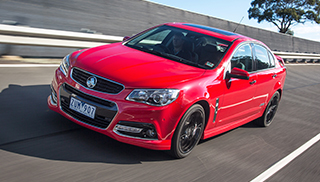
Holden VF Commodore
It’s hard not to be impressed by the VF Commodore. The harder you drive it, the better it gets. Indeed, the Aussie car has never been better than he VF, not by a long shot.
Cheaper than VE, yet more sophisticated and bristling with new technology that includes the latest colour head-up display. And it’s a better, more precise drive, with refinement levels that other Commodore (and Falcon) drivers won’t believe possible. Safer, more economical, with a stylish interior that exudes quality.
At Holden’s Lang Lang proving grounds, we tested four different versions of VF to discover if what’s under the mildly facelifted exterior is enough to change the way buyers perceive Holden’s home-grown family car. And the news is good: VF Commodore represents significant progress on virtually every objective front.
There will never be another all-Australian designed and engineered Commodore – or any other car for that matter – so let’s celebrate the best ever. The VF deserves as much.
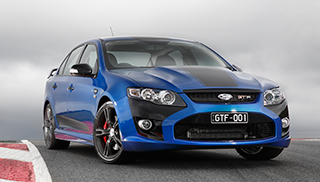
FPV GT-F
Make no mistake, FPV’s farewell vessel is a veritable missile. The GT-F auto hit 100km/h from standstill in just 4.68s, backed by a subtle blurting from its exhaust pipes as the ZF auto upshifgts with rapid-fire slickness.
Turn-in is as quick as it’s ever been in an FPV, and the GT-F has the tyre grip and chassis poise to maintain the directional change promised by the front end. For all the GT-F’s cornering and drifting bravado, it still manages to ride well.
If it wasn’t for the passion of the engineers, designers and program managers championing the GT-F, it would never have turned out the way it did. They really wanted to do the nameplate justice.
It was a labour of love, born out of the enormous affection for performance Fords in this country, and behind the scenes at Broadmeadows. As GT-F project manager Justin Capicchiano points out, it’s an emotional car for Blue Oval fans and also the guys working on it. “People would come up to you in the hallways at work and say ‘you’ve got to do a good one, you’ve got to make it special’.” And they have.
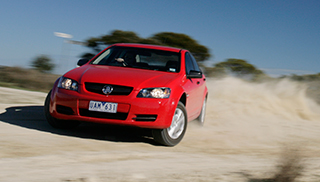
#01 – Holden VE Commodore
In many ways the VE Commodore is the best car Australia has ever created. At its core are virtues of strength, spaciousness, and sophistication. At last given the chance to design, engineer and develop a car from a clean-sheet starting point, Holden grabbed the opportunity with both hands. The 2006 VE is different from any earlier Commodore.
When the VE was launched, there certainly wasn’t a contemporary BMW that steered with the beautifully fluid accuracy and consistency of the Holden. Equally outstanding was the VE’s shape; a perfectly proportioned combination of dynamic drama and easy elegance, precisely and simply detailed.
The Holden heads our 10 Greatest for its design, engineering, value and versatility, but also because it’s a greater and much more significant achievement than any other car Australia has ever made. Holden began in 1948 with a basic design imported from America. With VE, the voyage was in the opposite direction. More than just a good honest car, this was the Commodore that proved, beyond doubt, that Australia’s got talent.
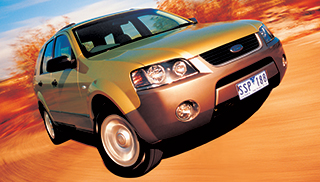
#02 – Ford Territory
In the end, only a handful of votes relegated the SX Territory to second place in our Top 10 showdown. It really was that close, and Ford’s 2004 all-roader deserves its place high in the list of Australian greats.
The Territory was a brave and brilliant departure from an accepted, comfortably familiar formula. It was a superbly executed crossover, with truly world-beating handling, ride comfort and practicality.
Territory made intelligent use of Ford Australia’s existing component set. It had Falcon’s 4.0-litre six-cylinder engine and four-speed auto, the ‘Control Blade’ rear suspension introduced in the 2002 BA, and shared the sedan’s engine box. But the rest of the body structure was new; it had to be, to accommodate seven-seat and five-seat versions. The front suspension and steering, which had to be compatible with AWD, was all-new and no-compromise.
Dynamics were a Territory strong point. It rode and handled and steered better than many crossover SUVs costing much, much more. Inside, the Ford had great seating and a myriad of places to stash stuff. It was every bit as useful as it was enjoyable to drive.
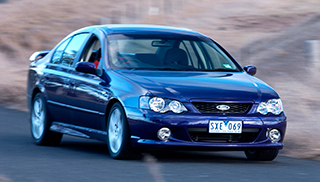
#03 – Ford BA Falcon XR6 Turbo
Nothing underlined Falcon’s 2002 great leap forward more emphatically than the XR6 Turbo. There was a new independent rear suspension beneath all BA sedans, sophisticated (for the time) electronic systems, a vastly improved interior and an exterior that looked nothing like the AU. But it was Falcon’s practically all-new six-cylinder engine that made the most difference.
The 240kW turbo ‘Barra’ of the new-for-BA XR6 Turbo model instantly made every Australian-made V8 then on sale seem stupid. Performance testing soon proved that neither VY Commodore nor BA Falcon V8s could match its pace. The super six’s spread of torque was broad and beautifully delivered. Sounded good, too.
BA’s mostly new chassis, especially the ‘Control Blade’ IRS, meant the XR6 Turbo wasn’t overwhelmed by its engine. There was a distinctly European flavour to the way the Turbo drove.
After years learning to expect as little as possible from Ford Australia and Falcon, the BA XR6 Turbo was a massive moment. Brilliantly quick, wonderfully refined and huge fun to drive, it snarled defiantly that Ford Australia had changed its ways.
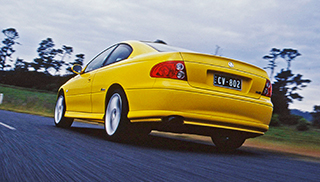
#04 – Holden V2 Monaro
Cunning and connivance was what it took to give the spark of life to a concept that brightened a dull era for the Australian industry.
Holden design boss Mike Simcoe had started work on a VT Commodore-based coupe at home. Work continued in secret in Holden’s studios as the conspiracy spread. The project was only revealed to Holden managing director Jim Wiemels four weeks ahead of the Sydney motor show. The American exec must have been surprised, but he let them build the concept car.
Totally unexpected, the impact of the Coupe Concept at the Sydney show, late in 1998 was so huge it must have registered on seismographs. Media instantly decided it had to be called Monaro and should be put into production pronto.
The car’s elegant and understated style emerged unscathed. Although a supercharged V6 version was offered initially, hardly anyone wanted the coarse and uninspiring 3.8-litre. But General Motors’ 5.7-litre Gen III V8, well, that was a different matter…
As conspiracies go, the Commodore Coupe was a surprising success.
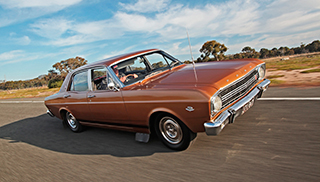
#05 – Ford XR Falcon GT
Ford Australia promoted its 1966 XR as the ‘Mustang Bred Falcon’, and the car won a second-in-a-row Wheels Car of the Year award. One of the chief reasons the trophy ended up on Ford Australia’s mantelpiece is that the company had responded to the magazine’s insistent calls for Made in Australia V8 power.
While Ford’s 4.7-litre (289 cubic inch) Windsor V8 was an option across the new range from its 1966 launch, it wasn’t until the following year that the Mustang claim really came true. The Falcon GT combined the high-performance 168kW version of the little Windsor V8 used by its American cousin car and a four-speed floor-shift manual, instead of the regular range’s three-speed.
Nearly all of the GTs produced were painted a bronze colour named ‘GT Gold’, and gold is exactly what the car earned at Mount Panorama in the Gallaher 500 the same year it was launched. The 1967 Bathurst victory of Harry Firth and Fred Gibson earned instant racetrack credibility for the GT, and provided the blueprint for generations of road-going V8 sedans to come. The arrival of the XR GT was a pivotal moment in our motoring history, one with enduring consequences.
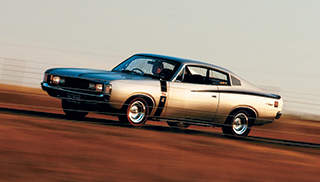
#06 – Valiant Charger E38/E49
These days $2 million might buy a car maker a new doorhandle design. In the early 1970s it was enough to develop a new variant of an existing car. Chrysler Australia’s Valiant Charger project relied on a brand of resourcefulness that was becoming a trademark of the Australian car industry. This can-do, low-cost spirit had already produced big results on small budgets; cars like Ford’s XR Falcon station wagon and Holden’s HK Monaro coupe. But the Charger was more audacious, more special.
One thing that made it so was stylishness. With the aid of a memorable and effective ad campaign with its ‘Hey Charger!’ catchline, the Valiant’s looks attracted hordes of paying customers.
Although V8 engines were part of the Charger model mix, it was the better handling high-performance versions of Chrysler’s in-line six that powered the car to greatness. Right from the beginning, the E38 option package lifted the power of the 4.3-litre (265 cubic inch) engine, with its trio of twin-throat Weber carburettors, to nearly 210kW. Revised gear ratios for the three-speed manual were also part of the deal. From Charger’s second year of production, 1972, the E49 option package upped power again, to 225kW, and included a four-speed Borg Warner manual.
Created on a shoestring budget by an outfit overshadowed by both Holden and Ford Australia, the E38 and E49 were the most outstanding cars produced by Australia’s brief but glorious late ’60s to early ’70s muscle-car era.
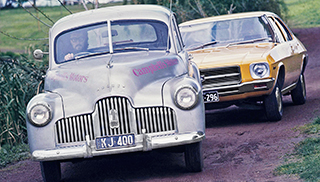
#07 – Holden 48-215
During World War II there was an urgent program to increase Australia’s capacity to make the complex machines needed to fight. But what, once the shooting stopped, would sustain the nation’s new-found manufacturing ability? The answer, Australia’s wartime Labor leaders decided, was cars…
That’s why a hat-clutching former locomotive driver from Bathurst was photographed beside the first Holden at its official introduction in November 1948. Prime Minister Ben Chifley had waited years for this moment. He’d been Treasurer when, with the war still raging, discussions began with both General Motors and Ford on how best to start a peacetime car industry in Australia. General Motors’ less costly scheme won government favour.
Today it’s impossible to imagine any result of government policy being as popular as that first Holden. The car, based on an unused design for a compact, post-war Chevrolet, was very basic: 45kW 2.2-litre (133 cubic inch) in-line six, three-speed column-shift manual and rear-drive. But it was roomy, tough and quicker than many contemporaries. At first, Holden production literally couldn’t keep up with demand.
The 48-215 wasn’t only a showroom success. Here was proof Australia could produce more than countless bales of wool. It was an accomplishment to be proud of, and it changed what Australians thought of themselves and their nation’s capability.
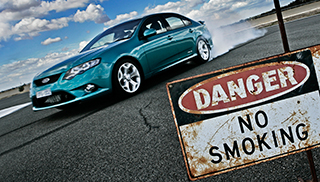
#08 – Ford FG Falcon
Ford’s FG Falcon is arguably a better car than any of the three million or so Falcons, spanning six generations, produced before it. Soon after launch it became the first Australian-made car ever to earn a five-star rating from the Australian New Car Assessment Program.
The super-fast performance variants from FPV may get the most motoring-mag ink. Recording the best 0-100km/h times ever seen from an Australian-made model will do that.
But it’s the most affordable versions of FG that also are the most outstanding. The basic models have benefited most from changes, everything from the switch to six-speed ZF automatic transmissions across the entire range to the introduction of better basic infotainment electronics.
The 2012 introduction of the 2.0-litre, four-cylinder Ecoboost variant was what propelled the FG Falcon into this elite company. The Ecoboost Falcon proves that Ford Australia’s engineers are as adept as any European at doing downsizing that works brilliantly.
It’s remarkable that Ford Australia managed, in hard times, to create such honest and admirable cars. Remarkable, too, that its work is sneered at or ignored by so many.
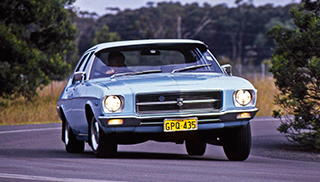
#09 – Holden HQ
Australians were to make the HQ the best-selling Holden of all time, buying close to half a million of them between 1971 and 1974. But that unrivalled sales tally of 485,650 isn’t the reason it’s here. This wasn’t a perfect Holden. Anyone who’d thumbed through the 1971 Car of the Year issue of Wheels would have known the HQ didn’t win because it was built for comfort, not for speed … nor corners, either, for that matter.
It was the first really all-new Holden since the 48-215, but unlike the first Holden, the HQ was engineered here. And the company made the most of the opportunity. As well as the Belmont, Kingswood and Premier sedan line-up, there was a wagon, a ute, a panel van, a coupe, a cab-chassis ute and a long-wheelbase luxury version. It was a massive effort, and highlighted the design and engineering ingenuity of the Australian industry.
The HQ also must be numbered among the best-looking cars Australia has produced. A Pontiac designer on loan from Detroit, John Schinella, styled the HQ, with plenty of help from young Australians in Holden’s studio. Its remarkably slim A-pillars and great forward vision are reminders that, in some ways at least, the past really was better.
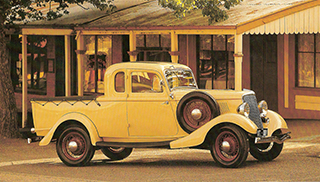
#10 – Ford Coupe Utility
How could Australia’s only contribution to the world’s vocabulary of automotive styles not make this list? Young Lew Bandt was the only designer employed by Ford Australia in the early 1930s, when the company’s management thought it might be worthwhile building something suggested in a letter from the wife of a Gippsland farmer.
The problem was that the car-based utes of the day were crude. Functional load carriers for sure, but cramped and uncomfortable to ride in, and lacking any hint of stylishness. The farmer’s wife yearned for something better.
Turning her dream into reality became a job for Bandt, then in his early 20s. His solution was based on Ford’s sidevalve V8-powered 40A Coupe. Instead of the tacked-on, separate tray of earlier utes, Bandt’s design clothed the cargo compartment in a smooth continuation of the coupe’s bodywork. It looked good, the coupe-size passenger compartment was roomy, and banks would loan farmers money to buy it.
The influence of Ford Australia’s 1934 Coupe Utility can be traced all the way to today’s Commodore Ute, but Bandt’s brilliance also reached across the Pacific Ocean. In the late 1950s first Ford, then Chevrolet, launched long-running model lines that owed a conceptual debt to the idea of the young Australian. Americans probably imagine their Ranchero or El Camino is as American as apple pie, but they’re the brainchildren of a bloke who undoubtedly preferred his portable pastry filled with meat.
We value your privacy as much as you do. We will not give your email address out to any other party. Bauer Media Pty Ltd (Bauer), collects information through this site to process registrations, send out invites, to communicate offers, competition or surveys. Bauer’s privacy policy is available http://www.wheelsmag.com.au/privacy-policy/ and contains information on how you can access or correct your personal information, entities we may disclose your personal information to (including overseas recipients) and how you can lodge a complaint.
THERE are now two more reasons your next chariot should be Roman, with the arrival of the diesel version of the sixth-generation Maserati Quattroporte, just a couple of months after the mid-range six-cylinder S.
At $198,800, the entry-level turbo-diesel is $41K cheaper than the twin-turbo V6 S and some $121,000 less expensive than the flagship twin-turbo V8 GTS.
Consider that, aside from wheels and minor equipment differences, the oil-burner is specified the same as the models above it and either the V8 is a monumentally expensive engine, or the VM Motori diesel is amortised across enough models to make it dirt cheap. Probably a bit of both.
Eased into entertaining the thought of Maserati ownership via the revived Ghibli, the $29K jump to a new base Quattroporte almost seems manageable.
However, the impact of the Fiat-Chrysler integration can be felt in the cabin, and the influence of China’s New Money is obvious in a broader, longer new model designed to put rear passengers first.
The turbo-diesel sounds deeper, louder and more guttural in Sport mode, but never especially sporty sounding – certainly no selling point in its own right, as it was with the old atmo V8.
No criticism of the surging 600Nm underfoot from 2000 revs, though. The least-expensive Quattroporte brings effortlessness that befits the Trident, with a ratio for all occasions in its slick ZF eight-speed auto.
Smooth roads reveal steering precision, and chassis balance and cohesion, but on more typical bumpy coarse-chip, the hydraulic steering rack rattles even at the straight-ahead and, regardless of which of the two modes the dampers are in, the ride is busy, not helped by the 20-inch alloys on our test car. With bumps and corners, much of the big four-door’s poise vanishes.
The chassis shortcomings are obvious on the sort of country roads Maserati sees its customers touring. We see them, instead, cruising our cities, enjoying drivetrain refinement and efficiency, basking in cabin space and soaking up Italian flair, which can be found anywhere there isn’t a Chrysler-sourced knob, button or stalk, in a variant that brings newfound accessibility to the Quattroporte line-up.
Plus: Much lower entry price; smooth-road handling balance; performance; efficiency; some Italian flair Minus: Rough/normal road ride and dynamics; lack of engine theatrics; Chrysler-sourced cabin bits
Model: Maserati Quattroporte Turbo Diesel Engine: 2987cc, V6, dohc, turbo-diesel Max power: 202kW @ 4000rpm Max torque: 600Nm @ 2000-2600rpm Transmission: 8-speed automatic Weight: 1885kg 0-100km/h: 6.4sec (claimed) Price: $198,800 On sale: now
MERCEDES’ all-new nine-speed automatic transmission will be introduced in Australia in November fitted to the facelifted CLS500 seen here – and it raises gearing to previously impossible heights.
The nine-speed ’box combines a 2.47:1 diff ratio with a 0.60:1 top gear for an astonishing 89.3 km/h per 1000 rpm, compared to 68.6 km/h for the current seven-speed auto (which will continue to be offered as volumes of the new auto are ramped up).
At 110km/h, the engine will be turning over at a barely above idle 1200rpm.
Mercedes claims the gearbox improves fuel consumption and performance, while also helping to advance refinement levels.
Three versions of the new 9G gearbox are planned to meet different torque output levels, though all three will share the same casing.
For AMG, Mercedes has engineered the gearbox for up to 1000Nm of torque; the intermediate variant is for torque up to 700Nm, while the third is intended for diesel applications with up to 640Nm.
Who are the villians?
SOCIAL media is abuzz with many and varied views debating who the bad guys are in the unfortunate saga of a potential clash of dates involving V8 Supercars and the annual Liqui-Moly Bathurst 12 Hour.
It has emerged that V8 Supercars Australia wants to hold its pre-season test day (or days) on the same weekend locked in months ago by the organisers of next year’s 12-hour enduro.
V8 Supercars says it wants to move forward to February 7-8 to accommodate its new telecaster, Fox Sports, because the cable network is showing the cricket World Cup from February 14.
Under the new deal with V8 Supercars, Fox’s Speed channel gets to telecast the whole banquet, including practice, qualifying and the races. And even pre-season testing.
V8 Supercars won’t settle on its 2015 calendar until September. Meanwhile, there is no shortage of aggro out there in petrolhead land with many believing V8 Supercars and Fox are playing hardball to disadvantage the Bathurst 12 Hour, a rival race gathering plenty of momentum and to be telecast free-to-air in its entirety by the Seven Network.
The fans are miffed (potentially) because many would like to check out the testing at Sydney Motorsport Park and get to the Mountain for the Bathurst 12 Hour and its growing grid of exotic GT cars and prominent foreign drivers.
Some of the gun V8 Supercars drivers who were planning to compete in the 12 Hour are more than peeved, too.
Not only have they (potentially) lost the chance of an extra earn, but more importantly they’ll miss out on the chance of showcasing their abilities in front of influential Euro team bosses. Those who may be affected include Craig Lowndes, Rick Kelly, Will Davison and Shane van Gisbergen.
Among others decidedly unhappy, count Nissan Australia, who had committed to a global motorsports exchange deal for its drivers, and VIP Petfoods boss Tony Quinn, who sponsors Van Gis in the V8 series and owns a brace of Bathurst 12-Hour cars. Chances are he would like to use the young Kiwi in the 12-hour and will not be pleased if he can’t. Likewise, Betty Klimenko might want to tap her Erebus V8 Supercar drivers for B12 duty in her Mercedes SLS GT3 fleet.
More than anyone, you’d expect the event director of the Bathurst 12 Hour to be howling. But if James O’Brien is angry, he’s keeping it within.
“It would be disappointing that we might miss out on having some of the V8 drivers compete the Liqui-Moly Bathurst 12 Hour, however V8 Supercars have the right to schedule their test day when they like,” said O’Brien, a gent who could find his calling in the diplomatic corps.
“We are a stand-alone event with an international focus and our priority is building that aspect further, so if the test day occurs on the same weekend, it will not change our plans.
“If this is the outcome, it may open up available seats to more high-profile international drivers who have been vocal about competing in the race already.” O’Brien added calmly.
O’Brien was highly visible at the Nurburgring 24 Hours in Germany last week and at the Blancpain Endurance Series round at Paul Ricard in France over the last three days chatting to potential entrants and drivers.
Ambrose climbs in Kentucky
FORD’S Brad Keselowski dominated NASCAR’s Quaker State 400 Sprint Cup race at the 1.5-mile Kentucky Speedway, the Penske driver converting pole into victory, with Kyle Bush’s Toyota the best of the rest.
Following his spirited top 10 result last week on the Sonoma road course, Australia’s lone NASCAR regular Marcos Ambrose put in another solid effort in his Richard Petty Ford, finishing 13th after starting 27th.
This jumped the Tasmanian a place in the points to 20th, but he still needs a win this year to assure a start in the Chase end-of-season playoffs.
Mid-season, Hendrick Motorsports teammates dominate the title table with Jeff Gordon, Jimmie Johnson and Dale Earnhardt Jr holding the first three places.
Next up for the NASCAR Sprint Cup Series is the Coke Zero 400 from Daytona International Speedway on Saturday, 5 July.
Houston, problem for Aussies
WHEN the first of the weekend’s two IndyCar Championship races on the bumpy streets of Houston ended with a caution , three Colombians were conveniently running up front – Carlos Huertas, Juan Pablo Montoya and Carlos Munoz.
It was Huertas’ first IndyCar win and the best result for Montoya since his return. And a slice of history with Colombians owning the podium.
Australians Ryan Briscoe and Will Power finished 12th and 14th respectively.
Things were not much better for the Aussies in race two, where teammates Simon Pagenaud and Mikhail Aleshin finished one-two after an exhausting 90-lap battle.
Power, who never leaves much in the tank, clouted a tyre barrier on the last lap to fall from running third to finish 11th, but still takes a 39-point title lead into next weekend’s race at Pocono.
Briscoe fared a little better, posting an 8th place finish.
Molly Taylor has tough WRC in Poland
AUSTRALIAN rally driver Molly Taylor was back into World Rally Championship competition at the weekend driving in Rally Poland, dominated by Volkswagen’s twin assault weapons Sebastien Ogier and Andreas Mikkelsen.
World champ Ogier won the rugged four-day event from Mikkelsen by 1min 07.7sec, with Hyundai’s Thierry Neuville third.
The high-speed gravel Polish event was round seven of the 13-round WRC series for 2014 and the second event of the year for Taylor, driving a Citroën DS3 R3T.
Rated the world’s number one female rally driver after winning the inaugural Ladies Trophy in last year’s European Rally Championship, Taylor got away to a promising start on Thursday.
But some hydraulic issues and a puncture on Friday hampered progress on the deeply rutted stages.
Taylor was unwell on Friday into Saturday, but fought on to finish 41st overall and eighth in the Junior WRC class.
The Polish event was based in Mikolajki, three hours north of Warsaw, but included stages in Lithuania.
Taylor has a six-round WRC program on her plate this year, with Rally Finland (July 31-August 3), Rallye Deutschland (August 22-24), Rallye de France-Alsace (October 3-5) and Wales Rally GB (November 14-16) ahead.
Budget constraints are likely to rule her out of her home WRC event, Rally Australia, in September.
West reigns in the Assen rain
BOY genius Marc Marquez may have made it eight straight wins in the MotoGP world championship, but Aussie interest was also focussed on a gripping Moto2 grand prix at Assen on Saturday.
Australian motorcycle warrior Ant West turned back the clock to win the Moto2 world championship race in a heart-stopper ahead of Maverick Vinales and Mika Kallio, charging through from 23rd on the grid on a treacherous rain-affected track.
In qualifying, West gave no indication of race-winning potential. But the race-day rain played into the hands of a rider recognised as a master of wet conditions.
It was the slow-talking West’s first grand prix win since the 250cc Dutch TT in 2003 – which until Saturday was his lone GP victory.
Earlier, countryman and Moto3 pole winner Jack Miller crashed out on the opening lap of an incident-packed Moto3 race.
Alex Marquez (Galicia), brother of you-know-who, took the Moto3 victory, with Alex Rins (Galicia) and Miguel Oliveira (Mahindra) joining him on the podium.
Miller (Red Bull KTM) still leads the Moto3 championship – by seven points.
THE revised Focus ST, unveiled at the 2014 Goodwood Festival of Speed, receives a number of updates highlighted by new front springs, adjusted shock absorber settings, retuned electronic power-assisted steering and a new flat-bottom steering wheel.
The remaining changes will see a redesign to the front and rear fascias, a bump-up in standard equipment and a rework of the instrument panel center stack.
Although the refreshed Focus ST is confirmed for Australian shores in 2015, don’t expect to see the European-bound diesel powered Focus ST anytime soon.
Martin Gunsberg, Public Affiars of Ford Australia, said that, “There’s not a huge demand for that engine here and with the efficiency we’re achieving with the EcoBoost engine, we think that’s the right option to offer for this market.”
The EcoBoost engine Gunsberg mentions is heavily rumoured to make its Focus debut in Australia alongside the usual mid-generation updates, also due in 2015.
The tiny 1.0-litre three-cylinder engine – found in the Ford EcoSport and Fiesta Sport – has recently been named engine of the year and produces 92kW and 170Nm.
With a fuel consumption rating of just 4.9l/100km, an EcoBoost engine would be the powerplant of choice for frugal Focus buyers.
HIROSHI Masuoka crashed the Mitsubishi iMiev Evolution on Wednesday afternoon. It was the first session on the first practice day before Sunday’s race, and his second run along the bottom section of three. The run would establish not only the car’s speed against its competitors, but determine Sunday’s starting order. Important to start as early as possible in a place like this, known for its treacherous weather.
So Masuoka, 52, was pushing. One of Japan’s grand master rally drivers, he won the Paris-Dakar for Mitsubishi two years straight in 2002 and 2003, and finished in the top 10 in the event for 10 years in a row. But even grand masters make mistakes. Engineers Corner, a tight left-hander, bit him. It is about three kilometres into the 156-corner run at Pikes Peak, Colorado, the world’s greatest hillclimb – 19.98km long and climbing from 2862m at the base to 4300m at the summit (see map).
Masuoka thought he was two corners further up than he was. An easy mistake to make. At Pikes, experience is paramount, and although Masuoka had made and studied notes and videos for nine months, and memorised every detail as precisely as you’d expect a grand master driver to do, he’d never run up here in a car this fast. He’d missed a small yellow marker on the right side of the road on approach. The shape of not only the bend, but the run-up to it, the sight lines, the trees and other features surrounding it, are almost identical to the turn before Gayler’s Straits, which is much faster and more open. The way Pikes Peak repeats itself is one of its great challenges.
From 150km/h, Masuoka dragged the Evo down to about 50km/h before he knew he was gone.
“At that point, I had three options,” he told me in the workshop later. “Either try to get the car turned for the corner, try the handbrake, or hit the ditch straight-on to minimise damage. I chose the last.”
The car dropped off the road and slammed dead square into the far bank of a deep ditch at 30km/h. It was then left perched across the divide, wheels askew, nose panel pushed up into the sky. Pictures soon emerged on the internet of this great driver, race suit tied around his hips, grimly directing the rescue team as they dragged his multi-million- dollar one-off electric prototype onto a flatbed.
It’s easy to criticise a driver for any accident, but this one was also a measure of Masuoka’s intent. He is Mitsubishi Motors’ chief test and development driver and is named as team principle for this program. His employers weren’t here for a happy display run – they were shooting for the outright record and were confident the Evo had the speed to do it. Mitsubishi hasn’t been involved in any sort of serious motorsport for years. Now it was back, with many of the old WRC crew present.
Masuoka went off, but he went off because he was going bloody fast. Still, as the shattered car was scraped up and the truck trundled away, two years of work looked lost.
Edit to Clarks Metal and Speed, a hot rod shop in a nondescript corner of Colorado Springs. Matt Clark, owner and founder, and a man not much smaller than Pikes Peak itself, set up this garage only three months previously – he’d secured the Mitsubishi deal before the shop was open, a deal which meant hosting the team throughout Pikes Peak and being prepared for any eventuality.
Matt’s from the SoCal hot rod school of artisan fabricators (see Wheels, February 2012) – a magician when it comes to turning metal and building stuff from scratch. He’d built rally and drift cars for such luminaries as Rhys Millen and Travis Pastrana, as well as countless high-end SoCal hot rods, and had decided to come back to his home town to start his own business.
Now he was staring at the ‘any eventuality’ bit – an expensive, computer-designed foreign racing car with its nose bashed in. As he and co-workers Tim Eckert and Brady Dimmick – both race car builders with vast experience – and the Mitsubishi engineers peered at the car’s crushed form on Wednesday afternoon, all knew they were faced with a desperate race against time to fix it for Sunday morning’s event.
Most of the Evo in front of the firewall was destroyed and would need to be either replaced – there were plenty of spares – or in the case of the chassis, rebuilt. Once the damage was assessed, somebody was dispatched to Denver to buy the chassis tubing.
One spare they didn’t have was a steering rack, which had been split in the impact. It was early Thursday morning in Japan when Mitsubishi engineer Nobuo Momose’s phone rang – he would no longer be going on holiday with his family, he’d be packing a steering rack into a bag and flying from Tokyo to Colorado Springs. He arrived Thursday afternoon but his bag did not – the airline lost it for four hours. Tense hours, those, because the team knew that any delay would kill the rebuild.
Late on Friday night, I saw Momose putting all his weight on a huge wrench, fastening a suspension mounting bolt. He’d pitched hard into the work and – like the other amazing Japanese engineers here – showed no trace of fatigue at any point.
Dimmick calmly sawed off the entire front end of this priceless machine and work began on reconstructing the chassis. The team jigged the car and established its reference points. The chassis had to be dead straight, and the suspension mounts were too complex to manufacture in the time allowed, so they were cut out of the damaged original frame and welded in – ideally to a tolerance of 0.01mm! It took 14 hours of grinding to get this as accurate as possible. And by all the measurements available to them, it was spot-on.
I watched for hours, mesmerised. The Japanese and Americans worked fantastically well together – never an argument or tense moment, just grim determination and the application of awesome expertise and experience. And a few practical jokes and laughs, too.
“At first, it was hard to communicate with them,” said Clark. “But after a few hours you can understand what they’re saying – it’s pretty fun.”
The work went on and on and on – all night Wednesday night, all day Thursday, all night Thursday night, all day Friday, deep into Friday night. Matt welding and overseeing, Brady grinding, Tim assisting, the Japanese fitting, measuring, honing, building. Not until Friday night were they sure they’d make it happen – at best, they thought they’d fix the car and take it straight to the hill.
I bailed out at 1:00am on Friday morning, just as the team was about to tackle the task of cutting, shortening and re-welding the steering column to fit the rack Momose had delivered. I’d only been observing and was almost too tired to drive back to the hotel.
The work was completed on Saturday morning – the team had slept about six hours in the last 90. Three great moments followed: Masuoka climbed into the Evo and reversed it out of the workshop under its own power. He then lapped it on the short infield track at Pikes Peak Raceway in nearby Fountain. Clockwise first … and it held together. Then anti-clockwise … and it held together. He rolled back to the service area after this second run, the loudest sound the slap of pebbles hitting the wheel wells.
“Same as before,” said Masuoka. He’d clasped Matt and Brady’s hands even before he’d clambered out of the car.
A red and white speck appeared in the distance, rounding a corner 12km away and more than a kilometre below. There he is. From this vantage point, I could watch about six minutes of the Evo’s run. Where even the quietest of the petrol cars would be audible by now, their engine notes rolling up the mountain, the little Mitsu was silent. As he climbed higher, the Evo was very much coming into its own – its three tuned iMiev electric motors, two at the back, one at the front, driving all four wheels (see panel) were losing no power at altitude, where petrol engines lose up to 40 percent of their power near the summit. Masuoka had 600Nm at his disposal from 0rpm. He says the acceleration and throttle response is unbelievable – the package only weighs about 725kg.
Up and up it climbed, the speck becoming a mini-car, Masuoka precise and clean – viewed from so far above, you could see how beautifully he was carving his lines – arcs all geometric perfection. Go.
There could be no thought of the accident now, no worry about a repeat occurrence – that wouldn’t happen with a driver of Masuoka’s calibre – just sheer wonder that the car was running at all. It was powered not just by motors but the raw skill of artisans – Matt, Brady, Tim and the brilliant Mitsubishi engineers. Go.
As I watched the little Evo grow bigger, thoughts of all of the hard work I’d witnessed came flooding into my head – the grinding and welding and measuring, the trial and error, the blueprint checking, the chat, with Masuoka overlooking it for countless hours himself, standing in the doorway and drawing on cigarettes in the dead of night. Now here he was, dishing out some payback. Go!
The car’s silly toy ambulance-like siren became faintly audible. It’s mounted to warn spectators of the car’s approach, and it’s a dumb rule that should be changed. Put marshalls on the corners with whistles, Pikes Peak. Then he was right below me, all siren and no engine, braking late for the final hairpin before my vantage point, the tyres’ scramble for grip and a faint squeal of brakes the only sound – no blipping, no popping, no gearchanges – then clipping the apex and whirring out with just a trace of oversteer. I couldn’t help it – I stepped out onto the track and pumped my fist. GO!
Masuoka, in his hyper-aware state, spotted me instantly and lifted his gloved hand off the wheel for half a second. This little wave was just about the most moving moment of my career.
Off he whizzed around the next hairpin and out of sight, the car looking beautifully balanced and devoid of roll or understeer, whirring away like a giant slot car. No, it doesn’t sound as spectacular as a petrol-engined machine, but its speed is gob-smacking. The thing has an other-worldly cool about it when you see it pushed to its limit.
Soon, word of the time filtered back – 10 minutes 30, so about 40 seconds shy of the fastest-ever petrol-engined time set on the hill. Not quite fast enough to beat the Radical-chassis TMG (Toyota) electric racer, which ran a 10min 15 shortly afterwards, but given Masuoka’s zero running in testing, it felt like a win. He said afterwards that he’d taken it relatively easy on the bottom section, and could have shaved 30 seconds off his time with more practice. But he was pleased and proud, paying constant tribute to the team. You often hear such words from top drivers, but having seen what went into this rebuild, and watched him watching on, you knew he meant it.
In the future, Pikes Peak will become more and more ‘corporatised’ – it was a bad sign that Audi was sniffing around it this year, running an understeery RS5 pace car – and no doubt other manufacturers with deeper pockets than Mitsubishi will mount attacks on the electric category. But when that happens, we should remember 2012 and this pioneering little electric iMiev Evo.
In the years to come, it’ll be sitting in a museum somewhere, godfather to a range of world-beating electric Evo road cars. But whatever glass box it’s in, let’s hope they leave the nose panel off. Matt Clark would like that.
Aston Martin has begun drip-feeding images of its latest digital-only concept car, the DP-100, ahead of a 2014 Goodwood Festival of Speed reveal and July in-game release.
Although the teaser pictures give away little information, the DP-100, or Design Prototype 100, appears to house a mid-mounted V12 engine and a central cockpit design similar to the Le Mans LMP1 racers.
The futuristic Aston represents the next digital concept car to be released under Gran Turismo 6’s Vision GT program, an outlet for automakers to design cars that are not limited by feasibility.
Even though the DP-100 is destined for the digital realm only, it is entirely possible for certain design cues and technology to trickle down into a production Aston in the future.
The program has already seen digital concepts from Nissan, Volkswagen, Mitsubishi, BMW and Mercedes-Benz, and these cars can be seen as previews into the automakers future design philosophies, with some even making the transition to the real world in the form of one-off show cars.
Nissan’s concept, the 2020 Vision Gran Turismo, is strongly rumoured to be a preview of the next-generation GT-R and Mercedes’ AMG Vision GT will form the basis of the German automakers AMG GT.
Genuine exclusives are rare. So when BMW said we could play with its new i3 and i8 – the only two cars in the country – we jumped at the chance.
We couldn’t drive them, they’re not registered yet, but that didn’t stop us crawling all over them to giving you a close up look at two of the most exciting new cars in years.
Check it out.
This render by Daniele Pelligar, a Sicilian design student, of a Ferrari LMP1 racer has shifted our imaginations into overdrive.
Sadly it’s not real, or even official, but it does offer a tantalising glimpse at what a Ferrari LMP1 car could look like.
Ferrari Chairman, Luca di Montezemolo, recently expressed his displeasure at the current state of Formula 1, citing the recent rule changes has made the sport more dull and less of a spectacle. Ferrari is also struggling to remain in contention of the championship and its top driver, Fernado Alonso, has stated his desire to race in the Le Mans 24-hour endurance race.
Does this mean Ferrari is gearing up to switch racing disciplines? The company isn’t saying, but in the meantime just look at that picture.
Imagine a Ferrari LMP1 rocketing down Mulsanne Straight, sun setting on the horizon, overtaking Toyota then Porsche and finally Audi…
We can only dream.
HYUNDAI’S new Genesis is surely one of the best-looking cars to ever come out of Korea.
Slightly larger than BMW’s current 5 Series, the big rear-drive sedan introduces Version 2.0 of the company’s Fluidic Sculpture design language. It’s a calmer and classier visual vocabulary, destined for a longer shelf life than Hyundai’s current frantic and flashy Version 1.0, first seen in 2009.
Due to arrive in Australia late this year, the Genesis will carry 3 Series-like prices. While these are yet to be firmly fixed, the Hyundai’s starting price will certainly be in the $50,000-$60,000 bracket.
At this money the Genesis makes a persuasive case on paper.
The engine selected for Australia is a direct-injected 3.8-litre version of Hyundai’s Lambda V6, producing 232kW and 397Nm, teamed with a Hyundai-made eight-speed automatic.
A 0-100km time of 6.5 seconds is claimed, which would make the Genesis fractionally slower than, say, a 535i. But the Hyundai is a heavier car by at least 100kg, and with heavier fuel consumption.
Hyundai claims exceptional rigidity and strength for the new Genesis, along with a Mercedes-like array of driver aids that helped earn the Hyundai an impressive 2014 Top Safety Pick + rating from leading US highway safety organisation IIHS.
The sturdy body also helps make the Genesis a very refined drive.
Sampling the Hyundai for the first time in Korean-market form this week, the silence and smoothness of the drivetrain was truly outstanding. So, too, was the lack of wind noise. It’s all very Lexus-like.
Handling left something to be desired on winding roads through spectacular mountains near the Demilitarized Zone separating South Koreans from their nutty neighbours to the north.
For Australia, special suspension and steering packages are being developed, which should add some precision and pleasure to the Genesis’s fuzzy-edged dynamics.
Genesis comes with both conventional and adaptive suspensions.
We tried one car equipped with an 18-inch wheel and tyre package, steel springs and conventional dampers, and another with the active dampers. Neither is especially accomplished.
The electric power steering is uninformative, understeer is the handling rule and ride comfort could be improved.
There apparently will not be changes to the Hyundai’s drivetrain for Australia.
The Lambda V6 is powerful, smooth and sounds cultured when pushed into the upper end of its rev range.
However, the slow-to-react eight-speed automatic makes the engine feel less good than it is. There are three driver-selectable drive modes – ‘Eco’, ‘Normal’ and ‘Sport’ – and none of them deliver especially satisfying responsiveness.
But the interior of the Genesis is excellent. There’s a luxurious amount of space for four large adults, the front seats are excellent and the rear seats are very good.
Eye-catching centrepiece of the good-looking instrument panel is a beautiful high-res touchscreen.
Some German influence is evident in the layout of minor controls, but the overall design isn’t overtly derivative.
As with the exterior, there’s much to please the eye inside the new Genesis.
