
Joe Hockey’s controversial first budget has dropped, but what does it mean for motorists? Sadly, it’s not great news – thanks mostly to an increase in the fuel excise.
From August, the government will index the price of fuel against inflation every six months – something no Australian government has done since 2001, when John Howard froze the fuel excise at 38.1 cents per litre.
In real-world numbers, it’s likely to see the price of fuel jump by about one cent per litre every year, while the government will collect $2.2 billion in revenue by 2018.
Break that down further and budget papers show the excise will deliver $168 million in revenue in the 2014/15 financial year, $380 million in 2015/16, $680 million in 2016/17 and $990 in 2017/18.
Hockey says every cent of this revenue will be funnelled into new road projects, such as Melbourne’s East West Link and the WestConnex tunnel in Sydney.
“Shovels will start moving within a matter of months,” Hockey said.
“But these projects will do more than create construction jobs. They will inject money into communities, lower business costs and reduce congestion. This will improve living standards across the country.
“And to help pay for this, the government is re-introducing fuel indexation where every dollar raised by the increases will be linked by law to the road-building budget.”
Motoring groups, however, have vowed to fight the fuel rise and are seeking a fairer use of the funds.
“Motorists expected a fairer deal from this Budget, they are sick and tired of paying taxes and not seeing a fair return on their investment,” Australian Automobile Association chief executive Andrew McKellar said.
“Only a fraction of fuel excise is invested on transport infrastructure by the federal government and this Budget provides an opportunity to get a better deal through a fairer direct link.
“Motorists want a guaranteed share of fuel excise returned to transport funding in order to stop the Budget ‘drip-feed’ of investment.”
NRMA president Wendy Machin also criticised the petrol tax increase.
“The federal government already collects more than it spends on roads and transport infrastructure, so there is absolutely no basis for this unfair tax hike,” Machin said.
Mick Gatto, colourful crime figure, Rolls-Royce owner and part-time road-tester, is set to be appointed as a Wheels Car of the Year judge and the face of the magazine’s 130 – Raise the Limit, Lower the Toll campaign. We might even get him to collect any unpaid debts we’ve got lying around, just for good measure.
We jest, of course – we couldn’t afford him – but the amount of media stir created by his appearance in this month’s magazine, helping us test the gangster-spec G63 AMG, does make it tempting.
Stories about the Gatto story have appeared in The Age, The Australian and the Herald Sun today, and Wheels Editor Glenn Butler has been all over the airwaves talking about the feature as well.
The Age didn’t bother to actually check its story with Wheels, which is why they report that, despite having to borrow money off his dad to buy his first car, he’s now being “paid to test drive them”.
It’s a claim not even supported by their own story, as Gatto said any money he was going to be paid would go straight to the Royal Children’s Hospital, but the fact is no offer of money was ever made to him. We figured he’s got plenty, though with the tax department apparently chasing him for $11 million, he might run short eventually.
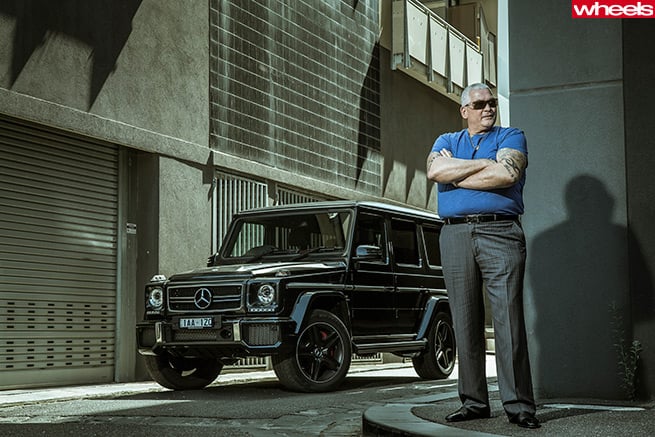
If anyone would like to call him on our behalf and remind him of that, we’d be most grateful. We’re really hoping he doesn’t turn up at our offices (which have moved to India, if you’re reading this, Mick) to collect on this non-existent debt.
Speaking of tabloids, the Herald Sun was most taken with Gatto’s admission that he bought his Rolls because he liked the infra-red feature, which he uses to check his driveway for hidden assailants every night. They also embiggened the fact that he “joked” with us about selling the suit he was wearing when he famously shot Andrew Veniamin, complete with powder burns, on Ebay. They suggest he “plans” to do so, which isn’t exactly the same thing. Journalists, eh?
The Australian‘s story adds just a sprinkle of embellishment with its suggestion that Gatto ran “a few red lights”. Fortunately, no fines have turned up so far, and if they do we’ll be far too scared to pass them on.
The story in the nation’s only broadsheet does mention how Gatto told us the boot of the big Benz would fit four bodies, when we’d guess only two, but all the papers missed what we think is the best exchange of the whole story, when he talks about body bags.
The story has also ruffled the feathers of some Mercedes-Benz customers, with a spokesman for the company telling us they’d received phone calls from disgruntled owners.
“But we’ve had a variety of calls; I think we’ll probably get some AMG customers who write in and say they really love it… It’s not the sort of story we would have initiated, but in the end, it’s a good read,” the spokesman said.
Gatto is no stranger to media attention, and one suspects he kind of enjoys it, but his association with Wheels – which was meant to be a bit of fun but turned out to be downright fascinating – has put us right in the spotlight for the day.
WALKINSHAW Automotive has revealed a pair of hardcore tuning options for the Holden Colorado ute, shifting the tradie-loving workhorse from load-lugging mild to corner-carving wild.
However, rather than revive the memory of the somewhat manic supercharged Toyota TRD HiLux, Walkinshaw’s performance tweaks to the big Holden-badged ute are limited to the suspension.
The move by Walkinshaw to expand beyond Holden-badged passenger cars and SUVs – the group already provides go-fast accessories for models including the Commodore large car, Barina hatchback, Captiva soft-roader and Cruze small car – now means Walkinshaw has a foothold in one of the fastest-growing segments of the Australian new-car market.
While the performance upgrade is currently limited to the two main criticisms of the Colorado – its lacklustre ride and handling – Walkinshaw general manager Tony Harris said engine performance upgrades are also under consideration.
“It certainly is something that is a possibility,” Harris said.
“For us, this (Colorado modification) is our first foray into this segment. We specifically focussed on some of the criticisms, some of the negativity about the vehicle, and we wanted to deliver an outcome that was positive to allow us to establish a footprint in this segment.
“The realms of possibility are still out there for us as to how far we can go with this program.”
Walkinshaw will offer two packages for the Colorado, an Xtreme Low Rider kit that lowers the ute’s rear by about 30mm, and an Xtreme High Rider version that raises the ride height at the front by about 50mm and the rear by about 15mm.
Both include specially engineered suspension modifications running to revised spring rates, Bilstein struts, front and rear dampers, bump stops and unique valve coding.
Other changes include bespoke Graphite Black 19-inch alloys clad in Continental ContiCrossContact rubber for the Xtreme Low Rider and Cooper Zeon LTZ off-road rubber for the Xtreme High Rider, a decal package, and cover for the balance of the Colorado’s new-car warranty.
Both packages are priced at $6990, with optional LED daytime-running lights costing an extra $795.
Walkinshaw Automotive claims the products have been designed and engineered to meet the same standards and levels of quality consumers would expect from an original equipment manufacturer.
“The package has been through a rigorous testing program to ensure there is no impact on the vehicles GVM or load carrying capacity, ESC or speedometer calibration,” the company said.
Three-time Formula 1 world champion Sir Jack Brabham died this morning, aged 88.
Nicknamed ‘Black Jack’ for his seemingly permanent five-o’clock shadow, Brabham passed away peacefully in his Gold Coast home at around 6am. He was the first man to be knighted for services to motorsport.
An icon of world motor sport, Sir Jack won the F1 world championship in 1959, 1960 and 1966 – the final time cementing his place in history as the only man to win a title in a car of his own construction.
An air-force mechanic in World War II, Brabham’s motorsport career started on Australia’s dirt speedway tracks in the early 1940s, tasting victory in just his third race.
Brabham travelled to Europe in 1955 to join the Cooper Racing Team and his engineering prowess helped the British team revolutionise racing by shifting his car’s engine from the front of the vehicle to the back – a mid-mounted configuration still used by Formula 1 today.
Brabham won the 1959 championship with Cooper, despite famously running out of fuel in the last race and pushing his car to the finish, then developed an improved version of the car and won another title the following year.
In 1962, Brabham joined forces with fellow Aussie Ron Tauranac to design and engineer their own cars under the Brabham name. Their first F1 car was the Brabham BT-3, which debuted at the 1962 German Grand Prix.
But it was the Repco-engined BT-19 in which Jack clinched his third world title in 1966, with Brabham also claiming the constructors’ championship that year, and again in 1967 when New Zealander Denny Hulme took out the drivers’ championship in a Repco-Brabham.
After scoring his final Grand Prix win in South Africa in 1970, Brabham retired from racing aged 44.
Brabham is survived by his second wife, Lady Margaret, and sons to his first wife Betty – Geoff, Gary and David, themselves all proven professional racers. Two grandsons, Geoff’s son Matthew and David’s son Sam, are now enjoying success on the international stage.
Walkinshaw Automotive has revealed it is casting its net well beyond Holden as it looks to find replacements for its Commodore-based engine modification business.
Holden announced early this year that it would quit its Australian manufacturing business in 2017, robbing Walkinshaw of its hot-tune staple, the Commodore large car.
However, Walkinshaw general manager Tony Harris told Wheels the performance-enhancing skunkworks is deep in talks with several car brands about expanding its aftermarket engine modification portfolio – and it is already working on a number of projects.
An opportunity for Walkinshaw, he says, follows Holden’s announcement earlier this month that it will add a number of Opel-sourced performance models to its showroom from next year, potentially robbing the car maker’s own HSV hot-shop of the potential to add the halo vehicles to its line-up.
Several rebadged Opel models will join the Holden line-up, including the Astra GTC and VXR (a rebadged Astra OPC wearing HSV’s former name for the car), and an Insignia OPC mid-size sedan.
The Opel brand was unexpectedly pulled from the Australian market last August in a move that Holden said was not linked to the decision four months later to shut down the Australian manufacturing business.
“We’ve always had these opportunities there (to add more marques to the aftermarket tuning portfolio),” Harris said.
“I think the fact we’ve limited ourselves as far as Walkinshaw Automotive is concerned to just the Commodore has probably restricted us in our growth.
“These types of vehicles (the Opel OPC range) entering the marketplace – whether it is a GM product, a Ford product – certainly it opens a lot of doors for us in terms of opportunity.”
Harris said the company is “quite excited” about the changes happening in the automotive landscape, which will see Ford, Holden and Toyota all quitting local manufacturing by late 2017, ending the era of the Australian born-and-bred muscle car.
“We’re looking forward to a lot of these things (new models) coming out,” he said.
“We’re working with other manufacturers as we speak on various other programs.
“What we’ve effectively done with our business is we’ve taken Walkinshaw Performance and made that purely all about V8 Commodore.
“We’ve created another group, which is Walkinshaw Automotive Group, which is very similar to the TWR (motorsport and race engineering) model, where we can work with manufacturers on bespoke programs, whether it be racing, product or whatever it might be, just for the domestic market.”
Harris said Walkinshaw has a five-year plan in place that accounts for the end of local car manufacturing, and its future is looking “very strong”.
IS AN extra 11kW and 10Nm enough to give a car its own identity? Porsche thinks so. It is drawing heritage lines for the new Cayman GTS that extend right back to the 1963 904 GTS race car and the road-going version that followed. More recently, GTS initials have been slapped on the rumps of the 997-series 911, Cayenne and Panamera. But it’s the Cayman coupe which is closest conceptually to the mid-engined 904 of half a century ago.
Wheels drove both the Boxster GTS and Cayman GTS at the international launch; here we’ll focus on the latter, which is headed to Australia in August.
No question the GTS version stands out from the Cayman crowd visually. It gets a unique nose topped with smoked headlight covers, rides 10mm closer to the ground on active suspension (PASM) and 20-inch alloys raided from the 911 Carrera S. GTS badges adorn the sills and, at the rear, a reworked diffuser adds a little more visual mongrel.
As for those many mechanical changes that liberate the additional 11kW and 10Nm, that would be… none. The power and torque boost comes courtesy of lines of computer code in the ECU targeting the 3.4-litre flat-six’s variable inlet valve timing. So the modern-day GTS moniker is as much a marketing play as it is about flagship performance.
Of those GTS changes, the only physical components not already available to regular Cayman S buyers are the body embellishments. PASM and the Carrera S alloys are $3390 each, the Sports Chrono pack another $4790, which explains only a little more than half the GTS’s $21,500 tariff over the S.
But that doesn’t mean the GTS is any less credible as king of the Caymans (at least until the rumoured GT4 arrives). It positively owns that throne. When you start with a competent base like the Cayman S, beef up the power and give it all the parts necessary to maximise application of said power, the results are always going to raise a smile.
We tested the Cayman GTS on Mallorca – an island better known to Aussies as Christopher Skase’s bolt hole of choice – on both winding mountain roads and a particularly tight and technical racetrack. In both settings, the Cayman proved that more power has not corrupted one of our favourite driver’s coupes. Far from it.
The Cayman GTS’s seemingly mediocre gains are palpable, and so very welcome. Everything feels more. There’s more aggression on turn-in and more grip through corners. It packs more punch out of the corner, and hurries through the gears more eagerly. Together, it’s not enough to make a ‘standard’ Cayman S feel slow, but enough to know you’re in something that is definitely quicker, more capable, and more exciting.
Compared to the latest crop of turbocharged torque monsters, the free-breathing GTS feels light-on below 4500rpm. But it revs so smoothly and fast, and sounds so bloody good doing it, it’s not exactly a trial keeping this aspirated six spinning in the fast half. Especially if you’ve got the sports exhaust cracked. The engineered over-run burble is particularly evocative and delicious. And properly thunderous in tunnels.
The GTS comes with a six-speed manual transmission, but unless you take deep pleasure in DIY gearchanges, or just like the added involvement, then the optional seven-speed PDK ($4990) is faster and smoother and hard to argue against.
The GTS is not a halo model in the truest sense, but it is a worthy Cayman flagship, and it does deliver on Porsche’s ‘GTS’ promise of an authentic sports car for both road and track. That’ll do us just nicely.
Porsche Cayman GTS
Engine: 3436cc flat-6, dohc, 24v Power: 250kW @ 7400rpm Torque: 380Nm @ 4500-5800rpm Transmission: 7-speed dual-clutch Kerb weight: 1345kg 0-100km/h: 4.8sec Price: $165,990 On sale: August
WITH its new appendage – a boot – Audi’s S3 is visually transformed from a hot hatch into a sports sedan.
To our eyes, at least, the styling of the first-ever S3 sedan is more convincing than the wagon-like Sportback, while the 2.0-litre turbo all-drivetrain remains just as compelling.
The S3 sedan is here now, priced at $62,200 to the Sportback’s $59,900 – so $2300 to trade hatchback load-swallowing ability for slick, three-box aesthetics. And the sedan’s boot, at 390 litres, is actually 10 litres bigger than the Sportback’s.
As well as looking more sophisticated than the Sportback, the sedan variant gives the S3 a unique selling point against hot Golfs – the all-drive R in particular – which have undermined the pricier Audi’s value equation in previous generations.
The newly attractive positioning puts the sedan within $7700 of Wolfsburg’s ultimate hatch while undercutting the hairier-chested Mercedes-Benz CLA45 AMG by almost $25K.
However, the S3 sedan’s allure, like that of the Sportback, is derived from the driver involvement delivered by the VW/Audi MQB-based chassis.
Compared with the previous-gen S3, it shifts the front axle line forward, while canting the engine 12 degrees to the rear, for 59/41 front/rear weight distribution. Credit is also due the clutch location, just forward of the rear diff.
The clutch-based AWD system is quick to send drive to the rear when it senses imminent front traction loss, but isn’t of the bulk-torque-to-the-back variety. The system provides a front/all-wheel-drive flavour rather than the subtly rear-drive satisfaction found in the torque-vectoring S4 and S5.
But if you get the nose aimed before squashing the accelerator like a cockroach, the S3 is capable of a seriously – and unflappably – quick backroad pace.
Magnetic ride suspension comes as part of a well-priced $4990 S performance package that also brings LED headlights, B&O audio, sports seats, 19in alloys and red calipers.
It’s as impressive for the all-surface compliance it offers across its modes as the sharpened chassis and steering responses it provides in dynamic mode.
As in the Sportback, the 2.0-litre turbo is detuned by 15kW from the 221kW Euro-market version because our hot climate.
Having driven both, it is noticeable in the form of a slight loss of punch at the very top of the rev range, but the local version delivers the same growling, potent bottom-end and mid-range urgency.
Importantly, dynamic mode frees the exhaust with a crisp four-pot howl by way of a pair of electro-flaps.
The sedan’s standard six-speed S-tronic transmission fits the S3’s effortlessly quick cross-country character perfectly. Meanwhile, if a manual transmission is a must-have, that’s an option only available in the Sportback.
If Germany’s reignited Merc CLA-led romance with the compact sedan is reflected by buyer uptake in Oz – and we reckon the S3 sedan will be a hit – Audi will have styled itself yet another segment-buster.
Audi S3 sedan
Plus: Brings extra exclusivity and a new S3 selling point; cultured speed; grip; intake and exhaust note Minus: Puts foolproof pace ahead of finer points of driver involvement; Oz version down 15kW on Euro specModel: Audi S3 sedan Engine: 1984cc in-line 4cyl, dohc, 16v, turbo Max power: 206kW @ 5500-6200rpm Max torque: 380Nm @ 1800-5500rpm Transmission: 6-speed dual-clutch Weight: 1450kg 0-100km/h: 5.0sec (claimed) L/100km: 6.9 Price: From $62,200 On sale: Now
Kia’a next-generation of small cars may converge into a single model as the company seeks to improve efficiencies through rationalisation.
According to the president of design, Peter Schreyer, the existing Cerato and Cee’d C-segment small cars might share common sheetmetal when their replacements surface in about 2017.
“The C-segment is a very wide segment and for us it depends a bit on the locations where the cars are made,” Mr. Schreyer told the Australian media at the New York International Auto Show last week.
“So with the Cee’d produced in Europe we can design it fully to European needs and the Forte is produced in Korea and it goes to America so we can basically design two different cars.
“But I do think there is a chance of maybe in the future, but I don’t know – maybe we have to think about this – for more unification. I don’t really see a need that they should look so different.”
Since about 2007/8 both the previous Cerato/Forte iteration and the original Cee’d have featured unique exterior and interior designs to suit their respective Asian/North American and European target markets.
Nowadays the Cee’d is available in the five-door wagon and three-door Pro_cee’d coupe-like hatch formats favoured by Europeans but shunned in most other parts of the world.
Conversely, while the South Korean-made Cerato matches its Slovakian-built cousin in being offered as a five-door hatch, that’s where the similarities end, since it also comes as a four-door sedan and two-door coupe known as the Koup.
However this adds complexity and cost to their development, when most rival C-segment models such as the Ford Focus, Volkswagen Golf and Mazda 3 adopt a ‘one size fits all’ philosophy.
Whether the regional differences that exist at the moment also become more uniform is not yet known.
The Cee’d features a multi-link rear suspension system that is both more expensive and less space efficient than the simpler torsion beam arrangement underpinning the Cerato.
Furthermore the European cars feature at-times more sophisticated engine and drivetrain technologies in order to help them meet specific European fuel consumption and emissions targets – including an upcoming seven-speed dual-clutch transmission in lieu of the conventional torque-converter automatics that the Americans in particular are much more partial to.
Australia, by the way, is the only market in the world to offer both Kia small cars, with the mainstay Cerato sold alongside the more niche Pro_cee’d GT warm hatch.
It is believed that the local operations is also assessing the importation of the Cee’d wagon for Australia, since it has no direct Cerato equivalent.
Shared platform and drivetrain components are helping Kia and Hyundai achieve greater styling differentiation than they would if they featured unique mechanicals.
This is according to Hyundai and Kia’s global design president, Peter Schreyer, who added that it frees up funds that can be channelled into better design for both brands.
Speaking at the New York International Auto Show on the day of the world premiere of the third-generation Kia Carnival people mover, the former Audi designer said that this approach has resulted in a very clear brand identification benefits for both marques.
“This is for economics,” he said, “… and it is something that everybody is pursuing.
“It helps to put the costs down and it offers the possibilities for designers and engineers to create different types of cars – and even the possibility of even more different varieties of cars than we would be able to make if I had to develop a new platform all the time.
“So it is a very natural thing.”
Last year, Mr Schreyer described to Wheels that the current models that Kia and Hyundai offer respectively as being like the difference between a snowflake for the former and a raindrop for the latter.
“Kia is more youthful, more of the challenger, fresher and somehow still perceived as a new brand,” he said.
“Meanwhile Hyundai is more about elegance – and without the negative connotation – more on the classic side.”
While Mr Schreyer joined Kia Motors in 2006 and quickly helped to radicalise what were hitherto considered dull and derivative looking vehicle styles, his tenure as concurrent design boss at Hyundai has only been in effect for about 18 months.
Getting the design spot-on with a compact and sporty look that could still accommodate three and even four rows of seats had contributed to delays of at least 12 months in the introduction of the new third-generation Carnival.
While the company flagged its future people mover intentions to the outside world over three years ago at the 2011 North American International Auto Show in Detroit, the resulting vehicle took much longer than anticipated.
This is according to Kia Motors president of design, Peter Schreyer, talking to the Australian media at the New York International Auto Show that served as the stage for the YP Carnival’s world premiere.
“The KV7 was shown three years ago in Detroit, and at that time our intention was to stay very close to the show car,” he said.
“But as the project developed we needed to accommodate a lot of people inside the car and make it very practical – but the show car was much shorter (than it needed to be) so we had to make some quite considerable changes.
“By merely extending it would not have worked because the (KV7’s) kind of design is very straight and angular, and if extended, it would just look like a bus; we wanted to put a lot of dynamic appearance into the car… so we needed to develop a different approach.”
Despite this, however, Mr Schreyer believes there is a clear connection between the 2011 Detroit concept and the 2014 finished product as unveiled in New York.
“On the other hand I think the new Carnival/Sedona still carries a lot of the spirit of the KV7, and you can still feel it somehow, and without the showcar we wouldn’t be where we are now – and I’m glad we did it, even if it doesn’t look like it’s been done straight from the showcar.”
New-gen Carnival sales will commence locally very late this year or early in 2015, to coincide with Kia Motors’ long-running sponsorship of the Australian Open tennis tournament in Melbourne next January.
As revealed last week in New York, our versions will all be in eight-seater only configuration for the time being, and offered with the choice of a 2.2-litre four-cylinder turbo-diesel or an all-new 3.3-litre direct-injection V6 petrol driving the front wheels via a six-speed automatic transmission.
While Australia isn’t in line to receive the more luxuriously specified seven-seater edition offered elsewhere and featuring a pair of individual ‘Captain’s Chairs’ for the middle-row instead of a regular sliding three-person bench arrangement, some overseas Carnival/Sedona variations can carry up to 11 people.
The YP was designed (and will be built) in South Korea with strong input from Kia’s North American operations, since the latter will probably end up being the people mover’s largest market in the world.
Production kicks off in September.
