
Is this the world’s coolest Ferrari garage? We think so.
Built by minimalist architect Holger Schubert, the garage is actually part of his Las Angeles home.
Built to accommodate his beloved Ferrari 512 BBi, the ‘garage’ includes a hydraulic ramp at one end and a 15-foot-high, glass enclosed bridge at its entrance.
And the cost? Schubert spent $1.5 million constructing his dream garage.
Click through the gallery to see a video of Schubert’s garage in action.
Renault has produced another Red Bull special edition version of its Megane RS hot hatch, reflecting its close relationship as an engine supplier to the reigning Formula 1 world championship team.
The Megane RS Red Bull Racing RB8, featuring an exclusive ‘Crepuscule Blue’ finish, will be marketed in 26 countries, including Australia, where the first of 120 cars will arrive late this year.
This limited edition version of the 198kW/360Nm hatch marks the launch of Renault’s in-dash ‘R-Link’ multimedia tablet for all Megane RS’s, offering six functions (navigation, telephony, multimedia, vehicle, systems and R-Link Store apps catalogue).
As well, the Red Bull special, features version 2.0 of the on-board ‘RS Monitor’ data logging system, offering a special Red Bull Racing home page, certain information displayed in 3D form, plus real-time access to data including power output, 0-100km/h times, and g-force.
Pricing is yet to be announced, but expect a premium over the existing car’s $49,990 price tag.
The Antilag car club in Western Australia has released a video of its recent ‘Race Wars’ speed event, where the (unlikely) winner reached 272km/h in a standing kilometre run.
More than 4000 people descended on Wyalkatchem (why-al-catch-em), 200km north east of Perth, and turned the small town’s airstrip into a temporary 1000m drag strip.
Exotic machinery including a Lamborghini Aventador, McLaren 12C, and Ford GT, mixed it with Japanese screamers like the Nissan (R35) GT-R and home grown muscle cars from Ford and Holden.
Cars raced side-by-side, and the fastest time of the day was recorded by a relatively humble Falcon F6, running 272km/h at the finish.
McLaren P1 obliterates Nurburgring record!
That’s the headline that burst into the Wheels office this morning, declaring McLaren’s new hybrid hypercar had destroyed the industry-recognized record for a lap at the Nurburgring by 15 seconds.
The report said the P1 has clocked a scarcely believable 6m33s26 at the 28km circuit, with an official McLaren image seeming to confirm the time.
Seen here on the right, the image, which was released by McLaren China, shows the lap time next to an image of the circuit.
To put the P1’s time into perspective, it is light-years ahead of the current benchmark for a road-legal car, set by a Radical SR8 at 6m48s.
It’s even 14 seconds faster than the non-road legal Zonda R, which uses slick tyres used for racing.
But as the day progressed, it emerged the P1’s unbelievable time is exactly that.
Unbelievable.
Turns out the ‘official’ image is merely a motivational poster for McLaren workers, with the British brand determined to clock the ‘right in ‘under 7 minutes’.
There’s still no official word from McLaren on the time, so there’s a chance it could be true, but somehow we doubt it.
What do you think? Head to our Head to our Facebook page to join the debate.
A timeline of Ford’s time in Australia.
1925 – Ford Motor Company of Australia incorporated – amalgamating distribution from state-based agents. Manufacture of Model T and Fordson tractors begins at temporary premises in Geelong, Victoria.
1926 – Major manufacturing plants built in Geelong, Brisbane and Adelaide.
1929 – Freemantle assembly plant opens in Western Australia.
1934 – The world’s first coupe-utility model – designed by Australian Lew Bandt – begins production.
1936 – Homebush assembly plant opens in Sydney.
1952 – V8 Customline sedan and Australian-designed Mainline utility released, along with smaller, six-cylinder Zephyr and Zephyr utility.
1954 – Geelong factory receives half-million-dollar overhaul with new stamping presses.
1955 – Overhead-valve V8 introduced in Customline and Mainline.
1958 – Construction begins on Broadmeadows assembly plant in outer Melbourne. Engine plant upgraded in Geelong.
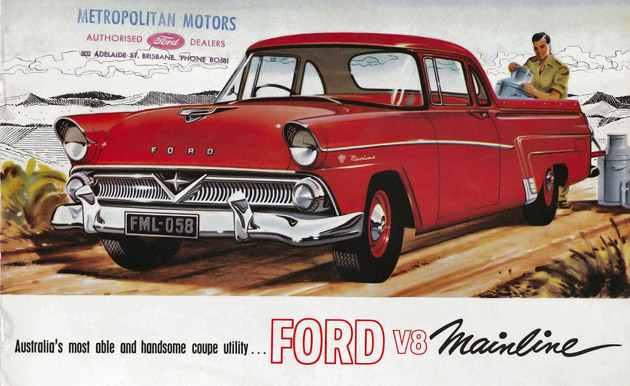
1959 – Broadmeadows plant opens in August. First car produced is a ‘Tank’ Fairlane.
1960 – First six-cylinder Falcon engine is completed on April 29 in Geelong. First fully-built XK Falcon leaves the Broadmeadows production line on June 28.
1961 – Manufacturing capacity is increased from 50,000 to 90,000 vehicles per year. Falcon utility and panel van added to range.
1962 – XL Falcon and first Cortina launched. Total Falcon production reaches 100,000.
1964 – New $2 million head office opens at Broadmeadows. XM Falcon launches with new two-door Hardtop.
1965 – You Yangs proving ground opens at Lara, Victoria. 70,000-mile Durability Run demonstrates the toughness of the re-engineered XP Falcon. XP wins WHEELS Car of the Year award.
1966 – XR Falcon range released with optional V8 engine. Falcon wins WHEELS Car of the Year award for the second year running. Brisbane plant receives $2 million upgrade.
1967 – Australia’s first muscle car – the XR Falcon GT – introduced, along with long-wheelbase ZA Fairlane. XR GT wins Bathurst 500. One-millionth Australian-built Ford produced.
1969 – XW Falcon introduces legendary HO (Handling Option) package for the GT.
1970 – CKD (Completely Knocked Down) exports hit 30,000. XY Falcon released as Ford announces $45 million expansion. Escort begins production.
1971 – XY Falcon GT-HO Phase III introduced to win Bathurst – fills all podium positions. Truck assembly plant opens in Broadmeadows.
1972 – First all-Australian Falcon introduced (the XA), along with Aussie-designed two-door Hardtop.
1974 – Ford Asia-Pacific regional office opens in Melbourne.
1975 – Ford Louisville truck begins local assembly in right-hand drive.
1976 – $72 million investment in new product and facilities announced.
1977 – Plastics plant expanded. Ford achieves famous one-two at Bathurst.
1979 – New-generation XD Falcon – first mass-produced vehicle in the world with a plastic fuel tank.
1980 – $300 million investment program includes Alloy Head engines for Falcon. Homebush plant gets $13 million upgrade to prepare for Laser.
1981 – Locally-built Laser enters production at Homebush. Becomes an immediate best-seller.
1982 – Ford achieves market leadership at Holden’s expense. XE Falcon is our best-selling car.
1983 – $70 million four-cylinder engine plant built in Geelong, but Ford drops the Falcon V8.
1984 – XF Falcon helps Ford achieve top spot in passenger and overall vehicle sales.
1985 – Ford Australia sells a record 170,811 units. Broadmeadows gets new paint facility.
1988 – All-new EA Falcon launched.
1989 – Ford is market leader in sales for the ninth consecutive year.
1990 – Aussie-designed Capri convertible is exported to the US badged as a Mercury.
1991 – The V8 is revived in the EB Falcon. Capri exports pass 30,000.
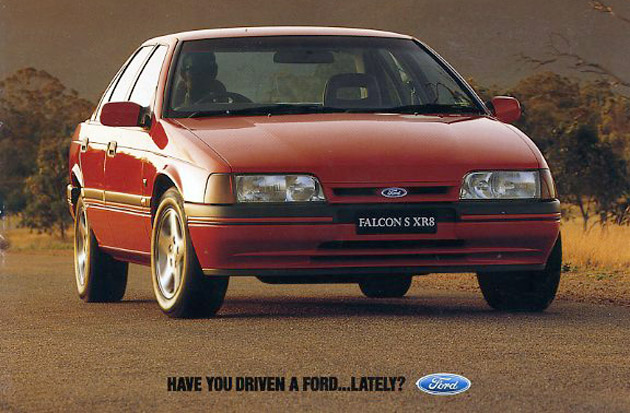
1993 – ED Falcon is Australia’s best-selling car.
1994 – Homebush assembly plant in Sydney closes – Laser now fully-imported from Japan. Capri production ceases.
1995 – Ford is number one in passenger and overall sales. EF Falcon is Australia’s best-selling car.
1996 – Falcon exports resume to South Africa.
1998 – All-new AU Falcon launched. Brisbane assembly plant closes.
1999 – Ford Tickford Experience (FTE) models introduced as a rival to Holdden Special vehicles (HSV).
2002 – Heavily re-engineered BA Falcon launched – first Falcon to win WHEELS Car of the Year since 1966.
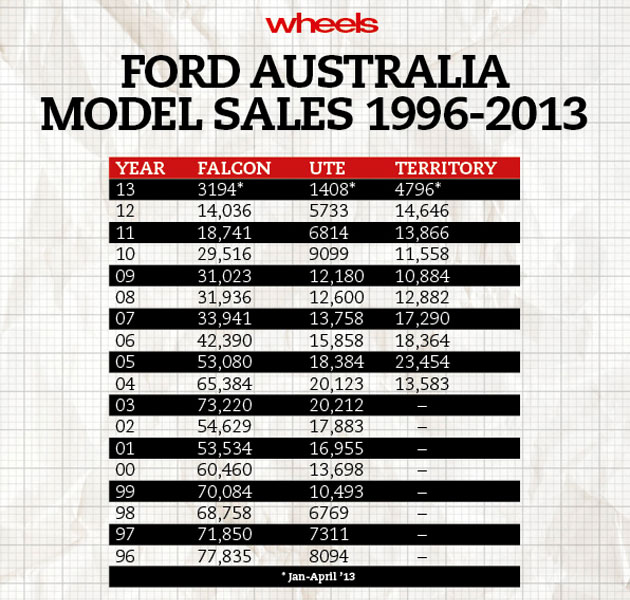
2003 – BA Falcon sales reach 73,220. Ford Performance Vehicles (FPV) replaces FTE.
2004 – Australia’s first home-grown SUV – the Territory – is released and wins WHEELS Car of the Year award.
2005 – BF Falcon is released.
2008 – Fairlane and LTD production ceases. New-generation FG Falcon is released and sells 31,936 units. Ford announces $21 million investment at Geelong engine plant, stating 4.0-litre in-line six will continue in production at beyond 2010.
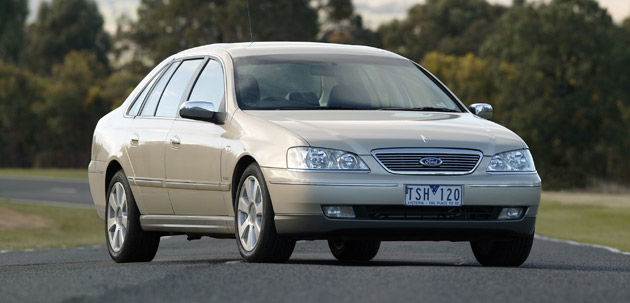
2011 – FG Falcon sales slip to 18,741.
2012 – Four-cylinder, turbocharged Falcon Ecoboost introduced.
2013 – Ford Australia announces it will cease local manufacture in October 2016.
*Source material: True Blue – 75 Years of Ford in Australia, Bill Tuckey
Ford and Wheels Magazine – Australia’s oldest and most trusted motoring title – have enjoyed a long and colourful history.
While not always the best of friends (take Ford’s reaction to our refusal to grant the XD Falcon Car of the Year for example) there has always been a mutual respect between the two brands.
So now, in light of Ford’s announcement that it will cease manufacturing in Australia, we thought it right to look back at how that relationship has changed since 1953.
So here it is: Ford in Wheels Magazine, a pictorial.
It’s official: the Ford Falcon, one of Australia’s most iconic and oldest nameplates, will be dead by 2016.
Ford signed the Falcon’s death certificate this morning by announcing it will close its Australian factories by October 2016.
So in the wake of this news, we thought it appropriate to crack open Wheels’ archives and pay tribute to one of Australia’s most enduring icons, with this – a pictorial history of the Ford Falcon.
In the wake of Ford Australia’s decision to end local car manufacturing in late 2016, Holden Chairman, Mike Devereux says his competitor’s announcement, “Shows how tough it is for manufacturers in Australia.
He believes Holden can ‘survive’ in Australia as a car maker, noting the company’s 10-year $1 Billion plan, shared with the Federal government, that points to two all-new ‘global’ vehicles being built here.
Devereux adds, Holden is working with government to ensure Holden’s viability, and will continue to collaborate with his ‘supplier council’ to ensure a “world-class supply chain.”
He says Holden’s new VF Commodore, due for launch on June 3rd, is, “testament to the quality of people making things in this country.”
It’s official – The Ford Falcon, one of Australia’s oldest and most iconic nameplates, will die in 2016.
Ford Australia CEO Bob Graziano today confirmed the Falcon name, which began in 1960, will be ‘retired’ when Ford closes its Australian factories in October 2016.
“The Falcon name is inextricably linked to Australia,” said Graziano. “We will retire that name when we retire the vehicle.”
In doing so, Graziano confirmed the new Falcon, set to be released in 2014 as planned, will be the last.
A similar fate awaits the locally-built Ford Territory, whose nameplate also faces extinction.
Sales of both models have struggled in recent years, with the Falcon in particular suffering as Australian buyers moved away from large family sedans.
Once Australia’s most popular best-selling car throughout the 1980s and early-‘90s, sales of the Falcon fell to less than 20,000 last year, from a high of 93,432 only 10 years ago.
Things have worsened in 2013, with sales of both the Falcon sedan and Falcon utility down more than 20 percent on 2012’s disastrous numbers.
FORD Motor Company announced today that it will cease manufacturing vehicles in Australia and become a full-line importer from October 2016. This means that the updated Falcon sedan, Falcon ute, and Territory due for release in 2014 will be the last domestic Fords built in Australia.
Besides the death of the iconic Falcon nameplate, the plant closures will also see a total of almost 1200 jobs lost – 650 in Broadmeadows and 510 in Geelong. But that figure is certain to multiply as suppliers of parts for these models throughout Australia also feel the effect of Ford’s decision.
According to Ford Australia CEO Bob Graziano, the decision was finally made on the evening of Tuesday May 22, after an after-tax operating loss of $141 million in 2012, culminating in losses of around $600 million over the last five years for the local operations. “Manufacturing is not viable for Ford, in Australia, in the long term,” said Graziano.
However, Ford’s design and engineering facilities in Broadmeadows and Geelong will continue to operate beyond 2016, as will the You Yangs vehicle proving ground near Lara.
Despite the sad news, Ford has announced it will increase the size of its product line-up by 30 percent in the lead up to 2016’s withdrawal from local manufacturing.
This suggests that the next-generation Taurus, currently under development in America, will finally replace the Falcon as the company’s large-car contender from 2017, though Ford remains tight-lipped on future model details.
Similarly, the fate of the Territory nameplate is also up in the air, although there’s a chance it may continue as a future iteration of the US Explorer, also due in the latter half of this decade.
But the fate of the famous Falcon ute is likely to follow the 64-year-old nameplate into history, as Australians continue to buy one-tonne trucks like the locally developed Ranger pick-up in ever-increasing numbers.
The future of the FPV Ford Performance Vehicle sub-brand will almost certainly cease as well, as the existing Falcon range are the only cars using it.
Following the 2016 closure, Ford Australia’s presence “will remain significant”, with 1500 personnel and over 200 dealerships throughout the country supporting future Blue Oval models.
“We will continue to deliver the refreshed Falcon and Territory in 2014 as we have previously announced,” Graziano told a packed media conference at Ford Australia’s HQ in Broadmeadows this morning.
“The decision we have announced today was not made lightly. We understand the very real impact this will have.
“We came to this conclusion only after thoroughly reviewing our business and only after exhausting all other alternatives.
“But despite [efforts to match production with demand], our locally made products continue to not be profitable while our imported products are profitable.
“And we’re still faced with the fact that our cost structure in Australia remains uncompetitive… they are double that of Europe and nearly four times that of Asia.”
Ford began manufacturing the Model T in Geelong in 1925, and the US-derived Fairlane at an all-new facility in Broadmeadows in 1959. The original XK Falcon replaced the locally-made British Zephyr in 1960.
