
Who says Formula One is boring. Take a look at our collection of ballsy overtakes from this season and decide for yourself whether these phenomenal wheelmen have no fear and no brains.
We mightn’t have the flying cars that TV promised us the 21st Century would bring. But very soon, there could be an affordable flying trike that you can jump in and drive/fly to your work.
The work of Texas inventor Larry Neal, the Super Sky Cycle has three wheels, a three blade propeller and a 582 cc engine. It’s road-legal in the states, where Neall already has substantial interest in his product.
The Super Sky Cycle can do over 130 km/h in the air, and it can fly for five hours without refuelling. When it’s on the ground, the propeller folds up, and it can do a perfectly respectable 105 kmh on asphalt. It can also land in only 20 feet of space.
Neal is already taking pre-orders for his invention, which will sell for around $70 000. The Texas Border Patrol will be using the Super Sky Cycle monitor movements between the USA and Mexico, and interest worldwide from law enforcement, companies and civilians is strong.
The Super Sky Cycle does require a pilot’s license to fly/drive, and there’s no word yet on whether it’ll be road-legal here, but we can hope.
We’ve all seen photos of cars screaming around our favourite racetracks, so here’s a different perspective.
The Audi RS Q3 has always been a difficult car to pigeon-hole.
It’s a small SUV for starters – a contentiously rational, if extremely popular, market segment – bestowed with hot hatch levels of performance courtesy of Audi’s excellent 2.5-litre turbo five.
Its recent update has made its performance more potent than ever, outputs from the now-Euro 6 compliant engine lifting from 228kW/420Nm to 250kW/450Nm, which has cut the claimed 0-100km/h to just 4.8sec.
It feels every bit that quick, with the traction control cutting in – albeit probably unnecessarily – in the first two gears under full acceleration.

Thanks to monster eight-piston front calipers clamping 365mm discs, stopping power is also plentiful, the rate of retardation made all the more dramatic by your elevated seating position.
This is, of course, the primary reason these baby SUVs are enjoying such a huge surge in popularity, however from a keen driver’s perspective it does create a disconnect from what’s happening below you.
The chassis is actually one of Audi’s more playful. Push too hard and it’ll understeer, but a well-timed lift of the throttle or brush of the brake will have the rear swinging around nicely.
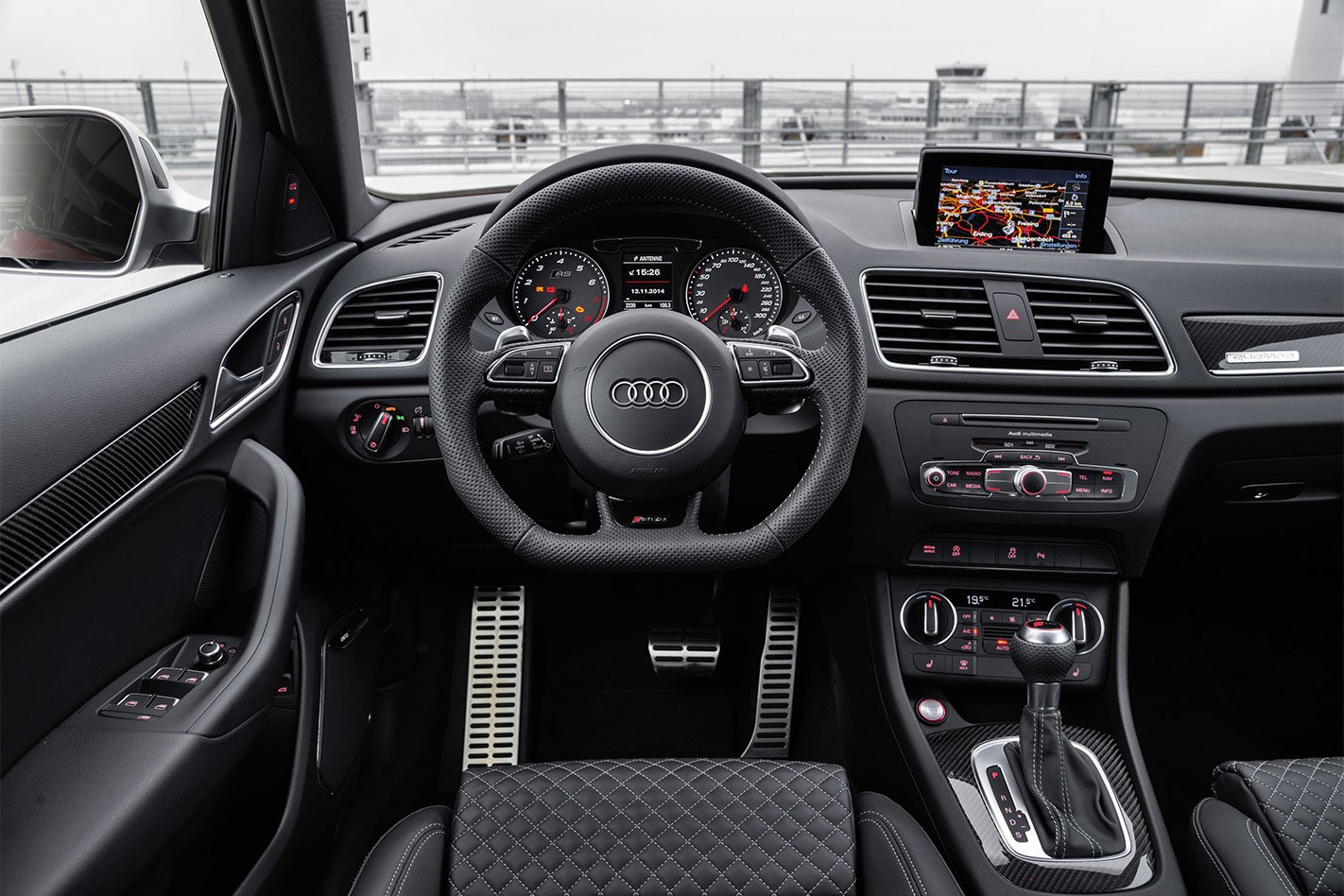
The major argument against buying an RS Q3, however, is the existence of the RS3. It usurps its high-riding twin’s place as the cheapest RS model in Australia, yet is also significantly faster and, ultimately, more enjoyable to drive thanks to its sharper setup and lower centre of gravity.
Unless you really need the extra 70-odd litres of luggage space, most enthusiasts are going to be far better served by the more conventional hatchback, and that’s before you throw in the RS3’s better looks and far more impressive interior.
None of this is to say the RS Q3 is a bad car, we just can’t figure out what it’s for. If you want a small, fast Audi, buy an S1 or RS3; if you want an Audi SUV, buy an SQ5 or a Q7.
3.5/5
Specs
Engine: 2480cc inline-5, DOHC, 20v, turbo Power: 250kW @ 5300-6700rpm Torque: 450Nm @1600-5300rpm Weight: 1655kg 0-100km/h: 4.8sec (claimed) Price: $81,510
Do you really need a Porsche 911?
Well, obviously, yes, but if you can’t afford one, the new Cayman makes a compelling case for buying the next best thing, particularly if you live in the US, where it will cost a staggeringly tempting $US52,600.
Unveiled at the LA Auto Show, the new Cayman follows its sibling, the Boxster, by being lower, longer, lighter, and faster, and by having its rear spoiler neatly integrated into the brake lights (Cayman’s is higher, and deploys at a steeper angle).
One of the world’s most exciting and recognisable sports cars turns 50 in 2013. First shown at the Frankfurt motor show in 1963, despite the occassional near-death experience, Porsche’s brilliant 911 has stood the test of time.
Its iconic curved shape, created by Ferdinand ‘Butzi’ Porsche, has been respected and evolved by a series of designers over successive generations, with the car enjoying long-term sales success, and motor racing glory.
In fact, the latest 991-series 911 Carrera S took out MOTOR’s Performance Car Cup award for the seventh time in 2012.
Adding ‘S’ to the Q5 unveils a performance revolution at Audi: it’s the first S-badged SUV and the first diesel S. Significant, because the Q5 comfortably outsells its BMW, Volvo and Mercedes-Benz rivals globally and, locally, vies with the A4 as Audi’s best seller, so the $110K SQ5 extends the range at the top end.
Audi’s newest SUV inherits the bi-turbo 3.0-litre V6 recently launched in the A6 and A6 Allroad. Sequential turbochargers, – the small one (with variable geometry vanes) increasing low-rpm boost; the bigger one adding more power above 3500rpm – are connected by a vacuum flap. The extra pressure required modified head cooling, revised intake timing and reinforced pistons. Peak power of 230kW between 3900-4500rpm matches BMW’s 535d, while the torque ceiling of 650Nm at 1450-2800rpm exceeds the BMW twin-turbo by 50Nm. Which is why the performance claims are so formidable – 0-100km/h in 5.1sec, yet the combined-cycle consumption is an equally impressive 7.2L/100km.
Audi offers just one transmission with the SQ5, ZF’s superb eight-speed auto mated with Quattro all-wheel drive. No doubting the SQ5 is seriously quick, with linear performance and a potent exhaust note that’s clearly been tuned to deliver something closer to the sound of a throbbing bent-eight than a humble oil-burner. In anything less than full-throttle driving, the torque converter and the electronics’ desire for the transmission to up-change early (in Drive mode) blunt the perception of performance. Selecting Sport restores the urge and adds an even harder exhaust note. Audi’s standard Drive Select offers a confusing choice of modes that most drivers will probably try once and then ignore.
All Q5s, including the SQ, inherit Audi’s new electro-hydraulic steering that so benefits the A6, A5 and A4. Here, it’s not so convincing, even working with the optional, variable-ratio Dynamic steering fitted to the test cars. It reduces the turns lock-to-lock from the normal system’s 2.8 to 2.2, yet there’s still a vague disconnect at the straight-ahead, while responses and weighting are inconsistent. For the hot Q5, the engineers reduced the ride height by 30mm and stiffened the springs, dampers and anti-roll bars. The standard 20-inch alloys wear 255/45R rubber and deliver a restless ride even on German roads. Only those who put style way above ride comfort will want the optional 21s in Australia.
Of course the beautifully detailed cabin is dressed up in harmony with the S-badge: black interior with terrific sports seats, brushed alloy trim panels, leather upholstery, grey instruments and a scattering of S logos.
More autobahn cruiser than backroad sprinter, the niche SQ5 is not going to be short of buyers. Think of it as Audi’s faster rival for the Range Rover Evoque.
After a six-year hiatus, the full Renault Clio range is returning to Australia, and what a brilliant comeback it promises to be. So great is this all-new, fourth-generation model that it may dethrone the Polo in the light-hatch class when it lobs here next October for around $17K. Sacre bleu! France is back in the segment it once dominated.
The Clio is bread-and-butter for its marque in Europe, so this new model needs to fire. It is the first Renault to be designed by Laurens van den Acker, who was poached from Mazda to define a new design language for the brand. Driving behind a new Clio, it appears taut and squat, the bulged rear haunches and Alfa-esque hidden rear doorhandles particularly appealing. The thorough modernisation (fashionisation?) of Clio extends to the cabin, a meld of rather nice bathmat-rubber-style, soft-touch plastics, piano-black trim, seven-inch touchscreen, and customisable dash colours (see breakout). A downside is that Renault has prioritised luggage space over rear legroom, with a generous 300-litre cavity offset by limited knee and foot space; there’s more rear space in its smaller Peugeot 208 rival.
Despite larger dimensions than Clio III (35mm longer/24mm wider), a classier cabin, and stronger body, the base Clio IV weighs around 100kg less, at just 1009kg. Lift the bonnet and part of the reason is obvious. The 0.9-litre three-cylinder petrol-turbo engine, badged TCe90 to reflect its 90hp (66kW) output, sits in an engine bay clearly designed to accept larger tackle. The 1.5-litre turbo-diesel option, named dCi90 for the same reason, fills the empty space left behind and beside the three-potter, and adds 61kg kerb weight.
Both engines complement, rather than compete, with each other. In the context of its breed, the three-cylinder petrol is the most outstanding. The barest of sewing-machine vibes stream to the wheel at idle, but not annoyingly so. Otherwise, the engine is near-silent when you want it to be – when idling or cruising – and even when it gets its growl on when pressed, it remains impressively unobtrusive.
Thanks to a low-inertia turbo (Renault claims the lowest on the market), 90 percent of its peak 135Nm is available from 1650rpm, and the full figure comes on strong from 2500-3500rpm. The turbo-triple offers comparable torque to the atmo 1.4-litre Polo (132Nm) and 1.5-litre Mazda 2 (137Nm) but those rivals don’t produce their peaks until circa-4000 revs.
Its 66kW at 5600rpm ensures the base Clio isn’t fast, although its 13.2-sec 0-100km/h claim feels closer to the diesel’s 11.4sec time. The turbo-triple’s driveability and refinement are what impress most. It feels torquey at the lower end of the tach, exactly where a larger-capacity atmo four struggles.
Ultimately, though, there isn’t quite enough there to capitalise on the chassis. The platform is a Clio III carry-over, with a longer wheelbase (by 14mm) and wider tracks (up 34mm front/36mm rear). Sounds (is) geeky, but I was genuinely excited to see all test cars riding on sensible 195/55 R16 Continental EcoContact rubber. It would be romantic to say the Clio reintroduces old-school French ride quality, all lushness and waftiness, but it’s better than that. There’s an inherent layer of firmness around town that promises – and delivers – excellent body control, but when tackling really rough imperfections, its compliance and isolation are also premium-grade.
The electro-mechanical power steering intially feels a tad vague, too light and artificial in the first movements, but the system subtly backs off the assistance at speed. The result is precise lane-change movements on the freeway and genuine feel and feedback when connecting apexes.
Oh, the handling. A defining photo of the old, old base Clio II is in Wheels, February 2002, showing a metallic sky-blue example cornering with its inside rear hoisted in the air. It’s like that with the new one. The front-end turns in crisply, and can really be leaned on. Brake deep, lift-off, flick the steering aggressively … whatever the cornering style, the Clio boogies from wheel to wheel, with a fluency and bounce that makes for intimate, playful punting.
Notch up the 1.5-litre turbo-diesel as the ‘performance’ variant, at least until we drive the dual-clutch-only 1.2- and 1.6-litre turbo-petrols. Where the triple needs to be spanked, and magnifies the ratio gap between the five-speed manual’s second and third – on hilly roads, it’s either nudging the cut-out in second, or off-boost in third – the oiler’s fat 220Nm is on from 1750-2500rpm and allows good pace. The ratio gaps are no longer a problem. Corners arrive quicker, the chassis is pushed harder, and your grin is widened. Wind up the windows to appreciate the diesel NVH difference – the clatter is toned down dramatically, to make this a refined, aurally enjoyable engine.
The only drivetrain in the range to offer stop-start technology, the dCi90 claims 3.4L/100km combined and 90g/km of CO2, marginally better than the TCe90’s 4.3L/100km and 99g/km. Currently, both offer benchmark official economy figures.
Renault admits that compromises had to be made to keep costs down. A five-star ENCAP result was achieved despite the fact curtain airbags aren’t available (see breakout), and the budget didn’t stretch to mating the triple to a dual-clutcher, or the forthcoming 1.2-litre turbo to a manual. Only the diesel gets both trannies.
Although sub-$17K pricing is confirmed for the three-cylinder, expect the diesel and petrol turbo-fours to cost around $21K. Those models will arrive from Renault’s Bursa, Turkey, factory next October, with the French-built RS to follow in mid-2014. Renault Australia insists it will offer generous equipment on all models, which should mean alloys, cruise and fast glass standard.
Regardless, unless VW flicks the uninspired 1.4-litre in the base Polo, the Clio has a good chance of nabbing class leadership. Mixing Fiesta verve with Polo refinement and unique character makes for an excellent return to form for Renault, and a big welcome back for the Clio range.
The new Patrol roughly approximates the dimensions of a tank. And that’s fitting because it’s already been attacked – actually, carpet-bombed – on at least three fronts long before it’s even due in Aussie showrooms in January, next year:1. It’s only being offered with a 5.6-litre petrol engine; there is no diesel variant; 2. It has independent suspension front and rear; no live axle; and, 3. It’s enormous.
The lack of a diesel is a problem for potential buyers because, among other things, the Patrol has traditionally been a popular off-road touring vehicle, so fuel economy has always been a serious consideration. Nissan reckons the Y62’s 140-litre tank and the model’s claimed 14.5L/100km should keep holidaymakers happy.
Independent suspension (in this case double wishbones, front and rear) is regarded by some 4WD traditionalists as too much of a concession to on-road refinement and, as such, Nissan has copped flak for its decision to go for independent suspension rather than the rigid axles of previous Patrols. But the company’s much-touted Hydraulic Body Motion Control (HBMC) is aimed at smoothing the Y62’s on-road ride and giving the model’s off-road cred an added boost, as well as crash-tackling any of those axle-related criticisms while it’s at it.
Size does matter – it’s the biggest SUV around – but with that bulk comes trade-offs. It is 5140mm long, 1995mm wide, and 1940mm high – and pops a vehicular belt buckle at 2829kg, so city driving will present a few challenges. Though the Y62 is, however, peppered with an Around View Monitor and sensors to give the driver at least a fighting chance of getting the Patrol into, through and out of a cityscape without knocking people, cars, or buildings down in the process. Its appeal for bush-touring is also in question as narrow tracks, squeezy rock spots and tricky water-crossings and creek beds will pose a problem.
It’s roomy – the ST-L and Ti models seat eight – and suitably posh for a luxury SUV. New Patrol is “the most luxurious and advanced Nissan ever offered in Australia,” according to its maker, with Landcruiser 200 Series and Land Rover Discovery et al firmly, if a tad unrealistically, in its sights.
On the move, the Patrol comes into its own – for a big bugger, anyway. Off-road, which is where it should be pointed straight away, the Y62 retains much of the classic Patrol prowess but with some new tech tricks.
The new All Mode 4X4 drive system – permanent four-wheel-drive that distributes torque where it’s most needed – offers four modes: Sand, Rock, Snow or On-road driving. There is no Mud mode. You can also push-button your way to 4H or 4L, or activate the rear diff-lock, Hill Descent Control and Hill Start Assist.
The Patrol dominated the moderately difficult off-road obstacles at Mt Cotton driver-training facility, south of Brisbane. It was not even close to being troubled by anything, and all the tech was effective and unobtrusive, although HDC (maintaining 7km/h in 4H, 4km/h in 4L) should be geared lower for safer, steadier steep descents.
When driven back-to-back, the HBMC-equipped Ti offered a more comfortable ride through off-road lumps and bumps than did its base-spec ST-L stablemate.
On a bitumen route – chicanes, switch-backs, tight corners etc – it was soon obvious that when push comes to shove, new Patrol is able to punch its way through twisty stuff without getting out of order. Through some corners, however, the Patrol’s combination of barn-sized bulk and over-protective tech resulted in an annoying drop-off in power under throttle.
The seven-speed auto ’box, with manual mode, is matched nicely to the donk. Again, the Ti with HBMC yielded a more driver- and passenger-friendly ride than the ST-L; tech proving its worth in a real-world sense.
The world’s most coveted motoring calendar celebrates its 40th anniversary by boldly departing from the supermodel nudes that made it famous.
This year’s calendar, shot by Steve McCurry, features supermodels and celebrities, such as Adriana Lima, who are renowned for their charity work.
Take a look and head to our Facebook page to tell us what you think.
