
This 1964 Cadillac Miller-Meteor hearse is the vehicle that carried the body of US president John F Kennedy from Parkland Memorial Hospital in Dallas, Texas, to the airport at Love Field, following his assassination in 1963.
It has just been sold at auction for $176,000 US.
Few cars have such a tangible link to anything like as significant a moment in American history. So regardless of what you think of the morality of selling it at auction, this Cadillac hearse is an exceptionally important piece of automotive heritage.
Powered by a ‘429’ V8 connected to the rear wheels via a four-speed automatic, according to auction house Barrett-Jackson this particular Miller-Meteor hearse began life in 1963 as a display model, before being sold to the O’Neal Funeral Home in Dallas.
It takes its place in history in the aftermath of the fatal shooting of President Kennedy on 22 November 1963. Subsequently O’Neal sold the hearse to funeral Home owner Arrdeen Vaughan, who kept it in a private collection for over 40 years.
If you thought Porsche’s most focused performance Panamera was the Turbo, think again. While the range topper with forced induction may have ultimate power, the new GTS, with its naturally aspirated V8, is the new king.
How come? It’s simply more focused as a driver’s car. The chassis has been tuned for maximum agility, the engine has 22kW more than the Panamera 4S on which this car is based, and there are plenty of subtle design features to add into the mix.
The body is close to that of the Turbo, with a bolder front end that includes large air intakes and black bezels to the headlights. At the rear the spoiler is a four-part design that opens sideways as it lifts. Below is a standard-fit sports exhaust.
The sound package is a crucial ingredient of the GTS, a combination of extra valves that open to free things up at the back end, and a ‘sound symposer’ like that fitted to the new 911, which channels noise from the engine air intake to the A-pillar, getting occupants more intimate with the engine. It works.
A pair of supercar owners from Seattle decided to go for a sneaky spin in the city’s recent ‘snowpocalypse’. While the owner of the Audi R8 seemed to cope with the wild weather, the GT-R’s tires wouldn’t allow it to have the same sort of traction.
Discovery channel’s Kustomizer has built the first ever car/pool table hybrid.
The portable pub game is based on a V6 Chevrolet Monte Carlo and is the brainchild of Kustomizer’s Vini Bergman. Despite its added load, the Monte Carlo manages to produce 160 kW. However it’s doubtful that the modifications will still allow the ute to reach 100km/h in under 8 seconds as it originally could.
The pool table can also be removed to reveal a fridge, which can store all the neccessary refreshments for the snooker enthusiast.
It’s all well and good for us to preach what the best car ever made was, but what we think and the rest of the world thinks may be completely different.
So we want you to decide the ultimate car list. MOTOR Magazine is conducting its first-ever reader’s poll to accumulate the 100 Hottest, Fastest, Coolest cars of all time. We want to know if you believe a Lamborghini Countach is better than a Gallardo, a Ferrari F40 is cooler than 458 Italia and whether a Ford Falcon GT HO is more legendary than a Holden Monaro GTS.
The answers are up to you, so click on the links below to vote. Add any comments you like or start a debate with your mates and you’re opinions could end up being published in the April issue of MOTOR Magazine and/or win you some cool prizes.
The America Car is back, more globally relevant than at any time since, well, since the Ford Model A of the early 1930s.
For far too long the Detroit show has been dominated by the domestic manufacturer’s trucks: pick-ups, SUVs and MPVs. These high profit centres for GM, Ford and Chrysler rendered cars a mere distraction in Detroit. Cars sales lists were dominated by the Toyota Camry and Honda Accord. For 2012 the car makes a welcome return. Lead by Ford’s handsome Fusion – visually identical to next year’s new Mondeo – the Cadillac ATS, Lincoln’s exquisite MKZ concept and the Dodge Dart, the Americans delivered a series of sleek, bold and significant sedans that truly look competitive.
The Dodge Dart, a rebodied Alfa Giulietta, will (like China) be sold in Australia as a Fiat, probably next year. The new 2013 Dodge Dart is the first evidence of what a serious Chrysler-Fiat collaboration can produce. Built on a Giuletta platform with wider tracks and a longer wheelbase, the three-box four-door sedan replaces the Alfa’s hatchback, while the curvy styling looks more premium than the Japanese competition. With factory support via Chrysler Australia, this may be a sleeper.
Chris Hamilton, the Pom responsible for the exterior design of the all-new, Fusion and Mondeo, says, “We wanted to create something that will be different with a sophisticated feel and elegance, to set our car apart from Camry and Accord … We wanted to create a beautiful-looking car. That’s always been our number-one objective.” Fusion ditches its Mazda 6-based platform to join the Mondeo on a heavily reworked version of the previous Mondeo’s platform. In the US, Fusion is sedan-only but Australia (and Europe) will get a wagon and hatchback.
So important was the new Cadillac ATS that it was one of the few programmes not to be stopped during GM’s bankruptcy. Not hard to know why: the ATS is GM’s direct competitor for the BMW 3-series and is set, at last, to make Cadillac a global brand, even if that doesn’t necessarily include Australia.
The benchmark was the E46 BMW 3-Sereis in terms of size and package (the rear seat is just as tight) and will eventually offer a range of four and six cylinder petrol and diesel engines. It’s all-new architecture can apparently be stretched (for the next Camaro) or shrunk for a 1-series rival. Development work largely took place in Germany. Coupe, wagon and convertible versions are in the pipeline after the sedan is launched mid-year in the US.
Chevrolet, inspired by performance legends like the BMW 2002 Tii and the Nissan 200SX, surprised everybody with the daring Code 130R, a four-seat coupe that’s based on the new Alpha rear-wheel drive platform that underpins the Caddy ATS.
GM has set the three-box Code 130R, powered by GM’s direct injection 1.4 litre turbo four, in direct competition to proceed to production with the TRU 140S, a front drive, baby-Lamborghini-crossed-with-a- Lotus, coupe. GM insiders say it may build one or other. Our vote’s for the Code.
Supercar fans headed for the Lexus and Honda stands. Lexus to see the LF-LC coupe, perhaps the first genuinely beautiful Lexus, a hybrid planned for a new Lexus rear drive platform that seems destined for production. Forget the previous NS-X concepts, the new model places the V6 (3.5 or 3.7-litres) engine amidships driving the rear wheels through a seven-speed dual clutch gearbox, while the front wheels are powered by two electric motors, each assigned a wheel, the system set to accelerate the outer wheel in a corner.
Expect to see the Audi R8-like proportioned new NS-X in 2015.
And so it all comes down to this; Nissan’s jaw-dropping, physics-bending GT-R claims its second MOTOR Performance Car Cup crown.
But unlike in 2009 when our six judges were deadlocked and it was awarded the first-ever joint winner with the brilliant Audi R8 V10 Coupe, the updated MY11 GT-R is the clear victor.
Which sorta doesn’t come as too much of a surprise to any of us because a) the numbers it produced are staggering, b) it comes with a reasonably-achievable sticker price and c) four out of the six judges placed it first amongst the 15 contenders this year.
What did come as a bit of an eye-opener was just how much of a difference Nissan’s subtle tweaks have made to the MY11 GT-R. While comparing the numbers it punched out in PCC09 to this year is a bit chalk-and-cheese (as we conducted our testing at Sydney Dragway and Eastern Creek Raceway that year), there is some merit in proving just how significant the changes are.
Back then, and on an undeniably better dragstrip, the GT-R clocked a 3.95sec run to 100km/h and clocked the 400m in 11.96 at 194.43km/h. The extra grunt from the 3.8-litre twin-turbo V6 that’s been added this year, plus the fact it’s got full launch control status, has shaved over half a second off both of those key straight-line measurements and delivered an extra 4km/h v-max at the end of it. The R8 Coupe was marginally faster in a straight line back then, and the fact that it was almost one second slower than the GT-R this time around is more down to the surface than its flip-top lid, which makes us think there’s a few more tenths to extract from the big Datto on a better piece of blacktop.
While its neck-snapping acceleration is still a thing of shock and awe, its sheer ability to blow everything else out of the weeds on the track is even more amazing. Its 1:43.39sec lap around Phillip Island is only around 10sec slower than a ridgy-didge V8 Supercar, and as Amac proved by belting around just two seconds slower than Luffy, it’s not that hard to extract the best from the all-paw beast.
But that’s also part of the GT-R’s downfall; its techno-laden all-wheel drive system does most of the work in delivering its madness to the road and, while there’s no denying it’s fast, it’s nowhere near as involving and as intimate as the Cayman R, nor does it need to be manhandled like the SLS or XKR-S.
While it’s still no pearler as a road car, the minor tweaks to the suspension have improved its on-road manners to make it more liveable everyday.
All of that shows up when you look at the individual scores from the judges. The GT-R scored 500 out of a maximum 600 points to take this year’s PCC crown, but only scored top points in the Performance and Buzz Factor criteria. It scored fifth in both Value and Accessibility and third in Dynamics, but was right down the bottom of the pack in terms of practicality and design. Harsh, perhaps?
Whatever the case may be, it punched out a healthy 19-point margin over the rest of the field to finish ahead of a close-run contest for the remaining podium places with the Porsche Cayman R, Audi R8 Spyder and Mercedes-Benz C63 AMG Coupe separated by just three points.
What’s encouraging about that is, taking the R8 out of the equation, three of the top four contenders cost less than $200K, proving you don’t need to pay supercar prices for supercar thrills.
Behind them, there are some interesting sub-plots to look at too, with the mega Panamera Turbo S popping up for a surprise fifth place, the Big Daddy SLS and XKR-S being split by just two points in seventh and eighth and, while the VW Polo GTI continued its BFYB-winning form by finishing as the best of the babies, there was only a couple of points between the Citroen DS3 and Audi A1 Sport.
What’s clear, though, is that there are no dunces in MOTOR’s Performance Car Cup class of 2011.
A quiet, reflective Tokyo Motor Show this year, in a country that’s very far from recovered from the disasters that struck in March.
Every speech from every MD, including Martin Winterkorn of VW, mentioned the earthquake and tsunami, which was only right and proper – and the floods in Thailand weren’t forgotten either. With that as the canvas, it was never going to be a bright and zippy show. In fact, Toyota’s stand was actually dark, lit by very few lights. Strange.
The stars were the Toyota 86/Subaru BRZ twins.The little coupe marks a new direction for Toyota – its first sports car in nearly a decade, commissioned by a boss who recognises the need for some dynamic thrills to lift a dull range, and developed in partnership with Subaru. It’s a new direction for Subaru as well, one that Subaru Australia isn’t quite ready to take. That is, rear-wheel-drive instead of ‘All 4 The Driver’ 4×4. Officially no decision will be made on whether or not the car will be sold in Australia until mid-December. Unofficially, we reckon Subaru’s all but certain to sell it Down Under.
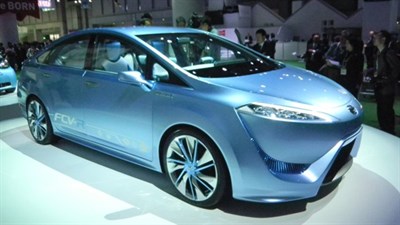
There were few stars here – sorry I can’t get more excited about this event, but that’s just how it was. Volkswagen, Japan’s top-selling imported brand for 12 years straight, revealed its new Cross Concept, a sporty Evoque-like small hybrid SUV that has strong hints of the next Tiguan in its proportions and sits on VW’s new modular MQB platform. Toyota unveiled its FCV-R hydrogen fuel cell sedan, Mazda showed its precursor to the next 6, the Takeri concept – beautiful and very close to production – and Honda’s EV-ster roadster showed what future sporty Hondas might look like.
What’s become of Honda? Now there’s a company desperately in need of an injection of fun and some of that old Honda spirit. Roll on the next NSX, due for unveiling at Detroit in January. Why it wasn’t here, starring at its home show is a total mystery…
But Honda’s message, and those of the other manufacturers, wasn’t about ‘sporty’ – it was about environment, austerity, reflection and belt-tightening. Not as bad as the post-GFC Tokyo show of two years ago, but still very much a show produced by an industry in troubled times.
An all-too-brief drive in the new Toyota 86 today at Fuji speedway (small track adjacent to proper track) revealed a sweet-handling, beautifully balanced little front-engined, rear drive coupe which will no doubt be a huge success for Toyota.
The 86 (or ‘Hachiroku’ in Japanese) is a car Toyota desperately needs – that is, it’s interesting, unlike pretty much every new Toyota launched in Australia in the last decade. The car was mostly developed on the technical side by Subaru, in which Toyota is a major shareholder. It uses a new flat-four boxer engine mounted as low as possible for a low centre of gravity, and is normally aspirated for sharper throttle response. Toyota oversaw the development of the car and provided the cash.
Is it any good? From my quick blast, yes, absolutely. In fact, it’s bordering on great. Its greatest talent lies in the balance between power, chassis and tyres – it doesn’t have a lot of grip, which means it’s more fun – the tyres don’t kill things. It slides gracefully and gives you plenty of feedback through the steering and through the seat of your pants. The chassis feels like it could handle twice as much power as the little four pushes out, but it doesn’t need any more because it’s immense fun as it is. Keep the engine in its power band and you can still initiate long, gentle slides.
This is a car that brings back the raw fun of driving, rather than concentrating on sheer speed and performance numbers – it’s the purest and best sports car Toyota has made in decades. The only problem is a lack of seat time – I need more than three laps of a short track in this thing, that’s for sure. It’s too much fun for short drives.
Two days ago I asked myself whether Porsche’s new 991 911 would crack my all-time top 10, and if so, would it supplant any of the four 997 models presently residing in my 10-car fantasy garage. After a day of hard driving in the mountains around Santa Barbara, California, the answer is yes and no.
Yes, the new 911 is a car so accomplished, so fast, so luxurious that it bashed down the door to my top ten with all the subtlety of a US airstrike. My misgivings about Porsche’s decision to switch to electro-mechanical assistance for the power steering proved largely unfounded. But for all of its clever tech, reduced NVH and outstanding fuel economy, it is not the best car I’ve ever driven. That honour still belongs to the 997 GT3 RS 4.0. Nor can the 991 topple my silver medallist Ferrari 599 GTB. But I acknowledge this is a very personal ranking and that neither the hardcore GT3, nor the three-times as expensive Ferrari are natural rivals for the everyday, every drive 991 Carrera S.
Things get trickier at number three on my list which until yesterday morning had the 997 Carrera GTS in residence. Now I just don’t know. Do I prefer the polish of the new car to the involvement of the old?
Two GTS models sat in the carpark at the international launch, but Porsche rebuffed my entreaty to drive one. Instead, they’d wheeled out examples of previous models from their excellent museum collection – the most modern of which was a Series One 997 Carrera S. For purposes of back-to-back
testing, it’d have to do. With fewer than 3000km on the odometer, the 2004 997 had less travelled than the 991 I was testing. As a first-gen 997 Carrera S it was powered by a 261kW 3.8-litre port-injected flat six. The 991’s 3.8-litre direct-injection engine (code-named 9A1) was introduced on 997 Series Two. For the 991, power jumps 11kW to 294kW at a howling, GT3-like 7400rpm. That’s a full 900rpm farther around the centrally-mounted tacho than the 997. Torque is also up (20Nm) but again the peak – 440Nm at 5600rpm – is found 1200rpm higher.
The seven-speed PDK is brilliant at masking the on-paper peakiness of the engine and with Sport Plus engaged the shifts are blindingly quick. With the aid of launch control, the PDK-equipped Carrera S blasts from rest to 100km/h in just 4.1 seconds – matching the 996 GT2 of a decade ago. Around the Nurburgring, the same PDK C2S has recorded a 7:40 lap time, equalling the 997 GT3 and Turbo. And as Porsche Cars Australia boss Michael Winkler pointed out, “It doesn’t do it with power, it does it with balance.”
Much of that balance comes from a 52mm increase in front track for the Carrera S (46mm for the 3.4-litre Carrera which will begin production in February). The front end now asks less patience from the driver to settle into corners giving you greater confidence to lean on it harder and earlier. Back-to-back with the older car (a six-speed manual), the 991 covers ground faster, safer and with less fuss. But that’s not to say it’s anodyne and boring. Compared to the 997, though, which is practically alive, the 991’s finesse has cloaked the raw 911 character we know and love.
Over the same roads you needed to work the 997 harder. Brake earlier, get the nose to settle and the front tyres to bite. Fail to do so and the nose would wash away with your confidence. Squeeze too hard or too soon on the throttle and the rear would slide. To provoke either reaction from the new car required brutal inputs and at least 20km/h more corner speed.
The 991’s composure extends to its ride quality as well, which for a car on 20-inch alloys is nothing short of astounding. Even switching between sports damping failed to elicit the fore and aft oscillation for which 911s are famous.
Aside from the ease with which the 991 covers ground, the other vast improvement is NVH. Where the 997 rumbled and grumbled over seemingly smooth surfaces, the 991 remained premium-sedan-quiet over coarse-chip tarmac. This relative quietness only amplifies the seductive moaning and wailing flat six when you’ve opted to give the exhausts their full voice via the console button.
Jumping back into the 991 after the older car, it feels bigger even though the size differences are minimal and the new car is 45kg lighter. The 991’s steering certainly lacks that old-school ‘feel’. In the 997 you sense what the front tyres are doing on so many levels – the whorls of your finger prints, the knuckles in your fingers and the fibres of your forearms. In the 991 you are aware that the front end is sharp, direct and willing to do as you tell it.
There is no question that the 991 is a better car. It is a phenomenally accomplished GT, could happily handle track days or transport you, your partner and two pre-teenage children for a week’s getaway. As the first salvo from a 911 armoury that will stretch to around 20 variants – think Cabriolet, Targa, Turbo, 4S, GT3, GT2 etc – the new 991 Carrera S almost certainly won’t be the greatest model of its generation, but I’m not willing to bet that one variant won’t end up being my greatest ever drive.
