
AT FIRST glance the 2011 Mercedes C-Class looks much the same: the facelift brings a stronger nose, more squared-off two-tier headlights and angular bumpers.All standard midlife revisions that remain true to the W204 C-Class origins. Still, Mercedes claims the facelift consists of 2000 new parts – more than any other in its history – and proof that the engineers have gone through the C-Class, enhancing the good bits, while rectifying any weaknesses, to create a mid-sized premium sedan that remains fully competitive. Especially when, engine-for-engine, prices will be unchanged when it arrives in June.The transformation of the interior is the big story, but there are also major changes to the drivetrain, while the switch to an aluminium bonnet saves 9.2kg and, because new tooling was required for the material change, allowed the designers to rework the headlight shape.The styling is more aggressive, especially the Avantgarde sports version with its open grille and massive three-pointed star. The class-leading 0.26 Cd remains unchanged.Criticism of the previous interior centred around the pop-out multimedia screen. Happily, it’s been dropped in favour of a slick horizontal replacement with a brilliant high-definition screen. The plastics are higher quality, and there’s a classy metal finish on the console that looks as if it comes straight from the SLS gullwing.On the road, the new C-Class always feels solid and planted and, especially with the optional Dynamic Handling Package, more nimble than the old car through reworked spring, damping and anti-roll bar rates.Buyers can choose between wafting about in mini-S-Class-like comfort via the supple ride of the standard car (essentially an Elegance without the badging) or opt for the Avantgarde’s extra dynamism and superior body control, chiefly through the transitions, and a decidedly firmer ride. It’s an intelligently broad choice.All four-cylinder petrol and diesel engines are essentially unchanged, but benefit from the belated fitment of Mercedes seven-speed automatic and start-stop technology. Strangely, the revised auto works far more effectively on the C-Class than the SLK.Kickdowns happen just when you want them, and the adaptive technology now seems to function as promised. In 250CGI form, the direct injection four works brilliantly, in cruise mode or when driven hard, when it takes on an edgy, sporting character. So effective is the 150kW 250CGI that Mercedes-Benz Australia has decided not to take the new direct injection 3.5-litre V6 petrol variant.The idea that it’s now a mini S-Class is reinforced by the availability of 10 new driver aid systems, including Adaptive Highbeam assist, Blind Spot Assist, Lane Keeping Assist and Parktronic.
When it comes to buying a brand-new car one of the first questions we tend to ask ourselves is, “How can I get a good deal?”We sift through countless friends in the hope one of them happens to be a car dealer or is a friend of a friend who is. We tend to ask lots of questions — although usually not the right ones — and worse still take hearsay advice on finance, market trends and/or buying strategies.Needless to say the shopping experience can quickly turn from excitement to uncertainty. And with so many variables to consider it’s easy to take the wrong turn only to realise there was a better deal around the corner — if only someone had told you.So to keep you away from a dud deal and instead happy you’ve driving away with the best possible, check out our latest top tips on how to beat the car dealer.
Not much needs to be said about Charlie Sheen, the US actor famously sacked from the hit TV show Two and a Half Men. His unusual public statements have earned him over 3.5 million Twitter followers and numerous headlines across the world.The former Wall Street and Platoon star was earning $2 million dollars an episode on his top rating TV show and with that kind of money he could certainly afford a lot of nice cars.Clearly he has a penchant for Mercedes-Benz, and it would appear from the pictures we found that he has a different one for every day of the week.
Audi’s new R18 TDI will be the manufacturer’s first closed-roof Le Mans challenger since 1999. The unusual characteristics of the Circuit de la Sarthe, where the Le Mans 24 Hour is held every year, require a unique aerodynamic approach. Around 85-percent of the lap is spent at full throttle, and the five-kilometre-long Mulsanne straight sees front-running LMP1 competitors approaching speeds of up to 400km/h.“A closed car is not necessarily more efficient,” says Audi Sport’s Dr Martin Muhlmeier. “Race cars designed to generate very high downforce levels, in Formula 1 for example, are also very efficient ‘open’ designs. If you want to go in the direction of low drag or must, like now at Le Mans with the engine power being reduced and the circuit characteristics still dominated by long straights and high speed, then a ‘closed’ car is more efficient than an ‘open’ one.”Muhlmeier is referring to the downsizing of diesel engines in this year’s race, after the oiler twins, Audi’s R15 TDI and Peugeot’s 908 HDi, blew all the petrol-powered entries away in recent years. In the Audi’s case, the R18 TDI is powered by a 3.7-litre V6 turbodiesel, down from the 5.5-litre V10 in the back of last year’s R15 TDI.The 2011 Le Mans 24 Hour race will take place on June 11-12.
BMW and Citroen have both won the 2011 Women’s Car of the Year award for the 5 Series and DS3 respectively.Fourteen female judges from around the world including Australia, USA, China and the UK have voted in a secret ballot across four categories: Best Family Car, Best Sports Car, Best Luxury and Most Economical.Director, Paul McCormick, said the results showed clear winners in each category however the overall supreme winner was a dead heat between the BMW 5 Series and the Citroen DS3.“Each judge voted according to her specialist knowledge and not all judges voted similarly,” said McCormick.“It was so very close between the top contenders and whatever way the voting is viewed, both the BMW 5 Series and the Citroen DS3 could not be separated – and for different reasons – and this, of course, shows the democratic nature of the voting system.”Chief Judge, Sandy Myhre of New Zealand, said two more judges will be added to the jury list for 2012 – one from Australia and another from China.”These awards are unique worldwide and are gaining recognition,” said Myhre.“We began with eight original judges in 2009 and have now doubled that, which reflects the importance of a woman’s viewpoint to the motor industry.“Category winners and the runners–up are:Family Car Volvo S60 Kia SportageSports Car Aston Martin Rapide Audi TTLuxury Car BMW 5 Series Jaguar XJEconomical Car Citroen DS3 Mini One DieselWhat’s your say? Which car would you vote for as Car of the Year?
A keen-eyed Wheels reader has snapped Holden testing its Cruze hatch range, due to go on-sale in October. Spotted undisguised in Myrtleford, near the Victoria-NSW border, the two Cruze hatchbacks – a dark blue CD diesel and SRi-V 1.4 turbo – were presumably undergoing final chassis/quality testing on local roads.While the Cruze sedan was designed by GM DAT Korea, the pert rear three-quarter section of the hatch was designed in Australia.The sedan switched to Adelaide production last month, and the hatch will join it on the production line in around six months.Holden sold 28,334 Cruzes in 2010, its first full year on-sale in Australia. However the small car segment is divided 50/50 between sedan and hatch sales, and the addition of the latter bodystyle to Cruze leaves open the possibility for another record year – and potentially troubling Corolla and Mazda 3.The Cruze hatch range is expected to closely mirror the sedan, with CD, CDX, SRi and SRi-V variants available with a range of 1.8-litre atmo petrol, 1.4 turbo petrol and 2.0 turbo-diesel powertrains.We’ll keep you updated on more developments as they come to hand.
Standing by the pit wall, a little white speck rounds the bottom corner of Wakefield Park and begins to wind itself towards me.
This article was originally published in the May 2011 issue of MOTOR.
I can hear the engine sucking in 351 cubic inches of air 50 times a second. The headlights dazzle me every time the car changes gear, the clutch slams home and that bluff nose rises against gravity and all logic one more time.
Now in fourth gear, the white missile blazes past, a wall of mangled air convincing me to take a half-step backwards.
It’s none other than Moffat in nothing less than a Phase III GT HO. Hang on a sec: Moffat? Phase III? What’s going on here? Has Wakefield Park been shipped back in time four decades?
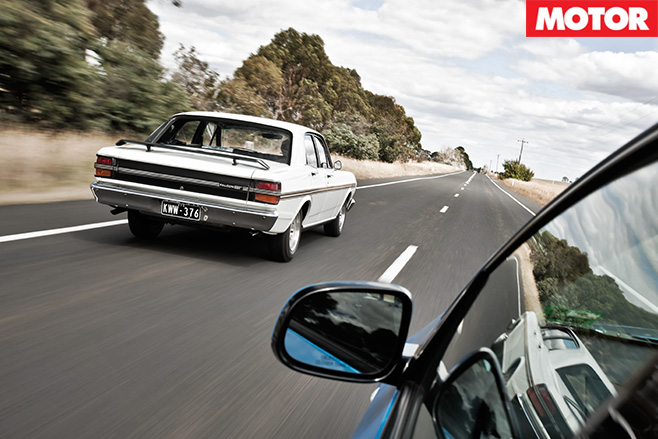
Now, see, this is interesting. The Ford Falcon has survived all this time (for now) and a new generation of Moffatry has stepped up to do the hot laps these days. Question is: how far have we really come?
Well, I’m not about to start comparing Moffat The Elder with James The Son, but there are some valid comparisons to be made when it comes to the Falcon package. Specifically, how good was (and is) the GT HO really? And, can a most basic ‘sporting’ Falcon make the most of 40 years of research and development and keep the old girl honest?
I mean, we’re constantly hearing about how good modern cars are; how even a cooking model can knock off the fastest, gruntiest of the old stagers. So how’s about we put it to the test once and for all.
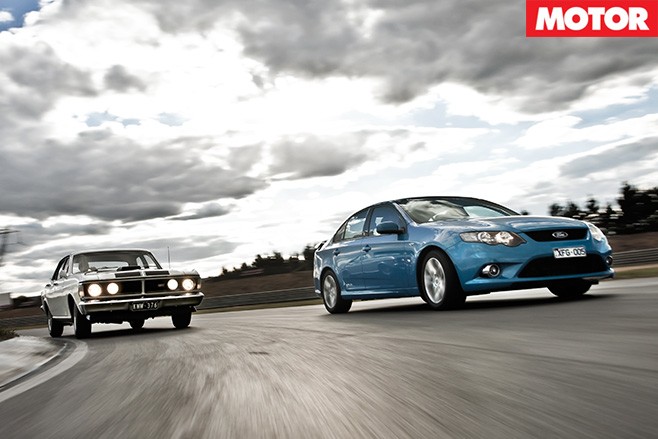
So why an XR6? Well, right now, bent-eight XR8s are on hiatus and the Turbo’s too powerful for fair play. Ditto the blown-V8 FPV gear. But crunch the raw data, and a non-turbo FG makes enticing competition.
See, its 4.0 six makes 195kW and 391Nm. Factor in the car’s 1728kg weight and you’ve got 113kW per tonne. So says Ford Oz.
The original claim for the GT HO was 224kW and 515Nm, though an army of Hoey-lovers will tell you it actual made more output. Weight? Just 1542kg. That’s a dominant 146kW per tonne. And plenty of scope for the old car to peg back its deficits in chassis and braking technology.
The dragstrip…
Okay, figuring we’d ease him into things, we let James loose in the new car first up at Sydney Dragway. You know, to get into a groove. And with the user-friendly auto ’box, it wasn’t long before he was cranking out consistent 14.8 second runs with a terminal velocity around the 153km/h mark. This is not bad for something that is a money meter and dome-light away from being hailed at the next corner.
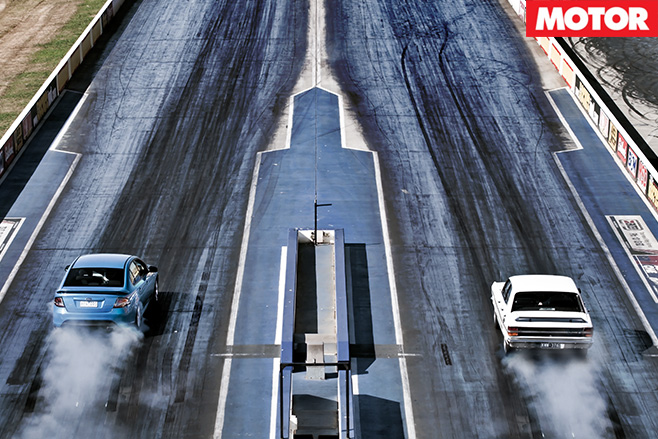
The gearshift in the Toploader four-speed feels like you’re setting a bear trap, and refuses to be rushed. The clutch is a bit more forgiving, but the real booby-traps are the 20-year-old Pirelli radials, whose grip on bitumen mirrors Charlie Sheen’s post-lunch hold on reality.
So it takes James a few passes to get it right, but before long he’s tantalisingly close to the FG’s 14.8sec best. And finally, it happens; Moff cracks it for a 14.8 at 156.2km/h.
Now, to those who hold that 400m of sticky hotmix is the end of any performance argument, some bad news. Here’s why. The most-powerful car doesn’t always win. In fact, the fastest car doesn’t always win these match-ups either. Ultimately, the car with the best combination of traction, torque, weight transfer and driveability will likely come up trumps in a drag race. And then there are tied results like this one.
See while, nought to 100 in either car comes up in 6.8sec and the quarter-mile in 14.8, it’s just not that simple. The biggest difference on the face of it is the terminal speed, with the old girl shading the FG by a couple of kays. Given that they both blitz 100km/h in the same time – suggesting a decent hook up in both cases – what’s going on with the Phase III’s extra terminal speed?
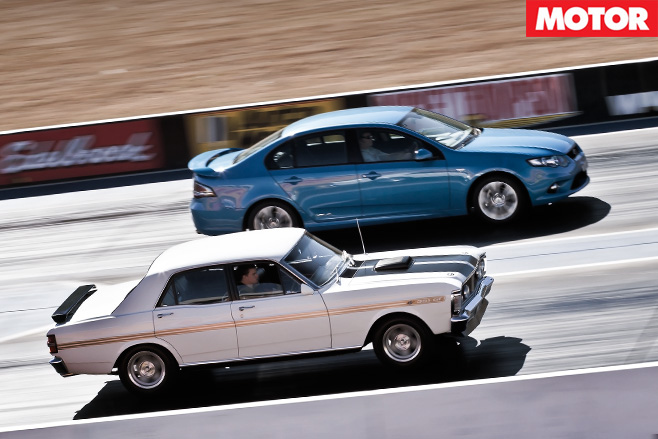
It’s the same every gear. The Phase III pulls out half-a-car length and then surrenders it during the inevitable, clumsy gearchange.
You can feel the FG has nothing like the Phase III’s grunt. It’s as plain as day on the drive from Sydney down to Goulburn’s Wakefield Park.
Race circuit…
Cars like the GT HO were, of course, designed as homologation specials. And, therefore, they were designed to do one thing; win races. So if the HO was going to shine in this contest, it’d be at the track, right?
Erm, maybe, but let’s also bear in mind those late-Jurassic Pirellis and the fact that braking was never really a HO long suit, even in its day.
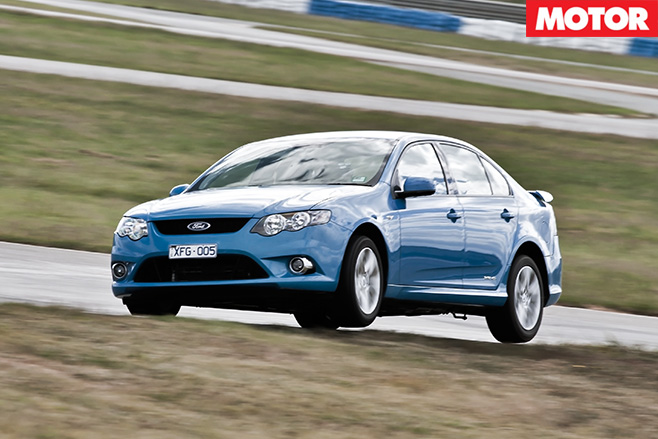
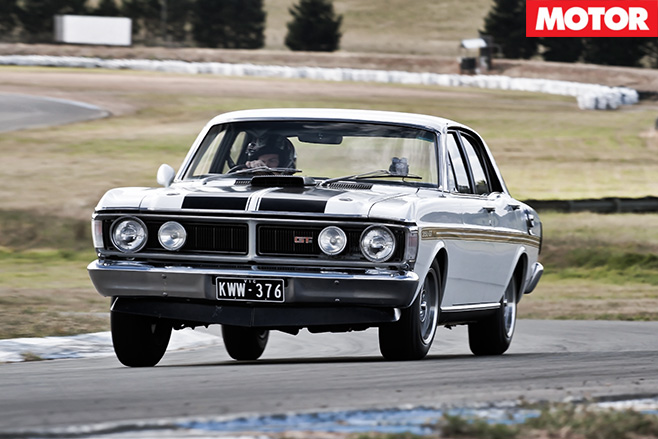
With all that in mind, then, nobody was too surprised to see the Phase III seven seconds adrift of the FG, though at least two of those seconds would be down to those tyres.
You could see the deficit in the data. The FG’s v-max during the lap was 161.8km/h, while the GT HO, even with its superior squirt, just wasn’t exiting the corners with as much pace, recording a peak of 154.4km/h.
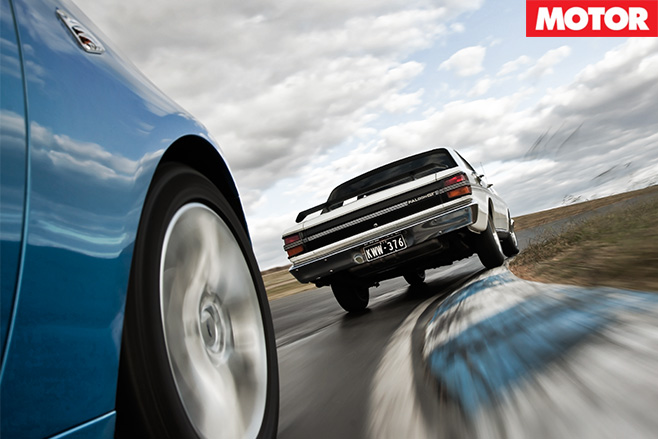
So, how far have we come in 40 years? A certain distance, to be sure, but maybe not as far as you might have thought in some areas.
And in any case, you can throw all the numbers in the world right into the nearest skip when it comes to the emotional attraction of both cars, because I sure as hell know which one I’d have rather gone home with (and it ain’t blue in colour).
And the Moffat motor-racing dynasty forty years on? Set to go from strength to strength, by the look of things.
Specs
| u00a0 | u00a0FORD XY FALCON GT HO | FORD FG FALCON XR6u00a0 |
| Body | 4-door, 5 seat sedanu00a0 | 4-door, 5 seat sedanu00a0 |
| Drive | rear wheelsu00a0 | rear wheelsu00a0 |
| Engine | 90-degree V8, OHV, 16vu00a0 | in-line 6, DOHC, 24v |
| Material | iron head/iron block | iron head/iron block |
| Bore/Stroke | 101.6 x 89.0mmu00a0 | alloy head/iron block |
| Capacity | 5766cc | 3984cc |
| Compression | 11.5:1u00a0 | 10.3:1 |
| Power | 224kW @ 5400rpmu00a0 | 195kW @ 6000rpm |
| Torque | 515Nm @ 3400rpmu00a0 | 391Nm @ 3250rpm |
| Redline/cut | 6000/6150rpmu00a0 | 5500/6400rpm |
| Fuel tank | 98 octane/ 163 litreu00a0 | 98 octane/68 litres |
| Kerb weight | 1524kgu00a0 | 1728kgu00a0 |
| POwer-to-weight | 146kW/tonneu00a0 | 113kW/tonne |
| Transmission | 4-speed manualu00a0 | 6-speed automatic |
| Ratios | 2.32/1.93/1.36/1.00u00a0 | 4.17/2.34/1.52/1.14/0.87/0.69 |
| Final drive | 3.25 (LSD) | 2.73 |
| Suspension | double A-arms, coil springs, anti-roll bar (f); live axle, leaf springs, dampers, anti-roll bar (r)u00a0 | double A-arms, coil springs, anti-roll bar (f); multi-links, coil springs, anti-roll bar (r) |
| L/W/H | 4689/1869/1397mm | 4970/1868/1433mm |
| Wheelbase | 2819mm | 2838mm |
| Tracks(f/r) | 1499/1486mm | 1583/1598mm |
| Steering | recirculating ball | power rack and pinion |
| Turning circle | 11.2m | 11.0m |
| Brakes | 286mm discs, single-piston calipers (f); 254mm finned drums | 298mm ventilated discs, twin-piston calipers (f); 303mm solid discs, single-piston calipers (r); |
| Wheels | 15 x 7.0-inch, alloy | 17 x 8.0-inch, alloy |
| Tyres | Pirelli P5 | Dunlop SP Sport 01 |
| Size | 205/70VR15u00a0 | 245/45R17 95Wu00a0 |
| Price | $5302 (1971) | $43,990 |
| As tested | $500,000 (estimated) | $45,840 |
Numbers down the strip
| u00a0 | FORD XY FALCON GT HOu00a0 | FORD FG FALCON XR6u00a0u00a0 |
| 0-10km/h | u00a00.49sec | 0.37secu00a0 |
| 0-20km/h | 1.00secu00a0 | 0.83secu00a0 |
| 0-30km/h | 1.53secu00a0 | 1.33sec |
| 0-40km/h | 2.14secu00a0 | 1.89secu00a0 |
| 0-50km/h | 2.71secu00a0 | 2.44secu00a0 |
| 0-60km/h | 3.28secu00a0 | 3.08secu00a0 |
| 0-70km/h | 3.86secu00a0 | 3.98secu00a0 |
| 0-80km/h | 5.24sevu00a0 | 4.86sec |
| 0-90km/h | 5.99secu00a0 | 5.76secu00a0 |
| 0-100km/h | u00a06.77sec | 6.75secu00a0 |
| 0-110km/h | u00a07.62sec | 7.92secu00a0 |
| 0-120km/h | u00a09.38sec | 9.46sec |
| 0-130km/h | 10.54secu00a0 | 10.86sec |
| 0-140km/h | 11.70secu00a0 | 12.37sec |
| 0-150km/h | 13.00secu00a0 | 14.04sec |
| 0-400m | 14.81 @ 156.26km/h | 14.85 @ 153.27km/h |
| 80-120km/h (3rd-6th) | 4.11sec | 4.50sec |
| 100km/h-0u00a0 | 64.65m | 41.05m |
Porsche has added a specially tuned version of Volkswagen’s 3.0 litre V6 TDI diesel engine to its Panamera line-up – and it’s now available in Australia.The diesel variant will join the S Hybrid as the most fuel-efficient models in the Panamera line-up, the TDI engine (and a start/stop system) achieving fuel consumption figures of 6.5 l/100km.Power for the diesel engine is rated at 184kW and 550Nm of torque. Combined with Porsche’s eight-speed Tiptonic S automatic transmission, the diesel engine pushes the Panamera to 100km/h in 6.8 seconds.By comparison, the S Hybrid lists fuel consumption figures of 6.8 l/100km, power coming from a 250kW supercharged V6 petrol engine and 34kW electric motor. The 0-100km/h sprint for the hybrid is knocked over in 6.0 seconds.With an 80-litre fuel tank, the Panamera Diesel offers a theoretical driving range of 1200km off one tank – enough to get you from Melbourne to Sydney in one hop.Pricing and Availability Priced at $194,900 (plus on-road costs), the Panamera Diesel is on sale now, with deliveries set to begin in September.Thanks to its 6.5 l/100km fuel consumption rating – 0.5 l/100km below the Federal Government’s 7.0 l/100km ‘green’ target – Luxury Car Tax on the Panamera Diesel is calculated from $75,375 instead of the standard $57,466 threshold.
A new study exploring the psychology behind our on-road decisions shows that envy and shame are two of the biggest factors in our attitude toward other drivers.Observing 959 interactions on the roads of Brisbane, researchers at the University of Queensland found that what motorists think of a person’s car, their gender and whether a friend is present often impacts on how we treat our fellow drivers.The study showed that owners of more expensive cars were 18 percent less likely to find kindness from other motorists – a factor driven by envy and jealousy, according to researchers Redzo Mujcic and Paul Frijters.There was solidarity among owners of similar vehicles however, with drivers of SUVs and other large cars more likely to make room for their like, rather than for smaller cars.The results showed that only 40 percent of motorists were willing to allow another car to move in front from the neighbouring lane or an intersecting street.Throw gender into the mix, and it was observed that male drivers were 22 percent more likely to let a female driver cut in. With the tables turned, women were only 15 percent more likely to make room for a male driver.Motorists with passengers were also 25 percent more likely to sacrifice their spot on the road, with motorists eager to appear altruistic in front of their friends.It was also observed that when one motorist allows another driver to slip in front from an intersecting road or merging lane, following motorists were likely to do the same.What’s your view on this? How do you rate your driving attitude in comparison to other drivers?
The fallout from Japan’s earthquake and tsunami disaster continues to affect daily life for the beleaguered nation, and the country’s auto industry has also struggled to recover.For Honda, the devastation in the north has caused extensive delays to its parts supply, leading the company to postpone the launch of the all-new 2012 CR-V.The new small SUV was scheduled to debut in the Northern Hemisphere’s Autumn (around September), but according to financial paper Bloomberg, it is now expected to appear closer to December.Production of the current-generation CR-V will be extended as a result, albeit at a reduced capacity.“Recovery from this crisis is difficult and constantly evolving, most notably the challenge of obtaining a few key components required to maintain production at appropriate levels,” Honda US’ John Mendel told dealers this week.“Overall production volume will be at significantly reduced levels as we continue production adjustments through the summer months.”Honda’s Japanese plants are expected to continue at 50 percent of capacity through June, and plants outside of Japan will operate on a case-by-case basis, depending on which models are scheduled.
