
RACV finds Hyudai Getz, Ford Fiesta cheapest cars to run, Land Rover most expensive.New figures from insurer RACV show that the cost of owning and operating a car in 2010 has changed little from the past two years, rising 4.5 percent over 2009.Covering 78 models in the new car market, RACV’s ‘Driving Your Dollars’ survey found that while the Ford Fiesta Econetic is the cheapest to run (10.23 cents per kilometre), its higher purchase price meant that the Hyundai Getz continues to be the cheapest to own and operate – its fourth year at the top.At the other end of the scale, the three most expensive vehicles to own and operate are all variants of the LandCruiser, with the V8 diesel costing $386.79 per week, the V8 petrol costing $369.88 and the LandCruiser ‘ute’ costing $40 less at $328.48 per week.“How much an individual pays to purchase a car is just a piece of the picture. We also assess how much it costs to have the car serviced, the cost of fuel, tyres, insurance, registration, RACV membership, interest, stamp duty, drivers’ licence as well as an assortment of spare parts like windscreens and batteries,” the RACV’s Brian Negus said.Mr Negus said that while the nearly $8000 cost over five years of maintaining a BMW wasn’t surprising, a trio of Toyota models provided their own surprises.“Toyota’s Yaris, Prado and Rav4 were all the most expensive to maintain in their categories, even with Toyota Service Advantage limiting scheduled costs,” he said.
| The Hyundai i45 is much more than just a new car. It’s a new idea. State-of-the-art engineering maximises performance and fuel efficiency, and the spacious interior concealed within its sporty silhouette combines superior levels of safety with comfort and style.
Sophisticated styling and intuitive functionality unite to make the i45 as exciting to drive as it is to admire from afar. Its smoked chrome radiator grille, fluid character lines, and sleek, eagle eye-shaped headlights reveal its sporty side, while its aerodynamics deliver an incredibly low drag coefficient of just 0.28, enabling it to cheat the wind and hug the road with even greater fuel economy.
Behind the scenes, the i45 employs cutting-edge technologies for an exhilarating, yet safe driving experience. Steering-wheel mounted paddle shifters allow for greater control upshifting and downshifting, and the anti-lock braking system (ABS) with electronic brake-force distribution (EBD) prevent the brakes from locking and distributes braking force according to the vehicle’s load.
| u00a0 | 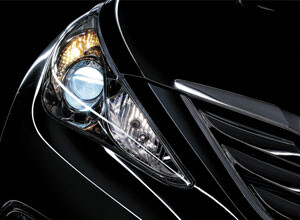 Crisp, bright lights enhance night-time vision Crisp, bright lights enhance night-time vision 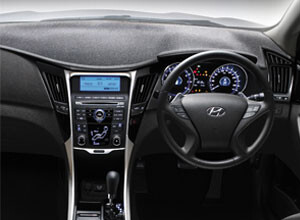 Ergonomic dashboard makes driving hassle-free Ergonomic dashboard makes driving hassle-free 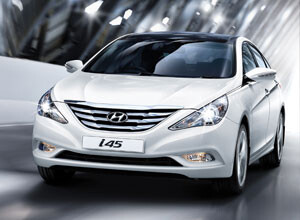 Sporty styling matched by performance Sporty styling matched by performance |
Attention to detail is evident in the little extras: the driver’s power seat with adjustable lumbar support; the integrated six-speaker audio system with iPod connectivity; proximity smart-key entry; and a fully automated air-conditioning system.
Performance with a conscience
Its sporty profile isn’t all the i45 offers. Underneath the bonnet lies a technologically advanced, high-performance powertrain that produces lower CO2 emissions and provides greater fuel economy than many other similar-sized engines.
Thanks to the latest gasoline direct injection (GDI) technology, the 2.4-litre Theta-II engine runs cleanly and efficiently, producing up to 148kW of power and 250Nm of torque for effortless performance. Combined with a six-speed automatic transmission, it can deliver an impressive 7.9 litres per 100km.
Break with convention and step into the future — you’ll enjoy the ride.
Holden is at work on a sharper, greener new VEII Commodore, and it’s expected to be unleashed on showrooms in October.The July issue of Wheels delivers a scoop first look at the VEII facelift four years in the making, which introduces the first major styling updates for VE since it went on sale in 2006.But beneath the tougher new look lurk mechanical and interior upgrades designed to help Commodore retain its mantle as Australia’s favourite car.There’s a green angle, of course. We saw the introduction of the direct-injected 3.0- and 3.6-litre SIDI engines, along with cylinder deactivation on V8 models in 2009. Now the headline act is an E85 ethanol-burning version of the 3.0 V6 capable of running on a fuel blend of up to 85 percent ethanol.The styling refresh is intended to reap maximum visual bang for minimum development dollars, and is based around new bumpers and grille, headlights and taillights.Featuring among the changes will be LED headlight inserts and taillights for high-end Calais and SS models, an aggressive front bar and grille with sharper crease lines, and a diffuser-style rear bar with integrated exhaust tips for hot versions such as SV6, SS and SS V.Inside, the major update is a touch-screen infotainment interface as part of a redesigned centre stack and console, while new, high quality trim and soft-touch plastics will lift cabin ambience into the new decade.For more details on Holden’s new Commodore plus all the latest automotive news and views from around the globe, grab the July issue of Wheels, on sale now.
Reports of a long-awaited successor to the current-generation BMW X3 have been circulating for some time, along with spy photos and best-guess renderings of how the new model might look at launch.Following the official release of a number of close-up teaser images on the BMW website, BMW has this week released a series of spy-like photos of the new X3 wrapped in the company’s signature swirl camouflage.These new official images reveal an overall larger body than its predecessor, with a more X5-like muscular design.One of the images shows the new X3 side-by-side with the current model, offering the best look yet at the new generation’s larger proportions.A report by UK magazine Autocar, supposedly drawing on comments from a BMW insider, claims the new X3 is 83mm longer, 29mm wider and 40mm higher than the current generation.Due in international showrooms later this year, the 2011 BMW X3 will likely share its engine options with other BMW models, including the 3.0 litre straight-six petrol engine and the 2.0 litre turbo-diesel.
Part 1 of our event coverage of the 2010 Beijing International Automotive Exhibition.
Part 2 of our event coverage of the 2010 Beijing International Automotive Exhibition.
Ferrari will take the wraps off its fastest ever road car, the Ferrari 599 GTO, at the Beijing motor show later this month (April 2010).
The Ferrari 599 GTO is an exclusive limited edition special which, in true Ferrari tradition, is a completely new concept, albeit inspired by a production car. In fact the 599 GTO is based on the 599XX, the advanced experimental track car, and can be considered almost a road-going version.The 599 GTO will be reserved for just 599 clients who seek the maximum expression of high performance driving. The 599 GTO benefits directly from the technological transfer from racing and set a record lap time at Fiorano in 1’24”. The Fiorano lap time provides just one indication of the potential of this car.As for the technicals – 670 hp in a 1495kg car represents a weight-to-power ratio of just 2.23 kg/hp, and ensures a 0-100 kmh acceleration time of just 3.35″ as well as a top speed of over 335 kmh.Fundamental to the GTO’s performance is the innovative approach to chassis development which, for the first time on a production car, saw the integration between a handling set-up tuned for a level of responsiveness that is close to the limit and highly sophisticated electronic controls. The result is the almost complete absence of understeer and a truly communicative chassis.The 599 GTO is also equipped with the latest, second-generation carbon-ceramic brakes which are lighter and offer better performance, new aerodynamic innovations, such as the wheel doughnuts which increase aerodynamic efficiency as well as improve brake cooling, and a different tyre set-up with wider front tyres for greater roadholding. The driver-car interface is also new with the adoption of the Virtual Race Engineer (VRE) which provides the driver with instantaneous information on performance.The 599 GTO’s more aggressive character is also apparent in a number of styling elements that recall the 599XX and from the powerful sound of the V12. The GTO (Gran Turismo Omologata) moniker instantly calls to mind two Ferraris that have entered the collective imagination as symbols of performance. After the 1962 250 GTO, which swept the boards in GT racing categories in the 1960s and is now a highly prized collector’s car, came the iconic 1984 GTO, which many claim practically invented the entire modern supercar genre.The Ferrari 599 GTO will arrive in Australia and New Zealand in early 2011.
There’s a war of opinion out there in Cardom. It has polarised, rarely openly and sensibly debated, and has simmered just below the surface for time eternal.
And there are two protagonists: the purveyors of OE purity against lovers of aftermarket tuning. The former ask how on earth Tim the Backyard Tuner, with his limited fiscal and R&D resources, could ever outsmart the engineering army that created a vehicle.The latter claim the very same vehicle almost always rolls off the showroom floor short of its ultimate performance potential, hamstrung by costing, reliability, safety and myriad other contingencies factored into cars for the masses. Go-fast fans call it “compromise”.There’s a third camp – G’day, how ya goin’? – who see degrees of truth in both sides of the argument. It’s a belief that pushing the performance envelope without overstepping balanced OE sensibility can create a stunning result.So imagine a car that, on balance, is better than the factory jigger in almost every way. A car born of underlying co-operation between manufacturer and tuner. And without the risks, headaches and ballooning costs of the vehicle being treated like Tim the Tuner’s guinea pig. An extremely rare win-win, right?That’s pretty much the Walkinshaw E2 Supercar in a nutshell.Supercar, eh? Bold name, bold claim. But I reckon it’s on the money. Drive a lot of Commodores and HSVs – in 15 years of car scribbling I’ve steered a few – and it’s pretty clear, stock or tuned, when the stars align in a particularly exceptional example.I tested Walkinshaw Performance’s 370kW blown 6.0 GTS – the wild, one-off Lambo Green cover car from February ’07 – and it was impressive. Ditto the red ‘WP470’ Clubbie cover car from September ’08 loaded with a blown 6.2 LS3 boasting fractionally less (470kW/770Nm) than its Supercar successor. Oh, the Clubbie was very good – brutally potent (12.5sec for the 0-400m sprint) yet sublimely controllable around Winton Raceway in conditions I’d call monsoonal. But its brittle ride and merely moderate road-holding ability left it well short of being considered exceptional.The Supercar adheres to the formula of its predecessors: a big-grunt supercharger upgrade, plus enough dynamic enhancements (braking, handling, etcetera) to sensibly harness its newfound mentalness in a public environment. Get it right, and its true bi-polar motoring in the greatest sense – sublime Jeckyll one moment, maniacal Hyde character the next. And after extracting myself from the supercharged 480kW/803Nm beast’s driver’s seat after two days and 400 kays of mixed city, country and up-it-for-the-rent testing, I’m convinced its a much better car, in every sense, than its predecessors.In fact, I’m struggling to think of a better, more impressive Commodore-based jigger I’ve driven. Ever. That’s not the shellshock of horsepower doing the talking, either. It’s more a realisation that, finally, someone has figured out how to harness outrageous, tuned output in a no-compromise package Nanna could fetch milk in.The key is that Walkinshaw Performance – HSV’s kissing corporate cousin which recently relocated to the ex-HRT workshop, right next door to HSV’s assembly line – has been honing blown Commodore/HSV enhancment kits to perfection for years now.And, in truth, ‘Supercar’ is the name of a specific upgrade package – which starts from $34,990 – not an actual model of vehicle.The green beast, though, is called the Walkinshaw E2 Supercar. It’s actually WP Program Manager Alan Hale’s manual GTS-based personal transport-cum-test bed-cum-demonstrator, with $49,920 worth of goodies. It’s a blurry line but, essentially, you could rock up to Clayton Business Park with $131,910 (plus ORC) burning a hole in your chequebook and you’re only a couple of door knocks away from a showroom-fresh turn-key clone. And, boy, it’s an eye-grabber. WP has created a strong Supercar identity using minimal carbonfibre exterior trickery that, for most part, improves upon the GTS look. Love the smaller, slim-line lip spoiler, subtle bonnet strips (GTS is chrome) and wing-mirror caps. And the carbon fender vents work in nicely. But those hippo nostrils are just bad taste.The new ‘no-dish’ signature WP 20-inch rims are more handsome than the try-hard GTS 20s and blend in with the de-chromed carbon look effortlessly. In HSV Poison Ivy green, the Supercar has a sort of military motorsport vibe going on. WP still offers the pricey 22-inch satellite-dish Vendetta rims (with ridiculously slim 30-series front/25-series rear tyres) it’s peddled for a couple years now, but the 20s are the go. They’re wider (10 inches, up 0.5in) at the rear, the 35/30-series tyres offer superior ride comfort and handling, and they look tough-as.Dual double-barrel cannon exhaust tips replace the dodgy Shockwave design stockies. And they’re almost as gorgeous to look at as they are to listen to. Fire up the blown 6.2 and the deep, rich baritone humming through the cabin makes the hair on your arms bristle.Hale and co. have paid particular attention to the exhaust system, which includes unique Super Sport Steel Cat headers (featuring a “stepped design” as used on the W427’s 7.0-litre LS7 V8), dual cat-back pipes and WP’s own super-sized bi-modal mufflers. From header to tips it’s a dual three-inch-diameter arrangement, half-an-inch larger than the stock GTS’s.The WP190 (Eaton) supercharger is also new, with a unique-to-WP housing and four-lobe high-helix internals. It makes the same 0.56bar (8.2psi) peak boost as WP’s old three-lobe (H122) blower, but it’s quieter, runs cooler, has more volumetric air efficiency and robs less energy from the crankshaft. The clever water-to-air intercooler, located in the valley between the heads and blower housing, remains. New frontier stuff is limited to the installation of a factory LS7 camshaft – specified for the 7.0-litre W427/Z06 Corvette V8, remember – into the otherwise internally stock 6.2 LS3. And the results are, erm, interesting.The old WP set-up took the 6.2 LS3 from 317kW/550Nm stock to an upgraded 470kW/770Nm. This new-gen system takes an E2 GTS from 325kW/550Nm to a modified 480kW/803Nm. So, not much to write home about in the numbers game, eh?But ease Supercar off the mark, dial up as little as 2500rpm, sink the boot, and you’ll want to yell “fire-truck” – or a rhyming word to that effect – the instant 800Nm clocks on at 3100rpm, followed instantly by a roaring supercharged symphony as the bi-modal flaps crack wide open to full volume at 3500rpm. Except you can’t, because the air in your lungs has been squeezed out by the manic forces of acceleration. Officially, the form guide says peak torque is at 4300rpm.In reality, its 803Nm peak begins to taper off at this rev point, but there’s still 750Nm under foot at 5600rpm, by which time most of the 480kW is working its magic. That’s a huge, fat slab of flexible energy to play with.And here’s precisely where the improvements have been made. Cruising in sixth, it’s effortlessly toey. In fifth, with just 2500rpm at 100km/h, acceleration is surprisingly punchy. At 3500rpm in fourth, it punches forward with every flex of your toe. The sheer rolling response of the thing, and how it masks the Supercar’s 1865kg mass, is remarkable.Third? Well, that’s the button Scotty hits when Kirk commands “Warp Speed”. The mid-range kick is so enormous, and the throttle response so sharp, that it’s ostensibly an exercise in keeping the fat 10-inch wide rears glued down and keeping the shimmying tail tidy. Should you wish to unleash fire and brimstone from a standing start, a) the factory Launch Control works as it does in a normal GTS, and b) HSV’s standard LS7-spec clutch (that WP has been speccing for its supercharger kits for years) can handle the punishment. And its 4.25sec 0-100km/h and 12.48sec 0-400m times are definitely Supercar territory.Thing is, there’s none of that startling urgency like you get from highly strung, big-output turbo engines. The throttle is very linear, like a volume knob for both energy and noise. In fact, after two or three hard launches it’s a doddle to dial up just the right amount of output underfoot – a bloody good thing when harnessing this amount of grunt on public roads shared with grandmas, nuns and school kids.And right here, that OE sensibility – that balance – shines. Y’see, it’s not merely controllable, it’s controlled in its all-round dynamic behaviour. WP enhanced the E2 GTS’s magnetic-damper suspension – a high water mark for muscle-car poise – quite subtly, using its specifically tuned springs. The MRC remains untouched. Lean on Supercar and ask it to boogie over uneven, pockmarked country curves, and even in MRC’s taut Track mode, the focused blend of balance and grip is near-perfect. The chassis does much more than simply deal with the extra poke. Those extra supercharged herbs actually electrifies the GTS’s dynamics. It’s as if the interaction of car and road is amplified, that somehow the laws of physics have been accelerated. It bucks and dances and skips and snaps across the blacktop harder and sharper than a normal GTS.Like truly well-honed supercars – say, Porsche’s Carrera S – the WP beast remains lively and entertaining even with ESP left on. It takes some very anti-social behaviour to get ESP to intervene when set to Competition Mode (which remains in standard HSV calibration). The ESP issue is a big thing – a real show of depth in quality. Besides, when deactivated, the stock GTS is pretty wieldy with just 550Nm, let alone a blown 803. So it remains one very exciting, very quick and controllable road car while still under the auspices of the electronic fun police.WP’s own six-pot front/four-pot rear brake caliper upgrade on standard GTS 365mm front and 350mm rear discs works faultlessly stone cold and tirelessly when red hot, and is a handy upgrade over the four-potters. It feels as strong as HSV’s optional 380mm six-piston package.So it’s got Hyde covered. And for that everyday Jeckyll character most owners request 95 percent of the time, the Supercar is equally impressive. Though bold and clear, the engine ticks along at low-rpm and on a light throttle with a muted, satisfying burble and almost no hint of blower whirl. The ride comfort, with MRC in Normal, is exceptionally compliant, and it’s as quiet and comfortable as any other GTS when clocking up highway kays. And WP’s new stealth 600-watt Rockford Fosgate audio system improves the lacklustre stock stereo’s audio quality ten-fold.For ticking boxes on both sides of the OE-versus-tuner argument, and melding the two camps together in harmony, the Supercar really is a page full of ticks (bar those nostrils). There’s even one really curly box most tuning fans accept as a mandatory concession to their wants – perhaps the biggest stumbling block that stops owners dipping in modification – that WP has covered off. And that’s warranty. Or, usually, lack thereof.WP now offers what it calls “a real industry breakthrough” – a complete drivetrain warranty (zero or $660, depending on mods) for cars fitted with WP blower kits, provided they’re less than a year old and have less than 20K on the odo’. It extends for the balance of its new warranty. Tick.The Supercar left us with one last little surprise. Actually, it’s a biggie. HSV officially claims the GTS consumes 13.9 litres per 100km on average. After 400 hard city and country kays, the Supercar returned 13 neat…And that’s a shade of green we definitely weren’t expecting.
Now F1’s worth watching again, here’s Wheels’ guide to the 61st grand prix season. Best crack a foster’s…
POINTS SYSTEM
Previously, the top eight drivers scored 10, 8, 6, 5, 4, 3, 2 and 1 point respectively. This season, however, the top 10 finishers score points. The change has been introduced as a result of the expanded grid. Under the new system, the winner scores 25 points, with 20 and 15 awarded for second and third places. The next seven finishers will score 10, 8, 6, 5, 3, 2 and 1 point respectively.
GRIDS GROW
Maximum grid size has increased from 24 to 26 cars (13 teams) and qualifying changes to accommodate the extra cars. Eight cars drop out of the first qualifying session, eight from the second and 10 cars will shoot-out for pole in the third session, which is run with low fuel.
HOT-SHOE IN
If a team substitutes one of its drivers with a driver who hasn’t raced in F1 in the two previous calendar years, one day of track testing is now allowed on an approved circuit not being used for a GP in the current season. This is to avoid a situation as in 2009, when Jaime Alguersuari made his F1 debut with Toro Rosso having only previously driven an F1 car in straight-line testing.
WEIGHTING GAME
Minimum car weight is up from 605kg to 620 – this was to aid heavier drivers who used KERS and thus had less flexibility with ballast distribution. But KERS, it seems, has been given the boot.
HUBCAPS OFF
Cars are no longer allowed to run wheel covers. The benefits are that there is one less thing to go wrong during tyre changes, and as a potential aid to overtaking by making the airflow behind cars less turbulent.
TESTING TIMES
Teams are allowed six rather than eight days of straight-line aero testing per season. They will also have the option of substituting these days for four hours of wind tunnel testing with a full-scale (rather than the normal 60 percent-scale) model.
DROP TANKS
Refuelling during the race is banned for the first time since 1993. Fuel tank size grows from around 80 litres to approximately 250, and the additional weight and changed weight distribution will bring a new focus on tyre and brake conservation. And car set-up becomes more important than ever. To accommodate the larger tank, cars run longer wheelbases and wider rear bodywork.
KERS-PLUNK
The controversial kinetic energy recovery system (KERS) has lost favour for 2010 due to poor uptake in ’09 and pressure from FIA to cut costs. KERS isn’t, however, banned in the regulations. The system works by capturing kinetic energy otherwise wasted to heat in the brakes, and storing it in a battery, supercapacitor, or flywheel. Drivers can redeploy this stored energy at a rate of 61kW as a ‘boost’ that lasts a maximum of 6sec a lap.
BIG SPENDERS
A proposed budget cap of £40m (A$70m) that would have seen teams opting to take up the cap being allowed greater technical freedom, together with unlimited testing, has been abandoned after strong resistance from teams and threats of an F1 offshoot series. However, F1 management will provide financial support to new teams. Assistance will consist of £6.25m (A$11m) along with transportation of two chassis and 10,000kg of components and equipment to each race.
WINGS ‘N’ THINGS
The aerodynamic regulation changes that made last year’s cars look so dramatically different to 2008’s remain in place. Introduced to decrease reliance on aero downforce and increase mechanical grip (therefore making the racing closer), changes included lower, wider front wings and higher, narrower rear wings. Bodywork remains heavily regulated, effectively banning aero add-ons. Front and rear wings are to be homologated and the number of aerodynamic updates during the season is restricted.
GRIPPING STUFF
When slick tyres returned in 2009 (after being banned since ’98) tyre size remained unchanged, which meant, in terms of contact area, the fronts gained proportionally more grip than the rears. Front tyre width is now reduced from 270mm to 245 to improve front:rear grip balance. Of the four tyre compounds available for dry races, teams are allocated only two compounds of tyre per race, with the softer compound identified by a green sidewall stripe. Two wet weather tyres are also available: intermediate (wet) and wet (extreme weather). Without the need to refuel, pitstops could be as short as four seconds.
Teams and drivers
Vodafone McLaren Mercedes MP4-25/Mercedes 1 Jenson Button (Britain) 2 Lewis Hamilton (Britain)Mercedes GP Petronas mgp w01/mercedes 3 Michael Schumacher (Germany) 4 Nico Rosberg (Germany)Red Bull Racing RB6/Renault 5 Sebastian Vettel (Germany) 6 Mark Webber (Australia)Scuderia Ferrari Marlboro F10/Ferrari 7 Felipe Massa (Brazil) 8 Fernando Alonso (Spain)AT&T Williams FW32/Cosworth 9 Rubens Barrichello (Brazil) 10 Nico Hulkenberg (Germany)Renault F1 Team R30/renault 11 Robert Kubica (Poland) 12 Vitaly Petrov (Russia)Force India F1 Team VJM03/Mercedes 14 Adrian Sutil (Germany) 15 Vitantonio Liuzzi (Italy)Scuderia Torro Rosso STR5/Ferrari 16 Sebastien Buemi (Switzerland) 17 Jaime Alguersuari (Spain)Lotus F1 Racing TBA/Cosworth 18 Jarno Trulli (Italy) 19 Heikki Kovalainen (Finland)Campos Meta 1 TBA/Cosworth 20 TBA 21 Bruno Senna (Brazil)US F1 Team Type 1/Cosworth 22 Jose Maria Lopez (Argentina) 23 TBAVirgin Racing VR-01/Cosworth 24 Timo Glock (Germany) 25 Lucas di Grassi (Brazil)BMW Sauber F1 Team C29/Ferrari 26 Pedro de la Rosa (Spain) 27 Kamui Kobayashi (Japan)
Take an exotic engine, bung it in a bread-and-butter car and, for some reason, you’ve usually got yourself a classic set of wheels.
It doesn’t work in reverse, of course; who’d want a Gallardo with a Daewoo engine, for instance? Still, there’s no getting away from the appeal of a Brand X body with a D&G powerplant.
Need proof? Okay, take a 7.0-litre Corvette engine and stick it in a Commodore. Then call it a W427 and wait for the internerd forum kiddies to canonise the thing. Vauxhall has done it (the Lotus Carlton), Citroen did it back in the ’70s (the Maserati V6-powered SM) and, in the mid-’80s, Ford pulled off one of the best by slinging a Cosworth lump into a rep-racer to create the Bathurst-winning – make that everything-winning – Sierra RS500.
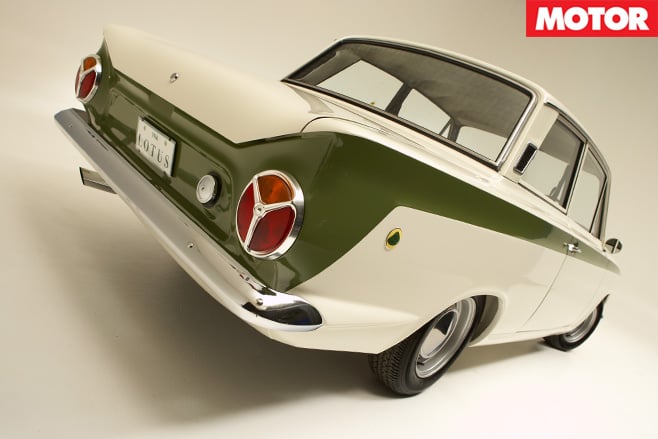
Management approached Lotus boss, Colin Chapman, with the idea of Lotus building 1000 homologation specials and Chapman, who knew a good deal when he saw it, agreed, even though he was also in the process of finalising the production of his own Elan. It must have been a busy time in the Lotus workshop.
Why did Ford choose Lotus? Well, obviously, Chapman had a few runs on the board. But the arrangement was for the development of the Lotus twin-cam engine to also be part of the deal.
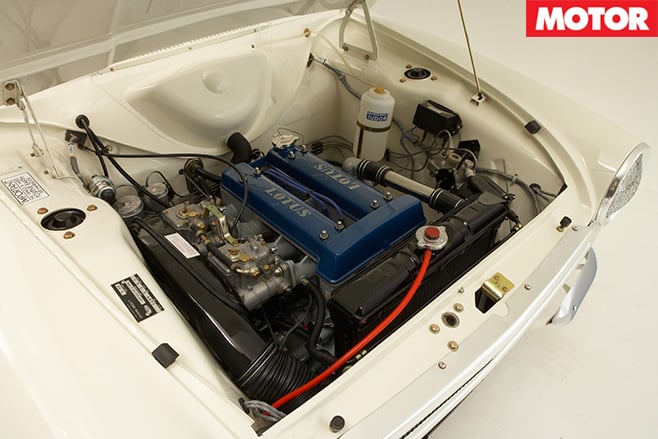
By 1962, Ford had the five-main-bearing Kent on line. With its capacity of 1.5 litres (1499cc, although the car pictured here is the later 1558cc) with Mundy’s double-overhead-camshaft head in place, it cranked out an astounding (for the time) 78kW – Chapman would have called it 105 horsepower.
And don’t forget that a standard Cortina didn’t have carpets or a radio and even the E-Type Jag didn’t get a glovebox lid as standard in those days, so a twin-cam engine was real news.
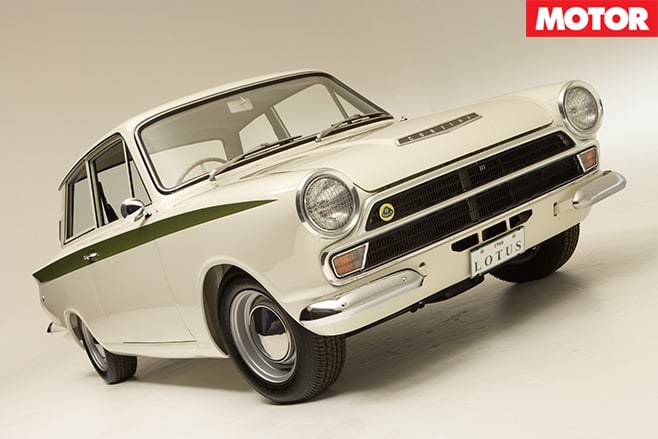
The mods to the front were pretty predictable, with shorter struts and forged (rather than pressed-steel) track arms. But out back, the changes were much bigger. The standard Cortina live axle suspended by leaf springs was flung in a skip and an A-frame cradle sprung by coils and upright dampers slotted in.
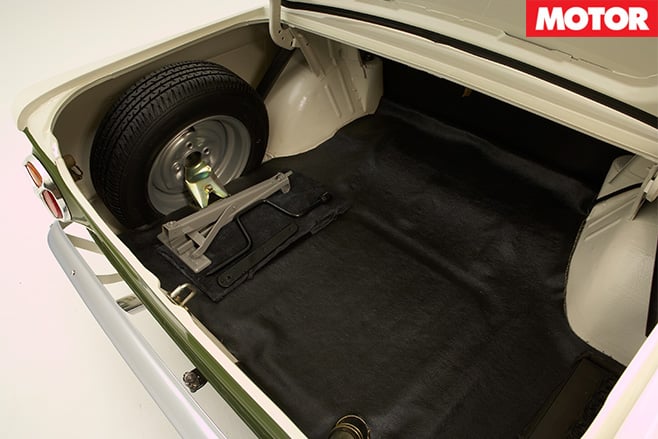
That dictated some strengthening ribs and braces in the boot and the rear-seat bulkhead, standing the spare tyre upright. While they were at it, the engineers also moved the battery to the boot to improve weight distribution.
Body-wise, you had front quarter-bumpers, Lotus badges and a white-with-green-stripe colour scheme (though Ford built a few red cars for racing). But, more importantly, the boot, bonnet and doors were pressed from aluminium to keep weight down.
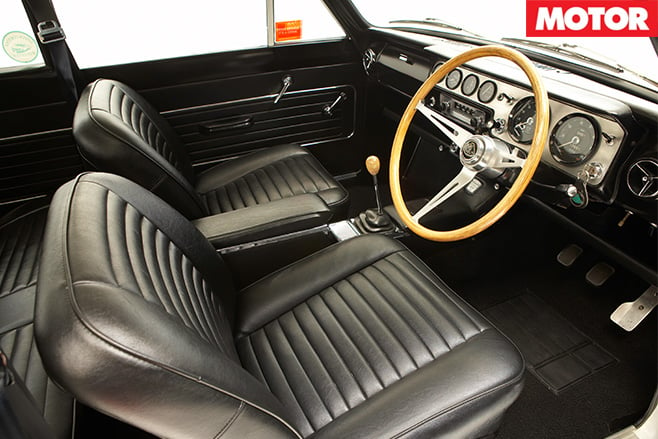
Inside, the Elan gearbox dictated a centre console to allow for the different shifter location and you got racy seats and a full suite of gauges so you could tell precisely when the engine was about to explode.
Timing chains wore out quickly and, if you’re shopping for one, listen carefully for timing-chain rattle, particularly when the engine is hot. Watch out for a timing-chain adjuster that’s screwed in as far as it’ll go, too, as that indicates chain and guide wear.
The rear suspension also proved fragile, with many competition cars requiring constant attention to keep their rears tracking properly and the diffs off the ground. The other big problem surrounded the gearbox ratios.
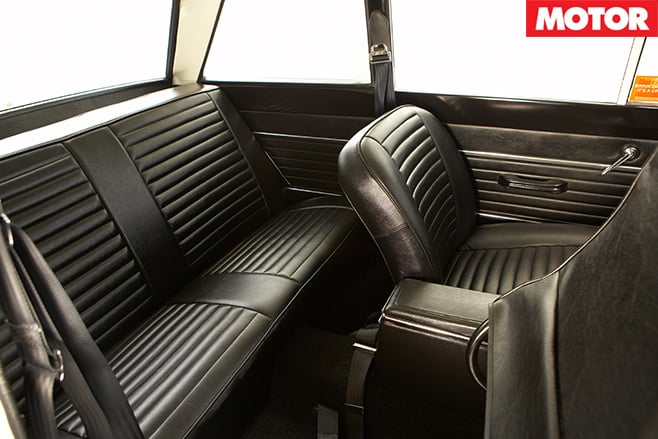
To be honest, a ‘normal’ Cortina GT was a vastly better day-to-day road car. But that ignores the fact that the Lotus Cortina was a real legend and a giant-killer into the bargain. It might have been flawed as a road car, but as its racing history becomes more fully appreciated and its collectability assured, the smart money says get in now if you want one.
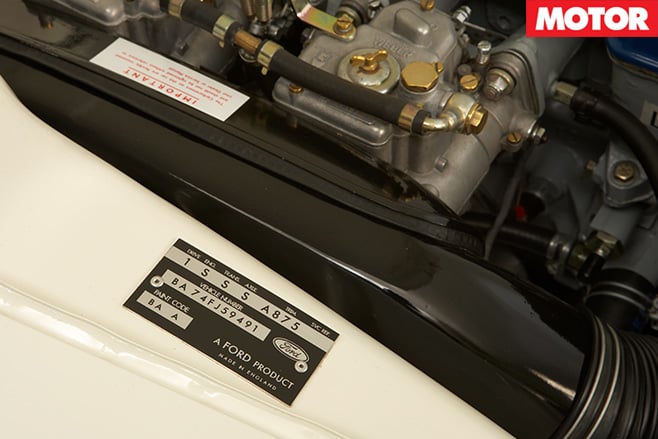
Apart from those durability and reliability issues we mentioned, the big catch is finding a Lotus Cortina that isn’t what it purports to be. Since the bodyshell was common as muck (and plenty have survived) and the Lotus twin-cam was ultimately used in all sorts of different models, there are still punters out there who reckon the idea of taking one and bolting it into the other, painting a green stripe down the side and tripling their money is a great plan. Ringers, we’re talking about.
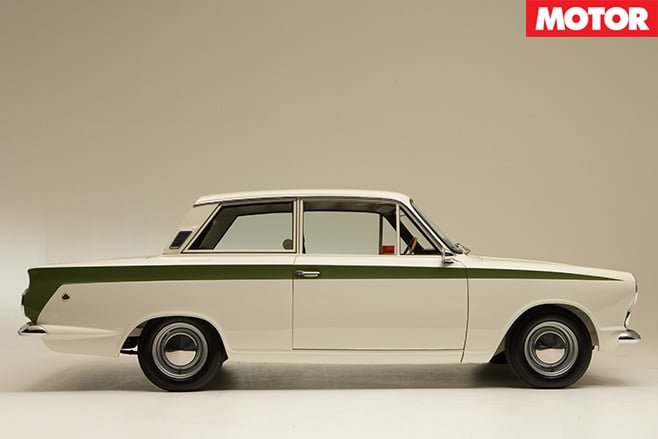
THE GOOD
1. Bona-fide heritage It’s a 24-carat collectible with bonafide heritage in a world where too many second-tier cars are riding the investment financial rollercoaster.
2. Barrel of laughs A good example will still be rewarding to drive. It won’t be the fastest thing on the block any more, but it should still be fit enough to make you giggle on the right day.
3. Monkey business Provided you can find somebody who knows their way around the engine, keeping a Lotus Cortina in fine fettle shouldn’t be as taxing as it would be for many exotics.
THE BAD
1. Ka-pow! Could often be pinless grenades for no good reason. The engines weren’t the only demon, either – the rear suspension was also a problem child until a fix job in 1965.
2. Fine Cotton Don’t even think about forking out gold on a Lotus Cortina until the car in question has been verified by a proper expert. Be wary of advertised race history, too.
3. Only for Sundays Attempt to use a Lotus Cortina every day and you’ll wind up hating the thing for its hopeless gearbox ratios, fragility and race-car manners. It’s no grocery-getter.
Escort service
Even before the Lotus-bred Mk II Cortina and its touring-car aspirations went the way of the dodo. Ford decided to shove the Lotus 1558cc DOHC 8-valve four (and much of Cortina’s running gear) into the newer, lighter Mk I Escort. The Escort Twin Cam was born. Developed by Ford UK’s motorsport department and unveiled to the public in January 1968 as a limited homologation special, the Twin Cam had twice the power (82kW) of the basic Escort 1100, and formed the basis of a highly successful era of rallying for the marque. In June 1971, it was replaced by a Cosworth-tuned 16-valve RS1600 model.
The Lotus Cortina was a pretty handy race car … when it hung together. The first 1000 homologation cars were completed in September 1963 and that same month a pair of Lotus Cortinas finished third and fourth at a touring-car race at Oulton Park in Britain. They finished behind a pair of V8 Ford Galaxies but, significantly, in front of a pair of 3.8-litre Jaguars, which had been the dominant force up until then.
In 1964, the great Jim Clark was British Saloon Car Champion thanks to a Lotus Cortina and the little buggers are still a force to be reckoned with in historic racing.
The car’s highest ever recorded speed was a stunning 236km/h (147mph) down Conrod Straight at Bathurst with Marc Ducquet at the wheel.
In rallying, the Lotus Cortina should have done better than it eventually did. On tarmac stages it was sometimes all but unbeatable, but on gravel and other harsh conditions it displayed infamous fragility.
The first works rally win didn’t come until December 1965 when Roger Clark and Graham Robson won the Welsh International. By then, the troublesome A-frame rear end had been replaced.
