Chinese automotive giant BYD has officially overtaken Tesla to become the world’s largest seller of battery-electric vehicles, marking a major shift in the global EV landscape after another difficult year for Elon Musk’s company.
According to Tesla’s fourth-quarter 2025 results, the US-based brand delivered 1,636,129 electric vehicles globally last year, down from 1,789,226 in 2024. The decline represents Tesla’s second consecutive annual sales drop, ending its long-standing reign as the dominant force in the global EV market.
By contrast, BYD recorded a strong year despite late-year headwinds. The Chinese manufacturer sold 2,254,714 battery-electric vehicles worldwide in 2025, an increase of 28 per cent year on year. While BYD has previously outperformed Tesla in individual months and in total electrified vehicle sales (including hybrids), this marks the first time it has surpassed Tesla (below) on an annual global basis for pure EVs.
The result has been building for some time, as competition intensifies and Chinese brands rapidly expand into global markets. BYD and its domestic rivals have gained momentum by offering competitive driving range, advanced battery technology and aggressive pricing – areas where Tesla once held a clear advantage.
David Bailey, Professor of Business Economics at the University of Birmingham, said Tesla is increasingly being squeezed by newer competitors. He noted the brand is “being outcompeted by Chinese firms that offer better value, rapid innovation and strong battery technology,” while also pointing to Tesla’s ageing model line-up and lack of a true small, mass-market EV.
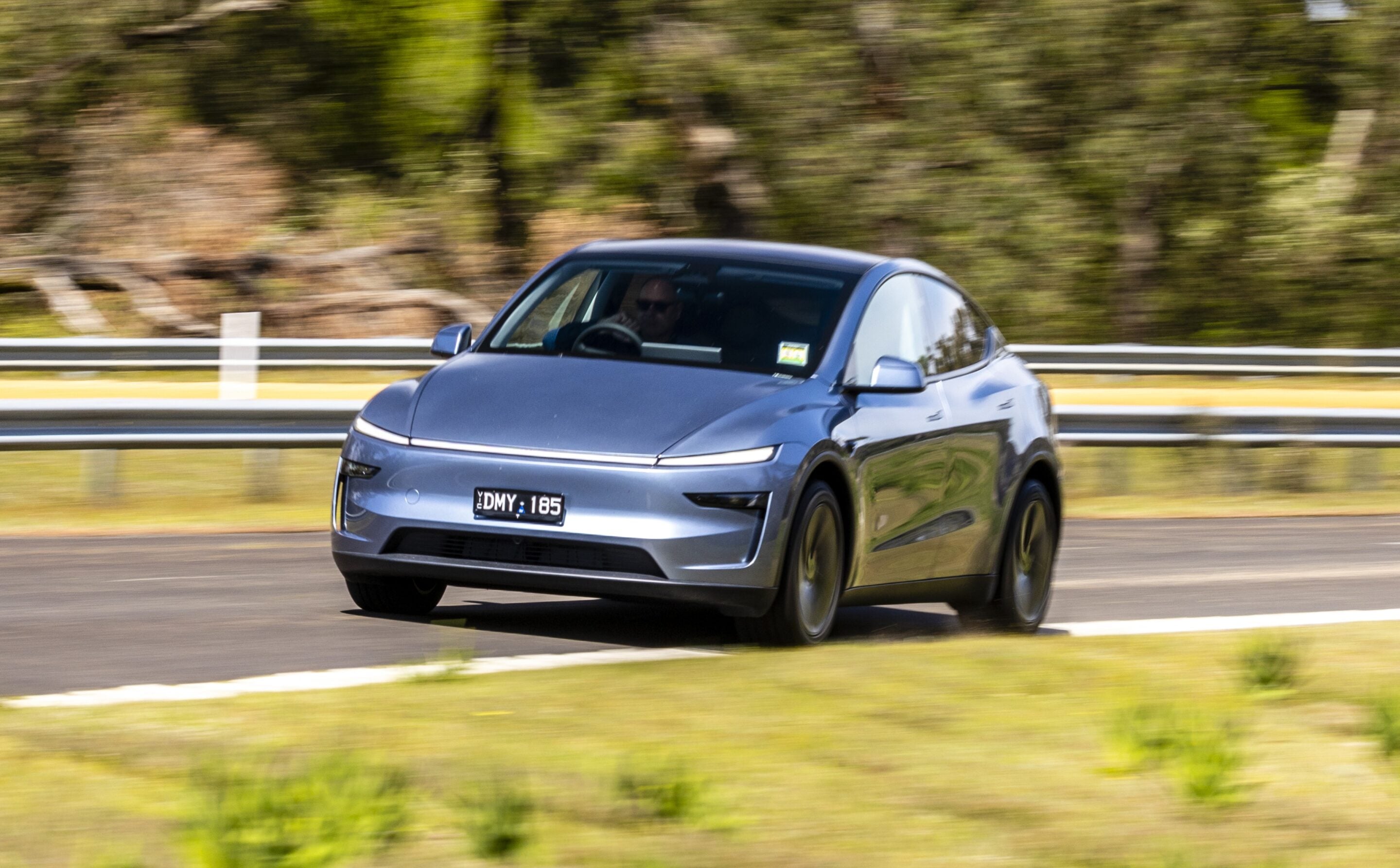
Tesla has attempted to reignite demand by introducing lower-cost variants of existing models, such as a pared-back version of the Model Y. However, broader market conditions are working against it. EV demand has softened in several key regions as incentives are wound back and buyers grapple with cost-of-living pressures.
In the United States, federal tax credits for electric vehicles ended in late 2025, pushing up effective purchase prices and dampening demand. Political controversy surrounding Musk has also proven divisive for some consumers. In Europe and Australia, while governments continue to promote electrification, policy uncertainty and future road-user charging schemes are creating hesitation among prospective EV buyers.
Despite the sales setback, Tesla’s share price remains relatively resilient, buoyed by investor confidence in the company’s autonomous driving, AI development and long-term profitability. The brand continues to push ahead with plans for self-driving technology, with autonomous Tesla vehicles rumoured to be under evaluation for select global cities from 2026.
For now, however, the numbers are clear: BYD has claimed the EV crown, signalling a new phase in the global electric car race – one where Chinese manufacturers are setting the pace.
Alpina has long been the connoisseur’s alternative to BMW M, delivering immense performance wrapped in subtle styling and long-distance refinement. Now, that identity is entering a new chapter, with BMW confirming Alpina is officially operating as a standalone brand under the BMW Group umbrella.
BMW’s acquisition of Alpina was finalised in March 2022, following an agreement struck between the two companies in 2020. That deal included a five-year transition period, during which Alpina continued operating largely independently. With that phase now complete, BMW says 2026 will “mark the launch of BMW Alpina as an exclusive standalone brand under the BMW Group umbrella”.
As part of the formal relaunch, all future models will wear BMW Alpina badging on their rear ends, featuring lettering inspired by the asymmetrical Alpina wordmark used in the 1970s. Interestingly, the brand’s website has yet to adopt the redesigned Alpina roundel revealed in 2025, suggesting visual elements of the new era are still being phased in.
Despite the corporate shift, BMW has made it clear Alpina’s core philosophy will remain intact. The brand has built its reputation on transforming BMW’s flagship models into effortless high-speed grand tourers, focusing on ride comfort, bespoke craftsmanship and understated design rather than outright aggression.
“Key elements of the BMW Alpina brand are its unique balance of maximum performance and superior ride comfort, combined with hallmark driving characteristics,” BMW said. “This is complemented by an exclusive portfolio of bespoke options and custom materials along with unmistakable details.”
The final model produced under Alpina’s previous structure was the limited-run B8 GT, based on the BMW 8 Series Gran Coupe. Powered by a heavily reworked 4.4-litre twin-turbo V8, it produced approximately 466kW and 850Nm of torque. True to Alpina tradition, the car featured an unrestricted top speed of around 328km/h – roughly 23km/h faster than the BMW M8 Competition Gran Coupe.
Alpina has yet to release a fully electric vehicle, but with the brand now fully embedded within BMW Group and access to its expanding EV platforms, an all-electric Alpina appears inevitable. Rather than chasing volume, the brand is expected to continue focusing on BMW’s larger and more luxurious models.
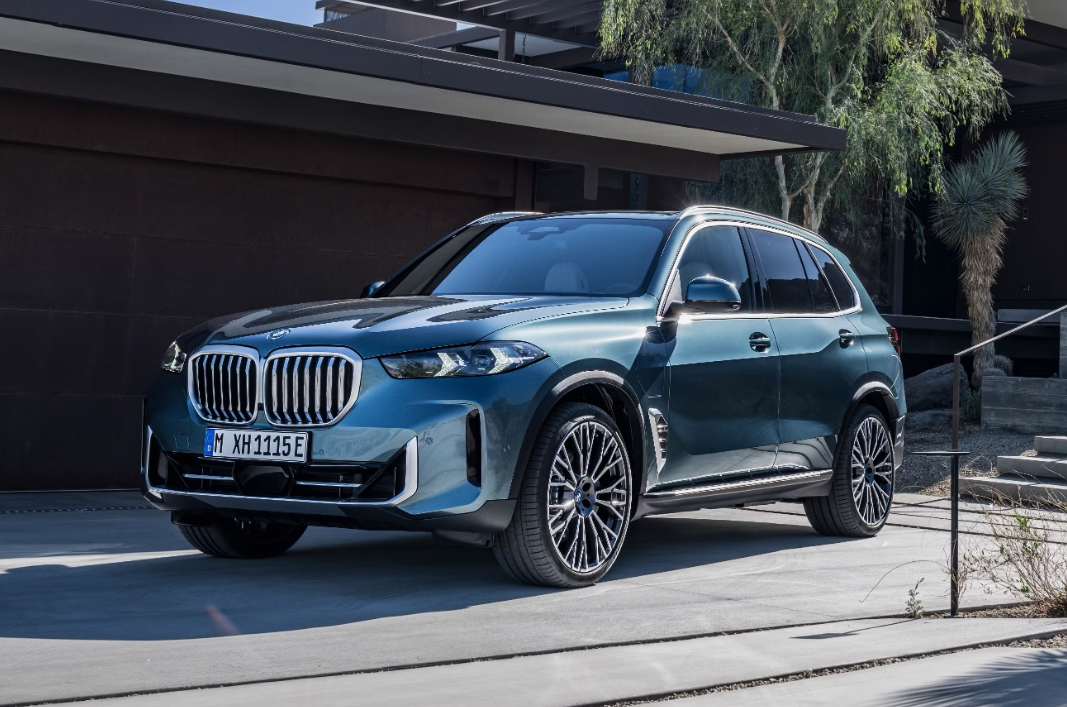
Future candidates for the Alpina treatment are likely to include the next-generation BMW X5 (current gen above), along with updated versions of the 7 Series and X7 – vehicles that align perfectly with Alpina’s long-standing focus on refinement, torque-rich performance and bespoke luxury.
For enthusiasts, the hope is that while ownership has changed, the essence of Alpina remains untouched: discreet, devastatingly fast BMWs for those who value nuance over noise.
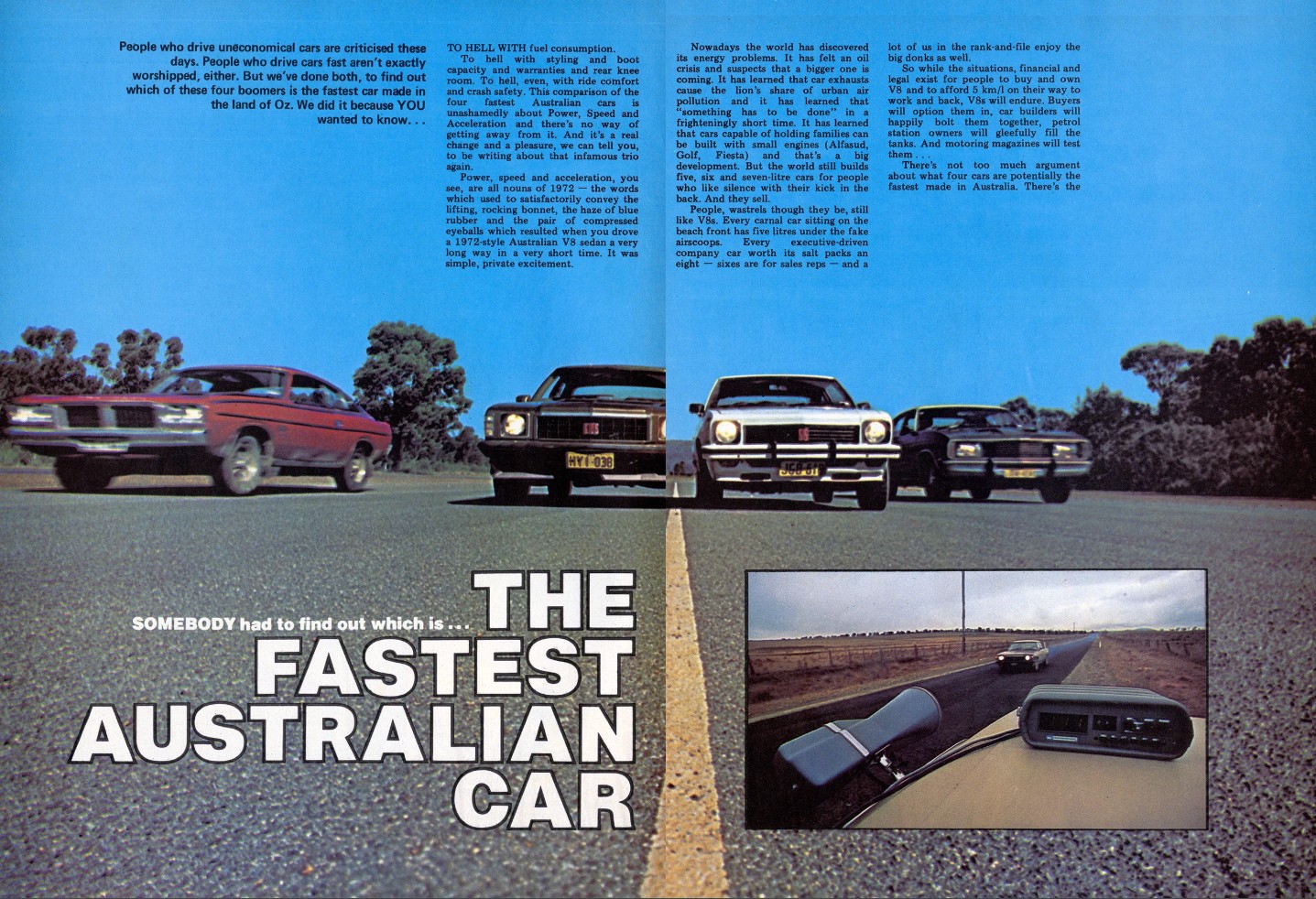
People who drive uneconomical cars are criticised these days. People who drive cars fast aren’t exactly worshipped, either. But we’ve done both, to find out which of these four boomers is the fastest car made in the land of Oz. We did it because YOU wanted to know…
First published in the September 1977 issue of Wheels magazine, Australia’s best car mag since 1953. Subscribe here and gain access to 12 issues for $109 plus online access to every Wheels issue since 1953.
To hell with fuel consumption. To hell with styling and boot capacity and warranties and rear knee room. To hell, even, with ride comfort and crash safety. This comparison of the four fastest Australian cars is unashamedly about Power, Speed and Acceleration and there’s no way of getting away from it. And it’s a real change and a pleasure, we can tell you, to be writing about that infamous trio again.
Power, speed and acceleration, you see, are all nouns of 1972 – the words which used to satisfactorily convey the lifting, rocking bonnet, the haze of blue rubber and the pair of compressed eyeballs which resulted when you drove a 1972-style Australian V8 sedan a very long way in a very short time. It was simple, private excitement.
Nowadays the world has discovered its energy problems. It has felt an oil crisis and suspects that a bigger one is coming. It has learned that car exhausts cause the lion’s share of urban air pollution and it has learned that “something has to be done” in a frighteningly short time.
It has learned that cars capable of holding families can be built with small engines (Alfasud,
Golf, Fiesta) and that’s a big development. But the world still builds five, six and seven-litre cars for people who like silence with their kick in the back. And they sell.
People, wastrels though they be, still like V8s. Every carnal car sitting on the beach front has five litres under the fake airscoops. Every executive-driven company car worth its salt packs an eight – sixes are for sales reps – and a lot of us in the rank-and-file enjoy the big donks as well.
So while the situations, financial and legal, exist for people to buy and own V8s and to afford 5 km/I on their way to work and back, V8s will endure. Buyers will option them in, car builders will happily bolt them together, petrol station owners will gleefully fill the tanks. And motoring magazines will test them …
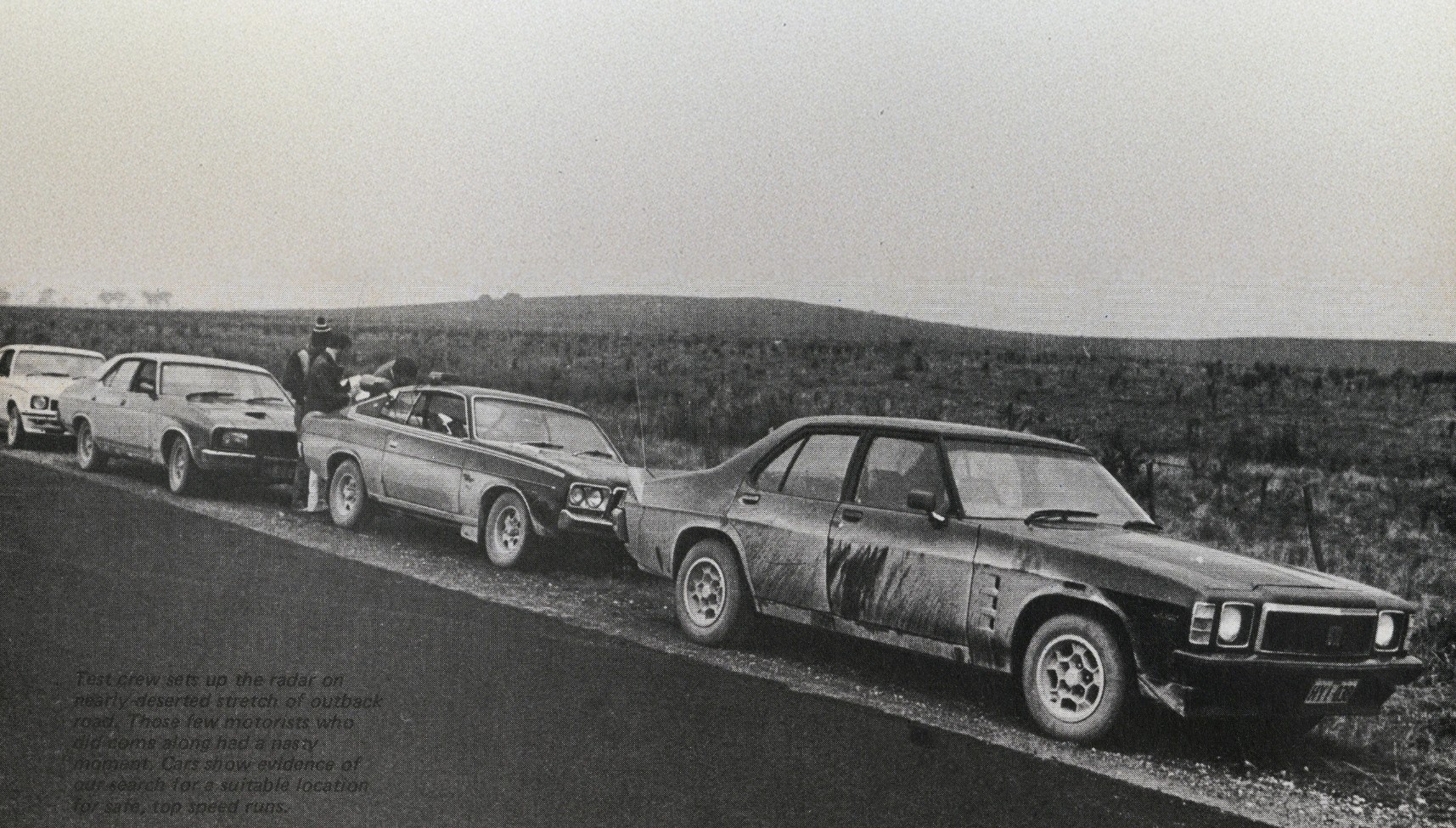
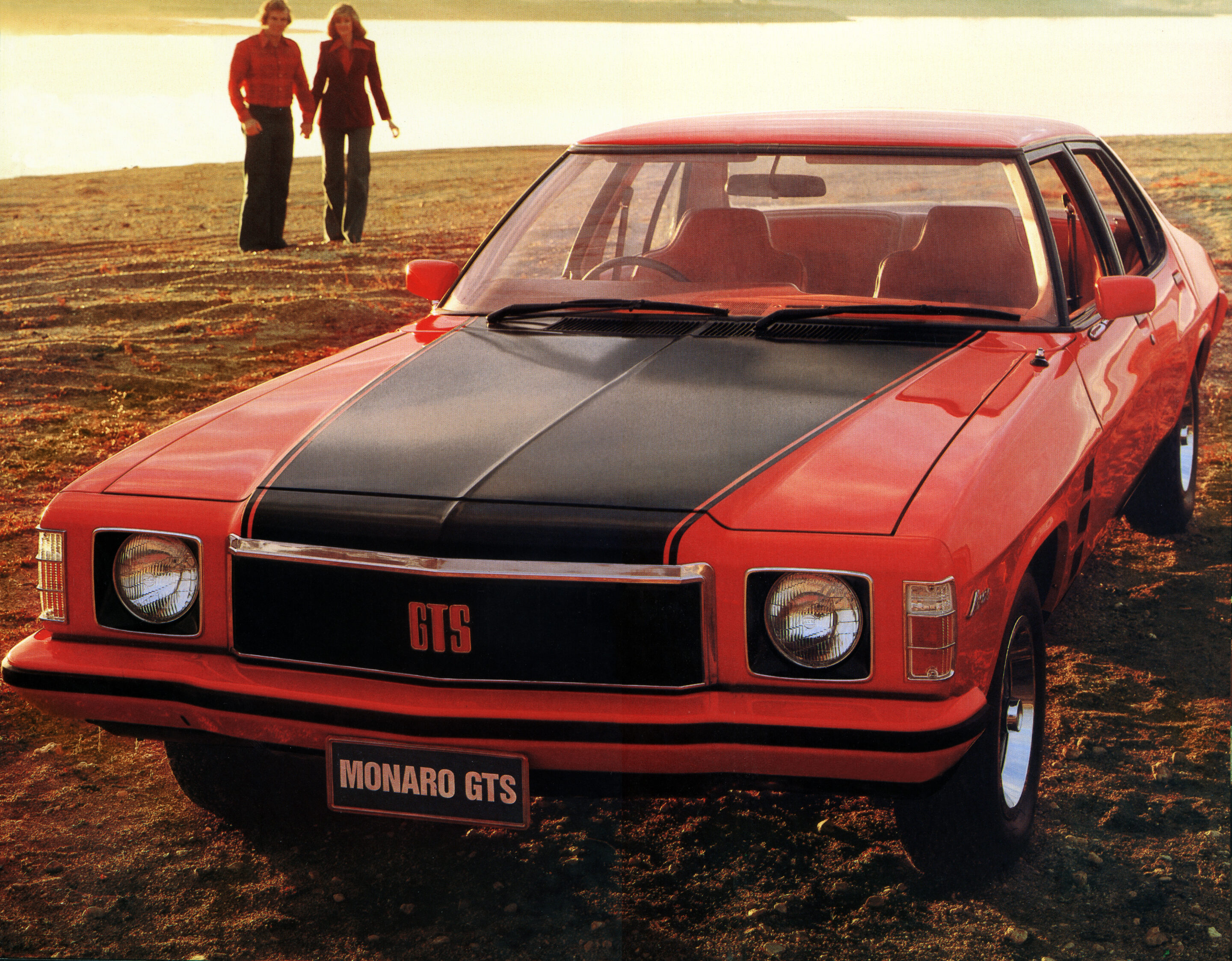
There’s not too much argument about what four cars are potentially the fastest made in Australia. There’s the obvious one – the 5.7 litre Ford Falcon, packing the biggest engine in a local lump. There are two Holdens – the Monaro GTS and Torana which both have the five-litre V8 as their top engine. And there’s a Charger, the lightest of the big Chryslers, but not a 5.3 litre V8. We spoke to Chrysler’s engineers and were assured that if we were prepared to give a 4.3 litre hemi-six Charger long enough to wind up, it would shade a 5.3.
We assembled these cars and as always there were hassles to be coped with and compromises to be made. The biggest compromise was deciding to make do with automatic transmissions in all of the cars. For one thing they make hardly any manual 5 and 5.7 litre V8 cars now and for another (as we were assured by a succession of plausible-sounding experts) at higher engine revs, torque converters in modern slushboxes lock solid so there was “certainly” no slippage and subsequent power loss at top speed.
And for yet another thing, the autos were typical cars – cars like we could actually buy from our friendly local Big Three chiseler. So with management bleating about deadlines, we took the self-shifters.

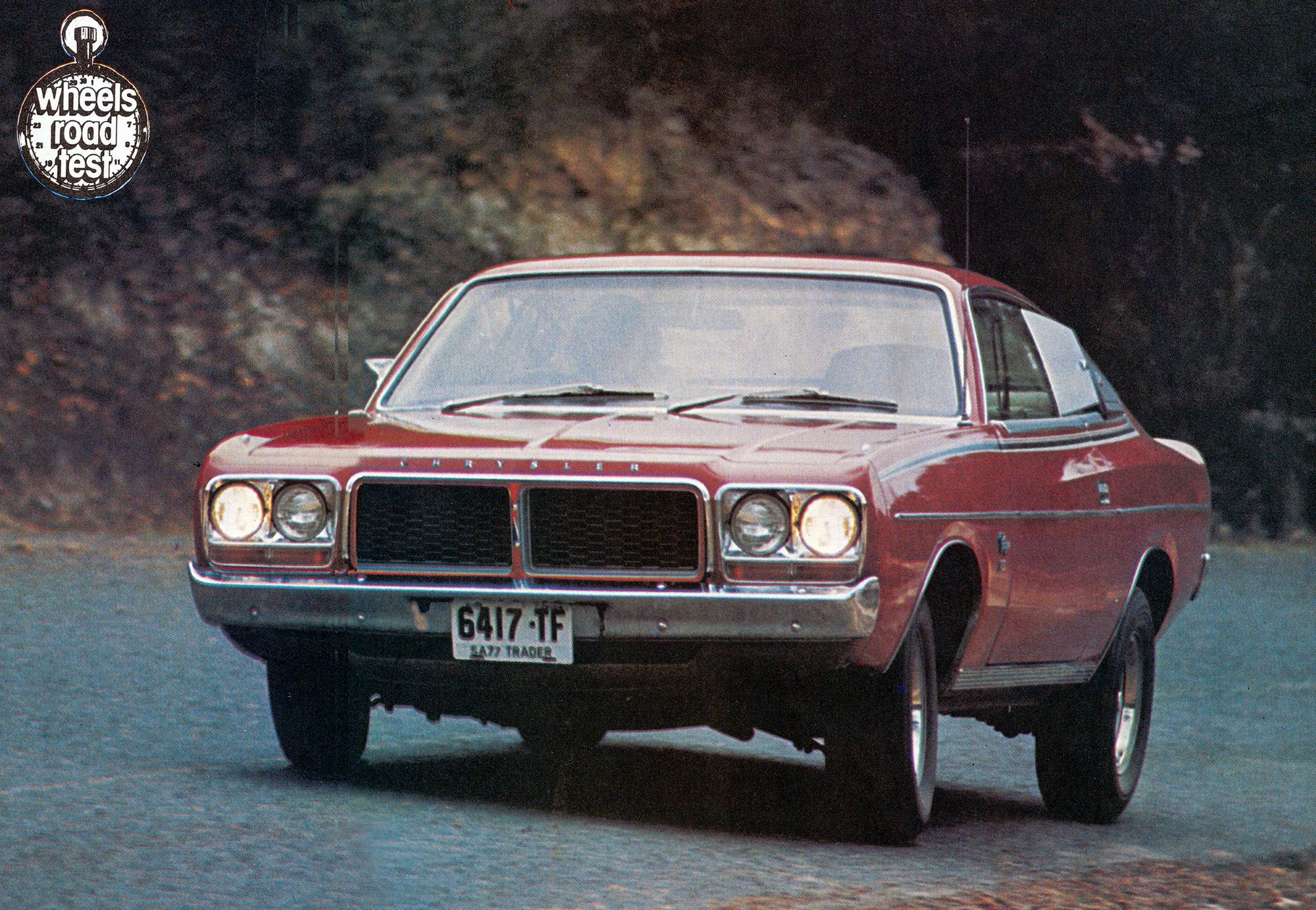
The Charger was a maroon 265 auto, the same one which Mr Editor Robinson brought back from the CL Chrysler release in Adelaide. Now it had 13,000 kilometres on its odo – most of it at the hands of other road testers but some with more sympathetic drivers (such as Miss Australia candidates and company heavies across from Adelaide) aboard. It was loose in the engine, tight in the body and growled as healthily as ever when you got on the power.
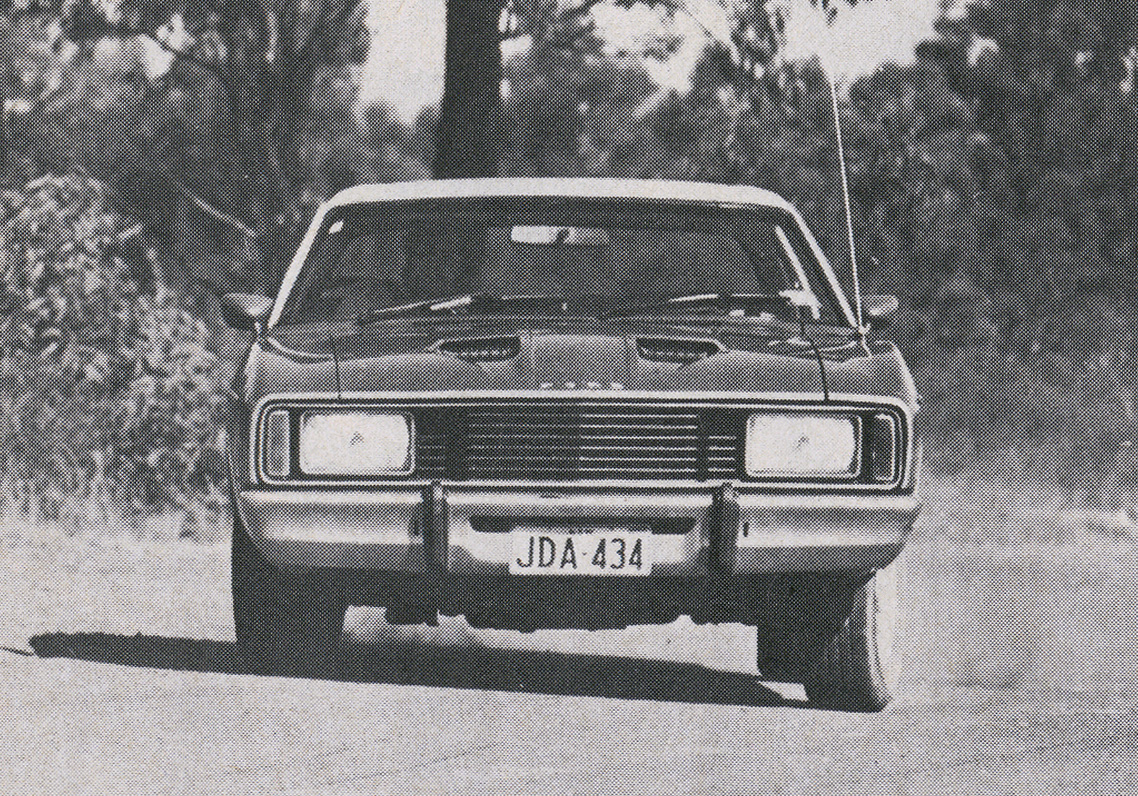
The Falc belonged to “one of the managers” of Ford Sales, Sydney. It was a GXL with air, tape, a hole-in-the-roof and all the other trick bits. It had about 4500 kilometres on the clock and ran like a very quiet Swiss watch. It was reputed to have a dud fuel gauge and demister but the gauge stopped working for a grand total of three seconds in four days and the demister distinguished itself by being one of the finest we’ve ever used.
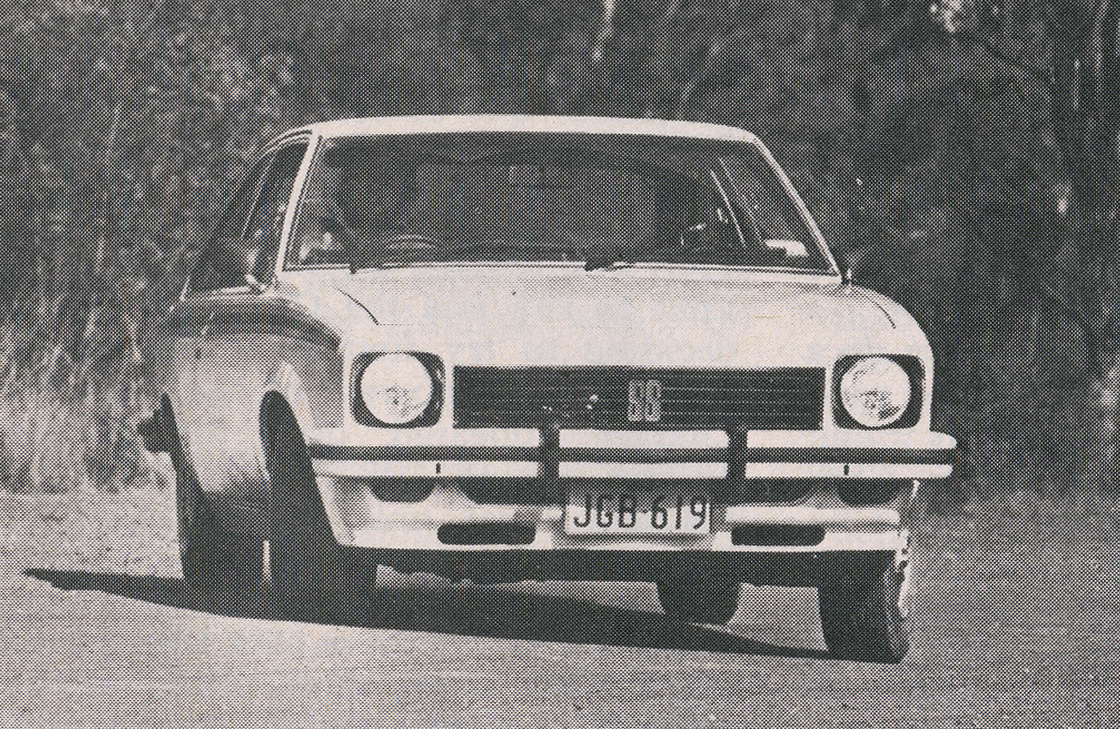
The Torana was a brand new SS Hatchback built for the Sydney PR fleet and run in by a selfless staff man who spent 1000 kilometres and a weekend looking for a sufficiently flat, straight, deserted and well surfaced piece of road within sensible distance of Sydney for us to time our top speeds in acceptable safety. The Torana had about 2300 kilometres up when we ran it for the clocks – perilously few but as many as we could manage.
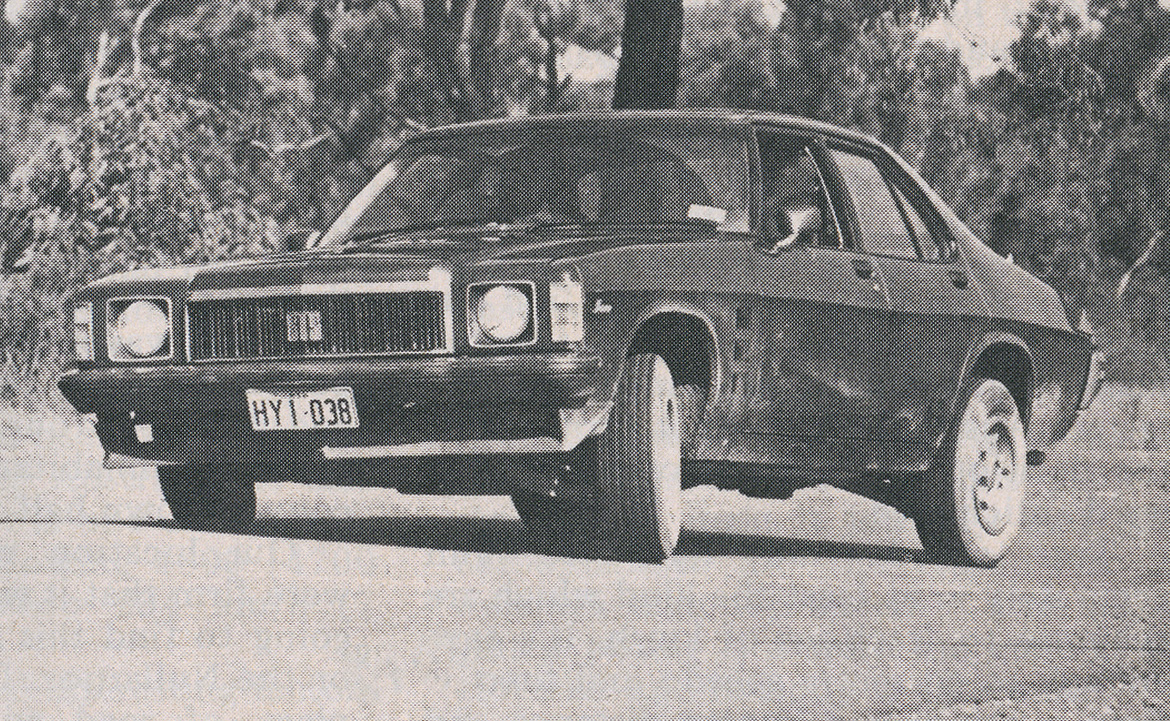
The GTS came from a GMH staff member. It had 12,000 kilometres up and distinguished itself from the rest by appearing to have very little in the way of front shocks. But the engine was sweet when you got it to about 2000 rpm – below that, like the Torana, it showed its ADR27 A heritage by belching and running irregularly.
These were the four. We planned to take them out and find out, once and for all, which was the quickest in a straight line under as neutral conditions as we could find – then to take them to the dragstrip and find out about their accelerations and then to make a judgement on which was the fastest Australian car. As it turned out, the decision was quite a lot easier than we’d anticipated.
Top speeds are hard to run accurately – at least the kind which are accurate to fractions of km/h. It’s easy enough to correct a speedo and then to time a car over a known distance and compute its average speed for that distance. That tells most people what they want to know.
This time we wanted it exact, so we approached a man who is about to start importing radar units for use by Australian police – they’re in the evaluation stage right now – and borrowed a unit to give us dead accuracy.
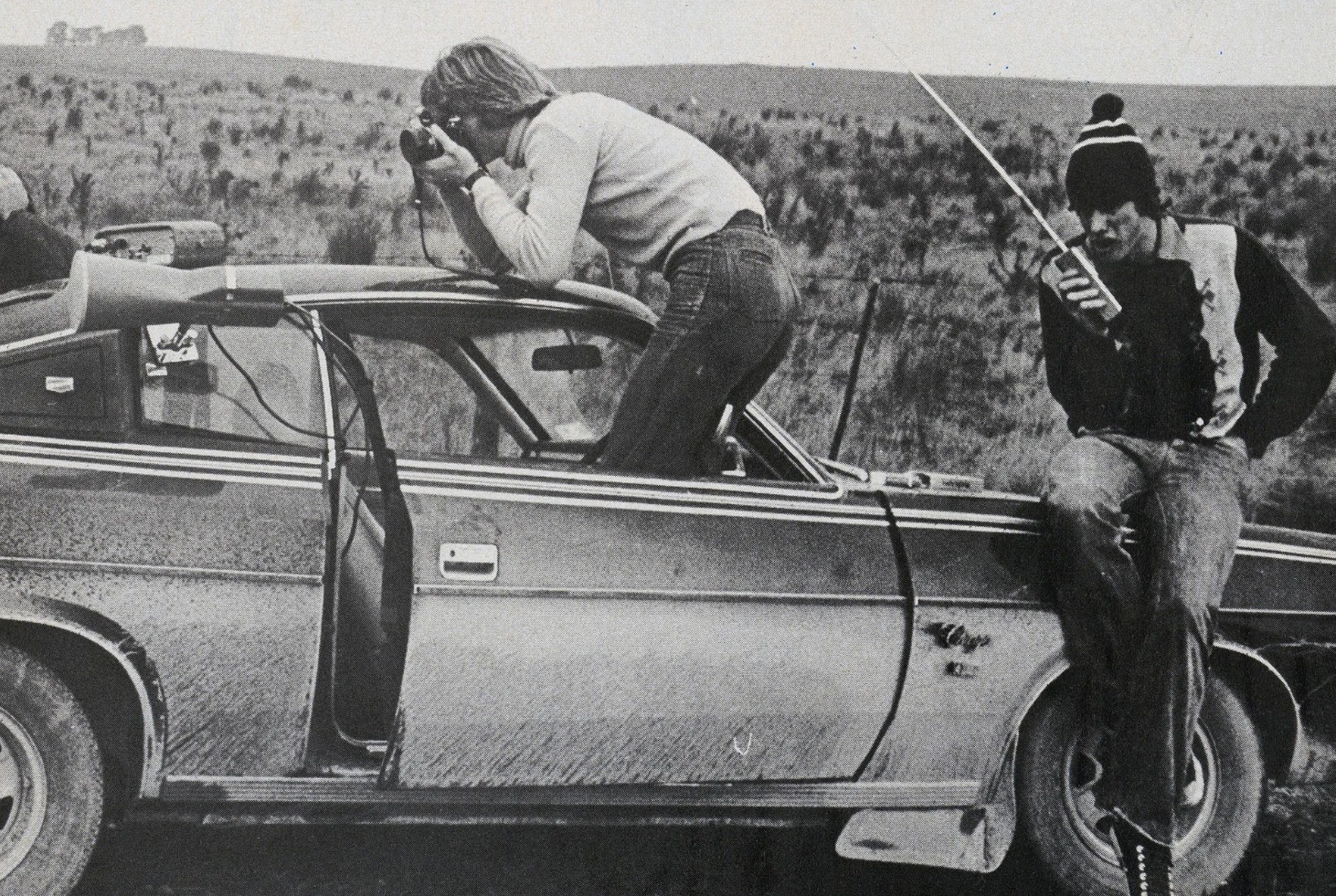
Our original plan was to set the radar unit up inside each car, beaming down the road and taking readings off the scenery as it flashed past, giving us top speeds. We soon found that approaching cars and the scarcity of substantial fences, rocks and so on on the verges of our piece of straight road put paid to that idea. The radar unit worked okay, but there were fairly long periods where you’d be sitting there with 180-plus on the speedo and the radar readout screen showing a moronic blank. Occasionally it would flash an isolated figure out of the nothingness for a few seconds but there would be no way of knowing if that was the maximum figure or not.
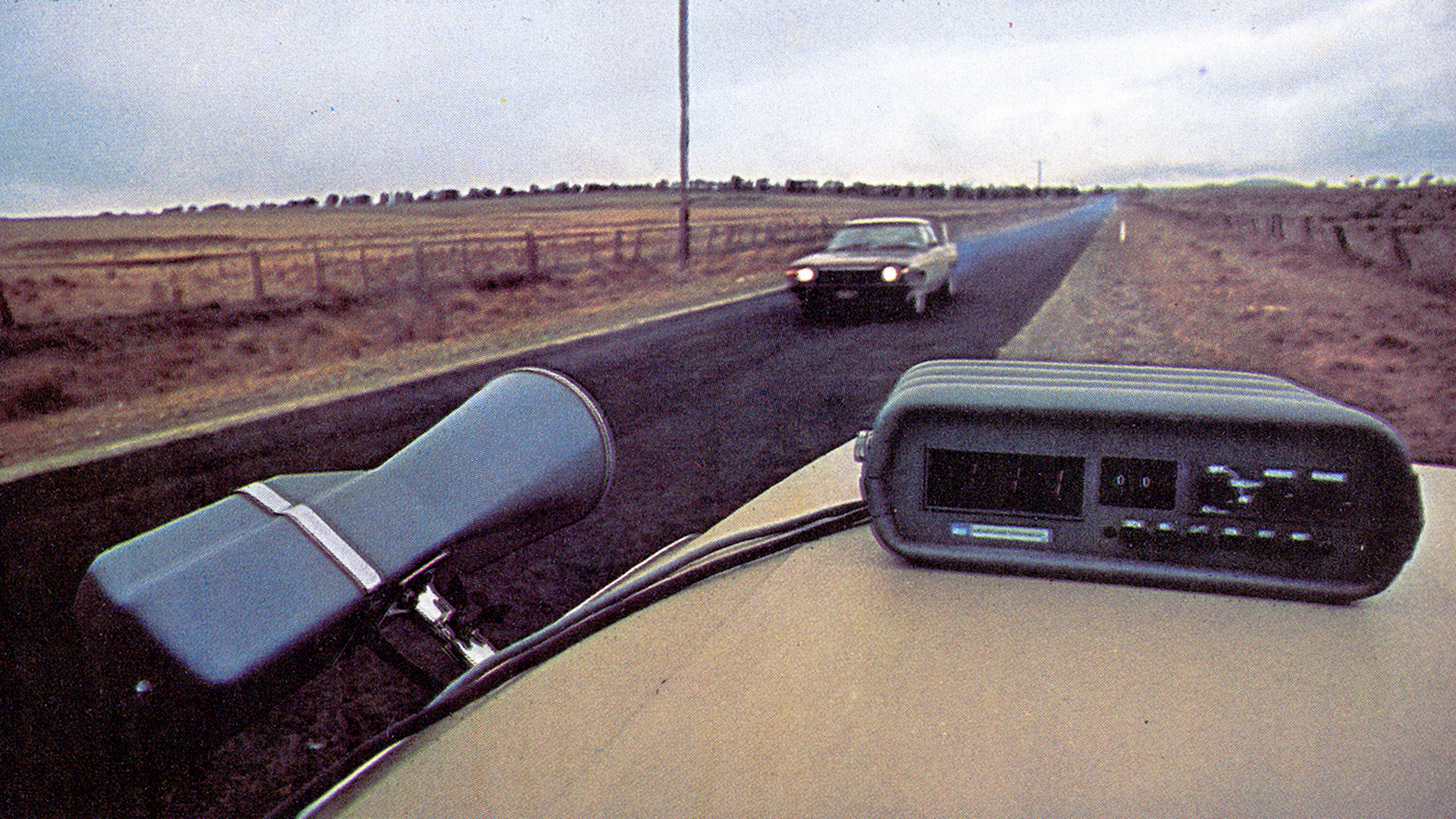
There was nothing for it but to do a police force, set the unit up on the road and drive our four cars through it – and scare the inhabitants of a certain NSW country town half to death.
Our location wasn’t ideal, but we were firm that it was as good as we were going to find this side of the Hay Plain or the Nullarbor. It was a straight, wide piece of road without a centre line, de-restricted, within three miles of the centre of a country town, yet practically deserted. The run-up to the radar straight – about two kilometres long – had a few bends but they could be taken at top speed. There was about four kilometres of wind-up available and a slight slope on the run into our timing straight. As well as that, a fairly fresh breeze was assisting the cars from right three-quarter rear. In short, the cars had just a little help – or at least no hindrances.
The top speed runs
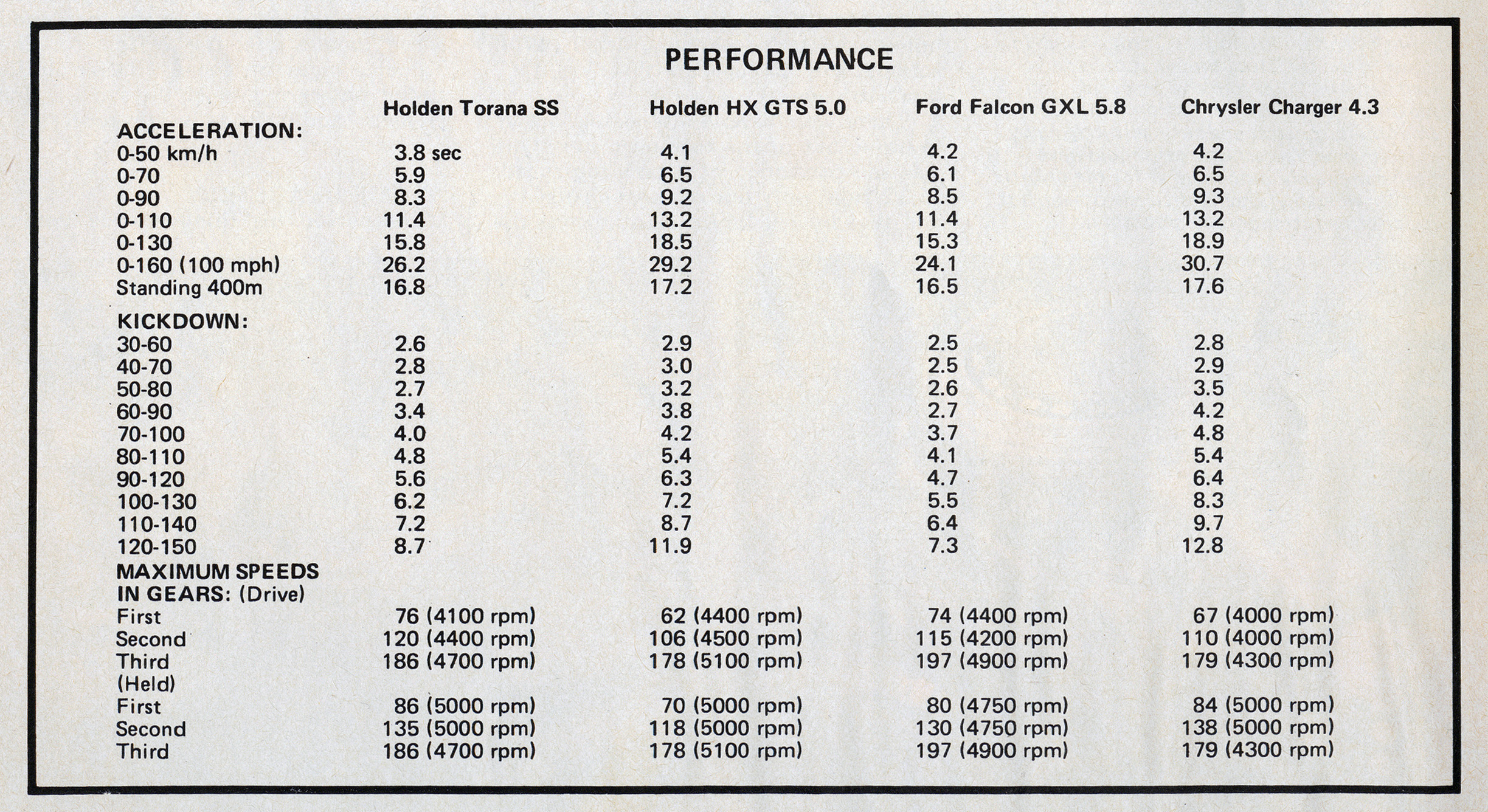
First to run was the Charger, our man deciding to try first what he thought would be the slowest of the four. The Charger appeared over the horizon pulling around 108 (the scale on our US-built radar unit was in miles per hour) and built up to 112 which it held through the trap without wavering.
Repeated twice more, the Charger did exactly the same. It surprised us that the top speed of a car was such a finite quantity – we’d expected to have three different readings, differing by as much as 5 mph (8 km/h). But it didn’t happen. The top speed of the Charger went into the notebook at 179 km/h. Its tacho was dead accurate at 4300, its speedo 8 km/h fast at top speed.
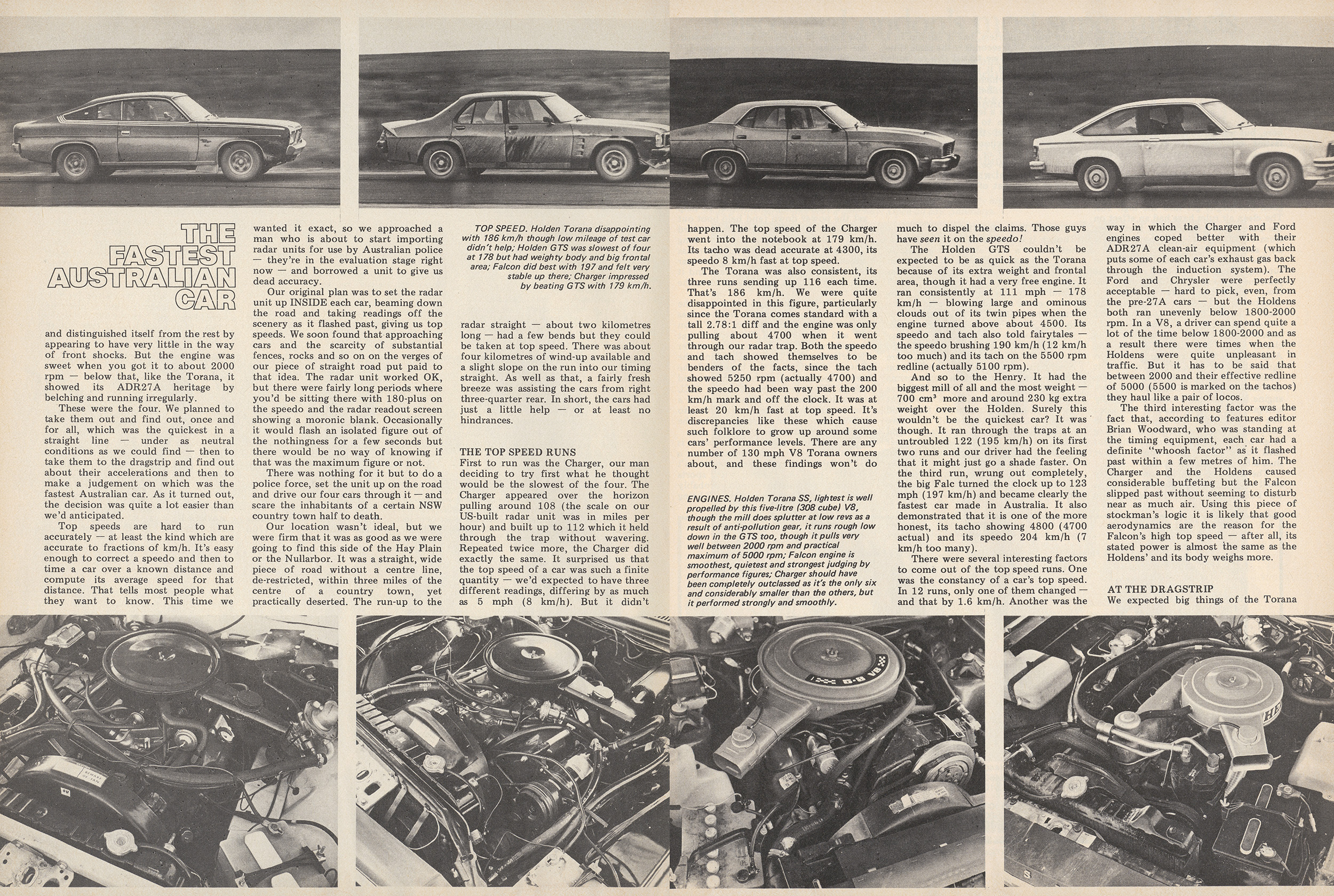
The Torana was also consistent, its three runs sending up 116 each time. That’s 186 km/h. We were quite disappointed in this figure, particularly since the Torana comes standard with a tall 2.78:1 diff and the engine was only pulling about 4700 when it went through our radar trap.
Both the speedo and tach showed themselves to be benders of the facts, since the tach showed 5250 rpm (actually 4700) and the speedo had been way past the 200 km/h mark and off the clock. It was at least 20 km/h fast at top speed. It’s discrepancies like these which cause such folklore to grow up around some cars’ performance levels. There are any number of 130 mph V8 Torana owners about, and these findings won’t do much to dispel the claims. Those guys have seen it on the speedo!
The Holden GTS couldn’t be expected to be as quick as the Torana because of its extra weight and frontal area, though it had a very free engine. It ran consistently at 111 mph – 178km/h – blowing large and ominous clouds out of its twin pipes when the engine turned above about 4500. Its speedo and tach also told fairytales – the speedo brushing 190 km/h (12 km/h too much) and its tach on the 5500 rpm redline (actually 5100 rpm).
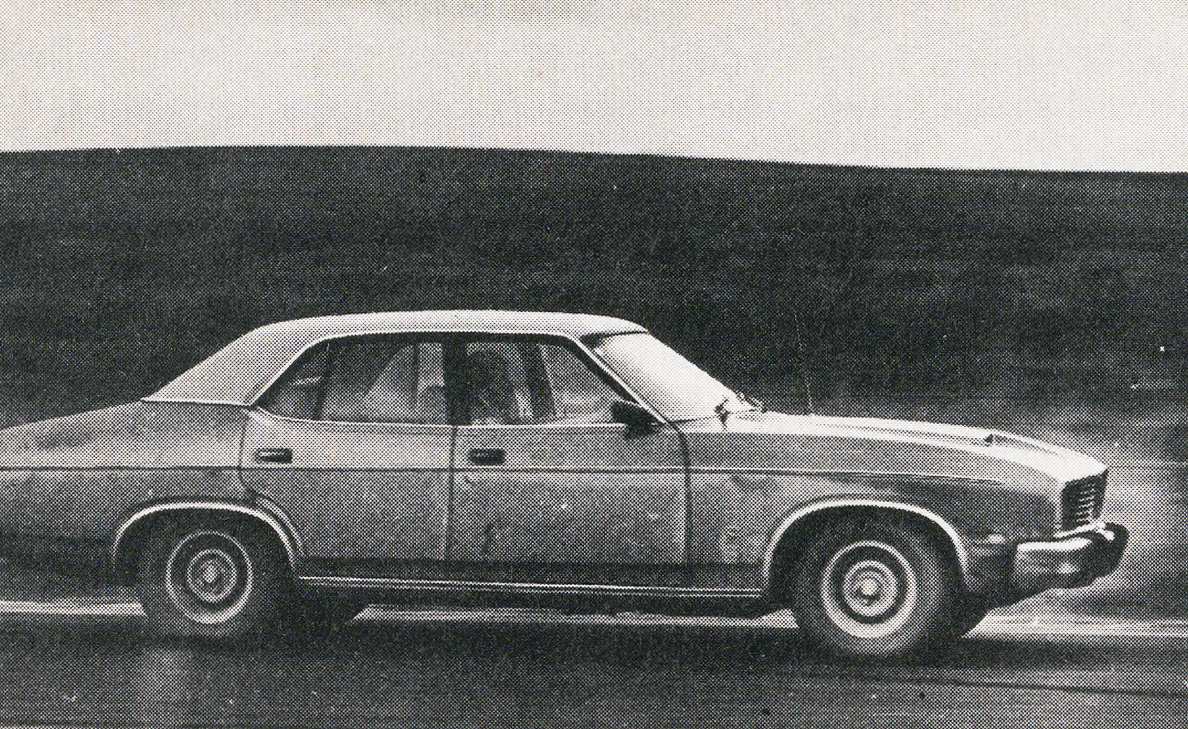
And so to the Henry. It had the biggest mill of all and the most weight – 700 cm3 more and around 230 kg extra weight over the Holden. Surely this wouldn’t be the quickest car?
It was· though. It ran through the traps at an untroubled 122 (195 km/h) on its first two runs and our driver had the feeling that it might just go a shade faster. On the third run, wrung out completely, the big Falc turned the clock up to 123 mph (197 km/h) and became clearly the fastest car made in Australia. It also demonstrated that it is one of the more honest, its tacho showing 4800 (4700 actual) and its speedo 204 km/h (7 km/h too many).
There were several interesting factors to come out of the top speed runs. One was the constancy of a car’s top speed. In 12 runs, only one of them changed – and that by 1.6 km/h.
Another was the way in which the Charger and Ford engines coped better with their ADR27 A clean-air equipment (which puts some of each car’s exhaust gas back through the induction system). The Ford and Chrysler were perfectly acceptable – hard to pick, even, from the pre-27 A cars – but the Holdens both ran unevenly below 1800-2000rpm. In a V8, a driver can spend quite a lot of the time below 1800-2000 and as a result there were times when the Holdens were quite unpleasant in traffic. But it has to be said that between 2000 and their effective redline of 5000 (5500 is marked on the tachos) they haul like a pair of locos.
The third interesting factor was the fact that, according to features editor Brian Woodward, who was standing at the timing equipment, each car had a definite “whoosh factor” as it flashed past within a few metres of him. The Charger and the Holdens caused considerable buffeting but the Falcon slipped past without seeming to disturb near as much air. Using this piece of stockman’s logic it is likely that good aerodynamics are the reason for the Falcon’s high top speed – after all, its stated power is almost the same as the Holdens’ and its body weighs more.
At the dragstrip
We expected big things of the Torana here, but we didn’t really get them. The fastest car over the standing 400m course, by a comfortable 0.3 seconds, was the Falcon which turned up 16.5 seconds. That, in Falcon terms, isn’t spectacular because in 1973 auto 351s could be expected to record 16s and a good one might get into the high 15s.
The clean air rules have had an effect on the Falc’s performance. But it still gets from 0-160 km/h (100 mph) in a lively 24.1 sec.
The Torana, for all our attempts at running-in and its top speed runs on the previous day was still suffering from too few kilometres. It turned a disappointing 16.8 for the 400m and made it to 160 km/h in 26.2 sec – 2.1 sec slower than the Falcon. It would improve with age but not enough to be clearly the fastest accelerating Australian production car.
It might equal the Falc, but in our opinion it wouldn’t do much better than that. On the face of it, the General’s five-litre engine is considerably more affected by anti-pollution mods than is the Ford 351 ( or the 302 if our experience with our orange long-term test car is anything
to go by). A good five-litre Torana auto used to be 0.1 or 0.2 seconds quicker than a Falcon over the 400m.
The Charger, with its comparatively small engine and long gearing (as tall as the Falcon’s) couldn’t be expected to turn quick quarters, but it ran out in a creditable 17 .6 seconds – the same time recorded when we tested this car early this year – and it ran to 160 km/h in 30.7 seconds which is a shade slower than the GTS. Before ADR27 A you could expect 17.2-17.3 from this car.
The GTS ran a leisurely 17.2 second quarter and ran to 160 km/h in 29.2 seconds. It had the advantage of a prime, 13,000 kilometre engine, but it was at least 0.7 or 0.8 seconds slower
than it used to be. That performance loss is consistent with the Torana’s and greater than that of either the Charger or the Ford.
Across the ground
Though it is least considered by fast car enthusiasts a car’s ability to go fast in typical road conditions is the most important of the three major yardsticks of performance. After all, you don’t spend much time on flat, straight roads – it took us several days of searching to find one within 200 kilometres of Sydney – and you can’t drive up and down Castlereagh Dragstrip all day either. They’d miss you at work …
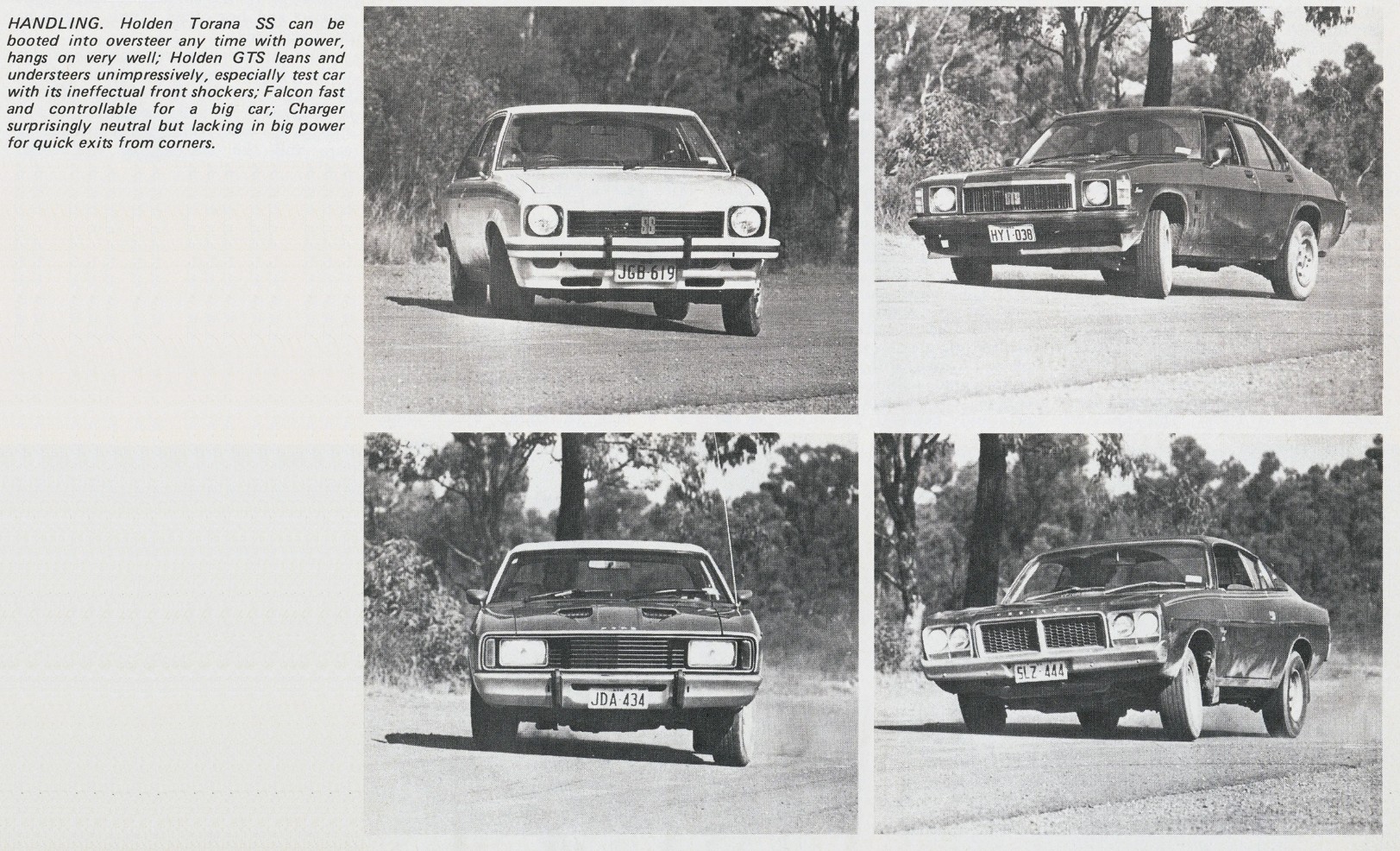
The Falcon and the Torana were clearly the two best at fast cruising on NSW’s array of roads with only a prima facie 80 km/h limit. The GTS was clearly the worst with its over-light power steering, its outmoded front end geometry which caused it to move about on the road a lot, its rear-end steer caused by Sorbent-soft rear suspension bushes, and a pair of clapped front dampers which caused disturbing wallow and lack of precision.
It needs to be said that by the time this magazine is in your perspiring paw there will be a new range of Holden HXs available with the same “radial-tuned suspension” modifications that have turned Toranas from puddings into cars. The car will have better damping, probably a rear anti-roll bar and stiffer shockers. It will be good. At present it’s terrible – even worse than we remember.
The Charger was an honest handling car with its hefty front anti-roll bar and fairly firm suspension settings all round. It went where it was pointed and hung on well, understeering refreshingly little at quite high cornering speeds. But it lacked out-of-the-corner poke compared with the Torana and Falc and it didn’t have a limited slip differential to help get the power down (and help boot out the tail in tight corners). So it was third best. But the Charger did have long touring legs as Mr Editor Robinson has already said in his test of the car (Wheels, Feb). It was pleasant and it was strong. It just wasn’t as quick as the top two.
It is hard to distinguish between the Falcon and the Torana. Once, there was a clear distinction between the Falcon GT and the Torana SL/R 5000 and that was because the Falcon had stiffer “sports handling” suspension and the Torana didn’t have the benefit of the new Opel-inspired grippy front end design. Nowadays the Fairmont GXL (as tested) has softer suspension with a kind of gentle oversteer drift built into it on high speed corners while the Torana has become much better.
It boils down to this. The Torana is probably quicker point-to-point than a GXL Falcon though the margin isn’t exactly big. A Falcon with sports handling suspension would probably hold it on performance while still being out-manoeuvred in tight going because of its sheer body size. It would be an interesting struggle and it would happen at awfully high speeds.
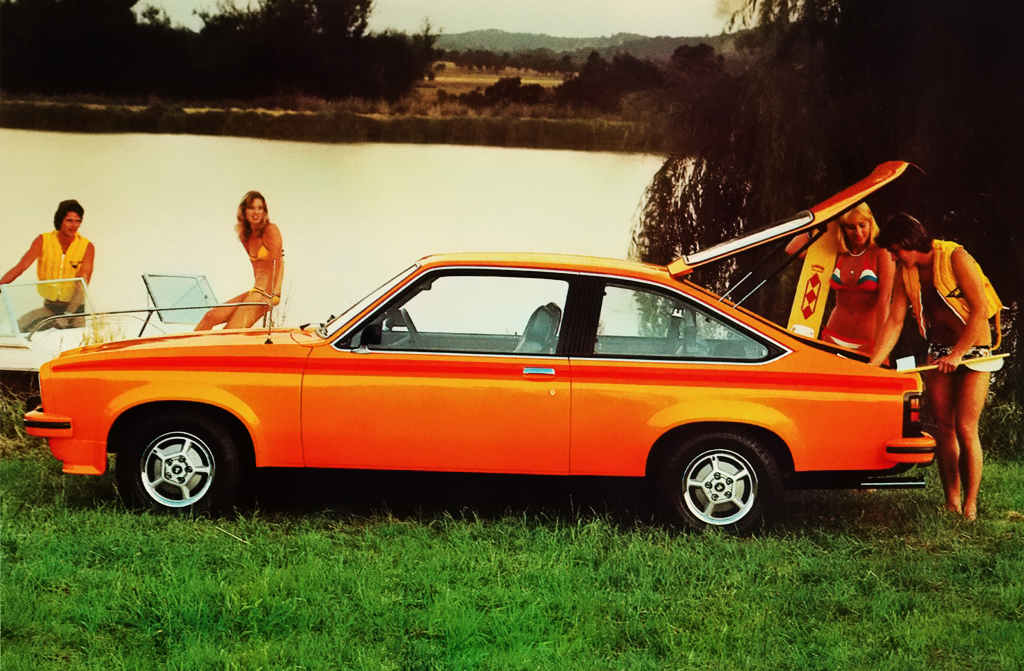
But for comfortable long-distance point-to-pointing the Falcon GXL is undoubtedly best. It is quiet, smooth, soft-riding and still damn quick. The Torana has exhaust booms, jigs on the bumps, stirs up a fair degree of wind noise and goes a bit quicker. But it takes more energy to drive fast and doesn’t have the ultimate top speed.
Our verdict, simply stated, is that the Falcon 5.7 litre is the fastest car in Australia – and if you want to· be sure of it, order yours with the stiffer suspension (and probably a manual gearbox, if they’ll build you one).
One of our staffmen who stood and looked at the top speeds of the fastest cars in Australia (178, 179, 186 and 197 km/h) and the standing 400m times (17.6, 17.2; 16.8 and 16.5 seconds) began reflecting on the good old days of 15 seconds at Castlereagh and 200 km/h on any half-mile straight stretch you cared to name.
“They’ve all had their balls cut orf” he grumbled, his right foot twitching and his burgeoning middle-aged spread receded for a moment as he thought of 1972. And he’s right, of course; they are slower in ’77.
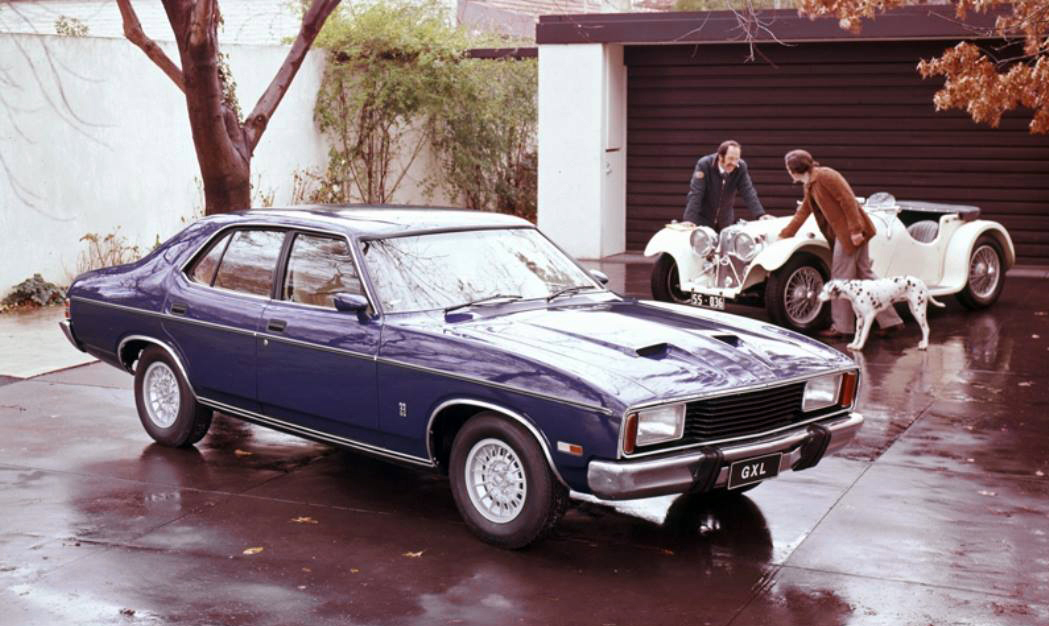
But truly, it’s not too bad. Only against the watches and the radar are the cars really, noticeably slower than they were. Apart from the Holdens’ more obvious ADR effects the four are very similar to the cars of ’72/’73 – but made better in three cases out of four by improvements to their suspensions. And we’d guess that quite a lot of the missing km/h can be restored by some cunning running-in and intelligent tuning.
You CAN still buy a horn car. Each of the four is still fast and powerful. Each of the four can still be owned by anyone on a sensible salary. But whether you SHOULD buy a car like this, knowing that you may well still own it in five oil-tight years’ time, is a matter for much closer consideration than it ever has been before.
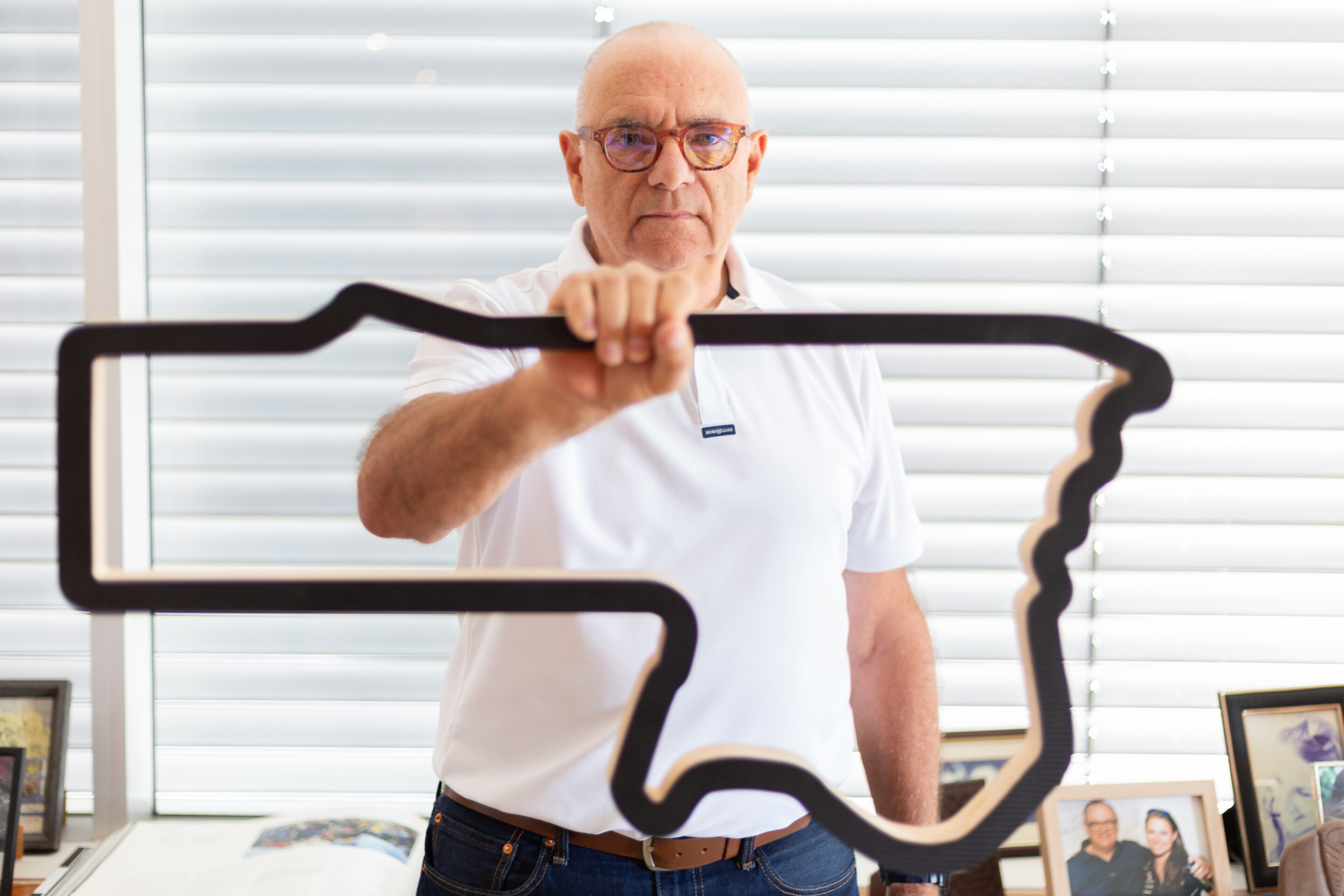
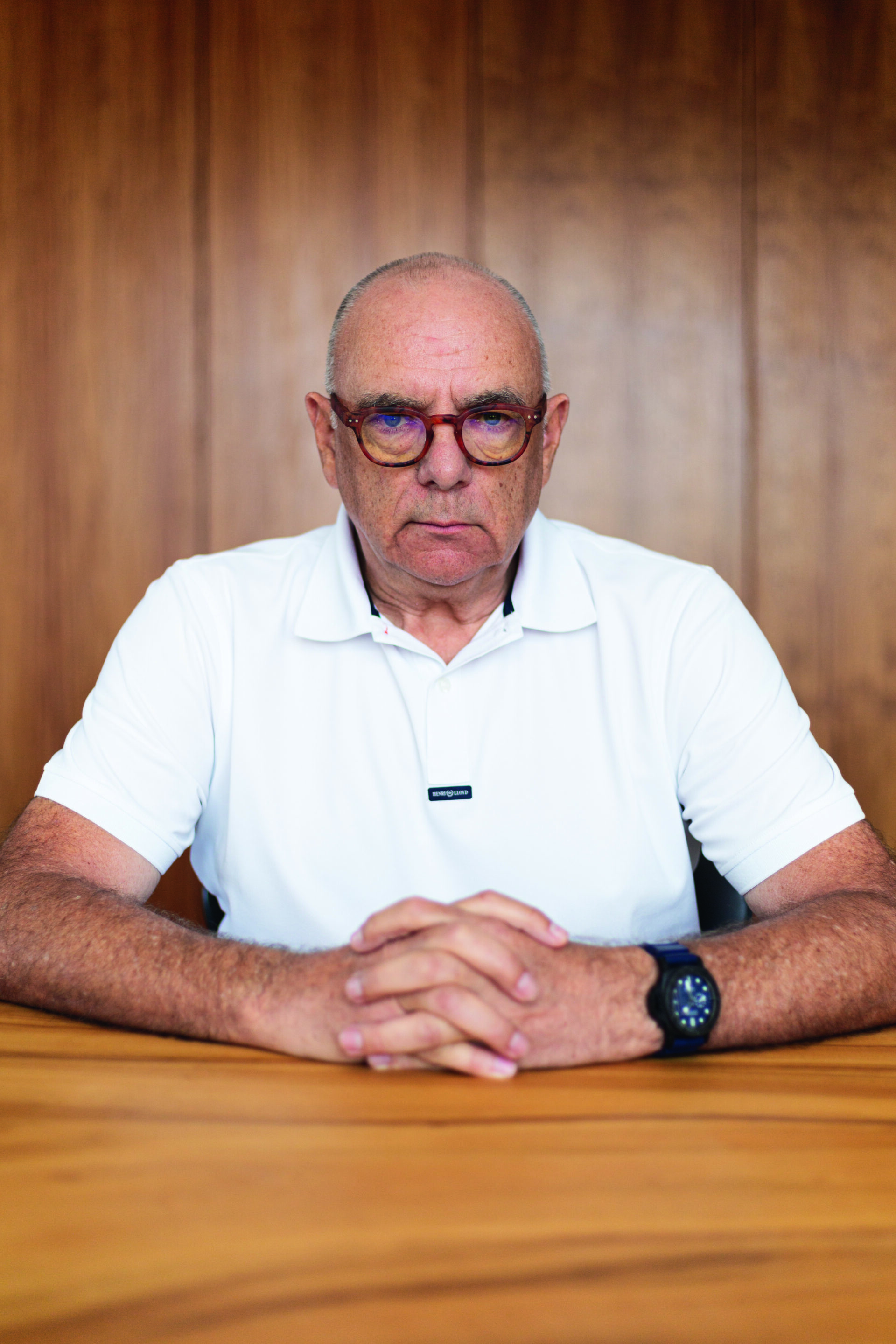
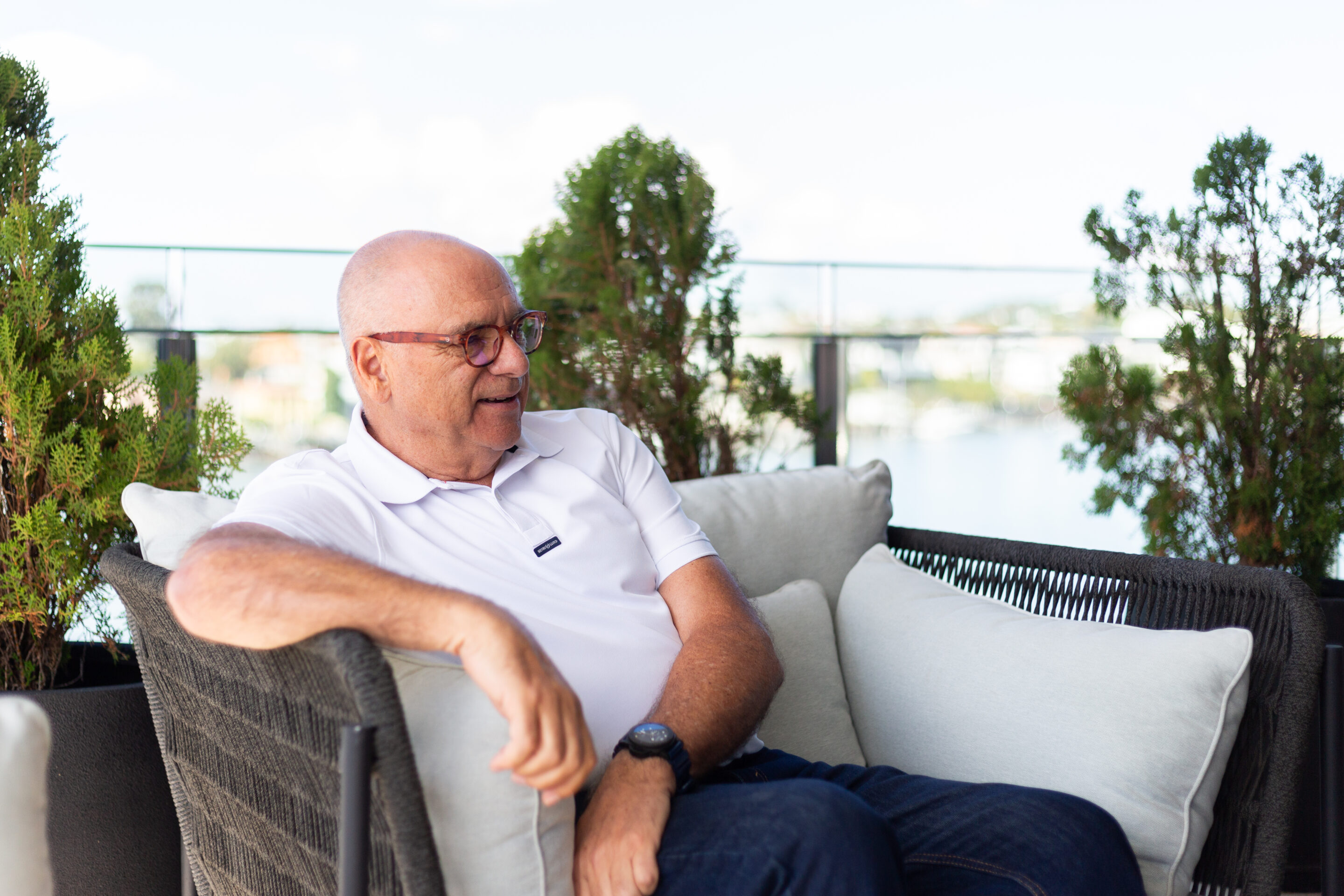
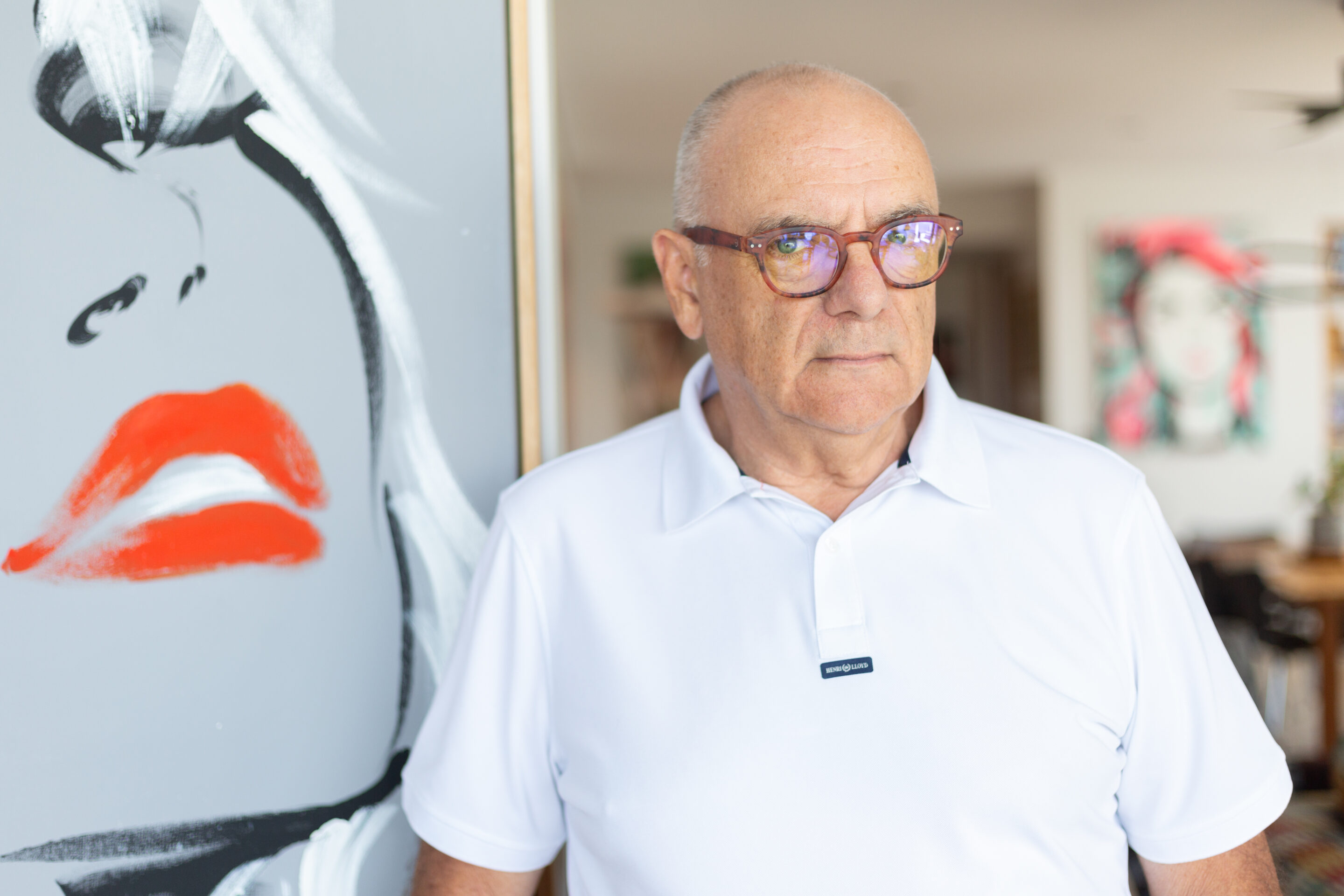
As you walk through the front door to Roland Dane’s luxury apartment overlooking the Brisbane River, it’s impossible to ignore one thing. It’s the bright and shiny line of eight Peter Brock trophies. They could hardly be more different from the original artwork of all kinds hanging from the walls.
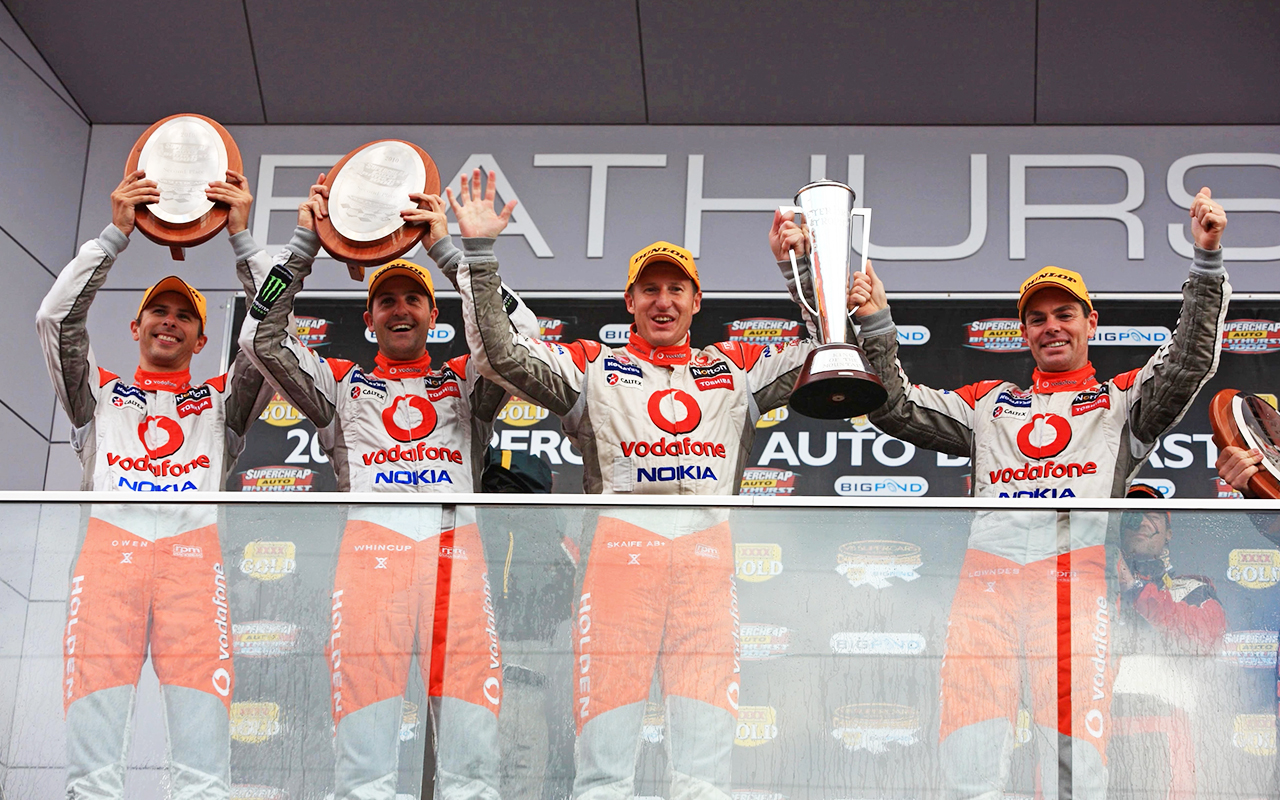
One Brock trophy is special enough, but eight is a reflection of Dane’s incredible impact on Australian motorsport. He was the key figure in Supercars racing for more than 20 years, creating a towering dynasty with Triple Eight Race Engineering and his hand-picked driver line-up of Craig Lowndes, Jamie Whincup, Shane van Gisbergen and Broc Feeney.
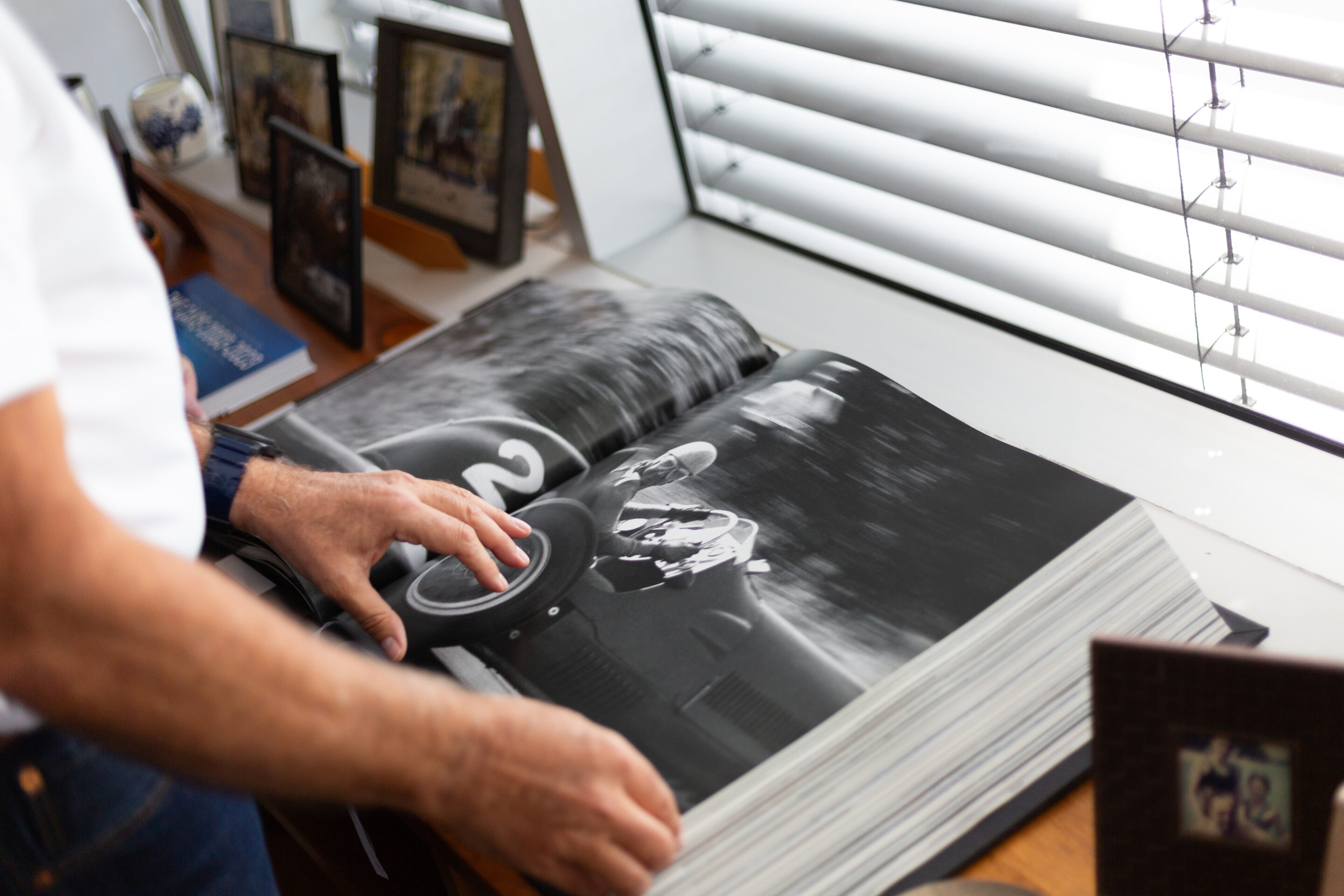
But there is much more to the Dane story than racing cars. The artwork on the walls, the extensive collection of books – including two hand-signed by Sir Winston Churchill – and the Boston Whaler sports boat tied up at the marina, prove it.
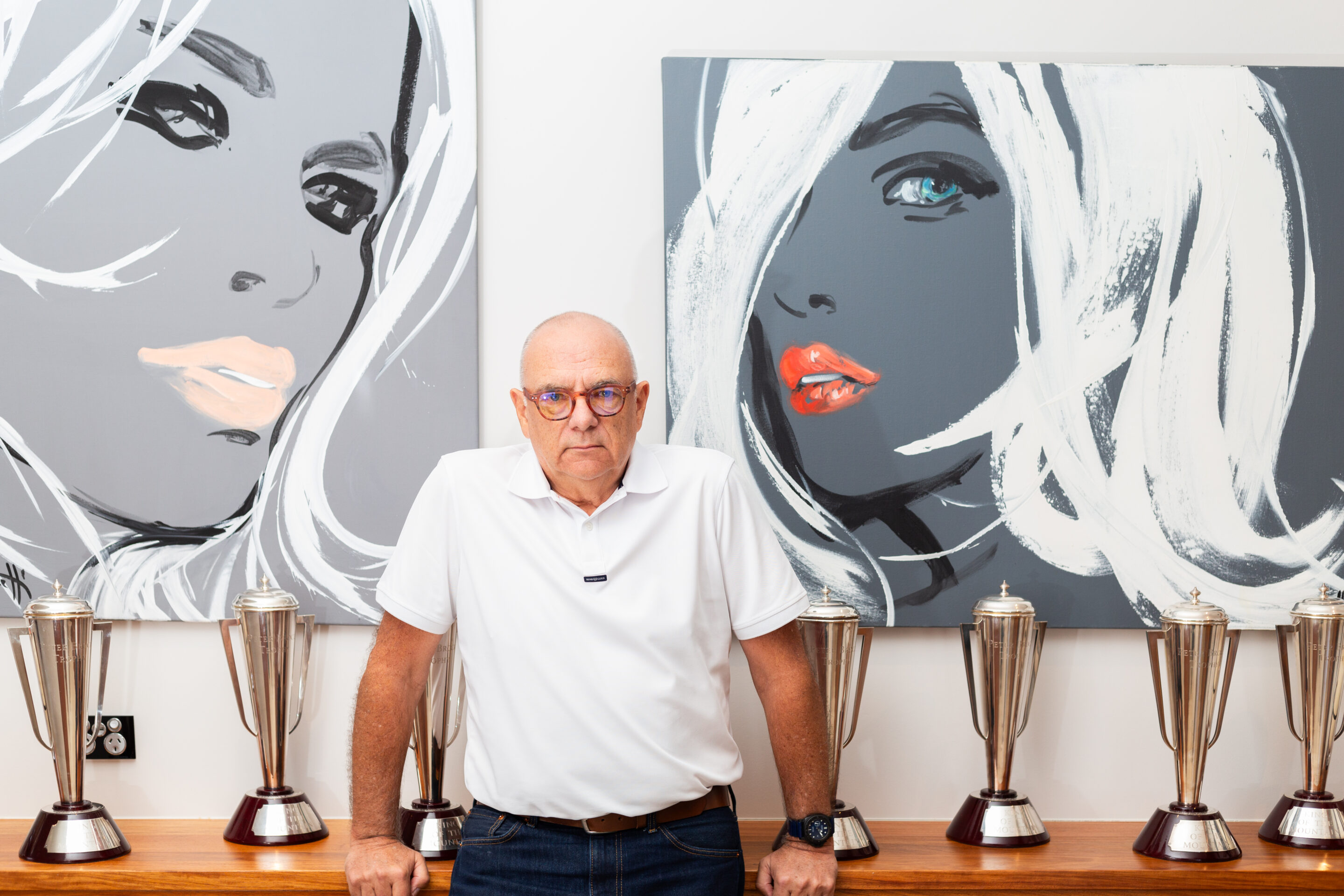
So, too, does his intelligent and argumentative approach to everything from modern history to fine wines and the best way to work a barbecue.
His father, Dr David Dane, discovered the virus linked to hepatitis B after serving with Britain’s Special Forces during World War II, his brother Thomas has contemporary art galleries in London and Naples, his brother Alex is a doctor in Alice Springs, and one of his sisters worked for many years for the Red Crescent – the Muslim world’s equivalent of the Red Cross – in Malaysia.
So, in some ways, Roland is the under-achiever in his family despite his huge intelligence and incredible ambition. And those trophies. Dane says he is officially retired at age 69 after selling his stake in Triple Eight and stepping down as chairman of the PWR automotive cooling company in Queensland, but he sometimes says things which are not completely true.
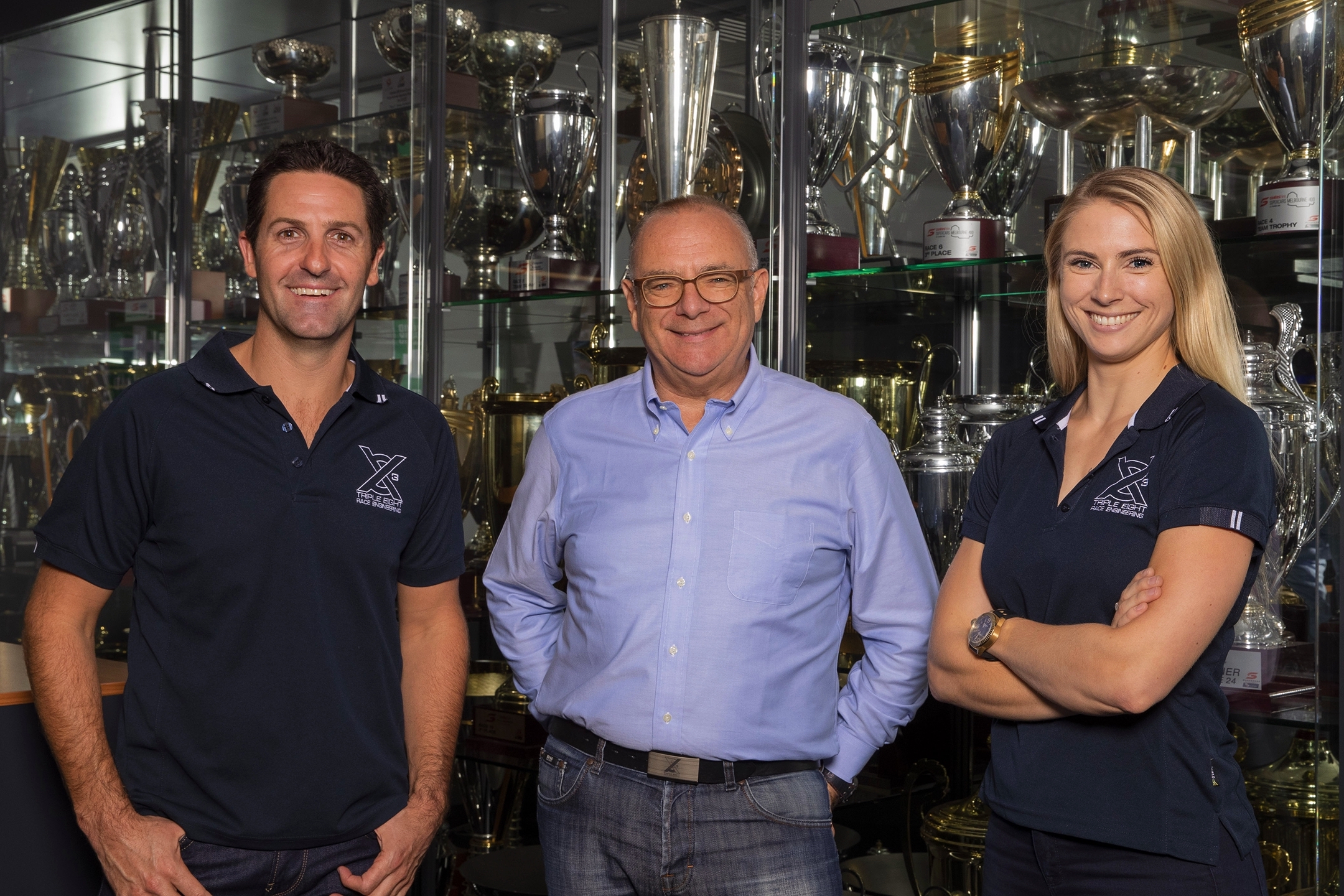
He is still advising the PremiAir squad in Supercars and can be found at Queensland Raceway whenever there are cars competing – even if it’s only humble Hyundai Excels with the next generation of young hopefuls.
The ambitious teens are unlikely to know even a fraction of Dane’s back-story. He has owned and run hotels and restaurants around Asia, once led the quirky Panther Car Company, and has been a genuine mover-and-shaker in the car world since the 1980s. For a time he was the largest non-official Rolls-Royce sales agent in the world and also one of the largest ‘grey market’ importers of second-hand Japanese cars into the UK.
He has also raced and won in yachts, and plans to sail The Great Loop around and through the USA next year, although he was less successful on motorcycles and never a chance in cars. Dane is clearly driven and tracks it back to his beginning.
“I do try, or have tried to do, a few things reasonably well. I don’t like the idea of being beaten when
I put my mind to something. I have been driven by the fear of failure, as much as anything else,” he begins.
“I can’t pinpoint any particular event or happening from my childhood, I just think I’ve always tried to make sure I didn’t come second.
“Growing up there were mechanical objects, so tractors, outboard motors, cars, a Honda step-through motorcycle. I pulled then apart, put them back together, and wondered why there were bits still on the bench.”
Dane was born in Belfast in Northern Ireland, although he has deep roots through ancestors in Australia in the 1800s. His middle name, Surrey, also reflects an historic connection to the English county.
“I’m a student of history in many ways, I enjoy it.”
His personal history lesson is tied, in many ways, to his father. It was both inspiration and intimidation.
“He thought I was a bit of a nuisance when I was young. Then gradually, after he’d retired, my relationship got better. I learned more about him, both from a point of what he had achieved professionally as a virologist, but also his war story.
“He was Parachute Regiment, then SAS. There was a famous operation that took place in France, behind enemy lines just after D-Day, called Bulbasket and many of them didn’t come back. His particular forte was clearing landing sites for extraction of people who had been parachuted in for ‘activities’. It was challenging, to say the least.”
Then he snaps back to the present.
“Almost everything we do pales into insignificance compared with what people went through in the last World War on such a huge scale. Being in the car business, being in motorsport for the last 50 years, is a privilege in itself. Many aspects of what I’ve done, to be honest, are as useful as chocolate on top of a cappuccino.”
His working life began when he left school at 18, picking up a job at a car company called Panther Westwinds.
“It was a lot of fun, especially in the early days, building almost-unique cars for almost-unique people,” Dane recalls. “Eight or nine years later I ended up as the general manager. I had plenty of examples of how not to do things. It’s not just a question of learning from successes, but learning from failures. That whole period had a lasting impact for me.”
He set up Park Lane UK Limited (even though it was not in the famous Park Lane in London) in his late twenties. The business specialised in armoured Mercedes-Benzes and stretched limousines, renewing links he had opened at Panther into Hong Kong, Japan and Brunei. But there was more to come.
“It opened my eyes to the potential for a big parallel market in new cars, from UK and Germany in particular, for Asian markets. The local agents were often very ‘opportune’ with their pricing. I created a lot of relationships off the back of that. And the markets were growing very fast.”
While business was happening, with cars and cash rolling in, Dane was also getting big in motorsport. He was never a hero as a driver in one-make races with Honda and Ford cars, but he did it right when he helped found Triple Eight Race Engineering in the 1990s, which became the successful GM factory team in the booming British Touring Car Championship.
He made his first trip to Bathurst during the Super Touring era with Vauxhall cars, although he realised the category could never rival the homegrown Aussie V8s.
“Two people and a dog turned up and the dog got bored and went home. It was obvious that V8s were the way forward.”
Later, after his divorce, he packed his bags and bought a team from Brisbane car dealer John Briggs and started racing Ford Falcons. There was a switch to Holdens after he was fired by Ford Australia, one of the more bizarre episodes in his life, and eventually Triple Eight became the official Holden Racing Team with big-money backing from Red Bull.
The T8 headquarters at Banyo is jam packed with trophies, many hundreds of them. He took Australian citizenship and has a large T8 tattoo – he designed the logo – on his shoulder.
“I’ve been around here for 22 years now. The last 15 years have given me more success, frankly and in many ways, than I could imagine when coming here. A lot of it has been very – not only satisfying – but enjoyable. That’s a big thing for me. Enjoying life.”
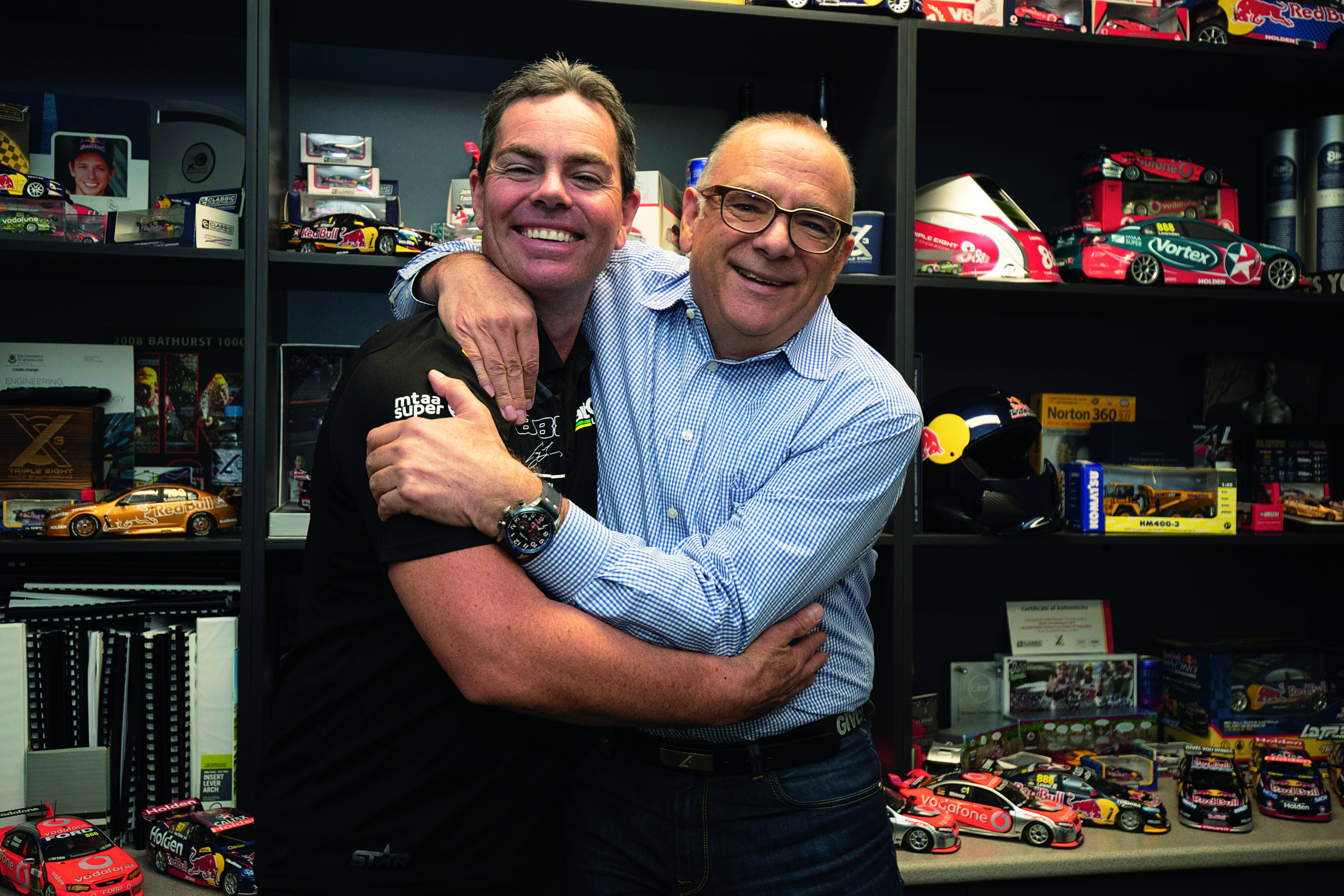
His success has brought many great friendships, financial freedom, a couple of tasty road cars – a Cupra EV and an upcoming manual Porsche 911 – as well as a man cave with lovely toys including a replica Audi Quattro E2 rally car and a super-rare Ducati Desmosedici road-going version of a MotoGP bike.
“As Mick Doohan said years ago, you have to be prepared to walk around the corner in Monaco and see a boat bigger than your own. I’ve got more than enough to keep me happy. One of the things I’m really proud about at Triple Eight is that a number of key people, including me, have left and still it’s as successful as it’s ever been. I have zero to do with it these days, but I like nothing more from a local motorsport point of view than to see Broc Feeney winning.
“There are a number of people who have been massively instrumental over the years in the success, but it’s the collective who made the difference and continue to make a difference.”
Dane highlights the work of his chief financial officer Nuri Paterson and engine builder Kenny McNamara at KRE, as well as his first superstar driver.
“Craig Lowndes believed in me back in 2004 when I sold him the idea of driving for us. That was a huge turning point because he was at the height of his powers.”
Then, just as we are wrapping-up, Dane recalls one last doozie of a story.
“Did I ever tell you about the time I sold a car to the CIA? Well, he didn’t say he was CIA, but he could have been from ‘central casting’, with the American accent, aviator sunglasses, dark blue suit, and built like an athlete.
“At the time I was selling some armoured Mercedes-Benzes to high-profile clients in the Middle East and Asia. I got a call from this American who wanted to look at a car that was in Germany.
“He flew in and brought a US military mechanic. He checked the car and fired bullets at some samples of the special glass. He said he wanted to buy the car. It was 500,000 Deutschmarks. The money was transferred in about 20 minutes. I even got a special call from a senior executive at my bank in London. Then next day we loaded the car into a military transport plane.
“As we were finishing up, I asked him what the car was for. He just said ‘Watch your television’. About a fortnight later I was watching the news coverage of Operation Desert Storm during the US war on Iraq, which was under the command of General Norman Schwarzkopf. He was arriving at his headquarters in Riyadh and getting out of my car.”
The article originally appeared in the October 2025 issue of Wheels. Subscribe here and gain access to 12 issues for $109 plus online access to every Wheels issue since 1953.
MG has taken a significant step forward in electric vehicle technology, confirming deliveries have begun for the MG4 Anxin Edition in China – the world’s first mass-produced passenger car fitted with a liquid–solid state battery.
Announced on December 18 by MG parent company SAIC, the milestone model represents a major leap in battery development, blending elements of solid-state chemistry with conventional lithium-ion design. While the new variant is currently China-only, it offers a glimpse of what could be coming for future global MG EVs.
The MG4 Anxin Edition was first revealed at the Chengdu Motor Show in August and sits at the top of the MG4 range. In China, it’s priced at 102,800 yuan (approx. A$21,000). That makes the technology leap all the more impressive, given the MG4 range starts at the equivalent of around A$14,000 in its home market.
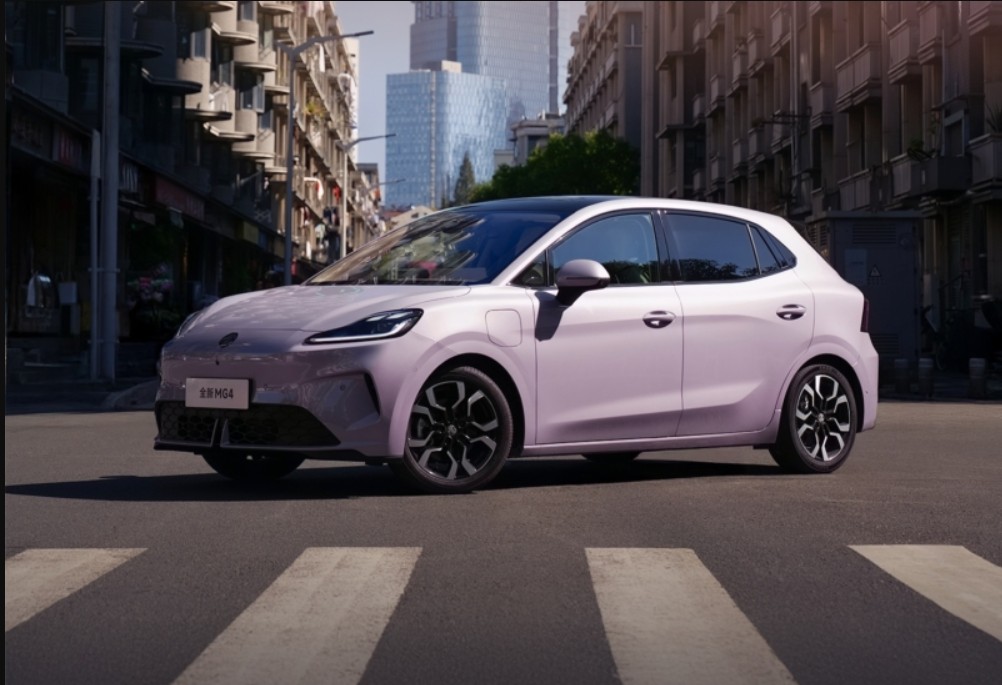
Power comes from a front-mounted permanent magnet synchronous electric motor producing 120kW and 250Nm, paired with a 53.95kWh manganese-based lithium-ion liquid–solid battery. MG says the pack contains around five per cent less liquid electrolyte than a conventional lithium battery, improving thermal stability and longevity.
On China’s CLTC test cycle, the MG4 Anxin Edition claims a driving range of 530km, with energy consumption rated at a very efficient 11.9kWh/100km. Thanks to 2C fast-charging capability, the battery can be replenished from 30 to 80 per cent in just 21 minutes. Performance is brisk rather than sporty, with a 0–50km/h sprint of three seconds and a top speed of 160km/h.
Dimensionally, the MG4 measures 4395mm long, 1842mm wide and 1551mm tall, riding on a 2750mm wheelbase. Kerb weight is listed at 1500kg – slightly heavier than MG4 variants using lithium iron phosphate batteries – while body torsional rigidity is quoted at a strong 31,000Nm/deg.
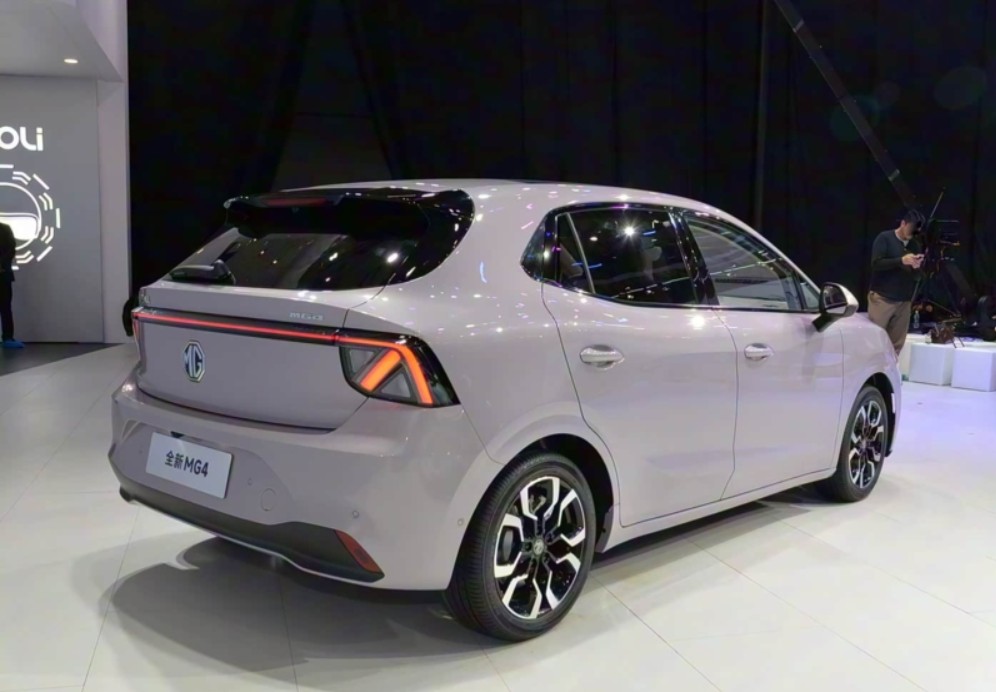
Inside, the MG4 Anxin Edition features a tech-focused cabin with a 15.6-inch 2.5K central touchscreen powered by a Qualcomm Snapdragon 8155 processor, a digital instrument display and a dual-layer centre console. Boot space measures 471 litres, expanding to 1362 litres with the rear seats folded.
Advanced driver assistance tech includes highway navigation assist and automated parking, supported by five cameras, 12 ultrasonic sensors and an 80 TOPS Horizon Robotics processor.
While there’s no confirmation of Australian availability, the MG4 Anxin Edition underlines MG’s ambition to lead on affordable EV innovation – and signals where next-generation batteries may soon be headed.
The Australian federal government is set to release its list of car makers that have, and have not, met CO2 emissions targets mandated by the New Vehicle Efficiency Standard (NVES).
Implemented on January 1, 2025 but with the reporting period not coming into effect until July 1, 2025, manufacturers face hefty fines and penalties for failing to meet the newly-mandated NVES targets.
The first reporting period, called the ‘interim emissions value’ (IEV) ran from July 1 to December 31, 2025. The results will be made public in February, 2026.
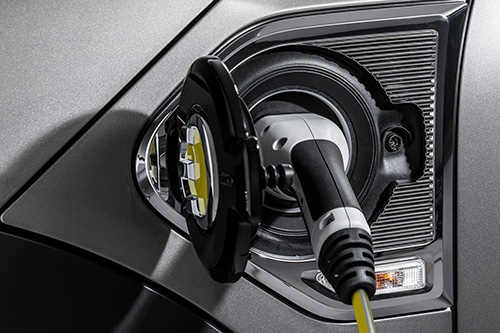
However, while those car makers that have failed to meet their target during the IEV will be named and shamed by the government, they will have until December 31, 2027 to offset those higher emissions before facing penalties.
Car makers can offset emissions by either selling more fuel-efficient vehicles, such as electric (EV) and plug-in hybrid (PHEV) that come in under the NVES targets or by purchasing credits from other manufacturers that have posted results below the government’s mandated target. The first fines will be issued in 2028.
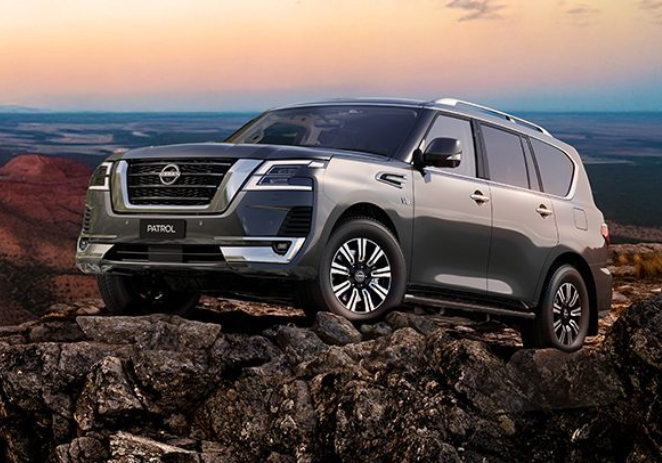
Several manufacturers have already indicated they already have – or will – pass on the NVES costs of any penalties to the consumer. Ford Australia recently cited its $5000 price rise on Ford Mustang was at least partly due to NVES.
Hyundai also confirmed that increases across i30 N and i20 N models were partially as a result of NVES. Similarly, Nissan Australia’s decision to hike the price of its V8-powered Patrol by $5000 was also down, in part, to more stringent CO2 standards.
The new cars rolling onto Australian roads have never been safer yet somehow the road toll is still rising across the country.
A government plan to halve deaths by 2030 is in ashes and there is no indication on why the National Road Safety Strategy – adopted with considerable fanfare in 2021 – is failing so miserably.
Is it the roads, is it the drivers, is it the cars, is it distraction, or drugs, or fatigue, or too much speeding?
How can it be so bad when 5-Star ANCAP safety ratings are considered the bare minimum for new-car acceptance in showrooms?
“We’re pretending we can still live in the 1950s. And it’s not working,” Professor Stuart Newstead tells Wheels.
“If I had a magic wand I would wind our transport and urban planning process back 70 years and start again. The systems are failing for both mobility and motoring. People are not trying to have major crashes. They might just make a genuine mistake.”
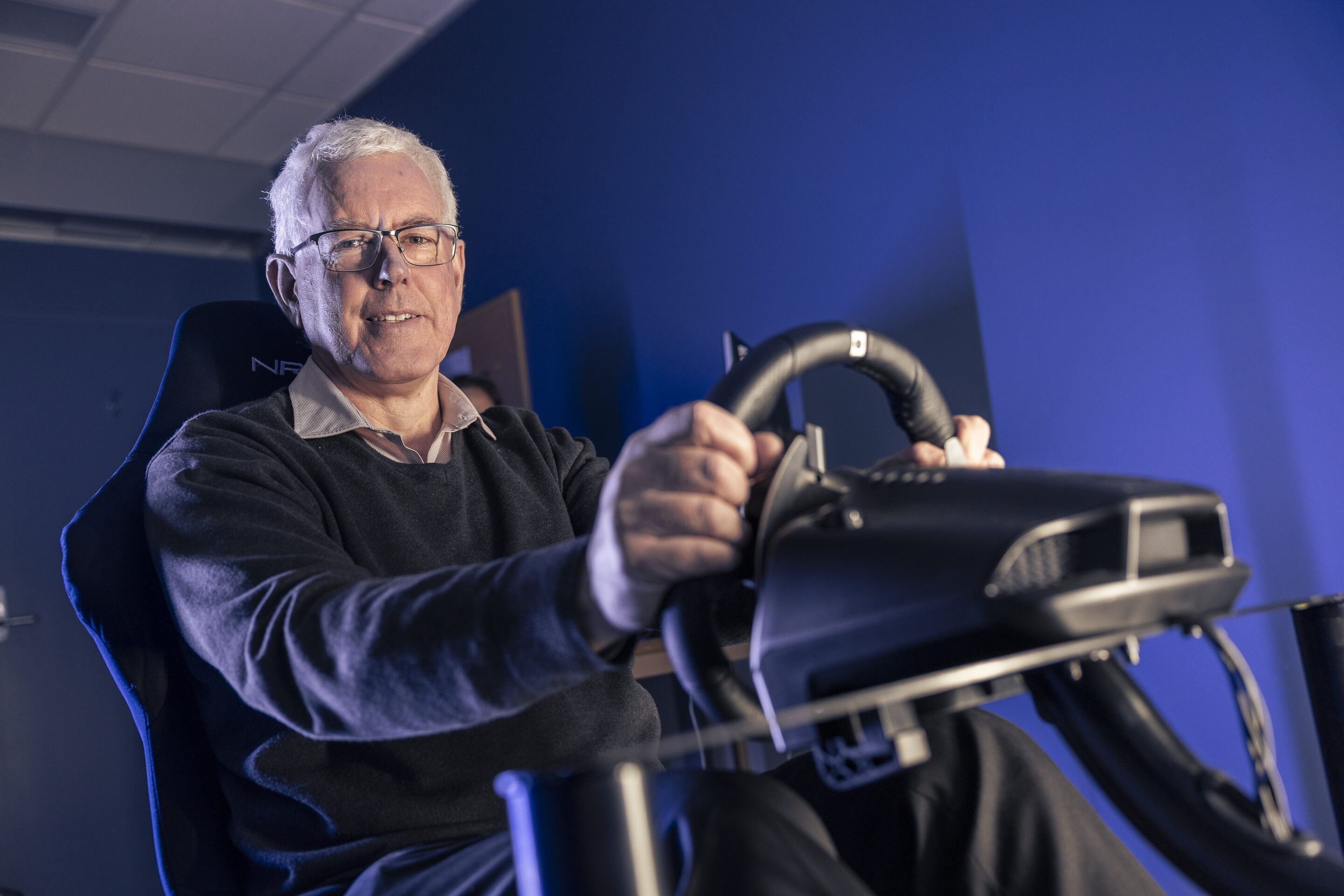
What would Professor Newstead know? He’s not a famous racing driver, or a new-car engineer, a policeman or an ambulance officer.
But he knows more than most about road safety and not just the ‘horror crash’ headlines that inevitably dominate the media coverage of holiday road carnage.
He has more than 30 years of experience at the crucible of Australian road safety, the Accident
Research Centre located at Monash University in Melbourne (MUARC).
It’s an organisation that does all sorts of safety research, even on accidents around the home and worksites, but is known best in the car world for its road safety research including the annual Used-Car Safety Ratings. These might not receive the coverage and support of the latest ANCAP crash-test scores, but they are much more useful for people who go shopping for their next car on the second-hand scene.
It’s about applying scientific research to real-world crashes, deaths and injuries, work begun at MUARC in the early 1990s by Professor Max Cameron under MUARC’s founding director Peter Vulcan, a pioneer of road safety science and vehicle safety regulation in Australia.
Newstead admits he spends a lot of work time with his head buried in spreadsheets and data documents, but those resources are not just ones and zeroes. Instead, his research tools are a genuine reflection of what’s happening on Australian roads.
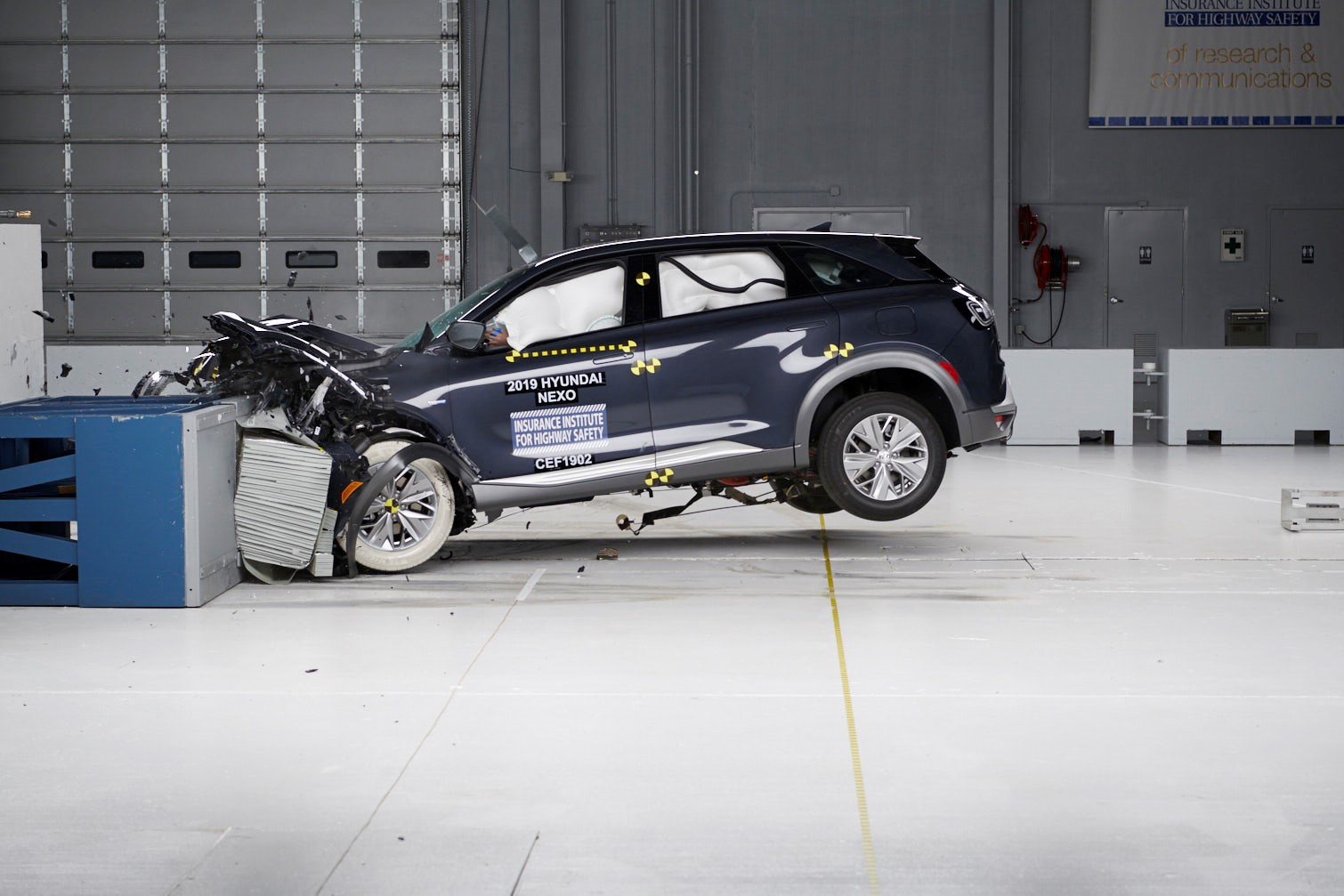
Creation of the ratings means compiling and comparing reports from more than nine million vehicles involved in police-reported crashes in Australia and New Zealand from 1987, then translating them into a star rating between zero and five. The results have grown to produce comparative results for more than 500 vehicles covering almost everything on Australian roads.
Newstead is just finalising work on the ratings for 2025 and, without giving too much away, he has one rock-solid prediction.
“None of the utes will achieve 5 Stars. They are big, they are heavy, they are stiff, and they are incredibly bad for ‘partner’ protection,” he says.
He is talking about the impact of utes on other vehicles and occupants, particularly smaller and lighter cars. As the director of MUARC, he leads a team of around 40 people who work on a variety of road safety research programs. He’s been there for more than 33 years, after completing a full suite of university courses to claim a Bachelor of Science with honours, a Master of Science and Doctorate majoring in mathematical statistics with minors in physics and applied mathematics.
“I also completed half a mechanical engineering degree but decided I was more interested in science,” he says.
He’s not only hugely qualified, therefore, but now also has vast experience in the car world, although he did not start down that road.
“Whilst I spent the early stages of my career in disease epidemic modelling, I pivoted to road safety
research when I joined MUARC and quickly developed a specialist focus in vehicle safety and in particular measurement of vehicle safety performance from real world data. Scientific evidence is absolutely critical.”
And even though he is a numbers man, he is also a car guy.
“I’ve always had an interest in cars and driving since I was young. My father was into his vehicles and, as a company sales representative, brought home a new vehicle every couple of years which was always an occasion.
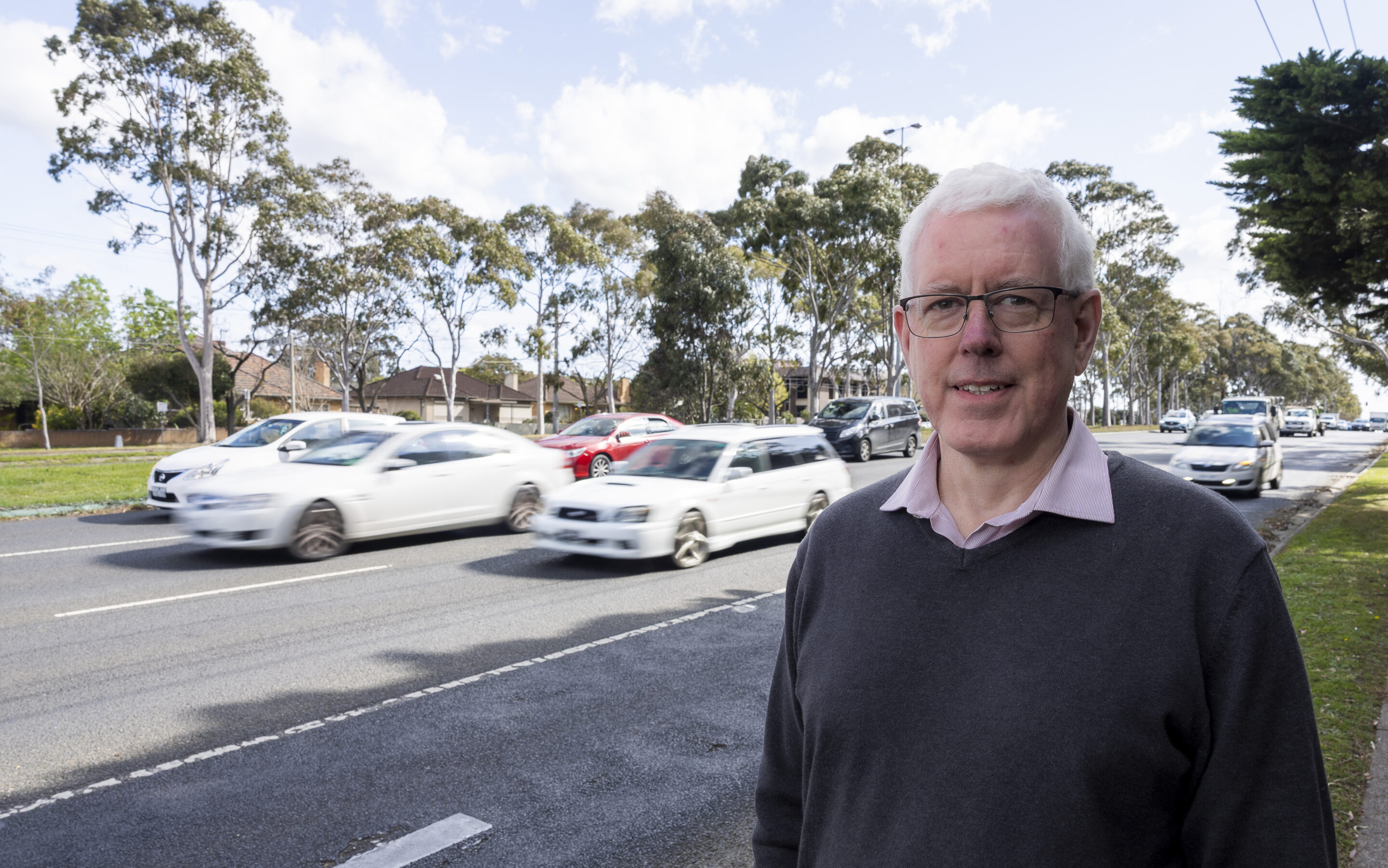
“I was into the car club scene for quite a few years. I still love working on my cars now when I have time.
“I am also a bit of a motorsport tragic, particularly Australian touring car racing. My interest is as much in the technology involved as the racing and since joining MUARC, the systems
involved in making racing safe. “
Now 57 and married with two adult children, his daily driving choice might come as a surprise. No, it’s not a Volvo…
“I drive a VF SV6 Holden Commodore Sportwagon. It’s a safe and practical car that was excellent value for money and served the needs of a growing family for many years,” he says.
“It’s fantastic to drive, super reliable and reasonably economical, particularly on long country runs to visit family interstate. I was also proud to support the local vehicle manufacturing industry and all the dedicated people who worked in it.”
He’s also familiar with the work that went into the last of the homegrown Holdens.
“MUARC did a lot of work with Holden at its peak and the passion of its engineers for safety was outstanding.”
He admits he could have moved to something newer and tastier, but his safety-first approach with his children meant they got priority.
“I have helped both my children get into safe cars when they first started driving. I had no hesitation in doing what I could to make sure my children are safe in their early driving careers.”
He taught them to drive but, thanks to his research and experience, is not advocating for advanced driver training.
“It’s quite an interesting skill, driving. You need to have confidence and skill to do it well, but you also need to be incredibly risk averse as well. Even the best and most experienced driver can make a mistake.
“The cognitive load in driving is enormous. For at least the first couple of years we know young drivers are not up to the tasks and we put them on the road hoping they survive.
“The common view in road safety is ‘It’s the drivers’ fault’. But we have not found a driver training system that stops people making errors. It does not exist.
“An ideal driver licensing system would ensure young drivers have experience in all situations in all conditions, and then slowly test their skills in more and more demanding situations as they transition to solo driving. But that’s time consuming and expensive.”
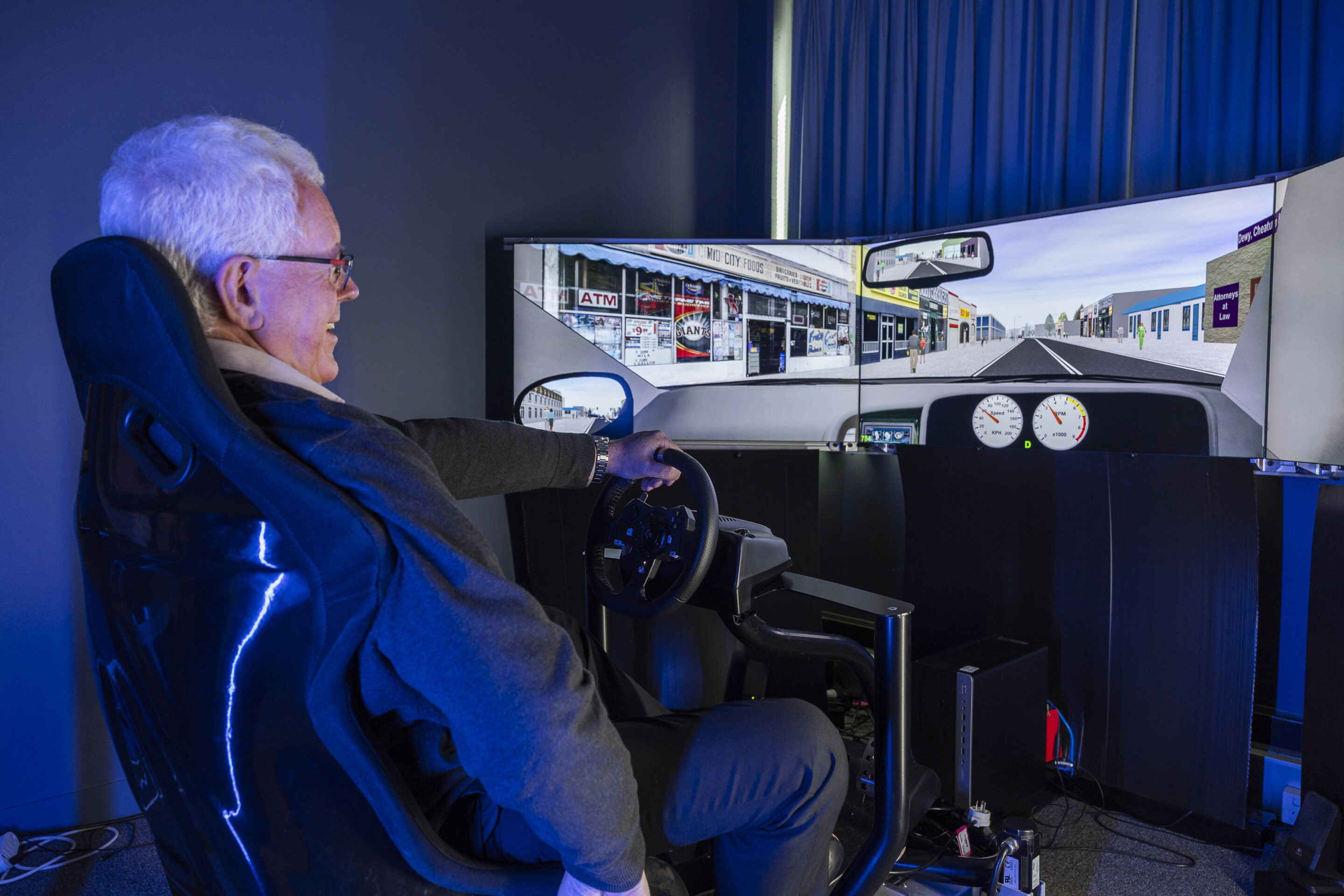
So where should people look for answers on the road safety front?
“The problems we have are in how our country has developed. We haven’t developed around the modern concept of mobility. We’re dealing with a legacy system that is not fit for purpose, and trying to put band-aids on it.”
Newstead contrasts the congestion in big cities with the under-developed situation in the countryside, and the work needed to improve safety.
“It comes back to the overall environment. Cities need much greater investment in public transport. The regional network is incredibly poor and incredibly dangerous. So it’s not only the maintenance of roads, it’s the fundamental design of the system.”
Newstead also highlights society’s attitude to road trauma of all kinds.
“Unfortunately, road deaths are still too normalised as an inevitable factor of life,” he observes. “You have to treat it like a public health problem. People are horrified when a plane crash is reported, yet in 2024 just under 300 people died in air crashes internationally. This compares to over 1.2 million who died in road crashes with around 1300 fatalities in Australia alone.”
Some of that starts with car choices. So, once again, he goes back to the numbers and the MUARC
research. More than 500 vehicles are listed in the Used Car Safety Ratings, 113 currently have a 5-Star rating with more than 50 also upgraded to the ‘Safer Pick’ status. But vehicle choice alone does not ensure safety.
“People buy a 5-Star car and think it can protect them in all situations. They get over-confident.”
The MUARC ratings also track the improvement in vehicle safety, with the average risk of death or serious injury for drivers in 2022 models reduced by 36 per cent compared with those manufactured in 2002.
“The underlying risk is reducing. But you need to reduce the risk faster than the population is growing to lower the road toll.”
Newstead is quick to highlight the poor choices being made by many people.
“There are things not addressed around the fleet mix. Particularly the growing size and different dimension of vehicles,” he says, talking about the size and weight of utes and large family SUVs.
Newstead also says road design and maintenance in Australia is a major problem.
“It’s an awkward conversation. Vehicle safety has improved incredibly, but the support we give vehicles to be safe on the road is not good. Crash avoidance technologies are seen as the next great hope. But they are still not well supported. Look at lane-keep assist – we don’t have the road infrastructure everywhere for it to work well which makes the technology frustrating or ineffective.
“We need to make all roads more like the Hume Highway. We’ve made it incredibly safe. It should be the model for all major country roads.”
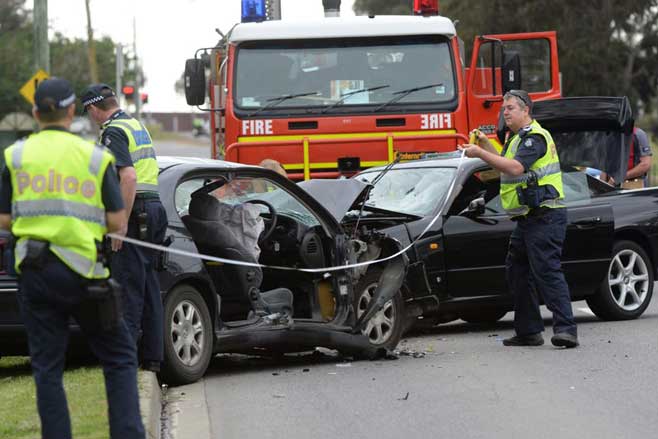
But, in the end, Newstead says people are still an important factor.
“Driving today is immeasurably safer than it was 50 or 60 years ago. But we have a very bad attitude in Australia, in terms of sharing the road network with other people. Some people think it’s a competition. And it’s become more prevalent since the pandemic, because people are more inwardly focussed.
“Everybody drives. Everyone thinks they know how to solve the road safety problem. And most of it is complete bunkum.
“Safe road use is not a race. It’s not a competition. Safe roads come from all working together to look after each other and comply with the rules.”
The article originally appeared in the November 2025 issue of Wheels. Subscribe here and gain access to 12 issues for $109 plus online access to every Wheels issue since 1953.
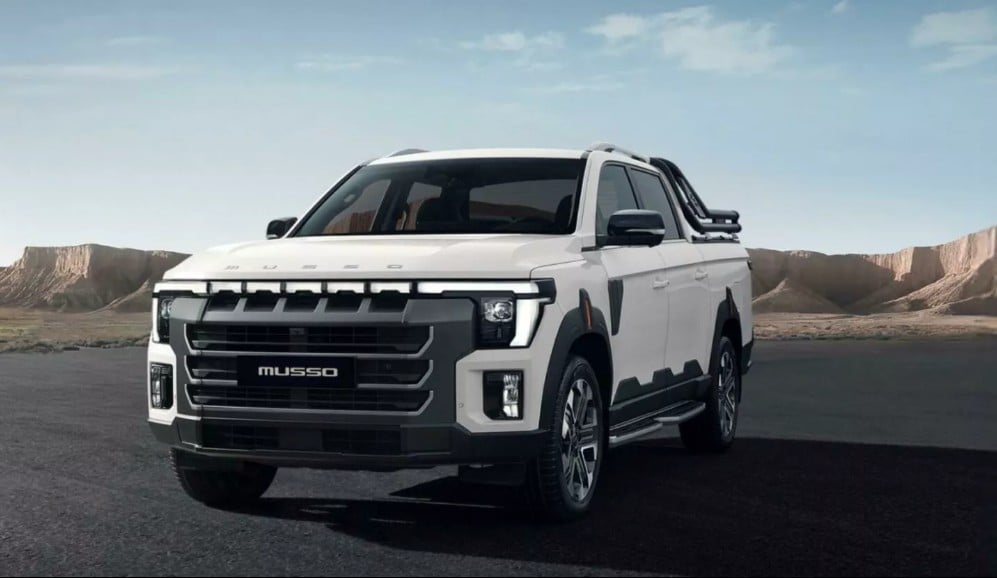
KG Mobility (KGM), formerly known as SsangYong, is preparing to take on the global midsize pickup heavyweights with a bold new truck that revives a familiar name. The new model, carrying the Musso badge, has been revealed in full ahead of its expected January 2026 debut and is being positioned as a direct rival to segment leaders such as the Ford Ranger and Toyota HiLux.
The new pickup, internally known as Q300, will replace the Rexton Sports, which has been sold in many markets under the Musso name. Following teaser images released earlier in the year, KGM has now unveiled official exterior photos and confirmed further details, showing a tougher, more assertive design than its predecessor.

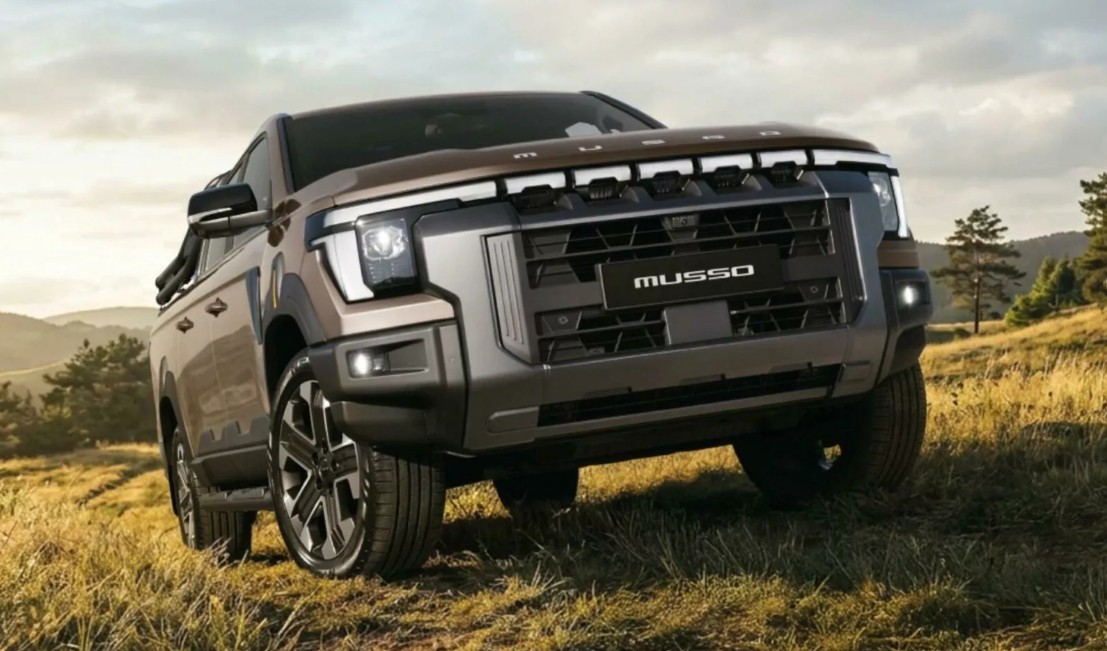
Up front, the styling is unmistakably influenced by established American off-road icons. The LED headlight signature echoes the look of Ford’s F-Series trucks, while the upright five-slot grille carries more than a hint of Jeep DNA. Illuminated grille elements, a chunky skid plate and oversized air intakes give the Musso a purposeful, off-road-ready stance.
KGM will offer the new pickup in two versions: a standard model and a more aggressive “Grand Style Package”, which adds additional off-road-inspired visual elements to boost its appeal.
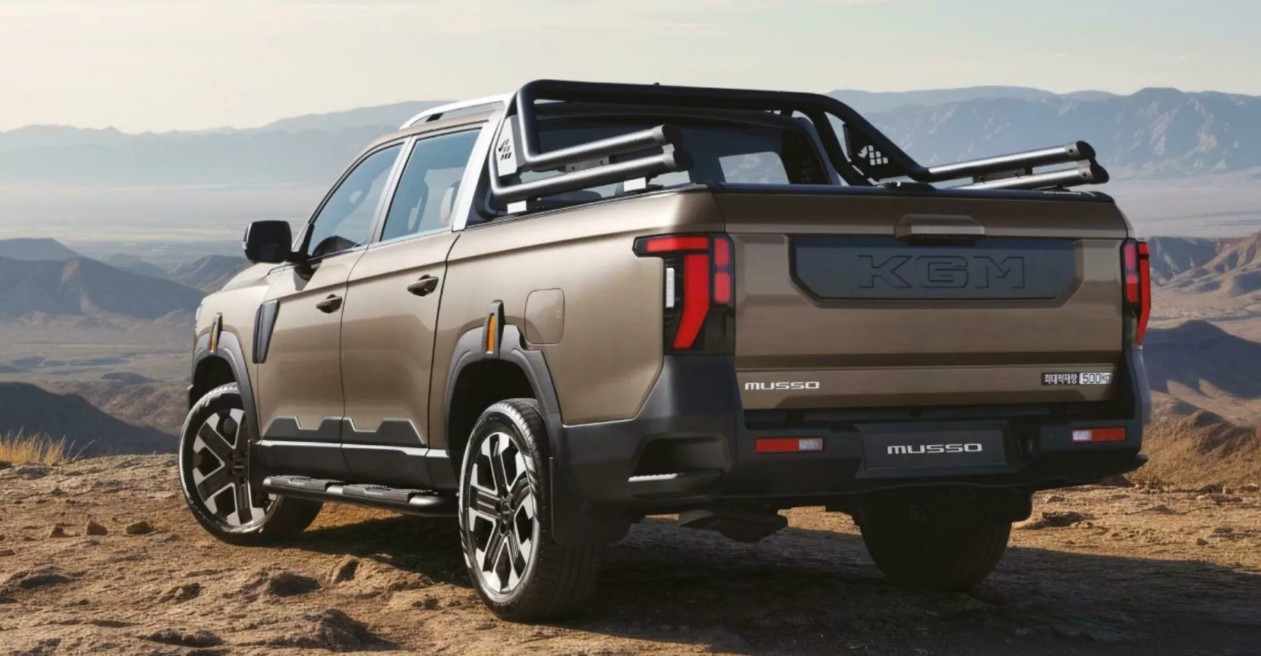
From the side, the Q300 retains some familiar elements. Plastic cladding, amber indicator details and the overall glasshouse appear closely related to the outgoing Rexton Sports, while most exterior panels have been reworked to give the truck a fresher, more muscular profile. The result is a blend of carryover architecture and new styling.
At the rear, vertically stacked LED tail-lights frame a sculpted tailgate with prominent KGM badging. Heavy-duty black cladding surrounds the lower bumper, which now integrates step sections for easier bed access. A tubular sports bar over the tray reinforces the Musso’s workhorse credentials.
KGM says the Musso nameplate is evolving into a broader sub-brand covering electric, hybrid and internal combustion pickups, designed to suit both lifestyle and utility buyers.
Interior images have not yet been released, but the double-cab proportions suggest a five-seat layout with a modern, digital-focused cockpit, similar in approach to the recently revealed Musso EV.
Under the skin, the new Musso is expected to continue using a ladder-frame chassis related to the Rexton SUV, updated to accommodate new powertrains. Diesel engines are confirmed, with a hybrid option also expected as part of KGM’s electrification push.
The full reveal is locked in for January 2026, with a Korean market launch to follow. While international plans haven’t been confirmed, Australia is a likely target, where the Musso would enter one of the world’s most competitive ute segments.
A new dual-cab is something pretty much guaranteed to get Aussie car buyers excited. And when it’s a new Toyota HiLux dual-cab, well, the stakes are pretty high.
Fact is, it’s more or less impossible to over-estimate the importance of the HiLux to Toyota Australia. Or Australians generally. The celebrated dual-cab four-wheel-drive (yes, and its single-cab, extra-cab and two-wheel-drive siblings) are a major part of Toyota’s ability to be the country’s number one car brand for the 23rd consecutive year. In the process, the HiLux itself has been the nation’s favourite four-wheeled purchase for seven of the last nine years. More than 1.4 million of the blighters have been sold here since the first-gen version of 1968.
Globally, Australia is the fifth largest consumer of HiLuxes and, of the 235,000 cars and light commercials Toyota plans on selling this year (according to the numbers thus far), about 53,000 of those will be HiLuxes. So, yeah, pretty important. Throw in the fact that the exterior styling update was largely the work of Toyota’s Melbourne HQ – a big deal for a global car selling in around 180 countries – and you can see why there might be a certain amount of pride on show.
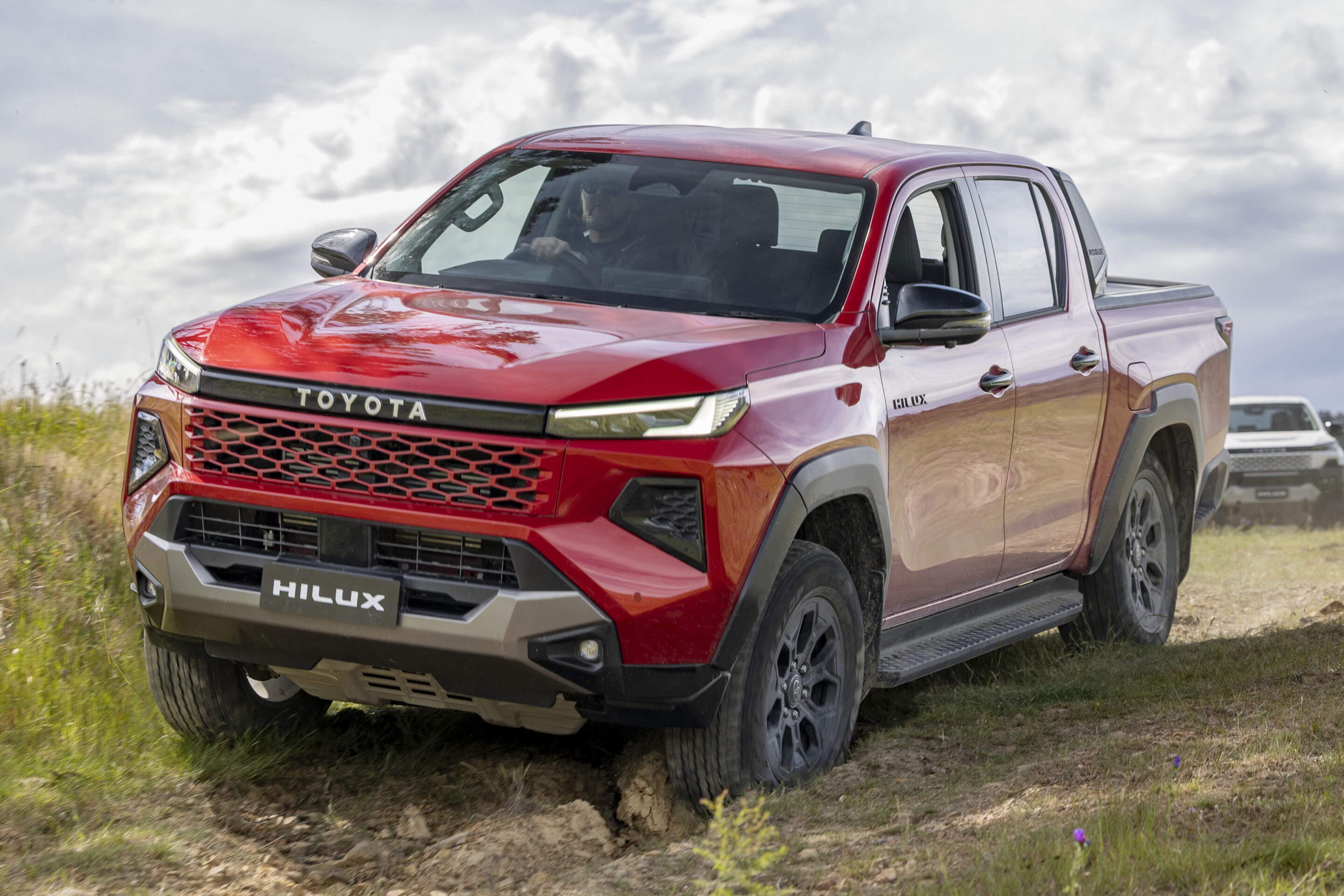
While a new model of anything often throws up more questions than answers, the existential meat-and-veg of the new HiLux isn’t really perplexing at all. And that’s because it’s really not that different. More puzzling, as it happens, is Toyota’s decision to call it an all-new (the ninth) HiLux generation. And that’s because there’s an awful lot of the eighth-gen HiLux involved here.
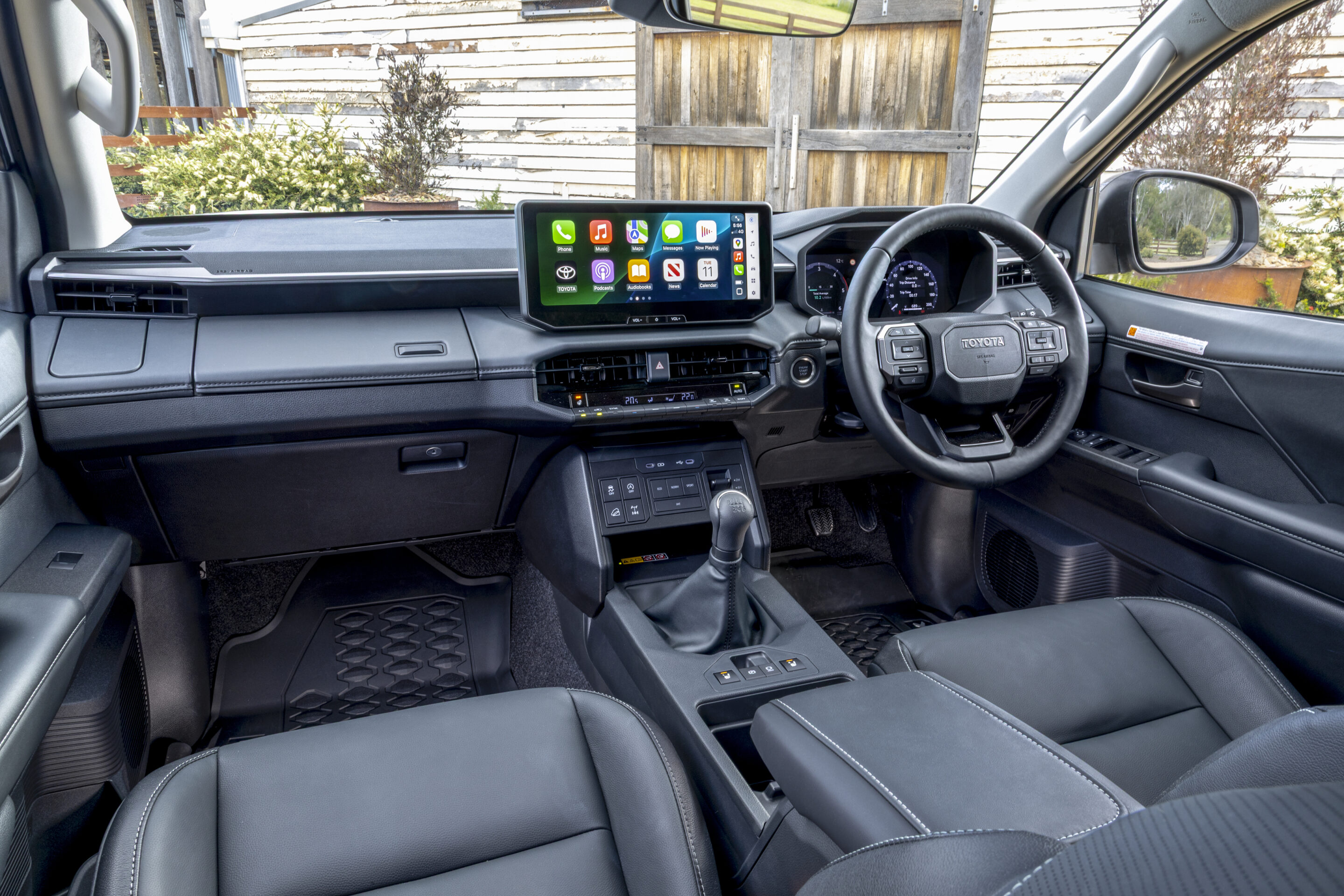
The carry-over bits are numerous, and it’s quicker to list the bits that are actually, genuinely new. They include the front sheet metal, the tub and the interior. Which means, of course, that the central body structure, all the mechanical hard-points, glass, most of the suspension and all of the driveline are carried over from the old model.
For all that, Toyota Australia’s senior product planning specialist, Rod Lyons, maintains that the new ’Lux represents “far more than a new skin”. He points to modifications such as thicker steel in the chassis, reinforced side rails, beefier front suspension towers, stronger cabin-mount brackets and extra spot welds (36 of ’em). The engine mounts that were rubber are now hydraulic.
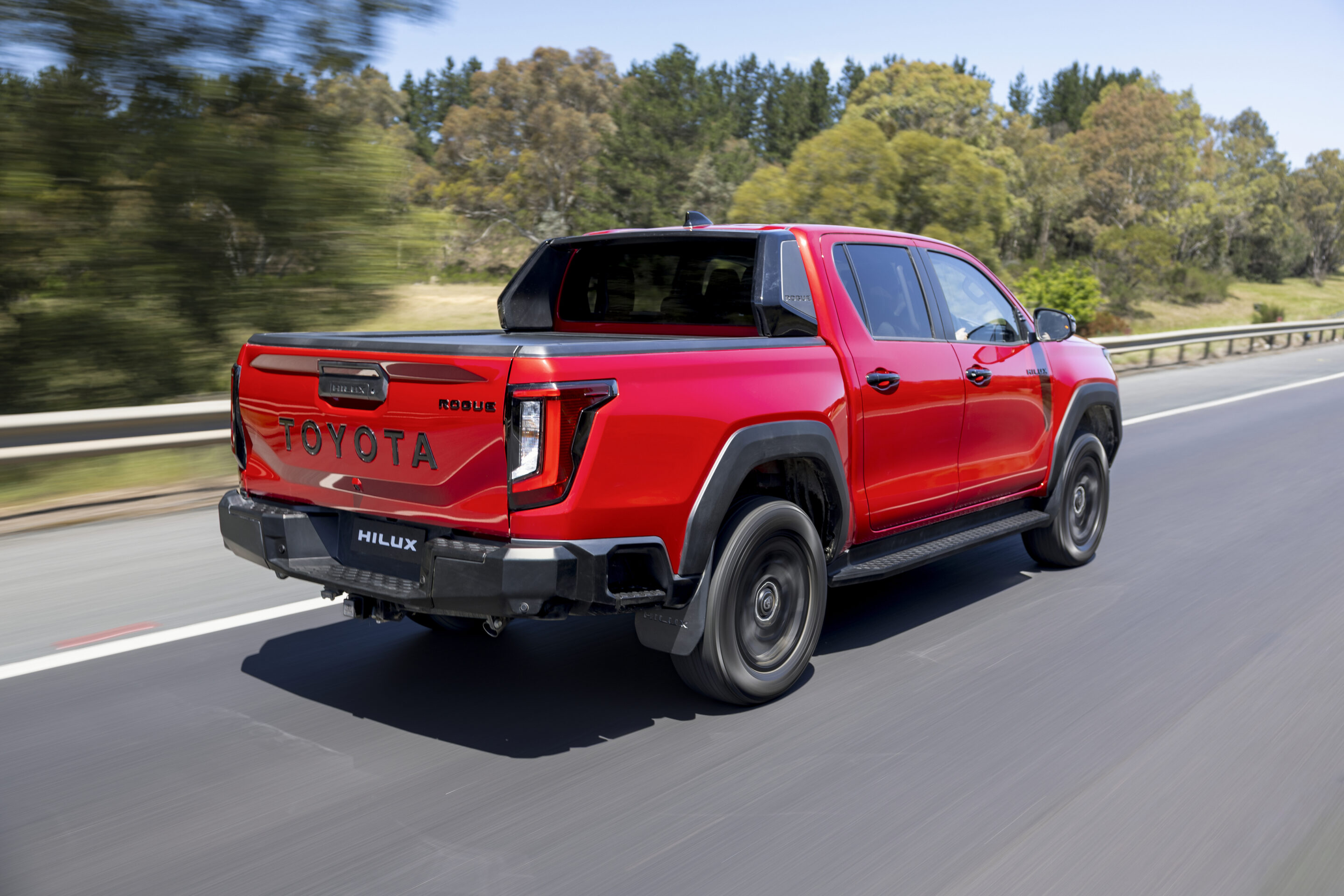
Front suspension is also tweaked with a new stub axle, a thicker roll-bar, retuned dampers, re-rated coil springs and new dampers and spring rates for the live-axle rear end. And there are now two suspension tunes; one for the blue-collar models (Workmate and SR) and a slightly softer set-up for the more expensive variants. The difference is all down to payload and buyer expectations.
But the suspension changes have also wrought an increase in Gross Combination Mass, now up to 6300kg for 4X4 models, representing a 450kg increase.
Put simply this means you can hitch up a big caravan and put people and their luggage in the dual-cab, towing it without going to jail.
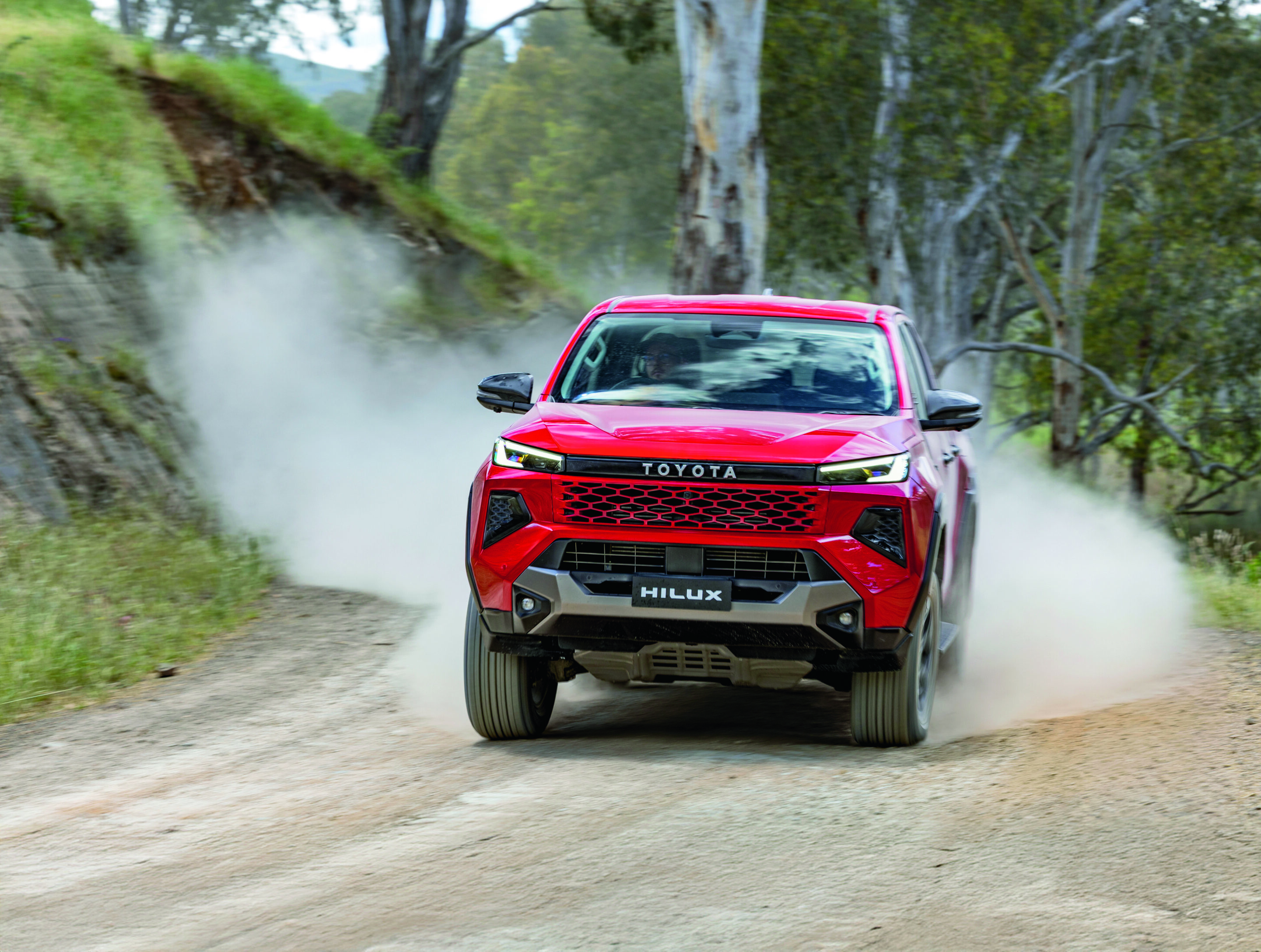
By far the biggest mechanical change has been the switch from hydraulic steering assistance to electric power steering. The actuator mounts directly on the rack and is claimed to reduce kickback and effort, and improve fuel efficiency.
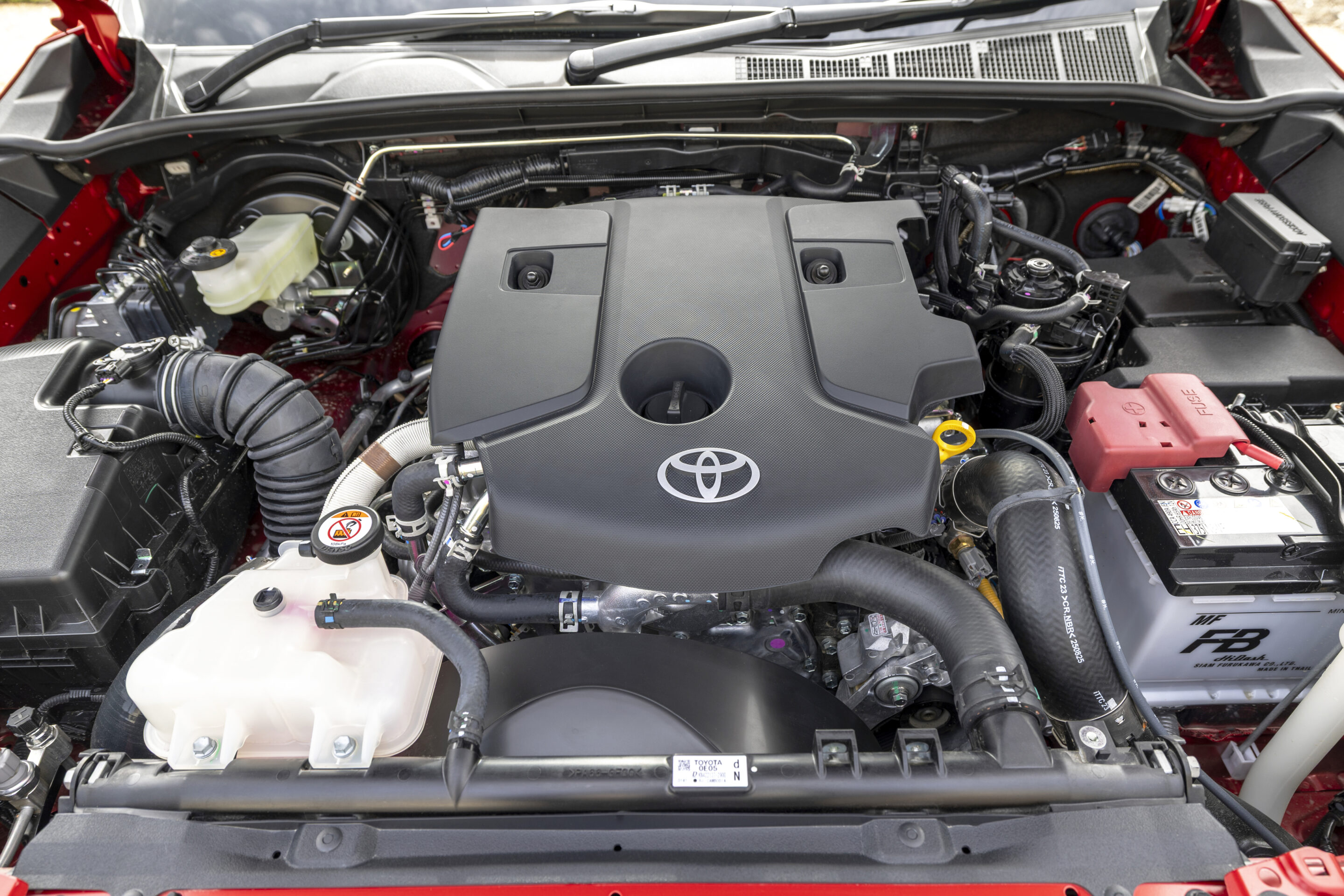
All dual-cab automatics with the exception of the Workmate now feature the 48-volt mild-hybrid system as standard, as do the dual-cab-chassis versions of the SR and SR5 (the most popular forms of dual-cab in these trim levels).
Interestingly, Toyota has kept the manual-transmission option, but ditched the petrol engine. Which kind of explains why the prices of the base models appear to have leapt into the stratosphere, when, really, it’s just that there’s no petrol option any more.
That leaves us with just the one engine, the familiar 2.8-litre turbo-diesel, cranking out an equally familiar 150kW and 500Nm. The exception is any variant with the six-speed manual gearbox which maintains the peak power number but limits torque to 420Nm in the interests of keeping the gearbox internals, er, internal.
For the record, the HiLux line-up looks like this: It kicks off with The Workmate 4X2 and 4X4 which now get the turbo-diesel engine standard and LED lights, along with upgraded safety tech including driver aids and eight airbags.
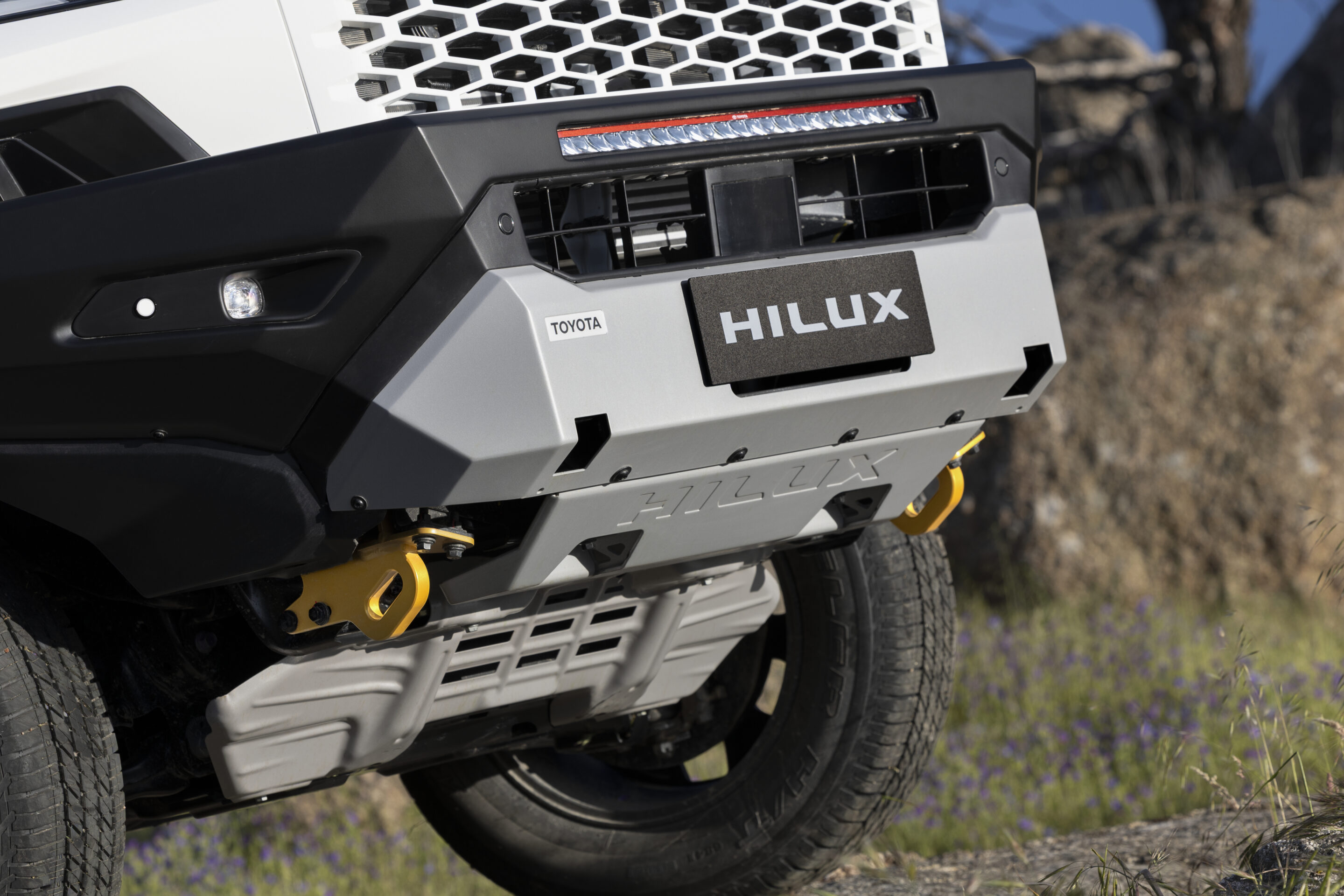
Things then move up to the SR 4X4 which now gets selectable terrain modes and then to the SR5 4X4 which has the slightly softer suspension tune, new rear disc brakes and the larger 12.3-inch display. The Rogue 4X4 is next with its matte-black wheels, leather accented trim and the Rugged 4X4 tops things off with the hoopless bull-bar (so, a heavy-duty bumper, then) bash plates and rated recovery points.
Prices start at $33,990 for the Workmate 4X2 single-cab while the first of the 4X4 models is the same Workmate single-cab at $45,990. Of most interest to Wheels readers will be the SR dual-cab 4X4 automatic at $57,990, the SR5 dual-cab 4X4 auto at $64,990 and the Rogue and Rugged dual-cab auto 4X4 twins at $71,990 apiece.
Given the mellow modifications, you might imagine the driving experience would be pretty familiar. And you’d be dead right. There’s not much to choose between the two suspension tunes and the HiLux follows dual-cab tradition by offering a reasonably firm ride when unladen. Frankly, there’s no way around this, and the sort of springs required to keep a tonne of payload off the deck, will never translate to a cushy ride. End of.
The worst of it is when large bumps arrive too close to each other and the suspension, already semi-compressed from Bump A, is punched farther into discomfort territory by Bump B.
But the switch to electric power steering seems to be a move in the right direction. There’s improved
on-centre feel and zero kick-back from the rack even over pattery stuff at speed.
The engine is exactly as the 2.8-litre turbo-diesel has ever been. Good but not class-leading. If you can pick the point at which the mild-hybrid motor makes itself felt, you’re a better judge than I am, and the engine has pretty much given its best by the time 3000rpm has appeared on the animated tacho.
It’s quiet enough, though, and while there’s some diesel clatter at idle, at highway speeds there’s but a faint hum that turns into a soft growl as you pour on the coals to go up a hill. Tall gearing means it’s never raising a sweat, although you do need to watch the speedo to avoid kilometre-creep.
The six-speed automatic gearbox is equally familiar, but I’m left wondering if it’s been recalibrated to be a bit more excitable. As it is now, there’s an argument to be made that it seems a fraction eager to drop a gear and equally keen to hold on to that lower ratio slightly beyond its usefulness.
Inside, the interior is much better than before with some obvious Prado themes but without all the soft-touch surfaces. But while the button-driven info system in the steering wheel might make perfect sense to a Gen-Zer, I couldn’t always make it display the info I was after. True, there are some hard buttons for major functions and, thankfully, the paddle to engage four-wheel-drive and low-range has a positive feel and action and never missed its target once. The rotary-dial alternative in many of the competition doesn’t seem as sure-fire.
Less positive is the decision to give even the range-topping models electric adjustment on the driver’s seat only, leather seat trim that looks like vinyl, and a speed-limit warning light that flips to red-on-black and becomes unreadable the millisecond you’re one km/h over the limit. On the plus side, the type-pressure monitoring includes a reading for the often-neglected spare tyre, meaning you’ll know when it starts to go flat as well as being able to use it at a pinch and still have full monitoring. Nice.
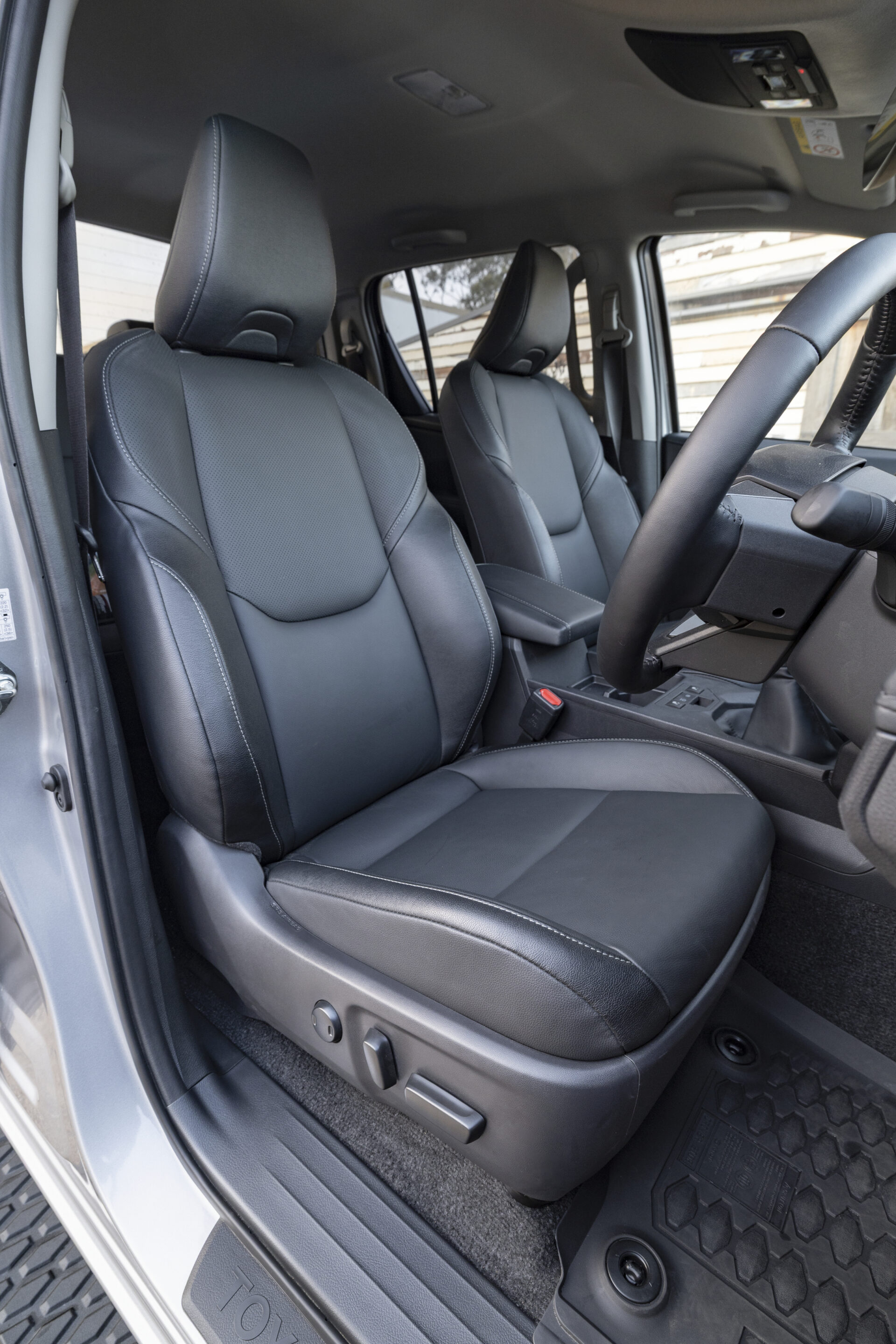
The retention of the previous car’s cabin and hard points mean the interior is still a bit on the slim side compared with some other dual-cabs. The same goes for the rear seat space which remains tight in every direction and continues to feature a too-upright backrest.
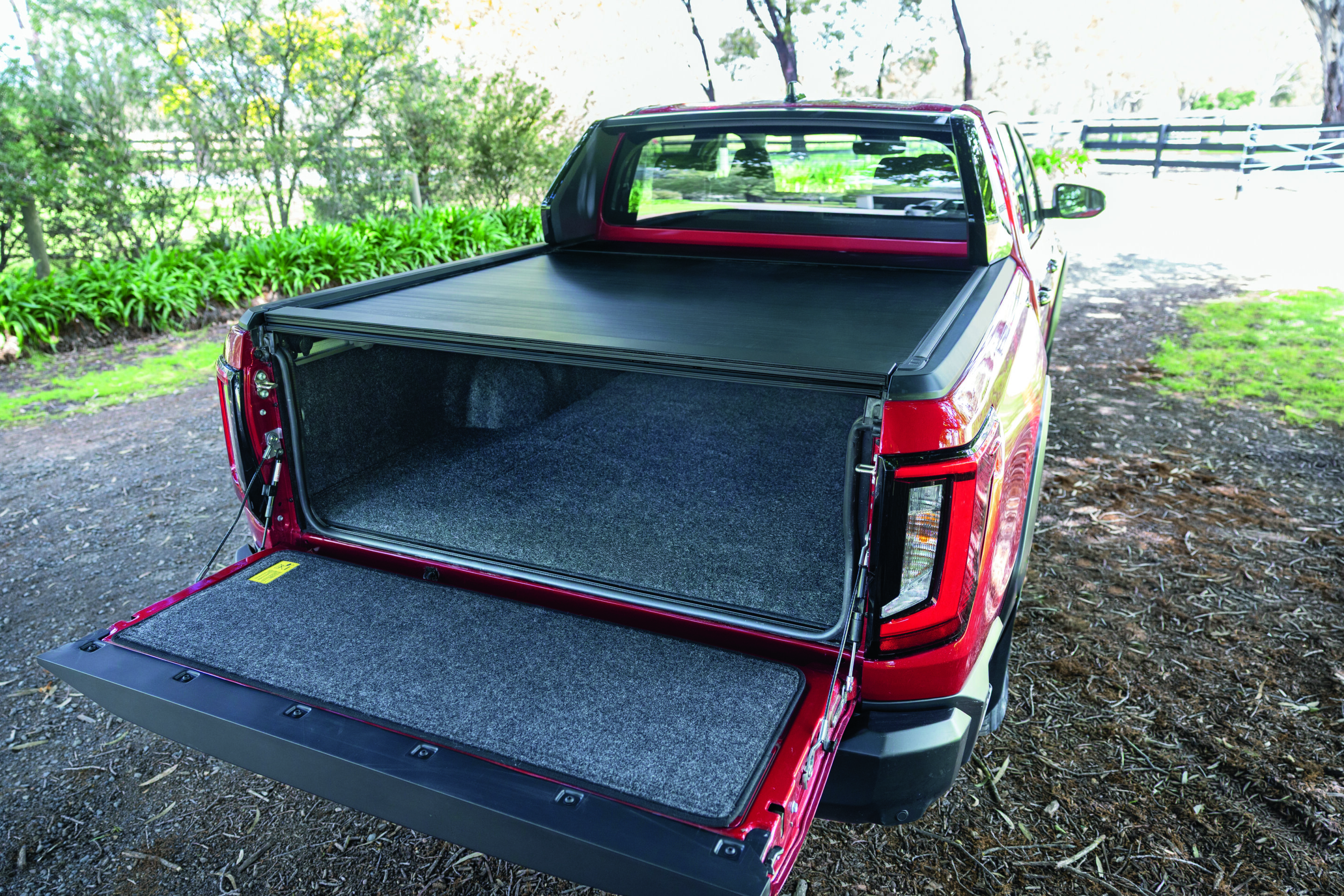
The tub, too, retains its basic dimensions and doesn’t have either a standard liner nor cover of any sort in the more basic models. The tie-down points are limited to four and they’re mounted too high up the tub sides to do their best work. And don’t get me started on the sports-bar…
Safety gets a leg up with new driver aids including autonomous emergency braking, pre-collision safety system, active cruise-control, rear cross-traffic alert, reversing camera, lane-departure alert, road sign assist, blind spot monitoring and lane-keeping assist. The latter seems a bit zealous to me but switching it off is a one-button job.
So, what’s missing? While paddle-shifters for the transmission might seem useless on a light-commercial, off-road they’re worth their weight in snatch-straps. Being able to hold a lower gear off-road for fidgety, delicate, light-footed work across rocks or gullies is a major bonus and paddles just make it easier. The other thing we’d like to see (and this goes for all dual-cabs) is an Auto 4X4 setting, allowing the vehicle to operate with an open centre differential and, therefore, use four-wheel-drive on bitumen. For towing on a wet road, there’s no tech you’d rather have at your disposal. Next time, huh Toyota?
You can see why Toyota has gone easy on the changes. The old show-tune ‘if it aint broke’ can be heard playing in the background of every kilometre you drive in the new HiLux. And fair enough; when the thing is slaying the opposition in the showroom aisles, why mess with such a successful product? Although I still reckon Toyota is taking the mickey calling it Gen 9. HiLux 8.5, would be a lot more accurate.
Specs
| Model | Toyota HiLux |
|---|---|
| Price | $57,990 (SR dual-cab auto); $64,990 (SR5 dual-cab auto); $71,990 (Rogue and Rugged dual-cab auto) |
| Peak power | 150kW @3400rpm |
| Peak torque | 500Nm @ 1600-2800rpm (automatic)/420Nm @ 1400-2800rpm (manual) |
| Transmission | 6-speed automatic/6-speed manual |
| 0-100km/h | Not given |
| Top speed | 176km/h (claimed) |
| Fuel consumption | 7.4-7.6 litres per 100km |
| Fuel tank | 80 litres |
| Dimensions (l/w/h/wb) | 5320mmmm/1885mm/1880mm/3085mm |
| Kerb weight | 2000-2342kg |
| Warranty | 5 years/unlimited kilometres |
| On sale | Now |
Lexus has unveiled a new halo model for its all-electric RZ line-up, and it’s not holding back. The new RZ 600e F Sport Performance sits above the existing 550e F Sport, bringing sharper styling, more power, upgraded brakes and the latest evolution of Lexus’s steer-by-wire technology. It’s the most extreme RZ yet – even if, frustratingly, it’s unlikely to reach Australian showrooms.
Based on the RZ 550e F Sport, the 600e F Sport Performance is built in Japan and priced from 12,165,000 yen (approx. A$125,000) before on-road costs. While UK references remain relevant given Lexus’s European focus for this model, there’s currently no indication the new flagship will be offered beyond select markets. For context, the Lexus RZ range in the UK starts at the equivalent of around A$110,000, while Australian pricing for the RZ currently undercuts that.
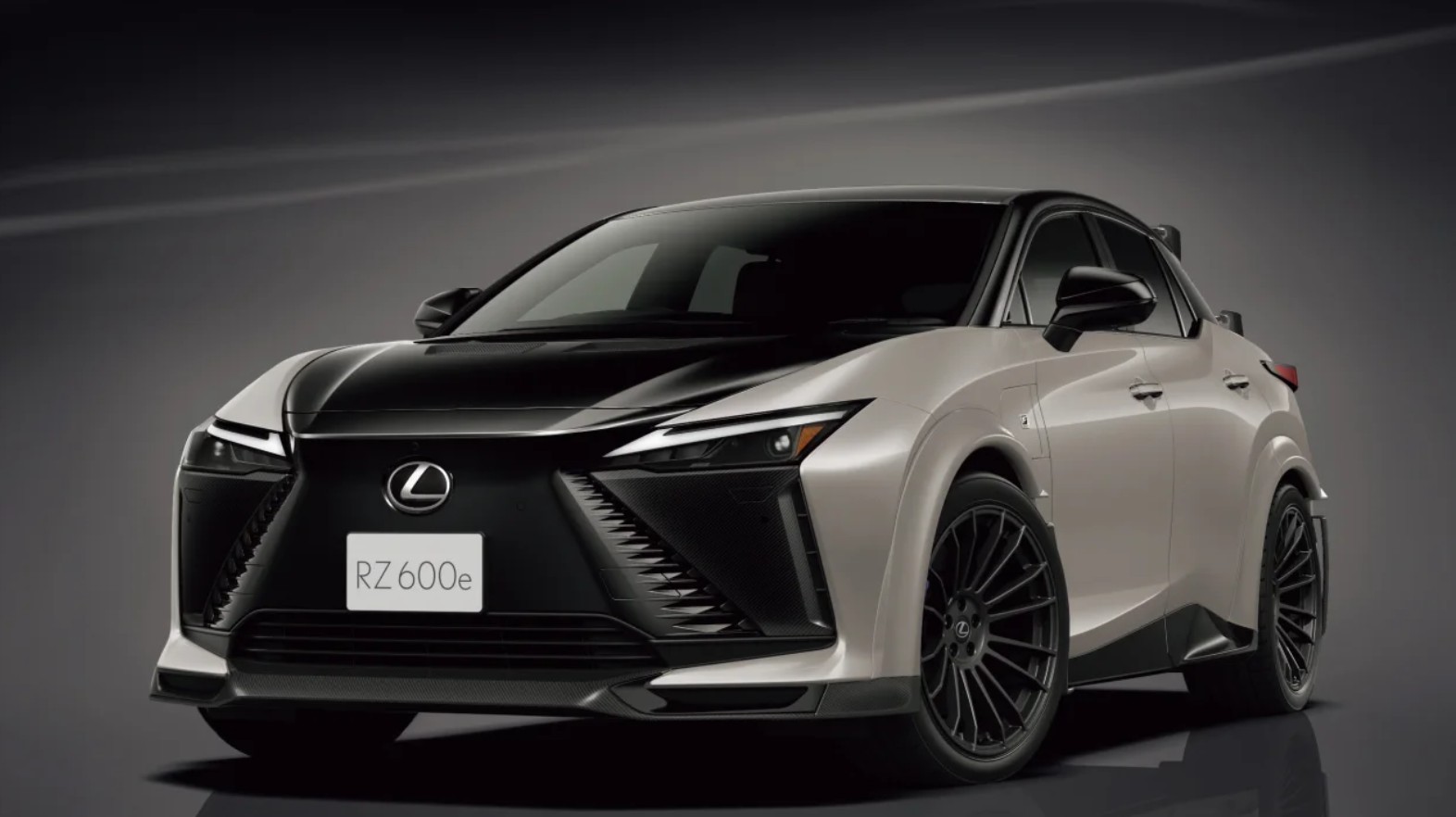
Visually, the RZ was already one of the more distinctive electric SUVs on sale, but the 600e F Sport Performance takes things much further. A comprehensive new bodykit has been designed not just for visual drama, but also for aerodynamic efficiency and added downforce. Carbon-fibre elements dominate, including a new front splitter, flared wheelarches, a unique bonnet, twin spoilers (roof-mounted and on the tailgate), a rear diffuser and additional vanes to manage airflow around the wheels.
Exclusive 21-inch aluminium wheels fill the arches and sit over a significantly uprated braking package. Larger discs are paired with six-piston front calipers finished in Lexus’s signature blue. That colour theme can also be applied to the mirror caps, front bumper accents and window trim, while buyers can choose between black-and-white or black-and-grey two-tone exterior finishes. A 20mm drop in ride height completes the look and, according to Lexus, contributes to greater stability and driver confidence.
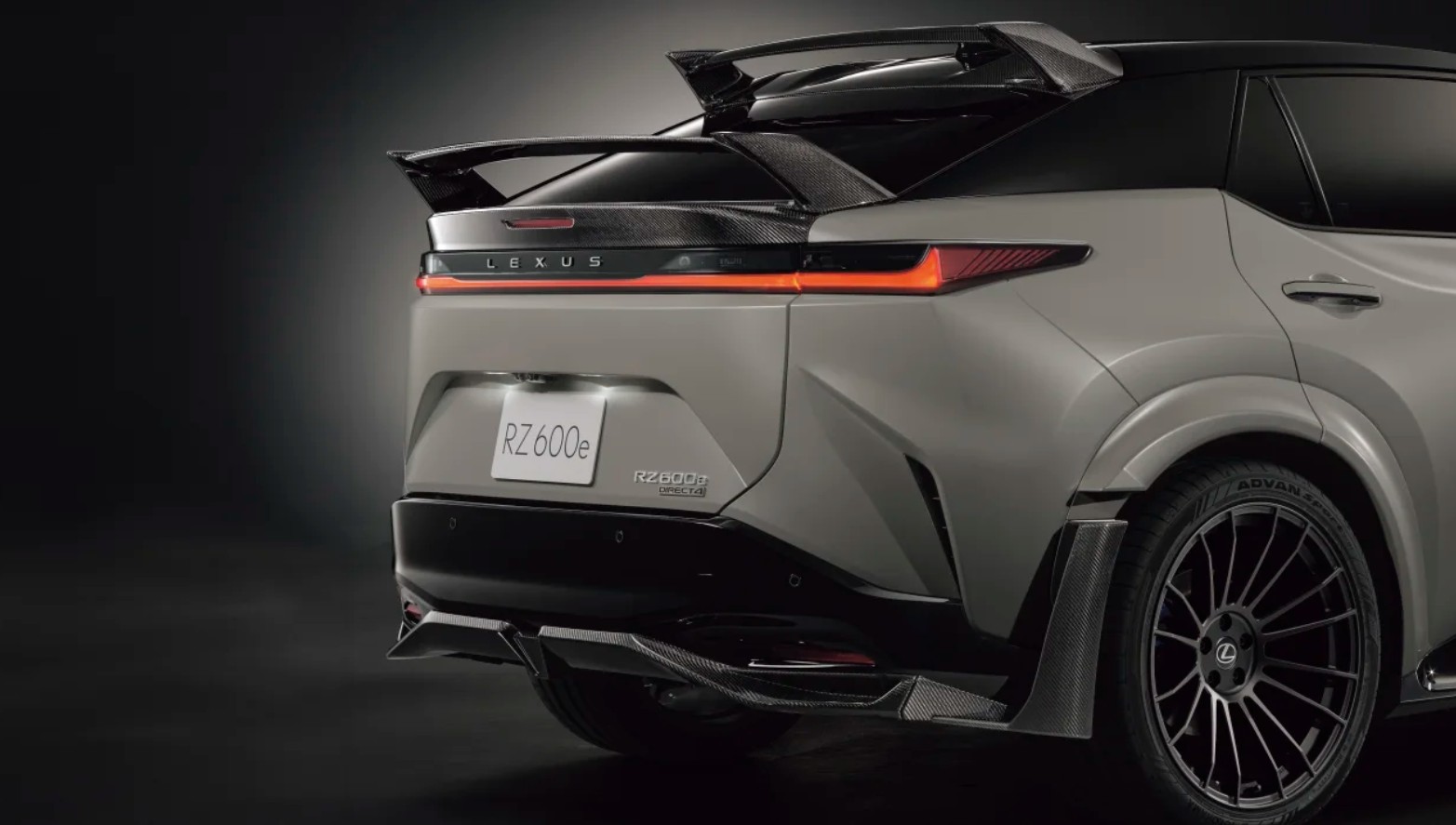
Under the skin, performance has been nudged up from the 550e’s already-healthy outputs. Total system power rises to approximately 313kW (up from around 300kW), while torque figures remain undisclosed. Despite the increase, acceleration is unchanged, with the 0–100km/h sprint still dispatched in a brisk 4.4 seconds. The dual-motor, all-wheel-drive layout carries over, as does the 77kWh battery pack.
Official WLTP range figures haven’t been released, but with the same battery as the 550e, a driving range of around 450 kilometres is expected – roughly in line with the existing model’s claims.
Inside, the headline feature is Lexus’s yoke-style steering wheel, paired with the latest version of its steer-by-wire system. The brand says refinements to the software and hardware deliver a more natural, engaging feel across all driving scenarios, addressing early criticisms of artificiality.
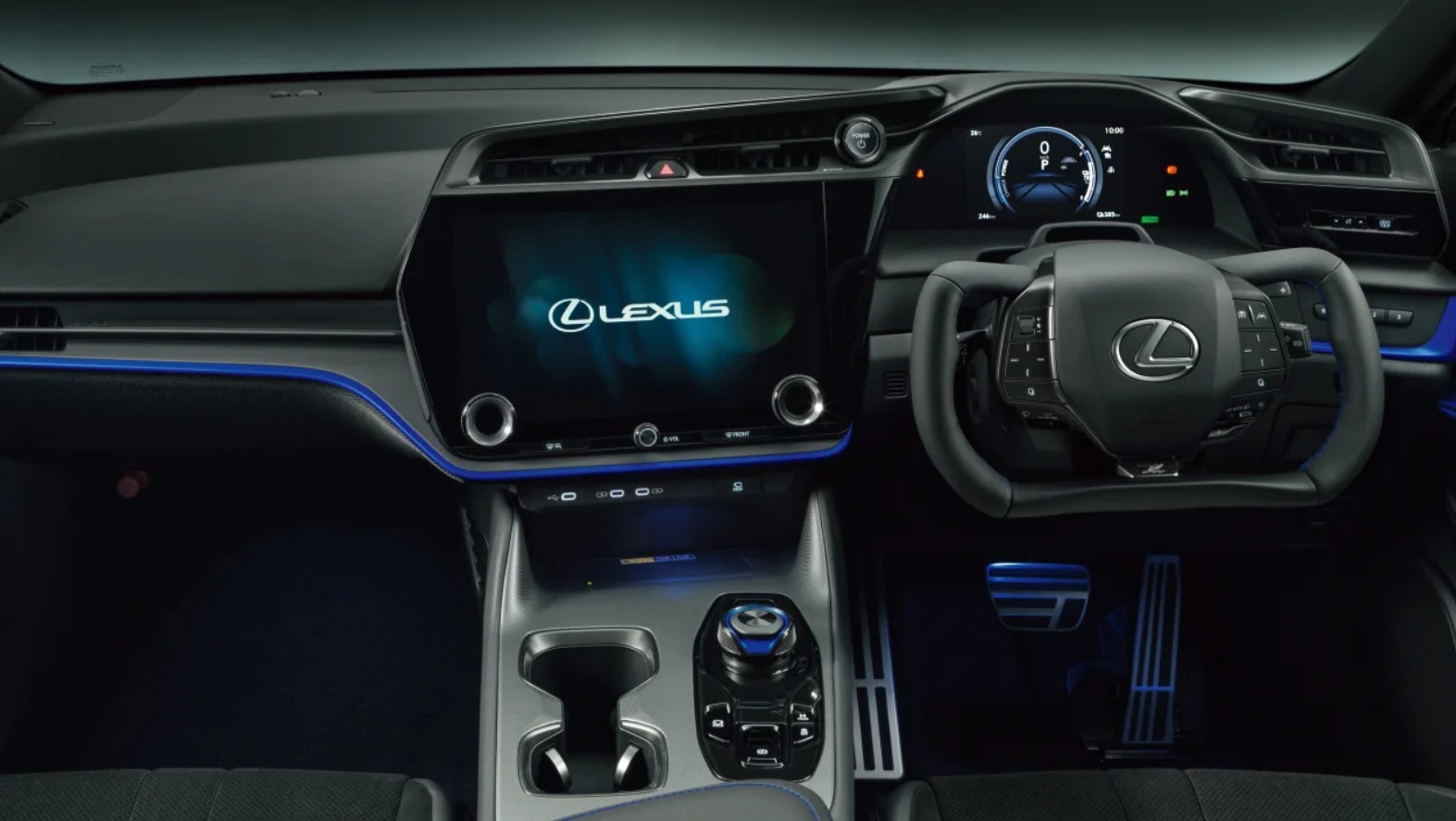
Unlike the limited-run RZ 450e F Sport Performance released in 2024, production of the 600e F Sport Performance won’t be capped. That makes it a true range-topper rather than a collector’s special.
Whether or not it ever reaches Australia, the Lexus RZ 600e F Sport Performance sends a clear message: Lexus is no longer content to simply dabble in electric performance – it wants to lead with style, technology and genuine intent.