
BYD has officially launched the Sealion 07 DM-i, a mid-to-large-size hybrid SUV, in China, the fourth addition to the automaker’s popular Sealion family and a hybrid sibling to the all-electric Sealion 07 EV introduced earlier in May 2024.
The Sealion 07 DM-i comes in three variants – the 150 Pilot edition priced at RMB 169,800 (A$36,570), 150 Pilot plus edition at RMB 179,800 (A$38,725), and 135 Performance radar edition at RMB 205,800 ($A44,325). Built on BYD’s latest fifth-generation DM (Dual Mode) hybrid platform, known as DM 5.0, the vehicle promises enhanced fuel efficiency and improved hybrid performance.
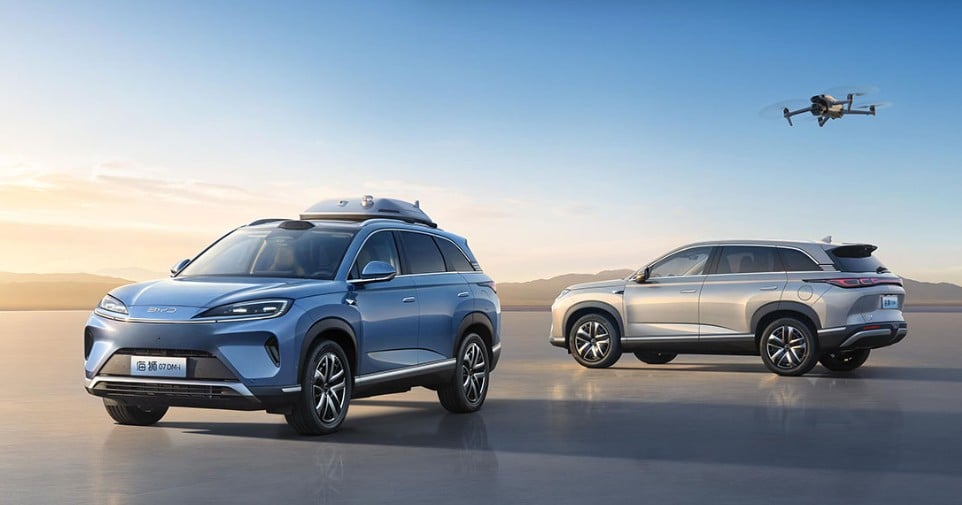
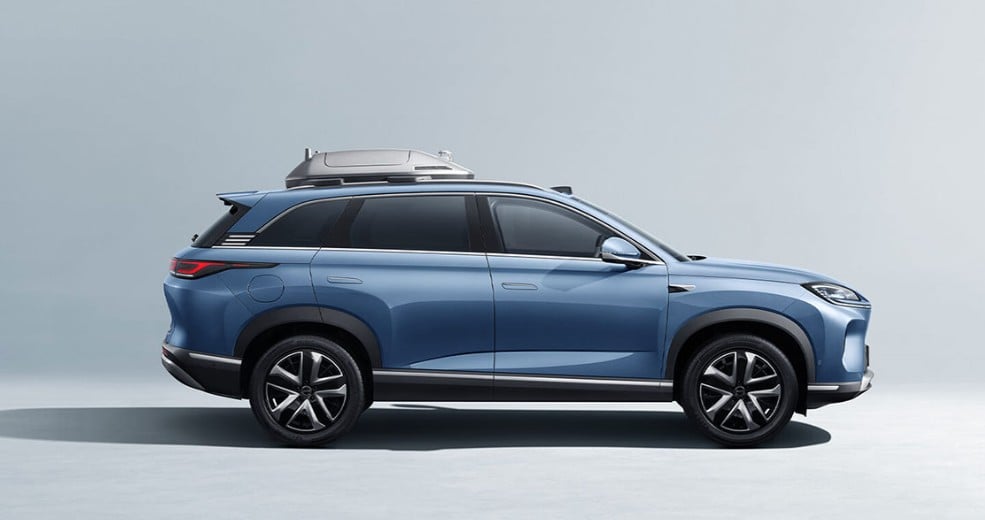
Measuring 4880 mm in length, 1920 mm in width, and 1750 mm in height, with a 2820 mm wheelbase, the SUV is powered by a 1.5T engine delivering 115 kW of peak power and 225 Nm of peak torque. It features a 60-litre fuel tank and a standard 26.6 kWh blade battery, offering a CLTC electric range of up to 150 km. Combined, the hybrid system enables a driving range of up to 1320 km on a full charge and full tank.
The two entry-level models – considered as competitors to cars such as the Tesla Model Y and Toyota Kluger – are front-wheel-drive configurations with 200 kW peak power and 315 Nm of torque, capable of accelerating from 0 to 100 km/h in 7.9 seconds. The top-tier variant adds a 150 kW rear motor and delivers 340 Nm of additional torque, reaching 0–100 km/h in just 4.7 seconds.
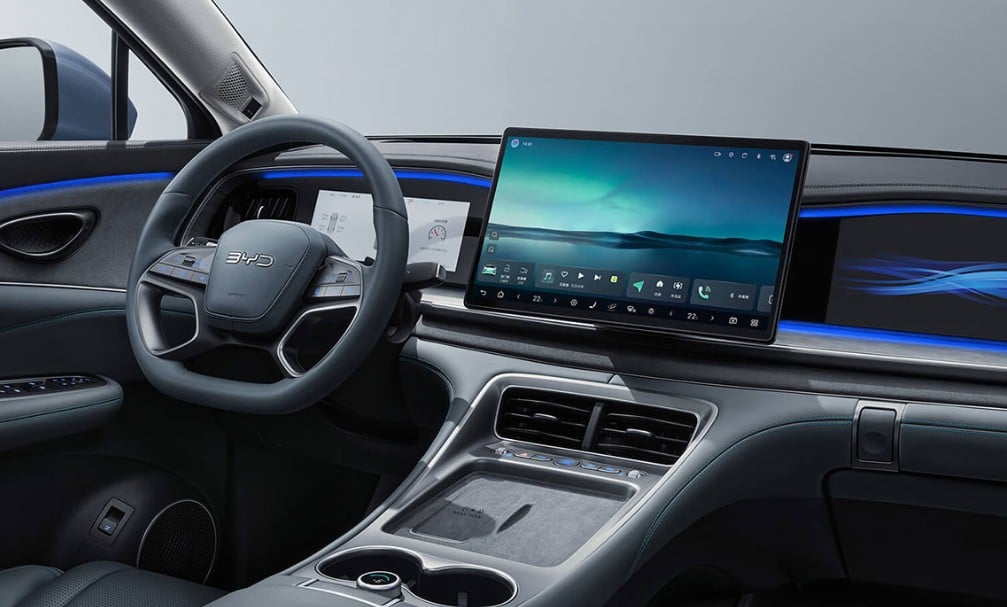
In terms of technology, the lower two variants are equipped with the God’s Eye C driver assistance system and DiPilot 100, supporting highway NOA (Navigate on Autopilot). The premium model features God’s Eye B and DiPilot 300, extending NOA capabilities to urban areas. All versions come with BYD’s DiLink 100 infotainment and an AI voice assistant powered by DeepSeek.
The Sealion 07 DM-i also supports the Ling Yuan drone system, developed in collaboration with DJI.
No word yet on whether the new hybrid will be sold in Australia though BYD’s Chinese executives have indicated global sales are imminent as part of its expansion of the Sealion offering.
It’s a fun game, predicting which cars are likely to become future classics. Of course, if anything becomes old enough and rare enough, it gains a certain curiosity value, but once in a while a car is launched and it becomes instantly and unambiguously apparent that it’s a nailed-on cert for classic status. And not even future classic status – it’s a fixture from launch.
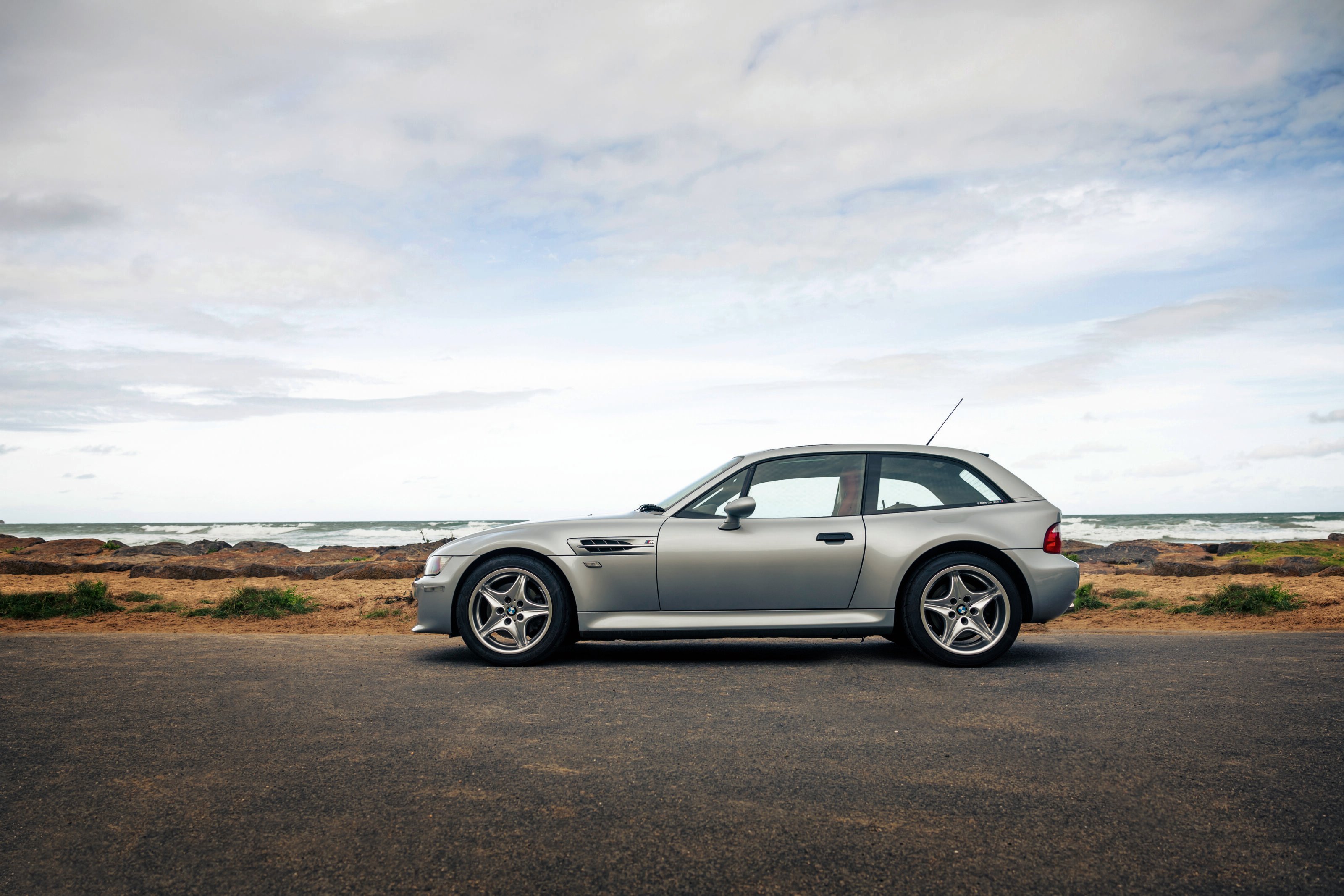
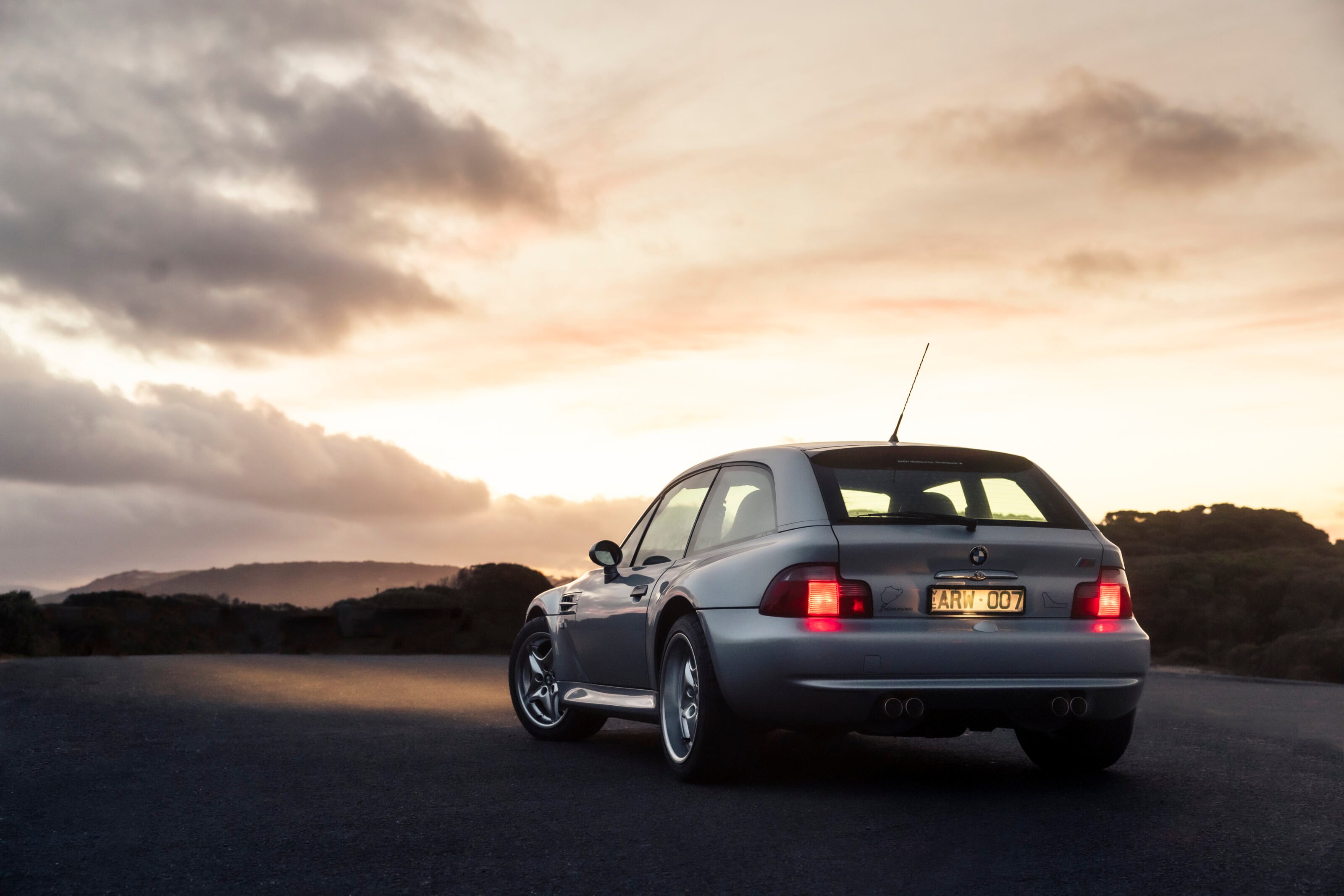
The BMW Z3 M Coupe is just such a car. But as if to undermine the sheer arbitrariness of it all, the car that it was based on – the drop top M Roadster – has often had a lukewarm reaction from car enthusiasts. That’s because so much of what makes the M Coupe special is the way that it looks. True, the more rigid coupe body also delivers better dynamics than the rather wobbly convertible, but the divisive and extreme styling of the M Coupe has always had people either drooling or peering through their fingers in horror. There’s almost no middle ground.
To understand this car is to spool back a long way, firstly to the initial conception of the Z3 family in general. Development of this model began in 1991, partially in response to the runaway success of the Mazda Miata in the US, and also to dovetail with the end of Z1 roadster production. Many lessons were learned from the Z1 project, chiefly around not throwing good money after bad.
Widely – and wrongly – perceived as a parts-bin special, the Harm Lagaay-styled Z1 proved both costly and difficult to build, with a peak build capacity of between 10 and 20 units per day. Only 8000 were built during its 27-month production run and none went to the US. In fact, 6443 units were sold in Germany. Rather belatedly, BMW realised quite how much money it had left on the table.
The name? The PR line is that the Z in Z1 stands for Zukunft, German for ‘future’. The truth is a
little more prosaic. ZT was the internal designation for BMW Technik GmbH, the department run by Dr Ullrich Bez where the Z1 was conceived. All project codes there started with Z. With typically Germanic logic, large projects got the Z code with a single digit following, medium-sized projects had the Z appended by two digits and there were three digits for small projects. So Z1 was simply the first big project that Technik undertook. Once the car was approved for production, it needed an official Entwicklung (development) number. It was assigned the internal designation E30/Z. It was also the very first BMW to use the sophisticated Z-axle rear suspension, more of which later.
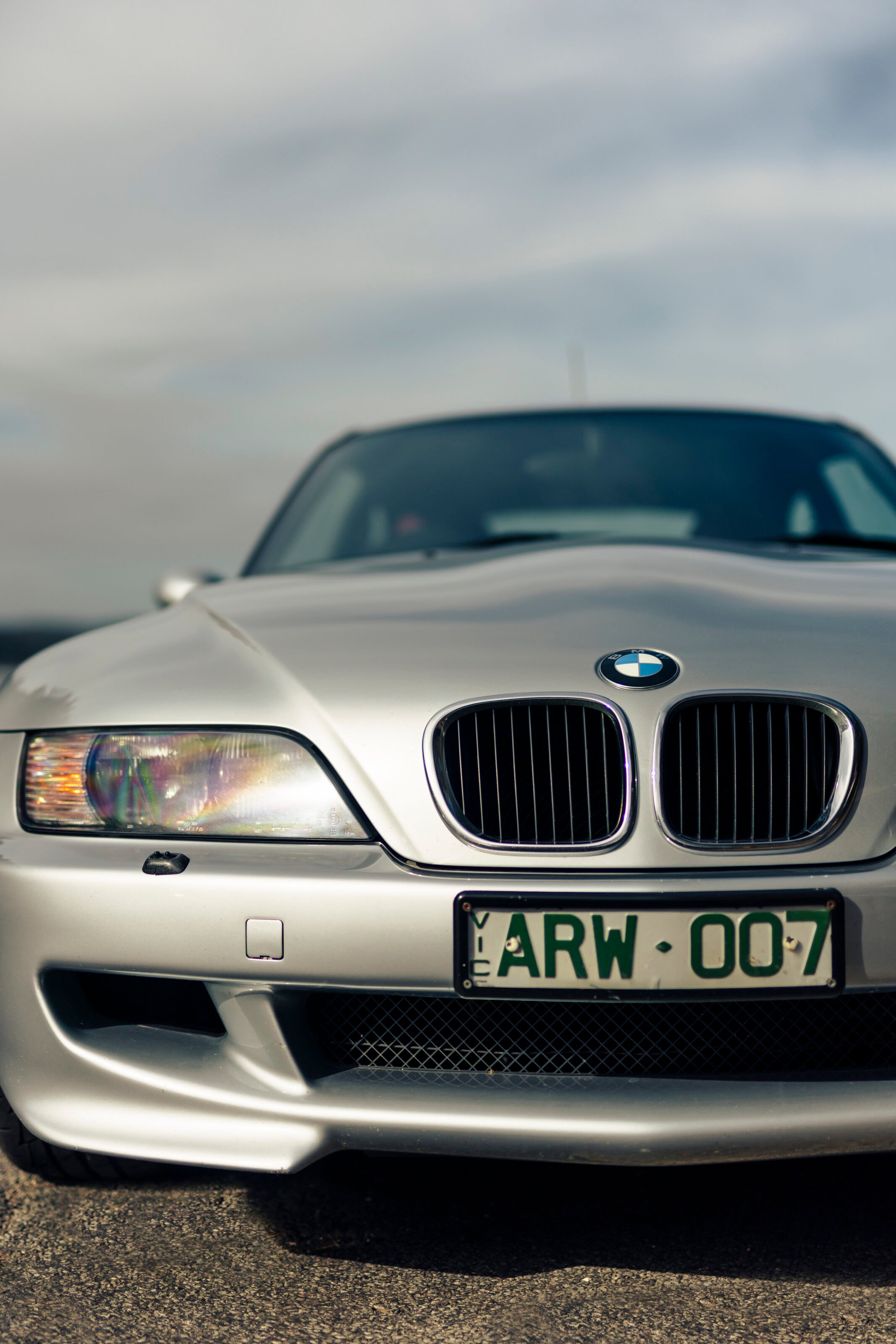
BMW realised that the Z1’s successor could not be such a boutique offering. It needed to shift some serious units, and the most cost-effective way to do this, the company reasoned, was to build a factory in the US. Spartanburg, South Carolina was chosen, due to its road and rail infrastructure, plus access to Inland Port Greer. It was a smart choice. There was ample available labour, due to the recent downturn in the region’s textile industry, and Tier 1 suppliers such as Bosch and Michelin were also co-located. The local airport’s runway expansion was part of the deal, as was then-state governor Carroll Campbell’s promised USD$35m in incentives. The deal was inked in June 1992 and the first car to roll out of Spartanburg was a BMW 318i on September 8, 1994. You could say that BMW’s decision was vindicated, as Spartanburg is now quite comfortably its largest production facility.
It was also a brave choice. Having acquired Rover in 1994, BMW knew that the Brits were developing a roadster themselves. It would have made short-term financial sense to piggyback onto the development of what would become the MG F, a far more technically advanced car with a mid-mounted engine and Hydragas suspension. Instead, BMW knew it had to play a longer game.
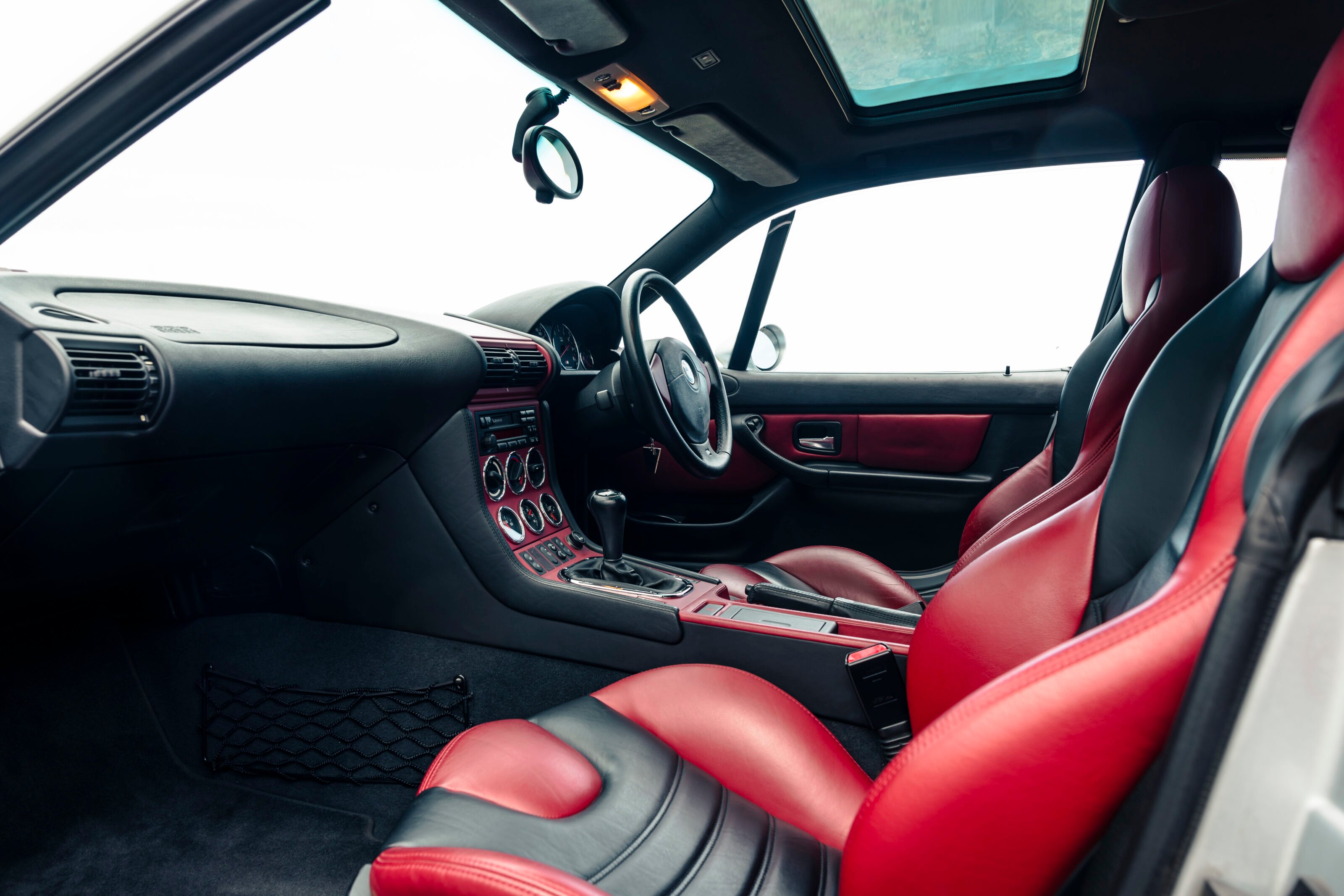
Running on a shortened version of the E36/5 3 Series Compact platform, with a hefty 246mm chopped out of the wheelbase, the Z3 was developed on the cheap. Burkhard Göschel, carrying the job title ‘Project Manager Roadster’, was in charge of the development. He commissioned Joji Nagashima to style the Z3, with the exterior design study approved in July 1992 and final design freeze coming in early 1993. The car was officially announced on June 12, 1995, with production beginning in September of that year. The Z3 featured in the generally rather awful Bond movie GoldenEye in November of that year, with the result that the entire 1996 production run was instantly sold out.
So let’s spool forward to 1997 and the launch of the M Roadster, or E36/7 if you’re an unreconcilable BMW tragic like me. At this point, the Z3 needed some help. To date, the brawny-looking Z3 had been offered with a choice of an 85/87kW M43 1.8-litre four or a 103kW M44 1.9-litre four. The ultimate driving machine it certainly wasn’t.
Cue the sixes. For the masses, the lovely M52B28 137kW 2.8-litre inline six-cylinder engine made its debut. For the M-car enthusiasts, the magnificent S50B32, all 236kW and 3.2 litres of it. Unless, that is, you lived in the US, whereupon you got the slightly less lovely S52B32 inline-six rated at a mere 179kW. For a bit more back story on that, dig out the November 2024 issue of Wheels, and the Modern Classic piece on the E36 M3.
The full-fat M Roadster was a wild and hairy thing. We strapped Peter Robinson into what was at the time the fastest-accelerating production BMW of all time and set him loose at Jerez in the May, 1997 issue.
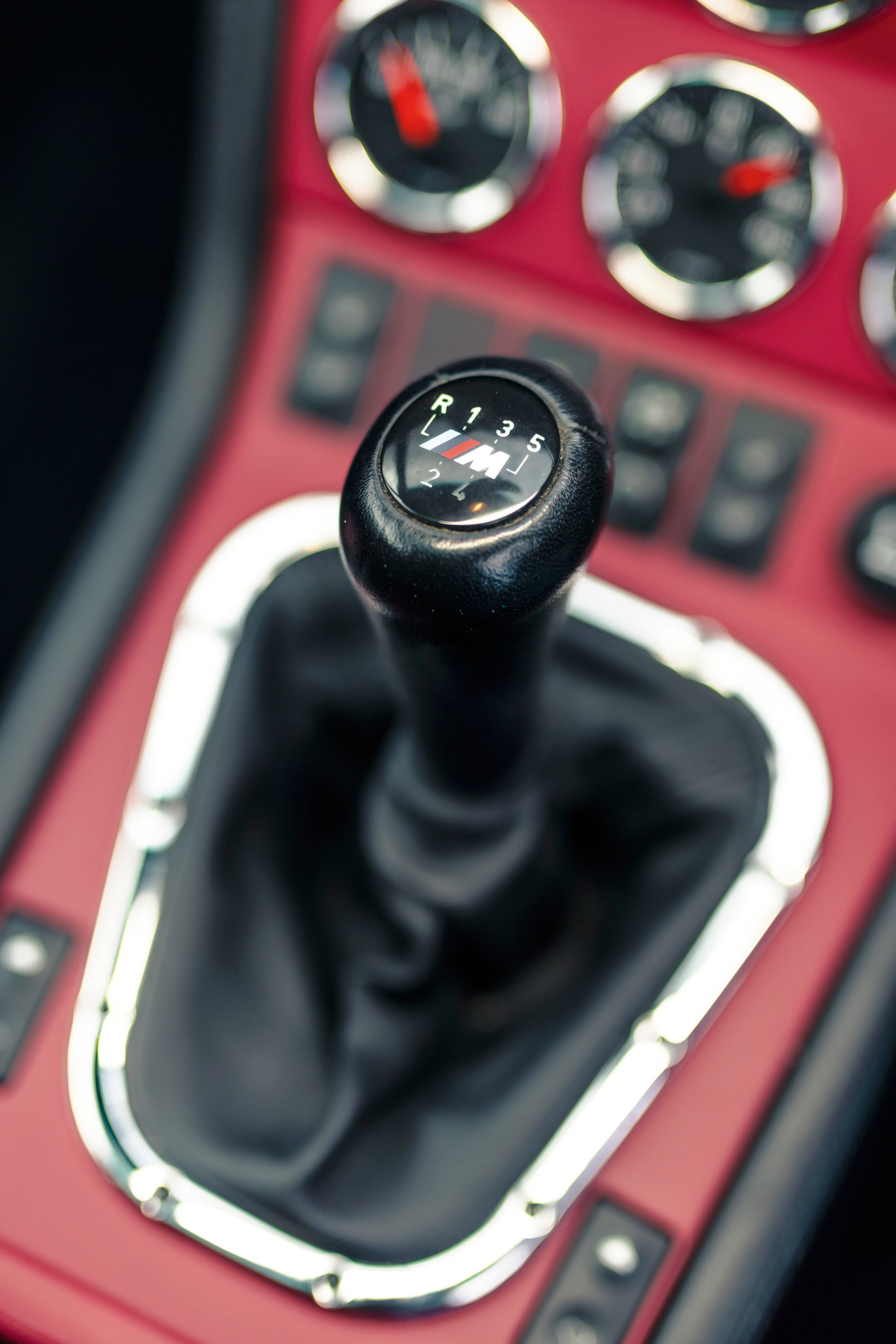
Traction control? That was our man from Glebe’s right boot. With front suspension, brakes and some of the steering from the E36 M3, there was little wrong with the strut front end. It was the rear that was in doubt, the old semi-trailing arm setup from the E36 Compact being beefed up with a rear subframe that was twice as stiff as in other Z3s, and an oil cooler for the differential. Unfortunately, the Z3 floorpan didn’t allow for the fitment of the M3’s six-speed manual, so the more compact five-speed unit had to do. At the time, with that power output it was more a rival for a Porsche 911 than a Mercedes-Benz SLK or Porsche Boxster.
BMW has a long history of what it rather appealingly calls ‘submarine projects’. To us, they’re the sorts of after-hours flights of fancy perpetrated by the most committed and enthusiastic designers, engineers and visionaries within the company. BMW even has a fund for them nowadays.
“That wasn’t planned,” says Burkhard Göschel of the coupe body. “We had several variants and said to ourselves: It looks kind of sharp. But that wasn’t an official plan, and somehow we pushed it through. But there were actually a lot of opponents. The car’s shape is somewhat polarising. But it wasn’t in the plan, and neither was the effort involved. The plan was also to develop and build the Z3 only with a four-cylinder engine. But that traditionally goes wrong at BMW.”
Yep, that’s right, the Z3 body was never originally designed to have a six-pot under that long bonnet
either. “We had to modify the rear end, with the rear axle,” said Göschel. He claims that the tin-top’s
unusual aesthetic created some internal conflict. “The sales were at war with the car,” he noted, claiming that BMW’s Italian sales manager pushed for the vehicle with an argument that it could only be understood with the heart, not the head. Ultimate sign-off responsibility lay with the urbane Wolfgang Reitzle who, we’re told, took quite a bit of convincing.
“So the Coupé slipped through,” chuckles Göschel. “From the construction it was a welded roof. Bodywork totally stiff. I just wanted to say if you built it on the Roadster then you had additional stiffness, but also heavier than the Roadster,” he noted.
It wasn’t by too much though, the Coupe adding a mere 25kg to the Roadster’s 1365kg dry weight.
The M Coupe’s additional stiffness wasn’t just provided by the roof panel. Reinforcing panels were placed around the windscreen, the doors and the subframe. As a result, BMW M claimed that the M Coupe was the stiffest car it had built to date, with a torsional rigidity of 16,400Nm per degree of twist – 2.6 times as torsionally stiff as the M Roadster. Dynamic stiffness was rated at 29.2Hz, the same as the E36 M3 coupe.
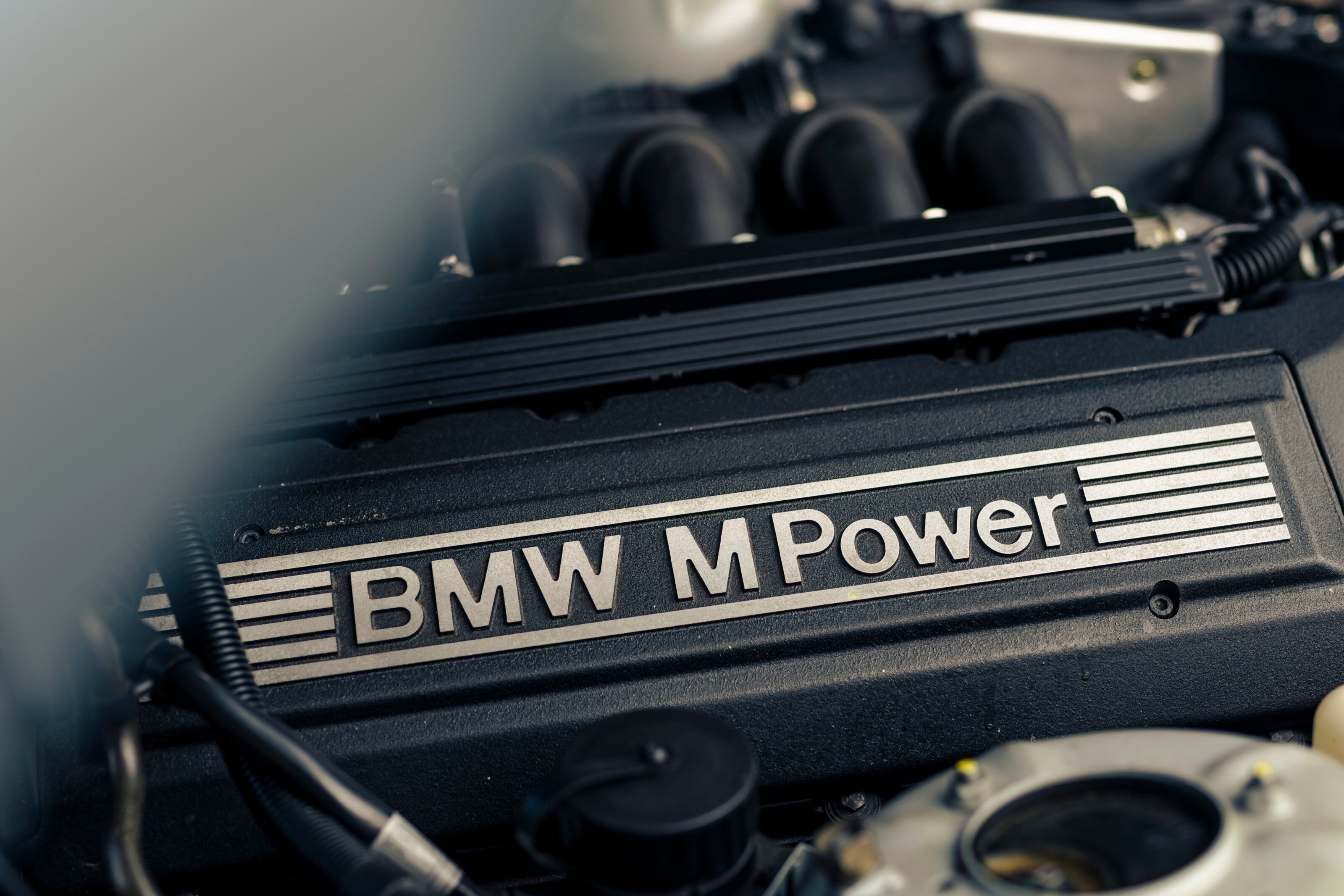
This additional body stiffness gave BMW’s chassis development team more options with suspension tuning, allowing the fitment of firmer springs and dampers versus the Roadster, while retaining the same gauge anti-roll bars. Firming up compression helped negate the noticeable toe change – and thus bump-steer – that afflicted the M Roadster.
Again, there were a couple of engines offered in the M Coupe. Initially, it was a choice of the 236kW S50 for most markets, with the US getting the 179kW S52. To give you some sort of idea as to how US-focused this car was, 2999 units were built with the US-spec S52 engine and a mere 2180 were shipped off overseas with the punchier S50 engine. German market cars had engines that clocked up a bizarre amount of mileage before they ever found owners, as the powerplants were built in Germany, shipped to the US to be mated with the M Coupe body in Spartanburg and then shipped back to Germany for sale.
No fewer than 11 body colours were initially offered on right-hand drive cars, comprising Alpine White III, Imola Red II, Dakar Yellow II, Evergreen, Cosmos Black, Black Sapphire Metallic, Arctic Silver Metallic, Titanium Silver Metallic, Boston Green Metallic, Oxford Green II Metallic and, of course, the hero launch colour, Estoril Blue Metallic, a paint finish that had first appeared on the E36 M3 in 1992.
Peter Robinson was again Wheels’ man on the spot for the first comparison test of the Z3 M Coupe, in this instance in the September 1998 issue where it faced a notably stern test against the then-new Porsche 996 Carrera in the UK. Whereas European markets also got a 2.8-litre six in the Z3 Coupe, Australia only received the flagship M Coupe, priced at $137,000 when it arrived on our shores, versus $183,900 for the entry-level 911. In other words, it already had a significant advantage out of the blocks.
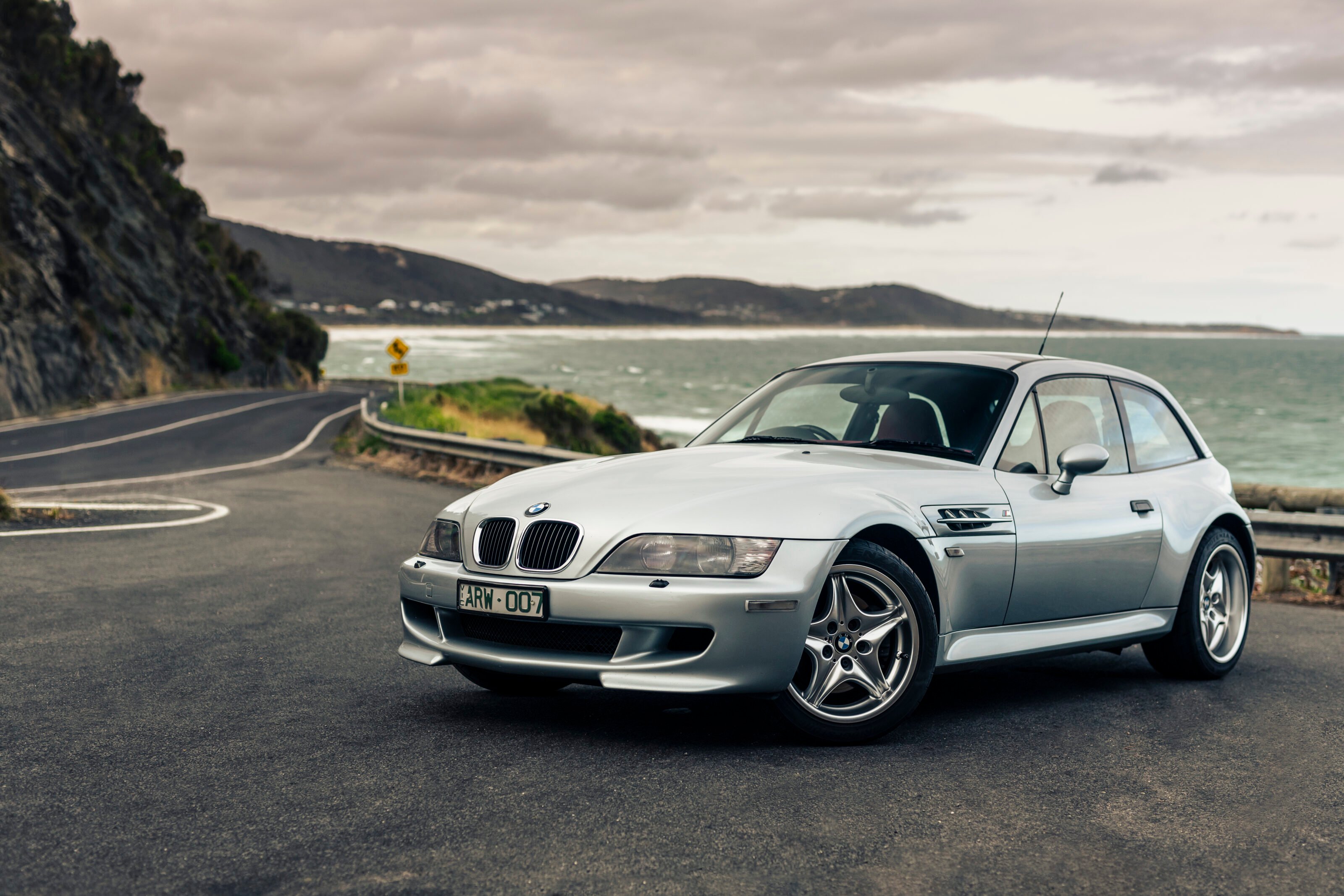
It was quickly clear that the M Coupe was something quite special. Robbo reckoned “the improved suspension control allows for better handling when the road surface is rough. This lends a refinement and a cohesiveness to the driving that’s completely lacking in the Roadster,” he said at the time. “The rawness of all that power can’t be disguised – nor would you want to cloak it any way. Now you can punch out of lumpy second gear corners, lighting up the rear tyres if you insist, the Coupe tracking true and without body shiver. It’s going too far to say the steering is sensitive by ultimate standards – it’s too meaty for that. But this M changes direction more consistently and effortlessly, and is thus far more rewarding; it is also quicker and better riding on any undulating road.”
What it wasn’t was a better all-rounder than the Porsche 911, but while the evergreen Neunelfer was the better overall car, Robinson opined that “there are those, however, who find this newfound refinement excessive, as if some of the desirable 911-ness of character has been engineered out of the new car.
Maybe, in truth, such people were exactly those that the BMW engineers had in mind when they developed the M Coupe. By the standards of the new Porsche, this is a raw beast, loud, aggressive and extroverted.”
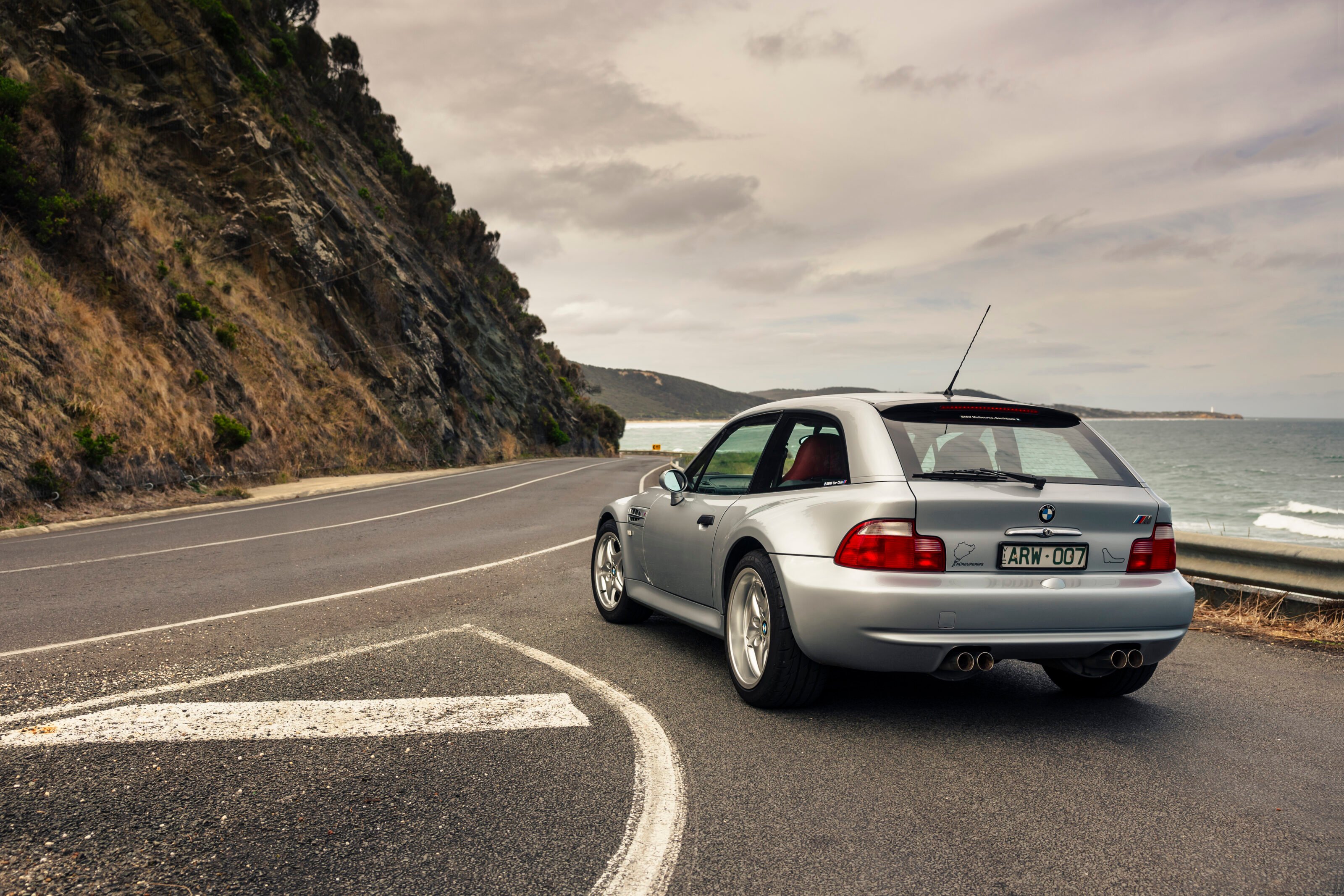
It was a telling point and one that helps explain the lasting appeal of the M Coupe. In a world where cars have become more sanitised and easier to drive, here was a vehicle with huge power and no stability control. Some form of electronic safety net appeared in February 2001 when, after a six-month production hiatus, all M Coupe models got the same BMW S54B32 engine as seen in the BMW E46 M3.
Now good for 252kW/365Nm in most markets (again, the Yanks were dudded), the engine was bored-out compared to the S50, now displacing 3246cc rather than 3201cc. Revised camshafts, finger follower valve actuation, an increased compression ratio, a Siemens MSS54 ECU with electronic throttle control (allowing the fitment of Dynamic Stability Control) were all introduced with the S54 lump.
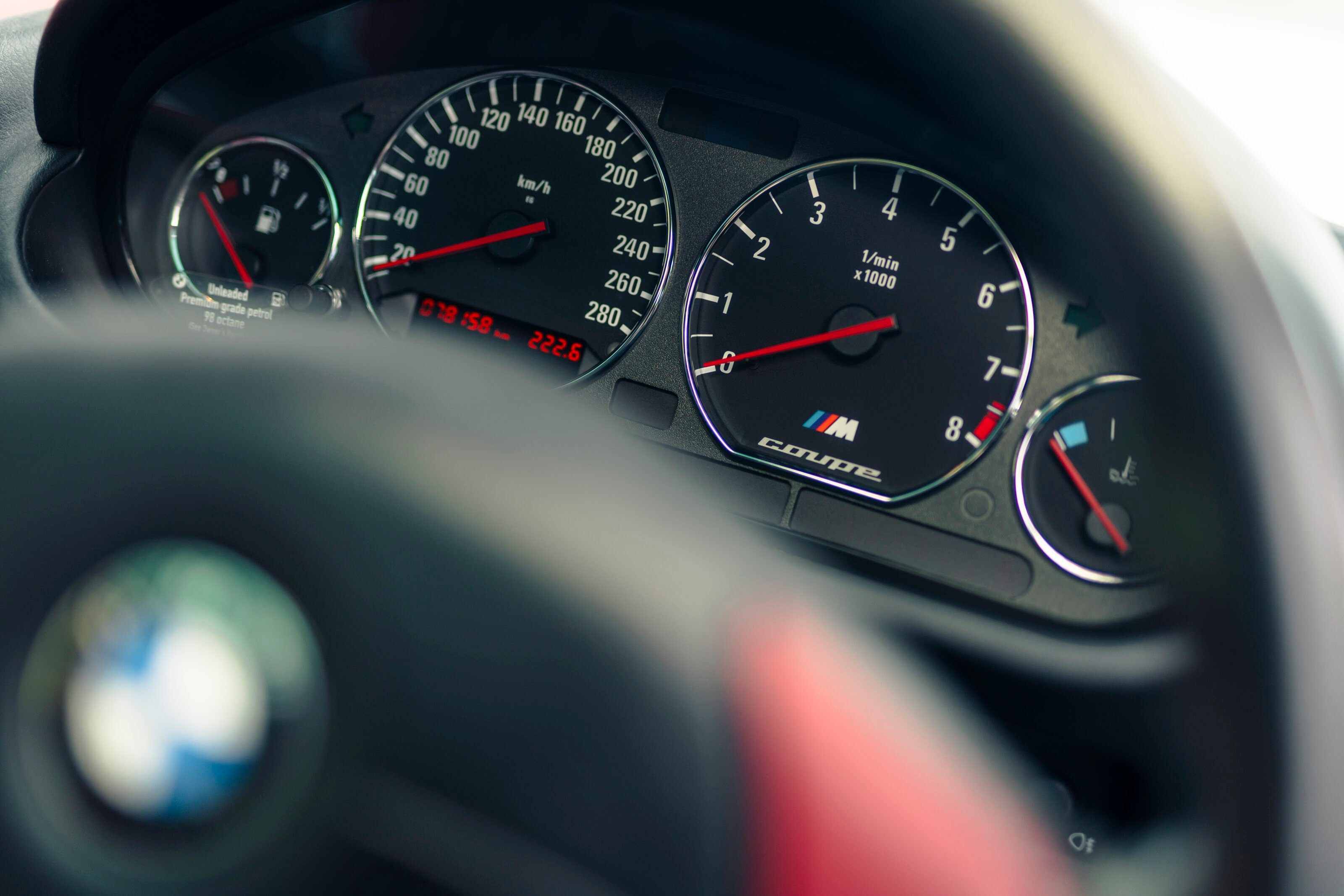
The colour palette was also subtly revised, the most significant change being the introduction of Laguna Seca Blue. Some modest aesthetic changes, such as revised dials, curved M-badging and a revised rear-view mirror also debuted. A total of 1112 M Coupes were built with the S54, 678 of which stayed in the US. In other words, a right-hand drive S54-engined M Coupe is a rare beast, with only 165 ever built. With an attrition rate of around 25 per cent, there’s probably little over 100 cars still in circulation. The 40 S54-engined cars sent to South Africa were equipped by the importer with AC Schnitzer suspension and exhaust, a short shift kit, a unique gear knob and 18-inch Type III alloys.
Opinions differ as to which is the better installation. Some prefer the analogue throttle action and the rawness of the S50-engined car while others lean towards the extra refinement and broader spread of torque of the S54. BMW also ironed out some of the teething issues with the double-VANOS system with the S54 unit. It also solved the irritating issue with the throttle cable stretching on the S50 engine.
One malady that can affect all vintages of M Coupe is that flex from the differential can pop both the rear cross member welds and the boot floor spot welds. Aftermarket bracing kits fix this and are recommended. You’ll also need to remember that with a 51-litre fuel tank and a fuel thirst that can easily climb above 25L/100km, you’ll have less range than most EVs if you pedal an M Coupe hard.
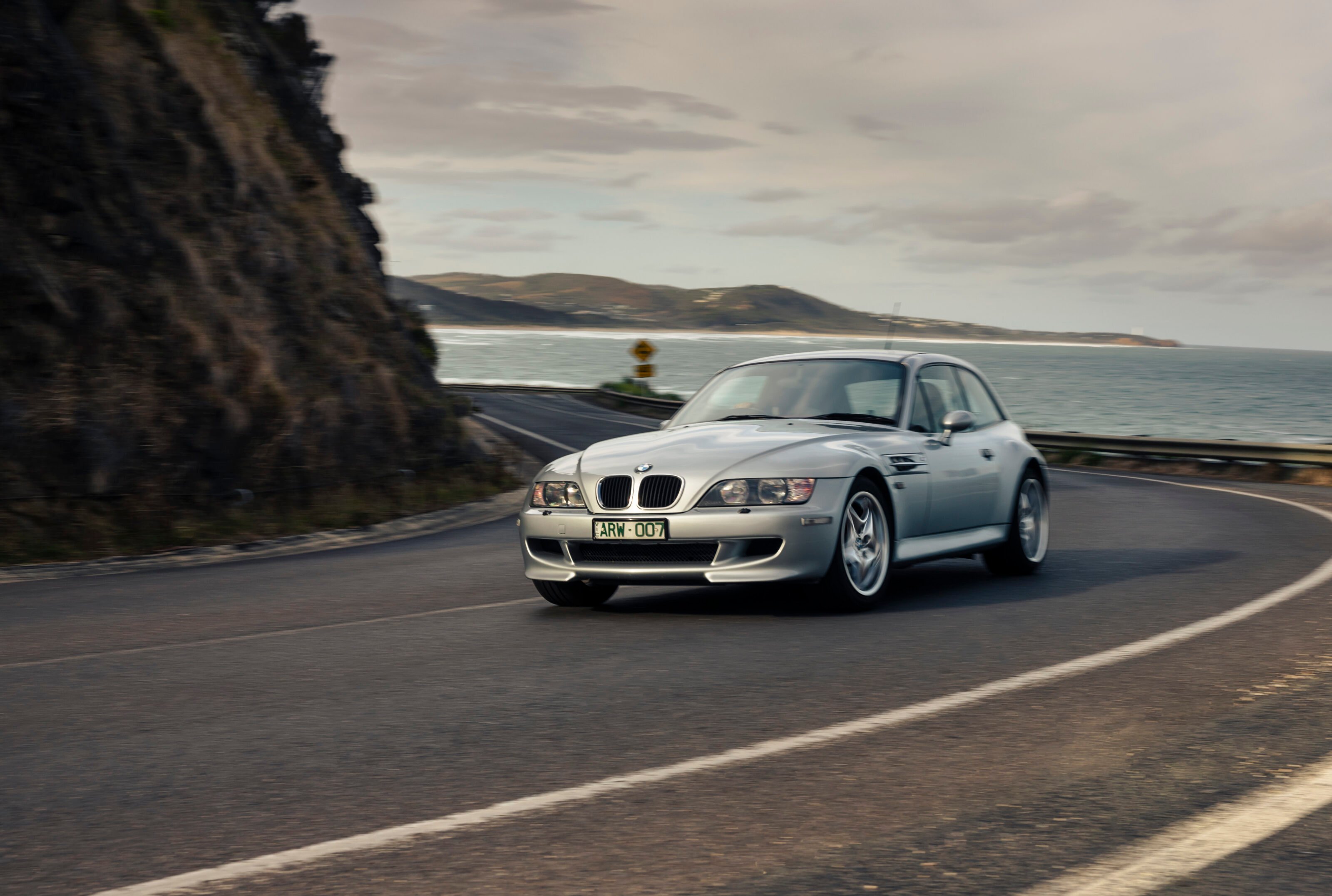
Still, by today’s standards, the Z3 M Coupe isn’t in the senior league of quick cars. At 5.4 seconds to 100km/h, it’s in the same ballpark as a Honda Civic Type R, and it’d take a very skilled and determined driver to keep the Honda in sight on a challenging road. Nevertheless, it’s plenty quick enough to have fun, and it demands a focus and intensity, the cab-back driving position making it always feel an occasion. You feel the rear suspension at work, you have to manage the weight transfers of the car deftly, and the straight-six engine is never anything less than magnificent. Sure, you’ll go quicker in lots of modern cars, but it’s doubtful that many of them are more of an event, in this price bracket at least.
What’s more, everybody wants to talk to you about your ‘clown shoe’, your ‘bread van’ or any one of the many nicknames that the M Coupe has worn over the years. Auto Motor und Sport even dubbed it “a bullfrog with a damaged hip”. Talk about a harsh appraisal. The Z3 M Coupe lasted in production until May 2002, whereupon Z3 manufacture as a whole was ceased.
Today, any version of the Z3 M Coupe is highly collectible. Because of their limited production run, and consequent attrition rate, the law of supply and demand ensures that prices are punchy. The opening price is around $100,000 for higher mileage cars, lifting closer to $150,000 for the very best available. That’s almost double what you’d expect to pay for manual E46 M3s, which are, objectively at least, superior cars.
That’s the magic of the M Coupe. Because it looks so odd, is so rare, and its development backstory is so interesting, it has generated a cult following. These cars don’t happen very often, and they’re increasingly difficult to justify in this day and age. If you hanker for a throwback, the Z3 M Coupe is a very singular choice. It’s cramped, noisy, angry and unapologetically of its era, but it’s hard not to love. And if you do choose one, look after it and drive it. You at least owe us that.
This article originally appeared in the Modern Classic section of the May 2025 issue of Wheels – subscribe here.
When Damien Meredith first told his South Korean masters he could sell an extra 20,000 Kia cars in Australia, they did not believe him.
But the CEO of Kia Australia persisted with a plan that was hoped to push the company past 100,000 annual deliveries and make it the number two seller in Australia behind Toyota.
Now Kia is less than a month from playing the trump card for its $1 billion gamble on Australia’s love affair with one-tonne utes.
It’s the Tasman and, despite initial doubts – if that’s the right word – about the styling, the momentum is building.
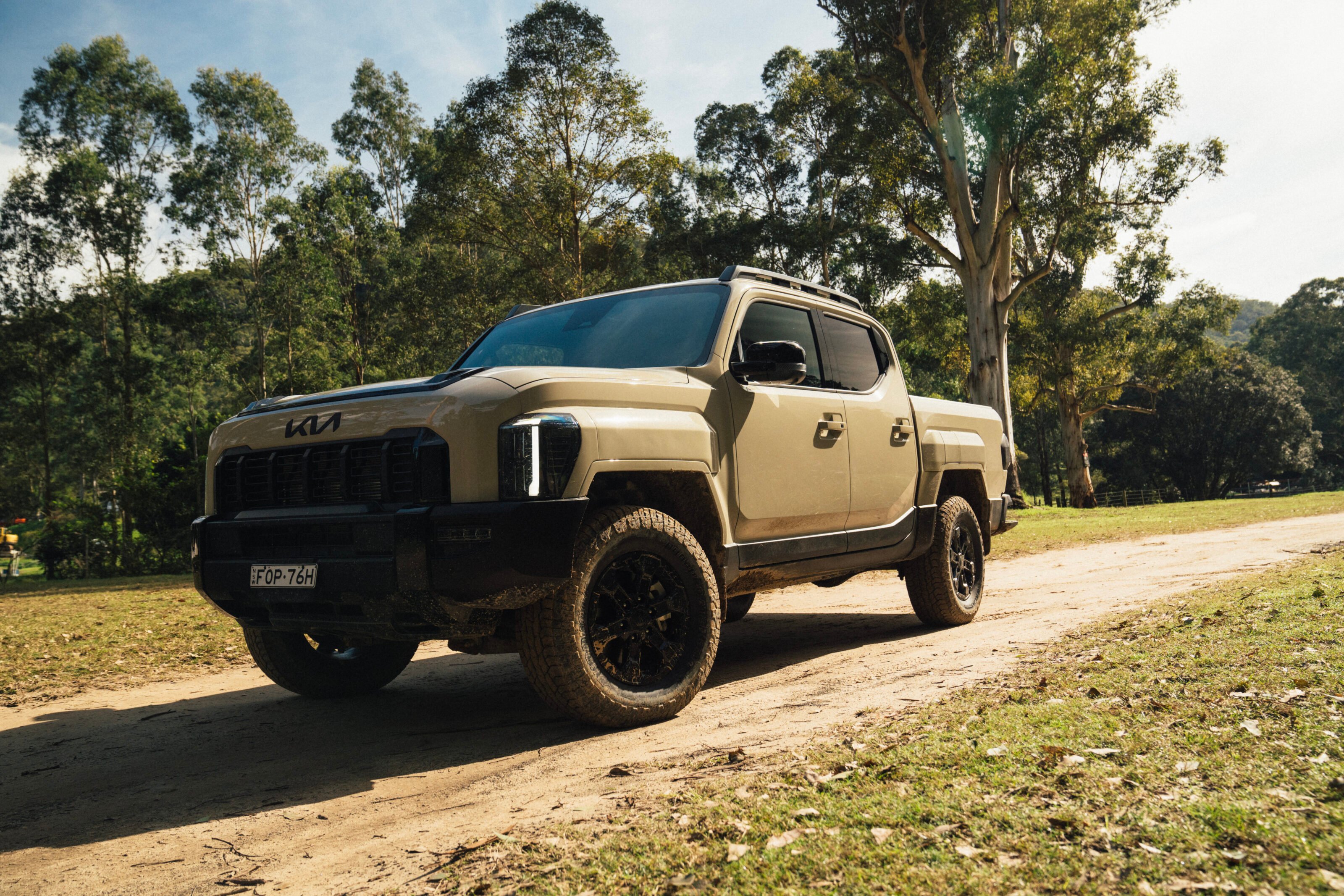
Kia Australia has used a classic trickle-feed approach to the launch of the Tasman, from a high-profile unveiling in Tasmania to an advertising program which first teased and revealed the name, then provided celebrity support from some of Australia’s most successful athletes.
Now Wheels is being given its first opportunity to drive the Tasman.
But don’t expect anything definitive after less than 15 kilometres at the wheel, on a single carefully-chosen off-road climb and over a series of specially-made obstacles, at the gorgeous Glenworth Valley retreat just north of Sydney.
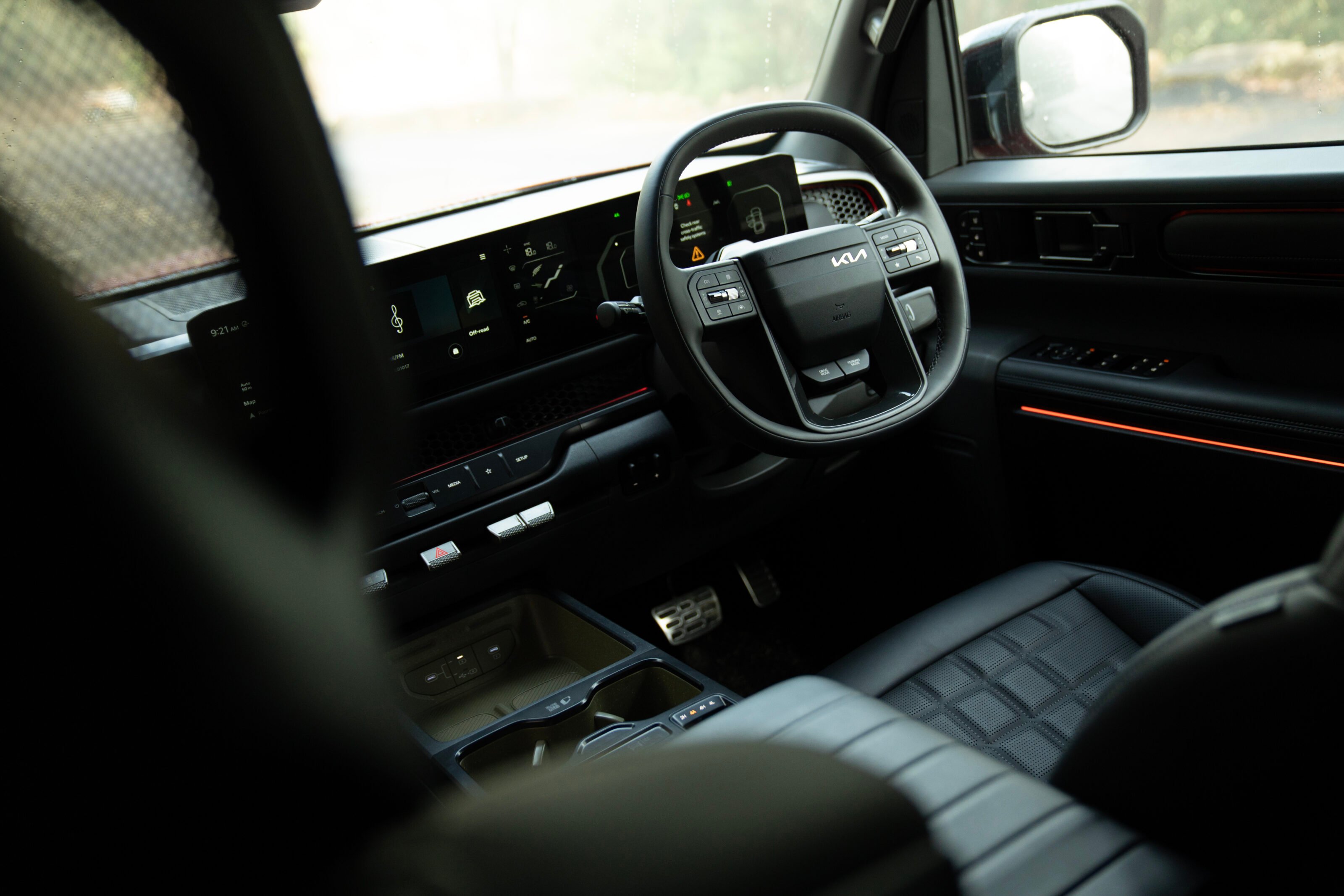
The look of the Tasman is way better with body-coloured flares, the cabin looks and feels good, and the Kia crew is saying all the right things.
But the small group of Tasman utes are all pre-production vehicles and only one – with tan-beige bodywork and trim – is claimed to be in full showroom specification – although even that changes when Wheels helps to highlight a small problem in the transmission program during the climb.
The reaction to the glitch is typical of the whole Tasman program. Engineers swoop, the problem is identified and a counter-measure is fast-tracked to Kia’s technical centre at Namyang in Korea.
On this basis alone, Kia is clearly listening. But we won’t get into the subjective subject of design . . .
The Tasman program has been running for more than a decade, although no-one can remember the exact time and place of the first pitch.
But Meredith is certain about one thing.
“If it wasn’t for the Australian market we wouldn’t have the car. Period,” he tells Wheels.
“The story has been going for 13 or 14 years, with regards to us making sure the products for Australia are suitable for Australia. The development of Tasman has had a dramatic amount of input from the Australian team.”
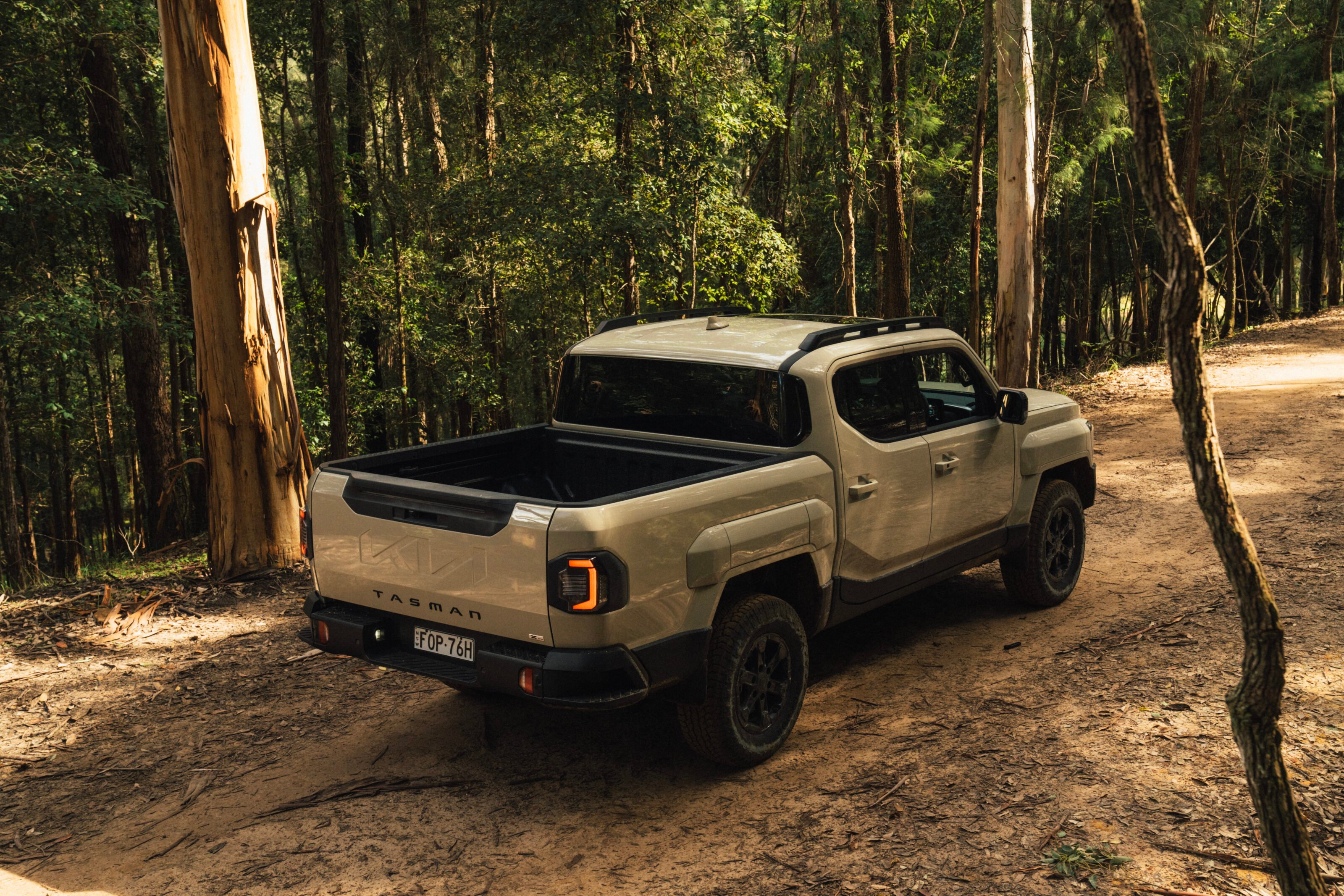
Right now, the focus is on the Tasman 4×4 and its 3.5-tonne towing capacity – with 350-kilo downball weight, 3250-kilo gross vehicle and gross combination mass of 6200 kilos – with trailer-sway control and off-road ability. The 4×4 package covers everything from 265×17 Hankook Dynapro AT2 Xtreme All-Terrain tyres to the locking differential system.
But, at its heart, the Tasman has a basic ladder-frame steel chassis that was created for it, and it alone. The 2.2-litre turbodiesel engine comes from somewhere else in the Kia world, but unique and bespoke stuff is everywhere from the heavyweight cooling package to the shape and size of the steering wheel.
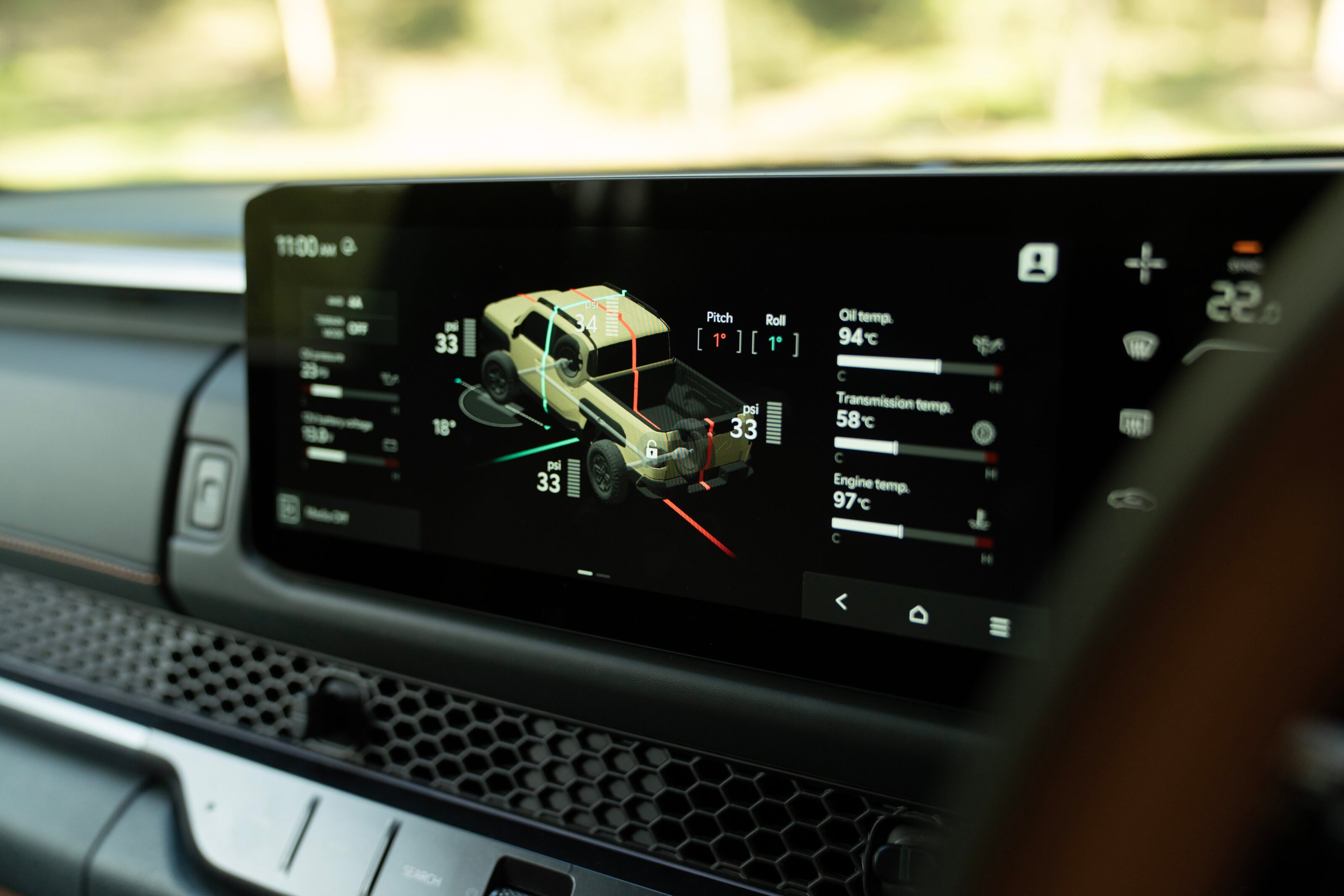
There is lots of talk at the preview about the Tasman’s electronics, with various modes for both towing and off-road work, as the giant display across the dashboard which lets you know what’s happening and why.
The total package seems equal or better than anything else in the class, up with the Ford Ranger and – in some ways – reminiscent of the Land Rover Defender, thanks to the frontal ground-view camera on the upscale X-Pro model and the choice of terrain modes.
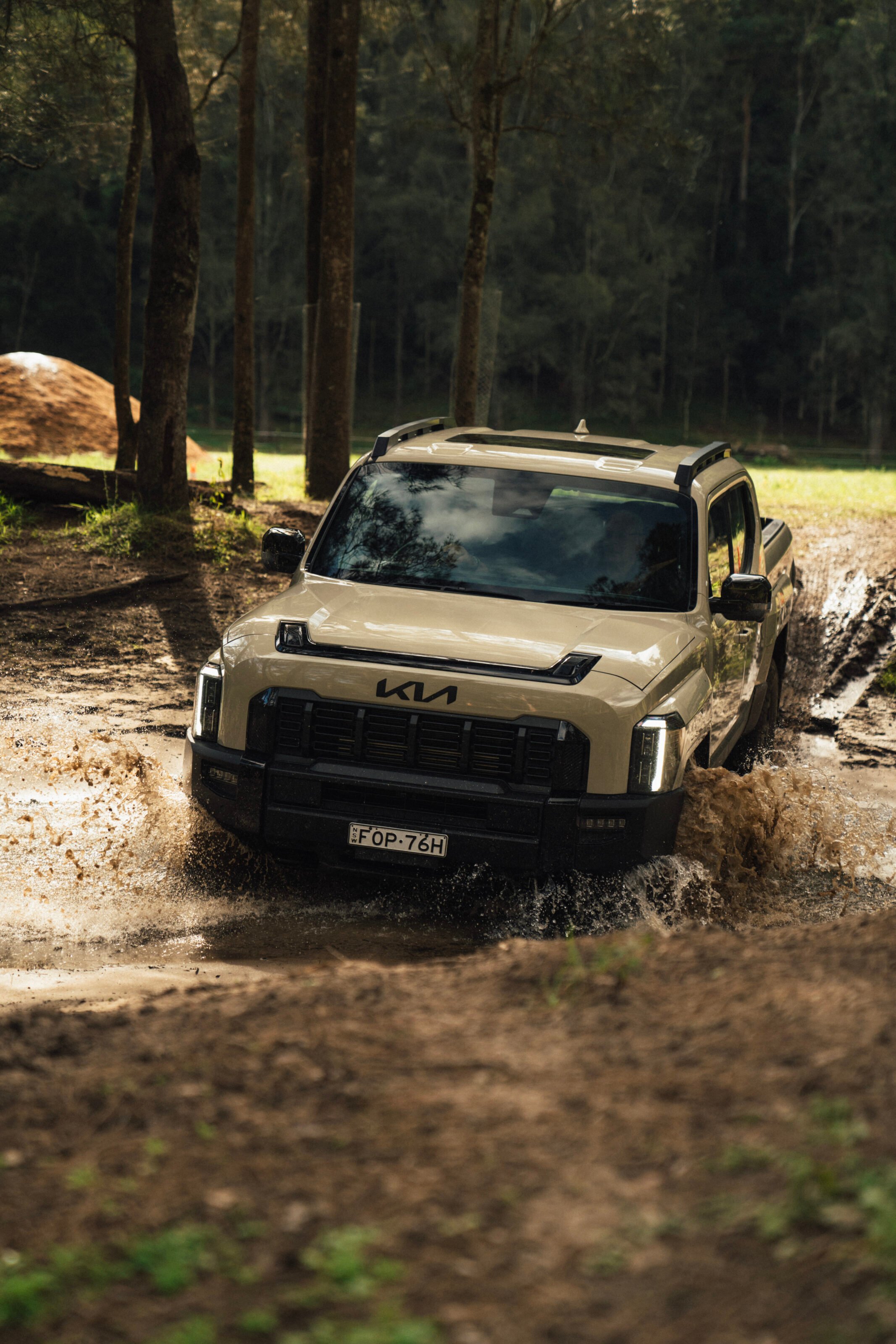
You don’t have to look far to find the Aussie influence in the Tasman. And, no, it’s not the name.
The original Korean pick-up package has a single rear leaf spring with a heavy load rating, where the local suspension has been morphed to a four-spring package with a rising rate.
Why? So the Tasman can ride smoothly as a family car while staying composed while towing or with a heavy load in the track.
There are the sunvisors, too. They are deeper than you would expect in a ute, to block low afternoon glare, with a slide-out panel to give full coverage for sun from the side.
“We had to fight Korea for that one,” says Roland Rivero, product planning manager at Kia Australia.
Kia says the plan is to position the Tasman as a “trusted workhorse”, thanks to everything from the 32.2/26.2 degrees of front and rear departure angle, double-wishbone front suspension with Sachs dampers, rear bump-stop rubbers that vary by model grade – one for S, SX, SX+ and X-Line, another for the flagship and family-focussed X-Pro – and a multi-mode 4×4 system which allows set-and-forget driving until the terrain really gets tough.
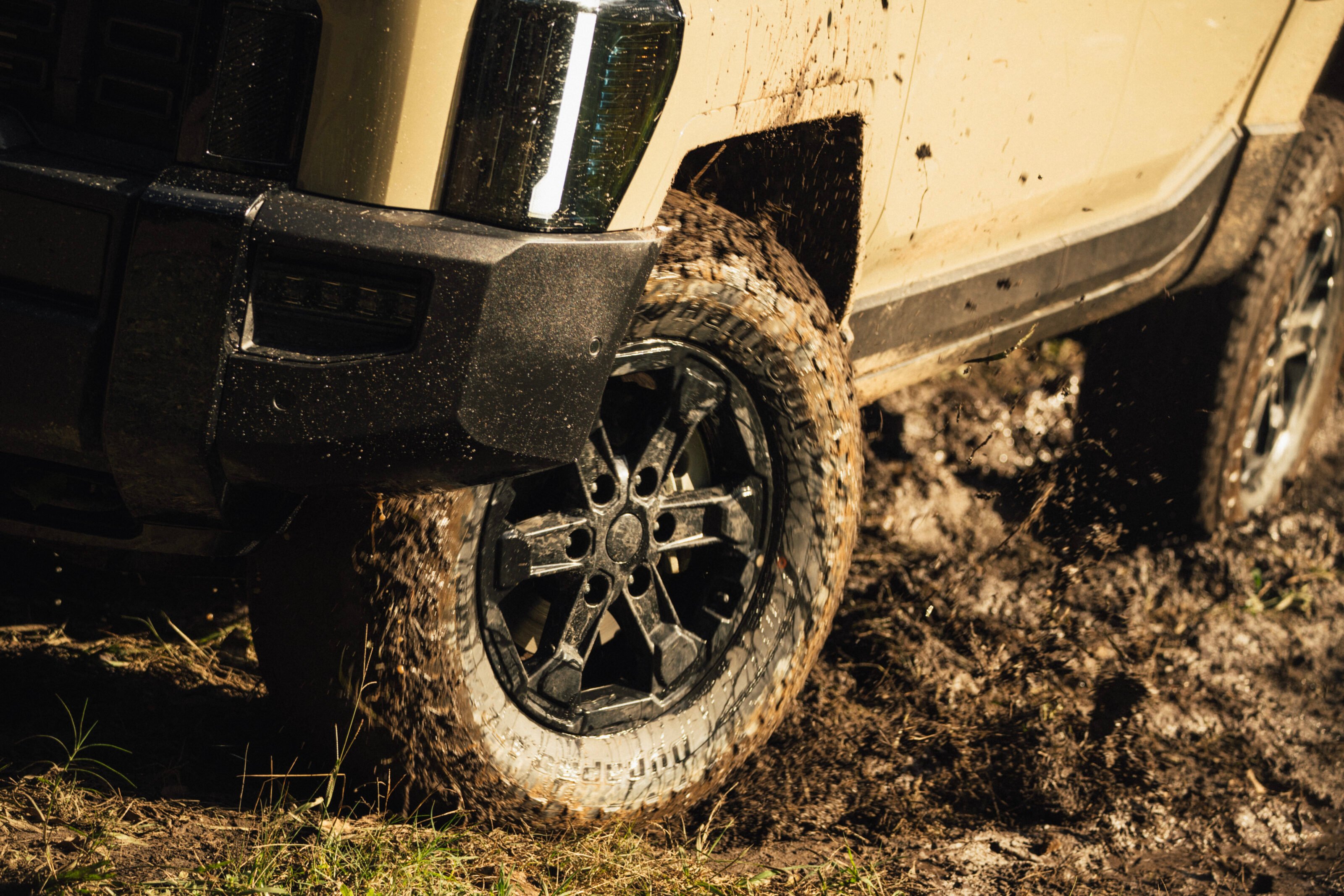
After the lengthy Powerpoint preview across the six model grades from 4×2 S to 4×4 X-Pro, and executive chats, the actual driving time is short and focussed. There is really just the one Tasman, with the X-Pro grade to present the best package.
But it’s easy to pick the smoother and more-compliant ride in the Tasman with full Aussie suspension, compared to the more-jittery Korean set-up, to sample the easy crossing of a muddy creek, and the ability to walk over typical small-ish four-wheel drive obstacles.
The cabin is impressive – with adjustable rear seats in the X-Pro which feel like ‘premium economy’ with sliding and tilt settings – and smart design work everywhere. The steering wheel is trendily ovoid, not round or square, and the switches and controls are well located with a substantial feel.
Time after time, the Tasman program is highlighted by a single sentence from Rivero.
“This is an area where Kia Australia had some influence. Our pestering has paid off,” he says.
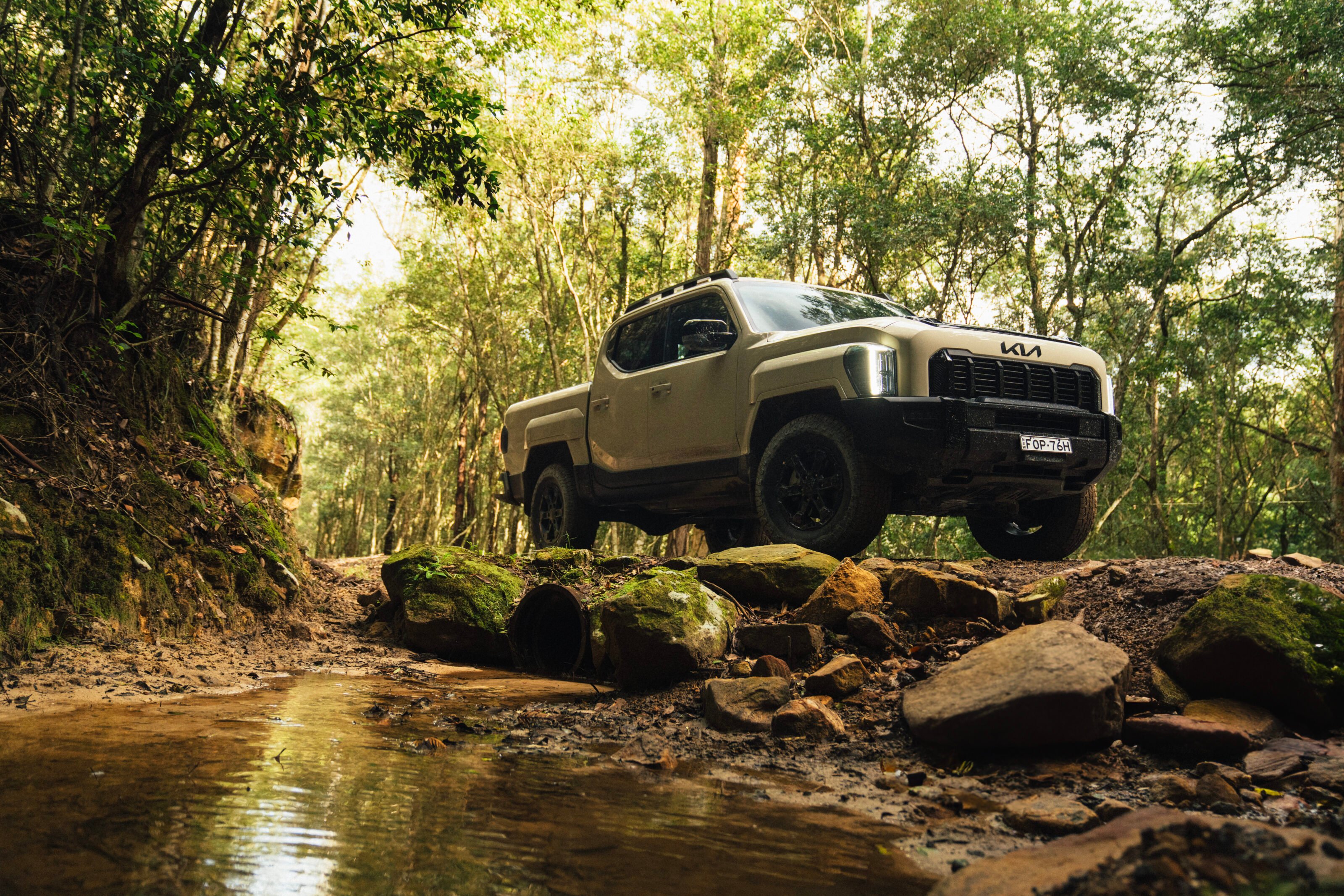
KIA Tasman – Preliminary details
| Starting price | $42,990 |
|---|---|
| Vehicle style | dual-cab pick-up |
| Models | S (4×2), S (4×4), SX, SX+, X-Line, X-Pro |
| Engine | 2.2-litre four-cylinder turbo-diesel |
| Outputs | 154kW/440Nm |
| Transmission | 8-speed automatic, multi-mode four-wheel drive |
- Price as tested: $191,900 plus on-road costs
- Distance travelled: 375km
- Power usage: 23.7kWh/100km
Having lived in Sydney and Melbourne my whole life I now call Tasmania home – at least that’s where I try to spend most of my time. It’s worth noting that Tassie is a relativity small place. Hobart to Devonport (where the Spirt of Tasmania docks) is a 285km drive and takes a little over three hours to complete. Much the same as Sydney to Canberra.
Why do I mention that? I believe EVs make a lot of sense, but only if you also have a non-EV in the garage for longer trips. Nothing in Tasmania can really be considered a long trip. Tasmania is different. No exact science to this, but the place is only 270km long and 320km wide. If you leave home with a full tank, or in an EV’s case, a full charge, there’s not many places you can even go that will require a scheduled charge along the way.
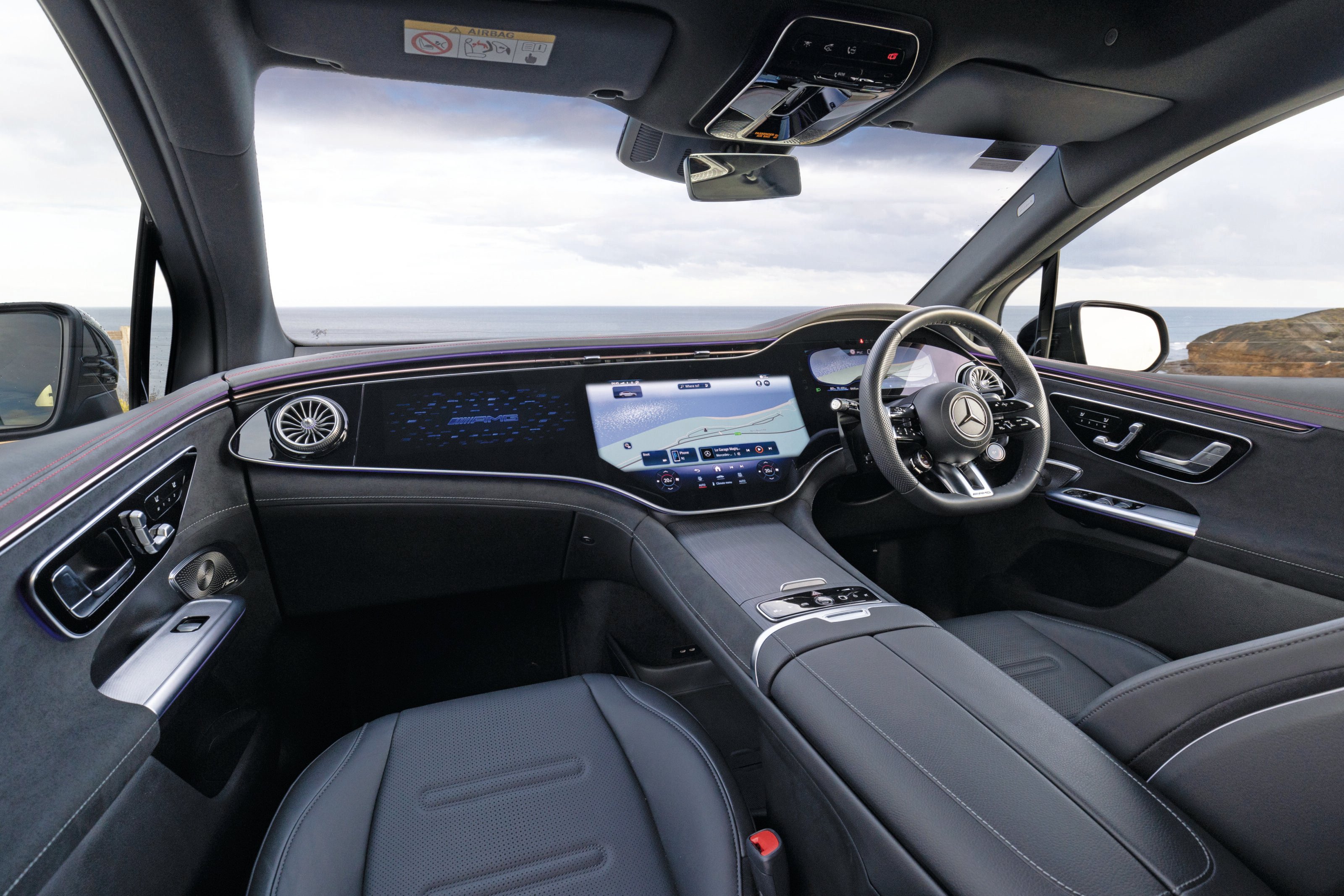
So it’s feasible to drive around the island in an EV. Perhaps Mercedes-Benz were keen to find out by using me as a guinea pig, so enter the Mercedes-AMG EQE 53 4MATIC+ SUV. If you want to go eco warrior on the matter of transport (I don’t), it kind of makes sense too, because down here – while it can get a little cold – the sun is always biting and solar is a big thing. With at-home charging fed directly by a roof that’s more solar panels than tiles, the EQE won’t ever see a public charging station and to me that’s the whole point of an EV.
With a 90.6kWh battery and dual-motor all-wheel drive powertrain, the EQE 53 produces healthy power figures of 460kW and 950Nm, more than enough grunt as standard. Deciding those figures simply aren’t good enough, my EQE 53 has the optional AMG Dynamic Plus Package, which increases those outputs to 505kW and 1000Nm. That’s 153kW and 423Nm more than a Ferrari F40…
The EQE 53 has a claimed range of 485km but range isn’t something that bothers me here – I’m not a big believer in travelling great distances that require a stop at a charging station. I’m lucky to do close to 250kms of travel in a week so that’s close to two full weeks between the need for charging anyway.
Interior wise I’m sure it’s a pretty standard AMG SUV, but I haven’t noticed any of that because my EQE is fitted with the Hyperscreen, a dash display significantly larger than any TV I grew up with as a kid. Given it’s the full width of the interior, it’s the first thing that passengers notice and it’s the last thing they remember. I’ll go into that more next month because it really is something quite extraordinary.
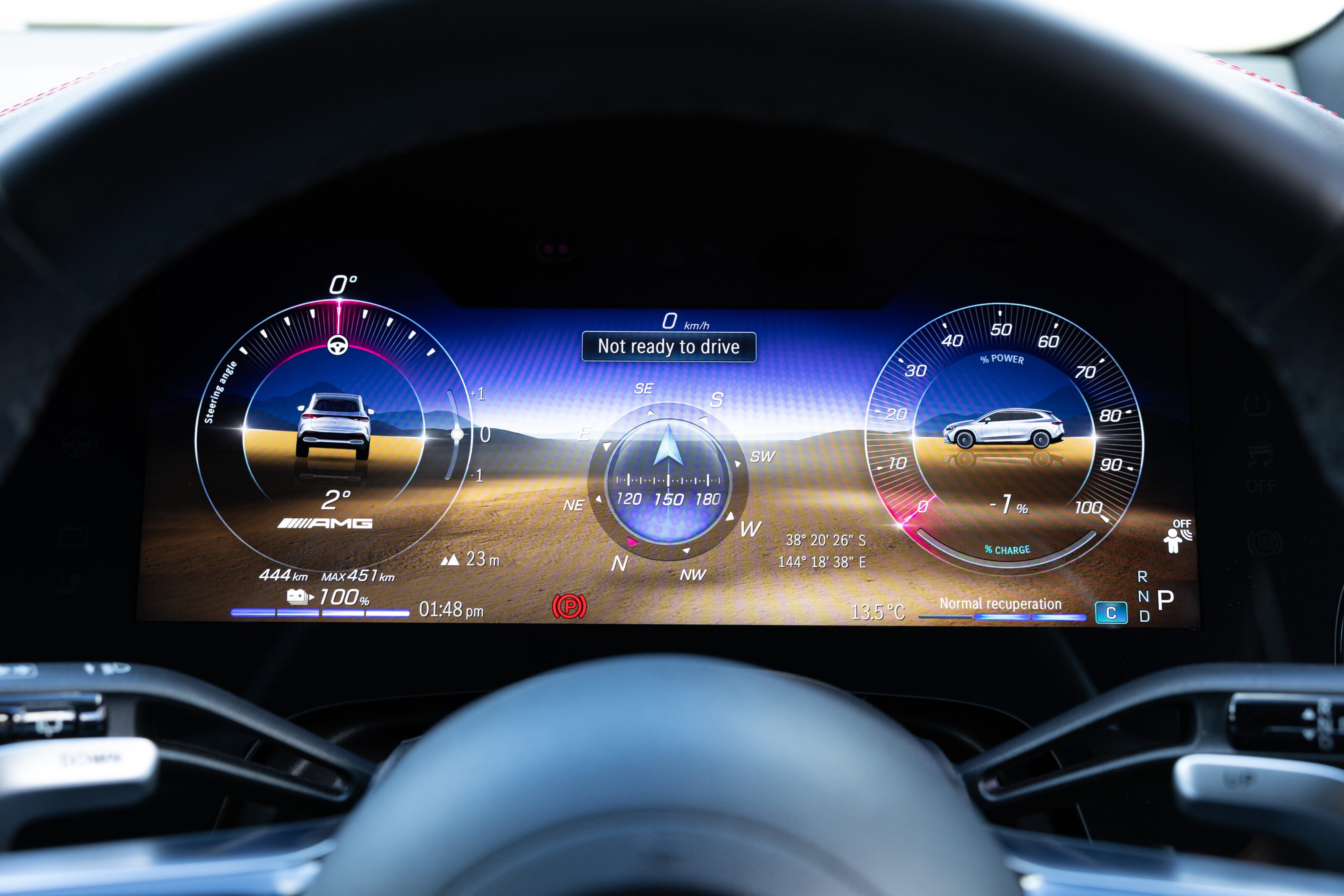
The thing I find amazing about driving any EV is how quickly you adapt to what is a rather different driving experience. Not acceleration, but braking. You simple adapt to not using brakes at all unless you turn the regenerative braking off all together. There are four regen modes to select from here: None, Moderate, Strong (as in, so strong that it’s like hitting the brakes quite hard as soon as you take your foot off the accelerator) and Intelligent.
I’ve simply been selecting ‘Intelligent’ mode wherever I go, not from any form of research, just blind
belief that German engineers wouldn’t have called it that if it weren’t the best mode to be in. And it seems to work.
One of my first drives in the EQE 53 was to the top of Mt Wellington/Kunanyi. A short 30-minute drive and exactly 21km from my front door. It’s a steep incline the whole way – and even with all that torque on tap you can feel the weight.
The battery loses significant range on the incline… but in reverse, regains around one-fifth of that back on the way back down due to regenerative braking.
Sadly I never flew Concorde, but thanks to the EQE’s rapid acceleration (0-100/km/h in an absurd 3.4 seconds) I think I have an idea of what it felt like when the afterburners kicked in. That acceleration is made more impressive by the EQE’s rather significant 2678 kg curb weight.
Let’s keep talking about that acceleration for now, as I want to get it out of the way then never talk about it again. Most EVs are quick, stupid quick in fact, however once you’ve experienced that 0-100/km/h and beyond sensation a couple of times – and readjusted your stomach to suit – that thrill is over. It becomes a non-event, because there really isn’t any skill involved. Sadly I suspect it’s also an age thing – thrashing a car left my system quite a few years ago, now only reserved for cars that were designed for it. Whatever the answer, I can count on one hand the amount of times I’ve actually ‘taken off’ in the EQE 53 in launch mode. All you need to know is its plenty quick enough and I haven’t lost a single drag race at the lights yet.
For travelling in comfort, nothing really compares to the EQE 53 in the EV market. It doesn’t float on the road – at 2,678 kg that’s simply not possible – it somehow just absorbs whatever it hits. In fact, the ride is great, given the enormous 22-inch wheels and minimal rubber fitted.
By and large the roads in Tasmania are great – but they are rough on tyres creating significant road noise inside the cabin of pretty much every car I’ve driven down here. Not the EQE 53. Would be a lie to say its whisper quiet but it’s still the quietest car I’ve even driven.
Over the next few months I’ll make sure the EQE 53 is put to the test in and around my island home – so let me know if there is anything you want me to find out. Just don’t ask me to go to a charging station.
This article originally appeared in the Garage section of the May 2025 issue of Wheels – subscribe here.
Buttons in cars. Some people love them, some hate them.
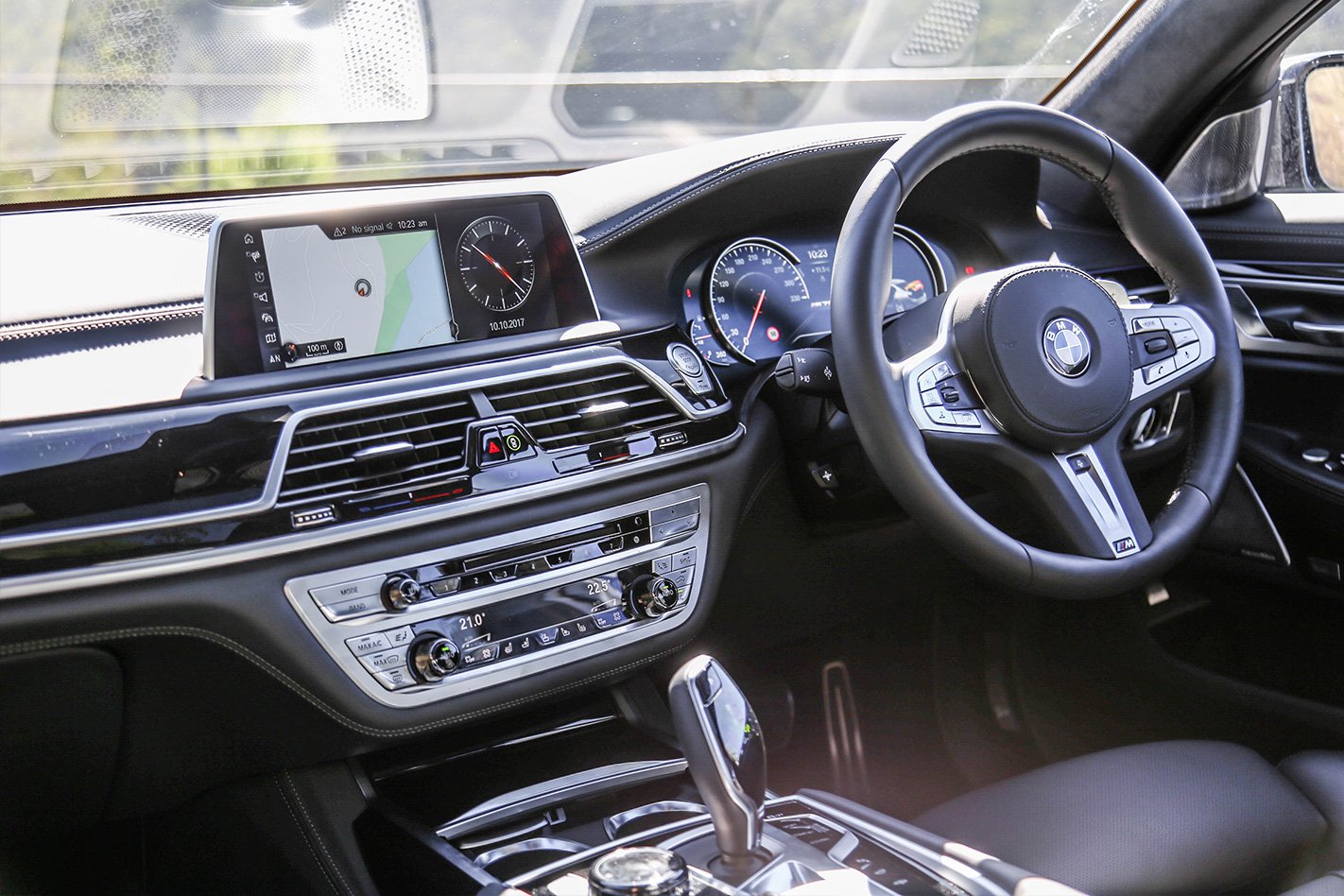
BMW led the original push to eject buttons from its cars with the first version of the iDrive system, in its 7 Series flagship way back in 2001. It promised to cut the button count by around half at a time when the luxury carmaker had more than 100 switches of various sorts sprayed around the cabin and back-seat lounging space.
I remember asking if the German carmaker thought we were iDiots, as its screen-based system and central controller was slow, confusing and ineffectual.
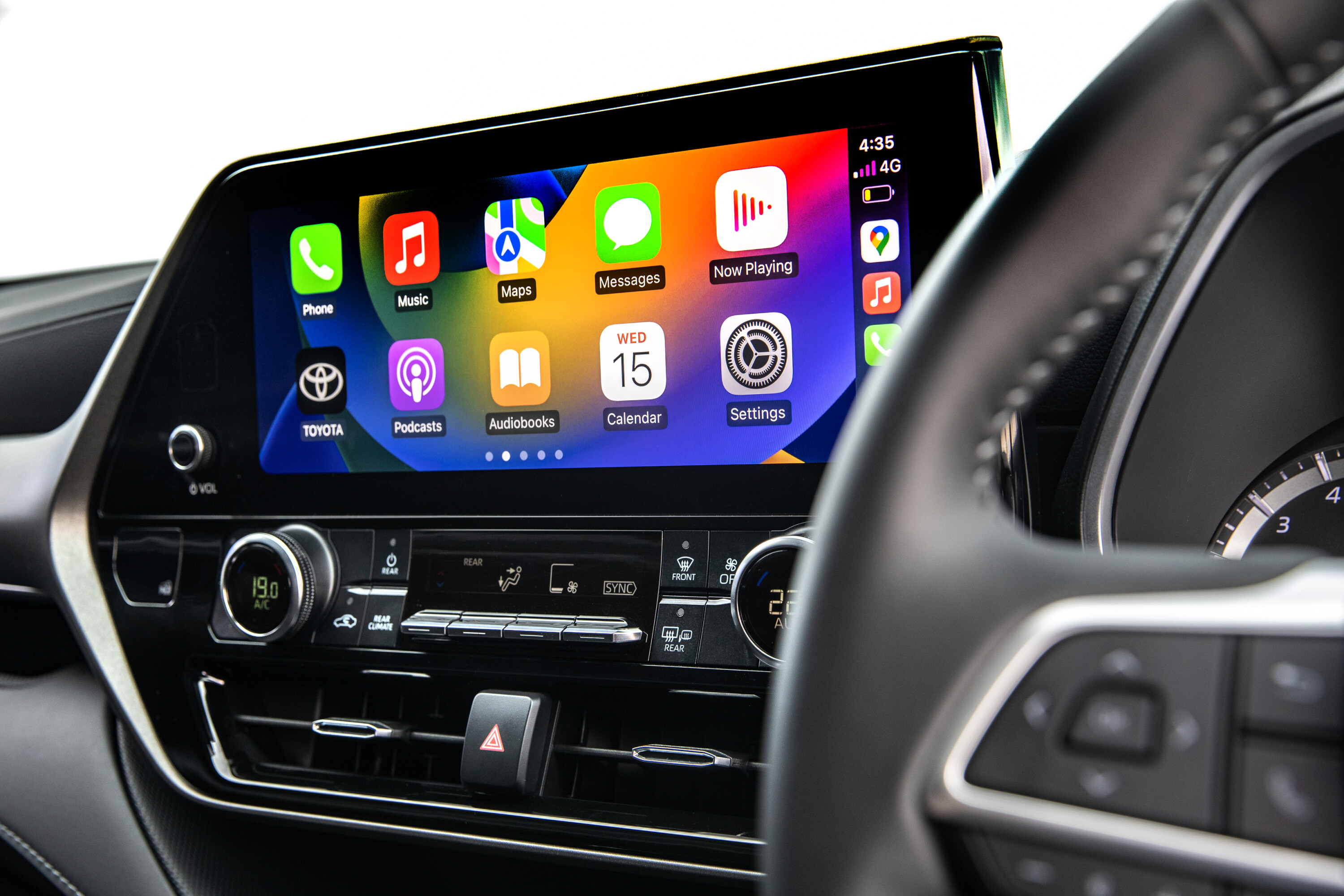
BMW even proved itself wrong by leaving a single unmarked button to turn the sound system on and off, as well as adjusting the volume, for iDrive deniers.
Since then, the rise and rise of in-car screens has put buttons on the automotive endangered list. Or has it?
Volkswagen has just reversed a decision to pull all the physical buttons out of its new models, reinstating some simple switches and admitting it had been wrong.
“We will never, ever make this mistake any more,” said design boss, Andreas Mindt.
Hyundai, too, has brought back some buttons after admitting a wholesale switch to haptic controls in touchscreens does not work for all owners.
When VW first made its move, adding haptic controls with sliders and no illumination, there were questions about how and why the move had been made. Volkswagen defended its button plan – vigorously – when I put questions to the Australian PR boss.
“The only people complaining are journalists,” he said.
Today he admits he was just toeing the corporate line. And owners were unhappy.
Still, the rise and rise of giant display screens does raise some questions. Are buyers really demanding screens which mean you can toy with farting pranks and play with driving games in the carpark but then bury the aircon adjustment and controls for the mirrors?
It’s obvious that people are tantalised by all the ‘bells and whistles’ in showrooms, but is everyone a fan of a car that’s like a giant smartphone on wheels?
I’ve done a little digging about the average age for a new-car buyer in Australia and the results might surprise you.
At Toyota, according to sales chief Sean Hanley, the average is “49 years young”. Less surprisingly, 55-year-olds are average for Mercedes-Benz while Rolls-Royce – whose owners had been in the Monty Burns brigade for decades – is down to a cashed-up 47.
According to an analyst at Deloitte, the overall average is 29.
That’s about right for the smart-screen push, with millennials driving the change.
But putting buttons on the automotive endangered list has another effect, as it makes it harder to judge the inherent quality of a car.
Solid switches with smart design work have been the hallmark of upscale brands since the earliest days of motoring. You only need to compare a Volkswagen with an Audi, which use the same basic recipe with different toppings, to see and feel the difference.
When Lexus was developing its original LS, it introduced all sorts of top-end electronic gadgets and measured the switches – right down to the microns of movement – as the chief engineer wore special ‘female’ gloves, with long artificial fingernails to see how the controls felt from a woman’s perspective.
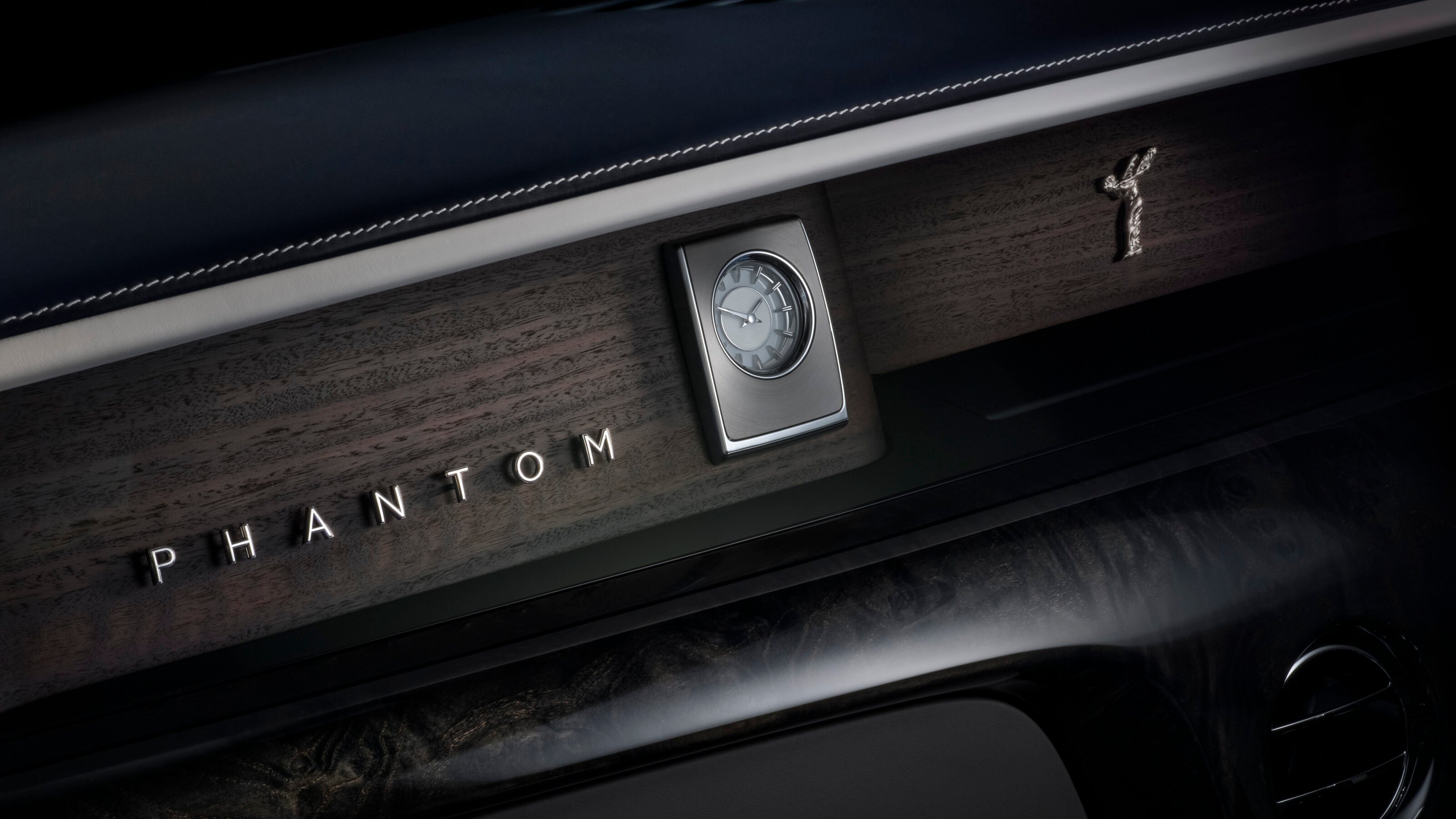
Inside a Rolls-Royce – not that many people know – any switch or knob that looks like solid metal will be solid metal. And it will feel indestructible because it’s all about perceived quality.
Haptic buttons in giant screens – let’s talk about distraction another time – reduce every brand to the same common denominator, not always in a good way.
This article originally appeared in the May 2025 issue of Wheels – subscribe here.
Here’s an odd thing. There are cars that review really well that nevertheless don’t tug on our heartstrings in any particular way. Take the Volkswagen T-Roc as an example. It has won every Wheels comparison test it’s ever been entered into. Then there are cars that achieve quite the opposite. Case in point?
The Suzuki Swift Sport. It’s been discontinued here due to the demands of Australian Design Rule 98/00, requiring the fitment of autonomous emergency braking to all vehicles imported to Australia as of March 1. It’ll be missed.
The Swift Sport is much loved but never won a Wheels comparison test. The Sport version of Swift IV came second last (in an 18-car field) in the July 2007 ‘Handling Olympics’ test and last in a December 2007 four car stoush. The Swift V Sport achieved a best of third out of four in November 2013, while the Swift VI Sport came second of four in December 2018 and then plum last in three-way dust up against the Ford Fiesta ST and the Volkswagen Polo GTI in July 2020.
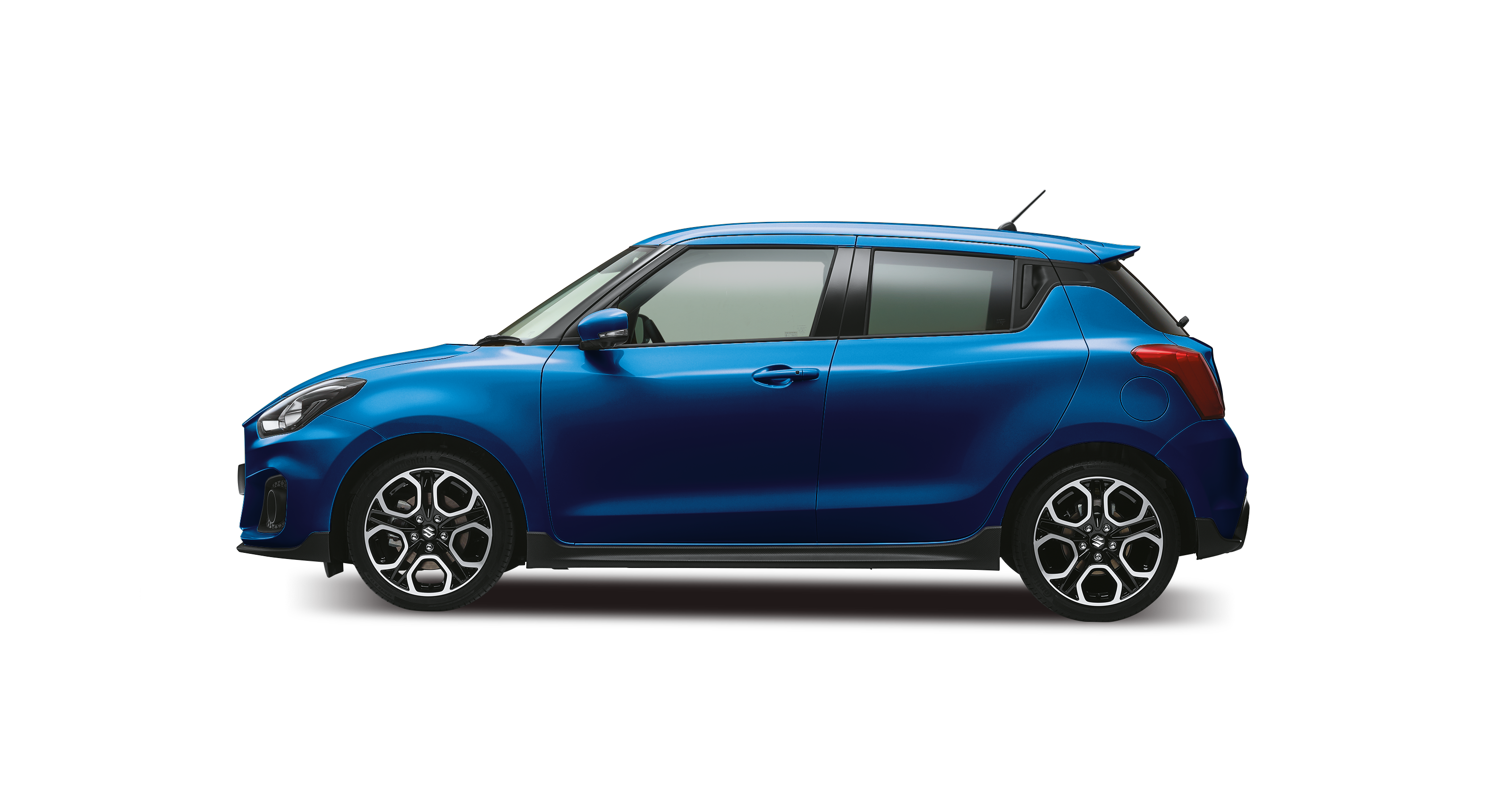
So why do we hold it in such high esteem? Probably for the reason why it could never quite get up versus its rivals – its simplicity. There was always something cheap, cheerful and pure in spirit about the Swift Sport. It was frequently outgunned by its rivals in the engine department, but clawed back some of that power disadvantage when it came to weight. Even the last Swift Sport we pitched into a comparo weighed just 970kg versus 1208kg for the Fiesta ST and 1285kg for the Polo GTI.
That purity meant that Swift buyers did without certain items of equipment that made its rivals easier to live with. The cabin plastics were thinner and scratchier, the doors clanged rather than thunked shut and an open differential meant that as one tester memorably put it “the Suzuki’s inside front smokes up quicker than an unattended barbie”.
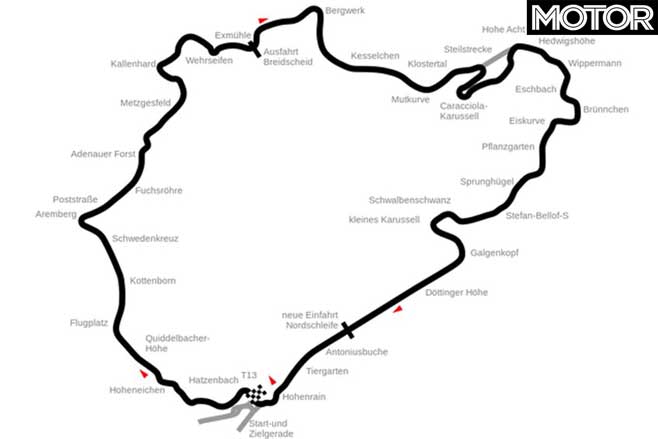
Yet the Swift was fun and forgiving. That’s probably what made it the most popular car for Nürburgring rental companies. It wasn’t fast enough to get you into serious trouble, visibility was great to spot quicker cars, repair costs were reasonable, and the handling was entertaining but benign in extremis. Above all, that sylph-like kerb weight meant that it didn’t chew through tyres and brake pads in a handful of hottish laps.
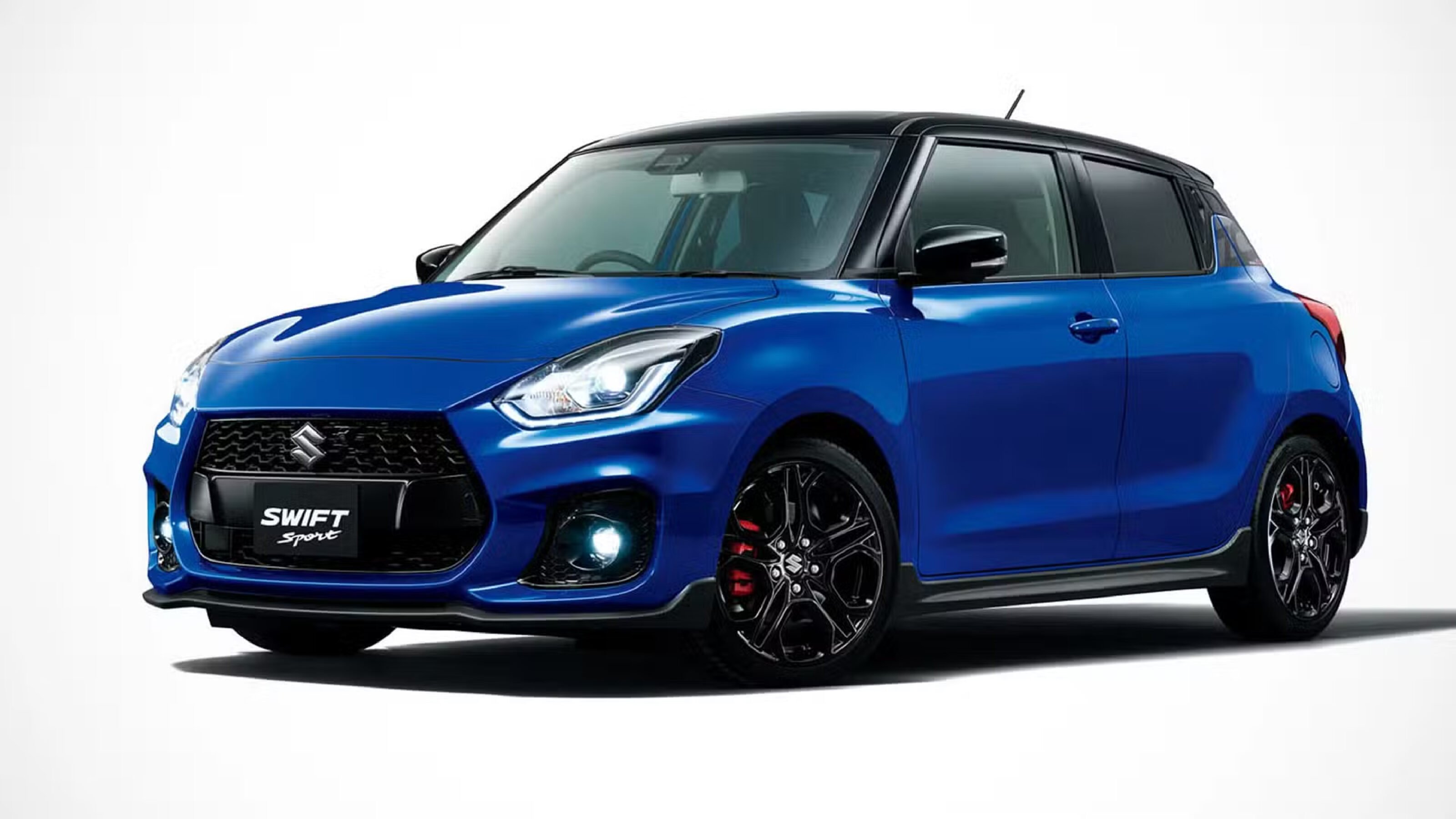
Sometimes you don’t need to be brilliant to be adored. Truth is, many of us warm to a plucky and endearing trier more easily than something a bit more polished. Above all, the Suzuki Swift Sport harked back to a simpler time that many of us yearn for, a time of manual gearboxes, modest power outputs and a price tag that didn’t require you to sign up for a lifetime of eternal debt.
Maybe we can be accused of missing what the Swift Sport signified rather more than what it actually comprised. At its core, it was always a somewhat limited warm hatch, with modest
aspirations. Nevertheless, our motoring landscape is a poorer place without its presence.
The ring king
One Swift Sport completed an amazing 59,000km worth of laps on the Nordschleife – the equivalent of 25 Nürburgring 24-hour endurance races – during its tenure with Rent4Ring. Some 457 drivers experienced the car, which logged 168,000 gear shifts, 180 million engine revolutions, and a peak engine speed of 8761rpm (oops). It consumed 8400 litres of fuel at an average rate of 14L/100km. It needed 14 sets of semi-slick tyres, 27 sets of front brake pads and 10 rears. The only spare parts that needed replacing were a clutch, an alternator, a battery, a set of wipers and a front left wheel bearing. It never broke down once and was never crashed.
This article originally appeared in the Driven to Extinction section of the May 2025 issue of Wheels – subscribe here.
Toyota has confirmed its upgraded Corolla Cross SUV will arrive in Australian showrooms in the second half of 2025, featuring a sharper design, increased standard equipment across the range, and the introduction of a new GR Sport performance flagship.
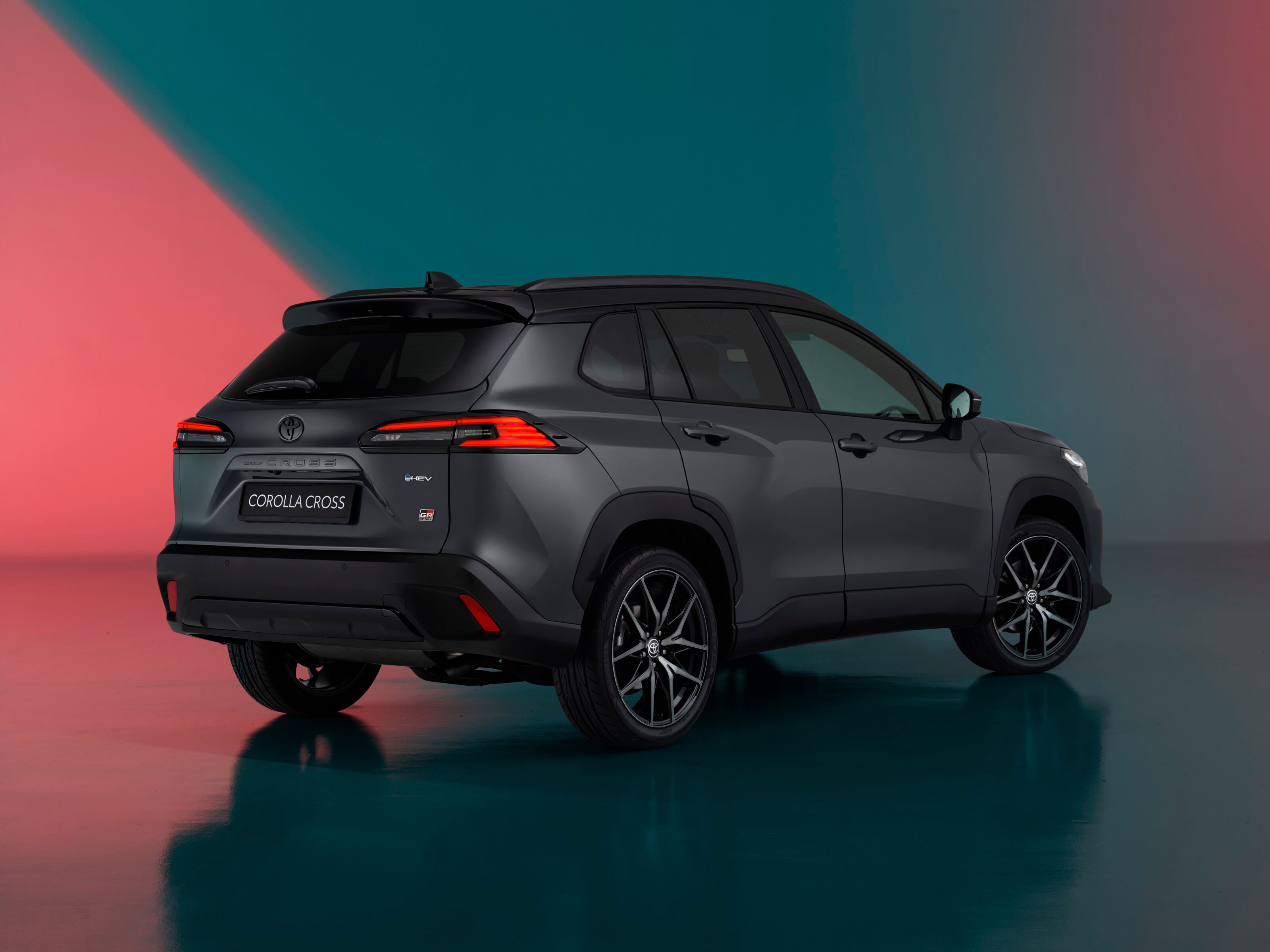
The all-new Corolla Cross GR Sport will join the existing GX, GXL, and Atmos variants, marking a bold step toward sportier performance and styling for the compact SUV.
Available exclusively with all-wheel drive, the GR Sport grade brings a host of dynamic upgrades and cosmetic enhancements that set it apart from the rest of the line-up.
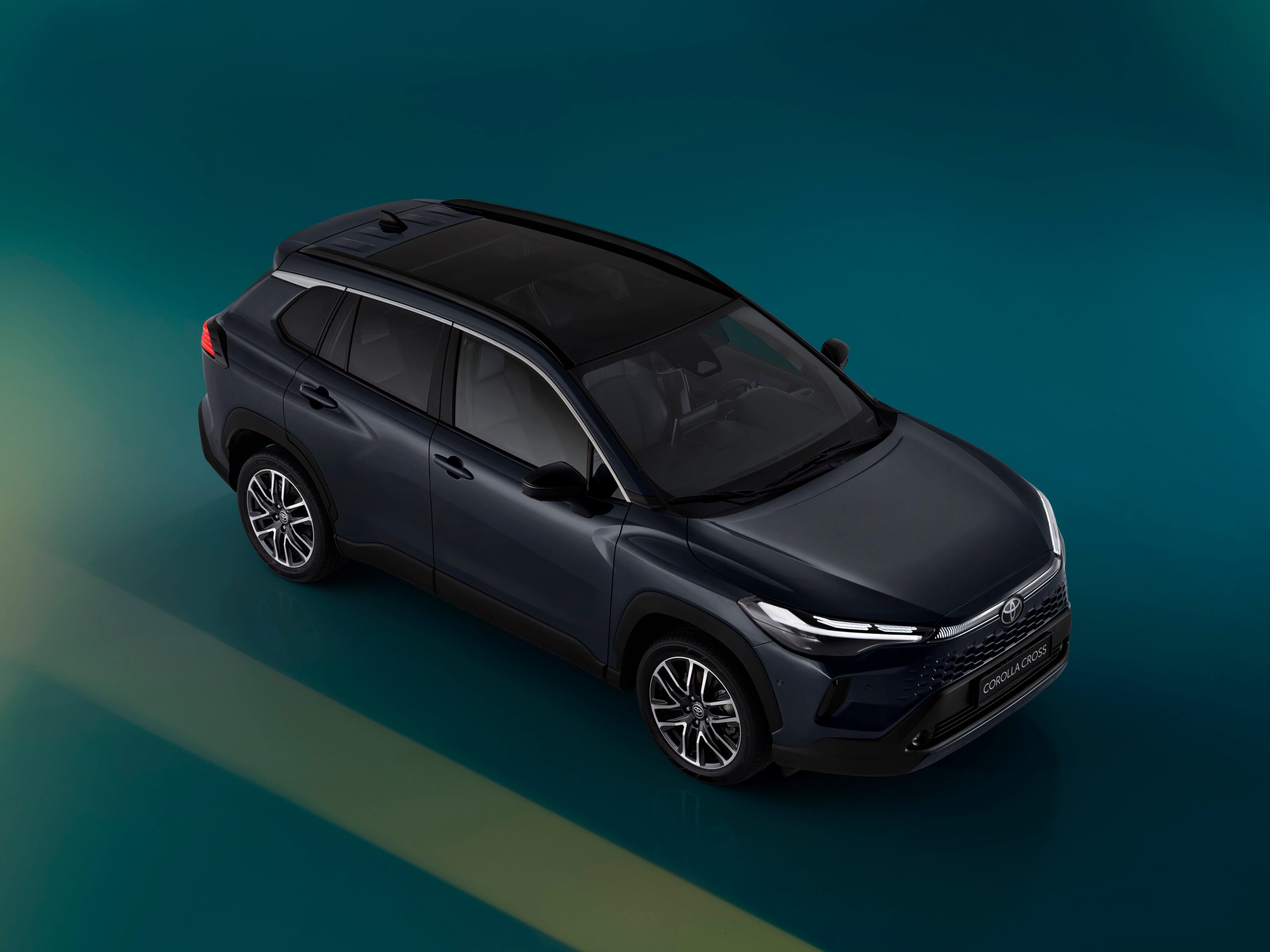
Sporting a unique front bumper, the GR Sport also gains darkened 19-inch alloy wheels exclusive to the grade, a bespoke Sport drive mode, and enhanced handling courtesy of specially tuned and lowered coil springs, shock absorbers, and revised electric power steering.
The entire Corolla Cross range benefits from a refreshed exterior design, including a new integrated mesh grille and, from GXL upwards, a revised LED headlight signature. These updates give the popular SUV a more modern and aggressive visual appeal while complementing its improved driving dynamics.
Toyota will also broaden the Corolla Cross’s visual appeal with an updated colour palette. New hues include Massive Grey, Ink, Ash Slate, Shadow Platinum, and Feverish Red, in addition to the carry-over Glacier White and Frosted White options. Selected colours – including Shadow Platinum, Feverish Red, Frosted White, and Ash Slate – will be offered with an optional two-tone black roof on certain variants, adding further personalisation opportunities for buyers.
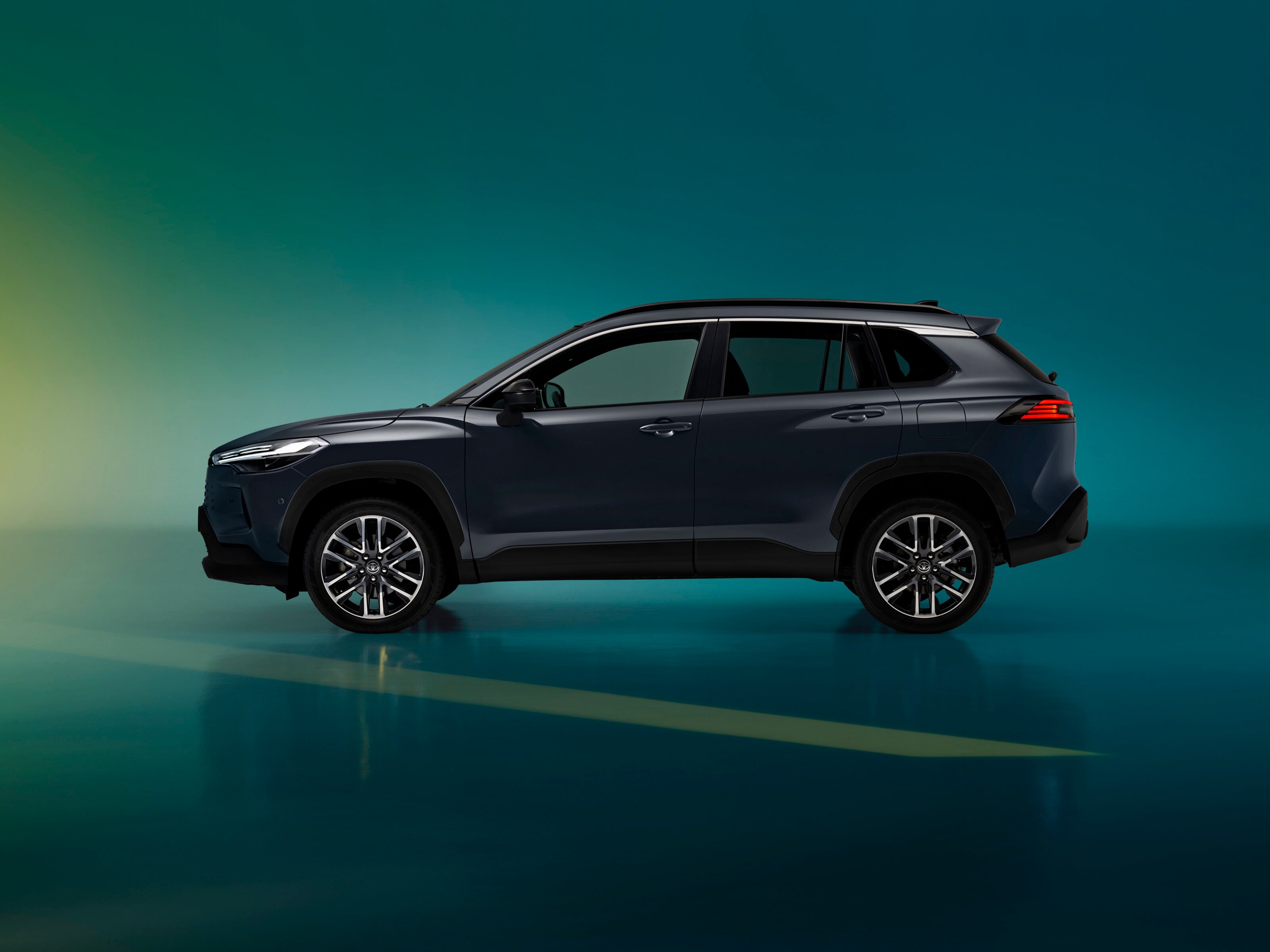
While full pricing and detailed specifications for the upgraded Corolla Cross are yet to be announced, Toyota has confirmed that the entire line-up will come with increased standard specification, reinforcing the model’s value proposition in the competitive small SUV segment.
The top-of-the-range Corolla Cross Atmos is currently priced at $50,030 before on-road costs. The current range features a 2.0-litre four-cylinder hybrid powertrain but Toyota have yet to say whether this will continue in the upgraded model.
More details, including pricing, engine, all- or rear-wheel drive, features, and exact release timing, will be revealed closer to its local launch in the second half of 2025.
Things we like
- Great ride and handling
- Improved value equation
- Impressive all-round talent
Not so much
- Some cheap interior materials
- Base engine could be more powerful
- M Sport styling is standard
It’s no easy feat to launch a new version of your best-selling product. You’ve got to refine, improve and add more value to it but also not change it too much so as to alienate its fanbase. Otherwise, those loyal fans could easily head elsewhere.
Originally sold as a smaller X5, the BMW X3 is now in its fourth generation and is the brand’s global best-seller. Has BMW successfully improved the X3 or should buyers look elsewhere? We tested the entry level X3 20 xDrive to find out.
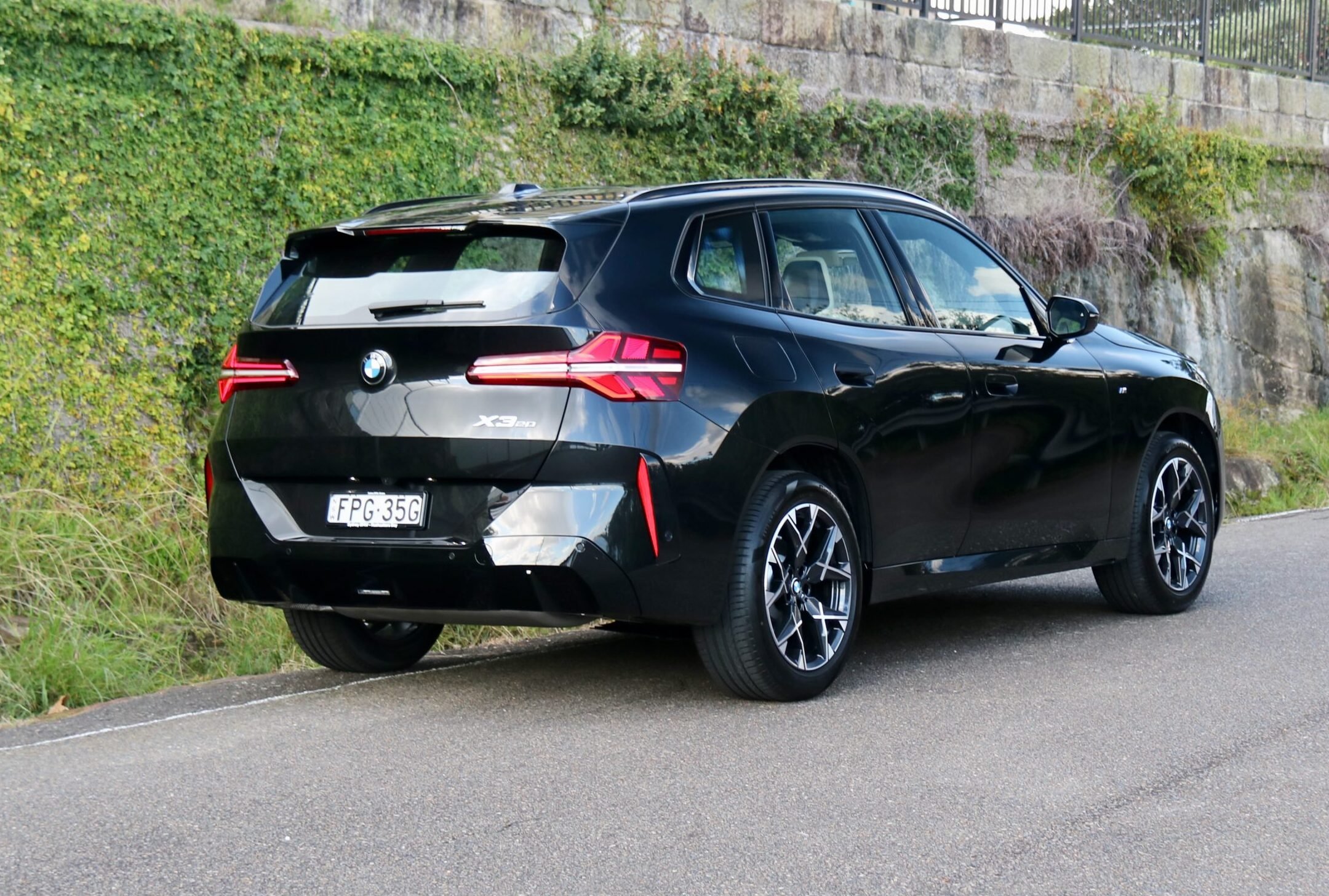
Codenamed ‘G45’ – but using the same ‘CLAR’ platform as before – the new X3 has been given a thorough glow up to launch it into 2025, and is now longer, wider and taller in every direction. The controversial exterior styling is familiar but more modern, and the interior is now more minimalist in keeping with other new BMW products. For what it’s worth, it looks great in the flesh.
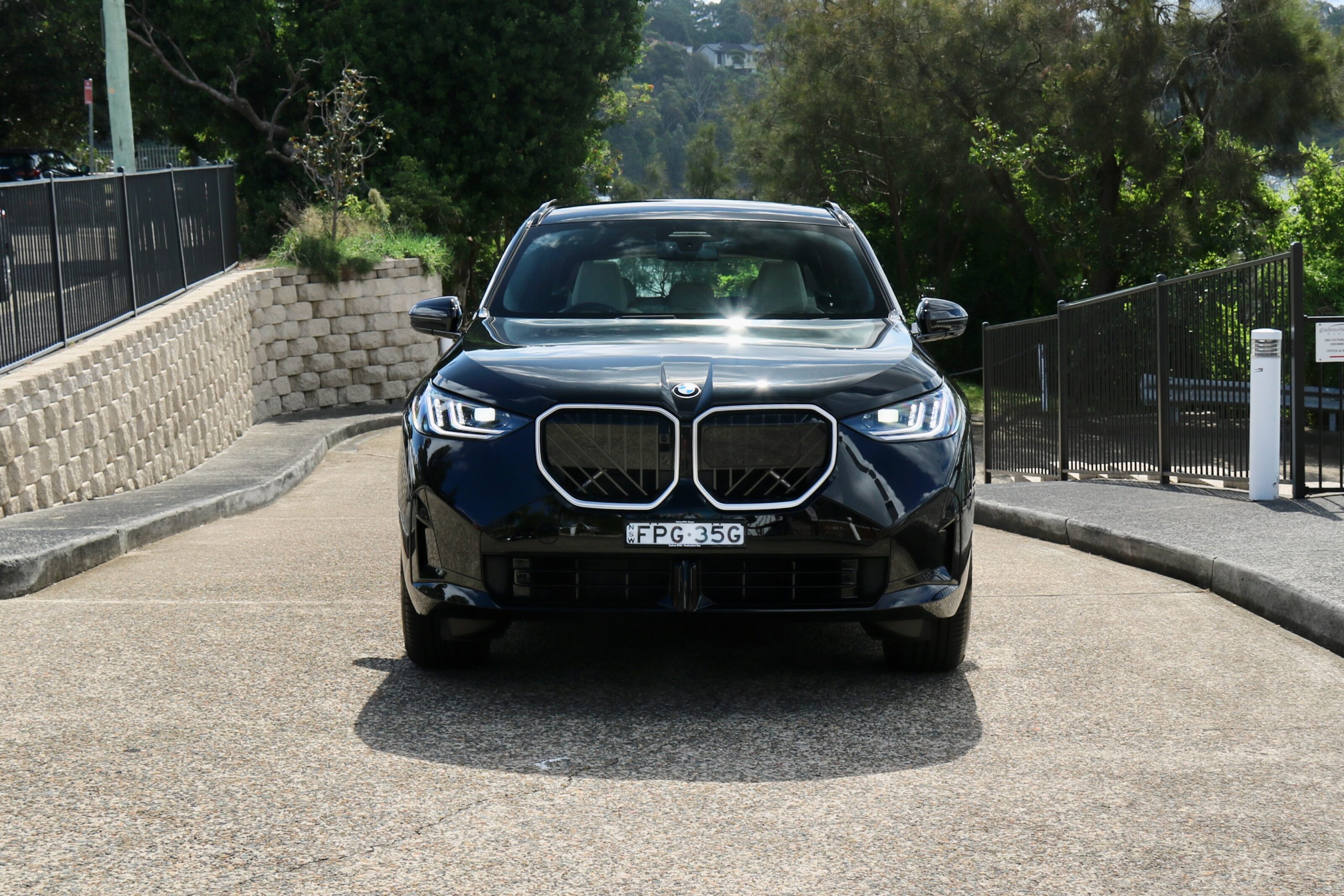
BMW Australia is offering three X3 models for the moment: the entry-level 20 tested here ($86,100 plus on-road costs), mid-spec 30e plug-in hybrid ($102,500 +ORC) and performance M50 at the top of the range ($128,900 +ORC). Base pricing climbed by $4000 over the former base 20i but a lot of standard equipment was added, including all-wheel drive, acoustic glass, a mild-hybrid system, heated front seats, ‘Veganza’ synthetic leather trim and sportier-looking M Sport styling.
Equipment otherwise includes 19-inch alloy wheels, tri-zone automatic climate control, a 12.3-inch driver’s display, a 14.9-inch touchscreen with an inbuilt eSIM, live services and over-the-air updates, wireless Apple CarPlay/wired Android Auto, a wireless phone charger, electric front seat adjustment, a powered tailgate and a full suite of safety tech like AEB, adaptive cruise control, adaptive lane guidance and high beam, blind-spot monitoring and a 360-degree camera.
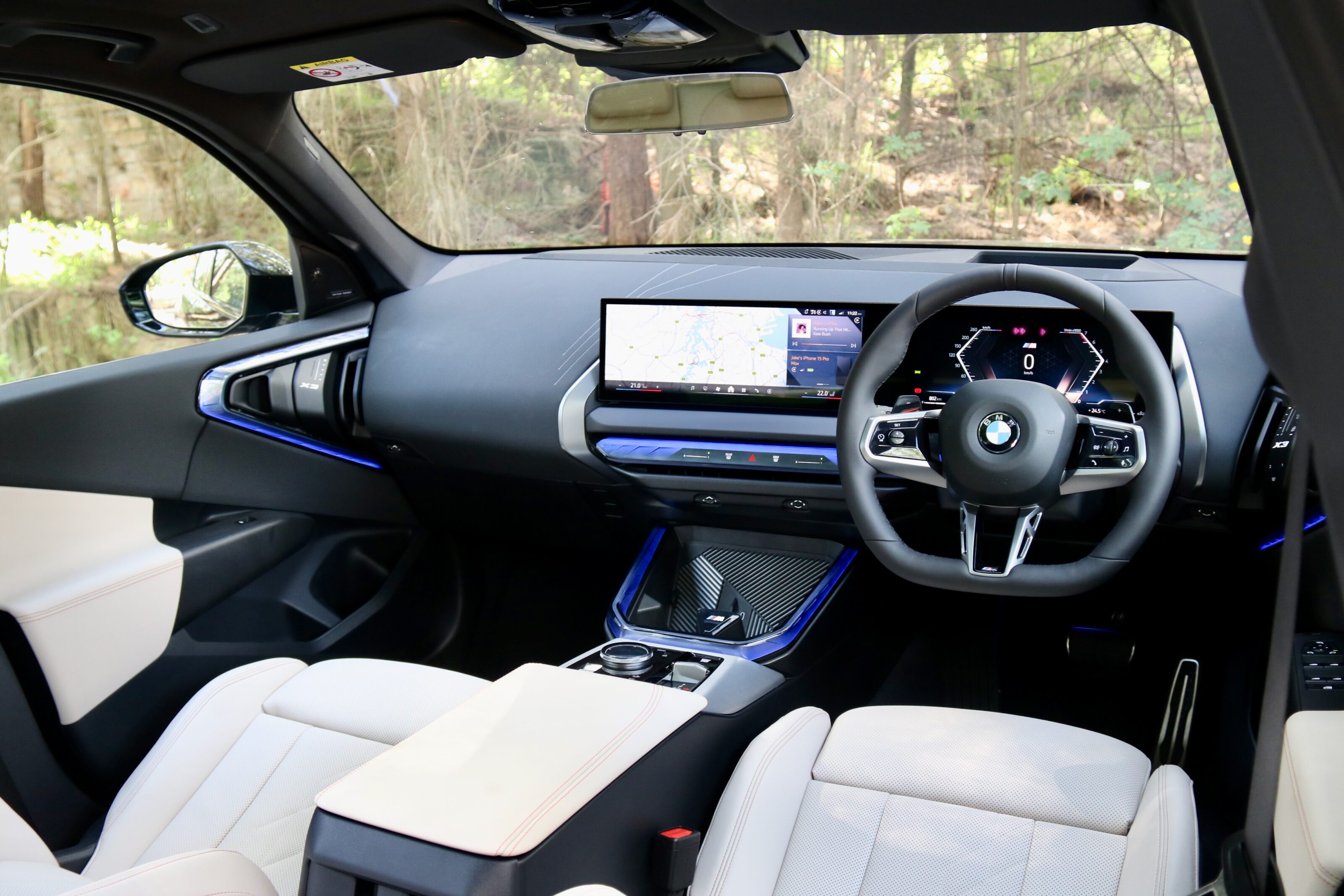
The new X3’s value is strong against its Audi Q5 and Mercedes-Benz GLC chief rivals, which start at $88,315 and $89,000 respectively, and need options ticked to match the BMW. Meanwhile, a fully loaded Genesis GV70 2.5T Signature asks $89,700. Food for thought.
Our test car was also fitted with the $6000 Enhancement Pack (with metallic paint, an alarm, a panoramic glass roof and 15-speaker 750-watt Harman Kardon audio). A $4000 Comfort Pack (front seat ventilation, a heated steering wheel and rear seat, rear door sunblinds, rear privacy glass and a luggage net), a $3000 M Sport Pro package (additional M Sport exterior elements), $4000 leather trim, $1200 knitted textile dashboard and upper door trims, and $2000 20-inch alloy wheels are also available.
Under the X3 20’s bonnet is a mild-hybridised 2.0-litre turbocharged four-cylinder petrol engine mated to an eight-speed automatic transmission and the brand’s ‘xDrive’ all-wheel drive system. Total outputs are a reasonable 140kW (from 4400 to 6500rpm) of power and 310Nm (from 1500 to 4000rpm) of torque, while the claimed 0-100km/h time is 8.5 seconds. The claimed combined fuel consumption is 7.5L/100km and with a full 65-litre tank, expect to see a range of more than 850km at that consumption – we achieved 9.2L/100km after a week with our test car, though that was brand new and only had under 500km on the clock.
As you’d expect for a BMW, the X3 20 handles quite well – but it also rides plushly, too. Despite the stiff run-flat tyres, the ride quality on the 19-inch wheels and adaptive dampers of the base X3 is supple and despite the sporty image and keen handling, it’s really comfortable. It’s also great to drive for a mid-size SUV; the steering offers good connection to the wheels, it’s nicely balanced and it’s just fun. There’s more of a driver connection here than in rivals.
The new X3’s refinement is also excellent thanks to newly standard acoustic glass and other improvements in noise suppression: at highway speeds, the cabin is quiet and unless you’re high in the rev range, the engine is barely heard too.
What’s also excellent is BMW’s active safety equipment. It’s fully featured as standard with adaptive cruise control with adaptive lane guidance, traffic sign recognition, blind-spot monitoring and AEB but in contrast to a plethora of vehicles we’ve tested recently, it’s serene. The systems aren’t sensitive or noisy, but they just work when required. They assist the driver rather than overbear or scare them.
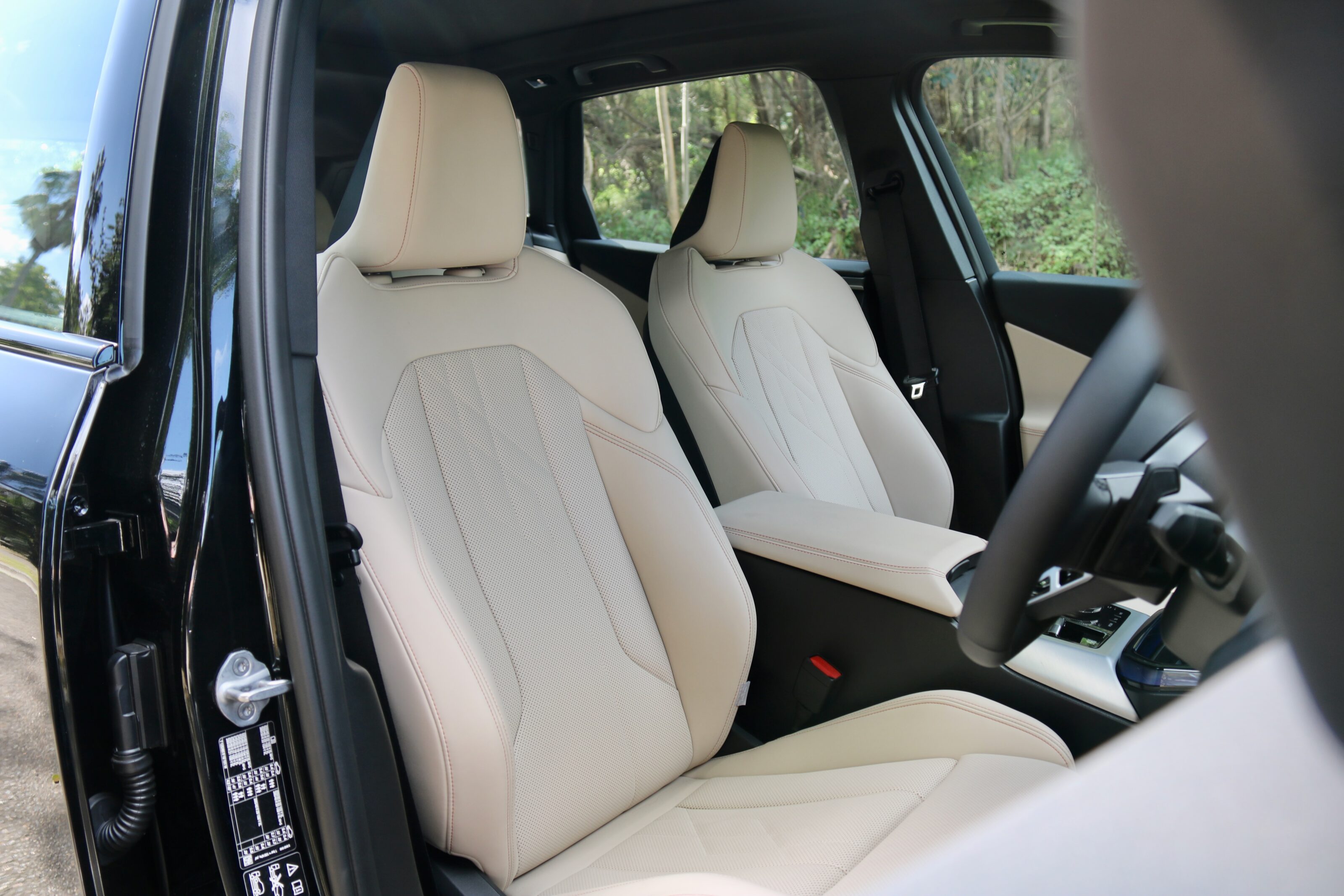
Inside the new X3 has seen a lot of change in line with newer BMW products: it now uses a more minimalist asymmetric design with more use of synthetic leather trim throughout. Overall quality is good, though some parts feel a bit cheap: the black plastic door handles, for example, and the air vent surrounds as well. But look beyond those and the new X3’s cabin looks and feels great.
It’s also quite practical with sectioned bins in each door, a deep bin underneath the centre console lid and a large open section at the front of the centre console with a cooled wireless charger, two USB-C ports and deep cup holders.
Centre of the cabin is a new 14.9-inch touchscreen with the brand’s new ‘Operating System 9’ software. It’s a fully-featured system but it’s not overwhelming to use thanks to effective shortcuts on the bottom of the screen that don’t disappear when using another function, like smartphone mirroring. There’s no need to hit the screen multiple times to change the temperature because it’s always displayed, which is pleasing in an age where many touchscreens require a lot of effort for simple functions.
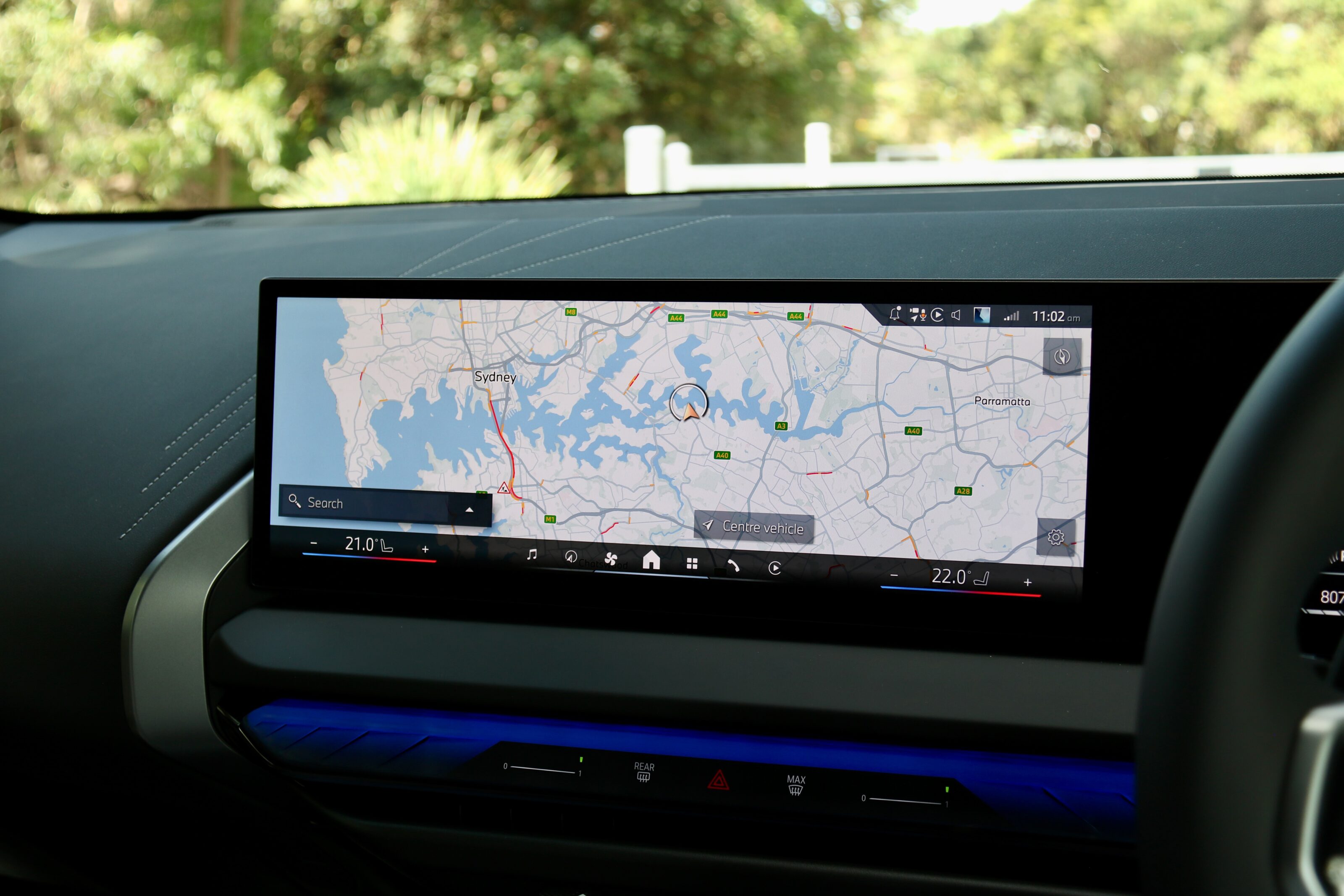
Wireless Apple CarPlay was easy to set up and worked faultlessly in our time with it, while the 15-speaker Harman Kardon sound system offers rich – if not massively punchy – sound quality.
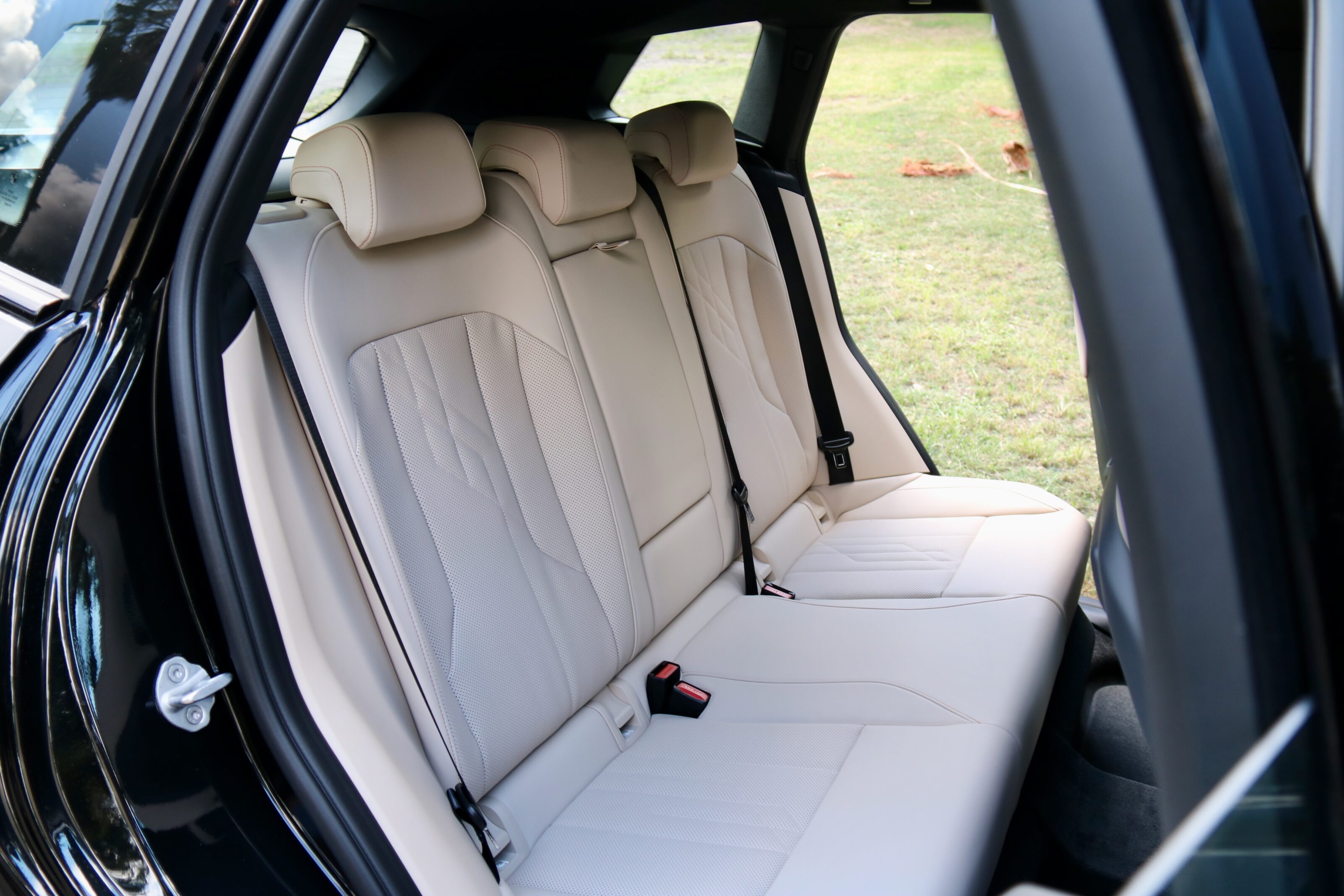
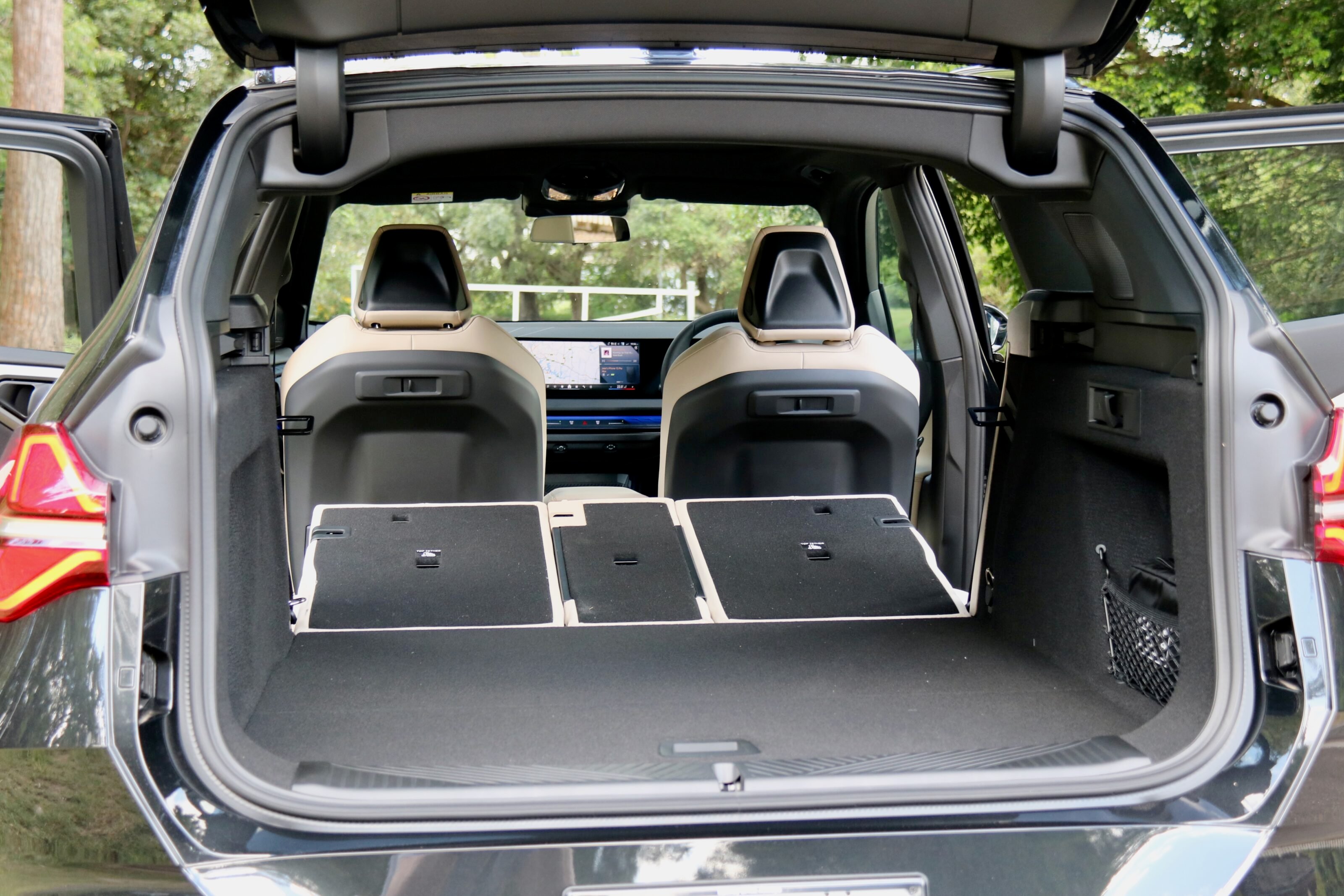
Because of the growth spurt, the new X3 is more than capable of taking four taller adults and their luggage. Rear seat room – particularly headroom – is impressive, plus the door bins, two USB-C ports, map pockets and separate climate zone add even more comfort. The 570-litre boot is the largest in the class and opens up to a huge 1700L space with the rear seats folded. The new X3’s boot also features a large under-floor section for extra capacity – though there’s no spare wheel, just run-flat tyres.
Overall, while some may not like the exterior styling, there’s no denying the talent of the fourth-generation BMW X3: it’s practical, well equipped, comfortable and fun to drive, as you’d expect from a BMW. The base engine could be more powerful and some interior materials have taken a step backwards, but it’s an otherwise great product that we think will keep its crown as BMW’s best-selling model for a long time to come.
Specifications
| Model | X3 20 xDrive |
|---|---|
| Price as tested | $92,100 plus on-road costs |
| Engine | 2.0-litre turbo 4-cylinder mild-hybrid |
| Power | 140kW between 4400rpm and 6500rpm |
| Torque | 310Nm between 1500rpm and 4000rpm |
| Transmission | 8-speed auto, all-wheel drive |
| Claimed fuel consumption and CO2 | 7.5L/100km and 171g/km |
| 0-100km/h | 8.5 seconds |
This article originally appeared in the May 2025 issue of Wheels – subscribe here.
- Price: From $76,990 plus on-road costs (Ultra Single Motor)
- Drivetrain: 185kW/420Nm (single motor) or 300kW/670Nm (dual motor), 82kWh battery
- NEDC range, peak charging speed: 485-520km, 135kW (single motor) – 200kW (dual motor)
- Warranty: 5-year/unlimited km, 8-year/160,000km for the battery, five years of roadside assistance
Things we like
- Excellent performance
- Good quality and practical cabin
- Lots of standard equipment
Not so much
- Expensive starting price
- Little personalisation
- Can be energy hungry
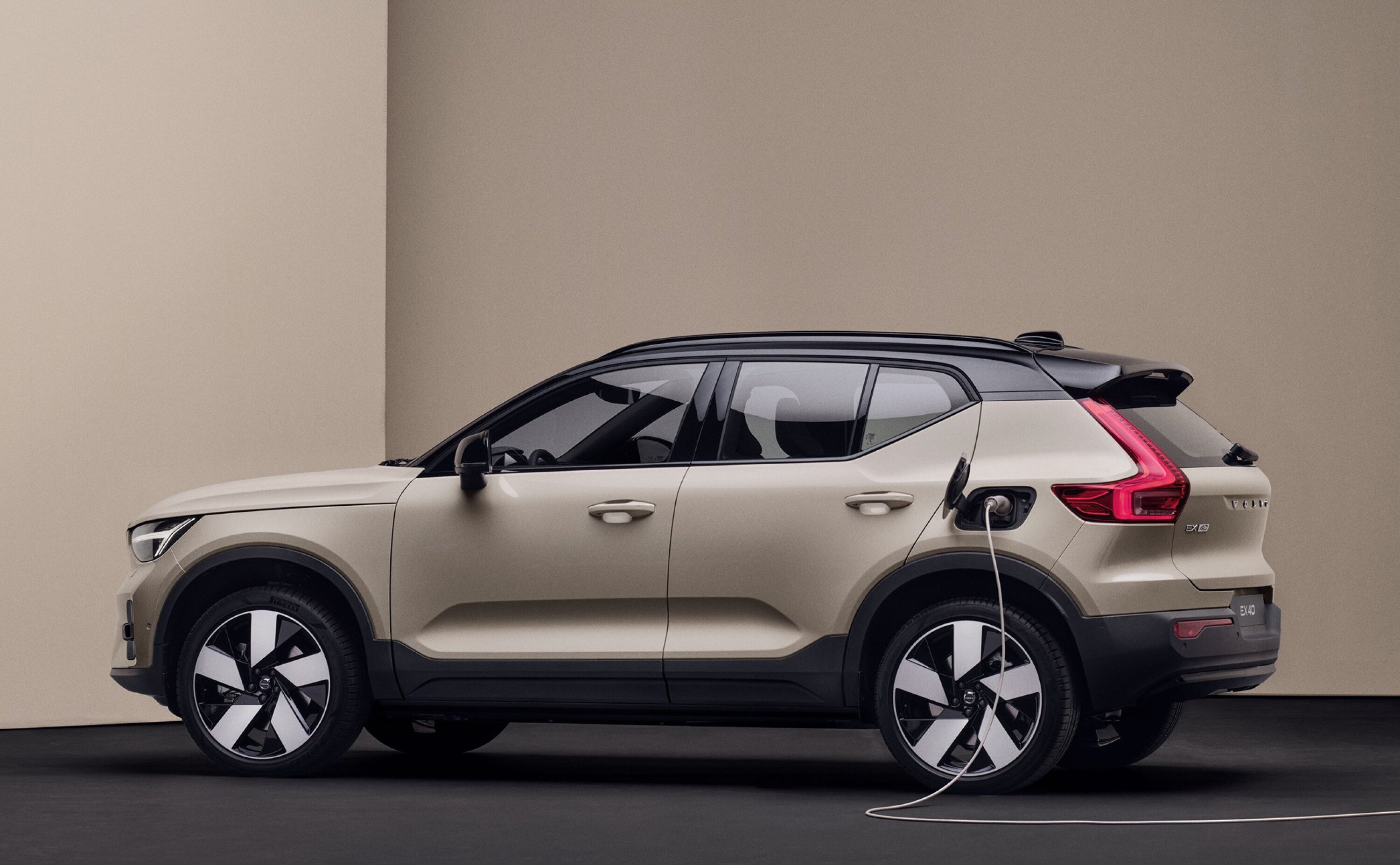
The Volvo EX40, formerly called XC40 Recharge, recently won the electric category at the Wheels Best Small SUV awards for 2025 in a competitive field.
Priced from $76,990 plus on-road costs, the EX40 is offered in two well equipped variants: entry level Single Motor Extended Range and top-spec Twin Motor ($81,990 +ORC), while there’s also a special Black Edition ($82,990 +ORC) based on the Twin Motor with black detailing in and out.
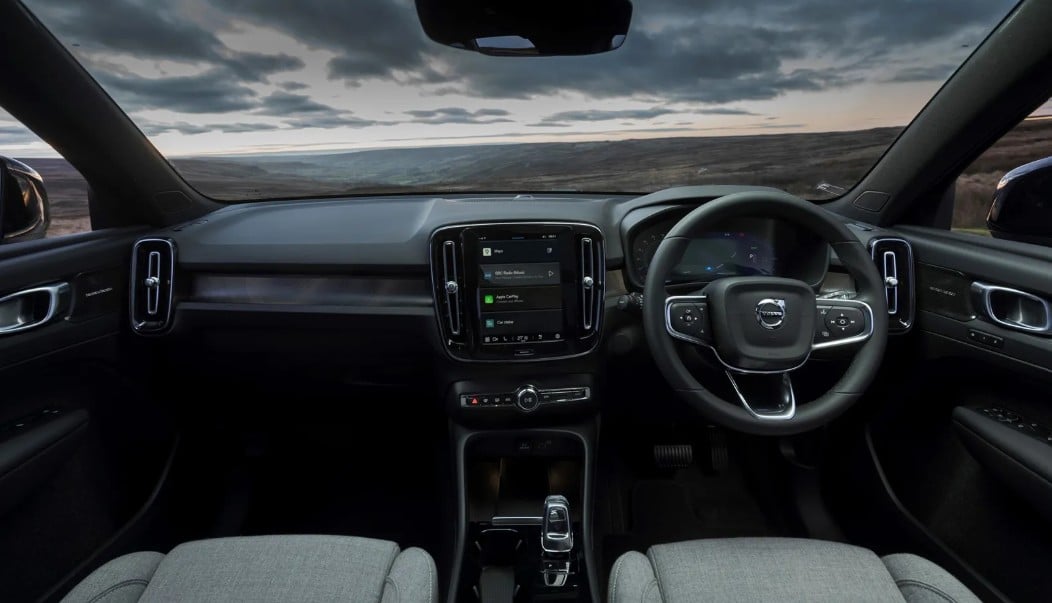
The cabin of the EX40 is a highlight in the small SUV market thanks to clever touches, easy to use tech, excellent practicality and quality materials used throughout. The 12.3-inch digital driver’s display is not configurable but crisp, and the 9.0-inch touchscreen is very easy to use and feature-rich because it uses Google software for apps such as Google Maps.
As you’d expect for a Volvo, the practicality inside the EX40 is great – from the plentiful storage to the ample dimensions for taller folk, it can handle what your family can throw at it. While its 410-litre boot may seem small on paper, in real life it’s impressively large and features many extra storage areas – plus, the rear seats fold completely flat for 1,295L of space.
On the road, the EX40 impresses with a very solid feeling, including a well damped ride than can be occasionally sharp thanks to the standard 20-inch wheels. Performance is excellent, even on the single motor – but the twin motor’s 300kW power output is huge. Thanks to that power, it’s not the most efficient EV, though fast charging capability helps outweigh that thirst.
Like the smaller EX30, Volvo includes five years of servicing in the EX40’s price. Overall the EX40 is still a stand-out offering in the electric small SUV segment – it’s practical, good to drive and even though it’s on the pricier side, the long list of equipment helps to justify the cost.
Volvo EX40 standard equipment:
- 20-inch alloy wheels with a tyre mobility kit
- Dusk-sensing automatic LED exterior lighting
- Rain-sensing automatic wipers
- Keyless entry and start
- Electric tailgate
- Heated, auto-dimming and auto-folding mirrors
- Microtech and textile upholstery
- Electric front seats with driver’s memory functionality
- Heated front and rear seats
- Dual-zone automatic climate control with rear vents
- 12.3-inch digital driver’s display
- 9.0-inch touchscreen with eSIM for live services such as over-the-air updates
- Inbuilt Google Services such as Google Maps and the Google Play Store
- Apple CarPlay
- Wireless phone charger
- 4x USB-C ports
- Harman Kardon sound system
- AM/FM/DAB+ digital radio
- Seven airbags
- Autonomous emergency braking
- Adaptive cruise control with traffic jam assist
- Adaptive lane guidance
- Blind-spot monitoring
- Front and rear cross-traffic alert
- Matrix adaptive high beam
- Front, side and rear parking sensors
- 360-degree camera
- Tyre pressure monitoring
- Rear automatic braking
Swiss brand Tudor’s latest release – the limited-edition chronograph Black Bay Chrono “Carbon 25” – celebrates the brand’s deep ties to motorsport. Inspired by the 2025 livery of the Visa Cash App Racing Bulls Formula One Team, the new timepiece blends cutting-edge material engineering with decades of racing tradition.
First introduced to motorsport in the 1950s, Tudor’s timepieces have long traded on a reputation for precision and durability under pressure. The “Carbon 25” is is designed to honour this legacy with a tech-forward carbon fibre case – complete with carbon fibre end-links and a one-piece carbon tachymetric bezel – for maximum weight savings and performance.
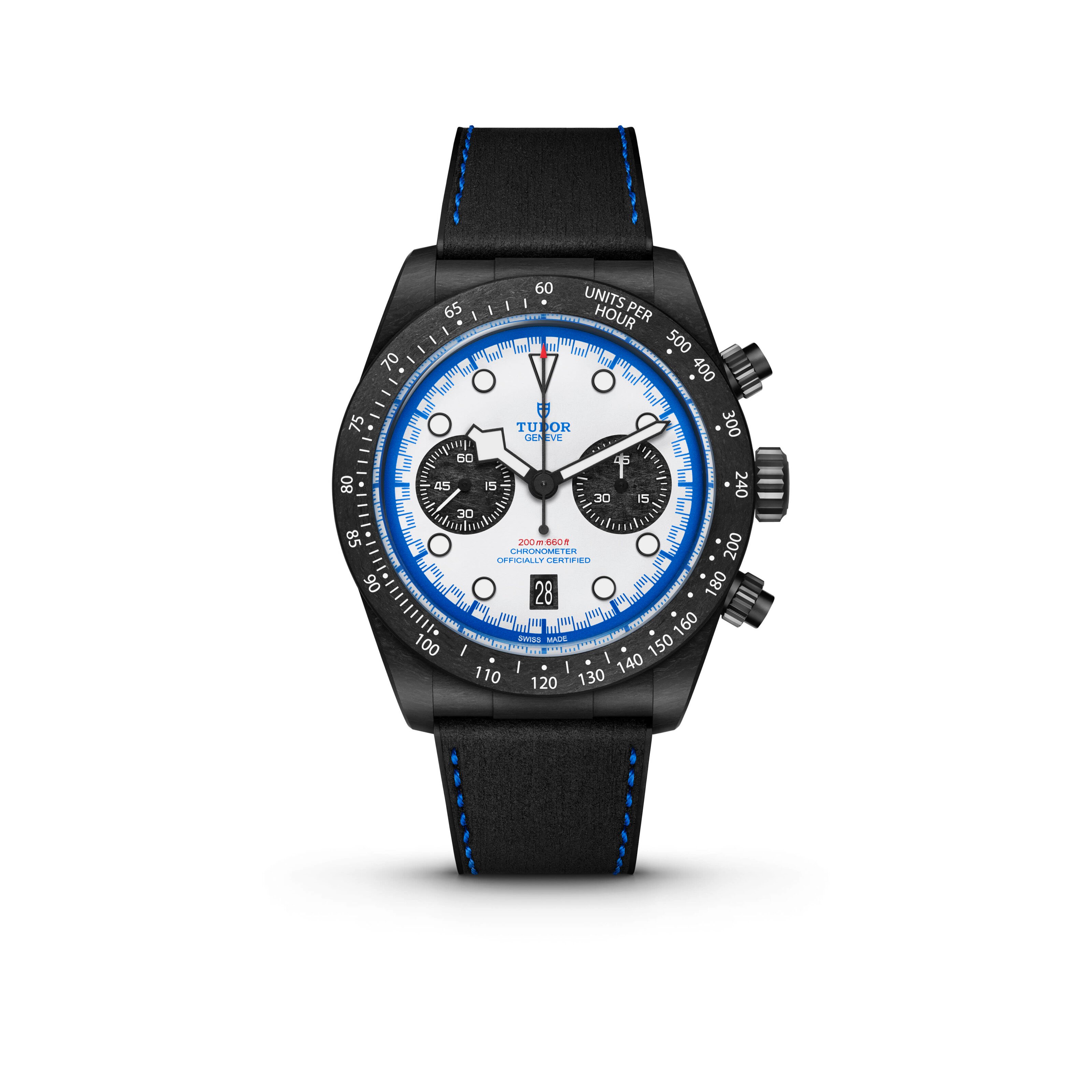
Every detail of the 42mm chronograph has been engineered for the track. The lightweight case houses the COSC-certified Manufacture Calibre MT5813, a column wheel movement with vertical clutch and a robust 70-hour power reserve. The movement, based on Breitling’s B01 calibre but enhanced by Tudor with a silicon balance spring and unique finish, is built for high precision – boasting a daily rate variation of just -2/+4 seconds.
The racing heritage is equally visible on the dial. Set beneath a domed ‘racing white’ face are two hollowed black carbon fibre sub-counters and the iconic ‘Snowflake’ hands – an aesthetic nod to Tudor’s diver legacy. A 45-minute counter and a date aperture at 6 o’clock round out the complications. The pushers, finished in titanium, are inspired by the first generation of Tudor chronographs, adding a vintage touch to this otherwise futuristic design.
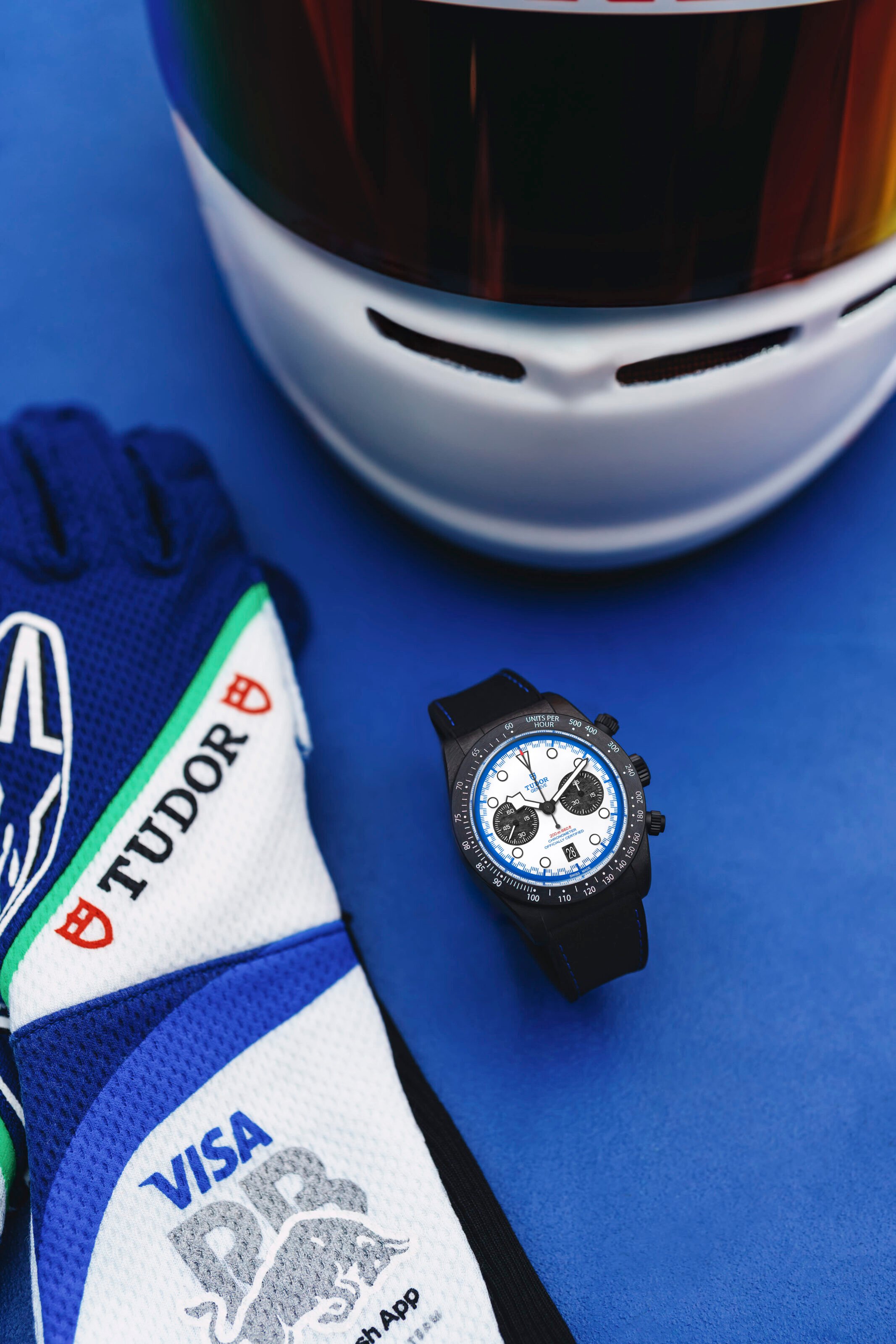
Only 2025 units of the Black Bay Chrono “Carbon 25” will be produced, commemorating the 2025 season and reinforcing its exclusivity. Each watch is individually numbered on a PVD-coated titanium case back, giving collectors a rare opportunity to own a slice of racing history – no pit pass required.
