
Classic Wheels

Gallery 1
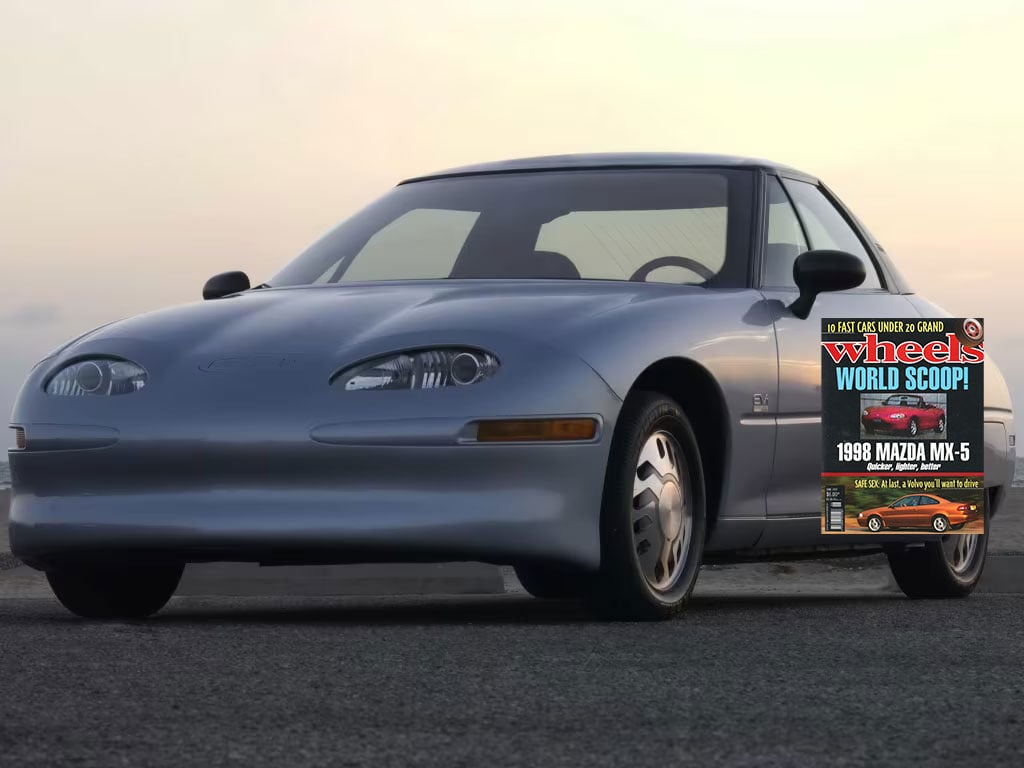
The General Motors EV1 wasn’t the first EV Wheels ever tested – that title goes to the Detroit Electric, which we took for a spin in our December 1953 issue – but it is the first battery-powered vehicle we put through its paces .
First published in the June 1997 issue of Wheels magazine, Australia’s best car mag since 1953. Subscribe here and gain access to 12 issues for $109 plus online access to every Wheels issue since 1953.
1
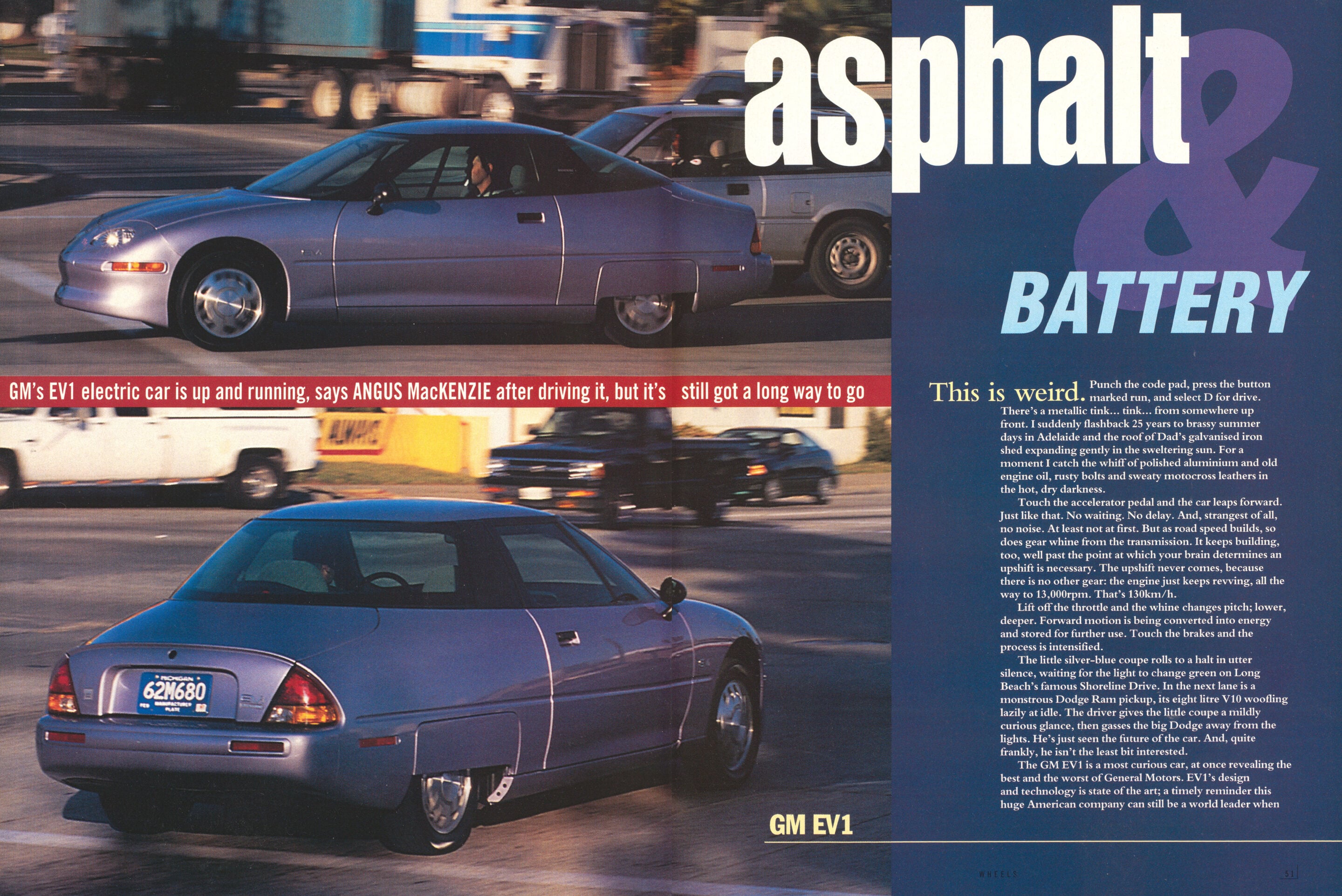
This is weird. Punch the code pad, press the button marked run, and select D for drive. There’s a metallic tink… tink… from somewhere up front. I suddenly flashback 25 years to brassy summer days in Adelaide and the roof of Dad’s galvanised iron shed expanding gently in the sweltering sun. For a moment I catch the whiff of polished aluminium and old engine oil, rusty bolts and sweaty motocross leathers in the hot, dry darkness.
Touch the accelerator pedal and the car leaps forward. Just like that. No waiting. No delay. And, strangest of all, no noise. At least not at first. But as road speed builds, so does gear whine from the transmission. It keeps building, too, well past the point at which your brain determines an upshift is necessary. The upshift never comes, because there is no other gear: the engine just keeps revving, all the way to 13,000 rpm. That’s 130km/h.
Lift off the throttle and the whine changes pitch; lower, deeper. Forward motion is being converted into energy and stored for further use. Touch the brakes and the process is intensified.
The little silver-blue coupe rolls to a halt in utter silence, waiting for the light to change green on Long Beach’s famous Shoreline Drive. In the next lane is a monstrous Dodge Ram pickup, its eight litre V10 woofling lazily at idle. The driver gives the coupe a mildly curious glance, then gasses the big Dodge away from the lights. He’s just seen the future of the car. And quite frankly, he isn’t the least bit interested.
2
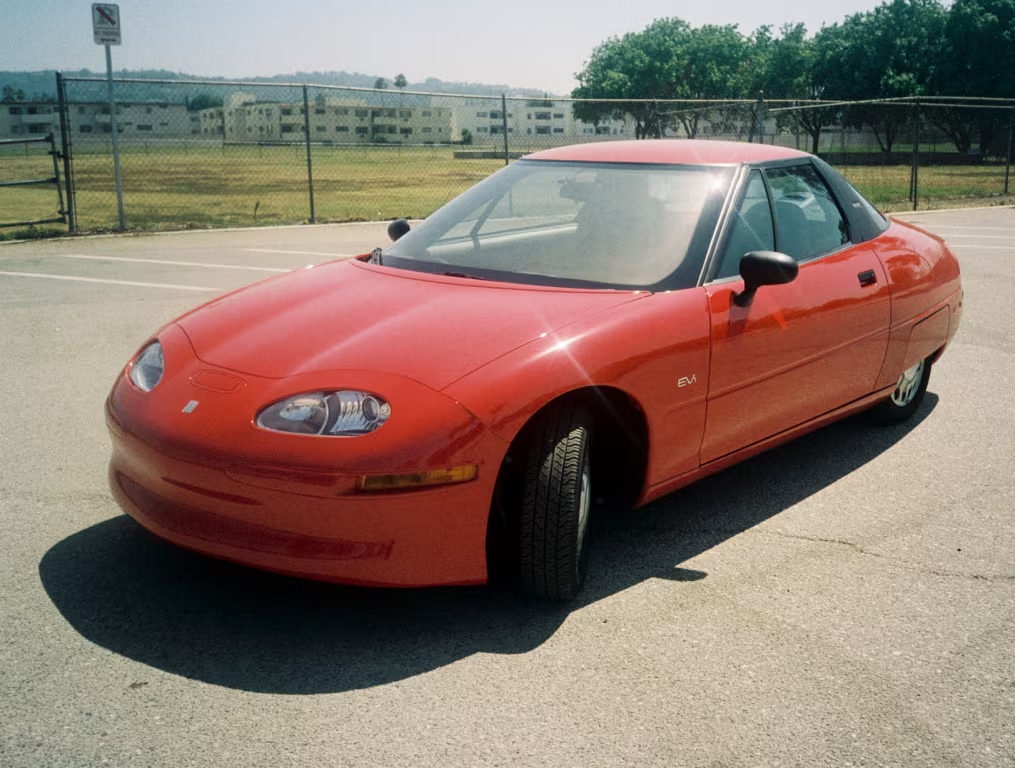
The GM EV1 is a most curious car, at once revealing the best and worst of General Motors. EV1’s design and technology is state of the art; a timely reminder this huge American company can still be a world leader when it comes to applied scientific research. But, like so many other GM cars in the US, the EV1 lacks a clear focus. What GM has built is the world’s first electric sports car. The burning question is, does anyone want – or need – one?
Electric cars are not new; the idea is as old as the car itself. Indeed, the world land speed record was set in 1899 by an electric car and no fewer than 45 different electric cars were produced in the US alone between 1895 and 1930. Smooth, silent, pollution free (at least in terms of tailpipe emissions), electric cars would be perfect but for one tiny detail: the battery.
In simple terms a battery stores energy. The only problem is, it’s not very good at it. Basically, you need 3.7 tonnes of lead-acid batteries to store the equivalent amount of energy found in a litre of petrol. Put another way, as an energy source for cars, a litre of petrol is 100 times lighter and takes up 40 times less space than a lead acid battery. That’s one helluva packaging problem for any car maker.
What GM has done with the EV1 is recognise the fundamental weakness of the electric car – the poor energy density of batteries – and use high technology to make the most efficient use of what limited energy is available. Much of the basic thinking behind the concept stemmed from lessons learnt building the solar-powered SunRaycer, which won the inaugural W odd Solar Challenge race between Darwin and Adelaide in 1987.
3
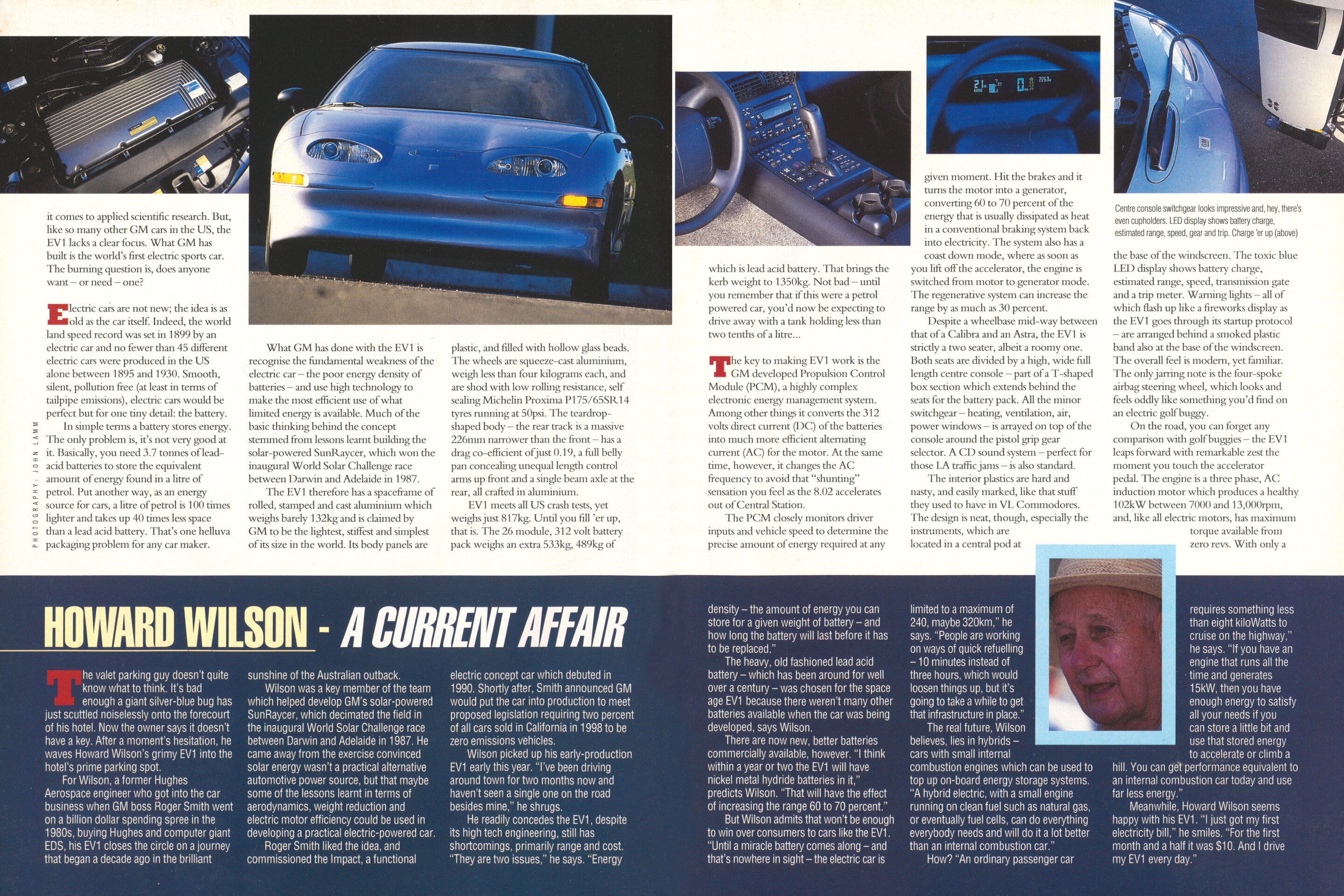
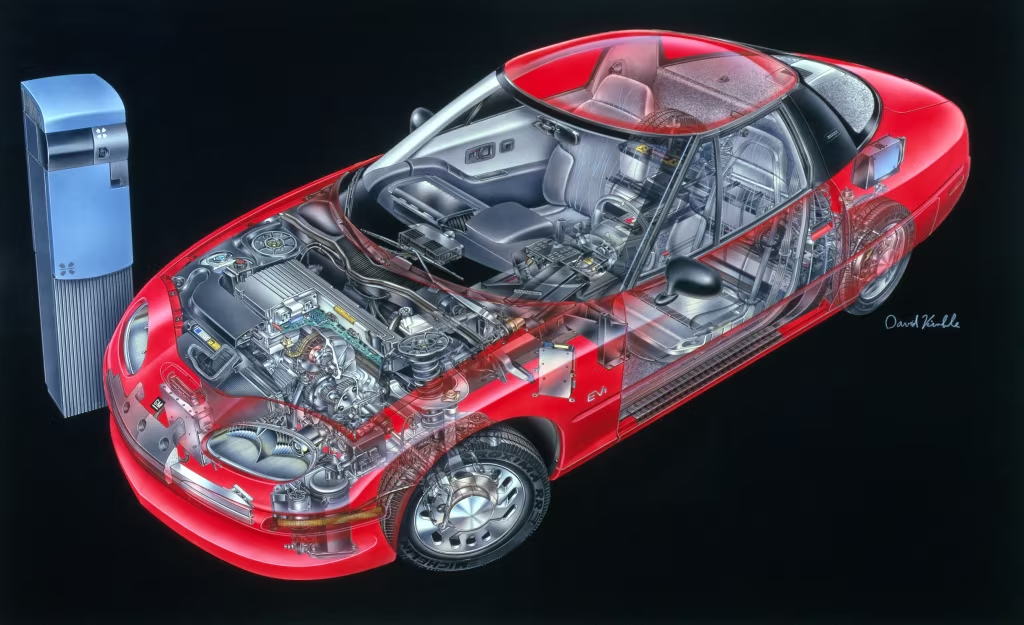
The EV1 therefore has a spaceframe of rolled, stamped and cast aluminium which weighs barely 132kg and is claimed by GM to be the lightest, stiffest and simplest of its size in the world. Its body panels are plastic, and filled with hollow glass beads. The wheels are squeeze-cast aluminium, weigh less than four kilograms each, and are shod with low rolling resistance, self sealing Michelin Proxima Pl 75/65SR.14 tyres running at 50psi. The teardrop-shaped body – the rear track is a massive 226mm narrower than the front – has a drag co-efficient of just 0.19, a full belly pan concealing unequal length control arms up front and a single beam axle at the rear, all crafted in aluminium.
EV1 meets all US crash tests, yet weighs just 817kg. Until you fill ‘er up, that is. The 26 module, 312 volt battery pack weighs an extra 533kg, 489kg of which is lead acid battery. That brings the kerb weight to 1350kg. Not bad – until you remember that if this were a petrol powered car, you’d now be expecting to drive away with a tank holding less than two tenths of a litre …
The key to making EV1 work is the GM developed Propulsion Control Module (PCM), a highly complex electronic energy management system. Among other things it converts the 312 volts direct current (DC) of the batteries into much more efficient alternating current (AC) for the motor. At the same time, however, it changes the AC frequency to avoid that “shunting” sensation you feel as the 8.02 accelerates out of Central Station.
4
The PCM closely monitors driver inputs and vehicle speed to determine the precise amount of energy required at any given moment. Hit the brakes and it turns the motor into a generator, converting 60 to 70 percent of the energy that is usually dissipated as heat in a conventional braking system back into electricity. The system also has a coast down mode, where as soon as you lift off the accelerator, the engine is switched from motor to generator mode. The regenerative system can increase the range by as much as 30 percent.
Despite a wheelbase mid-way between that of a Calibra and an Astra, the EV1 is strictly a two seater, albeit a roomy one. Both seats are divided by a high, wide full length centre console – part of a T-shaped box section which extends behind the seats for the battery pack. All the minor switchgear – heating, ventilation, air, power windows – is arrayed on top of the console around the pistol grip gear selector. A CD sound system – perfect for those LA traffic jams – is also standard.
The interior plastics are hard and nasty, and easily marked, like that stuff they used to have in VL Commodores. The design is neat, though, especially the instruments, which are located in a central pod at the base of the windscreen. The toxic blue LED display shows battery charge, estimated range, speed, transmission gate and a trip meter. Warning lights – all of which flash up like a fireworks display as the EV1 goes through its startup protocol – are arranged behind a smoked plastic band also at the base of the windscreen. The overall feel is modem, yet familiar. The only jarring note is the four-spoke airbag steering wheel, which looks and feels oddly like something you’d find on an electric golf buggy.
On the road, you can forget any comparison with golf buggies – the EV1 leaps forward with remarkable zest the moment you touch the accelerator pedal. The engine is a three phase, AC induction motor which produces a healthy 102kW between 7000 and 13,000rpm, and, like all electric motors, has maximum torque available from zero revs. With only a single ratio gearbox – 10.95:1 – and constant torque, ‘throttle’ response is instantaneous and absolute.
The EV1 easily keeps up with fast-moving city traffic – in US testing it has zapped from 0-100 km/h in about 8.5 seconds – and cruises comfortably at 110km/h on the freeway down to Long Beach. The ride is remarkably compliant, despite the high pressure tyres, and the steering quick and accurate. It’s only when you start to push the EV1 into corners that its mass and low friction tyres start to make their presence felt. It might accelerate like a sports car, but it gets a touch tanglefooted if you ask it to change direction in a hurry.
3
But that’s not why you quickly start driving the EV1 like an eco-car, all anticipation and gentle inputs. It doesn’t take too much enthusiastic driving for the battery charge indicator to start dropping alarmingly, and the range predictor, which bases its calculations on driving behaviour, to get down to single digit numbers. You soon become acutely aware that when the charge indicator reaches ‘E’, the thousands of petrol stations around LA aren’t going to help. It’s an uncomfortable sensation.
GM claims the EV1 has a range of 110 to 145km driven on the US EPA city and highway cycles respectively. But, like a conventional car, slow stop-start running, using the air conditioning, chews into those numbers. Our test car had a roughly two-thirds full battery when we started, and the range predictor suggested about 47km. Freeway cruising boosted that to 60km, but an hour or so of traffic light derbies quickly drained the battery’s reserves.
In all we covered just over 50km of mixed urban and freeway running, and by the time we returned the EV1, there was only one bar left on the battery charge indicator, and the range predictor was suggesting we had 15 or so gentle kilometres left. Had we gone much farther, the ‘Battery Life’ indicator light would have come on, indicating the battery pack was more than 85 percent discharged and soon after the PCM would have begun to reduce the available power to protect the battery pack from damage, slowing the car to a crawl.
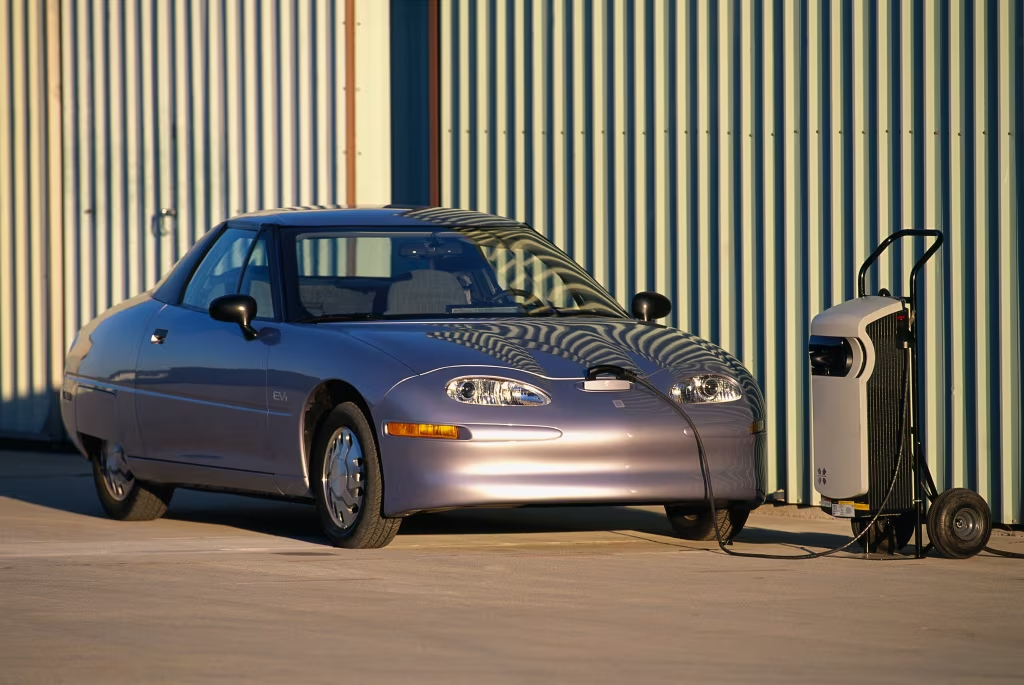
Of course the beauty of an electric car is you can refill almost anywhere there’s a powerpoint – if you have the time. The EV1 ‘s capacious boot contains a 110 volt, 1.2k W Magne Charger which brings the batteries up to full strength in 12 to 14 hours. GM also offers a 220 volt, 6.6kW unit which can be leased privately. This unit, which will also be installed at shopping malls, airports and other locations around LA later this year, cuts recharge time to two to three hours. GM says a 440 volt charger in the pipeline will slash recharge time to under 15 minutes.
GM chairman Jack Smith announced the EV1 would finally go into production at the Los Angeles Auto Show early last year. “It’s time to get electric vehicles out of the lab, into the showroom and onto the road,” he said, 12 years after his predecessor Roger Smith committed GM to the electric car. But so far precious few have made it onto the road.
As at March, just 115 EV1s had been delivered to customers in LA and San Diego in California, and Phoenix and Tucson, Arizona. Although listed at US$33,995 (about four grand more than a C220 Benz) you can’t buy an EV1 – GM will only lease it to you over three years for between US$477 and US$640 a month and with a residual of US$14,700.
3
There is no purchase option at the end of the lease – all EV1s go back to GM. This helps GM get around legislation designed to prevent the sale of electric vehicles below cost, as well as a requirement to build and hold 15 years’ worth of spare parts. But the really bizarre bit is that politicians who refuse to put up the price of petrol to give consumers an incentive to switch to smaller, more fuel efficient, less polluting vehicles, are meanwhile happy to give each EV1 buyer almost US$8400 in tax credits.
The EV1 was designed to meet laws requiring two percent of all vehicles – 20,000 cars – sold in California next year be zero emission vehicles (ZEVs). A laudable target, except there’s no evidence two percent of car buyers want ZEVs (and electric cars are the only practical zero emission vehicles). While that legislation has quietly been put on the back burner, sales of mostly V8 pick-up trucks are at an all time record level.
The idea that electric cars will help LA’s chronically poor air quality is a good one – in theory. However, some studies suggest achieving a 20 percent reduction in smog-forming ozone levels in LA by 2010 would require the introduction of 1.5 million electric vehicles. That’s a lot of tax credits…
Follow WhichCar/Wheels on Google
Click the button below to make WhichCar by Wheels a preferred source for your news.

We recommend
-
 Classic Wheels
From the Wheels Archive: Ford’s ground-breaking 4WD XY Falcon ute was decades ahead of its time
Forget the Ford Ranger, this Falcon-based four-wheel drive ute from Australia is the original gangster of lifestyle utes.
-
 Classic Wheels
From the Wheels Archive: Super coupe! The sexiest Holden Commodore of all time... and it’s a hybrid
Holden's stunning ECOmmodore proved that when it come to hybrid technology, Australia could mix it with the best in the world.
-
 News
NewsGeneral Motors to invest US$6.5bn in battery tech
GM isn't the first manufacturer to join forces with LG in the United States...
