Reviews


Gallery 1
“IT’S FULL OF BALLS.”
When Hyundai told me I’d be picking up the new Santa Fe XRT from John Cain Arena in Melbourne and that it might have some promo material from the weekend’s Melbourne Mavericks netball match in it, I wasn’t expecting a boot full of unsecured Gilbert Phoenix size fives. This could prove a problem, especially as the route I’d chosen for the day took us out of Melbourne and into some of the most inhospitable parts of Victoria.
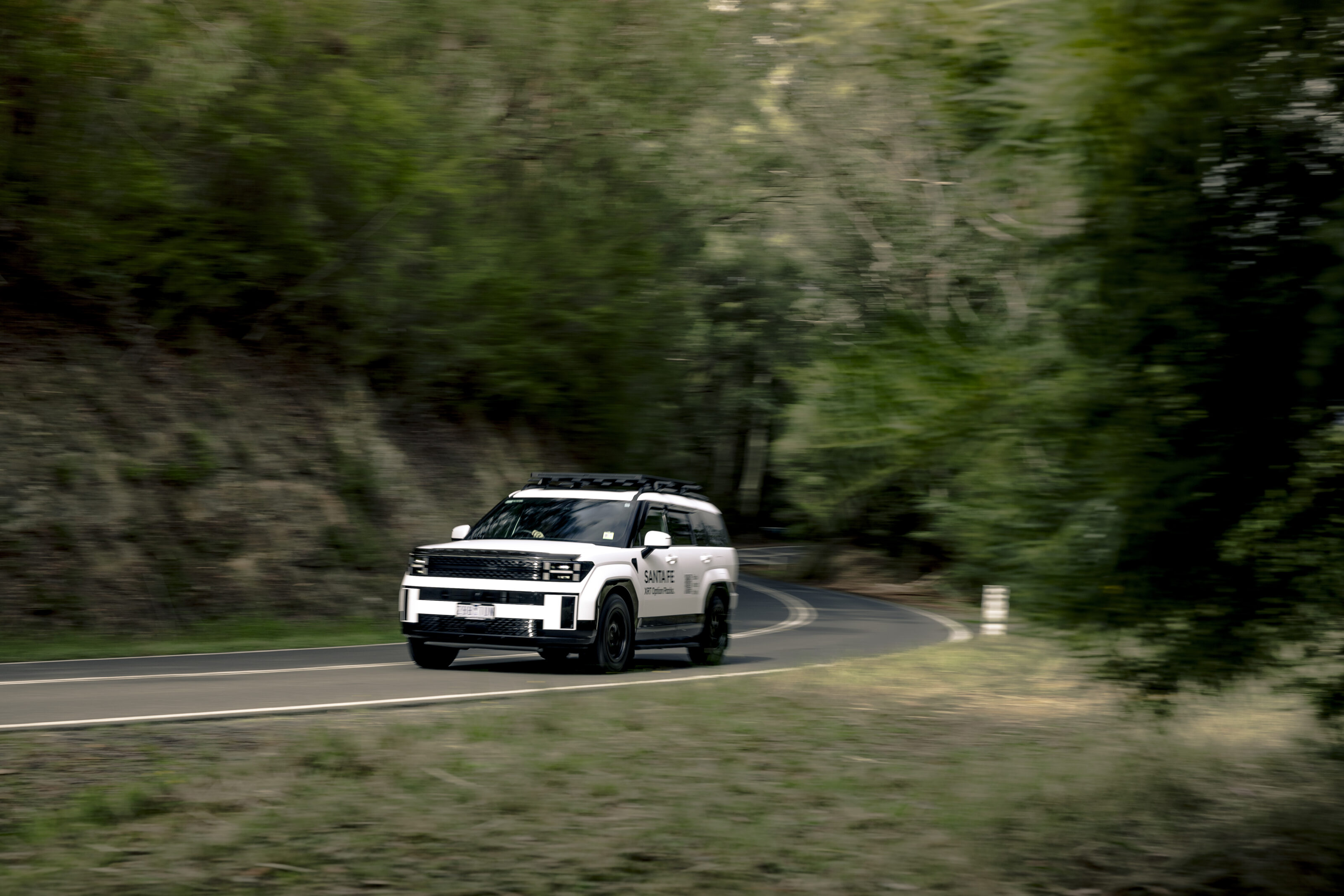
It would certainly be a test for the Santa Fe, an SUV that blends seamlessly into suburbia, but which doesn’t really do arduous. With the XRT accessory pack, Hyundai wants to add some attitude to this lovely but mild-mannered box. Or, if you prefer, some balls.
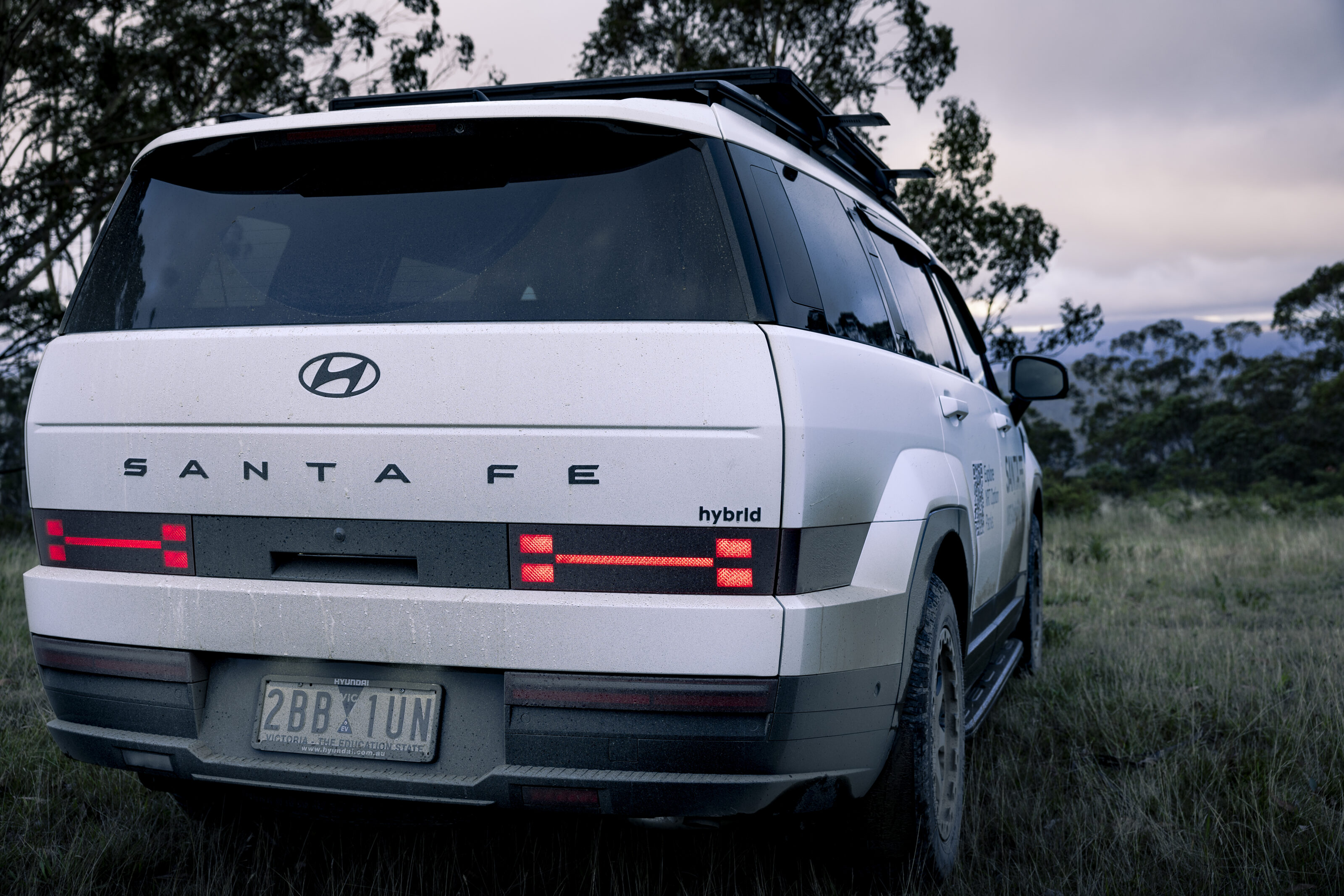
The XRT Peak Option Pack, as fitted to this one, adds $9,990 to the price of your Santa Fe and includes the 17-inch off road wheel and tyre package, an integrated side step, a bonnet protector, a roof platform, XRT mud flaps, roof racks, and underbody skid plate, window visors and the XRT suspension kit. This features new hub carriers, stabiliser bars, springs and longer stroke HL Mando shock absorbers which deliver 30mm of extra ground clearance over a standard Santa Fe. In fact, with 210mm of clearance, the XRT features the exact same clearance as an entry-level Toyota Prado, but the Hyundai’s long overhangs mean that it can’t match the Japanese car’s approach and departure angles.
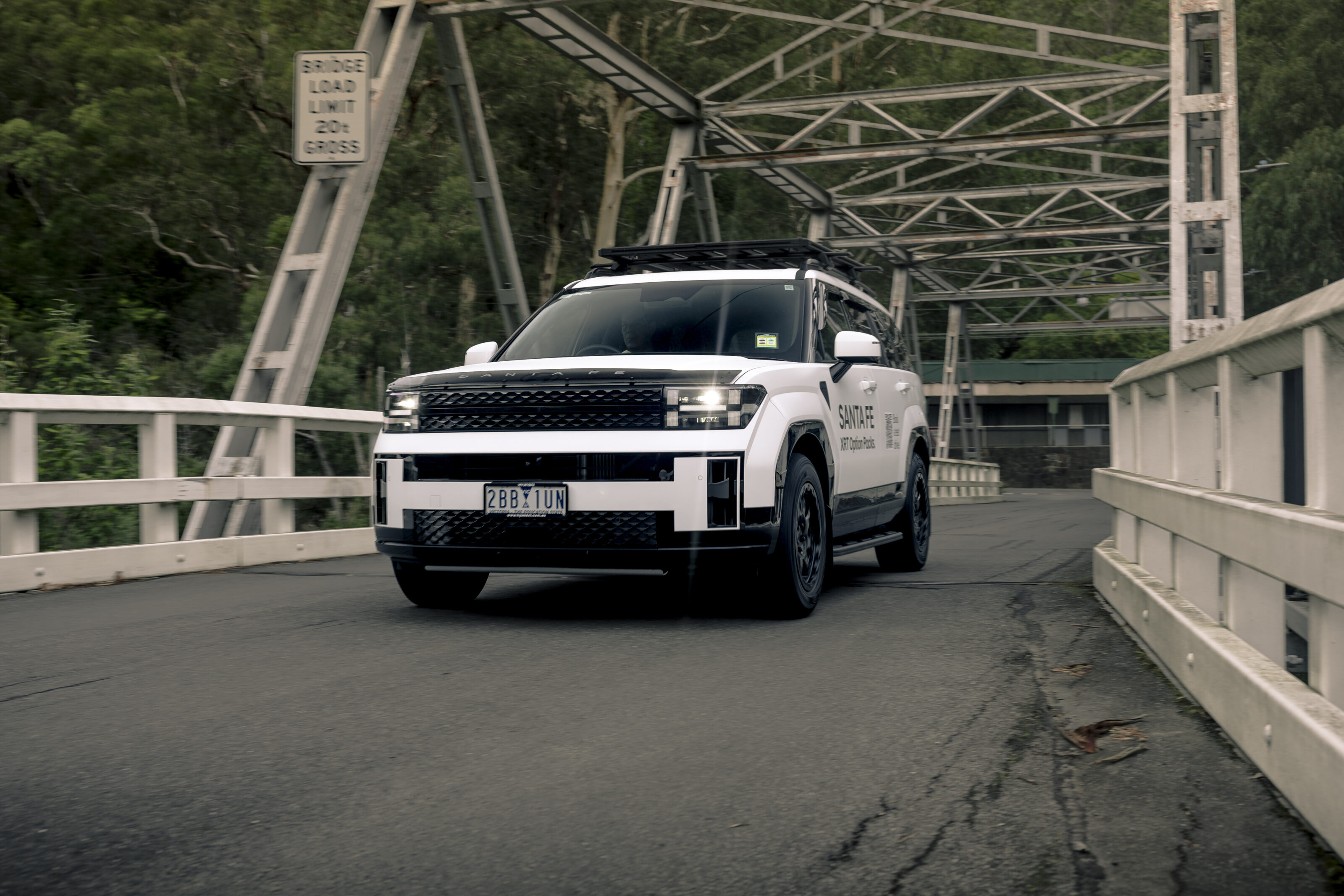
If you don’t need all the trimmings, the XRT Adventure option pack nets you the wheels, tyres, suspension, underbody skid plate and mud flaps for $6,990 including GST and fitting. That may well be a bit more palatable to many. The tyres were meant to be Pirelli Scorpions, but a supply issue meant that our vehicle was shod with Yokohama Geolander AT rubber measuring 235/65 R17 all round.
I’m waiting for photographer Ellen to arrive at the Three Sugars Cafe in Warburton. The skies are leaden and, given our route out to Woods Point reaches over 1200 metres above sea level, it looks like it might be cold, wet and windy if the clouds scuttling along the Yarra Ranges ridge lines are anything to go by.
It’s an intriguing route, following the Yarra east towards its source before ramping crazily uphill on the tortuous Reefton Spur road. Arriving at Cumberland Junction, the road then turns to dirt diving into wooded wilderness before arriving at Matlock (population: 7) before dropping down to the remote and historic gold-mining settlement of Woods Point, nestling in an elbow of the brook that becomes Victoria’s mightiest river, the Goulburn.
That ought to give the XRT a reasonable workout. As well as understanding what it is, it’s also important to accept what this Santa Fe is not. It’s not one of those Serious Off Roaders, beloved by men with voluminous beards, a hard drive full of electric winch porn and a predilection for killing their dinner with a spade. I was half looking forward to being smirked at by these types, who would be unable to resist giving me that ‘you’re driving entirely the wrong vehicle’ sort of look. So while you’re not about to be wading through 800mm deep water or engaging low range to tackle a gnarly incline, you’re nevertheless getting something that’s rugged enough to deliver peace of mind when tackling an extended variety of off-trail adventures.
Putting theory into practice
Tackling Reefton Spur is a different matter. On the way out, I’ve been impressed by the refinement of the hybrid Santa Fe, even on the Yokohama AT rubber which has, if anything, helped to massage away some of the flintier edges of the standard car’s ride. There’s little in the way of tread block singing on smooth bitumen and even when you subject them to some cornering forces, there’s not that woolly vagueness that afflicts many SUVs on knobbly hoops. The thing with Reefton Spur, though, is that it goes on and on and on.
Its origins date back to the 1860s and the Victorian gold rush, when a cart track was built to haul material between the gold workings of Reefton and Jamieson. The road as we know it today was the result of a different natural bonanza: timber. The post-war building boom meant that during 1947-48, the Forests Commission invested in a major project at the Big River, and the Reefton Spur Road was scratched out of the mountain slopes as a trucking route for mountain ash sawlogs. This 20km stretch – from the old Reefton township to Cumberland junction – comprises 180 bends, ascends 632 metres and, should you arrive like us midweek, is usually devoid of traffic. The odd logging truck chugging from the plantations beyond Cambarville is all we see. The road itself is rhythmless, with the odd short descent thrown in to keep you on your toes, and the surface is patchy and deformed from winter ice and snow, summer fires, mountain ash roots and the sheer weight of those big logging trucks. In a sports car it’s a challenge, in a big 4×4 it’s a handful.
Lyrebirds explode out of the ferns in a screeching cacophony as the Sant Fe whirs through. It’s making a pretty good job of things, but the threshold at which the tyres start to wilt gets lower and lower as the tyre carcass gets hotter and hotter. Our car is the Calligraphy trim, in six-seat guise, and weighs 2105kg before you start adding the XRT accessories. In other words, it’s quite a hunk of car to be flinging into off-camber tightening apexes. Amazingly, the undersized 1.6-litre four-cylinder petrol engine doesn’t feel as if it’s lacking for muscle. With a total system torque of 367Nm at its elbow between 1000 and 4500rpm, helped by a reasonable alert six-speed automatic, it’s far from embarrassed when you make demands of it. If you’re concerned that XRT-ing your Santa Fe will turn it into a blancmange on the blacktop, fear not.
Cumberland Junction arrives and it looks like a satellite offshoot of Summernats. A pile of expired wheels and tyres sits on the roadside, cremated radial belts litter the roadway and the bitumen looks more rubbered-in than the Gunsei touge course. It seems a long way to come for a bit of circle work, and one VE Commodore isn’t going home anytime soon, buried so far backwards into the underbrush that, given time, it may well earn its own historic marker signpost.
Head right – passing the obligatory LandCruiser owner giving me that look – and the blacktop ends in short order. In this case it transitions instantly to washboard: the sort of corrugations that were you merely on a weekend jaunt, would have you turning back and reconsidering your options after a couple of hundred metres. At one point it felt as if the entire centre console was trying to tear itself free from its moorings, and the vibration hit a certain frequency whereupon all of the netballs in the boot instantly went from shuffling about meekly to wildly flinging themselves about the cabin. Fortunately, after a few kilometres, the terrain changed and the washboard ended.
At the further reaches
The route out to Cambarville climbs and falls as you follow the spine of the Yarra Ranges. There’s nothing in Cambarville, a locality named after two sawmill owners, A. Cameron and F.J. Barton, who set up shop in the 1940s, before the settlement was repeatedly ravaged by fire and deserted in 1971. Now it’s the gateway to huge pine plantations and, curiously, one of the loveliest stretches of road for miles. After 25km of jarring dirt roads, you’re suddenly presented with a serpentine, seven-kilometre stretch of some of the smoothest hotmix you could imagine. It’s heavenly.
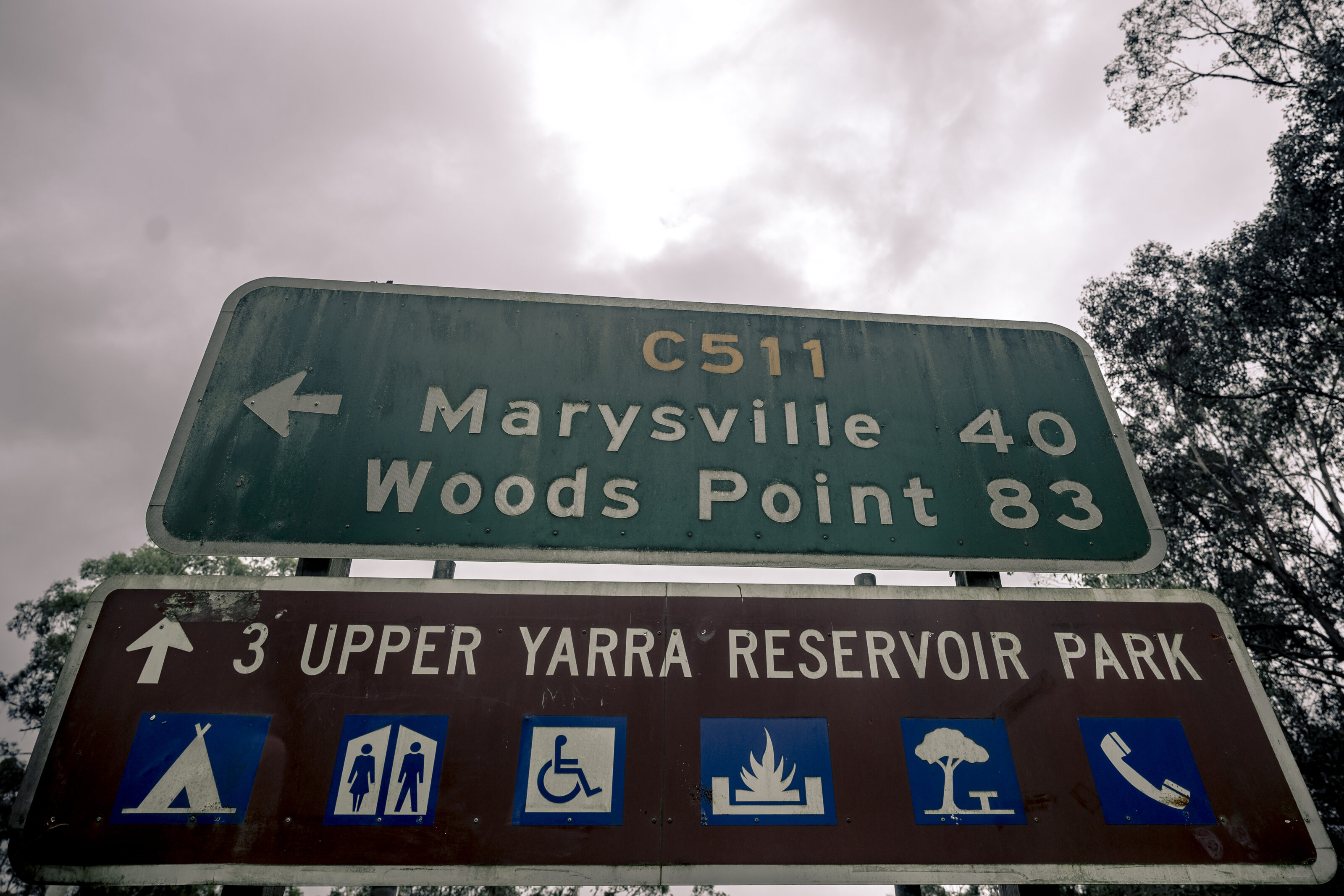
There’s considerable conjecture as to how this section of the C511 came to be. One persistent rumour is that it was laid by Australian Army engineers ahead of a visit by Queen Elizabeth II in 1954, as part of a tour that took in the soon to be completed Upper Yarra Reservoir. Try as I might, I can find no basis in fact for this. The reintroduction to dirt consists of a pock-marked cluster of potholes that fire water over the Santa Fe’s windscreen. Back into it with gritted teeth.
Barrel into some of the tighter corners and you can experience a sudden introduction of washboard that casually walks the nose of the Hyundai wide. There’s a three-stage stability control system that can do little but rob you of throttle authority when this happens. I experiment with it off – in its middle setting and fully on – and realise things can get quite exciting with everything fully off, but that there’s little material difference between the other two nanny modes.
Unlike, say, an Everest or a Prado, there’s not much in the way of off-road specific settings that you can play with. There’s a hill descent control mode, that we’re not about to use today, and three off-road settings: Mud, Sand and Snow which, for the most part, just implement a few different lines of code in the traction control software. The tempting looking clay-rutted trails that clamber up into the nether reaches of the plantations look a little too sporty for the Santa Fe. Horses for courses and all that.
Photographer Ellen brings us to a halt for yet another photogenic corner, folds of blue-grey pastel hills peering through the trees, fading into fuzzy layers. It’s quiet out here. The brake discs tick as they cool, the Santa Fe’s hybrid electrics emitting a soft whine. The air is so clean that hairy green lichens grow madly on every snow depth marker, signpost or fence line. We count three separate fires on the distant horizon, but the wind has dropped to nothing now. The light’s starting to soften though, and we realise we’ll need to hustle to get to Woods Point and back before night falls.
We emerge from forest onto the bald hilltop of Matlock, formerly the thriving gold mining community of Emerald Hill. You don’t have to wander too far from the road here to find mineshafts angling into the tussock grass. At its peak, back in the 1860s, the town had about 300 residents and sprawled across the plateau, some 1213m above sea level. Winters were harsh on this windswept knoll, and the gold seams were said to have been spectacularly productive before they pinched out. Like Cambarville, Matlock was devastated by fires, first in 1873, which killed its gold industry and then in 1939 when the timber industry was brought to a similar full stop. This is hard country in which to make any sort of living.
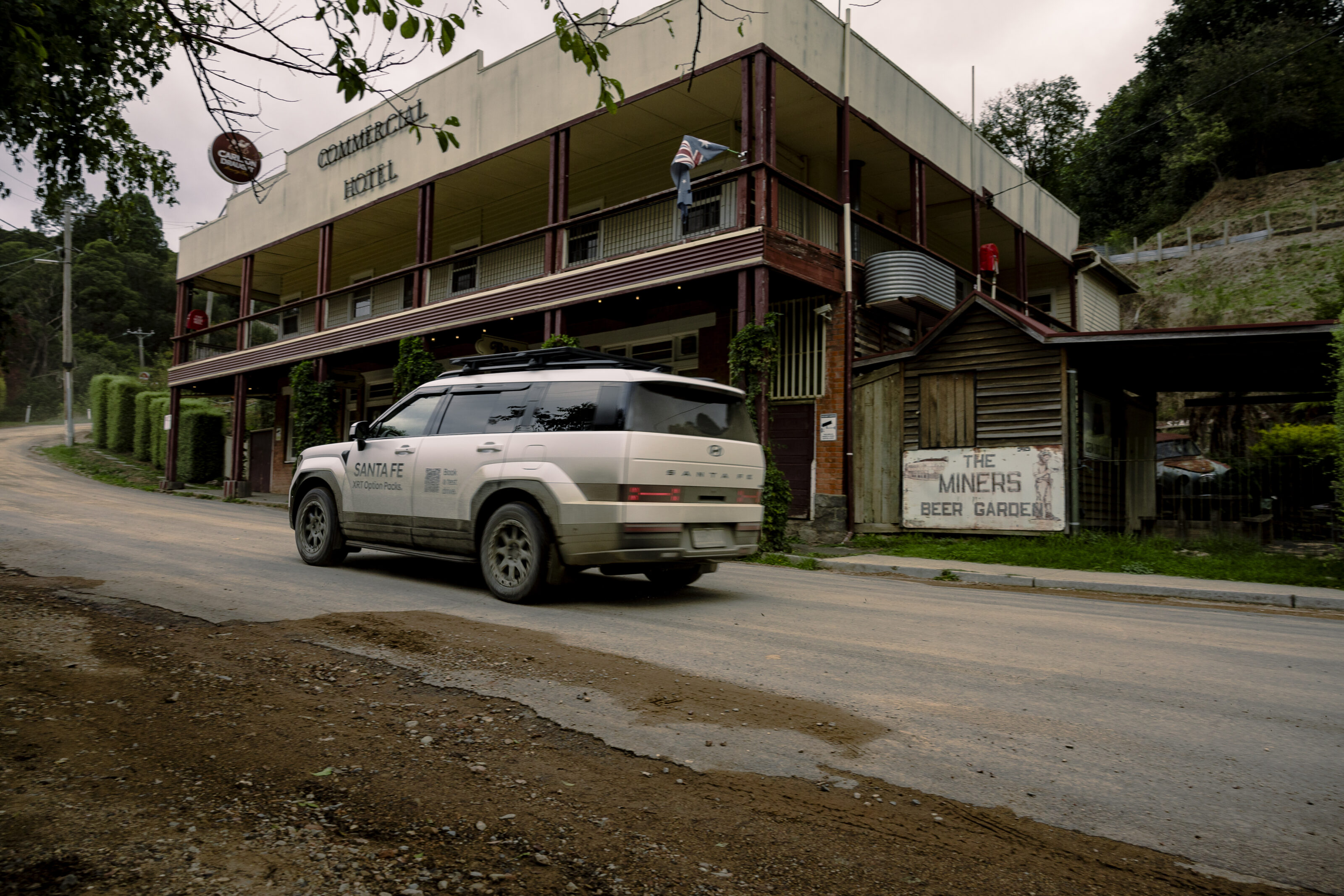
Drop off the northern scarp slope from Matlock and the road descends down to the headwaters of the Goulburn River. The terrain becomes folded and rilled, with lusher vegetation and the road surface becomes softer and loamier. It’s only 7km between Matlock and Woods Point, but the contrast between the two settlements is stark. Whereas Matlock is bleak and moribund, Woods Point has some spirit. You roll in and are welcomed by the Commercial Hotel on Bridge Street and a small general store.
A Telstra cell tower on a nearby hill was installed in 2019, bringing this remote community a little closer to the rest of the world. For some who choose to live so far off the grid, that was perhaps a blessing and a curse. One gold mine is still operating in the locale, the A.1 mine, run by Kaiser Reef. It was the Morning Star mine, though, that was the heart of the original community. Founded in 1861 and producing some 883,000oz of gold, it closed in 2023. This seam, situated on a spur leading to the junction of the Morning Star Creek and the Goulburn River was accessed via a 160m shaft. Even as recently as 2019, the mine’s owners, AuStar Gold, were reporting hugely productive seams at nearby McNally’s Reef. There’s still plenty of gold in them hills.
We’re left to ponder whether the XRT kit for this Hyundai Santa Fe is a little nugget of gold or just a bit of mere tinsel. For mine, the $6990 Adventure option pack seems like the better choice, delivering all the bits that add capability. The $9990 Peak option pack merely adds three grand’s worth of tinsel. The Santa Fe XRT’s bigger issue is that the accessories add cost to what is already a fairly pricey vehicle. The Hybrid AWD starts at $58,500, the Elite Hybrid retails at $65,000 and this Calligraphy Hybrid starts at $75,000. Add $7k to those prices and you start getting into the gunsights of some very capable competitors. A Ford Everest Tremor, for example, costs $76,590 and will get you to off-road spots where the XRT would be waving the white flag. Likewise the $72,500 Toyota Prado GX.
Neither of these macho SUVs delivers the sophistication of the Santa Fe’s hybrid powerplant and neither come close to levelling with the Hyundai’s assured and quietly stylish interior finish. That’s where the Korean car might well find its niche. Should your off-road ambitions be a little more limited, but you still require a modicum of capability and the reassurance of tougher tyres and suspension, the XRT asks for little in terms of material compromise. It still rides and handles neatly on road. Do without the Peak pack’s aero-penalty roof platform and you won’t knock too much of an edge off the standard car’s fuel economy either. In short, you’re adding a few percent to the all-up price and adding considerably more in terms of extra ability. We’d call that a win.
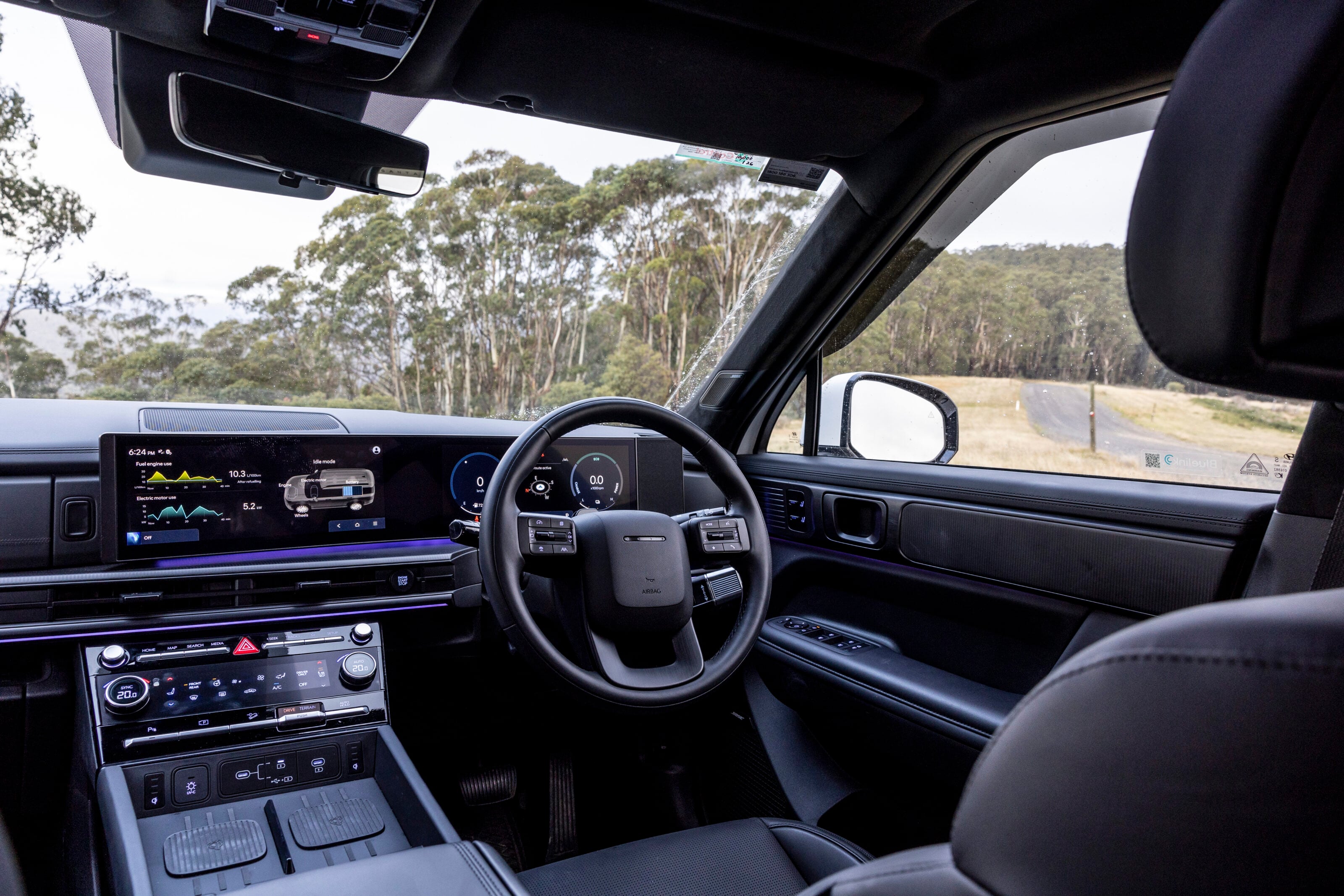
As the evening falls in Woods Point, we realise that we have 55km of dirt road to tackle once again, this time with bonus nocturnal marsupials thrown into the mix, before tackling the giddy dive down Reefton Spur. It’s been a long day but the Santa Fe XRT has shrugged off the worst that this teak-tough road has thrown at it. We pass another marker for the gravestones of some long-passed folk of this unforgiving high country. I switch my steering wheel heater on, fire up a playlist on the Bose stereo, sink into the Nappa leather seats and ponder the privilege of having things easy. That’s the beauty of a vehicle like the Hyundai Santa Fe XRT. Taking the rough with the smooth has a lot to be said for it.
Born In The USA: XRT-lite
While we get the Santa Fe XRT here in Australia, the XRT badge has a bit more reach in the US, with the Tucson, the Palisade and the sexy Santa Cruz ute all offered with an XRT model in the range. Unfortunately, unlike the ruggedised Santa Fe that we get, the American XRT treatment is all show and no go, with the options purely aesthetic, such as specific wheel designs, with black front and rear underbumper fascias and side cladding.
Specifications
| Model | Hyundai Santa Fe Calligraphy Hybrid w/ XRT Peak option pack |
| Engine | 1598cc 4cyl, DOHC, 16v turbo hybrid |
| Max power | 172kW @ 5600rpm |
| Max torque | 367Nm @ 1000-4100rpm |
| Transmission | 6-speed automatic |
| Weight | 2105kg |
| 0-100km/h | 9.5s |
| Economy | 6.1L/100km (tested) |
| Price | $86,515 (as tested) |
| On sale | Now |
Follow WhichCar/Wheels on Google
Click the button below to make WhichCar by Wheels a preferred source for your news.