Comparisons


Gallery 1
Small SUVs are the new hatchback. Don’t believe me? Look at the sales charts.
Sales of small passenger cars are in steady decline, and have been for years. Twenty years ago, Aussies bought almost 220,000 small cars, over 21 per cent of them Toyota’s venerable Corolla. Fast forward to 2025 and the number of small cars bought new fell to just 72,000, down from 93,000 the previous year. The only constant? Corolla remained the best seller in the category, with a 26 per cent share of the market.
Small SUVs, meanwhile, did not exist as a category in 2006, with less than a handful of what today would be considered small high-riders. Collectively, they accounted for just over 1000 sales for the year.
Twenty years later, Aussies are buying them in ever-increasing numbers, some 200,000 finding new driveways to call home in 2025 alone, an 11 per cent increase over the previous year. And that number is already on track to be eclipsed in 2026, sales to the end of June already up five per cent on last year.
And there’s more choice than ever before, with 47 models from 31 manufacturers clamouring for buyers’ attention. And wallets.
Added to the mix, recent world events have thrown into sharp focus – in 4K ultra-high-definition – the
importance of fuel efficiency.
1
The ongoing Middle East conflict has seen sales of electrified vehicles of all shapes and sizes surge as buyers look to immunise themselves against future fuel shocks.
And at the top of the tree, the venerable hybrid which across all SUV categories continues to climb in popularity. That insatiable hunger for fuel-sipping tech is playing out in the small SUV segment too where an increasing number of models – 15 at last count – have added hybrid variants to their popular compact high-riders.
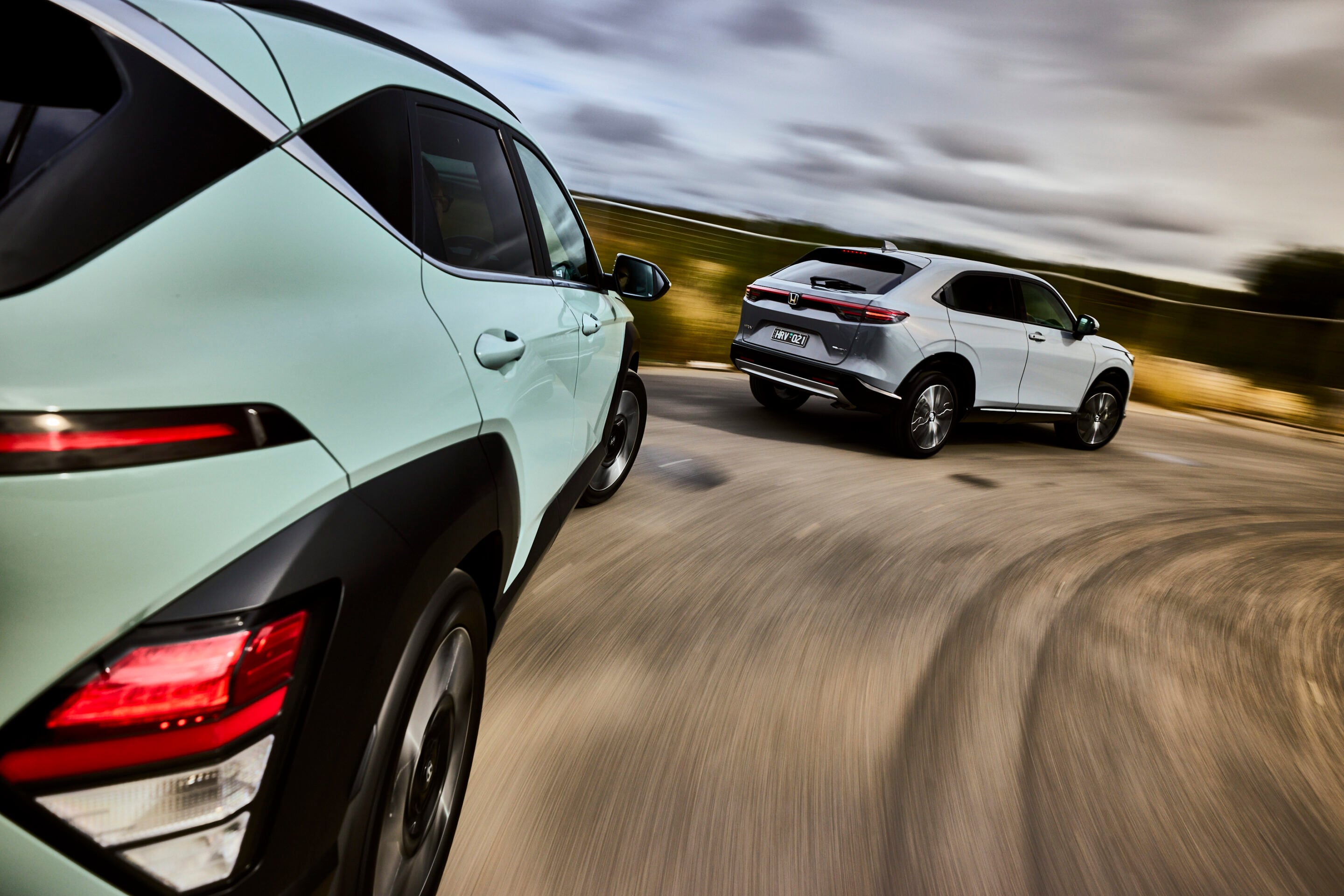
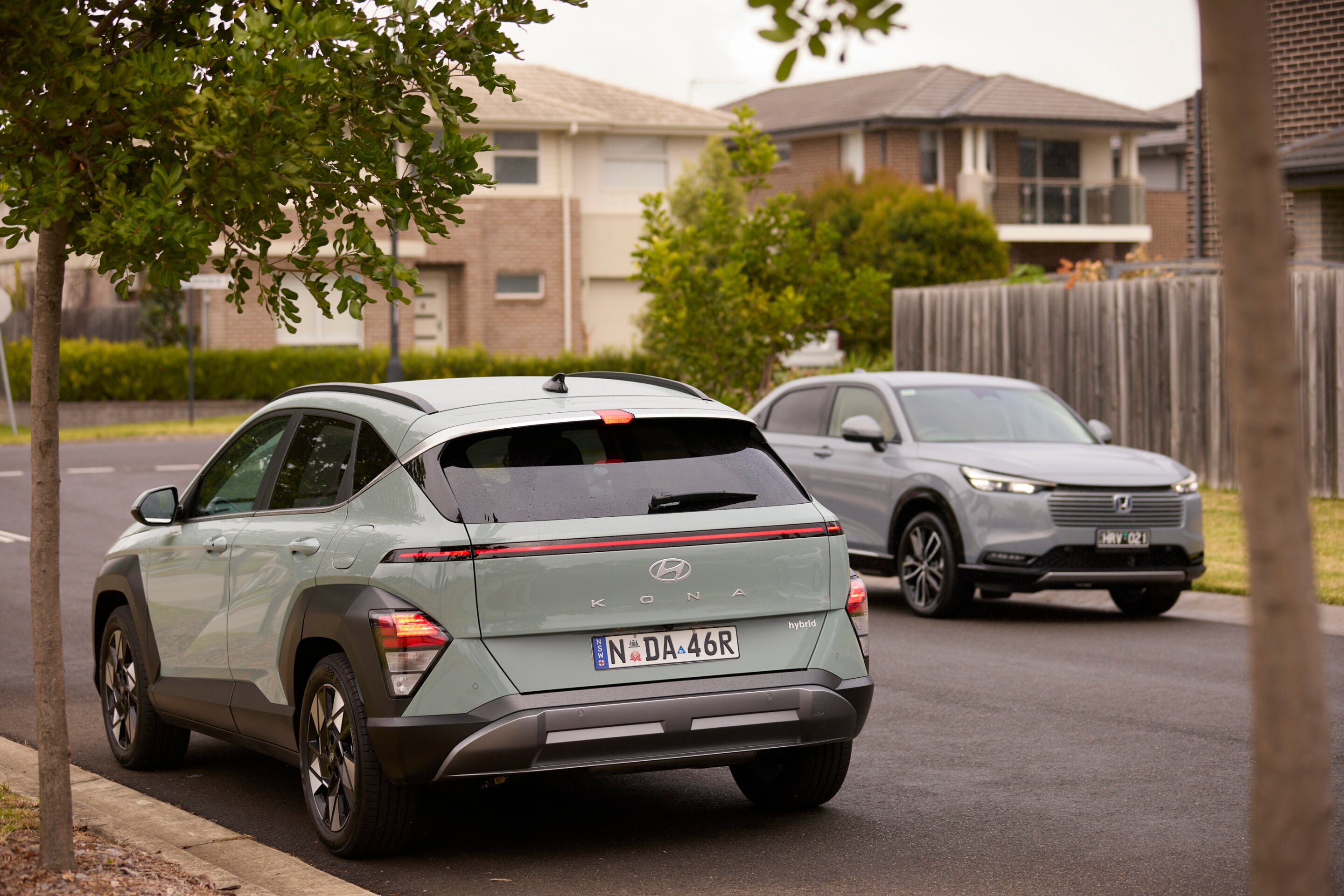
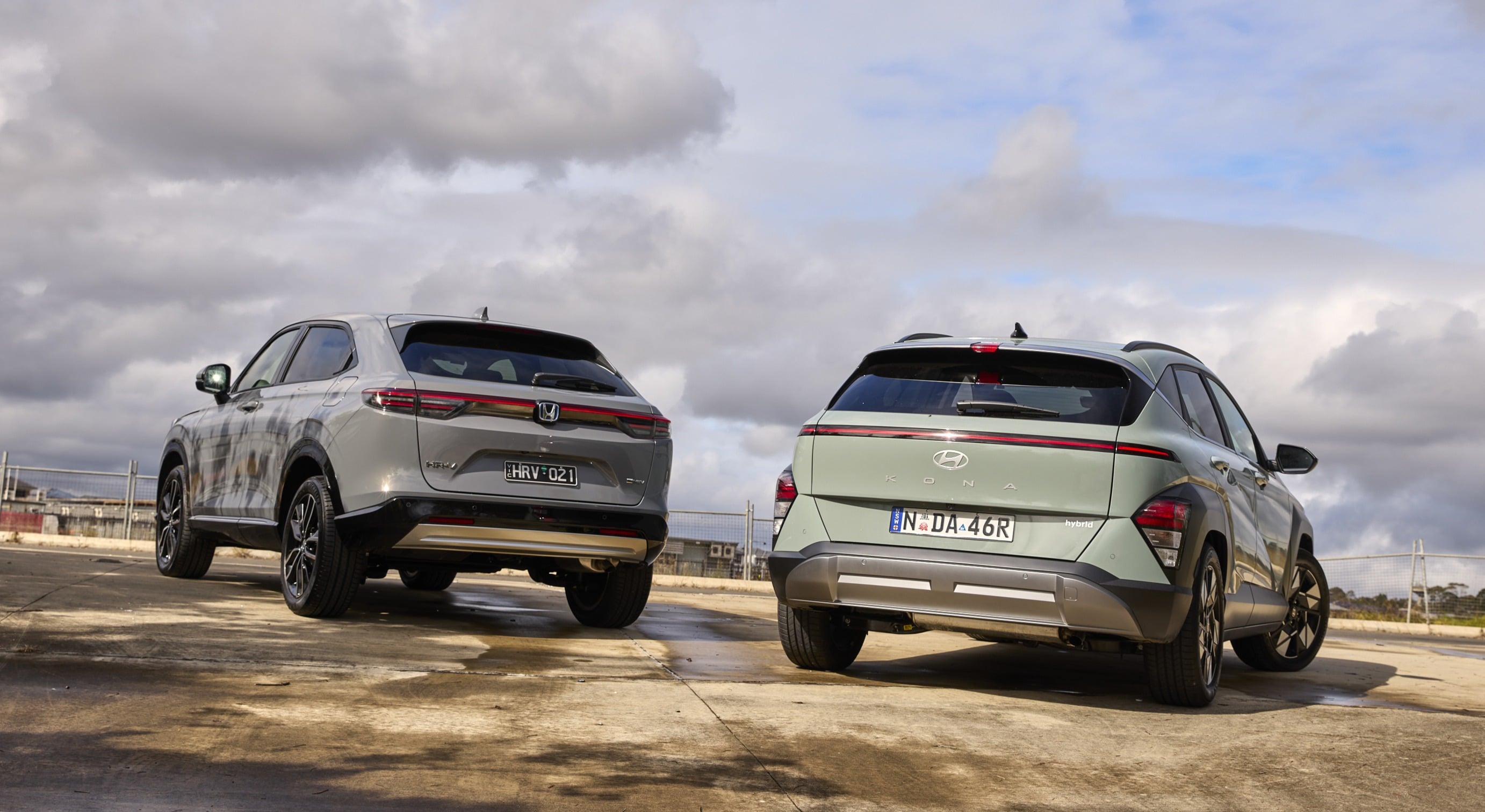
Two of the best, by our reckoning, are the two we’ve assembled here – Honda HR-V and Hyundai Kona.
The price war
There’s not much between this pair at the cash register.
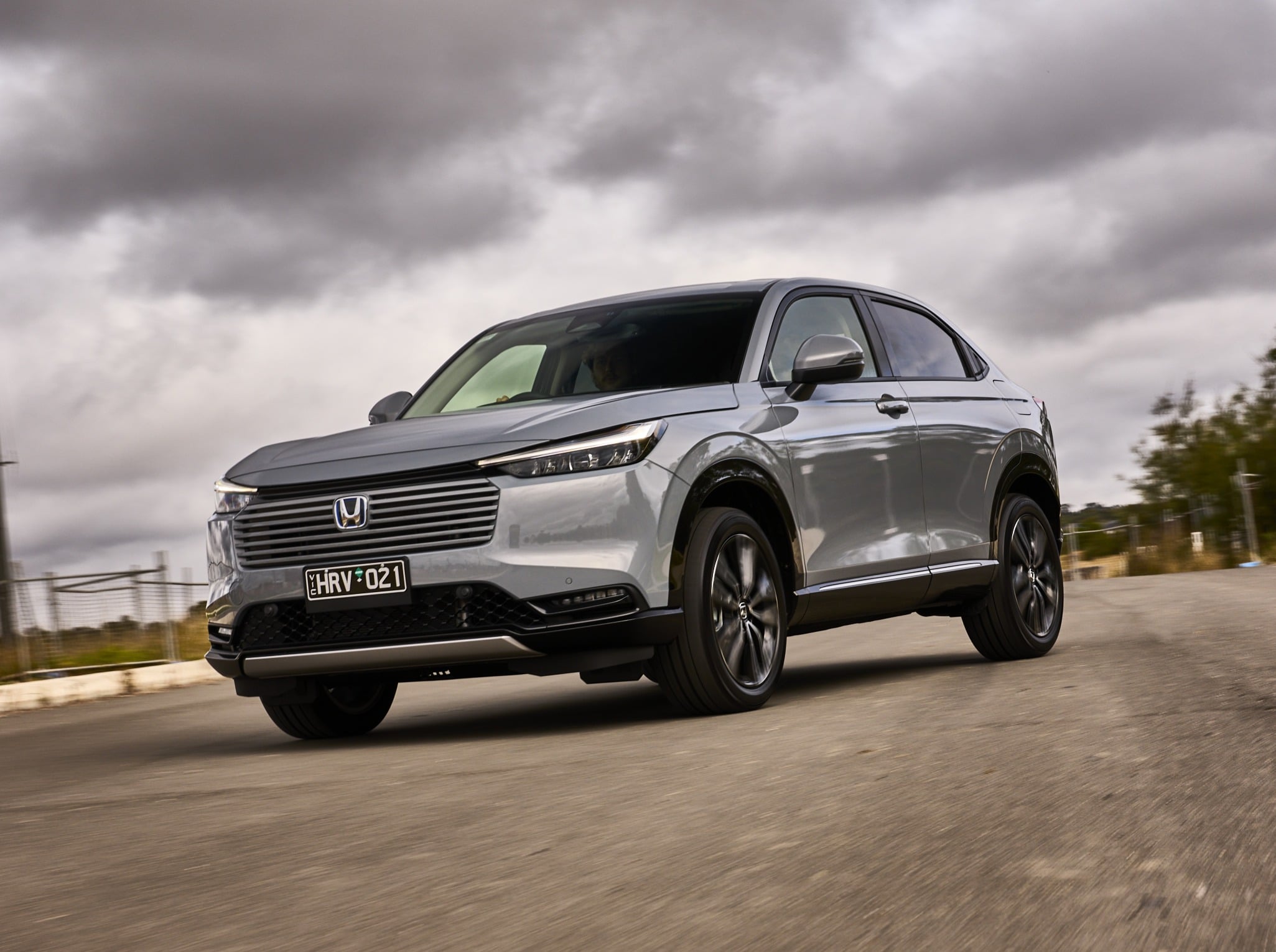
The Honda HR-V e:HEV L we have here sits at the top of its range, with a non-negotiable sticker price of $42,900 driveaway. If that breaks the budget, there is the more affordable $39,900 e:HEV X or if you just want petrol, sans hybrid, then the entry-level HR-V Vi X at $34,900 might be more your speed.
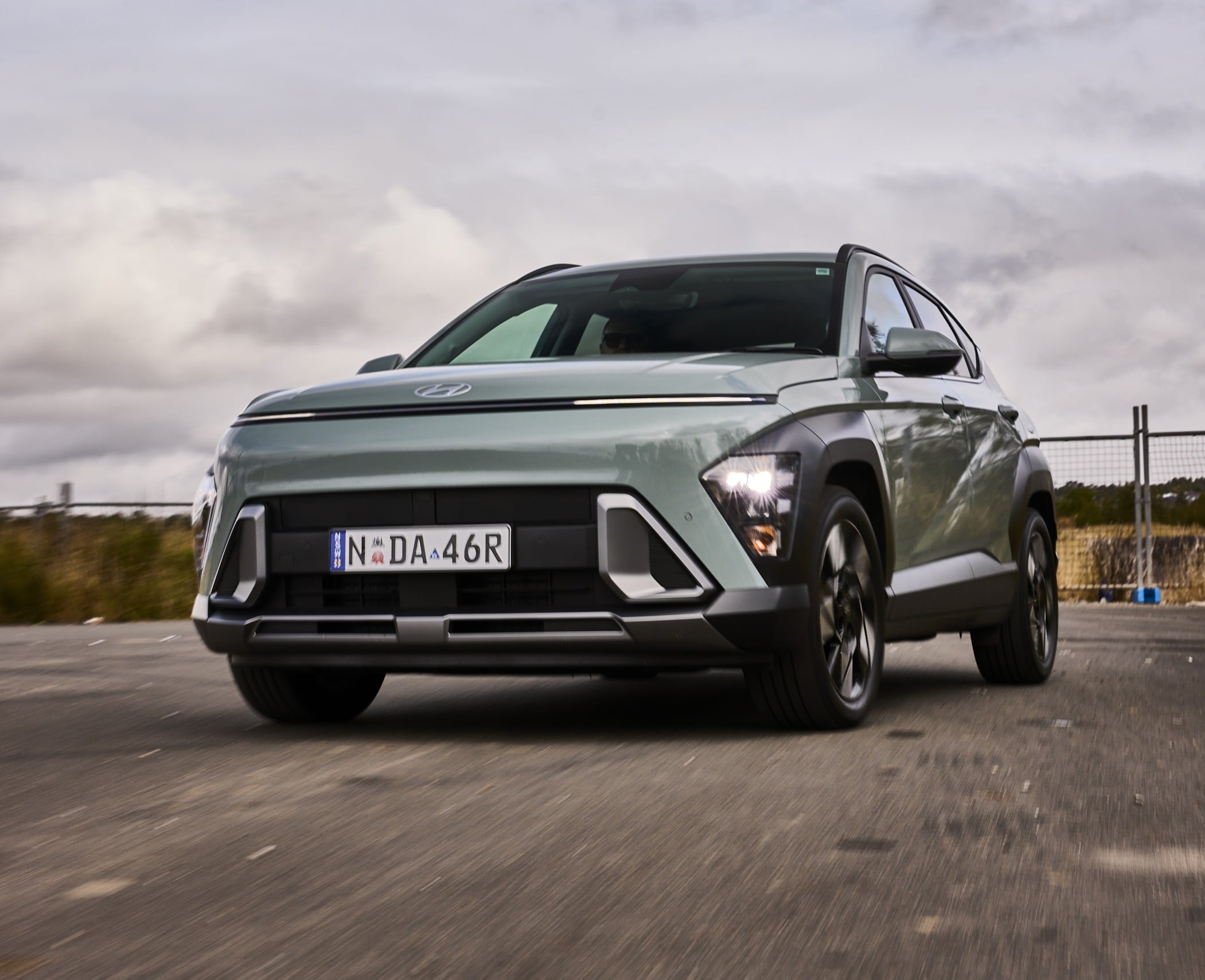
Hyundai’s Kona range offers something for every one, with 16 variants across petrol, hybrid and electric. But we’re keen to test like with like which is why we’ve plumped for the mid-spec Kona Elite hybrid and its manufacturer list price of $39,950 before on-road costs or, to give a more comparable number, around $44,322 driveaway according to Hyundai’s online calculator.
That hands the price war advantage – by $1422 – to the Honda, which, by our calculations, is around a year’s worth of petrol.
Neither Honda or Hyundai offer a bewildering array of options. In the case of Honda, your choice is limited to paint, a five-colour palette at no extra cost.
Hyundai also limits options to paint colour, with six hues available, four of which – black, grey, red and blue – attract a $595 premium. Our test car was finished in a no-cost shade of Mirage Green.
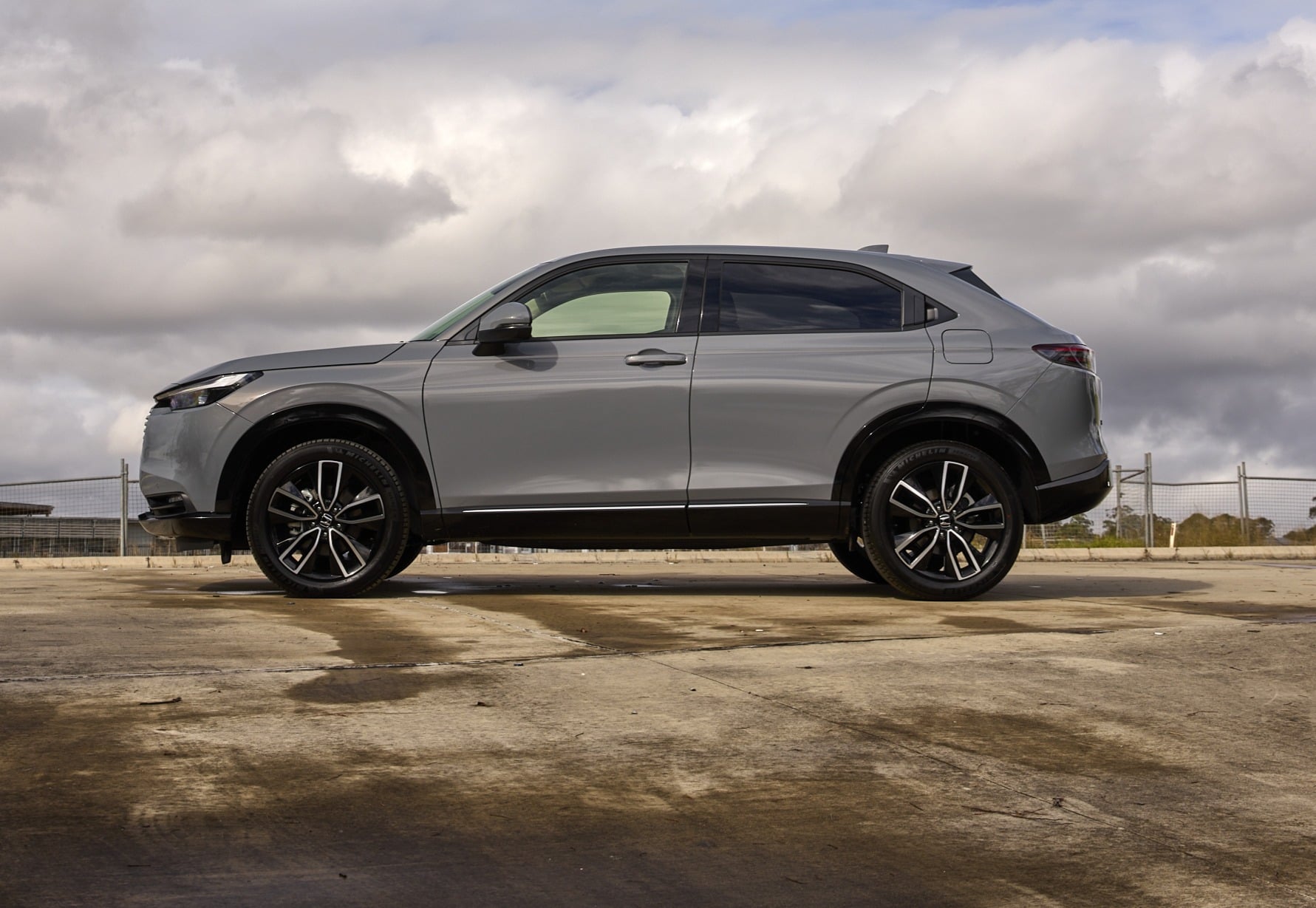
Not much in it in terms of price, and not a lot in equipment either. Standard across both models are a mixture of niceties and essentials – 18-inch alloy wheels, dual-zone climate controls, heated front seats, wireless smartphone integration, rain-sensing wipers, six-speaker sound system, as well as a suite of advanced driver assist and safety technologies.
1
The Honda HR-V (above) is alone in bringing its gloriously versatile ‘Magic Seats’ (more on this later), inbuilt satellite navigation, powered tailgate with hands-free and a heated steering wheel.
On the Hyundai side of the ledger, the Kona scores full artificial leather seats (the Honda’s are a mix of faux leather and cloth), power adjustable front seats, seven airbags (the Honda has six), door exit warning and a driver fatigue monitor.
The power war
Both Honda and Hyundai tread a familiar path when it comes to what powers their respective small SUVs, although there are some key differences.
Honda’s hybrid system employs a 1.5-litre naturally-aspirated four-cylinder petrol engine paired with what the manufacturer calls its 2-Motor i-MMD hybrid system. Essentially, two electric motors perform different functions. One helps drive the front wheels and when working in tandem with the 1.5-litre petrol, combines for a healthy 96kW and 253Nm.
On its own, the 1.5-litre petrol unit makes 78kW and 131Nm, underscoring the performance benefits of a well-sorted hybrid system. An e-CVT (electric continuously variable) single-speed transmission sends those outputs to the front wheels.
The second electric motor serves a different master. For starters, it’s not connected to the driveshaft, meaning it offers no propulsion on its own. But it is connected to the engine, serving as a generator. Simply, it converts energy harnessed from the petrol engine into electricity to either power the primary electric motor to drive the wheels or charge the hybrid system’s battery.
Honda says this eliminates frictional energy loss usually associated with complex mechanical components, resulting in improved performance and efficiency.
1
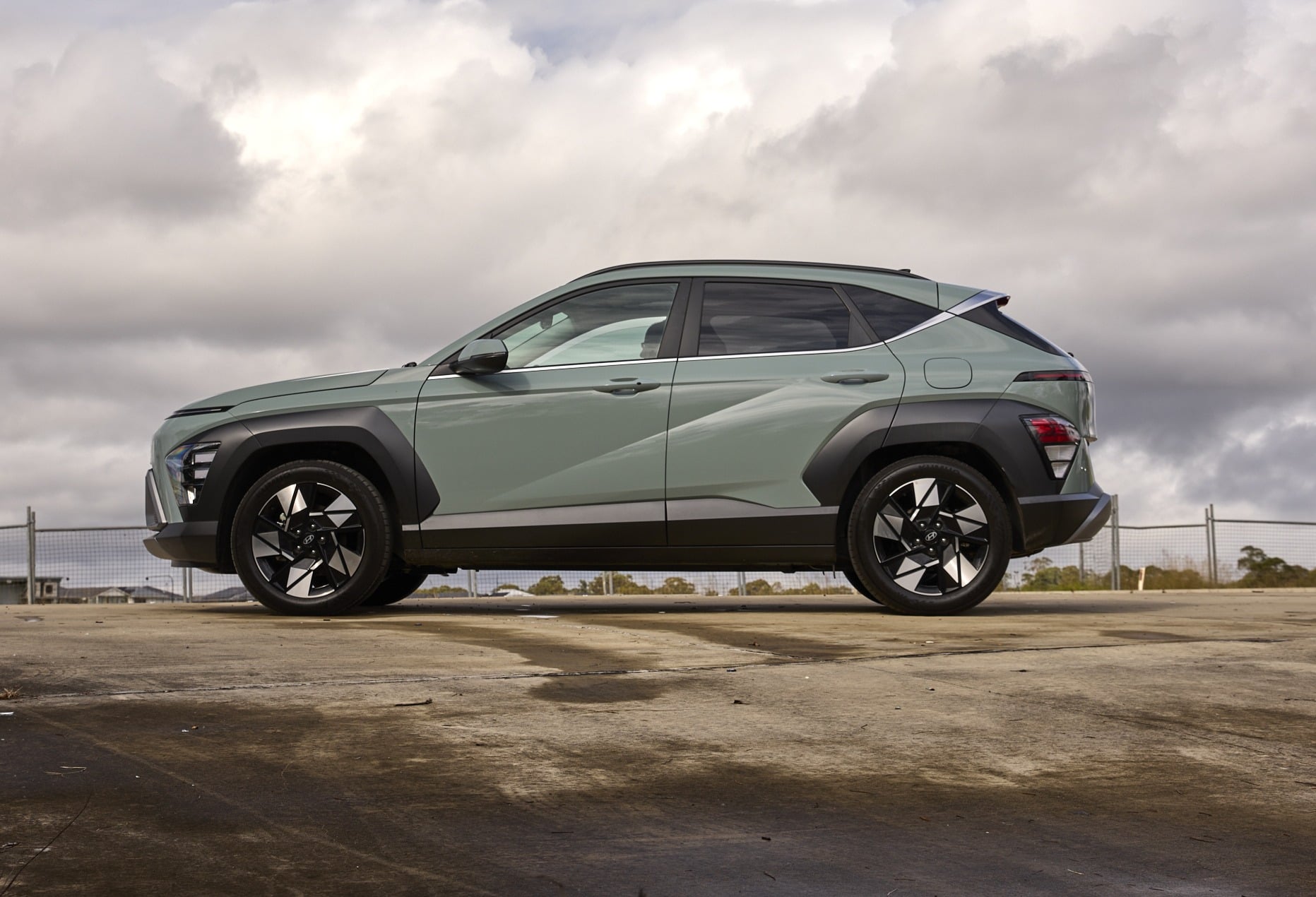
The Kona’s (above) hybrid powertrain is altogether more conventional, blending a 1.6-litre non-turbo four with a single electric motor driving the front wheels via a six-speed dual-clutch automatic. On its own, Hyundai’s 1.6-litre petrol makes 77kW and 144Nm, down on power (by 1kW) but up on torque (by 13Nm) over the HR-V. Kona’s combined outputs run to 104kW and 263Nm, trumping the Honda’s, but not by much.
The HR-V claws back some ground, thanks to its lighter kerb weight, 1382kg against the heavier Kona’s 1410kg, but not enough to come out on top in the power-to-weight stakes, the HR-V’s 69.5kW/t shaded by Kona’s 73.6kW/t.
Cabin fever
Both Honda and Hyundai have favoured a simple, clean and uncluttered in-car aesthetic, blending cutting edge technology with enough niceties to ensure buyers will feel like their money has been well spent.
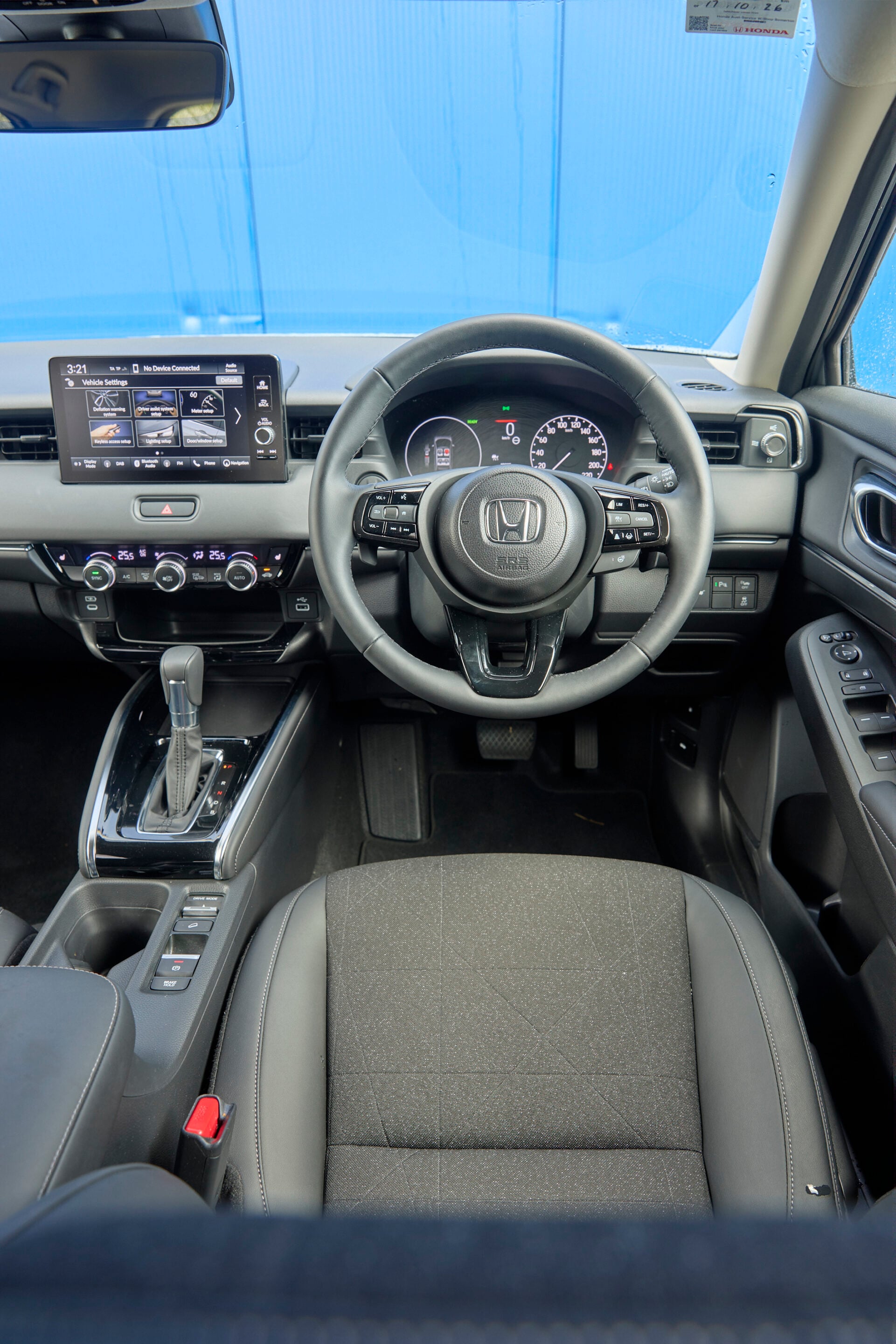
Sliding into the HR-V (below) brings plenty of feel-good moments – from the nicely-bolstered and supportive front seats to the chunky dials and switches, and even the traditional gear lever in an age where buttons and stalks on the steering column are proliferating – all combine to add a beautifully tactile user experience.
The seats, trimmed in a mix of artificial leather and nicely-textured cloth, sit nice and high in the cabin, offering a commanding view of the road ahead. Lateral support is good, as is under-thigh, while the seat-base is nicely cushioned making for a comfortable time behind the wheel, even on longer journeys.
A simple 9-inch infotainment touchscreen eschews the modern trend of filling the dash with glass and the cabin is, overall, to my eyes, a nicer place for it. Honda’s infotainment set-up also moves away from the complex widget-heavy set-ups of some with a simple interface that is easy to decipher and easier still to navigate.
5
The smartphone basics are covered off with wireless connectivity while USB Type C and Type A plugs bring added connection options. The full gamut of radio bandwidths are present too. Bonus points to the HR-V for its inbuilt sat-nav, something the Hyundai doesn’t match.
In stark contrast to its overall dimensions, the Honda HR-V is spacious and comfortable inside, especially in the second row which offers Tardis-like space in all key areas, even for taller adults. Two kids or young teens will have no problems getting comfortable back there. And they’re well served with USB outlets and air vents, not always a given in the segment.
But, there is a compromise, a big glaring one, because the Honda HR-V is strictly a four-seater. Long story short, Honda was unable to meet the Australian Design Rules requirement for a top-tether child seat mount across all seating positions in the second row. Rather than go through the costly process (both to Honda and the end buyer) of resolving the issue, Honda removed the middle seatbelt, transforming it into a four-seater.
This is arguably not as big a deal as it sounds, with small SUVs rarely the chariot of choice for a family of five who are better served by mid-size SUVs.
Boot space isn’t especially generous at 304 litres. But it’s here where Honda’s famous ‘Magic Seats’ show their true worth with the ability to fold them forward in the traditional manner to create a flat floor capable of accepting 1274 litres of stuff. But, thanks to their clever rear-hinged set-up, the base of the back seats can also be flipped up and secured against the backrests, creating a large load space in the second row for bulkier and taller items loaded through the side doors.
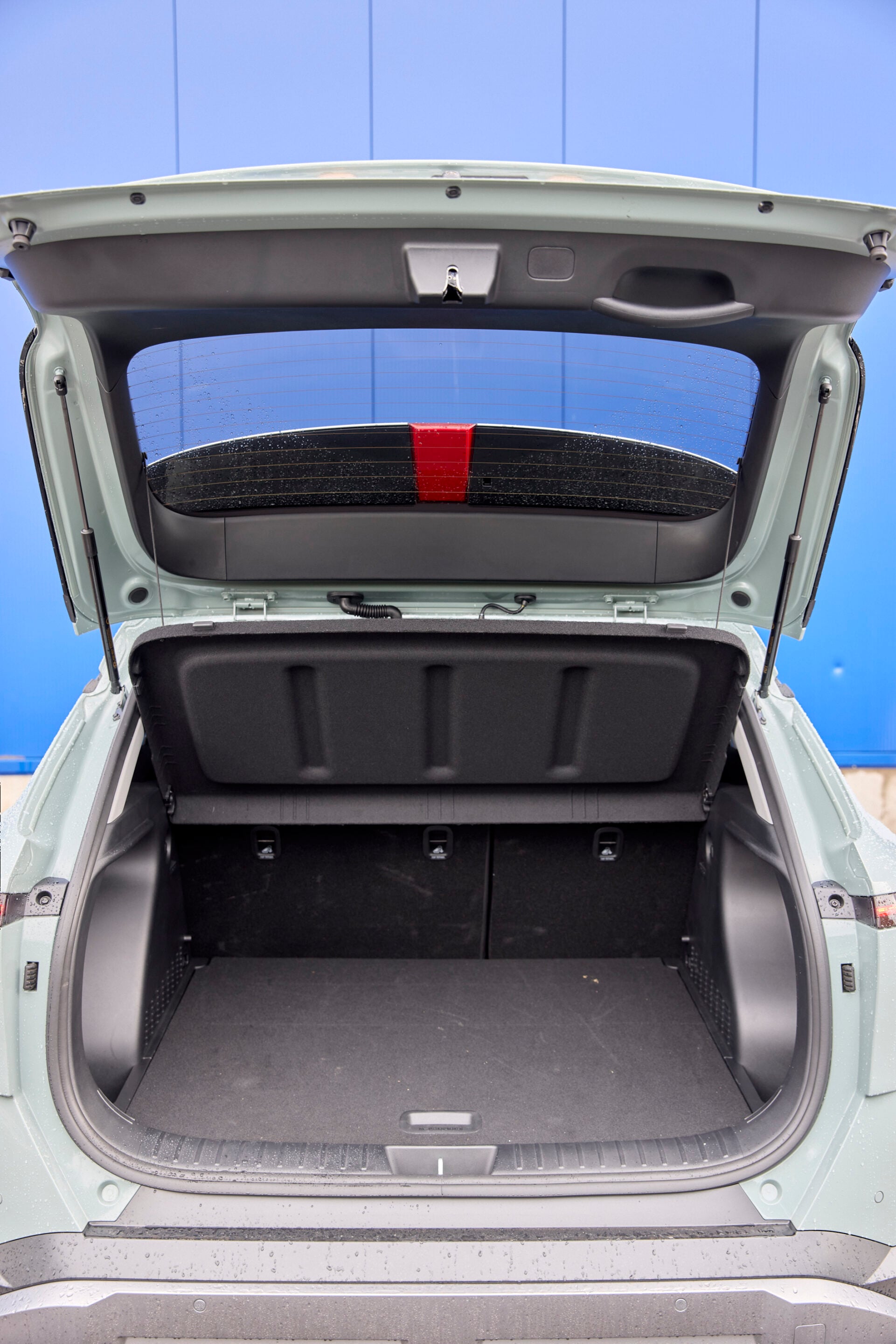
The Hyundai Kona doesn’t have ‘Magic Seats’ but its 407-litre cargo area trumps the HR-V’s, at least when the second row is in use. But folding the back seats away liberates 1241 litres of storage, down 33 litres on the Honda. The difference is marginal, but it does highlight just how thoughtful and clever Honda’s packaging is.
Still, Kona has its own Tardis-like qualities with generous proportions in row two. Space in key areas such as foot, knee and leg room is on par with the HR-V, as is head room. Like the Honda, there are a pair of USB outlets and air vents adding to the comfort factor in the back seats. And unlike the Honda, the Kona is a five-seater, although three adults across, while possible, is best saved for those occasional short trips.
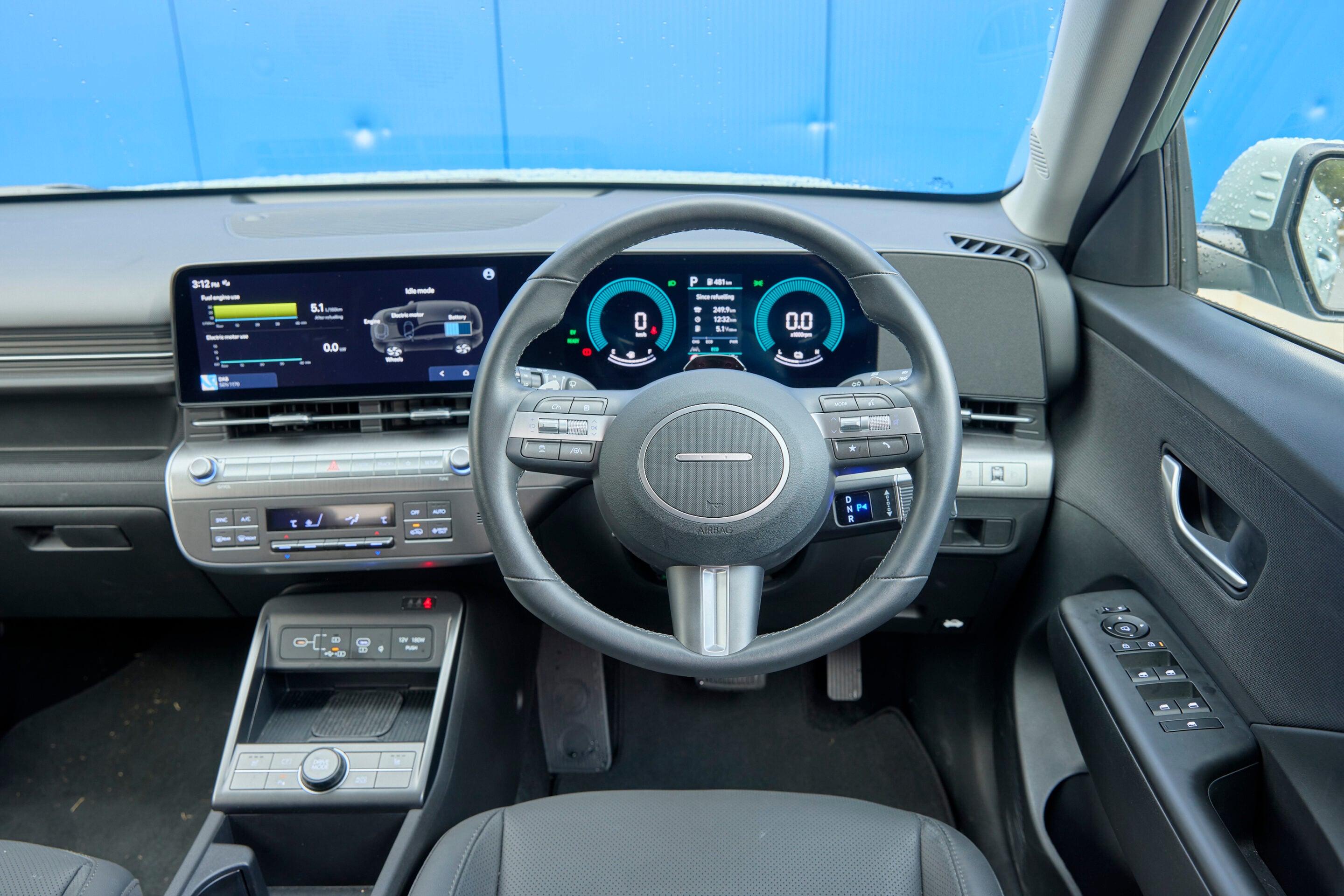
The Kona’s interior feels solidly built with plenty of nice touches – such as the useful storage shelf in the passenger-side dashboard – but there is a smattering of hard plastics that detract a smidge from the overall ambience as does the predominantly grey interior palette. Some contrast wouldn’t go astray.
Hyundai’s large and gently curved single-frame widescreen that houses both the Kona’s infotainment and driver display dominates the dash.
3
Hyundai’s native system is a good one, easy to use and with crisp responses to inputs. The usual suspects are in place – Apple CarPlay, Android Auto, digital radio, et cetera – but the lack of native sat-nav at this pricepoint is a minor mis-step.
Pleasingly, though, like Honda, Hyundai has persisted with providing physical switches for commonly accessed features such as climate controls, although the presence of a ‘Map’ button when there is no sat-nav is a reminder of what buyers are not getting with their Elite grade Kona, a featured reserved only for top-spec Premium grades.
The artificial leather seat trim works nicely and thanks to perforated inserts, looks classy. Like the HR-V, the front seats feature heating but only the Honda scores a heated steering wheel as well.
The seats themselves, power adjustable up front (something the Honda misses out on), are comfortable enough, but arguably not as comfy as those in the HR-V. Bolstering and support is good, but the bases feel just a touch firm.
Overall, the ergonomics of the Kona are pleasing with plenty of storage options including in the centre console which is conspicuously devoid of a gear selector, Hyundai taking the path of a stalk on the steering column. It’s out of the line of sight too, tucked away behind the right-hand spoke of the tiller, not ideal when trying to make a sneaky three-point turn. What’s wrong with a traditional pistol grip lever in the centre console?
Ultimately, the differences between the two cabins are minor, each with their strengths and weaknesses. For me, the Honda edges it – just – thanks to its simplicity, comfort, and better use of technology that doesn’t try to impress with its size.
The Kona’s larger boot, and the inclusion of a space-saver spare, work in its favour (HR-V comes with a ‘tyre repair kit’), but Honda’s ‘Magic Seats’ are the practical storage solution you didn’t know you needed.
On the road
There’s not much in it from behind the wheel, both the Honda and Hyundai capable and charming.
The Honda’s trick hybrid system works differently to most, its two-electric-motor set-up prioritising pure electric motivation wherever possible, leaving the 1.5-litre petrol to chip in when needed to provide some extra zip or to regenerate energy for the battery.
The HR-V can comfortably navigate urban environments on electric power alone, even at speeds of 80km/h. It’s refined and brisk, and the quietude of travelling on electrons alone can’t be underestimated.
The caveat here is that Honda’s hybrid system features a lock-up clutch inside the e:CVT that will decouple the wheels from the petrol engine, leaving the electric motor to provide motivation while the engine ticks over to recharge the battery.
But it doesn’t take much for the lock-up clutch to re-engage drive between the wheels and petrol engine. Yet, such is the refinement of Honda’s system, it’s barely felt inside the cabin which remains serene. Only at highway speeds does the combustion engine make its presence felt, but even then, find a stretch of long, flat motorway, and you’ll be surprised at how easily and quickly the HR-V reverts back into EV mode for brief spells, helping to maximise fuel economy.
2
At under 1400kg, the HR-V is a relatively light SUV and that’s keenly felt in how it handles the road. It feels nimble, light on its wheels, and with a nicely tuned handling package that ensures the small SUV can scoot about inner city enclaves with minimal fuss.
Ride comfort is good too, the HR-V tackling everyday road nasties with alacrity and without telegraphing the presence of ruts and potholes into the cabin. Larger obstacles are also dispatched with minimal fuss, with no tell-tale wobbling over speed humps and the like.
Three drive modes – Econ, Normal and Sport – alter throttle response but the changes are so incremental as to be barely noticeable. Even in its most benign Econ setting, the HR-V still feels like it is up to the task of zipping through traffic.
Braking and steering responses are commendable, at once accurate and predictable, making for an easy time behind the wheel. Easy is a word that keeps popping up because that’s exactly what the Honda HR-V provides – a relaxed drive that’s both enjoyable and, yep, easy.
Hyundai’s hybrid set-up doesn’t suffer for being the more conventional of the two systems offered here. Like the Honda, the Kona gets underway on electric power alone and can do so comfortably at speeds of up to 40km/h before the 1.6-litre four needs to fire up to help keep things moving.
It’s equally as refined as the Honda’s, with smooth transitions between the two sources of power. It’s also arguably a touch more swift than the Honda, but the differences by the age-old seat-of-the-pants measurement, are marginal.
Certainly, the Kona is happy to trundle along in traffic and spring into action when more is asked of it out on the motorway. But it’s less inclined to cruise at 100km/h using just the electric motor, requiring downhill stretches before the combustion engine will take a breather and let the electric motor take over. That’s a crucial difference and one that is most keenly felt at the bowser.
Ride quality is decent, although just a touch stiffer than the Honda over the same roads. It’s not jarring by any stretch, but where the Honda smoothed out rougher surfaces, the Kona displayed a tendency to skip over those same imperfections, something felt through the steering wheel. Body control remains good over larger obstacles while the steering is accurate and responsive.
Like the Honda, the Kona features three drive modes – Eco, Normal and Sport – but unlike the Honda, the differences between the three are far more noticeable. Sport mode certainly adds some menace to throttle response while Eco does strip the little SUV of a little of its urgency, especially noticeable when moving away from traffic lights. That said, Eco is a perfectly acceptable drive mode for the bulk of urban driving.
The weight penalty the Kona carries over the HR-V is minimal, and not big enough to make a discernible difference. That’s helped by light and accurate steering that makes navigating city and suburban streets a doddle. Is the Kona as ‘easy’ to drive as the HR-V? Definitely and while the pair might tackle hybridisation with different technology, the differences between them are so small that you’d be hard-pressed to pick which one is the better of the two. Except…
1
At the bowser
With little to separate the two, it comes down to how they fare as hybrids. Both are frugal, that much is certain. But how frugal?
The Hyundai Kona claims 3.9L/100km on the combined cycle, a claim that betters the HR-V’s 4.3L/100km. Both are good numbers and both can quench their thirst with 91 octane regular unleaded. How do those claims stack up in the real world, though?
To ensure a level playing field, I drove the Kona and HR-V back-to-back on the same roads, on the same day, covering around 150km of driving each over a typical blend of weekday traffic, suburban running around and a decent stretch of Sydney’s motorway network.
Neither SUV matched their manufacturers’ stated claims, hardly surprising since those claims are derived from controlled laboratory testing with only a passing resemblance to the real world.
And it’s in the real world where the Honda impressed the most, returning an indicated 4.6L/100km, just a smidge (0.3L) over the maker’s claim.
That’s not to say Kona’s fuel consumption is bad. It’s not, but its 4.9L/100km return is a full litre over Hyundai’s own claim, and 0.3L higher than the HR-V’s. That might not seem like much, but in an age where every drop of petrol counts, even the smallest savings can quickly add up.
The Wheels verdict
It’s difficult to split this pair on the road. Both offer just enough pep from their respective powertrains to not leave you floundering in traffic. And both feature cleverly packaged and modern interiors that are spacious, comfortable and nicely-equipped for the money. Neither feels like it’s been built down to a pricepoint, with just enough ‘primo’ touches to feel a little bit special.
Ultimately it comes down to the value-for-money equation and here, the Honda is a clear winner. It’s more affordable in the showroom, significantly cheaper to service and, if our real world testing is an indication, will use less fuel than its Hyundai rival.
And for buyers playing in the small SUV segment, those few extra thousand dollars in the bank over the Honda’s lifetime can make a big difference to household budgets.
Specs
Honda HR-V e:HEV L
1
| Price | $42,900 driveaway |
|---|---|
| Engine | 1.5-litre four-cylinder petrol-hybrid |
| Peak power | 96kW (combined) |
| Peak torque | 253Nm (combined) |
| Transmission | e:CVT single-speed, FWD |
| Fuel consumption (claimed) | 4.3L/100km |
| Fuel consumption (as tested) | 4.6L/100km |
| Fuel type | 91RON |
| Fuel tank | 40 litres |
| CO2 emissions (claimed) | 98g/km |
| Dimensions (l/w/h/wb) | 4345/1790/1590/2610mm |
| Boot space | 304 litres / 1274L |
| Kerb weight | 1382kg |
| Warranty | 5-year/unlimited km |
| Servicing costs | $199 per service for first 5 years/50,000km |
| Overall rating | 8.4 |
Hyundai Kona Elite Hybrid
1
| Price | $44,322 driveaway (manufacturer website) |
|---|---|
| Engine | 1.6-litre four-cylinder petrol-hybrid |
| Peak power | 104kW (combined) |
| Peak torque | 265Nm (combined) |
| Transmission | 6-speed dual-clutch auto, FWD |
| Fuel consumption (claimed) | 3.9L/100km |
| Fuel consumption (as tested) | 4.9L/100km |
| Fuel type | 91RON |
| Fuel tank | 38 litres |
| CO2 emissions (claimed) | 89/km |
| Dimensions (l/w/h/wb) | 4350/1825/1585/2660mm |
| Boot space | 407 litres / 1241L |
| Kerb weight | 1410kg |
| Warranty | 5-year/unlimited km |
| Servicing costs | $3176 for first 5 years/75,000km |
| Overall rating | 8.0 |
This story first appeared in the August 2026 issue of Wheels magazine, now on sale. Subscribe here and gain access to 12 issues for $109 plus online access to every Wheels issue since 1953.
Follow WhichCar/Wheels on Google
Click the button below to make WhichCar by Wheels a preferred source for your news.

We recommend
-
 Comparisons
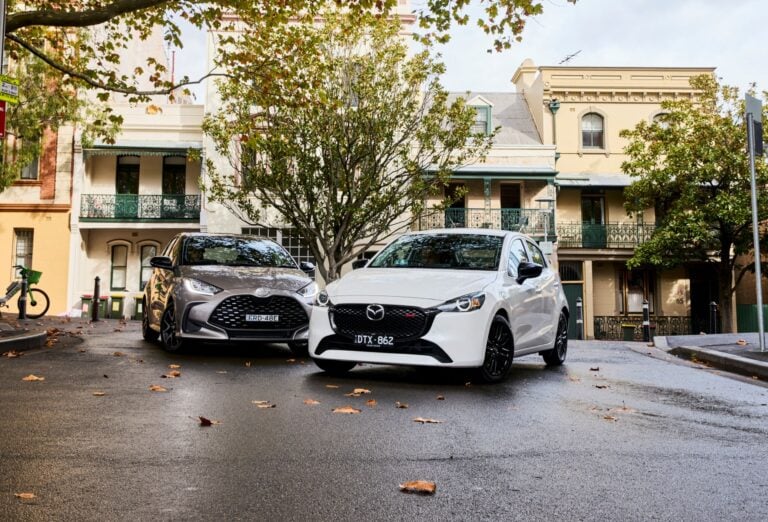
Toyota Yaris v Mazda 2: Small cars for the big smoke face off
Traditional rivals Toyota and Mazda tackle the compact city car segment with the Yaris and 2 – one hybrid, one traditional, but both intent on packing the most space into a compact hatch.
-
 Comparisons
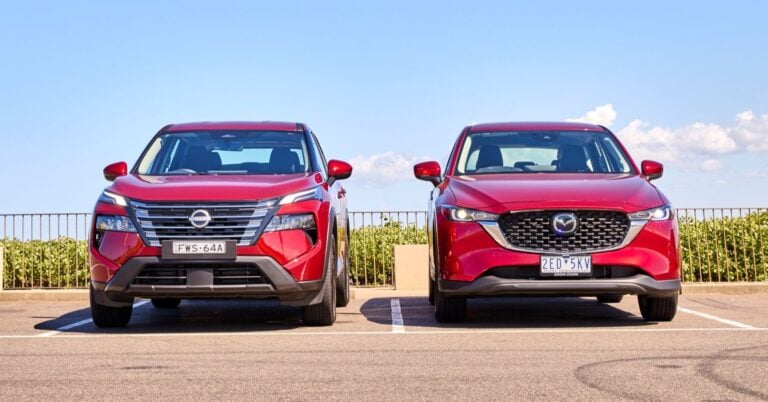
Nissan X-Trail v Mazda CX-5: Medium-size SUVs go head-to-head in hard-fought segment
Upgraded for 2026, the Nissan X-Trail is primed to take the fight to one of the segment favourites, the Mazda CX-5, which is nearing the end of its life as a new model looms on the horizon
-
 Comparisons
Honda Accord v Toyota Camry: Middleweight sedan showdown
Medium sedans might not be the flavour of the month any more, but as we discovered with two of the stalwarts of the segment, there is still plenty to like about these hybrid family haulers.