Comparisons


Gallery 1
Medium SUVs are – in the passenger car segment at least – the key battleground for manufacturers.
You’ve seen us write it here before in Wheels, acknowledging just how important this segment is to almost every car maker, regardless of country of origin. This month we pit an old favourite at the tail end of its career against an even older stager (in terms of time in market), but refreshed for 2026 and with a new lease on life.
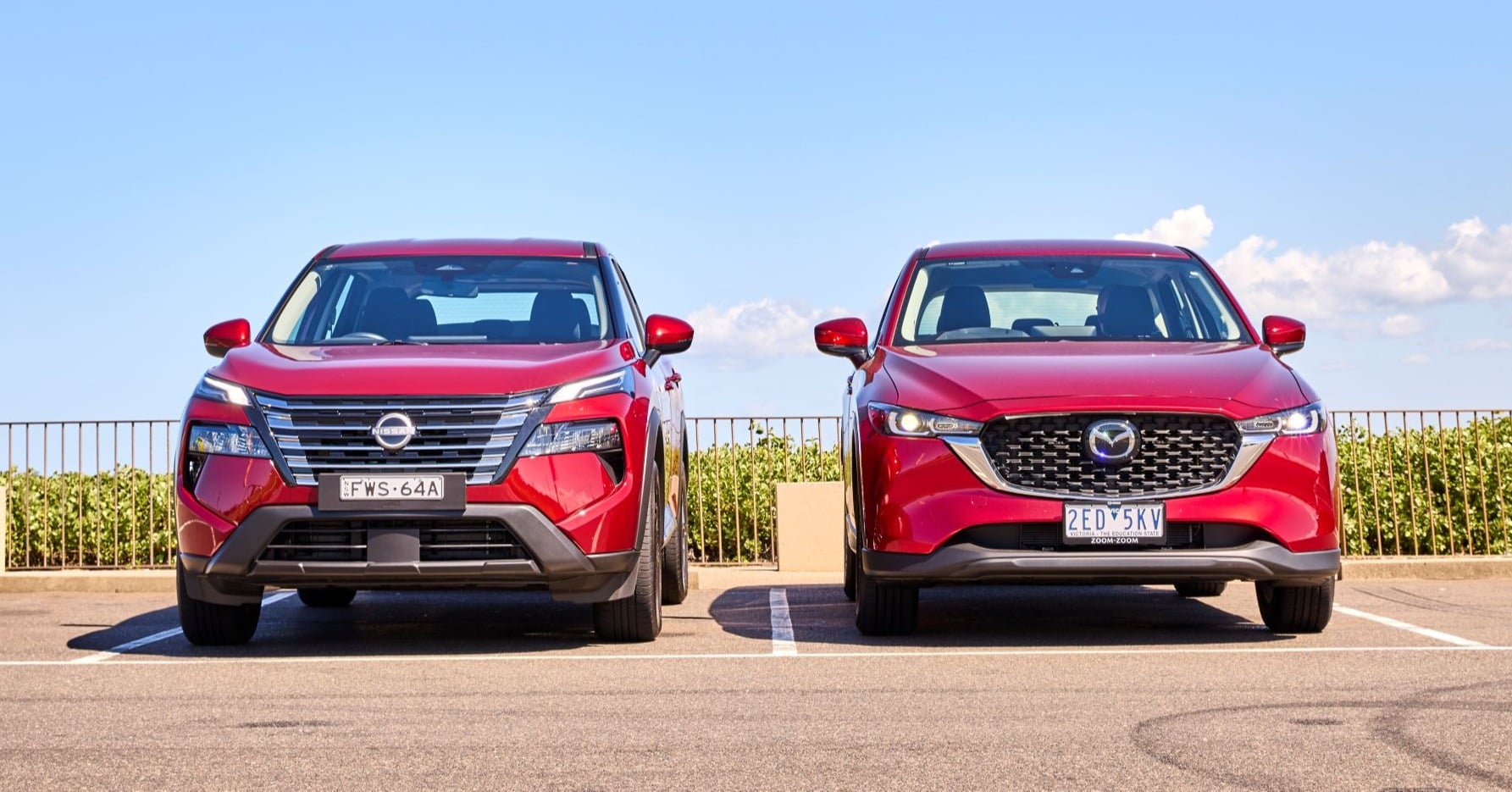
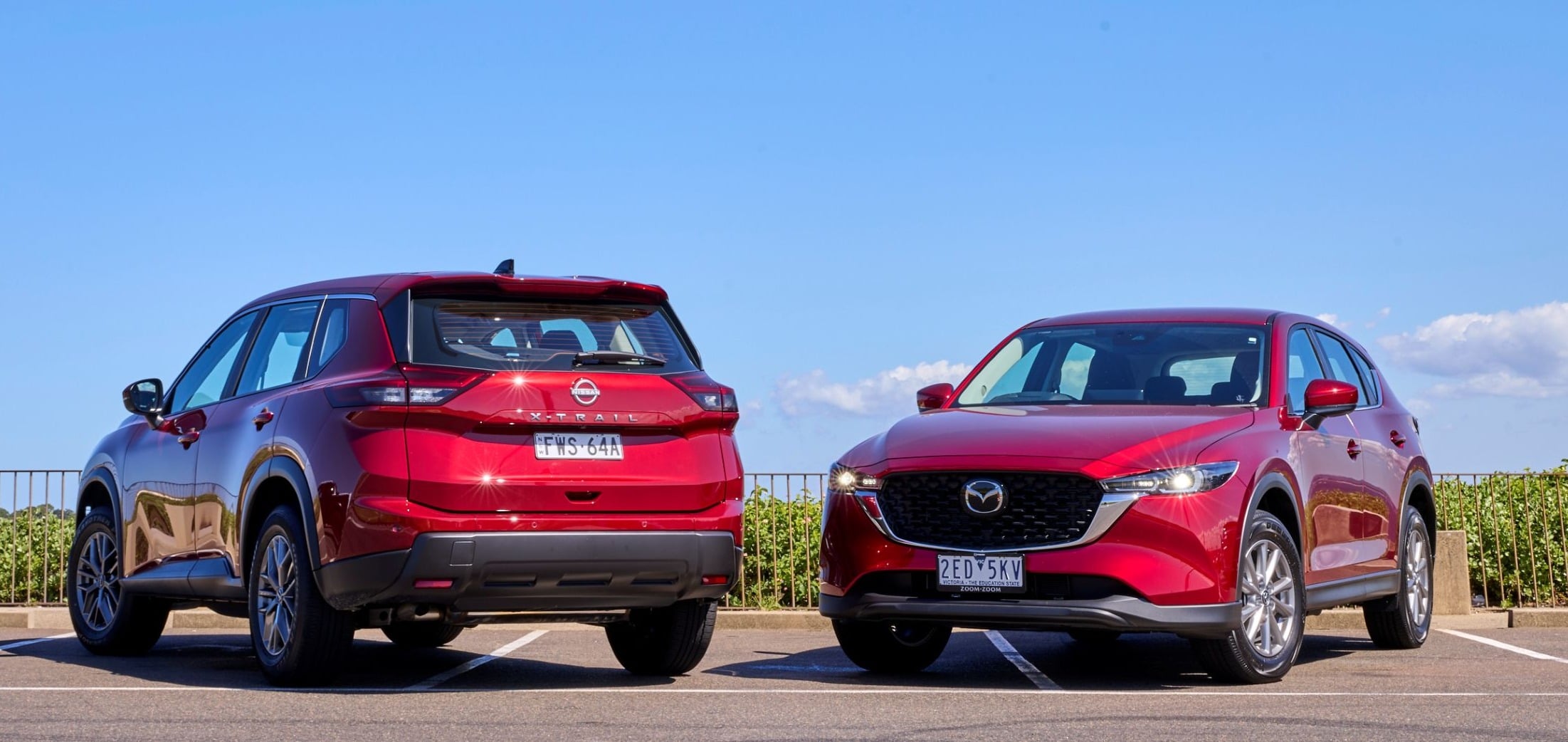
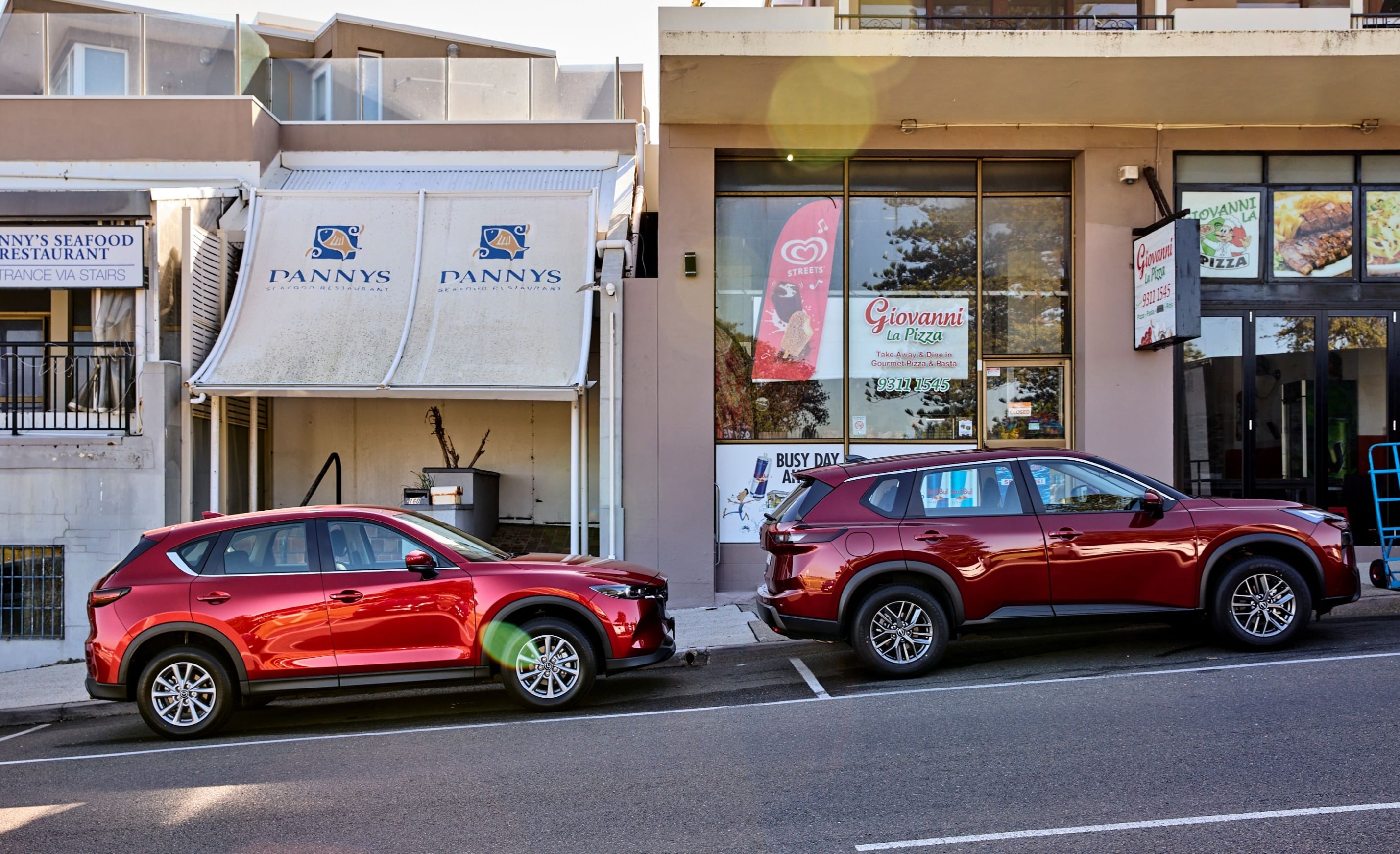
What we’ve done this month – following on from our popular, budget-focused Haval v Hyundai shootout also in the medium SUV segment – is revisit the concept with two of the other mainstream players, and two that have been popular with Australian buyers for a long time. As such, we’ve got the 2026 Mazda CX-5 G20 Maxx and the 2026 Nissan X-Trail ST, the two brands’ respective entry points to the medium SUV range.
Mazda has sold more than 320,000 CX-5s in Australia since first landing here in 2012, with the second generation – on sale since 2017 – still one of the most popular new cars in Australia, finishing last year in eighth position on the top 10 new car sales chart. There’s no doubt this SUV, despite the increased competition from newer vehicles, remains popular with Aussie new car buyers.
1
Nissan has also sold more than 320,000 X-Trails in Australia, but over a longer period, with the model debuting way back in 2001. It was the manufacturer’s most popular vehicle in 2025, registering more than 15,700 sales for the calendar year, showing just how vital this segment is to any manufacturer.
For Nissan, its X-Trail has been refreshed and updated – more on that in a minute – and for Mazda, its mid-sizer is in runout phase, with an all-new CX-5 around the corner and an electric CX-6e sibling also about to hit showrooms. It’s very much a case of the more things change, the more they stay the same in this segment.
There’s little doubt the new CX-5 will be a solid contender as the nameplate has been for some time. Crucial to that appeal will be increased cabin space in the second row, something this model has struggled with against the best in segment, but if you’re looking to buy a CX-5 right now, Wheels will take a look at exactly what you get.
The price of entry
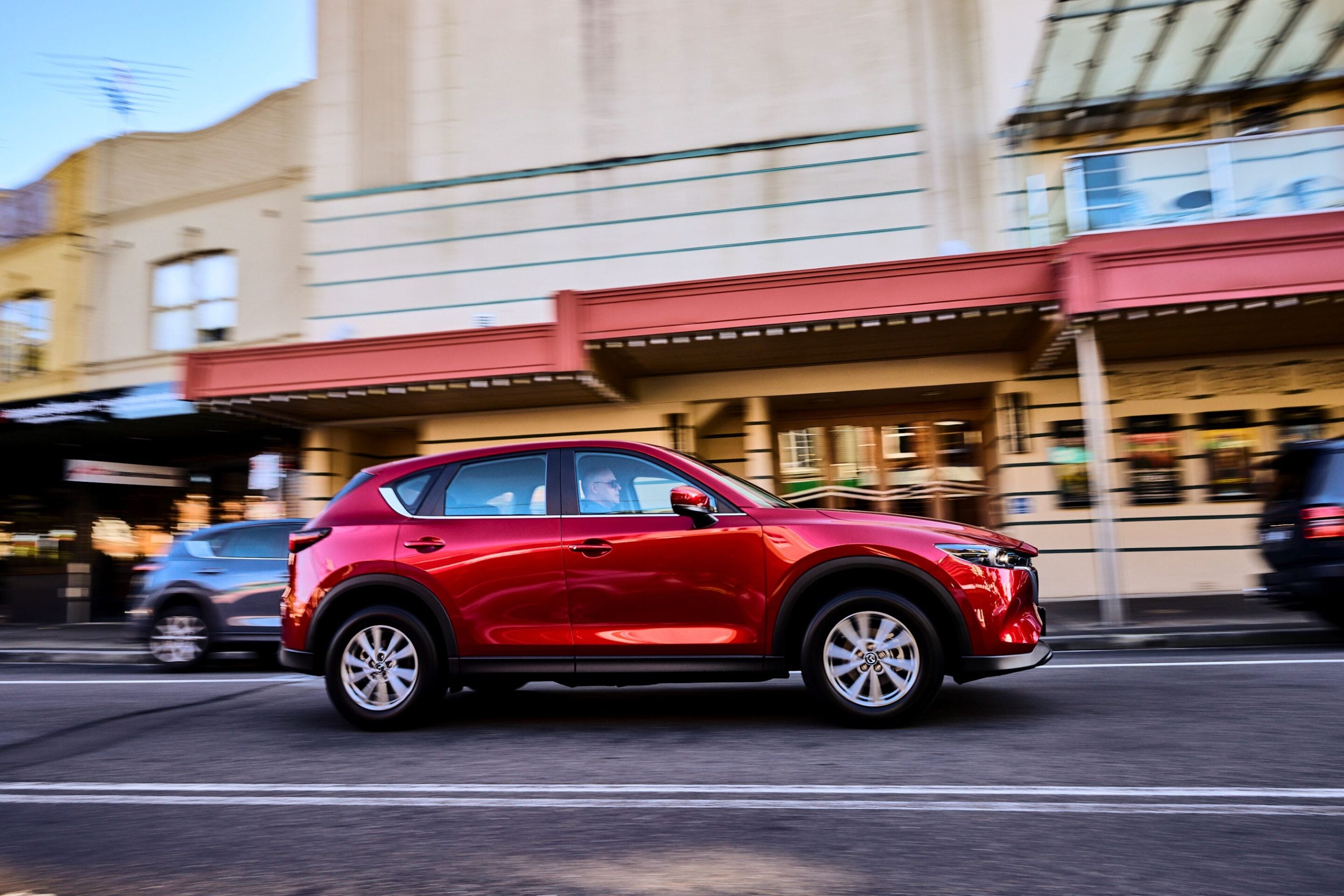
Starting from $37,290 before on-road costs, at the time of testing the CX-5 was in runout phase for $37,990 driveaway. That’s sharp pricing for one of the perennial favourites that still punches above its weight.
The 2.0-litre, DOHC four-cylinder petrol engine does away with any kind of hybrid tech, and makes 115kW at 6000rpm and 200Nm at 4000rpm, while using a claimed 6.9L/100km. Our average, after a week of testing and city-to-highway running in an approximate 70:30 ratio, was 9.4L/100km. Mazda’s familiar six-speed automatic is present and accounted for and Maxx specification is FWD.
1
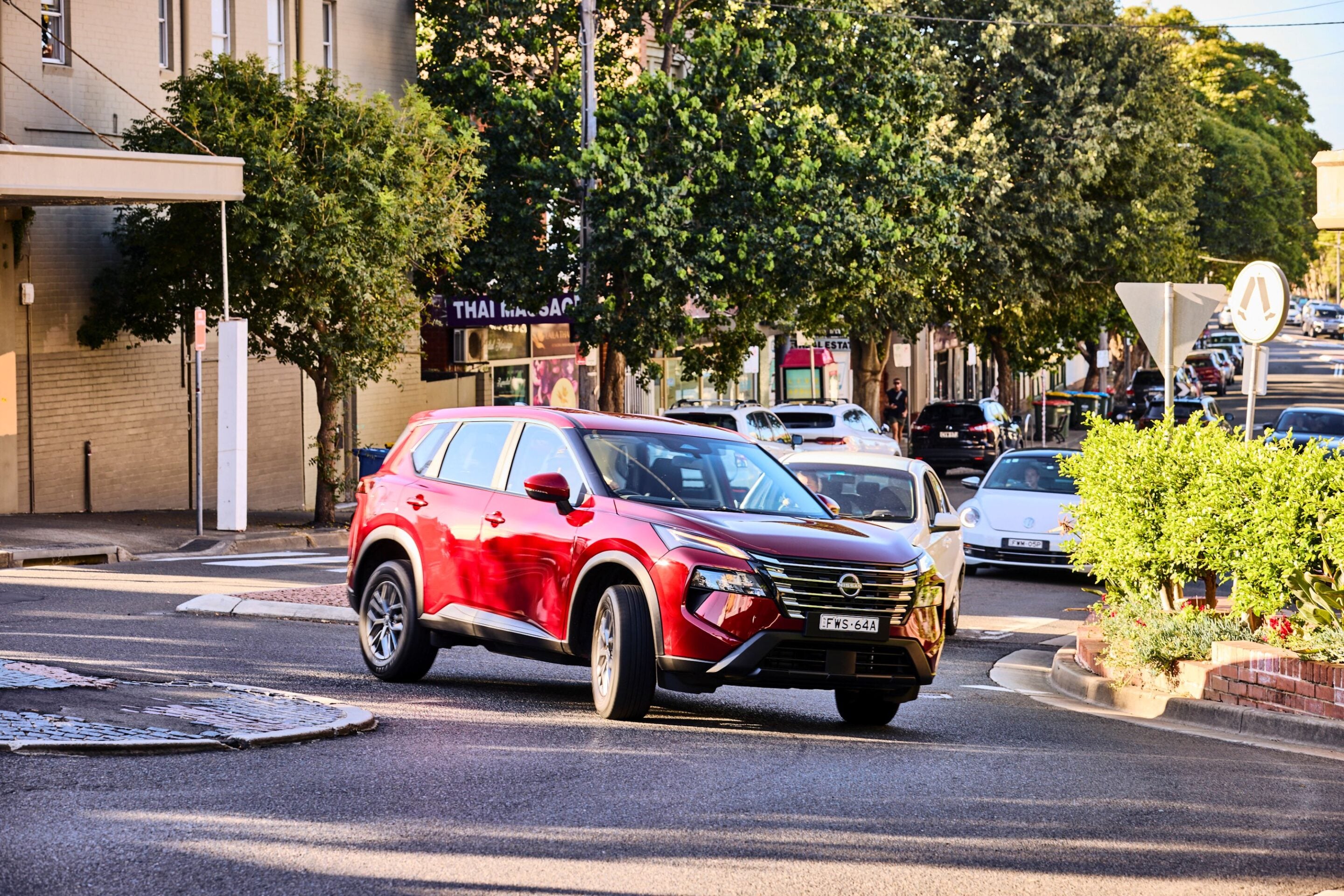
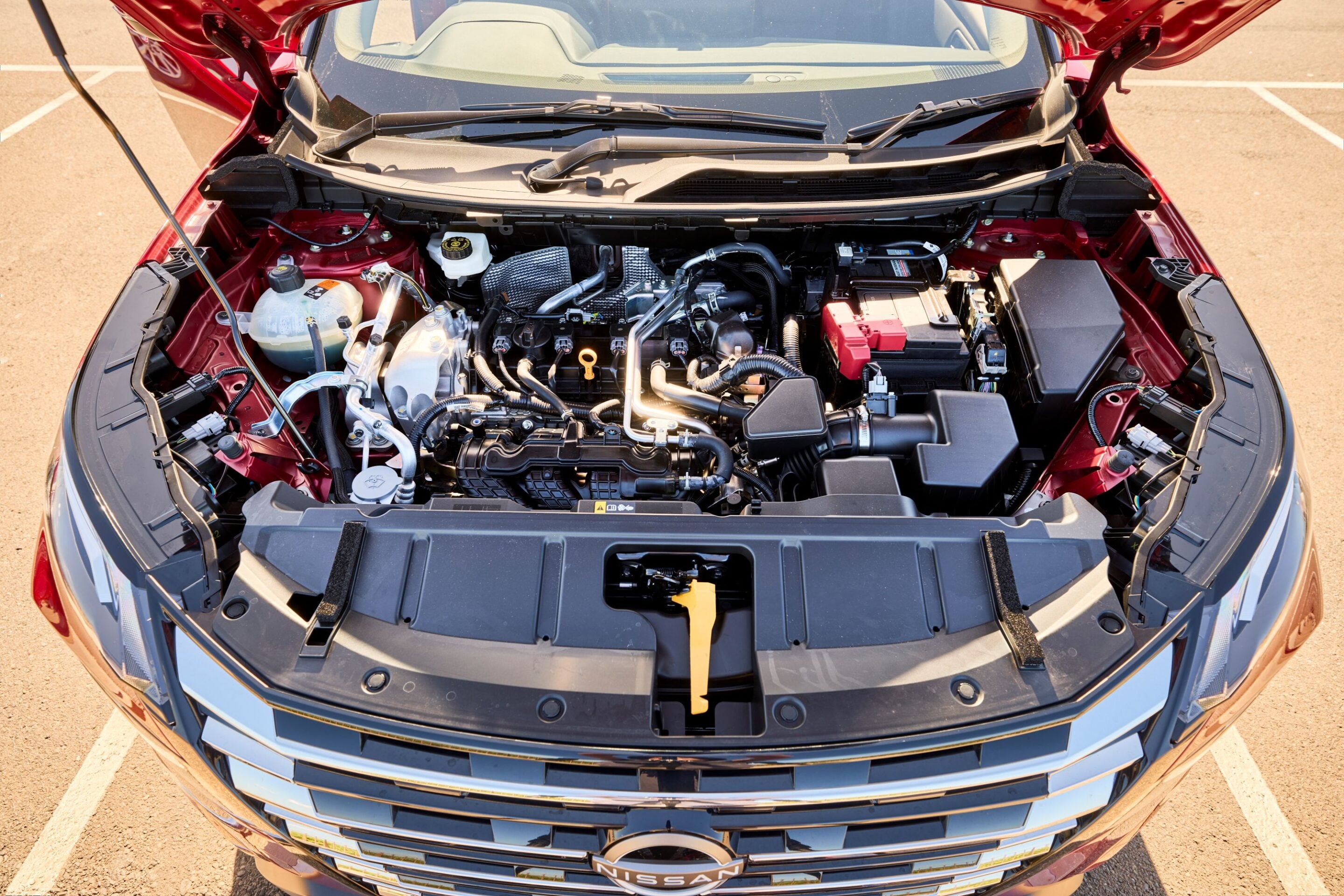
The Nissan X-Trail ST starts from $38,140 plus on-road costs and has a bigger, punchier engine under the bonnet. The 2.5-litre, four-cylinder engine is also non-hybrid with DOHC, and makes an easy 135kW at 6000rpm and 244Nm at 3600rpm. The combined fuel use claim is 7.4L/100km and Nissan uses a CVT also with FWD. On test, over the same terrain and conditions as the CX-5, Wheels used an indicated 9.6L/100km.
Both vehicles ask for only 91 RON fuel, which is a plus whenever the pricing cycle pushes the cost up, but the real-world fuel use was an interesting one for us. There’s obviously not much in it, but you’d think the bigger engine in the newer Nissan might get the job done a little more efficiently, but it didn’t actually play out that way.
However, Mazda tells us (and the sales figures indicate) that there are still plenty of Aussie new car buyers who don’t want the complexity of a hybrid drivetrain, hence this comparison.
While a clever hybrid in this segment will use as little as 50 per cent of the fuel compared with non-hybrid models, if you’re looking for the simple way of doing the same job, and you’re willing to use more fuel to do it, neither of these are particularly thirsty.
Across the first five years of ownership – and both with five-year/unlimited kilometre warranties – the Nissan is cheaper to service, costing $1995 against $2208 for the Mazda. Keep in mind, though, that if you service your X-Trail at a Nissan service centre, that warranty can extend out to 10 years/300,000km.
1
Standard equipment showdown
Let’s first look at what the two vehicles on test share in regard to standard equipment. Those features include 17-inch alloy wheels with a temporary spare, dusk-sensing automatic LED headlights, rain-sensing wipers, push-button start, manual single-zone air-conditioning, auto up/down on all four windows, electric-folding exterior mirrors, cloth upholstery, remote services through a smartphone app, 7.0-inch part-digital driver’s display, wireless Apple CarPlay and Android Auto, AM/FM/DAB+ radio, six-speaker sound system, two USB-C front cabin charging ports, 40:20:40-split rear seats with recline, AEB (forward and reverse with pedestrian detection), adaptive cruise with stop and go, lane departure warning, blind-spot monitoring, rear cross-traffic alert (with braking), auto high beam, driver attention monitoring, rear parking sensors, and a rear-view camera.
The X-Trail ST then steps things up a notch, adding over and above the CX-5 Maxx, LED front daytime running lights, heated/auto-folding mirrors, rain-activated automatic headlights, smart keyless entry with automatic approach unlocking and walk-away locking, paddle shifters, 12.3-inch touchscreen (10.25-inch for the Mazda), electric lumbar adjustment for the driver’s seat, rear air vents, rear centre armrest with cupholders, rear USB-C charging ports, front centre airbag, traffic sign recognition, AEB with cyclist detection and junction assistance and lane keep assistance.
It doesn’t quite end there, though, with CX-5 Maxx getting some standard features the X-Trail misses out on, including a leather-wrapped steering wheel, remote window opening, tyre pressure monitoring and automatic door locking.
4
Tale of the Tape: size matters
This is as fascinating as every other comparison between these two, as evenly matched as they are. First up weight, and the Nissan pips the Mazda, weighing in at 1535kg against 1575kg. Again, not much in it, but weight is weight, especially if you’re loaded up for a family road trip.
The Mazda is 4575mm long, 1845mm wide, 1675mm high and rides on a 2700mm wheelbase. The Nissan is 4690mm long, 1840mm wide, 1725mm high and rides on a 2705mm wheelbase. Most of that increase in bodily length, then, goes into overhang for the Nissan given the almost identical wheelbases.
The X-Trail, undeniably, has more room in the second row, which trumps the CX-5’s back seat comfort. It’s been one of the few bugbears of the Mazda CX-5. The new model will have more space in the second row, but for now if you’re using the back seats often and you have tall kids in the family, the X-Trail is the pick.
With the second row in use, the X-Trail’s boot is bigger, too – 585 litres against the Mazda’s 438 litres. Fold the second row down, and as expected, the X-Trail’s 1396 litres beats the Mazda’s 1340 litres, though not by as much as you might have expected.
Inside the cabin
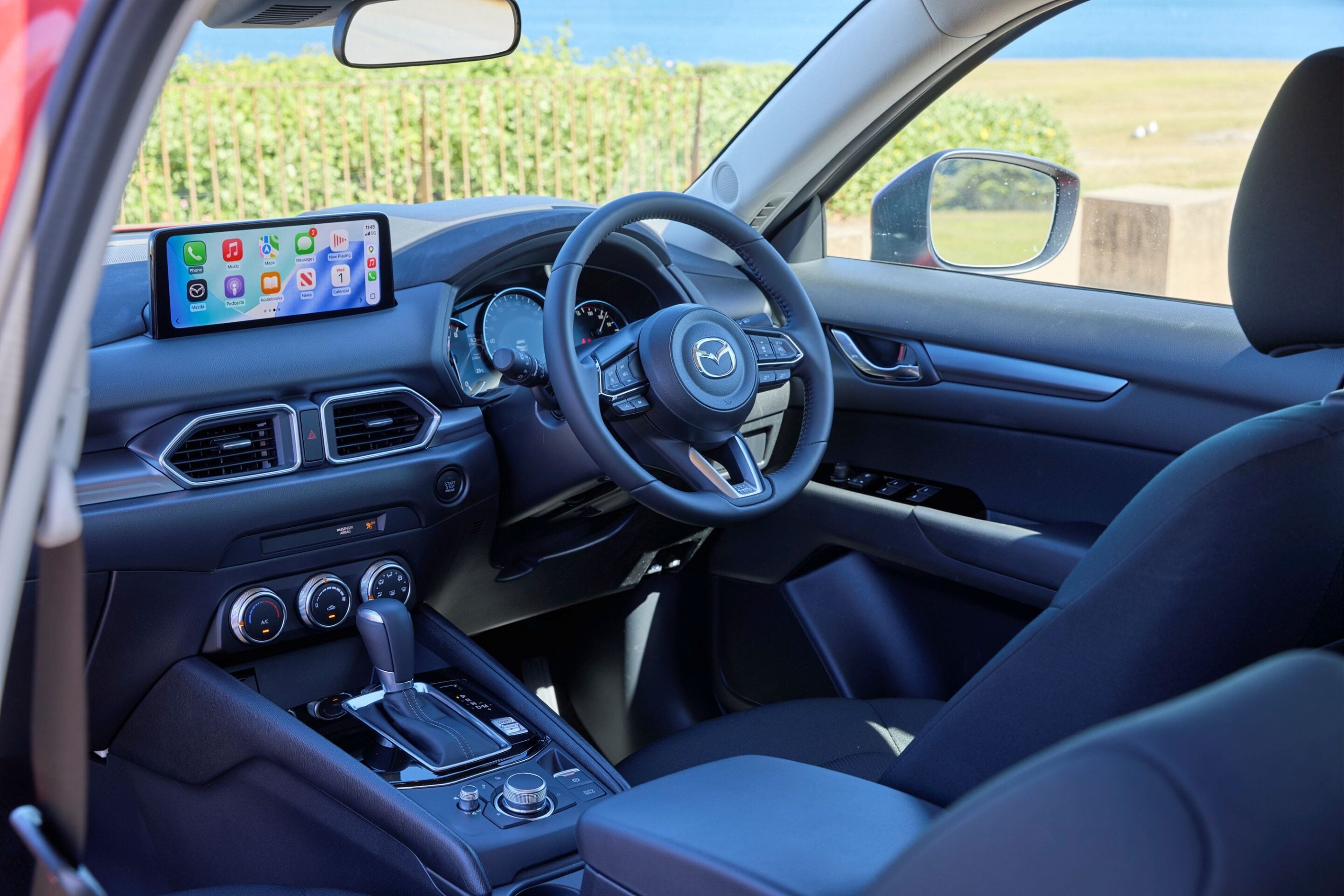
We’ve noted it before during Wheels testing, but in the face of endless fake leather, pleather, vinyl, synthetic leather, vegan leather, recycled this or repurposed that, we love testing any vehicle with good, hard-wearing cloth trim.
And the Mazda does it really well, with its black cabin looking a little on the dark side in low light but the payoff coming in the comfortable cloth trim that didn’t have that adhesive effect so many of the faux-leather options give on a hot day.
2
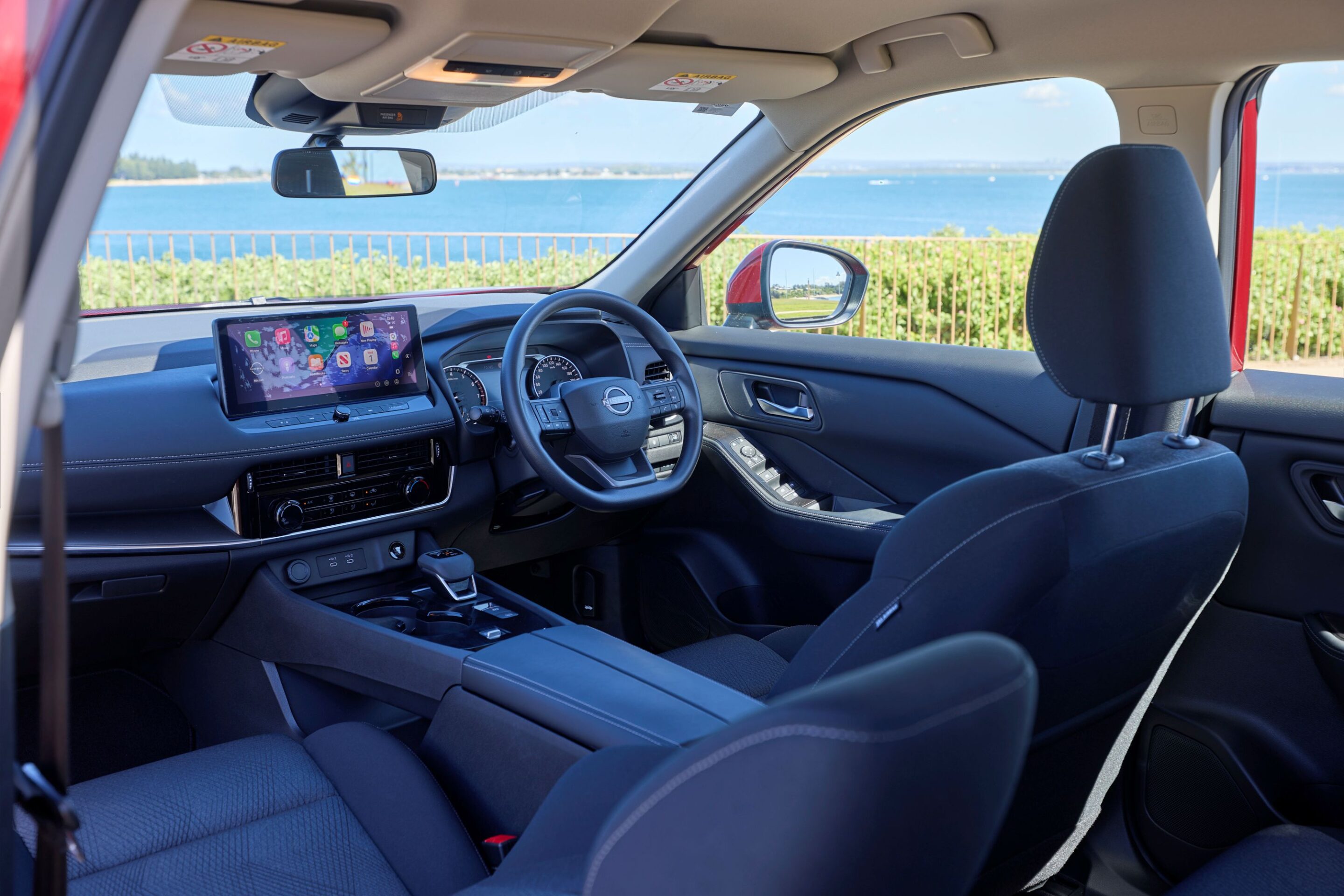
Nissan also gets black, robust-looking cloth, just as comfortable in the heat, but the polyurethane steering wheel is a let down, especially once you’ve grasped Mazda’s leather-trimmed wheel. Even at this sharp price point, a urethane steering wheel is a bit too much on the cheap side for our liking. It’s a minor gripe, sure, but as something you interact with every single time you’re driving the car, it’s going to be noticeable.
Both cabins are comfortable, with broad glasshouses ensuring plenty of light comes in, and excellent visibility is afforded out from all four main seats. The seats themselves are sculpted enough up front in both SUVs, such that you sit into them rather than on them, and the outer two seats in both are also comfortable on longer trips.
The seats in the Nissan are softer than the Mazda’s. Spongier maybe, and whether they are more comfortable will be a personal preference. For mine, I don’t mind a firmer seat. You’d notice this more if the ride was harsh, but it isn’t, so it’s line-ball in regard to seating comfort up front.
Interestingly, the X-Trail, though newer and more up to date, has a rear-view camera that isn’t as clear or crisp as the Mazda’s, but it does have an infotainment system that feels like it belongs in 2026, not 2017. Nissan’s smartphone connectivity and controls are much more intuitive and easier to master than the Mazda’s dated control centre.
3
Mazda’s infuriating old rotary dial system is a mishmash of dial manipulation and touchscreen inputs, and while the screen itself is lovely to look at once set up and you’re using mapping, for example, it’s frustrating to use and has been for a while. You do get used to it, but Wheels would argue you shouldn’t have to.
There’s a refreshing lack of annoying driver assistance systems in both these SUVs – just jump out of a new electric car straight into one of these if you don’t believe us. They have enough safety to ensure you’re not doing anything silly behind the wheel, but not so much that they intrude on the enjoyment of the driving experience.
On the road
It’s here, in the driving, as it so often is, where things get interesting. We’ve already noted that the Mazda – older as it is – remains more fuel efficient in the real world. So even though you pay a little more for the X-Trail and you get more standard equipment, you don’t get a powertrain that is as fuel efficient as the Mazda’s. To some of you, that may not even register a ripple, but to those of you looking to save every cent you can, it’s a factor to consider.
There’s also no doubt that in just about every regular driving scenario, Mazda’s excellent six-speed automatic is a significantly more enjoyable transmission to use than the CVT Nissan has opted for. Yes, it’s a big leap forward from the CVTs of old that felt like you had a slipping clutch in need of replacement, but it can’t transfer the drive as responsively or as smoothly as the old-school torque converter automatic mated to the Mazda’s four-cylinder.
Some of the extra grunt the Nissan offers, then, is dulled a little by its CVT, where the Mazda delivers a sense of urgency, especially handy when you need to nail the throttle to make a gap, or turn across
traffic. However, if you need to scoot off the mark from a standstill, the X-Trail will run to 100km/h faster than the Mazda.
1
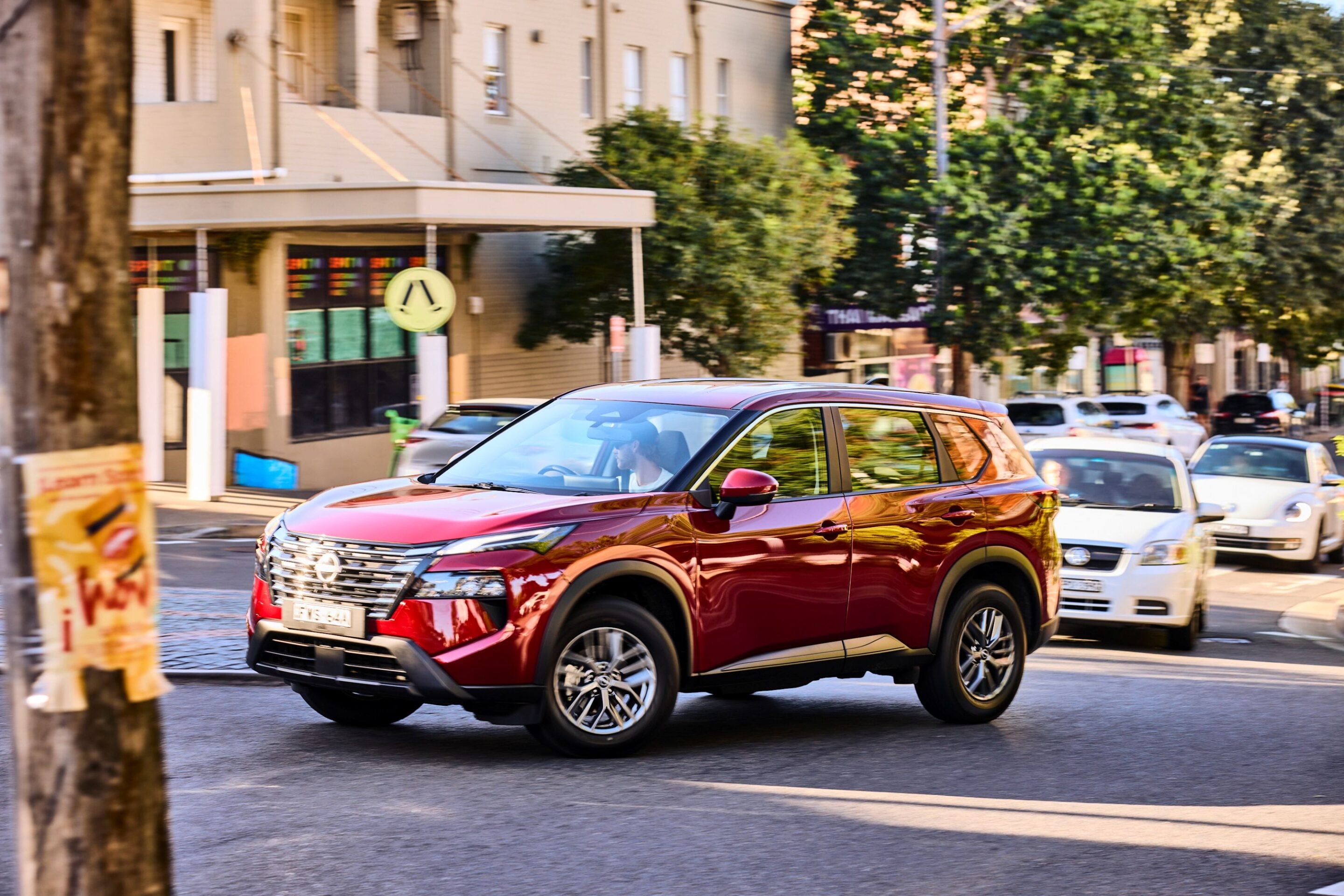
The Nissan isn’t necessarily a more difficult vehicle to drive smoothly, it’s just that the CVT saps some of the enjoyment and precision from the experience. The counter to that argument is the Mazda sometimes feels a little jerky or hesitant to drop back a gear when called upon, almost as if the transmission was thinking about whether what you wanted it to do was actually the best way forward. In other words, there’s a certain road speed in on/off throttle applications where the Nissan will be the smoother of the two to drive, but you’ll only notice that when it’s happening.
The X-Trail’s steering is lighter, especially noticeable at low speeds where you’re fighting your way through traffic, into and out of shopping centre carparks, or attempting to execute a snappy reverse park on a crowded street. It doesn’t feel too light on the highway though, firming up nicely on the move as speed increases and making for a relaxed long-distance cruiser.
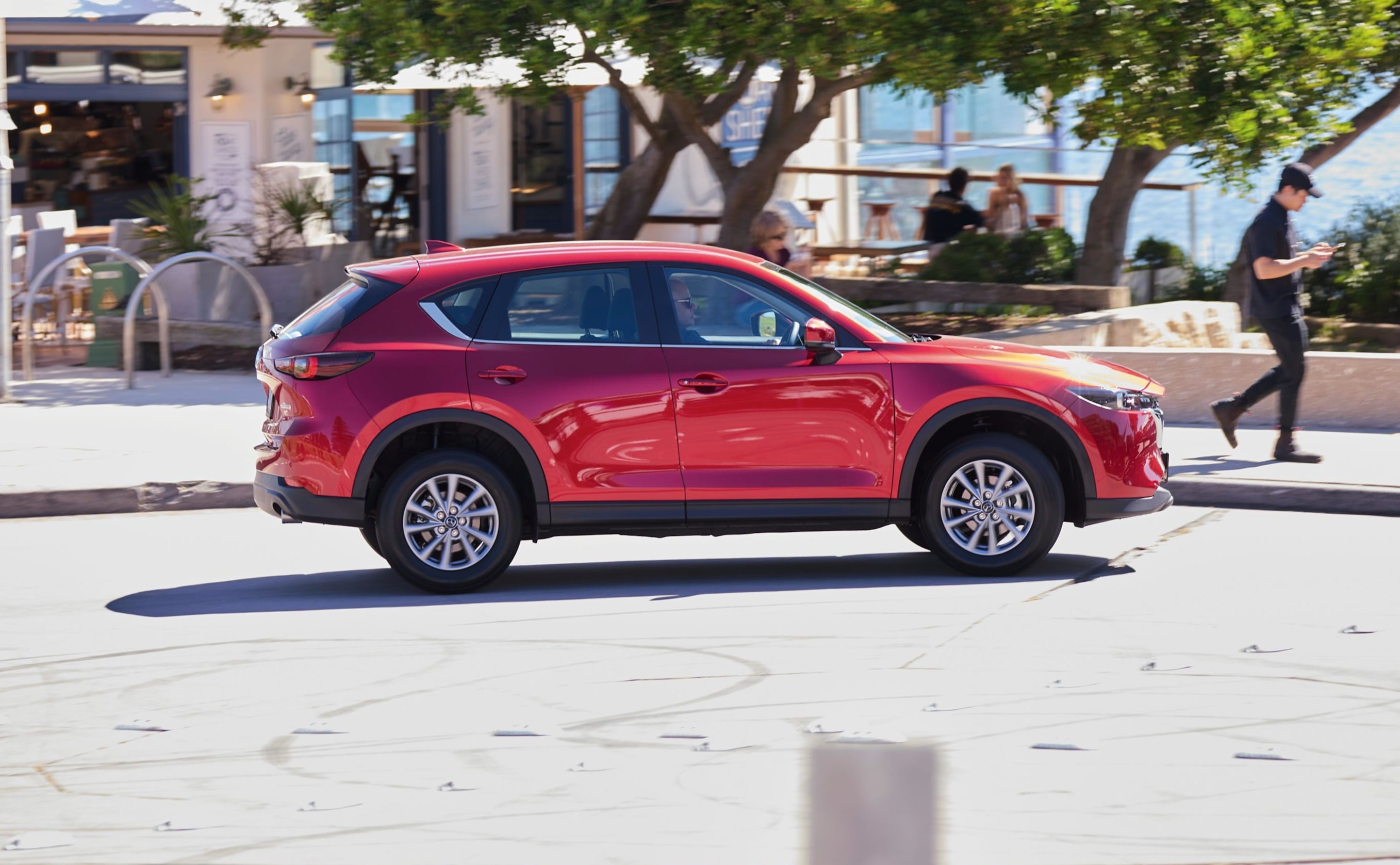
There’s as much marketing guff in Mazda’s proclamation of jinba ittai being injected into all of its vehicles as there is truth. However, there’s something to be said for the way Mazda can make even an otherwise slovenly segment feel somewhat connected and satisfying. You don’t speak Japanese? We’ll do our best for you, then. Jinba ittai is Mazda’s way of likening the driving of its cars to the relationship between a horse and jockey. That is, at one. Now, you’d be right in assuming it’s much more evident where you’re firing into a corner in an MX-5, but we begrudgingly acknowledge that some of that potent DNA is evident across the broader Mazda range.
As such, there’s something disarmingly sporty about the way the CX-5 responds when you’re out on the open road. If the X-Trail is the more effective family hauler, the CX-5 is the one you buy when mum or dad actually enjoys driving. It’s a hard-to-define characteristic that the CX-5 is imbued with, but even in low power, FWD base trim, it’s a lovely SUV to drive on any road, at any speed.
1
Another area that is so difficult to split these two is the way in which they deal with the typical patchwork urban playground our politicians call our ‘road network’. Our urban roads tend to get worse every time Wheels heads out for a test, but these two, with their smaller rims and chubby tyres, put the case forward with some gusto as to why ordering the biggest wheels you can get isn’t always the smartest way to attain a comfortable ride.
The X-Trail’s 17-inch alloy rims wear 235/65/17 Dunlop Grand Treks, while Mazda’s 17-inch alloys are also fitted with Dunlop Grand Treks, measuring 225/65/17, and the tall profiles make for excellent bump insulation.
The Mazda is the sportier handler, but looking to understeer into a corner on a B-road isn’t really what this segment is about, so for Wheels, this test is more about bump absorption and ride quality on choppy surfaces. This is another fascinating one, where the Nissan is softer in the way that it soaks up the ruts, but the Mazda seems to have the edge in regard to body control.
Drive these two SUVS back-to-back on the same road and it’s almost impossible to split them. In terms of how they feel to drive, there’s so little between them as to make separating them almost impossible. Every line on the spec sheet though, and the price, is evidence of that, before you even get to the driving.

1
The Verdict
There are certain areas where the X-Trail edges the CX-5 and others where the Mazda shades the
Nissan. Everything from the price down to the standard equipment lists is very similar, meaning that separating the two comes down to the finest details.
You might think it’s nitpicking, for example, but the existence of something like the Nissan’s urethane steering wheel is symbolic of a bigger factor that tips the scales in favour of the older Mazda CX-5. The CX-5 possesses an inherent level of polish and refinement that, as good as the new X-Trail is, it can’t quite match.
Some of that polish is in the small details – the steering wheel being one of them – but some of it comes with continued evolution and refinement over a long period of time. There’s a good reason the CX-5 has been one of the segment favourites in the face of newer competition for as long as it has. It’s always been a competent medium SUV that is excellent to drive, stylish and well-executed, and even though it’s on its retirement tour, that hasn’t changed.
The Nissan X-Trail, even in its most affordable guise, is a sensible choice in a crowded segment that gets more competitive by the month. However, the Wheels’ verdict gives the win to the Mazda CX-5… just. There’s a new version coming, but for the moment, the old model which has been with us for some time can still take the fight right up to the newest in the segment.
1
Specs
Mazda CX-5 G20 Maxx
| Price | $37,240 plus on-road costs |
|---|---|
| Engine | 1998cc DOHC four-cylinder petrol |
| Power | 115kW (@ 6000rpm) |
| Torque | 200Nm (@ 4000rpm) |
| Transmission | Six-speed automatic, front-wheel drive |
| 0-100km/h (claim) | 10.6 seconds |
| Combined fuel consumption (claim) | 6.9L/100km |
| CO2 emissions | 161g/km |
| Fuel required/tank size | 91 RON unleaded, 56 litres |
| Dimensions (l/w/h/wb) | 4575/1845/1675/2700mm |
| Boot | 438 litres (seats up), 1340 litres (seats folded) |
| Kerb weight | 1575kg |
| Warranty | 5-year/unlimited km |
| 5-year service cost | $2208 ($441 per year) |
| On sale | Now |
| Rating | 7.3 |
Nissan X-Trail ST
| Price | $38,140 plus on-road costs |
|---|---|
| Engine | 2488cc DOHC four-cylinder petrol |
| Power | 135kW (@ 6000rpm) |
| Torque | 244Nm (@ 3600rpm) |
| Transmission | CVT automatic, front-wheel drive |
| 0-100km/h | 8.5 seconds (est.) |
| Combined fuel consumption (claim) | 7.4L/100km |
| CO2 emissions | 174g/km |
| Fuel required/tank size | 91 RON unleaded, 55 litres |
| Dimensions (l/w/h/wb) | 4690/1840/1725/2705mm |
| Boot | 585 litres (seats up), 1396 litres (seats folded) |
| Tare weight | 1535kg |
| Warranty | 5-year/unlimited km, extendable up to 10-year/300,000km with dealer servicing |
| 5-year service cost | $1995 ($399 per service) |
| On sale | Now |
| Rating | 7.2 |
This story first appeared in the May 2026 issue of Wheels magazine, now on sale. Subscribe here and gain access to 12 issues for $109 plus online access to every Wheels issue since 1953.
Follow WhichCar/Wheels on Google
Click the button below to make WhichCar by Wheels a preferred source for your news.

We recommend
-
 Comparisons
Geely Starray vs Mitsubishi Outlander PHEV spec battle: Which plug-in hybrid SUV should you choose?
Plug-in hybrid SUVs are gaining popularity in Australia and the Geely Starray is one of the newest on the market. How does it compare against the more established Mitsubishi Outlander PHEV?
-
 Comparisons
Powertrain battle! Nissan X-Trail v Tesla Model Y v MG HS Hybrid+
Australian buyers love medium and large SUVs – and the choices have never been more broad than they are right now. The question is, which powertrain suits you? best? Regular hybrid, petrol generator electric, or full electric? Three very different combatants duke it out
-
 Comparisons
Hyundai Tucson Hybrid v GWM Haval H6 Ultra Hybrid: Front-wheel drive SUV showdown
Medium SUVs are Australia’s favourite way to move a family around, get to and from work, or head off on a road trip. That’s why every manufacturer wants a piece of the pie. If you want a medium SUV though, do you need AWD and all the extras? Wheels looks at two of the more affordable hybrid FWD models on the market.