
Comparisons


Gallery 1
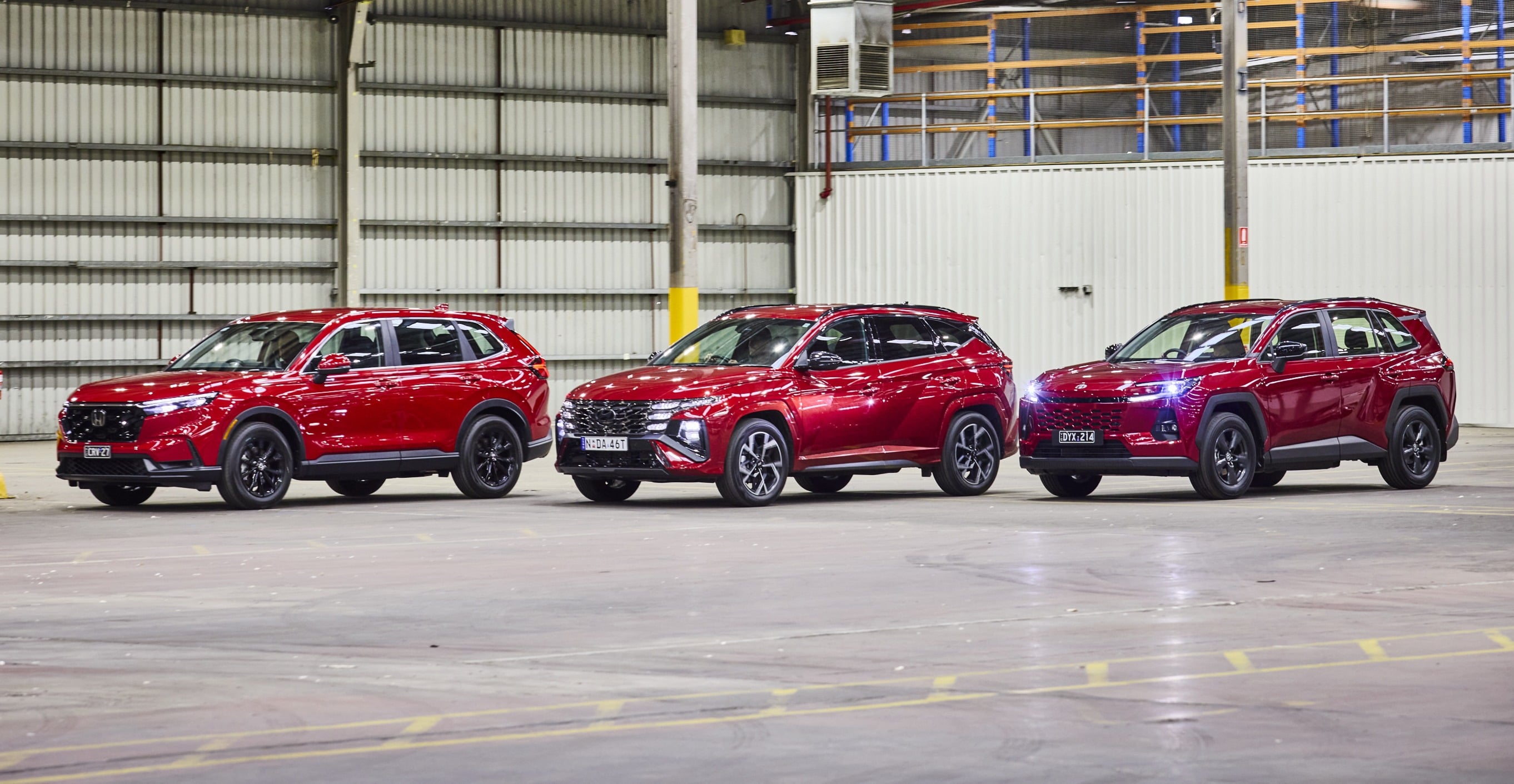
The more things change, the more they stay the same. It’s a popular saying imprinted heavily on the medium SUV segment in Australia, and this month two models that have stayed the course for decades go head-to-head with one that has made a serious mark on the segment in recent years.
For Honda and Toyota, the medium SUV battleground is familiar territory. RAV4 beat Honda to the punch by launching the three-door RAV4 first in 1994, with the five-door coming a year later. Honda followed suit in 1997 with the CR-V and the two Japanese mainstays have been going at it ever since. Almost a decade later in 2004, Hyundai joined the fray with the Tucson, entering a segment that by then was well-established as an Australian favourite.
1
The consequence of these new entrants was that from the mid ’90s, the medium SUV segment started to kill off the concept of the large sedan as the popular family choice On byroads once dominated by Commodores and Falcons, today the most common sight outside of a dual-cab is a medium SUV. From the early days of ‘what does SUV even mean anyway?’ through to today where the segment dominates passenger car sales, the change has been swift and significant.
In 2025, the second most popular vehicle sold was Toyota’s RAV4, with 51,947 delivered. Less than 5000 units behind Ford’s Ranger, Toyota’s golden child gave the big dual-cab a run for its money. With Mazda CX-5 finishing in eighth place – despite much newer competition – Mitsubishi in ninth with Outlander, and Tesla in 10th with Model Y, four medium SUVs sat inside the top 10, weathering the large 4WD and dual-cab storm. Hyundai finished 2025 in 12th place with the Tucson, and there’s an honourable mention for Sportage (not available to us for testing here) rounding out the Top 15.
It’s obvious, therefore, how critically important these vehicles are to manufacturers in this market, and with more challengers arriving every month, it gets harder and harder to win the battle. For what it’s worth, against the aforementioned 51,947 units for Toyota, Tucson represented 20,145 sales in 2025, and CR-V 5595 sales for Honda. There’s no doubt then that the ‘other’ Japanese brand trails Toyota and Hyundai significantly by volume.
Interestingly, as you may have read recently, Honda Australia boss Jay Joseph told Wheels that in his home market of the USA, CR-V is neck and neck with RAV4 on the sales charts, and has the chops to replicate that here. He was unequivocal in his comments that the CR-V has what it takes to run a lot closer to RAV4. And with our current pick of the segment thrown in for good measure, we’ll find out whether he’s right.
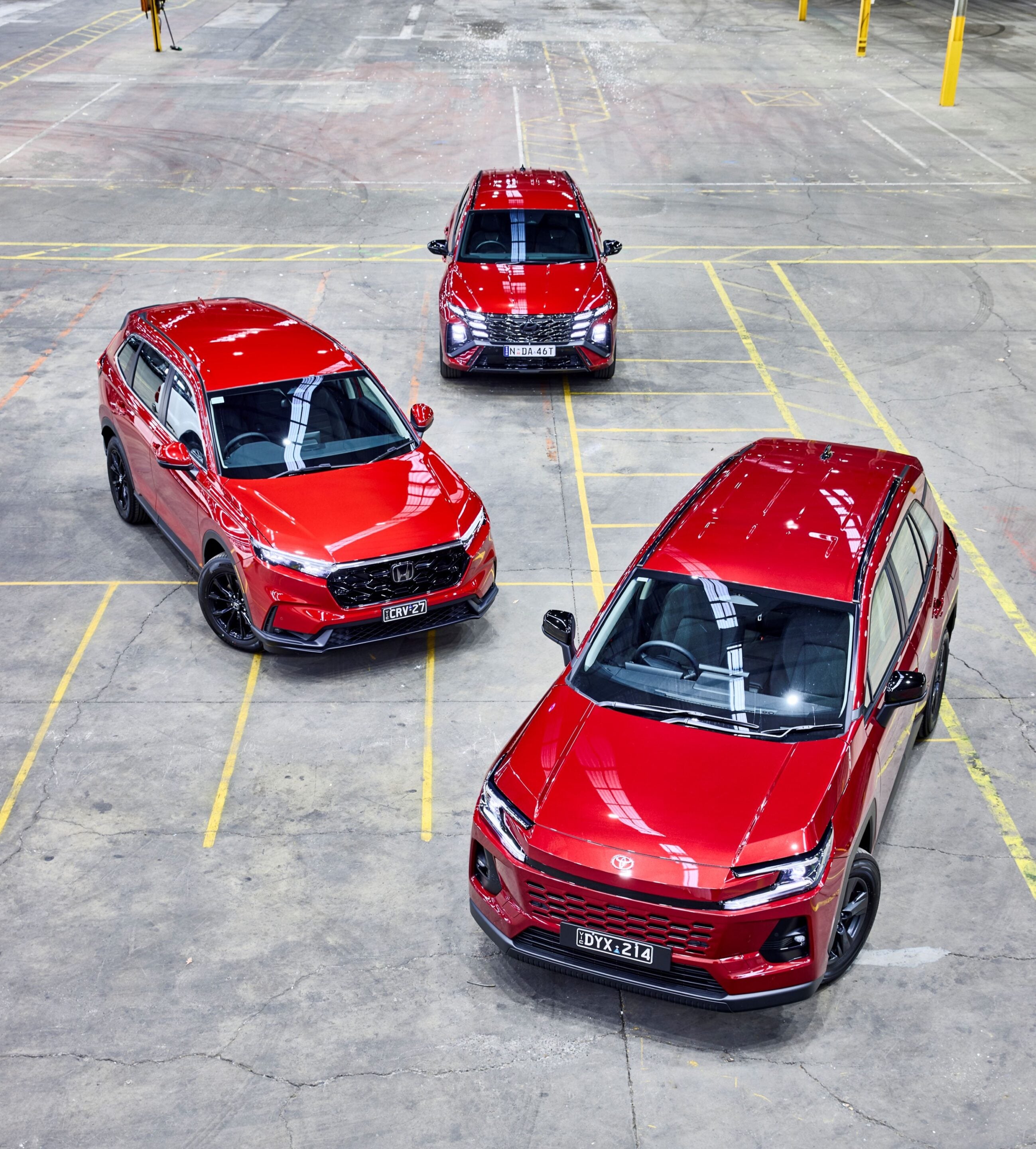
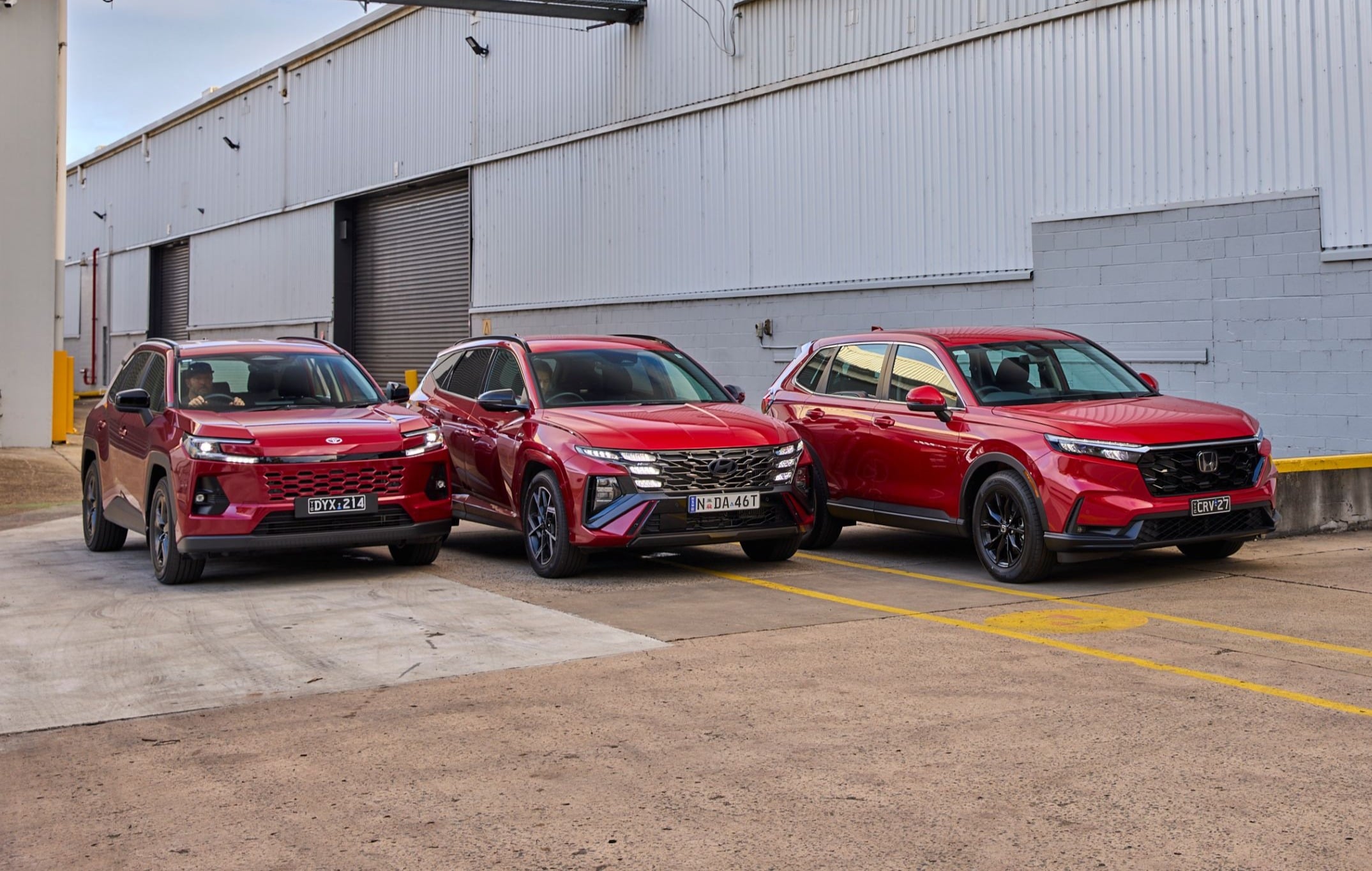
We’ve sidestepped the allure with which the more expensive variants bat their eyelids at you in the showroom and are instead showcasing the wallet-friendly charm of the more affordable models in the line-up. All are FWD, and all are hybrid, with the price spread as close as we could line up. There is 1.0L/100km between their respective fuel use claims, two CVTs and one conventional auto, three different engine capacities, and $4000 between their driveaway prices at the time of testing.
1
You obviously get more as you spend more, but whether you need more or not is an argument for another day. If you decode the specification sheets for the three on test here, they really do all have exactly what you need in this segment. And with the driveaway price close to the $50,000 mark for all three, they also work well for buyers on a budget.
However, the cars here aren’t necessarily the point of entry for their respective ranges. While the RAV4 GX is the entry model, the Tucson Elite Hybrid is the fourth model up the ladder, and the CR-V e:HEV in X trim is the second step up. It’s worth acknowledging, therefore, that there’s already a chance that the Hyundai and Honda will feel slightly more premium than the entry grade Toyota. Let’s find out.
Toyota RAV4 GX
1
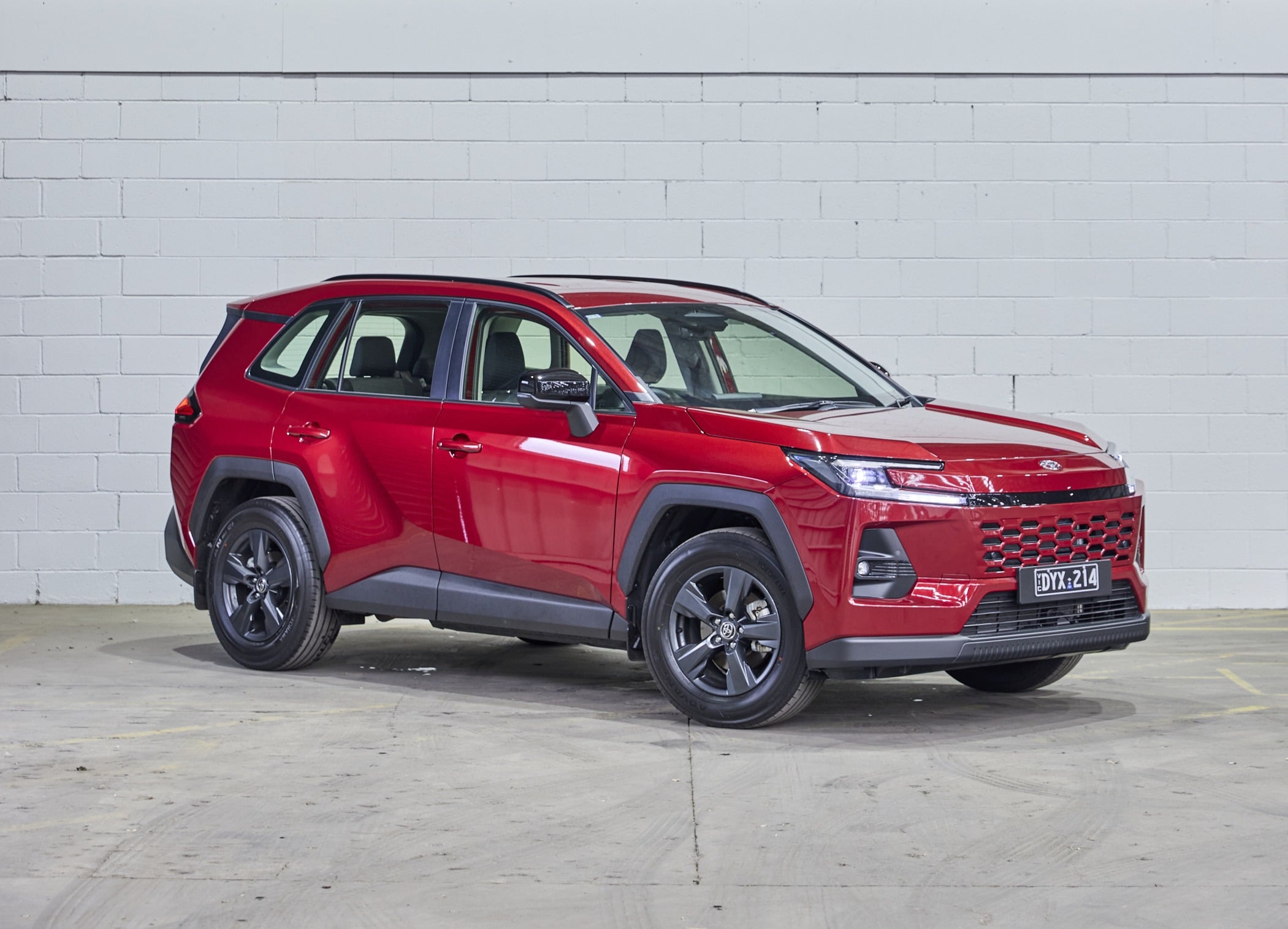
As mentioned, the GX FWD model provides the entry point to the RAV4 range. Head to the penthouse, though, and if you want the range-topping Cruiser AWD, it’s $60,340 before on-road costs, so there’s a decent price spread across the RAV4 range.
As tested here, the RAV4 starts from $45,990 before on-road costs and was $50,700 driveaway at the time of writing. Servicing costs have risen for this new model, required every 12 months/15,000km, with each costing $325, and the warranty retains five years coverage. A total of $1625 over the first five years isn’t outrageous, but can’t match Honda’s sharp servicing costs.
Under the bonnet, these three SUVs all attack the same task slightly differently – with petrol engines the common theme. Toyota’s tried and tested hybrid system sees a 2.5-litre, naturally aspirated four-cylinder engine paired with a single electric motor. Toyota doesn’t quote a peak torque figure but says the system generates 143kW and uses a claimed 4.5L/100km.
There’s an e-CVT mated to the petrol engine, and in testing we used 5.6L/100km. Toyota leans heavily on fuel efficiency – both on paper and in actual driving – and with good reason, given how efficient the RAV4 is, no matter how you drive it. However, it’s worth noting Toyota has upped the fuel quality demand – the RAV4 the only one here that asks for 95 RON premium fuel.
2
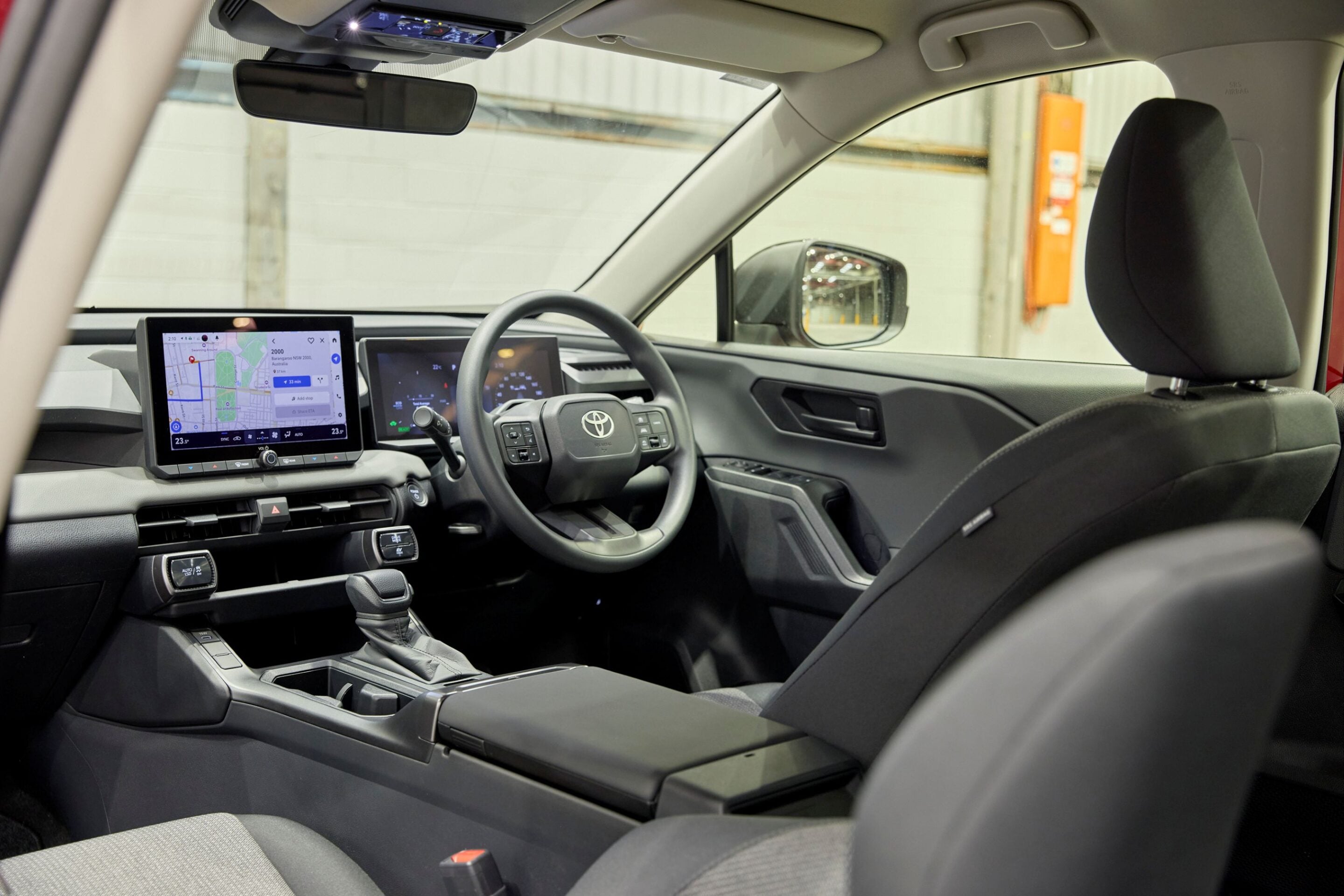
First up, the elephant in the room, or should that be cabin? A urethane steering wheel? In a 50 grand SUV? Really, Toyota? I know this is the base specification grade, but if Hyundai and Honda can deliver much more premium finishes for the same price, there should be no excuse. It’s a minor gripe in the overall scheme of things, but for Wheels, especially at this price, it simply doesn’t pass muster. Elsewhere in the cabin, larger screens and a revision of just about everything ensures this feels like a generational step forward from the old model. As such, the new infotainment system also represents a big leap.
The hybrid drivetrain is smooth, efficient and effortless in just about every sense. The one area where it isn’t, is noise suppression. When the petrol engine kicks in, it’s noisy and grates a little with the otherwise insulated drive experience. That means the transition from electric propulsion to petrol-powered isn’t as smooth as it could be. But it doesn’t detract from the reality of what the tyres are doing on the road. The RAV4 has enough power to get cracking, but it feels less refined than we’d like.
The ride quality and bump absorption is only beaten in this test by the quality of the CR-V. Toyota has done an excellent job of delivering chassis control with the ability to soak up nasty hits, and the 235/65/17 Yokohama Advance VG1 tyres fitted to our test vehicle provide plenty of grip.
While there’s a lot that’s new about this updated RAV4, it isn’t the outright leap forward that you might have expected given the way in which the previous model effectively reset the segment. It’s still solid across the board, and better than average by every measure. But it needs to be better than that to win a comparison in this segment, especially at the budget-focused end of the range.
Hyundai Tucson Elite N Line
1
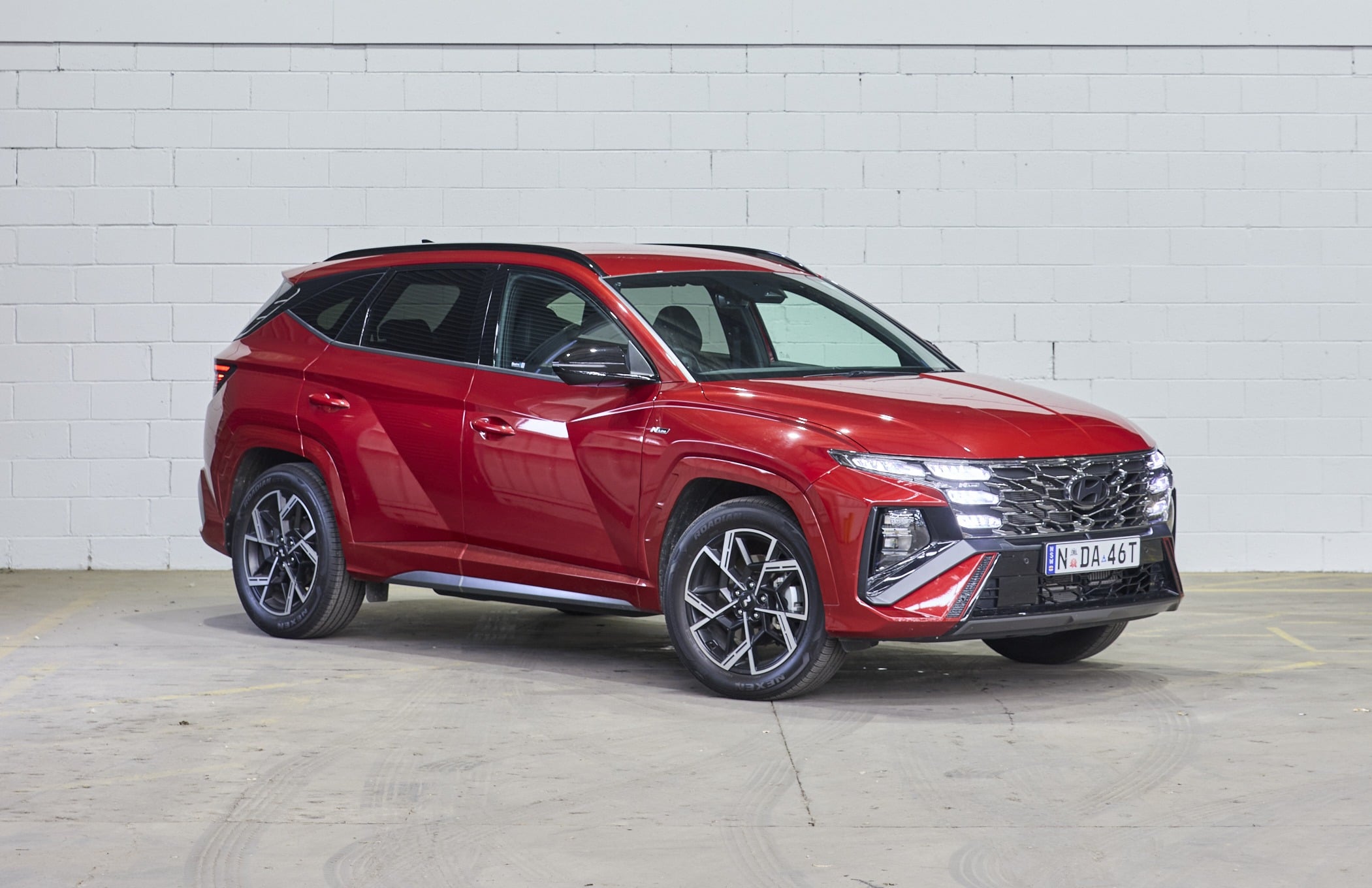
In the Hyundai camp, the Elite Hybrid is the fourth step up, with Base kicking the range off, then Hybrid, then Elite in the model walk before you get to Hybrid Elite. The most expensive Tucson is the Hybrid Premium, priced at $61,490 driveaway. Buy an Elite N Line, as tested here, and you’ll be asked to part with $53,350 plus on-road costs. However, at the time of writing, the Elite could be had for $53,990 driveaway in NSW.
Hyundai’s five-year warranty is extendable out to seven if you service the Tucson at an authorised dealer, with a visit required every 12 months/10,000km. And it’s not cheap to service – $2290 across the first five years, significantly more expensive than either the Toyota or Honda.
The Tucson on test has the N Line pack, which adds 19-inch alloy wheels, projection LED headlights, intelligent front lighting system, LED reverse lights, N Line exterior styling, body coloured cladding, glass black exterior trim, chrome exhaust outlet, N Line sports interior in leather/suede and alloy pedals.
Tucson differs from the other contenders here with the presence of a traditional, six-speed automatic transmission. It’s a good one, too… more on that in a minute. Hyundai has used a 1.6-litre, turbocharged four-cylinder engine with a single electric motor for outputs of 172kW and 367Nm, figures that blow the opposition out of the water. Hyundai quotes a combined consumption figure of 5.3L/100km, making it less efficient than the frugal RAV4, but not as thirsty as the CR-V. On test, we used 5.9L/100km, not too much more than the RAV4.
2
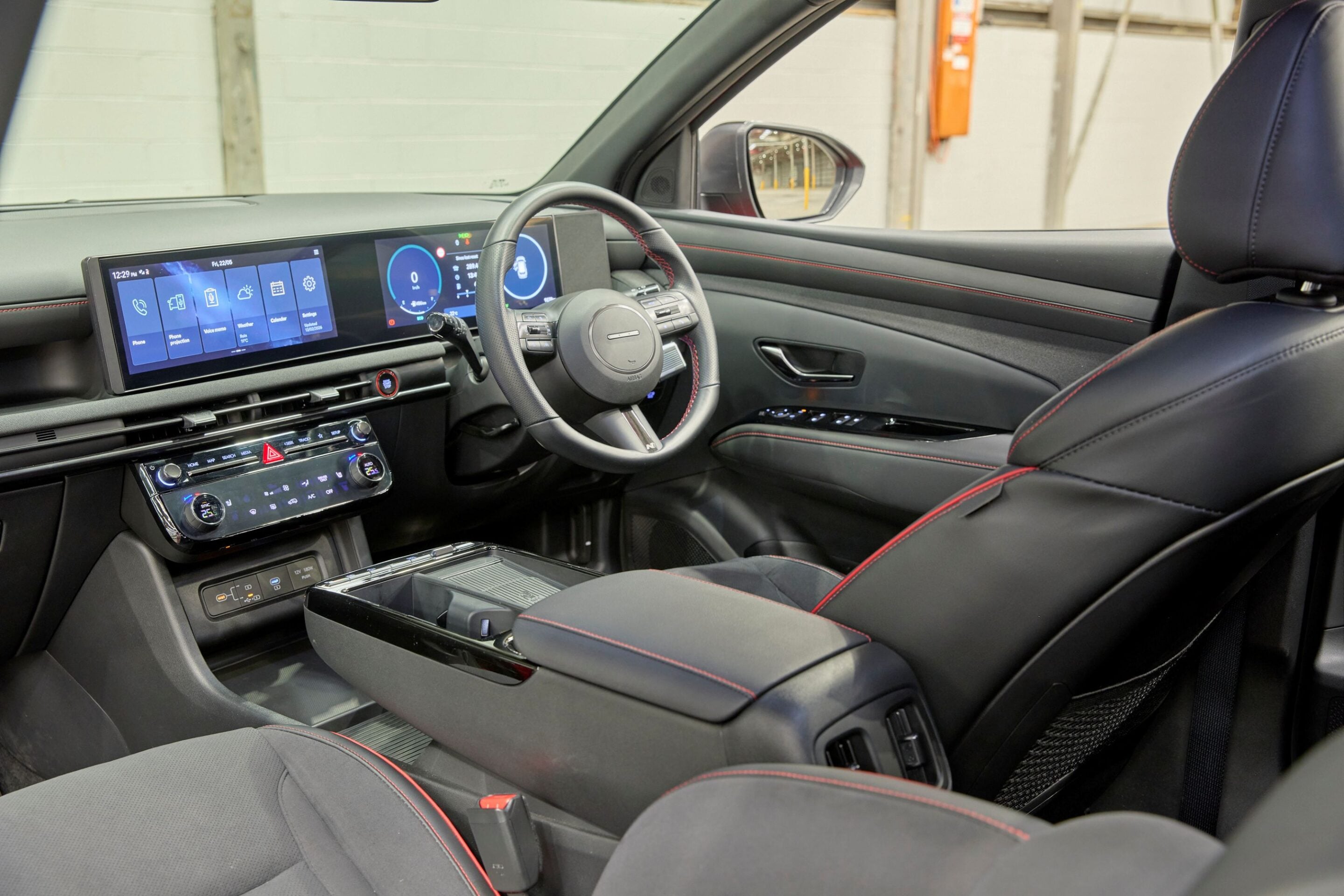
Put a more powerful engine together with a conventional automatic gearbox, and you’d expect a sharper, more engaging driving experience, and that’s exactly what you get from the Tucson. It impresses rather than dazzles from inside the cabin, with signature Hyundai tech that’s easy to use. And while the cabins are line ball in quality between the three, the Tucson is the most engaging to drive – sportier perhaps than it needs to be – but all the better for it in an otherwise bland segment.
The 235/65/18 Nexen Roadian tyres provide a slightly chubbier sidewall than the profile of the CR-V and yet the Tucson rode the firmest of the three on our test loop. Wheels looks for the worst of our urban network for these tests, but it’s worth noting if you want to float over the road, the Tucson is the least likely of the three to do it. The ride matches its sharper driving response, however, so it does make some sense.
On that note, the combination of the zesty drivetrain and the perceptible shift of the ratios makes for feedback that delights in its traditionalism. The world might have moved on, but there’s nothing wrong with the way cars used to drive either, certainly from the seat of the pants.
Honda CR-V e:HEV X
1
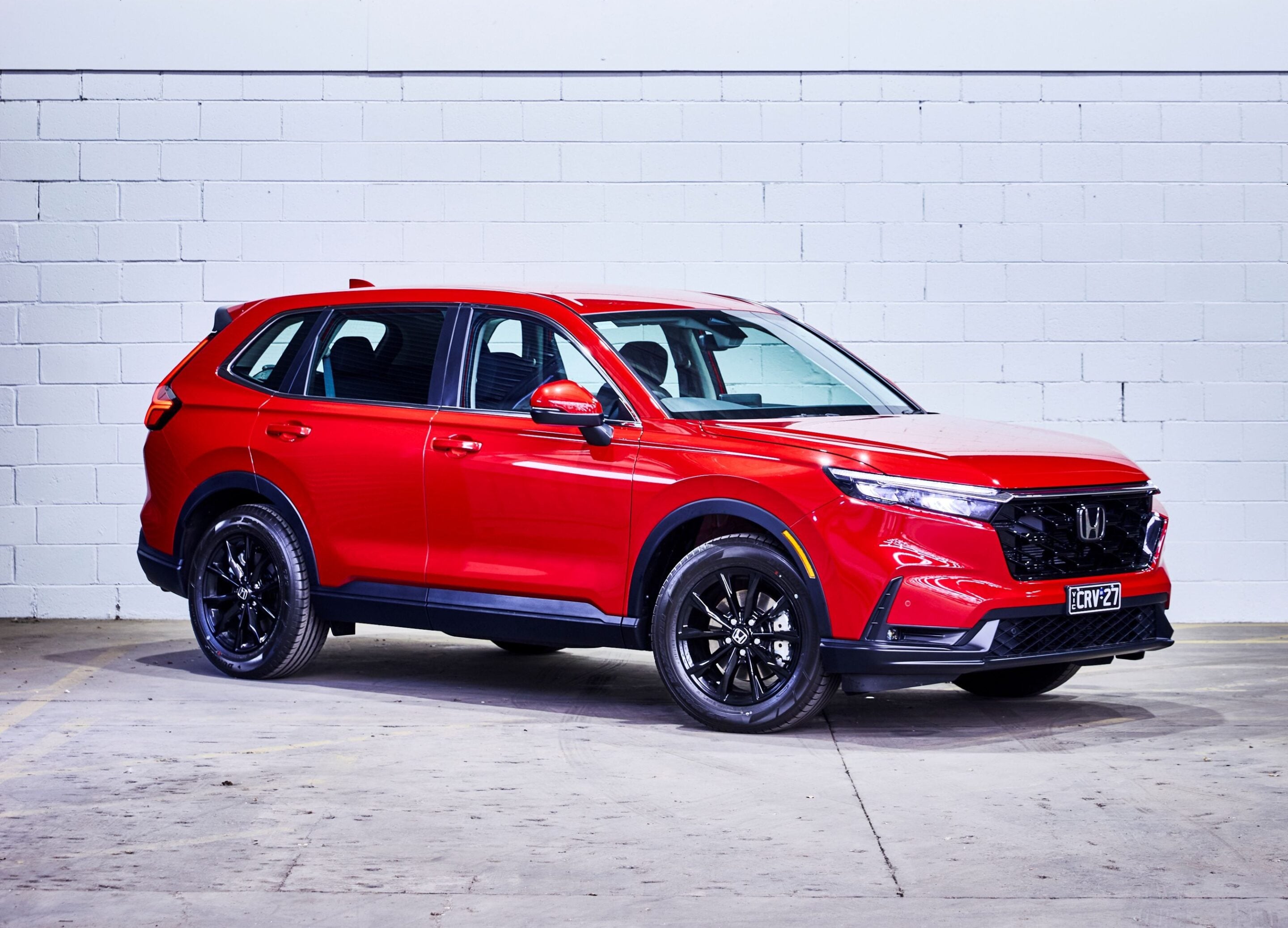
Inside the Honda showroom, our test CR-V is the second step up from the base VTi X (non hybrid). The range topper is the e:HEV RS AWD and it costs $64,400 driveaway. At $49,900 driveaway, the CR-V presents as excellent value straight off the bat, especially given the premium edge Honda adds to its vehicles. Of particular note is the cost of servicing, just $199 per year for the first five years of ownership. At $995 in total, then, that undercuts even the competitive pricing for the RAV4.
CR-V is powered by a 2.0-litre, naturally aspirated, four-cylinder, with a single electric motor and e-CVT, with combined outputs of 135kW/315Nm and fuel use of 5.5L/100km. On our test cycle, Wheels used 5.8L/100km. Unsurprisingly, perhaps, the Honda isn’t as efficient in the real world as the Toyota, and doesn’t feel as sharp performance-wise as the Hyundai, which gives credence to the figures you see on paper. It is, however, very close to its claim in the real world.
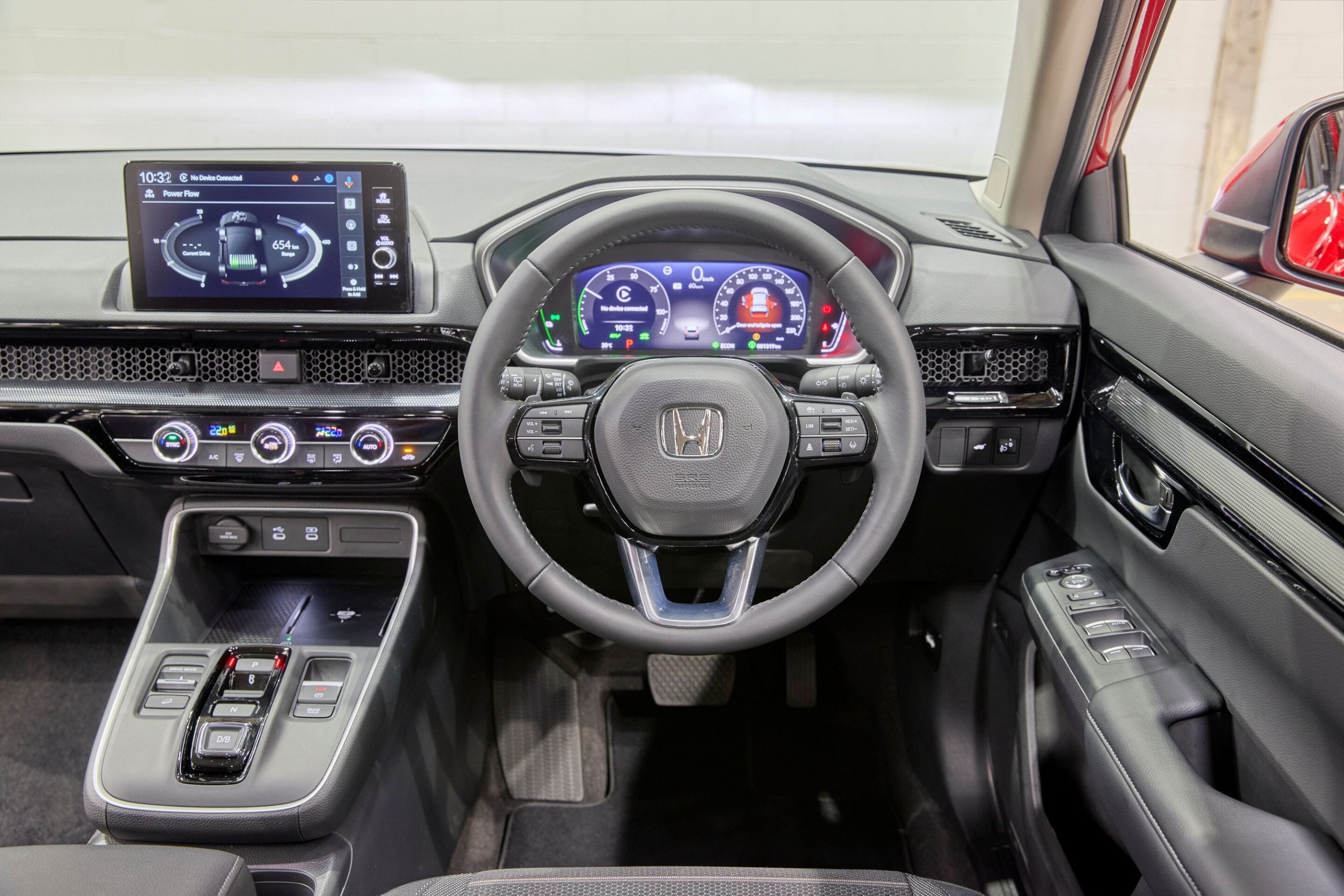
It’s once you’re seated inside the cabin where the CR-V shines, and then on the move. The cabin exudes a premium, high-quality air not just in design but in execution. At this price point, you feel like you’re getting a hell of a lot of SUV for the money. That case could be made for all three here (the RAV4’s steering wheel aside), but the Honda just seems to do it better. Where Honda hasn’t tried to blind you with massive screens and edgy tech, it impresses with quality switchgear, excellent material choice and that insulated build quality Honda has been renowned for over the years. Honda lost its edge for a while there, there’s no doubting that, but it most certainly has got its groove back now.
That feeling of insulation continues on the road, where the Honda rides as well as, if not better than the RAV4, and filters out road and wind noise exceptionally well. It means you have a relaxed cruising
environment at any speed on any road, and the family will love being inside the CR-V on a roadtrip. The CR-V boot isn’t as space effective as the RAV4, but it’s marginally bigger than the Tucson. Crucially – and this is true of all three – the CR-V’s boot is roadtrip friendly even with four or five on board.
3
The way in which the drivetrain gets the CR-V moving and smoothly progressing is noteworthy as part of its overall relaxed driving experience. The 235/60/18 Dunlop SP Sport Max tyres provided plenty of grip even on wet surfaces, and the CR-V was the least likely to chirp the front tyres under hard acceleration too.
CR-V continues Honda’s current roll, with excellent products in the form of the Wheels COTY-winning Civic, the smaller HR-V and Accord all punching well above their sales volumes. This test paints a picture of just how hard this segment is to conquer. The Tucson is a worthy previous holder of the title, only pipped by the newer CR-V, while the RAV4 makes the podium. But if you want the Wheels pick at this price point, it’s the 2026 Honda CR-V e:HEV X.
The Verdict
Some comparison tests of this nature resolve themselves quickly. A poorly executed cabin, shabby
dynamic control and poor ride quality, or lethargic drivetrains that are either ugly to drive or inefficient, will quickly sort the wheat from the chaff, and make it impossible for Wheels testers to ignore the shortcomings. Without wanting to suffer the uncomfortable reality of splinters in the backside, this one is no such comparison.
In many ways, even after more than a week rotating through the three vehicles on test, this is a head scratcher. There is a winner but inherently, and in testing, there is nothing specifically ‘wrong’ with any of the three SUVs we’ve assembled. You could, quite easily, formulate a legitimately strong argument to buy any of the three – and perhaps most crucially – be happy that you did. None will have you walking out your front door and looking into your driveway thinking, what the hell have I done?
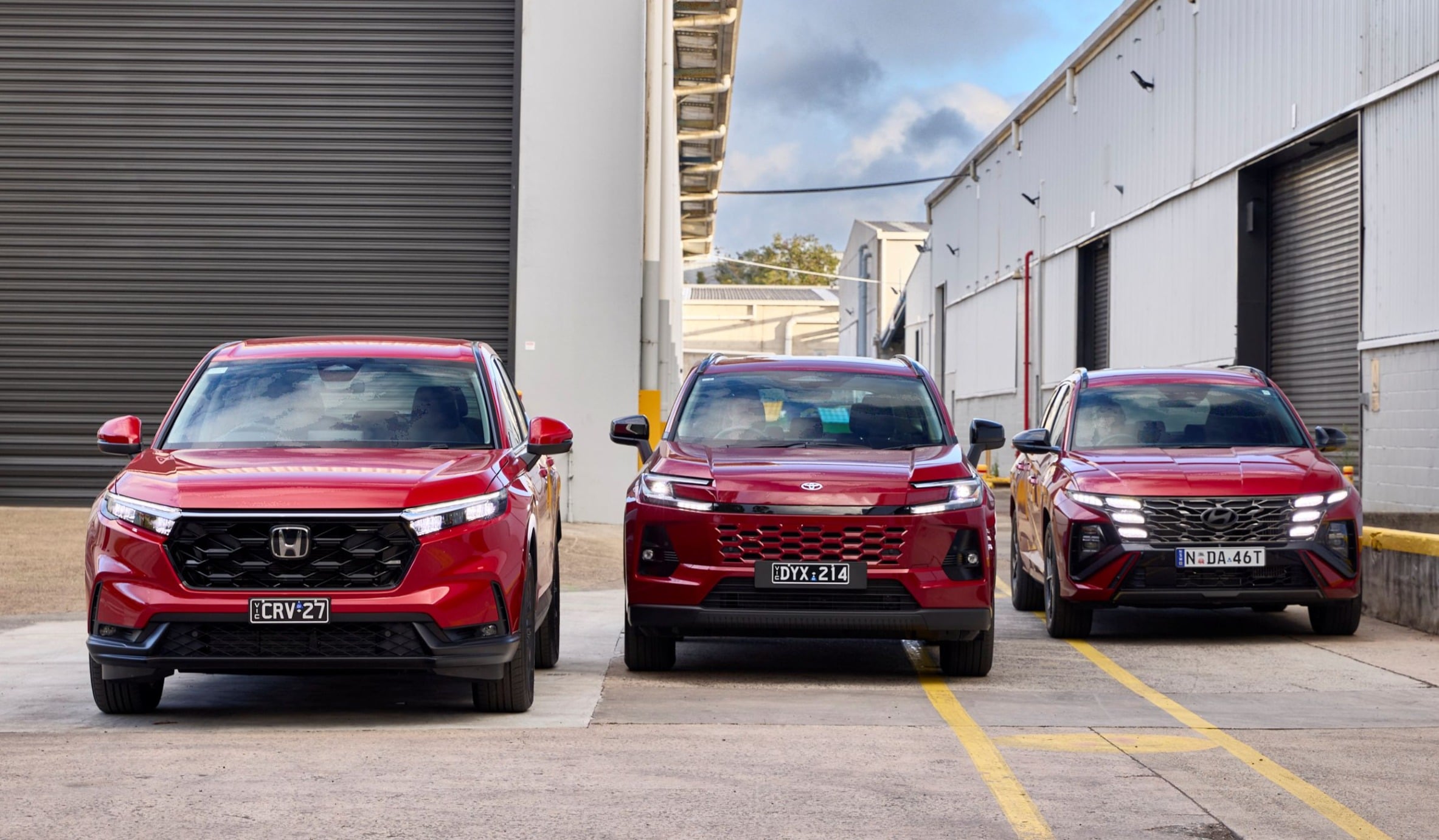
Individually, they all do what this segment and its buyers now demand. That alone is no easy feat. Family duties, long distance haulers, de-facto pickups, comfortable, practical, spacious and fuel efficient, the demands made of them are many and varied.
1
It’s why success in this segment hasn’t always been easy to achieve.
Starting with the Tucson, it’s arguably the sharpest of the bunch in terms of styling. It cuts a fine figure either stationary or on the move, and received the most positive praise for its look. It’s also excellent to drive, efficient, comfortable and imbued with Hyundai’s easy-to-access and easy-to-use tech.
The RAV4 does, in many ways, what Toyota always does. Strong across the board without raising eyebrows, the new version builds on the efficient success of the model it replaces, and continues to use as little fuel as possible. This new model is a significant step forward, especially inside the cabin. The urethane steering wheel though, being the most significant touchpoint of any car, is a letdown at any price.
And that leaves us with the exceptional Honda CR-V. Reserved (some might say mature) styling, a smooth, efficient hybrid drivetrain, and an exceptional ownership perspective, see it edge the better-selling Tucson and RAV4 into second and third places, respectively. Honda has provided a level of polish, especially inside the cabin, the others can’t match, along with a superbly insulated and resolved driving experience.
Specs
Honda CR-V e:HEV X
1
| Price | $49,900 driveaway |
|---|---|
| Drivetrain | 2.0-litre naturally aspirated four-cylinder + an electric motor |
| Peak outputs | 135kW/315Nm |
| Transmission | e-CVT, front-wheel drive |
| Claimed fuel consumption | 5.5L/100km |
| Claimed CO2 emissions | 125g/km |
| Fuel type/tank size | 91 RON regular unleaded, 57 litres |
| Dimensions (l/w/h/wb) | 4704/1866/1681/2701mm |
| Boot capacity | 589 litres (rear seats up, measured to the belt line), 1671 litres (rear seats folded, measured to the roof) |
| Tare mass | 1710kg |
| Braked towing capacity | 750kg |
| Warranty | Five-year/unlimited km (extendable to eight years with dealer servicing) |
| On sale | Now |
| Overall rating | 8.5 |
Toyota RAV4 GX FWD
1
| Price | $45,990 plus on-road costs (currently $50,700 driveaway in NSW) |
|---|---|
| Drivetrain | 2.5-litre naturally aspirated four-cylinder + an electric motor |
| Peak outputs | 143kW (no peak torque figure available) |
| Transmission | e-CVT, front-wheel drive |
| Claimed fuel consumption | 4.5L/100km |
| Claimed CO2 emissions | 102g/km |
| Fuel type/tank size | 95 RON premium unleaded, 55 litres |
| Dimensions (l/w/h/wb) | 4600/1855/1680/2690mm |
| Boot capacity | 705 litres (rear seats up, measured to the roof) (no figure available for with the seats folded) |
| Tare mass | 1605kg |
| Braked towing capacity | 800kg |
| Warranty | Five-year/unlimited km (mechanical warranty extendable to seven years with dealer servicing) |
| On sale | Now |
| Overall rating | 8.0 |
Hyundai Tucson Hybrid Elite N-Line
2
| Price | $53,350 plus on-road costs (currently $53,990 drive away in NSW) |
|---|---|
| Drivetrain | 1.6-litre turbocharged four-cylinder + an electric motor |
| Peak outputs | 172kW/367Nm |
| Transmission | Six-speed automatic, front-wheel drive |
| Claimed fuel consumption | 5.3L/100km |
| Claimed CO2 emissions | 121g/km |
| Fuel type/tank size | 91 RON regular unleaded, 52 litres |
| Dimensions (l/w/h/wb) | 4650/1865/1665/2755mm |
| Boot capacity | 582 litres (rear seats up, measured to the belt line), 1903 litres (rear seats folded, measured to the roof) |
| Tare mass | 1775kg |
| Braked towing capacity | 1900kg |
| Warranty | Five-year/unlimited km (extendable to seven years with dealer servicing) |
| On sale | Now |
| Overall rating | 8.3 |
This story first appeared in the July 2026 issue of Wheels magazine, now on sale. Subscribe here and gain access to 12 issues for $109 plus online access to every Wheels issue since 1953.
Follow WhichCar/Wheels on Google
Click the button below to make WhichCar by Wheels a preferred source for your news.

We recommend
-
 Comparisons
Hatchback Hit-Out: Mazda 3 v Kia K4 v Volkswagen Golf
The small car battle has raged in this country ever since Australians first questioned whether a big country was the place for such a vehicle. Wheels puts three of the frontrunners head-to-head...
-
 Comparisons
Nissan X-Trail v Mazda CX-5: Medium-size SUVs go head-to-head in hard-fought segment
Upgraded for 2026, the Nissan X-Trail is primed to take the fight to one of the segment favourites, the Mazda CX-5, which is nearing the end of its life as a new model looms on the horizon
