
While we get the Santa Fe XRT here in Australia, the XRT badge has a bit more reach in the US, with the Tucson, the Palisade and the sexy Santa Cruz ute all offered with an XRT model in the range. Unfortunately, unlike the ruggedised Santa Fe that we get, the American XRT treatment is all show and no go, with the options purely aesthetic, such as specific wheel designs, with black front and rear underbumper fascias and side cladding.
Things we like
- Barely puts a foot wrong
- Well appointed and very practical cabin
- Good to drive and fast to charge
Not so much
- Is it almost too large?
- Not cheap to buy
- No spare wheel
| Rating |
|---|
Price: Air: $97,000 plus on-road costs, Earth: $106,500 +ORC, GT-Line: $121,000 +ORC
Drivetrain: Single or dual-motor electric motor
Outputs: 160kW/350Nm (Air), 283kW/700Nm (Earth, GT-Line)
Battery: 76.1kWh (Air), 99.8kWh (Earth, GT-Line) lithium-ion
Claimed range: 443km (Air), 512km (Earth), 505km (GT-Line)
Peak charging capability: 350kW DC, 10 – 80 per cent charge in 20 minutes (Air), 24 minutes
(Earth, GT-Line)
Dimensions: 5010-5015mm long, 1980mm wide, 1755-1780mm tall, 3100mm long wheelbase
Tare weight: 2312kg (Air), 2552kg (Earth), 2636kg (GT-Line)
Boot: 333L (all seats up), 828L (third row folded), 2318L (second and third rows folded), 90L (Air)
or 52L (Earth, GT-Line) front boot
0-100km/h: 8.2 seconds (Air), 6.0 seconds (Earth), 5.3 seconds (GT-Line)
Warranty: Seven-year/unlimited km (7-year/150,000km for the battery)
Five-year/75,000km service cost: $1351 ($270 annually)
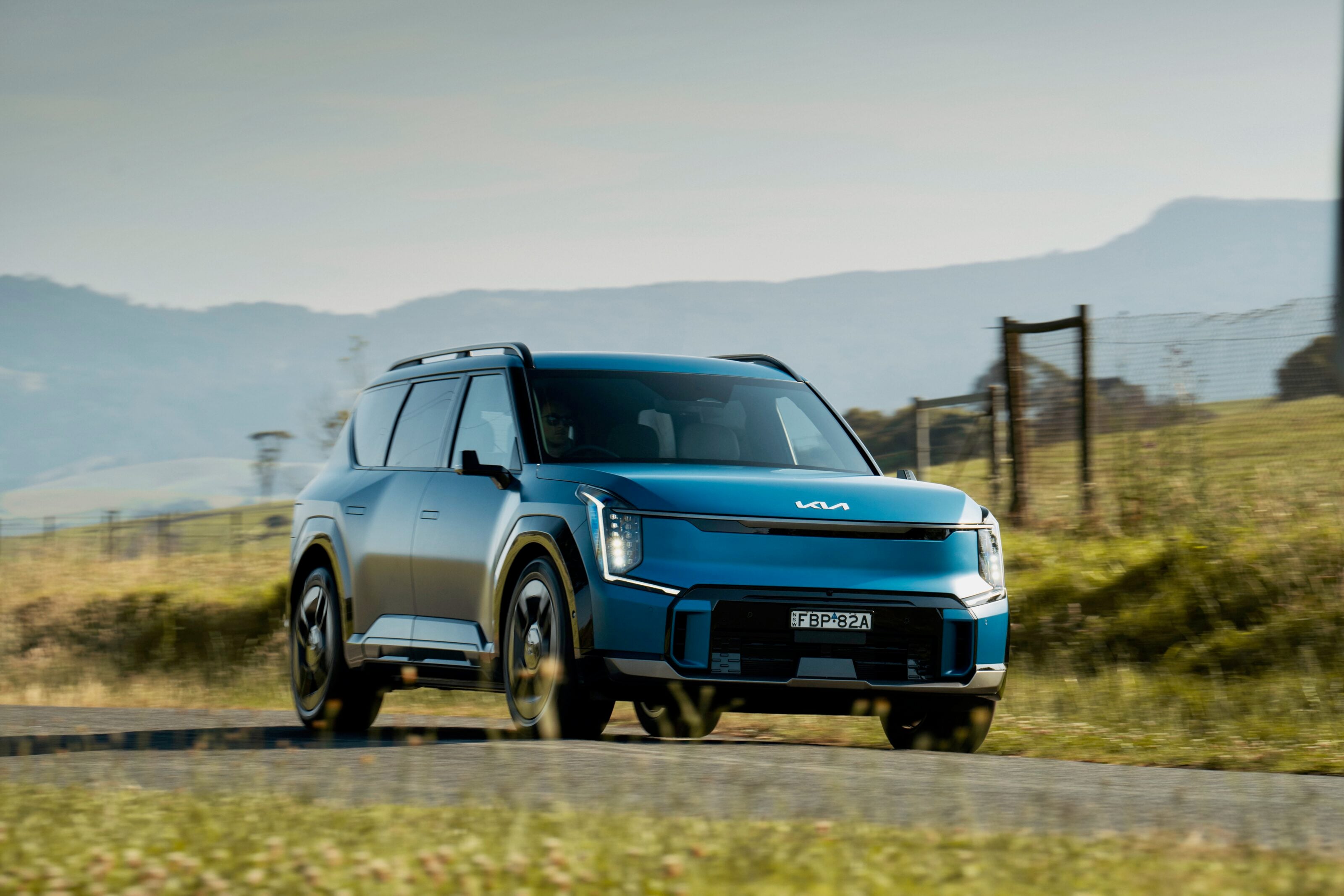
Kia’s rise to sales stardom has been amazing to watch. No longer the butt of jokes in the global car industry, modern-day Kia makes world class products that, unlike some car markers, still offer great value for money.
But in order to hunt for more segments to conquer, Kia had to think bigger, so here we have the EV9 seven-seat upper large electric SUV.
The EV9 is its most expensive product ever, and at over five metres in length, it’s also the largest passenger vehicle as well. Kia belives there’s definitely a market for it in Australia, and evidence of that is that it took only nine months from global reveal to reach Australian showrooms, which is much faster than most cars. Is the EV9 a good choice for the larger family?
Price and equipment
For now, there are three variants in the Australian Kia EV9 range, with the high-performance GT revealed late last year due to join the range soon.
2025 Kia EV9 pricing (plus on-road costs):
| Air | $97,000 |
|---|---|
| Earth | $106,500 |
| GT-Line | $121,000 |
Kia EV9 Air standard equipment:
- 19-inch alloy wheels with a tyre repair kit
- Dusk-sensing automatic all-LED exterior lighting
- Rain-sensing automatic wipers
- Roof rails
- Keyless entry with push button start and remote start
- Auto-retracting door handles
- Heated and auto-folding mirrors
- Noise-suppressing windscreen and side glass
- Artificial leather steering wheel and seat upholstery
- Heated and ventilated front seats
- Heated steering wheel
- 10-way electrically adjustable front seats
- Tri-zone climate control
- 12.3-inch digital driver’s display
- 5.0-inch climate control screen
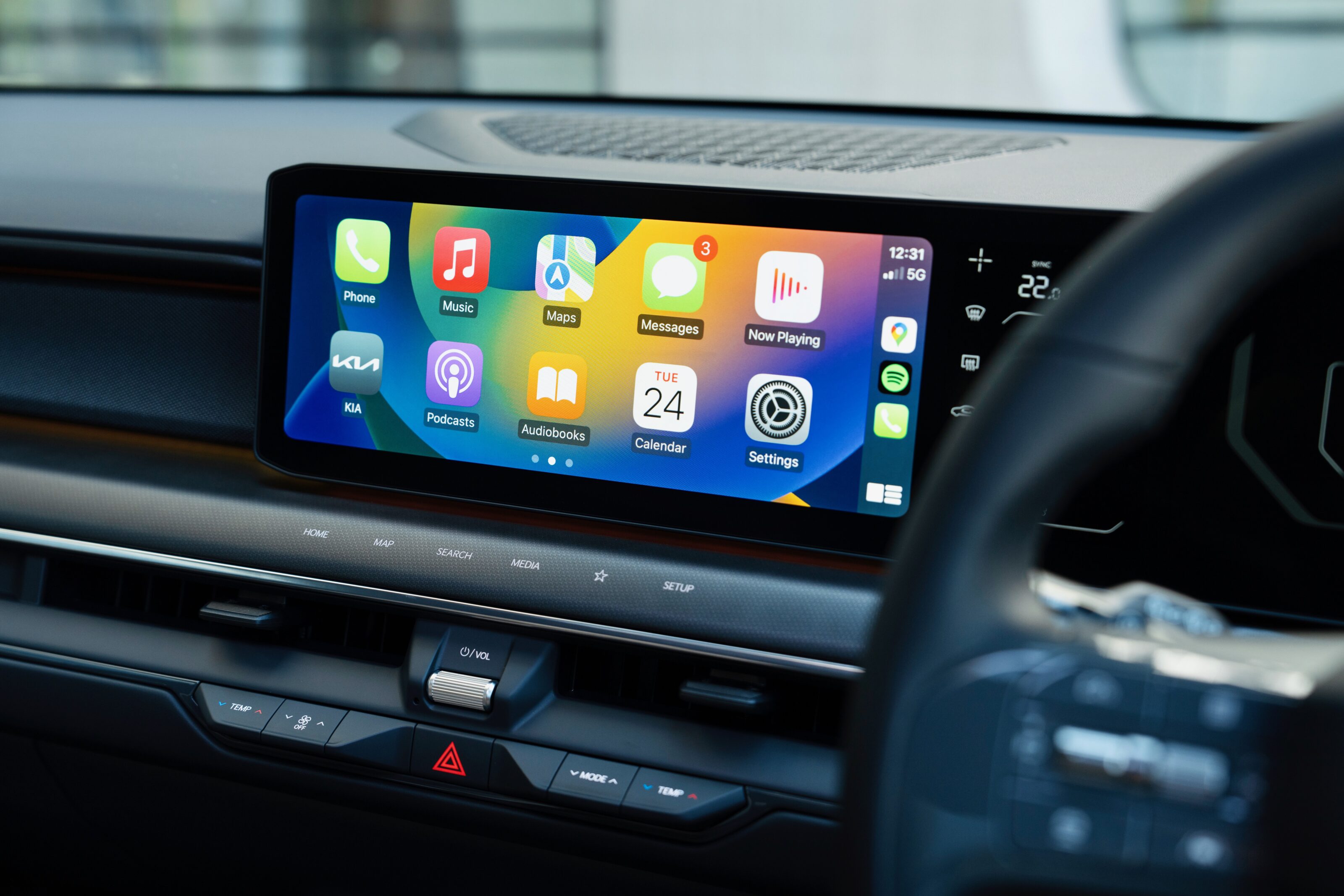
- 12.3-inch touchscreen
- AM/FM/digital radio
- Wired Apple CarPlay and Android Auto
- Satellite navigation
- Live services and over-the-air updates
- Eight-speaker sound system
- 6x USB-C and 2x 12V charging ports
- Wireless phone charger
- Recycled fabric headliner
- Eco, normal and sport driving modes
EV9 Air safety equipment:
- Nine airbags
- Autonomous emergency braking with pedestrian, cyclist and intersection assist
- Lane keep assist with lane departure warning
- Adaptive lane guidance for highway driving
- Blind-spot monitoring with rear cross-traffic alert (with braking)
- Speed sign recognition
- Driver attention monitoring
- Adaptive cruise control with traffic jam assist
- Auto high beam
- Safe exit warning
- Intelligent speed limit assist
- Front and rear parking sensors
- Reversing camera
- Alarm
- Tyre pressure monitoring
- Auto-dimming rear mirror
The EV9 received a five-star ANCAP safety rating in 2023 with scores of 84 per cent in adult
protection, 87 per cent in child protection, 76 per cent in road user protection and 85 per cent in
safety assist.
EV9 Earth model adds over Air:
- Dual-motor drivetrain with larger battery
- Gloss black exterior trims
- 64-colour cabin LED ambient lighting
- Illuminated Kia logo on the steering wheel
- 360-degree camera
- Blind-spot camera
- Different 19-inch alloy wheels
- Automatic low-speed braking in reverse
EV9 GT-Line model adds over Earth:
- GT-Line exterior styling with front and rear skid plates
- Cube-shaped projector LED headlights with Matrix adaptive high beam
- 21-inch alloy wheels
- Rear privacy glass
- Digital side and rear mirrors
- Dual sunroofs
- Two-tone synthetic leather trim
- Augmented reality head-up display
- Alloy pedals
- 14-speaker Meridian sound system
- Heated and ventilated outer rear seats
- Remote parallel, perpendicular and diagonal parking functionality
- Second-row door sunshades
- Recycled suede headliner
- Electric steering column adjustment
Performance and efficiency
Using Hyundai e-GMP platform, the Kia EV9 is offered in two lithium-ion battery sizes in Australia: a smaller 76.1kWh unit in the base Air, or the larger 99.8kWh one in the Earth and GT-Line. The claimed range for the Air is 443km, 512km in the Earth and 505km in the GT-Line (WLTP).
Because the EV9’s platform uses an 800V architecture, it can charge quite fast: up to 350kW, according to Kia. That gives it a fast 10 to 80 per cent DC charging time of just 20 minutes in the Air and 24 minutes in the Earth and GT-Line.
The EV9 Air uses a 160kW/350Nm electric motor on the rear axle, providing more than enough shove for most buyers with a claimed 8.2 second 0-100km/h time. Going up to the Earth and GT-Line adds a second motor on the front axle for 283kW/700Nm outputs and much quicker acceleration: just 5.2 seconds is required for the GT-Line to hit 100km/h.
On the road
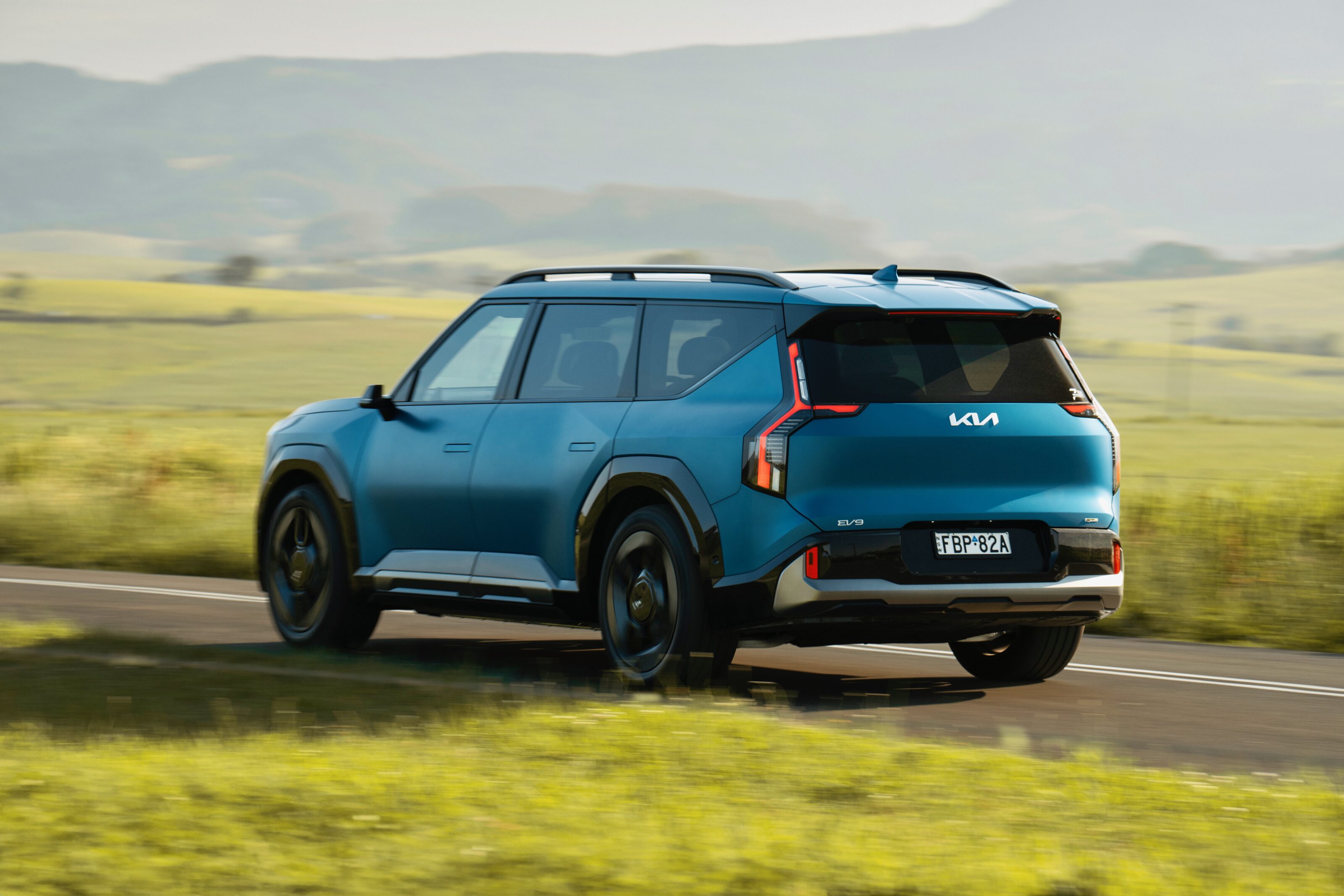
Using the same platform as its smaller EV6 sibling, the EV9 drives well. Thanks to Kia’s local ride and handling tuning program, regardless of model, the EV9 provides a comfortable driving experience. Despite the heavy up to-2636kg tare weight (GT-Line), the EV9 feels lighter on its feet and while it’s no EV6 GT for handling, it’s more fun than you’d expect with light but quick steering and excellent damping, even on the big-wheeled GT-Line.
As you’d expect for a $100,000+ car, refinement in the EV9 is excellent with very little in the way of road noise – even despite the lack of engine noise – and despite the boxy body, very little wind noise either. Because of the boxy body, the visibility is excellent, though the camera mirrors on the GT-Line should be optional equipment as their field of vision is limited.
Interior comfort, practicality and boot space
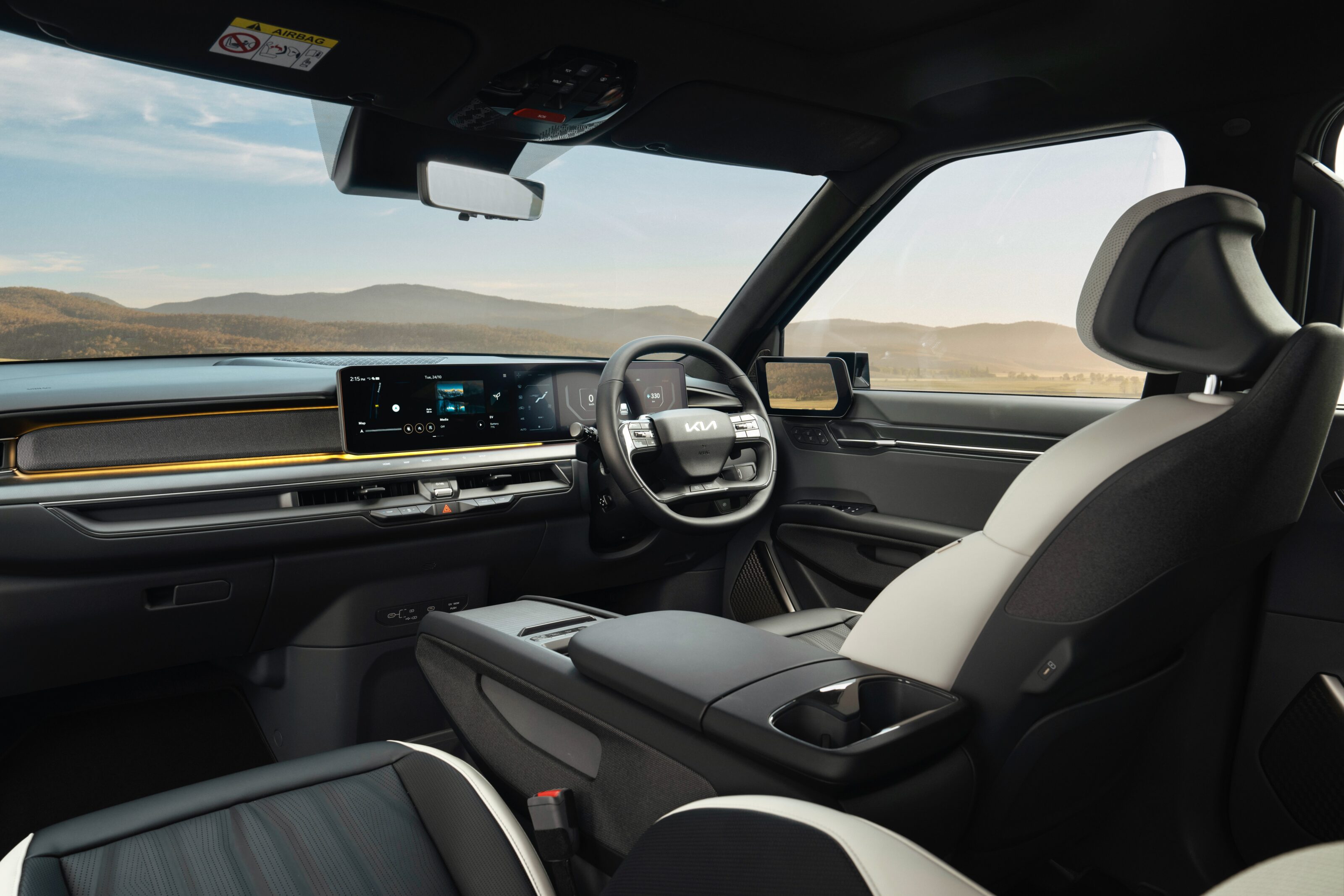
The dashboard of the Kia EV9 set the design language of the EV5, EV4 and EV3s that came after it with a very horizontal and practical design. Material quality is good though some could better reflect the car’s pricing. It’s also a fairly cold cabin – we’d love to see more colour options added for a warmer feel inside.
Every EV9 features a 12.3-inch touchscreen with a 5.0-inch unit and then another 12.3-incher sitting next to it for the climate control and driver’s display respectively. As we’ve seen in other Kia models, it’s quick and easy to use, while the sound systems are also quite good, especially the 14-speaker Meridian unit in the GT-Line. Though initial EV9 models feature wired smartphone mirroring, an over-the-air update will add wireless capability to match newer Kia models.
The storage on offer in the EV9 is good with a massive lower console bin and a big cup holder section, though the door bins are surprisingly small and the section underneath the centre armrest (which also has an excellent wireless phone charger with a raised island to accommodate blocky smartphone cameras) isn’t huge either.
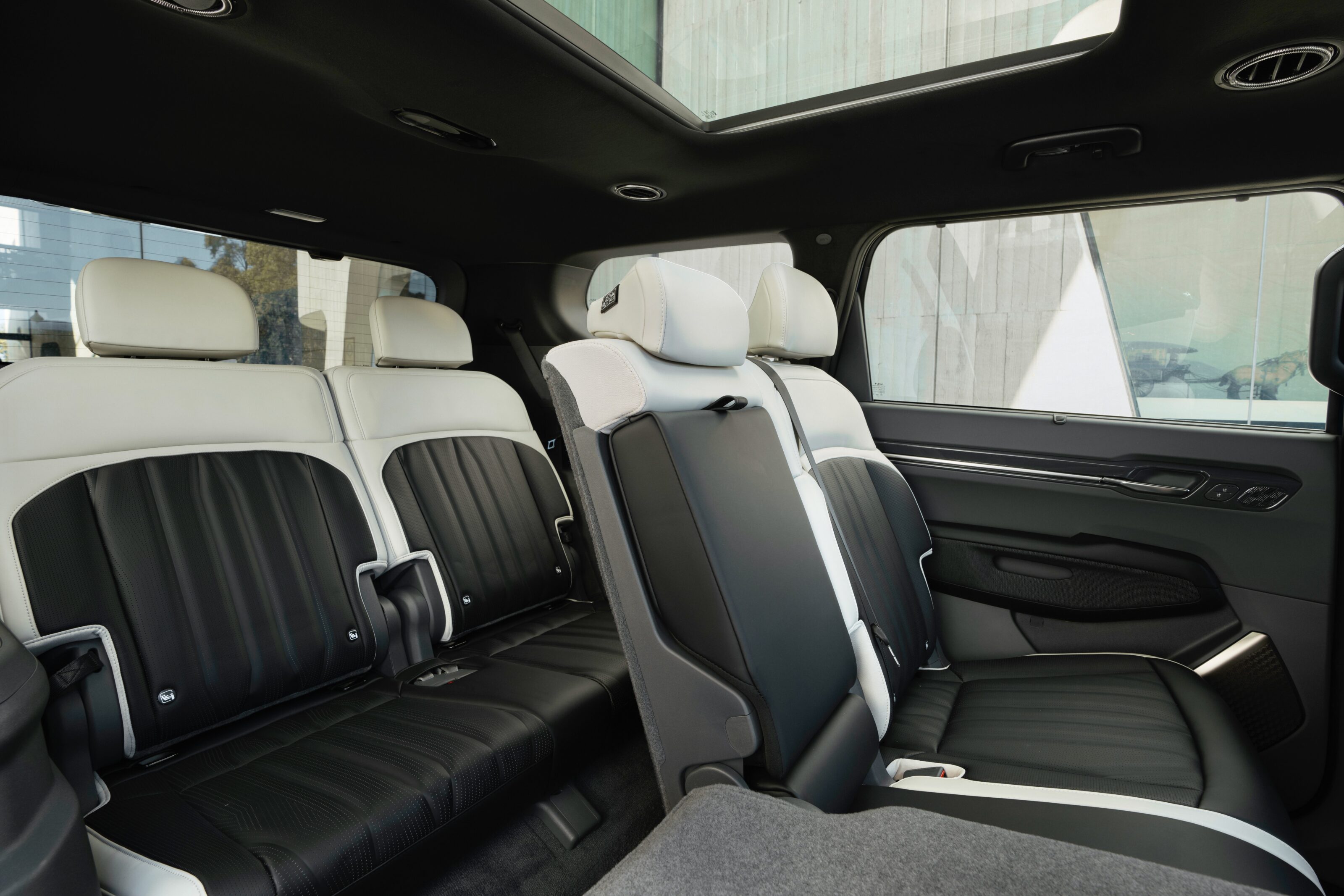
The second row of the EV9 is one of the best on the new car market, with plenty of space for three adults. Even in the base Air, features on offer are impressive with charging ports, a third climate zone, map pockets, door pockets and a sliding tray for storage.
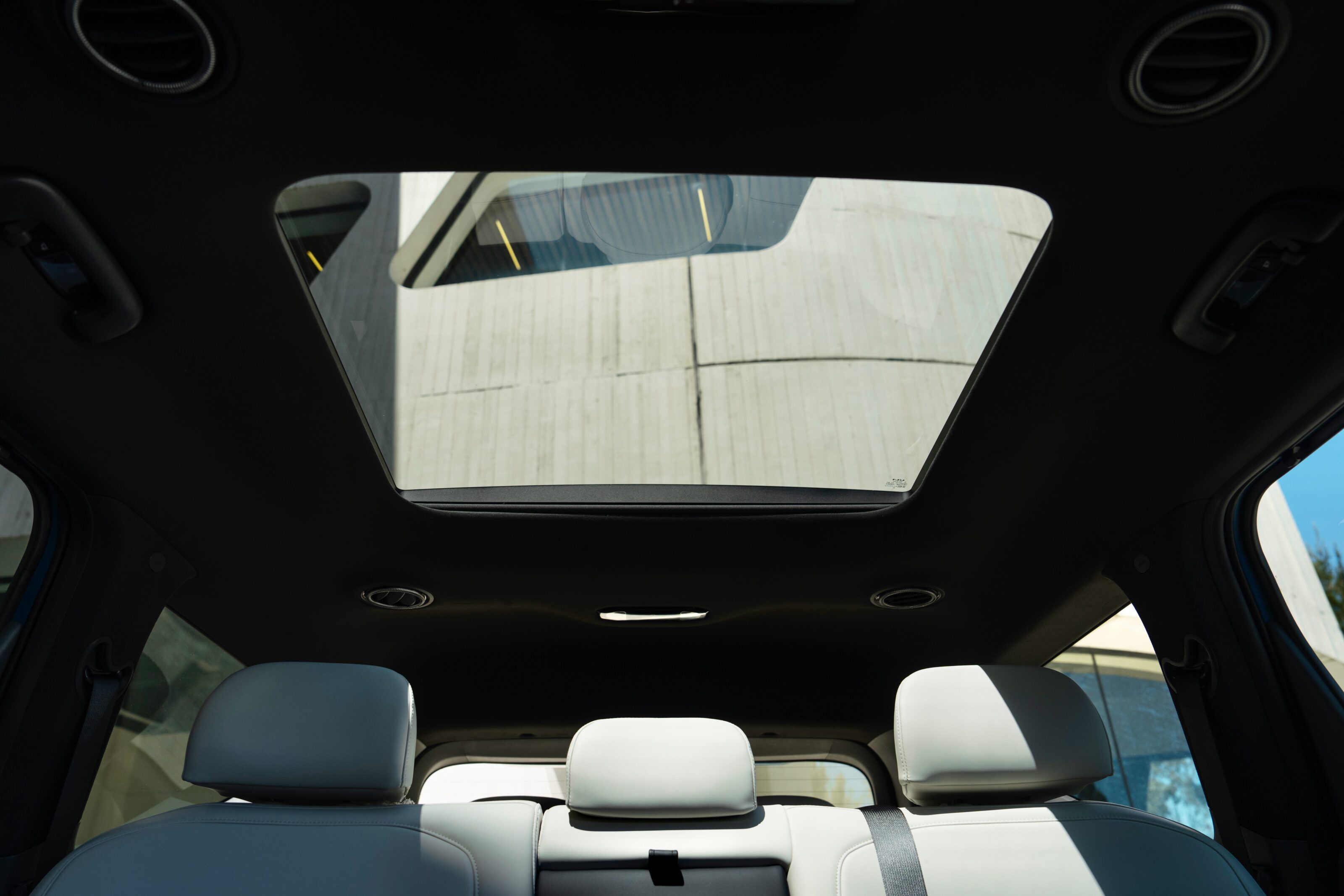
Jump up to the GT-Line and a sunroof, heated and ventilated outboard seats and sunshades also feature. Sliding the middle row forward is easy thanks to a button on the seat, moving forward and up to give access to those entering the third row.
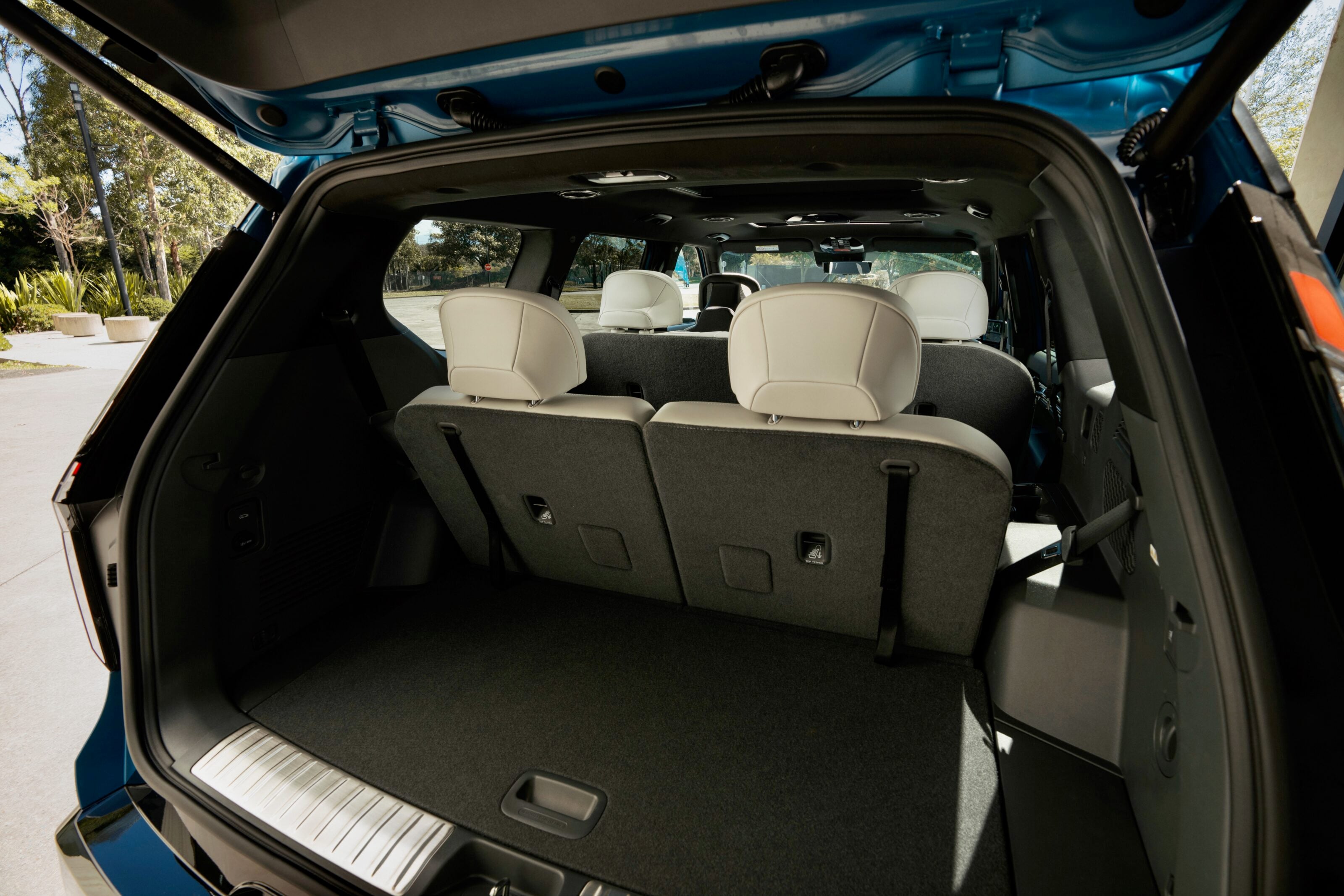
The third row of seating in the EV9 is large for a seven-seat SUV, though not as spacious as its Carnival sibling. Two adults will be quite comfortable, and the large windows – and sunroof in the GT-Line – make it feel airy. There are also air vents, USB-C charging ports and cup holders.
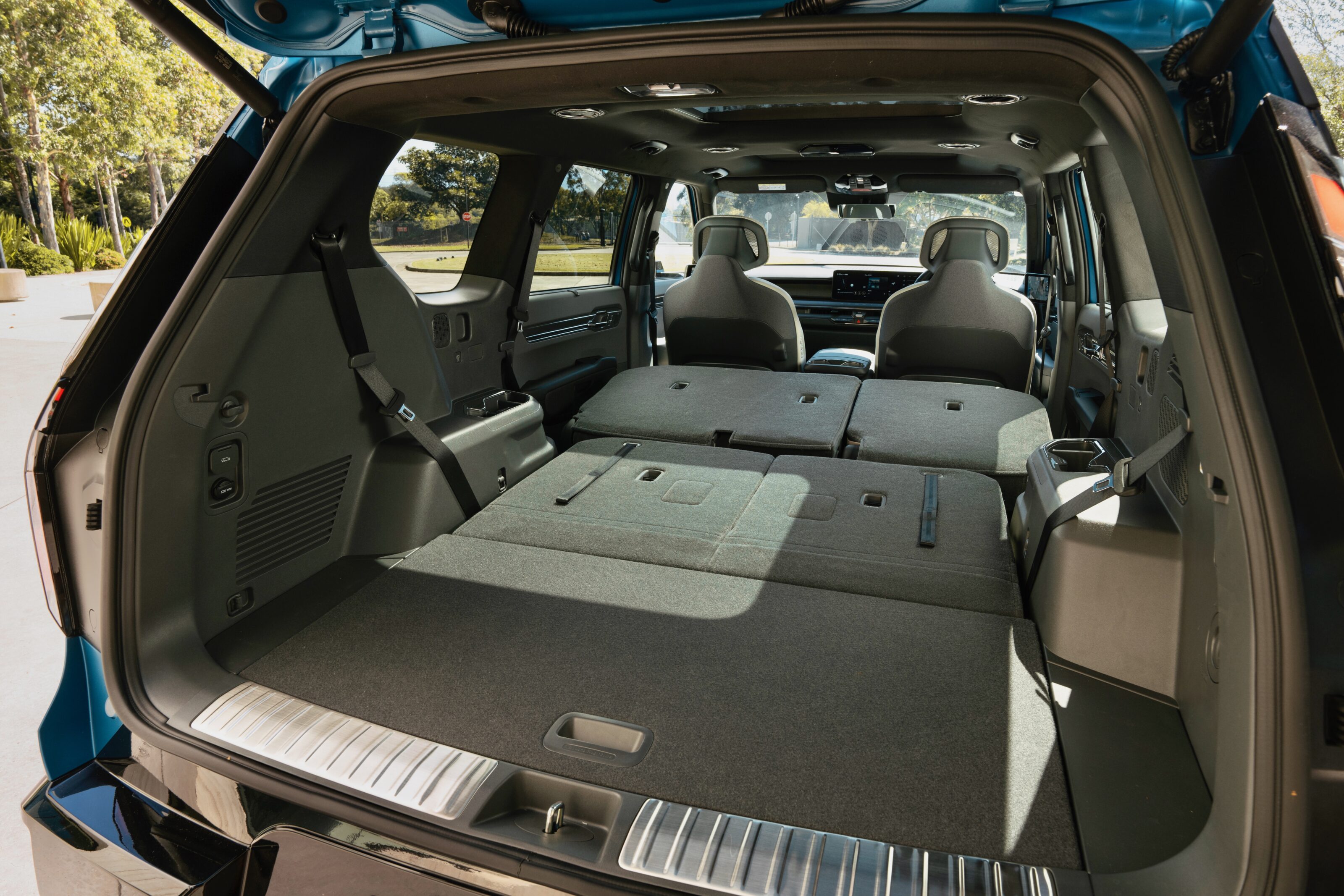
Behind the third row of seating is 333 litres of space, which opens up to 828L with the third row of seats folded and a huge 2318L with the second row folded as well. As you’d expect for such a gargantuan vehicle, it’s a massive space and is even more impressive considering that it’s got a battery underneath to further complicate packaging. Open the bonnet and there’s a big 90-litre front boot (52L in the Earth and GT-Line) as well, though no EV9 features a spare wheel.
Service and warranty
As with all other new Kia products, the EV9 is covered by a seven-year/unlimited warranty with up
to eight years of roadside assistance.
The battery is covered by a seven-year/150,000km warranty and a five-year/75,000km service plan
costs $1351 ($270 each year).
Verdict: should I buy a Kia EV9?
If you’re after a large seven-seat electric SUV, your choices are currently limited in Australia, meaning the Kia EV9 is a great option that acts exactly as you’d expect of a modern Kia product. It’s huge but also very practical, the interior is spacious, it drives well, its charging speeds are some of the fastest in the industry and it’s loaded with equipment.
To consider is that the EV9’s is that its’s size can be a bit intimidating, the camera mirrors in the GT-Line just aren’t as useful as regular mirrors, and that even for the base Air, it will be over $100,000 once it’s driven out of the dealership. In all other respects, the EV9 is a great product for those who need space and more space.
Kia EV9 rivals
Hyundai Ioniq 9
Volkswagen ID. Buzz
Toyota has released a fresh batch of teaser images offering the most revealing look yet at what appears to be the next-generation RAV4, ahead of its official debut set for May 20. The company also shared a livestream link for the world premiere, fueling anticipation around its best-selling SUV.
While Toyota stops short of confirming this is the new RAV4, the teaser shots show a vehicle bearing strong resemblance to camouflaged prototypes spotted earlier this year in the US.
The test models featured what seemed to be a production-ready body with C-shaped headlights, a more upright stance, and a slightly larger footprint – possibly hinting at improved interior space and cargo capacity.

The teaser campaign includes dynamic aerial views of the vehicle traversing snowy landscapes, winding roads, and suburban streets. Toyota describes the model as ready for “urban streets to outdoor retreats,” though the name RAV4 is notably absent from the promotional material.
Introducing a sixth generation of the current model is a high-stakes move.
In Australia the RAV4 is the best selling car in Australia in latest figures to the end of April 2025, with 17,610 units sold, marginally ahead of the Ford Ranger (17,257) and Toyota Hilux (15,120).

In the US, meanwhile, it sold over 475,000 units last year – a 9.3 per cent increase – making the compact crossover America’s best-selling SUV for the eighth consecutive year.
Under the hood, hybrid and plug-in hybrid versions are expected to return, though it remains unclear if the base petrol variant will be dropped. If so, the RAV4’s starting price could climb above the current hybrid’s $33,695.
Production plans also remain under wraps, but reports in the US suggest Toyota may continue building the RAV4 there to avoid tariffs. If true, production at Toyota’s Kentucky plant could begin as late as 2027, with the new model arriving stateside by the 2026 model year. Australian deliveries are yet to be confirmed.

Last year the model passed 500,000 customer deliveries in Australia, and marked 30 years since its introduction down under.
Official sales figures reveal RAV4 reached a cumulative total of 501,546 local sales to the end of June 2024, following its introduction in July 1994. The model is credited with beginning the SUV revolution in the new car market.
“Customer demand has never been higher for RAV4 because it delivers a winning formula that combines SUV fun and adventure with passenger-car ride, handling and economy – just as it’s done for three decades,” said Sean Hanley, Toyota Australia Vice President Sales, Marketing & Franchise Operations, last year.
“RAV4 enters honoured company in reaching 500,000 sales in Australia, joining other Toyota icons in Corolla, HiLux, LandCruiser and Camry – all of which have now exceeded one million sales.”
When Tesla unveiled the Cybertruck in 2019, it was pitched as a game-changing, all-electric pick-up designed to redefine utility and design. With over 250,000 units planned for annual production, the expectations were nothing short of astronomical.
But in 2025, the reality looks grim. Over 10,000 Cybertrucks remain unsold in U.S. lots – amounting to nearly $800 million in inventory. Once a symbol of innovation, the Cybertruck now symbolizes Tesla’s waning influence and deepening troubles.
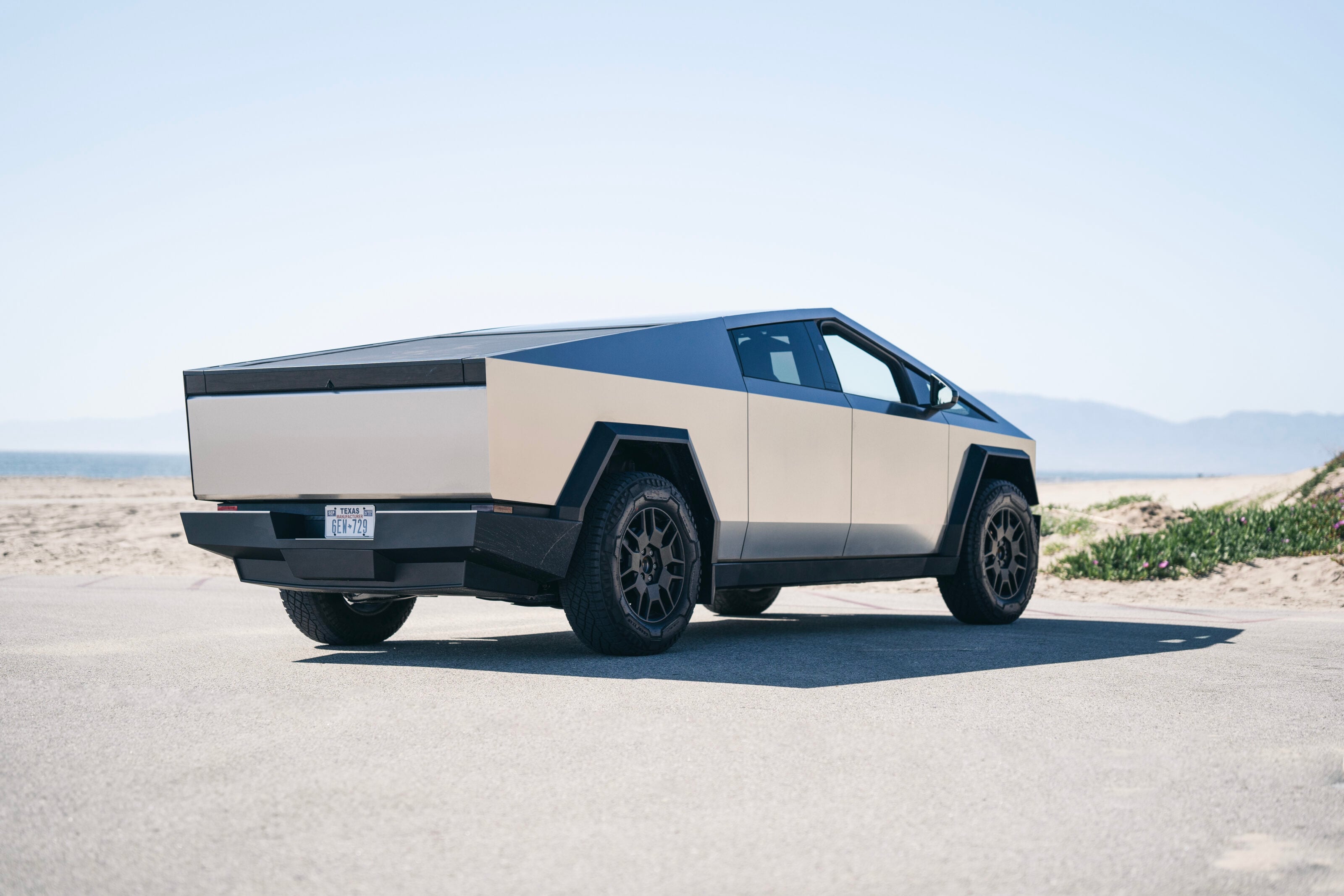
Several factors are converging to bring the Cybertruck – and Tesla itself – to a standstill. Elon Musk’s increasingly controversial political affiliations, including open support for Donald Trump and Germany’s far-right AfD party, have alienated large portions of the consumer base. Combined with erratic behavior involving cryptocurrencies like DOGE, Musk’s persona has turned from visionary to volatile, tarnishing Tesla’s once-untouchable brand image. As a result, sales are faltering worldwide, prompting serious discussions in major outlets about Tesla’s long-term viability.
International sales figures are stark. In the Netherlands, Tesla sales plummeted 75 per cent compared with April 2024, while the U.K. saw a 62 per cent decline. Germany, once receptive to Tesla’s gigafactory dreams, is seeing the brand lose ground to BYD and VW.
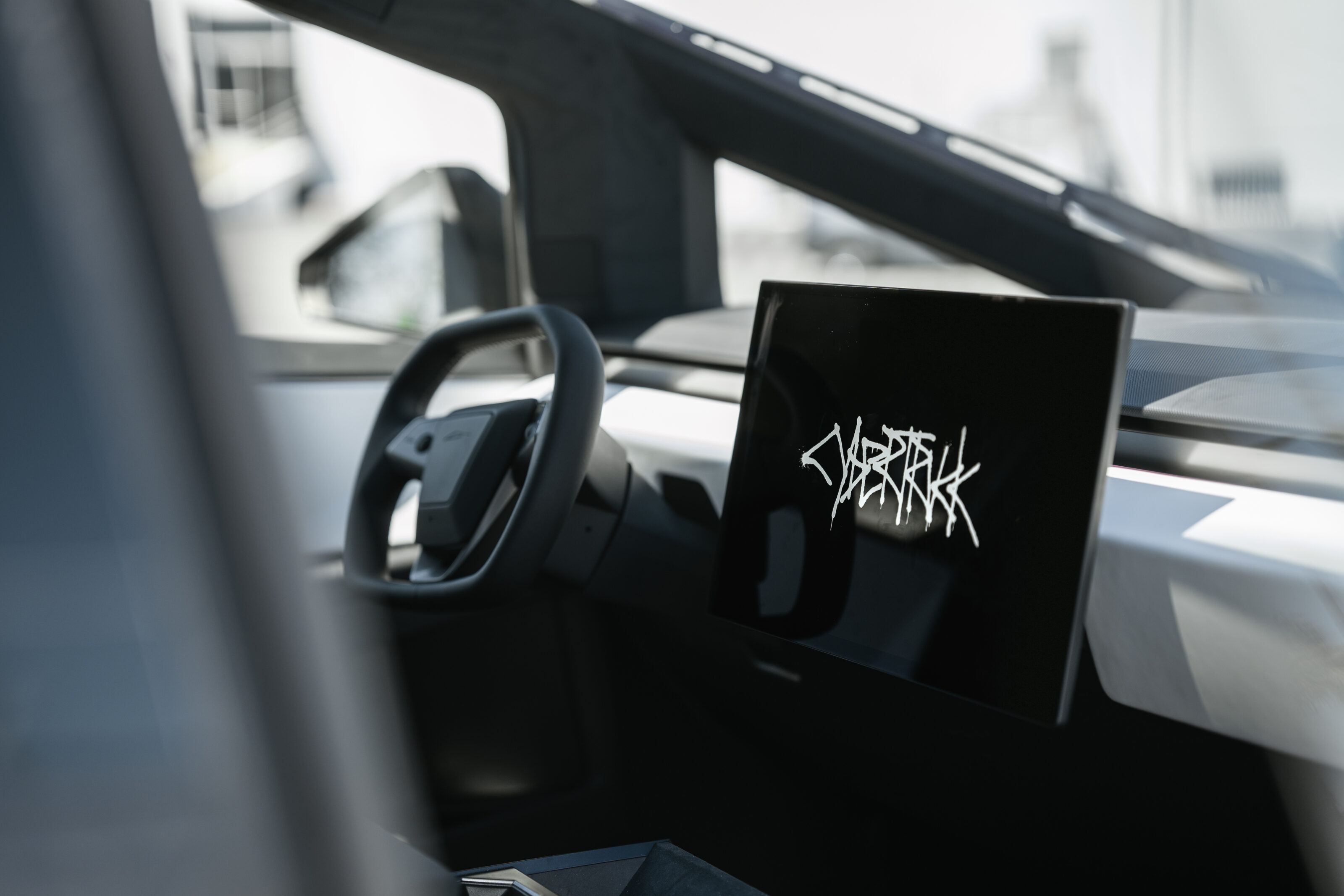
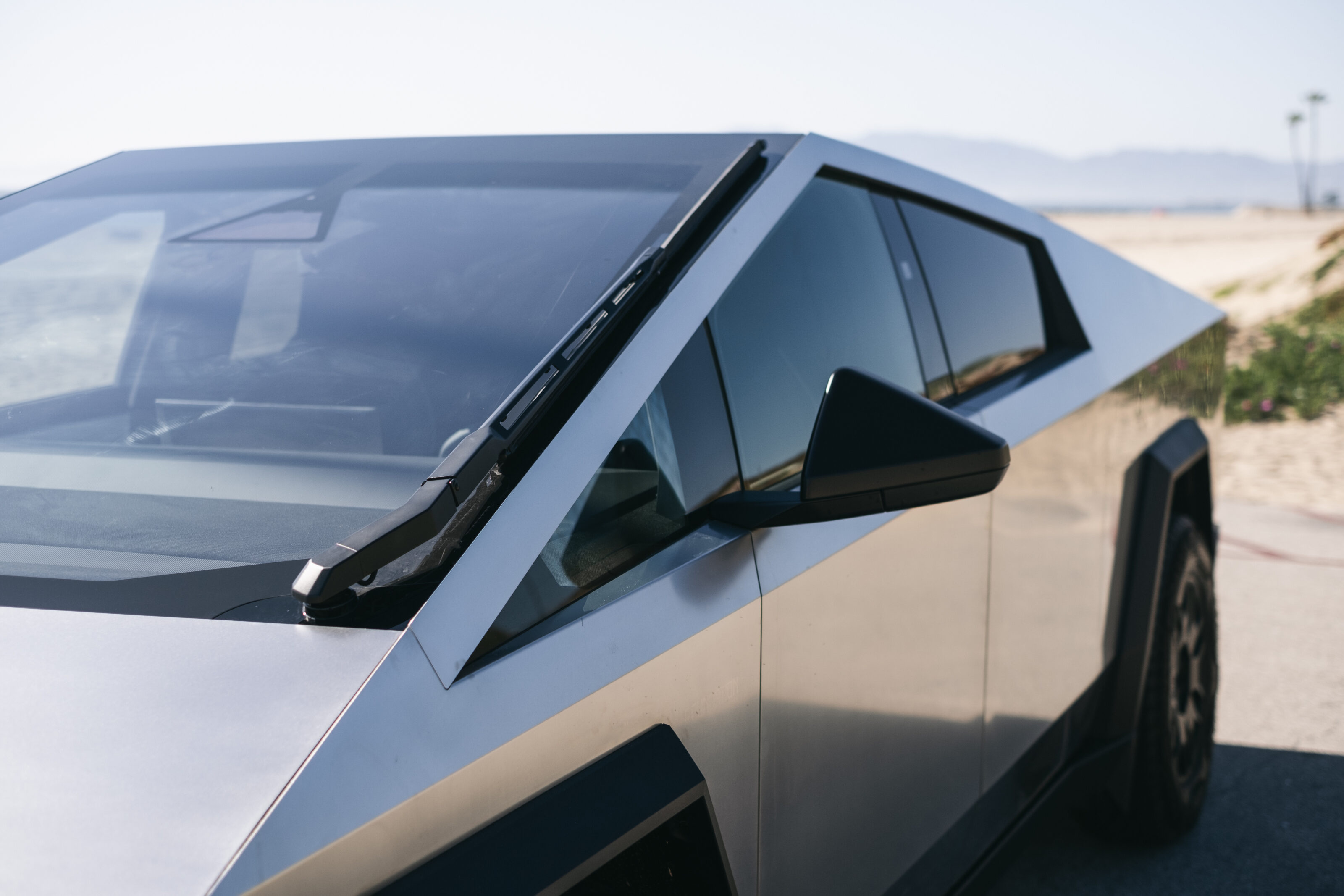
In a symbolic blow, a privately imported Cybertruck was even impounded in Britain, reinforcing regulatory and design concerns – its size, weight, and sharp exterior edges were flagged as safety issues. Even in China, Tesla’s most vital international market, year-over-year sales have dipped 6 per cent – a worrying trend given the country’s size and importance.
Domestically, Tesla hoped the facelifted Model Y would reverse its fortunes. Instead, it’s gathering dust on dealer lots. The Launch Edition failed to generate the expected hype, and anti-Musk sentiment continues to dampen demand.
Compounding Tesla’s challenges is fierce competition. The Kia EV3 undercuts the Model 3 in price and offers superior interior quality and comparable charging speed. Others have opted for cheaper, better-specced cars such as the XPeng G6. Chinese EV manufacturers have reverse-engineered Tesla vehicles and delivered better performance and value at lower prices.
In Australia, Tesla’s Model Y was most recently bested by the BYD Sealion 7 as Australia’s best-selling EV. The brand has recently launched two variants of the Model Y – a Rear-Wheel Drive and Long Rang AWD – as part of its ‘Juniper’ refresh, with deliveries beginning this month.
The Cybertruck’s design missteps, regulatory hurdles, and poor reception are just the tip of the iceberg. Unless Tesla swiftly confronts its price-quality gap and distances itself from the divisive antics of its CEO, the company risks ceding the EV crown to more agile, consumer-focused rivals. The Cybertruck isn’t just a sales disappointment – it’s a warning sign.
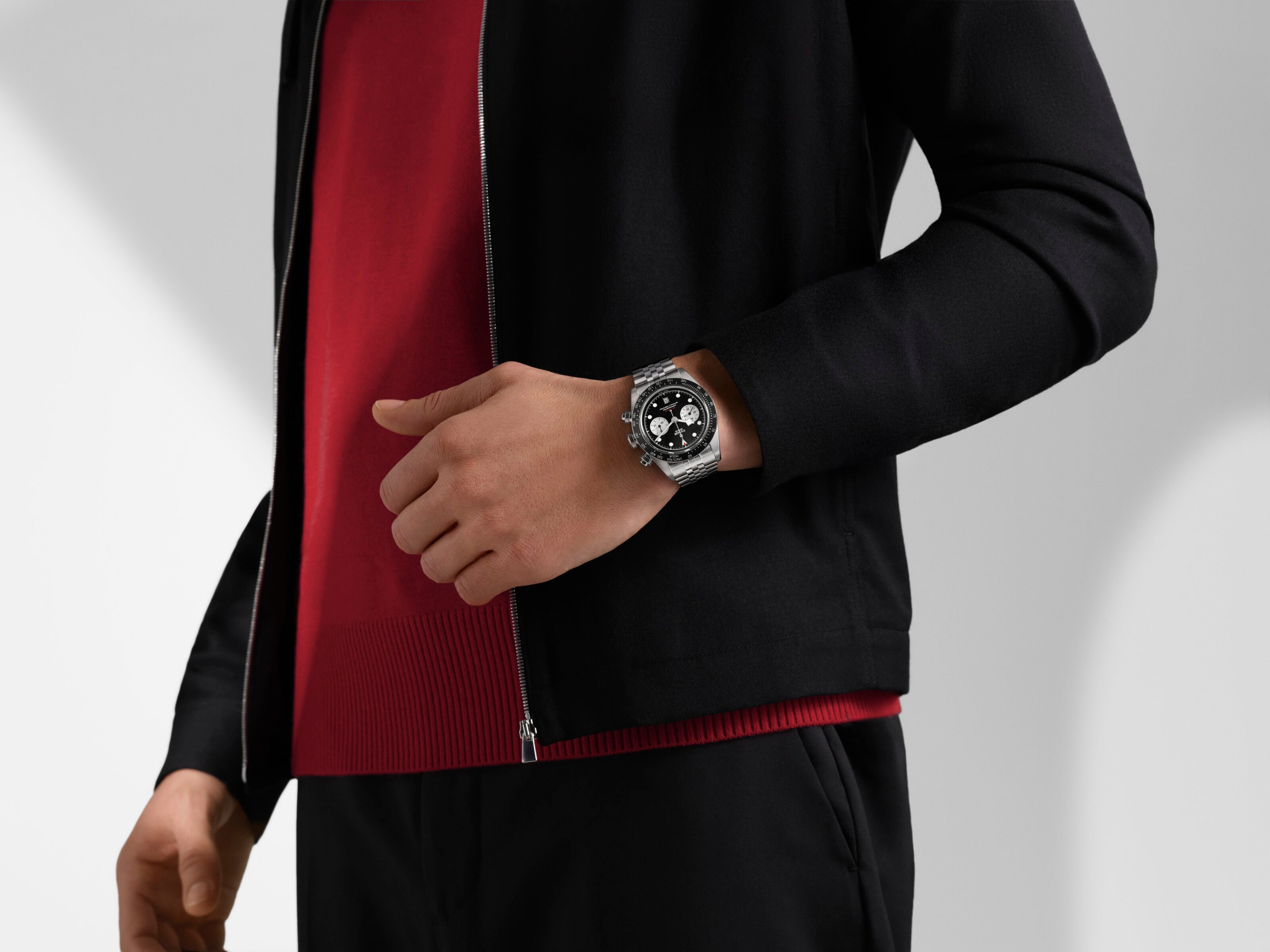
The Black Bay Chrono brings together some of the brand’s finest traditions – sporty appeal, rugged wear and reliable timing performance – now with an updated model.
Marking five decades since the introduction of its Oysterdate chronograph in 1970, the revised Black Bay Chrono model in steel features a reworked case with two dial options and a stylish 3-link or 5-link bracelet, both with ‘T-Fi’ clasp.
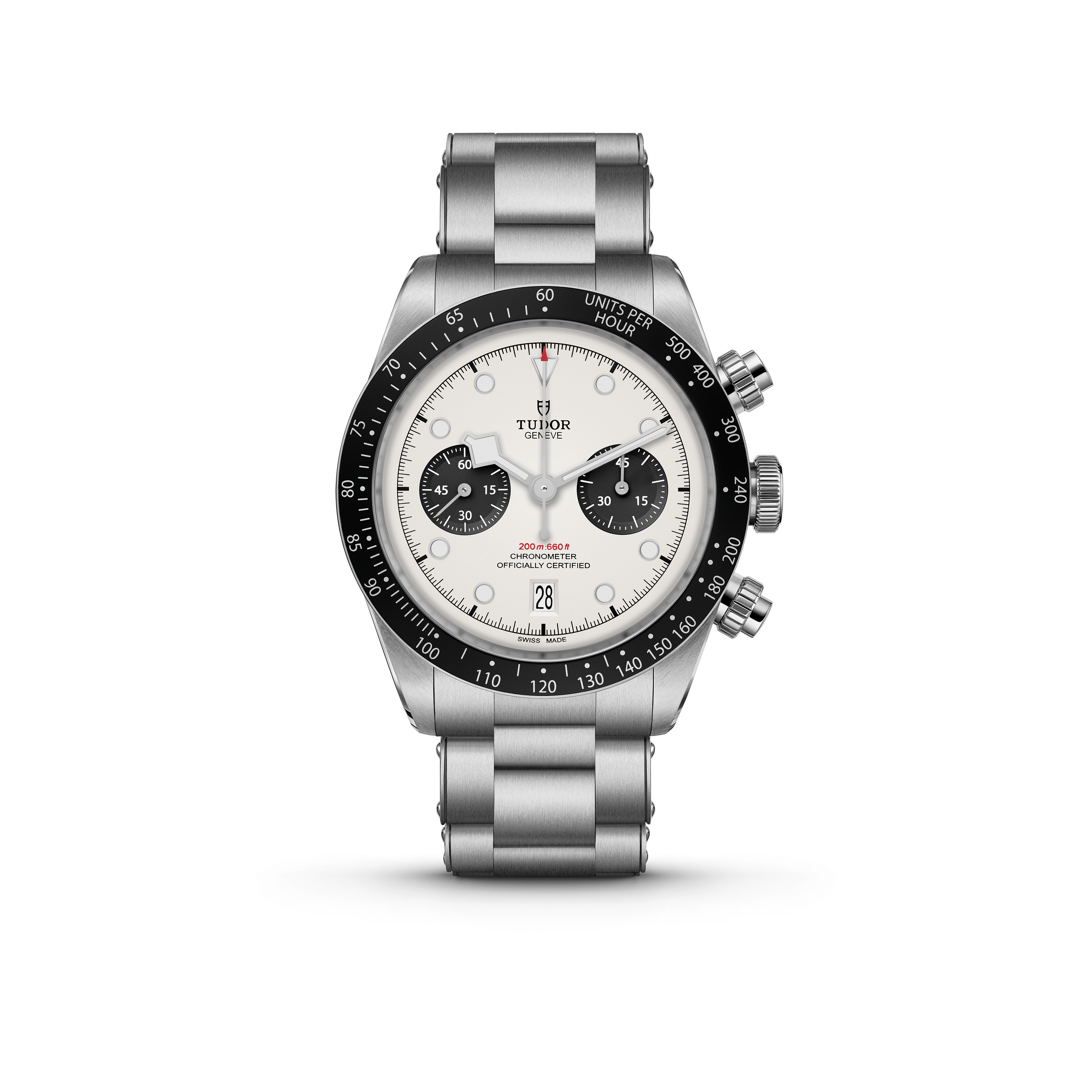
Inspired by that first generation of chronographs, the new model is available in two 41mm steel case versions – matt black or opaline – with two hollowed sub-counters in contrasting colours on the dial to maximise legibility. A 45-minute counter and a date aperture positioned at 6 o’clock, stainless steel pushers and fixed bezel in stainless steel with a tachymetric scale insert in black anodised aluminium are all nods to the earlier designs.
A signature of the Black Bay style is the famous ‘Snowflake’ hands, crafted here to ensure optimum readability under the domed dial.
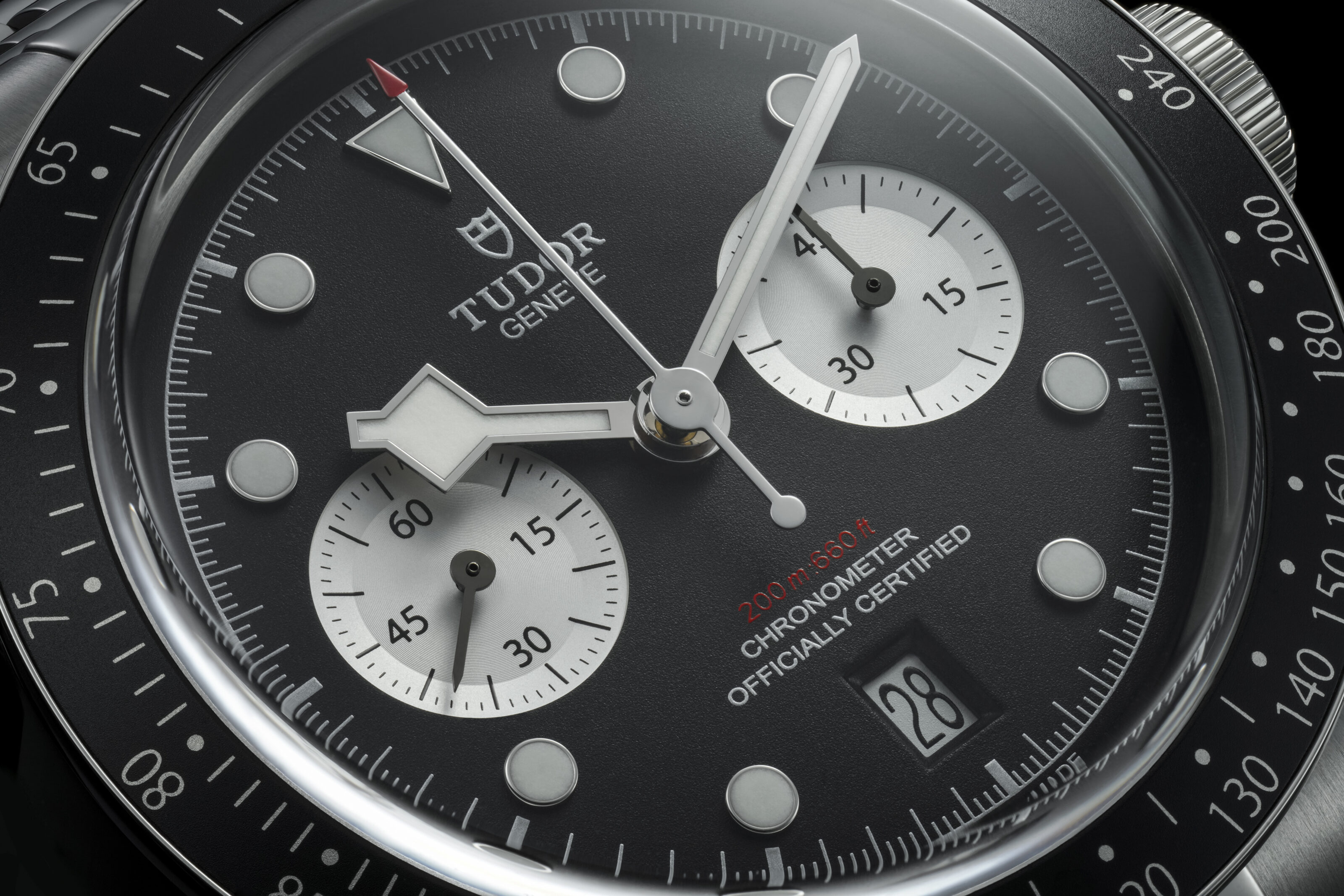
The heritage inspiration extends to the beautiful 5-link stainless steel bracelet or 3-link stainless steel ‘rivet style; bracelet, inspired by the folding riveted bracelets made by the brand in the 1950s and ’60s. These were famous for their stepped construction and having rivet heads for attaching the links, visible on the side of the bracelet. Both bracelets feature TUDOR’s ‘T-fit’ rapid adjustment clasp, allowing the wearer to carry out a fine, instant adjustment of the total length of the bracelet along an adjustment window of 8mm. The clasp also features ceramic ball bearings that ensure a smooth and secure closure in addition to adding a pleasing tactile element to the action of the clasp.
Powering the Chrono is the Manufacture Chronograph Calibre MT5813, certified by the Official Swiss Chronometer Testing Institute (COSC) and with a silicon balance spring, 70-hour power reserve, a column wheel construction and vertical clutch. Where COSC allows an average variation in the daily rate of an uncased movement of between -4/+6 seconds’ variation per day, Tudor says it applies a -2/+4 seconds’ variation standard on the completely assembled watch.
Tudor’s art is to arm its retro-inspired timepieces with tech and styling improvements with each new iteration, and that mission is successfully achieved with the new Black Bay Chrono.
You could see the mild panic in their eyes.
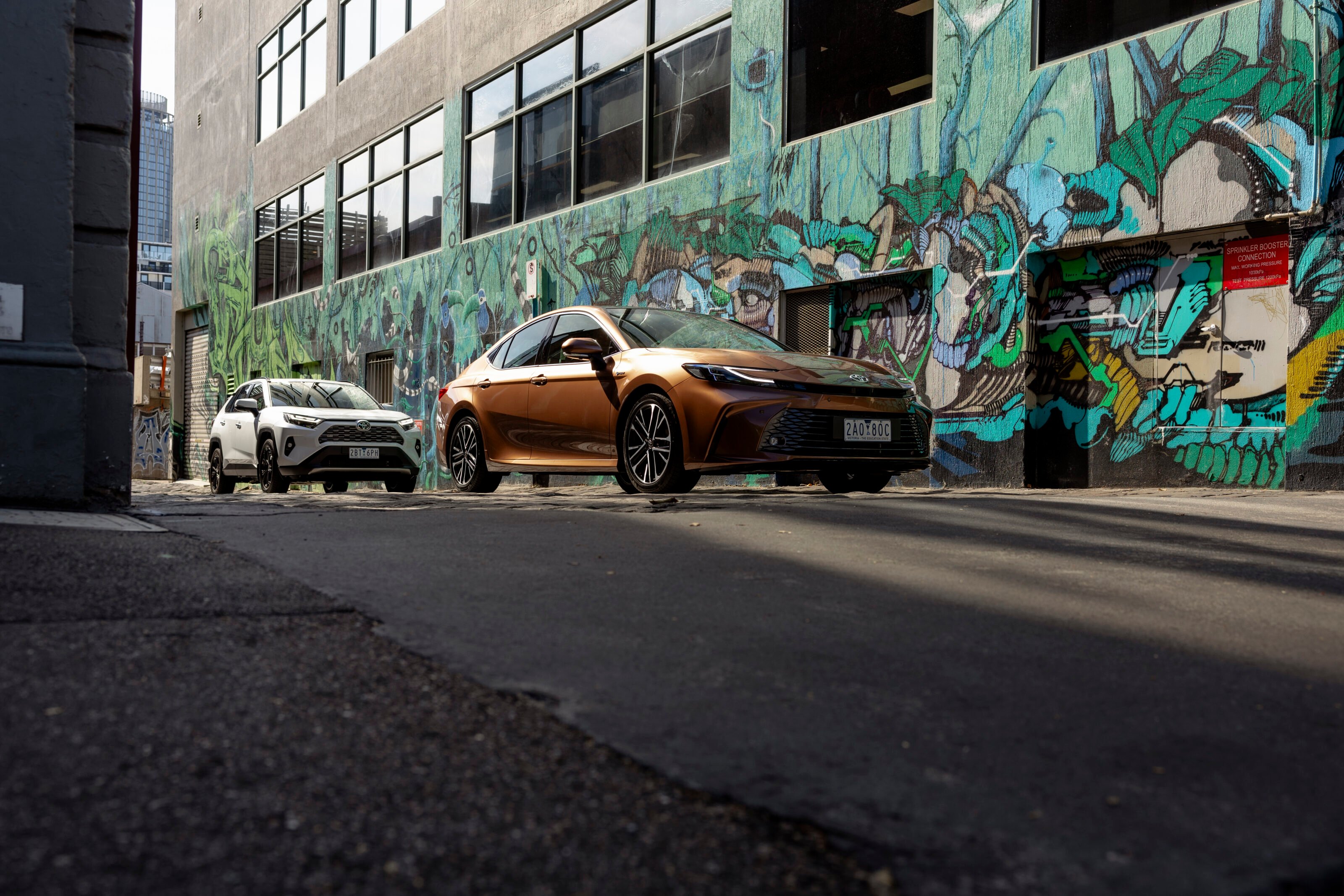
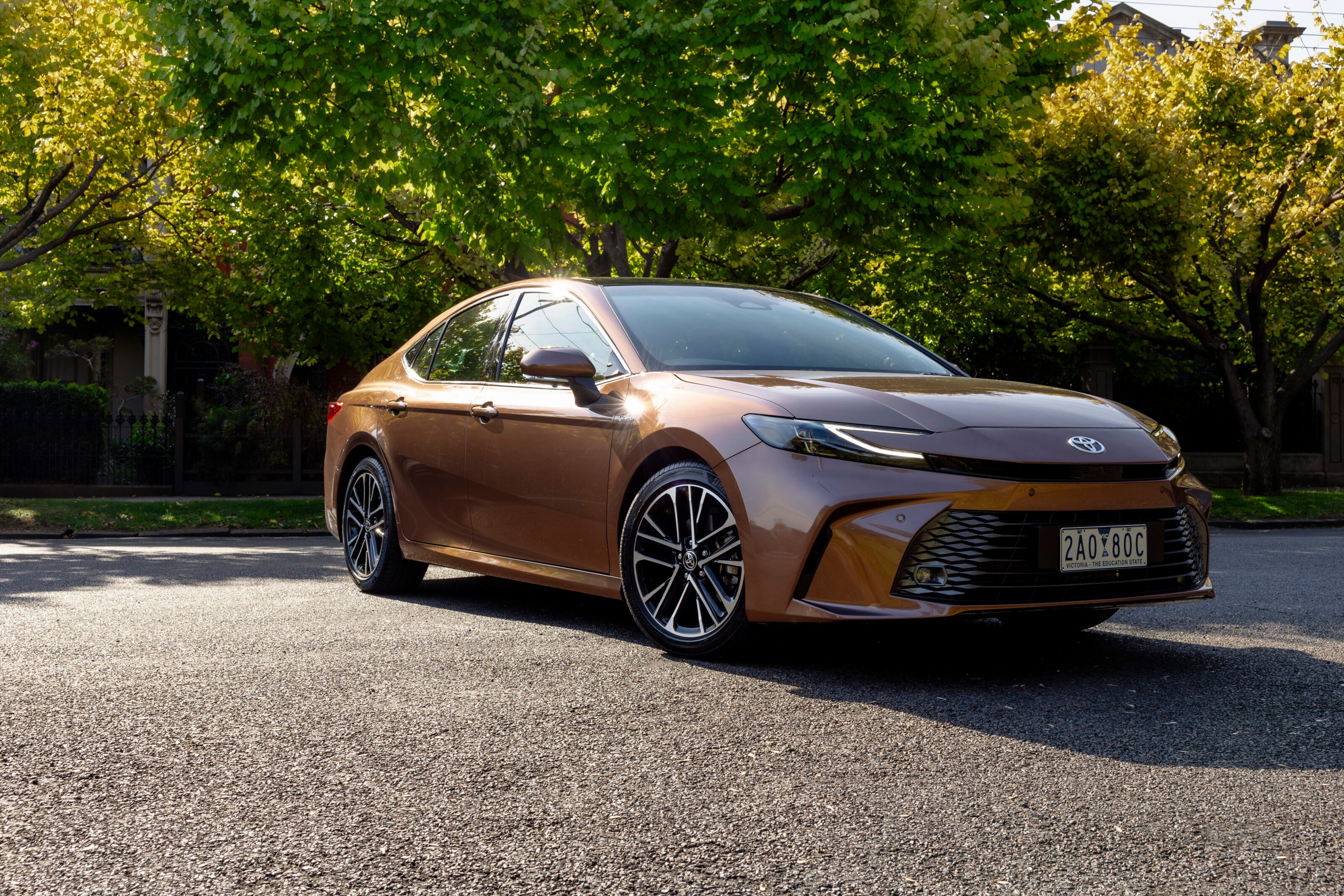
What was assured confidence was giving way to creeping doubt. The current and ex-editors who formed the Wheels Car Of The Year 2024 jury were, at the cull of the three finalists, reasonably sure that the hugely exciting Hyundai Ioniq 5 N was going to win, and by some margin. Then, after the final round of drives, you could see chinks in the armour.
As judge after judge climbed out of the Toyota Camry and heaped praise upon it, maybe COTY wasn’t such a done deal after all. “Who needs a Lexus?”, asked Peter Robinson, impressed by the big sedan’s sophistication and value. I wasn’t too worried about the Camry winning. After all, when the final three were an EV, a family SUV and a Camry, whatever happened there were going to be some spittle-flecked detractors. It’s just what happens at COTY where only one vehicle can win. In the end, the Ioniq did enough to snag the win, but make no mistake, the unprepossessing Camry was the car that had shifted itself furthest against the expectations of this experienced jury.
I was reminded of COTY 2020 when the Toyota RAV4 kept creeping through the standings. In truth, had we only judged the hybrid version, it would likely have been a finalist, but on that occasion it was let down by the 2.5-litre petrol variant dubbed by some ‘the noisy nail’. A spell in the Wheels garage only underlined what a brilliant all-rounder the RAV4 Hybrid was, and we’re far from surprised to see it claim the crown of Australia’s best-selling SUV.
But the RAV4 never made the COTY podium and the Camry did. In 2025, Toyota expects the Camry to be outsold by the RAV4 by nine units to one among private buyers in Australia. All of this raises a rather obvious question. Are we all buying the wrong car?
Brand wars
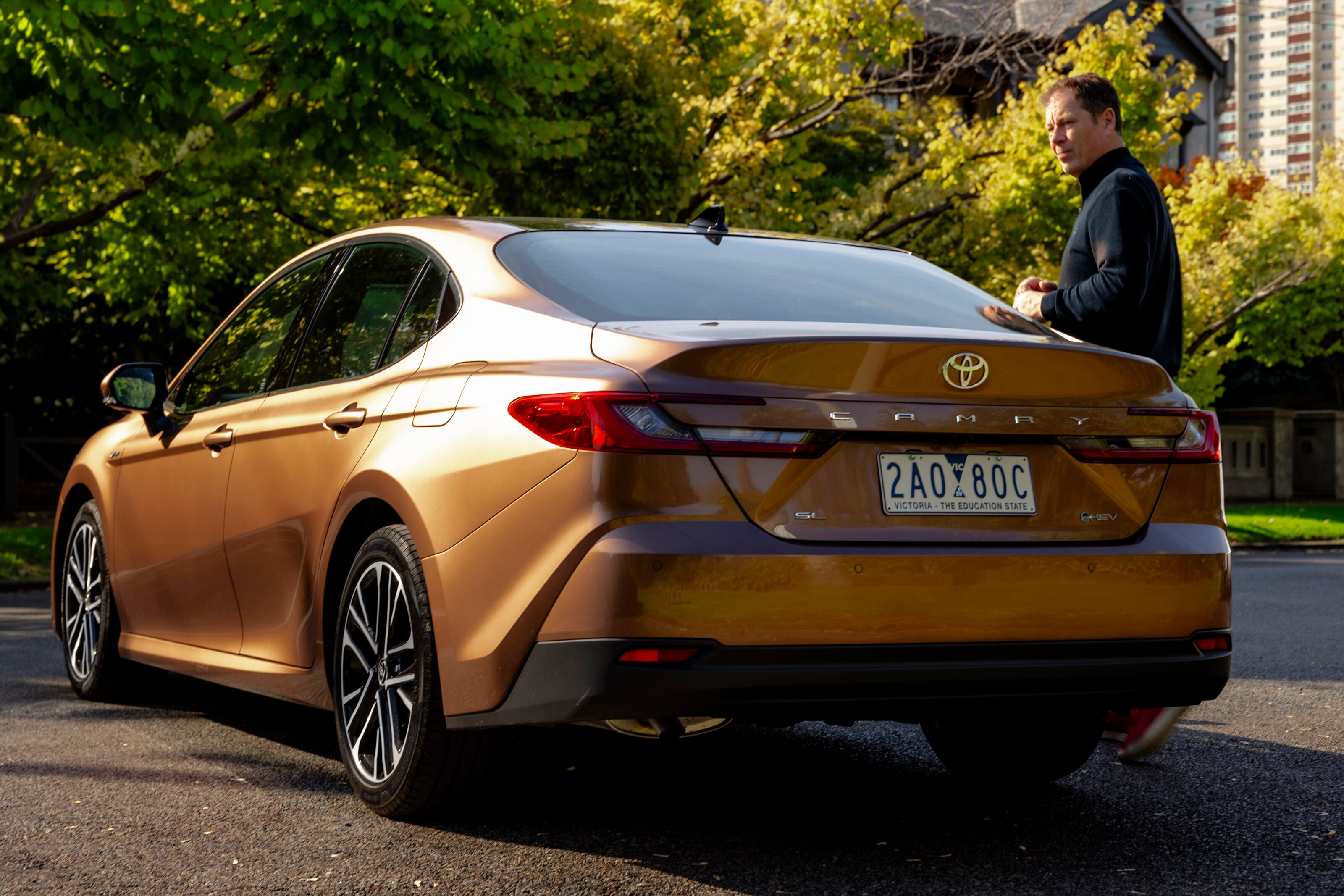
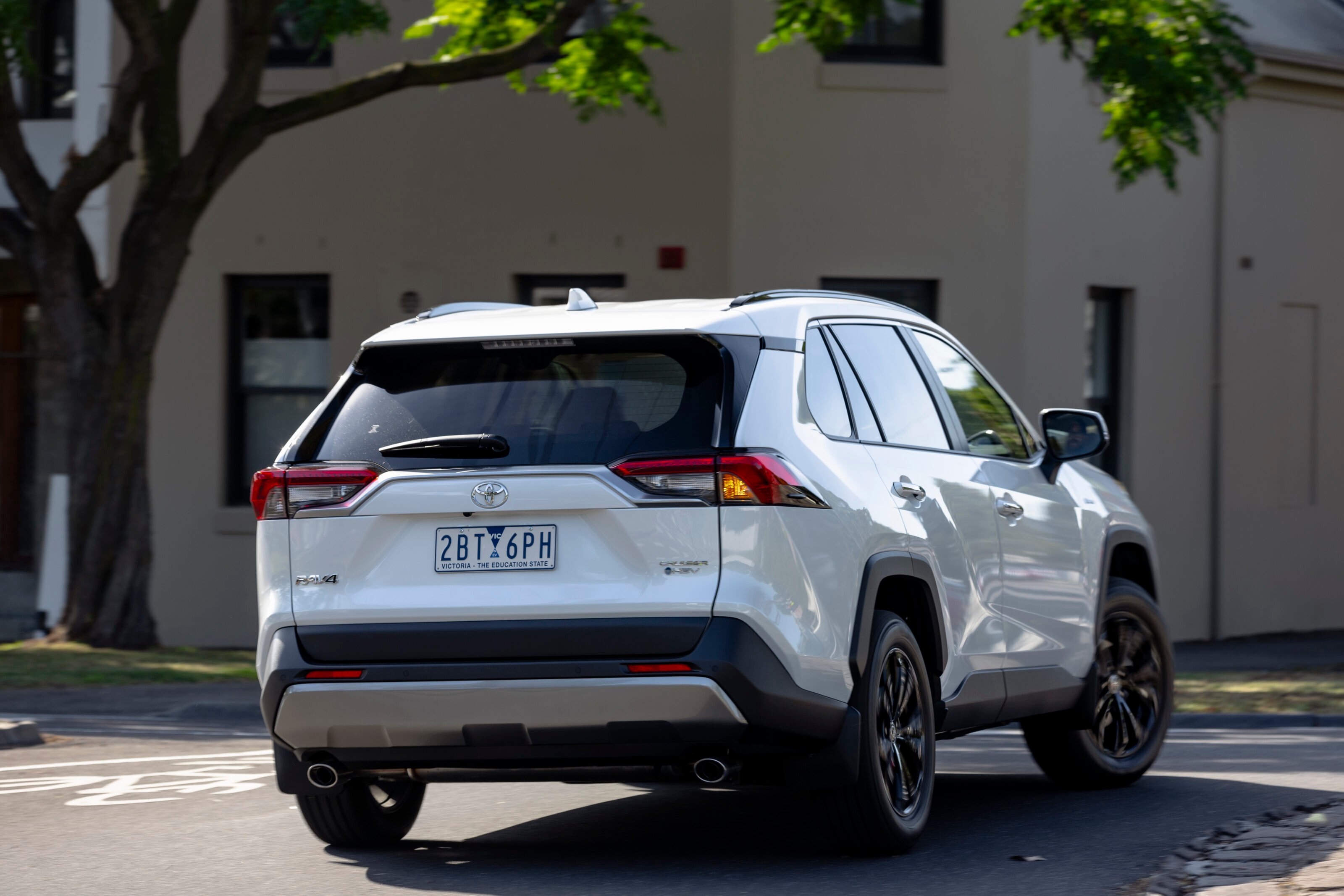
In an attempt to answer that question, we’ve put the two head to head. Representing the old school is the flagship Camry SL Hybrid, packed with kit and yours for the princely RRP of $53,990. Facing it is the more familiar face of the RAV4 Cruiser Hybrid, also front-wheel drive, and wearing a $51,410 sticker price.
The fifth-gen, or XA50, RAV4 was first shown way back in March 2018 at the New York International Auto Show, and launched locally in May 2019. It rode on a version of the TNGA-K platform as used by the existing Camry, albeit on a shorter 2690mm wheelbase versus the sedan’s rather more luxurious 2820mm measurement. It got off to a strong start, instantly establishing itself as Australia’s medium SUV of choice, selling 38,537 units in its first full year on sale in 2020. By contrast, the next-best selling rival was the Mazda CX-5, languishing way behind at 21,979 registrations.
A modest facelift followed in 2021, with new wheels and headlights fitted, but the story stayed much the same, RAV4 beating CX-5 by a hefty margin. Then things changed. Supply chain issues meant that getting hold of a RAV4 was only marginally easier than finding Lasseter’s Reef and, as a result, Toyota edged out the CX-5 by a mere 7783 units in the 2022 figures. That supply-affected theme continued into 2023 and it was only when that situation rectified in 2024 that we got to see the RAV4’s true dominance. Last year, Toyota shifted 58,718 cars, more than double the number of its nearest competitor, the Mitsubishi Outlander. Australia’s favourite SUV? You’re looking at it right here. Heck, it’s the biggest selling vehicle Down Under if you choose to exclude dual-cab utes.
It’s easy to see why the formula works. Choose a RAV4 Hybrid and you’re getting a vehicle that’s reliable, easy to drive, practical, reasonably good looking and supremely economical. It’s as close to the template of the perfect family vehicle as we’ve probably ever come across, as evidenced by its popularity. So is it reasonable to expect that track record of success to be usurped by what many will dismiss as a glorified Uber?
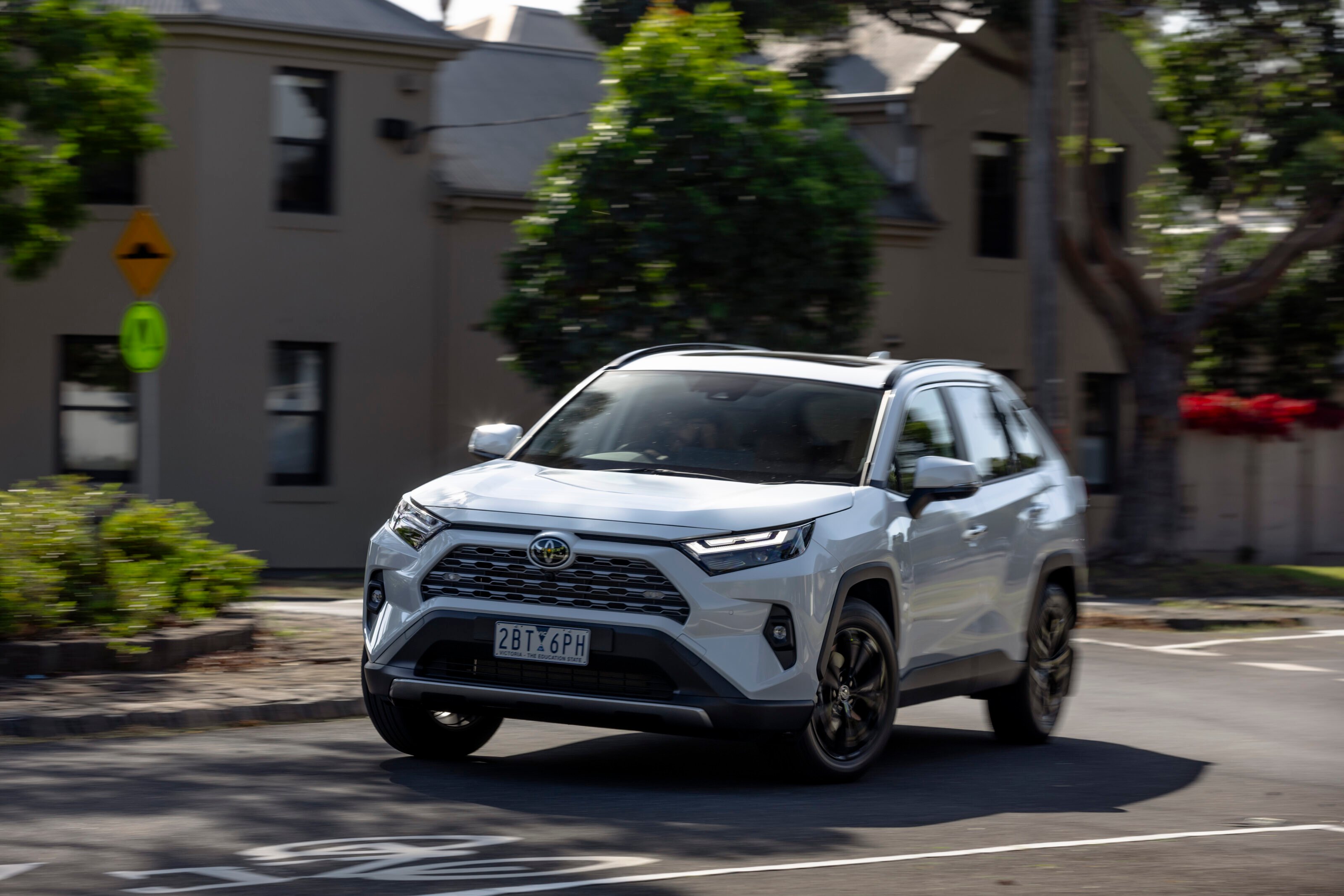
No. No, it isn’t. But here’s the thing. The RAV4 is, by today’s standards, quite an old car. It’s no great secret that a replacement is well in the works, with prototypes spotted road testing. By the time you read this magazine, it may even have been unveiled at the Shanghai show, and then it would likely be a 12-month hiatus until production modes arrive in Aussie showrooms. In other words, this car still has around a year of life left in it before it gets hooked.
By contrast, the current XV80-gen Camry is a newer and fresher thing. It is, by the strictest definition, a refresh of the previous XV70 model, with some parts such as the doors and the roof line carried over, but Toyota has gone through this ninth-gen Camry with a fanatical attention to detail, improving so much about it that it feels a very different proposition.
Aside from the fact that you can no longer buy a Camry in Japan, the big change is that there’s now no V6 option, with just one engine option – the 2.5-litre four-cylinder hybrid. Australia gets a three-car range running through Ascent, Ascent Sport and this flagship SL model. The value proposition is impressive, with the entry-level car starting at $39,990. Let’s just pause on that for a moment. Less than $40k is buying you a 170kW hybrid that’s built better than a bank vault. You’d pay $55k for a 135kW Honda Civic Hybrid. By virtually any measure, the Camry delivers a heck of a lot of bang for your buck.
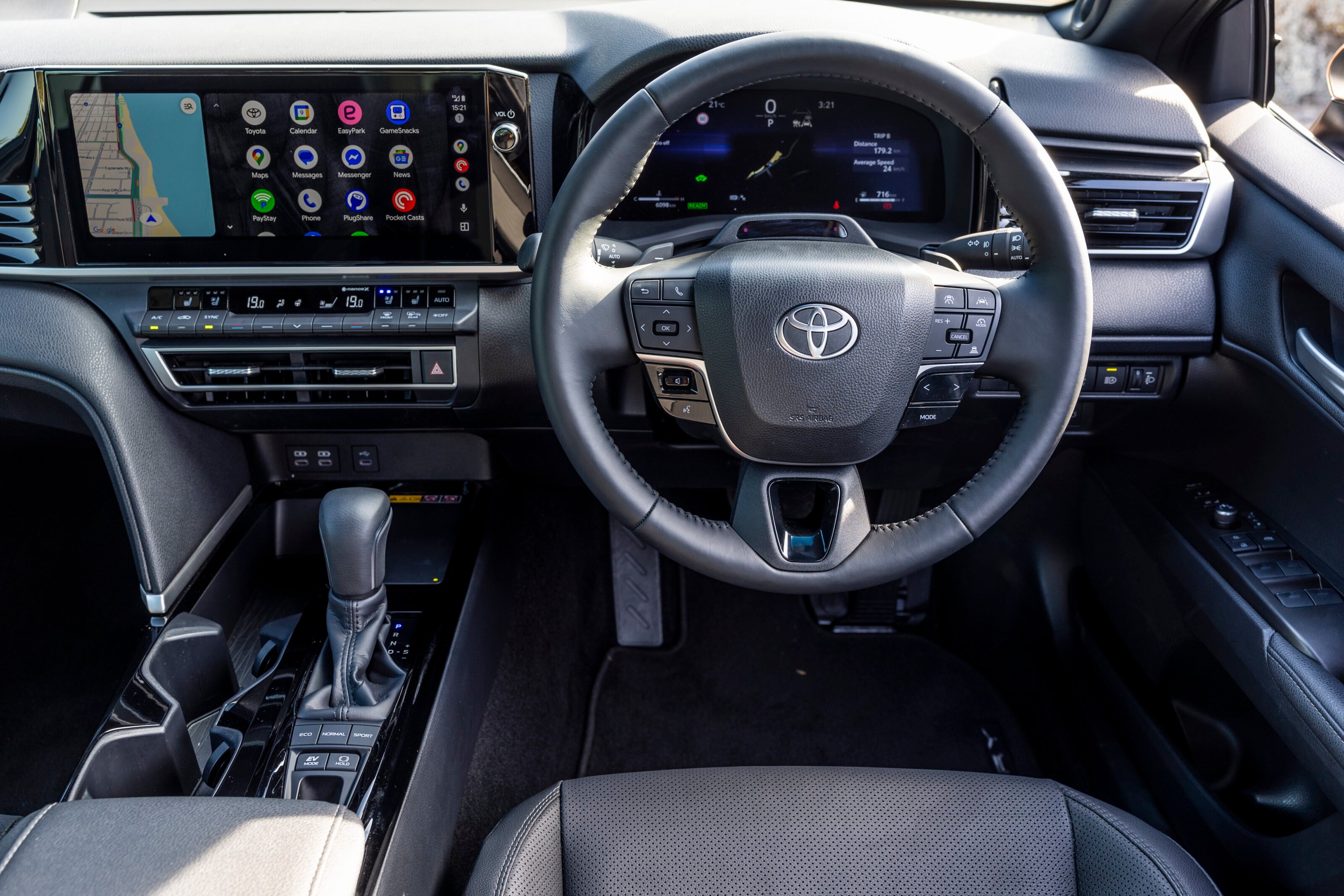
So what has Toyota done to this latest Camry to differentiate it from its predecessor? Aside from the obvious changes to the exterior styling, beneath the skin Toyota endeavoured to improve four key areas: comfort, response, efficiency and safety. There haven’t been wholesale changes to the fundamentals with the car still suspended by a pair of MacPherson struts up front with a multi-link rear end, but the bushings have been altered, and the springs and dampers tuned to reduce noise, improve body control and deliver a plusher ride.
The steering has come in for some remedial surgery, with a more rigid steering box and column for an improved response, and the software for the electric assistance has been finessed. And the braking system has been re-engineered to improve both pedal feel and control, with the transition from re-gen to friction braking now so smooth as to be almost imperceptible.
A 4.0Ah lithium-ion battery resides under the rear seats and has been treated to an improved cooling system, while the motor-generator mounted on the front axle gets six rather than three magnets. A lighter, simpler, dry-sumped transaxle features revised gearing and is bathed in lighter-grade oil for better efficiency. As a result of this suite of improvements, the Camry develops 10kW more than its predecessor yet fuel economy is improved to a claimed 4.0L/100km. On test around the city, the Camry supped 4.7L/100km with the RAV4 netting 5.9L/100km.
Inside, Toyota has striven to improve the impression of quality, although there’s still a muddle of fonts and hard plastics in the lower cabin that feels fairly mainstream. The fabric that runs across the step in the dash and the fluted passenger-side vents are a nice touch, and there’s a huge amount of oddments space, including a vast centre bin and multiple cupholders. You’re also extremely well provisioned for USB-C slots with three up front and two in the rear. I’m not a big fan of the fingerprint and scratch-prone piano black fillets around the centre console though.
This SL version gets a stack of kit thrown at it, including 18-inch alloys, leather trim for the seats, a panoramic glass roof, a digital rear-view mirror, rain-sensing wipers, a heated steering wheel, a head-up display and a nine speaker JBL stereo. It even features paddle shifters on the steering wheel, which seem superfluous in this car. While it’s nice to be in a Camry that feels so plush, I’m not sure that this is the sweet spot in the range. That’s probably the mid-spec Ascent Sport, which is 35 per cent cheaper and does without one feature that hobbles this SL version.
The dual-pane sunroof in the SL trim is a truly awful addition. Not only does it add weight and complexity, it robs you of fully nine centimetres of headroom. Had this version of the Camry been at COTY, this packaging shortfall would have likely relegated it from the top three. In the front seats, my head brushes the roof, while in the rear of the car I feel like Captain Kyphosis, so hunched am I from a lack of headroom. This wasn’t apparent in the far more accommodating Ascent Sport.
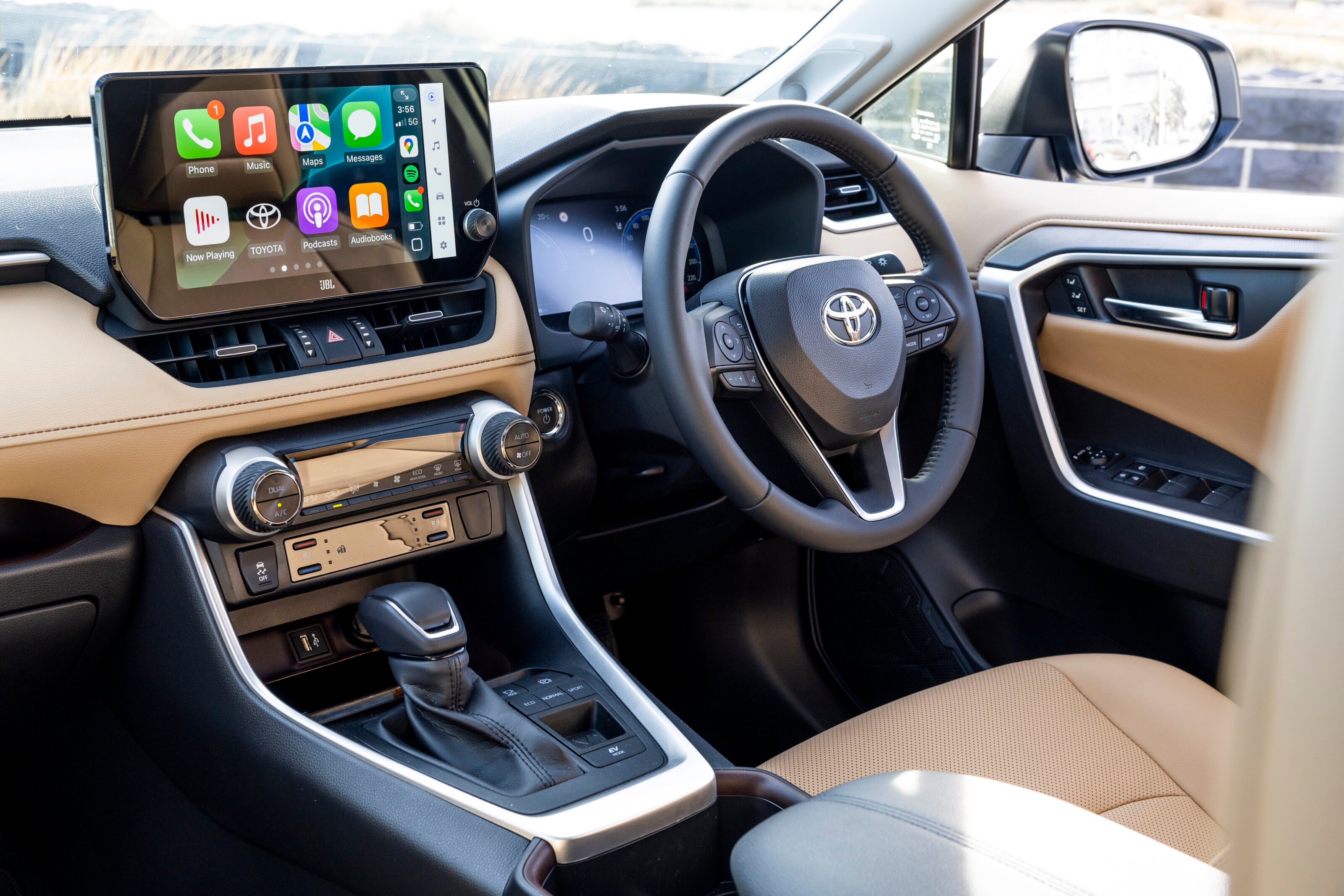
By contrast, the RAV4 feels far airier, with more headroom both front and rear. The pale leather seat trim adds to the feeling of expansiveness inside, a sharp contrast to the Camry’s unrelentingly dark interior colour palette. Taking headroom out of the equation, the Camry scores with 28mm more front leg room (1069 vs 1041mm) and a mere 5mm more rear leg room (965 vs 960mm). The rear doors also open wider than the RAV4, with a more generous foot swing area. The RAV4 counters with 18mm more rear shoulder room (1414 vs 1432mm) and squeaks ahead in front shoulder room (1465 vs 1468mm).
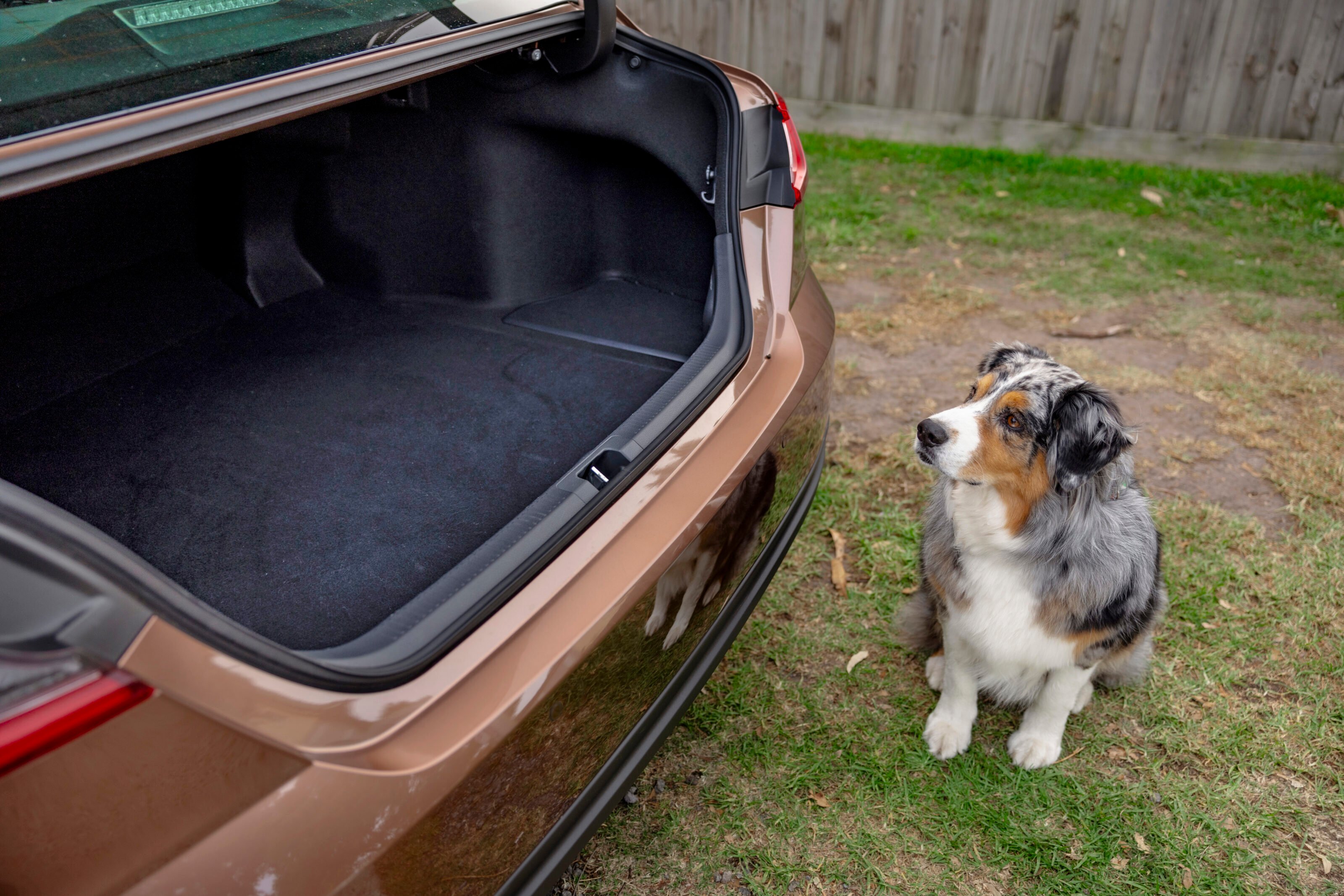
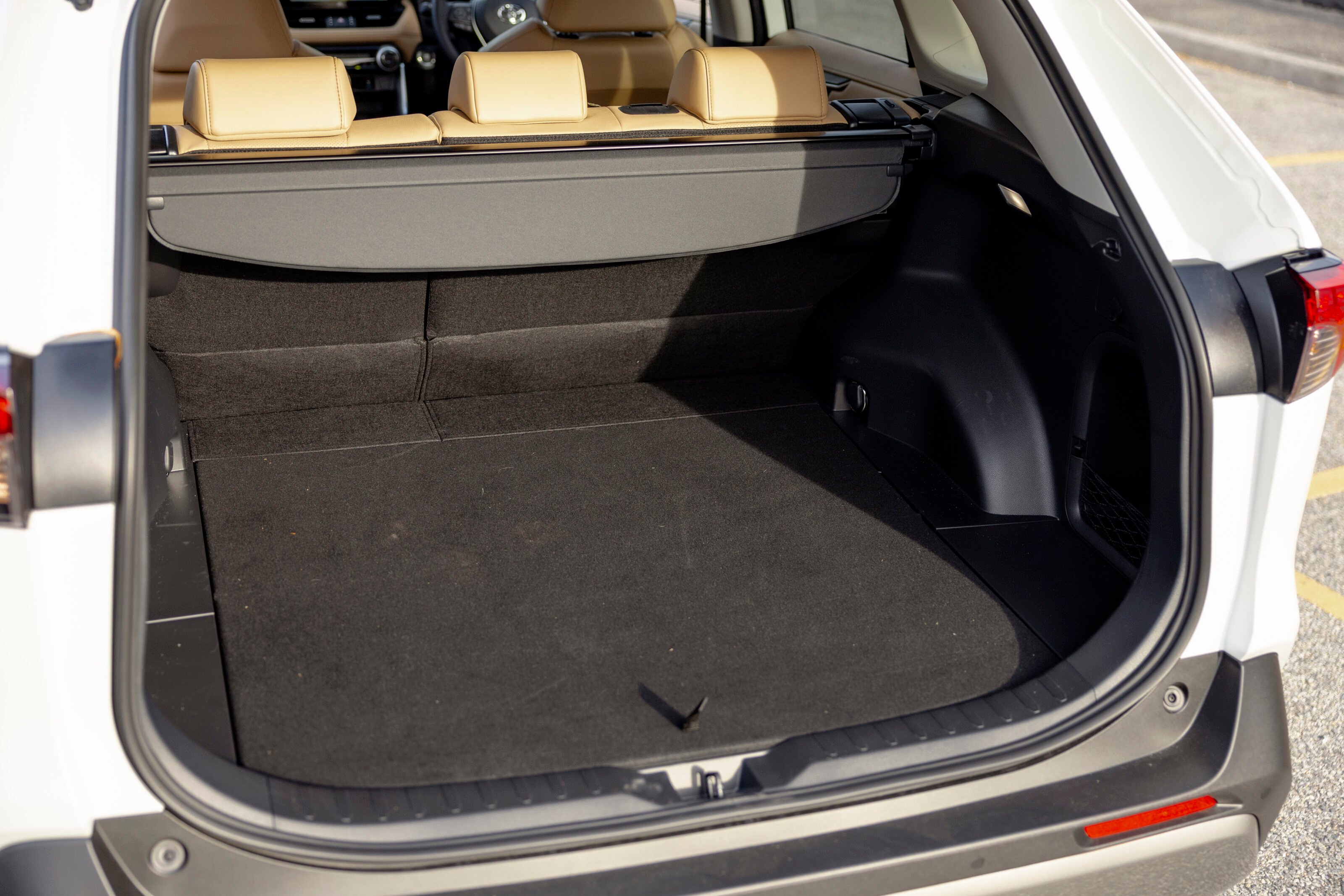
Move round to the back, and the boots aren’t too far apart in terms of carrying capacity. The Camry offers 524 litres while the RAV4 delivers 542 litres, with both offering a 60/40 split rear bench. In other words, the Camry offers 97 per cent of the RAV4’s carrying capacity and, because the boot floor is far bigger, offers a benefit there. After all, who wants to stack grocery bags on top of other bags? As long as you can post the item through the 1250x480mm boot aperture, you’ll find that the boot extends a massive 1170mm back before it reaches the rear seats, compared to the smaller 1020mm depth from the RAV4’s loading lip to the back of its non-sliding rear bench. If you’re planning on utilising the rear seats, the Camry is, for the most part, the more practical solution.
Flop the rear bench down in the RAV4 and its obvious advantage becomes apparent. Suddenly you have a massive 1690 litres of space in which to haul bikes, furniture, dogs or whatever takes your fancy. And this is the crux of this whole comparison. Be honest. How often will you use that space?
There will be some for whom this is an absolute non-negotiable, and that’s fine. For many of us, however, it’s the sort of excess capacity that we purchase just in case we may one day need it. Yet if we’re honest with ourselves, chances are we won’t. It’s a beguiling sell and plays on that fear of missing out that product planners and marketers have slyly tapped into.
Nuts and bolts
You see, the alternative is to choose the Camry and you’re treated to a vehicle that is not only sweeter to drive, which you’ll feel all of the time, but is also more fuel efficient. For the typical Aussie motorist that would translate to 105 litres of fuel saved every year. A quick Google search found that you can rent a hybrid RAV4 for $74 a day. So you could conceivably rent a RAV4 for the three days of the year when you really needed to pack it to the ceiling with large items and then spend the other 362 days of the year in something quieter, smoother, better equipped and which is better for the environment. It’s worth remembering that the Camry demands premium fuel whereas the RAV4 doesn’t.
The respective sales figures of the two vehicles will demonstrate that most buyers are prepared to forgo all of that, which seems a shame. It’s also a shame that the perceived safety benefits of sitting in a higher, heavier vehicle aren’t balanced against those of sitting in a more agile vehicle with better braking performance that’s less likely to be involved in an accident in the first instance.
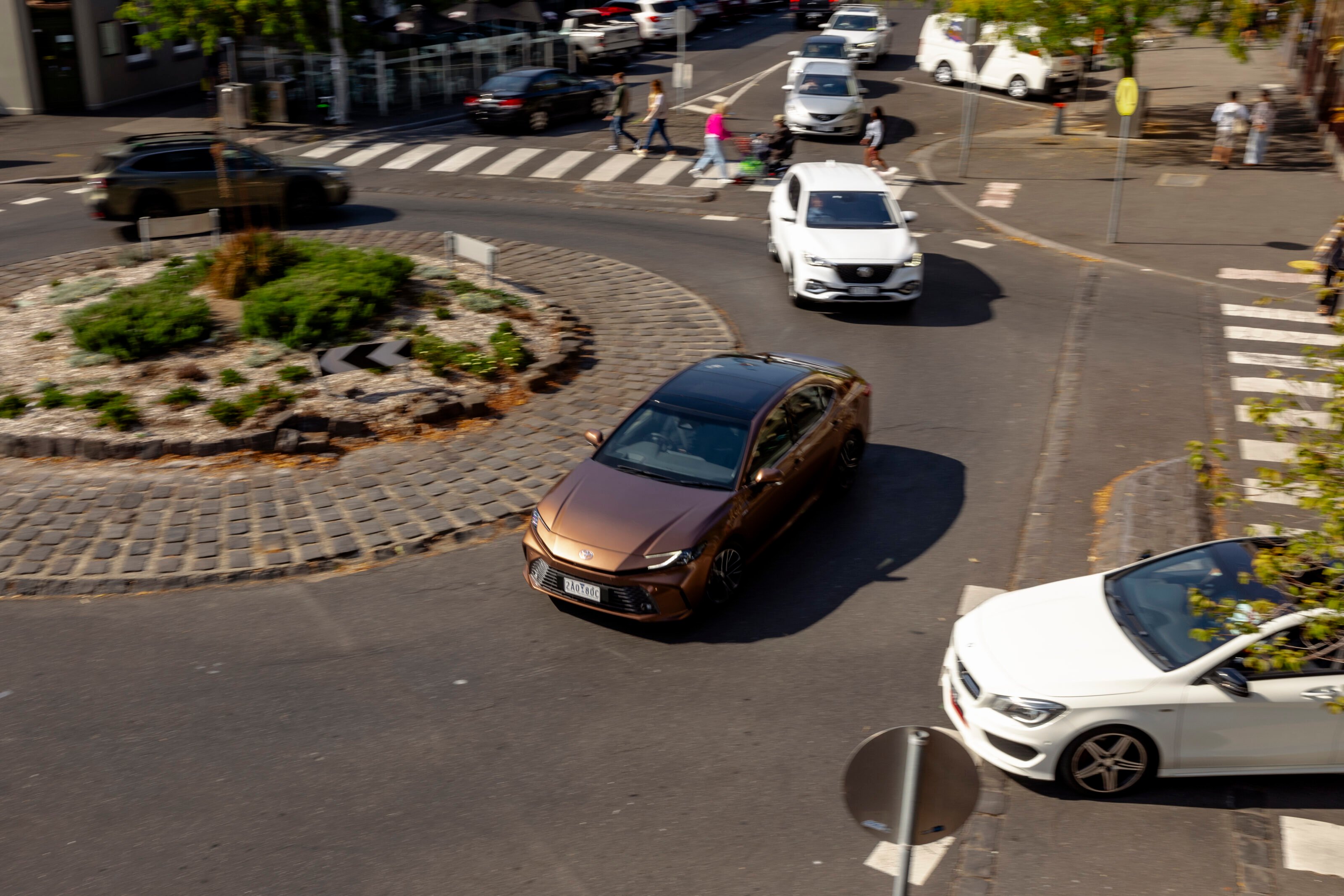
In truth, they’re both pleasant vehicles to drive. The RAV4 still feels a smart piece of engineering, and its raised seating position and smaller turning circle (thanks to the shorter wheelbase for that) is a boon in town, as is the fact that it’s 285mm shorter overall, making it a little easier to parallel park.
The Camry counters with a more modern suite of safety systems, which hinges around a better camera sensor, a superior forward millimetre-wave radar sensor and the additional reassurance of two radar sensors scanning the outer front and sides of the car. Compared with the RAV4’s rather rudimentary sensor suite, it’s night and day better. As indeed is the infotainment system. As long as you opt for anything but the base variant, the Camry gets a big 12.3-inch colour touchscreen that puts the RAV4’s rather shonky JBL-branded item – with its maddening facility for dropping your Bluetooth phone mirroring connection – to shame. That’s before we get into how far superior items such as the Camry’s wireless phone charger or its LED headlights are.
Much of these arguments for modernity will be levelled when the new RAV4 appears but, as we mentioned earlier, that’s at least a year away. For now, the Camry is the better pick on almost every score. There is a practical edge to the RAV4 that’s appealing. The hip height of the rear bench makes loading and unloading kids easier, and the hatch allows you to easily carry large items and dogs. For a vehicle that’s been six years in market it holds up really well.
Should you not have to lug small kids and dogs about, think seriously about whether the compromises that the RAV4 imposes are worth those few occasions when you’ll need to carry a bulky item. In short, we’re hobbling how our car drives every day for an occurrence that may or may not materialise. Data shows that we grow into SUVs at child-rearing age, with only 9.5 percent of 18-24s choosing them, while 36.1 percent of 35-44s own them, that figure then receding to 22 percent of those aged 65+. That suggests that we don’t want SUVs if we don’t need them for family duties which, in and of itself, is encouraging.
The sedan was Australia’s car of choice for many decades and then something changed. Some of us became sold on the promise of an active lifestyle we never actually lived. We paid for capability that we never used. We believed we were buying better when, for many of us, we were merely deluding ourselves.
As we reach into a future where efficiency is king, perhaps that argument will return to the sedan or, better still, the low frontal area and space efficiency of the traditional family wagon. Wouldn’t that be a thing? It would probably take a company like Toyota to make it work, to have the mass communications clout to cut through. But it’s not impossible. Over to you, Toyota.
Specs – Toyota Camry
| Model | Toyota Camry Hybrid SL |
|---|---|
| Engine | 2487cc 4cyl, DOHC, hybrid |
| Max Power | 170kW (system output) |
| Max Torque | 221Nm @ 3600rpm (combustion engine only) |
| Transmission | CVT automatic |
| L/W/H/WB | 4920/1840/1445/2825mm |
| 0-100km/h | 7.2sec |
| Fuel economy | 4.7L/100km (tested) |
| Price | $53,990 |
| On sale | Now |
Specs – Toyota RAV4
| Model | Toyota RAV4 Cruiser Hybrid |
|---|---|
| Engine | 2487cc 4cyl, DOHC, hybrid |
| Max Power | 163kW (system output) |
| Max Torque | 221Nm @ 3600rpm (combustion engine only) |
| Transmission | CVT automatic |
| L/W/H/WB | 4600/1865/1685/2690mm |
| Weight | 1565kg |
| 0-100km/h | 8.1sec |
| Fuel economy | 5.9L/100km (tested) |
| Price | $51,410 |
| On sale | Now |
This article originally appeared in the May 2025 issue of Wheels. Subscribe here.
Porsche likes to squeeze its money’s worth from the 911. Of the water-cooled models, the 996 version was around for six years, the 997 a yawning nine years and the 991, eight. It’s hard to believe that the 992 has already been with us for six years, so well has it worn its years. It has though, and it’s now been treated to what has become a Porsche staple: the mid-life update.
This is dubbed the 992.2 generation by the factory and we’re driving the 911 Carrera coupe. To simplify things a little for you, it’s everything that most of us will ever need from a 911. Given that it’s priced at $280,500, maybe you’re right to expect something quite special, even from the base model 911.
A decade ago, that sum would have bought you a 297kW/440Nm Carrera 4S with a 3.8-litre naturally-aspirated engine and change for some options. Now you get a 290kW/450Nm twin-turbocharged 3.0-litre with half the number of driveshafts. Is this progress? It’s a question worth asking.

Let’s take a look at that engine first. Unlike the Carrera S and GTS models, which have both enjoyed major power bumps, the flat-six plumbed into the posterior of the Carrera isn’t hugely different to what went before in the 992.1. That installation made 283kW/450Nm, so you now get the same torque figure but seven additional kilowatts that have to lug about an additional 11kg, resulting in a modest uptick in power-to-weight ratio (from 188kW/tonne to 191.3kW/tonne). That additional grunt comes from the turbochargers that were fitted to the previous 911 GTS and the old 911 Turbo’s chargecoolers.
That was done largely because they’re more efficient, but the tickle of power is a welcome bonus. As indeed is the added response and flexibility. Two-thirds of peak torque is around just 1500rpm, before the maximum of 450Nm chimes in from 2000rpm – and it stays all the way to 5000rpm, making the Carrera feel fairly brawny.
That is unless you drive it back to back with some more senior 911 models, as we did. A new Carrera GTS with 570Nm of torque can make the base car feel a little breathless on a race track, but on roads, it’s not something that’ll occupy your mind for a moment.

Some will miss the fact that you can no longer buy a Carrera with a manual transmission and I’d say that’s a warranted complaint. You have to step up to the slightly more aggressive Carrera T if you want three pedals and a stick. That’s $306,800 and also includes gear like standard Sport Chrono, rear-wheel steering, PASM Sport (lowering by 10mm) and Carrera S-style bigger alloy wheels. Given how expensive Porsche options are, if you were already thinking of optioning the wheels and Sport Chrono onto your Carrera, that’s almost $8000 accounted for straight away. It’s another $7000 for PASM Sport and rear axle steering, but those are two options not offered on the base Carrera, so there’s a little curtain-lift on how Porsche slyly walks you into more expensive models.
Instead you’ll have to content yourself with the standard eight-speed dual-clutch transmission, which is a truly excellent piece of engineering. Thus equipped, the Carrera can leap out of the blocks to 100km/h in 4.1 seconds or 3.9 seconds if you opt for Sport Chrono pack, which also includes the Sport Plus drive mode, Launch Control, the Porsche Precision track app, the Sport Response button and the hero PSM Sport mode. This is the one option I’d consider a must-have for the base Carrera, as it appreciably lifts the ceiling of its abilities by a few per cent and is reasonable value at $4370. Other technical changes include better brakes, the Carrera now getting the six-piston front calipers that were standard-fit on the old 992.1 Carrera GTS, beefier engine mounts and revised gear ratios to help address the perennial Porsche complaint of overly long ratios.
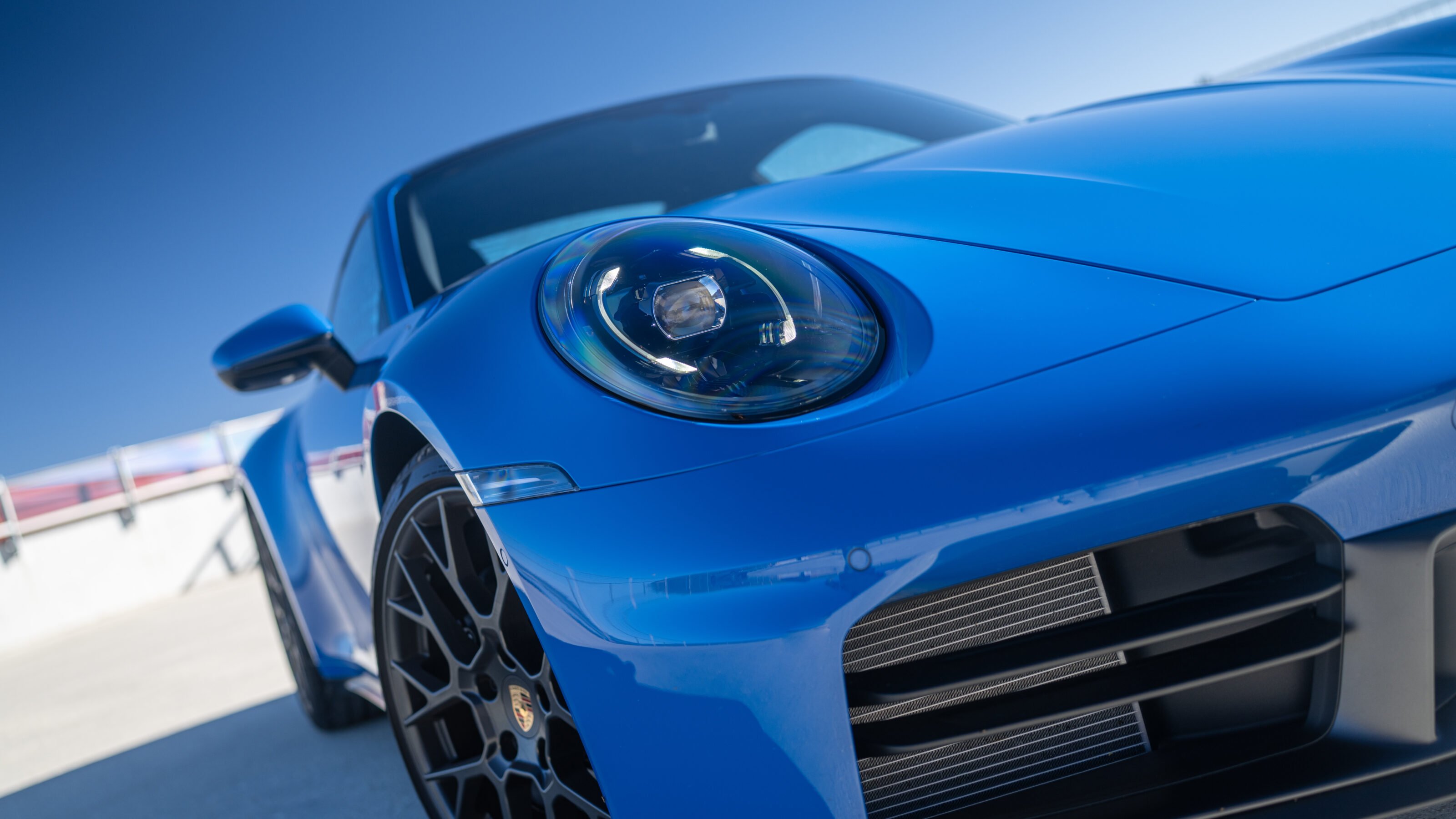
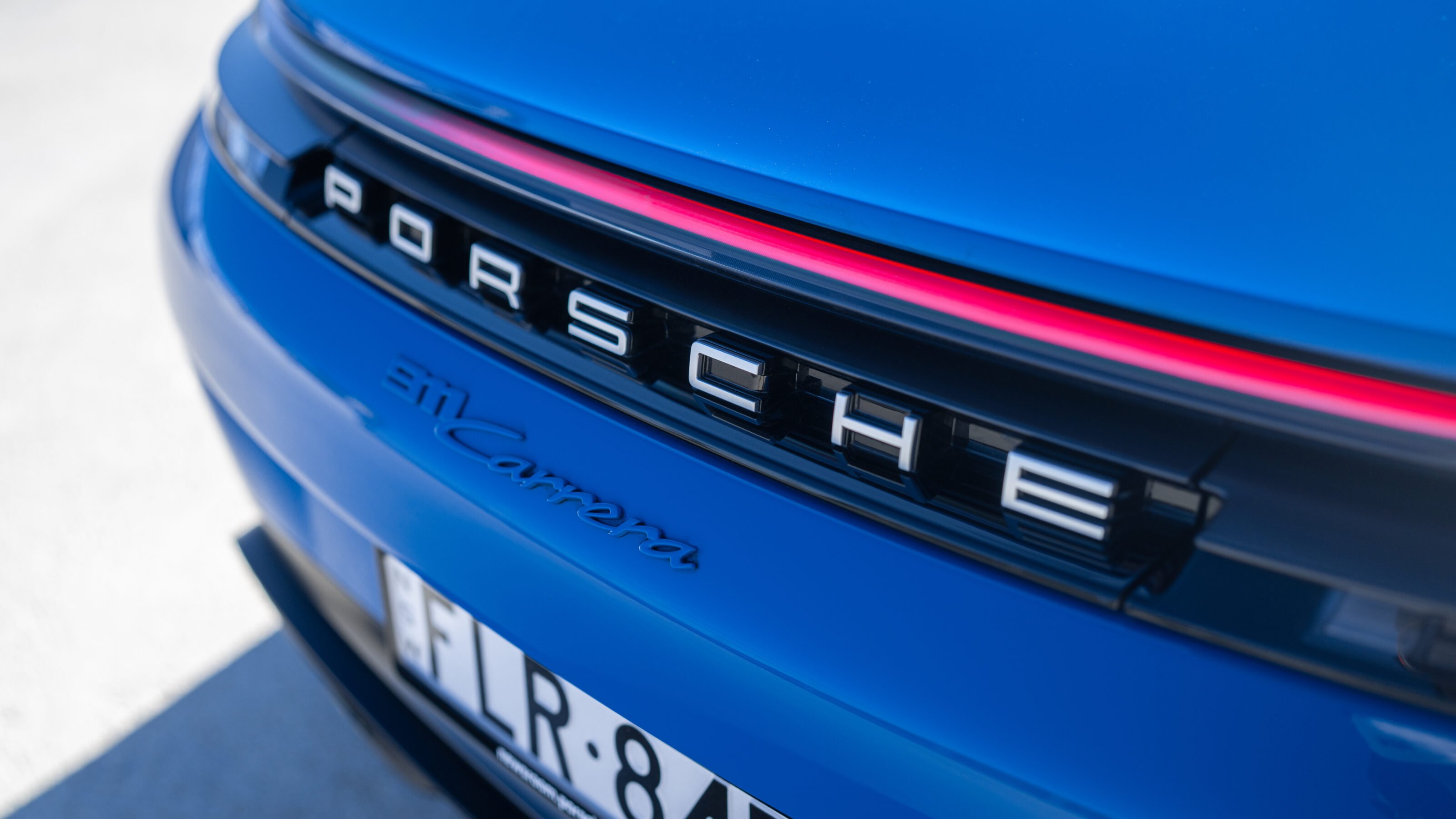
The exterior changes will escape many casual onlookers. Beadier matrix LED headlamps and a more sculpted look to the front air intakes are the key differences up front. The number plate now sits in a more raised position, allowing space beneath for the car’s rather ungainly sensors. At the rear, the number plate has been raised, now no longer sitting between the exhausts. The rear light bar also looks sleeker and more cohesive. It’s evolutionary stuff; nothing radical.
Inside, things are a bit more interesting. The main difference is that the 911 no longer has back seats. Well, it doesn’t have back seats as a standard fit item. The reason why is to gerrymander weight and efficiency figures a little. Should you want rear seats – and it’s a key 911 attraction amongst buyers – they are a zero cost option from new.
Talking of keys, the 911 now features a starter button rather than the knurled twist ‘key’ it featured before. This looks cheaper and more generic than the twist key, but it’s arguably easier to use. The dash has ditched its one analogue clock and gone to a full curved digital display that’s configurable through seven different screen modes. Again, some will say that this is another area in which the 992.2 is reverting to the mainstream, but the screens look pretty good and include full Android Auto and Apple CarPlay wireless integration.
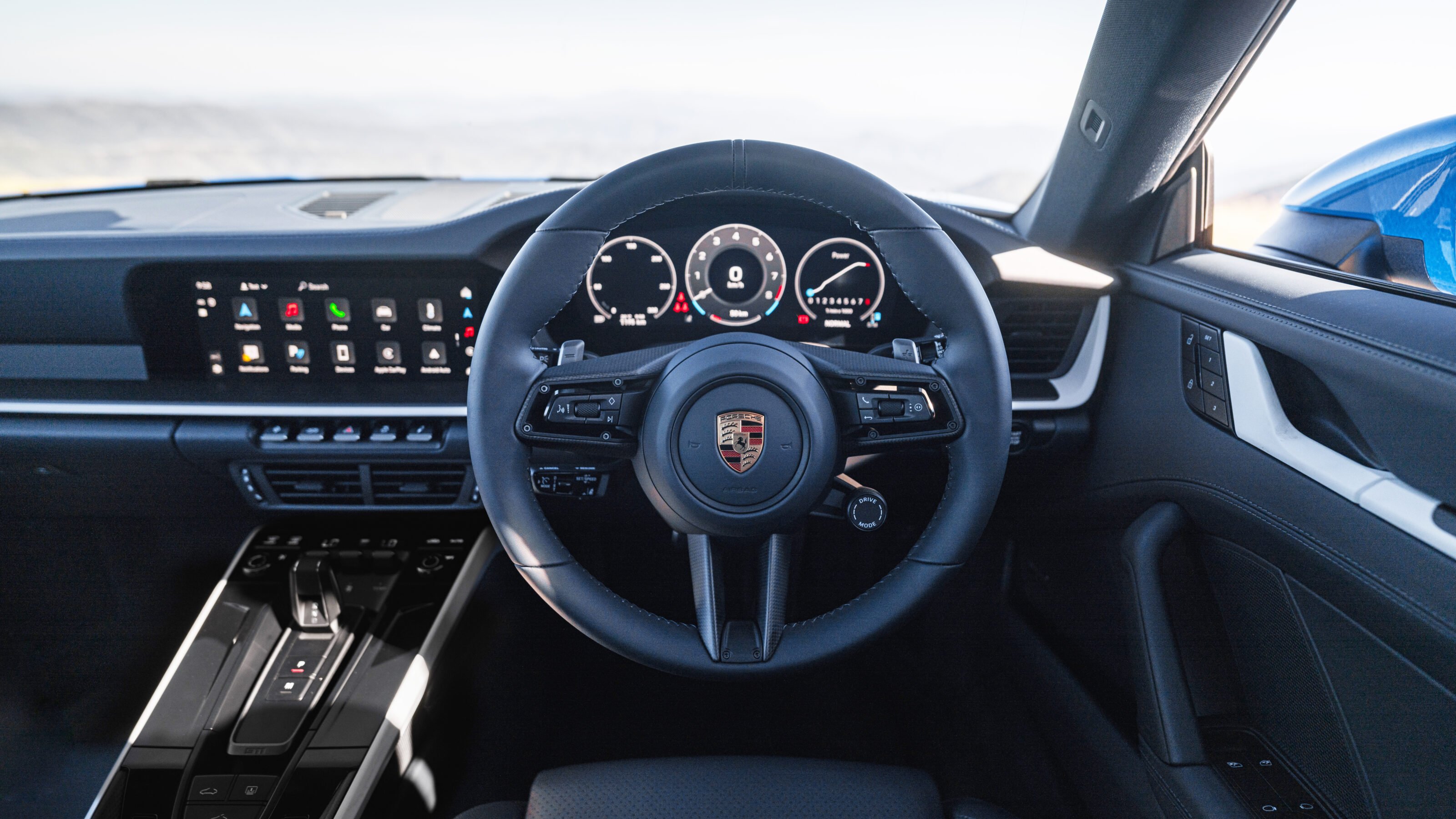
The driving position is as good as ever. You sit low in the car, the standard 14-way electrically adjustable sports seats being a decent chair. Should you want more lateral support, there’s a four-way adjustable sports seat that’s a little more sculpted, which is a zero cost option. You can’t option in anything more aggressive, so if you had designs on something like the racy CFRP bucket seats, bad luck. Buy a Carrera T and budget another $11,250 for that particular privilege.
Prod the starter button and the 911 Carrera fires up into a purposeful chunter. The PDK box engages cleanly and easily with no mechanical shunt. The control weights feel cultured and well-oiled. The cabin is free of low-speed squeaks and rattles but there’s the immediate realisation that this is a louder car than before. The new engine mounts seem to transfer more vibration into the passenger cell and there’s also an element of synthesised sound being piped into the cabin. Put that down to the fitment of particulate filters strangling the engine’s natural acoustics a little.
The Pirelli P Zero tyres also transmit a hefty quota of decibels into the cabin. This is a shame as the Carrera has always been a great long distance cruiser. Indeed, the gearing of the latest 992.2 features lower ratios for the first six gears and then longer ones for the top two cogs to help give a long-legged feel to freeway driving, but the noise never really goes away and can be wearing on open-pore surfaces.
A 135-litre frunk and 261L of free space behind the front seats if you have rear seats fitted, or 373L if you don’t, means that the 911 has enough practicality to easily manage a couple’s weekend away. You might also need to budget for a set of noise-cancelling earbuds, or else you can crank up the standard Bose surround system – all 570 watts and 12 speakers of it.

Ride quality is very good, with fantastic body control. Smaller surface imperfections can send an audible jolt through the 911’s superstructure, but the revised adaptive dampers do a great job of rounding off the worst excesses. The brakes feel mighty, with serious stopping power again and again. Only on track would you start to find their limits, and we had one car that felt as if it might have warped a disc, but on road they’re more than up to the task.
The gearbox does a great job of selecting the right gear, but if you’d rather take control, the stubby metal paddle shifters feel great, with a positive soft click into the next gear. One thing we didn’t miss at all was the rear-wheel steering that’s fitted to the GTS. If anything, this gives the standard Carrera a more natural and trustworthy feel to the steering, and it’s huge fun to punt around the Phillip Island circuit, exploring its surprisingly benign limits. For that, I’d like to think it’s my skills behind the wheel, but it’s largely due to the brilliant PSM Sport stability control setting on these Sport Chrono-equipped cars.

The engine sounds bassier and more organic than the GTS, and it’d be happy enough on a track day. It’s as a road car that the Carrera really shines, and that element of both practicality and all-round performance is why it’s such an icon. That hasn’t really changed with the latest car. Yes, there are some elements of the 992.2 that have appeared to erode its quirkiness, but that’s been a process observed for years, maybe decades.
The best part of the base Carrera is that it still feels like the definitive 911. The GTS might be more capable, the GT3 angrier, but this is the datum from which they all spawn and the best way to judge a new 911 in its entirety. On that basis, the 992.2 update is more than worthy. The best news? While most of the other models have increased in price by $25k or so, the uptick in price for the Carrera has been a mere $2700. That has to be the rarest of things: a present from Porsche.
Specifications
| Model | 911 Carrera |
|---|---|
| Engine | 2981cc flat-6, 24v, dohc, twin-turbo |
| Max power | 290kW @ 7500rpm |
| Max torque | 450Nm @ 2000-5000rpm |
| Transmission | 8-speed dual-clutch |
| Weight | 1520kg (DIN) |
| 0-100km/h | 4.1sec (3.9sec with Sport Chrono pack) |
| Price | $280,500 |
| On sale | Now |
“IT’S FULL OF BALLS.”
When Hyundai told me I’d be picking up the new Santa Fe XRT from John Cain Arena in Melbourne and that it might have some promo material from the weekend’s Melbourne Mavericks netball match in it, I wasn’t expecting a boot full of unsecured Gilbert Phoenix size fives. This could prove a problem, especially as the route I’d chosen for the day took us out of Melbourne and into some of the most inhospitable parts of Victoria.
It would certainly be a test for the Santa Fe, an SUV that blends seamlessly into suburbia, but which doesn’t really do arduous. With the XRT accessory pack, Hyundai wants to add some attitude to this lovely but mild-mannered box. Or, if you prefer, some balls.
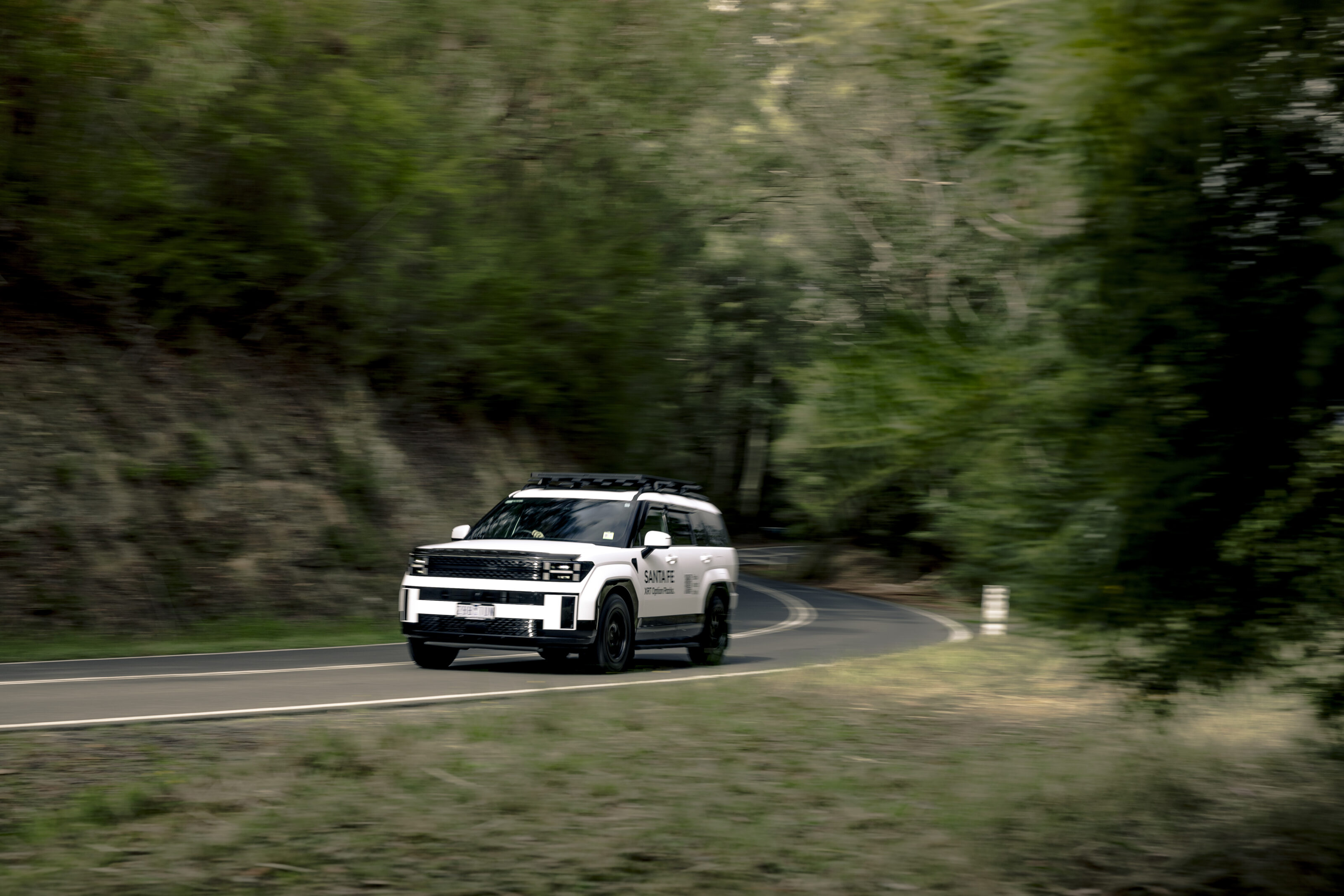
The XRT Peak Option Pack, as fitted to this one, adds $9,990 to the price of your Santa Fe and includes the 17-inch off road wheel and tyre package, an integrated side step, a bonnet protector, a roof platform, XRT mud flaps, roof racks, and underbody skid plate, window visors and the XRT suspension kit. This features new hub carriers, stabiliser bars, springs and longer stroke HL Mando shock absorbers which deliver 30mm of extra ground clearance over a standard Santa Fe. In fact, with 210mm of clearance, the XRT features the exact same clearance as an entry-level Toyota Prado, but the Hyundai’s long overhangs mean that it can’t match the Japanese car’s approach and departure angles.
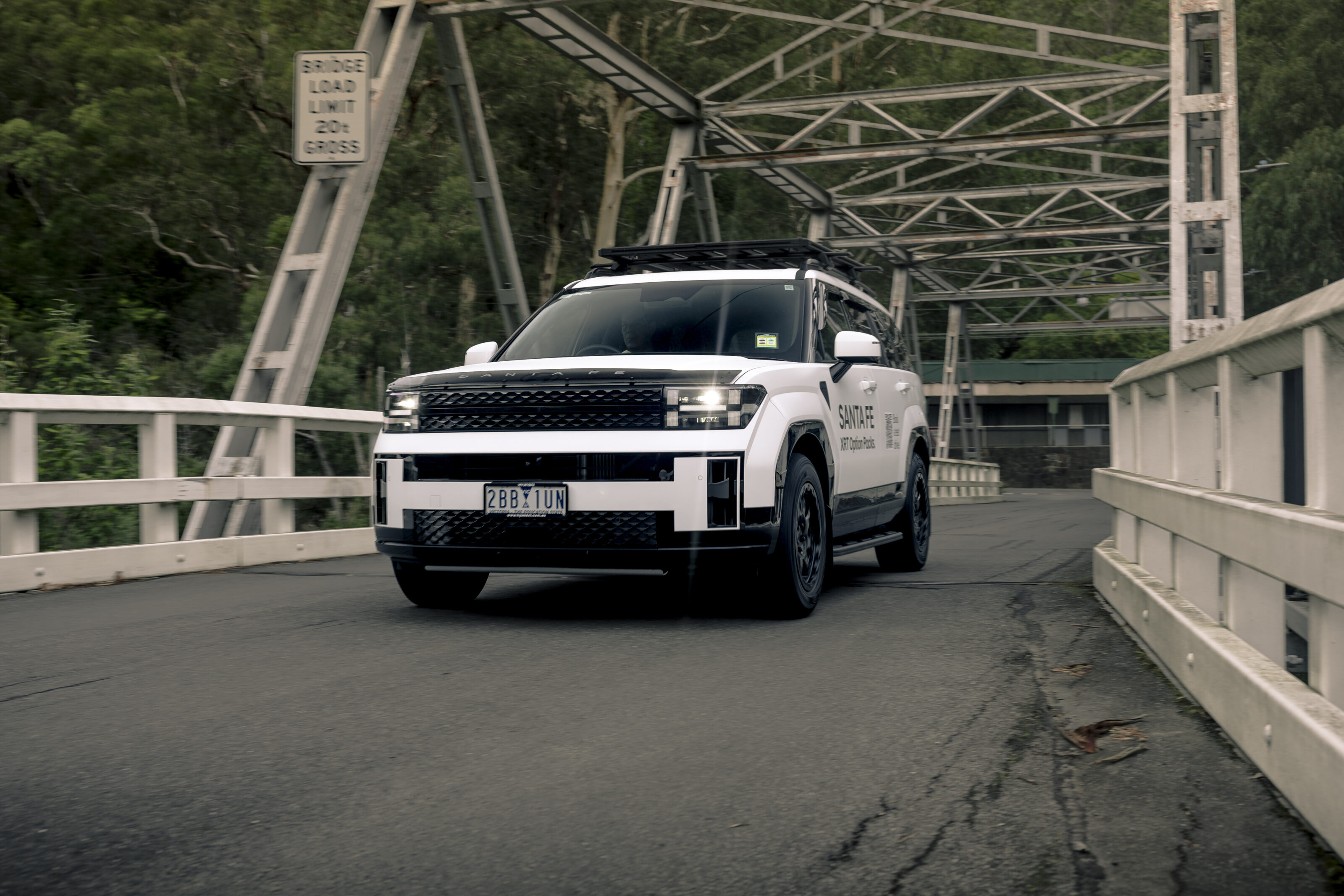
If you don’t need all the trimmings, the XRT Adventure option pack nets you the wheels, tyres, suspension, underbody skid plate and mud flaps for $6,990 including GST and fitting. That may well be a bit more palatable to many. The tyres were meant to be Pirelli Scorpions, but a supply issue meant that our vehicle was shod with Yokohama Geolander AT rubber measuring 235/65 R17 all round.
I’m waiting for photographer Ellen to arrive at the Three Sugars Cafe in Warburton. The skies are leaden and, given our route out to Woods Point reaches over 1200 metres above sea level, it looks like it might be cold, wet and windy if the clouds scuttling along the Yarra Ranges ridge lines are anything to go by.
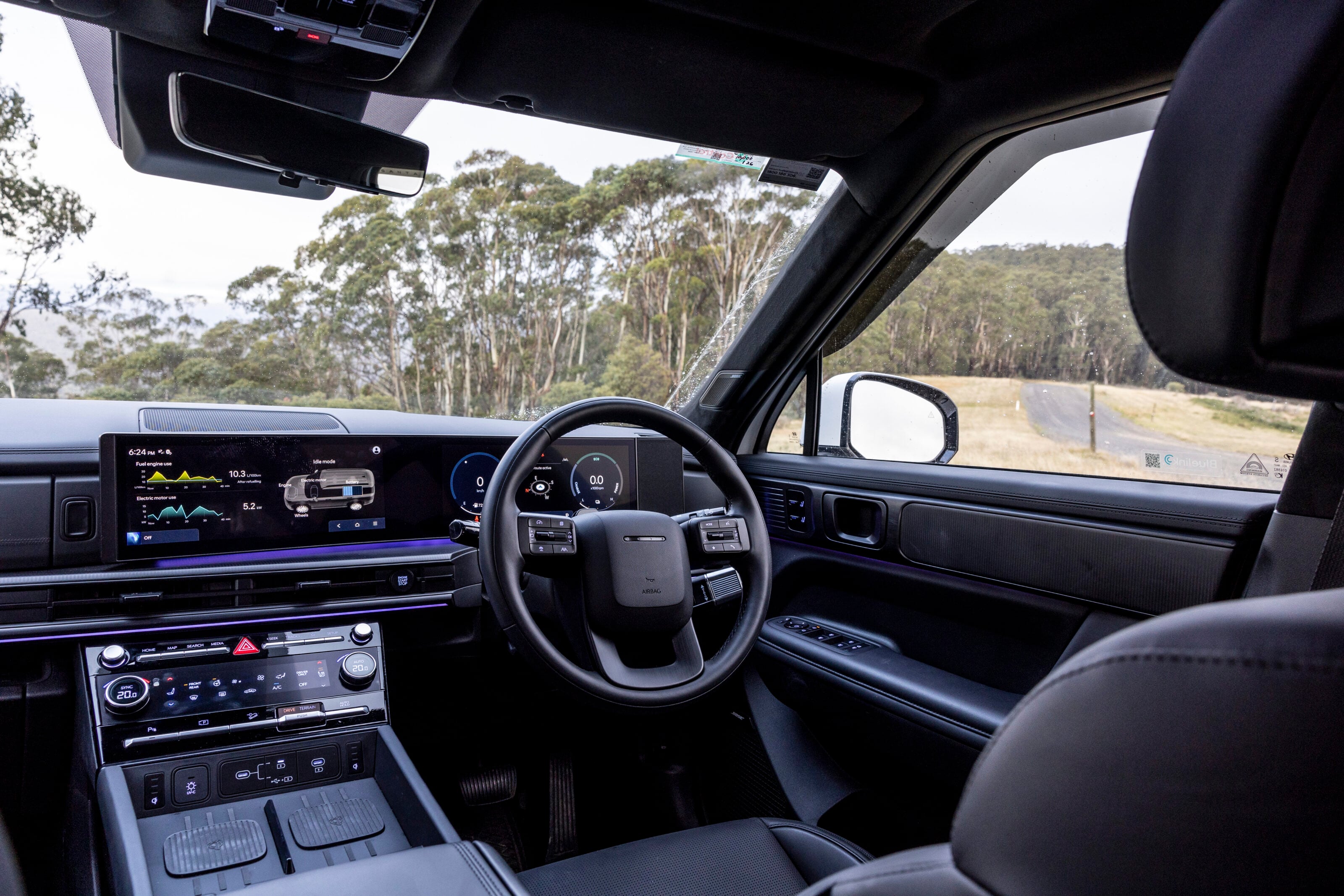
It’s an intriguing route, following the Yarra east towards its source before ramping crazily uphill on the tortuous Reefton Spur road. Arriving at Cumberland Junction, the road then turns to dirt diving into wooded wilderness before arriving at Matlock (population: 7) before dropping down to the remote and historic gold-mining settlement of Woods Point, nestling in an elbow of the brook that becomes Victoria’s mightiest river, the Goulburn.
That ought to give the XRT a reasonable workout. As well as understanding what it is, it’s also important to accept what this Santa Fe is not. It’s not one of those Serious Off Roaders, beloved by men with voluminous beards, a hard drive full of electric winch porn and a predilection for killing their dinner with a spade. I was half looking forward to being smirked at by these types, who would be unable to resist giving me that ‘you’re driving entirely the wrong vehicle’ sort of look. So while you’re not about to be wading through 800mm deep water or engaging low range to tackle a gnarly incline, you’re nevertheless getting something that’s rugged enough to deliver peace of mind when tackling an extended variety of off-trail adventures.
Putting theory into practice
Tackling Reefton Spur is a different matter. On the way out, I’ve been impressed by the refinement of the hybrid Santa Fe, even on the Yokohama AT rubber which has, if anything, helped to massage away some of the flintier edges of the standard car’s ride. There’s little in the way of tread block singing on smooth bitumen and even when you subject them to some cornering forces, there’s not that woolly vagueness that afflicts many SUVs on knobbly hoops. The thing with Reefton Spur, though, is that it goes on and on and on.
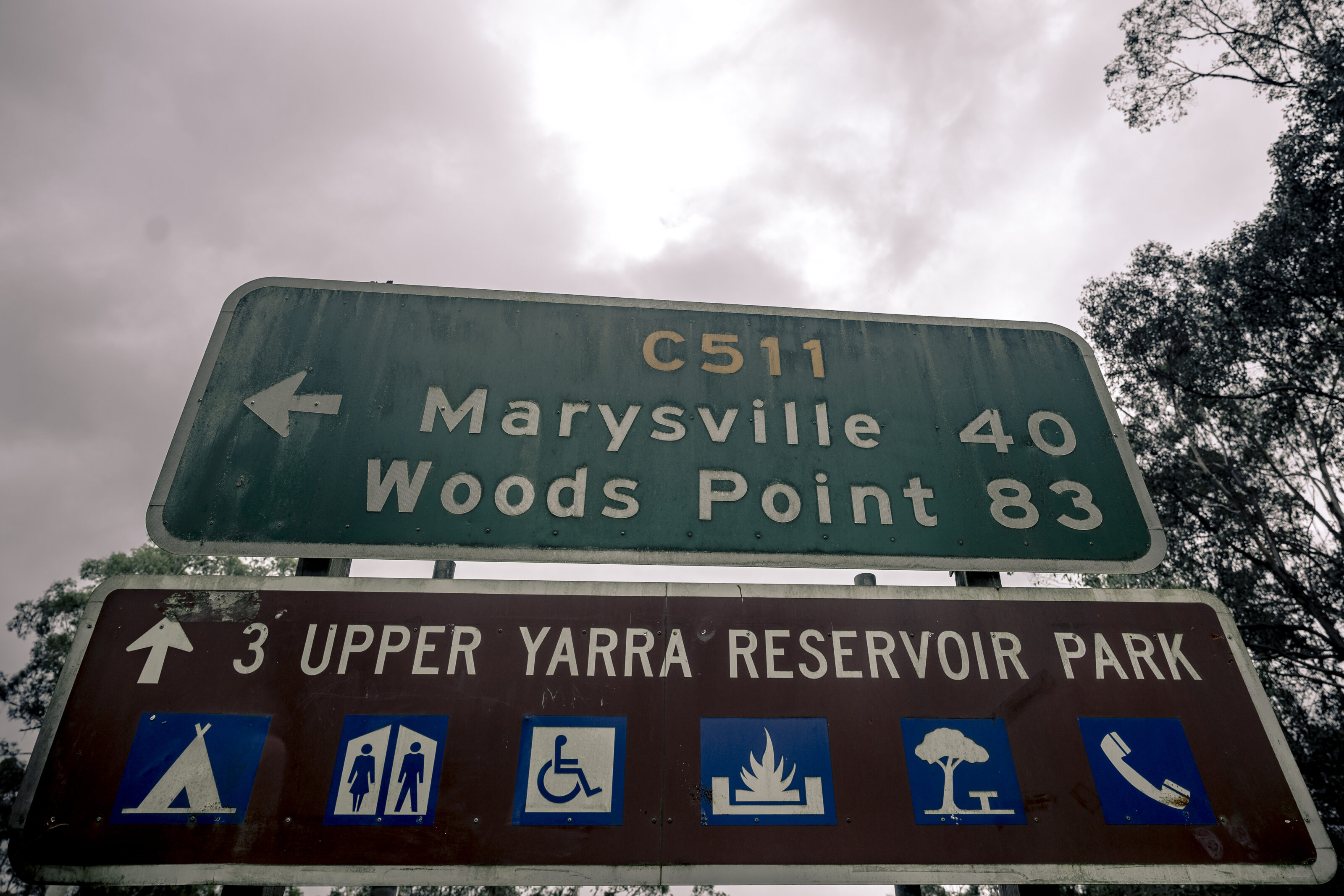
Its origins date back to the 1860s and the Victorian gold rush, when a cart track was built to haul material between the gold workings of Reefton and Jamieson. The road as we know it today was the result of a different natural bonanza: timber. The post-war building boom meant that during 1947-48, the Forests Commission invested in a major project at the Big River, and the Reefton Spur Road was scratched out of the mountain slopes as a trucking route for mountain ash sawlogs. This 20km stretch – from the old Reefton township to Cumberland junction – comprises 180 bends, ascends 632 metres and, should you arrive like us midweek, is usually devoid of traffic. The odd logging truck chugging from the plantations beyond Cambarville is all we see. The road itself is rhythmless, with the odd short descent thrown in to keep you on your toes, and the surface is patchy and deformed from winter ice and snow, summer fires, mountain ash roots and the sheer weight of those big logging trucks. In a sports car it’s a challenge, in a big 4×4 it’s a handful.
Lyrebirds explode out of the ferns in a screeching cacophony as the Sant Fe whirs through. It’s making a pretty good job of things, but the threshold at which the tyres start to wilt gets lower and lower as the tyre carcass gets hotter and hotter. Our car is the Calligraphy trim, in six-seat guise, and weighs 2105kg before you start adding the XRT accessories. In other words, it’s quite a hunk of car to be flinging into off-camber tightening apexes. Amazingly, the undersized 1.6-litre four-cylinder petrol engine doesn’t feel as if it’s lacking for muscle. With a total system torque of 367Nm at its elbow between 1000 and 4500rpm, helped by a reasonable alert six-speed automatic, it’s far from embarrassed when you make demands of it. If you’re concerned that XRT-ing your Santa Fe will turn it into a blancmange on the blacktop, fear not.
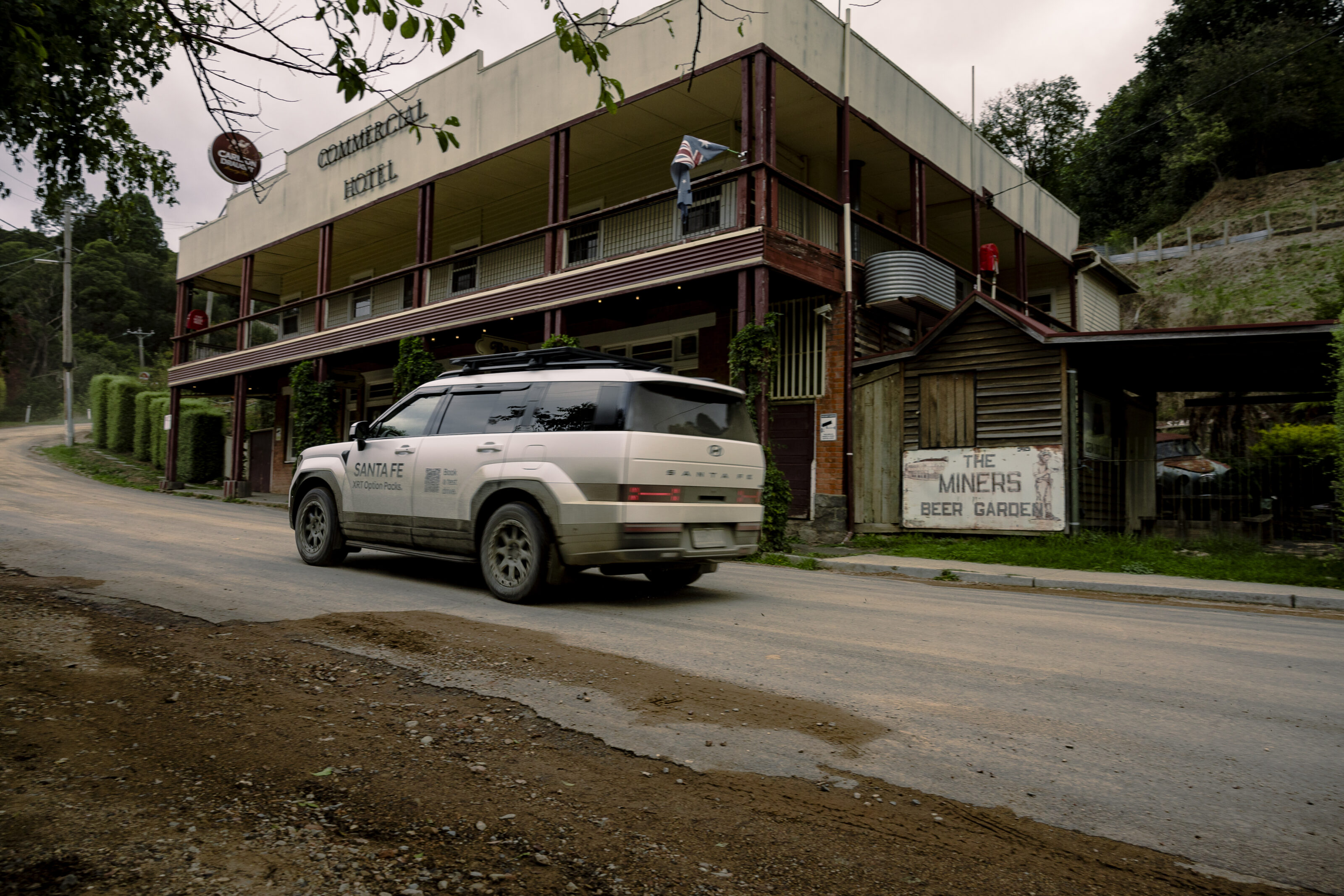
Cumberland Junction arrives and it looks like a satellite offshoot of Summernats. A pile of expired wheels and tyres sits on the roadside, cremated radial belts litter the roadway and the bitumen looks more rubbered-in than the Gunsei touge course. It seems a long way to come for a bit of circle work, and one VE Commodore isn’t going home anytime soon, buried so far backwards into the underbrush that, given time, it may well earn its own historic marker signpost.
Head right – passing the obligatory LandCruiser owner giving me that look – and the blacktop ends in short order. In this case it transitions instantly to washboard: the sort of corrugations that were you merely on a weekend jaunt, would have you turning back and reconsidering your options after a couple of hundred metres. At one point it felt as if the entire centre console was trying to tear itself free from its moorings, and the vibration hit a certain frequency whereupon all of the netballs in the boot instantly went from shuffling about meekly to wildly flinging themselves about the cabin. Fortunately, after a few kilometres, the terrain changed and the washboard ended.
At the further reaches
The route out to Cambarville climbs and falls as you follow the spine of the Yarra Ranges. There’s nothing in Cambarville, a locality named after two sawmill owners, A. Cameron and F.J. Barton, who set up shop in the 1940s, before the settlement was repeatedly ravaged by fire and deserted in 1971. Now it’s the gateway to huge pine plantations and, curiously, one of the loveliest stretches of road for miles. After 25km of jarring dirt roads, you’re suddenly presented with a serpentine, seven-kilometre stretch of some of the smoothest hotmix you could imagine. It’s heavenly.
There’s considerable conjecture as to how this section of the C511 came to be. One persistent rumour is that it was laid by Australian Army engineers ahead of a visit by Queen Elizabeth II in 1954, as part of a tour that took in the soon to be completed Upper Yarra Reservoir. Try as I might, I can find no basis in fact for this. The reintroduction to dirt consists of a pock-marked cluster of potholes that fire water over the Santa Fe’s windscreen. Back into it with gritted teeth.
Barrel into some of the tighter corners and you can experience a sudden introduction of washboard that casually walks the nose of the Hyundai wide. There’s a three-stage stability control system that can do little but rob you of throttle authority when this happens. I experiment with it off – in its middle setting and fully on – and realise things can get quite exciting with everything fully off, but that there’s little material difference between the other two nanny modes.
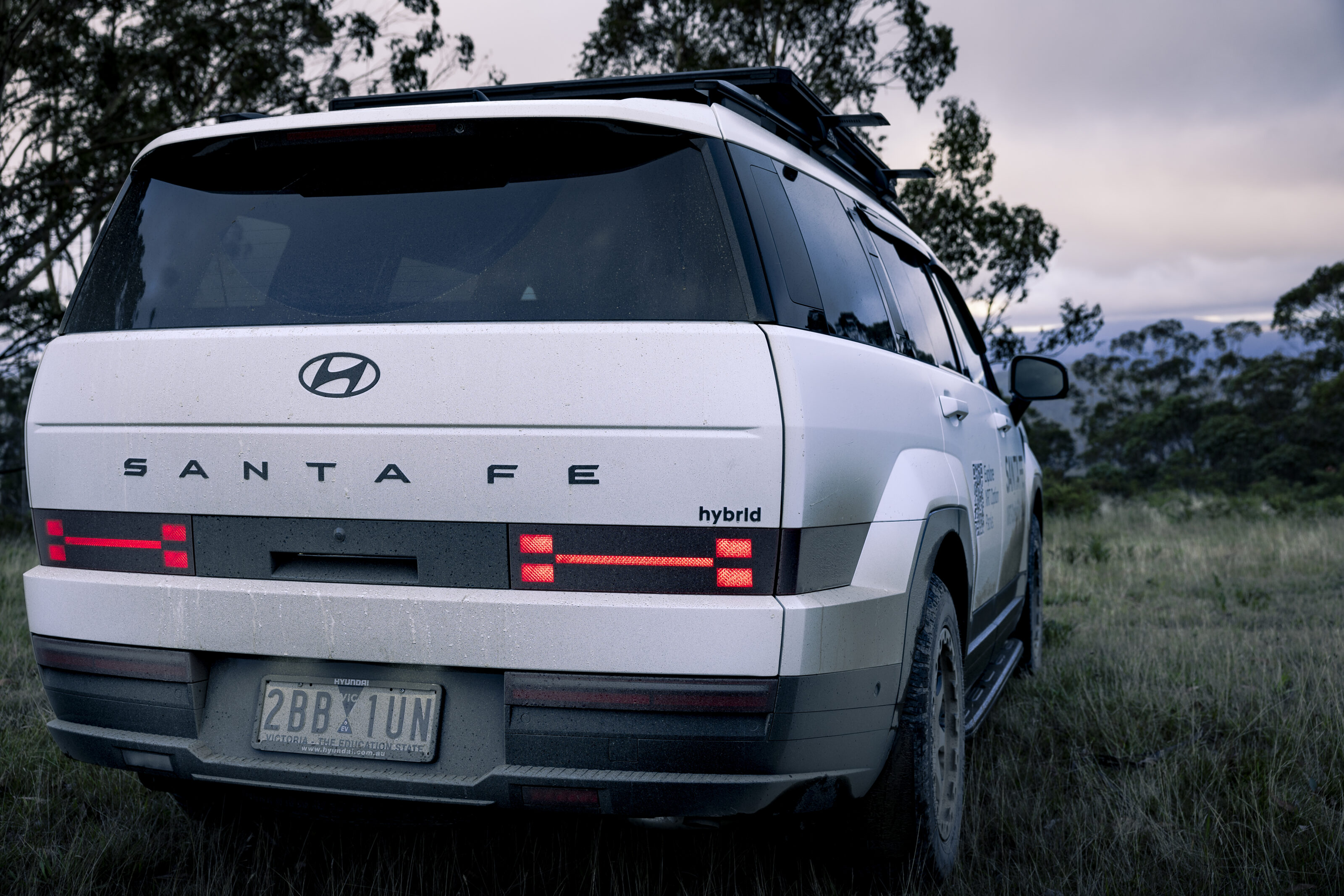
Unlike, say, an Everest or a Prado, there’s not much in the way of off-road specific settings that you can play with. There’s a hill descent control mode, that we’re not about to use today, and three off-road settings: Mud, Sand and Snow which, for the most part, just implement a few different lines of code in the traction control software. The tempting looking clay-rutted trails that clamber up into the nether reaches of the plantations look a little too sporty for the Santa Fe. Horses for courses and all that.
Photographer Ellen brings us to a halt for yet another photogenic corner, folds of blue-grey pastel hills peering through the trees, fading into fuzzy layers. It’s quiet out here. The brake discs tick as they cool, the Santa Fe’s hybrid electrics emitting a soft whine. The air is so clean that hairy green lichens grow madly on every snow depth marker, signpost or fence line. We count three separate fires on the distant horizon, but the wind has dropped to nothing now. The light’s starting to soften though, and we realise we’ll need to hustle to get to Woods Point and back before night falls.
We emerge from forest onto the bald hilltop of Matlock, formerly the thriving gold mining community of Emerald Hill. You don’t have to wander too far from the road here to find mineshafts angling into the tussock grass. At its peak, back in the 1860s, the town had about 300 residents and sprawled across the plateau, some 1213m above sea level. Winters were harsh on this windswept knoll, and the gold seams were said to have been spectacularly productive before they pinched out. Like Cambarville, Matlock was devastated by fires, first in 1873, which killed its gold industry and then in 1939 when the timber industry was brought to a similar full stop. This is hard country in which to make any sort of living.
Drop off the northern scarp slope from Matlock and the road descends down to the headwaters of the Goulburn River. The terrain becomes folded and rilled, with lusher vegetation and the road surface becomes softer and loamier. It’s only 7km between Matlock and Woods Point, but the contrast between the two settlements is stark. Whereas Matlock is bleak and moribund, Woods Point has some spirit. You roll in and are welcomed by the Commercial Hotel on Bridge Street and a small general store.
A Telstra cell tower on a nearby hill was installed in 2019, bringing this remote community a little closer to the rest of the world. For some who choose to live so far off the grid, that was perhaps a blessing and a curse. One gold mine is still operating in the locale, the A.1 mine, run by Kaiser Reef. It was the Morning Star mine, though, that was the heart of the original community. Founded in 1861 and producing some 883,000oz of gold, it closed in 2023. This seam, situated on a spur leading to the junction of the Morning Star Creek and the Goulburn River was accessed via a 160m shaft. Even as recently as 2019, the mine’s owners, AuStar Gold, were reporting hugely productive seams at nearby McNally’s Reef. There’s still plenty of gold in them hills.
We’re left to ponder whether the XRT kit for this Hyundai Santa Fe is a little nugget of gold or just a bit of mere tinsel. For mine, the $6990 Adventure option pack seems like the better choice, delivering all the bits that add capability. The $9990 Peak option pack merely adds three grand’s worth of tinsel. The Santa Fe XRT’s bigger issue is that the accessories add cost to what is already a fairly pricey vehicle. The Hybrid AWD starts at $58,500, the Elite Hybrid retails at $65,000 and this Calligraphy Hybrid starts at $75,000. Add $7k to those prices and you start getting into the gunsights of some very capable competitors. A Ford Everest Tremor, for example, costs $76,590 and will get you to off-road spots where the XRT would be waving the white flag. Likewise the $72,500 Toyota Prado GX.
Neither of these macho SUVs delivers the sophistication of the Santa Fe’s hybrid powerplant and neither come close to levelling with the Hyundai’s assured and quietly stylish interior finish. That’s where the Korean car might well find its niche. Should your off-road ambitions be a little more limited, but you still require a modicum of capability and the reassurance of tougher tyres and suspension, the XRT asks for little in terms of material compromise. It still rides and handles neatly on road. Do without the Peak pack’s aero-penalty roof platform and you won’t knock too much of an edge off the standard car’s fuel economy either. In short, you’re adding a few percent to the all-up price and adding considerably more in terms of extra ability. We’d call that a win.
As the evening falls in Woods Point, we realise that we have 55km of dirt road to tackle once again, this time with bonus nocturnal marsupials thrown into the mix, before tackling the giddy dive down Reefton Spur. It’s been a long day but the Santa Fe XRT has shrugged off the worst that this teak-tough road has thrown at it. We pass another marker for the gravestones of some long-passed folk of this unforgiving high country. I switch my steering wheel heater on, fire up a playlist on the Bose stereo, sink into the Nappa leather seats and ponder the privilege of having things easy. That’s the beauty of a vehicle like the Hyundai Santa Fe XRT. Taking the rough with the smooth has a lot to be said for it.
Born In The USA: XRT-lite
Specifications
| Model | Hyundai Santa Fe Calligraphy Hybrid w/ XRT Peak option pack |
| Engine | 1598cc 4cyl, DOHC, 16v turbo hybrid |
| Max power | 172kW @ 5600rpm |
| Max torque | 367Nm @ 1000-4100rpm |
| Transmission | 6-speed automatic |
| Weight | 2105kg |
| 0-100km/h | 9.5s |
| Economy | 6.1L/100km (tested) |
| Price | $86,515 (as tested) |
| On sale | Now |
Sometimes it’s hard to establish just where a measure of healthy scepticism lapses into hard-bitten cynicism. Nobody wants to be that rube, who falls for the promises of snake oil salesmen and is hook, line and sinkered by the extraordinary claims. Take the BYD Shark 6 ute as a for-instance. It’s normally pretty good policy to ignore a company’s first stab at a new market sector because said company will learn quickly and bring along something a whole lot better in time.
That was certainly my read when I first heard that Chinese manufacturer BYD was about to sell a ute into the Aussie market. After all, there’s nowhere else on Earth that knows more about utes than Australia, that lives and breathes them, and devours every last detail of their existence. Make no mistake, this is a phenomenally well-informed market. The result, I assumed, would be that we would point and laugh, condescendingly write it off as a plucky first stab and get back into our Rangers and Hiluxes.
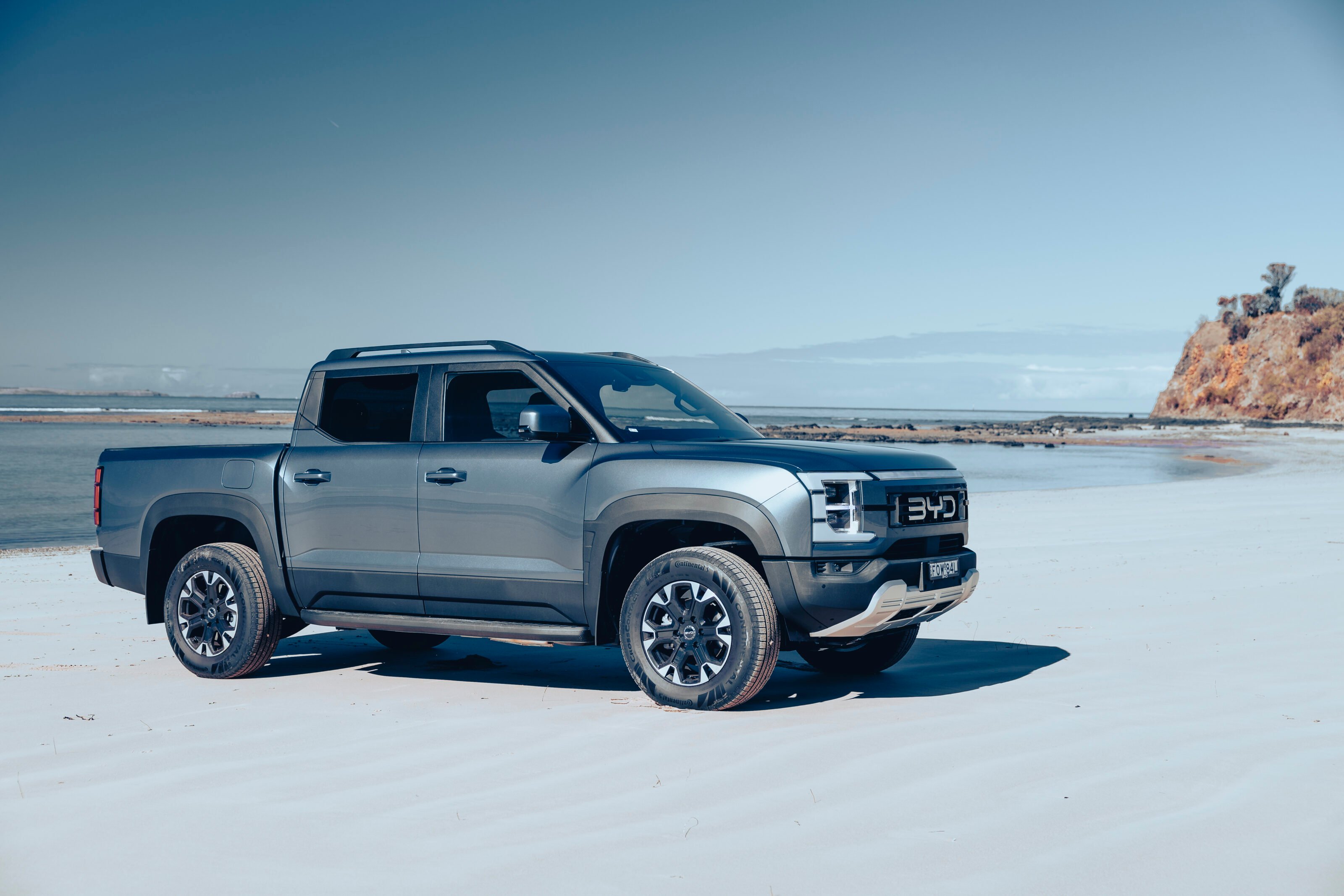
Then rumours of huge pre-orders started circling. The initial sales figures backed the rumours up, admittedly swollen by buyers falling over themselves to place an order for this plug-in hybrid before the government pulled the plug on fringe benefit taxes. In March, the Shark claimed a 14.7 percent share of the 4×4 dual-cab market, seriously eroding the shares of Ford and Toyota and positioning itself in third place, snapping at the heels of the Hilux. Established names like the Mitsubishi Triton, Isuzu D-MAX, Mazda BT-50 and Volkswagen Amarok had all been instantly leapfrogged.
Many didn’t understand quite what it represented. Because it couldn’t tow 3500kg, it was dismissed by the hardcores as a pretend ute. It certainly wouldn’t be your first choice to drag a horse float or to venture into the Simpson Desert. What we wanted to establish today is not how it might appeal to these power users, but how it fulfils a role as a large but light-duty ute for the buyer who will use it for its absolute target use-case: on suburban tarmac or country dirt roads, as a vehicle that offers an active lifestyle option without requiring you to delve right into the weeds of off-roading or heavy towing.

On this route we start at an EV charger in Doveton and we end, appropriately enough, at Shark Bay or, as its better known today, Safety Beach on Victoria’s Mornington Peninsula.
I realise fairly on in the piece that I’m committing some sort of EV crime. I have parked a lowly plug-in hybrid on a 350kW high-speed DC charger. This Evie unit at Doveton is the only high-speed charger in quite a wide radius, and I feel slightly self-conscious with the Shark sitting there accepting a maximum charging rate of 40kW. Only a few weeks earlier, I’d charged a Hyundai Ioniq 5 N at this same charger at 240kW, adding a stack more power to it than the paltry 25.8kWh I’ve pumped into the Shark 6 over 50 minutes to top it to 100 per cent. I know, another public charging station demerit. Nevertheless, I vow to move aside if another user needs to charge an EV.
The reason I want the battery at its peak state of charge is that I’m keen to see how far we go today on battery power alone. The claim is 100km, but we know about manufacturer fuel economy claims. I’d heard some fairly scary stories about the Shark’s lack of overall range, due in no small part to the tiny 1.5-litre engine working itself hard to maintain battery state of charge, in turn rapidly draining the 60-litre fuel tank. This was to be no hypermiling exercise though.

First impressions are promising. The cabin is a far more mature proposition than evident in the designs BYD first offered the Australian market, with quality touch points, considered materials choices and decent ergonomics that belie the $57,900 list price. It’s big too, with plenty of space for one six-footer to sit behind another. Oddments space, charging facilities and all-round visibility all score highly. Moving round to the back, there’s a sizeable 1200-litre tray with a spray-in bedliner, a pair of lights, six tie-downs, a trio of three-pin plugs – ideal for camping trips. Up to 6.6kW is available via the vehicle to load (V2L) function. Payload isn’t standout at just 790kg but, again, it pays to consider the Shark’s role in the larger marketplace.
Our route starts on major arterials: M1, M420 and M780. I’ve yet to pair my phone with the Shark and the native nav is stuck in an endless loop, locating the car in Dandenong trying to get it to exit the M1. We follow signs south to Hastings, on the shores of Western Port, the nav still rinsing and repeating. It’s not a promising start. We switch off and on a few times, but it still can’t seem to camp onto a signal. Only by connecting to Android Auto does the native nav then refresh itself. Weird.
The other thing that’s odd is that the party piece of the Shark’s interior, the 15.6-inch rotating display, will do its thing with a voice command without invoking the BYD assistant. Just saying “rotate screen” will get it to do its 90-degree spin, which suggests the car is listening to everything you say, all the time. Even without donning the tinfoil hat, that’s a bit spooky. It’s also worth noting that if you’re wearing polarised sunnies, the screen goes virtually invisible when rotated into portrait mode. The otherwise excellent head-up display also dims to near illegibility.

People want to talk to you about the Shark. I was buttonholed by a tradie at the charging station who was keen to hear my views and when we stop in Flinders for lunch, an old boy in the general store also wanted to pick my brains as he was looking to replace his old Navara and wanted to know if the Shark was much chop. It seems that there’s still a swathe of interested but undecided potential buyers out there in the market in whom BYD has piqued interest, but have yet to commit. Although the ute comes with a a 6-year/150,000km vehicle warranty and an 8-year/160,000km warranty for the high-voltage battery, the sort of customer who might typically buy a vehicle locally will probably require a bigger dealer network before feeling fully assured.
After a highway section that wasn’t offering a lot of opportunity for the vehicle to add any re-gen to the battery, energy consumption is reassuringly modest. In the end, we register 85km before the state of charge reaches 25 percent and EV mode kicks in. You can hold the EV/BEV button down to force it to continue running in EV mode – the so-called ‘Max EV’ option, illuminated in blue in the binnacle – but otherwise the 1.5-litre engine suddenly chimes in. Had we done so, it would have comfortably exceeded the 100km claim, so that’s a big tick on the positive side of the BYD’s ledger.
Because the dual electric motors have been pressed into action and the engine has been effectively twiddling its thumbs for the last couple of hours, it sounds like a cold start procedure when internal combustion finally chimes in. It’s quite startlingly uncouth for a few minutes before it seems to settle back to a less obnoxious background chunter.
One thing Shark owners will have to become comfortable with is that while the engine does drive the front pair of wheels in some instances, it’s more often used as a generator to charge the battery. In this guise, the engine speed bears no relation to your speed across the ground, and it can sound like it’s straining a bit, desperate for an upshift that there’s no way of making. Nudge up the 12-speaker Dynaudio stereo instead. Another oddity is that the Shark will automatically enter towing mode if a trailer is connected, at which point the cruise control is deactivated, even if you’re nowhere near the 2500kg braked towing limit.

Entrain the motors and the engine with some purpose and the Shark is undeniably rapid. We timed it at 5.6 seconds to 100km/h which is quicker than a figure achieved in a current Ranger Raptor with the same data logger. In short, there’s no ute at a comparable price point that’s anything like as quick off the mark as the Shark. At 2.7 tonnes, it’s no lightweight though, and this, coupled with the bulbous Continental CrossContact RX tyres (265/65 R18 all round) don’t promise much when the road gets twisty.
Boneo Road, which runs out of Flinders towards Cape Schanck, is the perfect place to trip up a clumsy ute. As the road climbs towards the track to Bushrangers Bay, it throws in a few wicked corners, with decidedly odd cambers. There are still pieces of a Lamborghini Gallardo on the hillside below the top hairpin where somebody extravagantly ran out of talent here.
Pitch it into a corner and there’s a slightly numb feeling on turn-in, as it settles on its springs, but outright grip is surprisingly good, the front end proving surprisingly resistant to understeer. The dynamic package is, on the whole well judged. The transition from re-gen to friction braking is slick, the two modes of electrical steering assistance both have something to be said for them and some thought has clearly gone into the control weights.
Ride quality has, however, been a point of contention. In short, the Shark’s primary ride and overall body control is extremely good. Secondary ride is a bit flintier. Pass over a cat’s eye or a patched piece of bitumen and the thud will run right through the Shark’s superstructure. On typically poor Aussie B-roads it can be ab it busy, but then that goes for virtually every other ute on the market. Perhaps it’s the contrast between the driveline serenity and this typically ladder-framed secondary ride that jars with some reviewers. I didn’t find it particularly offensive in the greater context of available dual-cabs.

On dirt, the Shark feels relatively surefooted, up to a point. On mild corrugations, the independent rear suspension does a good job. Up the amplitude of the washboard and things start to get a bit lively. We didn’t have the opportunity on this drive to really start clambering around, but the Shark’s limited wheel articulation and reliance on software rather than a locking diff or a low-range transfer case means that you’ll need to recognise the limits of the hardware. The terrain modes comprise Muddy, Sand, Snow and Mountain and hill descent control is fitted as standard. The three drive modes are Eco, Standard and Sport.
From the dirt roads of Boneo, we head north. It’s a picture-perfect autumnal day on the peninsula, cerulean skies with no wind, the seasonal green starting to creep back into the paddocks after a dry summer. It’s getting warm and the Shark’s air conditioning seems to struggle to get up to speed, although the seat coolers on this Premium model – a lower spec Essential model is due to join it early next year – are a welcome and effective inclusion as these dark pleather seats could probably cremate your unmentionables in the peak of an Aussie summer.
Talking of coolers, this grade features dual wireless mobile phone chargers, and the one on the right is cooled to keep your handset from overheating. That’s a thoughtful touch. As is the way that you can drop the tailgate from the key fob, the screen, a button on the fascia or a button on the tailgate itself. It motors down briskly, but it’s up to you to heave it closed. I also like the way that the ADAS intrusions aren’t obnoxious.
The driver attention monitor can be a little zealous, but the chimes are soft and it can be switched off. There’s a huge suite of driver assists and the Shark has a newly-minted ANCAP five-star rating, scoring 85 percent for adult occupancy protection, 87 percent for child occupant protection, 86 percent for safety assist and 74 percent for vulnerable road user protection. The latter score was hobbled mainly by the excruciatingly-titled ‘AEB Pedestrian Backover’ score of 1.0. So do keep that in mind and endeavour not to reverse this ute over people.

Fuel economy? We’re getting firmly into discussions on the length of a piece of string here. Measuring and communicating plug-in hybrid fuel economy has long been a bone of contention among regulatory bodies and we averaged 3.4L/100km, which is clearly not particularly representative. After depleting the battery to a 25 percent state of charge and running in hybrid mode, the figure was 8.1L/100km (against a 7.9L claim), which is pretty much the same as I’ve been achieving with my Mazda BT-50 long termer although that would require a sharp southerly turn while crossing the Nullarbor to get to 100km/h in 5.6 seconds.
The roads we find ourselves on are well-trodden in Wheels‘ history, as the run across the Mornington Peninsula and then onto the multiple hairpins that pitch down the face of Arthur’s Seat were once the Car of the Year test route. I imagine legions of bearded COTY jurors, knotted of brow and white of knuckle, flinging cross-plied, chrome-bumpered behemoths up this road and pause to consider quite how far we’ve come. Today, it’s Chinese influencers in the wild posing with a Lexus LC drop top, IT consultants pretending to be bikies on box-fresh Harleys and us, maintaining a modicum of tyre-squealing tradition.
The locals display signs protesting at plans to build a luge track to run beneath the Arthur’s Seat Eagle gondola lift and, had I paid millions for a hillside view of the bay, I’d probably object to non-stop shrieking and clattering all day too. They didn’t particularly like it when we were doing likewise in old Falcons and they haven’t changed their opinions. Times change but some things are reassuring constants.

Our drive route ends at an unassuming spot. Dunns Creek meanders under the road onto the wholly photogenic Safety Beach. Today it’s a popular spot for families to swim in its sheltered waters. It used to be one of the most shark-infested stretches of water in Australia. The reason? Behind where the famous Dromana drive-in movie theatre sits today is a garden centre, but prior to 1988 this land was occupied by an abattoir. In the early 20th century, offal would be thrown into Dunns Creek and neighbouring Sheepwash Creek to be flushed into the sea: a sea which was thick with bronze whalers and the occasional great white shark, drawn by the prospect of easy pickings.
Thankfully much has changed since then. Dunns Creek disappears into a culvert and still looks somewhat unappealing, but it no longer attracts dangerous sharks to its confluence with Port Phillip Bay. The old name for this stretch of water, Shark Bay, has largely been forgotten. In fact, the last fatal shark attack in Victorian waters came way back in 1987, off the shores of Mornington Peninsula. Given how many people use the waters for recreation, it’s a genuine success story of responsible people, wildlife and environment management.
The BYD Shark 6 also leverages its own story of success. Sales have backed up a lot of the pre-launch hype. It’s a genuinely good ute. Yes, you have to accept the limitations of the vehicle, but we’re not all in the market for something that can tow a tectonic plate or drive to Cape York. A good constituency of ute buyers just want the security of all-wheel drive and reasonable ground clearance, plus they want to be able to tackle a dirt road without worry, need to be able to throw bikes, fishing gear or camping equipment on board, or drive to the tip with a browning Christmas tree after the New Year celebrations. The Shark 6 answers that call beautifully and, in most of these use cases, will feel more civilised and easier to live with than pretty much any other 4×4 dual-cab in the market.
It’s not perfect but BYD appears to be learning on the job at an eye-watering speed. What’s more, it deserves more than to be patronised as a worthy first try. The Shark 6 will improve over its lifetime, and will do so quickly, but it’s more than good enough right now that if you’re thinking of buying – and its blend of qualities is right for you – don’t sit on your money and wait for something better. Certain caveats aside, it feels like the real deal. My healthy dose of scepticism on this one? Parked.
Eco Warrior
In most vehicles, pressing the Eco button will soften off the throttle response and it’ll upshift earlier. The Shark 6 is different. This drive mode is an environmental mode, and it means that the vehicle will default to battery power at virtually every opportunity, and also switch drive to just the front axle. It’s worth knowing this, because many will switch on the Shark’s Eco mode, thinking it will eke greater range out of the battery. Instead its first instinct is to use all of the battery’s available charge.
Specifications
| Model | BYD Shark 6 Premium |
|---|---|
| Engine | 1497cc, 4cyl, DOHC, 16v plug-in hybrid |
| Battery | 29.58kWh lithium-iron phosphate |
| Electric range | 100km |
| Electric motors | 170kW/310Nm (front) 150kW/340Nm (rear) |
| Max System Power | 321kW |
| Max System Torque | 650Nm |
| Transmission | Single-speed reduction gear |
| 0-100km/h | 5.6sec |
| Weight | 2710kg |
| L/W/H/WB mm | 5457/1971/1921/3260 |
| Fuel consumption | 2.0L/100km when battery between 25-100% charge, 7.9L/100km when battery level below 25% (claimed) |
| Price | $57,900 |
| On sale | Now |

With the cost of living crisis continuing to affect many Australians’ budgets, it’s no surprise that new vehicle sales are down by 5.1 per cent – or almost 21,000 units – compared with this time last year.
Many of us are tightening our belts, and although many of us may want one, a new car simply isn’t on the horizon for a lot of us.
Car manufacturers are aware of declining sales across many segments and in the lead up to the end of financial year (June 30th), many have launched pre-EOFY sales in the hope of boosting sales numbers.
Hyundai, for example, is offering special drive away pricing across most of its range, while newcomer Geely has a free charging cable and further discounts available. Buyers can save more than $20,000 on some run out Jeep models, while Volkswagen is offering special finance rates and big discounts on some products.
It’s not just mainstream brands either, with Audi, Genesis and BMW offering potentially big savings for buyers through special finance offers.
May 2025 pre-EOFY deals:
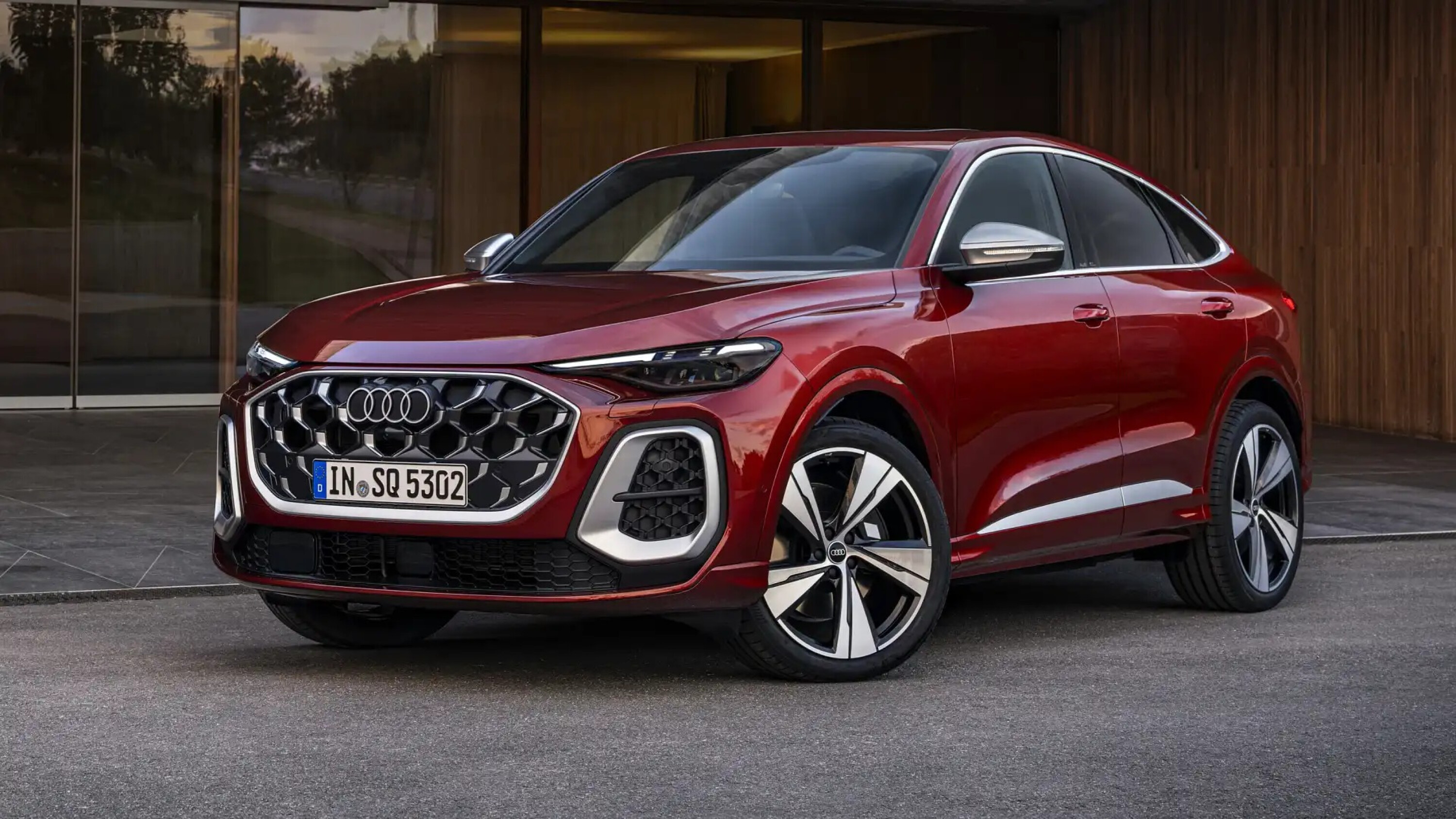
Audi
Q3 35 TFSI S line Edition: $60,900 drive away, 7.49 per cent finance rate
Q5 45 TFSI Sport: $85,990 drive away (usually $88,315 +ORC), 7.79 per cent finance rate
Q5 Sportback 45 TFSI S Line: $92,990 drive away (usually $96,515 +ORC), 7.79 per cent finance rate
Q7: five-year service pack (worth $3820), 3.99 per cent finance rate
SQ7: five-year service pack (worth $4600), 3.99 per cent finance rate
BMW
- $5000 deposit, four-year service plan and 2.99 per cent finance across new and demonstrator i4 eDrive35, iX1 and iX2 models.
- 6.99 per cent finance rate for X3 and 118
Ford
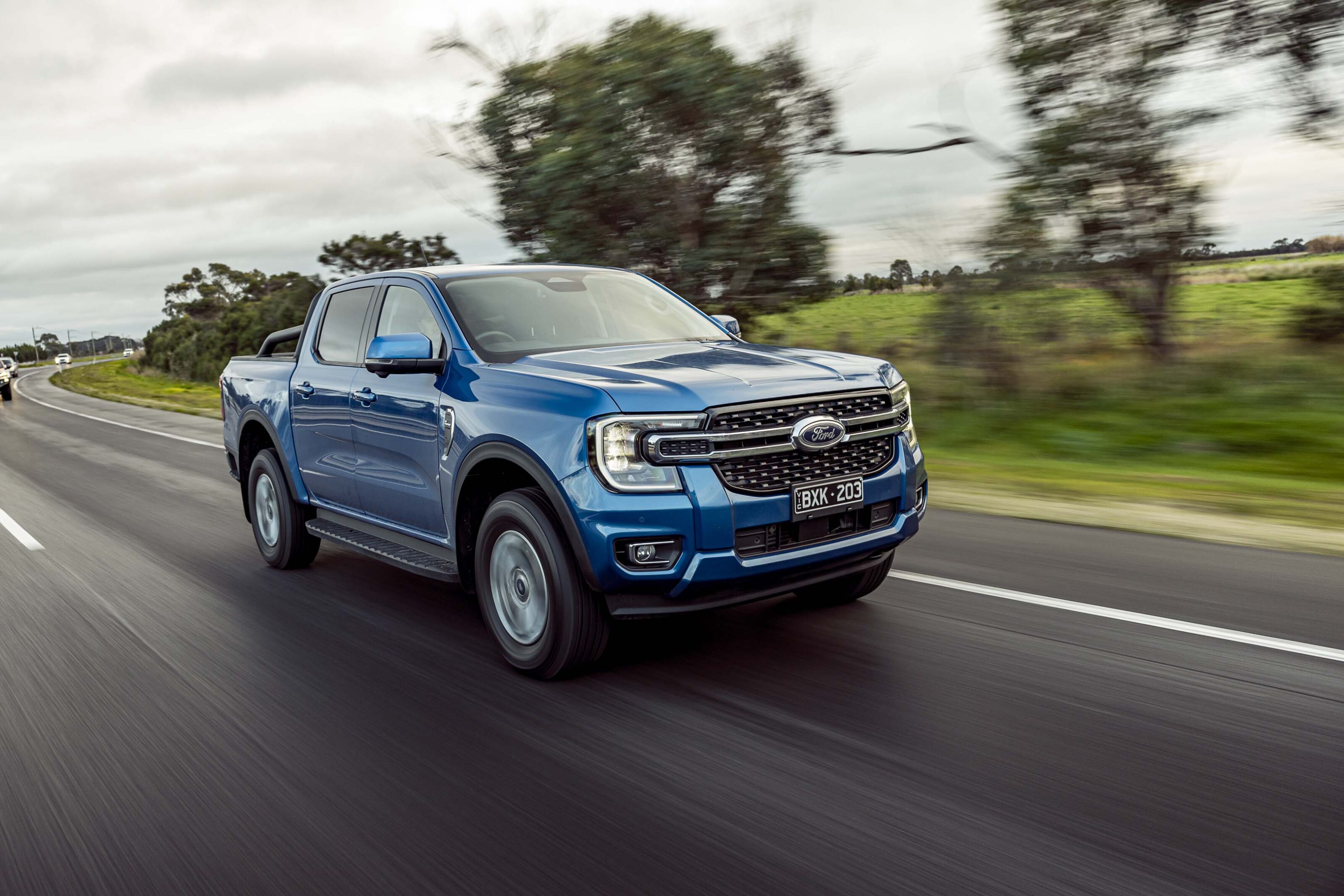
Ranger XLT bi-turbo 4×4 dual cab: $60,000 drive away (usually $63,640 +ORC)
Ranger Wildtrak bi-turbo 4×4 dual cab: $70,000 drive away (usually $69,640 +ORC)
MY23 F-150 Lariat LWB: $133,000 drive away (usually $140,945 +ORC)
MY23 F-150 Lariat SWB: $137,000 drive away (usually $139,950 +ORC)
Transit Custom Trend SWB: $55,000 drive away (usually $56,590 +ORC)
Transit Custom Trend LWB: $56,000 drive away (usually $57,590 +ORC)
Transit 350L RWD mid-roof: $62,000 drive away (usually $62,990 +ORC)
E-Transit mid-roof: $64,000 drive away (usually $89,990 +ORC)
Mustang Mach-E Select: $63,000 drive away (usually $64,990 +ORC)
Mustang Mach-E Premium: $77,000 drive away (usually $79,990 +ORC)
Mustang Mach-E GT: $94,000 drive away (usually $97,990 +ORC)
Tourneo Titanium X: $74,000 drive awayaway (usually $70,990 +ORC)
Geely
EX5: $2000 trade in bonus, complimentary mode 2 charging cable and either five years of servicing or a $2000 discount. For those financing, Geely is also offering a special 3.88% finance comparison rate.
Genesis
GV70 2.5T: 6.99 per cent finance rate for in-stock vehicles
MY25 GV80: $7000 deposit contribution and $2000 delivery fee reduction ($9000 in total)
Hyundai
Venue manual: $25,990 drive away (usually $22,750 +ORC)
Venue auto: $27,990 drive away (usually $24,750 +ORC)
Venue Active: $29,990 drive away (usually $27,000 +ORC)
Venue Elite: $32,990 drive away (usually $29,500 +ORC)
Kona: $35,490 drive away (usually $32,500 +ORC)
Kona Electric: $5000 bonus
Tucson: $39,990 drive away (usually $39,100 +ORC)
Tucson N Line 1.6T AWD: $45,990 drive away (usually $45,100 +ORC)
Tucson Hybrid: $46,990 drive away (usually $45,100 +ORC)
Tucson N Line Hybrid: $50,990 drive away (usually $49,100 +ORC)
Tucson Elite: $44,990 drive away (usually $46,100 +ORC)
Tucson Elite 1.6T AWD: $46,990 drive away (usually $48,600 +ORC)
Tucson Elite N Line 1.6T AWD: $49,490 drive away (usually $51,100 +ORC)
Tucson Elite Hybrid: $51,990 drive away (usually $50,100 +ORC)
Tucson Elite Hybrid AWD: $54,490 drive away (usually $52,600 +ORC)
Tucson Elite Hybrid N Line: $54,490 drive away (usually $49,100 +ORC)
Tucson Elite Hybrid N Line AWD: $56,990 drive away (usually $51,100 +ORC)
Tucson Premium Hybrid: $62,490 drive away (usually $59,600 +ORC)
Tucson Premium Hybrid N Line: $63,990 drive away (usually $61,100 +ORC)
Tucson Premium 1.6T AWD: $58,490 drive away (usually $55,600 +ORC)
Tucson Premium N Line 1.6T AWD: $59,990 drive away (usually $57,100 +ORC)
Ioniq 6: $20,000 bonus
Palisade: $5000 finance contribution or $3000 factory bonus
I30 Sedan: $30,990 drive away (usually $29,000 +ORC)
I30 Elite Sedan: $35,490 drive away (usually $33,500 +ORC)
I30 Premium Sedan: $38,990 drive away (usually $38,500 +ORC)
I30 N Line Sedan: $38,990 drive away (usually $36,000 +ORC)
I30 N Premium Sedan: $43,490 drive away (usually $41,500 +ORC)
I30 Hybrid Sedan: $34,990 drive away (usually $33,000 +ORC)
I30 Hybrid Elite Sedan: $39,490 drive away (usually $37,500 +ORC)
I30 N Line MHEV Hatchback: $38,990 drive away
I30 N Line Premium MHEV Hatchback: $43,990 drive away (usually $37,500 +ORC)
Staria 3.5L V6: $53,790 drive away (usually $49,500 +ORC)
Staria 2.2L Diesel: $56,790 drive away (usually $52,500 +ORC)
Staria Load: $5000 finance contribution
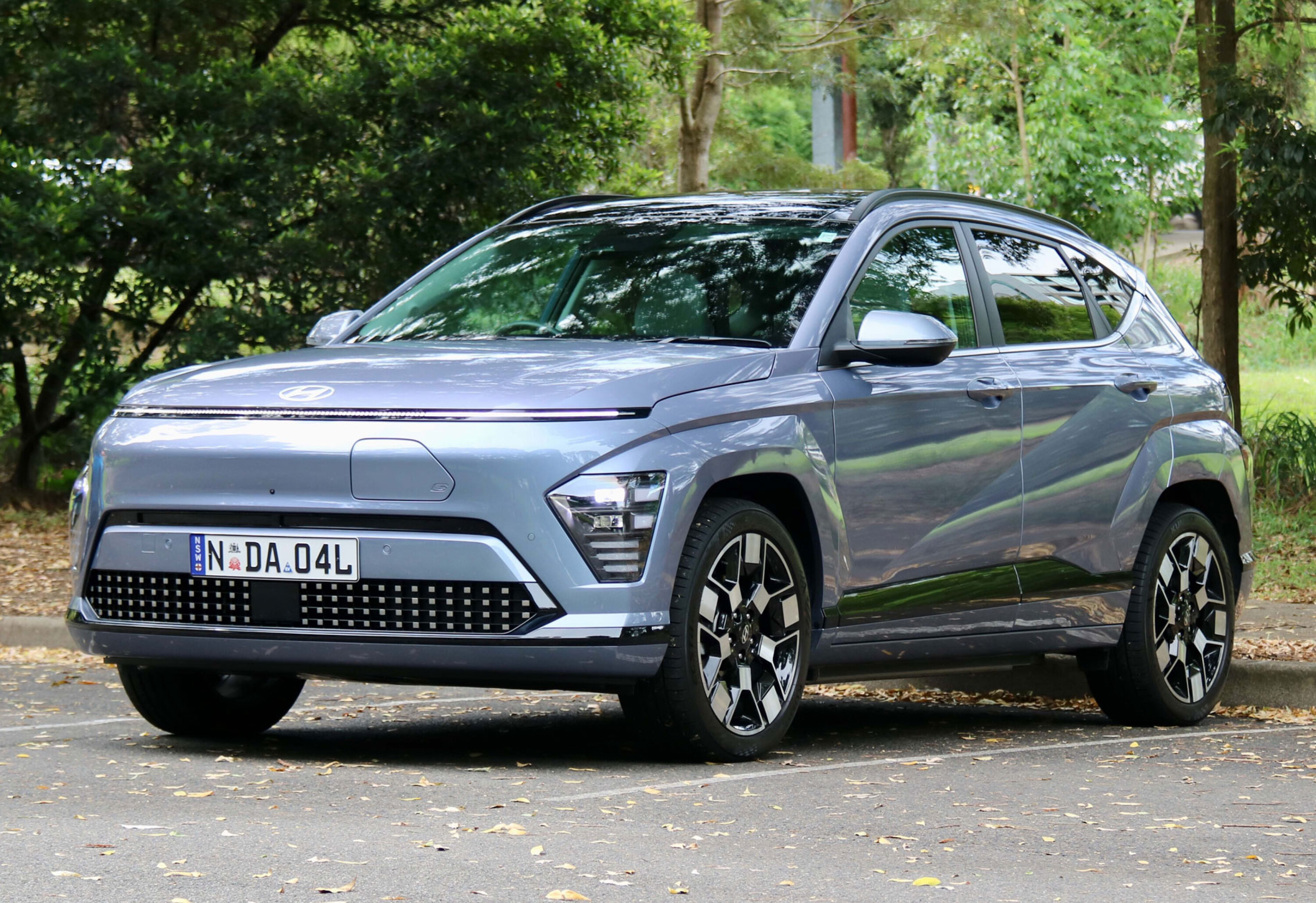
Isuzu Ute
D-Max SX single cab high-ride 4×2 1.9L manual: $32,990 drive away (usually $32,700 +ORC)
D-Max X-Rider dual cab 4×4 3.0L: $57,990 drive away (usually $59,500 +ORC)
D-Max X-Terrain dual cab 4×4 3.0L: $68,990 drive away (usually $70,500 +ORC)
MU-X LS-M 1.9L 4×2: $46,990 drive away (usually $48,400 +ORC)
MU-X LS-T: $69,990 drive away (usually $71,400 +ORC)
MU-X X-Terrain: $73,990 drive away (usually $75,100 +ORC)
Jeep
Avenger Longitude: $40,000 drive away (usually $49,990 +ORC)
Grand Cherokee Limited: $62,000 drive away (usually $72,950 +ORC)
Gladiator Night Eagle: $66,000 drive away (usually $78,250 +ORC)
Wrangler Night Eagle: $75,000 drive away (usually $87,250 +ORC)
Gladiator Rubicon: $76,000 drive away (usually $81,450 +ORC)
Kia
K4: $3000 deposit contribution
K4 Sport: $37,990 drive away (usually $35,190 +ORC)
EV6 and Niro EV: free 22kW EVSE home charger
Stonic GT-Line: $33,790 drive away (usually $31,980 +ORC)
Picanto Sport automatic: $22,340 drive away (usually $19,990 +ORC)
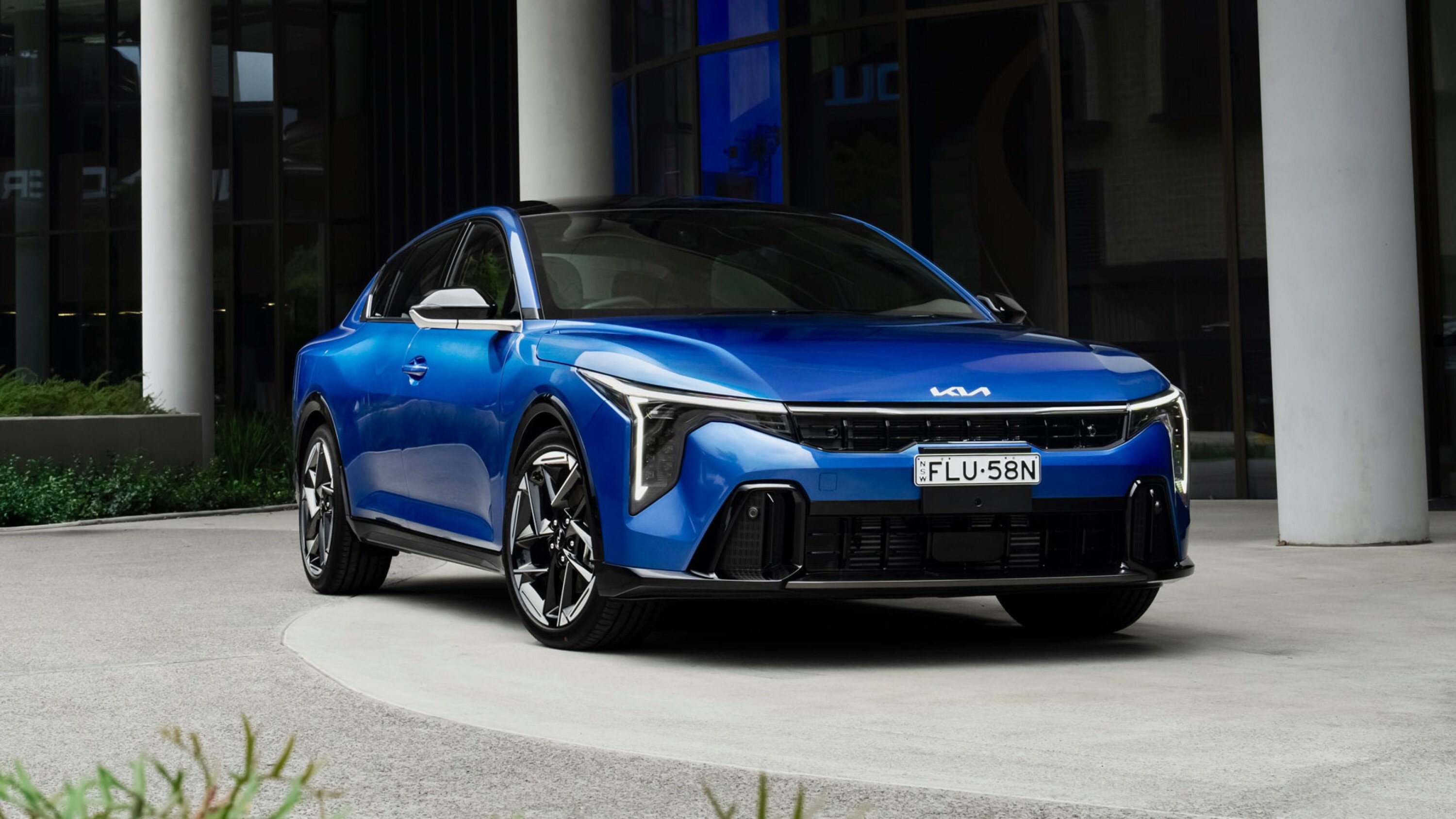
Mahindra
Scorpio Z8: $38,990 drive away (usually $31,990 drive away)
Scorpio Z8L: $41,990 drive away (usually $46,990 drive away)
XUV700 AX7L: $38,990 drive away (usually $42,990 drive away)
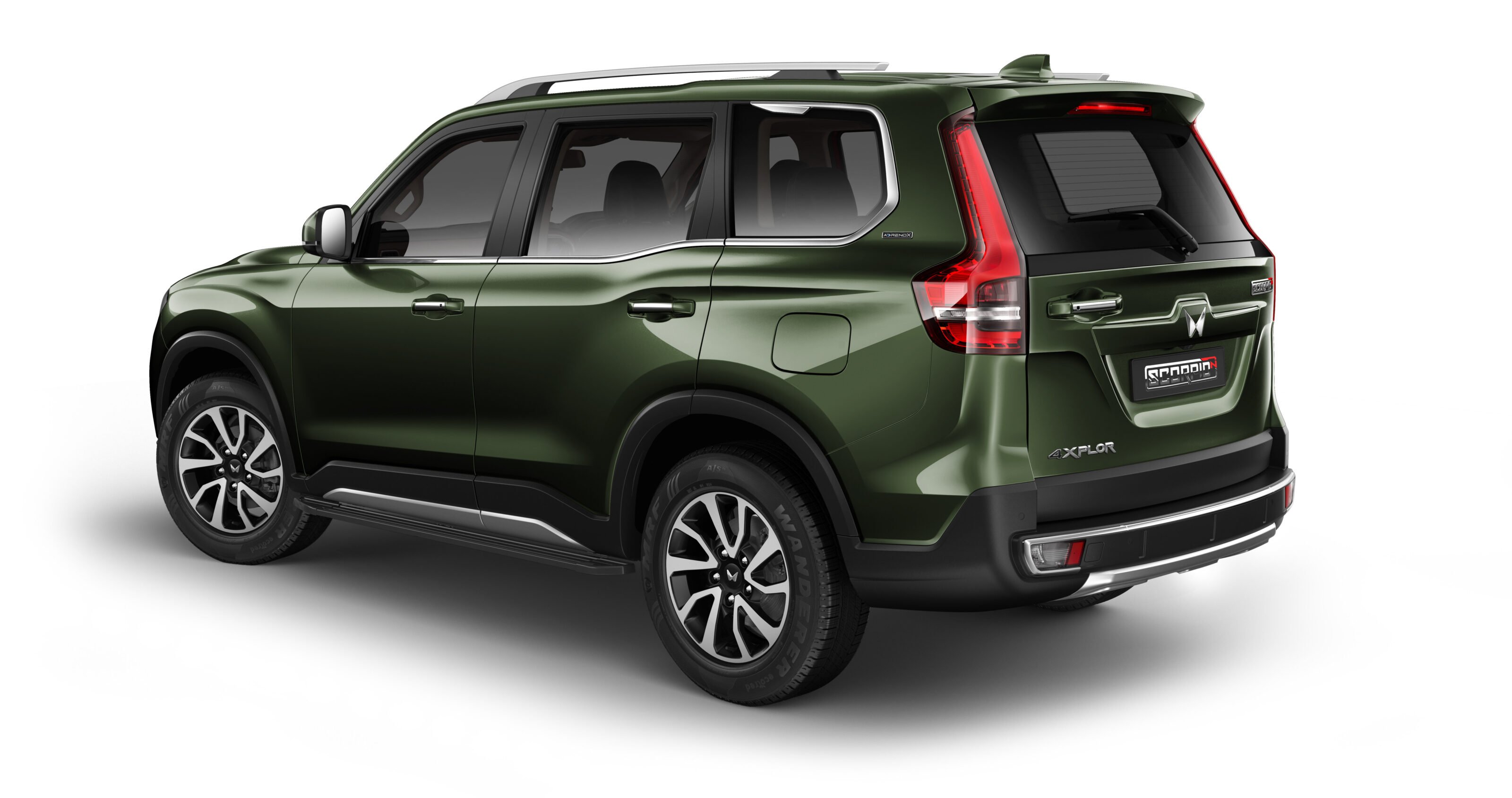
Mazda
Mazda2 Evolve: $29,990 (usually $26,990 +ORC)
CX-3 Pure: $32,990 (usually $30,370 +ORC)
Mazda3 Pure: $33,990 (usually $31,310 +ORC)
CX-30 Pure: $35,990 (usually $34,060 +ORC)
Mazda6 Sport sedan: $37,990 (usually $36,290 +ORC)
CX-5 Maxx: $37,990 (usually $36,740 +ORC)
BT-50 XS Cab Chassis 4×2: $38,990 (usually $36,400 +ORC)
Mazda6 Sport wagon: $39,290 (usually $37,590 +ORC)
CX-60 Pure: $53,990 (usually $50,240 +ORC)
BT-50 XT Pickup 4×4: $54,990 (usually $51,000 +ORC)
CX-80 Pure: $59,990 (usually $55,200 +ORC)
BT-50 XTR Pickup 4×4: $62,490 (usually $62,750 +ORC)
BT-50 GT Pickup 4×4: $65,990 (usually $63,070 +ORC)
BT-50 SP Pickup 4×4: $67,990 (usually $66,170 +ORC)
Mercedes-Benz
- Complimentary three-year service plan on most models
- $5000 deposit contribution on AMG A 35, GLB 35 and C 43 models
MG
ZST Vibe: $23,888 drive away (usually $26,490 +ORC)
ZS EV Long Range: $36,888 drive away (usually $47,990 +ORC)
QS: $46,990 drive away for Excite, $50,990 drive away for Essence
- $1000 bonus on MY24 MG3, MG4, MG5 and HS models

Nissan
- 1.9 per cent finance rate for Navara, X-Trail, Pathfinder and MY25 Qashqai e-Power ranges
- 2.9 per cent finance rate for petrol Qashqai models
- 4.9 per cent finance rate for Juke and Z ranges
- $1000 loyalty bonus on X-Trail
Peugeot
3008: complimentary three-year service plan
Partner: $1500 cash back
MY23 Expert SWB auto: $46,990 drive away (usually $48,990 +ORC)
MY23 Expert LWB manual: $40,990 drive away (usually $46,736 +ORC)
MY24 E-Expert: $79,990 drive away (usually $79,990 +ORC)
MY23 Boxer: $49,990 drive away (usually $54,527 +ORC)
Skoda
MY24 Fabia Select: $29,990 drive away (usually $32,490 drive away)
Karoq and Kamiq: 6.99% finance rate
Smart
- Free on-road costs and three-year/60,000km service plan for all models already in stock
Subaru
- Five-year roadside assistance and a factory bonus on all models, aside from the Solterra and MY26 Forester
Toyota
bZ4X: 1.9 per cent finance rate and a free 7.4kW ABB Terra AC wallbox charger
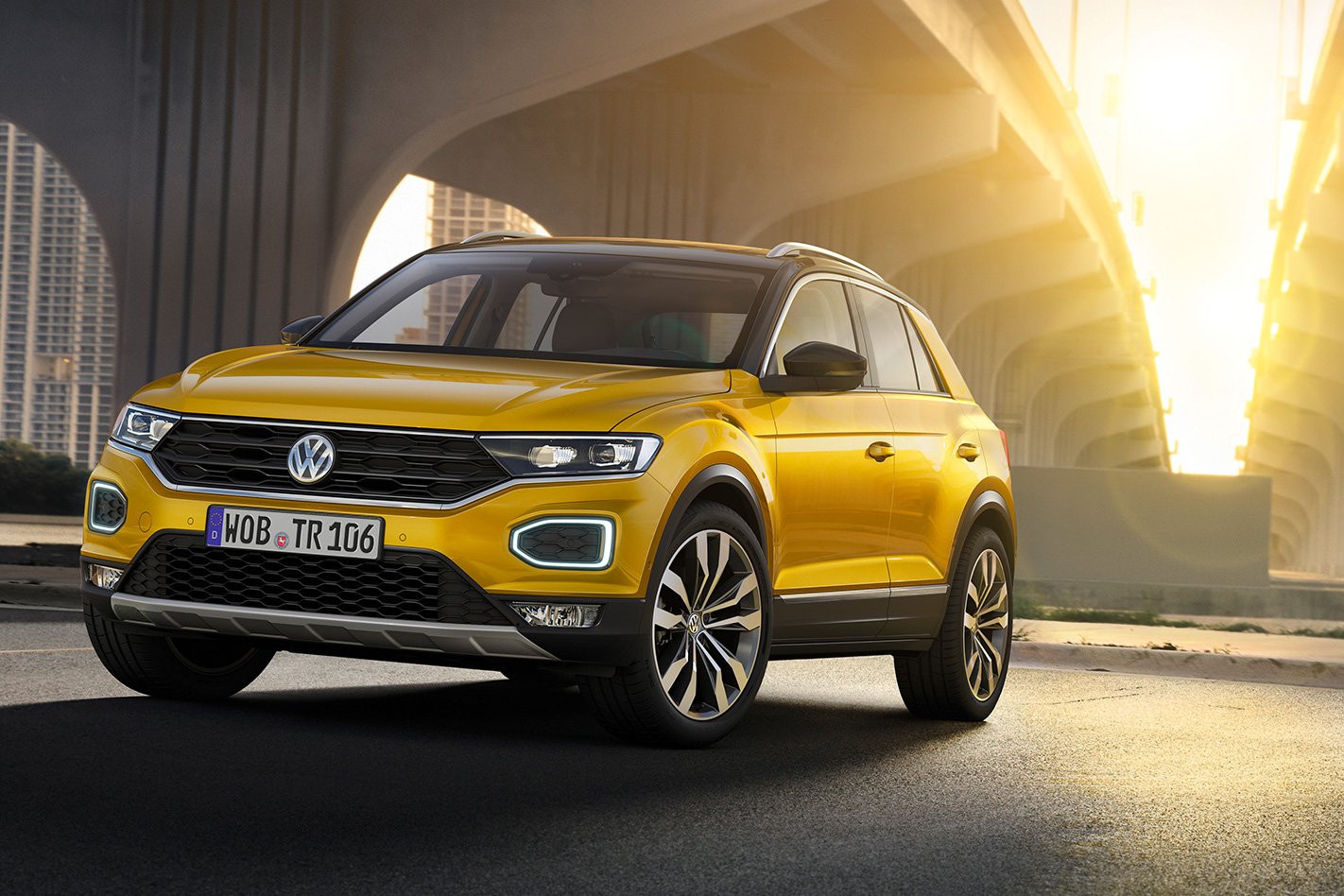
Volkswagen
MY24 T-Cross Life: $36,990 drive away (usually $33,990 +ORC), 7.99% finance rate
MY24 T-Cross Style: $39,990 drive away (usually $37,490 +ORC), 7.99% finance rate
MY24 T-Cross R-Line: $43,990 drive away (usually $40,990 +ORC), 7.99% finance rate
MY24 T-Roc CityLife: $37,990 drive away (MY25: $39,990 drive away – usually $38,990 +ORC)
MY24 T-Roc Style: $42,990 drive away (MY25: $44,990 drive away – usually $41,990 +ORC)
MY24 T-Roc R-Line: $51,990 drive away (MY25: $53,990 drive away – usually $49,990 +ORC)
MY24 T-Roc R: $65,990 drive away (MY25: $67,990 drive away – usually $64,990 +ORC)
MY24 Touareg 170TDI: $95,538 drive away (MY25: $98,373 drive away – usually $89,490 +ORC), free five-year service plan
MY24 Touareg Elegance: $109,938 drive away (MY25: $113,073 drive away – usually $103,490 +ORC), free five-year service plan
MY24 Touareg R-Line: $119,898 drive away (MY25: $123,573 drive away – usually $113,490 +ORC), free five-year service
plan
MY24 Tiguan 110TSI Life: $47,990 drive away (usually $43,990 +ORC), 5.99% finance rate
MY24 Tiguan 132TSI Life: $50,990 drive away (usually $47,990 +ORC), 5.99% finance rate
MY24 Tiguan 162TSI Elegance: $59,990 drive away (usually $57,090 +ORC), 5.99% finance rate
MY24 Tiguan 162TSI R-Line: $61,990 drive away (usually $60,590 +ORC), 5.99% finance rate
MY24 Tiguan Allspace 110TSI Life: $39,990 drive away (usually $43,990 +ORC), 10.42% finance rate
MY24 Tiguan Allspace 132TSI Life: $44,990 drive away (usually $47,990 +ORC), 10.42% finance rate
MY24 Tiguan Allspace 162TSI Elegance: $59,990 drive away (usually $57,090 +ORC), 5.99% finance rate
MY24 Tiguan Allspace 162TSI R-Line: $61,990 drive away (usually $60,590 +ORC), 5.99% finance rate
MY24 Tiguan Allspace 162TSI Wolfsburg Edition: $64,990 drive away (usually $63,990 +ORC), 5.99% finance rate
MY24 Golf Life: $39,990 drive away (usually $38,690 +ORC)
MY24 Golf R-Line: $44,990 drive away (usually $47,990 +ORC)
MY24 Golf GTI: $59,990 drive away (usually $56,090 +ORC)
MY24 Golf R: $69,990 drive away (usually $70,590 +ORC)
MY24 Polo Life: $31,990 drive away (MY25: $32,990 drive away) (usually $34,790 +ORC)
MY25 Polo Style: $37,990 drive away (usually $34,790 +ORC)
MY24 Polo GTI: $42,990 drive away (MY25: $44,990 drive away – usually $41,790 +ORC)
MY23 Amarok Core: $51,990 drive away (MY24: $53,990 drive away – usually $55,490 +ORC)
MY23 Amarok Life: $56,990 drive away (MY24: $59,490 drive away – usually $59,490 +ORC)
MY23 Amarok Style TDI500: $66,990 drive away (MY24: $69,740 drive away – usually $69,740 +ORC)
MY23 Amarok Style TDI600: $70,990 drive away (MY25: $73,740 drive away – usually $73,740 +ORC)
MY24 Amarok PanAmericana: $76,990 drive away (usually $78,990 +ORC)
MY23 Amarok Aventura TSI452: $76,990 drive away (MY24: $79,990 drive away – usually $82,990 +ORC)
MY24 Amarok Aventura TDI600: $79,990 drive away (usually $82,990 +ORC)
Do trailers, caravans and boats belong on suburban streets? It’s an increasingly controversial question in our crowded city streets, where space is at a premium, and a commonly asked one for one council in Sydney.
Randwick City Council revealed it has been swamped with complaints about boats and trailers parked in suburban streets, and has issued $28,000 in fines and impounding more than 400 vehicles in recent times as a result.
Parking in major cities is increasingly scarce and increasingly expensive, and many residents argue that trailers, boats and caravans take up critical space. According to Randwick City Council, many reported cases allege that some vehicles are parked for weeks at a time, making parking difficult for locals.

What does the law say? Boat owners can legally park their craft – including outside the owner’s residence – for up to 28 days at a time.
This week, Randwick City Council told Yahoo News Australia rangers had been kept quite busy tending to reports of what residents claimed were unattended vehicles and trailers.
The council told the news outlet it is actively monitoring and removing trailers that have overstayed their welcome in its streets. “State government rules allow owners of registered trailers to park their trailer legally on the street outside their home, and to park the trailer elsewhere for up to 28 days before moving it,” a Randwick City spokesman told Yahoo.
“Rangers have investigated 932 suspected unattended vehicles in 2025, impounding 440 and
issuing over $28,000 in fines.”
It’s not a new controversy in congested Sydney. Two years ago a boat parked in the street at Freshwater on Sydney’s Northern Beaches had “f**k it off” spray painted in red on its side. The owner then responded to the vandals by taping a note to the boat which read: “The boat and trailer are registered, and we can thus park it legally in the street.”
Understandably tired of the drama, the boat’s owner then posted another – and presumably the last –letter to the community. It read: “The boat will be moved in the next few days, please do not damage it or graffiti it”.
