
Porsche says its 919 Hybrid endurance racer has been redeveloped to compensate for new regulations in the 2017 World Endurance Championship.
The essence of the 919’s drivetrain remains the same, with a 2.0-litre turbocharged V4 supplying 368kW and an electric motor capable of bringing another 294kW to the party.
The result is a healthy 662kW pulling along a lightweight chassis and a monocoque made of carbon fibre and honeycomb aluminium, totalling a dry weight of 875kg.
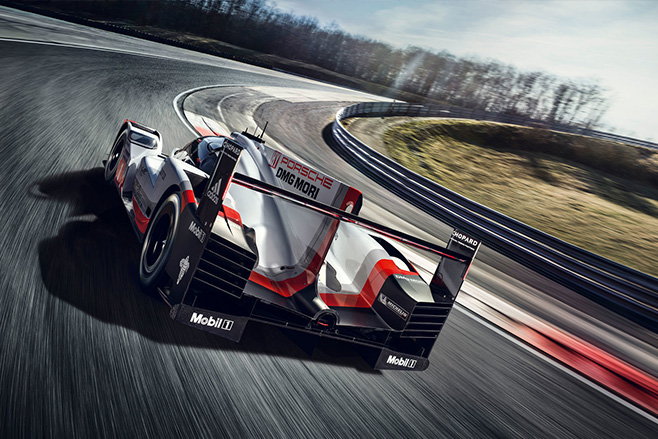
Mark Webber’s Porsche 919 Hybrid in London
Team principal and acting technical director Andreas Seidl says most of the car has been updated in some way. “For the 2017 season, 60 to 70 per cent of the vehicle is newly developed. The basic concept of the 919 Hybrid still offers scope to optimise the finer details and further boost efficiency.”
The updated Porsche 919 Hybrid will reach 100km/h in a spritely 2.2 seconds, and 200km/h in 4.8, which leaves more than 86,395 seconds of the 24-hour race at Le Mans to go.

New regulations have reduced the amount of downforce allowed in an effort to lower cornering speeds. Porsche says it will counter account for this by using one of two new aerodynamic setups.
Nine things we learned at Le Mans 2016
One setup is specially designed for high speeds and minimal air resistance at Le Mans, while the other focuses on higher downforce to compensate for extra drag, enabling the car to more easily navigate technical tracks.
“As a result of the aerodynamic losses we will incur due to the new regulations, we are expecting to see a three to four-second increase in lap times at Le Mans,” explains Seidl.
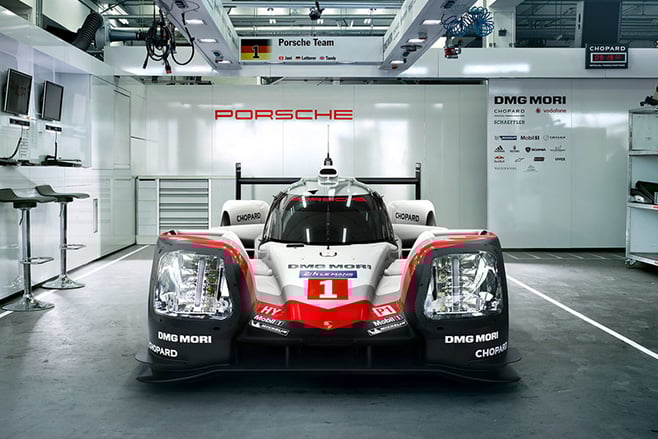
“We will have to wait and see how well the various enhancements we have made will compensate for these losses,” says Seidl.
LMP vice president for Porsche Fritz Enzinger says the 24-hour race at Le Mans will be unpredictable as usual, and adds he expects Toyota to put up a robust challenge for Porsche.
Toyota TS050 LMP1 racer revealed
“Toyota is set to be a very strong contender in the top-tier LMP1 category for the 2017 season,” he says. “We will face up to them with a meticulously enhanced Porsche 919 Hybrid and a team of six first-class drivers.”
Remember rotary engines? Mazda loved them for a while, and we’ve been feeling nostalgic. So we found this.
The Mazda 767B was a late-’80s development, which eventually turned into a 1989 24 Hours of Le Mans competitor under the Mazdaspeed racing team.
Though the two 767Bs in the race only finished 17th and 19th overall, they were 2nd and 3rd in their Mazdaspeed-dominated GTP class. To be fair, there were only three entrants in the GTP class that year.
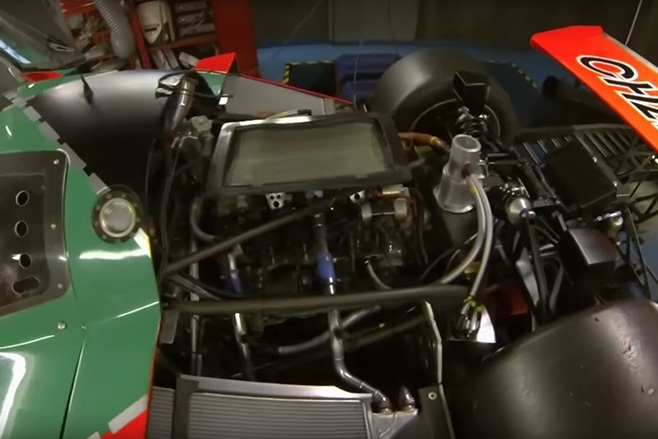
In our quest to find more 767B goodness, we were reminded of one example which recently sold at Amelia Island for a pretty respectable US$1.75m.
Chassis number 767-003 was the last of three 767Bs built, and was the class winner in the 1990 Le Mans, according to sellers Gooding & Company.
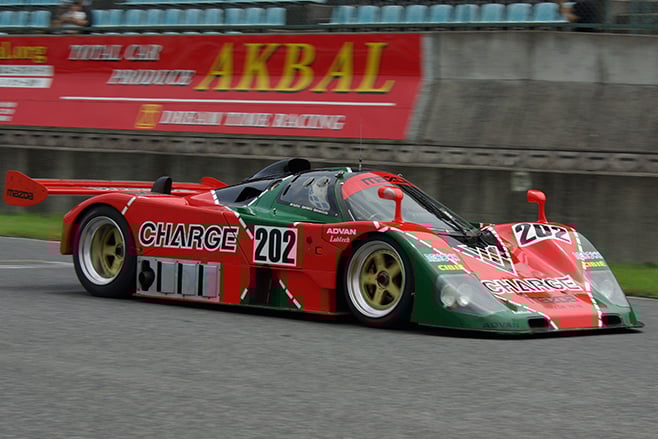
The reason we love this car isn’t just its rarity. We love the sound it makes at 9000 revs. And the fact that it shoots flame.
We would have loved to have been in there, even if it did us some permanent ear damage. Plus, we know we’ll probably never get to drive one. Forbidden fruit is always the most appealing…
THE Hyundai Kona, the Korean carmaker’s all-new compact SUV, will arrive in Australia this year after today revealing the badge it will wear.
Taking the name from the venturesome coastal region on Hawaii’s Big Island, Hyundai said Kona reflects the “adventurous spirit of Hyundai Motor’s newest SUV”. This follows a similar geographical naming convention to Hyundai’s other SUVs – the Creta (sold in China), Santa Fe, Tucson and Veracruz (sold in Korea).
Sharing the same technology and underpinnings as the third-generation Hyundai i30 due on sale this month that we’ve already sampled overseas, Hyundai claims the Kona will deliver “best-in-class interior space” and Hyundai’s signature strong design features.
The Kona will be the Korean carmaker’s first entry to Australia’s baby SUV segment, sitting below the Santa Fe and Tucson and taking on the likes of the Mazda CX-3, Toyota C-HR and Mitsubishi ASX. It’ll also be available in Europe, the US and Korea.
Hyundai Australia public relations general manager Bill Thomas said the Kona’s platform was “related to the new i30 [and] should give more luggage space and be a slightly larger car than the [Mazda] CX-3”.
Hyundai added that the small SUV had “also been developed with a focus on enhancing driving dynamics”.
Expect the Kona to feature similar engines to the i30, which will include a 1.6-litre turbocharged four-cylinder unit. And while its form will be shaped by Hyundai’s European design centre and it is expected to be built in both Korea and Europe, Kona’s ride and handling will be fine-tuned in Australia before it goes on sale.
A teaser image of the Kona reveals a two-tier headlight assembly, but at this stage there’s no more information about the compact SUV’s appearance.
The Kona is due to arrive in Australia in the second half of 2017, although it should make its debut before mid-year.
Sister company Kia is also expected to launch a Rio-based small SUV this year to sit below the large seven-seat Sorento and the five-seat mid-size Sportage.
IT’S that time of year again when the world’s car makers do their best to pull the wool over our eyes with a barrage of April fools gags that range from the downright ridiculous to the almost believable. Here are our five favourites and one fail.
BMW and Mini have built themselves quite a reputation as a pair of pranksters on April 1 and didn’t disappoint this year.
The British brand presented a John Cooker Works version of its convertible Mini – yes you read that correctly – which allows caterers to convert the passenger compartment into a timber-topped work area for the preparation of food.
| 2017 Mini Cooper S to gain JCW tuning options
In a series of official images, an expert chef is preparing sushi, which is not the only fishy thing about the John Cooker Works. It doesn’t actually appear to have an oven either.

BMW, on the other hand, announced its dDrive dog basket which uses the company’s TwinPower Turbo technology to cosset your pooch with air, creating the same sensation of hanging out of the car window without having to go anywhere at all.
The company has not specified if the canine creation also incorporates technology to stop your dog jumping out if it sees a cat.
Speaking of which, Lotus stuck with the pet theme and offered a skid lid for your cat, allowing owners to take Tiddles to the track. But the feline helmets were only available until midday on April 1. Suspicious?
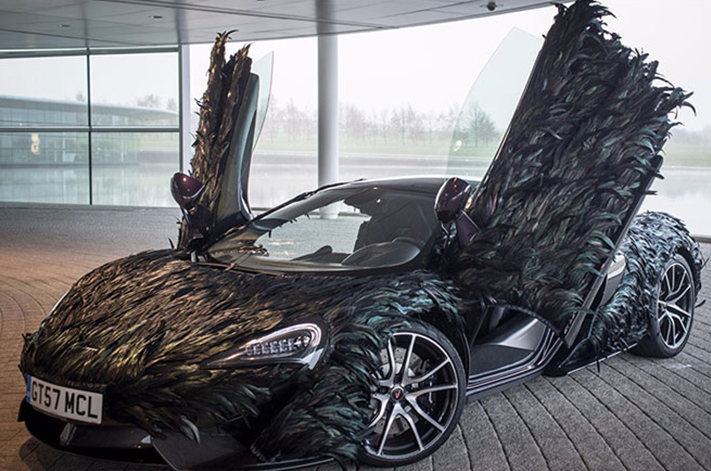
Top marks go to McLaren for creating something Andy Goldsworthy would endorse and a potentially marketable one-off.
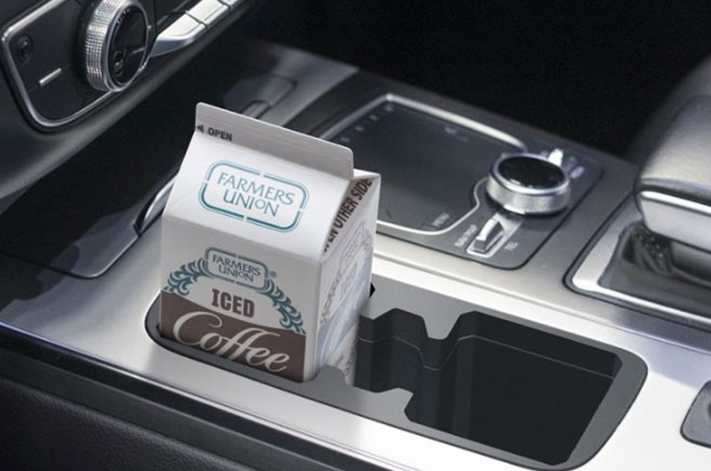
Audi fans will delight at the German car maker’s decision to offer a special square drink holder in selected models sold in South Australia, where the favourite drink is Farmers Union flavoured milk – sold in square cartons and not round bottles.
Bonus marks awarded for the local angle and even the production of a short film to add credibility.
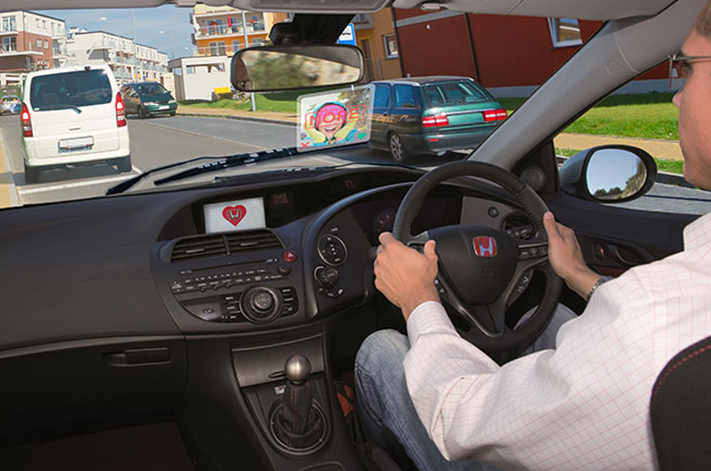
The user can either accept or reject the candidates by selecting left or right with special s-wipers (d’ya see what they did there?) operated by steering wheel buttons, which sounds a little like Nissan’s N-Connect application from last year, which notified users if a nearby car was occupied by a single person.
Of course, we may have been reeled in a little further if Honda currently offered any conventional head-up display technology in its cars.
WANT to get a seat in federal politics, but hard up for the cash to get you there? There is a way: former Victorian senator Ricky Muir’s project car, a 5.0-litre V8-engined 1997 Holden VT Calais named “Politically Incorrect”, is up for sale.
More at home as the ride of choice in the Howard-era parliamentary carpool, Muir’s Calais is the project car the ’roo poo-flinging senator adopted about the same time he unexpectedly fell into federal politics, and it now has to make way for other projects. The price? A very affordable $800.
“No I am not giving up on motorsport,” the at-times outspoken Muir said. “With the Gippsland Motorplex/Bairnsdale Dragway set to begin drag racing again in a fortnight, our family XR8 is about to inherit some Drag Radial tyres and a little shot of nitrous,” Muir wrote on his Facebook page.
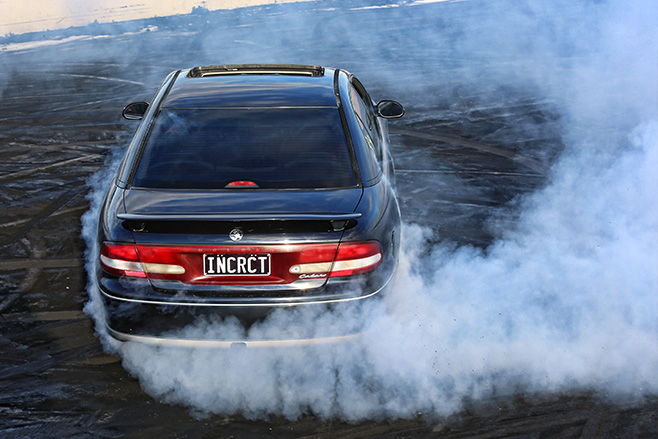
Muir is selling the “reasonably straight and clean” car as a roller. He says it sits on factory alloys, has had the rear seats and boot trimmings removed for weight reduction, while the diff is welded locked. As well, the buyer gets new Pedder Sports Ryder springs (rears fitted, fronts not), and a new radiator.
According to Muir, it was built as a cheap entry-level motorsport vehicle. “It was used for a few burnout competitions and once around a gravel hillclimb track,” he says.
But as always, the political sunshine soon makes way for the post-budget rain. Politically Incorrect needs a new water pump, has “a tendency to break down in higher revs, never got around to looking at why”, and it “seems to have a mystery noise only audible at a certain amount of revs”.
Sadly, it’s not the same car Muir’s daughter, then aged eight, was filmed dropping a burnout in – a video that was swiftly removed from social media shortly after he was elected.
Wheels has peeked behind the parliamentary veil a few times in its 65-year history. We’ve even had Prime Minister Malcolm Fraser review cars, and trawled through Australian businessman and former political heavyweight Clive Palmer’s $20 million car collection – he famously knocked back the offer of a commonwealth car to arrive at Parliament House in the back of his chauffeur-driven Rolls-Royce Silver Cloud to help reduce the financial burden on taxpayers.
A true man of the people.
The off-roader specialist has again gone a bit crazy for its hardcore fans – especially those who will attend the 51st running of the event, which runs in Moab, Utah, for nine days from 8th April.
The event is designed for fun but also to showcase the capability of its products, potential production ideas, as well as accessories and parts available through Jeep’s service, parts and customer care sub-brand Mopar.
Here’s WhichCar’s guide to Jeep’s six 2017 concepts:
JEEP GRAND ONE
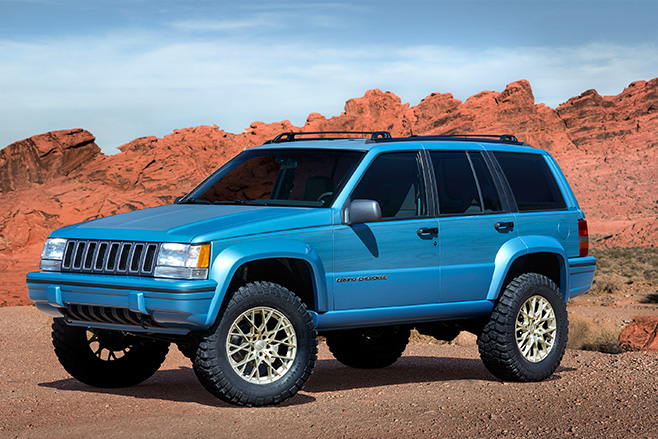
Power comes from an unmodified 5.2-litre V8. A 1990s-inspired interior includes an old-school car phone for a period-correct touch.
SAFARI
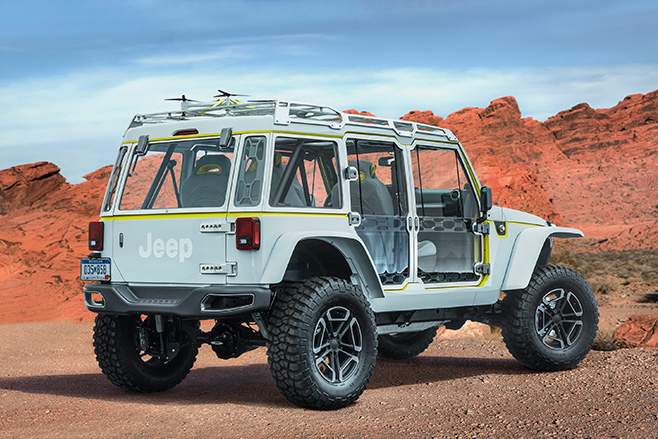
| Jeep 75th anniversary special editions releasedA two-level roof rack comes with a drone, and inside is an instrument-mounted iPad. Off-roading ability is enhanced by selectable locking differentials front and rear, 35-inch mud-terrain rubber (fitted over 18-inch rims), and a reduced body length that targets greater nimbleness on trails.
QUICKSAND
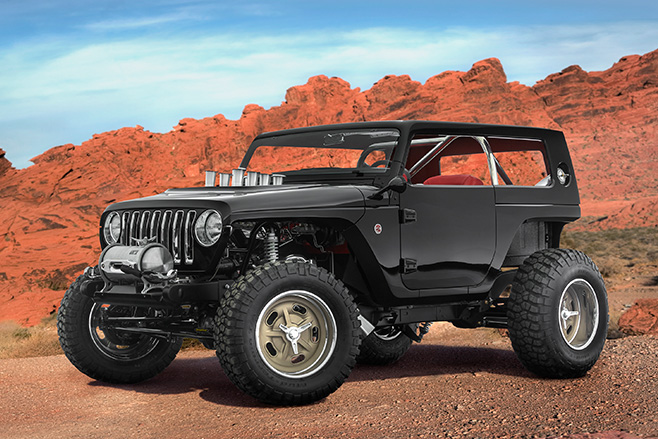
That will make for some loud engine noise on the move, and Jeep has removed the roof panel and glass windows so occupants can fully appreciate it. Uniquely, even for a Jeep, the Quicksand sits on staggered wheel sizes – 32-inch at the front and 37-inches at the rear. To ensure it doesn’t get bogged – and look like a literal interpretation of its name – the Quicksand also features a winch and recovery rope.
TRAILPASS
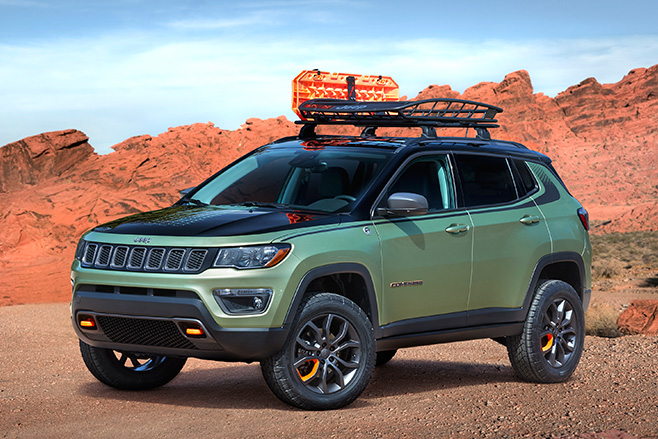
A black bonnet, black decals and tinted headlights and tail-lights add a suitably tough aesthetic, while driver and passengers get to sit on custom leather seats.
SWITCHBACK
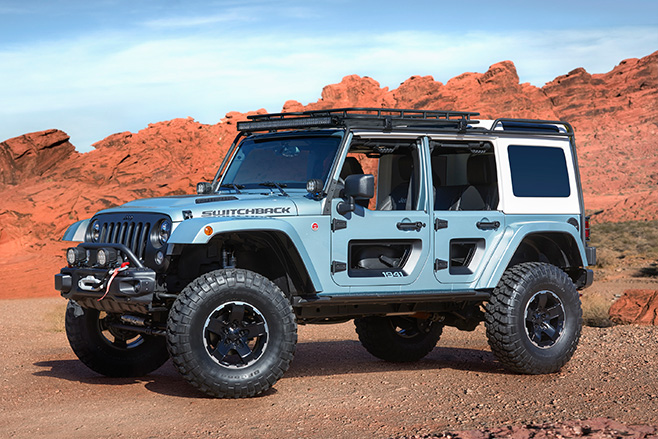
The body is distinctive for its ‘half’ doors and white Safari hardtop. A special lighting system encompasses some more conceptual features, including a concept light bar above the windscreen and A-pillar lamps. Power comes from a standard 3.6-litre V6 ‘Pentastar’ engine.
LUMINATOR
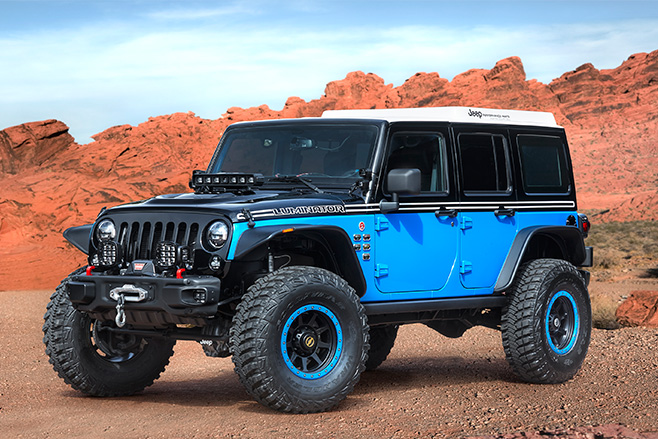
Jeep’s Luminator concept, as its name suggests, is designed for ultimate trail visibility. It’s been co-developed with the Automotive Lighting division of renowned high-tech Italian specialist Magneti Marelli – a subsidiary of Jeep’s parent company FiatChrylser. The vast array of illuminating systems includes magnetic underbody rock lights, 7-inch LED projector headlights, LED tail-lights, windscreen pillar spotlights, and LED auxiliary lighting and cornering foglights on the upper bumper.
The stand-out lighting feature is a bonnet-mounted LED scanning module that can spot and follow wildlife and other potential hazards to keep Jeep drivers safe on the trail. The laminator can also serve as a scouting vehicle thanks to a multi-coloured rear, high-mount stoplight, with red (stop), amber (drive at 2-5km/h), green (5-40km/h) or white (to provide rear flood lighting). The Luminator’s roof includes a solar panel and a drone landing pad – for a drone that can also be used for supplementary lighting.
The automotive industry is entering a brave new world, where SUVs can be performance cars, sedans can drive themselves and limousines can make do with a 2.0-litre four-cylinder.
Not too long ago a four-cylinder 7 Series wouldn’t have been able to get out of its own way, but with a 190kW/400Nm turbocharged petrol engine allied to an 83kW/250Nm electric motor combined outputs of 240kW/500Nm make the 740e the third-quickest 7 Series, out-accelerated only by the twin-turbo V8 750i and twin-turbo V12 M760Li.
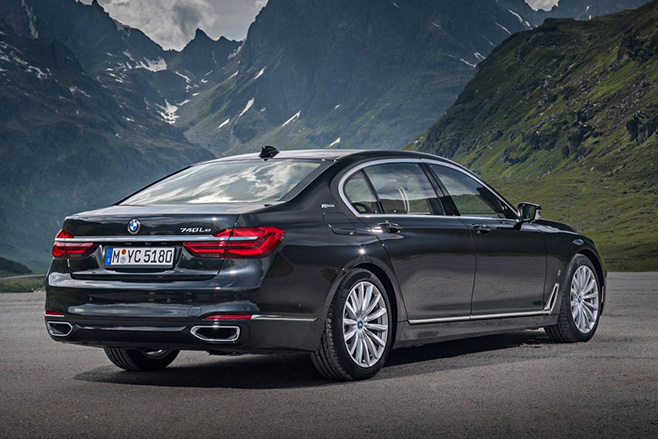
It’s certainly plenty quick, though when it kicks in the buzzy four-cylinder engine ruins the luxury vibe somewhat; the smooth-as-silk 3.0-litre six would’ve been a more appropriate engine for this luxury application.
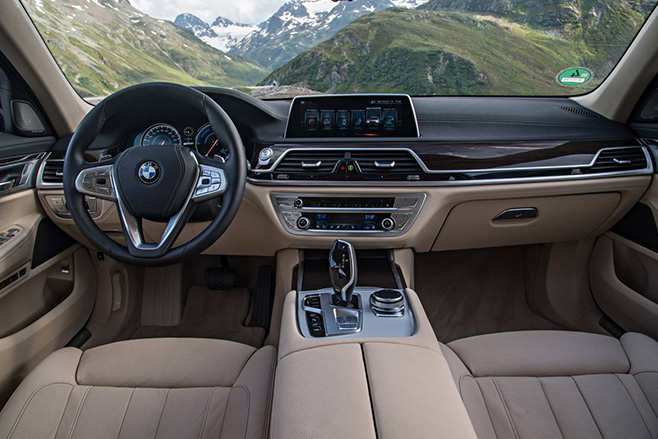
The rest of the experience is standard 7 Series: heaps of technology, impressive handling, alarmingly feel-free steering and a suitably wafty ride, bar the occasional choppiness on rough surfaces.
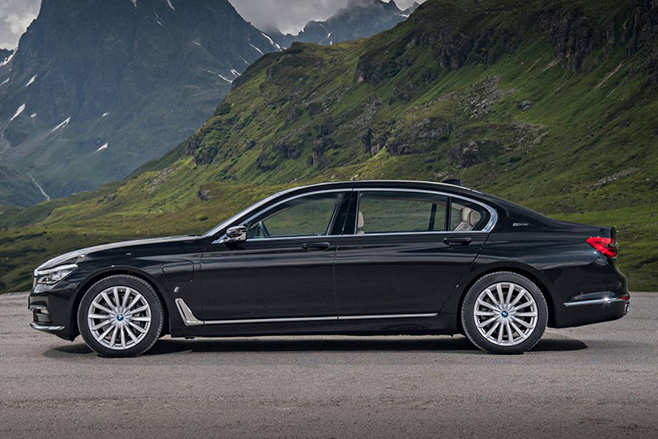
SPECS Engine: 2.0L I4 hybrid Power: 240kW Torque: 500Nm Weight: 1900kg 0-100km/h: 5.4sec Price: $229,000
AFTER a meeting in Paris to discuss whether Formula One should consider replacing the unloved current turbo hybrid power units, the FIA controlling body and significant stakeholders have indicated their desire to switch to less expensive, noisier engines by 2021, the year of the next opportunity to move to new regulations.
Chaired by FIA president Jean Todt and attended by representatives of new F1 owner Liberty Media, the four current F1 engine suppliers plus manufacturers potentially interested in participating in the sport (among them Volkswagen), those present agreed on several key moves to change the sport.
The meeting established the overriding aim was to keep F1 as the pinnacle form of motorsport with road-car relevant technology, while making power units simpler and cheaper to develop and produce – and more powerful.
Though it is almost inevitable the current hybrid power units will go, it is likely some of the technology will stay.
The stakeholders in the sport also agreed on the need for engine regulations which give drivers the freedom to drive harder at all times, rather than the fuel and power unit conservation obligatory with current engines and the 105-litre fuel minimum.
Todt, who oversaw the introduction of the technically complicated and scarily expensive turbo-hybrid engines in 2014, seems happy to concede these power units haven’t been a resounding success.
The Frenchman came away from the Paris meeting very satisfied with the absence of conflict among the stakeholders, who agreed broadly on the future direction of the sport.
“I was very pleased with the process, and the fact that so many different stakeholders were able to agree on a direction for the FIA Formula One World Championship in such an important technical area,” Todt said in an FIA statement.
“Of course, now we must sit down and work through the fine details of exactly what the 2021 power units will be – but we have begun on the right foot, and I am looking forward to working through the process to come up with the best decision for Formula One into the future.”
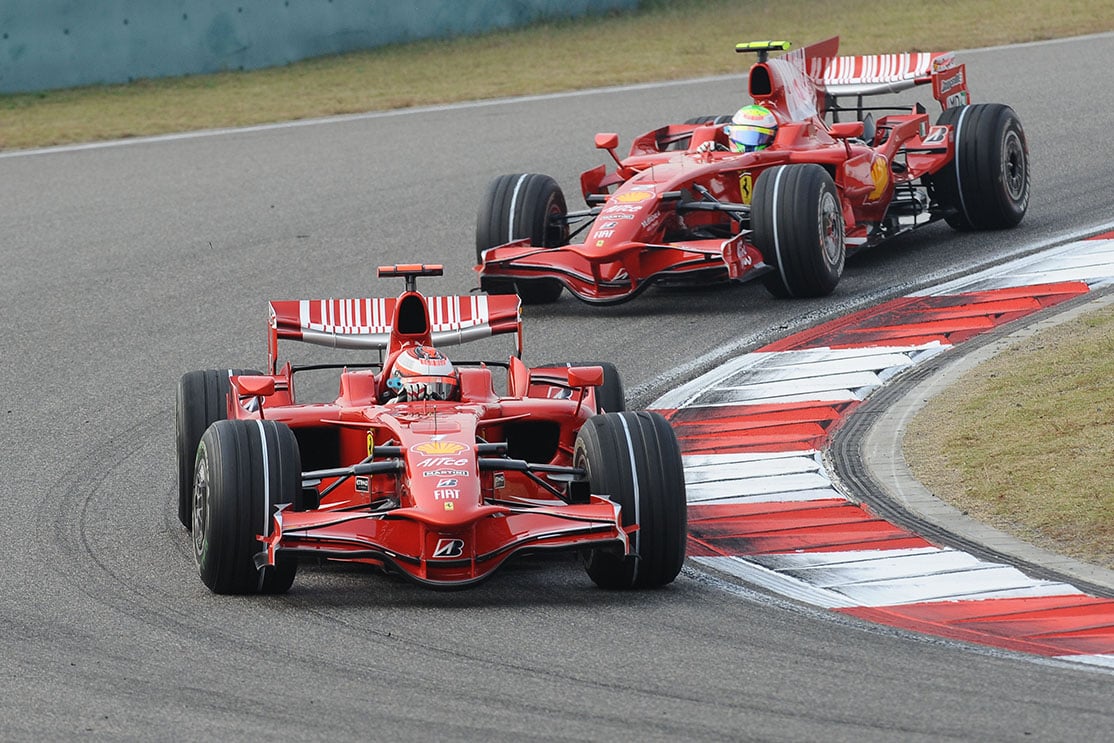
Talks are already in train for the revisions of the 2021 engine regulations.
The FIA confirmed the existing 1.6-litre V6 turbo hybrid power units will remain until the end of the 2020 world championship, with rules dictating the first change cannot be applied until 2021.
A week earlier, in a media briefing at the Australian Grand Prix, Todt said it is the responsibility of the FIA to make the rules, but in the context of a yearning by new commercial rights holders to make changes.
“They [Liberty Media] will never be in a position to write the rules,” Todt said. “They will always be written by the FIA.”
The FIA boss went on to say he felt the cars today were “too sophisticated, too expensive, too complicated and in a way too reliable”.
He said the technical sophistication of the sport shouldn’t take a priority over action and emotion.
He also emphasised F1 would never go back to the inefficient but loud, naturally aspirated engines of a decade ago.
He also indicated it was essential there was less disparity in pace between teams.
Ross Brawn, hired by Liberty to drive the technical changes to the sport, is pushing for greater entertainment on track. Faster, more dramatic, more passing.
“We should work out how we can make the aerodynamics as benign as possible so cars can actually race each other. That’s never truly been done,” Brawn said.
“Can we come up with a set of regulations where we can still use the power of aerodynamics to give us the speed and spectacle of the cars, but in a more benign way so they can at least race each other more closely without it having an impact? That is my ambition, that is my objective.”

Porsche and Toyota unveil 2017 WEC title weapons
Porsche has launched its updated 919 Hybrid which the German marque hopes will defend its FIA World Endurance Championship Drivers’ and Manufacturers’ titles in the LMP1 outright category of the World Endurance Championship.
As effective as the 919 has been – and undoubtedly will be – it is still nothing of compelling beauty.
The new 919 Hybrid car features a radically revised aerodynamic package, in compliance with new regulations from the FIA placing limitations on downforce, and will be powered by a 2.0-litre V4 combustion engine, the most efficient in Porsche’s history.
This will be combined with an eight mega-joule hybrid system that recovers energy during acceleration and braking, generating 900 horsepower, about on par with today’s Formula One cars.
Porsche displayed the car in low-downforce spec at the season’s Prologue at Monza alongside other hybrid vehicles from the performance range, a display which clearly demonstrated the transfer of technology from the race track to the road.
At the launch, Andreas Seidl, the Porsche team principal, said that the 2017 919 is 70 per cent new even though the chassis is unchanged from last season.
Toyota Gazoo Racing also unveiled the latest evolution of its TS050 Hybrid for the 2017 WEC.
Jointly engineered in Germany and Japan, Toyota’s new LMP1 challenger has undergone extensive development over the winter to comply with new technical regulations brought in by Le Mans race organiser, the Automobile Club de l’Ouest, and take the challenge to Porsche.
It has already completed more than 30,000 km of testing across Europe, including four 30-hour endurance tests, with Toyota desperate to finally break through for a first victory at the 24 Hours of Le Mans in June. Last year’s heart-breaking finish is still very raw.
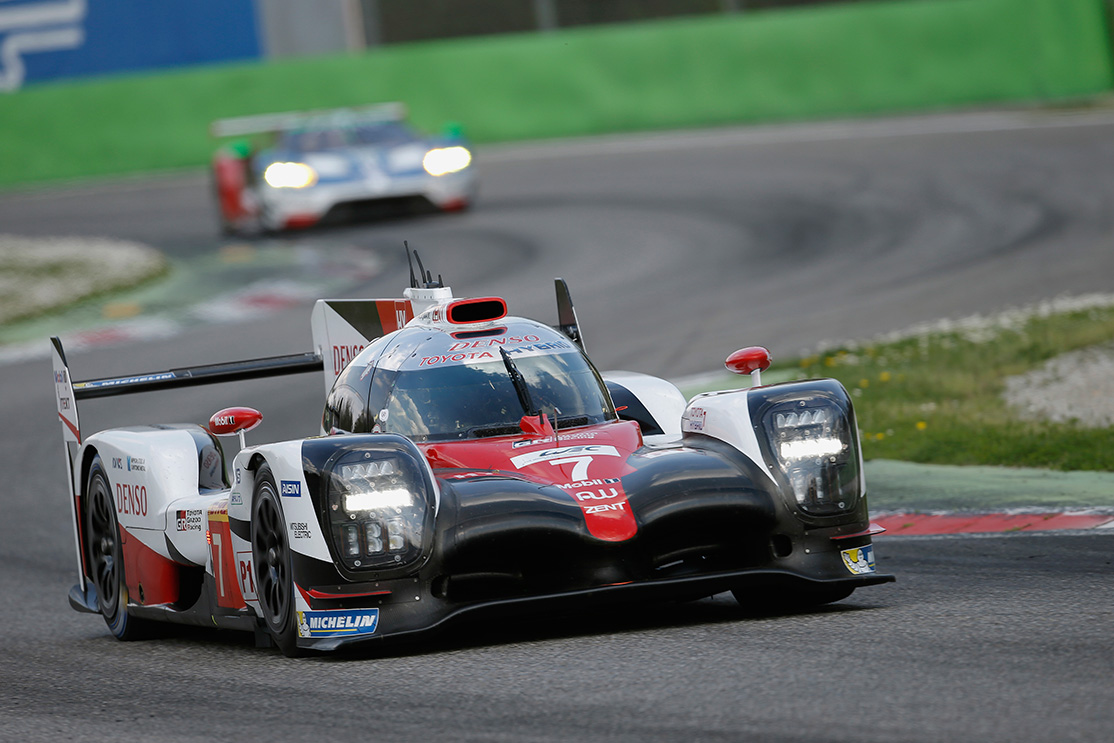
The TS050 gets a new 2.4-litre V6 turbo-charged petrol engine, combined with a smaller, lighter 8MJ hybrid system delivering 1000 horsepower.
A raised nose and sharp undercuts to the sidepods are among the raft of modifications to the bodywork aimed at improving aerodynamic efficiency.
Like Porsche, the monocoque is the only carry-over item. And, like the Porsche, the Toyota stands as a representation of function over form.
“As well as big aerodynamic changes, we have optimised each area for performance and weight,” said Pascal Vasselon, Gazoo’s technical director. “What happened at Le Mans last year was painful so we gave extra attention to quality management. Pre-season testing has gone well in terms of performance and reliability so we feel positive but we also know we face a tough competitor.”
Fastest over the prologue test sessions at Monza at the weekend, on his return to LMP1 was Nicolas Lapierre in the #8 Toyota. Lapierre, was 0.785 seconds faster than the best time set by team-mate Mike Conway in the #7 Toyota.
The two Porsche 919 Hybrids were third and fourth, with the top four cars separated by just 1.2 seconds.
With Audi out of the WEC this year, Porsche and Toyota will be the only outright factory duellists in the WEC, which starts on April 16 with the Six Hours of Silverstone.
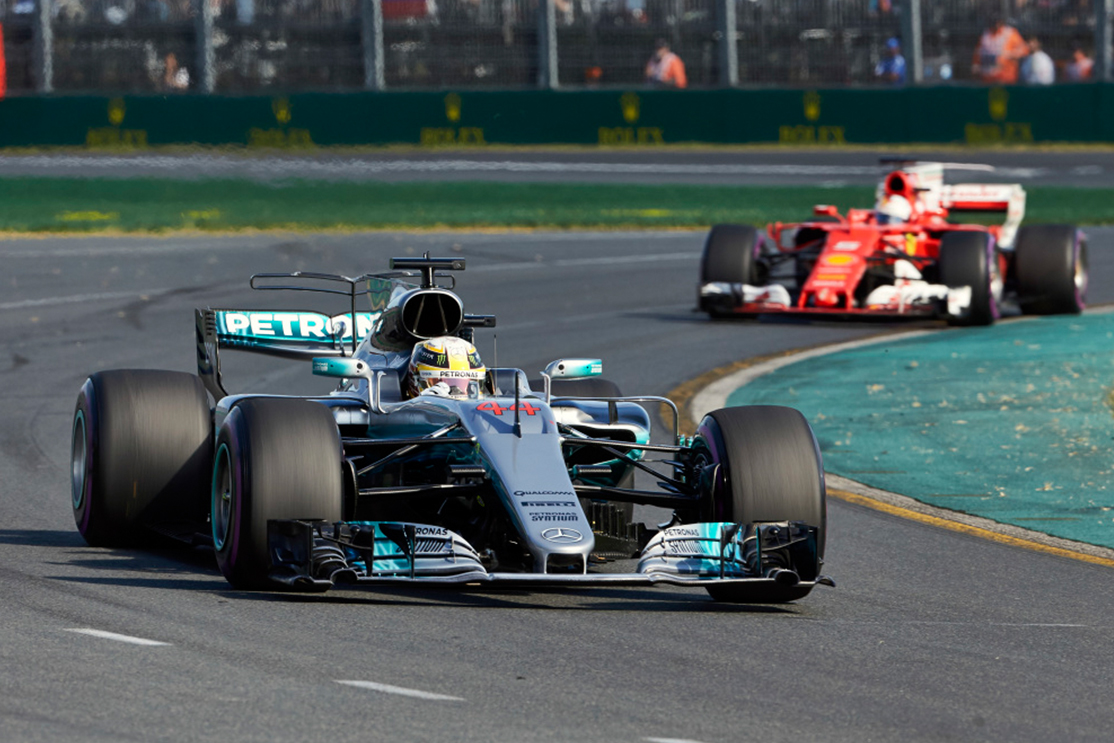
Mercedes needs to go on a diet
The Mercedes F1 team has acknowledged it needs to rip some weight out of its Silver Arrows, admitting that its 2017 cars might be on the wrong side of the 728kg minimum.
Mercedes is probably not the only team with the problem as the 2017 regulation’s demanded suspension components be toughened to cope with the stresses of higher corning loads while engine parts are sometime more robust in the interest of endurance.
More weight obviously costs time. Equally, designers like their cars to come in under the limit so they can place ballast more advantageously.
Force India has asked its drivers to shed weight. Presumably this is easier and less expensive than pulling kilos out of the car.
Red Bull is rumoured to be right on the limit after Renault reverted to its five kilo heavier 2016 MGU-K for the AGP. A lighter MGU-K will come on stream later, saving Daniel Ricciardo from a diet of lettuce.
Couple of newies in Nissan enduro line-up
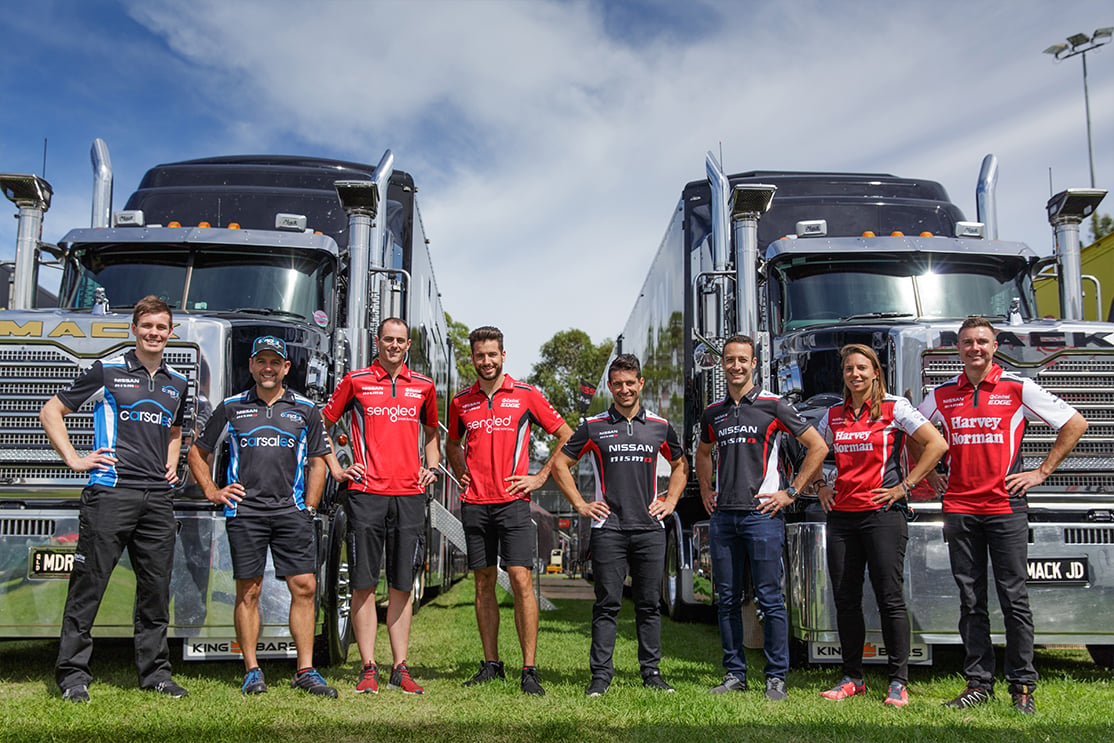
Nissan Motorsport’s enduro squad for the Sandown 500, Bathurst 1000 and Gold Coast 600 has a couple of drivers new to the team as well as two returnees.
Rick Kelly will pair with David Wall for the first time, both sharing the #15 Sengled Racing Altima. Wall finished third in last year’s Endurance Cup points (pairing with Scott McLaughlin at Garry Rogers Motorsport) and brings a wealth of experience to the team.
Having worked with the engineering team at the pre-season test earlier in the year, Wall is already very much part of the squad.
David Russell is back with Nissan Motorsport in 2017, but this year will co-drive with Simona De Silvestro in the #78 Team Harvey Norman Altima. Russell previously co-drove with Todd Kelly (2013) and Rick Kelly (2014 and 2015), and his familiarity with the team and the Altima will be an asset for De Silvestro in her first attack on the Enduro Cup.
The “Italian Heritage” #23 Nissan Nismo entry, brings Dean Fiore and Michael Caruso together for their fourth endurance campaign.
Earlier, Nissan announced the #7 Altima will rely on a mix of experience and youth as Todd Kelly partners up with Jack Le Brocq for the first time. Le Brocq, 24, will stay sharp in the lead-up to Sandown by continuing to campaign Kelly’s old Altima for MW Motorsport in the Super2 Championship.
IndyCar racing’s 2018 car
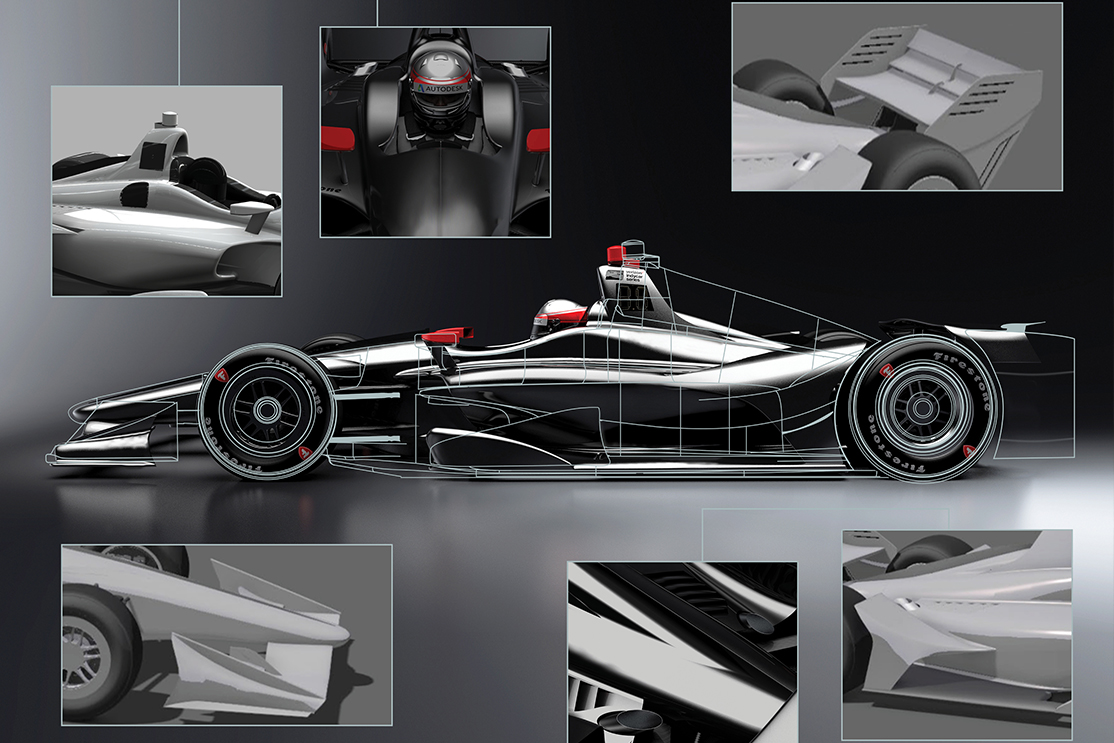
Computer-generated images of the 2018 IndyCar Series car design revealed this weekend have received a very positive reaction from fans and teams.
The images show the direction IndyCar is taking with the new car, a Dallara IR-12 chassis to be used by all teams
Still a work in progress, the final look of the 2018 universal aero kit might vary from these concept images.
IndyCar’s development goals are to create a bolder, more traditional-looking Indy car that produces most of its downforce from underneath to promote more passing opportunities, while at the same time adding numerous safety enhancements.
Scale model testing of the universal kit is ongoing, with the first on-track car testing expected by mid-year.
Meanwhile the next round of the 2017 series is set for the Long Beach Grand Prix next weekend with Aussie Will Power keen to compensate for a disastrous opening round in Florida.
The mid-size SUV market in Australia is booming, with plenty of options for buyers to choose from.
The Kia Sportage is one of Korea’s latest offerings in the segment, and has plenty of features to put it on your shopping list.
WHAT STANDS OUT The Sportage is a good looking SUV that is comfortable and quiet to ride in. It also ranks among the most enjoyable compact SUVs to drive.
The diesel engine in some models has plenty of power and great economy. As with all Kias the Sportage comes with an industry leading seven-year unlimited kilometre warranty.
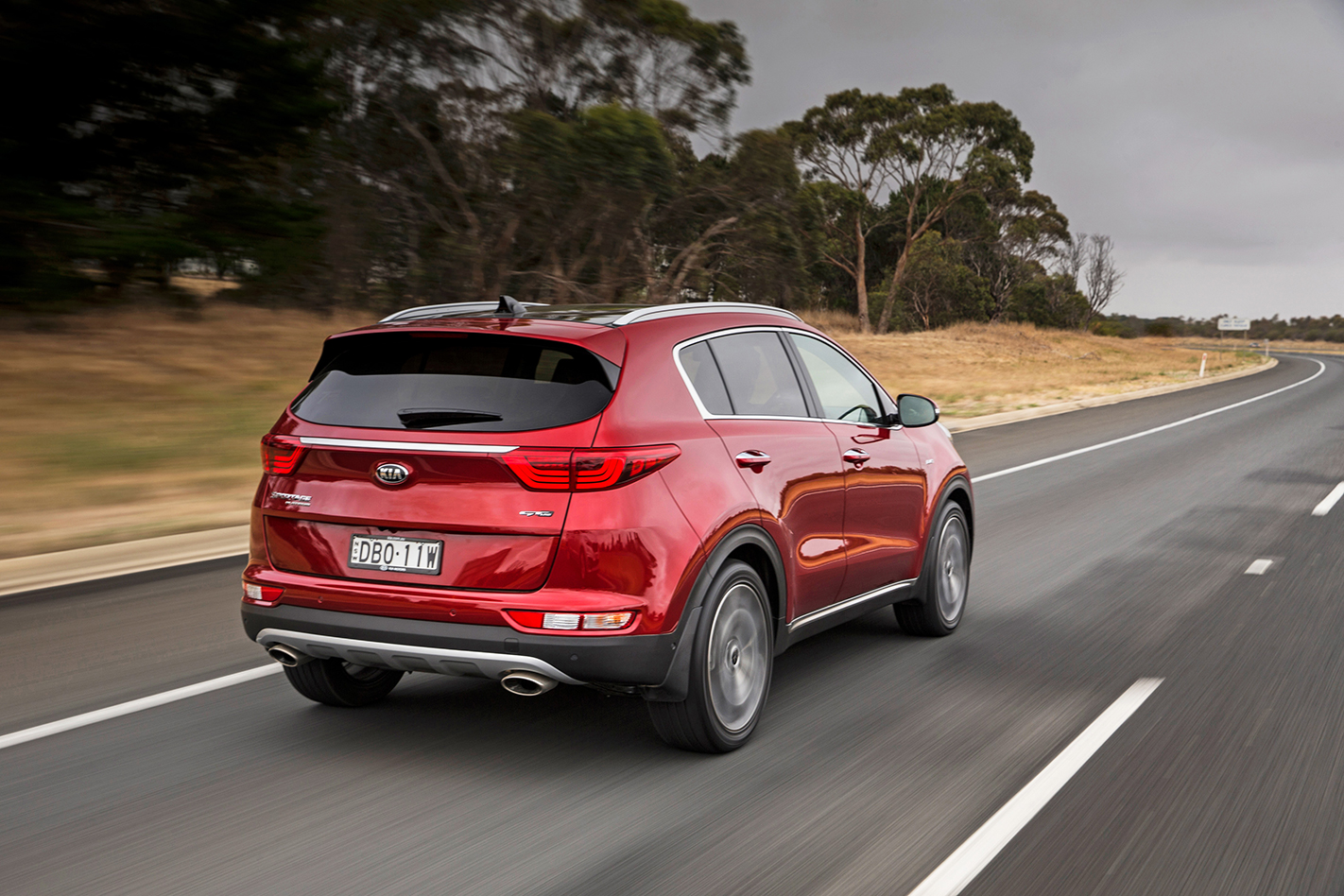
WHAT’S INSIDE The cabin in the Sportage is roomy, and the high seating position gives a great view of the road. All the instruments and controls are laid out neatly, with the infotainment display located at the top of the dash – the less time with your eyes off the road, the better.
The interior is well built, and is finished using decent quality plastics, fabric and carpet. The rear seats in the Sportage are some of the most accommodating in this segment, with good back, under thigh, and lateral support, while also providing plenty of headroom.
The cushions in the seat are comfortable, while the leather and cloth trim options feel hardy. Despite its size compared to other SUVs, the Sportage is a capable hauler, with 466 litres of boot space. This can expand to 1455 litres with the 60/40 split rear seatbacks folded down.
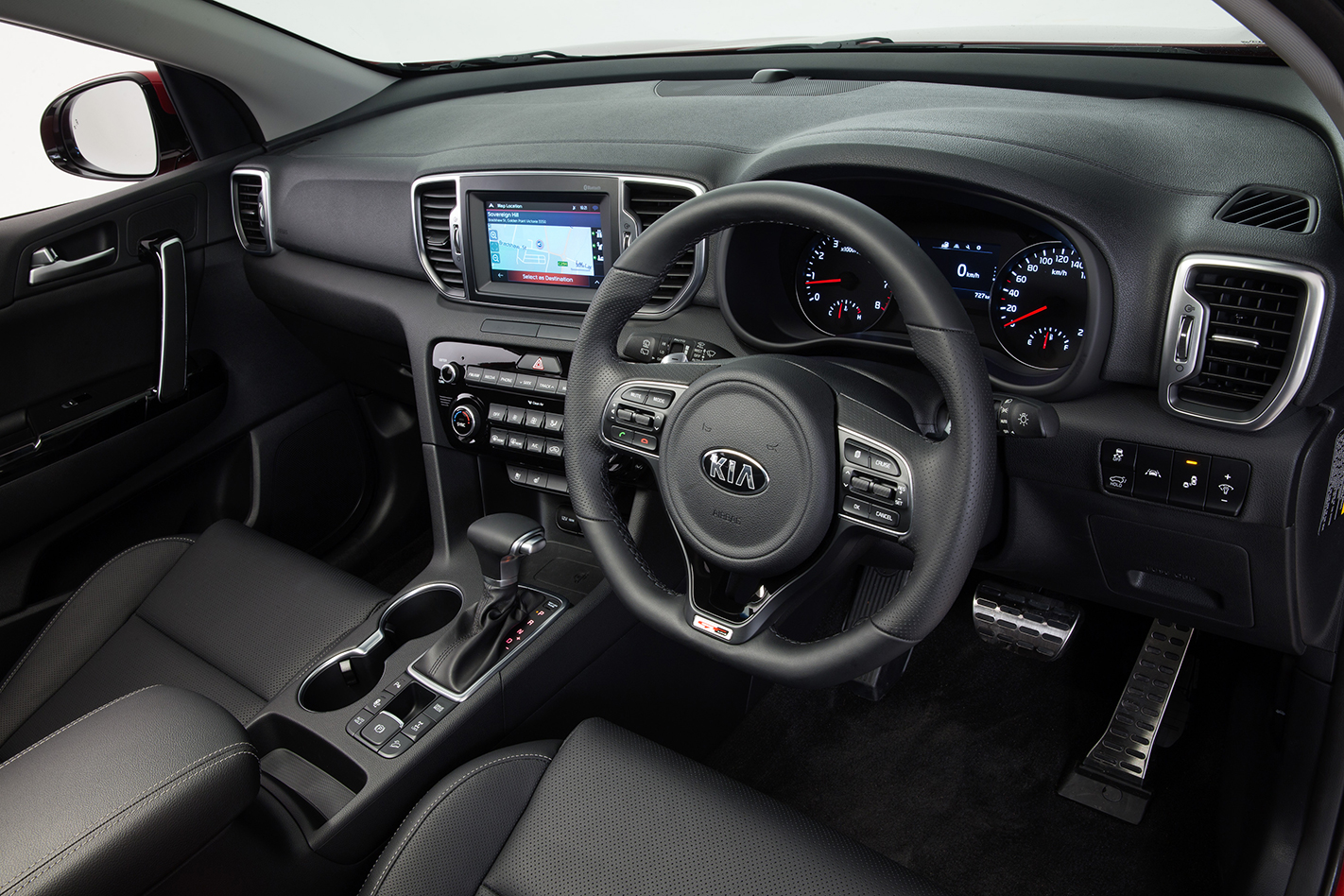
CHOOSING YOURS Pricing for the Sportage starts below $30,000 for the Si front wheel drive, and goes all the way above $40,000 for the Platinum all-wheel drive.
Every model comes with cruise control, rear parking sensors, and a rear view camera, along with a 7-inch touchscreen, Bluetooth connectivity, and audio streaming.
The 2.0-litre turbo diesel is the best engine in the range, with an impressive 6.8L/100km fuel economy, and decent grunt for the city. It is available across all three specs, Si, SLi, and Premium, but only in all-wheel drive models.
However, if you’re on a tighter budget the 2.0-litre petrol engine is available in both the Si and SLi, for $5000 less than the diesel.
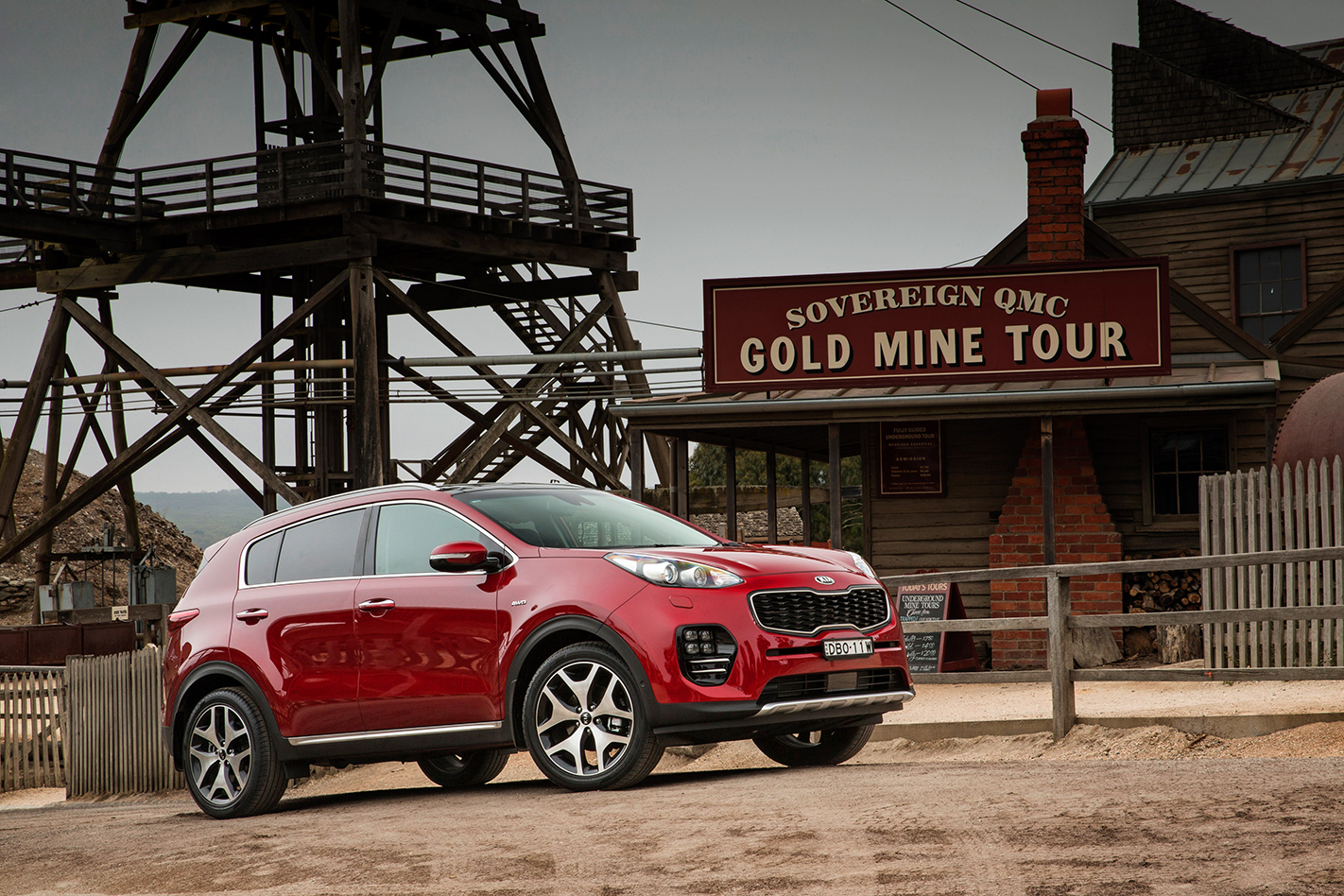
For us, the Kia Sportage SLi AWD is the pick of the bunch, offering the best combination of value for money, performance, and practicality. It has plenty of features without paying an unnecessary premium.
SUMMING UP The Sportage is a solid option for the frugal buyer in the market for a mid-size SUV. Kia’s seven-year warranty makes it a safe long-term investment.
If I gave you an envelope containing fifty-six thousand dollars, what would you buy? What about a Mustang Ecoboost and some change in your pocket, or perhaps a Mercedes A250 Sport if you want something a little more prestigious?
Want some real muscle? Well Holden wants a mere $54,590 for an SS-V Redline, just sayin’. If you prefer a more delicate touch, then a top-of the line Mazda MX-5 RF GT can easily be had for less than $56k, on the road. The point I’m trying to make here is that $56k is a lot of money, and at that price point your options are extensive.
So why would you drop all of that coin on something as mind-numbingly pedestrian as a mid-sized five-seater SUV?!
This car, the Tiguan 140TDI, is ex-pen-sive! It retails for $49,990, but in this configuration here, with the Driver Assistance Pack and R-Line Pack, will set you back just under $56k. That’s a monumental amount of coin for a medium SUV from a mainstream brand like Volkswagen.
Or is it? Volkswagen reckons its classy second-gen Tiguan has what it takes to rival entry-level SUVs from luxury marques like the BMW X1, Mercedes GLA and Audi Q3. We’ll be the judge of that.
ON PAPER So what do you get? The headline stats for the 140TDI is a two-litre turbodiesel inline four with 140kW and 400Nm, with a seven-speed dual-clutch automatic taking power to all four wheels. It may be an oil-burner, but it’ll sprint to 100 in a fairly brisk 7.9 seconds.
There’s a lower-output 110kW version of this engine available for less money, though with not as much muscle it’s substantially slower. Interestingly, both the high-output and low-output Tiguan diesels consume the same amount of fuel on the combined cycle – just 5.9L/100km.
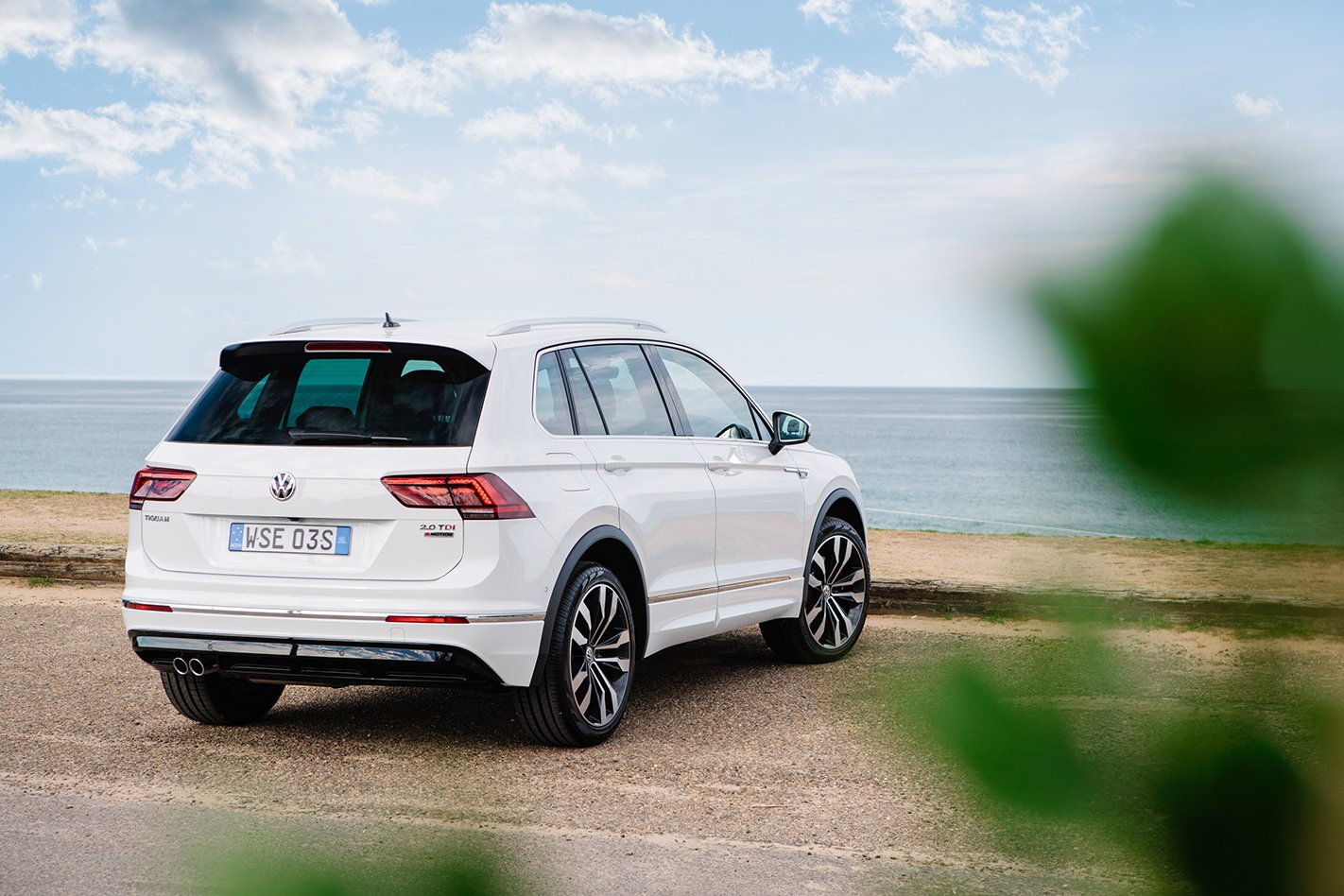
WHY IS IT IMPORTANT? Now, Volkswagen’s new Tiguan marks a massive improvement over the model it replaces. Built on an all-new modular platform, it’s now bigger on the inside and packed to the brim with some fancy gear. Combine that with a fresh, modern design both inside and out, plus a semi-premium aura, and it’s clear that Volkswagen is gunning for slightly wealthier customers with its new Tiguan.
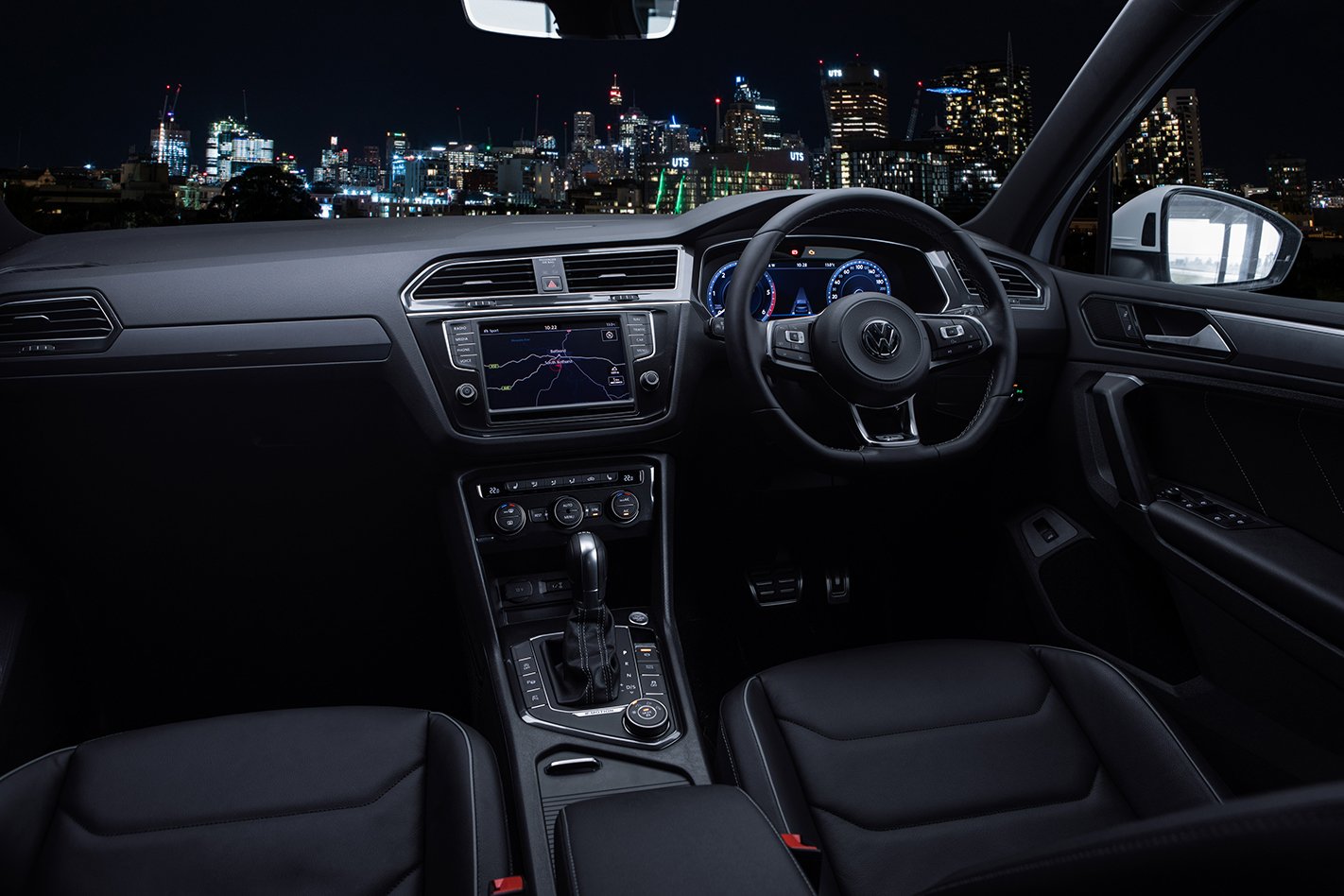
In the car we’ve got here, there’s also plenty of visual wow factor in the form of this reconfigurable instrument panel. Some of the data displayed is kind of useless – like the display that shows you how many degrees your front wheels are turned – but it’s a pretty slick way of showing the driver a huge amount of information. I particularly like the navigation screen, which frees up the centre infotainment screen for your passenger to use.
PLUS AND MINUS Here’s the good stuff: the Tiguan, when specced in this high-grade configuration, looks and feels properly premium.
The responsive infotainment display is feature-rich and also has the benefit of smartphone mirroring, should you want to exploit the extra features of Apple CarPlay or Android Auto. However, with a full-featured integrated sat-nav, music harddrive and digital radio tuner already built-in, there are more than enough features without plugging in your phone.
To drive, the Tiguan 140TDI is, on the whole, rather good. The engine may be a bit gravelly, like all diesels, but it’s relatively smooth and pulls strongly thanks to its generous torque curve.
However I’m still not convinced by Volkswagen’s dual-clutch gearboxes. They’re great when you’re in motion, but taking off from a standstill can be jerky and slow as the computer-controlled clutches toss between slip and grip.
Ride quality is pretty good on the large-diameter alloys, though I’d advise spending a little extra to get the optional adaptive dampers. In their most comfort-oriented mode they dial out most of the firmness that the standard fixed-rate suspension has, which is important for your long-distance comfort.
The Tiguan feels a lot more dynamic and nimble than other mainstream mid-size SUVs as well, though that’s not as huge of a selling point in this segment.
Interestingly, the Tiguan also presents better value-for-money in high-grade models like these, rather than the sparsely-equipped entry-level variants. But even so, $56,000 is still a hell of a lot of money to drop on a five-seater.
