
VOLKSWAGEN Australia this week announced it finally has gained government approval to start fixing some of the 99,678 cars impacted by the diesel emissions scandal.
However, the initial software fix is only for 8694 Volkswagen Amarok utes, leaving more than 90,000 Volkswagens, Audis and Skodas still requiring upgrades.
Today’s announcement comes almost six months after the US Environmental Protection Agency issued a violation to the carmaking giant for fitting defeat devices to its vehicles to ensure they passed stringent laboratory regulatory tests but emit up to 40 times the legal levels of dangerous nitrogen oxides in regular driving.
Volkswagen says the free software update to the EA189 engine will take about half an hour and that owners would be notified by email and/or regular mail advising them they could book their car in for the fix.
Despite concerns any updates would negatively impact performance and/or fuel use, Volkswagen says there will be “no affect to vehicle performance, torque, fuel consumption, engine acoustics or [CO2] emissions”.
The statement read: “Volkswagen Group Australia assures its customers that the implementation of the measure does not lead to a deterioration of the fuel consumption, CO2 emissions, engine performance, torque and vehicle acoustics and all vehicle values related to type approval remain unchanged; and continue to outperform the minimum emissions requirements of both Euro 4 and Euro 5 standards.”
Volkswagen says recalls of the other affected diesel-powered models – both with the 2.0-litre engine that accounts for most of the affected vehicles and the 1.6-litre engine that also requires a hardware change – “will follow in the coming months”.
“Recalls for other Volkswagen Group models with 2.0 litre EA189 diesel engines will continue throughout the year, progressing model-by-model,” the statement said. “A recall for affected 1.6-litre vehicles will commence later this year.”
The highly publicised recall is expected to run well in to 2017 and cost the Australian arms millions of dollars.
The diesel emissions recall affects more than 20 old and existing models from Volkswagen, Audi and Skoda, with each requiring a slightly different software change due to different tunes; some models may require two or more tunes due to updates throughout the vehicle’s life.
Each revised engine tune must be individually verified by the German transport regulatory authority, the KBA, and the Australian Department of Infrastructure and Regional Development before being applied to vehicles locally.
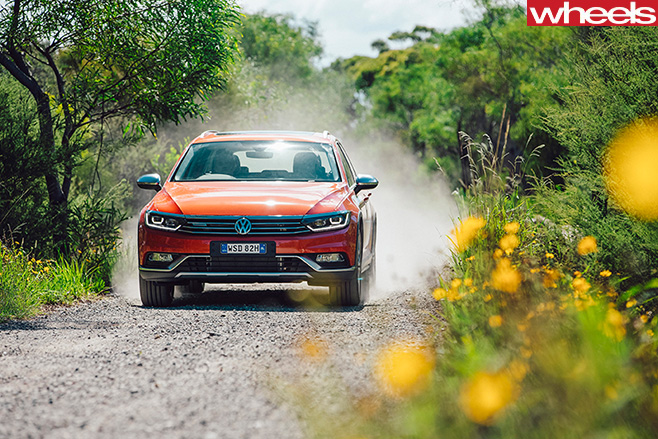
Tall estate or short SUV? The AWD version of Volkswagen’s polished Passat steers a comfortable middle path.
WHAT IS IT?
The most adventurous variant of Volkswagen’s most popular model globally, the mid-sized Passat – this time built on the latest, eighth-generation wagon.
WHY WE’RE TESTING IT
This trail-loving version of the Passat has just arrived in Australia. And notionally anyway, it’s a good match for Australian touring conditions.
MAIN RIVALS
Fellow jacked-up wagons such as the Audi A4 Allroad, Subaru Outback, Skoda Octavia Scout and Volvo XC70… and just about any similarly priced SUV.
THE WHEELS VERDICT
One sentence: Even in the dirt, the Volkswagen Passat Alltrack retains that Passat polish.
PLUS: Loose-surface traction; excellent ride and smooth steering; classy and practical interior; good value over regular 140TDI MINUS: Low-rev lag; DSG still not the epitome of smooth gearboxes; increased weight hurts economy
THE WHEELS REVIEW
Subaru’s Outback, a Liberty on stilts, has been kicking up dust for a successful couple of decades. Yet while Volvo followed not long after with the XC70, there’s been only an incremental increase since in similar high-riding estates.
Volkswagen didn’t come around to liking the idea until 2011, though unlike Subaru and Volvo it wasn’t willing to drop the nameplate of its biggest-selling model globally when it introduced the Passat Alltrack variant.
And now we have the second iteration, applying the same formula of rugged looks and light off-roading capability to an even more impressive donor model – the eighth-generation Passat, which was a 2016 Wheels Car of the Year finalist.
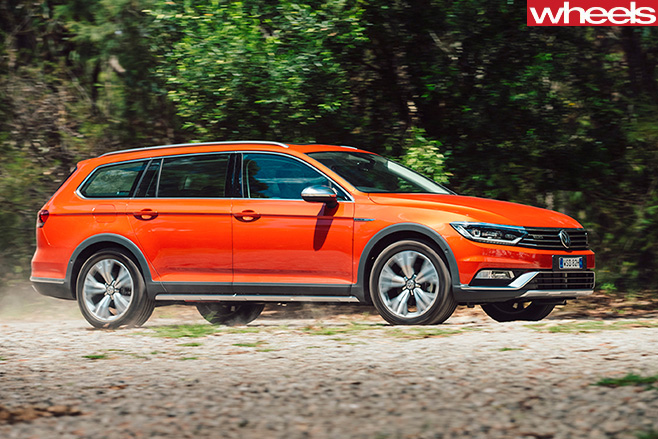
Obvious exterior changes over a regular Passat wagon, besides the Alltrack badging, include the aluminium-look scuff plate at the front, matt-black body trim front and back, extended sills, roof rails, exclusive 18-inch Kalamata alloy wheels, and of course that extra ground clearance (raised 28mm to 174mm).
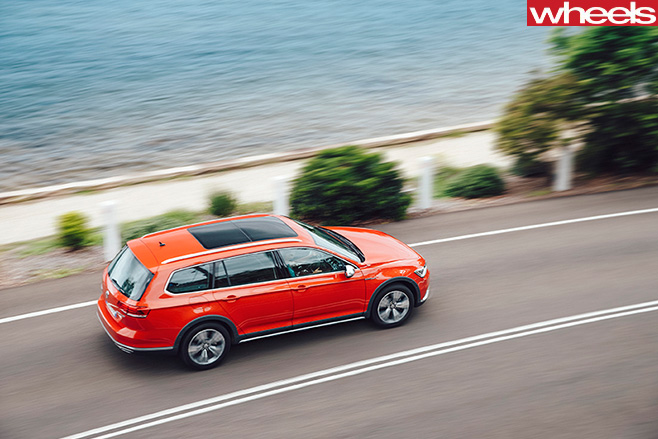
There’s increased underbody protection, and the Alltrack is the only Passat with 4Motion all-wheel drive.
This AWD system is predominantly front-wheel drive, adding torque to the rear axle as required via a fast-acting electro-mechanical multi-plate clutch.
It’s certainly effective on dusty trails and loose-surface tracks, endowing the Alltrack with strong traction even under hard throttle out of tight bends.
Combine that with the higher ride and a 2200kg braked towing capacity, and you have a Passat that seems match-fit for country Australia. Oh, and there’s an Off-road mode that retards throttle response, recalibrates the ESC and ABS, and introduces a hill-descent-control function on gradients of 10 degrees or steeper.
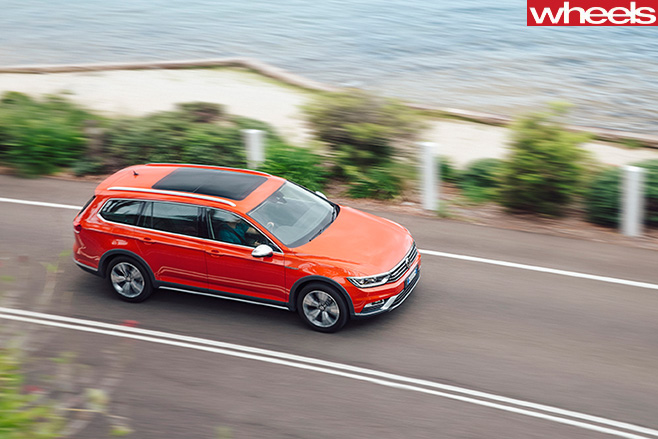
The Alltrack’s Continental tyres also have a special inner skin that’s designed to resist common punctures, such as those caused by small nails.
The rubber is fairly noisy on coarse-chip surfaces, but that’s about the only thing that disturbs the otherwise excellent cabin refinement. From the inside there’s no unwelcome clatter from the 2.0-litre, four-cylinder turbo diesel, the only engine offered with the Alltrack locally.
The diesel is not quite as effective as it is in the regular Passat, though. The Alltrack’s all-paw hardware and extra helpings of bodywork add 107kg to the 140TDI wagon’s mass, taking its toll on acceleration (down a tenth to 100km/h) and fuel economy (officially an extra 0.6L/100km).
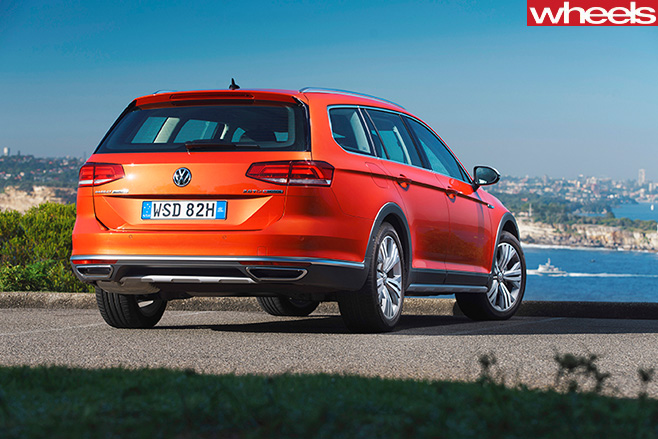
There’s noticeable lethargy at low revs – not eradicated by selecting the available Sport mode – before the turbo spools up to present the Alltrack with a mid-range to match its beefy aesthetics.
A Passat 132TSI sedan could also almost be called agile in comparison, but despite some body roll the Alltrack remains decently poised along fast, flowing curves.
And while the suspension may be slightly modified, there’s no change to the Passat’s reputation for bump-blotting ride quality.
The all-wheel-drive set-up robs the Alltrack of just 11 litres of cargo capacity. Its status as a classically practical wagon is guaranteed by a 639-litre boot that can be extended to 1769 litres by folding the 40-20-40 rear seats.
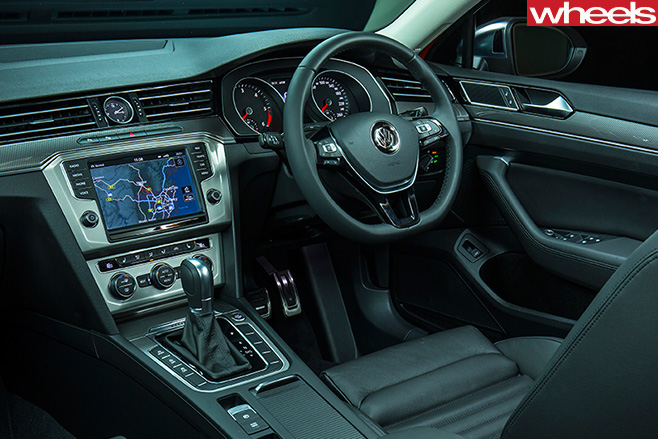
A $49,290 starting price also only asks a $1300 premium over the 140TDI wagon, continuing the good-value approach to the overall range. The only option is a $3500 Luxury Pack that includes LED headlights with integrated DRLs, semi-automatic parking, panoramic sunroof and a chrome grille strip.
With it or without, the Passat Alltrack makes a convincing alternative to similarly priced luxury SUVs, for those seeking a comfortable and capable vehicle for the open road and open spaces.
SPECS
Model: Volkswagen Passat Alltrack Engine: 1968cc inline 4-cyl, dohc, 16v, turbodiesel Max power: 140kW @ 3500-4000rpm Max torque: 400Nm @ 1750-3000rpm Transmission: 6-speed dual-clutch auto Kerb weight: 1671kg 0-100km/h: 8.0 seconds Fuel economy: 5.4L/100km Price: $49,290 On sale: Now
What stands out?
Good looking and well equipped, the Sportage is also one of the most enjoyable SUVs to drive. Steering and general handling are excellent for a medium sized car of this sort, and if you order a diesel there is plenty of power. This review covers the Sportage on sale prior to February 2016.
What might bug me?
You might wish for more grunt in the petrol version – especially if you have driven the diesel.
What body styles are there?
Five-door wagon only.The Sportage drives either its front wheels or all four wheels, depending on the version. It is classed as a medium SUV, lower priced.
What features does every Sportage have?
Air-conditioning, cruise control, and rear parking sensors. Windscreen wipers that operate automatically when it rains.An iPod-compatible CD and radio system with auxiliary and USB input sockets, and speed-sensitive volume control (which gets louder to compensate for road noise). Bluetooth connectivity for phone calls and audio streaming, and steering wheel controls for the cruise control, audio and Bluetooth systems.A trip computer that presents fuel use and distance information.Wheels made from an alloy of aluminium, which are usually lighter and better looking than steel wheels with plastic covers, and a full-size alloy spare wheel.Hill-assist control, which operates the brakes automatically to make take-offs on hills easier.Static cornering lights on each side at the front: as you turn the steering wheel to enter a corner at night, these light up and illuminate your path. Front and rear foglights, and heated, power-adjusted, side mirrors.Six airbags: two directly in front of the driver and front passenger; one alongside each front occupant to protect the upper body; and a curtain airbag on each side protecting the heads of front and rear occupants.Electronic stability control, which can help the driver to control a skidding car. All new cars must have this feature.On automatic transmission versions, trailer stability control – which helps you straighten out a weaving load when towing.Every Kia Sportage carries a seven-year, unlimited kilometre warranty.
Which engine uses least fuel, and why wouldn’t I choose it?
The 2.0-litre turbo-diesel engine uses the least fuel, at 7.2 litres/100km on the official test (city and country combined).The main reason you might not choose this engine is that you want to pay less for a Sportage. The diesel is available only in the more expensive SLi or Platinum models, which also have an automatic gearbox as standard, and all-wheel-drive. And it costs about $3000 more than the alternative petrol engine in these.However, in most driving conditions the four-cylinder turbo-diesel feels much more powerful than the other engine available in a Sportage, a 2.0-litre petrol which uses about 8.4 litres/100km.The petrol engine comes with either a five-speed manual gearbox (only in the least costly model, the front-wheel drive Sportage Si), or a six-speed automatic. The diesel comes only with the six-speed automatic.
What key features do I get if I spend more?
Stepping past the Sportage Si and paying more for an Si Premium gets you an automatic gearbox as standard, a reversing camera, headlights that switch on automatically when it’s dark, and long-lasting LED daytime running lights.Wheels are an inch bigger at 17 inches, a change many will like for the sportier look. That goes with chrome doorhandle and waistline highlights. And there are roof rails, which allow the attachment of luggage systems. The cloth seats have real leather accents, and fake leather on wear-prone surfaces.Spending more again on a Sportage SLi gets you all-wheel-drive and the option of the diesel engine. Dual-zone climate control lets you set different temperatures for each side of the cabin. Front parking sensors are added, and the audio system sounds better (thanks to an external amplifier and a sub-woofer.) There is a 7.0-inch colour touchscreen, and satellite navigation.The most costly Sportage, the Platinum, adds another inch to the wheel size and has a powered sunroof. There is keyless entry, which allows you to unlock the car with your key kept safely in a pocket or bag. The cabin is trimmed in a blend of real and fake leather. Front seats are heated, and the driver’s seat is power adjustable. Headlamps are very bright, auto-levelling HID types.
Does any upgrade have a down side?
The ride at low speeds gets a bit rougher as the wheel size rises from 16 inches, on the Sportage Si, to 17 inches, on the Si Premium and SLi, and then to 18 inches, on the Platinum. The bigger wheels use lower profile tyres, which leave less rubber and air cushioning you from the road.The Sportage Si and Si Premium do not have a touchscreen and so display the image from their reversing cameras on the interior rear-view mirror. This is a handy feature that you lose in the more expensive SLi and Platinum, which move the display to their upgraded multimedia systems. At least the image gets bigger.Only white is a standard colour on the Sportage. The other six shades available carry an additional premium paint charge of about $500.
How comfortable is the Sportage?
It is easy to get comfortable in the driver’s seat of a Sportage: you can adjust it manually in eight different dimensions (unless you have a Sportage Platinum, which has six-way powered adjustment). The steering wheel’s angle and distance from the driver are also adjustable.The Sportage cabin is roomy, with a great view of the road, and the instruments and controls are neatly and appealingly laid out. The interior is well built and finished using good quality plastics, fabric and carpet.The Sportage rides more firmly than some alternative vehicles, but the ride is not so firm that it becomes tiring. The cabin is a quiet place, with little suspension, tyre or wind noise intruding.
What about safety in a Kia Sportage?
Every Kia Sportage attains a safety rating of Excellent.Safety high points include the standard reversing camera, the emergency brake light flashing function, and the seatbelt warning chime and light for every seating position – a simple but valuable feature for those with children old enough to unfasten their belts.(To see a list of the safety features on any model, select the car and look under the features tab. Safety-related features are listed in red.)The Australasian New Car Assessment Program (ANCAP) awarded the Kia Sportage its maximum five-star rating for safety.
I like driving – will I enjoy this car?
The Kia Sportage is among the most enjoyable, best-handling compact SUVs available.The Sportage steers quickly and accurately, and the steering gives the driver a good feel for how much grip the tyres have on the road. Its quickness also means the Sportage is at home negotiating tight urban streets.The handling in both front-drive and all-wheel-drive versions is well balanced. Adjustments to the accelerator, brakes and steering adjust this balance, which gives the driver a feeling of connection and control. This is a big part of why the Sportage feels so good to drive.All-wheel-drive versions offer extra stability in slippery conditions, such as on gravel or wet roads. AWD medium SUVs are suited to only light off-road duty, such as snowy conditions or reasonably smooth dirt tracks, but the Sportage is among the best of this breed of vehicle, thanks to good ground clearance and the inclusion of a full-size spare wheel and tyre.On the road, the firm suspension contains body roll and pitch, and helps make the handling responsive.The turbo-diesel engine has as much as 90 per cent more oomph than the petrol at the low engine speeds used in a lot of normal urban driving – it is a much more desirable engine.The petrol engine ordinarily offers enough performance, but it struggles when the car is loaded with passengers and luggage.
How is life in the rear seats?
Rear seating in the Sportage is among the roomiest in a compact SUV. The seats offer good back, under-thigh and lateral support, with enough headroom. Cushions are comfortable, and the leather and cloth trim options feels like they will wear well.The view is good forward and out of the side windows, and the rear of the cabin is well isolated from tyre and suspension noise.
How is it for carrying stuff?
The Sportage is good at carrying lots of luggage, thanks to a 564 litre cargo bay, which is bigger than all direct rivals except the Toyota RAV4. This expands to 1353 litres with the 60/40 rear seatbacks folded down.A one-piece tailgate opens upwards to reveal a large opening, which makes it easy to load bulky items.There are useful luggage net hooks, and a luggage net in versions from the Si Premium upwards.
Where does Kia make the Sportage?
The Kia Sportage is manufactured in Slovakia.
What might I miss that similar cars have?
A more powerful, turbocharged petrol engine, which alternatives such as the Ford Kuga and Volkswagen Tiguan offer.Active safety features such as automatic emergency braking, blind-spot monitoring and lane-departure warning. The Mazda CX-5 offers these.Other mid-sized SUVs worth considering include the Nissan X-Trail, Subaru Forester, and Mitsubishi Outlander.
I like this car, but I can’t choose which version. Can you help?
We like the Kia Sportage SLi diesel, mainly because it is the least expensive way to get the desirable turbo-diesel engine. The SLi specification also brings some nice extra features compared with the (still well equipped) Si and Si Premium versions.
When did Kia update this Sportage?
This third-generation Kia Sportage arrived in 2010, and an updated Series 2 version arrived in mid-2013. It was superseded by a fourth-generation Sportage about February 2016, which is covered in a separate review. The new model brought a fresh look, more comfort, and some equipment upgrades. Its most expensive, Platinum, variants gained a bigger petrol engine, automatic emergency braking and other driver aids, and a power-operated, hands-free tailgate.
PLUS
MINUS
JAMES DEAN AND LITTLE BASTARD
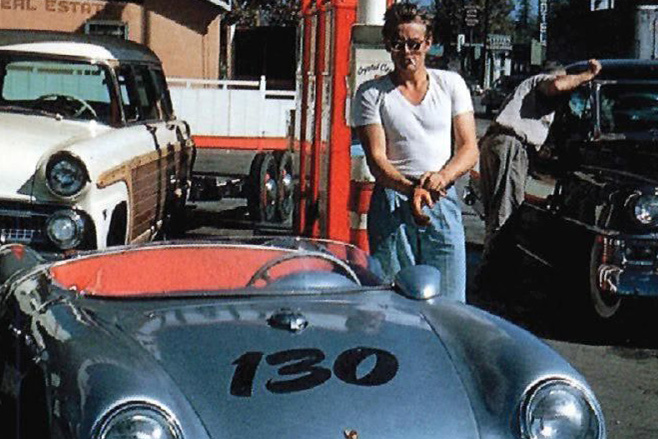
This customised Porsche 550 Spyder had tartan seats, red stripes and the number 130 painted on it. Supposedly actor Alec Guiness told him, “If you get in that car, you will be found dead in it by this time next week” and people said it was cursed. A week later, Dean was killed in the car, which was called “Little Bastard”. The car went on to be involved in more fatal crashes.
SEAN CONNERY AND ASTON MARTIN DDB5
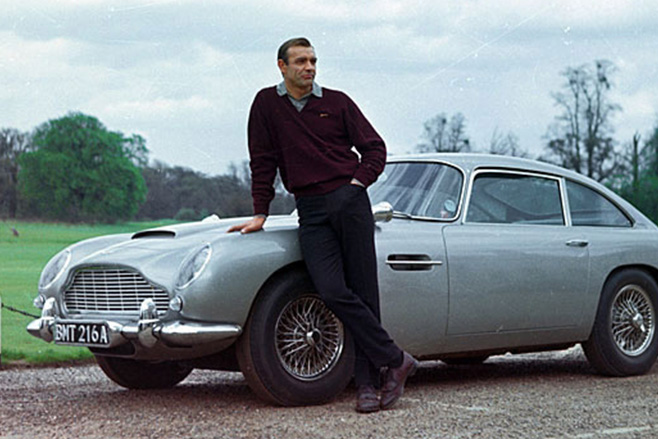
The Aston Martin DB5 appeared in a Bond film for the first time in 1964’s Goldfinger, starring Sean Connery. The same DB5 was used in both Goldfinger and Thunderball, and at a 2010 auction was sold for 2.6 million pounds. DB5s have also appeared in GoldenEye, Tomorrow Never Dies, Casino Royale, The World is Not Enough, SkyFall and Dr. No.
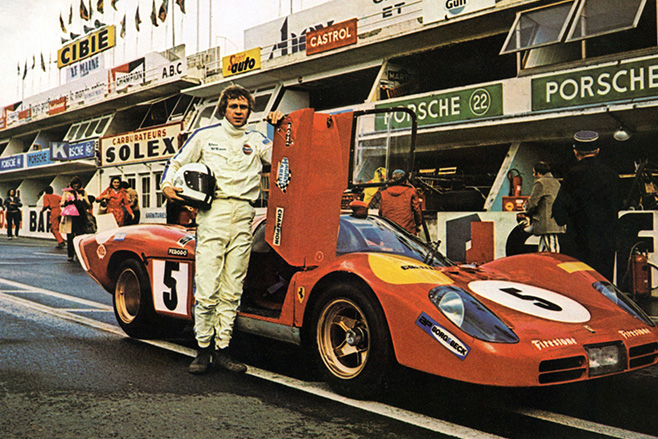
STEVE MCQUEEN AND ANY CAR (FERRARI)
Actor Steve McQueen was known for being a bit of a car and motorbike nut and had at one point considered being a racing driver. He performed many of his own-stunts on film and owned many luxury sports cars, including several Porsches and Ferraris.
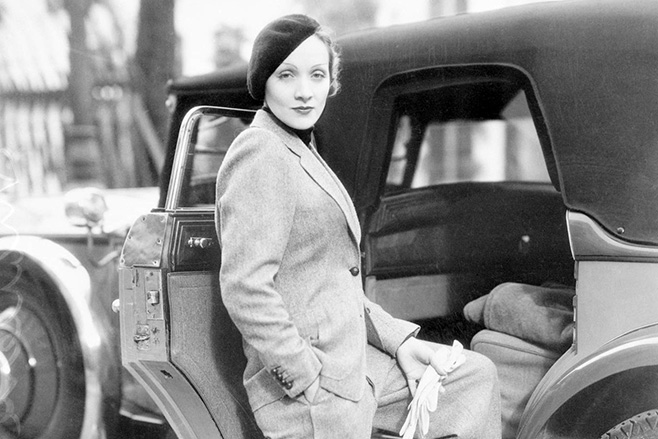
MARLENE DIETRICH IN A PANTSUIT WITH A ROLLS ROYCE PHANTOM
Legendary actress Marlene Dietrich caused waves in 1929 at the premiere of Ship of Lost Men in Berlin. The actress dared to wear *gasp* – a pantsuit! This capitalised on the furore caused by her wearing a tuxedo to an event previously.
The photo of her stepping into this car has become an iconic image of this era – and the change in women’s fashions. The vintage Rolls Royce had been given to her by the film studio Paramount when she moved to Hollywood from Germany. It even starred with her in the 1930 film, Morocco.
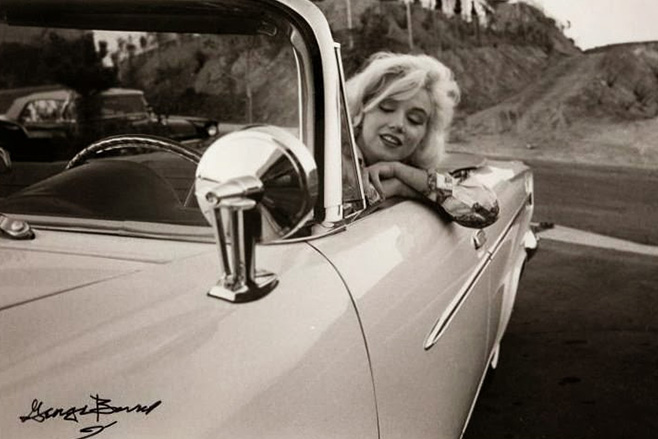
MARILYN MONROE IN HER CHRYSLER CONVERTIBLE
Marilyn Monroe owned and drove a lot of cars and was photographed with many of them, especially convertibles. This 1962 Chrysler 300H Convertible was owned by the film studio MGM and driven by Marilyn.
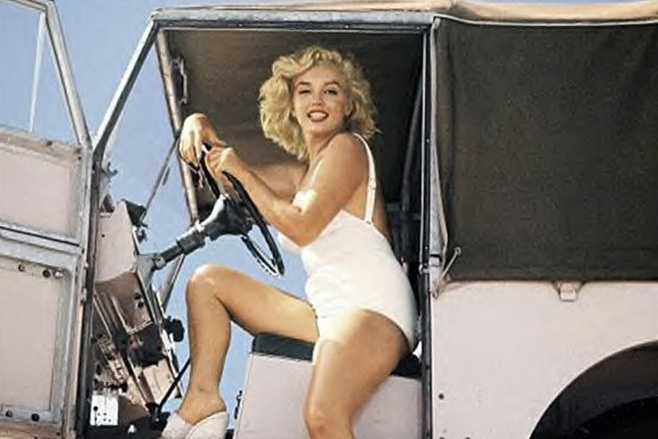
MARILYN MONROE IN A JEEP
Because why not.
Great British car design still stands out in today’s market, especially with cars like the Ian Callum designed Jaguar F-Type.
Ian understands the contribution Britain has had and continues to have to the automotive landscape, saying, “Britishness is something that, aesthetically, should be restrained – it can never be vulgar. It’s reassuring, elegant and tasteful.”
Jaguar put Ian in a room with equally revered British car designer Gerry McGovern, to talk about the importance of British creativity and design. These two industry legends were interviewed together for the first time at the Royal College of Art, where they both studied.
Ian says, “I wish drawing cars all day was our job but, collectively, it is understanding the car, creating the atmosphere of the car… The hardest part is not coming up with the idea, but protecting it right through a whole process where hundreds of forces come at you from different directions, be it financial, legal, functional or manufacturing.”
The interview even delves into a debate between Ian and Gerry regarding Jaguar’s entry into the SUV market with the launch of the all-new F-Pace. Hit play on the video and take a look for yourself.
Belgian entrepreneur Guido Dumarey’s bid to keep Holden’s production lines running beyond 2017 has failed, with both parties today conceding to the “insurmountable” challenges of the proposal.
GM International, which manages the Australian operations, and Dumarey’s Punch Group issued a joint statement late today saying the rescue bid would not go ahead due to the “insurmountable” challenges with keeping the supply lines alive.
The news comes on the same day as Holden announced it would switch off Cruze production in October – the same time as Ford plans to end more than 50 years of Falcon production – with the loss of 400 jobs.
The statement reads:
General Motors and Punch Corporation have undertaken and completed a detailed global evaluation of a proposal from Punch Corporation to continue manufacturing vehicles at Holden’s Elizabeth plant in South Australia.
Both parties concluded that a viable business model was not possible for this case. Therefore the proposal will not be taken forward.
GM and Punch have communicated on this decision.
As discussions have been governed by a Non-Disclosure Agreement, neither party involved is able to discuss details of the proposal, nor the assessment.
The challenges to domestic automotive manufacturing in Australia – lack of scale, high production costs, supply base contraction and increasing market fragmentation – persist and cannot be overcome for this business case.
In particular, the wind down of the supply base following the manufacturing exit of the three existing car makers, and the critical production mass they represent, is insurmountable.
GM thanks Punch Corporation for their proposal. GM will continue to consider Punch Corporation, along with other interested parties, to participate in the sale process of the Elizabeth plant and assets after GM ceases local manufacturing.
Punch Corporation will continue to pursue other business opportunities in the Australian automotive sector.
Industry Minister Christopher Pyne said he was “surprised and disappointed” by the decision.
“It [the decison to exit talks] does not match the statements both Punch and GMH have made to me,” he said.
“At the end of the day it is a decision for the two parties involved.
“The Government offered every support to Punch in every matter that they raised with us,” he said.
“We will continue to offer help to Punch in pursing other opportunities in the automotive sector should they choose to do so.”
PLUS
- Reliability: The MU-X’s diesel engine is the latest version of the Isuzu engine used since the last Holden Rodeo. That means it’s dependable, even if it’s not the most advanced or refined engine. It’s also backed by the Aisin five-speed auto used by Toyota in several Prado and Land Cruiser models. That’s a winning combo.
- 4×4: After a hard week’s work, there are not many better things to do than escape the other humans. And the MU-X will take you pretty much anywhere you want to go. It’s not a soft-roader. It’s a real 4×4, with old-school capability.
- Price: Starting at $45,600 for the manual and $47,800 for the automatic, the MU-X is excellent value for money. In fact, if a dependable, tough 4×4 wagon without bells and whistles is what you want, it’s hard to find better value.
- Training: If you’ve always wanted to go off road but you don’t know where to start, the Isuzu I-Venture Club can assist with professional 4×4 training for Isuzu owners. The short courses are designed to help owners get the most out of their vehicles, whether they’re novices or hardcore off-roaders.
MINUS
- Cabin: This is not a fancy pants car. The cabin looks dated and it has more of a commercial feel than a passenger-vehicle feel. It’s practical, though. Just don’t expect all the latest and greatest tech and refinements.
- Old-school: The MU-X is not the most user-friendly car for those who have never driven a 4×4. It has a part-time 4×4 system, which means the driver has to choose the right 4×4 mode as needed. Also, its traction control is a bit outdated and there is no rear diff lock or hill-descent control. What all that means is you need to know what you’re doing to take this wagon off-road – which is where Isuzu I-Venture Club can help.
SKODA FABIA 66TSI WAGON Score: 85/100
Price & Equipment | 18/20
The $17,140 66TSI wagon gets city emergency and multi-collision brake systems, hill-holder, tyre pressure monitors, idle-stop, steering wheel audio and phone controls, rear park sensors, 6.5in touchscreen audio and Bluetooth phone and audio. Travel Pack adds cruise, fatigue detection and 16in alloys for $1300.
Interior & Versatility | 17/20
Fabia is classy inside and has much more personality than Polo, with which it shares architecture (and drivetrains). Capacious 505L cargo bay. Typically clever Skoda convenience features include a luggage net and compartment in the cargo bay, multimedia-device holder up front, and a waste bin in the door panel.
Performance & Economy | 17/20
These two cars take unique paths to performance and economy, but arrive at similarly swift and frugal results. Little 1.2 turbo Fabia is low on kilowatts, but low-down torque (160Nm) makes easy work of shifting 1087kg, and it sips just 4.8L/100km. The engine has a nice cammy character and spins sweetly for 0-100 in 10.9sec.
Ride & Refinement | 17/20
Fabia is a supple tourer on standard 15s and still nicely absorbent on the Travel Pack’s 16s. Drum-tight body suppresses tyre, suspension and wind noise well. A Sports Pack that brings 17s and 15mm-lower sports suspension, removes some of the comfort in return for sharpened steering and chassis responses.
Steering & Handling | 16/20
The Fabia handles neatly and responds obediently, but lacks steering feel. However, it’s terrifically capable for a light car with humble torsion-beam rear suspension and the harder you lean on the nose the better the steering gets. Pushing on fails to flummox the chassis and only the 66TSI’s ultimate lack of grunt limits the fun factor.
MAZDA CX-3 NEO Score: 80/100
Price & Equipment | 16/20
The dearer ($19,990) CX-3 Neo gets 16in steel wheels and cruise standard, but misses out on a leather wheel and the 7in touchscreen found upstream. Neither gets nav, but Mazda matches Skoda’s Bluetooth phone/audio, steering wheel controls, hill-holder and rear park sensors. Safety Pack adds $1030 with Smart City Brake.
Interior & Versatility | 16/20
Neo feels a bit stripped-out against higher CX-3 variants, but the design is fresh and ergonomically – and logically – laid out. It betrays its light-car design origins with a 264L cargo capacity but can’t touch the Fabia for hauling stuff. Upswept side glass limits vision for back-benchers, who are otherwise well catered for in both mini-wagons.
Performance & Economy | 16/20
An old-school atmo 2.0-litre wouldn’t deliver competitive fuel economy, so Mazda has a thoroughly modern one. More power and torque than the Skoda, and more performance, but that grunt and extra weight means higher consumption (6.3L/100km) in this FWD base model. Both have sweet manual shifts.
Ride & Refinement | 16/20
Lack of refinement is a decades-old Mazda bugbear, though recent generations have seen huge improvements. The CX-3, like the new 2, is reasonably hushed place, just not as quiet as its rival. Ample suspension travel and well judged damping results in good ride comfort on patchy urban tar and lumpy country coarse-chip alike.
Steering & Handling | 16/20
The CX-3 chassis is enthusiastic, but (unlike the Fabia) the keen steering is prone to kickback approaching the limit. The extra straight-line performance enlivens the chassis to an extent that’s not possible in the Skoda (unless you upgrade to the 81TSI). CX-3 buyers also have to spend more (for an AWD version) for real entertainment.
VERDICT
Baby SUVs are big in 2015, and the genre-defying CX-3 is among the coolest of this new breed. The Fabia wagon, meanwhile, emerges from left field as the pragmatist’s pick of the light class. The Skoda is better equipped for the money, thriftier, roomy enough to do family car duty, and bound to be less common. The Mazda, set to be a top-seller, is quicker, sexier and a bit more fun. If you’re weighing them against each other, it’ll be difficult to choose. However, we suspect if you’re sold on the Mazda’s style you’ll be blinkered to the Skoda. And if you’re compelled by the Fabia’s value and capacious practicality, the 241-litre cargo-carrying cost of CX-3 style will be too great.
This article was originally published in Wheels October 2015.
Australia’s track-focused Volkswagen Golf GTI Clubsport model will be known as the GTI 40 Years because locally HSV trades on its overseas name.
What’s in a name change? A couple of doors and some unique features, according to Volkswagen Australia public relations manager Kurt McGuiness, who confirmed to MOTOR the three-door Clubsport will become a five-door 40 Years for our market when it lands mid-year.
“It’s coming mid-year [and] will be the GTI 40 Years because obviously Clubsport is already a synonymous brand name out in Australia,” said McGuiness. “This will be a stand-alone model for our market, Germany is effectively building a special model for us and it will be five door.
“The other thing that will be a real kicker is that we will get the same 195kW engine that’s in the Clubsport and available in Germany [so] it will also be the fastest Golf GTI ever.”
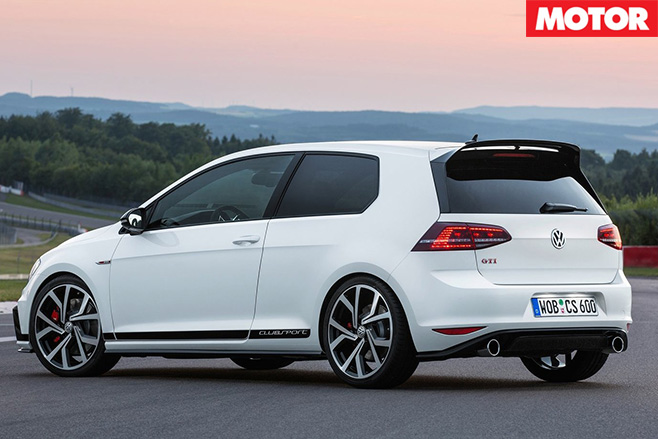
For the six-speed-manual Golf GTI Clubsport that power upgrade results in a claimed 5.9-second 0-100km/h compared with 6.4sec for the DSG-only Golf GTI Performance and 5.2sec for the manual Golf R.
The Clubsport uses the limited-slip differential from the front-drive GTI Performance, but trades on aggressive aerodynamic modifications and extra power, without the all-wheel drive hardware of the Golf R that pushes weight from 1364kg (GTI Performance) to 1416kg.
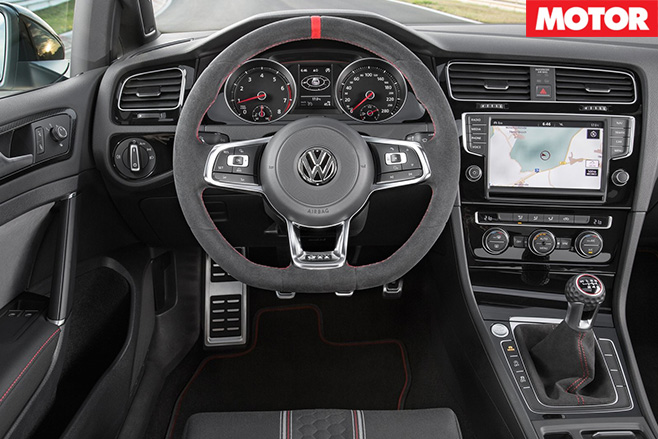
Volkswagen Australia chose not to import the GTI Performance with the six-speed manual available overseas, however the Clubsport/40 Years that is tagged as moving the Golf “into the realms of motorsport driving dynamics” we understand has a much better chance.
What the 40 Years shares with the Clubsport is unclear, however. “There will be a lot of similarities but I’m not in a position to talk about spec at this stage, but it will also have some unique features for our car,” said McGuiness.
What is a sure thing is that the Golf GTI 40 Years will be price-positioned between the $47K Golf GTI Performance DSG and $53K Golf R manual when it arrives locally mid year.
