
An important piece of the new Top Gear puzzle has fallen into place overnight with the announcement American actor Matt LeBlanc is to join main host Chris Evans.
LeBlanc is best known for his role as Joey in the long-running sitcom Friends, however he is also a bona-fide petrolhead, with a Ferrari 458 Italia and Mercedes-Benz ML63 AMG in the garage.
The US star is also a big motorsport fan, regularly attending F1 races around the globe.
Based on the show’s previous format, there is still at least one host to be announced, with internet rumour suggesting UK motoring journalist Chris Harris will fill the spot.
Harris is certainly involved in some form, as he appears in a picture tweeted by Chris Evans following the LeBlanc announcement.
However, whether he is a host is another matter. Harris shut down his Patraeon account recently, which he used to crowd fund his videos productions, stating in a letter to supporters “I am now working on a new project [which] will allow involve me making videos on the internet which you won’t have to pay for.” Doesn’t sound like Top Gear.
German racing driver Sabine Schmitz has also been linked with a hosting role, and was recently seen in spy shots shooting with Evans, however it would be a left-field choice.
The new series of Top Gear is expected to appear in the second quarter of 2016.
Hold on to your steering wheels, ladies and gents, because we’ve got some big news… BBC has revealed Joey Tribbiani Matt LeBlanc will join Chris Evans as a new host on Top Gear.
The former Friends star will be changing things up in more ways than one. Aside from the addition of a bit of eye candy to the popular motoring TV series, it brings a brilliant clash of accents – LeBlanc is the first non-British host in the show’s history.
This isn’t LeBlanc’s first stint on the fast paced show, having appeared as a guest twice before and also as the presenter of the Top Gear: The Races spin-off.
The self-confessed petrol head also holds a significant Top Gear record as the fastest celebrity Star in a Reasonably Priced Car.
“As a car nut and a massive fan of Top Gear, I’m honoured and excited to be a part of this iconic show’s new chapter. What a thrill.” LeBlanc said.
Evans also commented on his new Top Gear co-driver, “Matt’s a lifelong fellow petrol-head and I’m thrilled he’s joining Top Gear. Acting out our craziest car notions on screen is a dream job and I know we’ll both be debating some epic road trip ideas.”
We can’t help but wonder if this appointment is BBC’s attempt to make Top Gear a more attractive viewing choice for women? Either way, the addition of words “gas”, “trunk”, and hopefully a few of the famous “how you doin’?” is enough to get us tuning in.
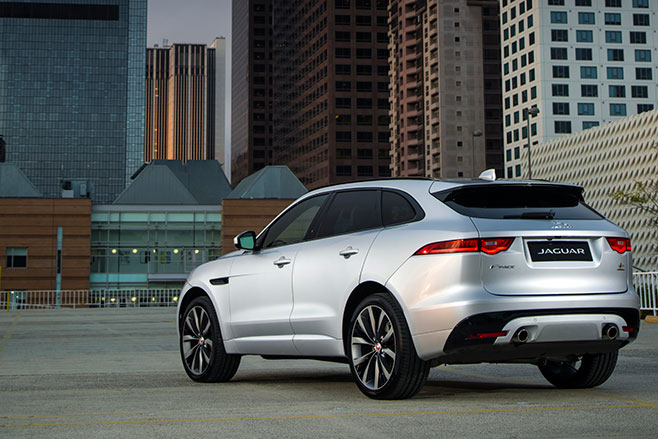
THE NEW Jaguar F-Space SUV will be so popular in Australia that it will double the brand’s sales, says the company’s Aussie boss.
Pitched as a rival for the BMW X5, Porsche Macan and Audi Q5, the F-Pace is Jaguar’s first ever SUV and arrives Down Under in July 2016.
Jaguar expects to sell “well in excess of 1000” F-Paces a year to SUV-hungry Aussies, a move that will see at least twice as many Jaguar-badged cars on local roads. Last year, Jaguar’s total volume was 1292 cars, but Wheels’ exclusive report card predicted the brand could see 3000 in 2016.
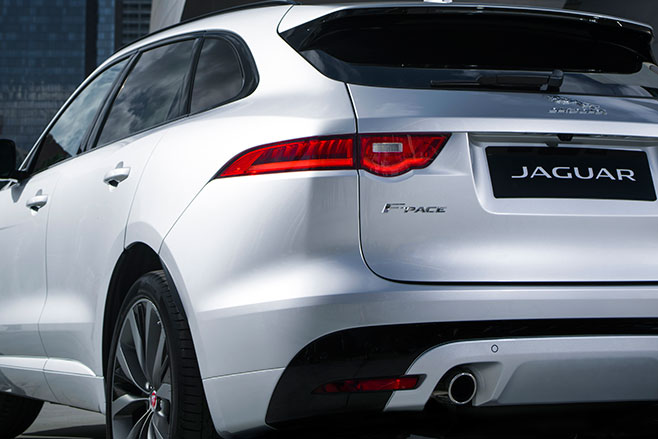
Wiesner says the F-Pace, which will be priced from $74,340 for the entry-level diesel-powered 20d Prestige, will bring new customers to the brand.
“We’re kind of skewed towards male customers with our offerings today, so what F-Pace does is open our brand up to a far wider audience,” he said. “Female buyers for example, and that not just helps F-Pace but brings more focus on the rest of our products.”
Built on the same aluminium-intensive architecture as the new Jaguar XE and XF sedans, and powered by the same suite of four- and six-cylinder petrol and diesel engines, the F-Pace and will have a strong focus on performance, rather than off-road ability.
“It is very much a Jaguar and what our brand stands for,” said Wiesner. “It’s job is very different to, for example, what a Range Rover Sports is, it’s more crossover than hardcore SUV, it’s not designed to go off-road. It’s a performance SUV. It’s going to drive like a Jaguar, it’s going to be dynamic. We want you to step out of an F-Pace and have a similar feeling to when you drive an XE or an XF.”
“F-Pace fits into the SVO space,” said Wiesner. “If you look at F-Pace and its markets and trends, you would say the guys at SVO would be very keen to get hold of it and do something with it, because it’s such an important car from a Jaguar perspective and it’ll have such a big role in driving the volume of the brand.”
Wiesner sited the success of AMG, which sold more than 4000 vehicles in Australia last year, as proof that a SVR-badged F-Pace would sell well here.
“It will be significant for us, to say the least,” he said.
Jaguar will launch the F-Pace in Australia in late July or early August, and Wiesner is confident that supply from the British brand’s Solihull factory, will keep up with demand. This despite reports in the UK that customers face a nine-month wait for their cars to arrive, such is the new SUV’s popularity.
Large luxury SUVs were one of the stronger-growing segments in last year’s bumper 1.15 million sales-strong new-car market. Audi’s Q7, replaced late last year with an all-new lighter model that made it into the top three in the 2016 Wheels Car of the Year, is the segment leader, with rivals including the BMW X5, Range Rover and the Range Rover Sport, and the new Mercedes-Benz GLE wagon and coupe chasing it hard.
The segment grew 8.7 percent last year as SUV sales continue to eat into tradtional passenger car sales.
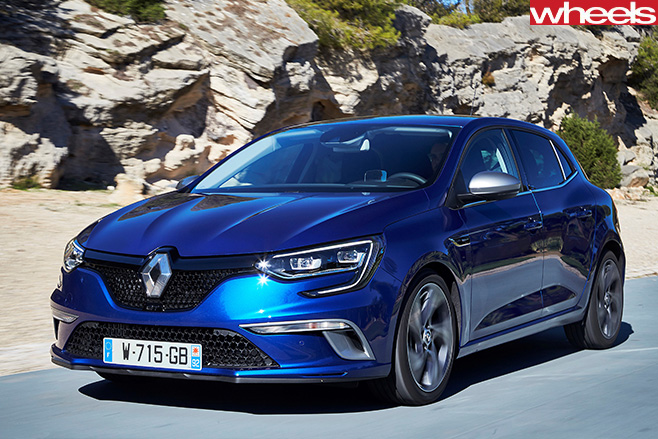
The next Renault Megane GT, which Australia will see in October, shows the French understand evolution as well as revolution
WHAT IS IT? A good-looking European C-segment front-drive hatchback, featuring a lively turbo drivetrain and some advanced or interesting tech for the class.
WHY WE’RE TESTING IT With Clio and Captur, resurgent Renault is winning hearts and minds. Will the new Megane, due here in the second half of 2016, add to the brand’s momentum? Driving the Megane GT, the only Australia-specification model on offer at the recent international launch in Portugal, suggests that it will.
MAIN RIVALS For the sporty Megane GT model specifically, cars like the Alfa Romeo Giulietta QV, Mazda 3 SP25 Astina and Peugeot 308 GT. Less costly versions of Renault’s newcomer will take on every credible C-segment hatchback contender, including the Mazda 3, Toyota Corolla, Hyundai i30, Volkswagen Golf and Ford Focus.
Plus: Exterior and (high-grade) interior design; ride comfort; refinement; engine Minus: Numb steering; sometimes hesitant double-clutch transmission; ergonomic irritations
THE WHEELS REVIEW THERE’S a lot of space (and plenty of Espace) in the new Megane GT. The fourth generation of Renault’s C-segment hatchback has grown in almost every direction, creating a car with a wider cabin, more rear-seat knee room and one of the biggest cargo compartments in its class.
Nothing unusual so far, but the source of the hardware that sets the sporty GT apart from more mundane Meganes is surprising. Its drivetrain, steering rack and steering rear axle all come from Renault’s big new crossover.
Like the Espace, the new Megane is built using the Renault-Nissan Alliance’s CMF (Common Module Family) component matrix. CMF is obviously a fairly flexible system: the crossover’s wheelbase is more than 200mm longer than the hatch’s.
The Espace is built only in left-hand drive, yet the ambidextrous Megane uses the same steering ratio and rack-mounted electric-assist system. It gives the GT 2.3 turns lock-to-lock instead of the 2.9 of standard models. The Megane GT’s ‘4Control’ rear axle, a torsion beam with a 30kg electric micro-steer system, likewise comes from the Espace. For the Megane GT, it’s retuned by Renault Sport for handling agility, not just a tighter turning circle.
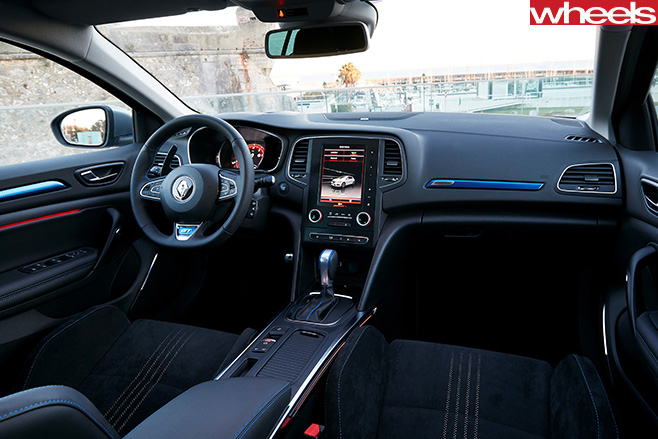
While the ways in which the GT differs from other Meganes are important, so are the things it has in common: stand-out exterior style and an inviting interior.
The new Megane’s longer, wider, lower dimensions must have helped, but Renault’s designers deserve credit for the car’s stance and shapeliness. It’s especially attractive from the rear, a view that emphasises the body’s broad shoulders and distinctive LED lighting strips.
High-grade Meganes (the only kind at the international launch in Portugal) will come with an instrument panel featuring a Volvo XC90-like portrait-oriented touchscreen in its middle. The second thing you notice, after the display, is the huge step forward Renault has made with interior design and quality. This is a cabin that stands comparison with the best in class.
But it’s not perfect. The steering column-mounted controls are a long way from ergonomic excellence. Rear access could be easier, with only a narrow gap between B-pillar and seat base for getting feet in and out. And, as with so many modern designs, the angle and thickness of the A-pillars hinder vision.
There’s stuff to praise, as well. The driving position is fine, as are the GT-specific Alcantara-trimmed front sports seats. The glovebox is usefully big. And that portrait screen makes car set-up – and Renault does give the picky driver a lot of choices – relatively painless.
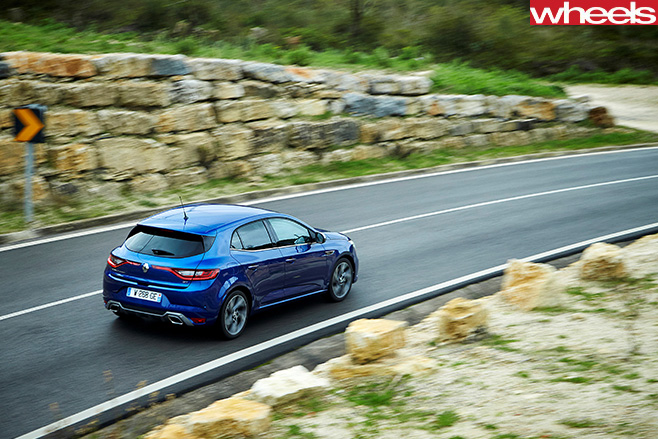
It also feels agile, thanks to the direct steering and the 4Control rear axle. In Sport mode, the rear wheels steer counter to the fronts up to 80km/h. In Neutral and Comfort modes the GT makes an earlier switch, at 60km/h, to stability-enhancing same-direction steering.
Sport mode also reduces the level of steering assistance, but does nothing to alter the system’s numbness. Still, the GT is prompt and precise in its responses to inputs. And the car feels well balanced up to the point it pushes gently into understeer.
The engine is sweetly refined, nicely muscular and with a pleasantly raspy top end. But the new-generation Megane isn’t significantly lighter than the old one, meaning the 1.6-litre turbo delivers brisk rather than brilliant performance.
The seven-speed dual-clutch transmission, which Renault labels EDC, does not seem able to read both the driver’s mind and the road ahead the way the DSG in Volkswagen’s Golf GTI can do. It’s okay in Neutral or Comfort, but in Sport – which alters both throttle and transmission mapping – it can be hesitant.
Still, the GT does promise a better basic Megane. The style and space are giant steps in the right direction, as is the emphasis on quality, refinement and comfort. And Renault’s decision to include a full suite of up-to-date active safety tech, including autonomous emergency braking, is a wise one.
With the local launch of the new Megane scheduled for the second half of 2016, Renault Australia is still months away from finalising specification and pricing. What they do know for sure is that the launch line-up will include a 97kW 1.2-litre turbo-petrol four teamed with six-speed manual and seven-speed dual-clutch transmissions, plus an EDC-only 81kW 1.5-litre turbo-diesel four.
Priced right – say from $21,000 for the base petrol manual to around $37,500 for the GT – Renault Australia should find there’s space enough for the new Megane in one of the market’s most crowded segments.
SPECS Model: Renault Megane GT Engine: 1618cc in-line 4-cyl, dohc, 16v, turbo Max power: 151kW at 6000rpm Max torque: 280Nm at 2400rpm Transmission: 7-speed dual-clutch Kerb weight: 1392kg 0-100km/h: 7.1sec (claimed) Economy: 6.0L/100km Price: $37,500 (est) On sale: October
MOST people looking at a base-model X1 would be first-time BMW owners. What should they expect from the brand’s first front-drive crossover?
WHAT IS IT? The second-generation X1 is the first SUV off the BMW Group’s UKL transverse architecture, meaning front-drive (sDrive) or all-wheel drive (xDrive). We’ve already tested the latter, but the former in base 18d and 20i are expected to be the volume sellers against Audi’s popular Q3.
WHY WE’RE TESTING IT Can a front-drive BMW SUV feel and drive like a BMW should? To find out, we’ve sampled both base variants, the sDrive18d (diesel) and sDrive20i (petrol). These are expected to be the most popular, taking on the big-selling Audi Q3. If BMW can get these bread and butter crossovers right, then the front-drive naysayers ought to be silenced once and for all.
MAIN RIVALS Audi Q3, Mercedes-Benz GLA, Mini Countryman, Lexus NX, Volvo V40 Cross Country
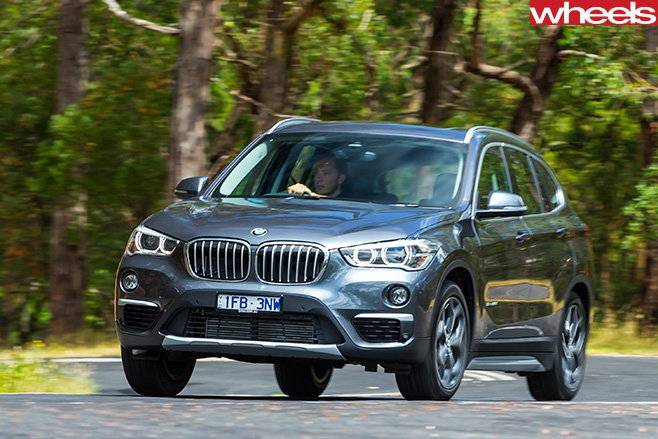
PLUS: Design, packaging, performance, efficiency, handling, ergonomics, safety, affordability
MINUS: More expensive than before, firm standard ride, tyre noise, costly options, clammy vinyl seats
THE WHEELS REVIEW PURISTS may bemoan BMW’s newfound fascination with front-wheel drive, but a stint in the cheapest X1s – the fresh sDrive18d diesel and its petrol-powered sDrive20i sibling – suggests we’re way better off because of it.
Blame the original X1. Launched in 2010, and based on the 2005 E91 3 Series Touring, it was a weirdly proportioned and angry-faced wagonoid with oddly unsatisfying packaging. Or, in other words, the company’s attempt to BMW-ify the compact SUV was as compromised as the cruddy ride.
Clearly, Munich’s brains trust knew it too, because in every vital way, the second-gen outshines the first. Less lengthy yet taller outside, bigger and airier inside, there’s space to move at last. A regular BMW dash layout and ambience, commanding driving position, deep side windows, and the flexibility of a sliding rear bench to boost an already usefully bigger cargo area, all tick the correct crossover boxes. And that it no longer looks like Drizella besides the X5’s Cinderella – take a bow, Aussie designer Calvin Luk – is literally a sight for sore eyes.
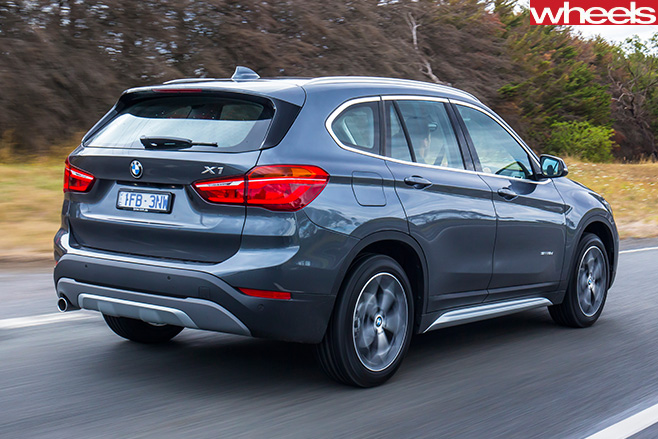
Also on-brand, on the other hand, is the at-times unyielding ride on the standard suspension. Wearing (at times quite noisy) 225/50R18s, the MacPherson strut-front and multi-link rear set-up seems sufficiently absorbent on smooth stuff, but wilts when the going gets rough. Luckily, for about $900 you can order adaptive dampers, to more effectively cush your tush.
Equipment wise, the base cars might surprise cynics, with a powered tailgate, LED headlights, auto self parking, satellite navigation, a reversing camera, front and rear sensors, Lane Departure Warning, Forward Collision Warning, and Pedestrian Warning with light city braking function all included. The charmless vinyl trim needs to go, though. Luckily, there are endless options to lift things up if pockets are deep enough.
Which, of course, all add up to the quintessential modern BMW experience. Front-wheel drive the X1 sDrive may be, but it’s also as true to the brand as today’s 3 Series. Tradition be damned!
SPECS
Model: BMW X1 sDrive18d Engine: 1995cc 4cyl, dohc, 16v, turbo diesel Max power: 110kW @ 4000rpm Max torque: 330Nm @ 1750rpm Transmission: 8-speed auto Weight: 1470kg 0-100km/h: 9.2s Fuel economy: 4.7L/100km Price: $49,500 On sale: Now
Once upon a time, the only real sports cars were convertibles.
Sure, there were sporty cars with roofs, but if you wanted a proper driving experience, you needed the wind in your hair and the sun on your face. The flies in your eyes and grit in your teeth weren’t mentioned so much, but let’s not spoil the romance. Cruising along a winding road in an Austin-Healey 3000 or Alfa Giulietta Spider – driving nirvana.
At some point, however, possibly around the muscle car era of the late 60s or early 70s, it all went awry. Open-top cars became wobble-bodied pose machines, built for the Cote d’Azur rather than the Col de Turini; more Sunset Boulevard than Spa-Francorchamps. They remain hot property, though, so with another Aussie summer upon us we felt it was time to discover what today’s drop-tops bring to the table.
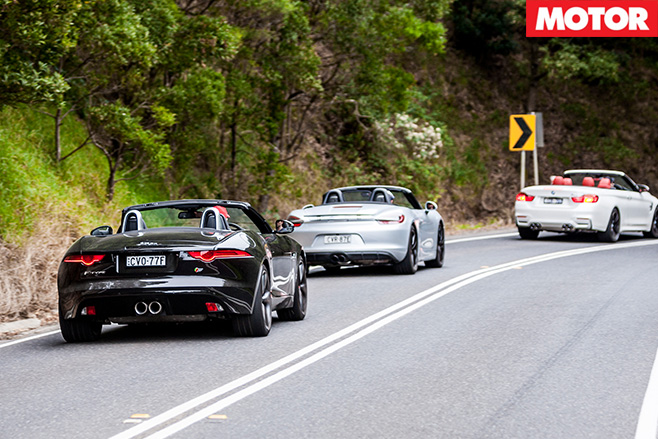
Losing the roof adds $12,000 to the price ($178,430), while the complex folding hardtop and requisite body strengthening add a hefty 253kg to the kerb weight. The F32 is, however, 60kg lighter than its predecessor and, in dual-clutch form, cheaper too.
Its closest challenger, on paper at least, is Jaguar’s F-Type V6 S. Priced at $170,575, the V6 S also packs a 3.0-litre force-fed six-cylinder, albeit in vee configuration and boosted by a supercharger rather than a pair of turbos, delivering 280kW and 460Nm. This is our first proper exposure to a six-pot F-Type – can it match the thrills offered by its V8-engined siblings?
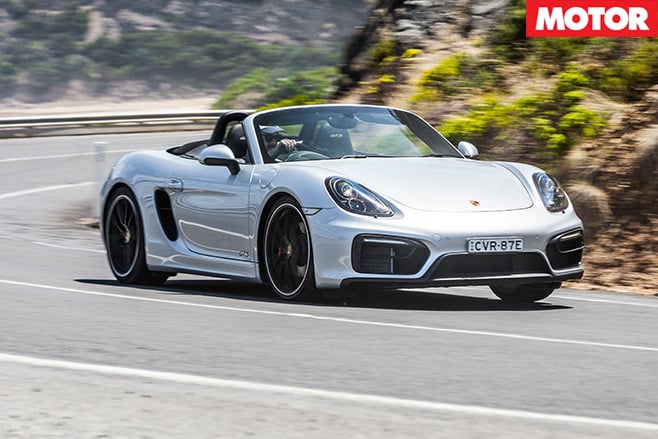
The GTS treatment also brings a slight lift in output to 243kW and 370Nm. Even fitted with the seven-speed PDK ’box, though, it’s easily our cheapest contender at $151,790.
The packaging advantages offered by its mid-engined layout also make it by far the smallest car here. Each successive Boxster has been more aggressive than the last, but it’s still more feminine than its brawny, traditional front-engine, rear-drive rivals. It’s a good-looking thing, even if the black highlights of the GTS make it look a bit like it’s going through a teenage ‘emo’ phase.
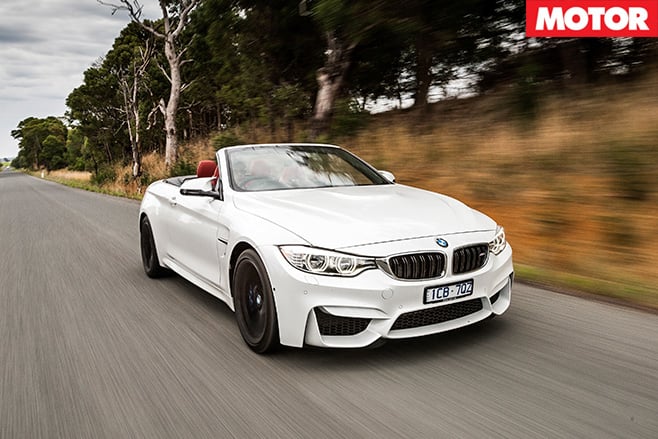
It certainly doesn’t lack aggression; M cars of old were subtle to the point of anonymity (which isn’t without its virtues) but there’s no doubting the M4’s intent. Following it in the Boxster, its narrow glasshouse and Kardashian hips give the impression that it’s swallowed a lesser 4-Series whole.
When it comes to the catwalk, though, appropriately it’s the Jaguar that steals the show. Wherever it pulls up passers-by point and produce camera phones. You could argue that it’s not quite as good-looking as its hardtop twin, but that’s like debating who’s the better looker out of Miranda Kerr and Mila Kunis.
Its case is further enhanced by green and red flecks in the black paint that sparkle in direct sunlight and those carbon-bladed 20s, which look so good $6800 suddenly doesn’t seem so steep.

At the strip it reels off 4.98sec to 100km/h and a 13.16sec quarter mile at 175.79km/h. It’s a breeze to launch: load it briefly against the brake and floor the throttle. There’s next to no wheelspin and the quick-shifting, close-ratio eight-speed ZF auto makes the most of the available power, while also proving that even the best dual-clutch gearboxes are yet to match the low-speed smoothness of a good automatic.

What could have gone faster is the Boxster. Its 5.11sec 0-100km/h and 13.29sec quarter mile times (at 173.77km/h) were well down on the 4.49sec and 12.66sec recorded in the (almost) mechanically identical Cayman GTS at PCOTY last year.
Blame the surface. On Heathcote’s slippery start line, launch control simply blazed the rear tyres and any other technique was still slower than letting the electronics do it. In one way the numbers are representative, though, as the Boxster feels a little slower than the Jag.

Allowing emissions regulations to kill this engine in favour of a 2.0-litre turbo four should be a crime against the Geneva Conventions, particularly since this ‘high-polluting’ atmo engine averaged a parsimonious 10.2L/100km, compared to 12.0L/100km for the Jaguar and 12.1L/100km for the BMW. Forced induction might shine on the highly controlled (and highly misleading) official consumption test, but in the real world the evidence doesn’t match the manufacturer’s claims.

It certainly shows up the BMW’s DCT. Once on the move it’s superbly responsive with lightning-quick shifts, but the engineered-in thump during full-throttle upchanges is irritating (and can break traction on slippery surfaces) and its low-speed behaviour is often clumsy. Simply performing a smooth three-point turn can take an age.
When it comes to speed, however, the M4 is in a class of its own. Despite being the biggest and heaviest (1750kg) car here, its greater power and excellent launch control system delivered 0-100km/h in 4.46sec and a 12.61sec quarter mile at 184.74km/h. M4 first, daylight second. The figures are no surprise from behind the wheel, as the BMW feels appreciably the fastest of the trio.
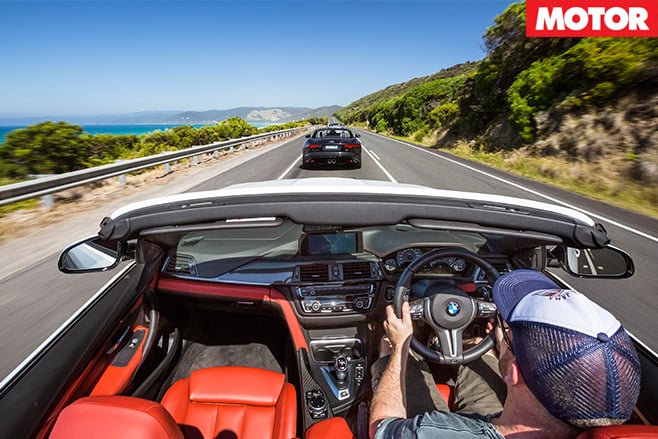
Sadly, one area the new engine is no match for its predecessor is noise, though it is at its best in the Convertible. While it never approaches the heaven-sent soundtrack of the old bent-eight, with the roof down you are privy to all sorts of growls, snorts and bangs that remain unheard in the hardtop. It turns out the new M4 sounds pretty good. You just usually can’t hear it.

In the dry, traction is incredibly strong, though when it does run out you have to act quickly to catch the ensuing slide. Back-to-back with the Coupe you’d no doubt feel the extra weight of the drop-top, but in isolation it’s still more than capable of tearing any given road apart. Keep that roof up when you’re having a punt, though, as there’s an alarming degree of body wobble over bumps in al fresco mode.

Unlike the Germans, you’re unable to separate chassis and engine settings, so the Jag is either ‘Dynamic’ or not. Being able to select Dynamic for the powertrain while retaining the softer chassis setup would be beneficial, as the F-Type can skip over bumps in its stiffer setting.
In fact, the ride is pretty firm regardless. The front end also doesn’t always provide the feedback you’d like, either, and the mechanical limited-slip diff is far too loose, the inside rear wheel easily spinning up out of corners. It feels at its best – which admittedly is very good – at about eight-tenths, but there’s no way it can match the M4’s pace.
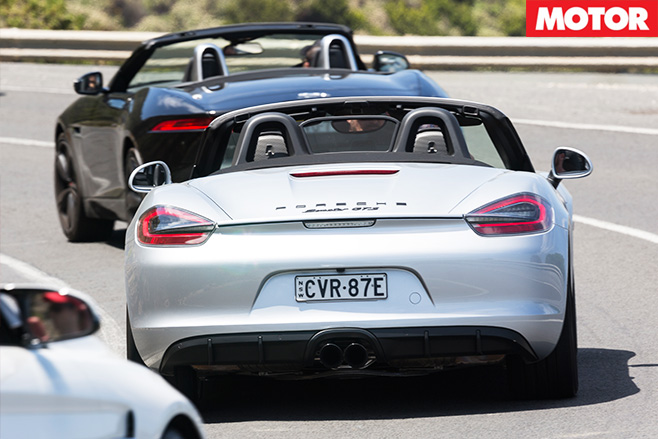
The structure feels every bit as stiff as the Cayman, the ride is sublime – by far the best here – the brakes are brilliant, the list goes on. More than its component parts, though, it’s the way the Porsche gets better and better the harder you push, rather than coming apart at the seams, that sets it apart.

Porsche isn’t alone in this game, though. Our test F-Type V6 S is $184,800, with Jaguar also asking extra for basics such as metallic paint ($2810) and parking assist ($1725), though the latter is now standard on the (more expensive) MY16 F-Type. And then there’s its practicality, or lack of it.
Forgo a space-saver spare and the boot will accommodate a couple of squishy bags, but with a spare in place there is virtually zero luggage space, meaning you either travel alone and use the passenger space for luggage or limit your F-Type experience to day trips.
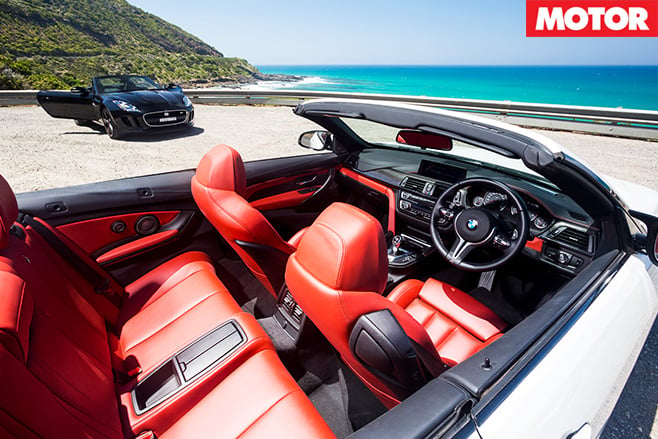
While far better to drive than most will give it credit for, it just goes against everything the M Division stands for. What’s the point of engineers slaving away for months saving every gram of weight possible only to add 250kg back on? That the BMW M4 was most enjoyable cruising around town kind of says it all.
The Jaguar does an excellent job of being the quintessential British roadster. It’s dripping with character inside and out and looks and sounds amazing. Unfortunately, while a likeable car, in pure driving terms the jiggly ride gets irritating and the handling isn’t sharp enough to compensate.

In terms of ability, however, there is a clear winner. The Boxster GTS comes incredibly close to receiving the full five stars, simply because there are so few ways in which to improve it. It’s the most comfortable car here, yet also the sharpest and most rewarding to drive.
Personally, I’d choose it over the Cayman, simply because having no roof doesn’t seem to penalise it in any way yet gives even better access to that incredible engine note.
You might no longer need to have a convertible to have a real sports car, but if you want a proper driving experience, you need a Boxster GTS.
| u00a0 | Porsche Boxster GTS | BMW M4 Convertible | Jaguar F-Type V6 S |
| Body | 2-door, 2-seat convertible | 2-door, 4-seat convertible | 2-door, 2-seat convertible |
| Drive | rear-wheel | rear-wheel | rear-wheel |
| Engine | 3436cc flat-6, DOHC, 24v | 2979cc inline-6, DOHC, 24v, twin-turbo | 2995cc V6, DOHC, 24v, supercharger |
| Bore/Stroke | 97.0 x 77.5mm | 89.6 x 84.0mm | 84.5 x 89.0mm |
| Compression | 12.5:1 | 10.2:1 | 10.5:1 |
| Power | 243kW @ 6700rpm | 317kW @ 5500-7300rpm | 280kW @ 6500rpm |
| Torque | 370Nm @ 4500-5800rpm | 550Nm @ 1850-5500rpm | 460Nm @ 3500-5000rpm |
| Power/Weight | 181kW/tonne | 181kW/tonne | 173kW/tonne |
| Consumption | 10.2L/100km (tested) | 12.1L/100km (tested) | 12.0L/100km (tested) |
| CO2 Emissions | 243g/km (tested) | 288g/km (tested) | 287/km (tested) |
| Transmission | 7-speed dual-clutch | 7-speed dual-clutch | 8-speed dual-clutch |
| Weight | 1345kg | 1750kg | 1614kg |
| Suspension | struts, A-arms, anti-roll bar (f); multi-links, coil springs, adaptive dampers, anti-roll bar (r) | struts, A-arms, adaptive dampers, anti-roll bar (f); multi-links, coil springs, adaptive dampers, anti-roll bar (r) | A-arms, coil springs, anti-roll bar (f/r) |
| L/W/H | 4404/1801/1273mm | 4671/1870/1386mm | 4470/1923/1308mm |
| Wheelbase | 2475mm | 2812mm | 2622mm |
| Tracks | 1526/1540mm (f/r) | 1579/1603mm (f/r) | 1597/1649mm (f/r) |
| Steering | electrically-assisted rack-and-pinion | electrically-assisted rack-and-pinion | hydraulically-assisted rack-and-pinion |
| Brakes | 330mm ventilated/drilled discs, 4-piston calipers (f); 299mm ventilated/drilled discs, 2-piston calipers (r) | 380mm ventilated/drilled discs, 4-piston calipers (f); 370mm ventilated/drilled discs, 2-piston calipers (r) | 380mm ventilated discs, 2-piston calipers (f); 325mm ventilated discs, single-piston calipers (r) |
| Wheels | 20 x 8.0-inch (f); 20 x 9.5-inch (r) | 19.0 x 9.0-inch (f); 19 x 10.0-inch (r) | 20.0 x 9.0-inch (f); 20 x 10.5-inch (r)u00a0 |
| Tyres | 235/35 ZR20 88Y (f); 265/35 ZR20 95Y (r) Pirelli P Zero | 255/35 ZR19 92Y (f); 275/35 ZR19 100Y (r) Michelin Pilot Super Sport | 255/35 ZR20 97Y (f); 295/30 ZR20 101Y (r) Pirelli P Zero |
| Price | $145,500 | $178,430 | $170,575 |
| Price as Tested | $167, 150* | $189,390* | $184,800* |
| Positives | Bewitching engine; superb chassis; great ride; practicality; value | Hugely fast; useability; interior quality; more theatre than hardtopu00a0 | Punchy engine; amazing noise; great styling; feel-good factor |
| Negatives | Possibly the last atmo Boxster; intergalactic gearing | Lack of roof-down rigidity; should still sound better; weight | Irritating ride; not super sharp to drive; lacks practicality |
| u00a0 | 4.5 out of 5 | 3.5 out of 5 | 3.5 out of 5 |
PROS
- Refinement. The first thing you notice about the Q7 drive experience is how quiet it is inside. The turbo-diesel V6 is blissfully smooth.
- Space. Though it’s smaller outside, clever packaging makes the Q7 bigger inside. It’s a very nice place to be.
- Power. Despite its lumbering frame the Q7 shifts along with impressive ease. Reams of torque lie under your right foot. Steering and body control is surprisingly good for a car of its size.
- Seats. Seven of them in fact, and all are independently configurable for a huge range of cargo and people moving potential. Third row leg room isn’t especially generous but the seats themselves are more comfortable than most.
- Technology. Audi nicked the TT’s beautiful and highly customisable digital display for the driver’s instrument cluster. It’s a really nice feature to have and works well in concert with the retractable display on the dashboard. Also adding to the infotainment experience is the touchpad with handwriting recognition, giving you another level of control over systems like the satellite navigation.
- Options. Advanced systems like auto emergency braking and semi-autonomous control are optional on the Q7. It’s a shame they’re not standard. The included safety kit is sophisticated but overshadowed by the standard kit on the Volvo XC90.
- Comfort. Unfortunately that comfy last row of seats doesn’t get its own air vents, even with the optional ‘deluxe’ air conditioning package. Perhaps a small oversight if you aren’t likely to use the third row of seats a whole lot.
STAND OUT FEATURES
Jump into the Q7 and you’re surrounded by what looks and feels as up-to-date as car interiors get. You’ve got two super sharp displays to work with, including a hugely customizable instrument cluster. There’s a large touchpad here on the centre console that can recognize your handwriting and gives you another level of control over the motorised screen on the dash.
Unfortunately a few of the Audi’s more advanced safety systems don’t come standard, like auto emergency braking and semi-autonomous control, so keep that in mind when buying. Also on the options list is a deluxe air conditioning package that turns most of the dashboard into one huge air vent and gives your back seat passengers their own climate controls.
WHERE DOES IT FEEL AT HOME?
Easily the most impressive thing about the Q7 is its refinement. The turbo-diesel V6 has plenty of power – in fact, it’s properly fast and it’s remarkably smooth and quiet. It defies its large size through the corners as well. That makes it sweet to drive at any speed and it cruises like a natural over long distances. In the very back there’s a third row of seats as standard, and while it is a big car it’s not unusable in the city. The hushed cabin acts almost like your own little sanctuary.
WHAT’S IT MADE FOR?
It probably won’t surprise you to hear that the Q7 weighs in at over two tonnes. What may surprise you is that it’s actually a lightweight compared to the old one. Audi has trimmed 240 kilos off the Q7s beltline which you’ll notice in better fuel economy and on-road performance.
WHAT WE LIKE AND WHAT WE’D CHANGE
Despite the outside being smaller than the old car, clever packaging means the interior space is actually bigger. You can configure the rear seats independently and this third row isn’t just somewhere to shove people you don’t like. It’s actually comfortable!
Sadly, even with the optional air con package, the third row of seats doesn’t get it its own air vents. How often you need to put people back here will determine how much that matters to you.
Now air suspension might sound like an unnecessary extravagance, but we would strongly suggest you test drive a Q7 with that option ticked before you buy. The ride on air is superb, and it actually adds to the car’s practicality by allowing you to lower the rear of the car to make it easier to load.
WHO WILL IT SUIT
The Audi Q7 is a hugely practical SUV with plenty of performance on tap, but it’s not trying to be anything other than a relaxed and luxurious people mover that you won’t tire of living with.
The days of two-wheel drive SUVs could be numbered if car makers can take away one of the biggest factors limiting their all-wheel drive siblings – high fuel use.
Mazda says it is close to developing a four-wheel drive system that is more efficient and uses less fuel than a lighter two-wheel drive system.
Speaking at the inaugural Mazda Ice Academy – a snow and ice driving course designed to highlight advantages of the brand’s i-Activ all-wheel drive system – drivetrain assistant management engineer Tetsushi Marutani said Mazda’s goal was to have an efficient four-wheel drive system “in the near future”.
“Our goal is to beat the 2WD efficiency on dry pavement,” said Marutani, adding that the second generation of i-Activ all-wheel drive wasn’t far off.
“If we get zero mechanical loss on mechanical system … we can beat 2WD [for efficiency].”
Mazda engineers point to inherent mild wheel slip by the powered wheels in any vehicle as a small but significant source of energy loss that can be reduced by powering all four wheels.
While i-Activ predominantly drives the front wheels when traction is good, they say that spreading some of the drive to the rear wheels will reduce those losses.
With pending improvements as part of the second generation i-Activ all-wheel drive system, Marutani says the benefits will outweigh the energy used to drive the AWD mechanical components.
“We are developing a new i-Activ AWD to reduce losses,” he said.
As for the additional weight of a four-wheel drive system – typically upwards of 50kg due to additional differentials and driveshafts – Marutani says it is negligible and will be outweighed by the reduction of wheel slippage in regular driving.
Mazda claims its i-Activ all-wheel drive system is more advanced than most on-demand systems used in car-based SUVs. It uses 27 existing sensors and systems in the car – everything from windscreen wipers and the external temperature to road speed, steering angle, g-forces and braking force – to predict when additional traction is required.
Mazda says the system can accurately predict low grip surfaces and bring all four wheels into play before wheelspin occurs, for smoother activation and added confidence.
Our Fiesta ST long-termer has been conspicuous by its absence from these pages these last couple of months. Don’t feel special, it’s been missing from my driveway for the same length of time.
You may remember that a couple of months back, I was happily filling the Fiesta’s little fuel tank with PULP when a trailer on the other side of the servo driveway clipped the Ford’s driver’s side rear quarter. Ouch.
The damage was limited to the quarter itself and the alloy wheel which was scraped beyond repair. So, back out to Broadmeadows for a little factory TLC, then.

Only problem there is that it was apparently a busy time of the year. That, and the fact that Easter and Anzac Day long weekends got in the way, and suddenly, I was weeks without the little red rocket.
I picked the Fiesta up late one night at Ford’s 24-hour gatehouse, so I couldn’t even check whether the repairs had been done at all, let alone to what standard, but daylight the next day revealed all.
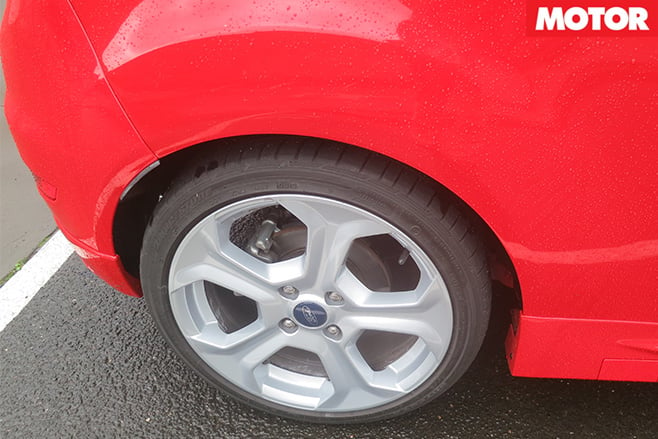
The only slight hiccup was when I first started to drive home and noticed what felt like a small vibration through the car. My instinct was to blame the new alloy wheel being out of balance, but within a couple of kilometres, the little shudder had gone and hasn’t come back at any speed.

But everything else is just as I remembered it, which is to say, wonderful. This really is a great little car – which we can’t wait to put some much-needed kays on – and if I missed it while it was away, I’m gonna need therapy when it goes back to Ford full-time.
Check out part 1 of the Ford Fiesta ST long term test.
Check out part 2 of the Ford Fiesta ST long term test
