
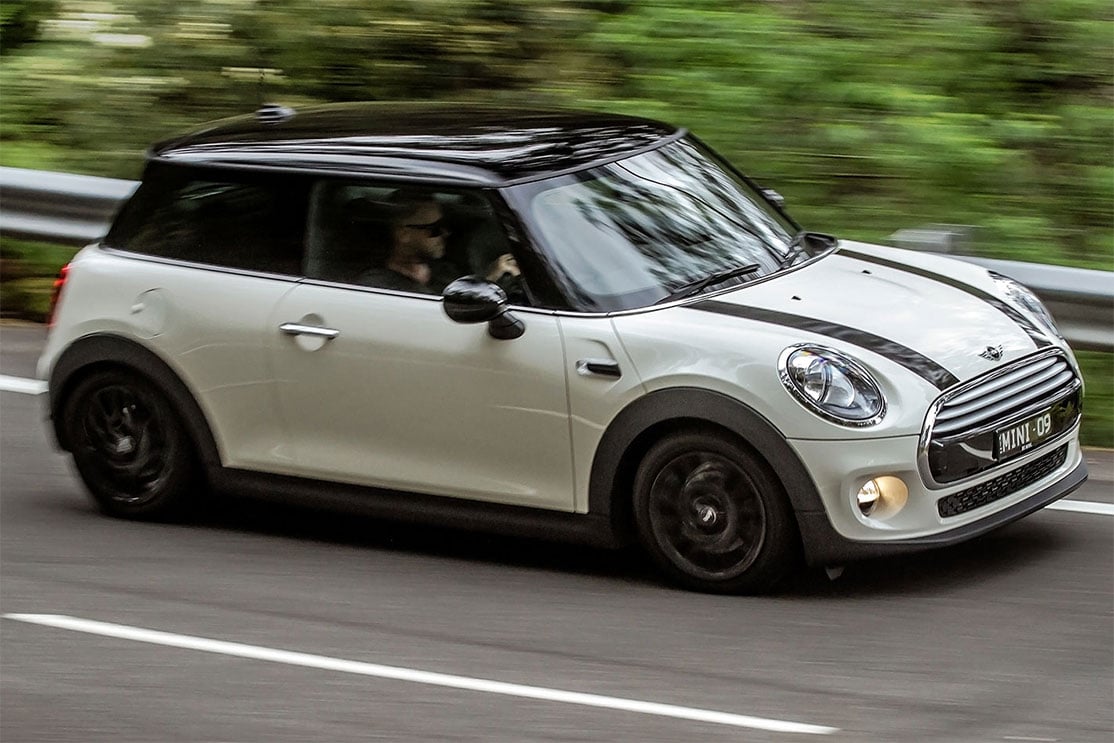
Compared to its 1959 Austin-Morris grandfather, the latest Mini is about as compact as an iPhone 6 Plus, but in contrast to most other cars lining my narrow, one-way street, this Mini Cooper Pepper hatch remains refreshingly small. That said, with a longer nose, thicker pillars and a steeper windscreen, the latest Mini definitely feels lardier and less airy than it once did.
Measuring 3821mm long, it’s 98mm longer than its predecessor, yet its wheelbase has grown by just 28mm, which goes to show how Latin the Mini’s pedestrian-friendly schnoz has become. All that crumple-zone real estate takes some getting used to, but with its regular parabola-lens headlights, at least this Cooper Pepper looks less like a startled cartoon character than the Cooper S with LEDs we tested back in June.
So what is a Cooper Pepper exactly? Well, it’s a $26,650 Cooper optioned with a $3000 Pepper package that includes black 16-inch Victory Spoke alloys wearing Hungarian-made Hankook 195/55R16 tyres (175/65R15s are standard), a larger 6.5-inch colour dashboard screen, dual-zone climate control, extended Bluetooth with music streaming and USB audio interface, Mini Excitement package with custom LED interior lighting, clear indicator lenses and fog lights at both ends.
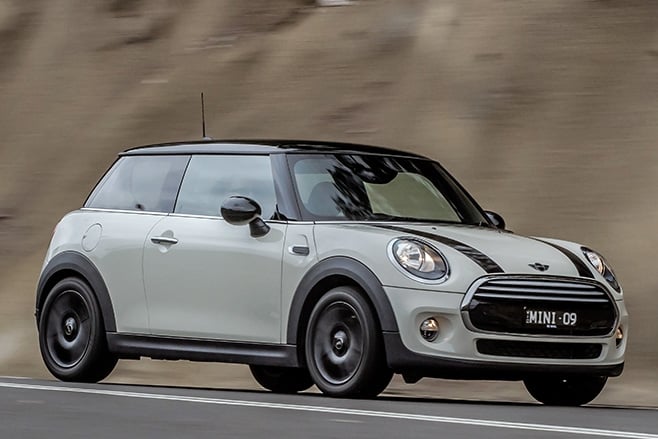
In addition to three grand’s worth of spice, MINI-09 also includes a reversing camera ($470), black bonnet stripes ($200), no-cost black roof colouring and mirror caps, anthracite headlining ($300), piano-black interior finishes ($250), sun protection glazing ($400), and an anti-dazzle mirror ($200). That takes this six-speed manual Cooper Pepper’s RRP to $31,470, which seems like a fair wedge, but is more than a grand under what a dead-stock Mini Cooper cost when the R50 launched in 2002.
While the latest-generation Mini may not look as cute as its predecessors, it’s a vastly better car to drive. BMW’s thrummy new 100kW/220Nm 1.5-litre three-pot turbo is an ultra-flexible, peachy little thing, far superior to the slightly harsh 90kW/160Nm 1.6-litre ‘Prince’ four in the outgoing R56, and the peaky 85kW/149Nm 1.6-litre ‘Tritec’ four in the R50. Finally, here’s a Mini Cooper with the muscle to justify its name.
It’s incredibly tall-geared, though. At the turbo triple’s 6500rpm redline, first gear stretches to 65km/h, while second gear will hit an astounding 114km/h. Most small cars demand an upshift somewhere in the 90s, but not this leggy Mini. The Cooper manual’s claimed top speed is 210km/h, which translates to 5950rpm in fourth gear, yet at a comfortable 180km/h on an autobahn the engine would be ticking over at just 3600rpm in sixth. No wonder its official combined fuel figure is 4.7L/100km.
In the real world, this super-tall gearing takes some getting used to. After relishing the third-gear flexibility of my previous long-termer – a base Alfa Giulietta manual – the Mini’s legs are simply too long to tackle 90-degree turns or obstructive speed humps in third gear. Try it and the car almost stalls.
On the odd occasion, I drive at low speed in first because the gearing is so tall and the engine is so smooth. Yet Mini claims 0-100km/h in 7.9sec, which is 1.2sec faster than the previous Cooper and is achieved with just one reasonably slick shift to second. You have to be on your game with the clutch, though, because any delay in depressing it results in slightly jerky progress and notchy shift feel.
Travel between the floor and clutch engagement is quite short, but once you nail it, she’s an easy, breezy manual to get along with. And ditto the rest of the three-pot Mini. Decent front seat support (even though this pre-production Cooper lacks the centre-front armrest usually fitted to Pepper models), a useable back seat and improved luggage flexibility should make my Mini experience one to savour.
TANKS A LOT
A purely urban month, shared among Wheels contributors, all of whom must have deemed it their duty to ‘test’ the Mini’s performance while I was overseas on holidays, yielded a fairly poor fuel figure.
Arriving with 5748km on the clock, our Cooper manual covered another 806km during September, drinking 98RON at an average of 9.6L/100km. Given Mini’s urban claim of 5.9L/100km and an extra-urban figure of just 4.0L/100km, I thought the first month’s average would be about as bad as it was going to get. But not even close.
The next tank consisted of Thomas Wielecki and myself driving the Mini for its photoshoot on the Old Pacific Highway. Trip computer reset, it said we’d averaged 10.7L/100km for the day, which will surely be optimistic.
Can torque-surfing and short-shifting improve things?
UPDATE 1
‘It’s not me, it’s you’ scenario stymies the romance
There’s something not quite right about this relationship. On paper, the F56 Mini Cooper should be right at the top of anyone’s RSVP feed. It’s small and sporty, punchy and pointy, and seemingly perfect for urban manoeuvrability. It has all the engineering genes to produce a frigging brilliant little hatchback, yet when Robbo recently asked me how we were getting along, and I paused, he said, “You’re not in love with it.” And he was right.
What the three-pot Mini Cooper lacks, and the four-pot Cooper S delivers, is a genuine high. Something that could see us bond like chewing gum to hair. After nearly 2000 kays in my six-speed manual Cooper, I’m struggling to find something I truly, genuinely love. But here goes.
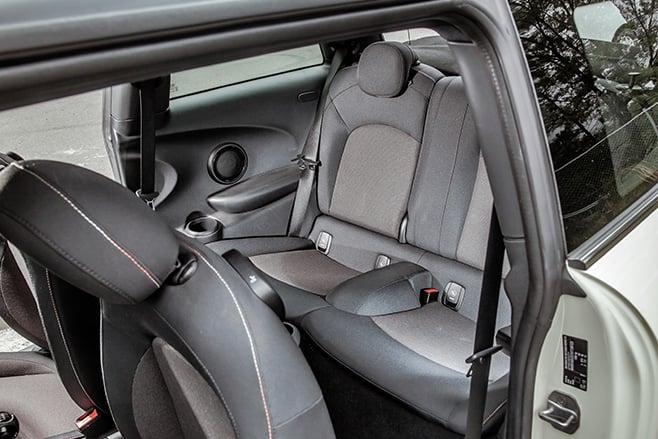
Contrary to what others think, I quite like the rear styling of the latest Mini, particularly its blobby tail-lights, and I’m always a sucker for frameless doors (until the seals stop sucking at highway speeds – ask any old Subaru owner). The Mini’s front cupholders are great for phones and keys and what not, while the one-litre Tupperware bottle I cart everywhere sits perfectly in the recess next to the handbrake. So practicality-wise it’s usefully inoffensive, even though its watered-down interior design means the new Mini is a little less Mini than it used to be.
It’s the dynamic aspect, though, that’s leaving me numb. Every now and then you get a taste of its delightful rear-end adjustment as it tucks into an urban corner, courtesy of super-keen steering and a neat leather wheel. But out on the open road, it simply doesn’t gel as well as it should.
Even on its non-run-flat 195/55R16 Hankooks, the Mini Cooper’s urban ride is rubbish, yet at speed on a typically bumpy Aussie freeway, there’s virtually no improvement in its bump absorbency. If you like a jiggly, constantly jostling ride, then here’s your car! And the Mini’s steering is arguably too reactive on a twisty road, especially when it’s wet, because those Hankooks don’t quite keep up with the steering’s demands.
So, highs that aren’t satisfying enough, mixed with a ride-quality low that’s borderline hateful. If the Cooper sounded raspy and keen, like a three-pot Mini should, then I could forgive some of its flaws, but it doesn’t do that either. If only it were a Cooper S manual with adaptive dampers.
DOLLARS AND SENSE
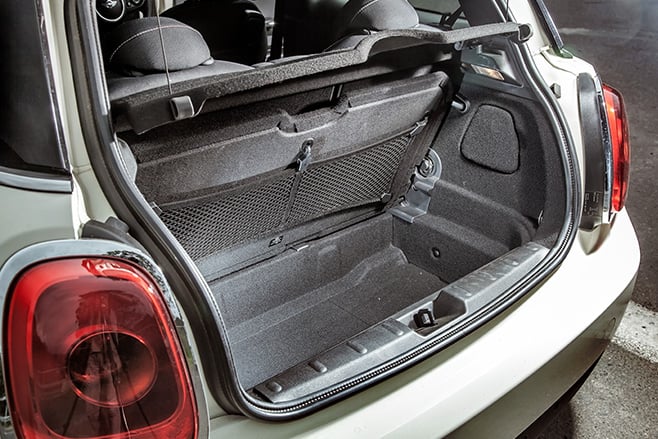
A $500 grocery shop is a big ask, not least for your wallet, but with a visitor staying for a fortnight, the new Mini’s increased cargo flexibility had a chance to prove its worth. I laid copious amounts of mineral water and anything else that would fit beneath the dual-height adjustable boot floor, and wedged the rest as tight as possible in the upper level. A few bags had to ride shotgun with the rear-seat passenger, but the little Mini did an admirable job.
UPDATE 2
Minimal anxiety about this separation
Many, many years ago, Wheels Magazine ran an R50 Mini Cooper for six months – a red manual with a white roof and mirror caps, and 16-inch alloys. Cute as a button, yet frequently left alone in the carpark on weekends, the original New Mini was too patchy to tug at our heart strings. We couldn’t wait to see the back of it.
Thirteen years and two generations later, the Mini Cooper has morphed into a much more sophisticated, comfortable and liveable little hatch, yet much of its ‘retro’ styling has been diluted along the way. Instead of being a flab-free and crisply formed slice of re-imagined 60s charm, today’s Mini looks a bit like a gym junkie who’s turned puffy from too many steroids. Still, if you can handle the styling, you’re definitely getting more Mini for your money. Less money, as it turns out.
Yet, somehow, I failed to bond with this manual Mini Cooper Pepper. And much as it hurts to admit it, I blame the drivetrain.
On paper, a feisty 100kW/220Nm 1.5-litre three-pot turbo tied to a six-speed manual gearbox should be a recipe for proper small-car shenanigans. But Mini negates the fun factor by over-gearing the Cooper to a ridiculous level, while failing to capitalise on the potential acoustic thrills of a tuned triple. Impressively elastic as the Cooper’s engine is, it feels like it belongs in a much bigger car, not a sporty little hatch.
In low-speed urban commuting, particularly over the speed humps and deep gutters that predominate where I live, there are times when you need to blip back to first gear to prevent the Mini from stalling. And yet when darting through small roundabouts, third gear is too tall to take advantage of peak torque arriving at just 1250rpm. Could this ill-suited gearing be the reason for the Mini’s unexpected thirst?
After the first month’s 9.6L/100km average, I drove specifically for economy, surfing the engine’s torque curve and grabbing a taller gear wherever possible. Admittedly, the Mini Cooper sounds quite charming when thrumming along at low revs in a high gear, but it never delivered the leap in efficiency I expected.
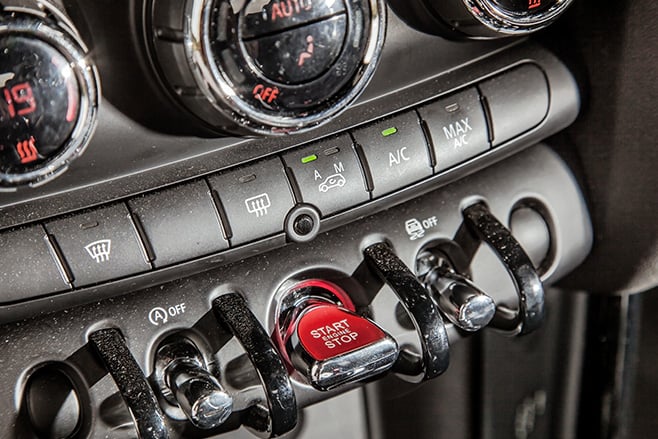
The Mini’s 7.8L/100km personal best included a 270km motorway trip, while its 11.5L/100km low point consisted of a spirited drive up the Old Pacific Highway to Brooklyn and plenty of urban commuting. Given its official combined figure is 4.7L/100km, my Cooper’s 9.3L/100km average doesn’t look too rosy. Nor does it compare well with my previous Alfa Giulietta’s 8.8L/100km, from a larger car with an engine whose roots can be traced back to 1983!
The Cooper’s notchy gearshift often made me wonder whether the six-speed auto would be a better bet, and even without optional run-flat tyres or big wheels, its roller-skate ride served as a spiritual reminder of the 1959 BMC original. The Hankook tyres didn’t work in harmony with the super-sharp steering, and the average quality of its stereo speakers meant it would be wise to carefully cherry-pick from Mini’s extensive options catalogue (see breakout).
Yet I didn’t dislike my cream Mini. Its frameless doors, comfortable seats, grippy steering wheel, wieldy size, parking sensors and optional reversing camera made it great for inner-city living. And the F56’s improved space efficiency was always appreciated when shoving passengers into the rear seat, or filling the boot with stuff.
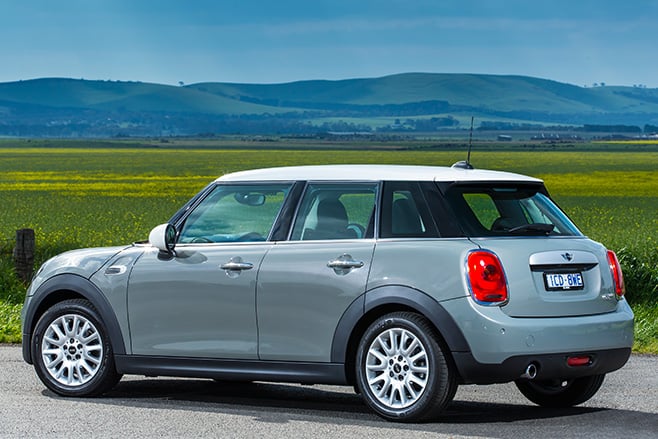
Like its predecessors, I think the F56 Mini gets better the higher up the chain you climb. The Cooper S is a significant step up for grunt, growl and gearshift feel, as well as ride quality if you stick with 17s and add adaptive dampers.
Given shorter gearing and a meatier induction note, the Cooper could easily be a poor man’s Cooper S. It’s just a pity Mini doesn’t see it that way.
OPTING IN
If I had to build my own Mini Cooper, I’d begin with Dynamic Damper Control ($700) and the mandatory Mini Driving Modes set-up (a collar around the gearstick that flicks between Eco, Mid and Sport modes – $250). That’s just under a grand for a big improvement in ride. I’d probably stick with the $3000 Pepper Pack, and I’d want this car’s black Victory Spoke 16s, as well as Harman Kardon hi-fi with 10 speakers ($1200). If the engine doesn’t make enough music, something else needs to!
BACK-DOOR POLICY
After returning my Cooper, I spent a few days in a Mini Cooper D five-door manual with adaptive dampers and Michelin Energy Saver 195/55R16 tyres. And really liked it! Admittedly, the stumpy (framed) doors look dorky and have a whiff of Austin A30 about them, but they’re more practical in tight carparks. The diesel’s torquey grunt is also much better suited to the gearing, and the urban ride on adaptive dampers and a longer wheelbase is comparatively bloody marvellous.
As impressive as it is on the road, if you’re really going to stretch the legs of the new Ford Focus RS you’re going to need a racetrack.
It’s an environment Ford doesn’t shy away from. Before the Focus RS was signed-off it had to complete 30mins of non-stop track work with no thermal degradation (power drop, brake fade etc.) and there’s the much-publicised Track and Drift modes designed specifically for circuit use.
Our test venue is the Circuito Ricardo Tormo, host of the Valencia MotoGP round, a smooth, flowing 4km circuit consisting of 14 turns. We’re instructed to cruise through the pits each time to avoid catching other cars, but apart from that we have free rein to drive as we please.
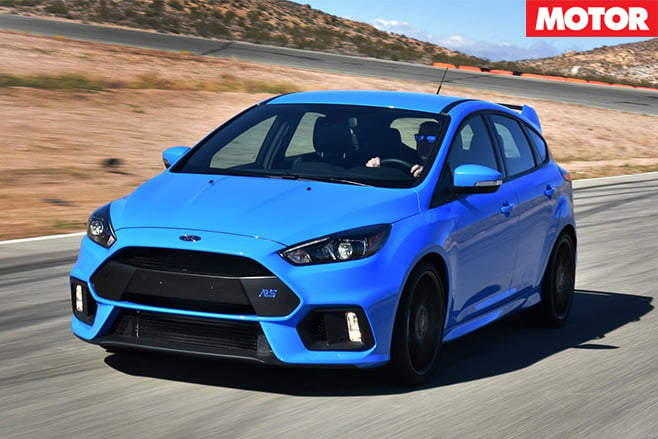
Accelerating out of the pits, the 257kW/440Nm 2.3-litre turbo four easily spins to its 6500rpm redline, the wider expanses of a racetrack failing to soften its punch. Circuito Ricardo Tormo is primarily a mix of long third-gear corners with a handful of tighter second-gear turns and these longer-radius corners show off the Focus’s clever all-wheel drive system to good effect.
Braking is strong and if you judge your entry speed right the nose peels into turns beautifully thanks to tenacious front end grip. Pick up the throttle at the apex, the power shuffles rearward and more often than not the car will exit a corner in a beautiful four-wheel drift.
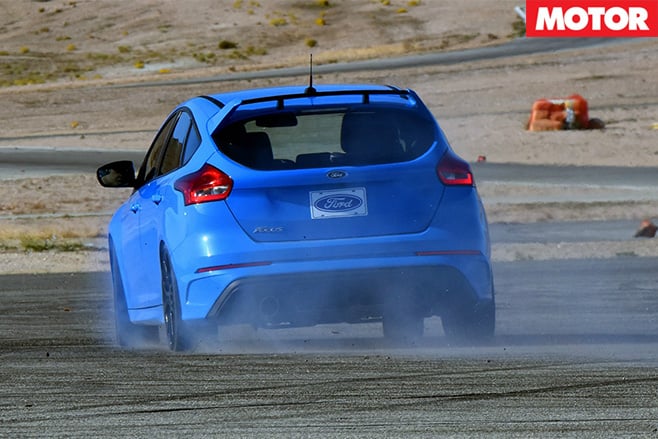
Track ESP is lenient and subtle in its intervention, but based on experience with the Focus and Fiesta ST there’s a suspicion there’s another layer of agility hidden within the RS, one that can only be uncovered by driving unaided.
Interestingly, Focus RS chief engineer Tyrone Johnson claims Ford is the only manufacturer that allows drivers to completely disengage ESP. Free of any electronic shackles, the Focus displays its playful side, adopting a variety of angles depending on your level of finesse.
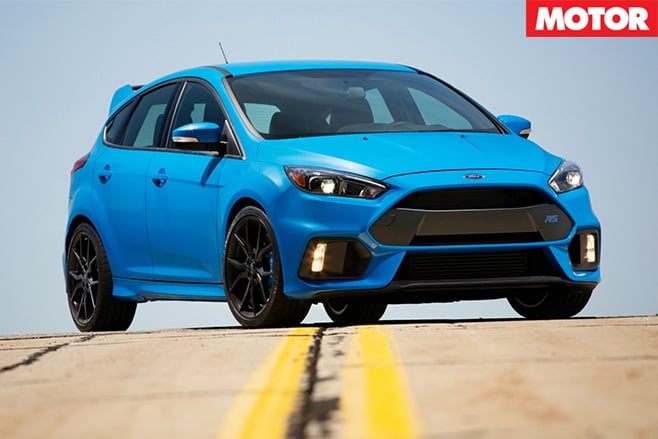
Arguably the Focus’s best trick, however, is the ease with which it can be driven hard; after only a handful of laps tyres are melting and brakes are smoking thanks to the confidence it gives to the driver. It’s maybe not quite as sharp as Renault’s Megane RS275 Trophy-R, but it’s faster and gives you more cornering options.
Continually sliding the car through corners can overheat the all-wheel drive system, but it quickly recovers and the rest of the car feels like it could go forever – or at least until it needs new tyres.
We’ll have to wait until the car arrives in Australia to see how to does against the stopwatch, but when it’s this much fun does it really matter?
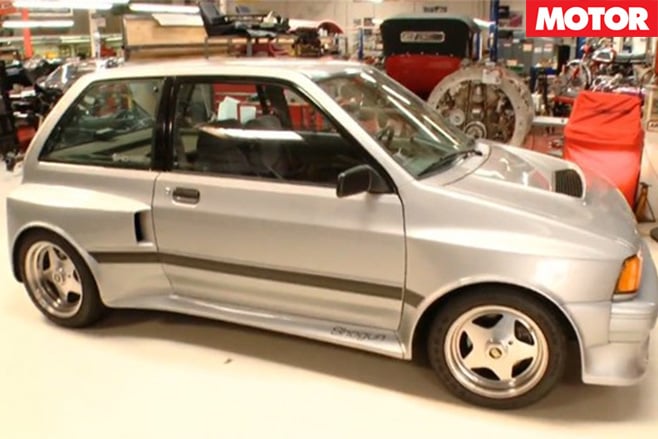
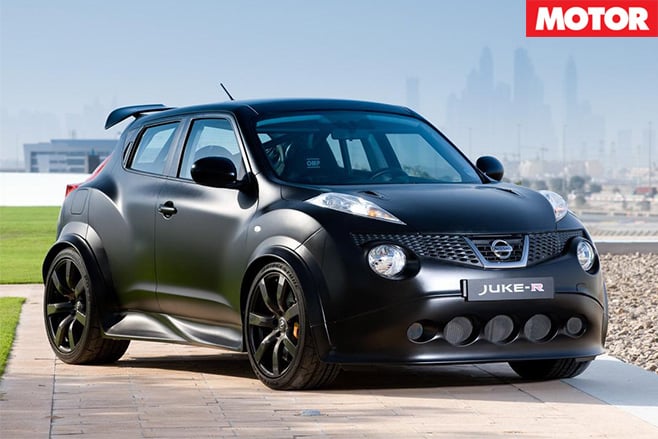
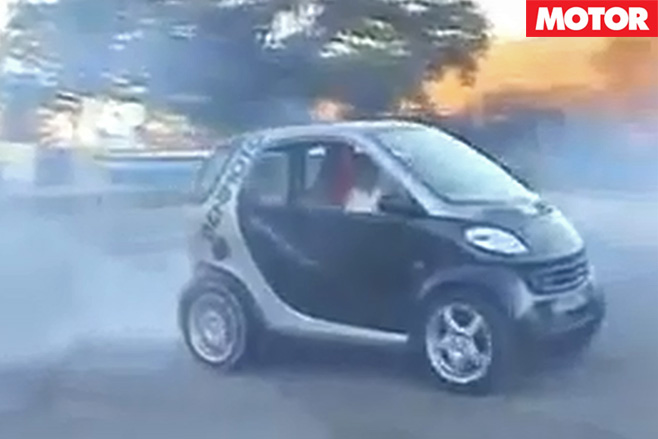
There’s something incredibly satisfying about shoehorning performance engines in cars they were never designed for. We pay tribute to nine truly mad creations.
1. Ford Festiva V6
2. Nissan Juke R
3. Renault Espace F1

4. Smart GSXR1000
5. Alfa 164 Procar
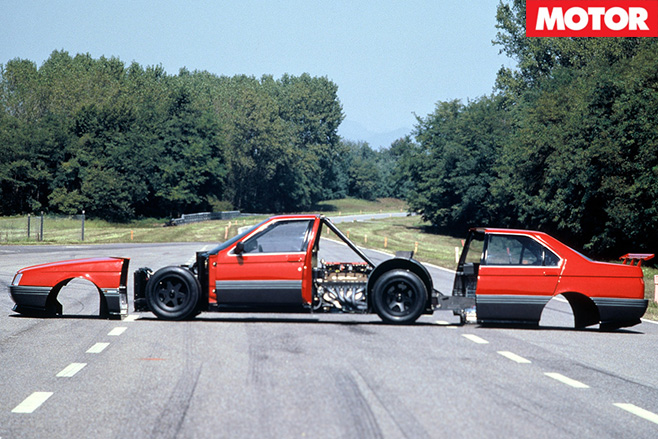
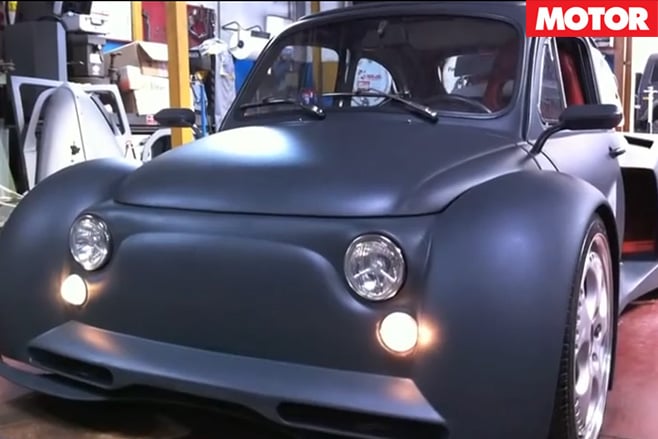
6. Oemmedi Meccanica Fiat 500 V12
7. BMW X5 LE MANS

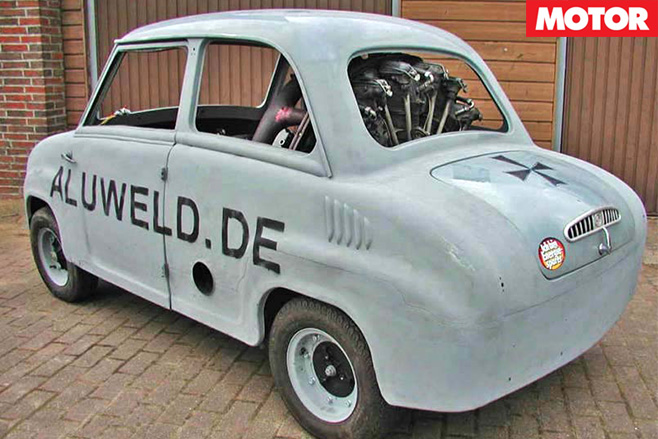
8. Radial engine-powered Goggomobil
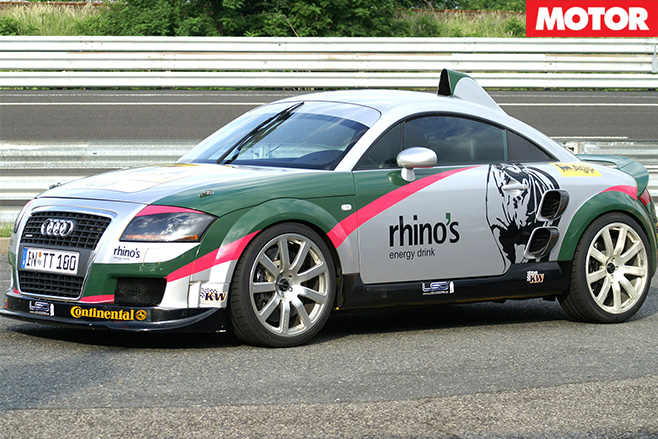
9. Audi TT Bimoto
So Audi’s thrown a driverless car around a track ‘at speed’.That’s cute.
And driverless child’s play, I expect, given the highly controlled conditions of a finely predetermined experiment. How about some random variables – a grid full of human racing opponents, say? Or, as a more real-world challenge, how about negotiating peak hour in Sydney ‘at commuting speed’?
Autonomous road cars are big noise in a long pipedream. There’s no short-term reality and that’s fine with me. Why? Too many stumbles in the baby steps. Besides, I don’t want two-tonnes of driverless calamity-in-waiting stumbling around where my loved ones dwell.
At least not until the concept is 101 percent failure-proof. Sure, we live with self-flying airliners, but they’re not skimming past one other, separated only by a white line. Sure, the automotive world’s brightest sparks can engineer self-manoeuvring vehicles.
The rudimentary stumbling block is the urban jungle. On evidence, the crucial data required for autonomous decision-making in public currently isn’t available with necessary accuracy or expediency.
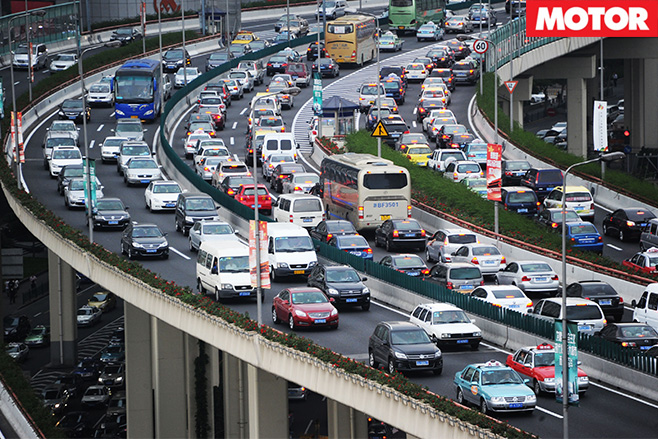
What evidence? Today’s road-going driver-assist and sat-nav systems are clever but far from flawless.
Look, creating an accurate world map is a monumental task for those who supply the entire automotive and information industries with The Database. Naturally, there’s lag between a road’s creation and the two-or-so sat-nav database updates a carmaker conducts per year. And that’s before it hits your vehicle.
This past year alone I’ve experienced sat-nav clunkers in new-release models from all German marques. Some hadn’t mapped the new-ish Mornington Peninsula extension, or the tram system that’s remodelled the Gold Coast. Another system thought every one-way street in Balmain flowed in the wrong direction. Speed advisory warnings? None I’ve seen are 100 per cent correct.
You or I can over-ride a sat-nav because it’s not guiding the car. In a driverless car, though, that database is crucial to the (ever-changing) world.

Again, this stuff isn’t flawless. Camera-based speed recognition proves glitchy time and again. Recently, I had one car inadvertently ‘read’ a 40km/h speed warning stickered on the rear of a bus. I’ve had myriad cars from different makers incorrectly trigger collision prevention braking or warnings through miscalculation. And don’t get me started on adaptive cruise control.
Clever tech needs a human failsafe. Human decision and judgment, often not in accordance with strict law, keeps the urban ebb and flow moving. But driverless cars governed by even the finest nu-tech would be an unpredictable, erratic and overly timid mess. Autonomous cars would have to maintain textbook legal manoeuvring with a fair margin for error. Throw that into peak-hour and you end up with driverless roadblocks or accidents.
Audi, Google and others’ testing on Californian and Nevada roads have forced pioneering legislation for public autonomous vehicle use. And it took about three minutes to collate conditions of use as follows.
A ‘passenger’ of a driverless vehicle must not sleep in the car – moving or stationary – must not be distracted by any outside stimulus and mustn’t be under adverse affect of alcohol or drugs. The precedent is for a human failsafe.
So guess what? No reading your iPad, or taking a kip in your driverless car. It won’t (legally) drive you home from a pub bender. Yes, all the convenience of autonomous driving is suddenly removed. You sit there, either bored or terrified, and guess what: you’ll want to drive the thing yourself. Or simply catch the bus.
THE updated Honda CR-V Series II scores a limited-edition turbo-diesel variant that’s all about its outstanding powertrain.
WHAT IS IT? A temporary replacement for the previous 2.2-litre i-DTEC CR-V turbo-diesel, with a fairly limited lifespan. Just 90 ‘limited edition’ CR-V Series II diesels will head Down Under in just one premium spec (the DTi-L), sourced from Honda’s UK factory rather than Thailand like petrol CR-Vs.
WHY WE’RE TESTING IT Not only because this Honda CR-V scores the carmaker’s excellent 1.6-litre ‘Earth Dreams’ turbo-diesel, featuring an all-new nine-speed automatic transmission, but because this is the drivetrain we’ll see debut in the slightly smaller, yet more accomplished, HR-V later in the year.
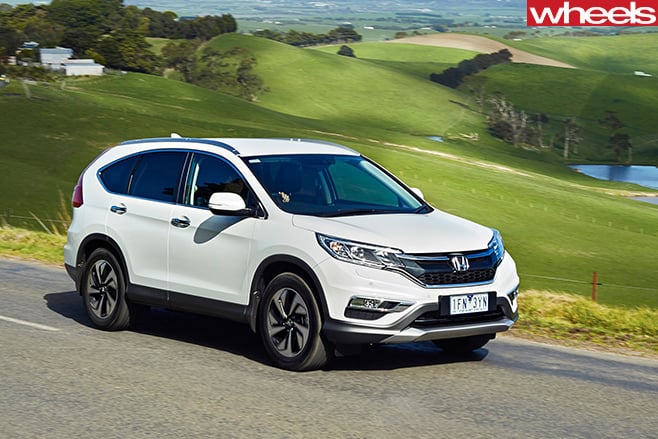
THE WHEELS VERDICT When Honda’s excellent new diesel drivetrain lobs in the slightly smaller HR-V later this year – in both six-speed manual and nine-speed automatic guises – it’ll be something to celebrate. In the meantime, while this DTi-L is far and away the most compelling variant in the CR-V line-up, its wooden steering, understeery handling and inconsistent ride continue to tarnish Honda’s once-unsurpassed reputation as Japan’s finest carmaker.
PLUS: Amazingly gutsy, refined and efficient small-capacity diesel; excellent nine-speed auto; nicely packaged MINUS: Low-geared, treacly and vague steering; heavy-footed ride; lacks handling poise
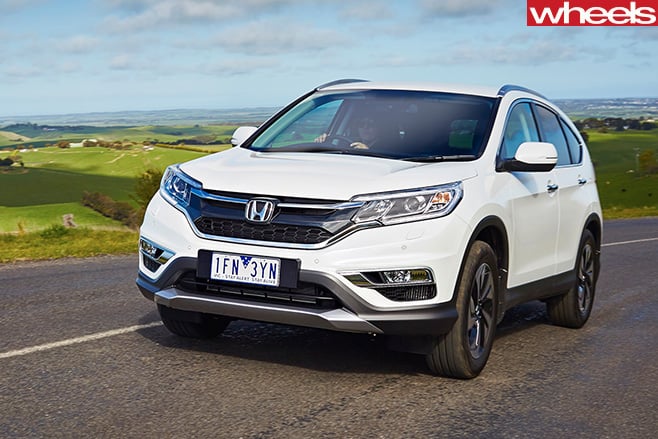
But things are changing, albeit slowly. Last year’s Series II update brought some much-needed though minor suspension and steering improvements to the current CR-V. But it’s the ‘limited edition’ turbo-diesel version that provides an encouraging glimpse of a brighter Honda future.
In showrooms from late September last year, the new CR-V diesel centres on the debut of a new ‘Earth Dreams’ 1.6-litre turbo-diesel four, replacing the previous 2.2-litre turbo-diesel.
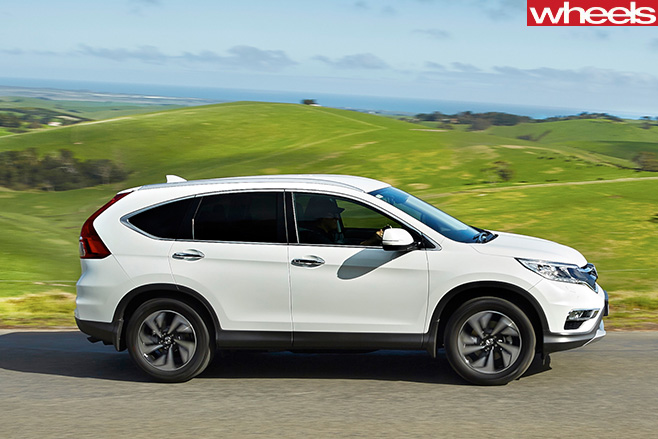
And even though the transmission possesses a seemingly ludicrous number of ratios, you’d never know. Smooth, intuitive and efficient, the nine-speeder gives the CR-V diesel a real kick off the line, as well as the legs to extract the greatest efficiency from highway running.
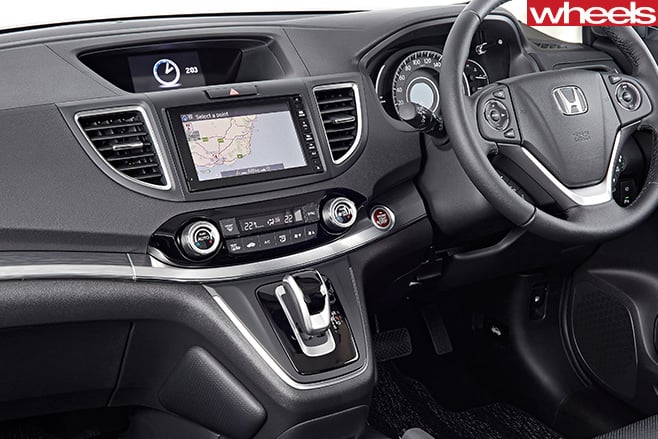
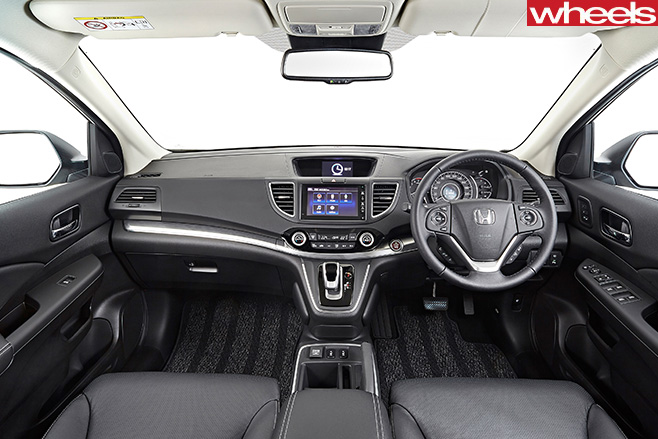
It’s a pity the diesel’s new space-age gear selector is such a fiddly, gimmicky and plasticky piece of tat. It’s like a hangover from a ’90s iMac; a classic case of form over function compared to a traditional, leather-topped lever.
The old CR-V’s nauseating ride is now less sickly, with improved body control and damping effectiveness. Yet the sense that the CR-V’s heavy wheels are out of phase with its suspension tune still exists.
So does its rather ponderous front end, which rolls more than the rear, detracting from its handling poise. You can provoke drive to the rear by braking the nose into a corner, then jumping on the gas and relishing the diesel drivetrain’s effortless corner-exit shove. But around town, the CR-V’s chassis still lacks cohesion.
Thankfully, the talent of its diesel drivetrain will resurface in the tastier HR-V later this year.
Model: Honda CR-V Series II DTi-L Engine: 1597cc 4cyl, dohc, 16v, turbo-diesel Max power: 118kW @ 4000rpm Max torque: 350Nm @ 2000rpm Transmission: 9-speed automatic Weight: 1754kg 0-100km/h: 10.2sec (claimed) Fuel economy: 5.9L/100km Price: $44,290 On sale: Now
Ford’s Focus RS is one of the most hotly anticipated cars of 2016. The pre-launch hype has seemingly been going forever, but after all the teasers and drip-fed information, we’ve finally driven it.
Traditionally, a review leaves the verdict until the end to build suspense, but in this case I’ll be up front. The new Focus RS is awesome, and instead I’m going to spend the rest of this review telling you why.
First, however, a refresher on the details. The third-generation Focus RS is the first to be built as a global model, and the first to receive all-wheel drive as standard. It arrives in Australia about mid-year priced at $50,990.
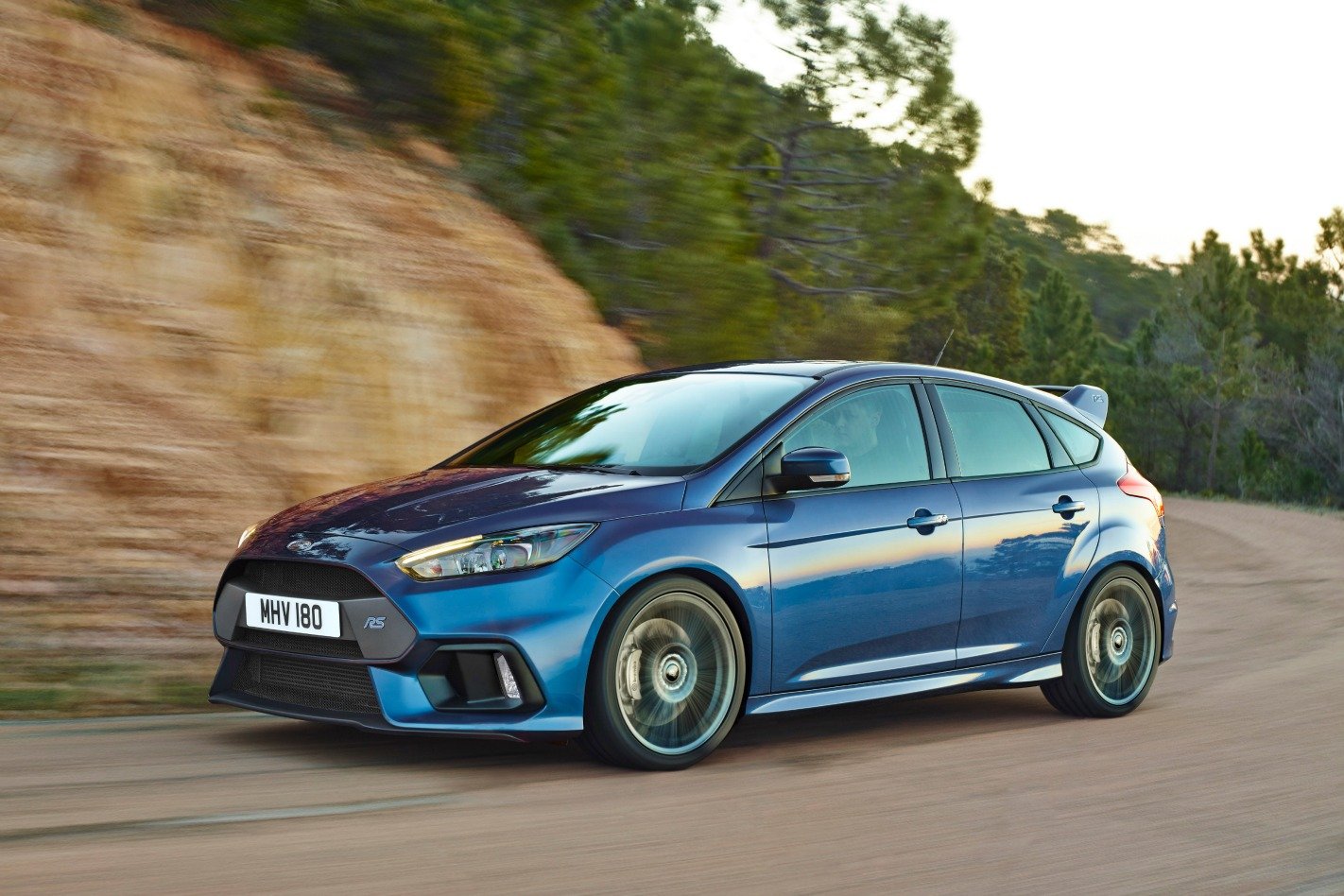
The noise it makes is a little synthetic, but it’ll be a long time before you tire of the cacophony of pops and bangs that escape the exhaust on gear changes and overrun; it sounds like a refugee from the World Rally Championship.
A six-speed manual is the only available gearbox and it’s a light and accurate shift with spot-on ratios. The engine’s powerband means you could just leave it in third gear but the ease with which you can heel-toe down the ’box means you’ll be changing for the hell of it.
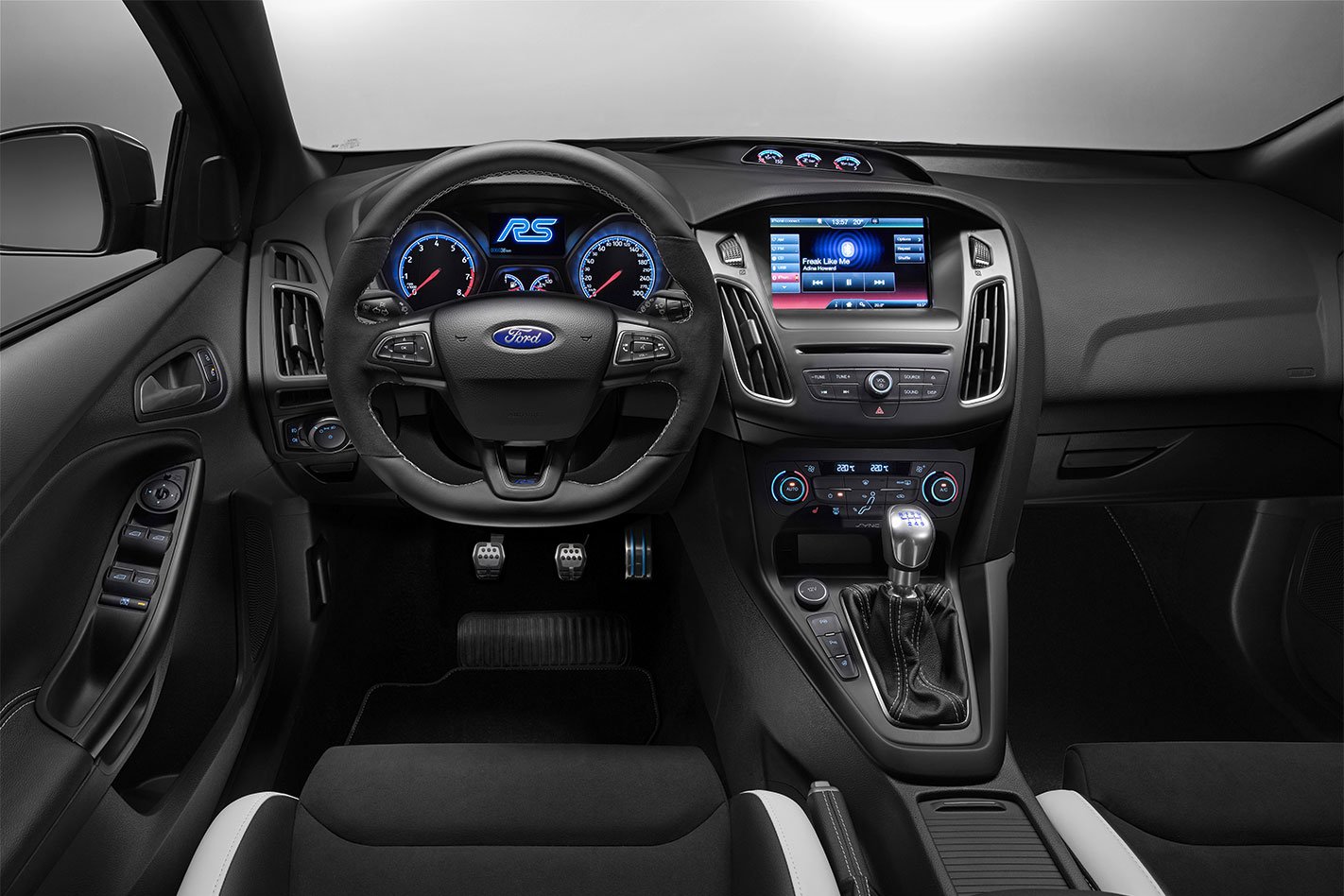
There’s also little to complain about with the driving experience – it is utterly magic. The steering is quick at just two turns lock-to-lock but never feels darty or nervous. It will occasionally tug at bumps or road camber but also feeds a delicious stream of information back to your hands.
Equally, the chassis is always talking to you about what’s going on. This is an exceptionally easy car to drive hard and more often than not feels well within its limits. It flows down a road beautifully, with all the various mechanical components displaying a Porsche-like sense of cohesion.
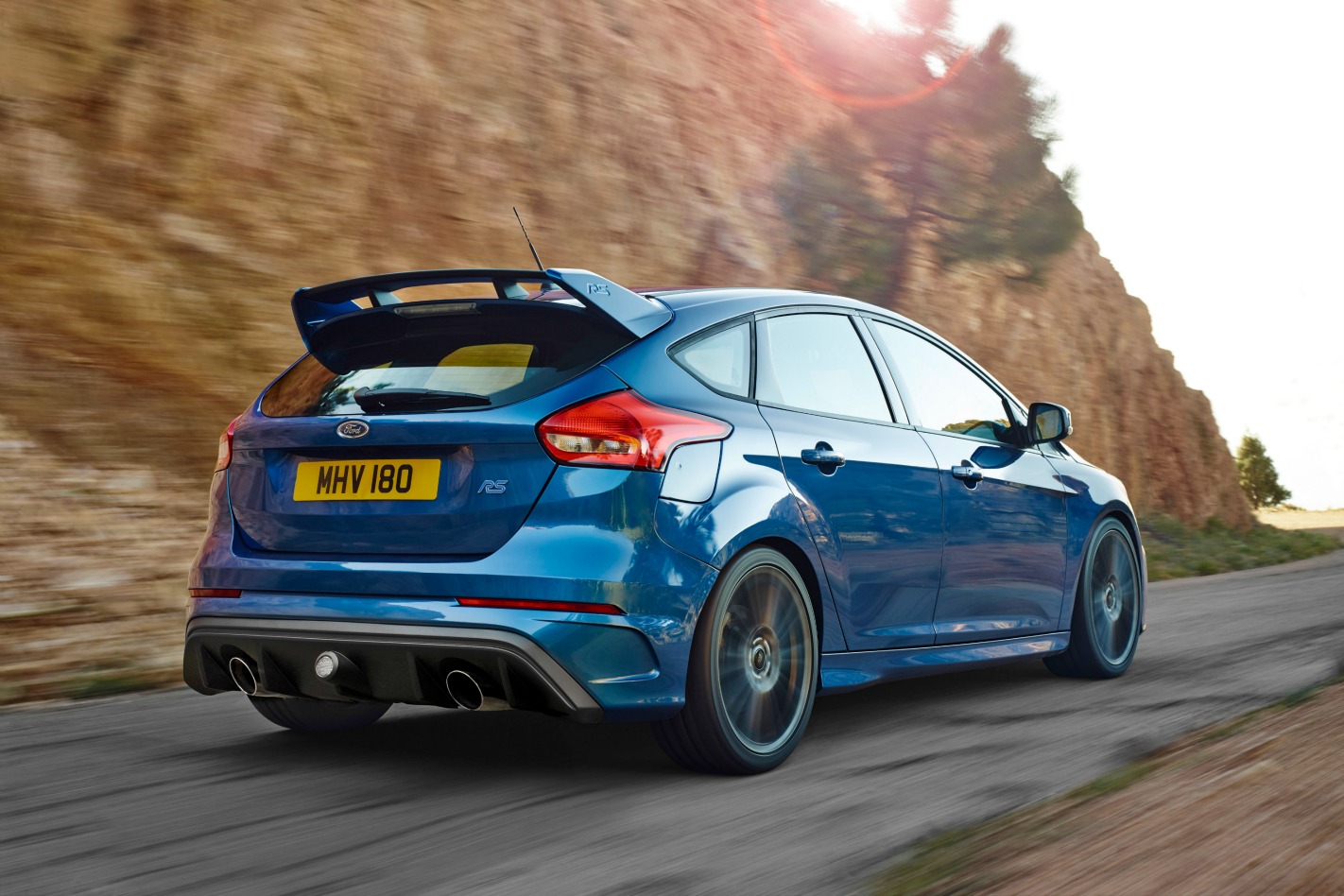
Find a slipperier surface than dry Spanish tarmac, however, and it gets even better. The nose slides gently on turn-in but give it a quick bootful mid-corner and the rear skips wide, even within the boundaries of the Sport ESP setting.
Essentially, the Focus RS has all the involvement and feedback of Renault’s RS275 Megane with the security and traction of a VW Golf R. Best of both worlds? It sure feels like it based on this brief early taste.
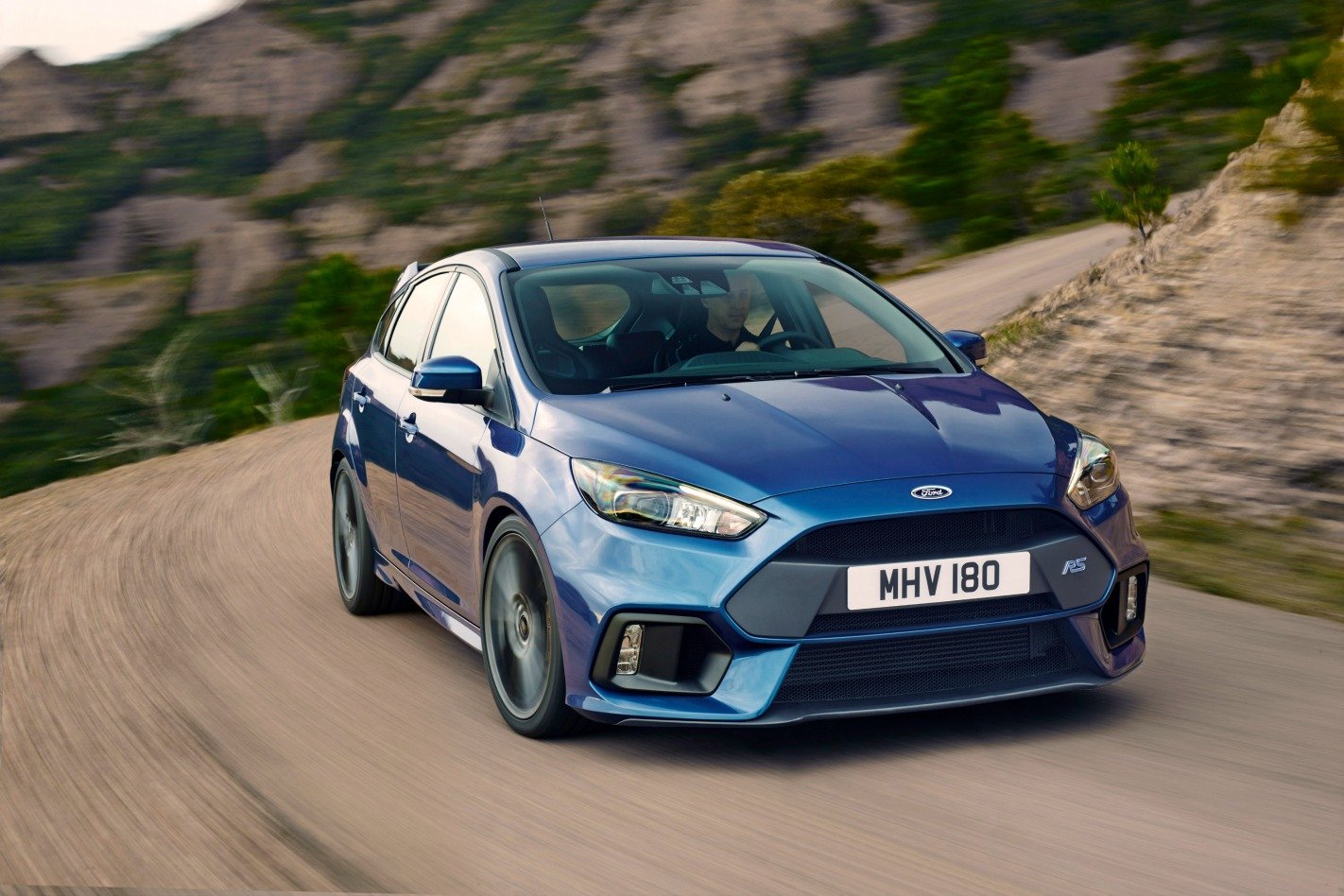
But that’s about it, and they seem like small bugbears given there is so much right in this car. A full verdict will have to wait until the car lands in Australia mid-year, but based on this first introduction the Focus RS is not just one of the best hot hatches around, but one of the best performance cars full stop.
4.5/5
Specifications
Engine: 2261cc inline-4, DOHC, 16v, turbo Power: 257kW @ 6000rpm Torque: 440Nm @ 2000-4500rpm (470Nm on overboost) Weight: 1575kg 0-100km/h: 4.7sec (claimed) Price: $50,990
SO, WHAT can we expect from Formula 1 in 2016? Quite a bit more of what we got in 2014 and 2015. Please not.
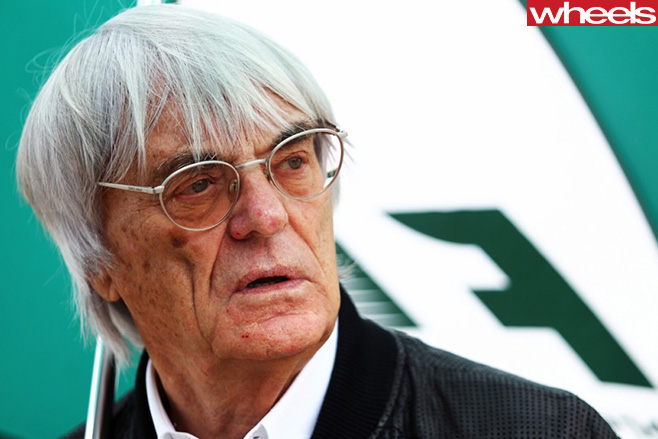
Surely with a mandate to fix the sport’s problems, Formula One commercial boss Bernie Ecclestone and Fédération Internationale de l’Automobile president Jean Todt – two great, if selfish and autocratic, minds – can produce smart solutions to bring back excitement and unpredictability.
We want grand prix drivers again left to their own devices to deal with 1000 horsepower in their mongrel machines, with lots of NOISE! We want the good guys to shine, using skill and daring to overtake rather than substitutes for talent such as technology and team tyre strategy. Tyres that turn to mush inside 10 laps are laughable as are a bevy of people in the pits calling the shots.
It’s obvious that passing in F1 is awkward due to the current aerodynamics creating a turbulent swirl behind the cars. Whenever a car gets close to the one ahead, it loses downforce and therefore grip. Game over. Tyres with more grip are part of the fix, along with an improvement in mechanical grip.

Meanwhile, there’s 2016. The Silver Arrows certainly go into the longest and biggest championship season ever as a strong fancy to extend Mercedes’s stunning championship-winning run.
It has a budget the size of Greece’s national debt, a technical superiority, an army of boffins and Lewis Hamilton and Nico Rosberg, the two drivers who dominated much of the past two seasons.
The F1 world championship will be chased down across 21 races over eight months, starting with the Australian Grand Prix at Albert Park on March 20, before climaxing under the lights at Abu Dhabi’s Yas Marina Circuit on November 27.
However, the calendar may reduce to 20 races – the FIA has only provisionally listed the US Grand Prix in Austin amid doubts about the event’s viability.
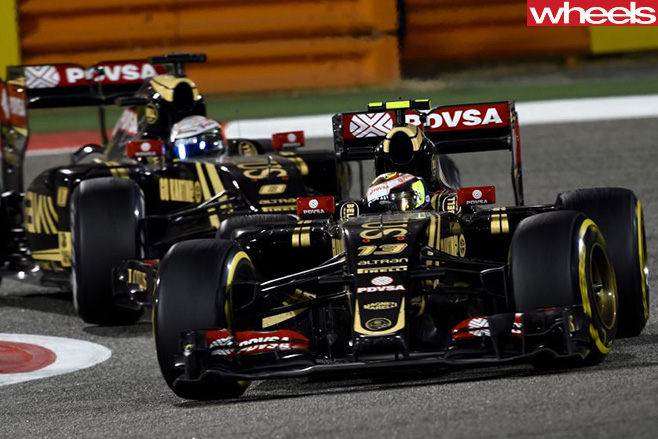
It seemed to go on forever, but the laborious process of Renault returning to Formula One with its own works team in 2016 was completed in December, with the French giant stepping up from its role as engine supplier to again operate its own works team, formerly known as Lotus.
Renault chairman and CEO Carlos Ghosn has been convinced that the company needed to better control its own destiny rather than play the role of engine provider to those energy drink ingrates from Austria.
Ghosn acknowledges F1 is a technological showcase with the capability of accelerating development of Renault’s innovation and range of sports cars. “Our ambition is to win – even if it will take some time.” He got that last bit right.
As a full team, Renault will take maximum benefit from its victories, should they happen. The payback as an engine supplier proved to be limited. Hugely negative even, when Red Bull turned on its partner.
Boosting the grid to 22 cars is the US’s Haas F1, the first American race team in the world championship since the unrelated Haas Lola outfit in the 1985-86 seasons. Haas F1’s chassis is being built by Dallara, with Ferrari supplying the power units. Former Jaguar and Red Bull Racing technical director Günther Steiner is the team principal. The team is based in the heart of NASCAR country in North Carolina alongside sister team and NASCAR Sprint Cup entrant Stewart-Haas Racing. Let’s hope the new F1 machine doesn’t roll out with carbies. Drivers for Haas are Romain Grosjean, who left Lotus to join the start-up team, and Ferrari test driver Esteban Gutiérrez.
The sad irony is that the new American F1 team bows at a time when the US Grand Prix is again in peril.
The whole circus continues to be about the haves and the have nots.
Mercedes conditionally shares elements of its success – primarily its hybrid V6 power units. But only to teams it senses are incapable of threatening the reign of the Silver Arrows. So Williams and Force India in 2015, while Marussia will switch to the Mercs after agreeing to a multi-year deal with the German manufacturer. No Mercedes-powered Red Bulls, though. The Germans said “nein”, concerned about the possibility of the works cars being embarrassed by the combo of best engine and arguably best chassis on the grid…
This impasse left Red Bull scurrying back to Renault to retrieve a partnership that had looked to be in tatters. Out of train wreck of a relationship emerged an interesting arrangement: whilst operating its own F1 team, Renault would continue to supply Red Bull with its hybrid V6 power unit developed in a bigger, bolder partnership with engine technology company Ilmor.
The two worked together this season as pressure increased on Renault to match the performance of Mercedes and Ferrari.
Now, for 2016, those ties have been further strengthened.
One major difference with the Red Bull engine is that its 2016 power unit will be branded as the work of timepiece maker TAG Heuer.
Any way we look at the new deal, Renault/Ilmor/Red Bull will be hard pressed to rediscover their winning ways in 2016. Patience, Daniel, patience…
Oh, and the Bull’s baby team, Toro Rosso, meanwhile, has linked with Maranello, to use the superseded 2015 Ferrari engine. Like Haas.
So, Mr Horner, what happens should Toro Rosso-Ferrari outperform Red Bull-Tag Heuer nee Renault…?
This prospect hasn’t excited the British media anywhere near as much as speculation that the enmity between the warring Hamilton and Rosberg has reached such a poisonous stage that the Mercedes brains trust is contemplating giving one the boot.
This beggars belief. Firstly, between them they won 15 races during 2015. Secondly, Hamilton and Rosberg are comparative pussies compared with other unhappy teammates of the past.
Still, Toto Wolff, the head of Mercedes Motorsport and a darling of the F1 media, has hinted that the tension between his drivers has infected the team to a degree that the atmosphere there is difficult to deal with.
“We struggle sometimes in winning races on Sunday and having always one [driver] upset, and this spills over into the team. It is something that needs to stop,” Wolff told the Motorsport.com website.
Wolff says that having two evenly matched drivers had helped propel the team ahead, but that the human side is important, too.
“We want to work with nice guys,” Wolff insists. Cheeesuss, he’d better get out of F1 then.
Here’s how former world champion Jacques Villeneuve viewed the ragged relationship between the Merc drivers: “Maybe losing the world championship to Lewis in the US GP changed him (Rosberg) psychologically. I don’t know. But after that he was a killer. And Lewis reacted really badly and revealed a very negative side of his character.
“He showed that he cannot be humble. He has won three world championships but he could not be happy, behaving like a spoiled child who lost his toy. He has not behaved like a great champion.”
The future? Who knows? Rosberg’s deal ends in late 2016. In his favour is that he is German. Hamilton has just signed a three-year extension, but contracts can be broken should the atmosphere at Mercedes prove too toxic. Hamilton can be disruptive and demanding but is smart enough to know where his best chances are of more championships. But his rampant ego and self-belief would also be propelling him to a scenario where he could show his sheer genius by potentially winning a title with a third team. Hamilton at Ferrari when Kimi Raikkonen slides off into the Midnight Sun-set?
Off-track dramas beaten up by a bored media between seasons are boring! Wake me when it’s over and pre-season testing fires up in late January at Paul Ricard, where the track will be drenched with water for some sessions. Please also direct the sprinklers at the press box.
2016 PRE-SEASON TEST SCHEDULE
T1: January 25-26, Paul Ricard (Wet-weather running) T2: February 22-25, Barcelona T3: March 1-4, Barcelona
2016 FORMULA 1 CALENDAR
R1: March 20, Australia (Albert Park) R2: April 3, Bahrain (Sakhir) R3: April 17, China (Shanghai) R4: May 1, Russia (Sochi) R5: May 15, Spain (Catalunya) R6: May 29, Monaco (Monte-Carlo) R7: June 12, Canada (Montreal) R8: June 19, Azerbaijan (Baku) R9: July 3, Austria (Red Bull Ring) R10: July 10, Britain (Silverstone) R11: July 24, Hungary (Hungaroring) R12: July 31, Germany (Hockenheim) R13: August 28, Belgium (Spa-Francorchamps) R14: September 4, Italy (Monza) R15: September 18, Singapore (Marina Bay) R16: October 2, Malaysia (Sepang) R17: October 9, Japan (Suzuka) R18: October 23, USA (Circuit of the Americas) * R19: October 30, Mexico (Hermanos Rodriguez) R20: November 13, Brazil (Interlagos) R21: November 27, Abu Dhabi (Yas Marina)
* subject to agreement with the promoter and the ASN
How do the first proper right-hand drive Mustangs hold up in Oz? And should you join the queue to ride home in one?
WHAT IS IT? The first US-factory-built right-hand-drive iteration of Ford’s iconic pony car. It has a nameplate that’s been in constant production since 1964, but only previously had two official Australian releases in 52 years. Now, after high anticipation, the all-new generation is finally here in Oz after delays relating to the supply of right-hand drive specific manifolds.
WHY ARE WE TESTING IT? It’s our first chance to properly assess this all-important halo car for Ford in Australian spec, on Aussie roads, and to find out how successful the product planners have been in delivering a cohesive line-up of body styles, engine choices and transmission pairings. And to make a value call.
PLUS: Knockout styling; generous grip; fine dynamics; sane pricing MINUS: Very firm ride, Convertible not ultra-rigid, both engines need to be louder
THE WHEELS REVIEW THE only potential problem with a growing wave of anticipation and expectation is the chance it can crash against the rocks of reality, leaving a trail of disappointment and a forlorn chorus of “is that it?”
Few cars have risked this as much as the new Mustang: it’s been one of the most hyped and anticipated cars in recent years. We’ve cheerfully been a part of that, deeming it cover-worthy on three occasions since January 2014, and devoting some 27 pages to it over the same period.
But is it brilliant? A true Blue Oval game changer? Well, let’s not get ahead of ourselves…
We learned from Road Test Editor Nathan Ponchard’s Stateside drive late in 2014 that it’s a car brimming with character and the kind of desirability that only comes when you’ve officially hit icon status. What wasn’t completely clear was how specifics of suspension tune, wheel and tyre combinations and right-hook configuration would translate to Aussie roads. Finally we have those answers.
But first, have a look at the thing. Seriously. If the way to a man’s heart is through his stomach, then surely the thoroughfare to a car enthusiast’s main aorta is via the eyeballs. A performance car needs to seduce you visually before it charms the pants off you with dynamic prowess.
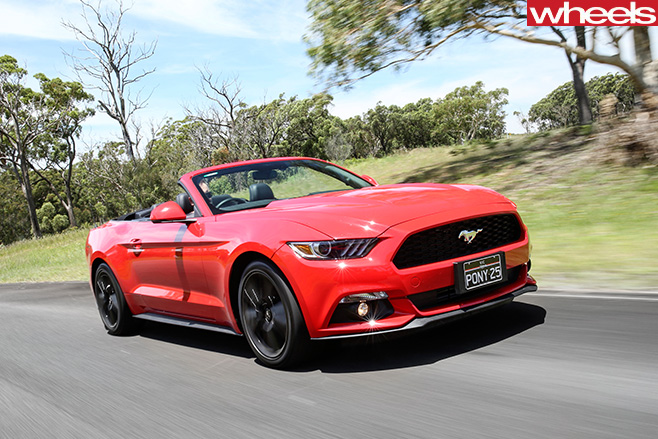
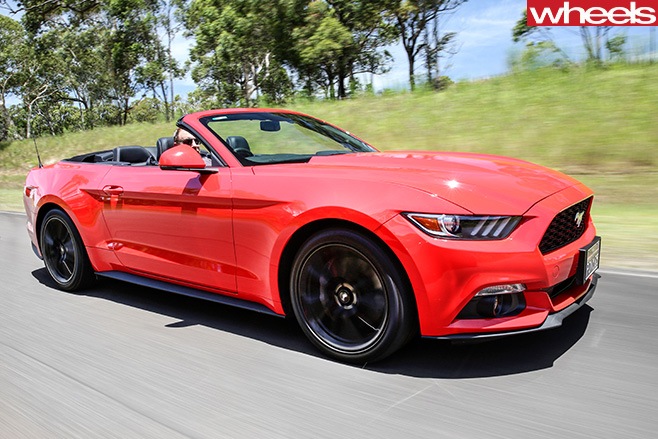
On this score, the Mustang lands a direct hit. This is a brilliant reinterpretation of the original’s design language – a squinty-eyed, bulging-haunched head kicker that creates a sweet harmony out of tension and aggression. The artful sculpting of the bonnet bulge is a thing to behold, both as you approach the driver’s door and from inside the car. The taillights, comprising vertical LED bars inside slotted Perspex blades, are a gorgeous nod to the ’68 Fastback coupe. Punters honk, wave and shout approval. That’s life in the icon lane.
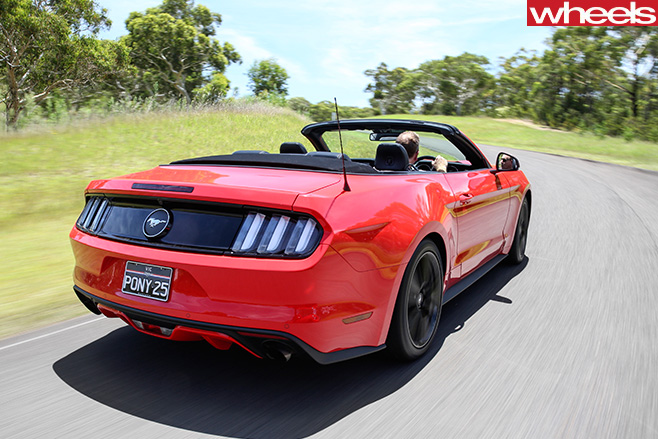
Roof up, the Convertible loses the elegant roofline sweep of the coupe, serving up more of a notch-back profile that, to my eye, is a lot less desirable.
In the interests of working up the range, we start off in what I’d respectfully suggest is the least blokey variant, an auto convertible powered by the engine expected to take only around 10 percent of initial sales, the 2.3-litre Ford Mustang Ecoboost four. Fed by a twin-scroll turbo, it makes a peak of 233kW, with max torque of 432Nm at 3000rpm. But 90 percent of this torque peak is available at just 1720rpm, so it’s terrifically eager, not too boosty-feeling if you select the Normal drive mode, and doesn’t shy from being worked hard.
In fact, it needs to be whipped along to let you get you involved. Below around 4500rpm, it’s too quiet and a bit characterless, despite the (questionable) inclusion of a sound symposer set-up that pipes engine noise through the audio speakers. Pull the shifter back into the Sport mode and get stuck in and there’s ample enjoyment to be had, with the auto holding the lower of its six ratios right up against the 7000rpm limiter and ample, rorty, sound filling the cabin. It’s a curious note, not typically turbo four-pot. It’s more warbly and slightly out of phase, like someone’s dangled a mic near something with Cosworth on the cam covers.
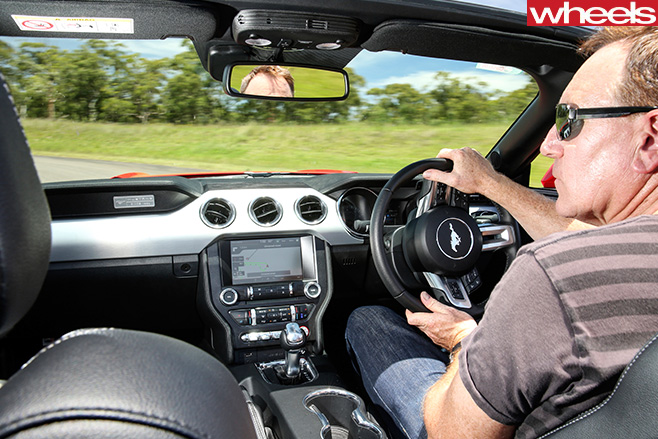
It should be explained at this point that all Australian-spec cars come standard with a variation of the optional Performance Pack offered in the US, part of which includes stiffer springs, firmer dampers and thicker anti-roll bars. This seems questionable on the Convertible, given the target market, because this combo surely contributes to the slightly too-reactive ride, along with the steady flow of minor tremors that ripple through the body and see the rear-view mirror quivering away busily over anything less than glassy bitumen.
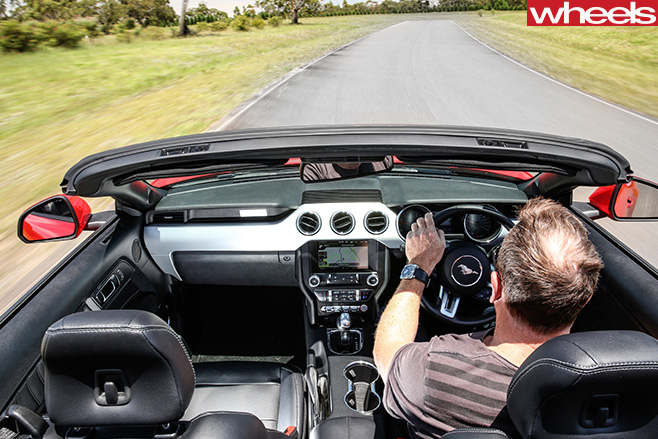
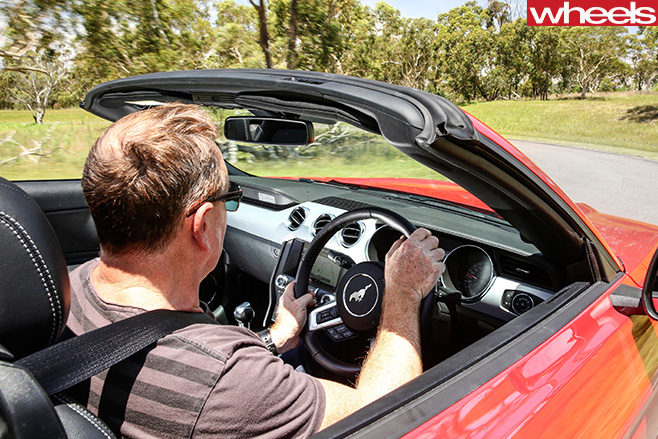
Open-road cruising is perfectly pleasant, though, even if the absence of any wind-management system does mean a fair degree of swirling, disturbed air in the cabin at freeway speed. Cruise mode also allows our attention to be drawn to a few misses in the right-hook cabin execution. The indicator stalk is on the right-hand side but the centre console remains unchanged, meaning the handbrake is located next to the passenger, and the deep bottle holders leave your beverages sticking up right where your arm needs to be to change gears in manual models. Better to drink in the mostly agreeable retro ambiance, admire the real aluminium that clads the instrument panel, and try to ignore some of the cheaper switch gear and hard plastics.
The throttle tips in with total precision, the V8 snarls via proper induction ducting piped from behind the dash, not the aural smoke and mirrors of the four-pot, and the medium-weighted clutch bites with mush-free progression. Only an excess of driveline shunt mars the manual experience. There’s a dull thud with each first-to-second shift that sounds like fat man being kicked in the bum, which could get tiresome in traffic. The shift action has a nice mechanical feel; the gates themselves are tightly spaced. And what a pleasure to be connected to a linear, eager, atmo V8.
The manual coupe’s 0-100 time is nothing to sneeze at, but on the road the performance feels swift rather than holy-crap fast. That’s more a product of the twin-turbo grunt-monster world in which we now live than any real shortcoming of the V8, although its quoted outputs are down a bit compared to LHD cars (largely a matter of divergent measuring standards). The important thing is there’s ample power to get the most out of a cracking chassis.
Front brakes on the GT Fastback are whopper Brembos clamped by six-piston calipers, and while the initial pedal action feels too sensitive and over-servoed, they bite hard and feel capable of withstanding a proper pounding.
So, for many customers, an auto four-pot convertible at $54,990 could be all the Mustang they really need, even if it may not be the Mustang they really want. The entry-level manual Ecoboost Fastback, at $45,990, is really just dangled as showroom bait, while the value equation of the V8 Convertible (auto only at $66,490) starts to head south. That leaves the choice between GT Fastback manual ($57,490) and GT Fastback auto ($59,990).
Either way, expect that wave to be one of delight, not disappointment.
SPECS Model: Ford Mustang GT Fastback Engine: 4951cc V8 (90), dohc, 32v Max Power: 306kW @ 6500rpm Max Torque: 530Nm @4250rpm Transmission: 6-speed automatic Kerb weight: 1747kg 0-100km/h: 4.8sec (claimed) Fuel economy: 12.6 L/100km Price: $59,990 On sale: Now
If you had access to a Ferrari F40, we suspect you wouldn’t risk the privilege by throwing it very sideways across a British farm.
Or, maybe, you would? That’s the question TaxTheRich asks again in its newly released ‘Farmkhana’ video.
Featuring a Ferrari F40, a gymkhana course, and two rear tyres the driver highly dislikes, ‘Farmkhana’ at once lives out your fantasies and deepest fears – wringing the neck of a Ferrari legend without kid gloves.
TaxTheRich have a reputation for irreverently thrashing priceless exotics. They’ve before drifted Enzos, rallied a Rolls Royce on an empty estate, and barbequed a Jaguar XJ220’s rear tyres.
It’s an iconoclast statement: screw appreciation, why not drive these things as intended? But for every one person prescribed to that train of thought, there’s another wincing and shaking their fist.
How they gain access to these cars and properties is reportedly through high profile, and obviously very generous, contacts.
As a result the team have amassed more than 150,000 YouTube subscribers and millions of views.
While controversial, there’s no denying this video’s a cracking watch. So go on, watch this F40’s 2.9-litre twin-turbo V8 repeatedly hammer its redline, even if it’s from behind the hands on your face.
From a list of 10 of 2015’s most stylish cars to just four finalists picked by an online poll, the WhichCar Style Awards celebrate all things beautiful in the automotive world.
2016 WhichCar Style Award Finalists
- Land Rover Discovery Sport
- Jaguar XE
- Holden Cascada
- Alfa Romeo 4C
2016 WhichCar Style Award Judges
- Paul Beranger – Former Corporate Manager of Design and Style at Toyota Style Australia
- Deb Bibby – Editor of Real Living magazine
- Tanya Buchanan – Editor of Belle magazine
- Anna Kantilaftas – Lifestyle Editor of WhichCar.com.au
- Michael Pickering – Editor of Men’s Style magazine.
