
America’s newest V10 supercar revealed at the Detroit Show is one Aston Martin didn’t want anyone to see.
Called the Force 1, it’s been lobbed by VLF Automotive, a brand new American luxury car manufacturer owned by Gilbert Villareal, former GM Vice Chairman Bob Lutz, and importantly, designer Henrik Fisker.
Fisker’s design nous has been employed by Aston Martin in the past, which might explain why – as Automotive News reports – he last week sued the British automaker for trying to veto the Force 1’s reveal.
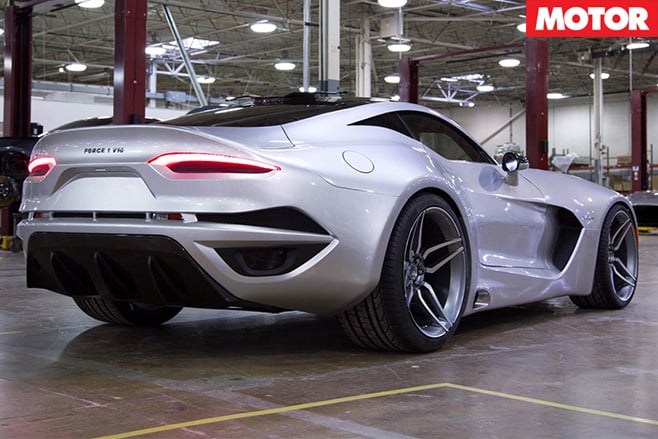
The two-seat coupe’s popular Detroit Show appearance proves Aston Martin wasn’t too successful with such allegations. And we’re glad, because the Force 1 sounds wonderfully unhinged.
With a Dodge Viper lurking under its bodywork, the original 8.4-litre V10 has been massaged to produce 555kW. That’s 80kW more than the stock car.
Either way, we’re hearing 97km/h disappears in three seconds before the Force 1 charges on to a 351km/h top speed.
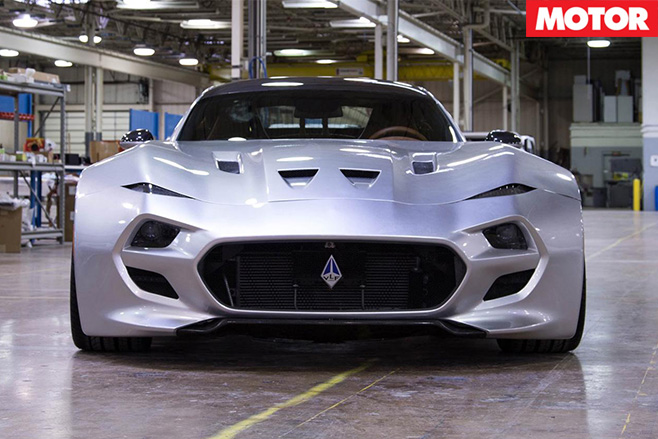
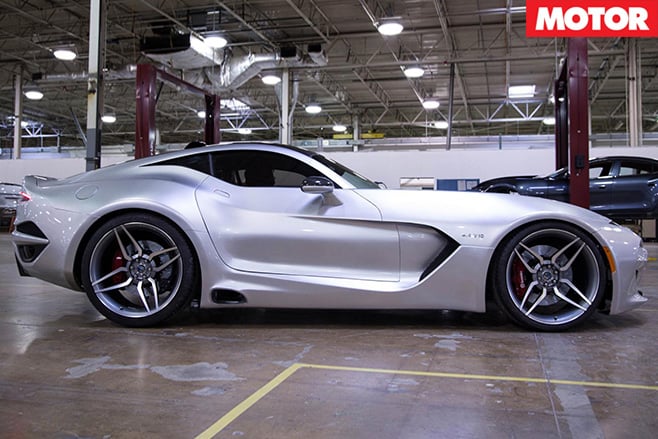
Then there’s its design. You can judge for yourself whether any Aston Martin hides in the bodywork. But there’s no denying its presence.
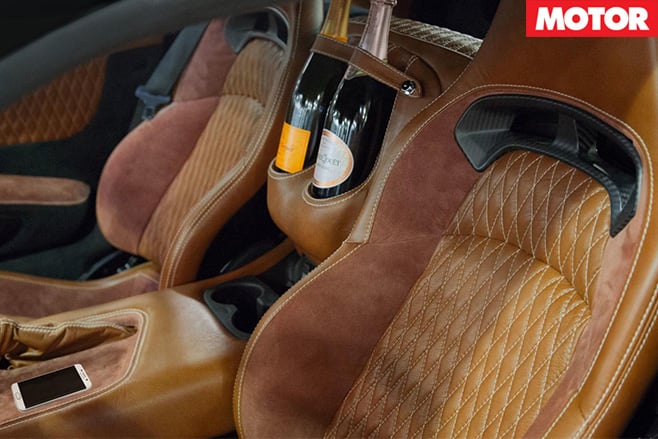
Abound with leather and suede, the interior makes the biggest statement about the car’s upmarket ambitions with champagne bottle holders that feature between the front seats.
The Force 1 will be priced at US$268,500 and go on sale this May.
Mercedes-AMG has revealed what is the most powerful S-Class cabriolet ever at the Detroit Motor Show overnight.
Employing the work of the company’s ubiquitous 6.0-litre twin-turbo V12, the new S65 chop-top makes 463kW and a colossal 1001Nm.
That’s enough torque to twist the most powerful bygone S-Class Cabriolet, the 1969 300SE, in to a fusilli stick.
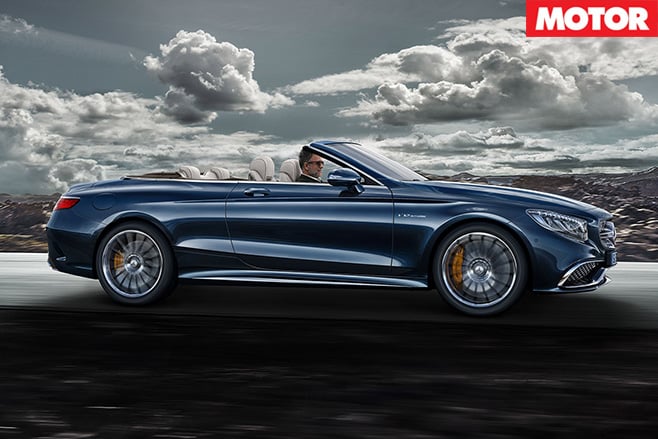
The AMG driver’s package, standard on US vehicles, will raise that limit to 299km/h. A ceiling it could easily surpass.
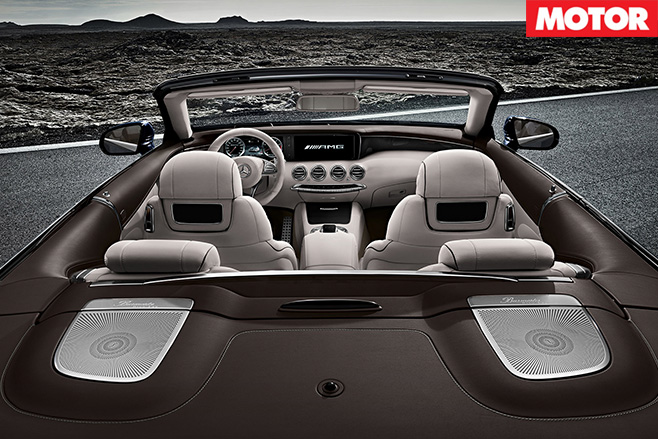
Chrome lathers its front badge, side flics, front splitter and front grille. “V12 Biturbo” also features on its wings, and high-sheen ceramic wheels under its guards.
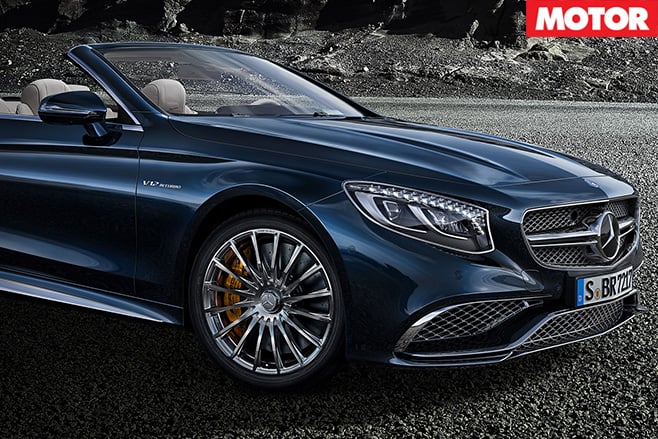
The AMG S65 will launch in the US this June, but expect to see it land in Australia for more than the S65 AMG Coupe’s $498,610.
So, what is it?
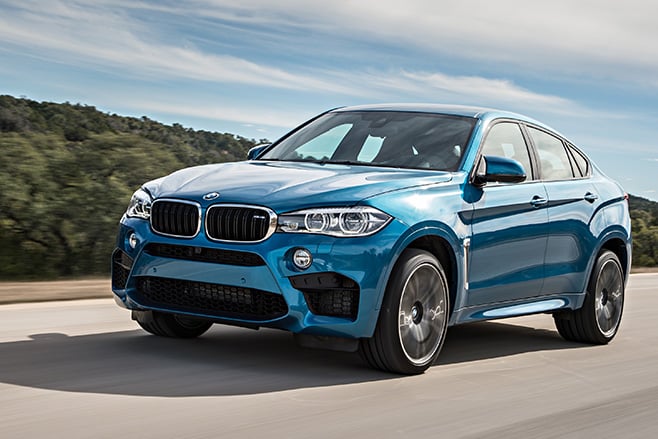
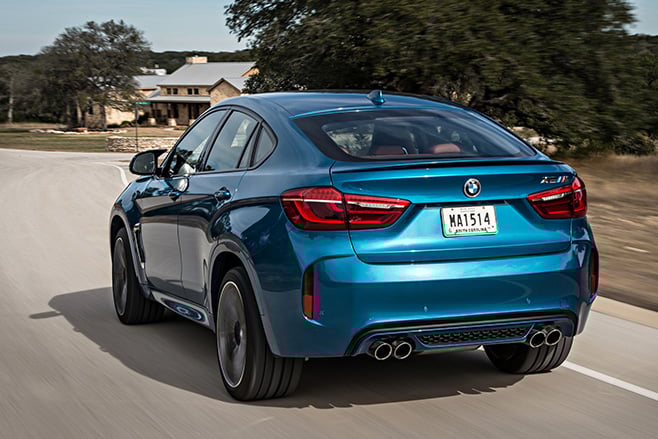
It’s a confusing but glorious 2.3 tonne SUV coupe thing with a 0-100km/h time of just 4.2 seconds. That’s thanks to a 4.4-litre twin-turbo V8 burping out 423kW and 750Nm. Does that make sense? Not exactly. But the previous generation arrived with an equally schizophrenic sense of purpose in 2009. Six years later, the world’s SUV lust having continued unabated, our hunger for ‘glorious but pointless’ might finally have caught up. It’s insanely quick.
Why should I care?
Because while even 18 months ago, before the much smaller likes of the Porsche Macan and Merc GLA45 proved their dynamic chops, launching an SUV at a racetrack – let alone Texas’s F1-hosting Circuit of the Americas – would have been a bluntly terrible idea. In fact, German touring car champion Marco Wittman mentioned this pre-drive in Austin. “I was not sure if this was a good idea,” he said, his torso all bedecked in M livery, “but now this is my favourite M car.” Oh, Marco! You’re a liar, or you’re odd. Even so, that’s a huge vote of confidence.
What’s new about it?
Lots. Power and torque bumps are reasonably modest (4 per cent) and reasonably impressive (10 per cent) respectively. Despite earlier reports, over 90 per cent of the twin-scroll V8 – the gruntiest BMW has ever shoehorned into an AWD car – is new. No fewer than 10 radiators are required to keep it cool. There are two new cogs in the slick 8-speed ’box, new compound brakes with sexy, blue, shoebox-sized calipers and a soundtrack that suits SUVs like The Amity Affliction suits a Country Women’s Association bake sale.
That’s all fine. What’s it like to drive fast?
Surprisingly lithe, if not delicate. With the suspension settings ratcheted to Sport mode it hides its weight like most Tinder headshots, creating the slightly dissonant sensation of a high seating position matched to minimal body roll. Those twin scroll turbos, cradled in the V8’s ‘vee’, are gratifyingly free of lag, and with the DSC disabled, the X6 M will even acquiesce to a spot of cheerful drifting. In essence, it drives like a lighter, lower car, all grip and noise – at least until those anchors, despite all discs being perforated and vented, start to be overwhelmed after four or five full-tilt laps.
And driving from home to the office in the city?
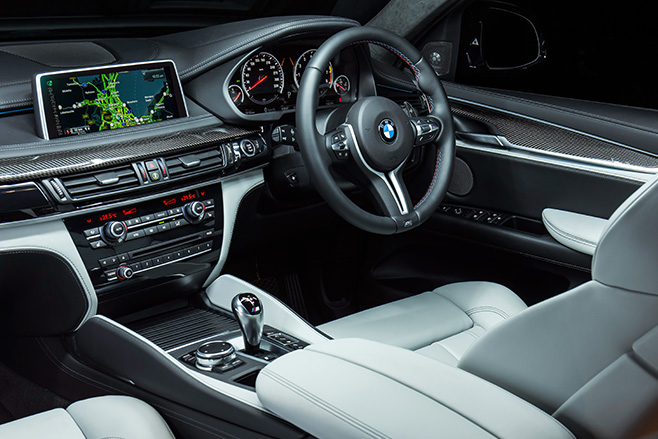
Dandy. The ride is significantly firmer than the base X6, but like the engine note, that’s par for the course with M vehicles. Really, it’s fine over real-world potholes, even on the optional 21-inch low-profiles. The rear seat is spacious enough, although made claustrophobic by its stretched, coupe-esque C-pillar. It’s awash with buttery leather, Alcantara and carbon. The boot is a not-bad 580 litres.
Is there anything bad about it?
Critics will say the X6 M is neither here nor there, and they’re right. It’s impressive how athletic M’s fairy dust has rendered a 2.3 tonne, 4.9m, five-door SUV… even if you’re nagged by the thought that their time is best spent elsewhere. This ain’t obese, but it’s a beast. And its looks could polarise.
How much would I have to pay for one? And is it worth the coin?
The X6M is $194,700, which is almost $40k below the Cayenne Turbo. The porkiest Porker has less power, equal torque, perhaps a pinch more prestige.
Would you take the X6 M or a Cayenne Turbo, then?
The X6 M looks much better, steers almost as well and is an equally perplexing mishmash of purposes. Both are colossal and luxurious. The M might shade it.
Click here to find out more about the BMW X6 M.
IT MIGHT be one of the current exhaust note kings, but AMG is considering a future where its cars will make no noise at all. The reason will be electrification, with AMG chief executive Tobias Moers revealing he sees a future where AMG models are pure electric.
“Absolutely,” he said when quizzed by Wheels. “We can’t change the future and we have to be ready to bring the brand into it, so it [electrification] is necessary.”
AMG is already investing in electric models and researching heavily into electric drivetrains that could manifest in a number of different forms.
“Electrification makes more sense to me than performance diesels,” he said. “We are looking at everything from plug-in hybrids to pure electric and electric turbos because we are not in position to exclude something from our portfolio. So we’ll do work on several programs at once to find our own path on electrification for the future.”

“Sound is crucial to AMG, so as for the sound we will find a solution,” he said. “We found one with the SLS Electric Drive and we know it’s important.”
The 552kW SLS AMG Electric Drive, which in 2013 claimed the title as the world’s fastest production electric car with a 0-100km/h sprint of 3.9sec, pumped artificial noise into the cabin during acceleration via its audio system.
While AMG sees a future in electric drivetrains, the same can’t be said of its mighty V12. Moers revealed AMG’s iconic 6.0-litre twin-turbo V12 is under threat due to ever-tightening emission laws.
Moers said recent changes to China’s emissions rules have placed the V12’s future in jeopardy.
“That’s giving us a big headache with the V12, so it’s a question of how we proceed. That’s what we’re discussing in the company now.”
That’s despite Aston Martin using the Detroit motor show to confirm production of a 5.2-litre V12 engine for its upcoming DB11, with AMG’s parent compamy Daimler owning five-percent of the British sports car brand.
Production of the hand-built V12 engine will switch to a new production line in Mannheim, Germany, next month after AMG’s facilities at Affalterbach were re-organised to cope with increasing demand. Many of the V12 engineers are now working on V8 powerplants instead.
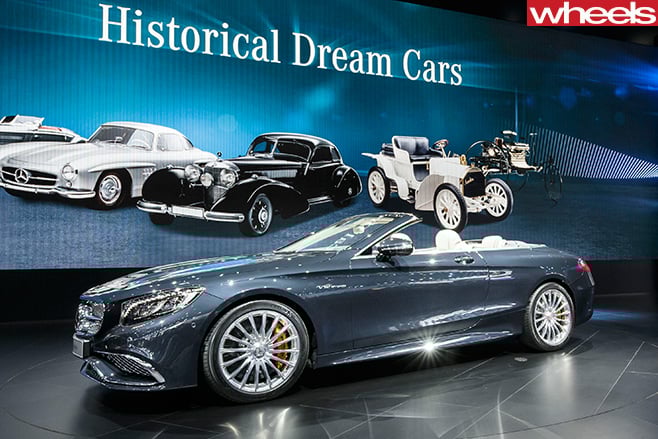
AMG used the Detroit Motor Show to unveil its latest V12 model, the Mercedes-AMG S65 Cabriolet that produces 463kW/1000Nm.
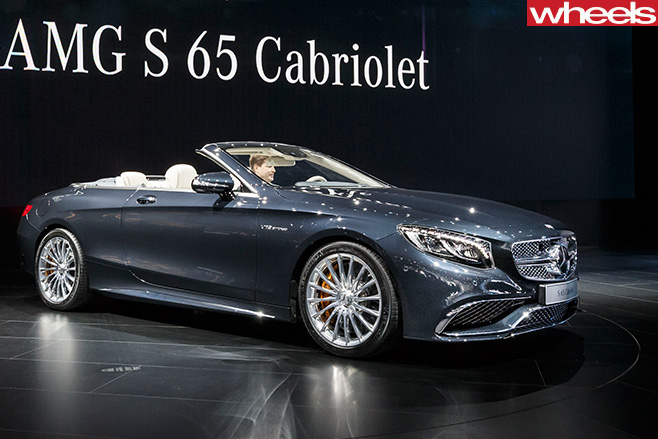
It won’t be the only ultra-exclusive Mercedes to hit our shores, with Mercedes-Benz Australia confirming it has secured five examples of the limited-run AMG S63 Cabrio “Edition 130”, also shown at Detroit.
Built to celebrate the marque’s 130th anniversary, the special S63 Cabrio is limited to 130 cars worldwide and features unique interior and exterior design treatments. Its 5.5-litre V8 produces 430kW/900Nm and it, too, should cost around the $450,000 mark when it arrives later this year.
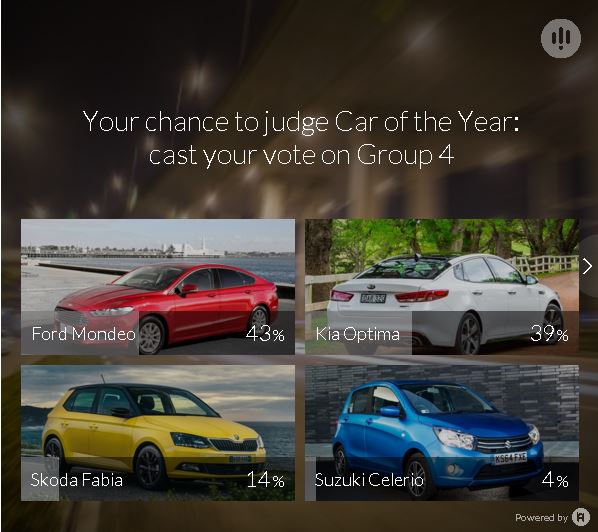
HERE is the fourth group of candidates for Car of the Year 2016. Vote here for your Group 4 winner.
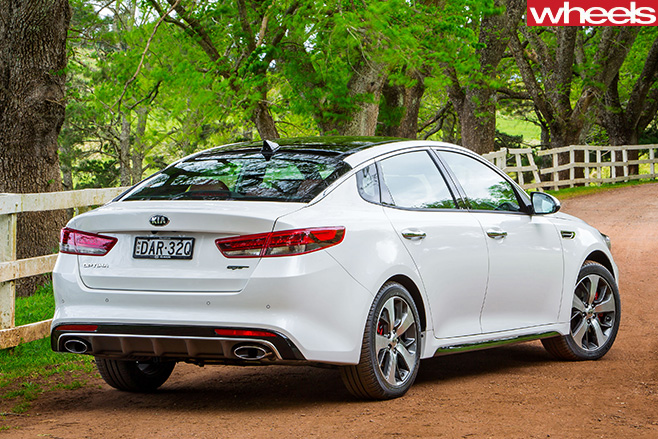
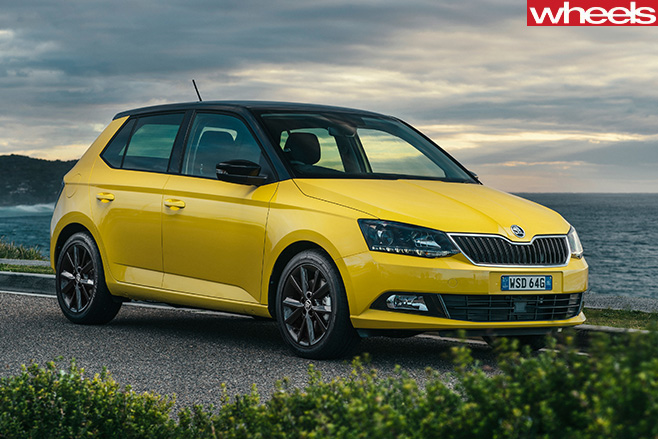
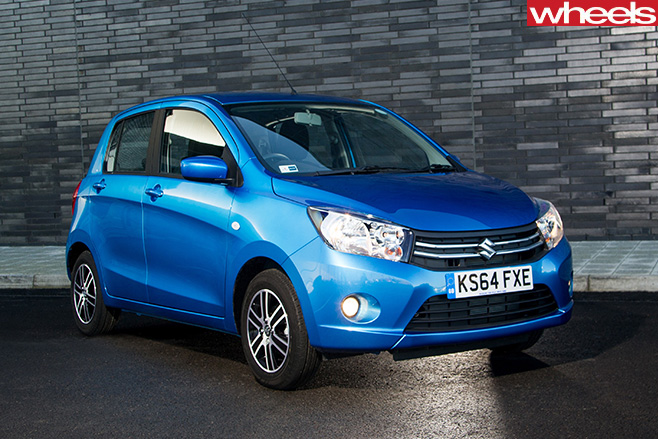
The impressive Ford Mondeo lines up with the new Kia Optima, the underrated Skoda Fabia hatchback and the pert Suzuki Celerio city car. Which is most worthy of a place in the People’s Choice final?
You can find a brief explanation of what each brings to the contest in our introduction to the 2016 Car of the Year contenders. It presents the full field of 25 cars in alphabetical order, by maker.
Or for a more concise description and a look at the cars, just scroll past the poll below.
This poll is the fourth of five, each covering different models from the Car of the Year long list. Tomorrow, we will post the fifth poll.
A final poll, covering the five group winners, will decide the People’s Choice for Wheels Car of the Year 2016.
Remember, this is not a beauty contest. Wheels judges the contestants under five strict criteria, refined over half a century:
Function – how well a car does what it is intended to do. Efficiency – in all aspects. Use of resources in producing the car and in running it. Value – both against its rivals and against the wider new car market. Technology – does it offer a tangible advantage over its rivals? Safety – We’re talking passive and active.
Weigh the Group 4 field and cast your vote.
Need help deciding? Scroll below the poll to find out more about these capable COTY contenders.
Thank you for voting, the poll has now closed.
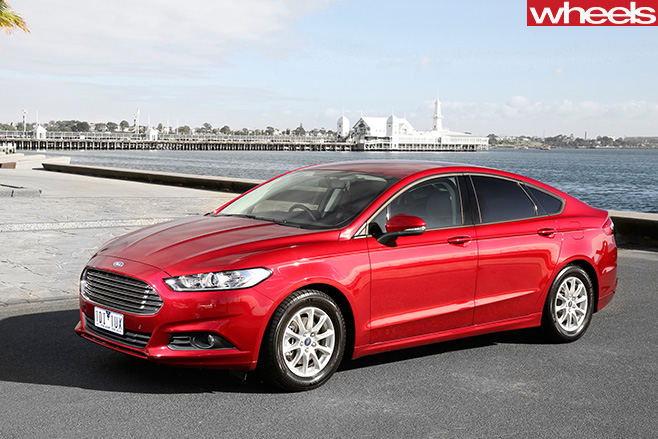
Kia Optima
Skoda Fabia
Suzuki Celerio
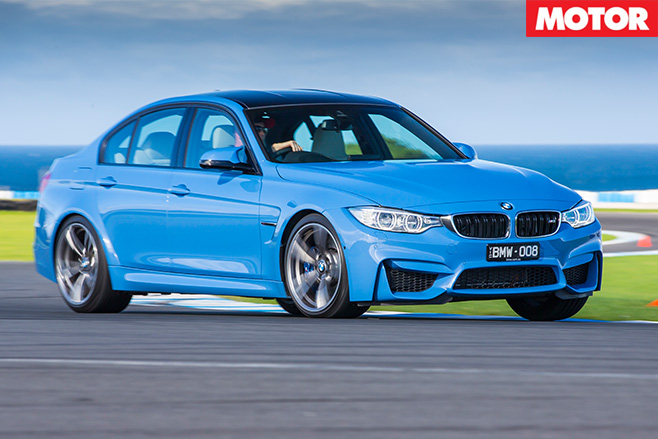
Having devoted plenty of ink to BMW’s new M4 coupe, we thought it was time we covered its sedan sibling, which retains the iconic M3 badge.
This marks the first time MOTOR’s had the luxury of covering the two- and four-door concurrently – in the instance of the E36 and E90 the sedan appeared two years after the coupe. And, in E30 and E46 guise, there was no M3 sedan at all.
Differences between the sedan and the coupe are relatively minor. At 1520kg for the manual and 1560kg for the standard DCT, the sedan weighs an insignificant 23kg more than the equivalent coupe, mainly due to it lacking a carbonfibre-reinforced plastic (CFRP) bootlid. It’s also 41mm taller than the M4, so it has a slightly higher centre of gravity.
Unsurprisingly, on the road such small differences are undetectable, as both feel prodigiously fast. The claimed 0-100km/h of 4.1sec is perhaps optimistic, but mid-4s should be easily and repeatedly achievable. With 550Nm available from 1850rpm, the M3 pulls hard from virtually idle and sustains this urge right up until its 7500rpm peak.
Also up to the individual is the preferred combination of settings. There are three settings for steering, suspension, engine, gearshift speed and DSC, and your favourite two combinations can be saved to the M1 and M2 buttons on the steering wheel. For me, M1 stores everything in Comfort for cruising, and M2 is all-out attack: Engine in Sport+, suspension in Sport, steering in Comfort, medium gearshift speed and DSC in its more lenient MDM mode.
Sport+ suspension is best left to very smooth roads or racetracks, and the sportier steering settings add weight but then no extra feel. Apart from requiring some finesse at low speed, the seven-speed dual-clutch gearbox is superb, though the fastest gearshift setting gives an unpleasant thump in the back on upshifts. It would be a very brave or talented driver that drove with DSC off on the road.
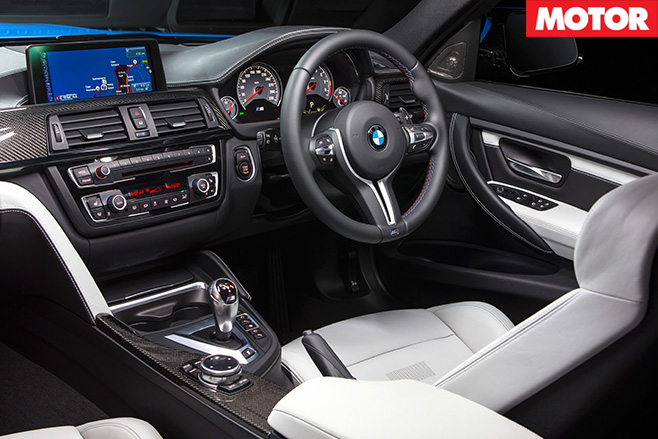
The only other blot on its copybook is the intrusive and continual road noise, likely a result of the rear subframe being bolted directly to the body. It spoils what is otherwise an incredibly accomplished grand tourer, as the ride is brilliant and the interior both comfortable and lavishly appointed. The M3 looks angrier and more aggressive than the M4. The fact that it’s also $10K cheaper seals it as the best M-car currently on sale, though it’s one best enjoyed on dry, sunny days.
4 out of 5 stars
Specs
Engine: 2979cc inline-6, DOHC, 24v, twin-turbo Power: 317kW @ 7300rpm Torque: 550Nm @ 1850rpm Weight: 1560kg (DCT) 0-100km/h: 4.1sec (claimed) Price: $139,900
If the Volvo 26 was an Australian concept car, it would be called the Volvo 1-Hour. Drivers apparently lose an average of 26 minutes to their daily work commute, and the time-saving, sanity–saving Volvo 26 autonomous concept promises to give that precious half-hour (or more!) back.
While most drivers would spend the time unproductively (and illegally) flicking through their Facebook feed, it’s still 26 minutes spent on things other than driving, or more likely, getting frustrated in gridlock. This is one of the key attractions of autonomous cars, along with incentives such as a safer vehicle that can converse with other vehicles to protect its occupants and streamline travel, react faster to hazards, save fuel through foresight, and even reduce or get rid of insurance premiums altogether as we head towards a no-bingle future.
In reality, we are far from this full-autonomy idyll. For starters, people have to be comfortable handing control of their vehicle over to a computer program, and let the car carry their loved ones, hands-free. The idea of handing over control with literally no controls in the car freaks even the techies out. But Volvo Car Australia says it will happen, regardless of our many misgivings.
“In 1969, Volvo invented the three-point safety belt – and people scoffed,” points out Volvo’s Director of Corporate and PR, Greg Bosnich. “Today, it has saved over a million lives. Trust [in autonomous cars] will need time and education, and while the tech is already here, full autonomy will need to surpass some ethical and moral issues, and government laws, rules and regulations…
“That said, I drive an XC90 which can steer, stop, go and brake at speeds of up to 50km/h by itself. Sure, it needs guides such as the white lines on the road, but it does it all with minimal input from me. It does take some getting used to, but it’s like the first time you use Cruise Control – your foot probably hovered over the brake until you learned to trust the technology.”
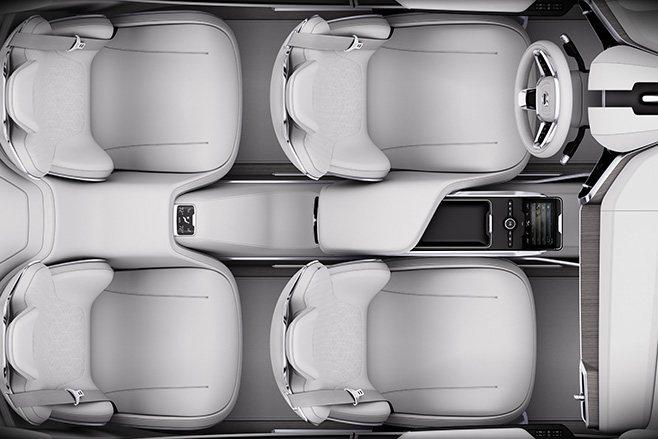
This is where the Volvo 26 bases its beginnings – while the concept is a futuristic look into autonomous vehicles and how people will comfortably travel inside them, Volvo acknowledges that people need a steering wheel and pedals, even if the car does not. So the Volvo 26 has three interchangeable ‘seating’ configurations, with the first offering full control by the driver with a conventional wheel and pedal position. The two next steps are where the concept gets truly interesting.
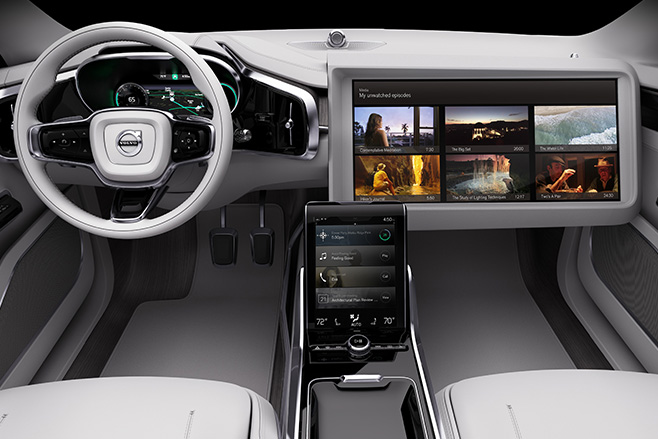
Before we go further, it’s important to note that the Volvo 26 is not a car; it’s a design study. Volvo already has autonomous cars on the boil: its Drive-Me XC90 project will see 100 self-driving cars on its Swedish home town of Goteborg’s roads by 2017. The Volvo 26 is all about how the interior will work to make the most of a completely autonomous driving scenario, so it’s just that – a cabin.
Without wheels, doors or a roof to distract the eye, the standalone cabin, which was unveiled last month at the LA Auto Show, clearly morphs from a car that is purely driven by human hands and feet, to a recliner, to a sleeper cabin. These three selectable modes—Drive, Create, and Relax— are like a seat memory switches on steroids.
“Drive” is self-explanatory. But if the car detects no hazards and the route has been plotted and accepted on the GPS, the driver can pull and hold both steering wheel paddles to engage the first autopilot mode, “Create”.
The driver’s seat slides back and away from the pedals and wheel, leaving room for a broadsheet newspaper to be spread and read. A tray table also pops out on the left of the driver (the concept is a left-hand-drive car), while the passenger’s side dash flips up and out to reveal a 25-inch multimedia flat screen. The centre console controls slide back with the seat, so the driver still has them at their fingertips to operate various functions, or to select Drive mode again for the final handover of control, “Relax” mode.
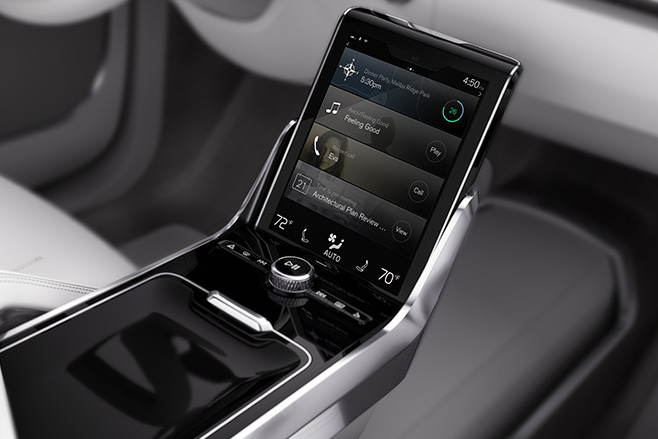
Here, the distractions of driving, multimedia, and everything else are taken away. The seat reclines all the way back for a full flatbed experience, complete with a footrest which flips out from under the seat, limo-style. The big display flips back in, doing away with TV and multimedia distraction, and the steering wheel sucks right back into the dash for maximum room.
Back to that inherent human instinct of holding on and never letting go of control; with the seat moved back away from the wheel, or the driver flat back and snoozing, what if something goes wrong? Where are Volvo’s impeccable safety standards in this scenario?
Apparently, an autonomous Volvo will be smart enough to pull over should something go awry, and move the driver back into the “Drive” position – and control of the car.
“Our vision is to not have one person seriously injured or killed in one of our vehicles by 2020,” states Bosnich.
“There will be fail safes for unforeseen circumstances on the road, but a vehicle we are in control of will do its job.”
And with the Volvo 26 concept built on Volvo’s latest interchangeable SPA platform which underpins the next XC90, and the interior clearly modelled on the XC90, perhaps it isn’t all that futuristic a concept. How long will it be before elements of this concept filter in to practical motoring? That really depends on the level of trust we drivers are willing to put into technology that is, quite literally, out of our hands.
Do you have that particular friend, one who takes nights on frustrating tangents…
Forgets their wallet, makes being in public slightly embarrassing, yet without fail, is the first friend you call before rounding up the troops, simply because you’re guaranteed a kidney-squeezing laugh?
Well, that’s what it feels like with the Series 3 Abarth in your driveway. The car, like its predecessor, is such ludicrous fun you almost forget it’s pragmatically less than ideal. For instance, if your commute’s of decent length, you might be unimpressed that cruise control hasn’t manifested in the Series 3 update.
You might also be disappointed to learn other luxuries like a reversing camera and keyless anything (except locking) aren’t present – admittedly, if you need a reversing camera to park such a diminutive car you shouldn’t be driving.
You will, however, be pleased to hear the price has been lowered during the range’s reshuffle. Gone is the 500 EsseEsse nameplate and in its place are the ‘595 Turismo’, which can be optioned in a two-tone paint job, and the ‘595 Competizione’. The former lowers the starting bid for an Abarth to $33,500 by forgoing trick bits that lift the Competizione’s price by $3000.
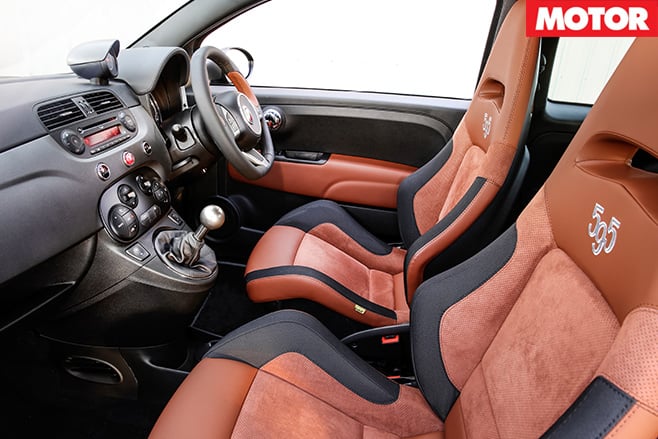
The Competizione’s meal ticket is its “Record Monza” exhaust. Turn the engine over and it barks angrily, emitting a flatulent but rorty note through its quad tailpipes. Prod the aluminium pedals, another luxury the Competizione scores, and it’s hard to believe a 1.4-litre could sound so malevolent. It sounds awesome.
Slot first with the new spherical metal knob, release the soft clutch and while the engine’s running rich during warm-up, shift quickly on part-throttle and you’ll be greeted by a cracking pop as the little Competizione does its best WRC impersonation. The whole experience, along with the car’s adjustable attitude in corners, is a recipe for thrills that leaves you laughing like The Joker.
It’s so fun, you might forget that the Abarth 595, a car of minute proportions, still needs the moon’s orbit to complete a U-turn. Or that it compromises on ride for great body control, or how the auto Competizione gets dangerously close in price to Golf GTI territory.
The Abarth 595 is still that genuine mood-enhancing friend, but like any high time, reality’s never far away.
2.5 out of 5 stars
Specs
Engine: 1368cc inline-4, DOHC, 16v, turbo Power: 118kW @ 5500rpm Torque: 230Nm @ 3000rpm 0-100km/h: 7.4sec (claimed) Price: $36,500
Hyundai Ute ready to go, says US boss, and is high on Hyundai Australia’s wish-list
THE Hyundai Santa Cruz ute has been confirmed for production. Hyundai US boss David Zuchowski told Wheels that it’s not a matter of if, but when, for the lifestyle concept vehicle ute shown at last year’s Detroit motor show to arrive in showrooms.
While not yet given the official green-light from company headquarters, when asked at a press function following today’s 2016 Detroit Motor Show, Hyundai’s US boss told Wheels: “It hasn’t been officially announced yet. Our timing is not crossing our fingers and waiting for approval, it’s trying to figure out when we’re going to announce it.”
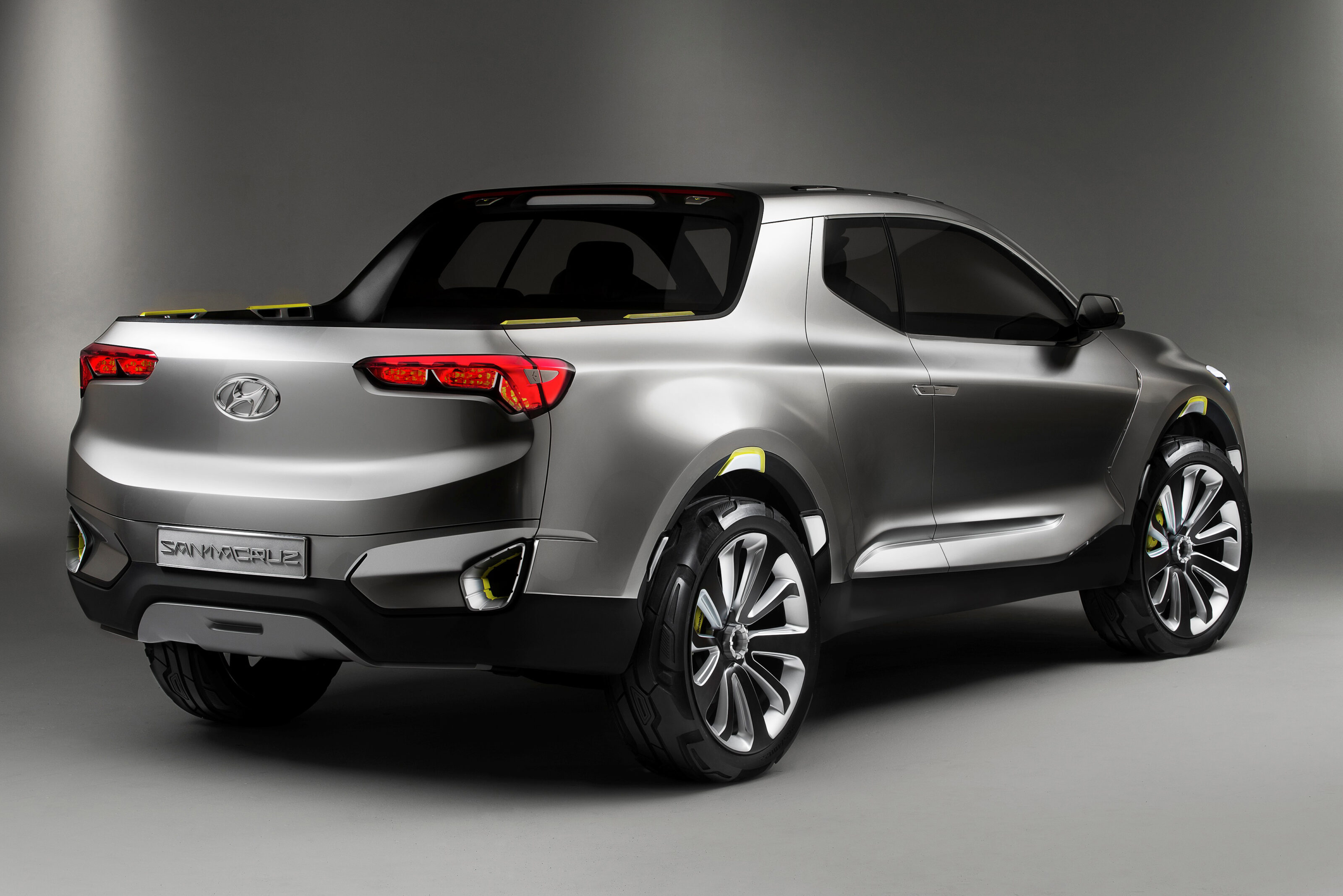
Zuchowski also said that public, official confirmation was in the hands of the company’s global headquarters in South Korea, but that the green light had been given internally to the funky Hyundai. “We’re waiting more for an announcement than we are for an approval, right? So HMC is going to dictate [when that happens] – we feel really good about it.”
That doesn’t mean that Hyundai Australia will necessarily take the Santa Cruz, despite its then-CEO, John Elsworth, telling Wheels at the 2015 Detroit show that the Hyundai presented a solid growth opportunity. Elsworth, who left the company last November, described the Santa Cruz as a lifestyle vehicle that could pick up from the Ford Falcon and Holden Commodore-based utes once local production ended by 2017.
Similar to the Falcon and Commodore utes, the Santa Cruz will be based on a passenger car platform, and not a ladder-frame chassis such as the strong-selling Toyota Hilux and Ford Ranger.
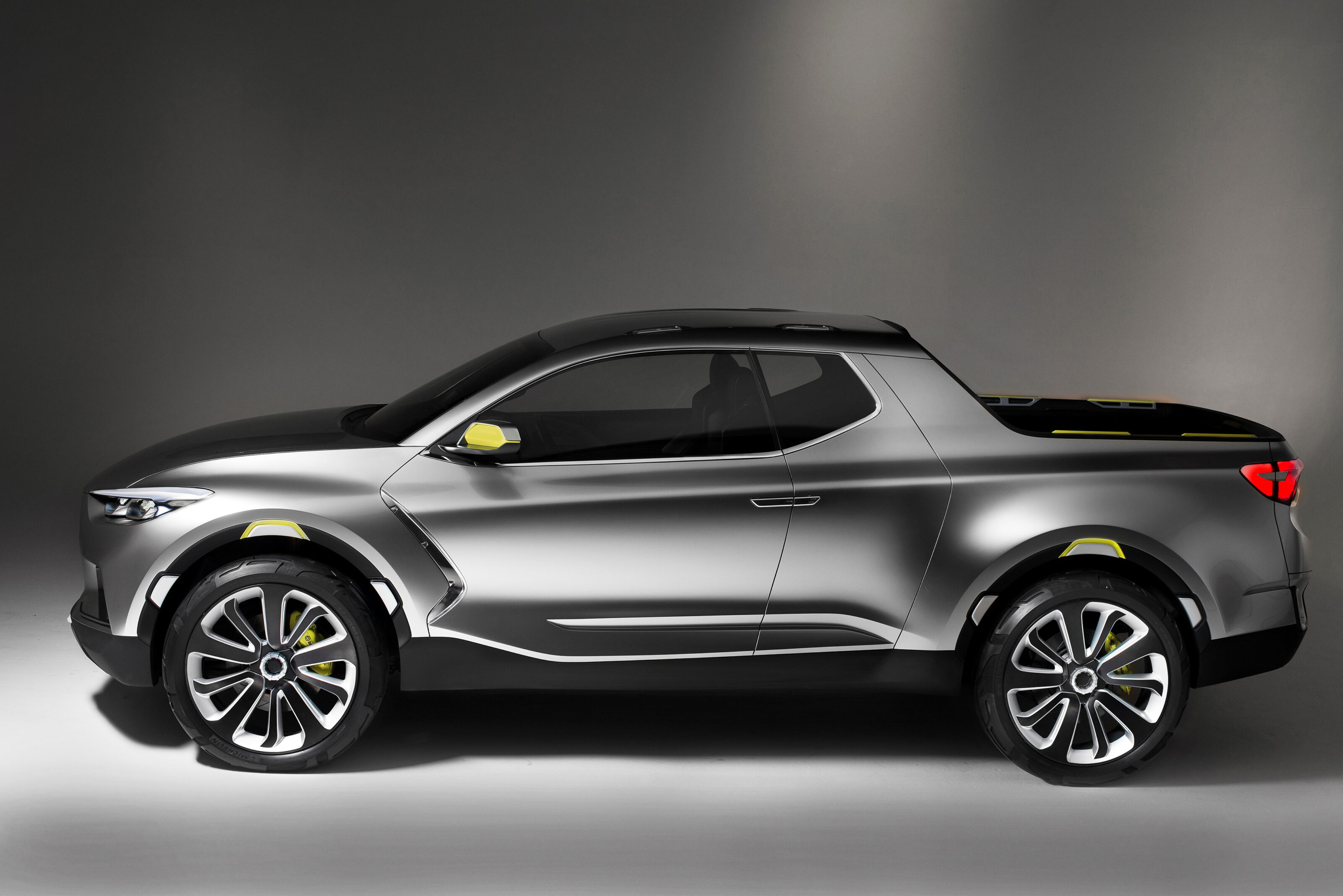
“Big utes aren’t for everybody, and with Holden and Ford not offering that sort of vehicle in the future [with the conclusion of Australian manufacturing], there’s a gap there in the market,” Elsworth said.
“And I think you’ll find there’s a blending of crossovers and SUVs and light commercials and this does fill that gap.”
The big question for the Australian market is whether the Santa Cruz is produced in right-hand drive, and even then, exchange rates from Hyundai’s various global facilities may hinder its progress south.
Hyundai Australia spokesman Bill Thomas did not confirm Zuchowski’s comments, but suggested that if the vehicle was given the official nod, it would be a welcome addition to the local line-up.
“If [that’s the case, and] it’s a production vehicle [then] it’s about where it can be produced and if it can be produced in right-hand drive. If the business case has sufficient numbers … we’d look at it [for Australia].”
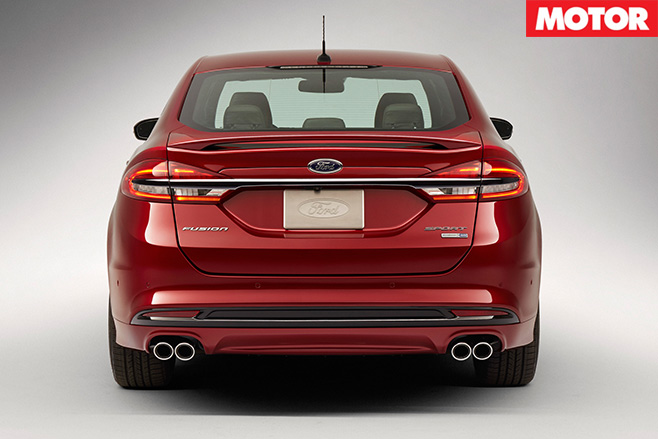
Remember when twin tail pipes on this Mondeo made us think a sportier version, possibly an ST, was on the way? Well, news from Detroit reveals that wasn’t far from the truth.
Overnight Ford announced it will roll out an all-wheel drive version Fusion (as the Mondeo is known in the states) with a twin-turbocharged V6 as part of the model’s renewed 2017 line-up.
Called the Fusion V6 Sport, it doesn’t carry the ‘ST’ badge we predicted, but it does ready some decent performance goodies.
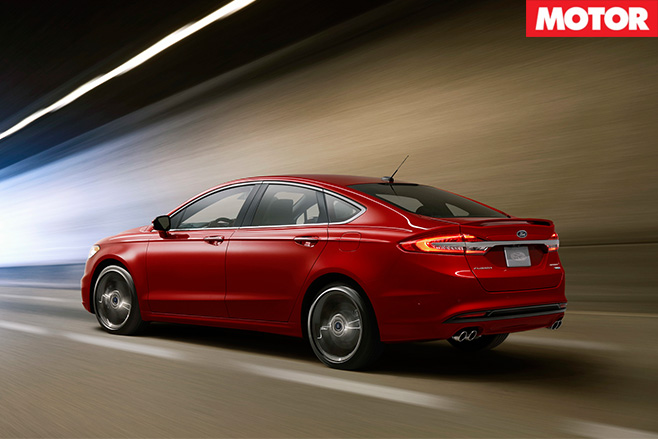
The twin-turbo engine will be paired to a tuned six-speed automatic transmission before its all-wheel drive system will channel the power to the ground.
Surprisingly adaptive dampers have been specified for the Fusion V6 Sport. They’re the kind that continuously adjusts their firmness according to conditions. And they’re apparently so adaptive they’ll be able to sense potholes and soften the shocks to suit.
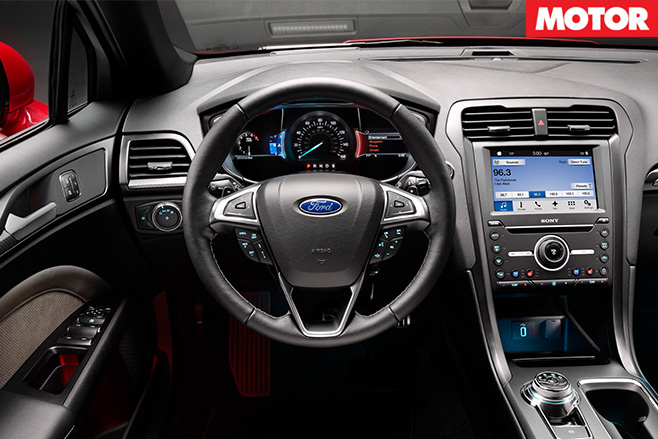
The V6 Sport also wears a new exterior design which will be introduced by the 2017 Fusion range’s facelift.
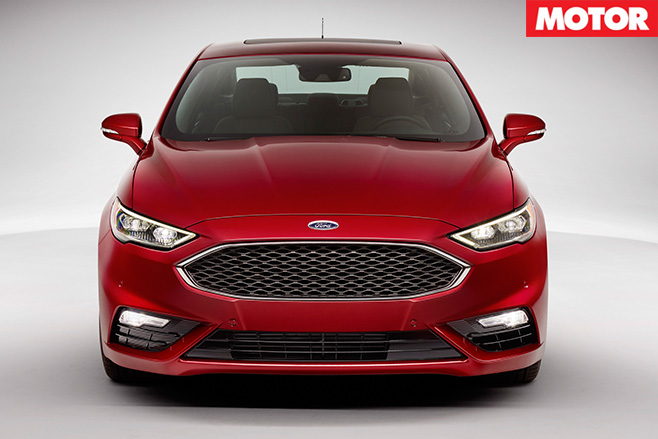
Meanwhile, V6 Sport’s will distinguish themselves with charcoal 19s and a dual twin-tailpipe arrangement.
But it is currently not known whether our Spanish-built Mondeo will welcome the twin-turbo V6 all-wheel drive specifiction.
