
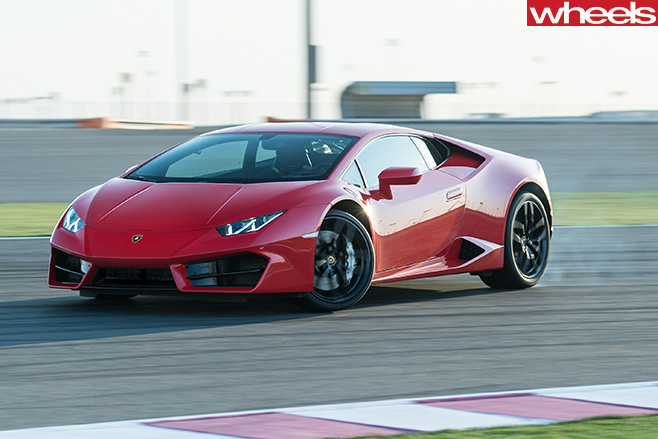
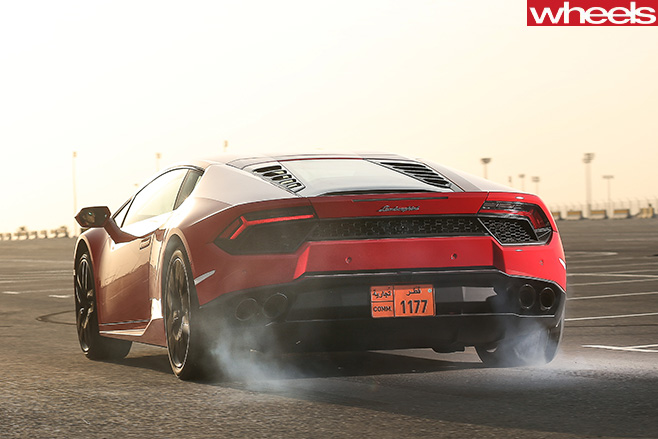
The separation of turning and burning makes the less-powerful, more affordable Lamborghini Huracan LP580-2 an altogether more exciting and enjoyable performance coupe. And it loves to do power slides.
WHAT IS IT? The Huracan LP580-2 is essentially the same as its Lamborghini LP610-4 all-wheel-drive brother, but has slightly less power and is rear-drive only. The goal, Lamborghini says, was to build a serious car for serious drivers.
WHY WE’RE TESTING IT Can less actually be more? Has Lamborghini, by reducing the Huracan’s complexity, actually delivered a more exciting and immersive driving experience?
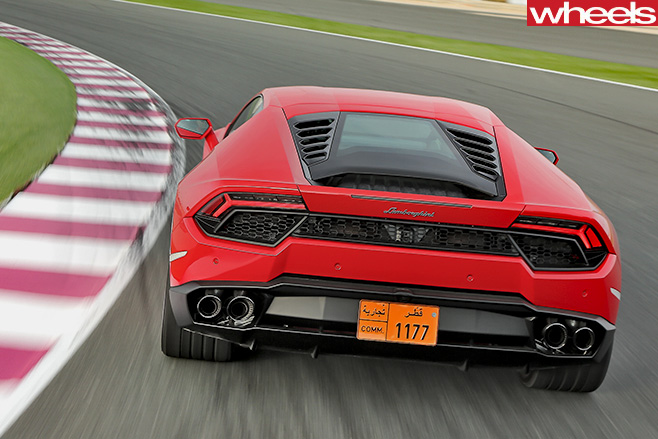
THE WHEELS VERDICT If you care anything about driving, this is the Huracan to have. It may not be as fast on paper, but it’s better in just about every other way.
PLUS: Better balanced; steering feel; everything about the V10; supercar looks inside and out MINUS: Gear-change paddles are not wheel-mounted; I can’t afford one
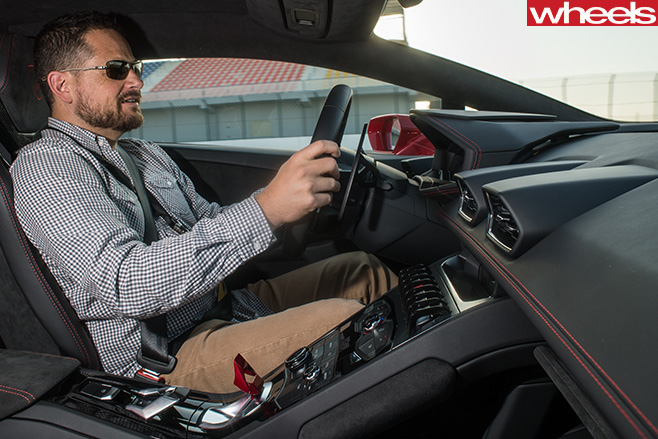
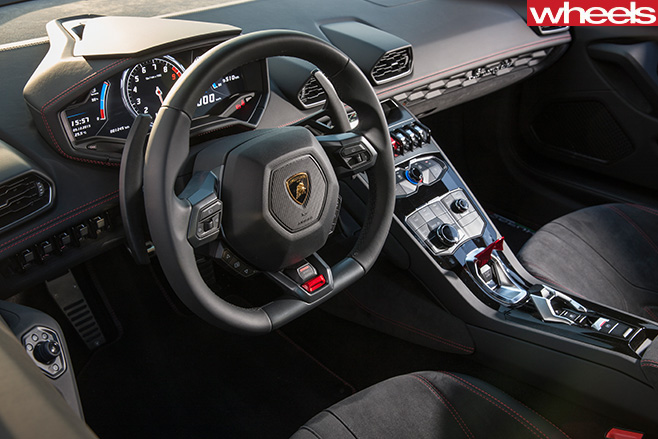
Power oversteer, you may be surprised to learn, was one of Lamborghini’s five main aims when developing this “entry-level” Huracan. The other four are admirable, too, but hard to remember when you’re oppy-locking 426kW of mid-mounted V10 through a corner, and juggling gears via paddles that don’t rotate with the steering wheel.
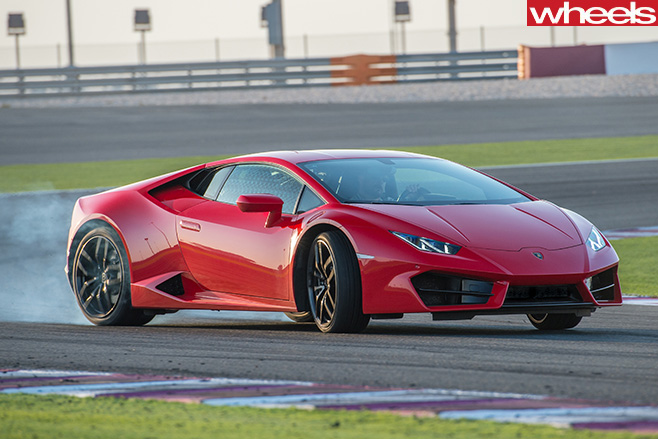
Despite this fixation on becoming a drifting demi-god, the Huracan LP580-2 is not a one-trick stallion. It possesses more adjustability and tactility than its sibling. Go too hard into a corner, and the front will scrub wide, just like the all-wheel drive would. But that’s where similarities end, because the driver can turn understeer into oversteer with smooth and judicious use of the throttle. Where the all-wheel drive version would respond by forcing the nose even wider, the rear-driver turns plow into wow when rear end slip allows the fronts to reacquire the adhesive upper hand.
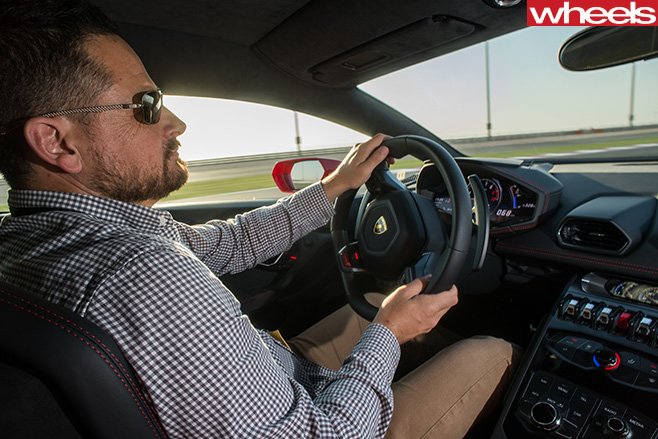
Taking accelerative responsibility off the front axle has also improved front-end feel through Huracan’s electric power steering. It turns in more hungrily, and easily has the bite to break the rear loose, especially under brakes. Ten percent softer front springs and dampers allow more weight transfer under brakes, and the reprofiled front spoiler increases downforce.
SPECS Model: Lamborghini Huracan LP580-2 Engine: 5204cc V10, dohc, 40v Max power: 426kW @ 8000rpm Max torque: 540Nm @ 6500rpm Transmission: 7-speed dual-clutch Weight: 1389kg 0-100km/h: 3.4sec (claimed) Fuel economy: 11.9L/100km (combined) Price: $378,900 On sale: April
At the pointiest end of the leading edge of supercar technology lie La Ferrari and McLaren’s P1. Sparks are sure to fly as these two hybrid hypercars finally collide.
First published in the March 2015 issue of Wheels magazine, Australia’s most experienced and most trusted car magazine since 1953.
THIS pair cost a couple of million each, give or take the odd 911 Turbo, and even if you can afford one, you can’t have it. They’re all sold, all 499 La Ferraris and 375 McLaren P1s, to a wealthy few who have collectively spent $1.5 billion in the pursuit of automotive nirvana. But, hypothetically speaking, suppose a vacant slot appeared on the list for each, and watching TV tonight you noticed the cushion felt a bit uncomfortable, lifted it up and discovered a year’s worth of Vegas slot jackpots in change down the back of the sofa. Which would you have? Which is best? La Ferrari, or the P1? We brought a P1 over the Alps and to Ferrari’s home town of Maranello to find out. Welcome to the lion’s den, McLaren.
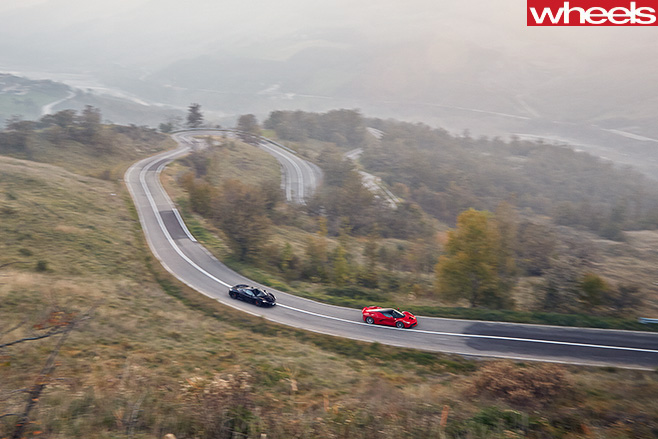
We’re heading for the roads south of Maranello, where the topography gets interesting and Ferrari’s own test drivers come to play. By the day’s end we’ll have seen three different prototypes for next year’s turbocharged 458, and been disappointed with the muted sound of every one.
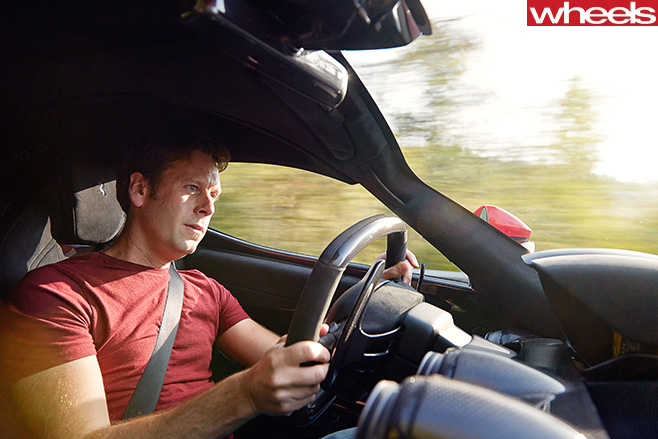
The route south is traffic-free and as we track the ribbon of dry rocks that currently make up the Panaro river, scouting for locations while we wait for Ben, I realise how relaxed I’ve become in the P1 now that I’ve got several hundred McLaren kays under my belt. Blisteringly fast, surprisingly compliant and so communicative, it’s as easy to drive as a 650S, but far more able. Not that money is even a factor at this level, but La Ferrari, at a whopping $200,000 more than even the $1.62 million P1, is going to need to be something special to top this.
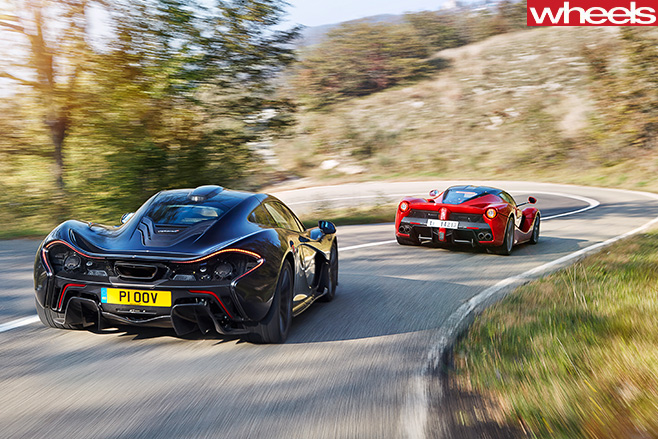
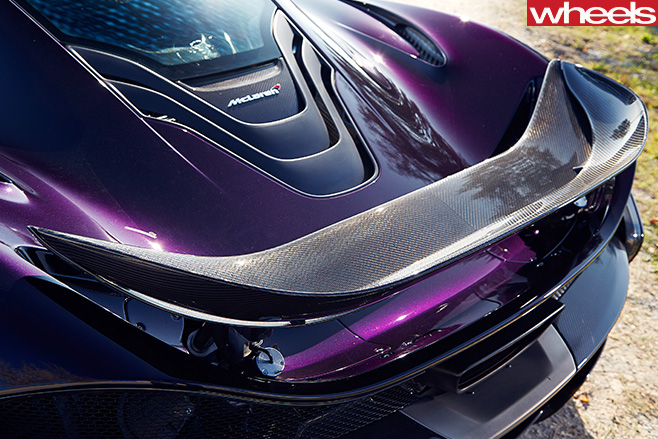
Immediately, it’s obvious how strikingly different the two cars are in design. And size. The Ferrari looks enormous: 114mm longer than the P1 and 46mm wider, but resting on a wheelbase shorter by 20mm that results in the nose hanging beyond the front axle as if design boss Flavio Manzoni had handed it over to cartoonist Gerald Scarfe to draw the schnozzle. Whoever did draw that nose did a fine job, though, because the combination of those angular arrow-slit headlights, horizontal cooling slats and floating septum means it absolutely monsters the P1 when it comes to the rear-view-mirror scare factor. Circle round to the back end, though, and it’s the P1 doing the scaring.
Both bodies are heavily contoured to make the most of the air passing above, below and even through the car, the Ferrari’s outrageously scalloped flanks leaving the front wings almost adrift from the car’s thorax in a manner not seen on a Ferrari road car since the first one, the 125S, back in 1947.
That soul is an evolution of the F12’s 6.3-litre naturally aspirated V12. With 588kW and a mental 9250rpm redline, that alone would be enough to make it one of the world’s quickest cars, and almost 112kW punchier than the Enzo it replaces. But here it’s augmented by 120kW of electric power.
The McLaren has even more electric power, at 131kW, is the only one with a plug-in charging option, and the only one to offer an EV mode. The P1’s combustion engine makes 46kW less power (542kW), but 20Nm more torque (720Nm). If you remember nothing else, the basics are this: the 1255kg Ferrari walks softly to the tune of 140kg, and taking both petrol and electric power into consideration, carries a 35kW bigger stick.
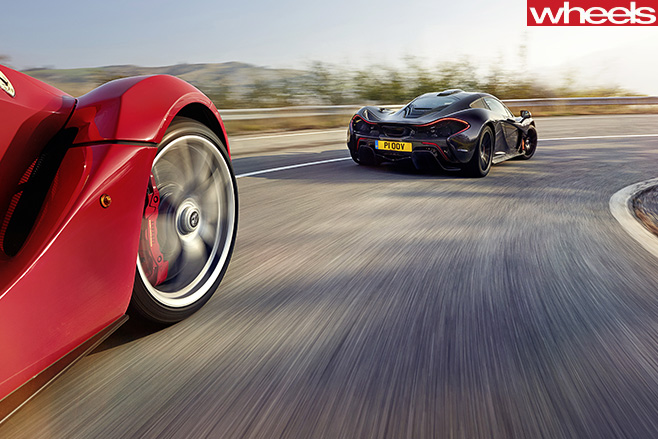
I’ve driven La Ferrari before, and on these roads in fact. But that was six months ago. How will it measure up after hundreds of miles in the McLaren? How different can two cars so closely matched in power, price and performance really feel?
I’ve barely opened the Ferrari’s door before those differences start appearing. You fold yourself awkwardly into the P1, but step casually into the Ferrari, its slim, low-cut sill and door aperture that bites deep into the roof making it a cinch to get in and out. Tug the door downwards (they’re surprisingly heavy in both cars) and the McLaren feels similar to the 650S on which it’s distantly based. The steering wheel and rising centre stack are instantly familiar, even if some of the details and the deliciously comfortable lightweight carbon-back seats aren’t.
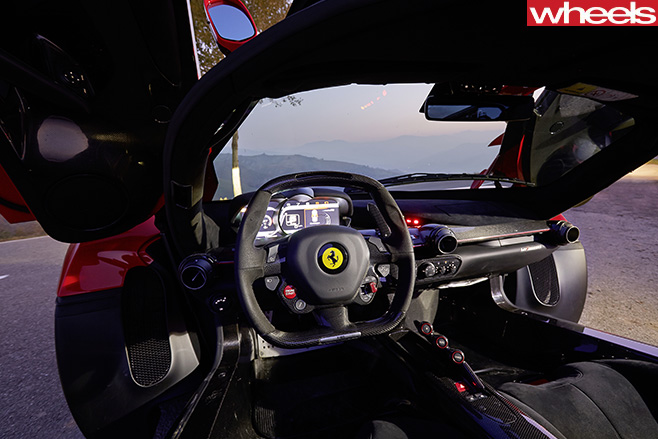
When even Fiestas come with keyless start, it seems absurd that a car so futuristic and expensive as this still requires you to twist a key to prime the ignition. Only then can you go to the steering wheel’s lower-left quadrant for the bright red button that will fire the starter motor.
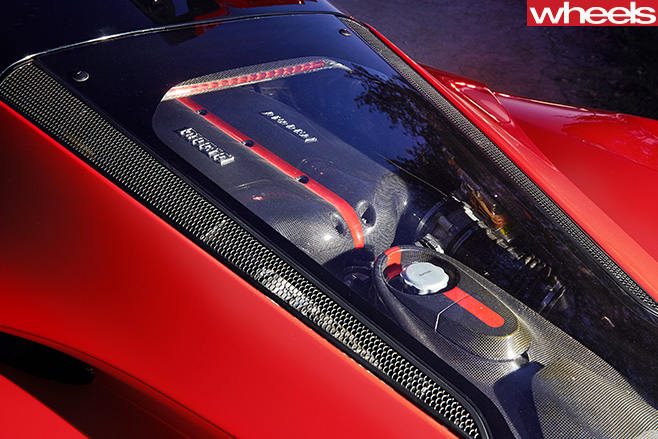
Both of these cars are supposed to use electric power to make up a torque shortfall at low revs, but flatten the pedal in the McLaren in a higher gear and you can go and make a cuppa before the action starts. Try the same in the Ferrari and it picks you up harder and faster than any caffeine hit ever could. No wonder the rear tyres are a colossal 345mm wide.
The peaks of the front wings help you place the nose, but it’s with some trepidation at first. The forward visibility isn’t as good as the P1’s, the steering even sharper than in the frenetic 458 Speciale. The McLaren you settle right into; La Ferrari feels more alien, and takes longer to trust. But trust you must if you’re to do more than scratch the surface of its talents.
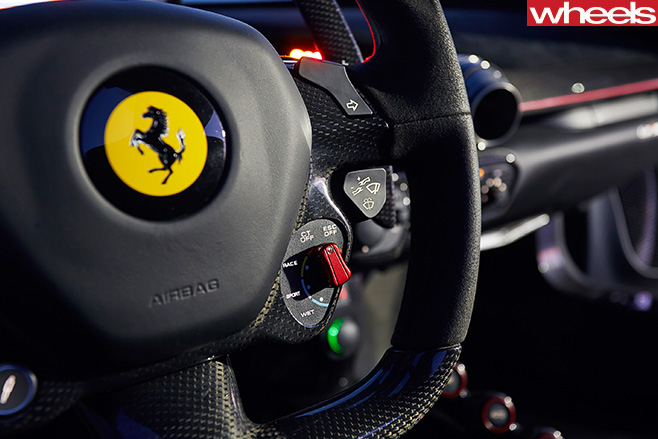
Fortunately, some familiar Ferrari traits help calm the nerves. The steering-wheel manettino selector, for instance, is more intuitive than the McLaren’s twin console-mounted rotary dials, and easier to wrestle with in the heat of the moment. And the ride is dumb-strikingly good. Thumb the damper button on the steering wheel, and both comfort and traction benefit as a result. I’m not sure about the brakes, though. The power is there, but they feel grabby at first, and the energy regeneration system makes them hard to modulate when just tipping in.
Already it’s clear that these two cars, aligned so closely in terms of power, price and purpose, feel wildly different from behind the wheel. That much we do know. But which is fastest? Both reach 100km/h from rest in less than three seconds and are limited to 350km/h, though we’re too far from the autostrada to see which one gets there, or somewhere near it, first. But our video guy wants some chase footage looking back from one car to the other. Wants us to drive from the bottom of a hill to the top, as fast as we can. It’s risky; plain stupid, in fact. We’re on a public road, a road too small for cars this quick, if we’re honest. If the lead car spins, we’ll be driving too close for the one behind to avoid it. The strong carbon passenger cells mean we’d likely survive unscathed, but probably wish we hadn’t.
Gulp, here goes.
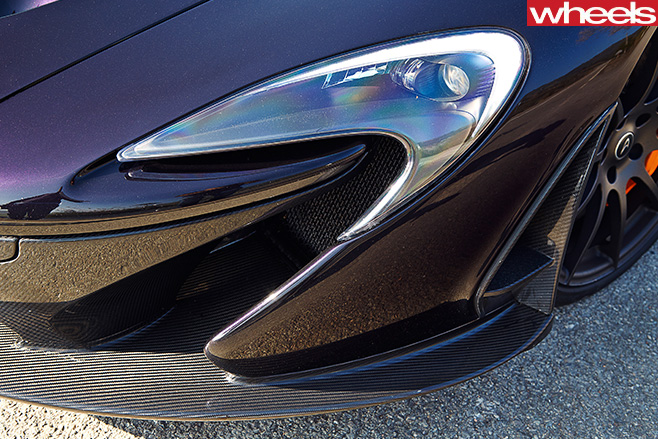
A nudge at the wheel and the P1 flicks into the left-hander. There’s a surprising amount of kickback, more than in the quicker-steering Ferrari, but it’s even more responsive in that first nano-degree of twist from centre and the feel is exquisite. You couldn’t know more about the road’s surface if you’d donned a high-vis and raked the tar out and rolled it flat yourself. But there’s definitely more understeer to deal with, and sticking with second gear on the slower, tighter bits, you’re too far below the power band to neutralise it.
A glance in the mirror shows Ben’s grappling with the opposite problem. The Ferrari’s front end bites hard, but even with rear tyres a full 30mm wider than the P1’s, the big hit of low-down torque that arrives when he opens the taps slews the tail wide as we exit a tight left-hander on to the longest straight.
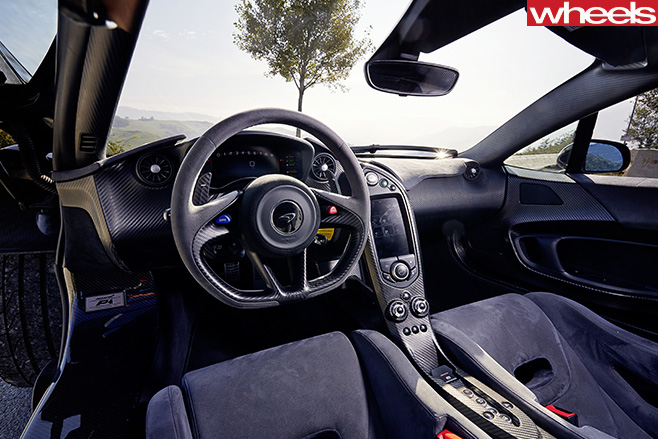
Finally we get the chance to keep those right pedals pinned, two of the fastest four-wheelers on the planet, piling on 30km/h increments, a second at a time: 60, 90, 120, 150, 180… Neck-and-neck every step up the ladder, then back down again on the brakes. I can’t know how Ben feels, but the P1 feels like it could do this all day. Fortunately for my sanity and the safety of the people of Santa Poco, we don’t, and I ease off the gas, simultaneously gutted and relieved that it’s over.
I glance across to the passenger seat. The video guy, who only met me for the first time last night, looks terrified, and I don’t feel much better myself. I’m shaking like a road-mender’s drill, as giddy with adrenaline as with the guilt of having driven far, far too fast.
I’m not going to pretend that a five-minute fight on a hill route that never let either car really stretch its legs beyond fourth gear or make use of its aero devices is in any way definitive proof that one is faster than the other around somewhere like the Nurburgring. But on these roads, with two reasonably handy and identically speedy drivers behind the wheel, they’re all but inseparable.
We spend the rest of the day criss-crossing our way through the spectacular late autumn scenery, picking off Fiats, picking up leaves with fat tyres and throwing them skywards, and trying to pick holes in either car. It’s not easy, if you accept that a car can actually be worth two million dollars, when a sublime 458 Speciale is one-fifth the price. But mostly we just try to pack in as much exposure to these amazing cars as we can.
The elation of the last couple of days is tempered slightly by the knowledge that this could well be our last proper encounter with either car, and even if we ever find our way behind the wheels in years to come, probably with an owner’s or dealer’s car, we’re unlikely to have a free pass to paste them so mercilessly.
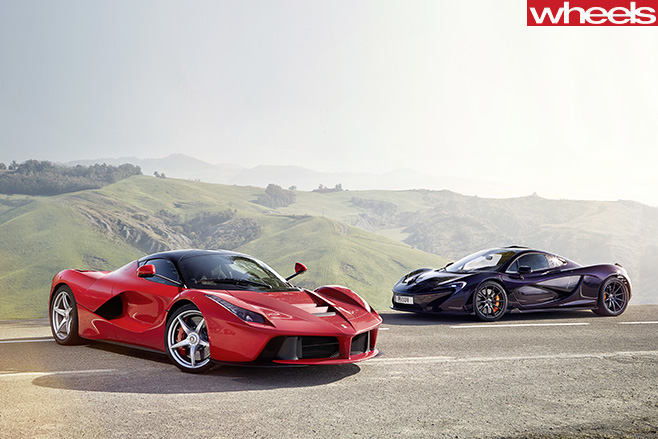
I could put a P1 in the garage just to stare at that outrageous rear styling, never mind to feel the savage kick of the V8 on full boost, that incredible steering, or the way you just click with the car from the moment you get behind the wheel. But there’s no getting away from the fact that the Ferrari’s drivetrain is the more impressive: faster revving, smoother, more soulful and so much lustier.
The Ferrari feels more of an event because that’s what it is. A ground up, clean-sheet car with the most outrageous front-end response this side of a pitwall. At this level, the McLaren’s reassuring similarity to the 650S is partly its undoing because, whatever any eventual track test or Nurburgring lap times might prove, I suspect the Maranello car will always feel more special. Staggering, wonderful achievement as the McLaren P1 is, on these roads, and for these drivers, the epoch-defining La Ferrari wins.
Ferrari La Ferrari Price: €1.2m ($A1.76m) Engine: 6262cc V12 (65°), dohc, 48v; Max power: 708kW @ 9000rpm Max Torque: 900Nm @ 6750rpm Transmission: 7-speed dual-clutch Weight: 1345kg Acceleration: 0-100km/h: sub-3.0sec (claimed) Plus: It’s bloody marvellous Minus: It’s bloody expensive Verdict: 10/10
McLaren P1 Price: £866,000 ($A1.55m) Engine: 3799cc V8 (90°), dohc, 32v, twin-turbo; one electric motor Max power: 673kW @ 7500rpm Max torque: 901Nm @ 4000rpm Transmission: 7-speed dual-clutch Weight: 1450kg Acceleration: 0-100km/h: 2.8sec (claimed) Plus: The world’s most exciting road car Minus: Too complex for its own good? Verdict: 9.5/10
The price of entry into BMW’s M range has just dropped significantly. BMW has announced today that the new M2 will land Down Under for as little as $89,900.
This figure sees the first-ever M2 undercut its predecessor, the 1M, by over $10,000, and slash the cost of owning an M car by a furlong, being priced $50,000 less than the four-door M3.
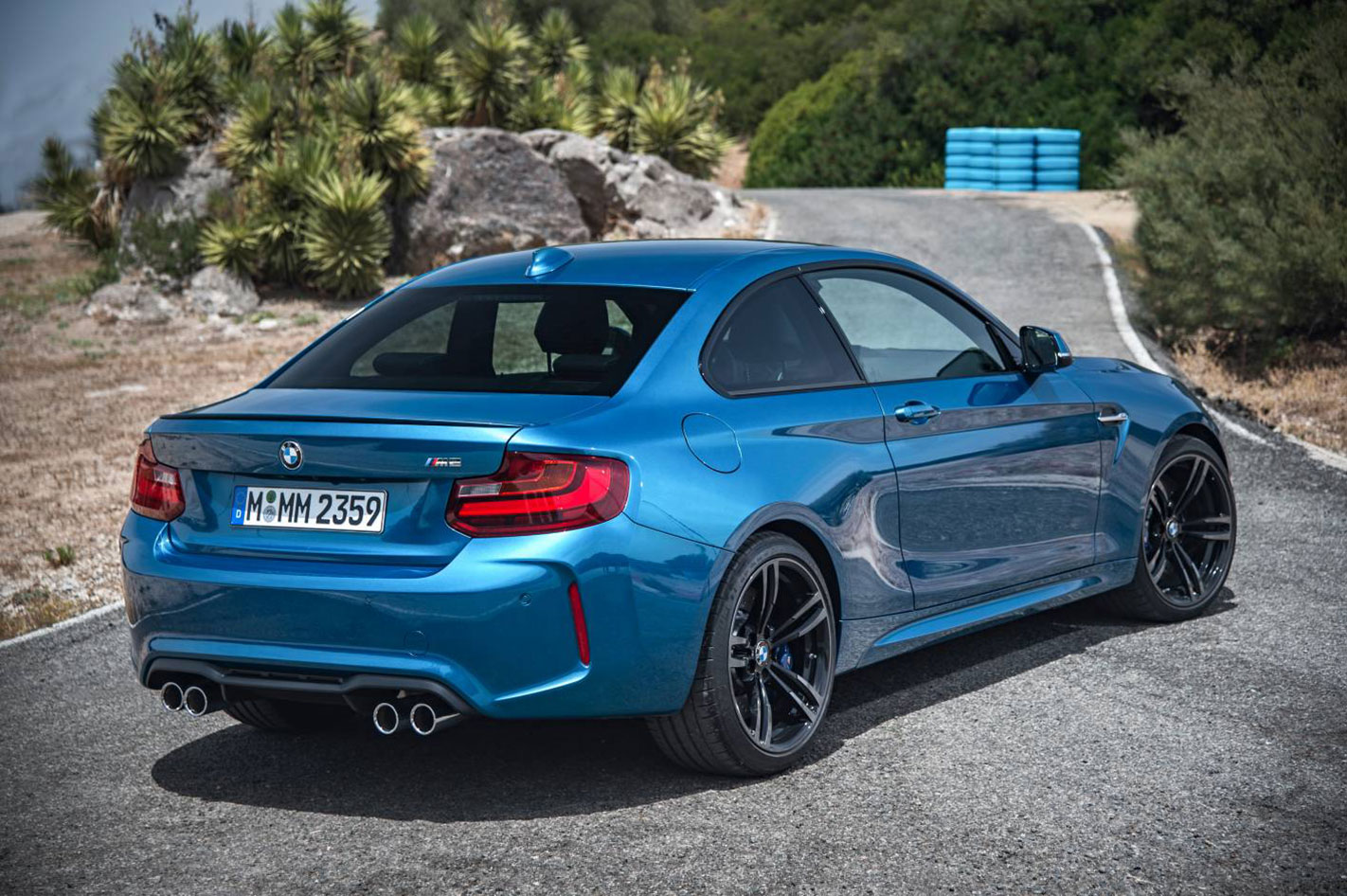
BMW’s seven-speed dual clutch gearbox, the only type of automatic available, is unique to the full-specification M2 model that drops the ‘Pure’ tag.
BMW has placed $9K between the manual-only ‘Pure’ and automatic ‘M2’, which represents the largest price difference between a transmission option in BMW’s model range.
To justify this BMW’s attached a considerable amount of kit to the price hike between specifications. Along with the dual-clutch ‘box BMW will also throw in an alarm system, keyless entry, heated electric seats, adaptive headlights that dip the high-beams automatically, and a Harmon Kardon sound system for the premium model.
Interestingly, though, the Pure is not available with an automatic transmission, whereas the ‘M2’ will be available with a manual transmission as a no-cost option.
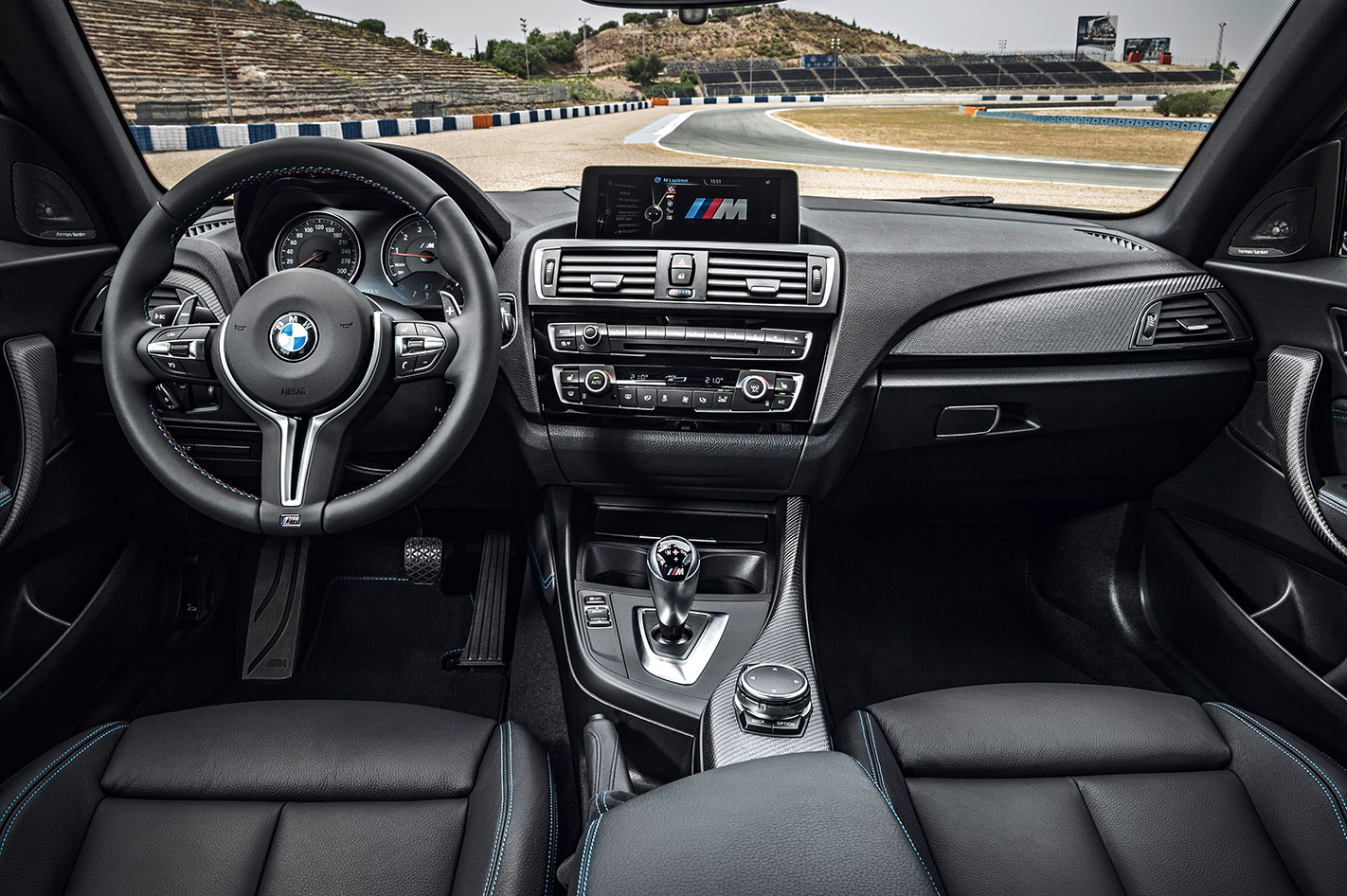
BMW says to expect the M2 here second quarter next year.
Everyone likes to think they’re a good driver. Most of the time, we get from A to B without incident, and obviously, the older we are, the more experience we have and therefore, the better we are at reacting, right?
Not necessarily. Europe’s JustPark have created a game that might suggest otherwise – it’ll either prove you have the reaction time of a 90-year-old, or it’ll take you back to 18 years old. The company surveyed 2000 people from 18 years and older to create the game.

Your reaction time plays a big part in the stopping distance of your car and there are a lot of circumstances that can change this such as speed, road conditions, what car you’re driving as well as impairments like drugs, alcohol and driver fatigue. So we’re not sure how this holds up in real life driving, but it’s a good indication and a great procrastination tool.

Plus, we don’t know about you but we’ll take the 21-year-old title any day. Or cyborg in the case of Anna, our Lifestyle Editor.
So, what’s your driving age?
You may be familiar with Jerry Seinfeld’s internet show Comedians in Cars getting Coffee.
If not, you should be, as it’s extremely entertaining and showcases some incredible machinery. However, if Jerry ever finds himself in a tight spot and needs one guest to fulfil both car and comedian roles he could do worse than choosing Jaguar’s new F-Type R convertible.
A new addition to the MY16 F-Type range, it replaces the previous V8 S and basically turns all the numbers up. Outputs from the 5.0-litre supercharged V8 lift from 375kW/625Nm to the full-fat 404kW/680Nm of the R Coupe while the price increases from $201,475 to $245,280 for the rear-driver and $260,980 for the new all-wheel drive variant.
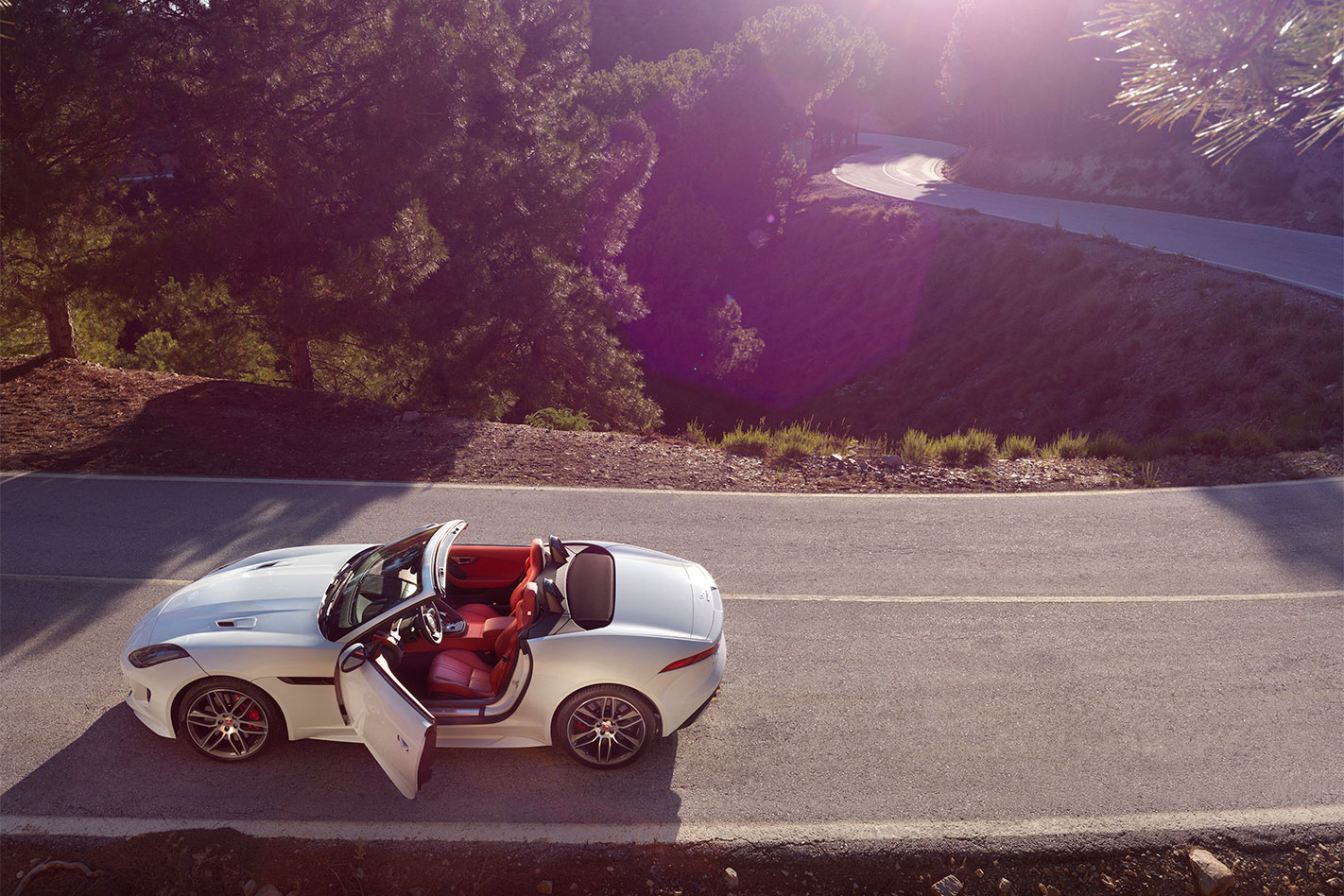
The steering is now electromechcanially-assisted but is a highlight for its weighting and rate of response; it provides strong turn-in but in second-gear corners it only takes half-throttle for the rear to break free. Despite its name, the ‘TracDSC’ mode is perfectly calibrated for the road, providing enough slip to feel involved but keeping a safety net in place.
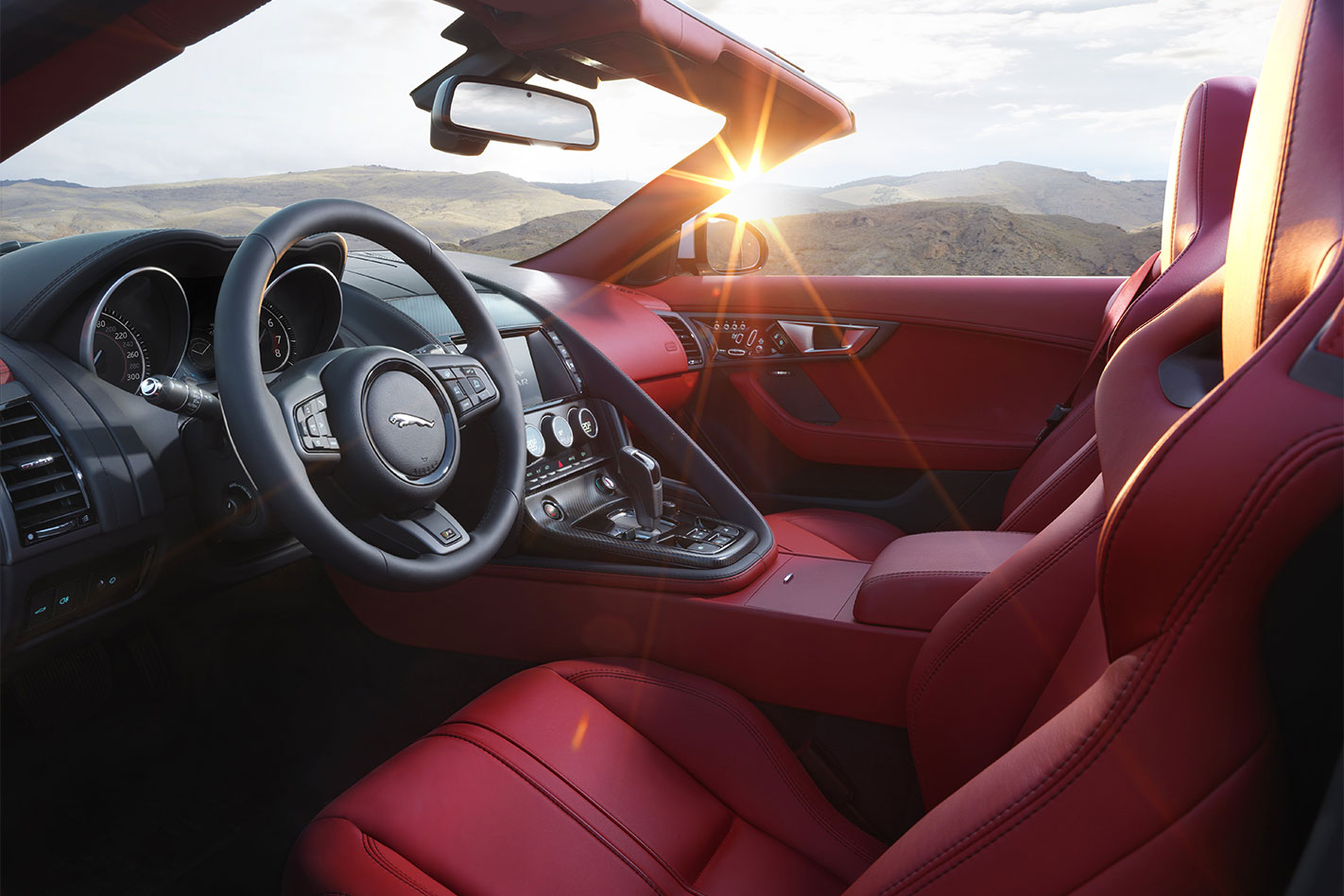
When those poor tortured rear tyres do finally hook up, acceleration is ferocious and the never-ending torrent of torque is accompanied by a raucous V8 soundtrack that you just can’t believe passes drive-by noise tests anywhere in the world.
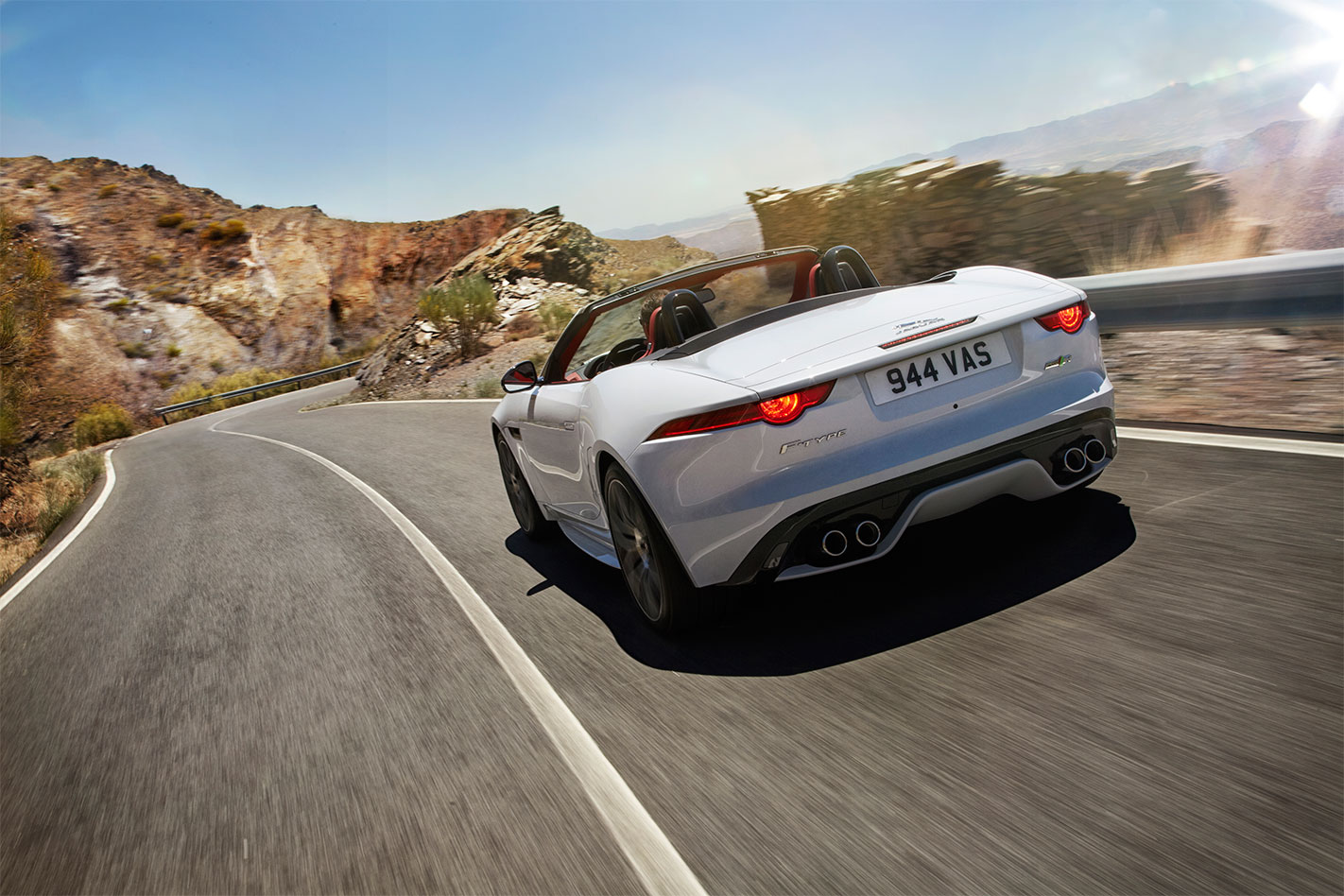
But who cares? The F-Type R is the perfect example of a MOTOR car. Non car-nuts just wouldn’t get it: why would you pay a quarter-mil for a car that deafens you, has no luggage space and devours a set of rear tyres every 2000km? Because it’s fan-bloody-tastic.
4/5
Specs
Engine 5000cc V8, DOHC, 32v, supercharger Power 404kW @ 6500rpm Torque 680Nm @ 3500rpm Weight 1665kg 0-100km/h 4.2sec (claimed) Price $245,280 (RWD)
THE last Australian-made Ford will roll off the company’s Broadmeadows production line on October 7, 2016, yet Ford Australia is yet to decide what model will officially sign off more than 90 years of manufacturing.
Ford currently builds the Falcon and Territory in Australia, and has confirmed October 7 date as the final day of operations. Which of the two vehicles – and what whether it will be a sedan or a ute if the Falcon is chosen.
“We haven’t decided,” Ford Australia president and chief executive Graeme Whickman said.
“The last unit rolling off the line is going to be an important day for us. It will be a celebration within the organisation.
“Yes, there’ll be people interested externally, but part of the dignified and respectful manner of how we’re transitioning in this country is important to us.”
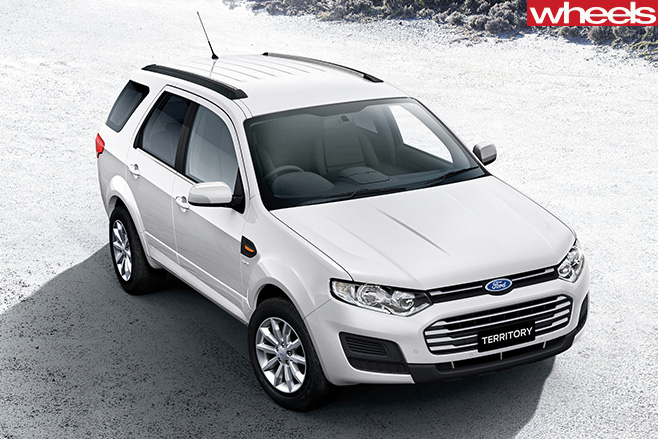
Whickman also assured Wheels that supplies of the Falcon XR8, which has seen it outstrip its forecast 1200 total sales, aren’t likely to dry up ahead of the closure. “We’ve worked hard to get all the bits and pieces required – including obviously engines – and my expectation is that we will continue to have a limited supply all the way through,” he said.
Ford isn’t expected to produce a flood of limited edition Falcons that arch-rival Holden is tipped to offer. That’s despite rumours of a high-performance Falcon XR6 Turbo Sprint that’s expected to be powered by the 310kW version of the locally-built 4.0-litre turbo six-cylinder, previously used in the FPV F6. Whickman would not confirm or deny the high-performance XR6 when questioned about it.
The Ford boss was also quick to quash criticism that the company’s locally made products have been performing poorly, with its market share having fallen to 6.1 percent, down from 7.3 percent this time last year.
“We’ve been pleased with our Falcon and our Territory numbers; whilst it may not be publically known, we had a plan – we reset the base last year – and we’re sticking to that plan, and we quietly market to our Falcon fans, and we keep hitting our numbers.”
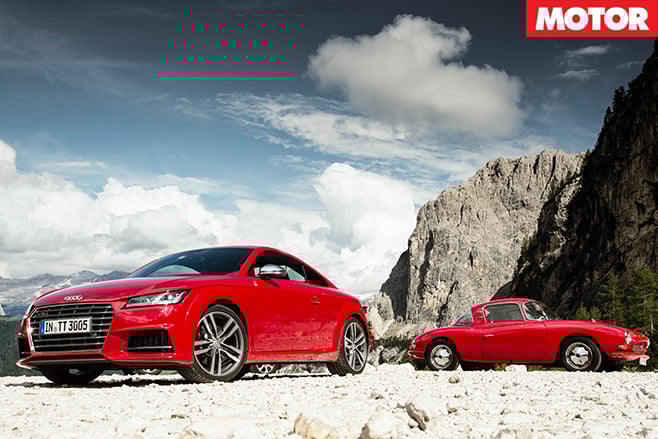
The genetic link between these cars, the diminutive DKW Monza Coupe and Audi’s Mk III TT, was established 58 years ago.
By the time the Monza broke cover in 1956, Auto Union, which encompassed DKW, Horch and Wanderer, had ceased to exist, with DKW, which incorporated Audi, the sole survivor. Two years later Mercedes-Benz acquired a majority stake in DKW before Volkswagen absorbed 50 per cent of the company in 1964, increasing that to 100 per cent within 18 months.
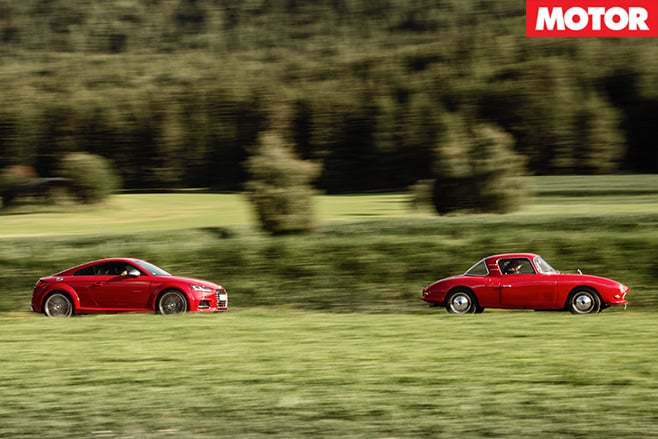
History’s not their most obvious commonality, though. Both cars were developed in Ingolstadt, and created as lightweight, efficient and compact coupes. Which is as good a reason as any to take both for an epic drive through the spectacular Dolomites in Northern Italy to see if we can trace the lineage.
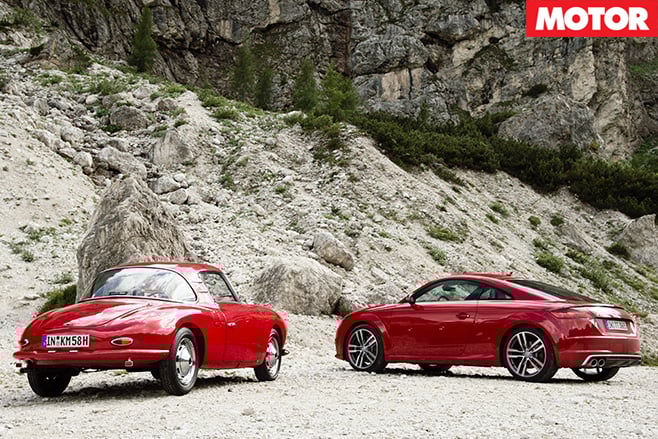
In contrast to the Monza’s limited success, the TT is almost an automotive icon. This third-generation, penned by Wolfgang Egger, arrives as a highly evolutionary shape and looks suspiciously familiar to its forebears from certain angles. The new TT may sit on VAG’s latest MQB architecture, but the silhouette and proportions have barely changed at all.
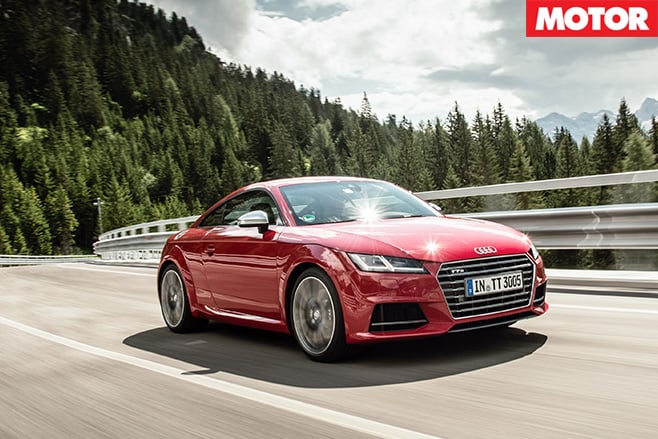
Our particular TTS is equipped with the S-tronic six-speed dual-clutch transmission and top-shelf 20s. Thanks to its highly-tuned 228kW/380Nm 2.0-litre turbo four, 0-100km/h takes just 4.7sec, matching the outgoing TT RS. At the same time its average fuel consumption (on standard-size tyres) has dropped from 7.9 to 7.1L/100km, though our spirited driving resulted in 12.2L/100km.
The improvements continue on the inside. The cargo bay swallows 305 litres, which increases to a shooting-brake-like 712 litres if you ditch the rear seats, which are next to useless anyway.
From the driver’s seat, the 2015 Audi TTS displays an exceptional level of fit and finish, and marks a significant advance in ergonomics. The eye-catcher is the new large TFT screen, which replaces the conventional instrument panel in its entirety and offers a choice of distinctive graphics. Gone then, is the second monitor that used to ride on top of the centre stack.
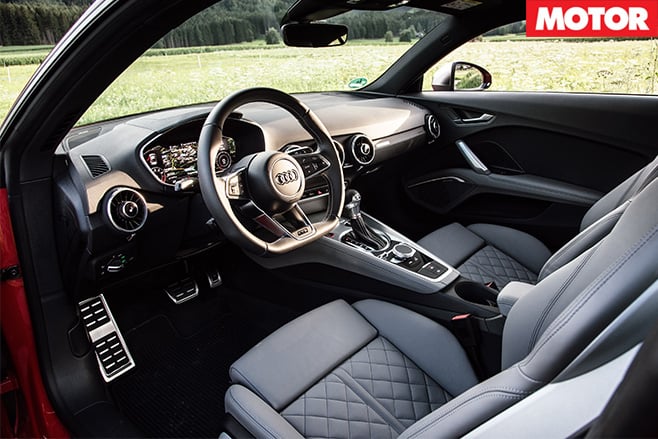
Like the recent S3, standard Drive Select is accessible via a button below the AC vents. Key vehicle traits are dialled in according to five different programs: comfort, auto, dynamic, efficiency and individual. We can’t help but think that an instant access button, like a Ferrari-style manettino switch, would be more appropriate.
After acquainting ourselves with the TTS’s interior, we’re back in the Monza and discovering that, though these two share a family tree, the polyester-bodied Monza and aluminium-bodied TTS are wildly different machines.
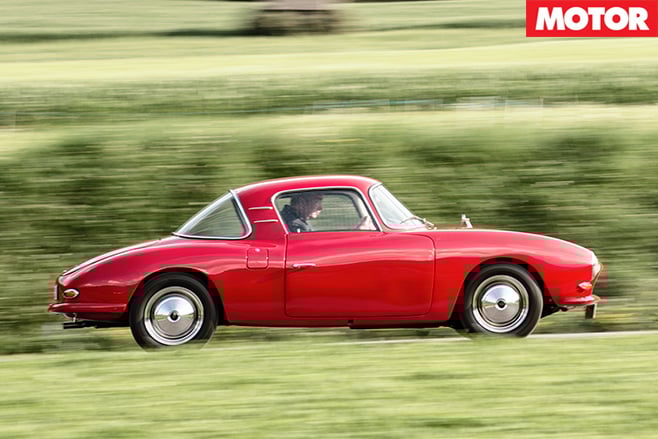
Its chassis consists of high-mounted front and rear transverse leaf springs, which are unusually supported by wishbones at one end of the car and by trailing arms at the other. Four drum brakes hide behind 15-inch steel wheels and flashy chrome hubcaps.
Under its bonnet, a tiny 980cc three-cylinder two-stroke unit buried deep down in the vast and nearly empty engine bay musters up a mere 33kW.
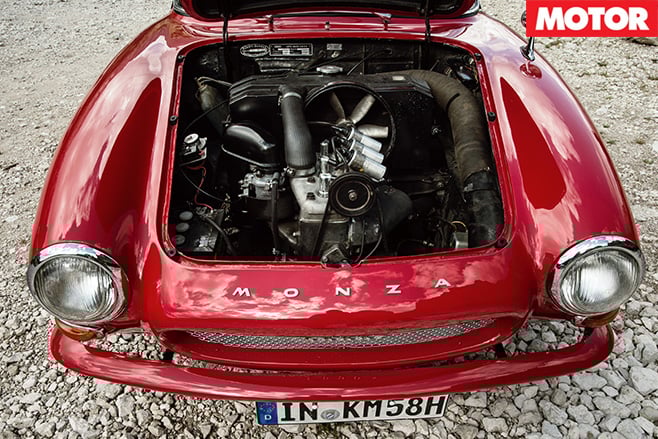
On this particular Friday, high up in the Italian Alps, our drive has hit problems. The Monza’s acting up. Pulling the choke and twisting the key, usually a fail-safe routine, produces only a string of misfiring. As it transpires, the engine will only start when the car is absolutely level, which is a bit of a problem in this mountainous region of the world.
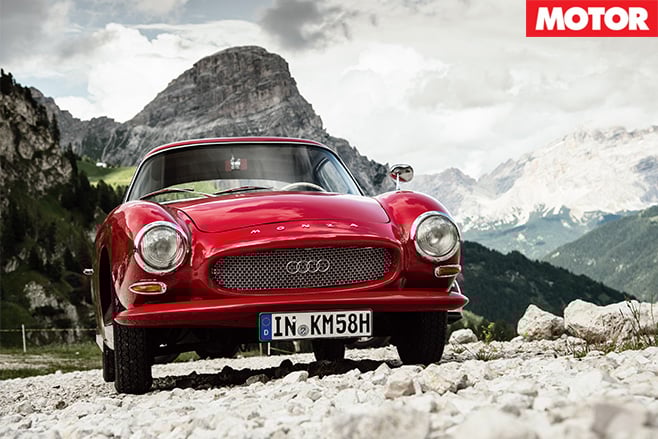
Things are better at the helm. Sure, the randomly sprouting pedals are trickier than expected but the unassisted steering is relatively light, gearing spot-on, and there’s no slack around straight-ahead.
It was this ratio which permitted the Monza’s original claim to fame – its 1956 record-breaking 72-hour endurance run when a pre-production version averaged 142km/h at Monza.
Jumping from the Monza to the TTS and there’s an intergalactic difference, which is highlighted when attacking the Dolomite’s corners.
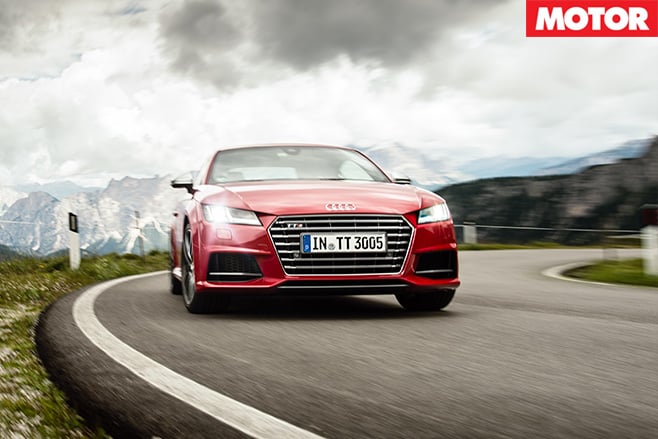
It sounds fast, too, with the new TTS’s sound actuators expertly manipulating intake and exhaust noise, especially locked in Dynamic – a mode which hurries gearshifts, tenses the magnetically adjustable dampers and relaxes the stability systems.
It also taps in to the drivetrain’s distribution of torque, asking the electronically-controlled Haldex clutch to send it to the rear wheels in direct response to initial turn-in, helping push the car into a bend.
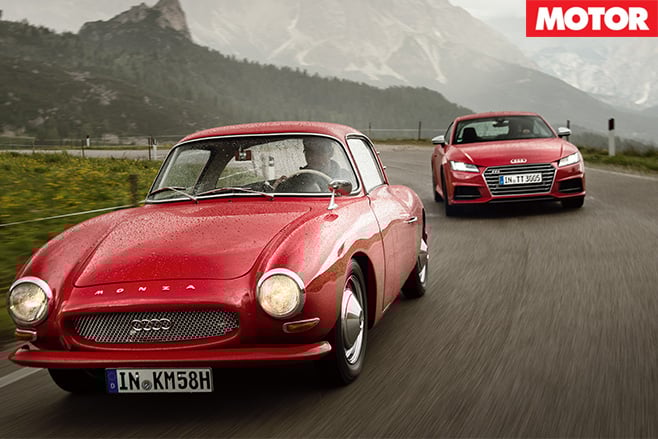
But there’s no need for this car to adopt a cornering attitude it wasn’t designed for, it can field plenty of other strengths. For instance, an undisputed traction advantage through slow kinks, perfectly manageable lift-off to assist turn-in and stoic directional stability even on broken surfaces.
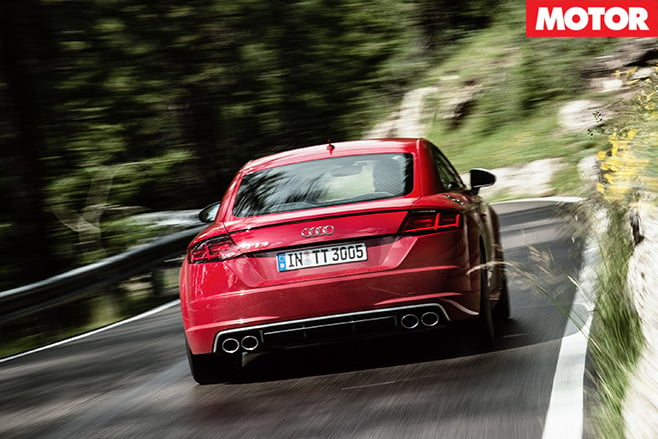
The DKW coupe is, in essence, a capricious near-classic which severely lacks grunt but oozes charm. In sharp contrast, the latest TTS is sure-footed and viceless. It’s fast, has a five-star cabin and does many things right, but loses out in the emotion stakes.
| u00a0 | u00a0 | Audi TTS | u00a0 | DKW Monza Coupe |
| Engine | u00a0 | 1984cc inline-4, DOHC, 16v, turbo | u00a0 | 980cc inline-3, two-strokeu00a0 |
| Power | u00a0 | 228kW @ 5700-6500rpm | u00a0 | 33kW @ 4250rpm |
| Torqueu00a0 | u00a0 | 380Nm @ 1800-5700rpm | u00a0 | 76Nm @ 2800rpm |
| Weightu00a0 | u00a0 | 1345kg | u00a0 | 810kg |
| 0-100km/h | u00a0 | 4.7sec (claimed) | u00a0 | How long have you got? |
| Top Speedu00a0 | u00a0 | 250km/h (claimed) | u00a0 | Depends on the gradient |
| Price | u00a0 | $100,000 (estimated) | u00a0 | $70,000 (approx) |
Rating | u00a0 | 3.5 out of 5 stars | u00a0 | 2.5 out of 5 stars |
AN ALL-NEW 2016 Fiat Tipo has its crosshairs set on the lower end of the C-segment small car class.
Plugging a gaping hole in the Italian brand’s arsenal, the neat if conservatively styled Fiat Tipo moves into value-for-money territory for Fiat Chrysler Automobiles.
It will eventually rival the likes of the Toyota Corolla, Hyundai i30, Kia Cerato, and Holden Cruze, rather than directly going after more sophisticated adversaries such as the Volkswagen Golf, Ford Focus, and Mazda 3.
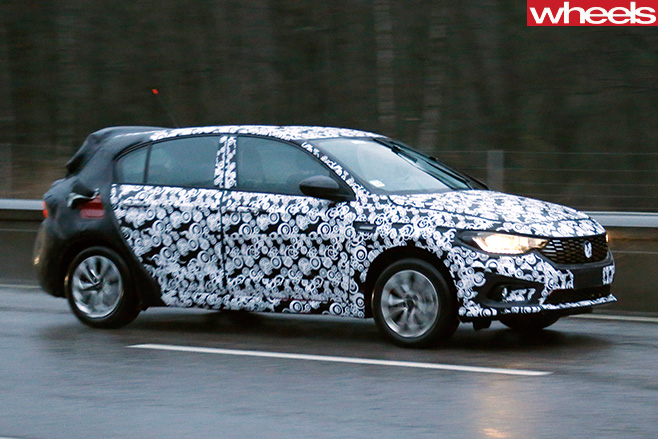
Most panels up to the central pillars, as well as the dash and cabin architecture, will be shared between four- and five-door configurations.
All three (a wagon is also in the pipeline) are expected to be present at the Geneva Motor Show in late February, and will be built in Turkey as part of a joint venture with Tofas (an acronym for Türk Otomobil Fabrikası Anonim Şirketi), in which FCA has a 37.8 percent stake.
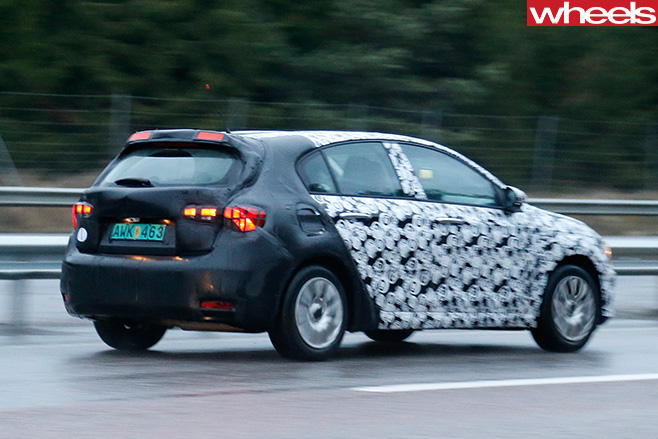
To help keep prices down against such fiercely cost-effective competition, the Tipo’s platform is a long-wheelbase evolution of the FCA/General Motors Small Wide architecture that has propped up the current Fiat Grande Punto and Opel Corsa for almost a decade. The hatch is said to be longer than a VW Golf.
Class-conventional engineering abounds, with a MacPherson strut front and torsion beam rear suspension set-up. Under the bonnet, 1.4- and 1.6-litre four-cylinder petrol and 1.3- and 1.6-litre turbo-diesel engines are slated for most variants, though higher-performance turbo petrol versions are also said to be under consideration.
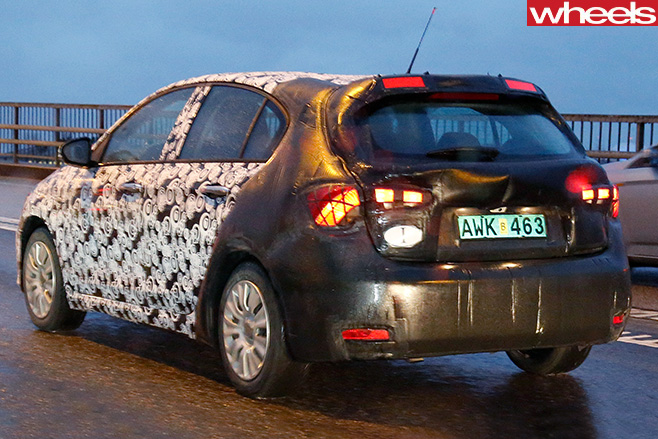
With the small car market dominating Australian new vehicle registrations, it is likely that FCA is deadly serious about importing the Fiat Tipo, though not before 2017 at the earliest. Expect pricing to kick off from the low-$20,000 mark.
Have spy pics of your own? We’d love to see them. Just email them to [email protected]
So, what is it?
Jürgen Königstedt is a shining light of hope for supercar aficionados who prefer their power supplied turbo-free. As Audi’s powertrain guru in charge of the second-gen R8’s glorious, naturally aspirated V10, he believes, “super sports cars could have an atmo future.” And if the sights, sounds, and sheer thrust delivered by the new R8 performance flagship is a taste of what’s possible, we’re with him all the way.
Why should I care?
Sure, Ferrari’s new 488 GTB is a techno tour de force, pumping out fat wodges of turbo-fed torque, but 5.2-litres of all-alloy purity howling towards its 8,700rpm ceiling makes maximum attack in the R8 a rare pleasure.
What’s new about it?
Like the first generation car, the new R8 shares much of its DNA with an Italian cousin. Audi has owned Lamborghini for 17 years, and first time around the long-serving Gallardo spawned the R8 (launched globally in 2006).
A decade down the track, the new R8 shares its underpinnings with the now one year old Lambo Huracán, including its hybrid construction (alloy/CFRP) space frame, V10 powerplant, electrically-controlled seven-speed dual clutch gearbox, double-wishbone suspension set-up, and all-wheel drive system.
Headline innovations for the Audi include standard Laser high beam headlights (Dr Evil will be pleased, although no sharks are involved), and the latest expression of the custom-configurable, hi-res TFT dash instrument display (tech debuting for Audi in the TT, and shared with the Huracán).
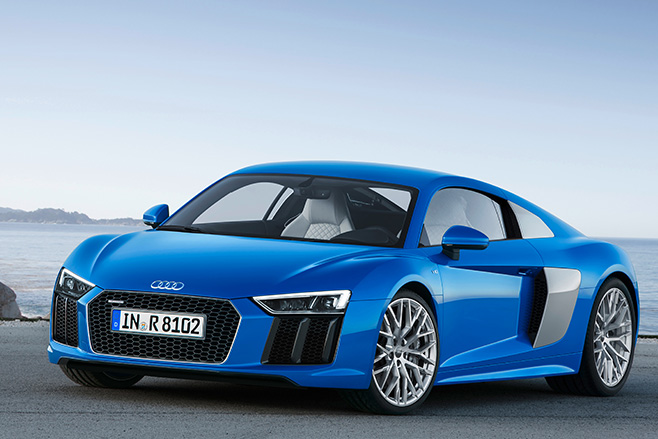
Although it’s an all-new car, the R8 is instantly recognisable as a design evolution of the out-going version. Wheelbase is identical, although the new car is fractionally shorter overall, thanks to 9mm deducted from the front overhang. It’s also wider (+10mm), lower (-12mm), and lighter (-40kg).
V8 lovers and manual fans should grab a straw and suck it up because Audi’s drop punted both options out of the R8 program. The car is now offered as a V10 with dual clutch only, the standard R8 V10 producing a hefty 397kW/540Nm, and the top-spec R8 V10 plus churning out 449kW/560Nm (identical output to the Huracán LP 610-4).
That’s all fine, what’s it like to drive fast?
We steered both R8 variants at the car’s global launch, including several hundred kilometres of flowing back roads across southern Portugal, as well as a day/night circuit session on the Autódromo Internacional do Algarve, in the southern coastal city of Portimão (last syllable rhymes with wow).
The overwhelming first impression comes courtesy of 10 cylinders sitting mere centimetres behind your head. We’re in the full-house R8 V10 plus, and straight line acceleration is ballistic. In fact, Audi says this is the fastest road car it’s ever built, and 0-100km/h in 3.2secs is only two tenths slower than the Fez 488 GTB, and just a tenth off Porsche’s 911 Turbo S.
That’s seriously fast company, and full compression of the throttle pedal slams you into the seat and narrows your field of vision to a centrally-focused tunnel of speed. This atmo engine loves to rev, enhanced by the combination of port (low revs) and direct (high revs) injection, as well as variable cam and valve timing; each eye-blink gear change delivering another stunning surge of acceleration. Let the ‘plus’ off the leash completely and it will punch up to 330km/h.
And then there’s the noise. Oh, the noise.
Audi’s development of the V10 introduces a specific intake set-up and exhaust system which stands the R8’s sound apart. No synthetic enhancement here; a full-blooded yowl in the mid-range, ascending to a blood-curdling, mechanical scream at the top end. And it’s worth noting the perceived and actual difference between standard and plus models is marginal.
As mentioned the ‘S tronic’ shift-by-wire, dual clutch seven speed (Lambo calls it LDF for Lamborghini Doppia Frizione) is race car fast, yet smooth and precise. The space frame chassis is claimed to be 40 per cent stiffer than the one it replaces, adopting a multi-material approach, blending CFRP (Carbon Fibre Reinforced Polymer) around the cockpit and rear bulkhead with aluminium in the rest of the structure. And the engine’s dry sump design means it can be mounted low to drop the centre of gravity down as far as possible. Front to rear weight distribution is 42:58 (identical to the Huracán).
The quattro all-wheel drive system uses a combination of mechanical diff lock and a new electro-hydraulic multi-plate clutch to seamlessly manage drive distribution between the axles, and steering is electro-mechanical. Standard rubber is 19 inch Pirelli P Zero (245/35 f – 295/35 r) and electronically-controlled dampers (Audi Magnetic Ride) are optionally available on both versions. A 20-inch rim wearing even wider tyres (245/30 f – 305/30 r) is optional.
The result of all this stiffening, balancing, and tuning is mega dynamic response, the R8 remaining stable and predictable even under extreme cornering pressure. On the circuit, the R8 V8 plus was fitted with the ‘Track Pack’ accessory option, which translates to a set of Michelin Pilot Sport Cup 2 semi-slick tyres. But the car’s open road character translates directly to the track; the nose pointing obediently and quickly with understeer the dominant trait at the extremely high limit of adhesion.
Braking by dinner plate metal discs in the standard car, with six-piston front and four piston rear calipers, is seatbelt-strainingly good. Carbon-ceramics with big eight pot calipers up front means the plus is race track ready.
Driver focus is the main cockpit design theme, and with the 12.3-inch TFT instrument display configured with a large, central rev counter and supplementary digital speedo driving quickly is simple and intuitive.
The standard multi-adjustable seats are brilliant, and the grippy, leather-trimmed wheel, complete with racy ‘satellite buttons’ sits in perfect alignment with the main gauges and peripheral switchgear.
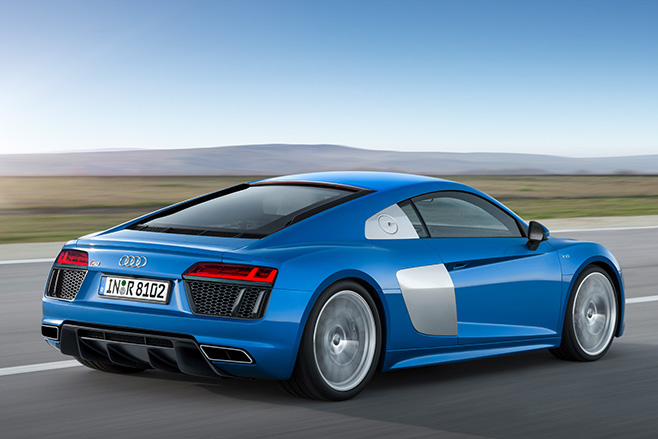
And driving home from the city?
The multi-function instrument display also negates the need for a separate infotainment screen in the centre console, and the interior feels restrained, yet surprisingly open.
A specific control on the steering wheel controls two flaps in the exhaust to enhance or mute its output, and the optional magnetic dampers magically iron out city and suburban bumps at the push of a button.
The engine also features COD (Cylinder On Demand) tech which knocks out one bank of cylinders at low loads (alternating either side to avoid cat converter cooling), a coasting mode which decouples the gearbox on zero throttle downhill runs, and a smooth stop-start function. All of which contributes to a 13 per cent improvement in claimed fuel economy.
Anything bad about it?
Despite sharp turn-in and reasonable weight, the steering lacks road-feel. Disconcerting in a car which buzzes the senses in so many other ways.
The arrow-shaped trim piece surrounding the top of the instrument binnacle also causes a massive windscreen reflection directly in the driver’s line of sight.
How much would I have to pay? And is it worth it?
Audi Australia’s launching the R8 locally in the second quarter of next year, and is yet to confirm final spec and pricing. But despite the fact the car is more expensive than the out-going model in Germany, the stated aim is to make it cheaper here. On that basis, expect the standard R8 V10 to weight in around $360k, with the plus stepping up to just the other side of $400k.
Standard equipment includes the latest MMI (Multi Media Interface) set-up, with a larger rotary/push-button controller featuring a touch-sensitive element for scrolling, writing and zooming in the nav function. Voice-control has also been upgraded for audio and phone.
Would you take the Audi R8 or Lamborghini Huracán?
So near and yet so far apart, the R8 exudes technical efficiency next to the Lamborghini’s more flamboyant personality. The R8 absolutely stands up as a daily driver, while the $20-$60k dearer Huracán is a special occasions special. Both fantastic, the choice will be determined more by the scale of your ego than the size of your wallet
Click here to find out more about the Audi R8.
You know a component has been underperforming when its replacement transforms the entire car to which it is attached.
There is more to the MY15 Aston Martin Vanquish than a new transmission, but if just looking at what it does for the car on paper gives an idea of the improvements, the change is more dramatic still in the real world.
The reason Aston Martin appears to have been so far behind the curve fitting the now-ubiquitous ZF eight-speed automatic gearbox to the Vanquish (and the Rapide S) is, until now, none has been available for a transaxle application. Placing a gearbox between the rear wheels will work wonders for weight distribution and traction, but it means the prop shaft not only enters the gearbox rather than exiting it, but also does so at engine rather than road speed.
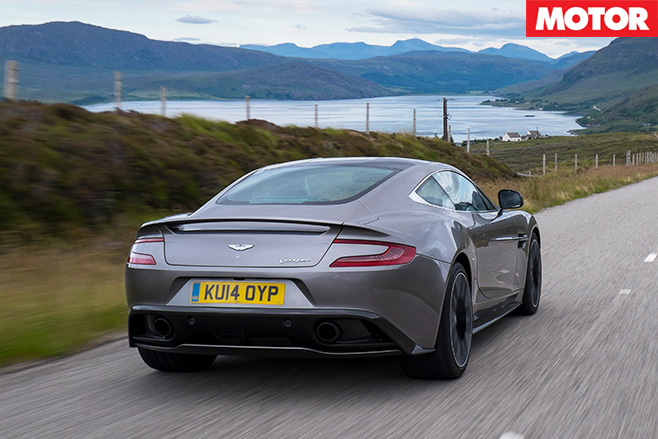
Meanwhile, the closeness of the lower ratios has carved 0.3sec from the 0-100km/h time, which may not sound like much, but down here in the strange world below 4.0sec, it matters. To be perceived as a proper supercar you have to go under 4.0sec and over 320km/h.
Now, the Vanquish can join the likes of the Ferrari F12 and Lamborghini Aventador in this most exclusive club.
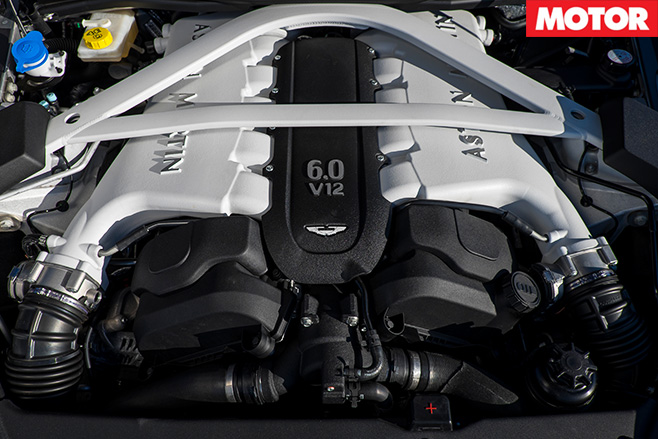
Aston Martin has also gone to work on the suspension, raising the front spring rates by 15 per cent and those at the rear by a substantial 35 per cent, a move coupled with a thicker rear anti-roll bar and new toe and camber settings. Making the car stiffer will make it corner flatter and faster, but raising the rear spring rate will also make the car more inclined to oversteer. Bespoke Pirelli P Zero rubber mounted on lighter alloy wheels that remove 7kg of unsprung weight complete the picture.
In the past, I have found the Vanquish confusing. While the wondrous V12 Vantage S is a sports car down to its tyres and the DB9 a classic GT, what was the Vanquish, other than far more expensive than either and less clearly resolved?
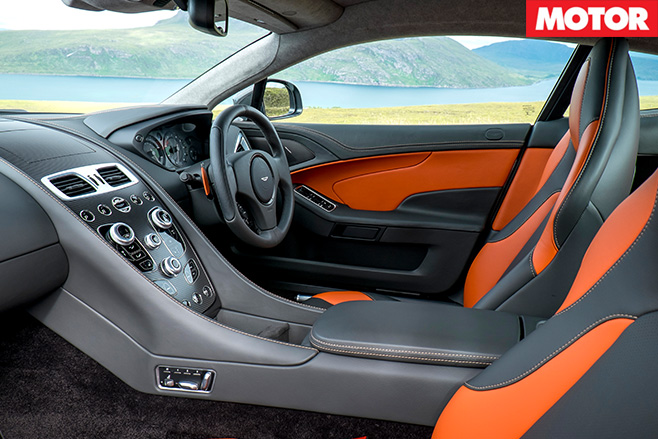
Atmo engines with high specific outputs need a stack of closely spaced gears to show them at their best, and this is precisely what the new gearbox does, keeping that delicious V12 yowling right in the thick of its torque band. Most of the time, and unlike the previous Vanquish, it feels like the torque converter is locked, so there is little or no mush in the system. Prod the pedal and it responds in kind.
Even so, its not going to frighten an Aventador or F12. Aston’s flagship will thrill all day long, but if you want to go past where exhilaration turns to wide-eyed, white-knuckled fear, it’s to the Italians you should turn. But if you are more interested in how a car feels than how fast it is from point to point, the Vanquish has more to commend it than ever.
Its steering is the most lucid in its class and its chassis probably now the best balanced. Use one to exploit the other and there’s rare and sophisticated pleasure to be had.
The price paid is ride quality. I’d tolerate some additional secondary interference for its greater agility, but primary body movements over humps and dips are disappointing. On admittedly tough roads in the Scottish Highlands, the Vanquish felt underdamped and lacking in poise.
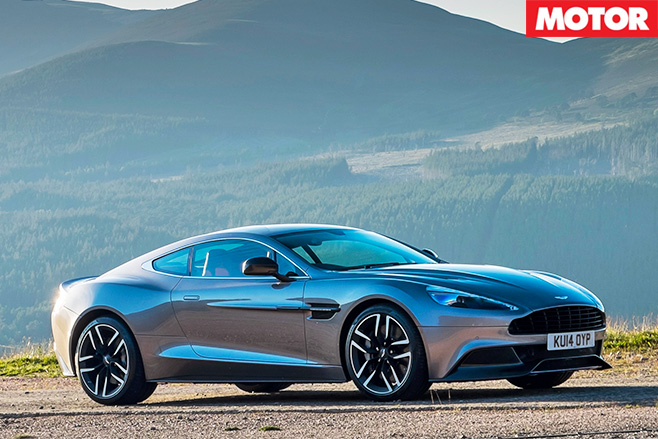
True, the gearbox has removed the car’s single biggest failing, but it would be more unkind than inaccurate to observe that all it has really done is allow the Vanquish to become the car it should have been from the moment it was launched. But when that car is as indulgent, satisfying and emotionally appealing as this one now is, such earlier and now irrelevant transgressions are easily overlooked.
4 out of 5 stars
Specs
Engine: 5935cc V12, DOHC, 48v Power: 424kW @ 6650rpm Torque: 630Nm @ 5500rpm Weight: 1739kg 0-100km/h: 3.8sec Price: $472,840
