
Senna? Hopeless at Trivial Pursuit. Loeb? I doubt he has ever won a meat tray at a pub in his life. And I don’t ever recall Brocky sitting opposite Eddie McGuire on Who Wants To Be A Millionaire?
Skill, talent and bravado behind the wheel win motorsport endeavours, right? Not quiz aptitude. So I ask that you consider this while I report that MOTOR has contested the Italian Connection Trophy road rally. And come last.
No, not last in category. Not ‘done poorly’ or ‘towards the bottom’. Bloody. Stone. Cold. Motherless. Last. Place. Outright.

It’s primarily a social grand touring event, and secondarily a charity run to raise money and awareness for Duchenne Muscular Dystrophy, a rare, ultimately terminal illness affecting one in 3300 males.
Some 800km of punting Australia’s finest twisties is supplemented by off-street elements such as timed motorkhanas, speed trials and lap sprints. All right up MOTOR’s alley. But the ICT bases its main competitive component on navigational skills (oh dear) and how adept entrants are at answering cryptic questions related to the route (oh very dear). So while Berry and I brought our game faces, turns out it was for the wrong game.

For starters, Fiat/Chrysler Oz supplied an Abarth 500C EsseEsse (aka, someone else’s car), good for 118kW/230Nm before you factor in its mod of an optional freer-flowing exhaust system.
The best optional extra, though, was its Michael Gee enhancement – a tireless Tassie lad who shadowed our white-on-white rag-top in a Jeep Grand Cherokee piled with supplies (aka, someone else’s fuel, tyres, helmets and credit card) as support crew. The most packed by half of the rest of the field was a sharp pencil for the quiz sheets and a picnic lunch.
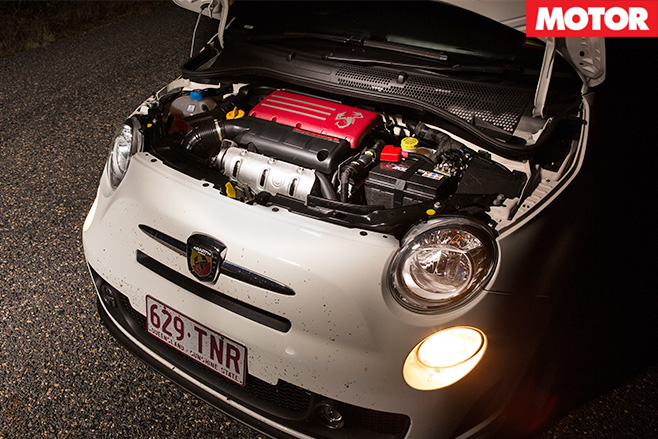
At scrutineering, a fellow competitor remarks that the Abarth is a quick breed, to which I respond it would be if we figure out how to activate its launch control system (which, I’ve heard, isn’t so much as mentioned in the owner’s manual) for “stage one”. He shoots me a look which clearly asks “why the bloody heck will you need launch control?”
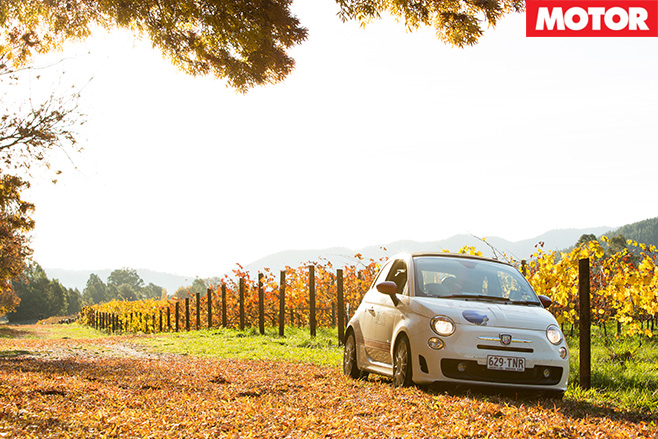
Of course, I blame Berry. And a lack of caffeine. And the car, which, even at $38,990 (a $4000 premium over the hardtop EsseEsse), has no sat-nav. I’d also noticed, well into Thursday’s 550km transport stage from Sydney to ICT’s base camp of Albury, that there’s no cruise control either.
It turns out the ICT, which isn’t strictly for Italian marques, is a bit of an Abarth-fest. We’re the only soft-top among a gaggle of five Abarth, meaning three of MOTOR’s direct rivals are 50kg lighter (1035kg) three-door tin-lid hatches sporting conventional five-speed manuals.
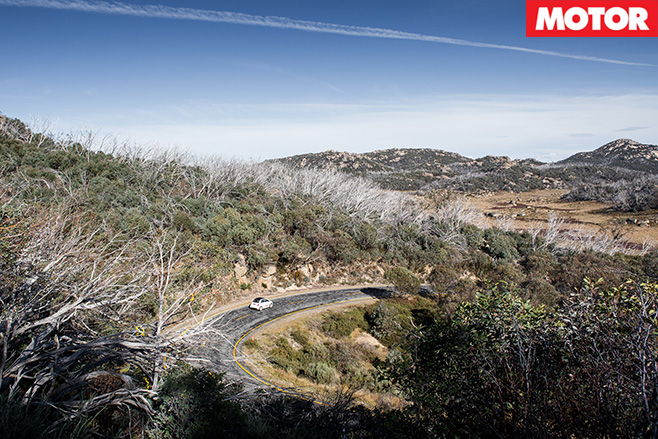
The flag drops, we blow the outskirts of Wodonga on a snaking 200km beeline toward Mount Hotham and I start strategising where I’m going to start rounding up our Abarth nemeses when, 15 kays in, Berry commands me to pull over.
“Scouts Australia is the parent body of what group?” he says. Pardon…? And so begins the quiz component of the rally, some 73 brain teasers spread over three days and two states that rely on observation, Sherlock Holmes-like deduction and the Abarth stuck firmly in Park on the side of the road. And I think to myself: why?
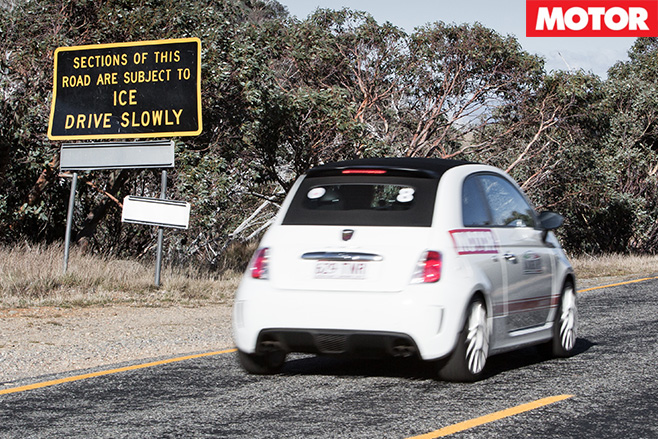
It’s simple really: success in ICT is as much – if not more – down to the co-driver as it is to the driver. Success or failure is largely down to those in the left-hand seat – the spouses, children and grandparents. Family-friendly motorsport, then, in the most literal and proactive sense.
That said, the driving component is brilliant. Mitta Mitta to Omeo could be the most relentless 100km stretch of tight, hard-attacking corners in Oz. And when the route gets challenging and serious, ICT suspends the quiz component from the itinerary. So as we climb Mount Wills, the 1.4-litre turbo strung off its redline, I’m surprised at my co-driver’s request to pull over. And not in the quest for trivial answers. Berry’s car sick.

It’s humiliation. So I do what any responsible team leader should do in such situations: I share Berry’s woes with anyone I can think of via electronic media. “I don’t get car sick,” Berry later retorted. “It was just a slight unsettling of the inner ear.” Sure.
By the time the wonderful Hotham Heights-Bright loop returns to Albury to complete day one, we’re placed 15th in the running and nowhere. But we’ve sampled some stunning roads, some of them even the correct ICT ones, to make the bottom order.

During 2014’s unseasonably fine May, though, it’s all smooth running, and the Abarth is proving as sharp as its pilots are blunt. We’re tumbling down the order like a pair of drunken clowns. At dinner, we discover we’re in last place. There’s another day to go.
In pathetic desperation, Team MOTOR Fiat – well, Berry, mostly – resorts to attempted cheating by trying to butter up three ICT veterans in a Valiant Regal to provide us with correct quiz answers. They shrewdly demand gold to the event’s sponsor charity in trade. Ruthless, I tell you.
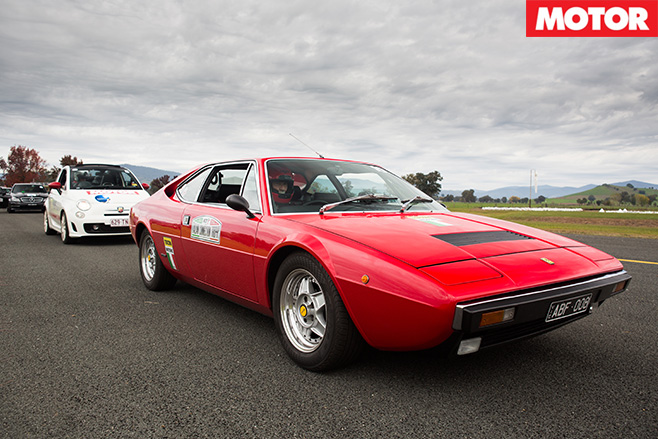
Motorkhana One, run one is a flurry of hapless steering inputs and handbrake butchery. Run two feels tighter and quicker…until an official informs me I ballsed up the cone sequence. D’oh. Fourth quickest though and our dignity, at last, begins to turn a corner.
Motorkhana Two is one run only. So a full kamikaze approach is the only way. Halfway along I clip a cone, copping a brutal five-second penalty. So imagine my surprise to find out my penalised time was still third quickest outright! Sans the cone infringement I’d have topped the table by two full seconds… We’re back!
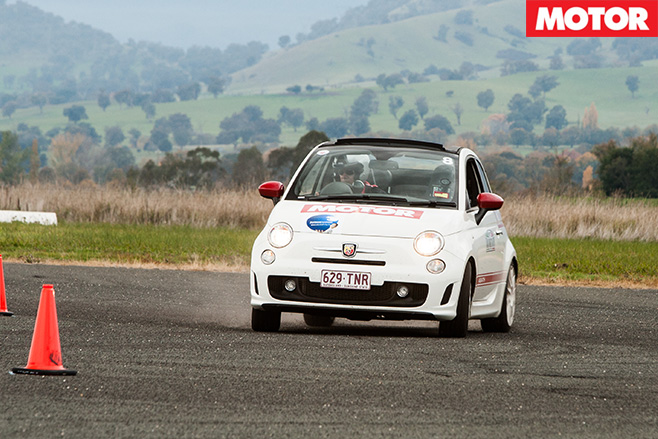
The event’s final road loop, some 144km to the Logic Driver Training Centre in Wodonga, is time to cool the heels and get the game face straightened up. Berry and I have now clocked up nearly 2000 kays in the Abarth and its driving position – all arms and no legs – is taking its toll on my back.
But, jeez, its agile little chassis, tremendous front-end grip and point, and robust handbraking talent have certainly made up for its ergonomic woes. The car’s abilities are bringing a shine to the MOTOR Militia party.

It doesn’t break. Far from it. I’m not sure which run was my 44.47 second pass but it tops the timesheet. Take that Scouts Australia.
With confidence rising, ICT presents its final challenge: two one-kilometre-long sprints, point-to-point, around Logic’s handy little, nine-corner race circuit. If MOTOR’s reputation will hang anywhere in the event, it’s here.

Pass two is a flat-out, 11-tenths flurry of constantly screaming tyres, nudged grass verges, wrung out redlines and torturous braking points. I almost take out the timing equipment over the flying finish. It wasn’t the prettiest lap, but the grab-its-scruff attitude is certainly what the Abarth seemed to relish.
It felt fast. Turns out that it was fast. The little 1.4-litre, convertible, automatic, trumped-up Fiat 500’s lap time of 49.13sec was third quickest of the entire field.
An absolute blast? Certainly. Even this dunce can understand that coming stone motherless last doesn’t really matter, as long as you have fun – and take a few scalps – getting there.
Abarth Fiat 500
Engine: 1368cc inline-4, DOHC, 16v, turbo Power: 118kW @ 5500rpm Torque: 230Nm @ 2750rpm Weight: 1085kg 0-100km/h: 7.4sec Price: $38,990
IS THIS the Mazda MX-5 you’ve always wanted?
The 2016 Fiat 124 Spider was revealed at the 2015 LA motor show as the start of Fiat’s renaissance, and comes with a more powerful turbocharged engine and Italian dressing inspired by its classic 1960s namesake.
The highly anticipated soft-top convertible, which is based on the Mazda MX-5 and built in the same Hiroshima, Japan, factory, was launched in the prime convertible market at the LA motor show.

Despite the Mazda MX-5 platform, which means it shares the same hard points and overall proportions, Fiat exterior design chief Felix Kilbertus says that the team didn’t reference the MX-5’s styling as it developed the 124, nor was the look an abandoned Alfa as parent company Fiat-Chrysler decided which marque would get the new roadster.
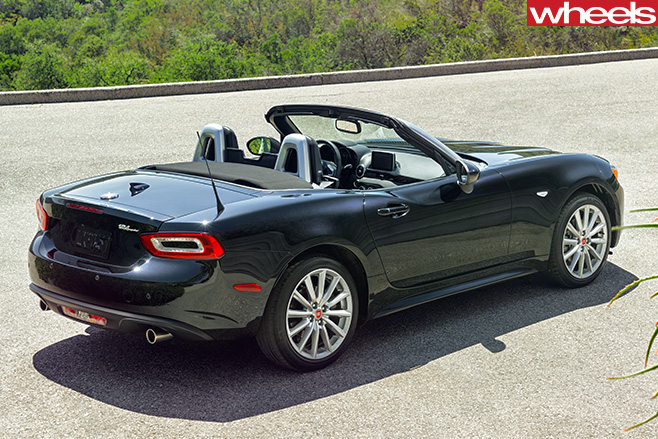
That means that not a single body panel – not even the doors – are shared with the Mazda, with the windscreen and that clever, lightweight roof mechanism carrying over from the MX-5.
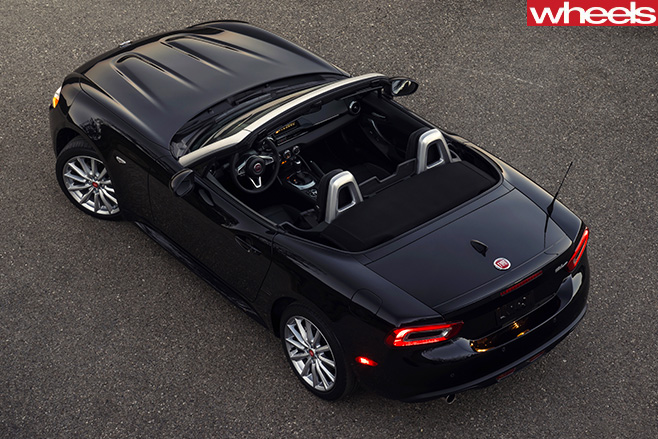
“We put a lot of effort into the things you interact with directly – the door handles, the shifter which was then covered with beautiful leather, the steering wheel which has a unique section,” Kilbertus said.

There’s double-wishbone front and a multi-link rear under that body, which at 4054mm is 139mm longer than the MX-5. It’s also 5mm wider, with broader front and rear tracks, and weighs in at 1105kg for the manual entry-level model, making it 96kg heavier than the Mazda.
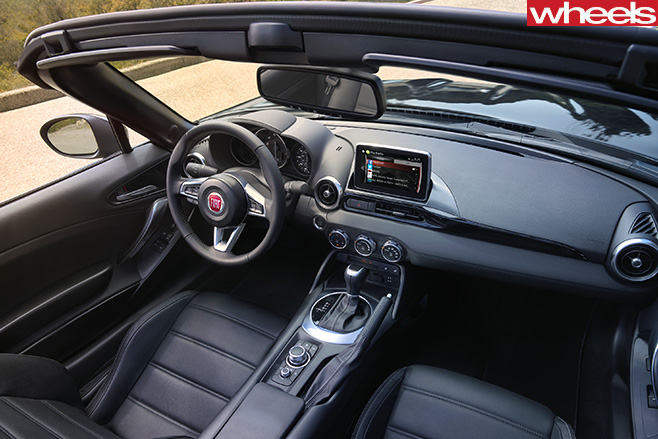
Fiat-Chrysler Australia is yet to confirm the 124 Spider for this market, however it salivating over the opportunity the car may present. “It will provide a huge boost to Fiat here,” said a company spokesperson. “It’s a hugely exciting car for Australia, and more exciting still because it’s just one part of the 124 story, and one part of the Fiat story.”
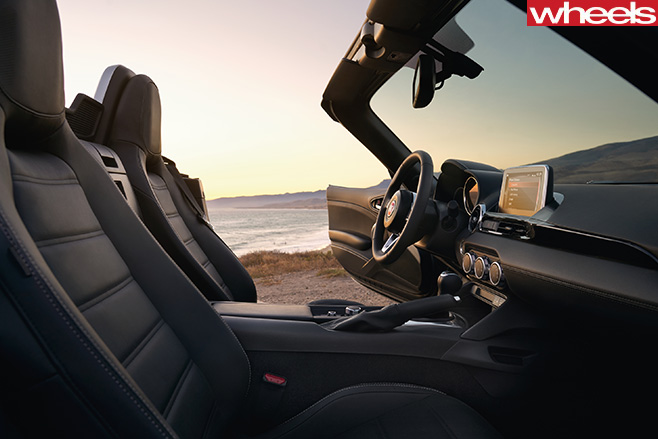
The Fiat 124 Spider goes on sale in North America in the second-quarter of 2016, and may be in local showrooms later next year.
MAZDA’S MPS high performance models aren’t likely to be offered in the current generation of cars, with the company investing its resources in the flagship sports car, shown as the RX-Vision concept at the 2015 Tokyo motor show.
President and chief executive Masamichi Kogai poured cold water on the possibility of the new 2.5-litre turbocharged engine that was shown in the 2016 Mazda CX-9 at the LA motor show as a new performance engine in smaller models.
“We don’t have to have any specific vehicles that we call Mazdaspeed [MPS], because we incorporate that performance across the board,” he said at the LA show. “We are not going to change that policy.”
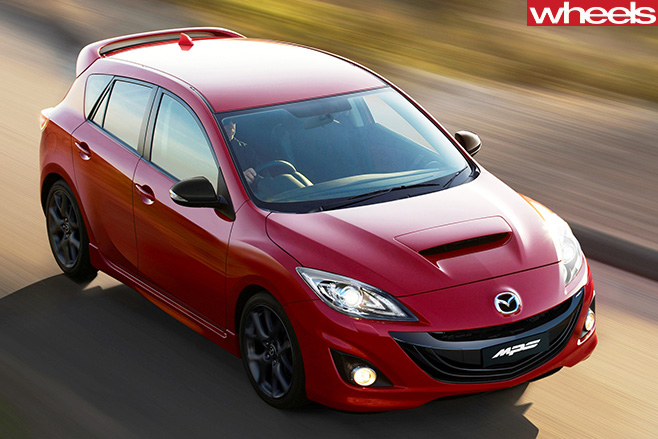
What’s more, it’s completely viable on a technical front, as the CX-9 shares its underpinnings with the Mazda 3 and 6, meaning that the new engine, Mazda’s first SkyActiv turbo, and drivetrain would fit under the bonnet of both.
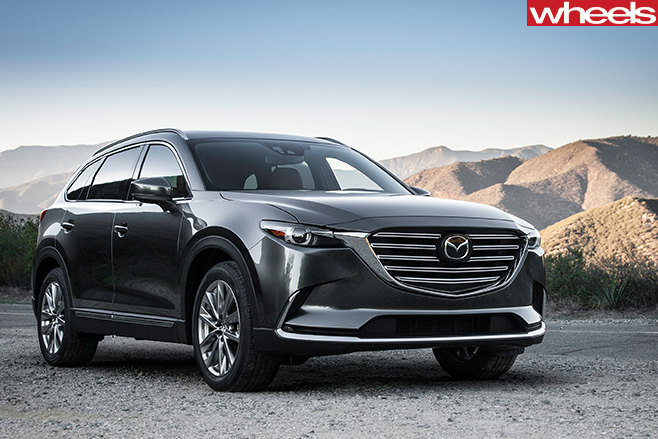
Yet there’s little scope to improve the engine’s power and torque, which are 169kW/420Nm in the new CX-9. The engine block is particularly small, as for the CX-9 it had to fit between straight chassis rails (instead of curved) that its engineers wanted for better crash protection. That means the spaces between the cylinder bores are fine, and cannot be used for improved cooling, something that a more potent model would demand. Dropping it in a 3 wouldn’t see it necessarily live up to a performance driver’s expectations, either, as it’s been developed and geared for a seven-seat SUV full of kids – and shattered MPS dreams.
LA Motor Show: Lifting the lid on the topless SUV – can Land Rover make the genre work?
WHETHER you see it as a return to the original 1948 Land Rover Series fabric roof 4×4 roots, or a new-wave, hair-tousling take on the luxury SUV, the Range Rover Evoque Convertible hopes to prolong the fashionista appeal of the great British success story of the last few years.
Dubbed the most capable all-terrain convertible in the world – with words like that, Solihull is surely wrangling for a catfight with Jeep – the monocoque bodied two-door, four-seat drop-top lobs in from about August next year priced from a heady $84,835 for the SE Dynamic Td4. Most will be powered by a 2.0-litre Ingenium turbo-diesel, though Ford’s 177kW Si4 four-pot turbo petrol is also on offer for the time being.

According to the company, the Evoque Convertible meets all of Range Rover’s “rigorous standards, ensuring exceptional structural rigidity, trademark refinement, outstanding levels of safety and unrivalled breadth of capability”. Should things go topsy-turvy, twin roll-over bars behind the rear twin seats deploy inside of 90 milliseconds.
Of more interest to most potential buyers is the debut of Jaguar Land Rover’s new high-res 10.2-inch touchscreen infotainment system known as InControl, offering fast, seamless smartphone connectivity, advanced sat-nav, and high-end audio.
So why is the Evoque Convertible here? Land Rover wants to ensure it is at the pointy end of a predicted 20 percent growth in global SUV sales over the next five years. It’s pure economics, then.
Convertible rivals? We’d nominate the upcoming C-Class, BMW 4 Series, Audi A5… at least the latter offers all-wheel drive. Just like that old Defender soft roof…
Now, we’re not usually in the business of publicising other outlets’ work, but we’re car nuts like all of you, and we’ve been waiting a long time for this.
Journo and driver extraordinaire Chris Harris has finally got his mitts on the hybrid hypercar Holy Trinity: Porsche’s 918 Spyder, the McLaren P1 and Ferrari LaFerrari.
This time around he’s enlisted some friends – Tiff Needell of Fifth Gear fame and racing driver Marino Franchitti – and they drive them like they’ve stolen them.
A word of warning, you’re about to lose an hour of your life, as the film is 52 minutes in length, but this is as good as car videos get.
As the cheapest Porsche until recently, the Boxster has traditionally attracted a certain type of customer. Not pointing fingers, or adding to any stereotypes, but forgive us if this has somewhat affected our lust for Porsche’s droptop junior model.
But, after one short drive, the Boxster GTS has sort of changed all that.
Starting from $146,000 the Boxster GTS is $44,500 more than its 2.7-litre base manual sibling which immediately means it’ll frighten off anyone who’s just buying a Boxster for the badge. The GTS, instead, is the most enthusiast-focused Boxster we’ve ever driven.
A step above the $126,500, 3.4-litre Boxster S, the $19,500 premium buys you another 11kW and 10Nm. Porsche has remapped the ECU to optimise timing of the variable inlet valves, the GTS now wringing 243kW and 370Nm from its 3.4-litre flat-six. There’s a bevy of minor cosmetic changes inside and out, paying attention to a “blacked-out” theme, and you now score 20-inch 911 Carrera S wheels standard.
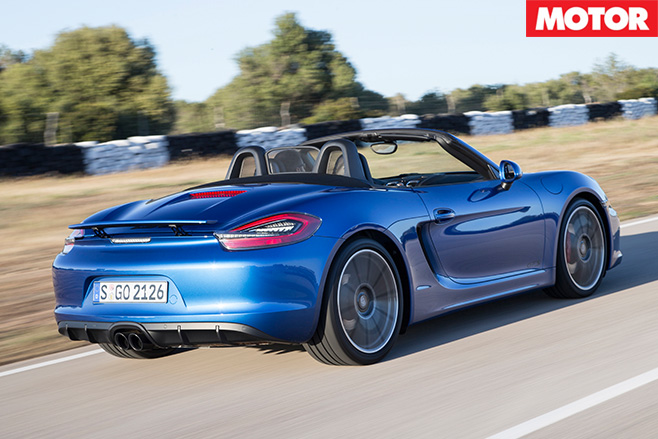
The result is a more masculine Boxster – with the poke to back it up.
Zero to 100km/h is now 5.0sec in the manual, down just a tenth, owing perhaps to the fact that, at 1345kg, the manual Boxster GTS weighs 20kg more than the manual S.
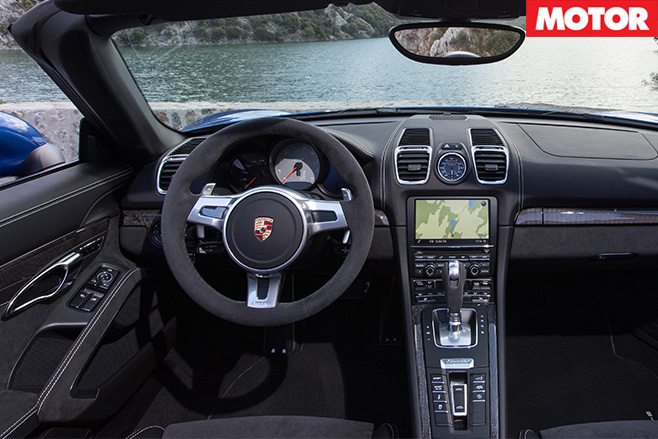
To drive? The Boxster GTS is bliss. That little extra oomph means suddenly, the Boxster pulls through its seven PDK, or six manual gears a whole lot harder.
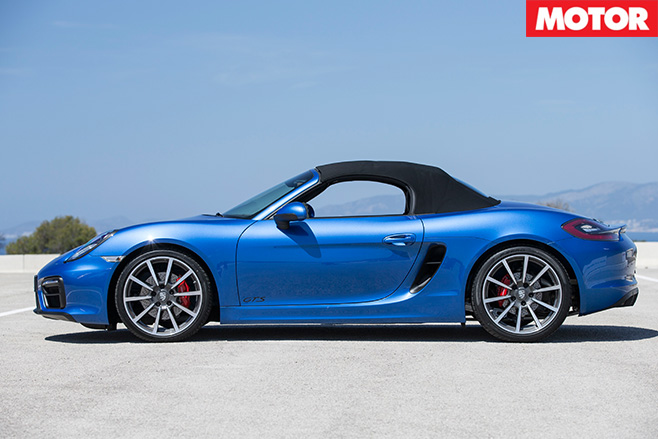
The active exhaust also seems louder – almost to the point of being anti-social. Not that we’re whinging. Neither would you if you heard one at 7800rpm. And, hopefully, it’s a noise most owners will hear often, given the GTS is built to be belted – like all Boxsters, really.
4.5 out of 5 stars
Specs
Engine: 3436cc, flat-6, DOHC, 24v Power: 243kW @ 6700rpm Torque: 370Nm @ 4500-5800rpm Weight: 1345kg 0-100km/h: 4.7sec (claimed) Top Speed: 279km/h (claimed) Price: $150,990 (auto)
The sun shines brightly, bathing Ford’s You Yangs proving ground in a warm glow, yet encircling its perimeter are thick black clouds, leaden with rain.
The weather is an apt metaphor for today’s activities. Doom and gloom surrounds the Blue Oval in the outside world as it makes the difficult transition from local manufacturer to importer, yet here today there is a palpable sense of excitement on both sides.
MOTOR is at You Yangs to drive the last-ever Falcon GT and meet the team that created it, a small group of engineers proud of their achievement and full of passion for the project.
They needed to be. With a shoestring budget and short time frame within which to work – the program only kicked off in September last year – they essentially volunteered for one of the toughest tasks imaginable, satisfying the demands of diehard Ford fans hungry for one last hurrah.
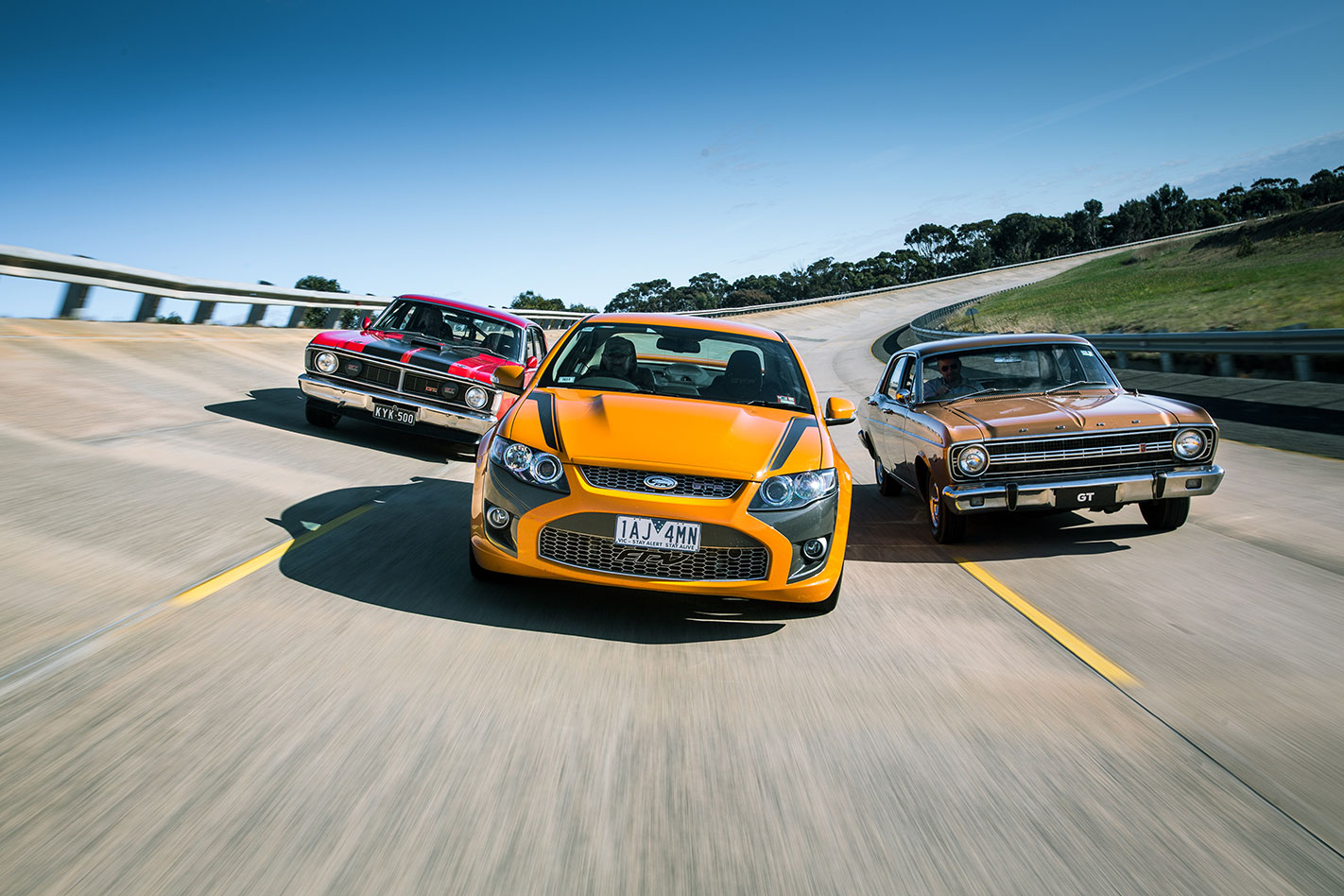
By the time you read this, the GT F (F for Final) will have been unveiled in the public domain, however a clash of embargo and deadline dates means we’ll be driving two of the four development prototypes, one automatic and one manual.
To the naked eye they may look like a pair of standard GT-Ps, but myriad paint chips, loose wires in the engine bay to allow on-the-fly ECU tweaks and brake discs heat-stained blue tell of the hours of abuse they’ve suffered.
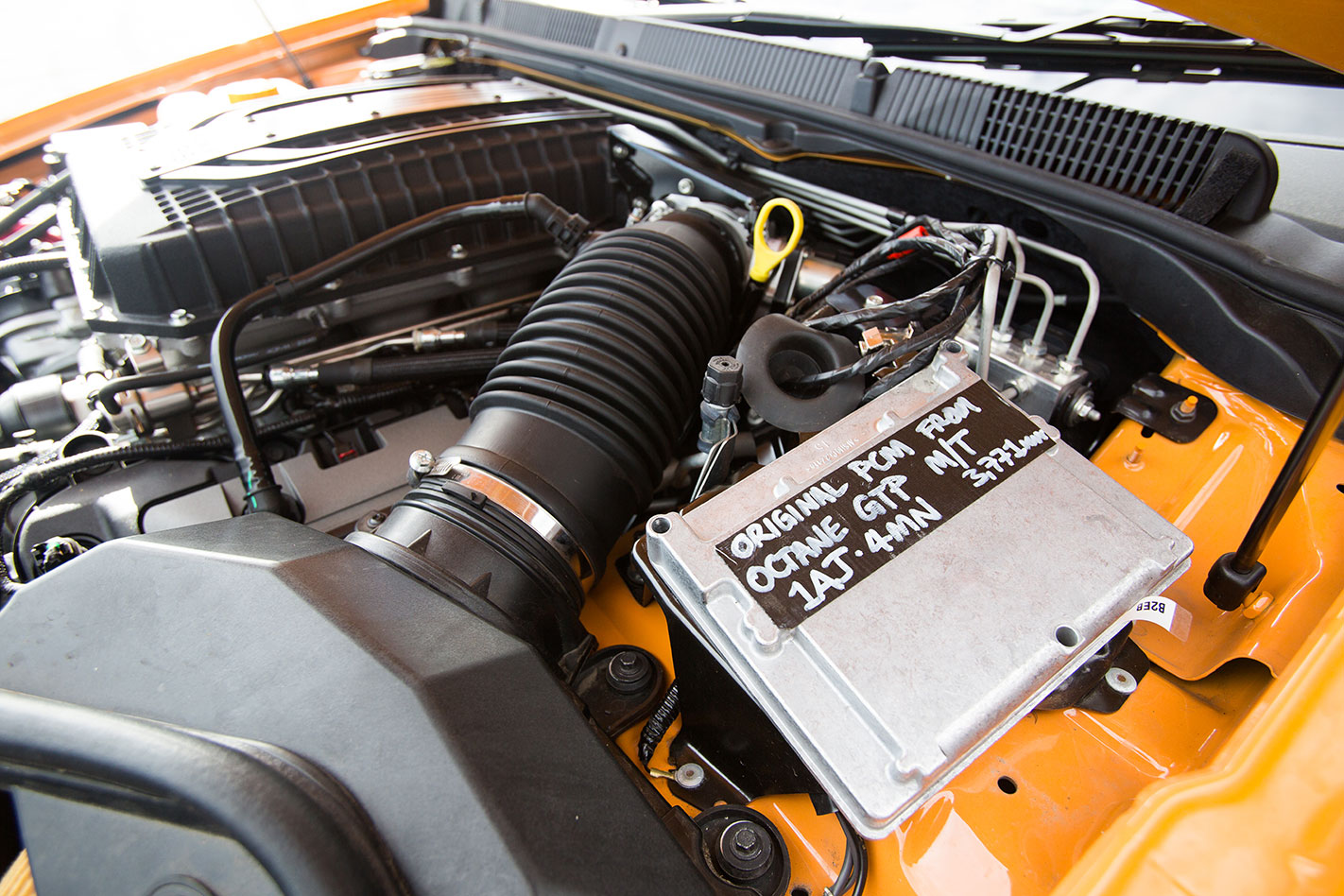
With time and funds short, the decision was taken to cherry pick the choice components from the existing range to create FPV’s version of a Greatest Hits album.
But let’s start with the engine work, the reason for the reintroduction of the iconic ‘351 GT’ badge. With the whole project dependent on reaching that magic number, the Miami engine was sent back to Prodrive for some massaging.
Chief Program Engineer for Falcon and Territory, Peter de Leur, tells us keeping the project quiet at this point was a major headache: “People were saying ‘what’s going on? What’s the Miami doing back on the dyno?’”
But although it’s the kilowatt figure that attracts all the headlines, the engineering team is keen to point out it’s the extra torque that plays the biggest role in changing the engine’s characteristics. While maximum twist remains at 570Nm, it’s now available over a wider rev range.
Of course, ever since the Miami engine appeared in late 2010 there’s been plenty of conjecture surrounding its actual power output, thanks to the presence of an overboost function.
While they aren’t keen to discuss it, the engineers confirm that if conditions are right, up to 15 per cent more power is available. We’ll let you do the maths. Simply put, while the GT F is never making less than 351kW, which already makes it the most powerful Falcon ever, it’s often making quite a bit more.
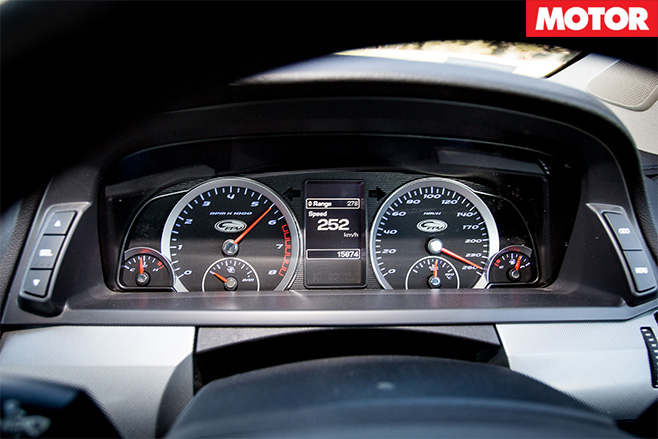
Once all the camouflaged prototypes and weird engineering mules have been shooed away by Ford’s nervous PR crew, we have the place to ourselves. Cruising on to the track, the speedo is reading 190km/h in what seems like moments, and a couple more laps confirms that the GT F rips to its 250km/h limited top speed with little effort.
Racing legend John Bowe is on hand to offer his thoughts and instantly notices the engine’s stronger top end. As JB regularly drives a standard GT for corporate ride days, this suggests that if you’re swapping from an FG II to a GT F, you’ll notice the extra power on more than just the spec sheet.
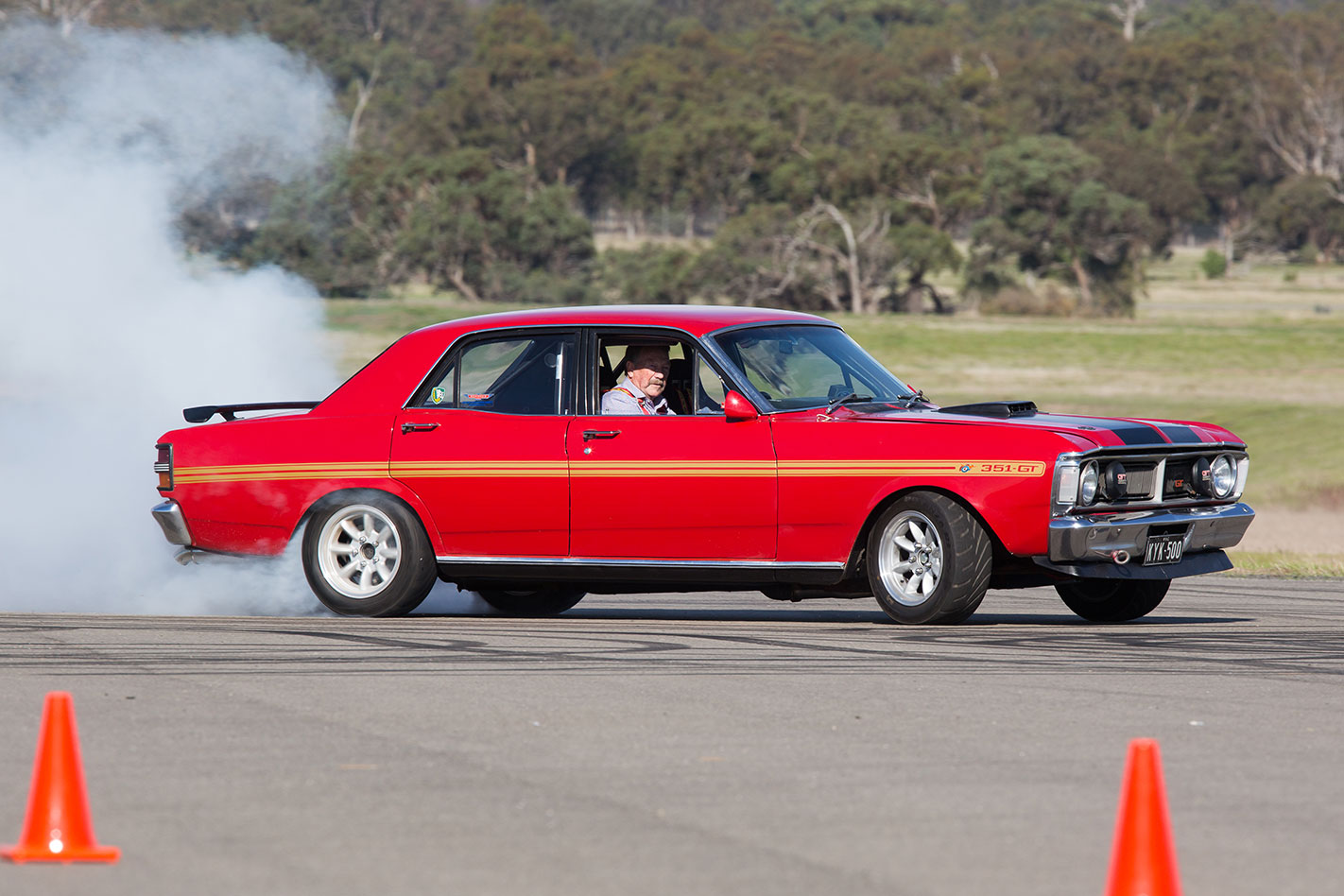
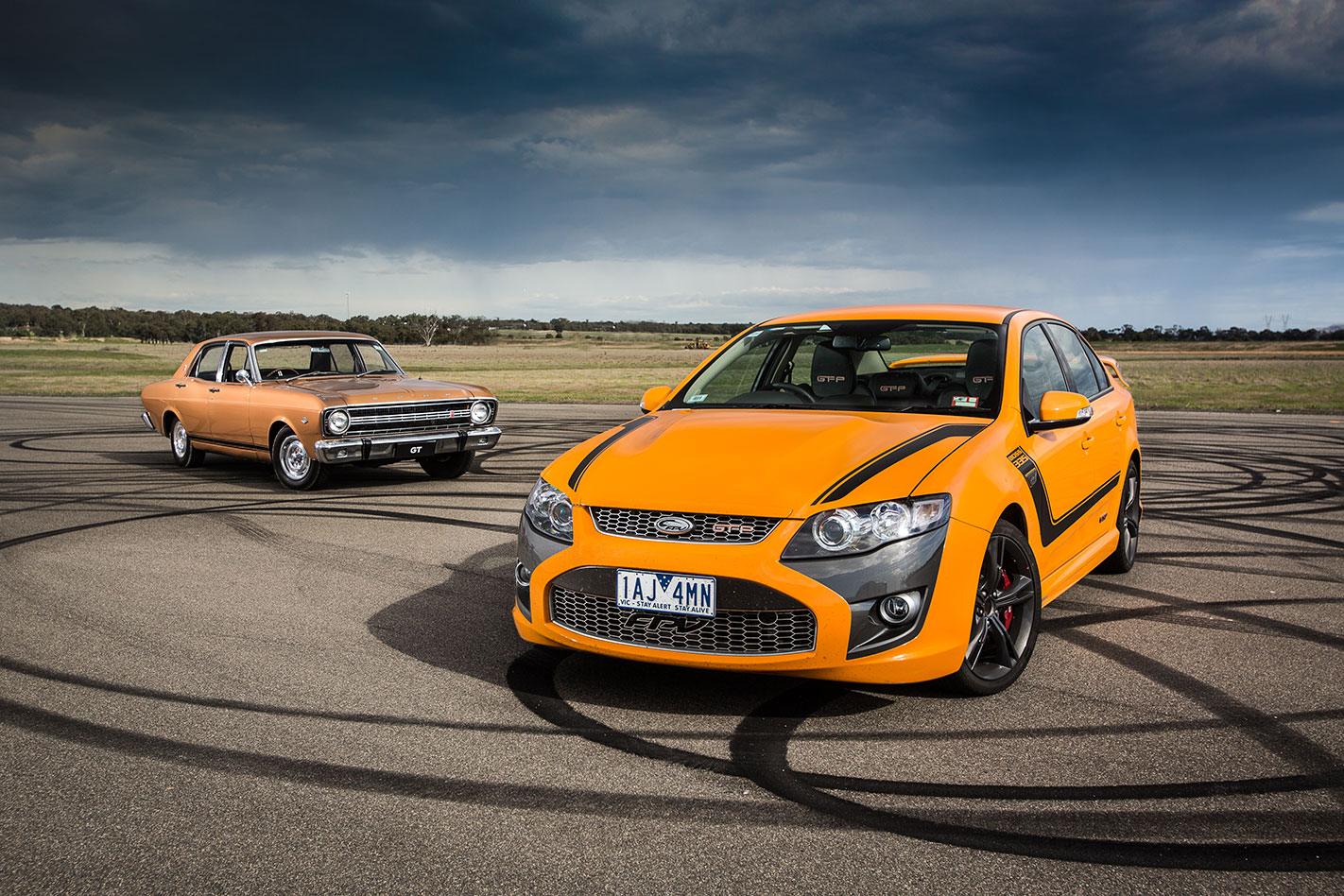
By any standard it’s a crazily fast car, each gear unleashing a relentless torrent of acceleration. It makes a mean noise, too, with a satisfying braarp on full-throttle upshifts and a roar that echoes around the You Yangs facility, though it’s soon upstaged by Garry’s Phase III, its tweaked 351 screaming like an angry V8 Supercar as it tears around the circuit at full noise.
To quickly recap, these consist of re-tuned Sachs dampers all ’round, stiffer upper control arm bushes and upper strut mounts up front, and higher spring rates, reinforced lower control arms and a larger anti-roll bar at the rear.
There’s also stiffer transmission mounts and, crucially, 19 x 9.0-inch rear wheels with 275mm-wide rubber. Added for GT F is the ability to manually adjust rear camber by up to one degree negative, though it’s unlikely anyone will bother.
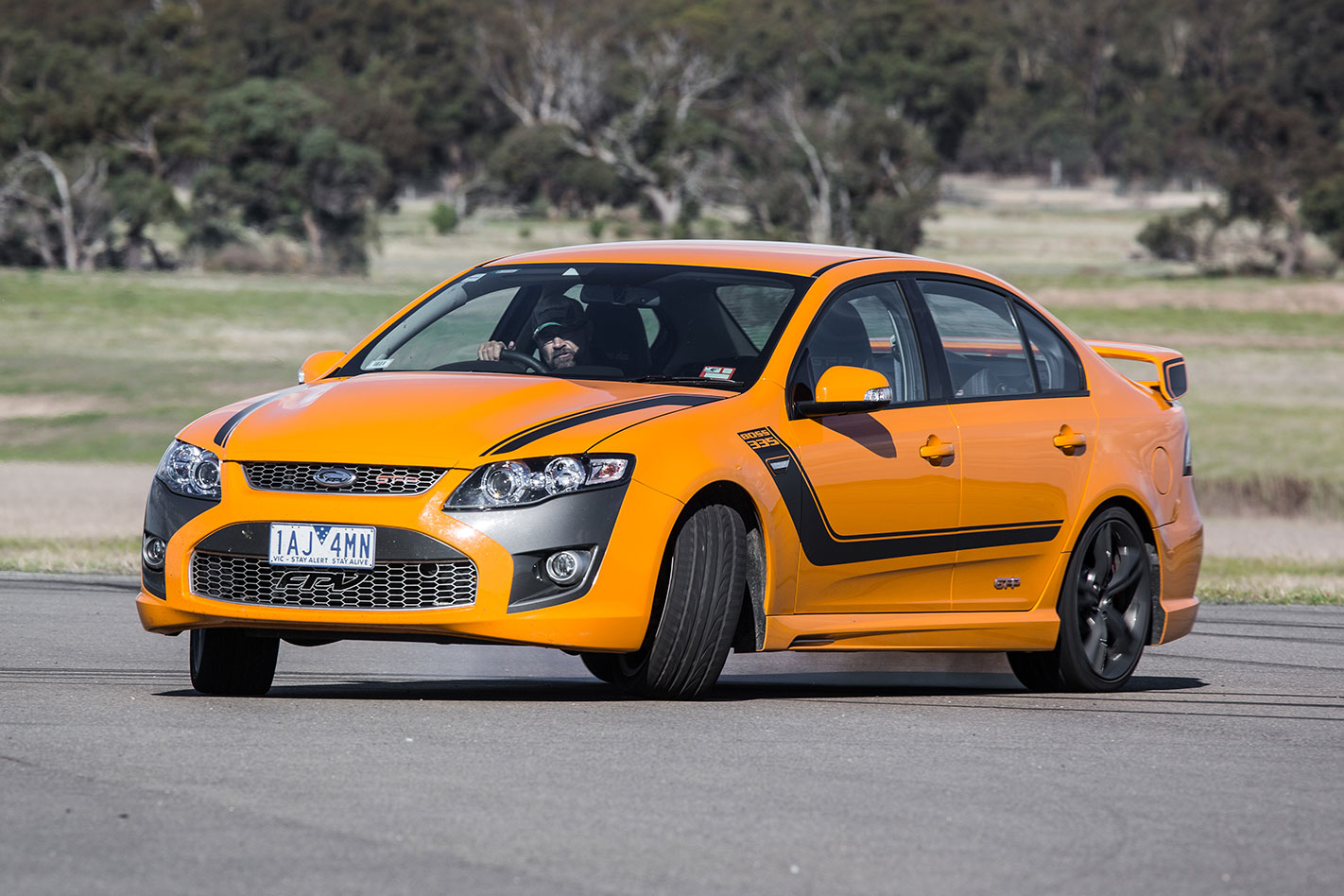
However, to be blunt, no-one has bought (by the time we go to press most will have been sold) a GT F based on the way it drives. This last-of-the-line GT is primarily a car for collectors, and Ford has made a real effort to individualise it and justify its collectable status.
Externally, a new stripe package based on the XB GT adorns the roof, bonnet and lower side sills. Five colours are available: Winter White, Kinetic (blue), Silhouette (black), Octane (orange) and Smoke (dark grey).
Which is a shame, as it means the GT-P’s body-hugging Recaro seats fitted to these development prototypes are not available. It’s an unfortunate omission when so much effort has been made to treat the GT F to the best components available.
Elsewhere, the interior is jazzed up with premium stitching and embroidery on the partial leather seats, the centre console and audio system from the luxo GT E and, this being a limited-edition FPV, a GT F-branded build plate.
Most of the 550 GT Fs available (500 for Australia and 50 for New Zealand) already have customer’s names next to them, with some fast Ford fanatics laying down $10,000 deposits before the car had been announced on the assumption that FPV would do something to say goodbye. It’s a strange state of affairs that Ford struggles to sell 700 Falcons a month of all varieties, yet can shift over 500 of the range-topping variant in only a few weeks.
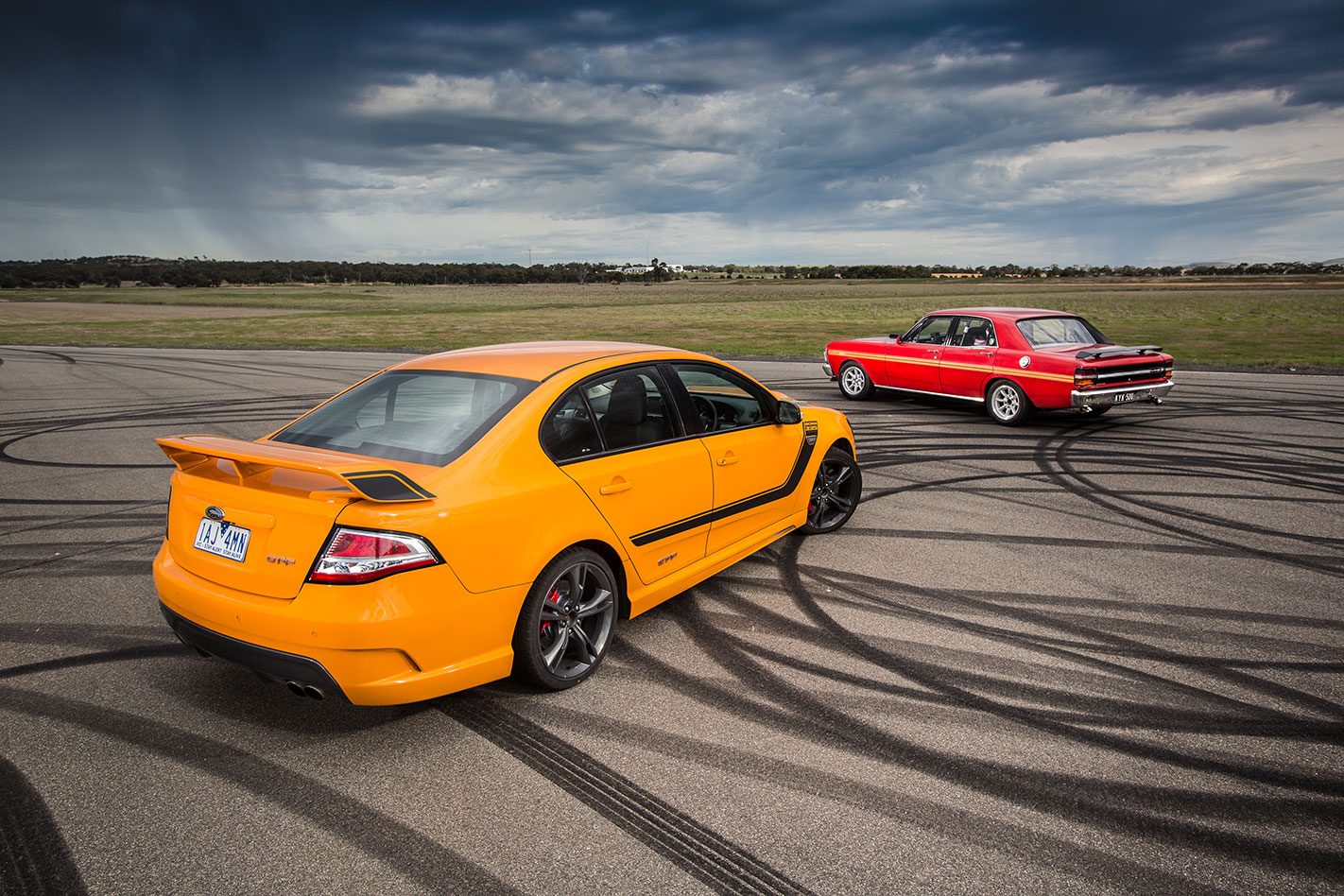
At least for the forseeable future. Whether or not the Falcon GT nameplate ever makes a return is up to Ford’s marketing department, but it’s unlikely to be in the form of a big, rear-drive, V8-powered sedan. And it won’t be Australian made.
We just hope those 550 GT F owners learn a lesson from Garry and his Phase III and drive their cars as they were meant to be driven in the country for which they were engineered. After all, the team who created it would prefer it that way.
Take a Bowe, John
Ford faithful JB has helped develop more than a few fast Falcons, from the EL GT to the Tickford T3 range and recounts the time he drove an original BA GT mule. Fairly handy behind the wheel, he’s more than qualified to give his thoughts on the new GT-F.
“It’s fast,” he says. “Beautiful engine; torquey, revvy, lots of grunt. I know it’s going to have this 351 badge and I don’t know this for a fact, but from my trained right foot, it’s got far more power than that.
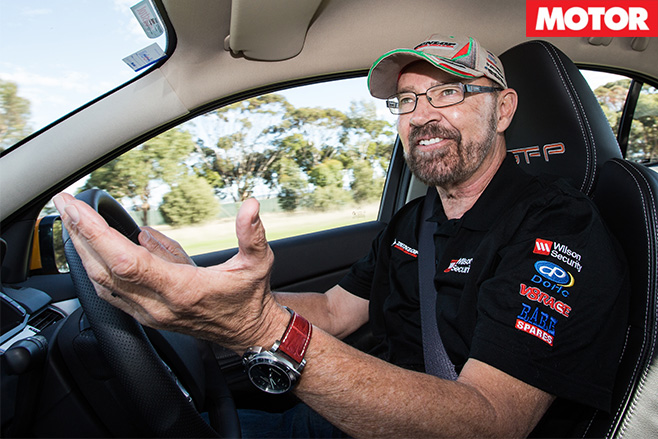
It’s very stable at high speed. It’s got nice damper control. And even though it’s firm and edgy, the ride is quite acceptable. It’s really like a driver’s car. Particularly in manual form, it’s terrific. A true muscle car.”
3.5 out of 5 stars
| u00a0 | u00a0 | FPV GT Fu00a0 |
| Body | u00a0 | 4-door, 5-seat sedan |
| Drive | u00a0 | Rear-wheel |
| Engine | u00a0 | 4951cc V8, DOHV, 32v, supercharged |
| Bore/stroke | u00a0 | 92.2 x 92.7mm |
| Compression | u00a0 | 9.25:1 |
| Power | u00a0 | 351kW @ 6000rpm |
| Torque | u00a0 | 570Nm @ 2500-5500rpm |
| Power / weight | u00a0 | 189kW/tonne |
| Consumption | u00a0 | 13.6L/100km (claimed) |
| Emissions | u00a0 | 324g/km CO2 (claimed) |
| Transmission | u00a0 | 6-speed manual |
| Weight | u00a0 | 1862kg |
| Suspension | u00a0 | Double A-arms, coil springs, anti-roll bar (f); Multi-links, coil springs, anti-roll bar u00ae |
| L/W/H | u00a0 | 4970/1868/1453mm |
| Wheelbase | u00a0 | 2838mm |
| Tracks | u00a0 | 1583/1598mm (f/r) |
| Steering | u00a0 | Hydraulically-assisted rack-and-pinion |
| Brakes | u00a0 | 355mm ventilated six-piston calipers (f); 330mm ventilated discs, four-piston calipersu00a0 |
| Wheels | u00a0 | 19 x 8.5-inch (f); 19 x 9.0-inch (r) |
| Tyres | u00a0 | 245/35ZR19 (f); 275/35ZR19 (r) Dunlop Sport Maxx |
| Price | u00a0 | $77,900 |
| Positives | u00a0 | Ferocious power; playful handling; youu2019ll be king in certain neighbourhoods |
| Negatives | u00a0 | Not much different to a regular GT; itu2019s the last one ever |
Toyota has launched the fourth-generation of its environmental poster car, the petrol-electric hybrid Prius.
WHAT IS IT? This is generation four of the petrol-electric hybrid car launched in Australia in 2001 that most of us have, one time or another, loved to hate.
WHY WE’RE TESTING IT Toyota is talking up this generation of the Prius, built on a new mid-size platform that will underpin a number of future platforms, as being fun to drive. Can the Toyota Prius finally hang up its cardigan?
MAIN RIVALS Toyota Camry Atara S Hybrid, Ford Mondeo Ambiente TDCi, Mazda 6 Touring
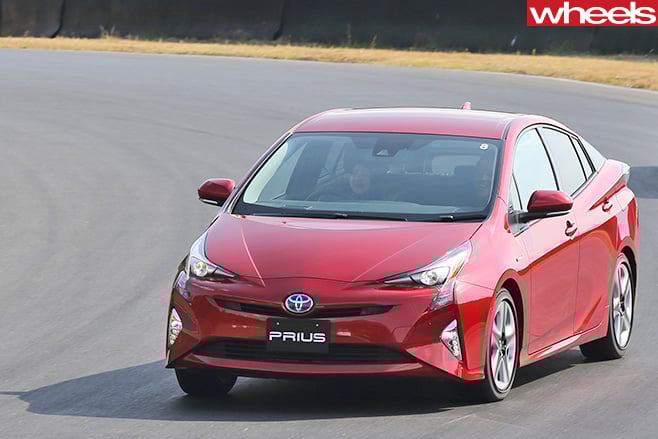
PLUS: Dynamically more focussed; engine and CVT now a better match; brake pedal loses wooden feel; improved fuel use MINUS: Higher use of aluminium and double-wishbone rear means it’s more expensive to make and potentially buy; doubts over lithium ion battery for Australia; no plug-in version
THE WHEELS REVIEW TOYOTA’S hybrid technology is now almost two decades old. Over time the technology has improved, but the drab, dreary experience behind the wheel has essentially remained the same. Until now.
The fourth-generation Prius is about to arrive, and it’s shaping up to be something of a revolution. The biggest change is that it introduces the Toyota New Global Architecture that will underpin a range of as-yet unnamed mid-size models.
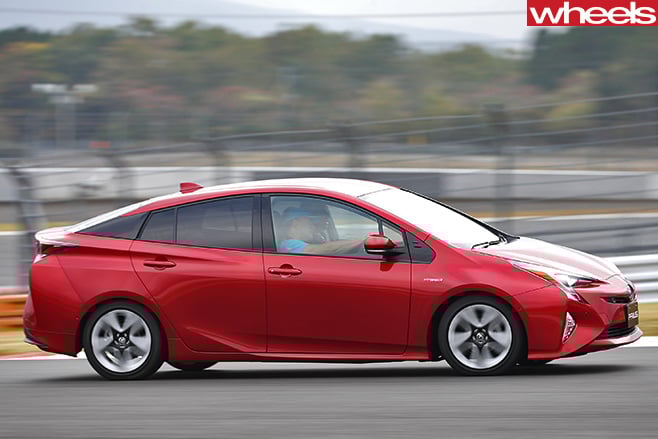
There’s still the traditional Macpherson struts up front, although they feature a more laid-back angle of attack and increased camber to help distribute steering force, and their towers now are joined by a stiffening cross-brace. Down the rear is a double wishbone – the stuff of performance cars – replacing the former generation Toyota Prius‘ torsion beam.
Inside, the instrument cluster – now in full colour – is still offset to one side of the driver’s eyeline. The Volvo-style floating centre console is gone, replaced with a fixed one with a shallow pan shaped to nestle a mobile phone. A smarter-looking steering wheel is now round rather than the former Prius’s oddly ovoid one.
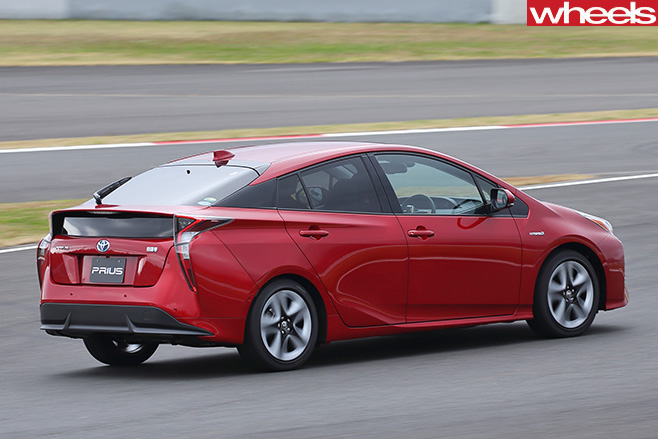
According to Toyota, the Prius is all about its newfound dynamics. To explore it, we were given two low-speed laps – about four kilometres all up – of the Lexus-owned test track fronting Japan’s Fuji Speedway.
It was enough to learn that improvements to the Prius are more advanced than the awkward cosmetics. The steering is 15 percent quicker than in the model it replaces, and has decent weight despite obviously being optimised for city parking. The formerly wooden brake pedal with its extensive dead zone now has a sharper, linear feel, and the awkward lurch when the regenerative braking kicks in to sap electricity from the Prius’s kinetic energy has smoothed out to be almost imperceptible.
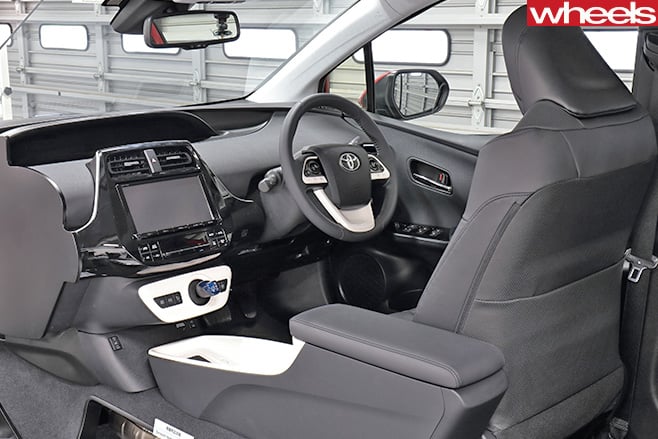
The throttle-dulling eco mode is no more, with just a default setting supplemented by a power mode that, upon the push of a dash-mounted button, changes the dash to an angry neon red.
The size of some of the components making up the hybrid drivetrain have shrunk by about a third, and the seats are mounted lower in the chassis, moving the centre of gravity down and greatly reducing the elephant-on-roller-skates feel of the outgoing Prius.
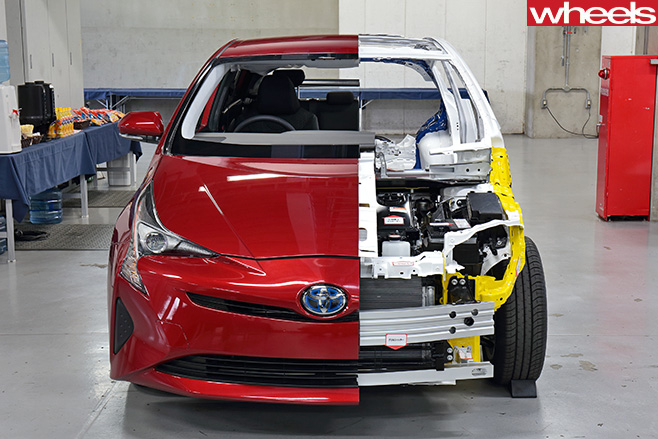
As yet, there’s no official fuel use figure for the Prius, although it could fall to as little as 2.5L/100km, helped by the electric motor that can now coast the Prius at speeds of up to 100km/h.
WEIGHT FOR IT THIS generation of Prius will again be available with either a heavier, cheaper nickel metal hydride battery, or a lighter, more expensive one. However, the lighter battery will only be used in markets where the 15kg saving improves fuel economy to meet strict emissions targets – think North America and Japan, not Australia. The new Prius uses more lightweight aluminium than the model it replaces, at up to double the cost of steel parts.
SPECS Model: Toyota Prius Engine: 1797cc 4cyl, dohc, 16v + electric motor Max power: Engine 72kW@5200rpm/motor 53kW Max torque: Engine 142Nm@3600rpm/motor 163Nm Transmission: CVT Weight: N/A 0-100km/h: N/A Fuel economy: 2.4L/100km (estimated) Price: $35,000 (estimated) On sale: Q1 2015
PLUS
- Value. The Grand Cherokee is stacked with equipment including heated front seats, automatic wipers and tyre pressure monitoring systems.
- 4WD available in all models (except base model Laredo 3.6).
- Overland variant includes an active safety system – blind spot warnings, emergency braking and automatic cruise control.
- 4WD aids. Quandra-Drive II and Quandra-Lift will be greatly appreciated by those who go off-road.
- Only comes with five seats so the lack of a seven-seat option will be a fault for larger families.
- Doesn’t come with a lot more space than its competitors, which we’d expect of an SUV without the extra two seats.
- The Cherokee’s low-profile 20 inch tyres will be more vulnerable to damage on tougher terrains.
WHERE DOES IT FEEL AT HOME?
The Jeep Grand Cherokee is a good family-car choice for those who don’t mind a bit of off-road fun.WHAT IT’S MADE FOR
It’s comfortable enough for the weekday commute it it’s also more than capable of taking the family on those weekend adventures.
STAND OUT FEATURES
The fact it comes packed with equipment for a lower price is a big plus. Cruise control, reversing camera, heated front seats, automatic wipers and a tyre pressure monitoring system are all standard features.
4WD is also available in all models except base model Laredo 3.6 which is rear-wheel drive.
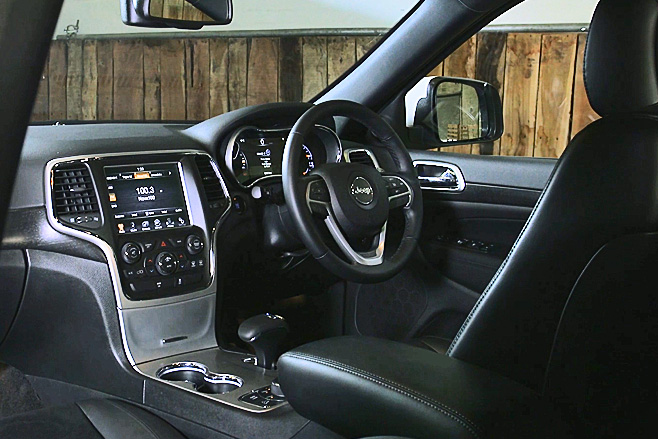
WE LOVE
We’re here with the Blackhawk but shout out goes to the Overland model which features an active safety system. This includes blind spot warnings, emergency braking and my favourite, automatic cruise control.
But perhaps most notable is the Quandra-Drive II and Quandra-Lift, which 4wders will appreciate.
These features are, of course, available as an added extra at other spec levels.
It also comes with decent engine choices; three petrol options and a diesel. Our top pick would be the diesel for fuel-efficiency.
THINGS WE’D LIKE TO CHANGE
It only comes with five seats and for some families, that’ll be a big red cross. We probably wouldn’t be so fussed about losing the extra two seat option if it came with more space than its competitors, but it doesn’t win at that either.
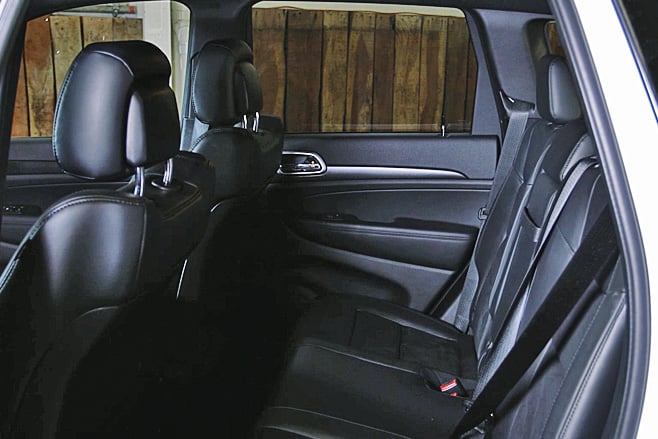
It would be remiss of me to not mention the Grand Cherokee’s 20-inch low-profile tyres, the Toorak Tractor users probably won’t notice, but they will be more vulnerable to damage on rougher terrains.WHO WILL IT SUIT?
We suspect mums will claim ‘key-keeper’ during the week while dads will itch at any opportunity to get it dirty on the weekends… then again, I’m not a mum or a dad, but if it was me, I’d own one of these.
Click here to read the full review on the Jeep Grand Cherokee.
