
WHERE DOES IT FEEL AT HOME?
The Jeep Grand Cherokee is a good family-car choice for those who don’t mind a bit of off-road fun.WHAT IT’S MADE FOR
It’s comfortable enough for the weekday commute it it’s also more than capable of taking the family on those weekend adventures.
STAND OUT FEATURES
The fact it comes packed with equipment for a lower price is a big plus. Cruise control, reversing camera, heated front seats, automatic wipers and a tyre pressure monitoring system are all standard features.
4WD is also available in all models except base model Laredo 3.6 which is rear-wheel drive.
WE LOVE
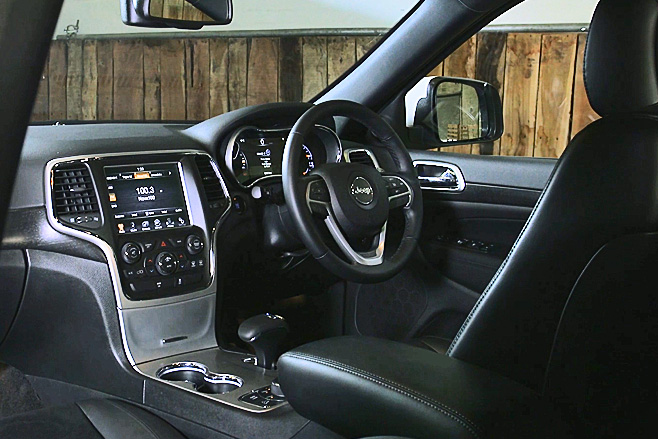
We’re here with the Blackhawk but shout out goes to the Overland model which features an active safety system. This includes blind spot warnings, emergency braking and my favourite, automatic cruise control.
But perhaps most notable is the Quandra-Drive II and Quandra-Lift, which 4wders will appreciate.
These features are, of course, available as an added extra at other spec levels.
It also comes with decent engine choices; three petrol options and a diesel. Our top pick would be the diesel for fuel-efficiency.
THINGS WE’D LIKE TO CHANGE
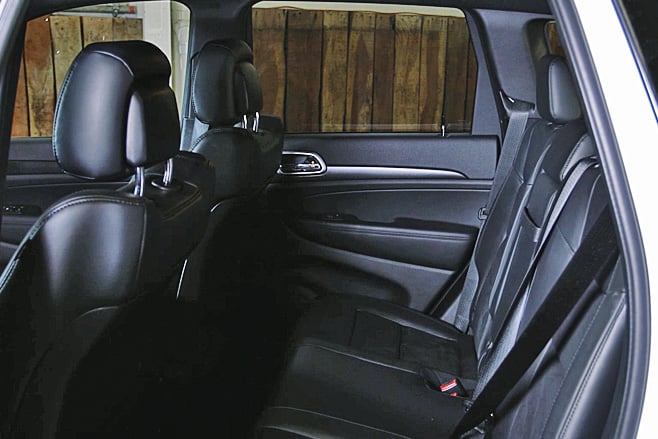
It only comes with five seats and for some families, that’ll be a big red cross. We probably wouldn’t be so fussed about losing the extra two seat option if it came with more space than its competitors, but it doesn’t win at that either.
It would be remiss of me to not mention the Grand Cherokee’s 20-inch low-profile tyres, the Toorak Tractor users probably won’t notice, but they will be more vulnerable to damage on rougher terrains.WHO WILL IT SUIT?
We suspect mums will claim ‘key-keeper’ during the week while dads will itch at any opportunity to get it dirty on the weekends… then again, I’m not a mum or a dad, but if it was me, I’d own one of these.
Click here to read the full review on the Jeep Grand Cherokee.
Introducing the closest look yet at the next-generation Subaru WRX – the Impreza Sedan Concept unveiled overnight in Los Angeles.
At this point Subaru fans may be cynical, recalling the sexy WRX Concept unveiled at the 2013 New York motor show and how it morphed into the, erm, rather less sexy production Rex the following year.
However although it doesn’t wear the famous three-letter badge, this Impreza Concept actually points to the WRX Concept of two years back in several ways. It all but confirms that the 2013 show car was a very early look further ahead to the 2017 model – we just didn’t know it at the time.
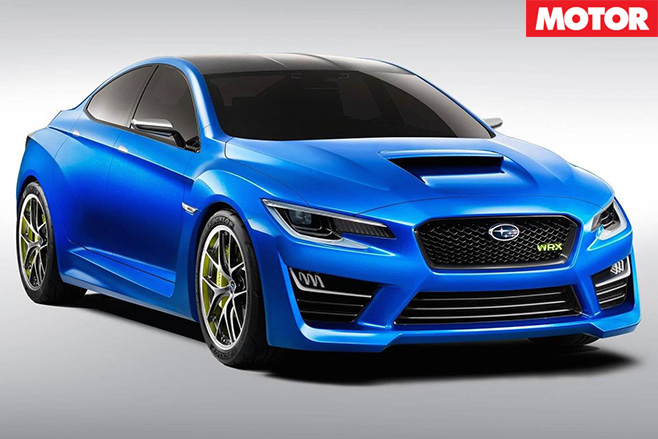
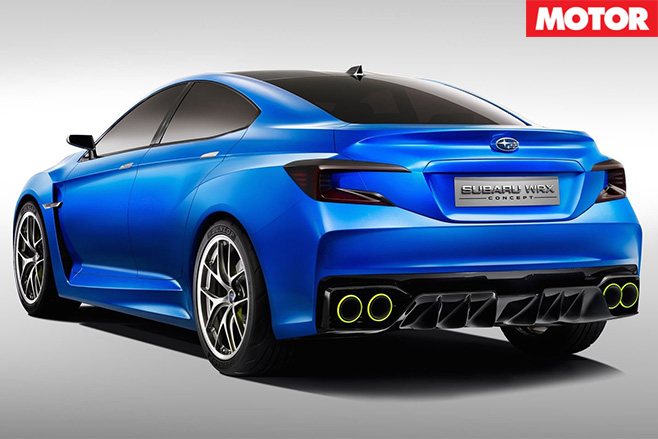
What Subaru now confirms is that this ruby-red sedan “is a design concept car previewing the next-generation Impreza.”
“Its compact body features a blend of bold expressions of Subaru’s Dynamic & Solid design elements and a quality feel beyond its class – hinting at the design direction not only of the new Impreza but of Subaru’s future models as a whole,” the company adds in a statement.
Compared with the current WRX, the Impreza Concept sports a 20mm longer wheelbase over a body reduced in length by 40mm. The low and wide stance is shown by the 85mm extra body width and height reduced by 22mm.
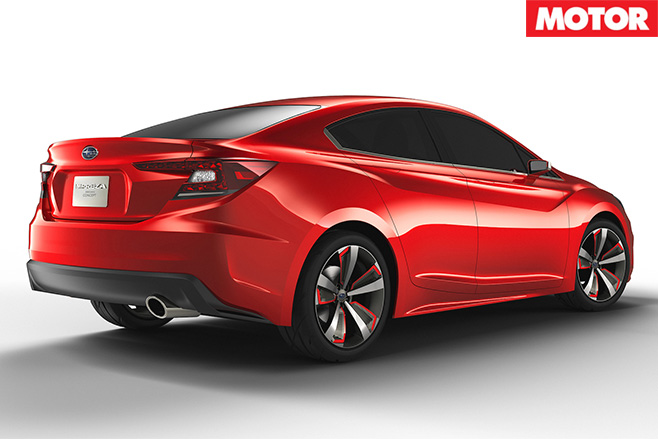
The next generation Impreza is expected to lob in 2017, but us enthusiasts may have to wait until 2019 for the WRX and STI performance variants given usual Subaru timelines.
It will certainly arrive before the year indicated in the brand’s ‘Prominence 2020’ mid-term management vision plan announced in May 2014, the next Impreza being tagged as “the first of Subaru’s next-generation strategic vehicles”.
Living in a stable like Porsche’s, the latest Cayman was always going to be called up for racing duty.
And overnight in Los Angeles, Porsche unveiled its new Cayman GT4 Clubsport: a beast designed for one thing… motorsport.
Revealed in yellow and grey livery, the Clubsport is heavily based on the GT4 road-going model, a car more than handy on a circuit, and splices on a few new bits to shore up its arsenal.
First, the bad news. Although it features the road car’s 3.8-litre 911 Carrera S engine, outputs remain untouched at 283kW and 450Nm.
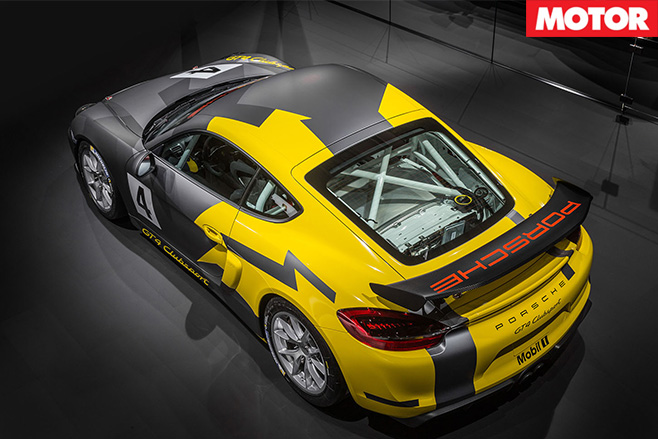
Along with the upgraded drivetrain, braking and suspension systems ascend to racing specification, with Stuttgart pinching the 911 GT3 Cup car’s front strut setup for the Clubsport.
Braking hardware, with 380mm discs all round and fixed six-piston grabbers up front, is as per road-going GT4, except that its ABS is adjustable over 12 settings should drivers lock up the 18-inch Michelin slicks too often.
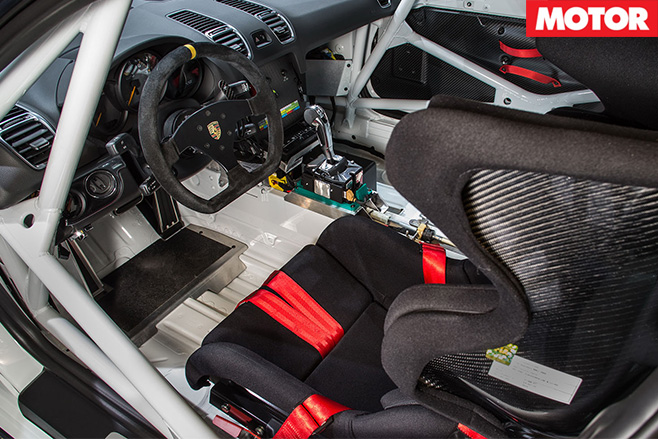
Should you option the available 100-litre fuel tank, which adds 30-litres to the standard capacity cell, we suspect that might cancel out the new diet.
Porsche is expecting the car to be homologated for events in Europe like the VLN Long Distance Championship Nurburgring, and Porsche one-make events in America, with a price tag of US$165,000 for American customers.
Sadly, though, Porsche Australia tells us it will not be bringing the GT4 Clubsport down under.
THE 2016 Mazda CX-9 has been revealed at the 2015 Los Angeles Motor Show.
With the Mazda CX-5 the best-selling SUV in Australia, and the diminutive Mazda CX-3 also leading its class, the new Mazda CX-9 serves to strengthen the Japanese car maker’s grip on Aussie buyers.
With a completely new platform and drivetrain, it’s the second-generation of the seven-seater that competes in the large SUV class, currently dominated by the Toyota Prado and the Toyota Kluger. There’s a slew of healthy competition from the likes of the Hyundai Santa Fe, Nissan Pathfinder, Ford Everest and Kia Sorento, but the new CX-9 is the final Mazda in its entire line-up to adopt the fuel-saving SkyActiv technology.
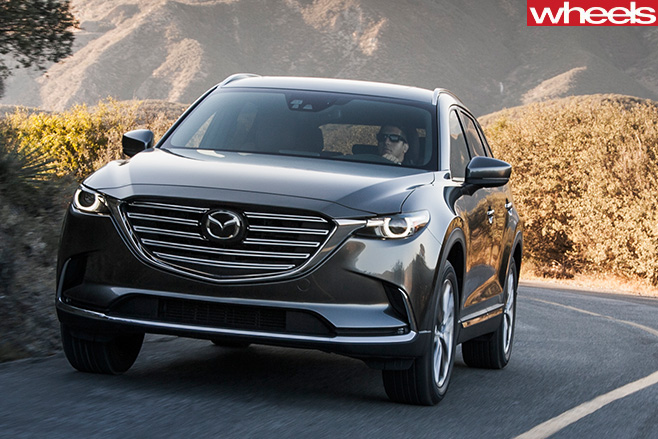
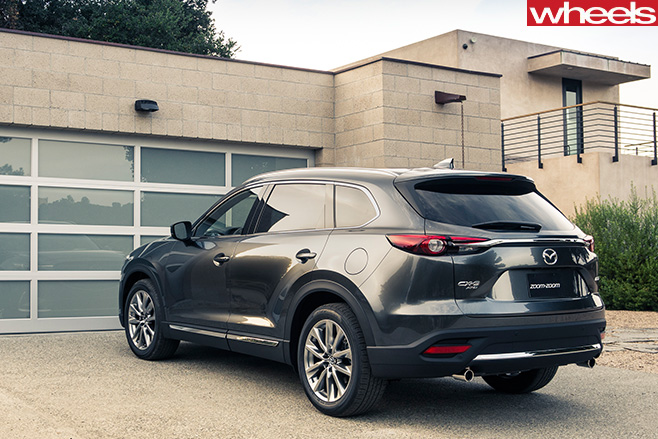
Despite the improved room and packaging, the CX-9 is 31mm shorter, now 5065mm, which allowed Mazda USA design director Julien Montousse to pull the cabin back a whopping 100mm and give it sleeker proportions and an athletic stance, with 20-inch wheels on flagship versions.
The production-ready LA show car is finished in a ‘Liquid Silver’ metal-flake colour, designed specifically to show off the CX-9s surfacing and body work, and display the quality stampings required to expose it so openly.
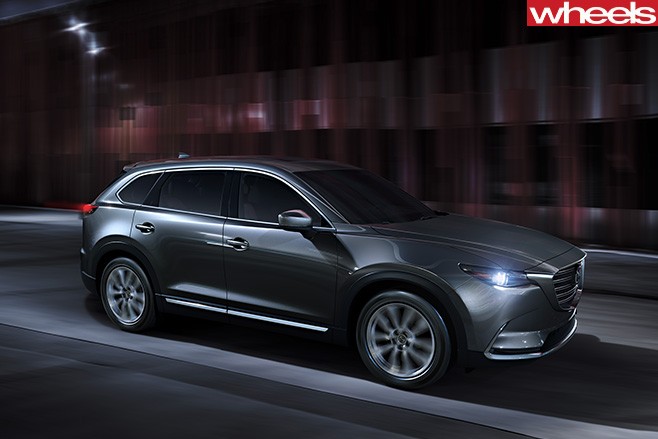
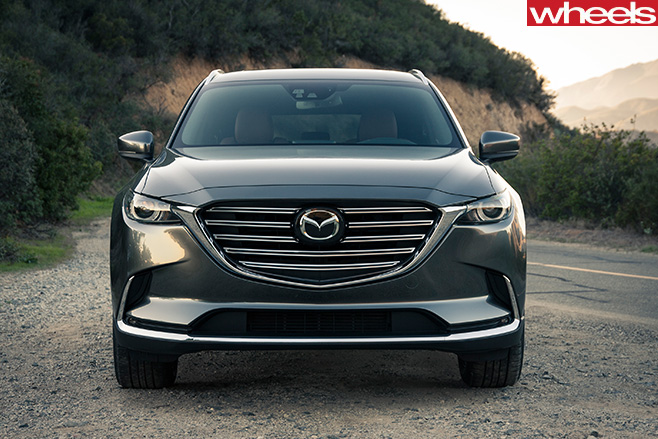
“The old CX-9’s nose was very submissive, now we’re very proud,” said Montousse. “Mazda has this kind of confidence of being on the road. We’re not hiding anything. We’ve got amazing performance, amazing styling – it says a lot that the grille is very proud. This is who we are. This is a Mazda.”
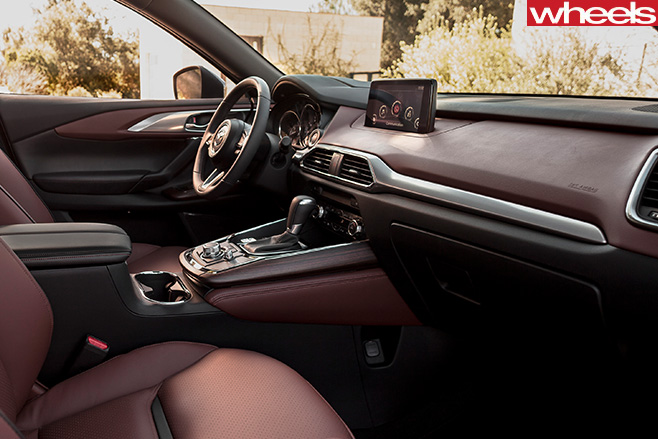
That grille effectively pushes through to the CX-9’s interior, which also has a horizontal emphasis and shows the progress compared with Mazda’s first ‘Kodo’ cabin, the 2012 Mazda 6.
Inside the new SUV is light years ahead of the existing CX-9. Not only is it more detailed, with real wood, aluminium and Nappa leather on the high-spec model on the LA show stand, but far more spacious up front.
The big news is under the CX-9’s bonnet. A new 2.5-litre turbo-petrol four-cylinder replaces the 3.7-litre V6 but delivers fuel savings of around 20 percent, according to Mazda engineers. While there are no official figures, such an improvement would give the new CX-9 a comparative consumption of 8.8L/100km for front-drive models, and 9.0L/100km for all-wheel drive versions, the latter using the same all-wheel system as the CX-5.
That’s because this is the first turbocharged SkyActiv engine. Completely new and sharing few parts with any other existing Mazda powerplant, the SkyActiv-G 25T produces 169kW on regular unleaded petrol, or 186kW on premium. That’s less than the previous model’s 204kW, yet the four-cylinder powerplant delivers 420Nm from 2000rpm, compared with the old V6’s 367Nm at a higher 4250rpm. It’s teamed with a six-speed automatic and has the same 2000kg towing capability.
“If you have a big four-cylinder and replace it with a small four-cylinder turbo, it doesn’t pay off,” said Mazda development engineer Dave Coleman. “But if we’re getting to a scale where we’re taking a really large V6, and we’re able to knock that down to a good-size four-cylinder, there’s a huge benefit of dropping those extra cylinders.”
To ensure it met Mazda’s aggressive efficiency targets, the four-cylinder engine features direct fuel-injection, as well a four-into-one exhaust system with exhaust gas recirculation cooling to manage temperatures and maximise fuel economy.
Mazda will not offer the CX-9 as a diesel model, despite the CX-5 it’s based upon having a SkyActiv diesel, as does the entry-level Mazda CX-3.
As the first SkyActiv CX-9, the new model also sees significant weight savings, with 90kg and 130kg reductions for the front- and all-wheel-drive models respectively. That gives the CX-9 an estimated starting weight of 1849kg.
Safety tech includes radar cruise control, blind-spot monitoring and lane keep assist, but also extends to Forward Obstruction Warning.
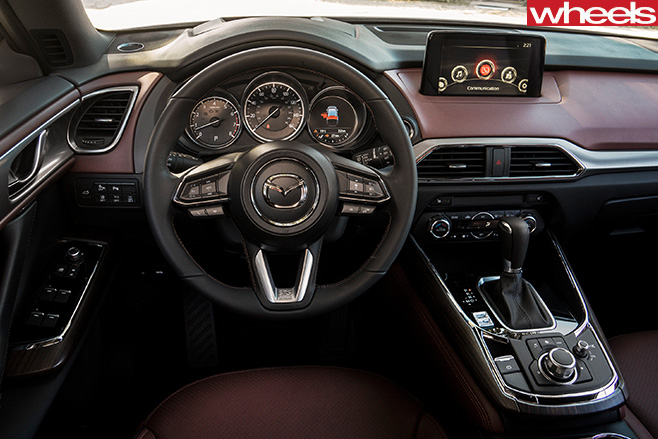
Mazda chose the LA motor show to reveal its new seven-seater as it says 80 percent of all CX-9 buyers will be in North America. “Of course, any country with wide open spaces, we find it a match for those, too,” chief engineer Masashi Otsuka said to journalists.
Mazda Australia expects the CX-9 to sell far more strongly than the current model, which is moving about 250 units per month after a peak of around 650 when it arrived in 2007. It hopes to achieve similar results more consistently with the new model.
Pricing for the 2016 Mazda CX-9 is not expected to fluctuate far from the existing model’s starting price of $43,770 when it arrives in Australia in July.
REBORN! Turbo Mazda RX-7 to return in 2017; first thrash of HSV’s blown Clubbie R8; less is more for McLaren’s lean and mean 570S; Toyota 86 road versus race challenge.
ALSO INSIDE THIS EDITION:
- The Ford insider who helped kill off FPV
- What does it take to make the Car of the Year shortlist?
- Track-tested: The 200kW Peugeot 308 GTi
- Marcos Ambrose’s Bathurst turning point
- Up close with Citroen designer Frederic Duvernier
- Small hatch showdown as Corolla takes on Focus, Golf
- Corby’s Goodwood Revival survival guide
Every Mercedes-Benz SL can now sprint to 100km/h in under five seconds while the AMG versions get reworked suspension and new steering.
A mid-life upgrade to the two-year-old, sixth-generation luxury roadster reveals a new front with intelligent LED lighting across the range and a grille inspired by the 300 SL Panamericana.
There’s also a subtly revised cabin with fresh infotainment system and the latest Benz active safety kit. The hard-top roof can now lower at up to 40km/h, with the luggage volume-reducing roof cover in the boot now automatically electrically folding up or down with it.
Underneath the refreshed SL lies a nine-speed automatic transmission for the 3.0-litre twin-turbo V6 SL400 and 4.7-litre twin-turbo V8 SL500 models.
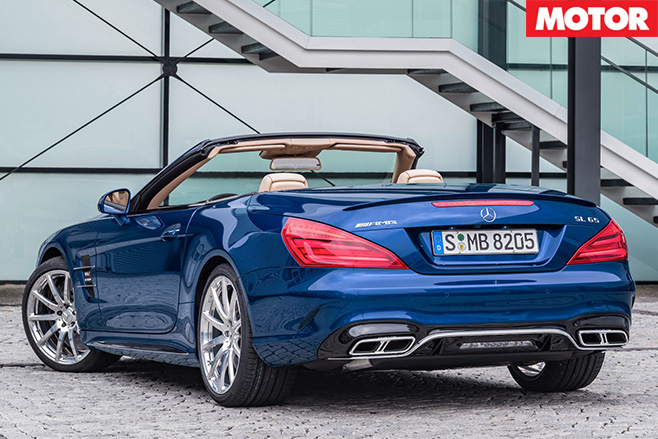
That’s three-tenths faster than before, and a performance match for the compact C450 sedan that gets the same donk.
The SL500 moves up 15kW to 335kW (between 5000rpm and 5250rpm), and although the 700Nm (from 1800rpm to 3500rpm) is unchanged, it’s enough to deliver a three-tenths-quicker 4.3sec claim.
Both models hone in on the performance of the 5.5-litre twin-turbo V8 SL63 AMG and 6.0-litre twin-turbo SL65 AMG that keep a seven-speed auto (though an SL63-specific change is quickened transmission response time in manual mode).
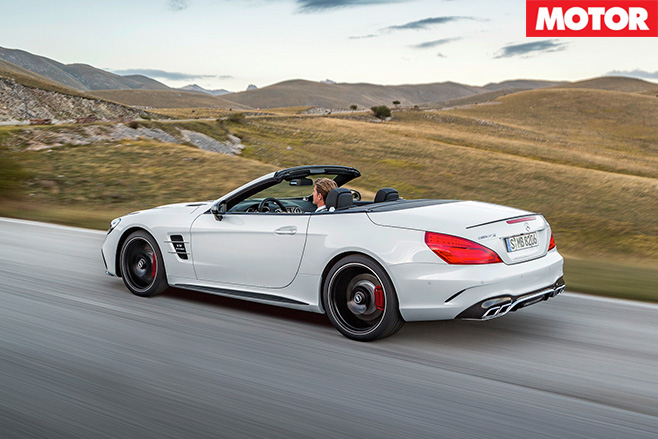
The AMG versions get chassis changes, however, with Affalterbach adding more negative wheel camber in addition to “fully revised, substantially stiffer” elastokinematics, and new electro-mechanical power steering. The previously optional electronically operated mechanical rear limited-slip differential is now standard.
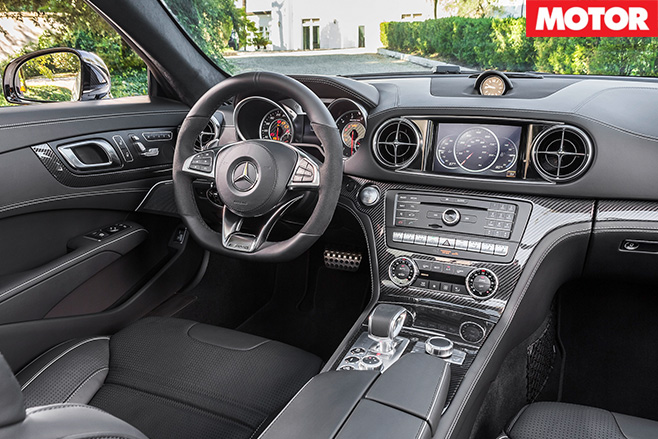
Fittingly, the covers came off the updated Super Light drop-top for the super wealthy at the LA motor show, not far from Beverly Hills where they are as common as Corollas in our local cities. The revised SL will lob in Australia mid next year.
The cloth has been dropped off the Fiat 124 Spider to reveal more than merely a re-badged Mazda MX-5 – but only just.
The 124 Spider remains Japanese built, but scores an Italian-made turbocharged engine, and its Los Angeles auto show reveal highlights its target of boosting the brand’s slow return to the US market.
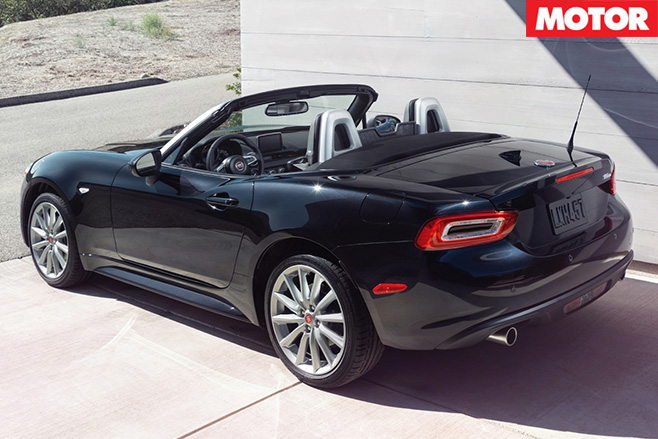
Fiat’s Spider version of the Mazda roadster gets higher rear hips that flow into a new side character crease dipping just above the front door handle. The new bonnet drops towards a nose – which looks Dodge-esque to us – that has been pulled forward, possibly to accommodate a front-mounted intercooler for the fresh engine.
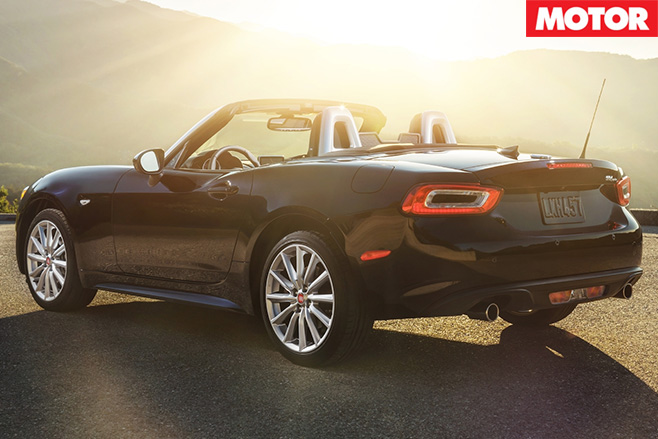
Unlike its all-atmo near-twin, the 124 Spider utilises the familiar 1.4-litre MultiAir turbocharged four-cylinder seen in the Fiat 500 Abarth, and Alfa Romeo Mito QV and Giulietta.
It’s the first time this engine has been installed in a rear-drive application, however, and it bypasses using the usual Fiat dual-clutch to pair with the Aisin six-speed torque converter automatic (or a six-speed manual) used in MX-5.
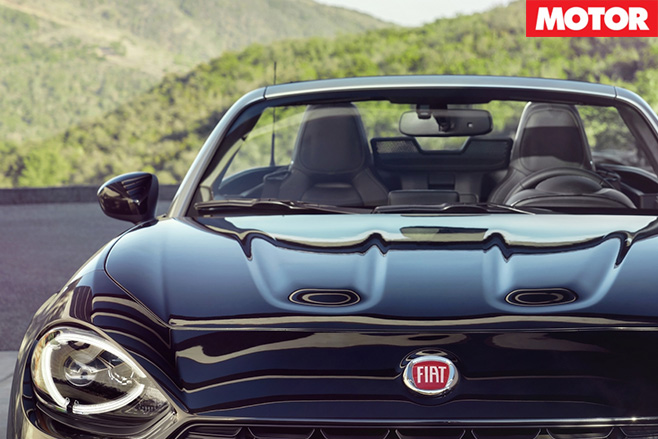
The soft 6250rpm cut-out is a force-fed downside, however. No performance figures are given, but with a kerb weight of 1105kg, the 124 Spider weighs 72kg more than its 2.0-litre rival.
The 124 Spider is available in two specification levels that closely mirror Mazda base and GT specification; Classica gets the same 16-inch Yokohama Advan tyres as 1.5-litre MX-5, cloth trim, body colour A-pillar and halogens, while Lusso upgrades to 17-inch Bridgestone Potenza rubber and adds leather seats and dash trim, and extra silver trim including on the pillars.
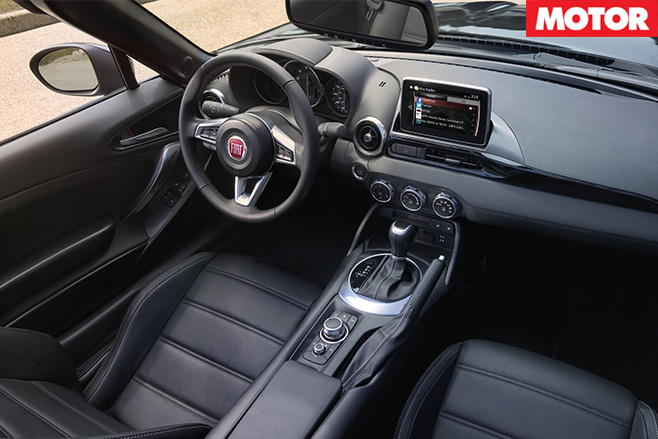
The 124 Spider will arrive in Australia in the third quarter of next year, but Fiat will likely skip over this version and await the Abarth version already confirmed (read more here).
So, what is it?
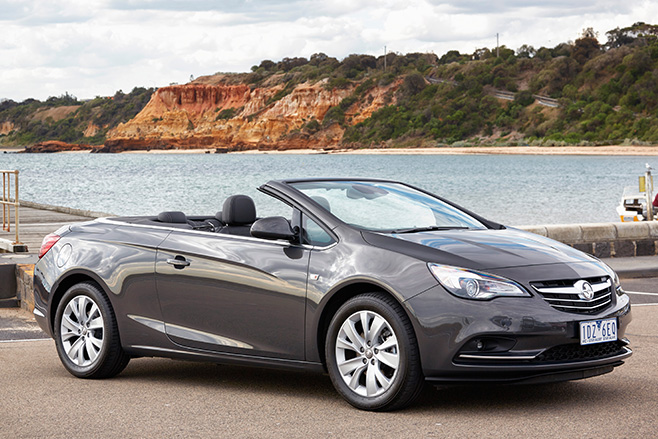
The Cascada is an elaborately transformed, de-roofed version of the Holden Astra, powered by the same 1.6-litre turbo four as the GTC hatch.
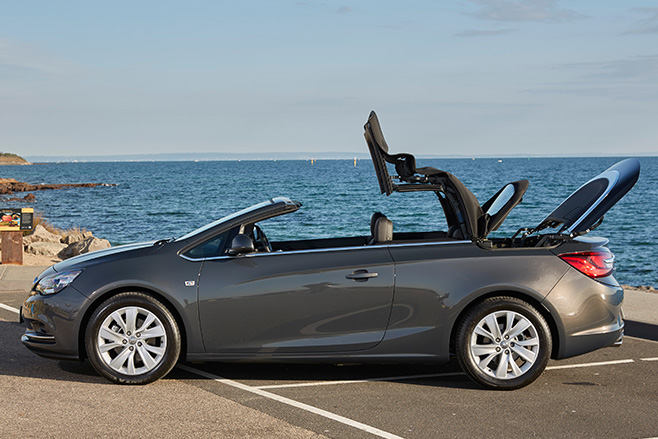
Available as a six-speed auto only, its signature inclusion is a triple layer, electrically-controlled convertible soft-top.
Why should I care?
Holden is positioning Cascada as a relatively small volume ‘halo’ car for the brand, claiming it offers the size and quality of other European four seat convertibles costing double the dollars.
What’s new about it?
Launched in Europe as an Opel in 2013, the Cascada “was planned, designed and developed from the outset as a pure convertible”, so it’s a purebred, engineered to deliver comfort and refinement with roof up or down.
The headlights might look Astra-familiar, but the rest of the body, particularly from the A-pillars back, is unique to the convertible.
That’s all fine, what’s it like to drive fast?
Sadly, the only engine available is the marginally de-tuned (125kW/260Nm) version of the 1.6-litre four, matched to a less than snappy ‘Active Select’ six-speed auto. Combine that with an extra 259kg of kerb weight (compared to the GTC) and you’re looking at more show than go.
Even a brutal mashing of the accelerator pedal brings a relatively lethargic and harsh response (0-100km/h claim is 10sec), the car crying out for the extra grunt of the Astra VXR’s 2.0-litre turbo.
But once decent highway momentum is achieved ride quality is good, with only a hint of body shudder over serious bumps and potholes (with roof up or down), and overall refinement is excellent. The ‘standard’ Cascada rides on 18-inch alloys, but a limited (50 units) ‘Launch Edition’ picks up 20s.
Although steering feel is good, the car’s extra weight makes its presence felt in cornering, with a gentile, ‘six tenths’ approach to highway kilometres proving the most comfortable and enjoyable.
And driving home from the city?
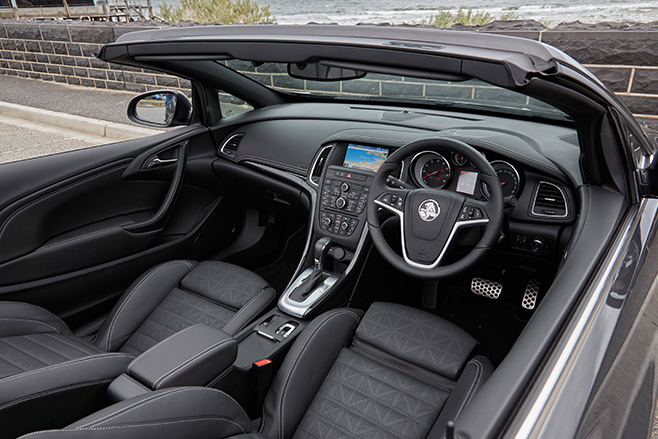
This is the Cascada’s more natural habitat. With cushy perforated ‘leather appointed’ seats, and seven-speaker premium audio, even with the top down (it raises or lowers in 17 seconds, at speeds of up to 50km/h) and side glass up, the interior is a pleasant place to be.
The distinct lack of open road urge is less of an issue in the urban jungle, the car moving smoothly and quietly through the stop light grand prix.
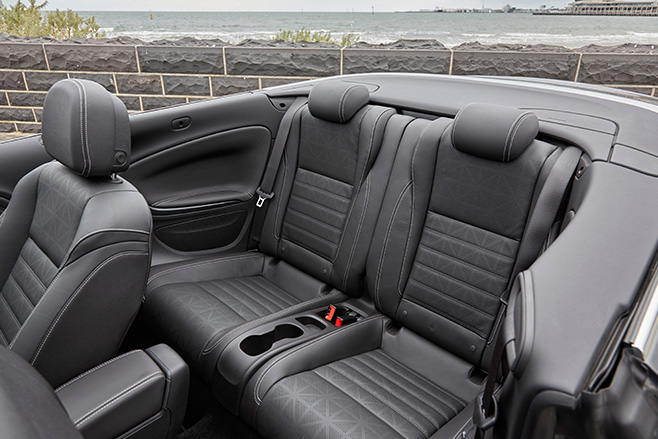
There’s genuine space for four, although rear legroom is tight. And cargo space is decent, with 280-litres available roof down, and 380-litres when it’s up.
Anything bad about it?
The soft-top’s (glass, heated) rear window is small, the centre console is all buttons, and the multi-function trip computer is a telling sign of this fourth-gen Astra’s age. Using old-school orange/red LED graphics, it’s hard to read, and looks out of place next to the 7-inch centre-dash screen running the MyLink infotainment system (including digital radio).
The A-pillars are also monstrous; despite inclusion of small windows near the base, they compromise forward vision, particularly to the right. And on the small annoying niggles register, although it wears a thin veneer of padding, the door armrest is as hard as granite.
How much would I have to pay? And is it worth it?
For $41,990 the Cascada includes heaps of standard equipment including, Hill Start Assist, 18-inch alloys (with 17-inch space saver spare), leather appointed heated front sports seats, sat-nav, cruise control, rear view camera, dual-zone climate-control air, front and rear park assist, rain sensing wipers, heated leather steering wheel, and the ‘MyLink’ Infotainment system with 7-inch colour display.
For an extra three grand, the 50 Launch Edition cars also pick up 20-inch alloys, nappa leather appointed and ventilated sports front seats, a leather sports steering wheel, and Adaptive Forward Lighting with bi-xenon headlights and LED daytime running lights. Get ’em while they’re hot.
Would you take the Holden Cascada or VW Golf Cabriolet?
Line-ball on bucks, but we’re leaning towards the Holden for is size, looks (let’s face it, that’s what the majority of people buying it will be most concerned with anyway) and lengthy equipment list.
Click here to find out more about the Holden Cascada.
Former Wheels editor Peter Robinson takes you behind the scenes of his 1997 feature An Italian Job, when he searched in a legendary Lamborghini for the Alpine setting of its most famous crash.
For car lovers it is surely both the most memorable and shocking opening sequence in movie history. The camera pans down on an orange Lamborghini Miura belting through the snow-covered alps, initially to the unmistakable sound of a V12 engine on song before this fades to the voice of Matt Monro singing On Days Like These.
Read Peter Robinson’s classic story, as published in the January 1997 edition of Wheels.
Nothing suggests what is coming: the Miura blasts into a tunnel… then you hear savage braking, then a devastating explosion. We then see a bulldozer throw the wrecked Lambo down a ravine, watched by an assembly of Mafia henchmen (see photo on the opposite page).
On first viewing the 1969 movie The Italian Job, it’s impossible to believe the producers would wreck a Miura, then probably the world’s most desirable – and certainly the most beautiful – sports car. “Oh no, they couldn’t,” I’d shouted in astonishment in the movie theatre.
I always wanted to find the road, preferably in a Miura, to bring car and magnificent scenery together again.

A few days on, photographer Stan Papior collected the Miura in Turin and we headed for the Alps for an unforgettable day. Not because the Miura was a great car to drive – it wasn’t – but for the excitement of driving that car on roads that provided Papior with the best photographic location he’d ever used.
Styling took total precedence over practicality and everything else in the Miura. Even in 1996, 30 years after it was launched, the Miura seemed impossibly compact and light. It weighed just 1200kg, and the 2464mm wheelbase is 236mm shy of today’s Aventador, Lambo’s equivalent V12.
With one stroke, the Miura made every production Ferrari obsolete; the first 12-cylinder mid-engine Ferrari didn’t arrive until 1971. Working in complete secrecy, Lambo engineers Gian Paolo Dallara and Paolo Stanzani effectively copied the Ford GT40 and Ferrari 250LM racers, though the Miura was always intended to be a road car.
Today, we know that Lamborghini provided the movie producers with two Miuras – one for the driving shots (recently found and now valued at about $2.5m) and another with a body shell mounted on an accident-damaged chassis that could be destroyed for the movie. Only on close examination can you see the body doesn’t include an engine.
Time for another viewing I reckon.
This is the story of a beautiful car, a great road and the classic movie that brought them together.
First published in the January 1997 issue of Wheels magazine, Australia’s most experienced and most trusted car magazine since 1953.
The car? Lamborghini’s Miura, celebrating its 30th birthday in 1996, justification enough for this adventure. The road? More difficult, we had to find the road. The Film? The Italian Job, of course, the Caine and Coward comedy in which the real stars were the cars.
Read former Wheels editor Peter Robinson’s story of how he came to write this classic tale.
Everybody remembers the opening sequence: the camera pans down from snow covered Alpine peaks to capture an orange car blasting across a bridge, high above a valley. Heart-throb film star Rossano Brazzi wheels the Miura through magnificent mountain scenery as the credits roll. The soundtrack begins with the unmistakable symphony of a Miura engine on song, only for this to fade behind the voice of Matt Monro singing ‘On Days Like These’. I’ll admit to a preference for the howling V12. Finally, after two minutes 50 seconds, the Miura roars into a tunnel.
There’s been nothing in this idyllic opening to suggest what happens next. You hear savage braking, then hear and see a shocking explosion. I remember spontaneously shouting, “No, they couldn’t,” back in 1969 when I first saw the film. Not even Hollywood, I reasoned, would destroy a Miura. I swear any enthusiasts will react in a similar manner on first viewing.
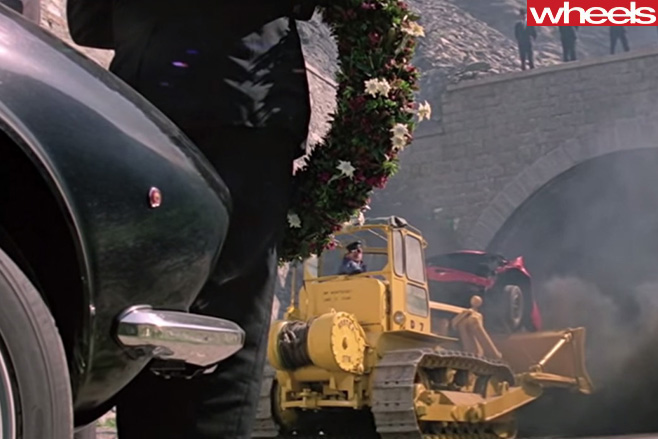
And so it goes, the story of British criminal brains versus the might of the Italian Mafia, the entire narrative exploited to permit a wonderful array of motoring adventures in a wide variety of cars. We wanted to bring car and road together again, reasoning there is no better way to honour the 30-year life of what many believe to be the most beautiful car in the world. Finding a Miura in the vibrant orange of the early cars proved impossible. In the end, we settled for a yellow 1970 S, courtesy of a generous (and anonymous) owner who allowed us to take his car for a day and thereby add a fifth to the 6000km odo reading since a complete rebuild six years ago.
But where is the road? Many viewings of the film suggest it is Italy, but movie makers almost inevitably cheat. Logically, however, it had to be close to Turin, where so much of the film’s action takes place. Various sources suggested the road was near Mont Blanc. We rang Remy Julienne, whose team L’Equipe Remy Julienne performed The Italian Job‘s terrific stunts. One of his team told us the road was “on the old road from Aosta to Mount Blanc”.
There is no old road from Aosta to the Mont Blanc tunnel. There’s only the existing, banal two-laner that runs up the valley, and is gradually being replaced by autostrada. Even Frederick St George, who organises the annual The Italian Job Run from London to Turin for charity, wasn’t sure.
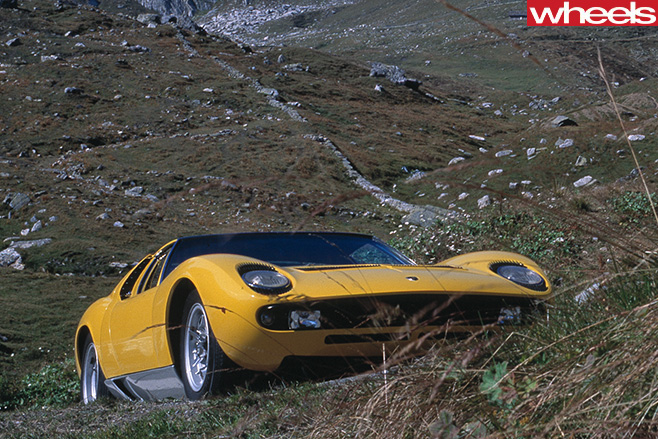
From the A5, linking Turin with Aosta and (almost) Mount Blanc, we turned off at Aosta towards Martigny, in Switzerland. Filming of The Italian Job began in 1968, just after the opening of the Gran San Bernardo tunnel. Based on Pete’s memory, we took the Colle road that begins on the Turin side of the spectacular new bridge built in the ’60s as part of the vast tunnel complex.
Within three hairpins, looking back at the bridge, we knew Pete was right. Today, there’s a new hotel complex and more power lines to spoil the view, but this bridge is that bridge. And the road, still recognisable. Yep, it’s that bridge on the Colle Gran San Bernardo, immortalised in The Italian Job’s opening sequence and still a spectacular structure recognisable to anyone who knows the film. Success. Except for the tunnel. On this Colle, there is no tunnel that remotely resembles the Miura’s black hole.
We ran the Alfa to the 2473m summit of the Colle and the Swiss border, and stopped for coffee. The barman told us that, until they were cleared away by rangers a couple of years ago, bits of many of the wrecked cars could still be found at the bottom of the valley. “We spent days throwing little Mini cars off the top of Mount Blanc,” says Michael Caine, slightly inaccurately, in his autobiography.
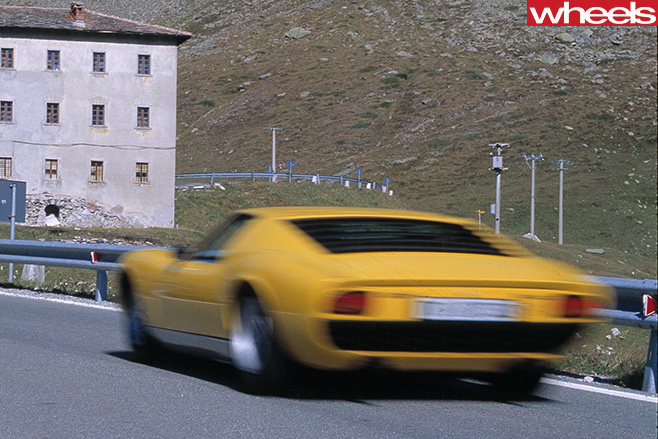
Why did the producers use the Miura, and not a (far more famous) Ferrari? That’s easy, in theory, though I could find nobody to support my deduction.
Lamborghini’s mid-engined supercar shocked the establishment on its debut at the 1966 Geneva show. Eventually, after much persuasion from Pininfarina, who hated to see an upstart rival steal the design lead from Ferrari, Enzo was forced to adopt the mid-engine layout for the Berlinetta Boxer. Ironically, the Boxer, as it is now commonly known, was shown at the 1971 Geneva show, on the very same day Lamborghini unveiled the prototype Countach, the Miura’s successor.
Incredibly, the Miura arrived two years before the 365 GTB/ 4 Daytona, the last of Ferrari’s great front-engined GT cars, at least until today’s 550 Maranello. No wonder Ferrarista hate the Miura.
Lamborghini, the tractor manufacturer, started building cars in 1964. The P400 Miura was the second product of a team of young, open-minded engineers who knew Ferruccio Lamborghini wouldn’t go racing. Still, they wanted to build a road car with the engine in the middle, like the sports racing cars of the era. At the Turin show in November, 1965, the Gian Paolo Dallara and Paolo Stanzani chassis was revealed.
Inspired by the Ford GT40 and Ferrari 250LM, Dallara want to keep his car compact. He positioned the Miura’s 350bhp, dohc, 4.0 litre V12 transversely behind the driver, with the block modified so it could be cast as one with the gearbox and final drive. Just like a Mini. There was no body and few people took it seriously – not until March and Geneva, when the Miura appeared clothed in a body of extraordinary beauty.
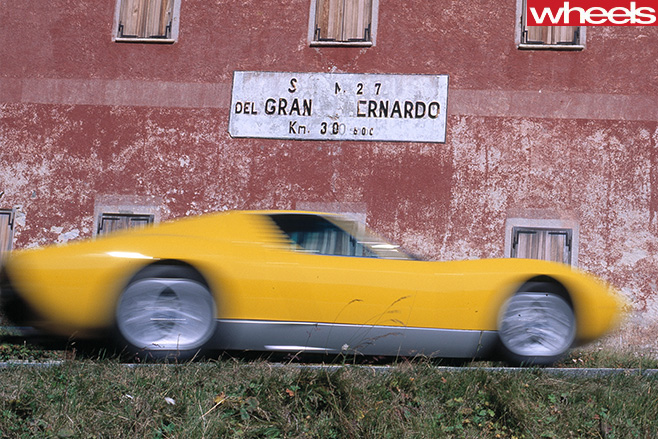
“The Miura design is 70 percent mine,” Giugiaro said recently, showing me copies of his signed drafting drawings, dated October and November, 1964.
“The idea came from the Testudo [Giugiaro’s 1963 concept car based on the Chevrolet Corvair, and the first design for which he was given complete freedom by Bertone J. At the time I didn’t even know the engine was transverse.
“When I left Bertone I didn’t have the chance of following the building of the car, and the originals of these drawings stayed behind. Gandini took my sketches and finished the car, but the true shape and proportions of the Miura are mine. The sketches are important, but the line drawings give you the detail of the car and are the real proof. There was no time to do proper perspectives. The car could be milled from these drawings.
“One day I should show them, but it would hurt Bertone. What’s really important is not who did the design, but that the car was built.”
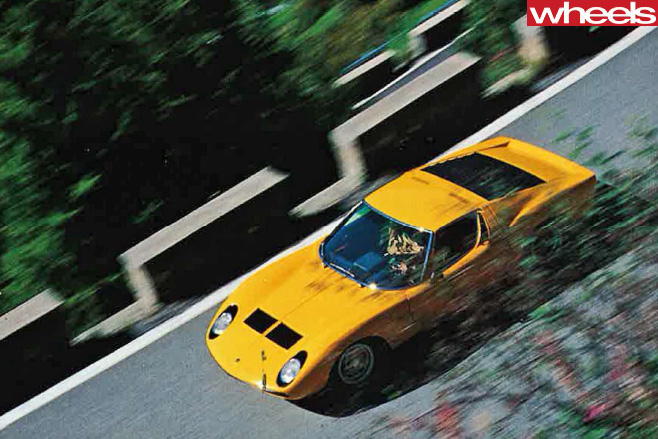
But Fetruccio Lamborghini and his young engineers were in a huny. They had the world – ie Ferrari – to beat and there was always a new project on the drawing boards, or in the works.
The delicately exquisite Miura was replaced by the spectacular Countach in the early ’70s, but there’s no doubt which design has best stood the test of time. The Miura, perhaps the sublime automotive beauty and so hauntingly graceful photographer Papior and I spent our day eulogising the styling. By the time we handed it back to its owner, we still couldn’t think of a better looking car.
Which is not to say it is perfect. Rossano Brazzi obviously fits the Miura. I don’t. The car is incredibly low, so low I feel as if I’m sitting on the road. The view through the panoramic windscreen is incredible; the elegance of the rolling wings, their compound curves merging perfectly into the sunken bonnet, is close to design perfection. My knees are set apart, the pedals so close yet, like Brazzi, I have to stretch to reach the delicate, almost horizontal steering wheel and my head hits the roof.
Tall people find the driving position impossibly uncomfortable. The road feels close, the cockpit distinctive with two huge binnacles for the 320krn/h speedo and 10,000rpm tacho on either side of the steering column.
There is no redline.
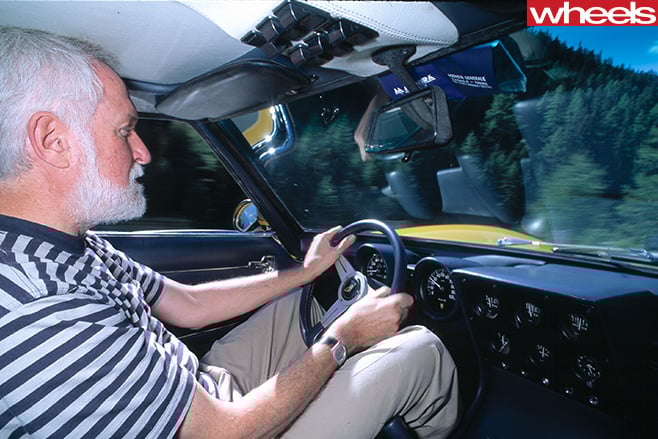
Watch the film and you’ll notice that Brazzi not only winds on steering lock but also winds it off. More than anything else, it’s the absence of self-centring steering that makes the Miura different to drive.
Yet, once above a parking speed, the low-geared, unassisted rack and pinion steering comes alive and it’s easy to drive.
There’s plenty of grip and far more stability than I had expected, given the early Miura’s reputation, but the brakes don’t feel trustworthy and the gem·change is stiff in its open gate.
It still feels incredibly powerful, and comparatively quiet below 4000rpm, before the whirr of cams and sucking of the four triple-choke Webers, inches behind your head, are overwhelmed by the bellow of the exhaust. The S is chronologically the middle of three Miura models. The first, P400, supposedly developed 261kW, the S 276kW and the later SV 287kW. However, Bob Wallace, the New Zealand test driver who helped develop all three, says any differences were largely the responsibility of the advertising department.
First is hard to find, the clutch is jerky and either in or out, the pedals are in line with the seat and the steering wheel but articulated from the floor and awkward to use. Moving away from rest is made more difficult because the handbrake can’t hold the car on a slope and I’ve been told the clutch is sensitive and should not be slipped.
Once under way, everything is easier, quicker and less awkward. The steering has a dead spot on-centre, slack that could be 26-year wear, and seems slow to react.
Cruising below 4000rpm is relaxed and tolerably quiet. The ride is far more absorbent than expected, the steering more precise and positive in fast sweepers.
This would have been a very pleasant mode of pan-European transport in the late ’60s for it is clear that by the time of the S, Lamborghini had cured the first Miura’s stability problems and the tendency of the nose to lift above 200km/h. At low speeds, it doesn’t like potholes but the body feels rigid and the grip from the relatively modest 215/70VR15 front and 235/70VR14 rear tyres is better than expected.
The Miura never feels agile – the steering is to blame – but it can be hustled along in safety, sweeping easily through second and third-gear comers. I’m not pushing the engine or the roadholding to the limit, but the impression (if you ignore the poor driving position, brakes and steering – yes, a long list of flaws) is of a civilised, virtually contemporary supercar.
If there is a better photo location in the world, Papior’s not found it. The sight of the Miura in the clear mountain air at over 3000m is more than striking. But somehow, for all the near race-car dynamics and packaging, the driving experience remains in second place behind the looks. That’s not the way Dallara intended it, of course, but then he didn’t know Giugiaro had fashioned so alluring a body for Bertone. For me, it’s the beauty of the exterior that dominated the Miura and lead to its starring role in The Italian Job. Nothing else was as exotic.
I loaned my copy of the film to our Miura owner. After one viewing, he saw the director’s deception: seconds after Brazzi puts on his sunglasses as the credits finish and unseen by the viewers, the Miura turns around. It’s actually heading in the opposite direction down the mountain from whence it came, and is below the snow line and among trees when it hurtles into the tunnel…
Bleedin’ step on it!
Immensely popular in Britain and I Australia, The Italian Job is hardly remembered in America, nor even with good reason in Italy, where it was called La Bombe ltalia.
Fiat and Giovanni Agnelli personally helped organise access to the many locations used in and around Turin. The Italians weren’t happy with the result. How, they asked, could Alfa Romeo police cars possibly be beaten by Minis?
One Italian I spoke to recalls angry discussions outside the cinema. The film does raise nationalistic prejudices.
Most people remember the cliffhanger ending, the bus tottering over the brink as the gold slips towards the open rear doors. It wasn’t intended that way. Charlie Croker and the gang were supposed to get to Switzerland and deposit the money in a bank – where the bank manager turns out to be the Mafia boss. Midway through the filming, Paramount sensed a sequel and changed the end to make this possible. Sadly, it never happened; agreeing a timetable with the key actors proved impossible.
Er, hang on a minute, lads. I’ve got a great idea…
