
What stands out?
The Colorado 7 is an SUV-style wagon that is based on the Holden Colorado ute, and it is built truck tough. That makes it ideal for serious off-road driving, and good at towing and carrying stuff. Both models seat seven and are strong on safety.
What might bug me?
Playing your favourite music tracks, if you haven’t exported your CD collection to your phone (or similar device). The audio system doesn’t have a CD player.Getting directions: the satellite navigation requires a separately purchased smartphone app.
What body styles are there?
Five-door wagon only.The Colorado 7 has selectable two-wheel drive and four-wheel drive, with dual-range gearing. It is classed as a large SUV, lower priced.
What features do all Colorado 7s have?
Cruise control, and Bluetooth phone connectivity. A six-speaker audio system, with auxiliary and micro-USB inputs for devices such as an iPod or smartphone.A 7.0-inch touchscreen for managing the audio system and smartphone. The touchscreen can also be used for satellite navigation, but this requires a separately purchased smartphone sat-nav app.Hands-free voice control for some smartphones.A reversing camera. Rear parking sensors, which warn of the proximity of obstacles when you are reversing.Seven seats.Six airbags: two directly in front of the driver and front passenger; one alongside each front occupant to protect the upper body; and full-length curtain airbags down each side of the car. The curtain airbags protect heads of all those sitting adjacent to a window, third-row passengers included.Electronic Stability Control, which can help bring a skidding car back under control. All new cars must have this feature.Electronic Traction Control, which helps on slippery surfaces and allows you go further off road.Hill Start Control, which prevents the car rolling backwards when you are starting off on a steep hill. Hill Descent Control, which helps you control the car on steep off-road descents.The Colorado 7 comes with a 100,000km, three-year warranty.
Which engine uses least fuel, and why wouldn’t I choose it?
There is only one engine available for the Colorado 7, a four-cylinder diesel with plenty of power.This is a modern design and is also good on fuel, using just 9.2 litres/100km in the official test (city and country combined). In real world driving, fuel use averages about 11.0 litres/100km.However, the engine is quite noisy and not particularly smooth running.A six-speed automatic is the only gearbox option.
What key features do I get if I spend more?
Step past the least costly Colorado 7, the LT, and spend more for a Colorado 7 LTZ and you get leather seats, with the driver’s seat power-adjustable. Automatic climate control holds a set cabin temperature.Headlamps on the LTZ are more effective projector types, and they self-level to compensate for a heavily loaded car. And the LTZ has fancier-looking 18-inch aluminium alloy wheels, rather than the 16-inch alloy wheels of the LT.
Does any upgrade have a down side?
The 18-inch wheels on the Colorado LTZ don’t work as well off-road as the smaller wheels on the LT. They also make the LTZ ride more harshly on rough roads, and the 18-inch tyres are more susceptible to punctures.Only white paint is standard. Other colours are an extra-cost option.
How comfortable is the Colorado 7?
The Colorado 7 has a roomy and comfortable cabin, and minor controls are well laid out and simple to use.However while the steering wheel is adjustable for tilt, you can’t adjust it for reach. That could be a problem for some drivers, especially those with long legs. And the interior finish, with its hard and cheap-looking plastics, gives the Colorado 7 more of the feel of a commercial vehicle than of a passenger car.The audio system sounds good. But not everyone will be happy that it doesn’t have a CD player.The Colorado 7 is generally easy to drive and the engine has good power, especially from low speeds, which makes for easy and safe overtaking. The automatic gearbox is responsive and generally shifts smoothly.The Colorado rides softly and generally feels comfortable even on bumpy roads. However, the ute-style solid axle at the back means that the rear of the car moves around over corrugations more than it would in an SUV with more car-like, independent rear suspension.
What about safety in a Colorado 7?
Both versions of the Colorado 7 rate as Excellent for safety, thanks to their six airbags, reversing camera, rear parking sensors, electronic stability control, and seat-belt reminders for all occupants.Side-curtain airbags on the Colorado 7 protect the heads of passengers in all three rows of seats.(To see a list of the safety features on any model, open the model from the Cars Covered By This Review dropdown near the top of this page, and look under the features tab. Safety-related features are listed in red.)The Australasian New Car Assessment Program (ANCAP) has awarded the Colorado 7 five stars, its maximum safety score.
I like driving – will I enjoy this car?
The Colorado 7 is designed to be tough and capable off road, rather than sharp and precise on the road. It is built on a commercial vehicle platform. It does not handle badly, but it is not a car that keen drivers will particularly enjoy.The engine offers enthusiastic performance but isn’t as quiet or as smooth running as other new-generation diesels, which can make it less relaxing to drive.However, the Colorado 7 is very capable off-road, helped by its dual-range gearing (which allows you to drive comfortably at a very slow pace) and the truck-type rear suspension. It can get your family to camping locations and the like that would be beyond the reach of alternative SUVs designed mainly for on-road use (which tend to have independent rear suspension, less ground clearance and only single-range gearing).
How is life in the rear seats?
The main rear seat of the Colorado 7 is good for two adults and a child but is on the tight side for three adults. It has attachment points for three child seats. The third-row seating is suitable only for children.The Colorado 7 is a good height for helping small children or less agile adults get in and out.
How is it for carrying stuff?
The luggage area is accessed via a single top-hinged tailgate. The cargo space is not as big as it seems from the outside of the car, because the third-row seats, even when folded down, eat into it.On a more positive note, the three-person middle row of seats folds 60/40 and the two-person third-row folds 50/50. That adds versatility, allowing you to tailor the car’s interior for carrying people or gear or both.The Colorado 7 has a 3000kg maximum tow rating, which is average for a medium-sized 4WD wagon. That is enough to legally tow a two-horse float or a large, tandem-axle caravan.
Where does Holden make the Colorado 7?
All Australian-delivered Colorado 7s are made in Thailand.
What might I miss that similar cars have?
A CD player, and sat-nav that doesn’t require a separately purchased smartphone app. The Isuzu MUX has this, for example.A rear differential lock, which can help you go further off-road. The Toyota Fortuner has this, for example.The option of using 4WD all of the time, which can make it safer to drive on wet or otherwise slippery sealed roads. The Ford Everest and (if five seats are enough) Mitsubishi Pajero Sport offer this. (The Colorado’s 4WD system can be used only off road.)Active safety aids such as forward collision warning (which alerts you to a looming obstacle such as a car stopping sharply in front) and lane keep assist (which helps prevent you from drifting out of your lane on the highway, a sign of fatigue). The Everest offers these features.You might also consider diesel-powered passenger-car based SUVs, such as the Hyundai Santa Fe and Kia Sorento. These don’t have the off-road ability of the Colorado 7 but they ride and handle more smoothly on the road.On the other side, if you wanted a seven-seat 4WD that was even more capable off-road you could opt for a Toyota Prado. But it will cost more to get a similar equipment level.
When did Holden replace the Colorado 7?
The Colorado 7 was new in 2013, and was revised just a year later.About October 2016 the Colorado 7 was upgraded dramatically and renamed the Trailblazer. Among a big range of improvements, the Trailblazer has a quieter and more comfortable cabin, a smoother engine, better handling and steering, and support for Apple CarPlay and Android Auto. Active safety aids introduced on the Trailblazer include a forward collision warning and lane departure warning.
I like this car, but I can’t choose which version. Can you help?
The cheaper LT is the best buy. It comes with all the safety features of the more expensive LTZ, and the same performance. And it has more practical wheels and tyres.
It’s a sprinter and endurance athlete, an eco-warrior and ultimately a luxury family trickster. Audi’s Q7 hybrid is the prince of diversity.
WHAT IS IT? Audi takes its largest diesel-engined SUV, the Audi Q7, and turns it into a fuel miser with a battery-electric hybrid system.
WHY WE’RE TESTING IT Audi has launched the Q7 in Australia with two diesel-engined variants that use just 5.9L/100km on the combined cycle – pretty good for something that weighs more than 2.0 tonnes. The hybrid gubbins will help to shave the fuel use to about an impressive 1.7L/100km when it arrives next year.
MAIN RIVALS Not many. The Range Rover Sport SDV6 HEV uses more fuel than the non-hybrid Audis, while the closely related Porsche Cayenne S plug-in hybrid only achieves 3.4L/100km.
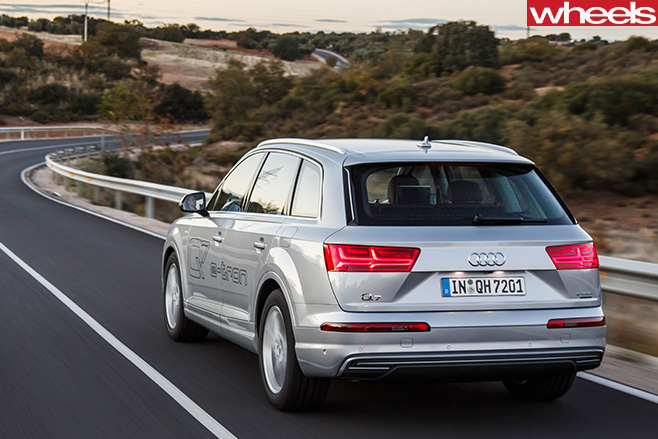
PLUS: Torquey diesel hybrid response, ride quality, intriguing yet workable technology and engineering, usual classy Audi cabin and appointments MINUS: No chance of arousal from exhaust note, sensitive steering, no spare tyre (that’s where you find the battery), big and heavy beast for the ‘burbs.
THE WHEELS REVIEW IT TOOK some time for the world to understand the concept of an SUV as a performance vehicle. Even longer to appreciate the apparently conflicting daftness of a hot-rodded SUV that is somehow also a green machine.
Joining this very select band is the Audi Q7 e-tron 3.0 TDI quattro, the marque’s first plug-in hybrid with a diesel engine. (Okay, we must acknowledge that astonishing, seemingly never-ending emissions and fuel efficiency scandal. When will it end?)
Still, Audi certainly isn’t walking away from diesel engines and this one – unusually – is a plug-in hybrid with a six-cylinder diesel engine and permanent all-wheel-drive.
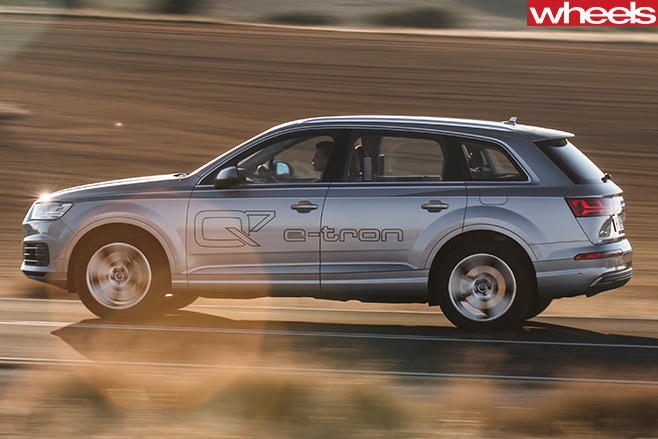
Here are two statistics to contemplate: this Q7, hardly a featherweight at a hefty 2445kg, will burst out of the blocks and reach the nominal 100 km/h mark in precisely six seconds, and yet it also has the chameleon-like ability to get along (rather more sedately, let it be said) whilst using diesel at the rate of not even two litres across a 100-kilometre journey.
The V6 3.0 TDI engine and the electric motor are both paired to an eight-speed tiptronic gearbox and there is a choice of four modes: EV, Hybrid, Battery Charge and Battery Hold. Electric driving is prioritised in EV mode, while in Hybrid the management system makes the calls on which driven type is used. Battery Charge mode is self-explanatory and Battery Hold saves the available electric energy for later.
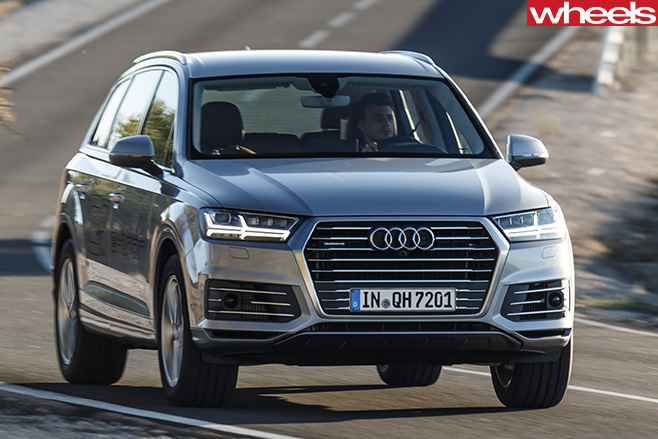
In some modes, throttle sensitivity is dulled for better fuel efficiency but when asked the e-tron gets the scenery moving. Its weight is a handicap when required to swing through some tight corners but the extra kilos help keep it settled over the urban speed humps. Its recovery from bumps is exemplary. In comfort driving mode, there is some body roll, but this type of behaviour tidies up when in the dynamic setting.
The electromechanical steering of the new Q7 still doesn’t quite cut it, with less-than-desirable road feel.
In all-electric mode the Q7 is capable of travelling up to 56 kilometres solely reliant on the high-voltage lithium-ion battery – with impressive throttle response and of course with zero tailpipe emissions. Audi reckons that a full charge on a three-phase industrial outlet takes less than 2.5 hours so it’s possible to use battery power along on a daily work commute. You can also recharge from a conventional outlet at home or work.
According to the New European Driving Cycle (NEDC) test, the efficiency reaches as low as 1.7 litres/100km. Real world readings are higher. Unequivocally, though, the smooth Leviathan is a frugal jigger.
Charged up and with a full 75-litre tank of fuel, and sometimes taking advantage of braking and cruising recuperation, the Q7 e-tron can travel – without stopping – a distance of 1400 kilometres, the equivalent of Melbourne to Sydney to Coffs Harbour.
Audi Australia says the newcomer will be generously appointed with new MMI infotainment system and virtual cockpit display (the screen resolution is brilliant) and new-for-the hybrid Q7 thermal management system with integrated heat pump. This collects waste heat from the electrical components to use for heating or cooling the interior.
The Australian price of the Q7 plug-in hybrid is yet to be determined. Somewhere adjacent the Porsche Cayenne hybrid’s $140,000 is a good guess.
Predictive efficiency assistant system
This is new. The Q7 e–tron’s standard MMI navigation-plus and hybrid management systems work together using GPS data and real-time traffic info to compute the best-case strategy at the start of a trip. Predictive efficiency system generates a detailed image of the route up to three kilometres ahead and uses visual signs in the head-up display to prompt releasing the throttle to save fuel. The pedal simultaneously pulses against the sole of the driver’s foot. Cleverly, the Q7 reaches the destination with zero battery power left…
SPECS Model: Audi Q7 e-tron 3.0 TDI quattro Engine: 2967cc 6 cyl turbo diesel Max system power: 275kW Max system torque: 700Nm Transmission: 8-speed tiptronic Weight: 2445kg 0-100km/h: 6.0sec Fuel economy: 1.7L/100km (NEDC); not rated for Australia Price: circa $140,000 On sale: Second half 2016
So, what is it?
The Range Rover Sport SVR makes no sense. Nobody needs a 405kW SUV capable of running 0-100km/h in 4.7 seconds. But, environmental sensibilities notwithstanding, the fact it exists makes the world a better place.
Powered by the same all-alloy 5.0-litre supercharged V8 found under the bonnet of the Jaguar F-Type R, this beautifully brutal, 2.3-tonne beast is the fastest, most powerful Land Rover ever produced, and the first product from Jaguar Land Rover Special Vehicle Operations (SVO), an engineering SWAT team assigned to the task of making cats leap further and Rangies rove faster.
Why should I care?
The Range Rover Sport is already available with a 375kW/625Nm version of the Jag V8, running 0-100km/h in 5.3secs, so the SVR is overkill of the most hilarious and desirable kind. It’s even lapped the Nurburgring Nordschleife in 8min:14secs; faster than the BMW 1M Coupe, and Holden’s own Rob Tribiani in the VF Commodore SS Ute.
What’s new about it?
Aside from the hi-po engine, the SVR picks up a swag of suspension, drivetrain and chassis improvements, including a sports exhaust with switchable bypass valve, stiffer rear sub-frame bushes, uprated air springs and revised dampers.
The rear eDiff has been recalibrated for optimum on-road performance, and the front Brembo brake set-up features 380mm ventilated rotors and six-piston calipers.
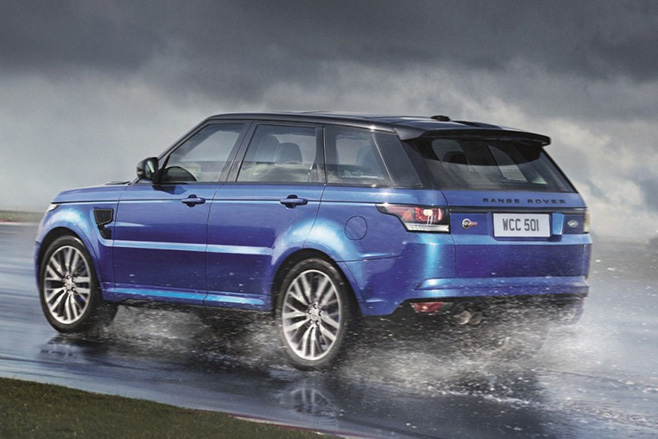
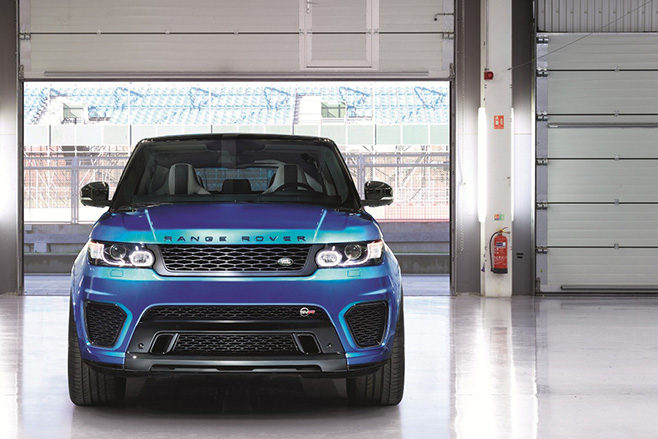
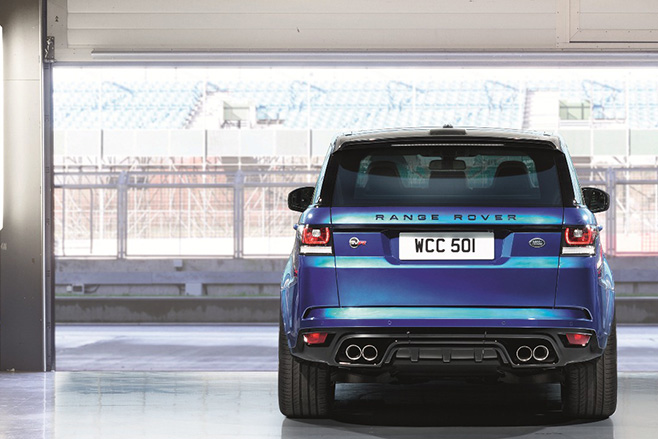
Outside, the biggest clue to the SVR’s performance potential is the standard 21-inch rims shod with 275/45 all season rubber. Giant 22-inch alloys wrapped in more focused 295/40 Continental SportContact tyres are optional. The front bumper also features larger, trapezoidal air intakes feeding the twin charge air coolers, the bonnet vents are revised and the grille is black.
There are also vents in the front quarter panels, macho side mouldings, a high level rear spoiler, and unique rear bumpers sitting above a gloss black diffuser.
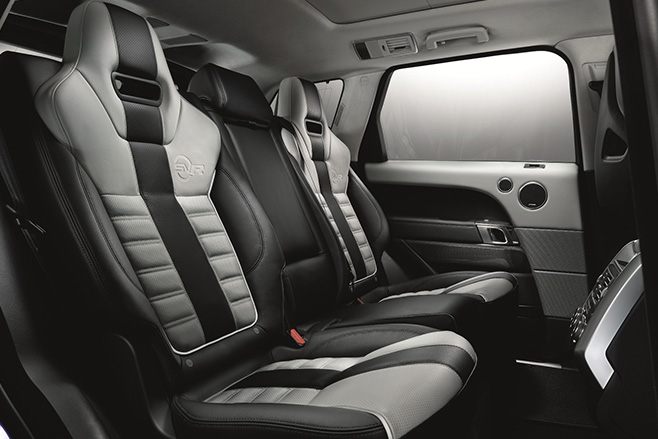
Inside, 16-way electrically-adjustable sports seats are trimmed in ultra-smooth (non-grained) Oxford leather, and the dash is highlighted by classic engine turned alloy panels (carbon fibre optional).
That’s all fine, what’s it like to drive fast?
The SVR’s launch program took in urban, B-road and freeway sections, as well as a track session, and like its Jaguar F-Type cousin the Sport SVR announces its arrival with a ground trembling rumble. Drive this Rangie to the polo and you’ll scare the ponies back into their floats. Around 3,000rpm an electronically-controlled exhaust bypass valve opens and Thor-like thunder starts blasting out of quad exhaust outlets.
On the other side of the rpm ledger, the engine is tuned to cut air charge more quickly when the driver lifts off the throttle, so spits of unburnt fuel combust in the hot exhaust system for a popping and cracking sound show.
But this suave utility vehicle puts its watts where its mouth is with fierce acceleration to match the bellowing soundtrack. Keep the throttle pinned and the SVR blazes ahead at supercar-rivalling speed.
The ZF eight-speed adaptive auto transmission is carried over from the ‘standard’ Range Rover Sport, although shift times have been reduced by a claimed 50 per cent thanks to careful management of fuel cut-offs during up-shifts.
Also worth noting the trans uses a torque converter for first gear, which is bypassed by a locking clutch from second onwards. As a result, ratio swaps, especially via the wheel paddles, are super clean and quick.
The net effect is rapid B-road progress, with impressive body control for such a big bus, powerful brakes, good steering feel, and stunning speed out of corners. No, it’s not a Lotus Elise clone, but it’s way better dynamically than any multi-tonne SUV has a right to be.
And driving home from the city?
The aluminium rich, double-isolated suspension consists of double wishbones at the front and multi-links at the rear. The SVR also features cross-linked, four-corner air suspension and ‘Adaptive Dynamics’ with continuously variable dampers (monitoring vehicle movements “at least 500 times a second”, and adjusting damping force in response to road-surface and driver inputs).
What that means is the SVR subtly transforms from stinging like a bee on the backroads, to floating like a butterfly in the city. Even on the optional 22-inch rims the SVR is smooth, quiet and relaxed around town. The standard of fit and finish inside is as you would expect, high.
What about off-road?
Land Rover says all claims on off-highway ability made for the Range Rover Sport stand for the SVR; same wading depth, breakover angle, approach and departure angles… the lot. And to prove it, the launch drive included a brief bush bash, covering steep inclines and descents, rutted muddy crossings, as well as broken, rocky trails.
We shifted the two-speed central transfer case to low range ‘on the fly’ (possible up to 60km/h) and explored the SVR’s crawling ability using the brilliant hill descent control. An impressive double act.
Anything bad about it?
Keep the exhaust in (open) sport mode at slower speeds and the engine note will boom and drone around the cabin; helped in no small part by a symposer, “enriching sound quality, and filtering desirable induction noise into the cabin.”
Claimed combined cycle fuel economy of 18.4L/100km is likely to climb well into the twenties in the real world, especially with this much snorty V8 fun lurking under your right foot.
How much would I have to pay? And is it worth it?
You’ll need $218,500 to park the SVR in your driveway, a cool $36,500 more than the Autobigraphy Dynamic V8. That’s a lot of dosh, but the SVR delivers a truck load of fun and performance.
Would you take the Range Rover Sport SVR or Porsche Cayenne Turbo?
Another forced induction V8, the Porsche is lighter (150kg), faster (0.2sec 0-100km/h), and more frugal (by 1.3L/100km) than the SVR. But it’s $12,300 dearer. Tough call, but the SVR’s mental exhaust alone is priceless.
Click here to find out more about the Range Rover Sport SVR.
PLUS
- Styling. We’ll admit, the 5 Series’ styling went through an awkward phase, but the current model really looks the business.
- Engines. No matter your favourite flavour – petrol, diesel or hybrid – you’re catered for. There’s a quality selection of engines in the 5 Series range.
- Interior. Premium materials and good ergonomics make the inside of the 5 Series a lovely place to be. If you need to do long trips regularly, you’ll appreciate it.
- Gadgets. There’s a lot of electrickery going on in the 5 Series. You can get an auto tailgate that opens hands-free, very clever cameras in the front bumper that help you see around corners, a head-up display for speed and navigation, and lots more. You won’t be left wanting for tech.
- Headlights. LED headlights are the ‘in thing’, and once you’ve used them you won’t want to go back to conventional halogen bulbs.
- Weight. The 5 Series is a heavy car, and the base model 520i does struggle to shift it quickly. Higher-spec variants don’t have that problem, though fuel economy is worth bearing in mind.
- Conservative. Some may consider the BMW’s handsome styling to be a little too understated.
- Options. There’s a gruelling list of additional extras available to choose from, and some of the options add significant cost to the total bill. Standard kit is good, though, so this is more of an issue for those who are looking for exclusivity.
VOLKSWAGEN’S performance car for the masses, the Golf GTI hot hatch, has been caught up in the VW emissions scandal, which widened last week to include petrol engines in some current cars.
The 162kW, turbocharged petrol engine used in Golf GTIs now on sale was among engines for which carbon dioxide (CO2) emissions had been understated on official documents, Volkswagen parent company Volkswagen Group announced at the weekend.
Volkswagen Australia spokesman Karl Gehling confirmed today that this engine powers Golf GTIs currently on sale in Australia.
However, he could not say whether Australian-delivered Golf GTIs were among the hundreds of thousands of vehicles globally identified as having understated carbon dioxide emissions, a gas targeted by environmental regulators for its contribution to climate change.
“At this stage all I can say is we are seeking further details from our head office,” Gehling said.
He said he expected to receive information on Tuesday, and that Volkswagen would notify customers of vehicles affected.
Gehling said he believed the Golf GTI was the only Australian model on a long list of 2016 model-year vehicles for which VW Group said it had understated CO2 emissions.
The carmaker, which over the first half of 2015 overtook Toyota as the world’s biggest manufacturer by volume, said on Saturday that the latest revelations in its continuing emissions scandal affected 430,000 vehicles globally that it described as 2016 models.
“The internal investigations into the current vehicles of the 2016 model year provide results for narrowing down the actually affected vehicles with implausible CO2 figures. In total for the 2016 model year approx. 430,000 vehicles are affected across the Group. A list of the individual brands’ affected models is attached,” VW Group said on its website.
The attached document listed a range of diesel and petrol powered Audis, Seats, Skodas and Volkswagens.
Volkswagen said earlier this month that it could have understated CO2 emissions for about 800,000 vehicles globally, most of which were diesel-engined vehicles, but did not specify model years.
Gehling said he could not comment on how Australian Golf GTI customers would be affected if it was confirmed that the understated emissions figures had been attributed to Australian-imported vehicles.
However, unconfirmed reports from German sources say that the figures VW described as “implausible” had been obtained using measures such as over-inflating the tyres of test-bed vehicles, and adding diesel fuel to engine lubricant so as to reduce internal friction.
The result of such manipulation would be a reduction in fuel consumption and hence in the engines’ emissions of CO2, which is a normal product of combustion.
Small reductions in test figures could draw particular models under CO2 thresholds applied in European Union countries, where owners save on vehicle tax if they drive cars that meet CO2 targets.
However, the key consequence in Australia for owners would be a greater discrepancy between official test figures and affected cars’ real-world fuel consumption.
VW Group said it had uncovered the understating of C02 emissions while investigating its diesel emissions scandal, which is not connected directly with its latest revelation.
Volkswagen admitted in September that about 11 million of its diesels worldwide used engine management software that cheated emissions tests, and therefore emitted much more nitrogen dioxide – a component of smog associated with breathing difficulties – in real-world use than in tests.
The Australian importers of Volkswagen, Audi and Skoda have announced they will recall nearly 100,000 Australian-delivered diesel cars to correct the software cheats, which were fitted to 1.6-litre and 2.0-litre versions of Volkswagen’s EA189 turbodiesel engine built since 2008 and supplied with a broad range of models.
Apologies if this is old news to some of you, but we’ve just discovered WRC Scalextric and it’s amazing.
A combination of regular Scalextric and lovingly crafted train models, remote control fans create long special stages that are like Colin McRae Rally brought to life.
Just how long it takes to create these environments is anybody’s guess – months? years? – but like their real-life equivalents, it makes WRC Scalextric a more enjoyable spectacle than its circuit racing counterpart, where the cars often move so fast as to be invisible.
If anything like this exists in Australia, drop us a line on Facebook or [email protected].
The test was simple. Take manual and automatic versions of the fourth-gen Subaru WRX and throw the wicked bumps, blind crests and sheer ruggedness of Tasmania’s north-west coast at their all-wheel drive chassis.
After all, it’s these roads on which the original Rex made its name.
Both variants share the same 2.0-litre, turbocharged, direct-injection boxer ‘four’ and its 197kW/350Nm outputs. Where they differ is in how those figures translate to the tarmac.
While the six-speed manual follows traditional lines, with its viscous limited-slip centre differential and 50:50 standard drive split, the Lineartronic CVT offers up to eight ‘steps’ in Sport Sharp or manual mode and uses a ‘variable torque distribution’ all-wheel drive system for a 45:55 front:rear split.
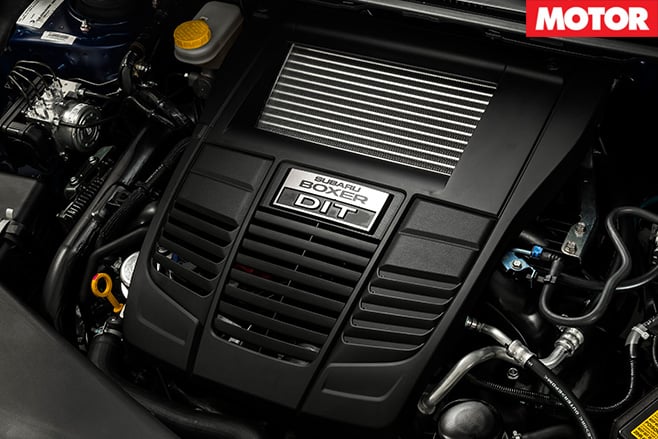
Masuo Takatsu, WRX Project General Manager, revealed to MOTOR that, due to the extra weight of the CVT, the front suspension – already featuring 39 per cent stiffer spring rates and a 3mm thicker anti-roll bar compared to the previous model – also gains firmer damper settings than the manual variant.
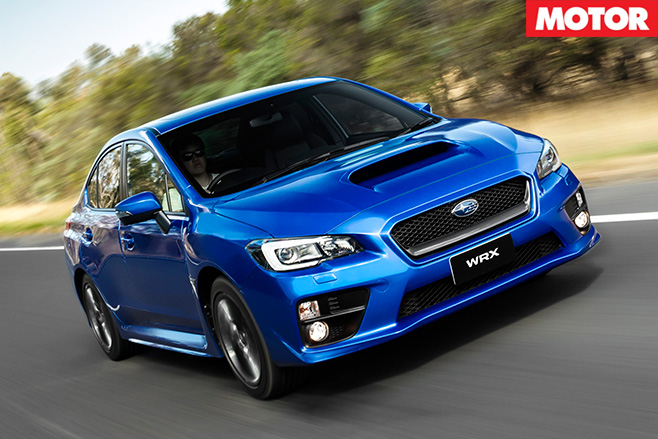
Back on the power, the CVT retains its composure, allowing more throttle to be introduced earlier, fully utilising the immense all-wheel traction on corner exit.
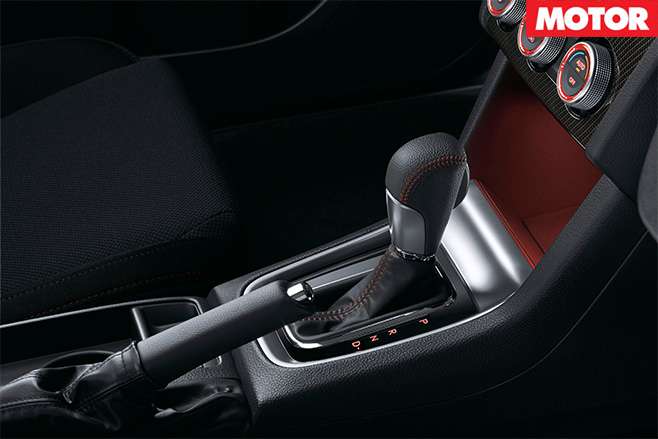
In essence, the combination of a slightly stiffer front-end, more responsive all-wheel drive system and the first truly sporty CVT makes the $2000 premium Subaru charges well worth the investment.
4 out of 5 stars
Specs
Engine: 1998cc flat-four, DOHC, 16v, turbo Power: 197kW @ 5600rpm Torque: 350Nm @ 2400-5200rpm 0-100km/h: 6.3sec (claimed) Weight: 1527kg Price: $40,990
FORMULA 1: Rosberg trumps Hamilton in Brazil, if anyone cares
LEWIS Hamilton arrived in Sao Paulo under the weather and trying to ignore the controversy of a road crash back in Monaco a few days earlier. The triple world champ’s Pagani Zonda cannoned off three parked cars, the Brit unwisely blaming his discomfiture on an unrelenting round of partying since sealing the 2015 title in Austin. “It was a result of heavy partying and not much rest for 10 days,” he said somewhat guardedly. Still, not a great look for a driving role model.
Hamilton’s ordinary week continued into the race, with Mercedes teammate Nico Rosberg extending his slick late-season form. Hamilton was second, but frustrated from the moment Rosberg made a forceful, elbows-out start.
The Ferraris of Sebastian Vettel and Kimi Raikkonen followed in third and fourth, the race outcome replicating their starting positions.
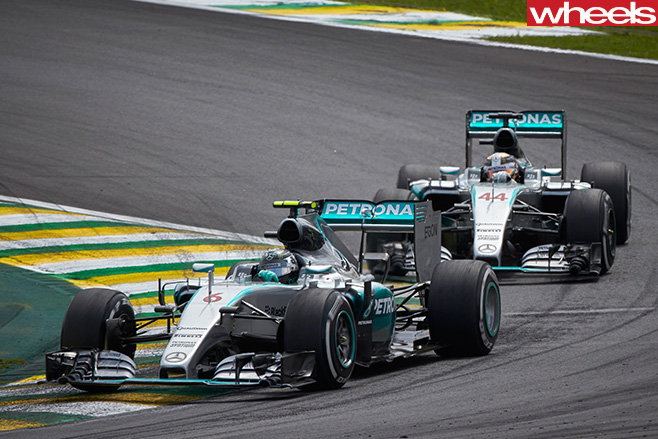
The Brazilian Grand Prix, a race our Mark Webber won in 2009 and 2011, had a slightly different face this year. Some wholesale re-profiling of kerbs meant the drivers had to use quite different lines through some tighter corners.
Rosberg stormed to his fifth consecutive pole position, pipping Hamilton by 0.078sec. Quick, meaningless stat: only 12 drivers have previously posted five poles back-to-back.
Daniel Ricciardo moved to an upgraded Renault power unit over the weekend but reported no discernible difference. His car was slower than that of teammate Kvyat down the straight – back to the drawing board, Regie. Daniel qualified ninth but a 10-place grid penalty put him 19th with but a distant view of the starting line.
The Aussie was better off than Fernando Alonso who used three Honda engines across the weekend, making 12 for the season. The Spaniard started at the rear after taking a 35-place grid penalty, although he was set to start 20th and dead last anyway after failing to set a qualifying time.
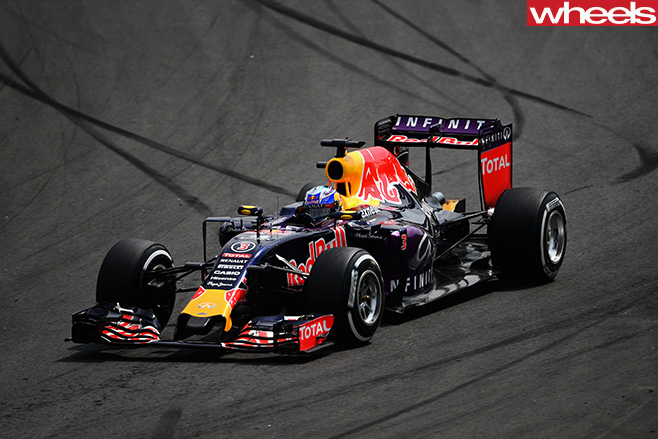
Daniil Kvyat finished in seventh to extend his points advantage in the battle of the Red Bull drivers.
“Clearly my grid penalty didn’t help today” Ricciardo observed, “but Abu Dhabi’s next and that has always been a good circuit for us. I enjoy it a lot so for the last race of the season we’ll hopefully finish strong and in the points.”
At least Ricciardo departed Brazil knowing that Red Bull has secured an engine for next season.
Details are to be confirmed but according to independent F1 news site The Judge13 the tip is that the base engine will still be supplied by long-suffering Renault, while a new Red Bull engine division headed by Mario Illien (one half of Ilmor) will develop it separately along the team’s own hybrid energy harvesting systems.
This arrangement, which gives Red Bull and Renault face-saving positions after their acrimony this year, re-unites Illien and Adrian Newey, after the two adventurous engineering geniuses were involved with the McLaren-Mercedes partnership of the late ’90s to early 2000s.
WRC: Grieving Ogier peerless in confronting conditions in Britain
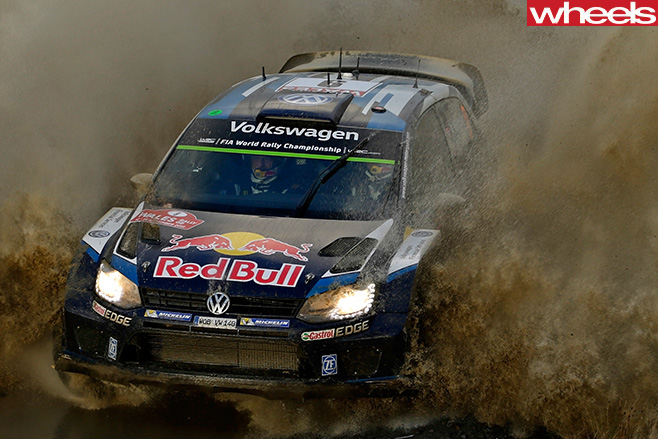
Ogier was keen to obliterate the embarrassment of the previous event when he crashed out of a good lead on the final stage of Rally Catalunya, handing a maiden win to his team-mate Andreas Mikkelsen. This time there would be no glitches.
Though distracted by the murderous events in Paris, Ogier was faultless, establishing a handy lead early and then controlling it to the finish, winning his seventh WRC event of the year by 26sec from Citroen’s Kris Meeke, with VW’s Mikkelsen third.
Out of contention early in Wales was Jari-Matti Latvala who slipped off in greasy conditions and nosed his Polo alarmingly into a very deep and wet ditch.
This elevated Meeke to second, to continue his fight to impress enough to secure a drive next season (and ultimately to hold off Hyundai in the fight for second in the manufacturers’ championship). “I like to fight for wins but that’s not possible at the moment, so second is good,” declared Meeke.
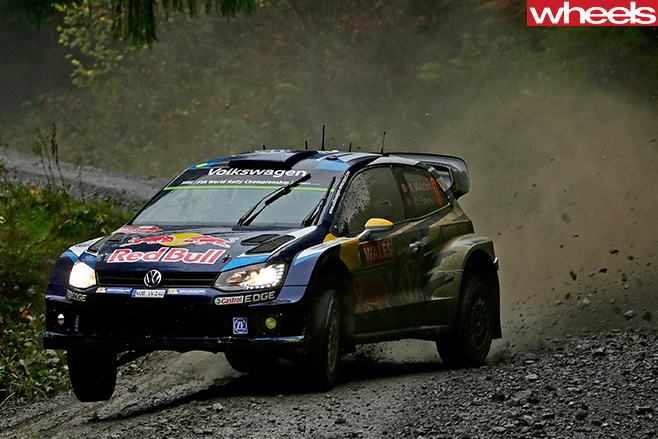
“Moments like this make you all too aware of just how insignificant what you are doing actually is,” Ogier said.
“Despite this, Julien and I decided this morning that we would continue with the rally. We feel this is the right decision, rather than quitting – which would be giving in to the perpetrators. It was obviously very difficult to concentrate on driving today,” he admitted.
Even with his heart not in his job, Ogier continued to control proceedings, finishing the second day 35.7sec ahead of Northern Ireland’s Meeke.
Torrential rain, gale-force winds and ever-changing grip levels demanded the utmost concentration. It will be a day remembered too for Neuville’s huge rollover after his Hyundai clipped a stack of timber.
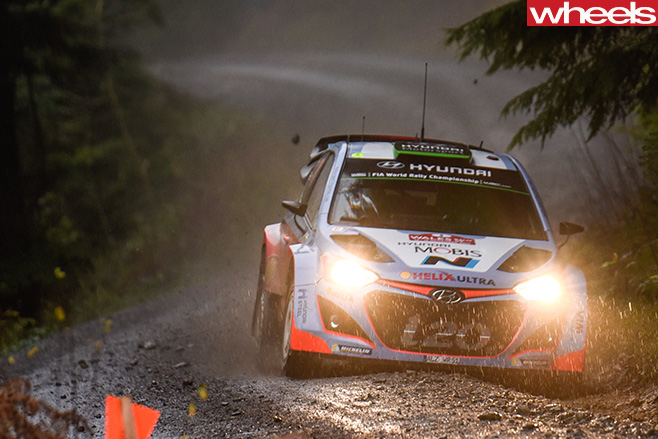
Meeke took a strong second but still doesn’t know what’s in store for him in 2016, despite a breakthrough win this season.
Mikkelsen’s third in Britain was matched by his third in the championship, behind team-mates Ogier and Latvala.
Hyundai’s Dani Sordo and Hayden Patton slid to fourth and fifth in the Wales’ mud and are hoping a new car in 2016 will power the South Korean manufacturer closer to the dominant VW Polos.
So, the focus is now redirected to next year and the WRC expansion to 14 events across five continents with China, the world’s biggest car market, returning in September for first time since 1999.
Rally GB is moving back to late October to allow Australia to host the final and hopefully deciding round in mid-November. It will be followed by a glamorous gala finale to the season in Sydney.
FORMULA 1: US GP under threat… again
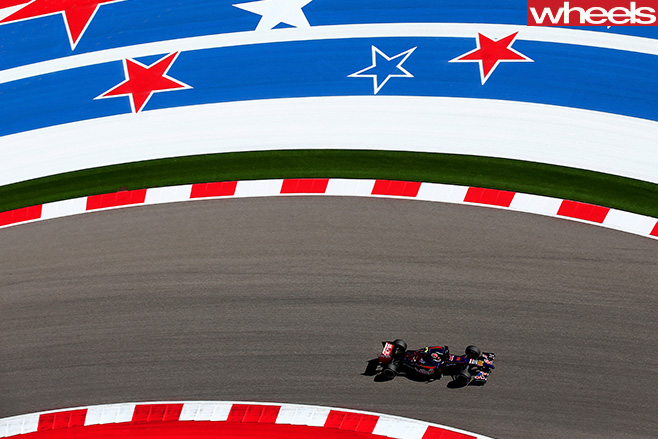
Since the venue – one of F1’s few interesting modern layouts – started hosting a world championship grand prix in 2012, the state government tipped in $US25 million per year as a nod to the race’s economic benefit to the region.
But a new governor has indicated his generosity has been trimmed by a different economic value calculation, and that in future the contribution would be reduced by 20 per cent to $US19.5 million.
Track chairman Bobby Epstein told Autosport of his concern about the future, COTA already hit hard by falling attendances, poor weather, and a hike in the race hosting fee.
To cover the loss of funding, the F1 race would need to attract another 30,000 spectators.
Epstein said he has spoken with F1 ringmaster Bernie Ecclestone, who is sympathetic, though his toughness in fiscal matters is legendary.
F1 in the US has had a chequered history across the decades with many and varies venues including Indianapolis (oval, and road course), Sebring, Watkins Glen, Phoenix, Dallas, Long Beach, Detroit, Las Vegas…
COTA looked to be a worthy and classy venue and, finally, a permanent F1 home. But maybe not.
To Americans, motorsport should be like their food… simple, fast and cheap.
MERCEDES-AMG is eyeing Porsche’s iron-clad grip on the top rung of the prestige performance car ladder in Australia.
Mercedes-Benz Australia head of corporate communications David McCarthy said AMG’s market share here is closer to Porsche than in any other market worldwide.
“It’s likely that Porsche will win for the year (2015) against AMG, but it will be only by a few hundred units,” McCarthy told us at the launch of the new Mercedes-AMG C63 S Coupe that goes on sale here around the end of March next year.
“When ultimately we get GLC 63, I think it will be interesting.”
With annual sales of AMG models set to top 4000 units for the first time in 2015, representing almost 13 percent of Mercedes’ local model mix, Australia ranks as the world’s highest AMG market as a percentage of overall sales.
Although the new AMG C63 Coupe is available elsewhere in the world in two states of tune, Mercedes-Benz Australia has opted, as it did with last year’s C63 sedan, to take only the higher-output, better-specified S version.
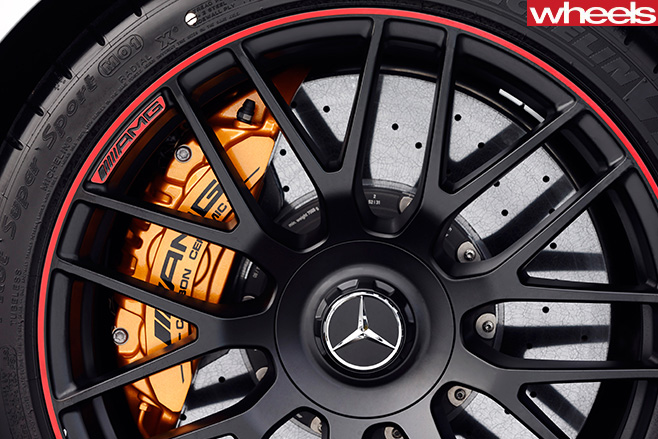
The extra herbs shave a tenth off the 0-100km sprint time of the C63 S (3.9sec) and help keep the Australian model mix simpler and more desirable, McCarthy says.
“Our AMGs are equal to the highest spec Benz offers anywhere in the world,” McCarthy said.
“The C63 coupe hasn’t (previously) sold at the same level as the sedan, but I wouldn’t be surprised if the new one does.”
While pricing has not yet been confirmed, McCarthy indicated the Australian arm is hoping to peg its new super-coupe close to last year’s limited edition AMG C63 507 coupe, meaning about $160K.
If that is the case, and the coupe takes off to the extent the C63 sedan has, it may be enough to give premium performance rival Porsche some sleepless nights.
“I think the way that coupe looks will generate more sales. It’s a really cool-looking car. And of course if you’re looking at a C-Class-based AMG, you’ve now got a sedan, a coupe and an estate.”
McCarthy said Mercedes-Benz Australia has delivered about 300 C63 S sedans since the new model went on sale in June and is holding firm orders for “north of 200 C63 S coupes”.
Just call it the Ned Kelly of hatchbacks – a more hardcore Ford Focus RS is being considered that would steal the fastest production hatch crown from the affluent Mercedes-AMG A45 and Audi RS3.
Ford Performance insiders have told UK car magazine Autocar that the company is awaiting sales reaction to the just-released Focus RS before signing off on a more potent, stripped-out version.
The aim is to lower the 4.7-second 0-100km/h claim of the current Focus RS to somewhere beneath the 4.2sec A45 AMG and 4.3sec RS3.
As the Benz has 280kW/475Nm, the Audi 280kW/475Nm and both have sub-$80K pricetags, the Focus RS needs only slight hikes to its outputs of 257kW/440Nm-470Nm (overboost) and $50,990 ask.
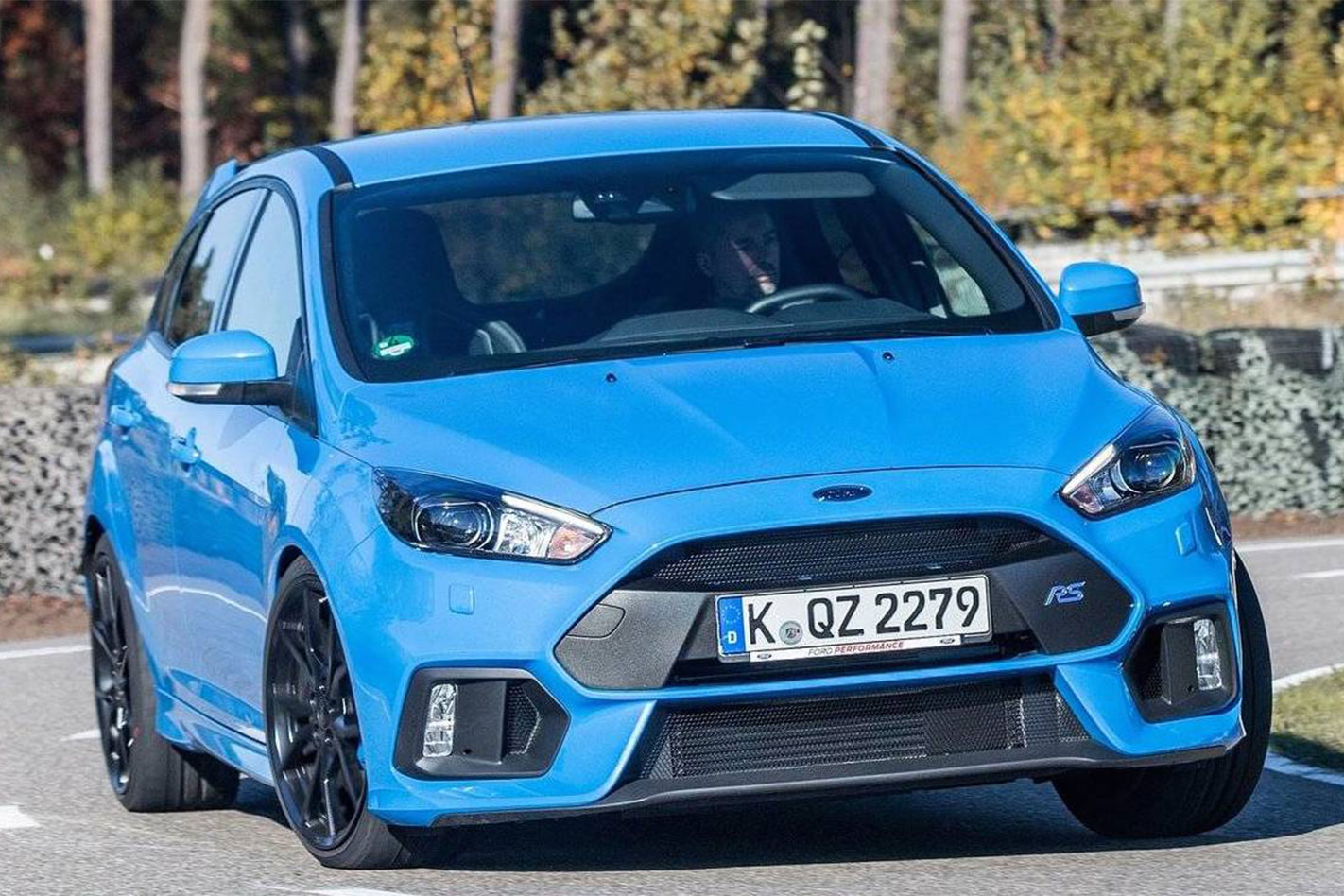
Most likely will be weight removal in a similar vein to that applied to the Renault Sport Megane Trophy-R – no back seat, flicked creature comforts, more expensive but lighter brakes and exhaust, and reduced insulation.
A electronically controlled mechanical front limited-slip differential was, according to the insider, ruled out for cost reasons in the original Focus RS program even though it was known to improve the all-wheel drive hatchback’s handling. It could return, particularly as a front LSD has since become an option on the facelifted A45 AMG.
The rumour mill is also spinning out considerations of a dual-clutch automatic gearbox that along with launch control would help improve the currently manual-only performance times, but it would be costly.
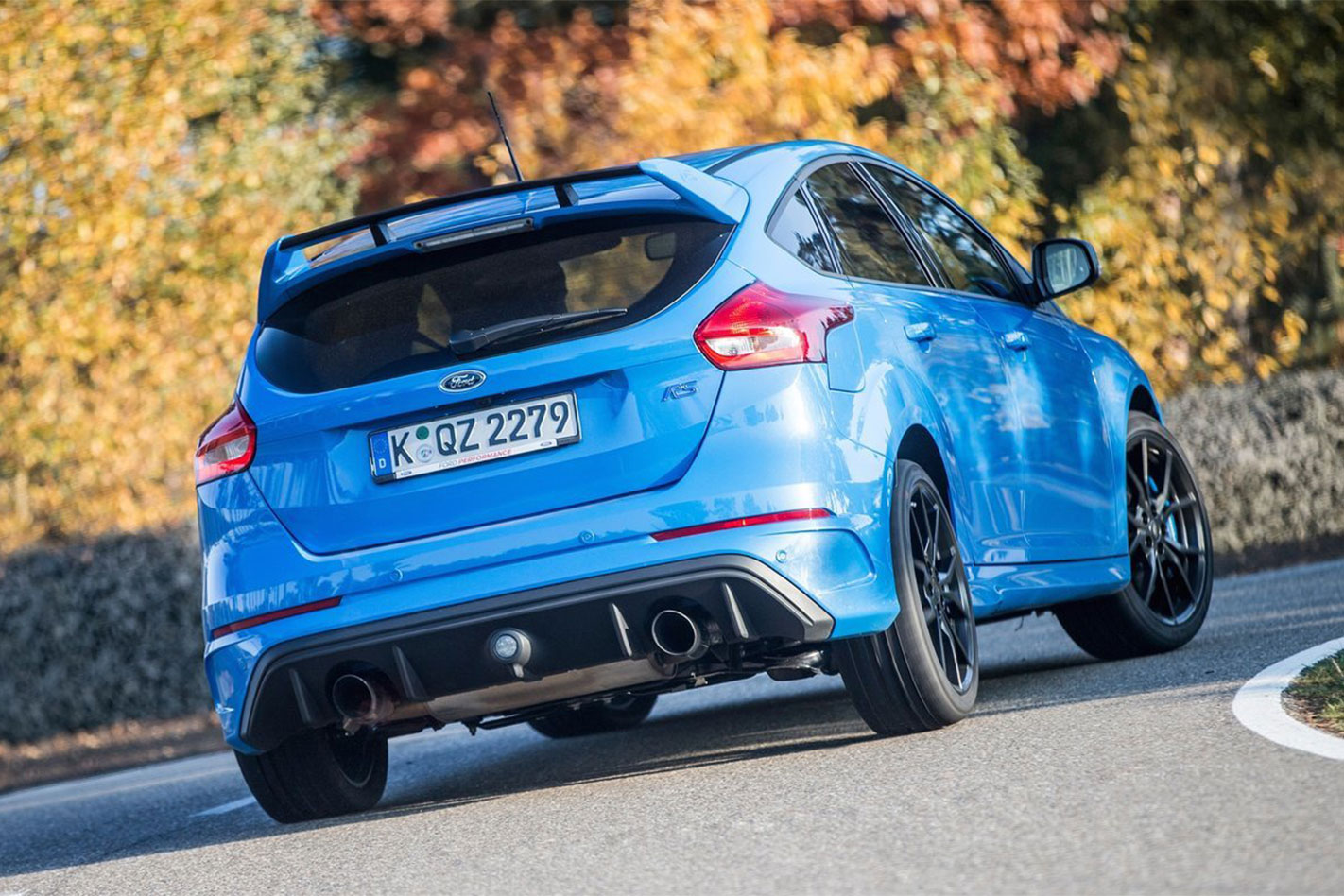
Currently the Fiesta ST, Focus ST and Focus RS are all manual only, but time will tell if there’s enough funding to install a dual-clutcher in any of this generation of small performance Fords.
Autocar believes that if Ford thinks it has a chance of breaking the 4.0sec 0-100km/h benchmark with a stripped-out, pumped up Focus RS, it will certainly seize on the opportunity to become the fastest production hatchback in the land.
Performance wars don’t end in draws, after all…
