
What stands out?
Based on the tried and proven Commodore sedan, the Holden Ute is easy to drive, performs well, and can cart around mountain bikes, large dogs, jet-skis and pretty much anything else. SS models use the same, 6.2-litre, V8 engine as V8 Commodores.
What might bug me?
Friends asking you to help them move house.
What body styles are there?
There’s only one body style in the Commodore Ute, and that’s the classic two-door cabin with the tray out back. With an aftermarket hard tonneau (sort of a fibreglass roof for the tray area) or a canopy (the same thing but higher), you can make the vehicle more secure but potentially less versatile when it comes to bulky loads.The Commodore Ute is rear-wheel drive. It is classified as a light commercial vehicle.
What features do all Holden Utes have?
Cruise control, a reversing camera, and steering-wheel controls for the audio and info systems.An 8-inch colour touchscreen supporting a sophisticated entertainment system with Bluetooth connectivity. Embedded apps include internet music services Pandora, Siri and Stitcher.Headlamps that switch themselves on when it gets dark. Dual-zone air-conditioning, which allows the driver and passenger to set temperatures independently.Front and rear parking sensors, and a park-assist system that steers the car into a parking spot while the driver handles the engine and brakes.Six air-bags: two directly in front of the driver and passenger, one outside each front occupant to protect the upper body, and side-curtain airbags for both to protect the head.Electronic stability control, which helps prevent skidding. (This is not mandatory on commercial vehicles, and so some alternative utes don’t have it.)The least costly model, the Ute, comes standard with a tyre repair kit but no spare; however you can option either a full-sized spare or a space saver. The SV6, SS and SS-V come with space-saver spares, while the SS-V Redline relies on just a repair kit.Satellite navigation and a DVD player are available as options on the Ute, SV6 and SS.All Commodore Utes have a three-year/100,000km factory warranty.
Which engine uses least fuel, and why wouldn’t I choose it?
A mid-sized petrol V6 is the basic engine in the Commodore Ute. It’s lifted straight from the Commodore sedan, and has an official combined (urban and highway) fuel consumption figure of 9.0 litres/100km in all variants.This is the most fuel efficient engine, but if you use the Ute for towing heavy loads, you might find it struggles up hills and at highway speeds.That’s where the enormous V8 of the SS, SS-V and SS-V Redline comes into its own. Yes, this 6.2-litre engine will guzzle plenty of fuel (especially around the suburbs), but it has lots of muscle for towing or just accelerating from the traffic lights.The least costly model, the Ute, is fitted only with a six-speed automatic, while the other models have the option of that gearbox or a six-speed manual.
What key features do I get if I spend more?
The Ute rolls on 16-inch wheels made of steel. Move up to the SV6 and you get 18-inch alloy wheels, with wider tyres of a lower profile that improve steering and grip. The suspension is firmed up, to promote flatter cornering. A body kit distances it visually from a council vehicle.Inside, there’s a leather-clad steering wheel and gear-shifter, and a soft tonneau is included.The SV6 (and every model above it) also gets blind-spot monitoring, which can warn the driver if there’s a car in the lane next to them, and a reversing alert, warning that a car could be crossing behind. Manual gearbox versions come with a limited-slip differential, which improves drive on slippery surfaces.The SS is the first variant to get the V8 engine. That’s pretty much where the extra money goes there, except that from here on up the autos too get a limited-slip diff. The SS-V and SS-V Redline gain bigger, 19-inch wheels with tyres slightly lower in profile, along with satellite navigation and a DVD player.The range-topping SS-V Redline model also gets a forward collision alert, to warn the driver that a nose-to-tail crash could be about the happen, and a head-up display, which projects a speedo on to the car’s windscreen, within the driver’s line of vision. The Redline also has a lane departure warning, which alerts the driver when the vehicle strays out of its lane on the road.The Redline is the only model to get extra-wide tyres at the rear, a high-performance braking package and rain-sensing wipers.
Does any upgrade have a down side?
The bigger tyres of the SV6, SS and SS-V variants will cost more to replace, and will wear out faster as well. These will also ride a little more roughly than the Ute on its more cushioning rubber.The bigger brakes of the SS-V Redline model use very expensive brake pads and these are a normal wear item.
How comfortable is the Holden Ute?
This is where car-based utilities have truck-based competition such as the Toyota HiLux, Nissan Navara and others licked.Simply, things like the Commodore Ute are as easy to drive as a conventional sedan (on which they’re based, after all), and with passenger-car suspension they are also much nicer to ride in.The Holden Ute’s cabin is pretty plain in base-model format but even so, it seems well put together.The more upmarket versions start to get busy looking inside and there seems to be a lot of different materials and surfaces.The seats are comfy for long periods, although the base-model gets cloth and less bolstering and support than the more expensive models. That said, the cheaper seats are also easier to get in and out of if you were using the vehicle for, say, deliveries.The Ute is a little noisier inside than a Commodore sedan, but it’s still quite civilised even at highway speeds.
What about safety in a Holden Ute?
Despite the range of models and their various price-points, the Commodore Ute has similar safety gear across each version. It’s how the whole range has achieved a five-star safety rating in Australasian New Car Assessment Program (ANCAP) testing.On the Which Car safety scale, all Ute models except the top-shelf SS-V Redline score in the Excellent range, elevated by the standard stability control and reversing camera. The Redline does even better, with features such as its forward collision alert and head-up speedo pushing it into Standout.(To see a full list of the safety features on any model, select the car and look under the features tab. Safety-related features are listed in red.)The major primary safety issue is with the thick windscreen pillars, which make seeing through intersections difficult.
I like driving – will I enjoy this car?
Yes, mainly because the Ute doesn’t drive like a truck; it’s definitely more car-like in terms of the way it accelerates, corners and rides.Both engines offer plenty of overtaking urge and they’ll happily cruise all day at freeway speeds.Opt for the V8 and you’re suddenly in the realm of even more acceleration and a luscious V8 soundtrack from the exhaust system. Many will love that distinctive roar – a sound that Holden has ingeniously enhanced inside the cabin – but those looking for a relaxed, refined ride may be put off by the bellowing and burbling.The SS-V Redline also gets a more serious set of brakes than the other models, so it’s an all-round performance car in every respect. Many owners take them to race-tracks for weekend thrills.
How is life in the rear seats?
There is, of course, no rear seat in a utility like this one. That also limits its suitability for child restraints.As for accommodation beyond the front seats, you’d best ask a dog.
How is it for carrying stuff?
Brilliant. This is why the Holden Ute exists, really.For moving heavy or bulky loads, a vehicle like this really takes some beating.All Utes get a plastic tray-liner, which means the metal the car is made from won’t be scratched and dented by the loads you carry.The downside is a relative lack of security for those loads, with only a soft cover supplied by Holden (and even that’s missing from the base-model).Towing is another of the Ute’s fortes, and with the Holden-approved towing package, the Ute can haul towed loads of up to 1600kg (a decent-sized boat, or a horse float with one horse on board).All Utes get Trailer Sway Control, which monitors the trailer’s behaviour and applies the car’s brakes to control any sideways motion from the towed load. Hopefully.
Where is the Holden Ute made?
All Holden Utes are made in Australia.
What might I miss that similar cars have?
Truck-based utes can carry much heavier loads. Apart from that, about the only thing the Holden Ute can’t offer that some utes can is four-wheel drive and extra ground clearance.But it’s not designed as an off-road vehicle, so that’s hardly a criticism.The other car a Commodore Ute shopper should short-list is the Ford Falcon Ute.It’s broadly the same concept but thanks to its more rugged rear suspension, it can – with the appropriate Ford-approved package – tow more than the Holden.
I like this car, but I can’t choose which version. Can you help?
The SV6 emerges as our pick of the bunch. In its latest guise, Holden has finally made the V6 engine as civilised as it always should have, and for just a little more money it steps away visually from the work-truck look.But if you’re a keener driver and can afford the fuel, then the seismic grunt of the V8 is hard to resist.
Are there plans to update the Holden Ute soon?
Thanks to the imminent death of the Australian car industry, this is the last Holden Ute we’ll ever see.There was a small facelift in October 2015, which added ducting to the front bodywork and brought a slightly bigger and more powerful V8 engine with enhanced sound production.
ONLY one manufacturer’s stand at the 44th Tokyo Motor Show still had the world’s media crowding four-deep approaching closing time.
Mazda was showing a line-up of familiar Axela/Mazda3 and Atenza/Mazda6 sedans and the CX-3, CX-5 and recent Frankfurt concept Koeru SUVs. But the star was a velvety-red coupe concept, the RX-Vision.
It’s a car – or at least a promise – that only Mazda could make. The RX-Vision heralds the return of the rotary engine, tipped for 2017 and the 50th anniversary of Mazda’s first rotary sports car, the Cosmo 110.
Head of Mazda design Ikuo Maeda, who penned the last rotary RX-8 and whose father Matasaburo Maeda designed the original RX-7 of 1978, admitted that to design this “real sports car” had been “a dream”.
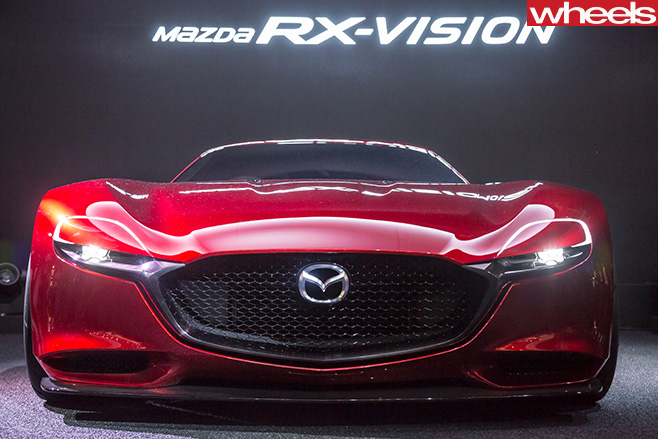
Here’s what we know about the production car that Mazda – and sports car enthusiasts worldwide – hopes will result from the show-stopping concept.
The RX-Vision is already real in its intention, if not much else. The fibreglass-bodied show car sits on a 2700mm wheelbase which, in production, looks set to be based on an independent platform. In contrast, its RX-8 predecessor was based on an enlarged version of the MX-5’s platform.
On the Tokyo turntable, the RX-Vision had pure supercar presence, thanks to the two-seater’s GT-like proportions, 20-inch wheels and imposing dimensions of 4389mm overall length, 1925mm width and 1160mm height. Maeda says the body surfacing, where light tumbles and zig-zags over its deceptively simple doors, took the better part of three months’ work.
Despite the long bonnet and tucked tail, proportions that imply a front mid-mounted V8 rather than a compact rotary, Maeda explains that the production version – likely to be called RX-9 – would not be a GT.
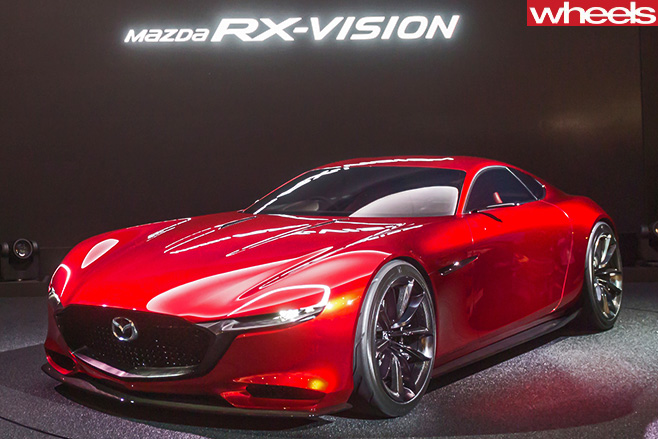
“The proportions were exaggerated for this concept,” he says. “The real car will be smaller – a real sports car.”
The RX-Vision concept was not designed around any set of engineering hard points: it lacks cut-lines for a front bumper, a solution for opening the bonnet and also, apparently, for opening the doors.
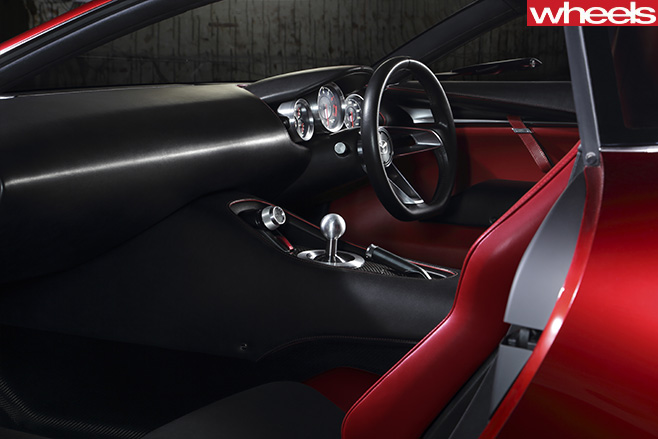
The interior is elegant and hand-crafted, divided by a transmission tunnel that Maeda insists could accommodate the relatively high gearbox location prescribed by a rotary engine’s output shaft.
The 1.6-litre, twin-rotor, turbocharged engine slated to power the production car has been dubbed Skyactiv-R and is said to be an evolution of the 1.6-litre 16X. This engine’s development was continued (not always with official sanction, admitted research and development boss Kiyoshi Fujiwara) after the 2012 demise of the RX-8 and its 1.3-litre Renesis rotary.
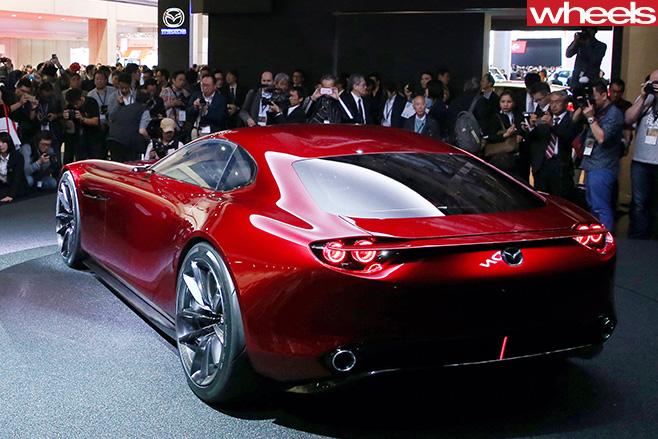
Significantly, the engineering team has been applying Mazda’s Skyactiv optimal compression ratio philosophy to the rotary, though Fujiwara adds that “the turbocharger is a big contributor to the future of the rotary”.
The engine’s hurdles remain as those of emissions, economy and durability. The placement of the spark plugs within the chamber is a “fundamental issue”, says Fujiwara, and a compromise between efficiency and spark plug reliability.
The rotary’s peculiarity to Mazda has also isolated it from development and manufacturing technologies commonly available to piston engines. One recent breakthrough was the ability to produce a transparent epitrochoid housing that allowed engineers to observe and optimise the rotary’s combustion process.
It’s believed that the Skyactiv-R is now not far off commencing vehicle prototype testing, in a program that will take into account all extremes of climate. Australia, being a critical market and not dissimilar in time zones, may well be on the test route.
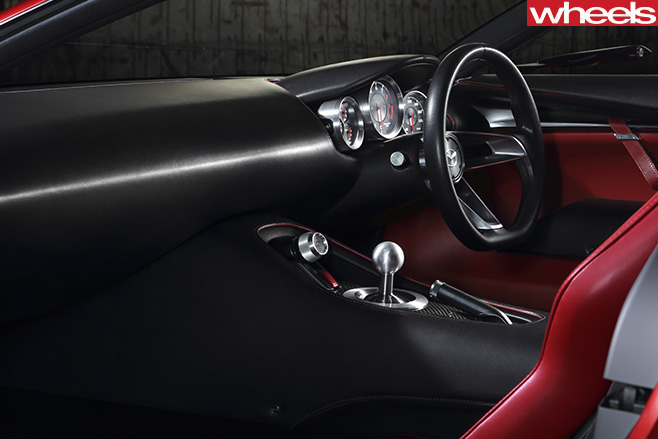
Fujiwara insists that the production Skyactiv-R “will only be for sports cars”. His intention is for the rotary to stand on its own two feet as a power source, at least initially; electrification could be added later, if emissions and consumption regulations became more difficult to achieve.
Along with the return of the rotary, the ‘RX-9’ would almost certainly usher in advances in body and construction, most likely composite panels and bonding techniques. “We don’t have a big sedan model like BMW’s 7-series,” Fujiwara said, referring to the process of trickling-down technologies from a fluffed-up flagship model.
It may prove significant that the Skyactive-R isn’t the only rotary engine under development. Mazda is striving to refine the 330cc, single-rotor range extender that was fitted to a fleet of evaluation Mazda2 EVs in 2013. Development is focused on reducing the size, weight and cost of the unit, so that it may be optionally fitted to any model platform without need of special chassis reinforcement. There is also discussion of its being produced as a portable domestic generator.
There’d be a nice circularity if its commercial success helped bankroll the rotary’s return to Mazda’s sports-car stable.
The new Honda NSX will beat a BMW i8 but get smoked by a Ferrari 488, if the newly-released specs are anything to go by.
Honda has finally confirmed numbers for its long-awaited hybrid supercar, which makes 427kW, 646Nm and weighs 1725kg.
The dry-sump 3.5-litre twin-turbo V6, revving to (in not the greatest news for VTEC fans) 7500rpm and with a highish-for-a-turbo-car 10:1 compression ratio, accounts for 375kW and 500Nm of that. The rest comes from a rear-mounted electric motor and two smaller electric motors on the front axle.
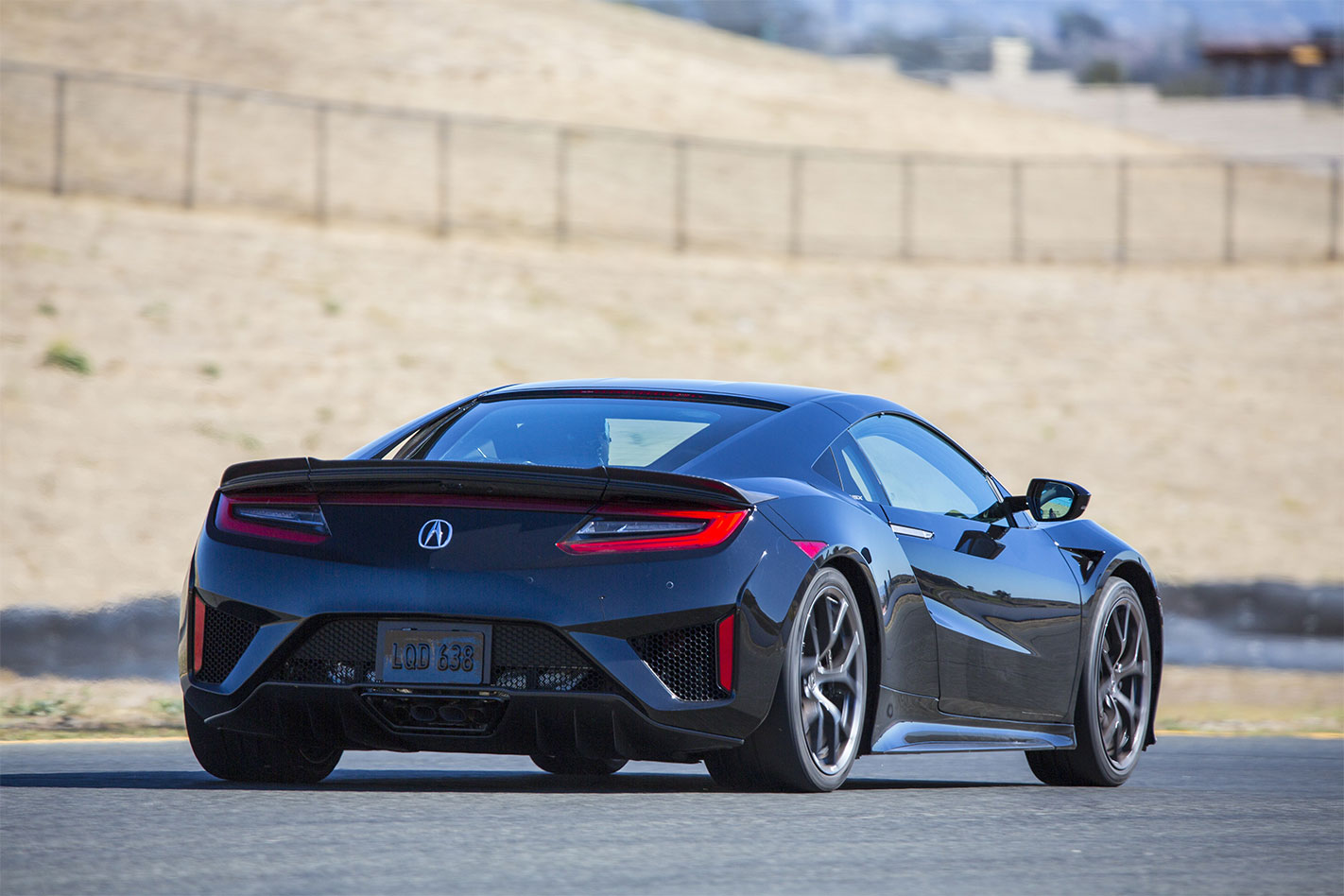
The NSX will offer drives four modes – Sport, Sport Plus, Track, and an EV mode for all-electric cruising over short distances, although the exact electric-only range hasn’t been released.
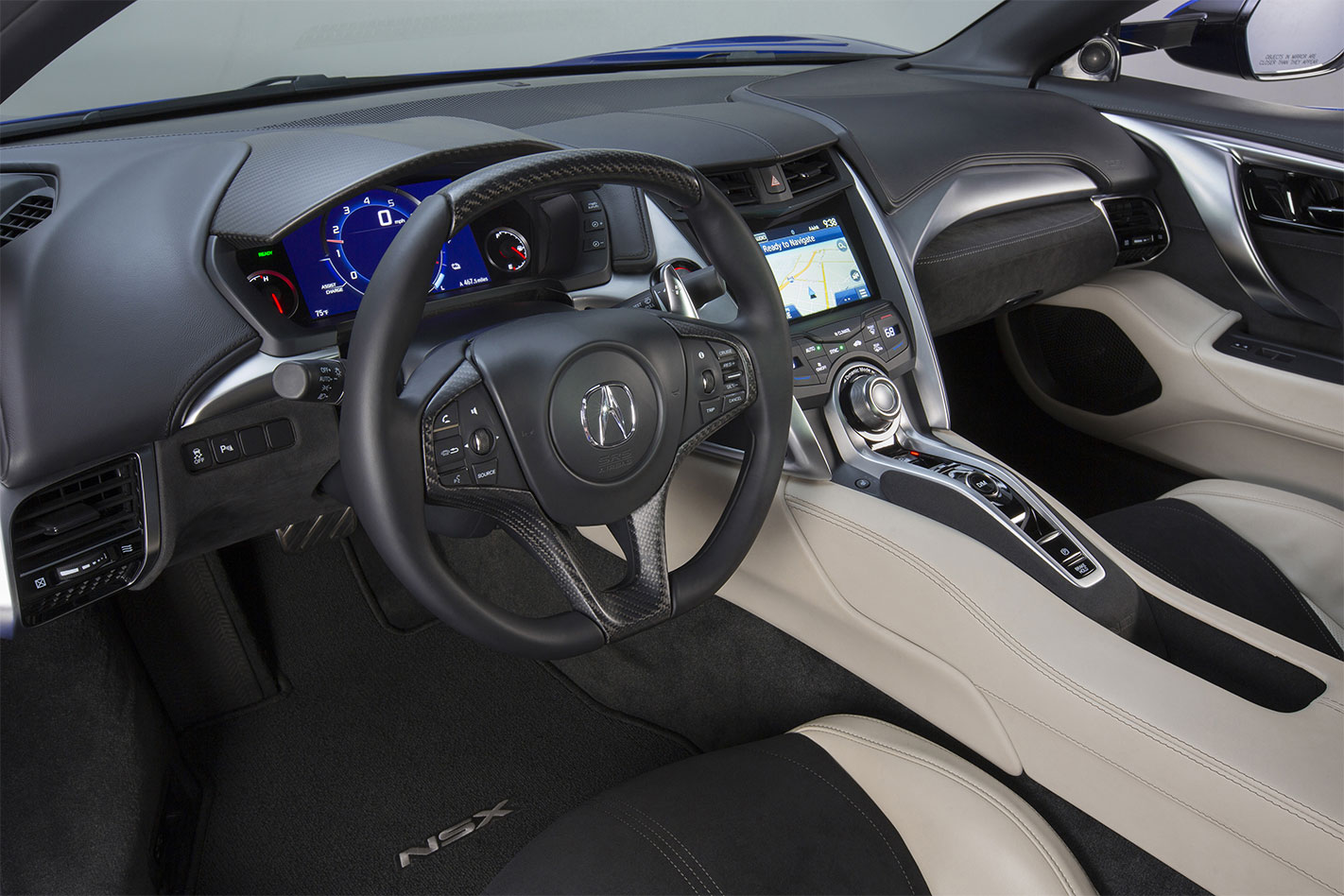
MOTOR’s had a short drive ahead of the Tokyo Motor Show – read our review in an upcoming issue.
Full specs download is available on the Honda website.
Nissan has stirred fresh speculation of a next-generation GT-R by mysteriously tweaking its Gran Turismo concept car in time for the Tokyo Motor Show.
Where such concept cars might be left to rot in a corner of museum, Nissan has reworked the 2020 Concept car’s corporate “V-Motion” front grille and repainted the car in a striking new ‘Fire Knight’ red, in a departure from the silver first shown at the car’s 2014 Goodwood Festival of Speed debut.
Industry insiders suggest the 2020 Concept, while only designed for use in the Gran Turismo PlayStation game, drops hints at what the R36 GT-R will look like when it arrives around 2018.
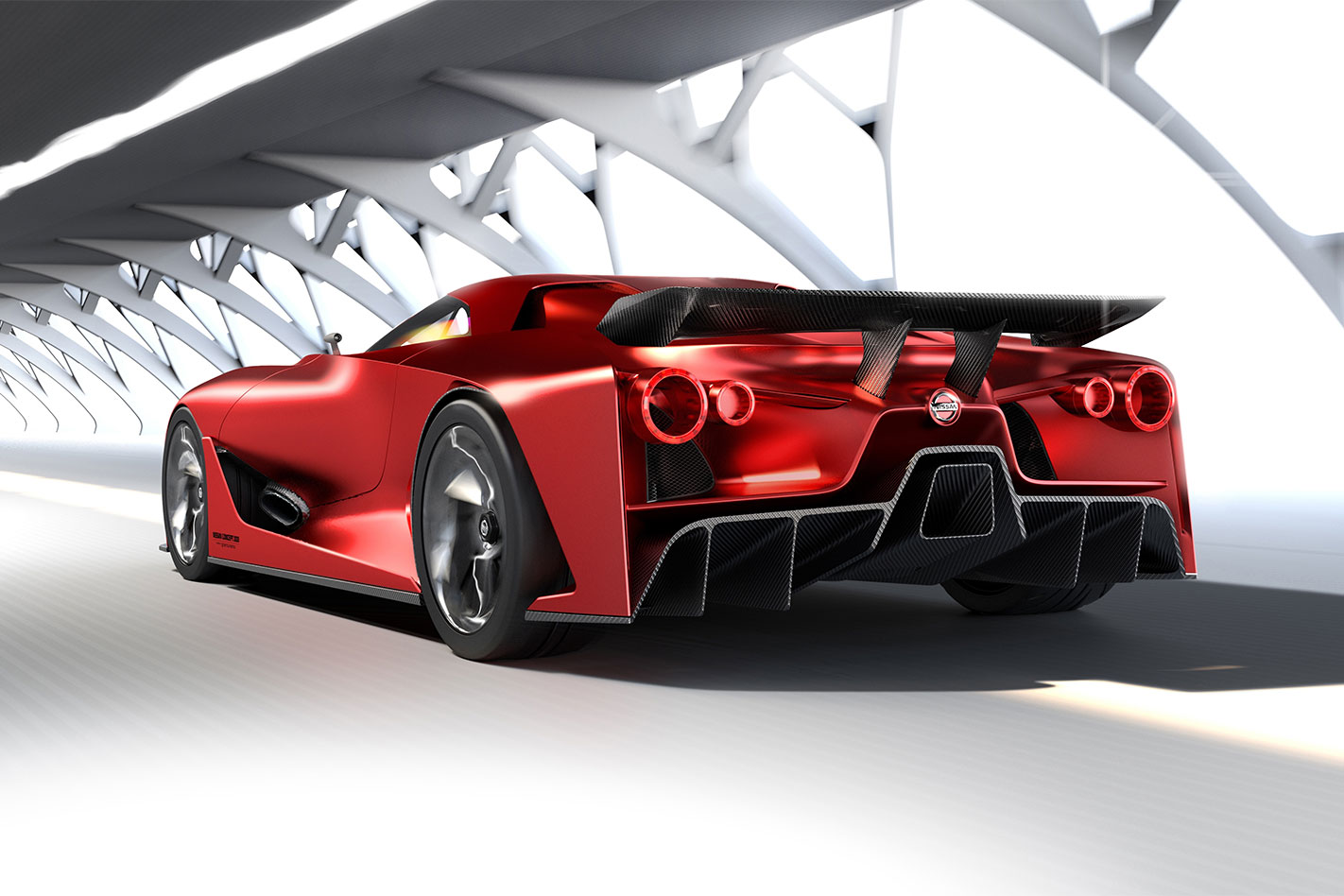
The virtual car, not just something dreamed up by game designers, brought together stylists from Nissan Design Europe and engineers in Japan.
Meanwhile in America, Nissan has taken to SEMA to announce a goodie bag of factory modifying parts for its Nismo GT-R – for customers whose cars don’t feel fast enough.
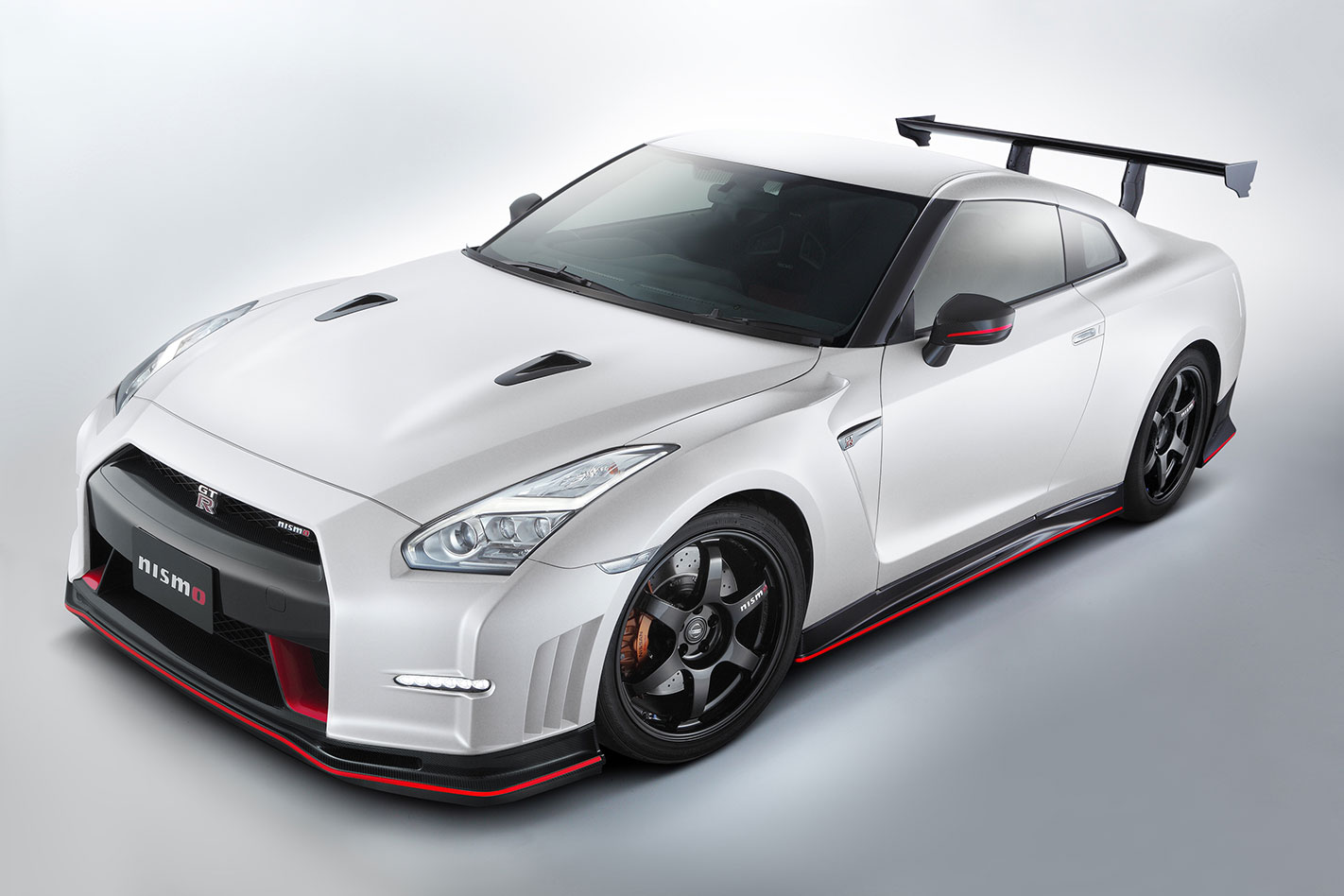
American Nismo GT-R owners can purchase parts developed for the Nurburgring record attempt, where the big Nissan set a new ‘volume production vehicle’ record of 7:08.679.
The most obvious offering is a suite of aggressive aero enhancements, but also includes suspension upgrades and more focused front seats.
You don’t learn a lot about a car’s real-world driveability on slick roads and frozen lakes.
Unless you live in Sweden, that is, where Audi chose to launch its segment-busting S1 hyper-hatch. It brought along an original S1, too, and a bloke named Stig to drive it. What you can discover, given dozens of square kilometres of flat ice and mounds of fluffy, knee-high white powder, is how much fun the Neu-S1 is.
On appearances alone, it’s easy to doubt the S1’s ability. Despite gorgeous black 18s, a black hardtop, black roof spoiler and toughened front and rear fascias, the S1 struggles to escape its slightly cutesy A1 mould in either Euro three-door or Sportback five-door styles, the only body style due to land in Oz.
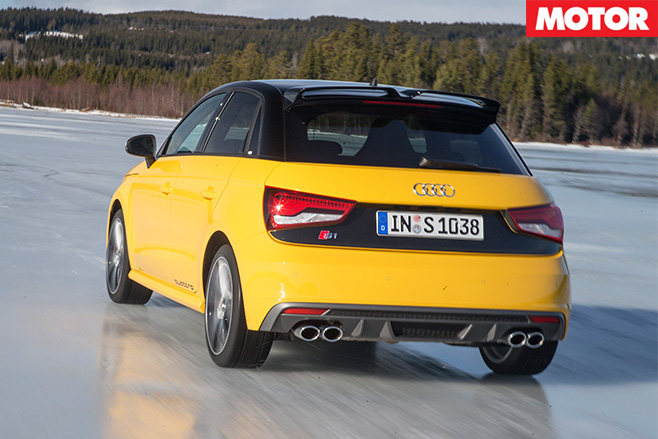
Pin the throttle and the studded snow tyres scramble in vain for traction on frosted open-road tarmac anywhere from standing starts to around 80km/h. It’ll squirm and sway within a broad ESP window, with the engine feeling robust in delivery. It will pull hard in tall gears from modest rpm in a way that a WRX – the only other serious 2.0-litre turbo, all-paw prospect under $50K – struggles to match.
This is the same dual-injected engine fitted to the S3, albeit with a smaller turbo and yielding a far more modest 170kW compared to the S3’s 221kW.
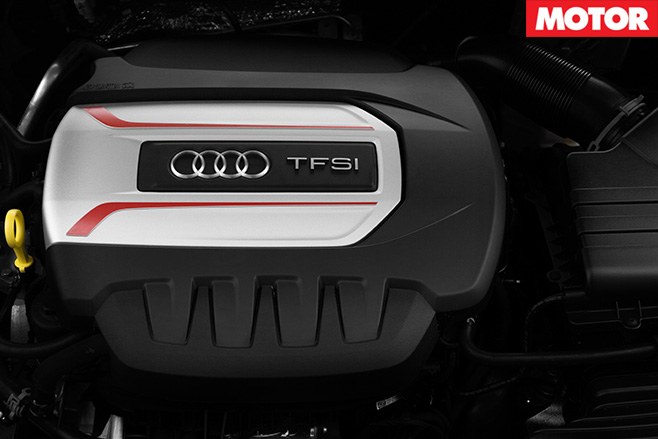
Audi reckons the three-door version will march to 100km/h from a standstill in 5.8sec, with the five-door version just 0.1sec slower. So the S1 is about half-a-second slower than the pricier S3 hatchbacks. Top speed is a predictably European 250km/h, while combined fuel consumption is a decent 7.0L/100km for the S1 (7.1L for the S1 Sportback).
Audi’s super-mini is clearly not about kissing nature, more about spitting it out the back and washing it off after a red-misted punt. The multi-link rear suspension – another rarity in the compact hatch segment – is a slightly narrowed, S3-derived system. The Haldex-type, hydraulic multi-plate clutch is mounted at the rear axle, transaxle style, to even up the front-to-rear weight distribution, while an electronic rear diff lock is integral to the ESC system, which controls torque across the rear axle and has two-stage deactivation.
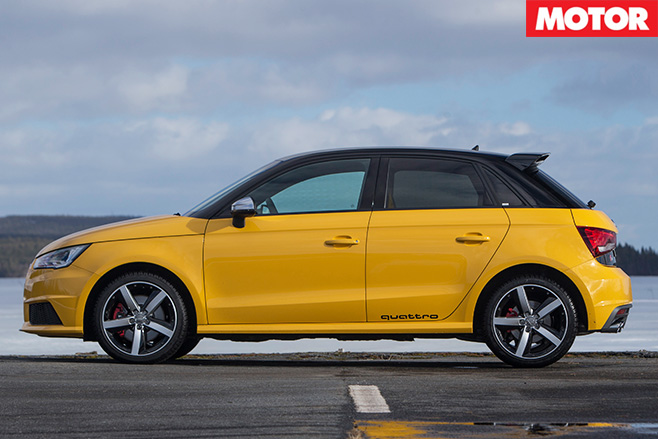
The jury also is out on whether the all-new, electro-mechanical steering, revised front end, 25mm lowered suspension with two-mode adaptive dampers, bigger brakes (enlarged booster, 310mm front rotors) and torque-splitting quattro conspire to create warm-weather tarmac heroics. Out cutting rooster tails across the frozen tundra, the signs are positive.
The steering is light, clear and eager off-centre. Studded tyres aside, there’s an impressive amount of front end purchase on ice. The slippery, hard lake surface also amplifies chassis prowess and the S1 displays the kind of inherent balance and adjustability that allows you to steer the rear easily and confidently using mostly the brakes and throttle.
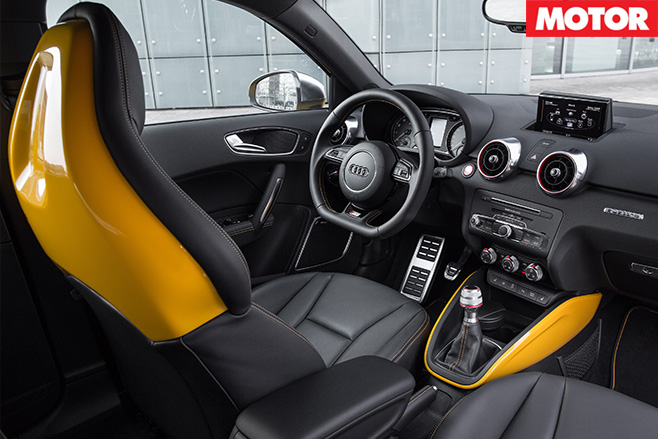
It’s available as a six-speed manual only, which is slick and precise. Why no self-shifter? Audi reckons it’s less to do with driving purity and more to do with weight balance, as the quicker shifting S-Tronic twin-clutch ’box, which would fit, is heavier over the front axle.
While the S1 certainly chalks up plenty of brattiness, it’s still a nicely-behaved, well-made and refined device. The cabin gets a tasty blackout treatment, “grey-scale” instrumentation, up-spec sports seats and feels a cut above your average A1 fare.
‘Xenon-plus’ headlights, LED tail-lights, stainless-steel capped pedals – there’s plenty of devil in the details. This is what you’d expect from a compact hatch that will nudge $50K when it lands in Oz (in five-door Sportback form only) around August.
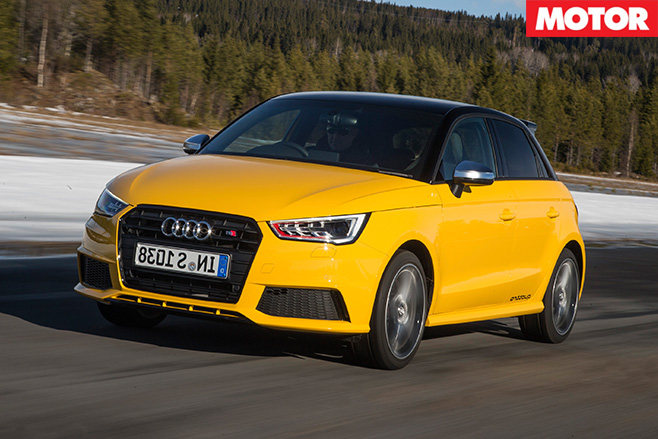
Polo GTI? Forget it. Volkswagen would have to stuff Golf R running gear inside that compact shell for it to become a worthy combatant.
4 out of 5
Specs Engine: 1984cc inline four, DOHC, 16v, turbo Power: 170kW @ 6000rpm Torque: 370Nm @ 1600rpm Weight: 1340kg 0-100km/h: 5.9sec Price: $50,000 (approx)
PLUS
- You want power? Step the way of the XR8’s supercharged 5.0-litre V8. Ford may say it makes 335kW, but Ford’s clandestine overboost system means it makes closer to 400kW in the right conditions.
- That means it punches at the horizon like a rocket-boosted freight train. Few cars offer so much performance for $53K…
- …all in the comfort of an Australian-made cabin that could swallow five and luggage.
- The chassis allows it to bomb around a race track fast, as well.
- The Falcon’s recently redesigned front and rear fascia bodes for a sharp look on the road.
- Q-car appeal. Besides the red performance brakes, the styling is nice and understated, despite the FPV developed bits lurking underneath the subtle sheet metal.
- Despite the performance of the car’s overall package, the experience isn’t very enrichening for a driver. The steering, chassis, and brakes feel numb.
- The FG X update did not see any significant changes inside, and the interior looks and feels outdated.
- The SYNC infotainment system will take some getting used to.
- The boot’s nice and big, but lacks a flat floor. Could make for difficult handling of luggage
- She’s thirsty. All that engine and a heavy foot can equate to a sizeable fuel bill.
Subaru to set to release an even faster Forester on Australia in 2016 with the arrival of the limited-edition tS model, based on the facelifted MY16 model.
Sharing the current Forester XT’s 177kW/350Nm 2.0-litre turbocharged flat-four, the tS won’t be any faster in a straight line, but Subaru’s STI performance division has waved its wand over the popular SUV to improve braking and handling.
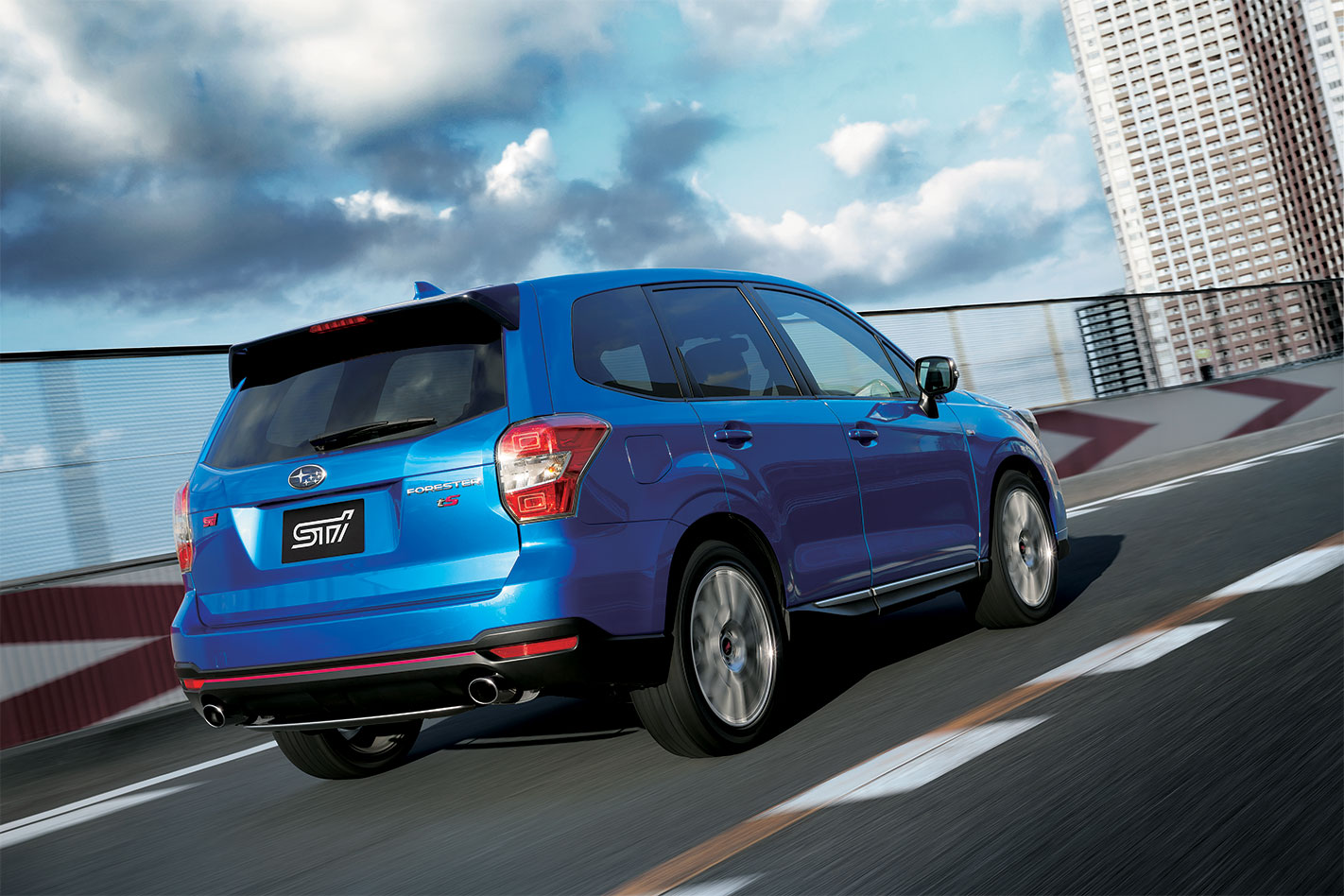
A front strut-tower brace reduces flex, as do stiffening arms in the front and rear suspension. STI-developed dampers front and rear tighten up the Forester’s handling.
Subaru Australia say that the car’s local specification is yet to be confirmed, however based on the previous Forester S-Edition we’d expect the braking and handling upgrades to be offered.
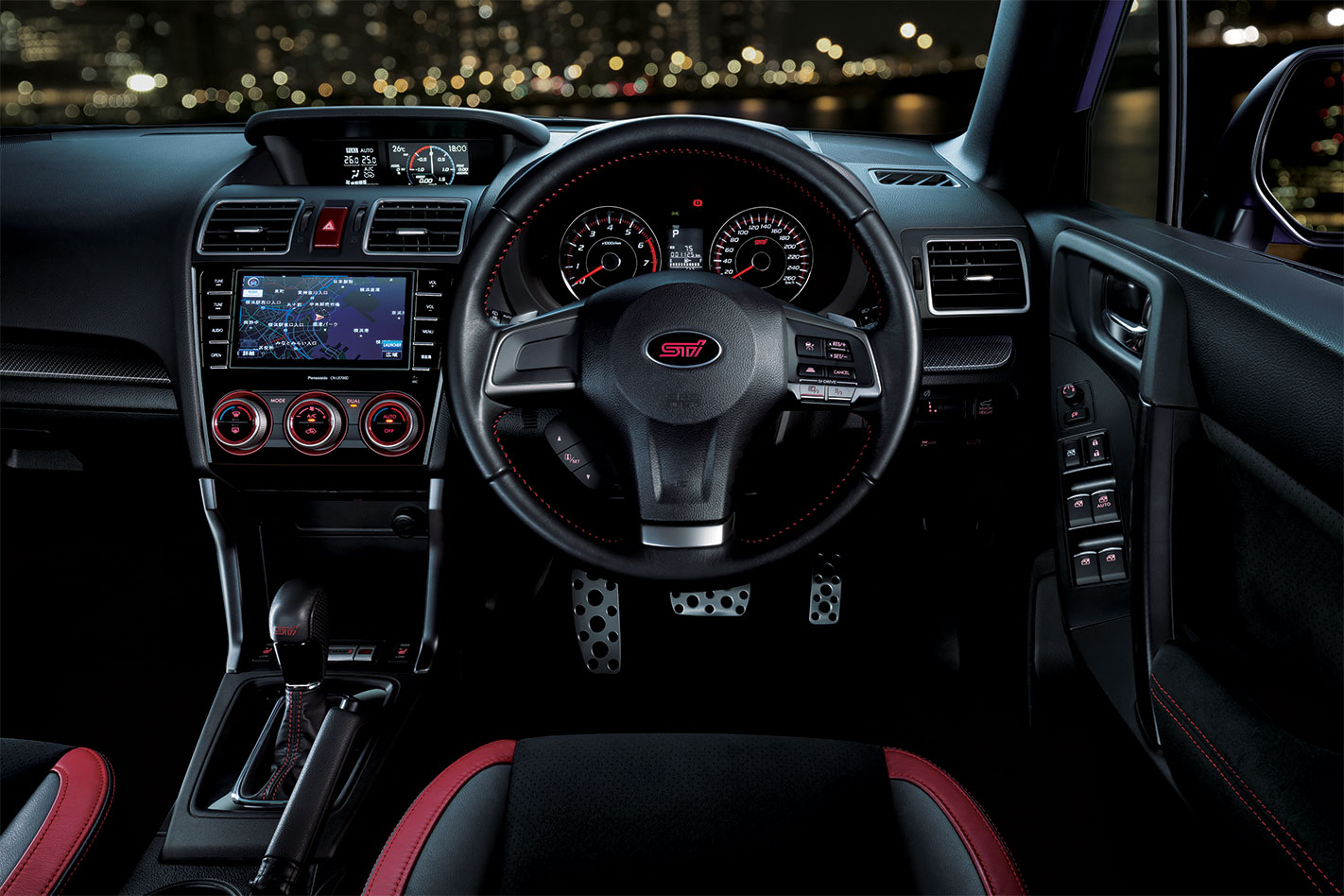
Local pricing will be confirmed closer to launch, however just 300 Forester tS models will be imported.
The Porsche Macan GTS is yet another extension of the sports softroader range and no doubt a further extension of its popularity.
As is tradition of the GTS nameplate, the Macan GTS is an upper-middle-tier variant. It takes the 3.0-litre twin-turbocharged V6 from the Macan S and raises outputs without nearing the loftier 3.6-litre Macan Turbo.
The 3.0-litre now produces 265kW at 6000rpm, up from 250kW, and 500Nm between 1650rpm and 4000rpm, rising from 460Nm.
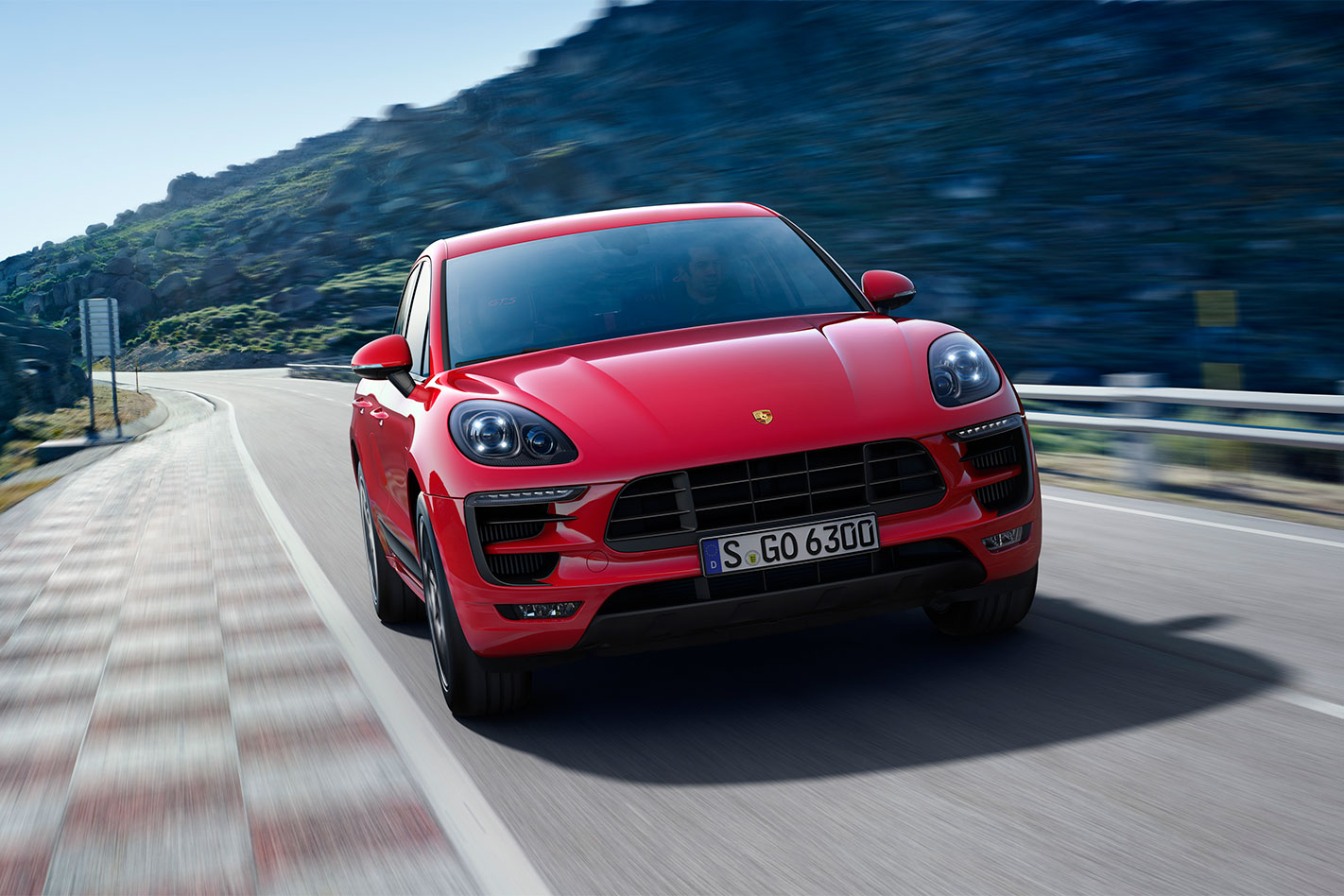
The 294kW/550Nm Macan Turbo is therefore left untouched with its 4.8sec/4.6sec SC times.
Brakes on the Macan GTS have been upgraded to the Macan Turbo’s 360mm six-piston fronts, up from the 350mm Macan S discs, though 330mm single-piston rears remain the same and are 26mm smaller than those in the Turbo.
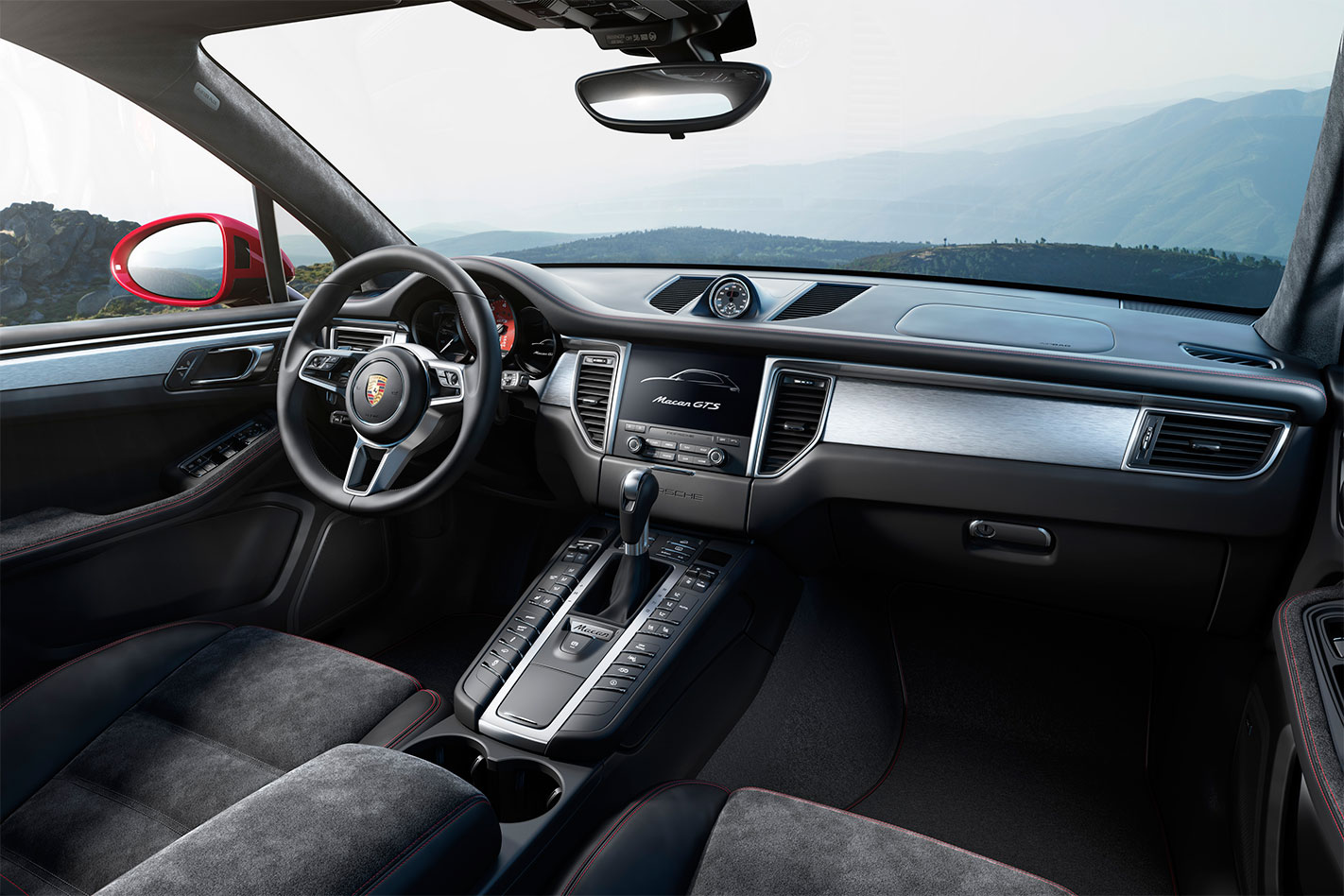
Standard 20-inch RS Spyder Design alloy wheels are an inch larger than the costlier model grade, too, painted matte black to match the exterior badging and detailing.
The use of Alcantara trim has become a signature of GTS variants, and the Macan GTS gets plenty of it around the cabin along with a unique sports seat design with GTS stitching.
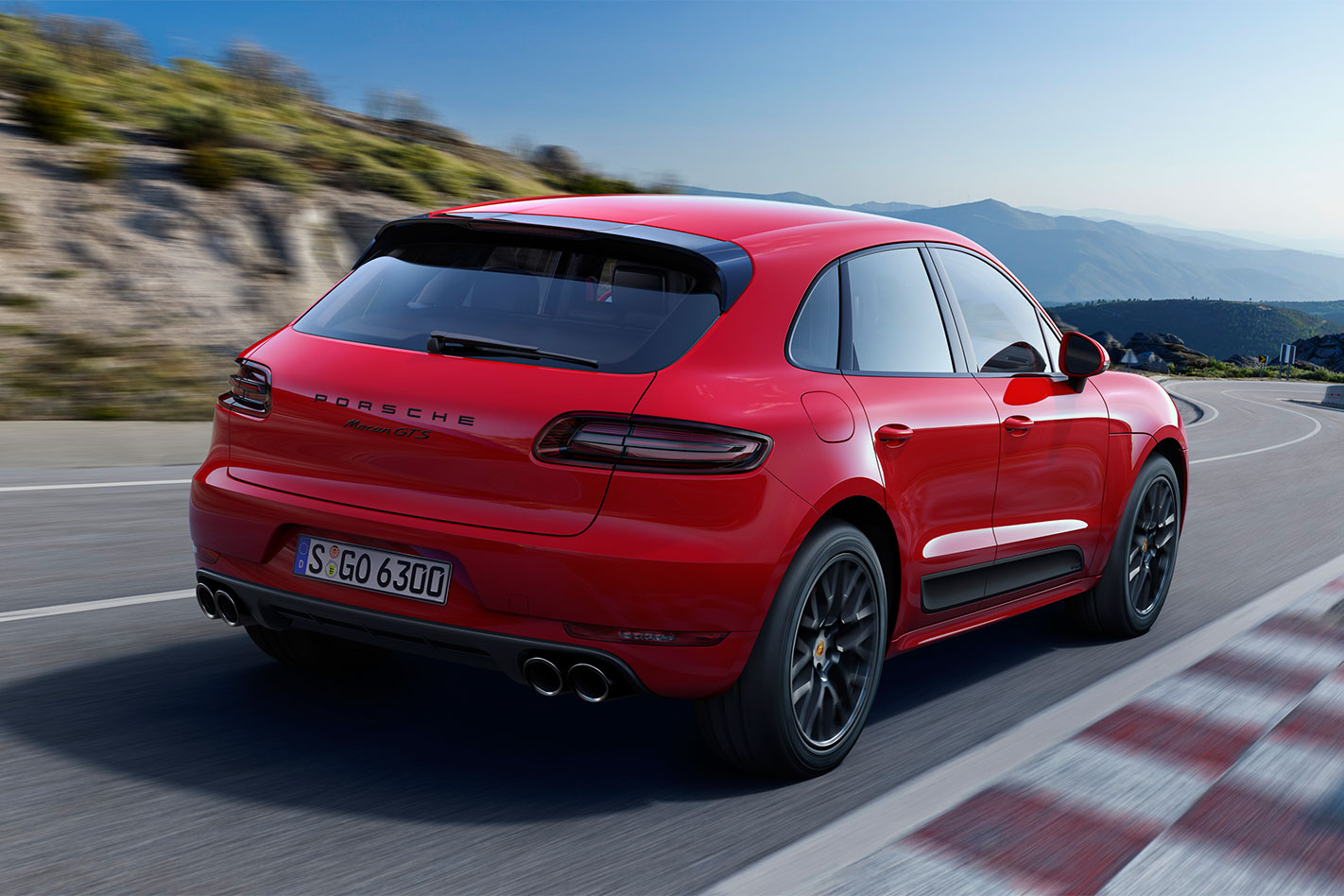
That’s well above the $91,900 Macan S diesel, as you’d expect, falling neatly between the $93,100 Macan S and $130,300 Macan Turbo.
All three models now rise by $3800 to $4500 following the addition digital radio, lane departure warning, three-zone climate control and Porsche’s new infotainment system across the range.
ROTARY fans, rejoice! The RX-Vision has been revealed at the 2015 Tokyo motor show to be the long-awaited return of Mazda’s legendary rotary-powered sports car.
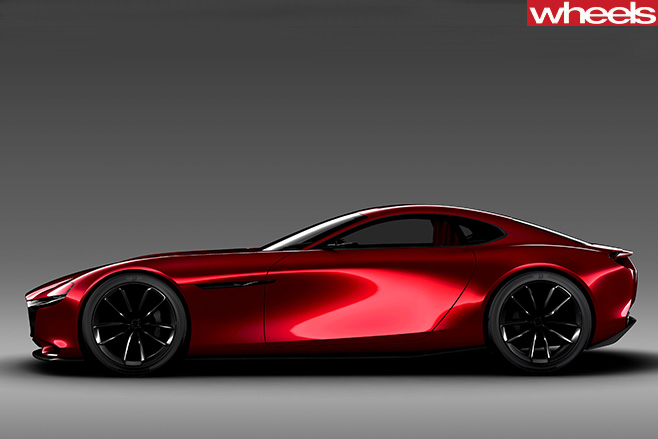
The seductive red concept car is a rear-wheel drive, two-seat, two-door coupe in the same fashion as the legendary Mazda RX-7.
The RX-Vision is powered by a new SkyActiv-R engine, with the R standing for rotary.
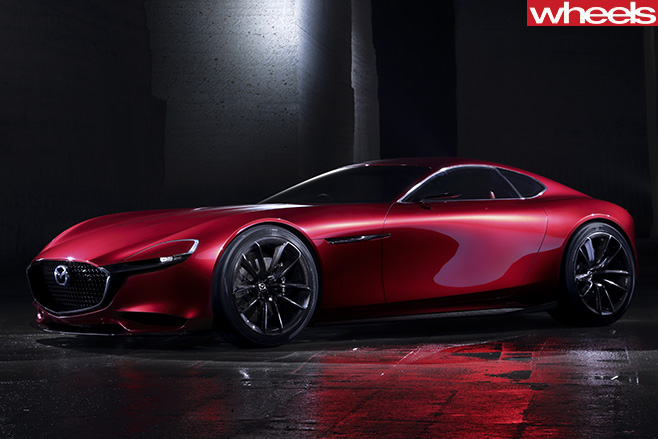
Mazda says it has gone ‘back to the drawing board’ in developing a new rotary engine in the face of ever-tightening emission laws, describing it as the soul of its brand.
“There are still many issues to overcome, but we will continue our development efforts in the spirit of never stop challenging,” said Kogai.
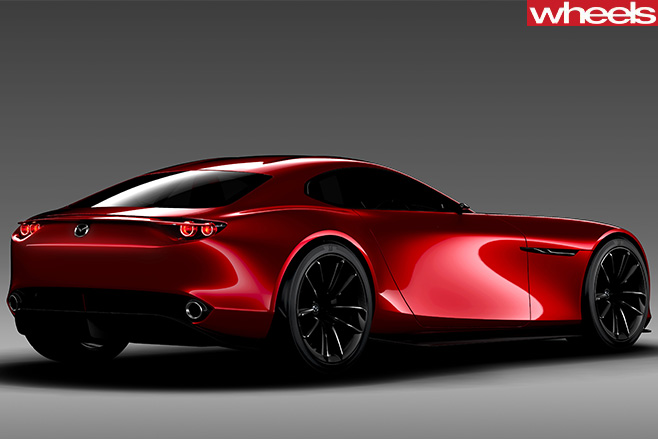
Its 2700mm wheelbase suggests that it sits on a stretched version of the Mazda MX-5 platform, with the previous MX-5 sharing its underpinnings with the RX-8, Wheels’ 2003 Car of the Year.
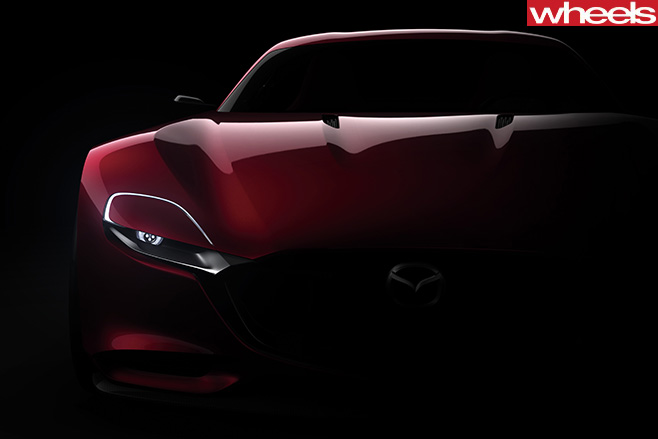
The concept is fronted by the brand’s trapezoidal grille, flanked by slim headlamps with a cap that seems a nod to the pop-ups that were offered on every generation of the company’s famed RX-7 sports car. At the rear, the stubby tail features clever detailing such as the integrated spoiler above twin circular tail lights mirrored by the exhaust tips in the diffuser.
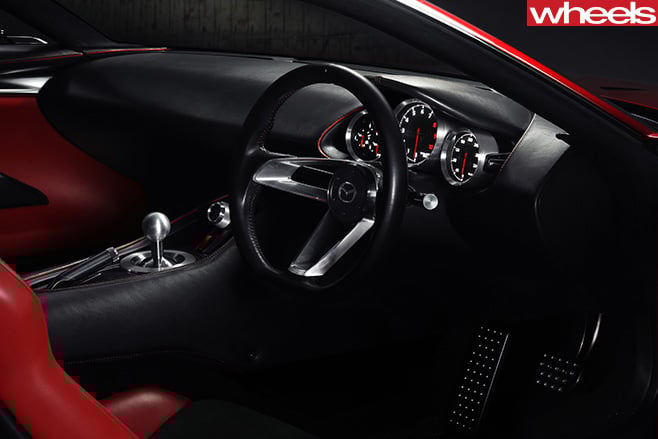
“We are not a big company, but the cars we make stand out,” said Kogai. “Our vision is to offer customers driving pleasure along with excellent environmental and safety performance. We don’t see cars simply as a means to get from one place to another.”
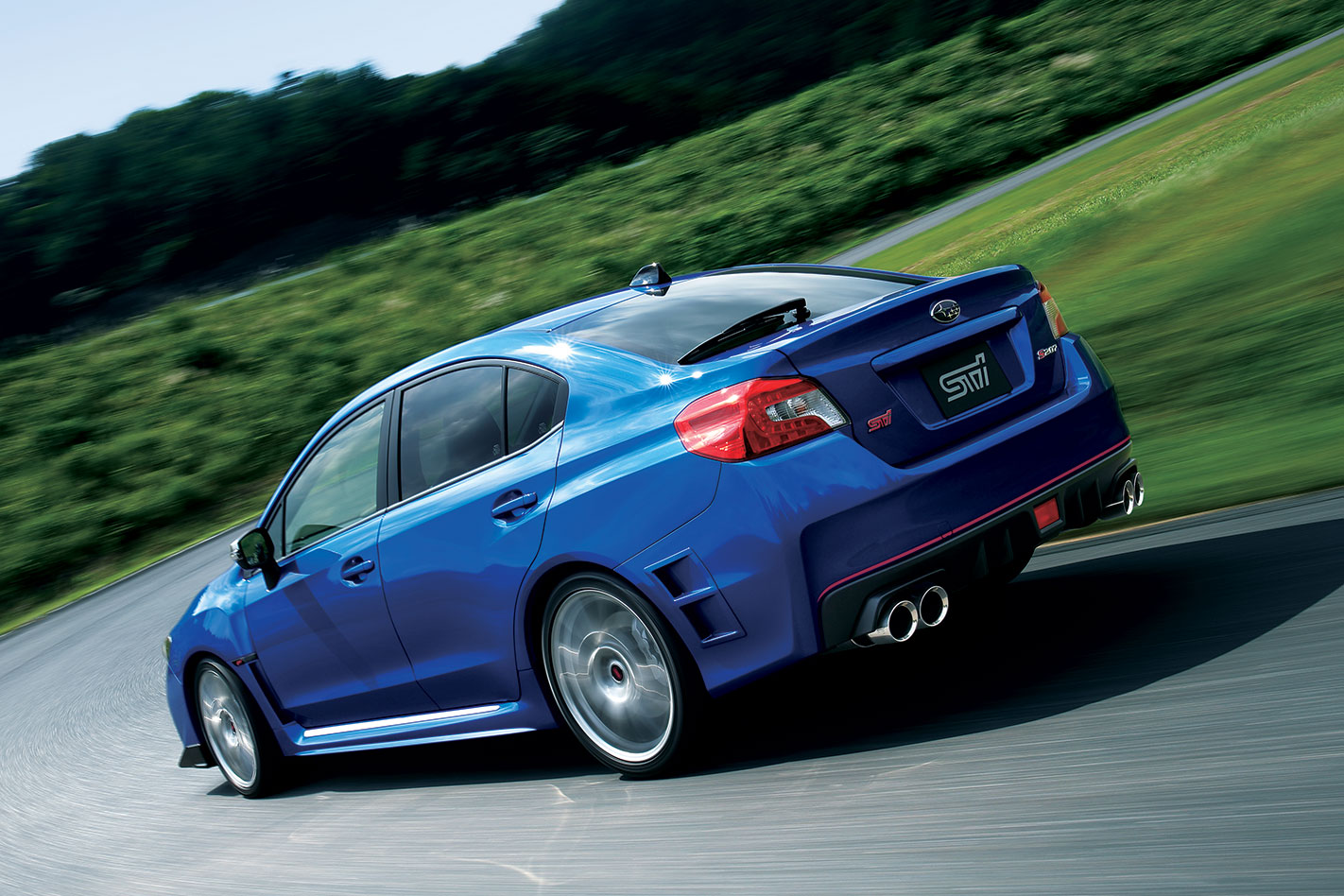
Subaru has revealed the ultimate incarnation of the current Impreza, the S207, at the Tokyo Motor Show.
Limited to just 400 units, sadly all for the Japanese domestic market only, the S207 is the latest in a long line of special edition STIs that lift the WRX’s performance to supercar-baiting levels.
The 2.0-litre turbocharged flat-four found in Japanese-market STIs (and the motorsport-only NR4 locally) benefits from engine balancing and a new intake, exhaust, ECU and twin-scroll turbocharger to lift outputs from 227kW/422Nm to 241kW/431Nm.
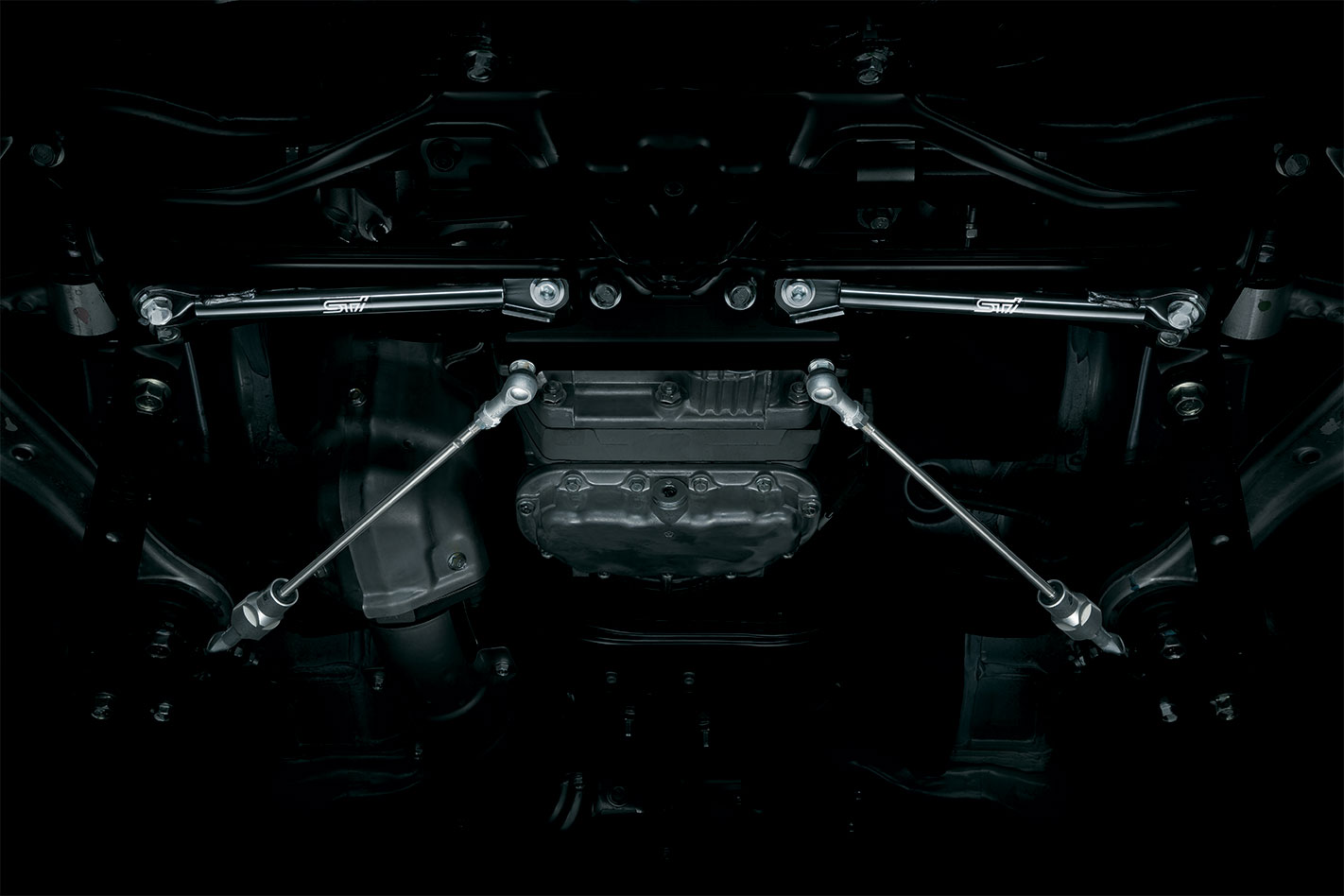
The chassis has undergone an even more extensive transformation. There’s bracing for the front strut towers and front and rear subframes, as well as pillow-ball bushing for the rear lateral suspension linkages.
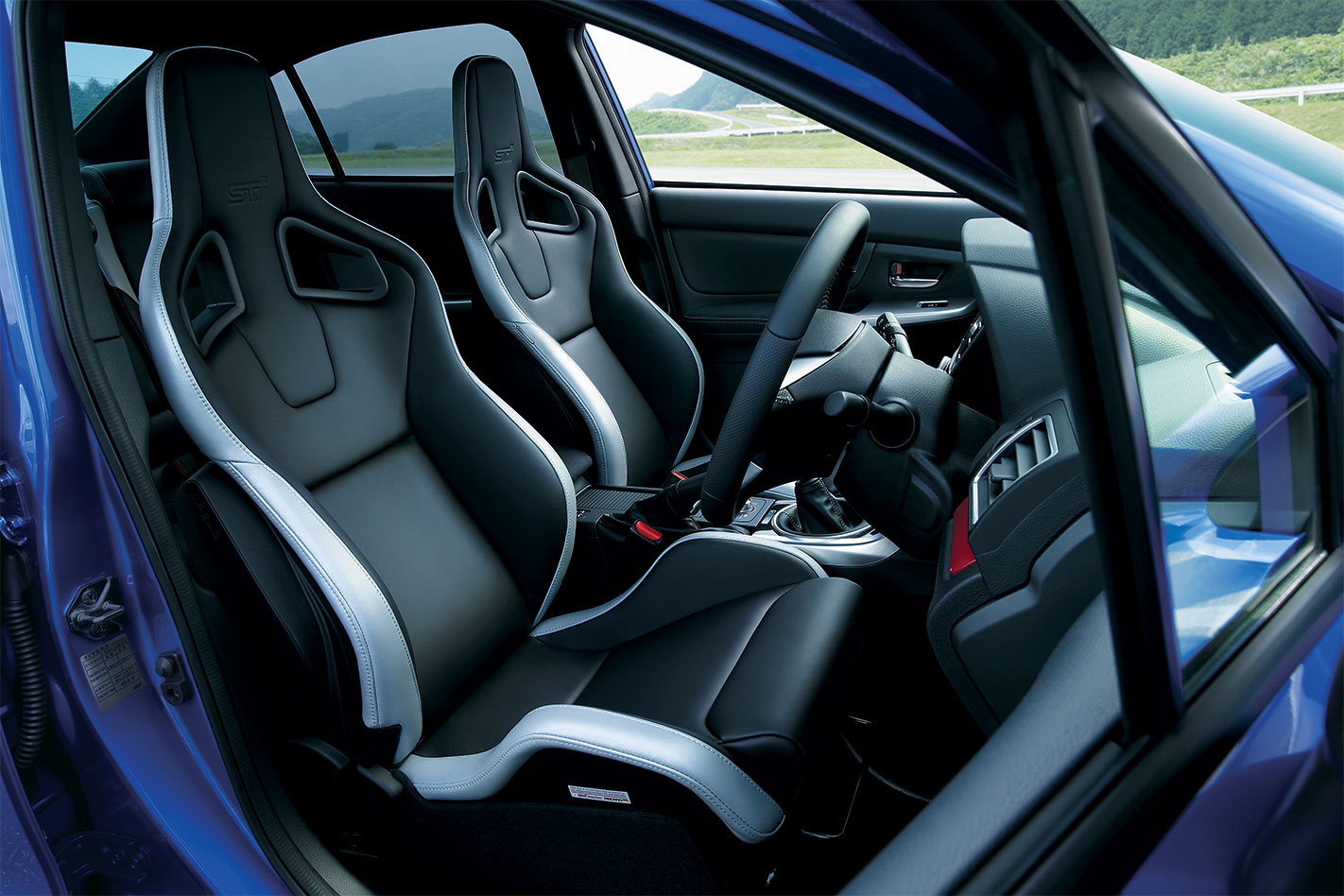
Bilstein dampers all ’round (adjustable at the front) combine with a quicker 11:1 steering rack and front-to-rear torque vectoring system to provide more grip and sharper responses, at which point you’ll be glad of the Recaro front bucket seats.
The S207 is available in blue, white or black, with 100 NBR Challenge cars available in yellow. Converted from yen, the S207 starts at A$69,159.40, while the NBR Challenge will set you back A$72,897.74, or $73,520.80 if you want it in yellow.
