
As inevitable as death and taxes, Porsche’s hottest Boxster, the Spyder, will make its current-gen resurrection – hopefully by year’s end.
The formula is a no brainer – take the mechanical package from the recently launched hard-core Cayman GT4 and port it into what’s essential its drop-top twin, the Boxster.
However, while that’s the broader concept, given structural differences between Porsche’s two entry sportscar ranges, exactly how much GT4 componentry the Spyder will benefit from is currently unclear.
It’s confirmed that the Spyder will pack 280kW, presumably from the same Carrera S-based 3.8-litre flat-six found in the Cayman GT4.
The current top-dog Boxster is the GTS with 243kW; extracting another 37kW from the 3.4-litre seems unlikely when there’s an easier solution ready to go.
With the larger engine installed, the Boxster Spyder, like the Cayman GT4, will be six-speed manual only, as the PDK has not yet been engineered for this application.
Given Porsche claims a 4.4sec 0-100km/h time for the new Cayman GT4, we’d expect the similarly engined Boxster Spyder to be a tenth or two slower.
What’s currently unclear is how much, if any, of the Cayman GT4’s extensive chassis upgrades will make their way into the open-top car.
Will it be a full-on car from Porsche’s GT4 department? On current information, it’s expected that the Boxster Spyder will be a regular production model, benefitting from the extra power but only limited chassis upgrades.
With that in mind, we’d expect Porsche’s new hi-po convertible to list at around $170K, reaching Australia in the first half of 2016.
Get your free weekly report from the world of fast cars – subscribe to the MOTOR newsletter!
A FIRE-BREATHING, STI-tuned Subaru Forester that would sit above the current range-topping XT petrol turbo is high on the car maker’s Australian wish list, the company has revealed.
Similar in concept to the recent limited-edition tS model offered in Japan, the high-performance Subaru Tecnica International (STi)-enhanced Forester hotshot would undergo similar enhancement to take over as the Forester range’s top dog.
However, while Subaru Australia managing director Nick Senior told Wheels there was a strong desire for a Forester STI-style range-topper, particularly after the success of the Impreza-based WRX and STI sedans launched last year, it hung on upcoming talks involving the Levorg performance wagon’s future in this country.
As we revealed earlier this year, the final decision on the latter will be made by the end of this month. The most serious stumbling block remains soaring ongoing demand in Japan (where there currently is a backlog of 8000-plus orders) – a situation exacerbated by limited production capacity.
Senior said if the Levorg was given the Aussie green light, any Forester STI-style variant for this market would be placed on the backburner for the time being due to his company’s limited resources.
“There was a limited-edition Subaru Forester launched in Japan last year, and (an STI-style flagship) has been added to our wishlist,” he revealed. “But it is sort of down on our wishlist. We need to get the Levorg decision sorted before we look at the Forester.”
Developed with STI, jus 300 limited-edition Forester tS models were sold in Japan from late November last year.
Among other modifications, it featured “exclusive tuning” of the S# (Sport Sharp) SI-Drive driving mode function, STI-upgraded suspension fettling including a 15mm lower ride height, revised stability and traction control, an adjustable strut tower brace and beefed-up subframe, uprated Brembo vented discs, BBS-designed 19-inch alloys and unique aero foils beneath the vehicle.
On the engine front, the tS topped the current 177kW/350NM 2.0-litre four-cylinder petrol turbo Forester XT with a 206kW version of the highly-strung boxer unit via a rejigged engine control unit and continuously variable transmission, as well as a gearbox oil coolersimilar to the one fitted to the new turbo-diesel CVT auto Forester.
Now discontinued in Japan, the tS was marketed as offering a mix of performance and luxury, with specification and trim enhancements that pushed it to the top of the Forester food chain.
With the latest MY15 Subaru Forester 2.0XT Premium CVT topping out at $47,990 (plus on-road costs), any potential STI-style performance hero would probably exceed $55,000 – the same price for the existing WRX STI.
With the Levorg decision scheduled to be discussed on March 28, according to Senior, the future of a Forester STI is expected to follow soon after.
Sign up here to receive the latest round-up of Wheels news, reviews and video highlights straight to your inbox each week.
FORD’S most popular vehicle in Australia is already out and about in facelifted Series II guise, weeks ahead of its global international debut at the Bangkok motor show.
And in what may be a world-first scoop, here’s the PY (or PZ) Ranger sporting its all-new ‘roo bar – a must for every rural tradie in road kill-infested Australia.
Snapped by eagle-eyed Wheels reader Justin Bauer near Ford’s You Yangs Proving Ground, the Blue Oval’s vitally important one-tonne pickup is shown in its renewed full-frontal glory, including the new clamshell bonnet design, slimmer headlight shape, beefy three-bar chromed grille, reprofiled bumper, more integrated foglights and a fuller-width lower air intake.
Interestingly, the prototype Ranger’s aggressive grille treatment seems to be the inverse of what the closely related Everest seven-seater wagon’s is, to differentiate what is otherwise almost identical looking nose cones. Rear-end changes are slight indeed, with different tail-light lenses and paint applications likely to be the only real differentiators between old and new.
Ford is coy about revealing further information about the Ranger, but we hear that an all-new six-speed manual gearbox is in the pipeline to overcome the heavy feel of the existing item found in the 3.2-litre five-cylinder turbo-diesel.
A revised dashboard with fresh instrumentation, updated multimedia and Ford SYNC connectivity system is thought to be part of the facelift’s drawcards. Look, too, for revised materials and trim fittings.
Stay tuned to Wheels for more information on the 2015 Ford Ranger following the XLT version’s global unveiling in Bangkok on Monday, 23 March.
Expect to see the Ranger in dealerships from late July, some two months ahead of the Everest, with prices pretty much mirroring the existing $19,740 (PX XL Single Cab 2.5 petrol 4×2 manual) to $59,390 (PX Wildtrak Double Cab 3.2 turbo-diesel 4×4 auto).
Have spy pics of your own? We’d love to see them. Just email them to [email protected]
If personalization is your bag and money is of little object, Geneva proved that nothing exceeds like excess.
Mansory Trofeo
German tuner Mansory unveiled its re-bodied Torofeo enhancement of Lamborghini’s Huracan that’s powered by a rebuilt and turbocharged version of the glorious 5.2-litre V10, said to produce in the neighborhood of 745kW.
Mansory G63 AMG Sahara Edition
The conceptual antithesis to Mansory’s 1000-horsepower Huracan is the company’s military-themed G-Class AMG, which sits on 22-inch rims and boasts a weapons-grade 615kW from 5.5 litres of twin-turbocharged V8 splendor.
MTM Audi RS6 Clubsport
Tuning house MTM has treated Ingolstadt’s hyper family-hauler to a Clubsport makeover, combining lairy ’90s paintwork, 21-inch rolling stock and a ferocious 560kW from its 4.0-litre twin-turbo V8.
Touring Superleggera Berlinetta Lusso
More a design reinterpretation than pure ‘tuning’ exercise, perhaps, but coachbuilder Carrozzeria Touring Superleggera’s retro-infused restyling of Ferrari’s flagship F12 was certainly one of the most stunning lookers of the Geneva show.
Techart 911 Targa 4S
While the mechanical package of Techart’s striking Targa 4S remains largely factory spec, the wild lime-yellow Porsche showcases an array of the company’s aero/bodywork, rolling stock, suspension and interior enhancements.
AC Schnitzer BMW M4 ‘ACS4 Sport’
While it’s questionable whether AC Schnitzer has improved the nails-tough factory M4 styling with its distinctive makeover, the tuning house’s handiwork under the bonnet has massaged around 380kW and 645Nm from the M coupe’s punchy turbo six.
Ruf RGT 4.2
Porsche tuner Ruf, creators of the legendary Yellow Bird, showcased a fleet of enhanced 911s, including its RGT 4.2, boasting a bespoke 4178cc naturally-aspirated flat-six that, at 386kW/500Nm, outpunches Porsche’s new (4.0L) GT3 RS.
Ruf Turbo Florio
Keen to plug holes in the 911 range Porsche hasn’t filled, Ruf offers a turnkey, 465kW turbocharged targa-topped special that can be ordered in Turbo-like all-paw or GT2-like rear-wheel drive, with either a manual or PDK transmission.
Brabus 850 6.0 Biturbo Coupe
This insane take on AMG’s S63 Coupe enlarges the factory 5.5-litre V8 to 5.9 litres, resulting in 625kW, a planet-shifting 1150Nm boast and a formidable 3.5sec 0-100km/h acceleration claim from the king-sized two-door coupe.
Brabus Rocket 900
The Coolest Nameplate Of Show Award goes to Brabus’s Rocket 900, in honour of the AMG S65 sedan-based model’s near 900-horsepower (660kW) boast, backed by an incredible 1500Nm courtesy of its biturbo V12’s expanded 6.3-litre capacity.
Sbarro Aria concept
Taking tuning and customization to the extreme, the Aria is the result of 26 design students starting with the Subaru 2.0-litre turbo boxer and end up with one inspired, composite-constructed 1100kg sportscar.
Hamann Macan Diesel S
More lightly tuned than many Geneva contemporaries was Harmann’s enhanced oiler Macan, offering a modestly boosted 221kW and 670Nm from its diesel V6 in a package resplendent in classic Gulf Oil-Wyer livery.
Get your free weekly report from the world of fast cars – subscribe to the MOTOR newsletter!
THE next Chevrolet Camaro will be shown for the first time at an international event on May 16.
Holden has confirmed it will have a V8-powered, rear-wheel-drive dedicated sports car in its future line-up, and we want it to be this: the sixth-generation Camaro. The Camaro is the car we desperately want for Australia, as home-grown performance models from Holden and HSV are wrapped up with the end of local production as a direct competitor to the new Ford Mustang that lands here in right-hand drive from December, priced at $45K.
While the new C7 Corvette is king, the Camaro will use Corvette’s brilliant Gen V 6.2-litre V8 to take on Mustang in a value-for-money muscle car showdown, bringing it within reach of more bent-eight loyalists as it won’t carry a supercar price.
That new Gen V engine moves the game on from the unit currently making headlines for HSV, and should offer similar power outputs to the current ’Vette’s 338kW. That means the new Camaro tentially has more power than the 303kW Ford Mustang V8 to give bow-tie fans an on-paper victory even before they’ve clapped eye on the new two-door hero.
The new sixth-generation version of the rear-drive muscle car will ditch the Australian-developed Zeta platform for a new, highly sophisticated Alpha platform. Among the key benefits is an increase in not only rigidity, but weight loss to the tune of 130kg. That means a 1560kg starting point for a V6-powered Camaro, or 1643kg for a V8 powered version.
Like Mustang, there will be a convertible version of the Camaro. The current Camaro, which shares the VE-VF Commodore’s Zeta platform, has sold almost half a million units since it arrived in North American showrooms in 2010.
After a Honda Civic Type R clocked a faster Nordschleife lap time as claim to world’s quickest production front driver, Renault has taken its Megane RS – and the fight – to Melbourne’s Albert Park.
The result? A lap time of 2min23sec for the 5.3-kilometre track at the hands of Red Bull F1 driver Daniil Kyvat during an ‘Albert Park Challenge driven by Renault’ event in the lead up to Sunday’s snoozefest of a main event.
The hard-core Trophy-R variant of the Megane range clocked an average speed of 133km/h.
The achievement has prompted Renault to issue official claims of ‘first production car to set a lap record’ and ‘the first time a commercially available production vehicle under or up to 2.0 litres has set a timed lap of Albert Park…”
The claim will no doubt amuse F1 rivals Mercedes-Benz, who also runs its own production car activities during the Grand Prix festivities, no doubt both officially and unofficially timed.
Mercedes-Benz also partakes in the high-profile Ultimate Speed Challenge during AGP weekend, pitting an AMG road car against a V8 Supercar and F1 race cars, this year in a 2.0-litre A45 AMG piloted by Mick Doohan.
Contested in variety of high-powered AMGs throughout recent years, the Ultimate Speed Challenge is, however, held from a standing start – last year’s C63 AMG effort yielded a slower lap than the Megane RS Trophy-R’s 2min23sec ‘flying lap’ by a measure of around five seconds.
Then there’s the fact Mark Webber was also on track in production car during GP weekend, doing demonstration laps behind the wheel of a Porsche 918 Spyder.
Claiming production car lap records around Albert Park is also slightly dubious in that the temporary race circuit is only feasibly accessible to car companies affiliated with the AGP event.
The Albert Park record holding Trophy-R was completely standard, one of just 50 examples allocated for local release of a limited 250-unit global production.
Get your free weekly report from the world of fast cars – subscribe to the MOTOR newsletter!
“THUMP! Rattle! Bang! … Ooh! Argh! Crap!”
On a rough and scarred NSW country road a Kia Rio is doing its best to transmit every nook and cranny back through my body without a skerrick of filtering. It has the unlikely ability to be porn-star rigid on smaller inputs then wobble flaccidly on the bigger hits. It’s the worst of both worlds.
My pace declines to around 90km/h. The car feels like it is exceeding its capabilities going any faster. It’s hard to believe a simple combination of MacPherson struts and a torsion beam could be this bad.
Graeme Gambold looks across from the front passenger seat: “That’s just tragic, it’s unsellable.”
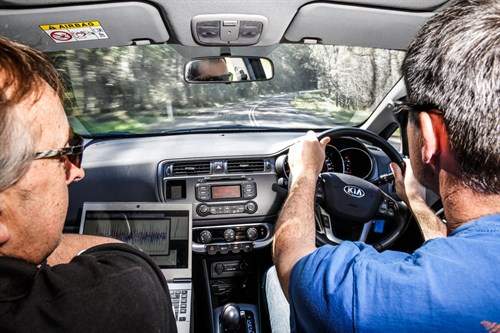
Considering Gambold is the independent chassis expert who has been consulting to Kia Australia since 2008 on its local suspension and steering development that’s quite an admission.
But he can afford to be brutally honest, because this is the “before” example of the just-superseded UB Rio, running on Korean domestic suspension tune.
If ever there was an answer to the question why Kia Australia has been going its own way on ride and handling in recent years then a short drive – and you’ll want to make it short – of this Rio provides it.
Gambold explains the Korean-spec Rio set-up is meant to be nippy and sporty with quick steering at the low speeds encountered in the car’s heavily urbanised home country. He talks about the roll couple distribution, or balance, of the car being rearward. It definitely doesn’t translate to Australian conditions.
“Because of the driving environment here – we have rough roads and high speeds – our roll couple distribution of the car is always forward … We try and go for a very firm front axle. All the European cars do that and they are the ones that drive well out here.”
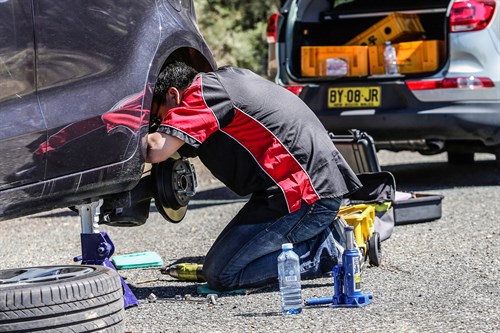
Gambold became involved with Kia’s chassis tuning when his former Toyota Australia colleague – and fellow rallying enthusiast – Steve Watt moved to the Korean company as marketing manager in 2008.
The rallying background is significant because it underpins their fundamental suspension set-up philosophy; make the ride more compliant and long-legged while tightening body control.
“That puts us into a unique tuning window and that means we extend the boundaries of our requests and go in quite a different direction from any other countries,” explains Gambold.
So different, Kia now classifies Australia as its own little separate ride and handling zone, alongside domestic, general market, North America and Europe.
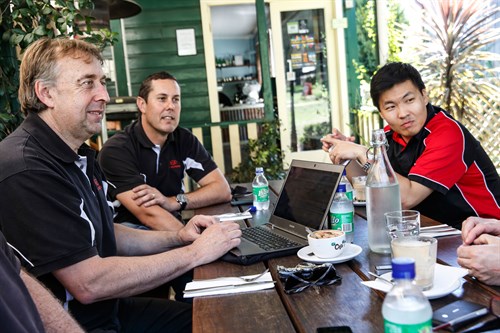
On this warm late 2014 day Watt, Gambold, senior product manager Jeff Shafer – another Toyota refugee – and senior product planner John Kil have assembled together in the NSW Hunter Valley out near Wollombi to walk Wheels through their chassis development program.
On this combination of rough, smooth, fast, slow, climbing and falling country highway the local team does its real-world shock absorber development work.
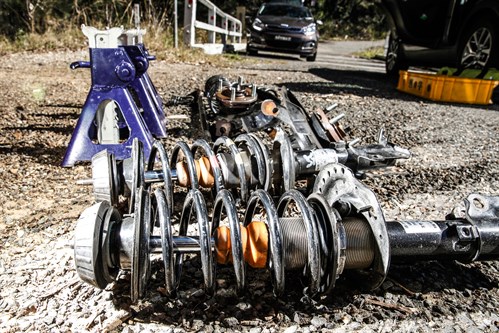
And with the facelifted UB-PE (product enhancement) Rio due early in 2015, Kia’s mini-car is the logical subject for this primer. Four different states of tune are here for us to try, all of them using the same optional 17-inch Continental Contisport Contact 3 rubber and driven by the 103kW 1.6-litre engine and six-speed auto.
Not that Rio is the only model in the Kia range to receive attention. The process started in a small way with some steering work in the first Soul back in 2009 and now touches all models in the range in some form or other.
Some of the Australian work has also been adopted overseas, most notably in the UK where road conditions quite closely reflect our own.
Kia is not the only brand that addresses ride and handling for Australia; local rival and global parent Hyundai has invested in this process, too. But most brands don’t.
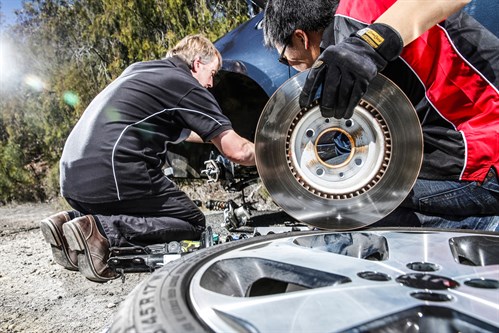
The Kia process starts with the identification of segment dynamic leaders and then a number crunch to see why they are so good. In the case of the Rio, that includes the likes of the Volkswagen Polo and Ford Fiesta.
The numbers for the Rio are also entered into Gambold-developed software and out spits an approximation of where its various settings need to be.
“We look at those numbers and I can see pretty much from them what the car will handle like,” Gambold explains as he points at graphs, curves and tables on his laptop.
“It’s pretty accurate; it will be understeery or oversteery. It will be stable, it won’t be stable, it will have good ride, it won’t have good ride.
“We temper all this stuff with how does it drive, how does it actually feel and tune accordingly. We use a balance of numbers, and subjective evaluation and experience.”
The first drive of the prototype in Korea at the giant Namyang proving ground inevitably reveals the car is some way from where the Australians want to be. But attaining the ideal dynamic target is not always possible. The basket of available tuning parts – shocks, springs and sway bars – may simply not take the car far enough.
The need to keep complexities on the assembly line minimised is one obvious limiting factor, but so is the cost of development.
“You’ve got to be careful you don’t ask for something that would require a retune of the ESP,” Gambold explains.
“That would require another winter test in New Zealand or Europe and a whole lot of other regulatory tests would have to be conducted. You’re talking teams of engineers and millions of dollars.”
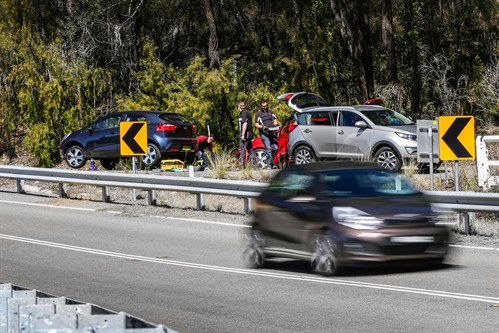
Once prototypes arrive in Australia, suspension is dialled in an intense two week burst in the Hunter Valley, generally working through two to three options per day.
Finally, the steering is set. Thanks to electric assistance this is quickest part of the process. Experts arrive from Namyang, plug in their computers and play.
From first drive at Namyang to sign-off takes about six months. And out of the process, should come a decent driving car.
Time to find out.
Apart from the Korean spec UB we’ve already driven, there’s an Aussie spec UB to reacquaint ourselves with, a car with UB-PE settings to sample and something of a surprise – a local development mule that encapsulates where the locals really would like to be.
“I wanted to prove to Kia Australia guys how good the car could be with the right componentry, which is why we set about building that buck,” explains Gambold.
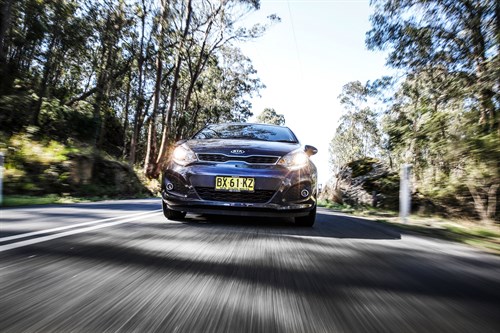
And Gambold’s point is proven in the driving. The “buck” runs the largest anti-roll bars and lightest springs of any of the four cars, and delivers the best ride and body control.
Its electric-assist power steering has been made faster and is the most positive and has the least friction.
The buck dives into corners, sits flat, holds it line, rides the bumps and delivers feedback. I’m quickly wishing for more power and flappy paddles.
At the core of the buck is a simply clever adjustment that allows the stiffness of the torsion beam rear axle to be varied. From that, appropriate anti-roll bar thickness and spring weights can be established.
“The strength in the rear improves the behaviour in the front,” explains Gambold. “It doesn’t have the lateral weight transfer variance.
“The stiffer rear torsion beam allows us to run a lighter spring rate, which takes the mid- corner jacking action or energy out of the inside rear. So as the car weights it doesn’t get pushed up by the spring rate.
“Confidence, security, engagement – those are the things you really want from a chassis.”
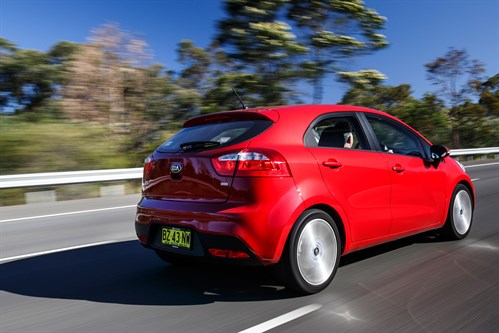
And you can feel what he’s talking about in each of the other cars. The Korean UB is – we know – crap. The Aussie UB is a much better drive with a more compliant low-speed ride and better body control. But the power steering tune is wooden and the ride on the 17-inch Contis poor.
The UB-PE is another step forward, although lacking the same sheer authority of the buck. It benefits from a steering upgrade from 16 to 32-bit processor and having local tuning of the 17-inch tyre (something the UB missed out on) and a spring, shock and anti-roll bar set-up closer again to what the Aussies want.
It drives confidently and smoothly, even enjoyably. But whether all this work on Rio and the rest of the Kia range does anything for profitability is another question.
“It’s a longer play,” Watt admits. “I don’t know if we can look at it as a direct correlation to sales today.
“The reason we went down this path is because it is something we identified relatively early on as something we could change that could give us an edge in this market and longer term help us with that customer who was alien to us before – a customer who likes having a drive of a car.”
THE BMW X5 Drive40e is the company’s first production plug-in hybrid that’ll draw swords with the Audi Q7 e-tron and Mercedes GL-Class eco-warriors. It takes technology developed for BMW’s ‘i’ sub-brand, currently two cars – the Wheels COTY-winning i3 city car and the BMW i8 sports car. These two cars, sold as full-electric (i3) and/or range-extenders (i3 REX and i8), have borne the development cost and experiences that should give the X5 Drive40e a leg-up.
The X5 is powered by BMW’s new generation of modular engines, which see a combustion chamber of 500cc for each cylinder multiplied by three or, in this case, four cylinders. The Swedes have followed the same idea with the new Volvo XC90 SUV that arrives in Australia later this year.
The 1997cc turbocharged four-cylinder engine, which is positioned low and as far back as possible in the X5’s engine bay, makes 180kW and 350Nm, sent through the eight-speed ZF automatic transmission that’s already used across the BMW model range, from its entry-level 1 Series though to flagship 7 Series products.
However, for the hybrid X5, the transmission houses an 83kW/250Nm electric motor linked to a lithium-battery pack located under the floor of the boot and behind the rear axle.
The battery pack eats into boot space, though, with the usual X5’s 1870 litres reduced to 1720 with the tri-fold rear seat upright.
The petrol engine and electric motor produce a combined 230kW/450Nm through all four wheels (even in electric mode) and gives the 2230kg X5 – the heaviest of the large SUV line-up by only 40kg – an electric-only range of 31km after a charge time of almost four hours.
As the masters of extras-selling, BMW is also pushing its own 3.5kWh wall-mounted charger that cuts the recharge time to 2.5 hours.
The only other plug-in hybrid SUVs on sale here are the Mitsubishi Outlander PHEV with a charge time of five hours, and the Cayenne S E-Hybrid with an almost three-hour recharge time – drop that to 1.3 hours if you buy its special under-bonnet charge unit.
That 31 km range is not as far as the Mitsubishi or the Porsche, yet it delivers a ‘power boost’ to help achieve a claimed 6.8sec 0-100km/h time and a limited 210km/h top-speed – good numbers compared with the 306kW/590Nm Porsche’s 5.9sec and 243km/h. The eco-X5 also comes with an adaptive chassis as standard, too, although shift-paddles are an option.
The all-important fuel claim is a best of 3.3L/100km (EU figures). That compares to the most parsimonious X5 currently on sale in Australia, the sDrive 25d with its 2.0-litre turbo diesel, which claims 5.8L/100km, and undercuts the Porsche Cayenne hybrid’s official Australian fuel use figure by 0.1L.
The X5 differs significantly from the Audi Q7 Hybrid, with the Audi using a 3.0-litre twin-turbo V6 and electric power for a stonking 278kW and 699Nm, yet both may be hampered as left-hand-drive only models – meaning neither are a sure bet for Aussie showrooms.
“We would like to have that vehicle [the X5 Drive40e] as it will continue to support out low-emissions vehicle program,” a BMW spokesperson told Wheels. If it does arrive in Australia, it won’t be here until early 2016, with the Audi Q7 e-tron arriving no sooner – if at all.
F1: Sorry, Bernie… simply not good enough
THE season-opening Australian Grand Prix was an embarrassment for Formula One – 15 starters was the worst since the politically decimated San Marino in 1982, when just 14 took the green, and the tyre-affected 2005 US race where only six cars competed.
The Silver Arrows were boringly dominant, led by pole man Lewis Hamilton, Ferrari and Williams were left to fight over the scraps, and Red Bull looked like they’d been sleeping through the northern winter.
RBR was outpaced by Sauber and was even under threat from its junior team of Toro Rosso rookie babies.
A margin of 1.3 seconds back in second, Nico Rosberg never really threatened his champion team-mate, but was comfortably ahead of third-placed Sebastian Vettel in the surviving Ferrari, and Williams-Merc’s Felipe Massa.
“It was still a tough race, though, as Nico was very quick throughout,” Hamilton insisted, while admitting “it was about managing fuel and also the tyres. Once I’d built a two-second gap it was about maintaining it.”
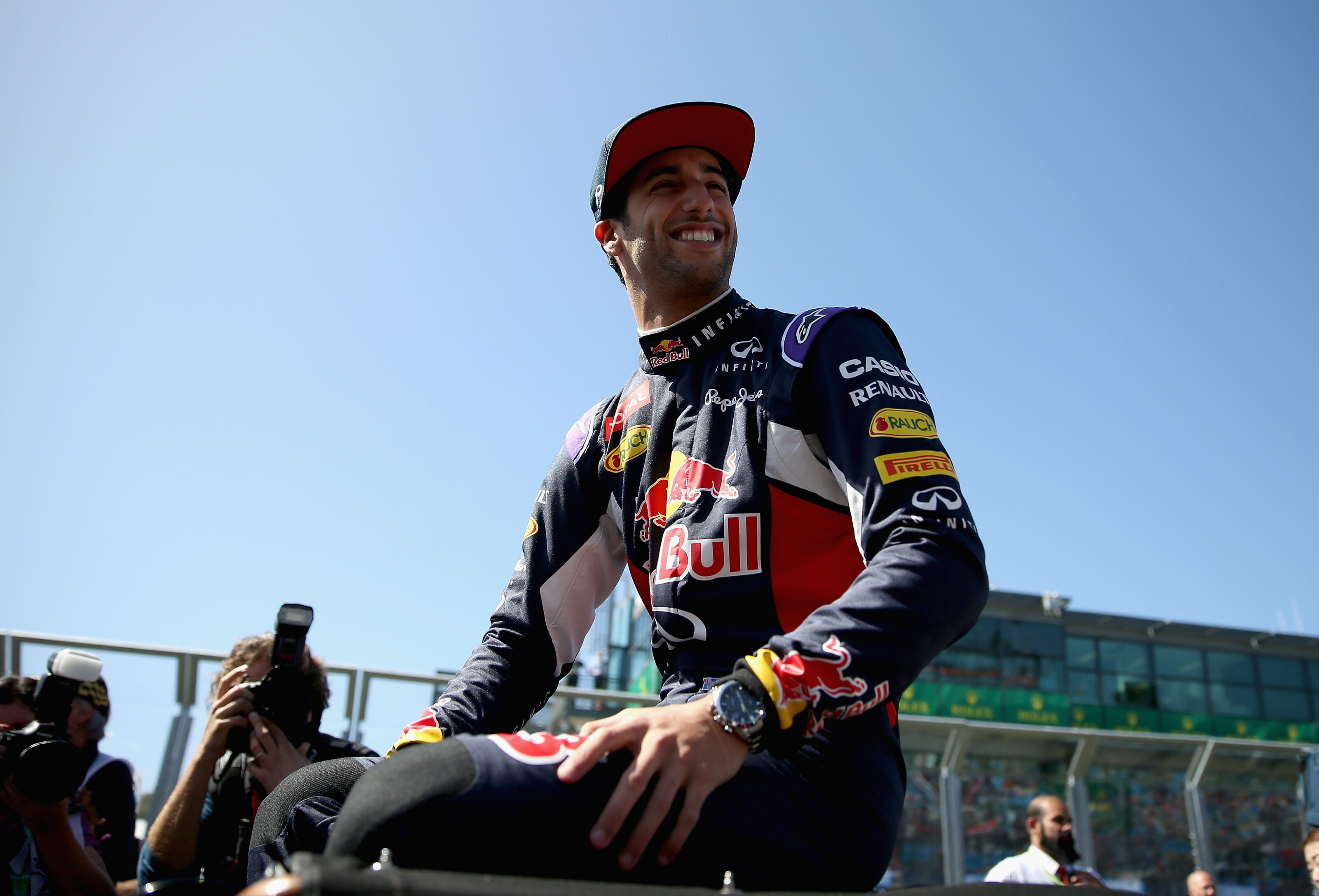
If there was a pleasant surprise, it came courtesy of Sauber’s Felipe Nasr, the rent-a-drive rookie who impressed in qualifying and then continued the fine work in the race, giving the embattled outfit a happy end to a week in which it spent more time in court than on the track.
Nasr was quick early, then fought off an attack from Daniel Ricciardo to bag a rightfully acclaimed fifth at the chequer. To think that Sauber failed to score even one solitary point last year.
Pleased enough with seventh in qualifying after power pack dramas and an engine change that cost him valuable track time, Ricciardo raced as well as ever, though struggling with driveability issues. Sixth was as good as he and Red Bull could have expected.
Between them, Red Bull and Renault managed to look pathetically under-prepared.
“It wasn’t the most exciting race,” commented a downbeat Ricciardo. “We finished the race and got some points, which was positive, and there are things we can learn. I hope we have a smoother weekend in Malaysia.”
Just 11 cars finished. Jenson Button was the luckless one out of the points, two laps down in his troubled McLaren-Honda.
Along with McLaren, the biggest embarrassment was reserved Formula One itself.
Manor F1, the reborn Marussia, didn’t even make it out of its garage all weekend. Then poor Valtteri Bottas, in pain through qualifying, was ruled out with back issues after spending Saturday night in hospital. Soft tissue damage…
Red Bull’s Daniil Kyvat was a non-starter, too, with gearbox failure on the way to the grid, while McLaren-Honda’s stand-in for Fernando Alonso, Kevin Magnussen, blew his power pack, also on the forming-up lap.
With a thin grid of 15 starters, Ron Walker should demand a partial refund from Bernie…
Then came the opening-lap turn one silliness, triggered when the Ferraris got together, sending Pastor Maldonado into the wall. Moments later, his team-mate Romain Grosjean retired his Lotus with a technical issue.
Carlos Sainz Jr looked good until a recalcitrant left-rear kept him stationary for an agonisingly long time. He finished a good ninth at the end while teenage team-mate Max Verstappen parked his Toro Rosso-Renault with engine failure a mid-race.
Kimi Raikonnen was another DNF after premature ejection from the pits left him with a wobbly rear wheel.
V8 SUPERCARS: The AGP races that don’t matter
V8 SUPERCARS raced at Albert Park on the support card to the Australian F1 Grand Prix.
The races were non-championship events so the results don’t really count for much. This is a shame for Ford Performance Racing, which per agency of Mark Winterbottom and Chaz Mostert finished first and second in all four races…

Heading to the line in race four, young Kiwi Andre Heimgartner jumped the (rolling) start by a good margin, causing a modicum of havoc. Perhaps he was operating on New Zilland time.
Lots of cars banged up for nothing.
F1: Sauber brings high farce to the pit lane
IT GETS no weirder than this.
Everyone, it seemed, had an opinion on the court action taken by driver Giedo van der Garde against Sauber after the team dumped him despite the Dutchman holding a firm contract to race in 2015.
Van der Garde claimed he was guaranteed a drive this season but embattled Sauber flicked him in favour of a couple of other pay drivers, Swede Marcus Ericsson and Brazilian Felipe Nasr.
A Victorian Supreme Court judge ruled on Wednesday that van der Garde, who raced for Caterham in 2013 and was Sauber’s reserve driver last year, should be able to race in the season-opener in Melbourne, upholding a Swiss arbitration tribunal’s decision.
A Sauber appeal against the ruling was then dismissed on Thursday, at which time it was no clearer which two of the potential three Sauber drivers would race in the Australian Grand Prix. Or in fact if Sauber would be able to race in light of van der Garde’s lawyer seeking a court-imposed freeze on Sauber’s assets.
For his part, van der Garde said afterwards that he still hoped to race in Melbourne, claiming he was more experienced than either of the two favoured by Sauber.
“I’m fit, I’m ready. Of course I want to race; it’s my life,” said the Dutchman, who is supported by his father-in-law Marcel Boekhoorn, a billionaire businessman and racing enthusiast.
Sauber argued unsuccessfully that it would be unsafe to let van der Garde drive in the race at such short notice in a car designed for Ericsson or Nasr. But the judge said regulators would ensure the race was safe.
Then Sauber’s legal eagle told the court van der Garde would not have time to get the necessary licence from the sport’s governing body.
On Friday, no Sauber appeared for the opening practice session. But then both rolled out for Free Practice 2… driven by Marcus Ericsson and Felipe Nasr.
Van der Garde was earlier seen trying to get into the paddock without the obligatory FIA pass. When he finally did get in he was quickly into a borrowed Sauber race suit, but wasn’t given the chance to get hot and sweaty.
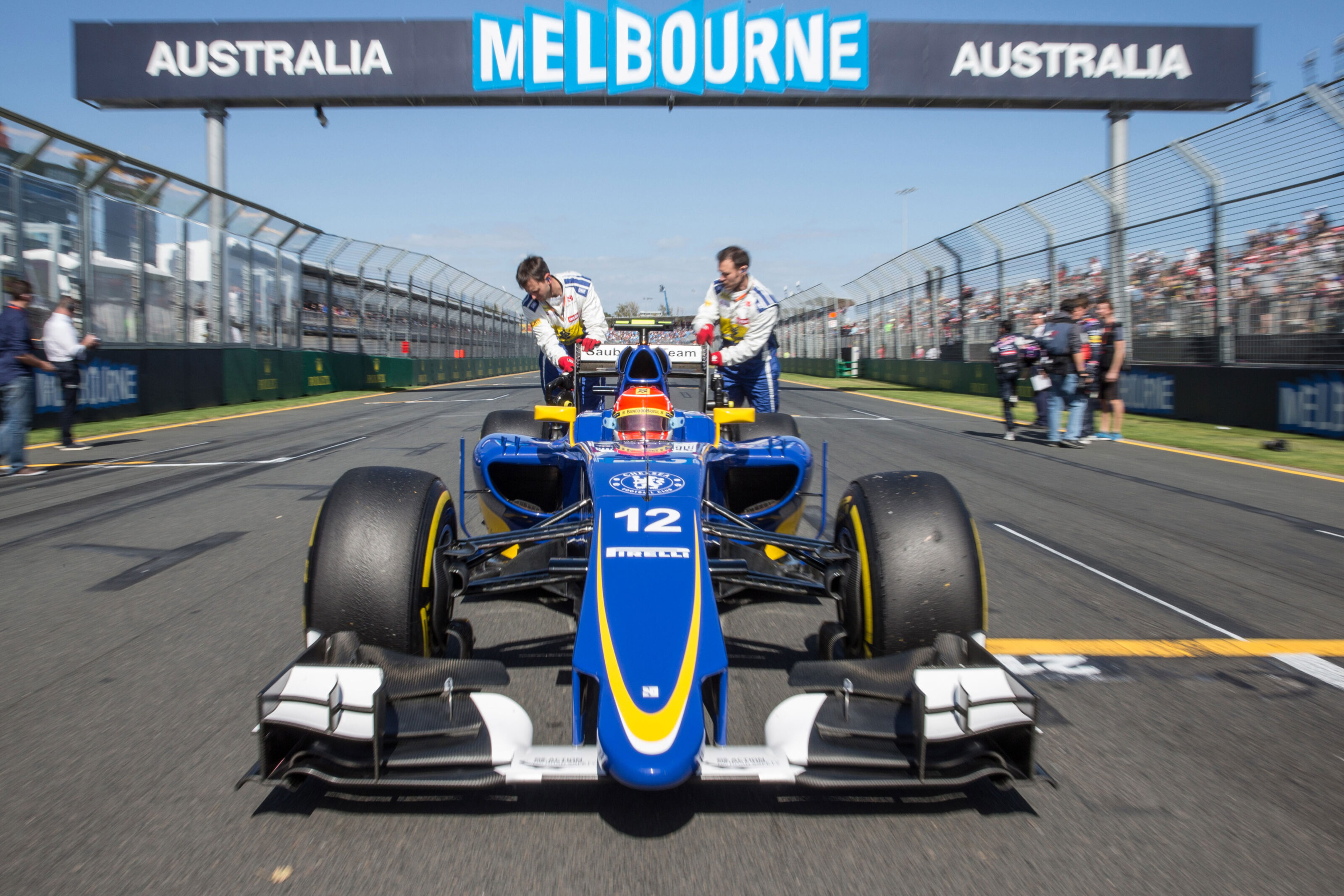
Social media ran white hot with rumours and opinions.
Why, some asked, did Van der Garde take such potential destructive action that could bring down an F1 team and its 300 employees as well as ruining his own F1 future?
That’s easy. He (or his sponsor) late last year paid Sauber a figure said to be not unadjacent to $11 million on the understanding that that would secure him a race seat. He claimed he had a contract to race, and the courts supported him. Hardly unreasonable.
But it has been suggested that struggling Sauber later signed contracts with Nasr and Ericsson, who the BBC reports between them brought $55m to the team.
Then at noon on Saturday came a statement from the Sauber F1 Team that it had been able “to agree with Mr Giedo Van der Garde that he refrains from driving in the Australian Formula One Grand Prix so it can keep its original planning. The Sauber F1 Team, Mr Van der Garde and his management will continue to have constructive talks in order to find a mutually acceptable solution.”
In a statement, van der Garde declared the decision had been “very difficult”. He said: “My management will continue talks with Sauber early next week to find a mutually acceptable solution for the current situation that has now arisen. I am confident such a solution will be found.”
Nasr and Ericsson duly tackled Saturday practice, then qualifying, where they were 11th and 16th fastest. Not bad considering the distractions.
The next exciting instalment should come before the Malaysian Grand Prix on Sunday week.
SPORTSCARS: Mr Le Mans would consider the Bathurst 12 Hour
RECENTLY retired sports car great Tom Kristensen says he will continue to race in selected events, mainly for historic sports cars.
But when pushed by Wheels, the nine-times winner of the 24 Hours of Le Mans also admits that, yes, “maybe” he would be prepared to race in the Bathurst 12 Hour.
Kristensen has heard much about Mount Panorama, especially from his friend, countryman and protege, the late Allan Simonsen, the former sports-car lap record holder at Bathurst.
He would love to race there, he says.
An ambassador for Audi, Kristensen would not be interested in racing for any other brand.
He was at the Geneva motor show earlier this month when Audi unveiled the new R8 supercar, and the GT3 race version.
And, if he were to race in the Bathurst 12 Hour, it would have to be within the next two years while he is still race fit and with the urge to win.
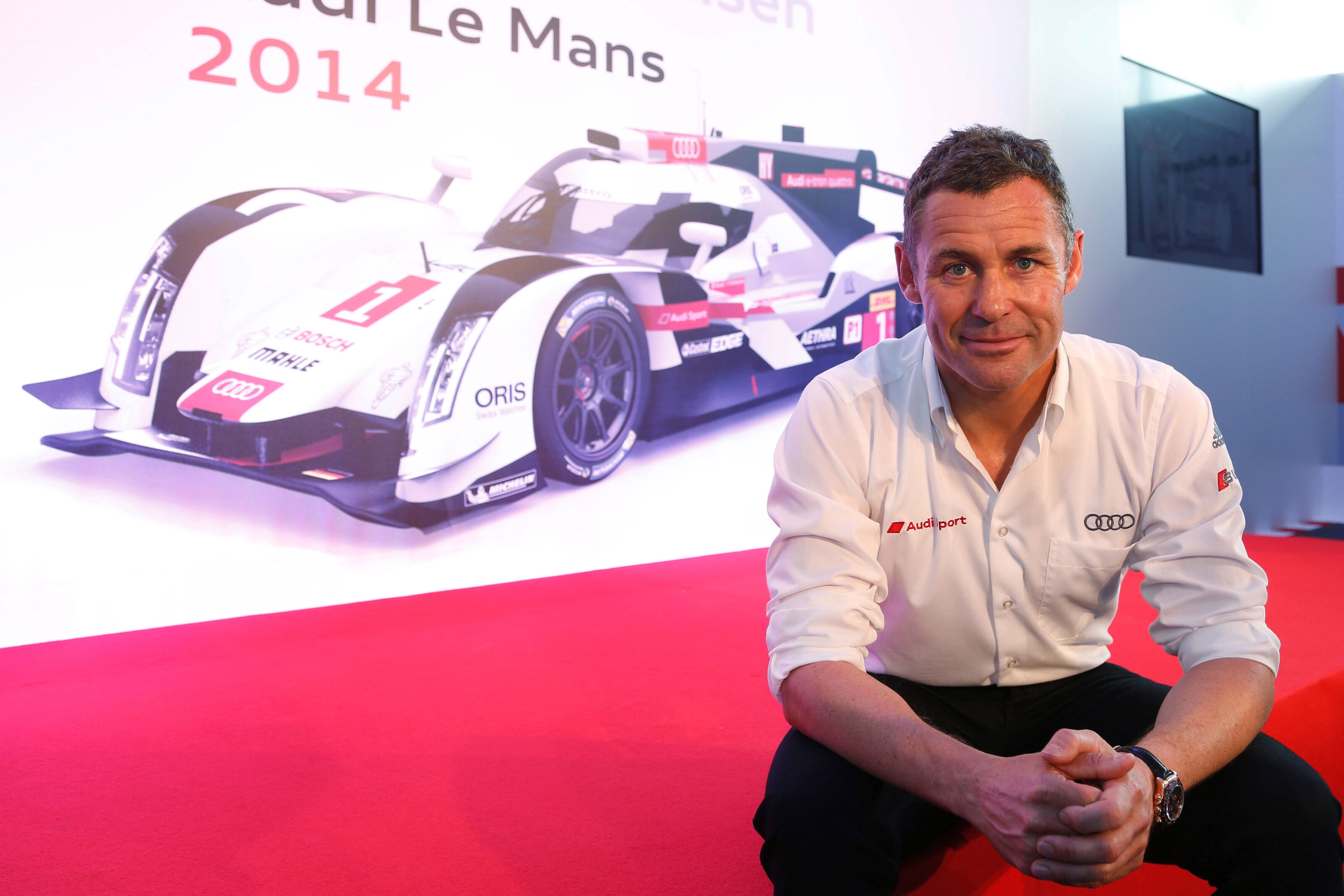
All of this is not to suggest that Kristensen is unhappy with his decision to quit full-time racing after the final round of the World Endurance Championship last December: “I loved every minute of my career. I had a chance to stop at the right time, when I was still strong [competitive].”
Kristensen said he always wanted to quit before people asked him, “Why don’t you retire?”
So far he has felt no pangs of regret about retiring, but expects to struggle emotionally a little at Le Mans this year, when he will go to work as a race steward.
The great Dane is still alarmingly fit. He had just returned from a 14km run when Wheels buttonholed him.
F4: Aussie Mawson to tackle German single seater series
AUSTRALIAN rising talent Joey Mawson has been signed by Dutch team Van Amersfoort Racing for the inaugural 2015 German ADAC Formula 4 Championship with the support of the CAMS Foundation.
Sydneysider Mawson, 18, is the first Australian to race for the Dutch squad, which will also be running the sons of Michael Schumacher and Adrian Newey this year.
The CAMS Foundation has a history of supporting young elite Australian drivers on their way to higher levels.
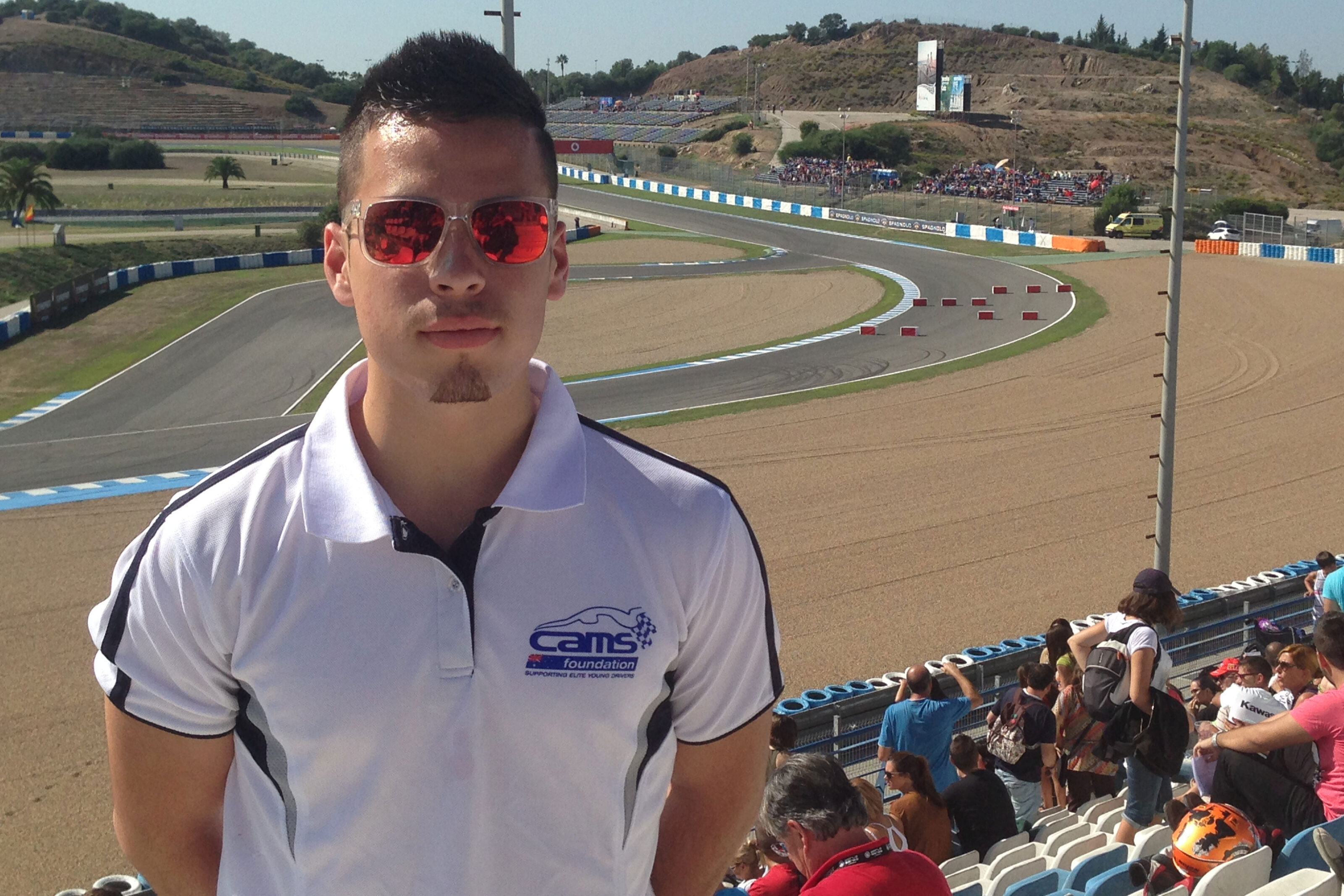
Mawson stood out in karting at an early age. He won three Australian championships, a round of the CIK-FIA U18 World Championship and finished second in the Rotax Junior Max Grand Finals, before moving to Europe to boost his racing career.
In his rookie season, Mawson scored three wins, three pole positions and three fastest lap times in the French F4 championship last year. Despite missing the last three races, Mawson was fourth in the final championship standings in his first season.
Van Amersfoort Racing has a history of running up-and-comers, including Max Verstappen, who made his F1 debut yesterday.
Mawson also said he was excited to be joining with 15-year-old team-mates Mick Schumacher, the son of seven-time world champion Michael Schumacher, and Harri Newey, son of Adrian Newey, Red Bull technical director.
The eight-round German F4 series starts on April 24-26 at Oschersleben and runs through to October.
Carmakers love to market their heritage and many at this year’s Geneva show rolled out prime examples of legendary old-school hero cars.
Ford MKIII GT40
With Ford’s GT40 road car resurrection in full swing, an ultra-rare 1969 Mk III – supposedly one of just seven built – shared the Blue Oval show space with its most recent heir apparent, which was recently unveiled at the Detroit motor show.
Ford Escort Mexico
The Blue Oval decided to publicly reveal its new Focus RS with its spiritual forefather, specifically a beautiful 1974 Escort Mexico, created in the early ’70s as a road-going homage to success in the London-to-Mexico Rally and producing just 63kW from its 1.6-litre four.
Ford Sierra RS500 Cosworth
The trifecta of fast classics on the Ford stand was completed with a car familiar to lovers of old ATCC Group A racing, a mid-’80s Sierra Cosworth, with this example one of the hard-core RS500 versions boasting an outrageous 150kW/277Nm (for its time) while weighing a feathery 1220kg.
Mercedes-Benz 280 SL
Famed for its ultra-powerful and super-pricey tuner cars, Brabus showcased its new Brabus Classic restoration division with one incredibly sexy Mercedes-Benz 280 SL W113 ‘Pagoda’, an example said to have clocked up over half-a-million US dollars in resto costs.
McLaren F1 GT Longtail
The British racing and road car powerhouse used the reveal of its new 675LT to roll out an original road-going Longtail homologation special, this factory-retained 1997 F1 GT example said to be one of just three ever built. The first time it had ever been publicly displayed, it’s estimated to be worth 23 million pounds!
Koenigsegg CC8S
You mightn’t think the Koenigsegg qualifies as a classic, but having made its first appearance back in 2002, it’s of the same vintage as the final AU Falcons! This mint example shared stand space with Koenigsegg’s wild new Regera and Agera RS.
Land Rover Defender
Oops, our mistake, this is actually a new car. Land Rover used the Geneva show to farewell its iconic Defender with the Heritage Edition models, released to celebrate more than 50 years of continual production.
Get your free weekly report from the world of fast cars – subscribe to the MOTOR newsletter!
