
Drive any Porsche Cayenne, from the base-model to the Turbo S, and it’s the GTS that hits the sweet spot.
Do the same with the entire Panamera range and an identical result crops up. So you can imagine that hopes were high for the Cayman GTS before anybody had even driven it.
Mind you, any Cayman is odds-on to be a pretty decent way of getting around, what with that gorgeous flat-six mounted in the middle, a front-end that yaks like a neighbour over a paling fence and an inherent balance that dares you to try to unload it, even at track speeds.
And, all that applies to the entry-level version, so adding some more kit, rubber with more grip and a bigger serve of kilowatts can’t do any harm, can it? Indeed.
Jump into the Cayman and – super-low-slung seating aside – it is perfection. There’s a level of quality apparent in the Alcantara and plastic that very few competitors can get close to. The stitching on the dashboard, for instance, is straighter than an FBI Christmas card.
Fire it up and the flat-six sounds urgent and kind of wholegrain, but smooth (if that makes any sense). The bellow when you hit the active exhaust (‘das racket-flappen’, in its native German) also promises many hours of fun going back and forth through tunnels and underground car parks.
It’s more than just fits of giggles, too; the steering is among – if not THE – best in the business. There’s just enough wriggle through your palms to tell you all you need to know about the road surface, and equally, there’s also just enough weight to fill you in on your current yaw and G-loading.
Throw in the sight of the two front guard-tops doing that old-timey Porsche thing of bobbing along in front of you, and you have a car with more tactility than a sandpaper singlet.
But don’t let the overt fun and feel of the Cayman GTS fool you; oh no, wind it up on a racetrack or dragstrip and you soon discover this ain’t no toy. The first 100 clicks arrive in just under 4.5 seconds, while the full quarter-mile occupies just 12.7 seconds of your valuable time, at which point you’ll be heading for jail (gaol, in my day) at a bit over 177km/h.
Attack the track with something like Luffy filling the space between the wheel and pedals, and you’ll lap Winton in 1:37.7sec, or fourth fastest of this lot. And when this lot includes the new 911 Turbo and potential track day heroes like the new M4, that’s nothing short of amazing.
It’d be even faster with even more grunt. And while there’s no question that the chassis could easily cope with more snot, that’s missing the point a little. See, the Cayman is all about that elusive commodity: balance.
Now, I seem to remember when the first Cayman S was bashing through the 13-second barrier, and marvelling to anybody standing still that this was, indeed, a mighty effort for the 911’s poor relation. That’s a twisted view, of course (my speciality, I’m told) and I have to admit that calling the Cayman a poor relation to anything is selling it short beyond belief.
In fact, there’s an argument that, these days, with the ever-higher price of admission to the 911 club and the extra weight and width of same, the Cayman GTS has been elevated to a higher post than ever before.
See, at $166,390 and with all the ability and purity it encapsulates, the big question anybody with half a brain will ask when they step from a test drive in a Cayman GTS is this: “Do I really need a 911 these days?” And that, folks, is the motoring leap of the century.
You know what they say about assumption being the mother of all… Well, you know what they say.
With a 405kW and 680Nm 5.0-litre supercharged V8 under the bonnet, the F-Type R Coupe was a walk-up starter for this year’s PCOTY, but no-one seriously expected it to trouble the pointy end.
Obviously it would score high on sex factor, but when it came to the crunch we thought it’d be a bit of a clown car, all wayward, comedy oversteer and loud, shouty noises, but not a serious performance machine. Oops.
To be fair, fuelling these preconceptions were memories of the F-Type V8 S Convertible from last year. It, too, made a noise so rude it should’ve been sent to the principal’s office and was so fast in a straight line it felt like the front wheels were lifting off the ground.
When it came to corners, though, the whole show began to unravel. It skipped over bumps and had zero traction, not helped by a limited-slip diff that felt like it had been lifted from a VN SS. After 250,000km.
Adding a roof and even more power didn’t seem like the cure to the F-Type’s ills, but what a transformation. Jaguar’s new Coupe is undoubtedly one of the finest pieces of car design in recent years and arguably Ian Callum’s best work since the original Aston Martin V8 Vantage. But it’s what’s gone on under that show-stopping skin that has made all the difference.
Of course, the engine still dominates the experience. Response is instant, there’s power everywhere – more than enough to overwhelm the 295mm rear Pirellis – and it has the sort of acceleration that compresses time and space.
Even limited to part-throttle in first and second, it cracked a 3.99sec 0-100km/h and backed it up with an 11.99sec quarter at 193.42km/h. That’s fast. And boy does it make a racket. It’s more of a rasp than a traditional V8 growl and the exhaust does a great impression of the Normandy D-day landings on the overrun.
On a cruise it’s quiet and comfortable, the very embodiment of the traditional British grand tourer, but flick to Dynamic mode, a little chequered flag appears on the dash and the car comes alive. Initially, it feels just as lairy as the Convertible, easily spinning its wheels even with ESP on, but push through that and you’ll find strong traction.
Accurate, well-weighted steering controls a sharp front-end, but the biggest surprise is how agile the chassis is mid-corner. The F-Type Coupe is no lightweight at 1665kg (about 250kg more than a 911) but the weight never really handicaps it.
Such a good chassis aligned to that monster engine makes it a natural drift car – you’d probably never tire of driving it on the lock stops – but the big surprise comes when you ask it to settle down and do a lap time.
Drive it on the ragged edge and it’s still loose in the rear, but crucially, it’s progressive and communicative. In that sense it’s similar to an E92 M3, and completely the opposite of the new M4.
What really seals the deal, though, is the Jag’s character, that indefinable X-factor all great cars possess. The F-Type R is so adept at theatre it could play the lead in Macbeth, and it’s this showmanship that establishes it as a viable alternative to the everyone’s-got-one Porsche 911. It’s the little things, like the way the starter button pulses when you turn the ignition on, as if the car has a heartbeat – surprise and delight I think it’s called.
It might have been pipped by the overwhelming technical excellence of the two Porsches, but Jaguar’s F-Type Coupe R is massively fast, heaps of fun and hugely desirable. It’s absolutely one of the best cars of 2014.
Marcos Ambrose left V8 Supercars a two-times champion at the top of his game. In 2011, after two years in the premier NASCAR division, the Tasmanian was primed to deliver in the longest, richest race that opened the season. We were there to watch his fortunes unfold.
“Top of three. Hold your line, hold your line.”
Tim Fedewa’s reassuring drawl is crystal clear in my radio headset. Fedewa hails from Michigan, but to my un-American ears his laid-back diction sounds straight from the wilds of Texas. He used to race NASCAR himself – you’ll find a couple of his most spectacular crashes on YouTube. But now he’s a spotter, an eye in the sky, and the Daytona 500 is his first time working with his team’s new signing, Marcos Ambrose. If there’s any tension here, there’s none to be found in Fedewa’s flat inflection.
“Okay, now you’re middle of three. Keep diggin’, keep diggin.”
On the far side of the 4km-long oval I can just make out the vast number ‘9’ on the roof of Ambrose’s Team Stanley car. He’s in the midst of a scrapping pack, moving at 320km/h as he tries to catch up with his draft buddy, David Ragan. Recovering from a disastrous pit stop, Ambrose is moving through the midfield mass with a vengeance.
“Wreck in front of ya…”
There’s a calm urgency in Fedewa’s voice. It takes me a second or so to find the trouble – a car is spinning on turn four, seemingly in slow motion. It tags another and sets it turning, too. Within a couple of seconds a chain reaction has filled the entire width of the track with spinning, smoking cars – and Ambrose is approaching at speed.
One of a spotter’s jobs is to help his driver find a way through crashes like this, but Fedewa stays silent for the very good reason that there isn’t one. Ambrose tries to go high, banging into the car above him, almost sneaking through. But one of the earlier spinners – now running backwards – swerves up the track and collects him. From my kilometre-distant vantage point I can see Ambrose has become nothing more than a passenger as his car runs hard into another, bounces into a third and comes to a rest at the bottom of the banking.
Fedewa stays deadpan:
“You’re alright, buddy. Now let’s get back to the pits.”
The previous day – the Saturday before the race – I get a chance to talk to Ambrose next to his XXL motorhome in the paddock. A PR minder hovers nervously nearby throughout our interview – NASCAR teams seem paranoid about keeping their heavily sponsored stars on message – but it’s soon clear that the Tasmanian is more than happy to give us the straight version.
NASCAR may be America’s favourite form of motorsport, yet its appeal has never really spread far from its homeland. Born from stock car racing in The South, and still proud to trace its origins to moonshine runners proving who had the quickest car, it’s become a vast (and vastly successful) business. Now there’s a 36-race calendar, a billion-dollar TV deal with Uncle Rupert, corporate sponsorship splashed across every surface – and enough cash to ensure even the lower-midfield runners can earn themselves comfortable seven-figure salaries.
Yet despite the money, NASCAR’s insularity has always cut two ways, with few outsiders managing to make an impression on it. Even after six years the best known recent convert, former F1 star Juan Pablo Montoya, is still struggling to regularly finish in the top 10. But Ambrose is determined to become the rule-proving exception.
“I still feel like an outsider, to be honest with you,” he says, “to some degree I feel like I’m within the game, but then flip the coin and you can see how very quickly you won’t be missed. Have I made an impression on the sport? Probably not. Do I need to feel secure? Yeah, I do – and to do that you’ve got to do something special.”
After enjoying major success in V8 Supercars back home, with back-to-back championships in 2003 and 2004, Ambrose took the decision to risk everything on trying to break into NASCAR – “a roll-the-dice kind of moment” – starting out in the most junior truck series and slowly working his way up to his current drive in the top-flight Sprint Cup for Richard Petty Motorsports. So just how hard has it been for someone with his inarguable racing talent to break into this alien world?
“Toughest thing I’ve ever done in my life, no question,” he answers. “You’re talking a difference between first and 20th place of less than a tenth of a second a lap on average. That’s why it’s hard for drivers; why it’s unique. If a European race team wants to come here and build a NASCAR then good luck to ’em, because it’s taken 60 years to get to this point. There’s so much inside knowledge on how this stuff works, so much art, so much grey area. We can’t run data systems – it’s all down to a driver’s feel and the crew chief watching through his binoculars.”
But preparations for the Daytona 500 haven’t gone well. The big story here is the arrival of two-car drafting. (By the time I get to the circuit the local newspaper, the receptionist at my hotel and a guy buying beer at a 7-Eleven have all given me their considered opinion of it.) Daytona is a ‘superspeedway’, basically a 4km banked oval, and to keep ultimate speeds under control the cars run with restrictor plates. These strangle the output of the deliberately old-fashioned V8 engines from the 640kW they make when breathing naturally down to around 330kW. This relative lack of power means that cutting air resistance – by drafting the guy in front of you – becomes the key to outright speed. And on Daytona’s freshly relaid tarmac, two-car drafting formations – where the car behind actually pushes against the front car’s bumper – have proved to be the quickest.
“We got caught out on it,” admits Ambrose. “We didn’t anticipate it was going to be like this and we haven’t done any drafting practice. So when I got here for the first practice session only two or three people went out who I could draft with, and I could only hook up with a slower car. The basic premise is that if you run your car right on the bumper of the car in front – literally touching him the whole way – then the wind will go over the blade [rear spoiler] of the car in front and you’ll both go faster. But if you fall off, even half an inch, then you’ll lose it and get dragged back.”
The result, after two qualifying sprint races, is that Ambrose is starting the 500 back in 35th place. At least he’s confident that he’s got a strategy for the race itself.
“Yeah, the whole week has been about knocking on people’s motorhomes and saying ‘would you work with me if the time came?’ – trying to get a feel for it – to find the right dance partner… The guy who wins the race isn’t going to win it without the guy who pushes him to the line – but then that guy’s only going to get second place. It’s a complicated game.”Saturday afternoon’s practice session gives a chance to get close to both the cars and the fans. NASCAR prides itself on its accessibility, with windows in the pit garages and open radio communications with published frequencies meaning anyone with a $50 scanner can listen in. It’s a long way from the swipe card snootiness of an F1 paddock.
Seen up close, the cars have a compelling brutality to them, with massive razor-like spoilers in place of rear wings and cockpits packed with old-fashioned dials. Regulations keep everything deliberately simple – one of the big recent controversies was the decision to switch from four-barrel carburettors to fuel injection next year. Power comes from 5.9-litre pushrod V8s and gets transmitted to the track via four-speed manual transmissions. Underneath their fibreglass bodywork, the cars are all based around similar spaceframes, only minor cosmetic differences distinguish them as being (supposedly) Fords, Chevrolets, Dodges or Toyotas. By racing standards, they’re whales, with a minimum weight of 1560kg.
In the pit garages the big difference from other top-flight racing is the lack of technology. Without telemetry or electronic systems there’s no need for laptops or computer screens. Instead there are boxes of tools, and mechanics who seem to relish the chance to get their hands dirty. We watch as damage to Montoya’s front bumper gets repaired with what looks like regular panel-shop filler – bog.
Outside Ambrose’s garage, watching his car get fettled through the window, we find a small contingent of Aussies who’ve travelled all the way here to lend their support. “With our dollar at parity against the US dollar there’s never been a better time,” reckons Neville from Melbourne – making flying halfway round the world to watch a race sound alarmingly rational.
But it’s well away from the paddock that we find some more traditional fans. A vast campsite has grown in the infield, right next to turn three, and it’s mostly filled with battered trucks and SUVs teetering under the weight of homemade viewing platforms. This is where the hardcore hang out, with a majority of the licence plates seeming to be from the sport’s traditional heartland: South Carolina, North Carolina, Tennessee and Georgia. Despite some right-wing T-shirt rhetoric the guys down here are friendly enough – we’re invited up to a platform teetering on the top of an ancient Jeep that we’re assured will carry the weight of 40 people for the race itself. But there are clearly some intense tribal loyalties at play, with banners proclaiming allegiances. Or, sometimes, the lack of them. ‘Jimmie Johnson You SUCK!’ proclaims one in a childish scrawl.
BEING most keen to follow Ambrose’s fortunes, I opt to watch the race from the roof of the main grandstand – right next to the spotters – with my scanner locked onto the team frequency. On the first formation lap Ambrose’s voice comes through loud and clear: “Time to make some history here, boys. Thanks for believing in me. Thanks for being here with me.”
It’s a rolling start, with the pack of 40 cars crossing the line making a sound that, even through thick headphones, feels like it should be audible from space. Ambrose is moving up quickly. The electronic leaderboard only lists the first 16 runners, but by the end of Lap 3 there’s a red ‘9’ next to position 14. A car near the back spins and we’re into the first of the many caution periods that will punctuate the race, the pack circulating slowly behind a Camaro safety car as the track gets scrubbed clean of debris. Fans rise and head off to buy food (or take a slash). It’s NASCAR’s equivalent of an ad break.
As the restart approaches, the radio channel gets busy.
Ambrose: “We need to think how we’re going to line up here.” Fedewa: “Ten-four. I’m gonna talk to him now.” Ambrose: “Tell him we’ll hook up as soon as this thing gets going.”
Over at the spotter’s stand I see Fedewa in intense negotiations with another spotter. The radio goes silent;
I presume they’ve switched to the other guy’s frequency to iron out the details.
The green flag comes out – and Ambrose slots neatly behind the number ‘6’ car of David Ragan. This is his dancing partner, his draft buddy. They’ve formed one of the two-car ‘bubbles’, and it’s not long before they’re pushing away from the midfield pack, launching their own challenge on the other two-by-two leaders who’ve already built up about a 100-metre advantage.
Another impact brings another caution. Most of the runners pit. Ambrose is called in for fuel, but gets baulked when the car in the pit in front of his blocks him. He rejoins down in 38th place, and – once the green flag waves – starts his slow climb through the pack. Which brings us to Lap 29 – right where we began – and Fedewa’s calmly delivered warning: “Wreck in front of ya…”
Ambrose limps back to the pits, but even from the top of the grandstand I can see the car is suffering from major front-end damage. Over the radio I hear the crew chief ordering him back to the paddock garage – and it’s nearly half an hour before the car reappears as the pack passes on lap 64.
In competitive terms, Ambrose’s race is run, but NASCAR’s scoring system rewards drivers for laps completed, hence the attempt to get him back out. He accelerates down the pitlane – “I’ve not got much clutch here, boys” – but the heroic effort peters out in the very first corner as the car coasts to a halt on a service road.
Ambrose gives his valediction over the air:
“Ah, sorry boys, the motor just let go big-time.”
Watching as his car gets towed back to the paddock, I know that Ambrose must be bitterly disappointed. The 500 is the biggest event of the season, and the one everyone wants to win, and his race was over pretty much before it began.
He was wiped out by an accident he did nothing to cause and was unable to avoid. But that’s NASCAR: huge crashes have always been as big a part of the show as heroic overtaking moves. Race drivers know that introspection is an indulgence they can’t afford; and NASCAR’s hectic schedule will give him plenty of opportunities to bounce back.
But there’s one detail that might end up playing on the mind of even somebody as professional as Ambrose. At the end of the race, after 74 lead changes, it’s Ambrose’s former draft buddy, David Ragan, who finds himself coming out of the final caution period – with just three laps to run – at the front of the pack. If Ambrose hadn’t wiped out in the crash – or if he hadn’t got blocked in his pit and pushed to the back – that could so easily have been him.
Not that Ragan manages to win it. He’s adjudged to have jumped the restart, changing his line before crossing the start line, and he’s disqualified with a black flag. After another crash, and a final caution – making 16 in all – it’s 20-year-old rookie Trevor Bayne – starting his second-ever Sprint Cup race and driving for a part-time team – who makes this his fairytale by holding off the assembled might of NASCAR’s aristocracy to become the youngest-ever Daytona 500 winner. Fairytale ending delivered: and he couldn’t have looked more surprised in Victory Lane.
The only real problem occurs to me later, on the way back to the airport. If I ever go to another NASCAR meeting it’s going to be a real anticlimax.
Morley circled the feline RCZ-R with an incredulous smirk.
“What’s this thing doing here?” he chortled. Attempting to justify its invitation, They Who Decided To Bring It stuttered apologetically.
And yet after their first blast in the RCZ-R, each judge wore an equally incredulous grin – for different reasons. The RCZ-R is good. In fact, cracking.
You can forgive us for worrying. Car companies have a history of bolting go-fast hardware to cars and then crossing their fingers for the R&D process. Forgetting the elusive glue that binds it all together, if you like.
The RCZ-R has the most powerful Peugeot road-going engine ever – 1.6 litres crank out 199kW thanks to a bigger turbo, forged pistons and beefed-up conrods. Its specific power output is higher than a 911 Turbo. True story.
Meanwhile weapons-grade 380mm discs (all-’round), bitten by Alcon calipers, do the stopping. It wears gumball Goodyear Eagle F1 rubber. Front and rear springs are 14 and 44 per cent stiffer respectively. There’s a Torsen LSD in the front, too. So it’s got all the goodies. And, fortunately, the glue, too.
Full throttle, there’s a little lag as the turbo wakes up, but when 330Nm arrives at 1900rpm the RCZ-R is ready to boogie. Its engine is a strong, ferocious little thing and it puts its power down impressively. It feels faster than its 0-100 time of 6.58sec (as tested) suggests.
There’s mongrel to the exhaust note, too. No homogenised turbo four-pot drone here – it’s distinct, and rorty.
The electric steering is light and accurate, if a little unnatural in feel as it loads up, but with a flick the 1280kg RCZ-R will dance on its tippy-toes in a way that’s more fun than frightening.
When it’s time to push, its long-ish 2612mm wheelbase and wide tracks make the RCZ-R feel stable and planted.
Importantly, the RCZ-R never feels like it’s going to bite. There’s safe understeer if you lean into the front end too hard. It’s easy to drive the RCZ-R fast – and immensely satisfying.
On the track, impressive mid-corner grip and strong stoppers help the RCZ-R overcome a wee deficiency in straight-line oomph. It’s second-last for lap V-max but second-quickest (!) through Winton’s Turn 11. Through the sweeper, it sits flat and feels so planted.
Unfortunately while the brakes put the RCZ-R midfield, the pedal is a little too soft. It still has ‘French’ ergonomics, too. The gearchange can be a bit woolly. And the driving position is made for people with long arms but no legs.
The price, $68,990, is also a bit scary. But punt the thing up a crooked road and the wince will turn to a cackle. The RCZ-R is great – and is Surprise Performer of PCOTY 2014.
Before PCOTY 2014 – before the seventh-gen VW hatchback even arrived, in fact – the Golf R had auspiciously pinched the crown as today’s turbo all-paw small-sized cult car.
It stole it from STI and Mitsubishi Evo and did so with depth and quality as much as tech and speed. Though Audi might argue a strong case against it with its S3 Sportback, today’s Golf R is the finest performance hatch out there.
And it’s that depth and quality as much as its formidable pace that earned Golf R a solid fifth place outright.
Its pace was impressive rather than earth-shattering. A cracking sub-five (4.94sec) to 100km/h backed by a 13.21sec 400m time was a middle-order effort that, together with a swift 3.22sec march from 80 to 120km/h, showed the STI its tailpipes. Mystifyingly, though, its braking performance was the longest/worst of the field.
The STI turned the tables in the hot laps, though, marching around Winton 1.5sec quicker. Golf R’s 1:43.2 best was second-slowest of the field and – gulp – 10 seconds off the pace-setting time.
None of this, however, dampened the judges’ affections for the Golf; after all, it doesn’t pretend it’s a race car (despite its Race drive mode, the ‘R’ doesn’t stand for ‘race’, even according to VW).
Not that it’s a bad track device, mind you. Its steering is pure, it doesn’t mind a power-slide when provoked, it connects well with its pilot and, thanks to superb ergonomics, is a joy to thrash on the ragged edge.
It’s just a little softer and more compliant around its dynamic fringes than other PCOTY rivals, favouring a balance of all-round goodness over hard-edged focus. That the Golf R shines brighter in the High Country sticks on less-than-perfect road surfaces than it does on track is no surprise.
The robust flexibility of its powertrain, the compliance of its damping, and surefooted composure that begs a driver to dig deep, all yield a fantastically quick A-to-B backroad drive. For instance, the M4, which was so much quicker on track, couldn’t shake the Golf from its wheel tracks along Granya Gap Road.
On the one hand it delivers speed without the histrionics of many of its PCOTY rivals – particularly the STI – and on the other it manages to engage the driver more effectively than much of the field. It’s also very friendly in less-than-expert hands, which is a big plus given its relative affordability.
But while the Golf R’s sweet blend of goodness means it deserves its cult-car status, its lack of outright potency – as exemplified by its lap time – was the anchor preventing a higher placing.
As a car that delivers on its promise, however, the Golf R is a solid-gold winner.
If all you did was look at the spec sheet, you could be forgiven for wondering if the Subaru STI is a new model at all.
Check it out: 2.5 litres, max power of 221kW at 6000rpm and a torque peak of 407Nm at 4000rpm. If that sounds familiar, it’s because it is. In fact, those were the same numbers possessed by the previous STI.
But hang on, aren’t new cars supposed to improve on the previous one? Well, they are provided you’ve got some development budget to make those improvements.
In Subaru’s case, the Yen-cupboard was pretty bare when time came to revamp the STI. So the boffins did the smart thing and went for nth-degree improvements to the electronics and stuff like the active centre diff. And, despite the odds, they came up trumps.
Okay, so the straight-line performance numbers are – predictably enough – a bit of a carry-over from the old car. Still, that gets you to 100km/h in 5.4sec and across the first 400m in 13.5sec at 165.6km/h provided you’re not antsy about dialling up 6000rpm or so and side-stepping the clutch. Ouch. But effective.
That said, it was pointed out to me that, unless you were prepared to be brutal, the STI quickly becomes a 14-second car in the real world. If you’re buying your own clutches, anyway. Fair call, too, I reckon.
It was quicker ’round the Winton track than the vaunted Golf R (the car it kind of had to beat) by 1.5sec, although it didn’t seem as pointy and accurate as it had at BFYB a few months earlier. Maybe it didn’t like the 30-or-so degrees of ambient heat. It was difficult to place in slower turns and never really seemed to have the front-end accuracy or bite it should have.
The interior is still a low-rent kind of deal, too, and while it’s better than previous models, it’s way behind the opposition. But the things I liked about it are the things that make it special – that ultra-mechanical feel to the way the gearshift works and the fact I get to call the shots on how the centre diff works and where it sends the torque.
The motor is (plateaued outputs notwithstanding) still a cracker and, while it felt like the last 1000 revs or so were hard work on the dragstrip, out on the track it suddenly felt much fitter.
And then there’s the price. I remember when a WRX STI would run you all the way to $60K (and that was before the R-Spec option), so the new car’s $49,990 has to rate as some kind of bargain. Not that this is BFYB, but you get my drift.
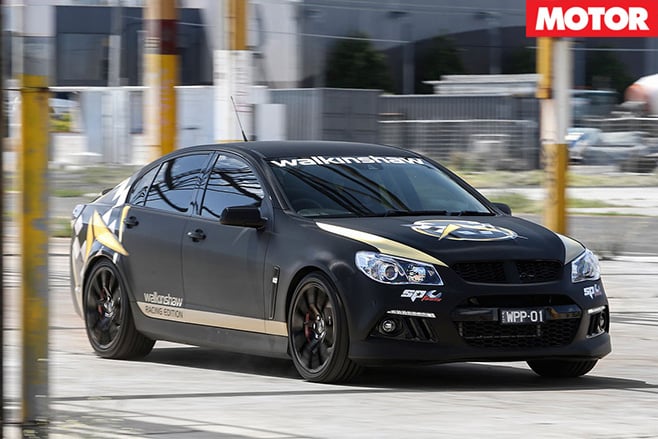
A 1984 Rover Vitesse might seem an unlikely place to find inspiration, apart for perhaps a trip to the local wreckers or re-enacting an old episode of The Bill, but it’s that very vehicle that led to the creation of Walkinshaw Performance’s new 550kW/980Nm monster.
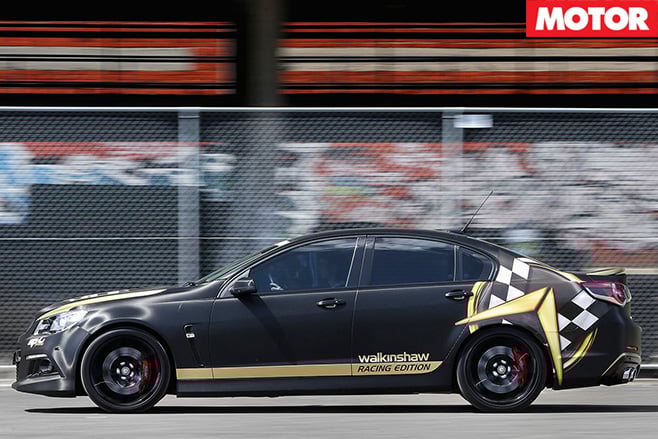
You see, the Walkinshaw Racing Edition was created to celebrate 30 years since Tom Walkinshaw Racing made its first foray into Australian motorsport, entering a Rover Vitesse in the James Hardie 1000.
While Walkinshaw himself, sharing a Jaguar XJ-S with John Goss, was taken out having stalled on the grid, Jeff Allam and Armin Hahne finished a fighting 12th outright and first in Group A, 11 laps behind the mighty Marlboro Commodore of Peter Brock and Larry Perkins.
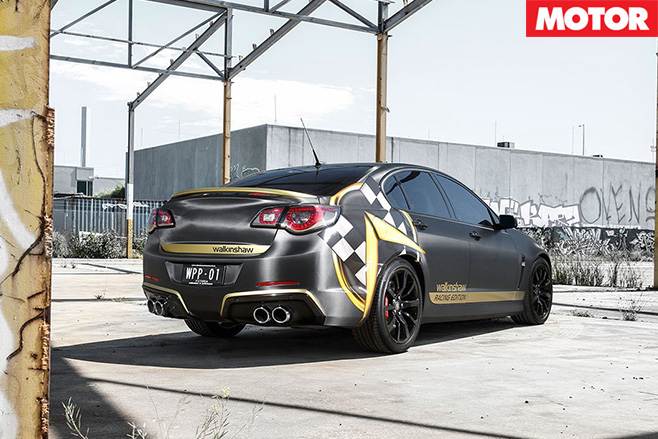
Walkinshaw Performance general manager Tony Harris hatched the idea of a special edition about 15 months ago, but was adamant it had to be a worthy tribute. “We didn’t want it to use our existing product range, it had to be something special – we didn’t want a sticker pack.”
While the resultant Walkinshaw Racing Edition does come with a full set of decals, it’s what’s under the bonnet that’s of greater interest. When factory-fettled HSVs come packing 430kW/740Nm, it’s tough for the aftermarket to produce a set of headline numbers, but 500kW/800Nm guarantees a second take. And that’s just the baby version, based on the 6.0-litre V8 found in the VE/VF Commodore SS.
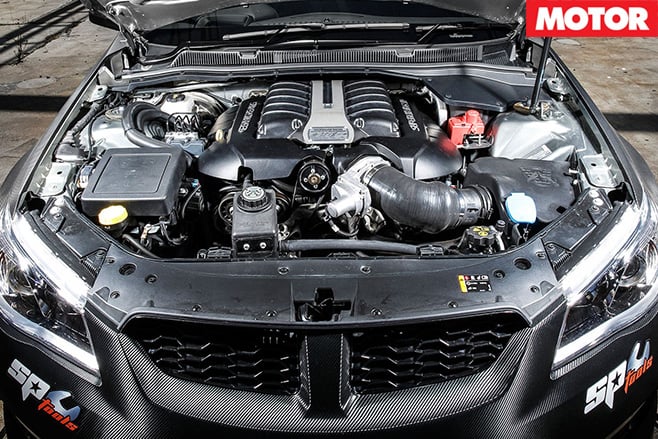
Forget V8 Supercars, those numbers make Walkinshaw’s latest hero more powerful than the most powerful production car currently on sale in Australia, outpunching the Ferrari F12’s 545kW and landing within spitting distance of the 1000Nm produced by AMG’s 6.0-litre twin-turbo V12 found in its ‘65’ models.
Unsurprisingly, extracting this level of output from a humble GM powerplant requires a bit of modification, though not as much as you might expect. Sitting atop the engine is Walkinshaw’s WPP 230 supercharger, each individually numbered and signed by Walkinshaw Racing’s four V8 Supercar drivers – Garth Tander, James Courtney, Tim Slade and Nick Percat – for that extra-special touch.
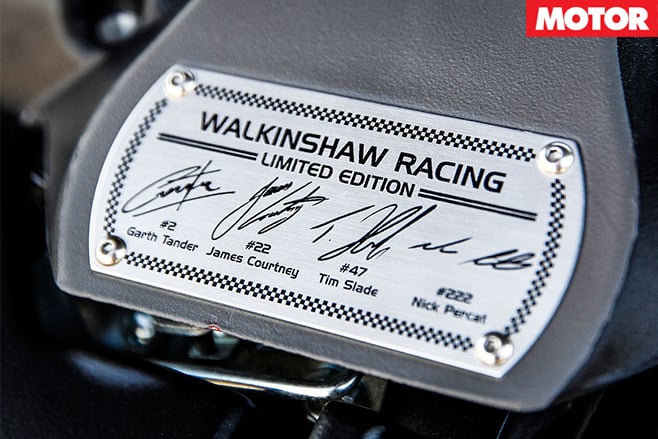
The bottom end remains standard, but Walkinshaw upgrades the valve gear and installs a different camshaft, as well as ceramic-coated headers and a cat-back exhaust. With everything supplied, fitted and tuned you’re looking at $24,490.
For such a serious outlay you’d want serious performance. We’ve tested a lot of tuner cars over the years that have claimed big numbers but haven’t been much faster than the stock examples, which illustrates two things: the law of diminishing returns (ie, you need lots more power to go a little bit faster), and that all the power in the world means nothing if you can’t translate it into forward motion.
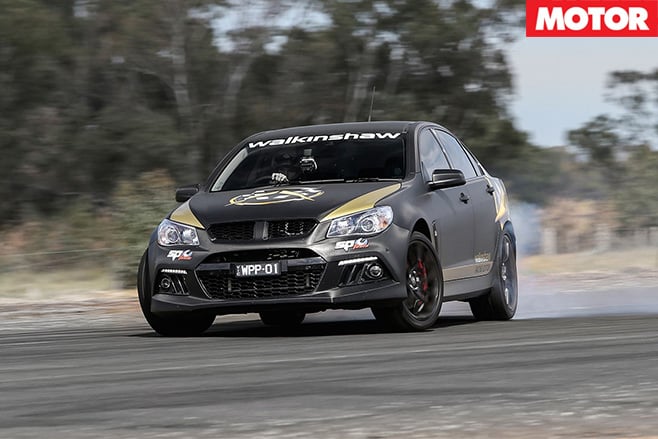
No such problems here, WPP01 nailing 0-100km/h in 4.09sec and a 12.08sec quarter at 195.19km/h. Want to go hunting M5s or E63s? Here’s your car. And it’s dead easy: find a clean bit of tarmac, floor the throttle and it just hooks up and reels in the horizon.
A good surface and good rubber are key; as soon as traction is lost that mammoth torque just turns the 275/35 R20 rear Continentals into very expensive clouds. It’s strong from idle, but it’s the top-end ferocity that sets it apart from any of the factory efforts. It makes a wicked noise, too, like it’s ripping the air apart in anger.
“It doesn’t have to be OE (original equipment spec), but we’re not about compromising the integrity of what is already a great product,” says Harris. “There are people who want to go to the extreme with their vehicles, [but] they’re probably not … our target market.”
Remove the carbonfibre wrap and only the slightly feral exhaust note would hint that all is not stock in WPP01. The power delivery is smooth and tractable and, incredibly, on a highway cruise fuel economy is no different from the standard product. The MOTOR crew drove WPP01’s sister car, the 500kW/800Nm SS, from Melbourne to Sydney and achieved 700km from a tank with ease.
That is, of course, exactly what it is, but it’s remarkable that the base car should handle a 70 per cent increase in power so easily. “I think it’s testament to the engineering that’s gone into the base car,” Harris says. “We’ve got to give credit to the engineers who designed [the Clubsport], because it’s a fantastic vehicle that lends itself to the right sort of performance upgrades.”
All of Walkinshaw’s upgrades are backed by a warranty that begins on fitment and lasts until 36 months or 100,000km from when the vehicle was first registered. Harris dismisses the notion that adding extra power to standard componentry jeopardises long-term reliability, stating that there are now around 600 Walkinshaw-tuned vehicles around the country of varying outputs but “we’ve never had a genuine, warrantable failure.
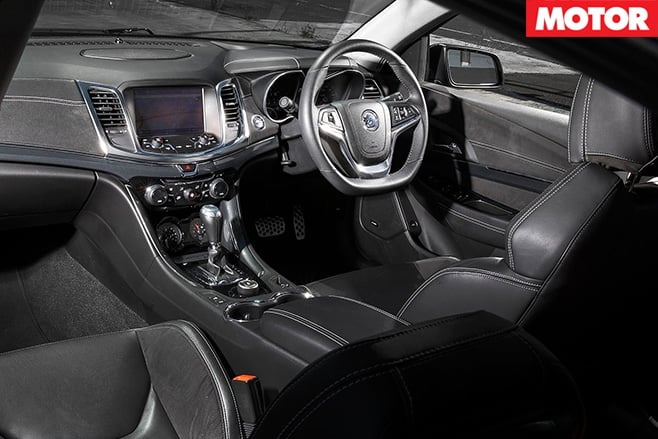
That said, while the standard cars do handle the extra power remarkably well, some chassis upgrades wouldn’t go astray when dealing with cars this fast.
If you’re spending the best part of $25K on the engine, an extra $4990 for brakes seems like a good investment.
Suspension, too, could do with some sorting. There’s nothing wrong with the chassis in a VF Commodore or Gen-F Clubsport – the opposite, in fact – but with the extra power you’re often travelling faster and asking more of the tyres than you would in the standard car, so replacing the stock suspension with something with a little more finesse and control certainly wouldn’t hurt.
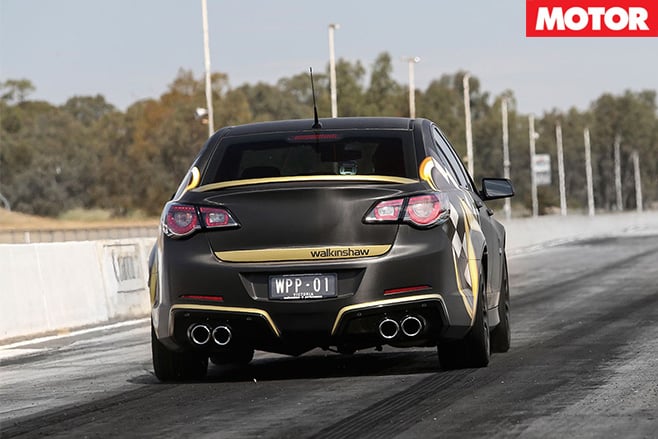
Makes sense if you think about it. Any buyer looking for a supercharged sedan has probably already bought a GTS, but those enthusiasts looking for GTS power (or more) in a less traditional package have pounced on the opportunity. A 550kW Grange, anyone?
The Walkinshaw Racing Edition might be sold out, but it’s a reminder that as our local product improves, so too do the aftermarket variants that use them as a base.
We can only hope that whatever replaces the Commodore and Falcon post-2017 allows similar freedoms for tuners to push the boundaries, but you can guarantee they’ll aim to improve it no matter what. After all, look what some managed with a 1984 Rover Vitesse.
So, seventh place for the heir to one of the world’s most iconic driver’s-car heritages.
Dispatched by a VW hatchback, a French front-driver and a Japanese device a third its price. Ouch. No other PCOTY entrant copped as much mid- and post-match discussion as BMW’s M4, here in rare-as-hen’s-teeth conventional manual form.
All the judges agreed the M4 is lacking, despite the across-the-board, on-paper ‘improvements’ that suggest it should raise the M-car game to a new plateau.
One theory is that in engineering a faster machine, the lab coats in Munich forgot to give the new-gen, mid-sized M coupe a soul. Or perhaps they failed to ensure it retained the driver interaction its legendary (and, in E46 form, PCOTY-winning) forebears had as a sort of core brief.
Whatever the case, the stinger is that the judging collective conceded they’d prefer driving either of the two previous (M3) generations. In fact, everyone felt that, regardless of how quick it was in present company, the M4 was actually stumbling over its own lofty legacy.
Thing is, the M4 was certainly fast. But it was conditionally fast. How so? In the hands of the surgically clean Luffy it pulled a 1:36.1sec blinder around Winton, second-quickest outright.
That’s despite the fact the Bimmer was only sixth-quickest in the sprint to 100km/h (4.82sec) and 400m (12.83sec) and plying what was, at 317kW and 550Nm, much less output than the 911 Turbo, Jag, GTS Maloo and RS7.
The M4 certainly has formidable chassis talent then, but in the hands of more moderate driving talent and thrown onto a twisty country road or asked to shimmy its rump a little, the coupe gets very taily and loses corner exit drive with little right-foot provocation. It’s a snappy chassis, a little spooky even, and constantly keeping lines tidy is more a chore than actual enjoyment.
The engine drew much criticism. Yes, there’s more torque than old the V8, but its vibe is weird and, without the advantage of the DCT’s mid-corner twin-clutch gear-shifting, it’s easily caught off the boil.
“Weird harmonics,” Morley said of the 3.0-litre’s character, or lack thereof. There was once a time when an M car’s (very-special-issue) engine was its soul. And it’s soul, beyond anything, that the M4 lacks.
Then there’s BMW overreliance on finding the suitable drive mode for any task at hand: a boring and laborious process that forced Luffy to abort his hot lap until the car was reprogrammed in pit lane.
On road, once you cracked the suitable drive mode Da Vinci code, its body control is a touch soft-edged, its steering a little doughy and its front-end isn’t as crystal clear as, well, an M car should be.
All of which explains why the second-fastest track machine manages just seventh outright. Its real enemy wasn’t sharing the PCOTY pit lane. Instead, it was the enemy within.
FROM pure electrics to people movers, hot hatches to hybrid SUVs, the 52nd Wheels Car of the Year is one of the most varied and toughest ever.
It’s a long wait until January 22 and the announcement of which of our 21 contenders for the coveted award takes the honours. In the meantime, here’s a chance for you to take a punt on who the winner will be. Will popular choice reflect the judges’ decision? There’s one way to find out…
Toyota FT-1
Detroit motor show It’s not often a Japanese brand upstages the American big three at their home motor show, but that’s exactly what Toyota did with the radical FT-1 at Detroit in January. Even better in an era where online leaks are more common than boring cars is that the radical FT-1 was completely unexpected. Hinting at an all new Supra sports car, the radical FT-1 drives the rear wheels with a petrol-electric drivetrain, something gamers could sample in the virtual world almost as soon as it clumsily exited its motor show box; it was made available as a download for Gran Turismo 6.
Kia GT4 Stinger
Detroit motor show As if one sexy import wasn’t enough, Kia decided to make a left-right punch to the traditional American muscle with its GT4 Stinger concept. The very orange rear-driven coupe has the on-road presence sports car buyers crave yet with clean lines that reinforce the design maturity of the Korean brand. Under the skin, too, the GT4 had the goods, with a 235kW four-cylinder turbo and 20-inch tyres. Think of it as Kia’s answer to the resurgence in affordable sports cars, with Toyota’s 86 (and its Subaru BRZ twin) at the top of the hit list.
Maserati Alfieri
Geneva motor show As Maserati was preparing to pop the Prosecco corks for its centenary celebrations it was also readying a styling and head-turning concept said to spruik the future look of its cars. As the brand begins expanding into more mainstream market segments – such as mid-sized sedans and SUVs – the Alfieri rammed home the point that Maserati can also build some of the world’s most elegant two-doors. The Alfieri has since been confirmed for production as a hero sports car to rival the likes of Porsche’s iconic 911.
Land Rover Discovery Vision
New York motor show Presence is something modern Land Rovers do well, from the Evoque to the big daddy Range Rover. Little wonder the Discovery Vision concept attracted its fair share of attention at its motor show debut in April. With clean, sleek SUV lines hinting at the new Discovery family (due in 2016) the Vision was as much about expanding and simplifying the Land Rover lineup as it was previewing a much needed fresh look. It also previewed some interesting technology, including gesture controls for functions such as the indicators, and Transparent Bonnet, which uses cameras to project an image on to the bonnet to show what you’re driving over.
Infiniti Q80
Paris motor show Sales might be disappointing but there’s no doubting Infiniti’s confidence and ambition. The sleek Q80 that was one of the stars of the Paris motor show was all about previewing a new sleek four-door to take on the luxury establishment by delivering “feminine elegance and muscular menace in equal measure”. Think Audi A7 and Mercedes CLS as prime rivals. Now that the Infiniti Performance Director, Sebastian Vettel, is driving Ferraris here’s hoping hard charging Aussie Daniel Ricciardo steps up to make the new breed of Infinitis more enticing.
Lamborghini Asterion
Paris motor show Show cars are typically about testing a new design language or showing off new technology, all with the aim of gathering feedback before rushing into something new. Not the Asterion. The chunky, almost retro-inspired two-door was all about having fun and showing what Lamborghini could do if emissions regulations forced it to revert to electric propulsion. The company says there are no plans to bring the muscular 669kW supercar – complete with V10 engine and electric motors that can drive the car on electricity alone for 50km – to showrooms, despite partial electric production cars from rivals such as Ferrari, McLaren and Porsche.
Mini Superleggera Vision
Concorso d’Eleganza Villa d’Este Not all Minis have to be cutesy and chunky, as the Superleggera Vision concept proved when it was shown off on the shores of Lake Como in Italy in May. The roadster was more MX-5 than practical city car, prompting speculation the German-owned British brand would be trying to crash the drop-top market dominated by the Mazda MX-5. Created in conjunction with Mini and Milan-based coach builder Touring Superleggera the one-off concept looks light and agile enough to take advantage of the latest generation of three- and four-cylinder turbocharged engines.
Toyota Sleeper Camry
SEMA show Camrys are decidedly unsexy, uninspiring and unfast. Most of the time at least. The Sleeper Camry shown at the Speciality Equipment Market Association show in Las Vegas in November adhered to the unsexy Camry cliché but bucked the boring trend by being able to cut a quarter mile in less than 10 seconds. A modified body looks for all the world like a fleet pack Camry, right down to the factory-inspired alloy wheels. But flip the lid and there’s a 630kW V8 drag engine built into a tubular frame. Needless to say it’s the first Camry we’d own!
Audi Allroad Shooting Brake
Detroit motor show As car makers continue to downsize and cater for growing demand for all things small it’s no surprise shrunken SUVs continue to make headlines. Except that the Allroad Shooting Brake is more like an overgrown TT than a baby soft-roader. The high riding two-door showed off the more angular new look of the since-revealed TT coupe as well as the Virtual Cockpit said to improve functionality within the driver display. Along with the TT Sportback and TT Offroad Concept from shows later in the year it also adds weight to expectations the TT family is set to grow.
Nissan Concept 2020 Vision Gran Turismo
Goodwood Festival of Speed It’s good to see a show car that is looking waaaaay into the future, like Nissan’s Concept Vision 2020. It’s difficult to see anything like it emerging from the often conservative Japanese brand, although there are elements you could see appearing on a future GT-R. Indeed Nissan admits it is one idea of how a future “high performance Nissan” could look. The PlayStation generation were the first to try the new supercar as a virtual download for the latest Gran Turismo game.
