
A Lexus owner is irate that he spent almost $114,000 on his luxury car only to find out the sat-nav was more than a year out of date and the manufacturer’s response was “to use Apple CarPlay or Android Auto instead”.
Wheels reader Cliff Anderson from Perth discovered the MY21 Lexus RX 350 Sports Luxury he purchased in June 2021 was fitted with a navigation system last updated in April 2020 – meaning the integrated maps were already 14 months out of date by the time he got the car.
Despite having repeatedly spoken to his Lexus dealer to try and get the system updated to the current version, Mr Anderson was told it was a common occurrence and they weren’t able to get a hold of the latest map as his request fell between updates in the company’s schedule.
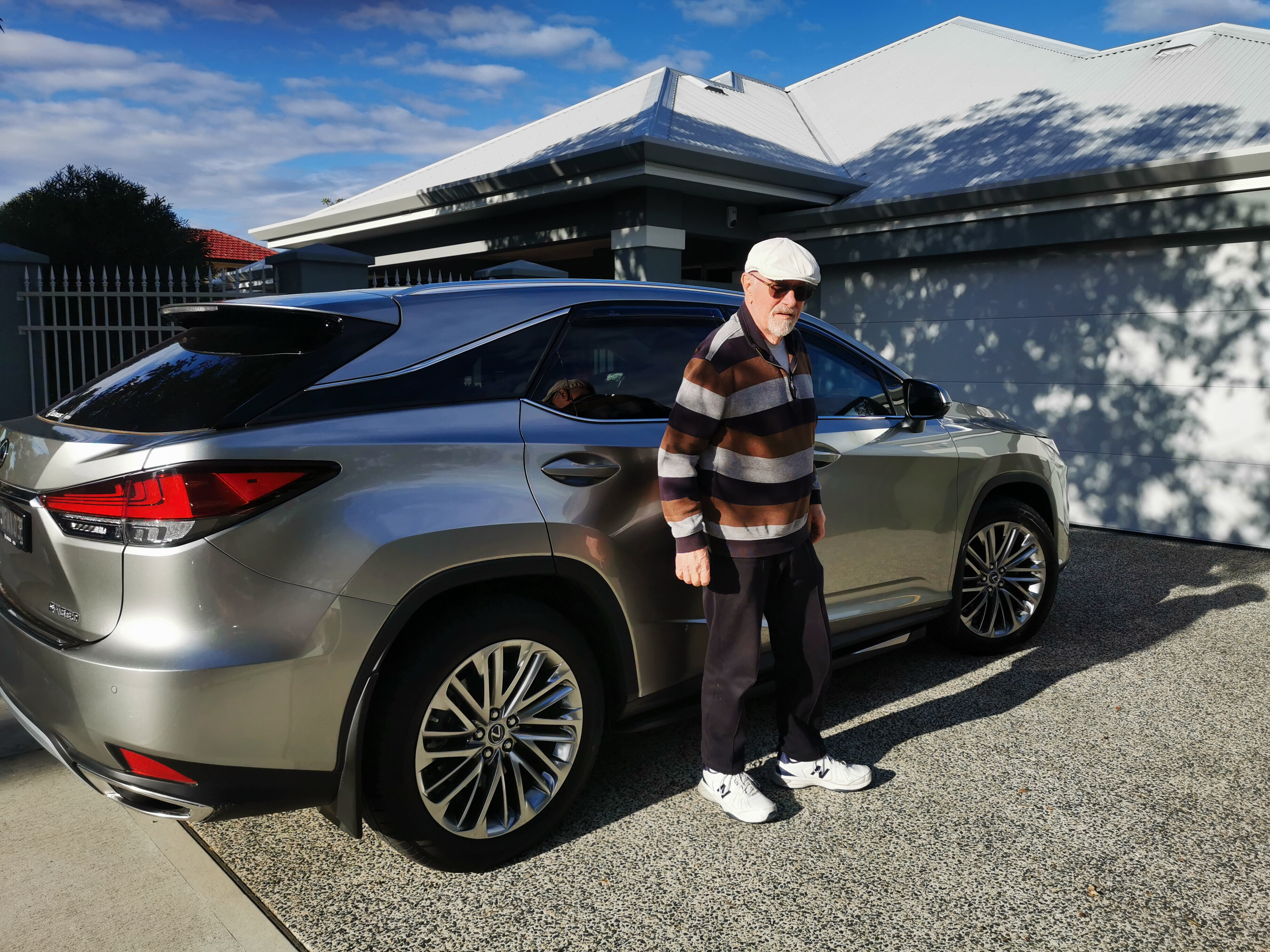
Mr Anderson told Wheels he feels it was an insult to be provided a car with an outdated map when it’s worth over $100,000.
“I just think it’s an insult to sell people a car and tell them that you’ve got free map updates for the first three years, but then I’d be lucky to even get one [correct] map update in three years,” he said.
“Everyone at the dealership here in Perth, the principal dealers – as well as the service managers, the head service manager and assistant – are on side, they’ve done as much as they can.
“I think this is unacceptable, but Lexus doesn’t seem to care.”
After exhausting his local options with the dealership, Mr Anderson took his fight to Lexus Australia directly – but instead of fixing the issue, the company told him to use a phone-mirroring system, such as Apple CarPlay or Android Auto, instead.

Emails seen by Wheels said: “Apple Maps and Google Maps can be accessed via Apple CarPlay and Android Auto, which is available on your RX 350 and allow the multimedia unit to be used as a display.”
However, the firm also told the 78-year-old that despite map updates not necessarily aligning with vehicle build dates, he could take advantage of Lexus’s three-year free update offer for customers.
“We understand the genuine map process does mean the mapping released dates don’t align with vehicle build dates and, as such, Lexus does provide up to three years of free updates,” Lexus told Mr Anderson.
“This will ensure your vehicle has the most current map and can be installed to your vehicle by your Lexus dealer at no cost to you.”
But in June this year, when Mr Anderson booked his Lexus in for its 12-month service, the new map version was from April 2021 – again over a year out of date by the time it was uploaded to the car.

According to the Australian Automotive Dealer Association (AADA), situations like this leave dealers in the awkward position of having to deal with customers’ frustrations without any support from their parent manufacturer.
AADA CEO James Voortman believes franchises often get caught in the crossfire, and is calling for better support to resolve disputes more quickly for all involved.
“Dealers don’t want to be telling a customer multiple times that they can’t fix [a problem], leaving the customer without resolution,” Voortman told Wheels.
“Dealers hate it because they are the face of it – often they’d love to give a refund or replacement and then get indemnified.
“With the cost of pushing back against the manufacturer, they’re in a no-win situation – you’ve got an unhappy customer and they spend so much time trying to manage that. Sometimes they’ll just wear the cost of it.

“It doesn’t make for a great customer experience. It puts everyone under so much pressure because the culture in the industry isn’t great when you have to tow the company line.
“This is why we need more legislation and a tribunal where cases can be dealt with quickly. It’s cut and dry – give the customer their maps or money back. We’ll see it more in the automotive industry than anywhere else because it’s the most emotive purchase you can make, and it’s often the most anyone will spend outside of buying a house.”
Despite the navigation issues, Mr Anderson says he’s overall happy with his purchase.
“Coming from a Calais V8, I am impressed with the pick up available on the Lexus via gearing. More than adequate and I am totally impressed with the camera’s view when parking,” he said.
“The solid feel, fit out and all other goodies including HUD are first class. Overall I’m pleased with my choice.”
Wheels asked Lexus for an official comment, but the manufacturer declined the request.
For many petrolheads and German-brand purists, the impossible and unthinkable is happening. In Munich, BMW has already rolled out a brace of pure electric cars wearing the coveted M badge, Porsche has recently slapped the esteemed GTS performance moniker on the hind of its Taycan pure EV and now it’s the turn of Mercedes to follow suit with the 2022 Mercedes-AMG EQS 53 4Matic tested here.
In addition to the bellowing V8s, silky sixes and boost-brute four-cylinders, the AMG brand will now have a silent assassin in its ranks – almost, but more about that later.
Launching in Australia ahead of the Benz EQS 450 version, the EQS 53 luxury sedan is the model that marks Mercedes-AMG’s foray into the bright electric realm – a significant burden to carry. But has the German giant chosen the right vehicle for arguably the most significant milestone in all of Affalterbach’s history?
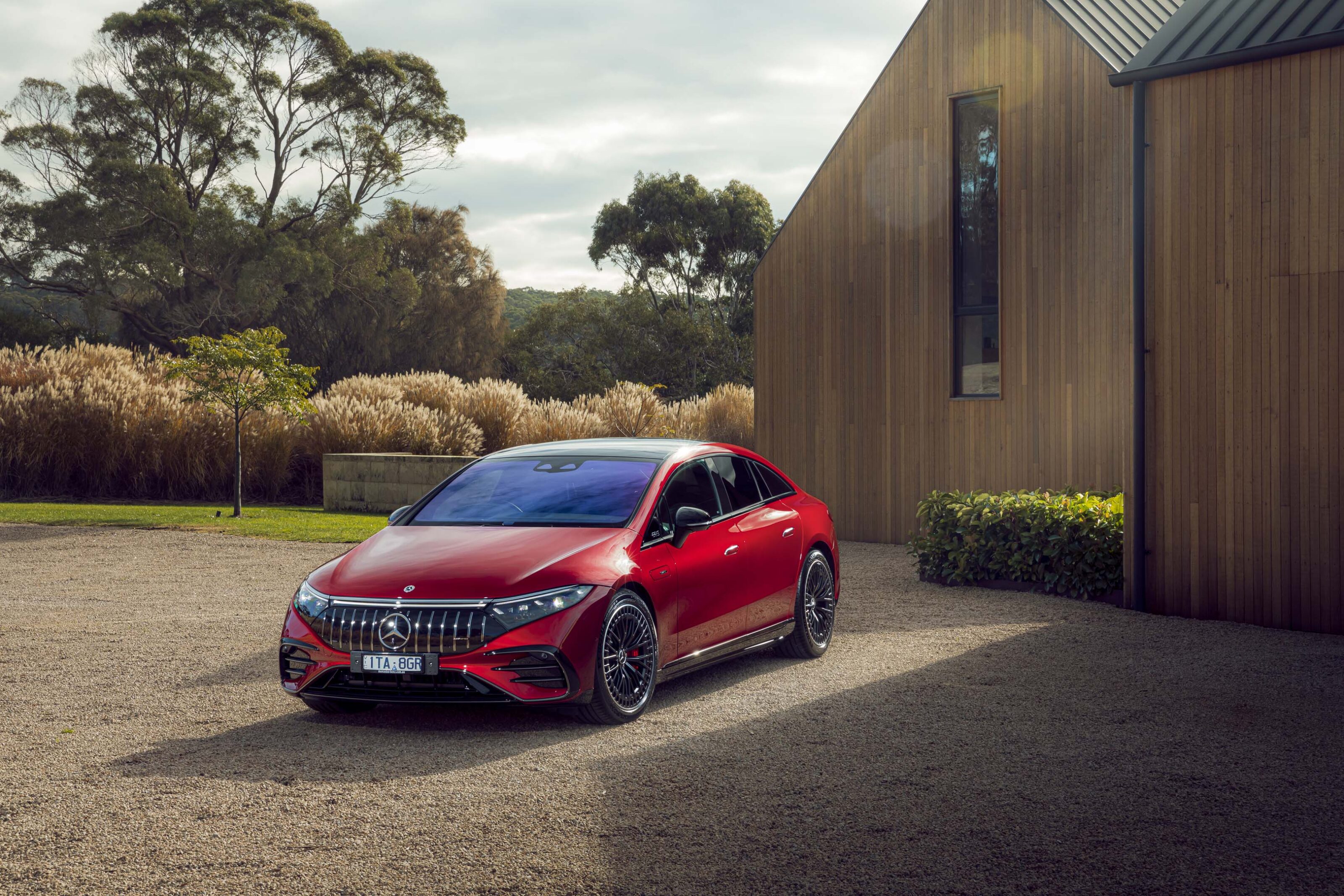
As if that wasn’t enough of a responsibility, the EQS also rolls out in the shadow of its S-Class sibling – a car that for five decades has represented the pinnacle of luxury, innovation of opulence for the three-pointed star.
Is it time for a technological upstart to take the mantle as the flagship? or do the petrol-powered (and gently hybridised) S-Class options still represent the forefront of the Mercedes line-up?
Let’s start with a close analysis of the boot badge itself. Introduced on the boot of the E-Class in 2018, the 53 denotes not the fire-breathing monster that is the 63 (or even 65), but the intercostal variant that offers a little more choice within the AMG family and fills a void between the AMG hero and the top end of the Mercedes-Benz line-up.
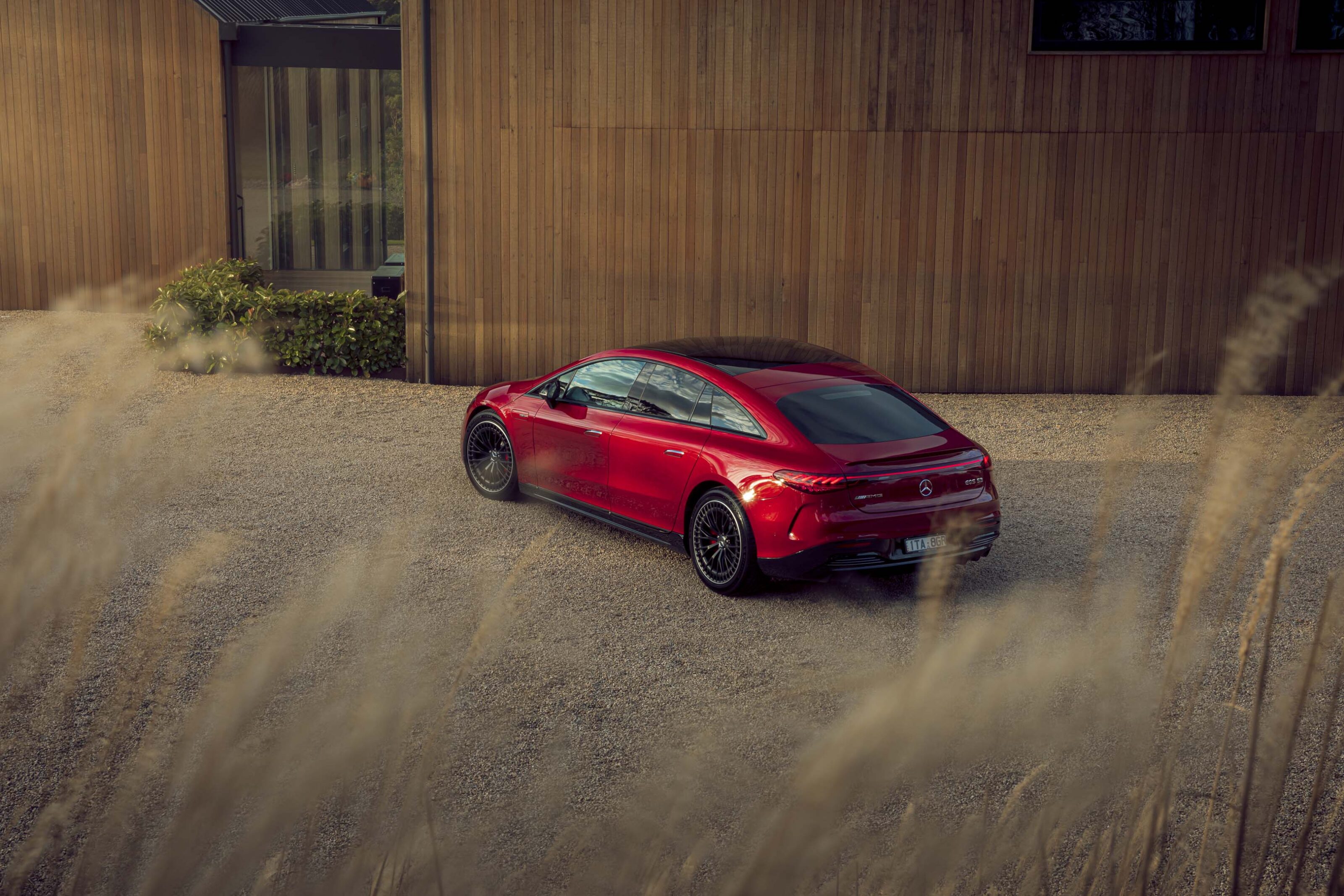
Despite that, the EQS 53 arrives with some spectacular performance statistics to its name. Drawing power from a 107.8kWh lithium-ion battery, an electric motor on each axle (for 4Matic all-wheel drive) produces a combined output of 484kW and 950Nm – significantly more than the current range-topping Mercedes-Benz S-Class.
Spend another $7690 however, and AMG will bolt on extra battery cooling hardware and unleash more current for peak outputs of 560kW and 1020Nm. It’s only available under certain circumstances, including the correct battery state of charge and temperature, and only when Race Start is selected in Sport Plus driving mode, but it’s absolutely worth it.
With the brake pinned and accelerator flat to the floor, the EQS 53 begins the most theatrical and sensational launch control routine I’ve ever experienced. The cabin is filled with the rising tone of something otherworldly, bass generators vibrate the seats, the seatbelts tighten against braced pectorals and the dash erupts into a carnival of graphical hype.
The whole incredible performance should be distracting but as soon as the left foot sidesteps the brake, any amusement or misdirection is immediately forgotten, replaced by a sole focus on intense acceleration. Mercedes claims a zero to 100km/h dash of 3.4 seconds – the same as an AMG E63 S.
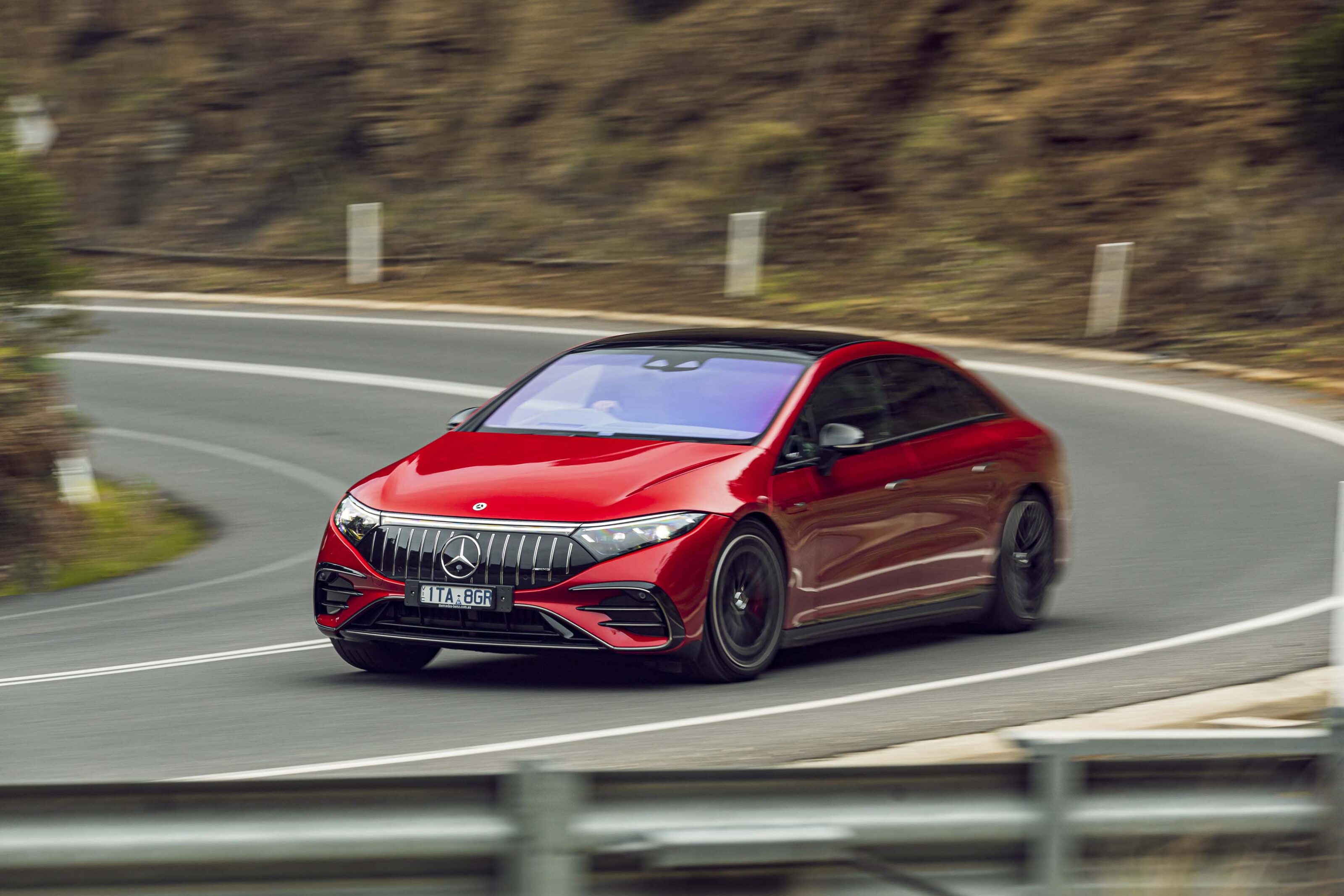
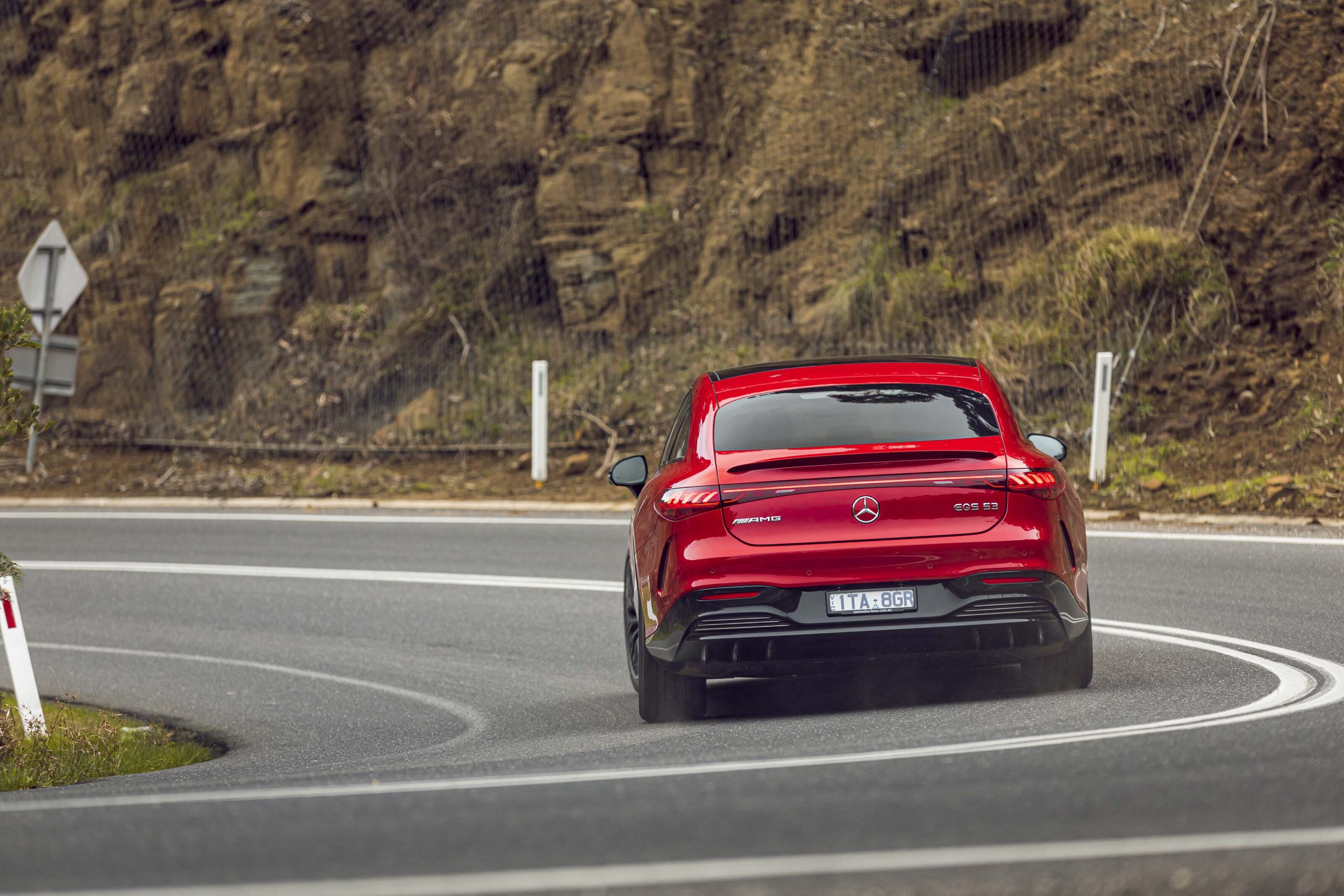
For most cars, a party piece like this would be more than enough but the EQS 53 has a few. Keep your foot buried and the 2.6-tonne limo carves impossible pace through corners as well.
Adaptive air suspension and adaptive dampers do an excellent job of hiding the heft but a standard rear-steering axle that can dial in as much as nine degrees of lock is the most transformative element.
The 53 turns into corners with an unexpected urgency and the tail follows with the obedience of a labrador. There’s little body roll to speak of – especially in Sport or Sport Plus modes – and the steering is tuned with a similar balance of feedback and comfort.
It’s in the more sedate modes that the EQS really shines, though. With minimal ‘natural’ noise coming from the electric drivetrain, the AMG whispers along open roads with little noise transmitted through its 21-inch or optional 22-inch wheels and with a drag coefficient of just 0.23, wind noise is also completely absent.
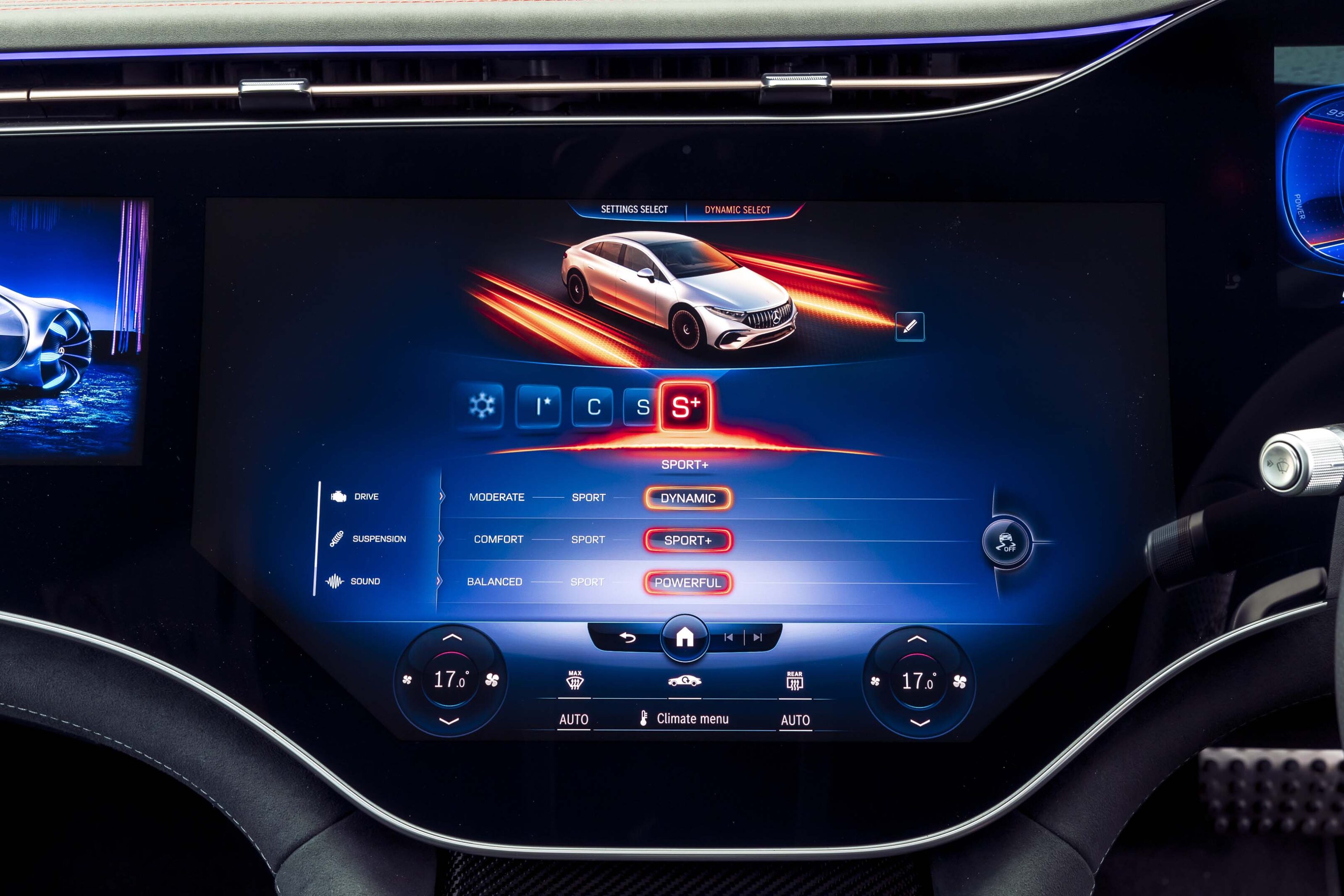
For those who find the near silence a little unsettling, there are plenty of options to dial back in some of the synthetic soundtrack you get in Race Start. For a car that makes no real sound of its own, the EQS 53 is easily the chattiest EV I’ve driven.
With three levels to choose from – Balanced, Sport and Powerful – occupants can experience an intriguing variety of noises all created synthetically and piped through the interior speakers as well as to the exterior of the vehicle.
The big Merc has a report on the outside when locking and unlocking, it’ll make another cool sound when the start button is pressed, and there’s an intricate soundtrack for acceleration and braking.
With such a rich heritage of engine noise, it should come as no surprise that the acceleration report has what sounds like just a little combustion rumble woven in, while the regeneration report is smooth and satisfying and bolsters the good feeling from recapturing energy that would ordinarily be burnt as heat in the brakes.
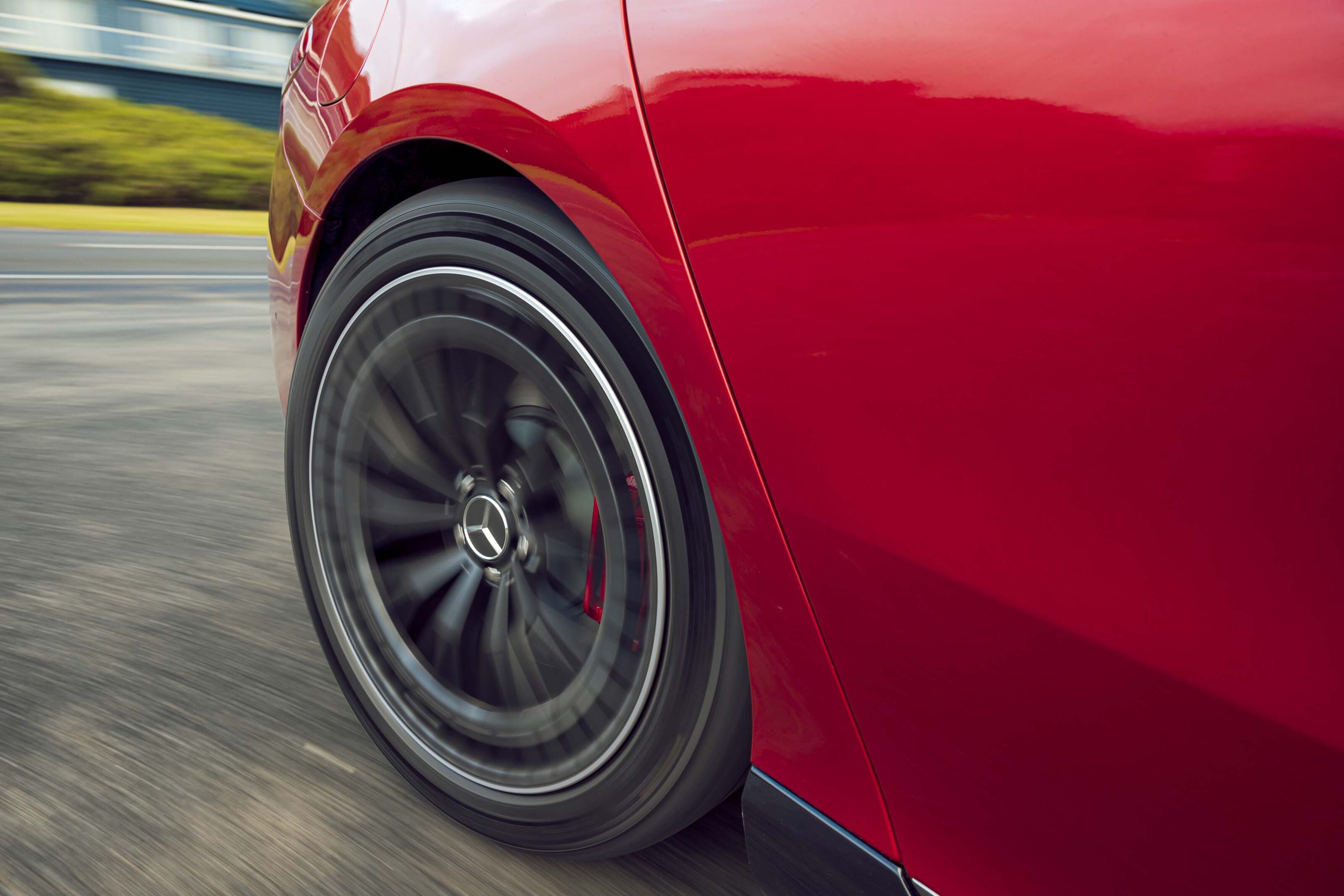
Speaking of which, the EQS 53 gets four-piston fixed calipers at the front and single-piston sliders at the back, but with up to 300kW of regenerative braking available, the traditional hydraulic system rarely comes into play, despite the car’s mass. Not once did we feel the need to blow another $9990 for the carbon-ceramic, six-piston set-up.
The official ADR range claim is a very respectable 587km but innovative battery technology and highly efficient power recuperation mean the average energy consumption of about 23kWh/100km is believable – even though during our very enthusiastic test the reported figure jumped into the 30s.
Perhaps the only downside to the EQS powertrain comes when it’s time to plug in. Its 400-volt system offers up to a maximum charging rate of 200kW, which is relatively slow, especially when you look over the fence and see what emerging 800-volt systems are offering.
Thanks to clever battery technology and AMG-specific power management, it’s still possible to force in 300km-worth of range in 19 minutes, but that is still beaten by rival systems including Porsche’s Taycan and Tesla.
One sweetener is three years of free Chargefox public topping-up included in the sale but most EQS owners will likely apply the smartphone charging regime analogy of plugging in at night and waking up to a full battery at home.
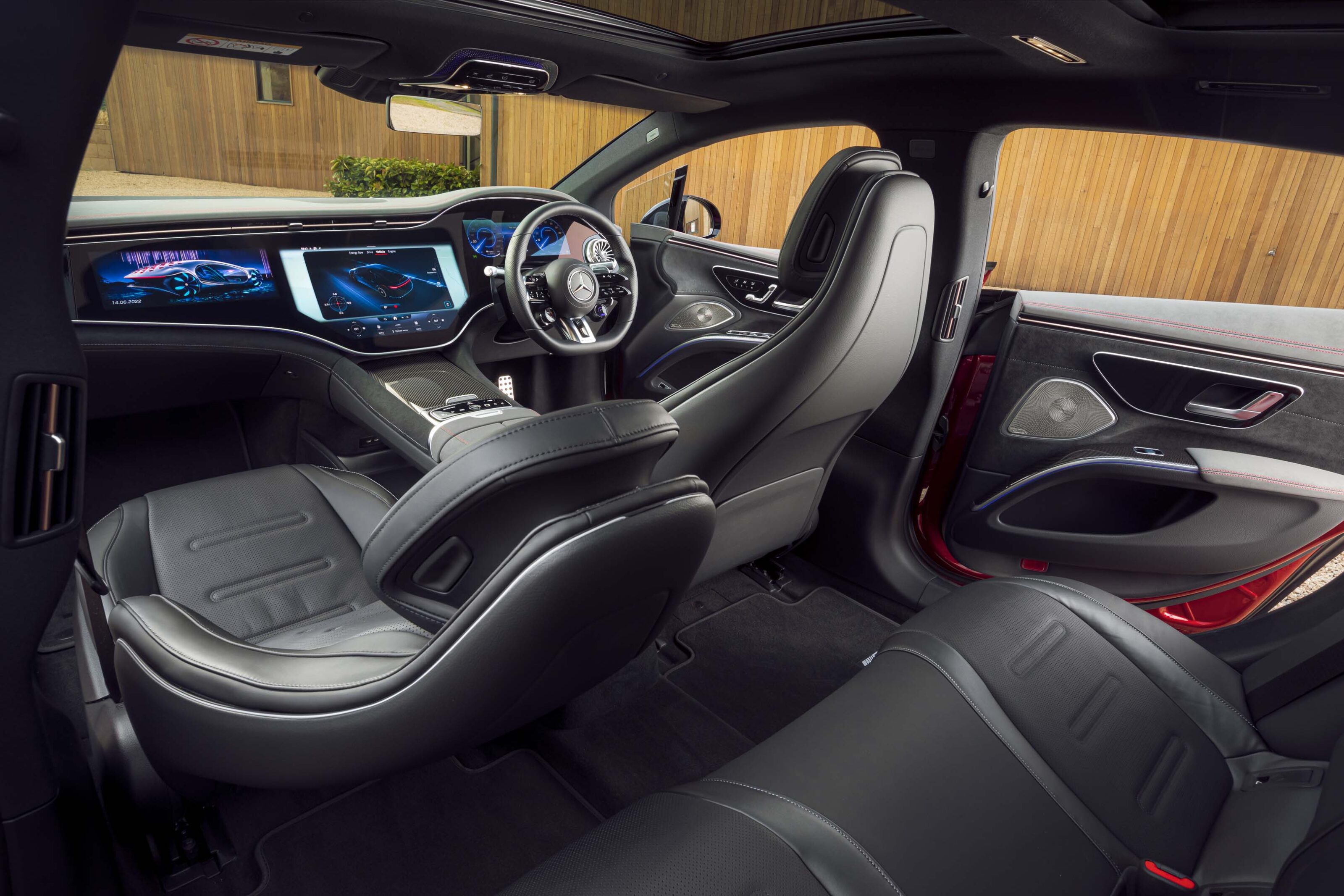
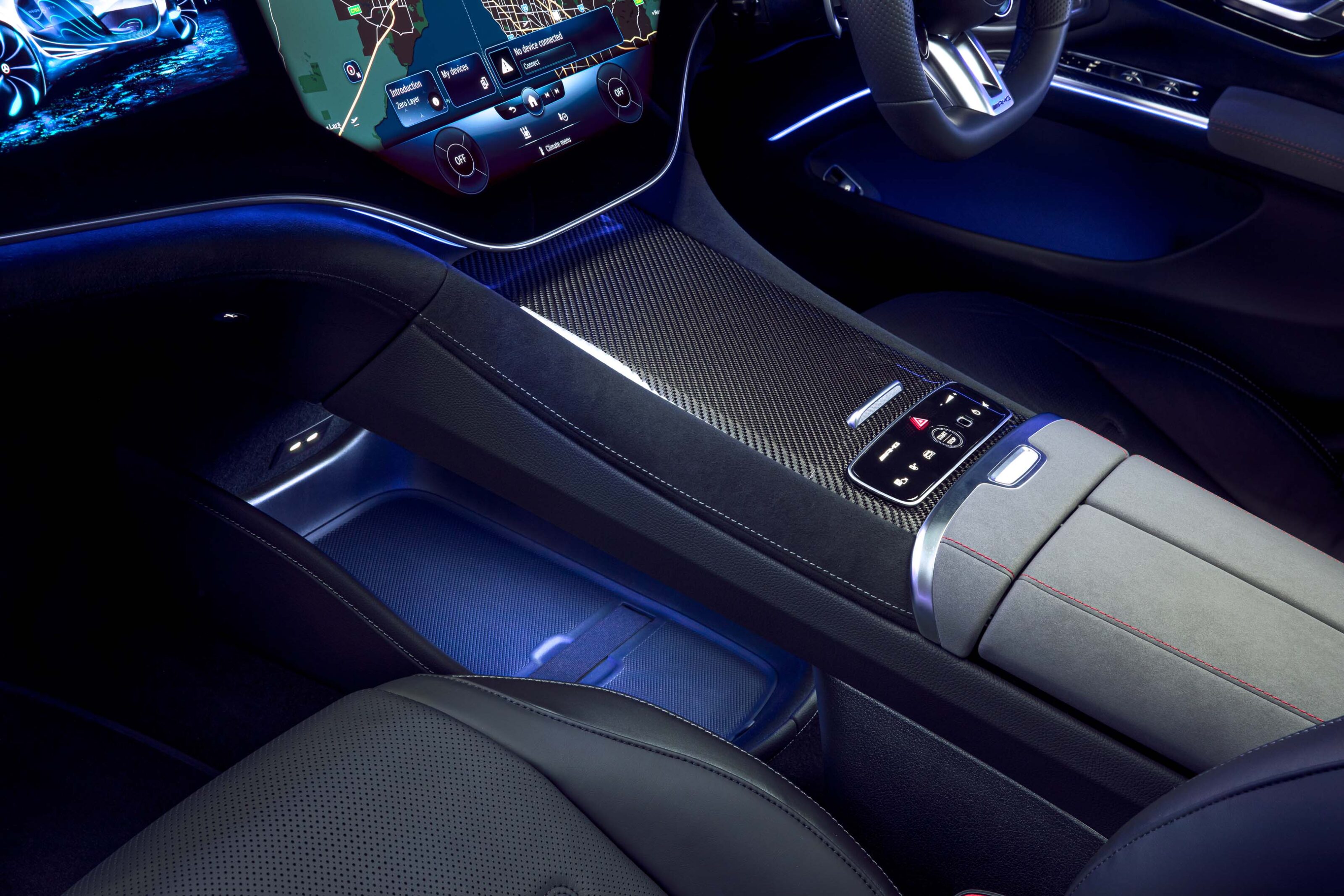
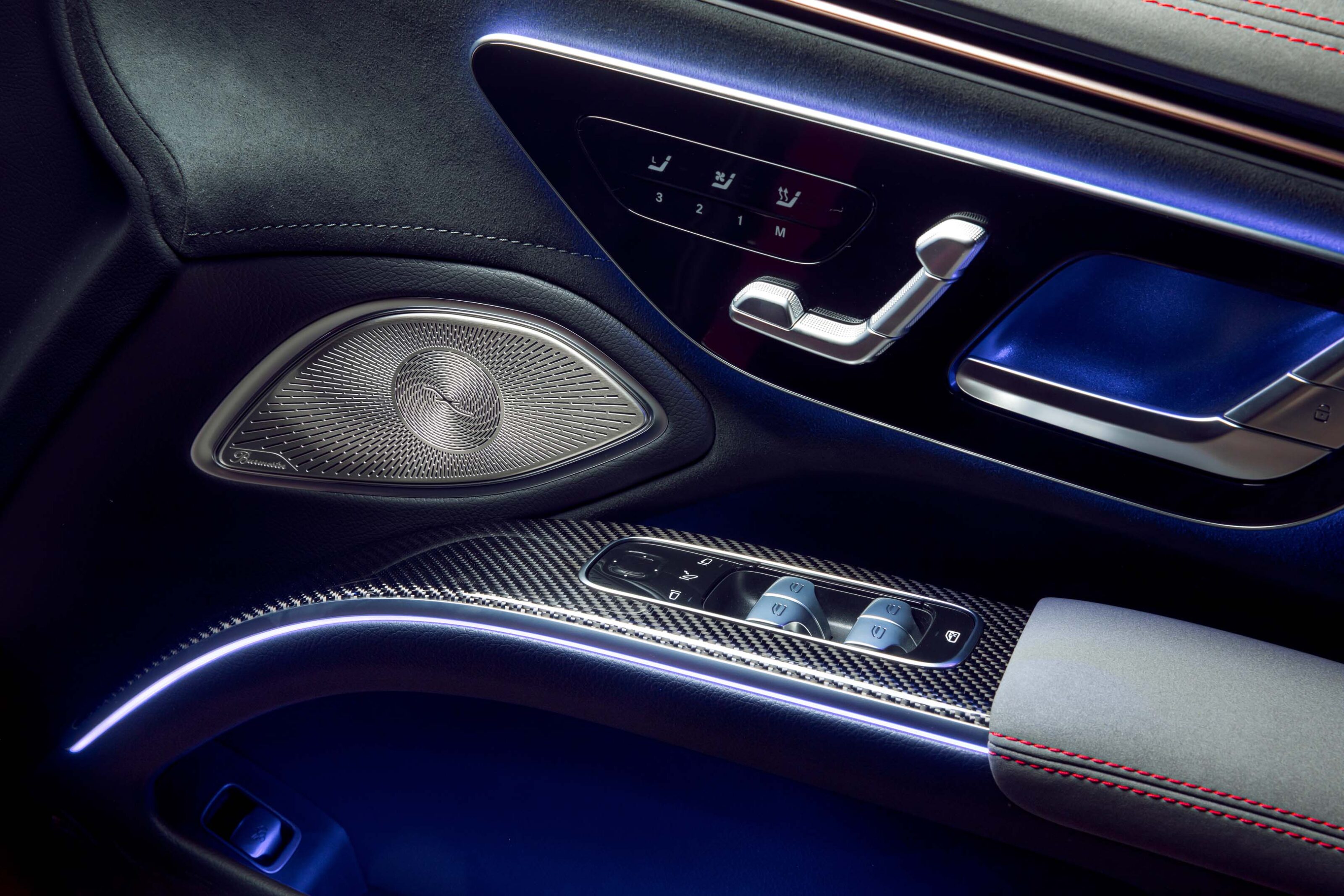
Standard AMG sports seats finished in Artico synthetic leather are supportive and comfortable and impart just enough AMG-ness without being punishing like the buckets in a C63 S, while the ‘Microcut’ microfibre material covering the centre armrest and door trims brings more sports appeal with contrasting red stitching.
But easily the most memorable element of the EQS 53’s interior would be its completely appropriately named Hyperscreen. This vast slab of glass that spans more than a metre hides three high-resolution monitors including the central screen that measures a whopping 25 inches.
Such is the area of the main screen, navigation maps could almost be displayed at a scale of 1:1 and a brilliant, intuitive operating system allows numerous information windows to be presented simultaneously – imagine comparing a decent-sized smartphone to a two-screen home PC set-up and you have some idea of the comparison to most car infotainment systems.
Flanking the massive display are two further monitors measuring about 12 inches each – one for the driver’s instruments and another all for the front passenger. Unfortunately, in Australia, the latter cannot be used to show movies and streaming as it can in other markets but it’s still an uncommon premium touch that will make anyone in the passenger seat feel as special as the driver.
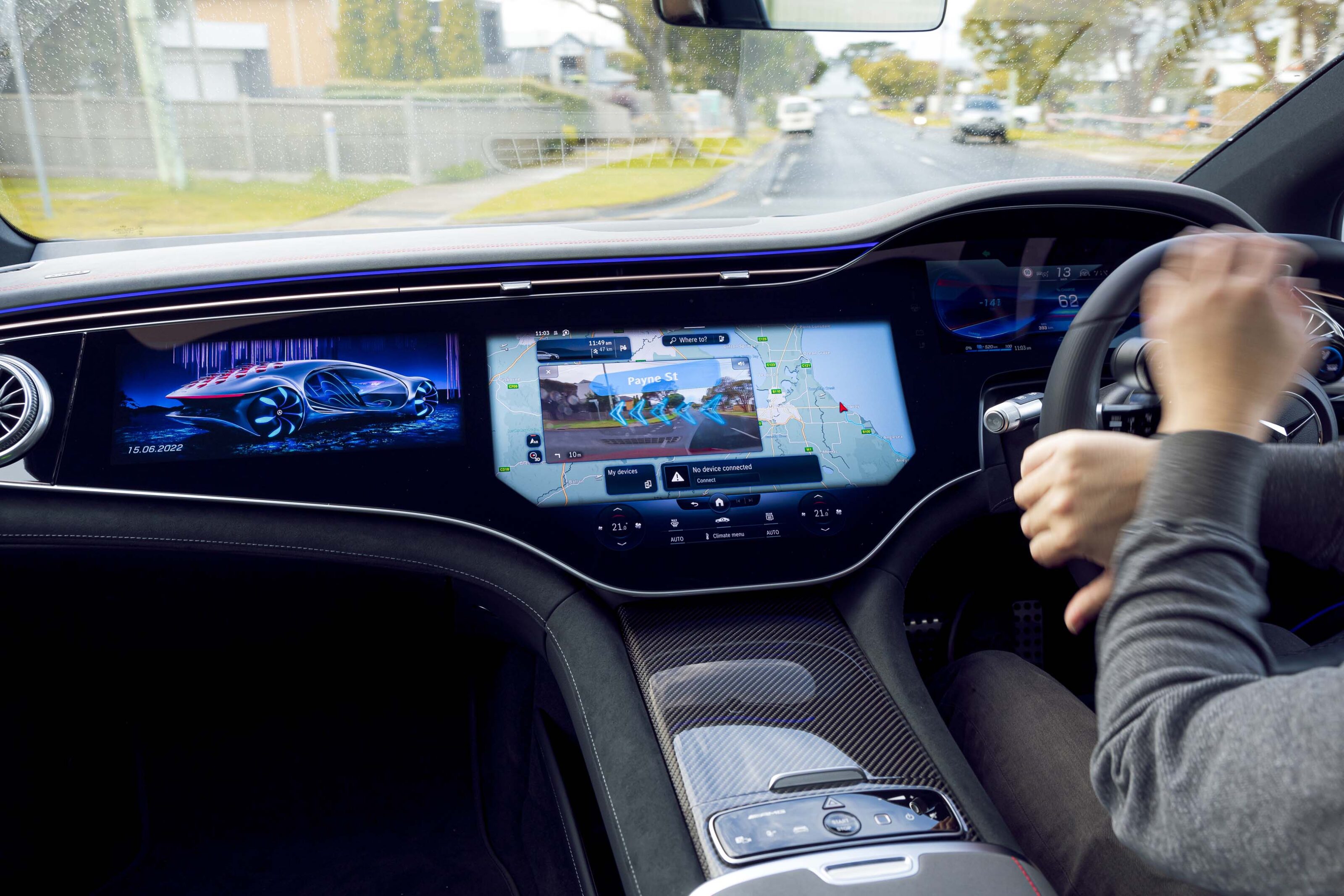
Mercedes’ excellent and almost eerie augmented navigation system works particularly well thanks to the new vast central screen but when optioned for $2690 to appear in the huge head-up display, it takes on a new and almost unbelievable level of functionality.
The EQS cabin is one eye-popping surprise after another. When the sun sets, the interior bursts into light with a web of pinstriped LED lighting that can be customised through countless colour combinations, including one special setting that’ll change according to driving style – a little like Mini’s LED cluster surround but amped up to 11.
Under hard acceleration the edge of the dashboard pulses red, cruising results in a pleasant flowing white, while regen turns the strip blue. There’s even light piped into the edges of the front seats for the complete Vegas-after-dark effect.
There is so much more to this pivotal car than it’s possible to explore in the relatively short time that was available with the EQS 53 at its local launch and I can’t wait to jump in for an extended drive in the near future. But this fleeting meeting has already highlighted an enormous amount of substance to the first EV from AMG.
And if you might imagine all that kit and tech comes at a price you’d be right, but not quite as much, measure for measure, as previous luxo AMG limos have commanded. The AMG EQS 53 starts from $328,400 before on-road costs, which is less than the current S-Class range-topping S580, $17,400 cheaper than the (albeit faster) Porsche Taycan Turbo S, and is likely to hover suspiciously close to the asking price of the incoming BMW i7.
Given this is a decidedly esoteric model, Mercedes isn’t expecting to sell many EQS examples, including the Benz-badged EQS 450 that’ll arrive in the fourth quarter of 2022. In fact, sales are expected to be less than the circa 200 registrations for the S-Class last year, but volumes and profits are not what this car is about by a long shot.
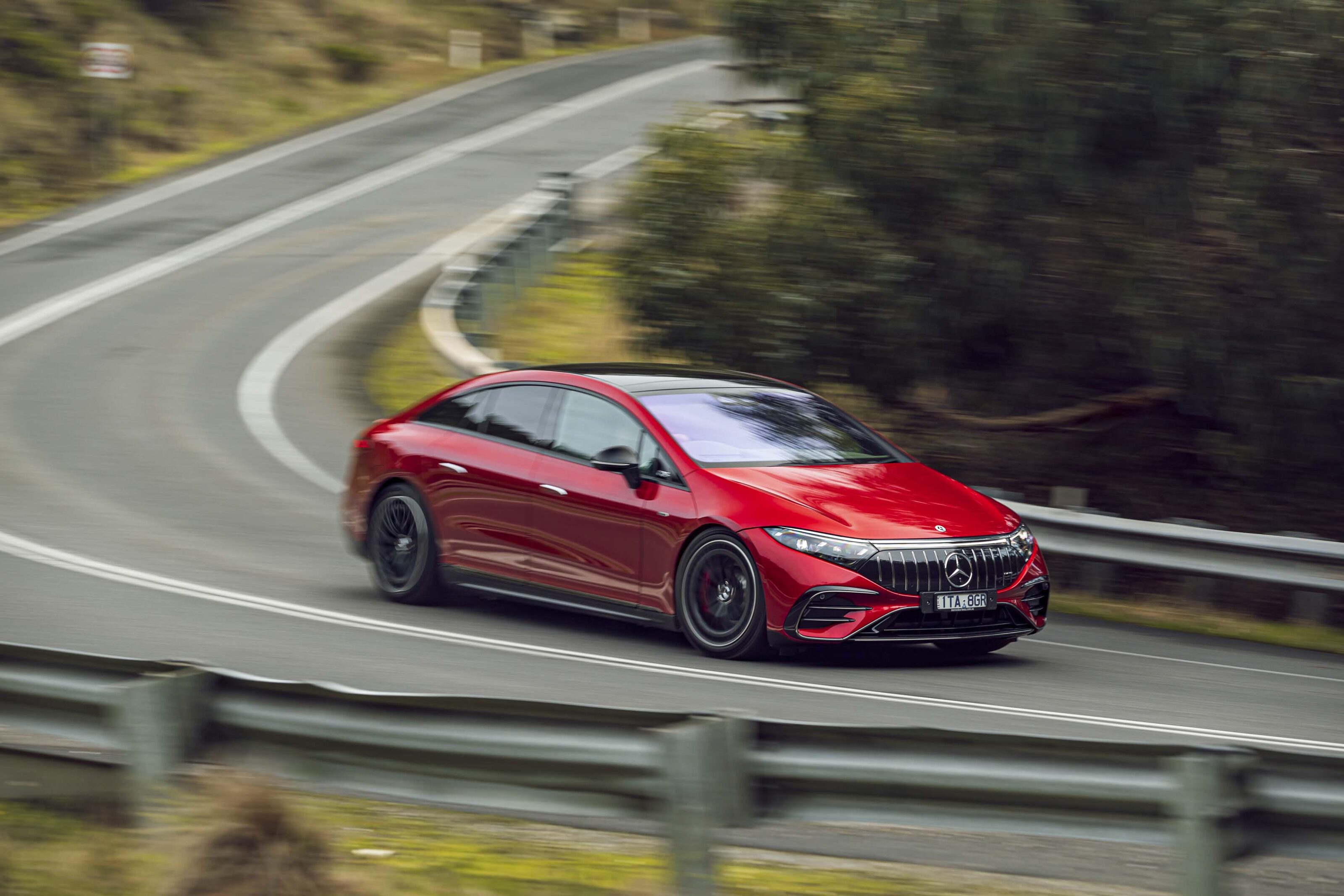
It doesn’t take long after boarding the EQS 53 to realise that the coveted AMG badge has not been hastily slapped on the rump of the first available three-pointer in a slightly desperate attempt to keep up with Mercedes-AMG’s arch-rivals.
There’s more performance and (zero-emissions) muscle available from the 53 badge than ever before, dynamics strike the perfect balance of comfort and agility, while the levels of luxury and equipment far exceed expectations.
If this is what Affalterbach can do with a 2.6-tonne five-door luxury limo, imagine what it’s going to achieve when it turns its attention to the rest of the electric Mercedes range.
A first spin in the first electric AMG not only categorically answers the question of whether it deserves the apple tree and camshaft coat of arms, but raises another.
After 50 years as the flagship of the Mercedes family, does the S-Class have to relinquish its title to a dazzling technological upstart?
2022 Mercedes-AMG EQS 53 4MATIC specifications
Snapshot
- Range Rover Velar to include new diesel and hybrid powertrains
- Prices up across the range
- Updated models to launch Q4 2022
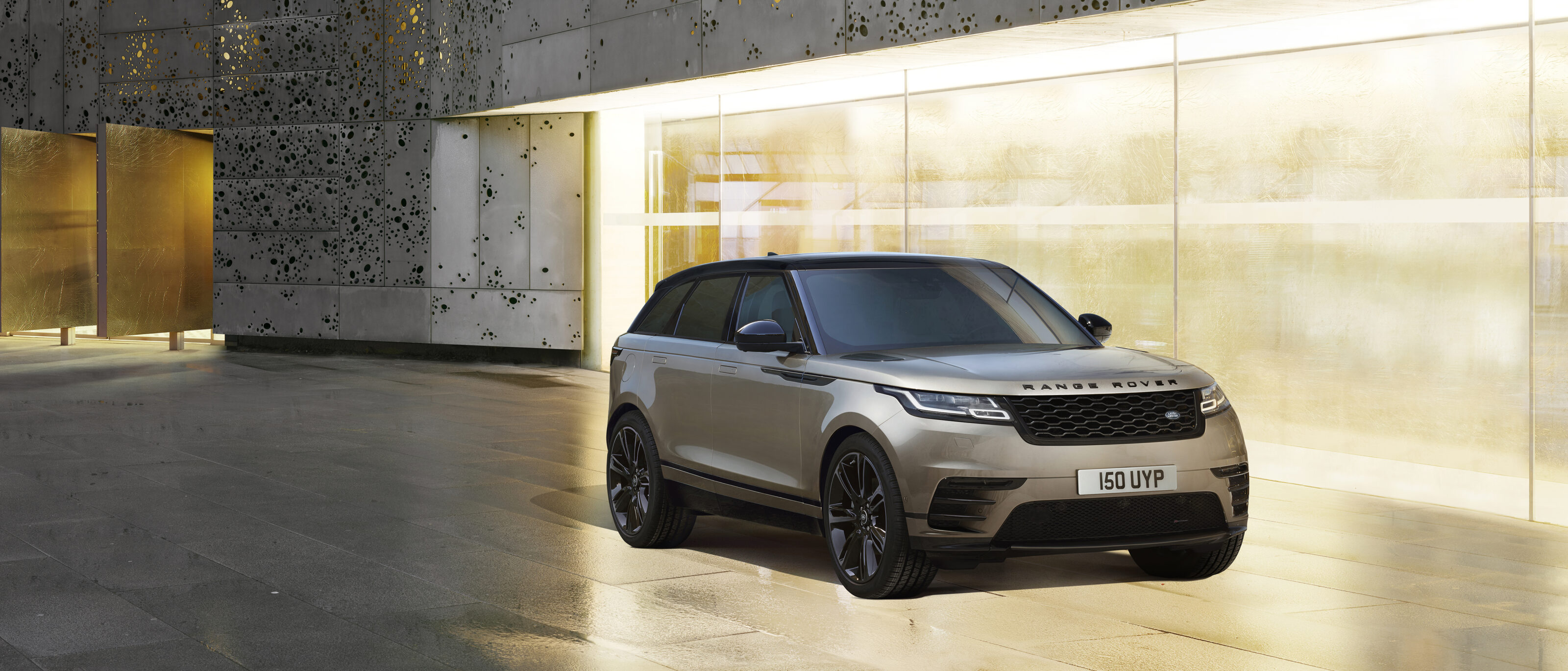
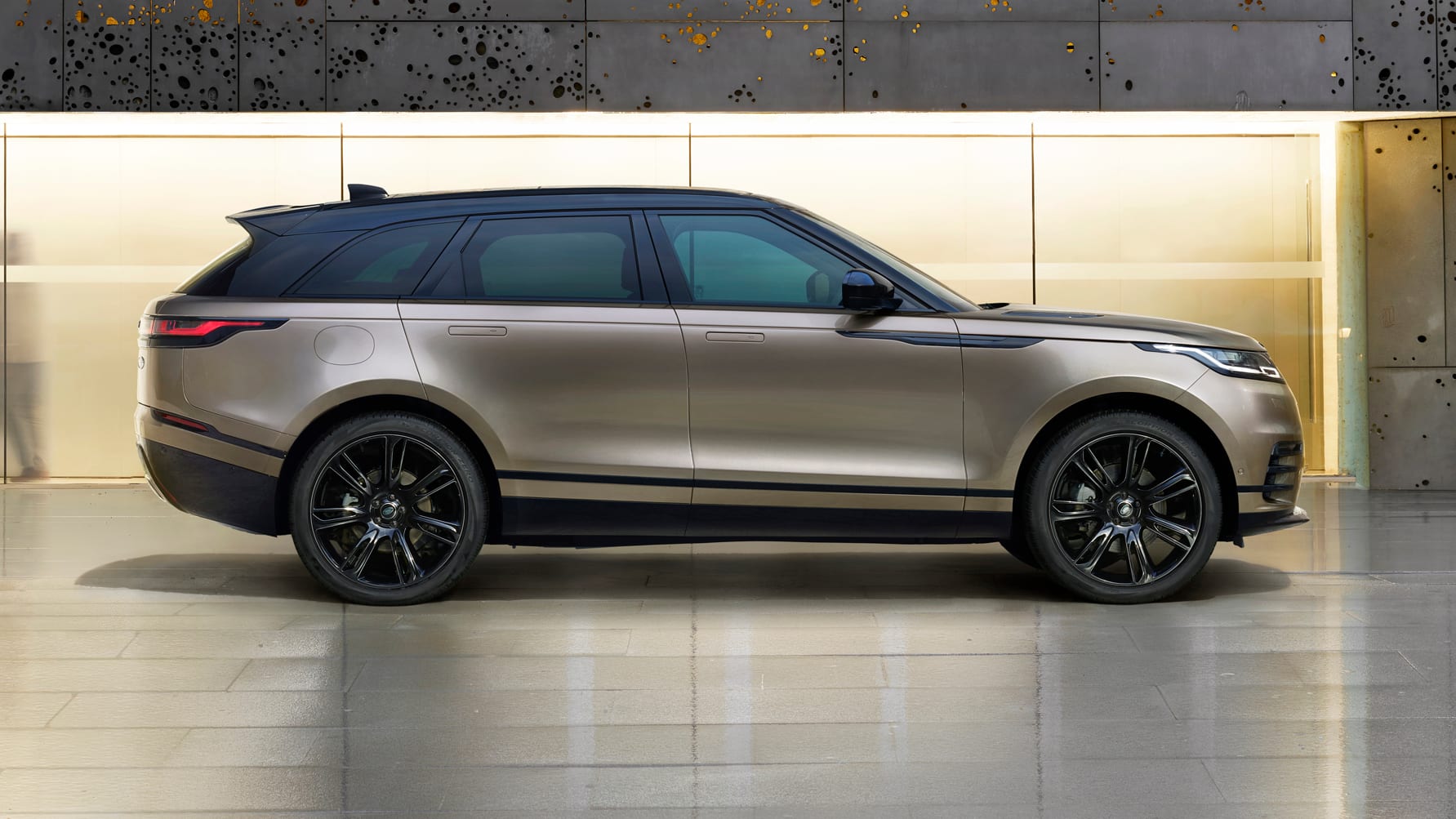
The updated 2023 Range Rover Velar is set to land in Australia during the fourth quarter of the year, with two new variants joining the line-up.
Already announced earlier this month, Jaguar Land Rover has confirmed the new Edition D300 and P400e variants of its Range Rover Velar will expand the luxury SUV’s range, with the latter bringing a plug-in hybrid (PHEV) powertrain to the Australian market for the first time in the model’s history.
The addition of the D300 now means the Velar is without its four-cylinder diesel offering, as the D200 is dropped for 2023 in favour of the limited-edition model.

Pricing
A price increase for the Range Rover Velar range this month showed JLR’s intentions of bringing the Edition D300 and P400e to Australia, coinciding with the rest of the family going up in price.
Prices exclude on-road costs.
| Model | Price |
|---|---|
| Velar R-Dynamic S P250 | $96,600 (up $3890) |
| Velar R-Dynamic SE P250 | $98,900 (up $2217) |
| Velar Edition D300 | $122,900 (new) |
| Velar R-Dynamic SE P400 | $125,200 (up $4538) |
| Velar R-Dynamic HSE P400 | $136,700 (up $3296) |
| Velar R-Dynamic HSE P400e | $138,800 (new) |
Features
On top of the existing line-up and previously-confirmed equipment upgrades handed down to the Velar, the new diesel variant gains:
Edition D300 (in addition to R-Dynamic SE)
| 3.0-litre, inline-six turbo-diesel engine |
| 220kW/650Nm |
| Fuel economy: 7.0L/100km |
| Gloss black exterior detailing |
| Black roof |
| Panoramic sunroof |
| Amazon Alexa (now standard across all Pivi Pro-equipped Velars) |
P400e (in addition to R-Dynamic HSE)
| 2.0-litre, turbocharged four-cylinder petrol engine |
| 105kW electric motor, 17.1kWh lithium-ion battery |
| Combined 297kW/640Nm output |
| Electric-only range: 53km |
| Fuel economy: 2.7L/100km |
Warranty and Servicing
All Range Rover products come with a five-year / unlimited-kilometre warranty, accompanied by a five-year roadside assistance offer.
On top of this, a five-year service plan can also be purchased, covering the first 60 months or 102,000 kilometres driven.
| Powertrain | Price |
|---|---|
| P250 | $1950 |
| P400e | $1950 |
| P400 | $2250 |
| D300 | $2650 |
Availability
The expanded 2023 Range Rover Velar line-up will launch locally in the fourth quarter of 2022.
Snapshot
- Hyundai anticipates increased Ioniq 5 supply throughout 2022
- Next batch going live on July 20 followed by another allocation in August
- No details on how many vehicles will be available
Supply of Hyundai’s popular Ioniq 5 is set to increase towards the end of the year, the brand’s Australian outpost has confirmed.
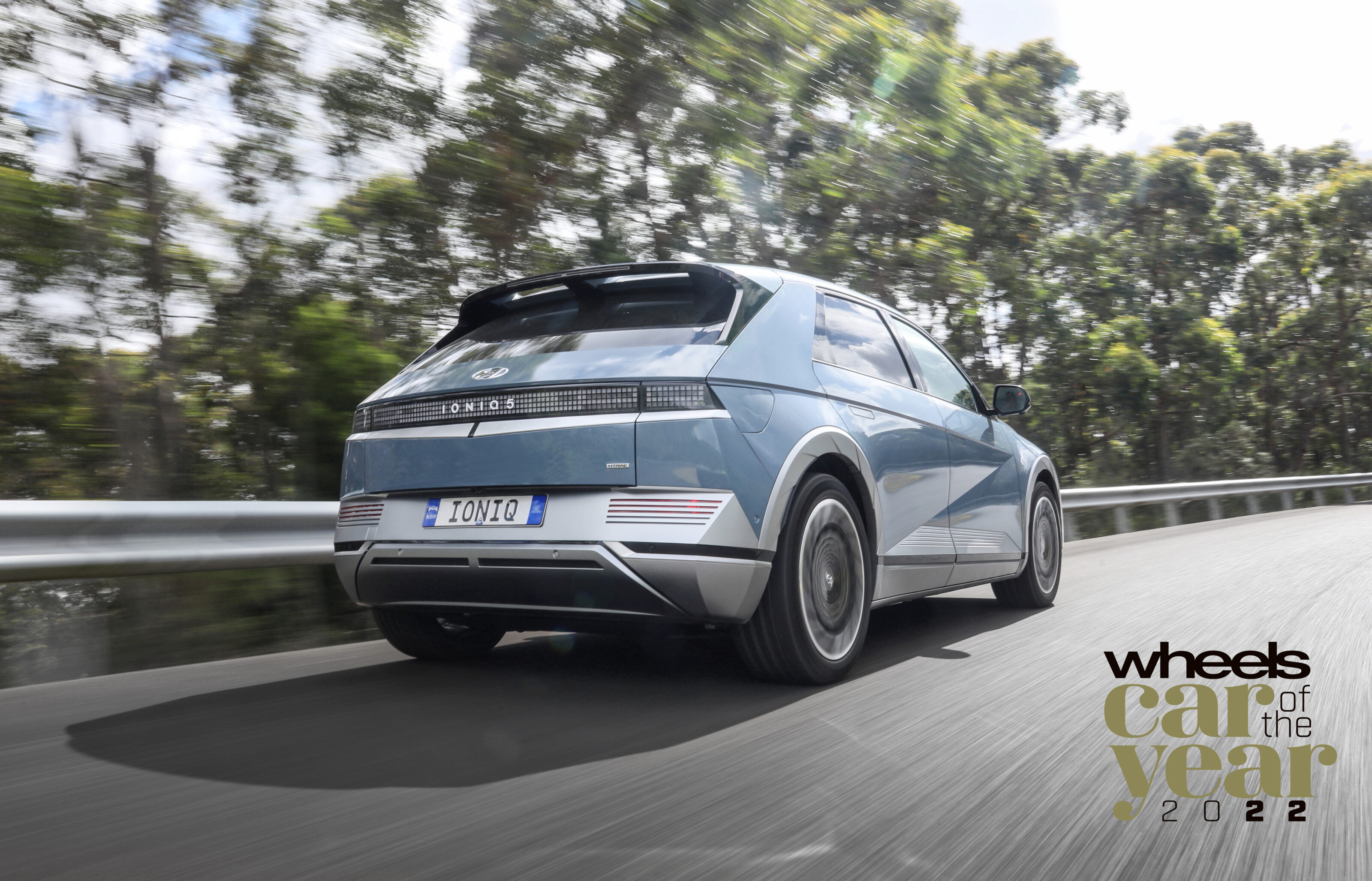
Since its arrival on Australian shores last year, the Hyundai Ioniq 5 has been released to the public in batches, so far totalling around 800 units after yesterday’s allocation went live with another 119 to be made available on July 20.
At the global launch of its Ioniq 6 sedan sibling in Korea, representitives from Hyundai Australia said they expected Ioniq 5 supply to increase over the coming months, without putting an exact figure on the expected deliveries.

While more cars are set to be released next week, Hyundai has also announced its plans for an additional load to be made available in August, becoming the first back-to-back months where prospective buyers have been able to put in orders.
For customers in the Northern Territory, the increased loads will hopefully mean Top End buyers can put in an order, having missed out on every round since the first allocation was opened.
Next week’s batch is set to be made up of the new flagship Techniq grade, announced earlier this week as the replacement of the existing AWD nameplate, while Dynamiq takes over from the cheaper RWD model.
Hyundai hasn’t been able to pin down a time for when the Dynamiq can be ordered, also applying to the optional Techniq Vision Roof – which is available as a $1500 extra for the range-topping grade.
Wheels will provide updates when Hyundai announces its upcoming allocations of the Ioniq 5.
Hyundai claims giving its new electric vehicles bold new designs and packing them full of high-tech equipment is driving customers away from premium brands and towards its own dealerships.
Following the reveal of the 2023 Hyundai Ioniq 6 last week, the new EV has been widely compared to a number of luxury cars, such as the Mercedes-Benz EQS and EQE, and even the Porsche 911 Turbo, both in terms of its aesthetics and its features.
At the global premiere of the Ioniq 6 this week, Hyundai execs told media both the coupe and its Ioniq 5 SUV sibling have shaken up the market – and its going in the Korean marque’s favour.
“The Ioniq 5 has created a buzz since it launched around the world,” said Thomas Schemera, Executive Vice President and Head of Customer Experience Division at Hyundai Motor Company.
“We’re changing the paradigm – we’re providing an extraordinary user experience with progressive design.
“Customers of premium brands are coming into our dealerships and showing big interest because we offer premium appeal without premium pricing.”
While the Ioniq 5 is aimed at young families, because it offers the space and functionality they need, says Hyundai, the Ioniq 6 is designed squarely for young, single professionals because of its luxurious styling, upscaled interior and high-end tech.“Everyone wants premium technology in the interior now, it’s something we must deliver and will continue to develop even though we are a volume brand,” added SangYup Lee, Executive Vice President and Head of Hyundai Global Design Centre.
“The premium technology and level of design raises the bar.”
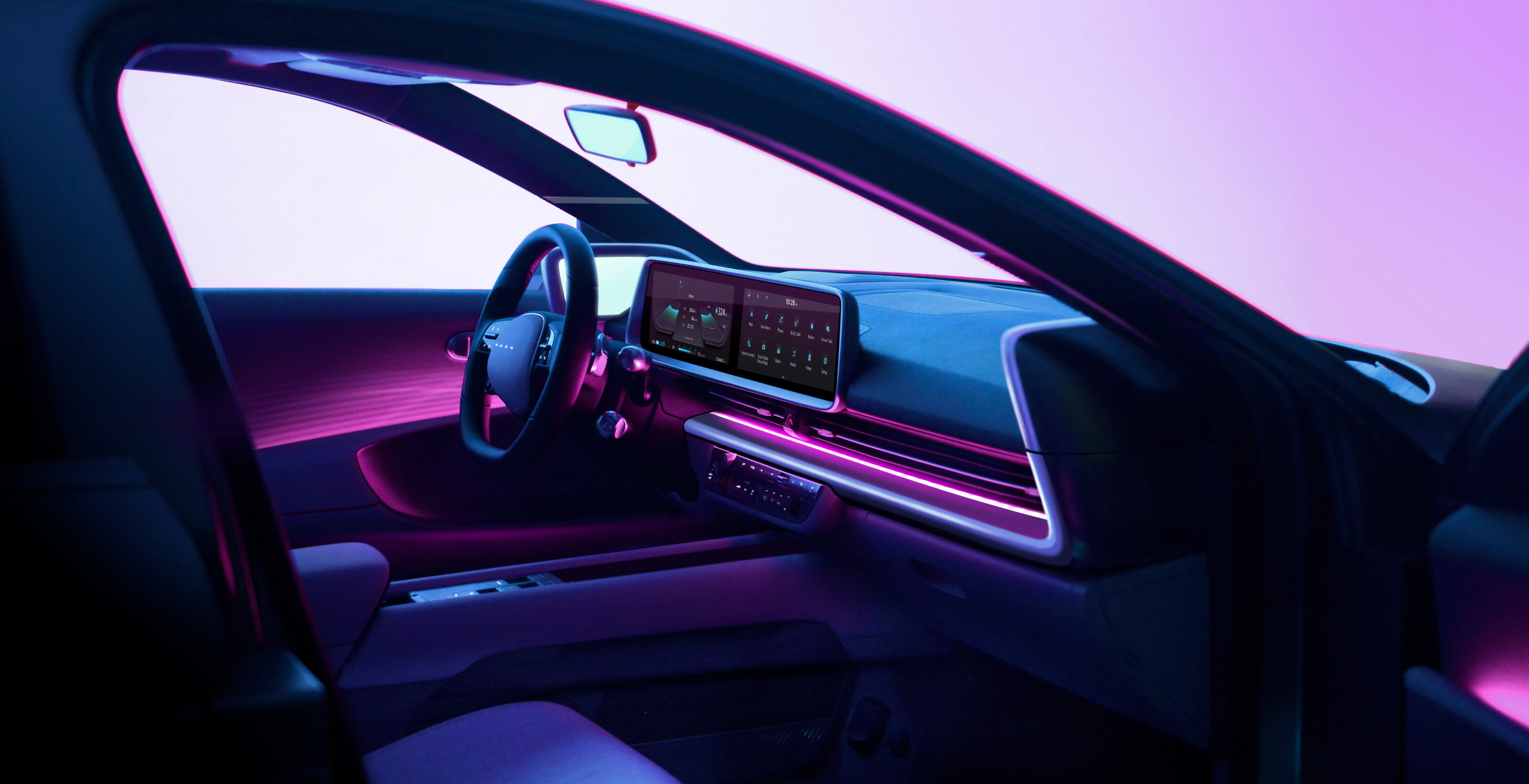
On the inside, the Ioniq 6 has been designed to be more of a living space than just a means of transport, and includes a number of top-end features reminiscent of much more expensive cars.
As well as having a high degree of personalisable features, the Ioniq 6 comes with; ambient lighting, two 12-inch screens (for infotainment and the digital cluster), Hyundai’s Electric Active Sound Design, Bose Premium Sound System and five USB ports for connectivity – as well as a wealth of safety equipment, to name just a few.
It also uses many sustainable materials throughout the cabin, including; faux leather materials, recycled polyester fabric for the seats, paint sourced from used vegetable oil for the doors, and recycled fishing net carpets – all of which SangYup Lee says don’t come cheap.
“Sustainable materials are pricey for a volume brand,” the boss added.
The cabin will feature a 64-colour configurable ambient lighting and six dual-colour themes, while the four-dot icon on the steering wheel lights up to communicate important messages to the driver.
The ambient lighting system is positioned to bounce off the door panels and the interior lighting in the front row is even synced to the speed the vehicle is going at the time.
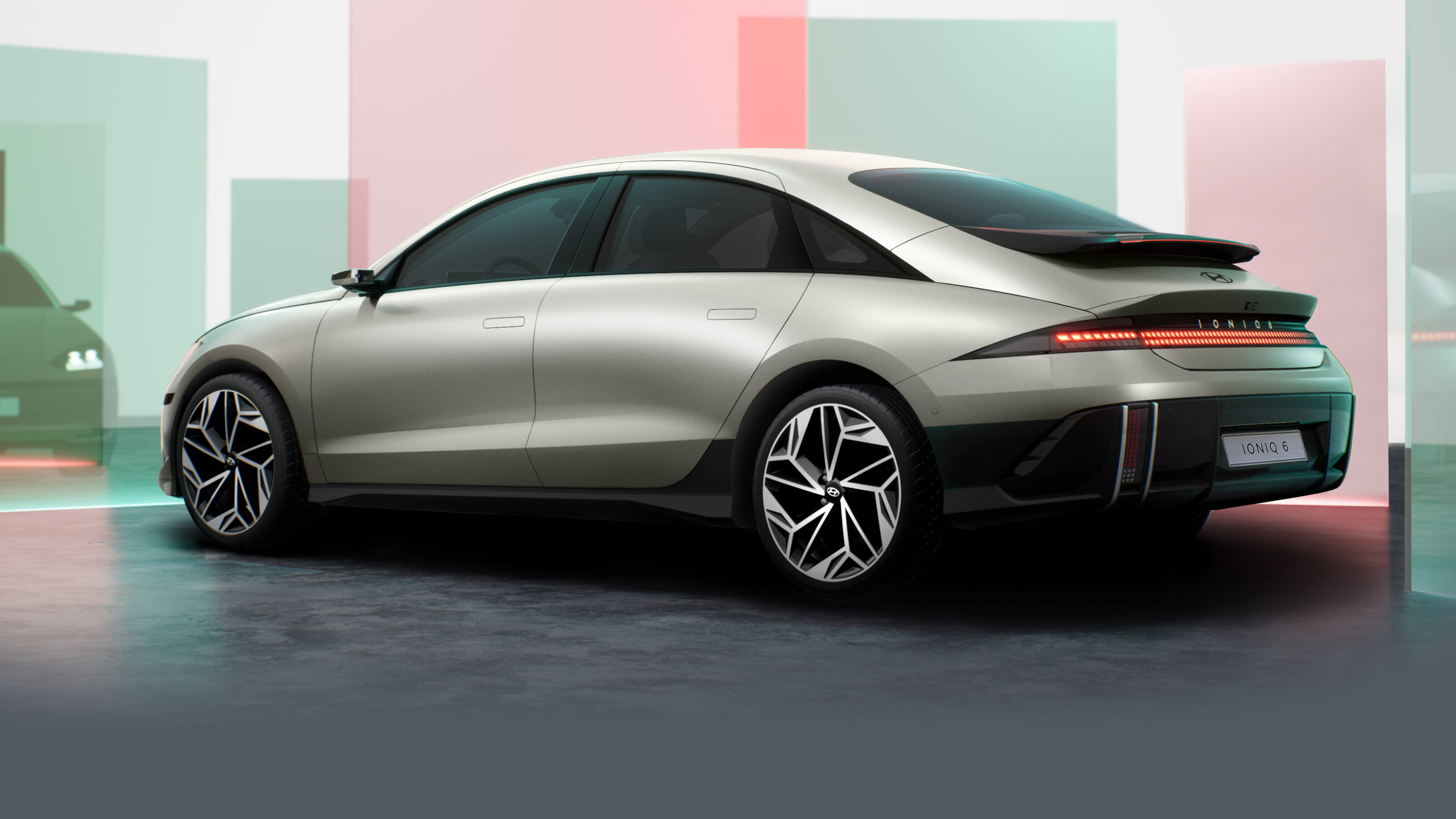
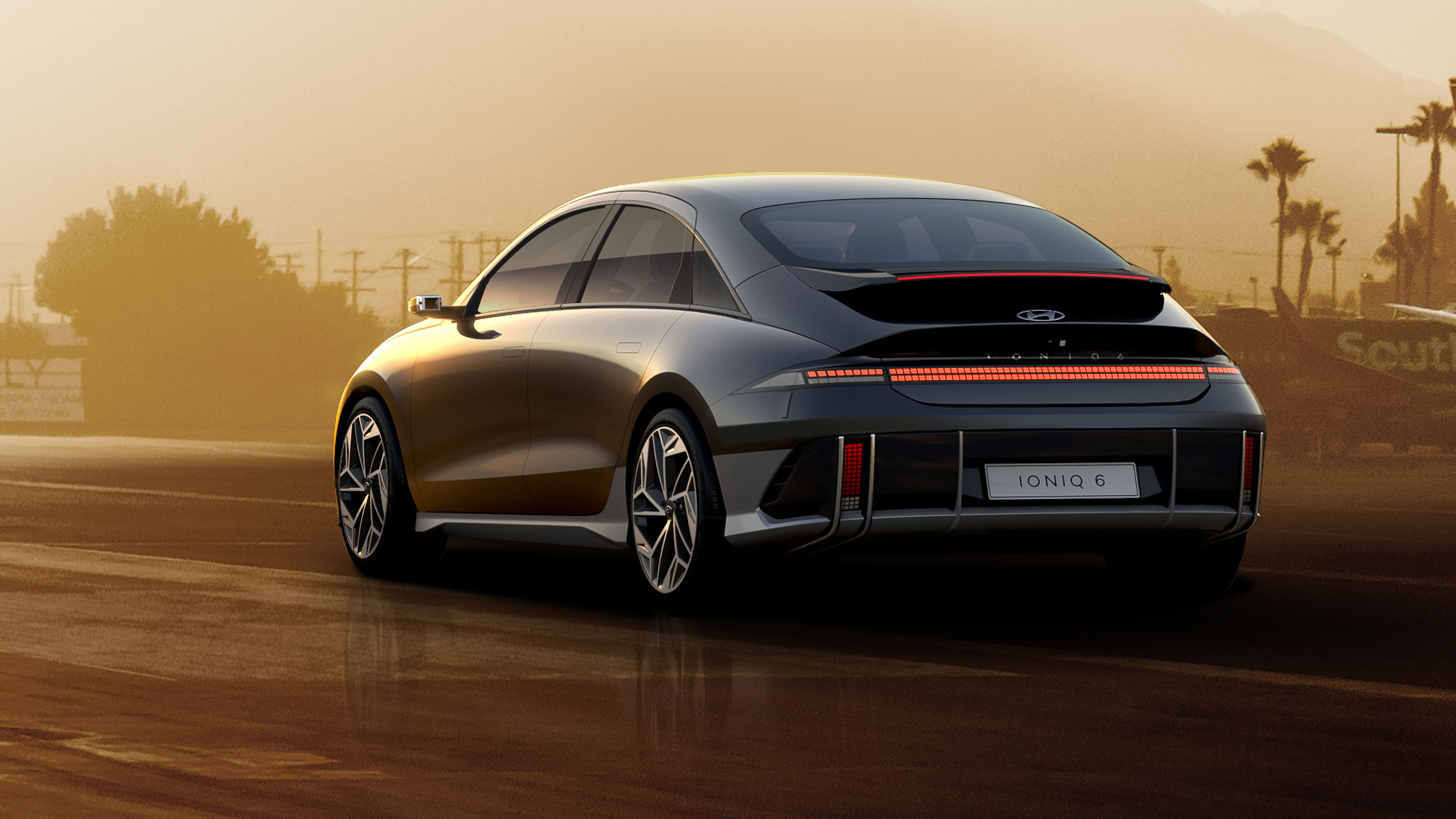
It’s exterior too is punching above its weight, as a low-slung sedan, aerodynamics played a significant role in the design of the Ioniq 6 – which achieves a low drag coefficient of 0.21 when fitted with 18-inch wheels and digital side mirrors.
For reference, the Tesla Model 3 is less slippery at 0.23 Cd, while the larger Mercedes-Benz EQS has a lower drag coefficient of 0.20.
The brand’s ‘Parametric Pixel’ lighting elements – also seen on the Ioniq 5 and Staria – features across the Ioniq 6, with Hyundai claiming it includes ‘more than 700’ individual LEDs front to rear.
To assist with getting in and out, the door frames of the Ioniq 6 sit above the low window frame – the latter of which echoes four-door coupes, such as the Mercedes-Benz CLS.
At the rear, the Ioniq 6 includes sharp full-width LED tail lights, a chunky bumper with air vents, and a ‘whale tail’ spoiler reminiscent of a Porsche 911 Turbo.
Only time will tell what sales will be like for the Ioniq 6 in Australia and whether it truly can pinch customers from the luxury carmakers, but if the Ioniq 5’s 370 units shifted locally so far this year is anything to go by, the Ioniq 6 as a more obvious competitor could upset the balance.
UPDATE: Ioniq 6 racing concept surfaces online
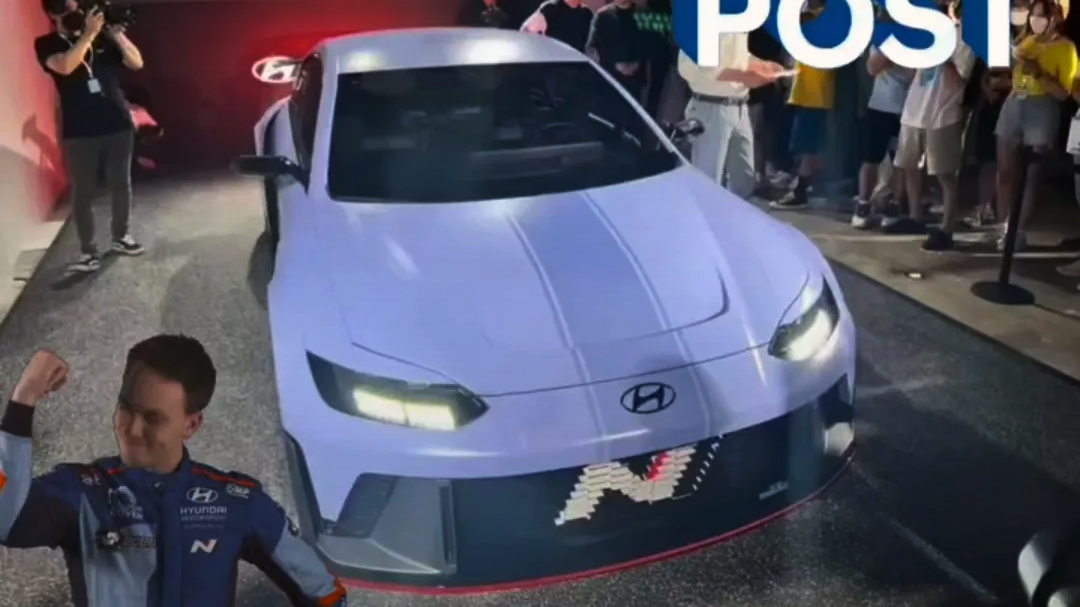
A sneaky photo from Hyundai’s N Day event in Korea has made its way online, revealing what looks to be a racing version of the new Ioniq 6 electric sedan.
Details of the car won’t be released until tomorrow, so for now we’re left to speculate. Enthusiast site Korean Car Blog has dubbed it an Ioniq 6 N preview concept, and they might not be wrong.
In this form, though, the car appears to be set for track, with wide flares at every corner and aero work along its lower section.
A massive battery cooling grille can also be seen at the front, with the now familiar N logo displayed proudly.
As the earlier teaser below shows, a giant wing will also feature, and a brief glimpse of a racing track is also shown at the beginning of the preview video.
Watch for more to be revealed on Friday.
The story to here: Ioniq 6 N concept previewed
Hyundai has teased the latest addition to its range of ‘N’ performance models, with the recently-released Ioniq 6 expected to join the family.
Covers may have only come off the Ioniq 6 last week, but teasers for this year’s ‘N Day’ show the rear light signature of the electric vehicle through a cloud of tyre smoke, with a big wing sitting atop its boot.
In a video posted to Hyundai N’s YouTube channel, the Korean manufacturer released sound bites of its previous N cars, such as the i30 N and Kona N, followed by the noise of an EV’s whirring motors, finishing with lightning strikes and the tagline “fun, evolves”.
In addition to these teasers, a silhouette teaser is giving us big ‘80s and ‘90s motorsport sportscar vibes, with a long nose, low splitter and tall rear spoiler – likely to be a concept of some sort, similar to the Grandeur restomod from 2021.
Also in the frame to be revealed is an N version of the Ioniq 5, Hyundai’s first dedicated EV which launched last year, with rumours circulating about a hot variant testing at the Nürburgring.
Last year’s N Day was highlighted by the reveal of the Kona N crossover, a part of the N family’s expansion to now include five models – the i30 N Hatch, i30 N Fastback, i30 Sedan N, i20 N and Kona N.
The new model(s) will be revealed on July 15 at 9am AEST.
UPDATE, July 21, 2022: Civic Type R revealed!
The new-generation Honda Civic Type R has now been revealed. Get all the pics and details at the link below!
The story to here
UPDATE: 2023 Civic Type R revealed in ‘leaked’ image
Well, that’s awkward for Honda. A single marketing image of the new 2023 Civic Type R has surfaced online this week, appearing briefly on the company’s own website in Japan.
It was a member of the enthusiast community Civic11Forum.com that discovered the image, found alongside details of other Civic models.
The image is clearly of the type that appears on a brand’s consumer website, usually on the configuration pages. No surprise the uncovered image shows the hatch in its iconic Championship White shade, of course.
As expected, and indeed as earlier preview images hint, the new ‘CTR’ will take on a more understated look than its seemingly Gundam-inspired predecessor – even down to the flared arches, which now look to be integrated into the body work rather than tacked on.
The expected bonnet scoop can be seen as a subtle addition, along with a large black wing at the rear and skirts along the sills.
Further details are still to come, but with the big reveal set for July 21, all will be known soon enough.
2023 Civic Type R previewed
Snapshot
- Honda Civic Type R set for July 21 reveal
- New CTR marks 30 years of Type R models
- Upcoming model has recently set a new lap record at Suzuka Circuit
Honda has previewed its upcoming 2023 Civic Type R, just under a fortnight before the new performance icon is revealed to the world on July 21.
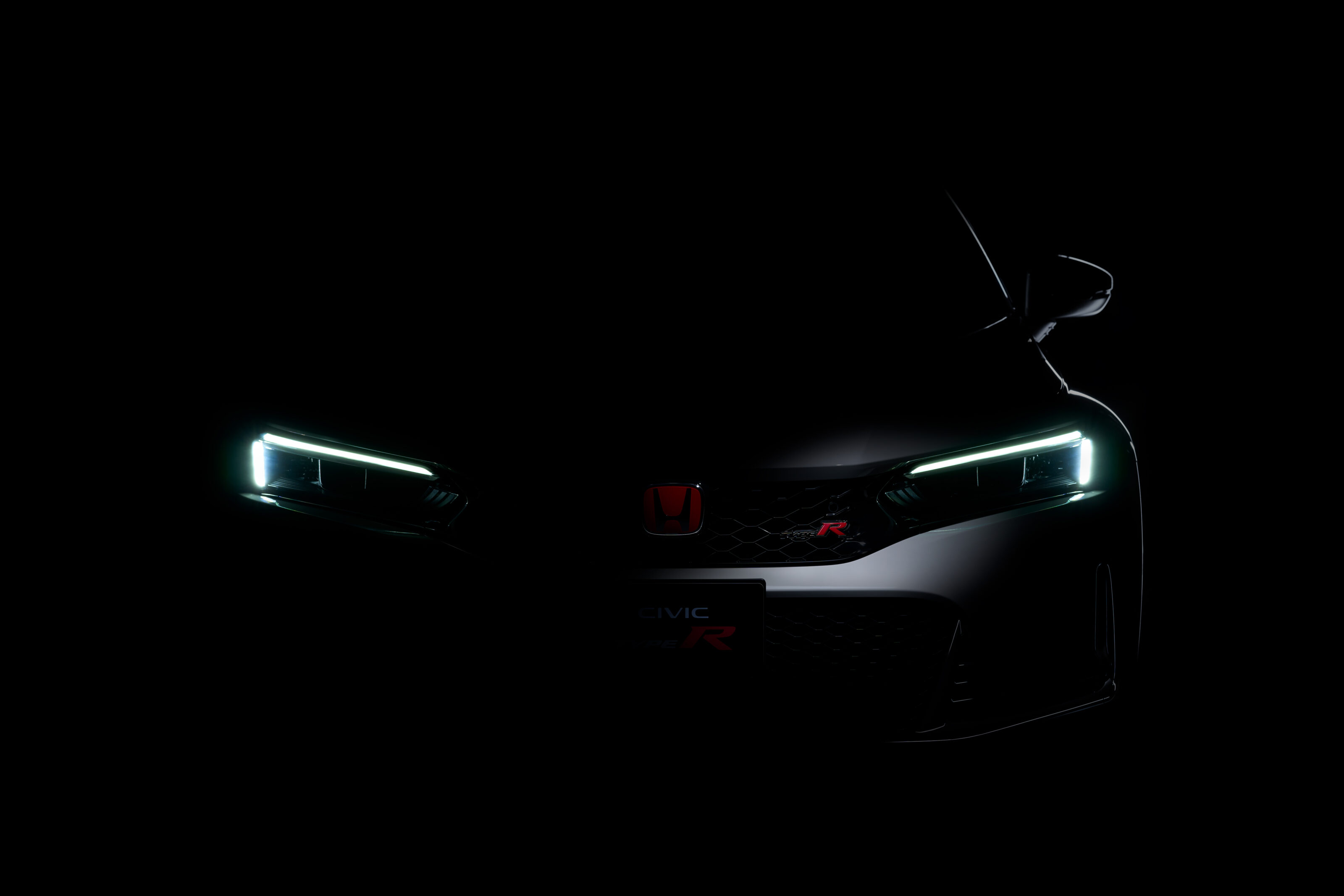
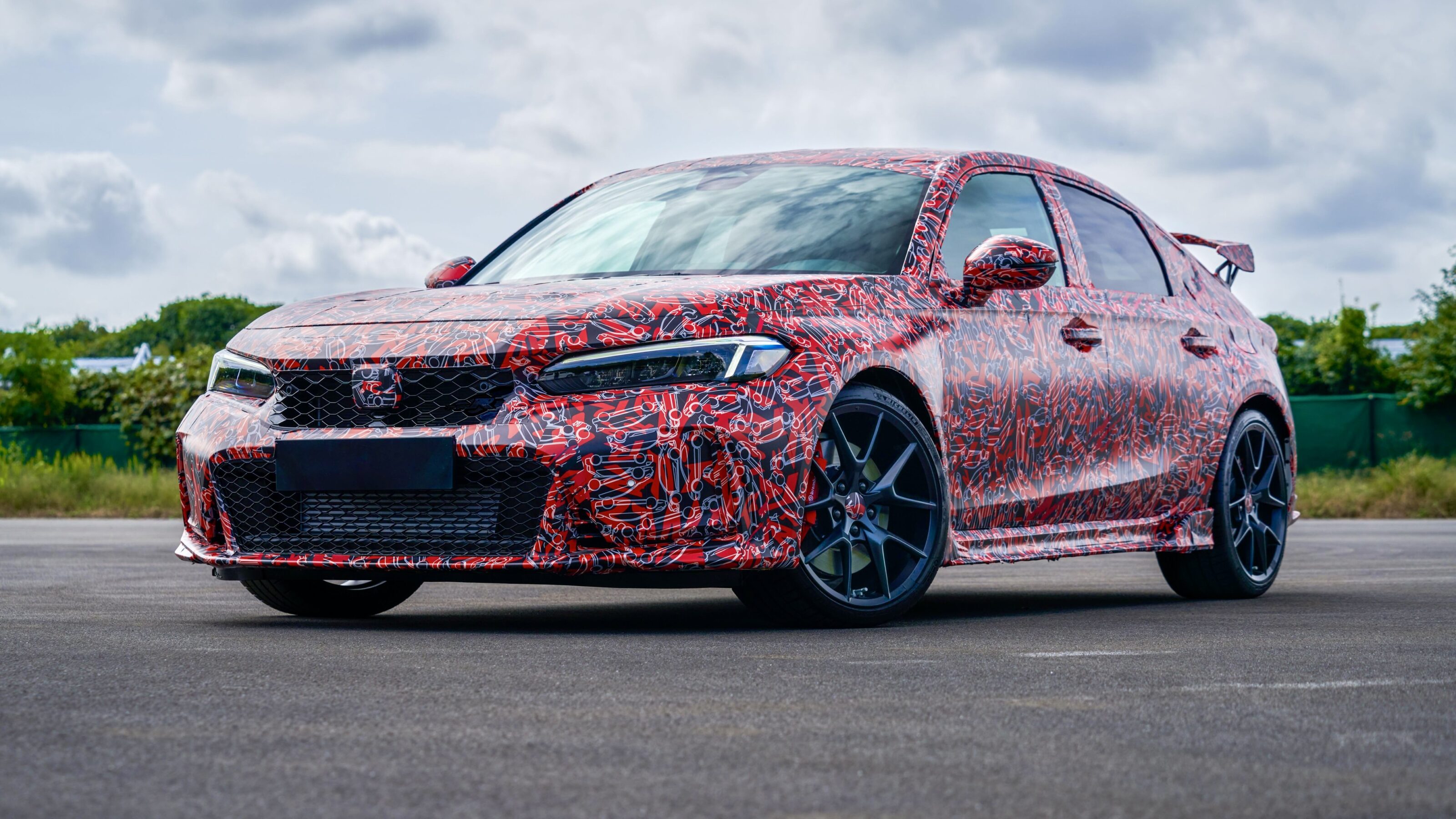
Although we’ve seen the new Civic Type R undergoing testing in camouflage recently, this is the first time Honda has shown us any details of the new model without its deceptive wrap.
Celebrating 30 years since the Type R nameplate was born with the original NSX, the all-new ‘CTR’ again wears the special red H badge and Type R emblem, while its headlight signature carries across from the standard car.
Previous teasers and development videos of the CTR have shown it blitzing the lap record for front-wheel-drive production cars at Japan’s Suzuka Grand Prix Circuit – a venue owned by Honda.
The outgoing Civic Type R was revered as a masterclass in the hot hatch formula, taking home MOTOR’s 2018 Performance Car of the Year award as well as back-to-back Bang For Your Bucks gongs in 2018 and 2019.
It’s expected the previous-gen Type R’s engine will carry across to the new car, with the 2.0-litre, turbocharged four-cylinder pushing out 228kW and 400Nm, feeding power to the front wheels through a six-speed manual transmission.
Today’s Type R teaser coincides with the 50th anniversary of the Civic nameplate, having gone on sale on July 12, 1972 and reaching over 27 million sales across 170 countries.
Be sure to check Wheels for updates and information on the new Civic Type R after its launch on July 21.
Snapshot
- BYD Atto 3 Standard Range pushed back to November or December
- Extended range variant to arrive before October, following a six to eight-week delay
- Newly-placed orders unlikely to arrive until closer to the New Year or beyond
The most-affordable variant of Australia’s cheapest electric vehicle, the BYD Atto 3, has been hit with a delay.
EVDirect, the third-party Australian importer of BYD vehicles, has informed customers the start of production for the 2022 BYD Atto 3 Standard Range in China has been pushed back to mid-October.
It was scheduled to launch in Australia alongside the Extended Range option, with a July on-sale date initially stated earlier this year.
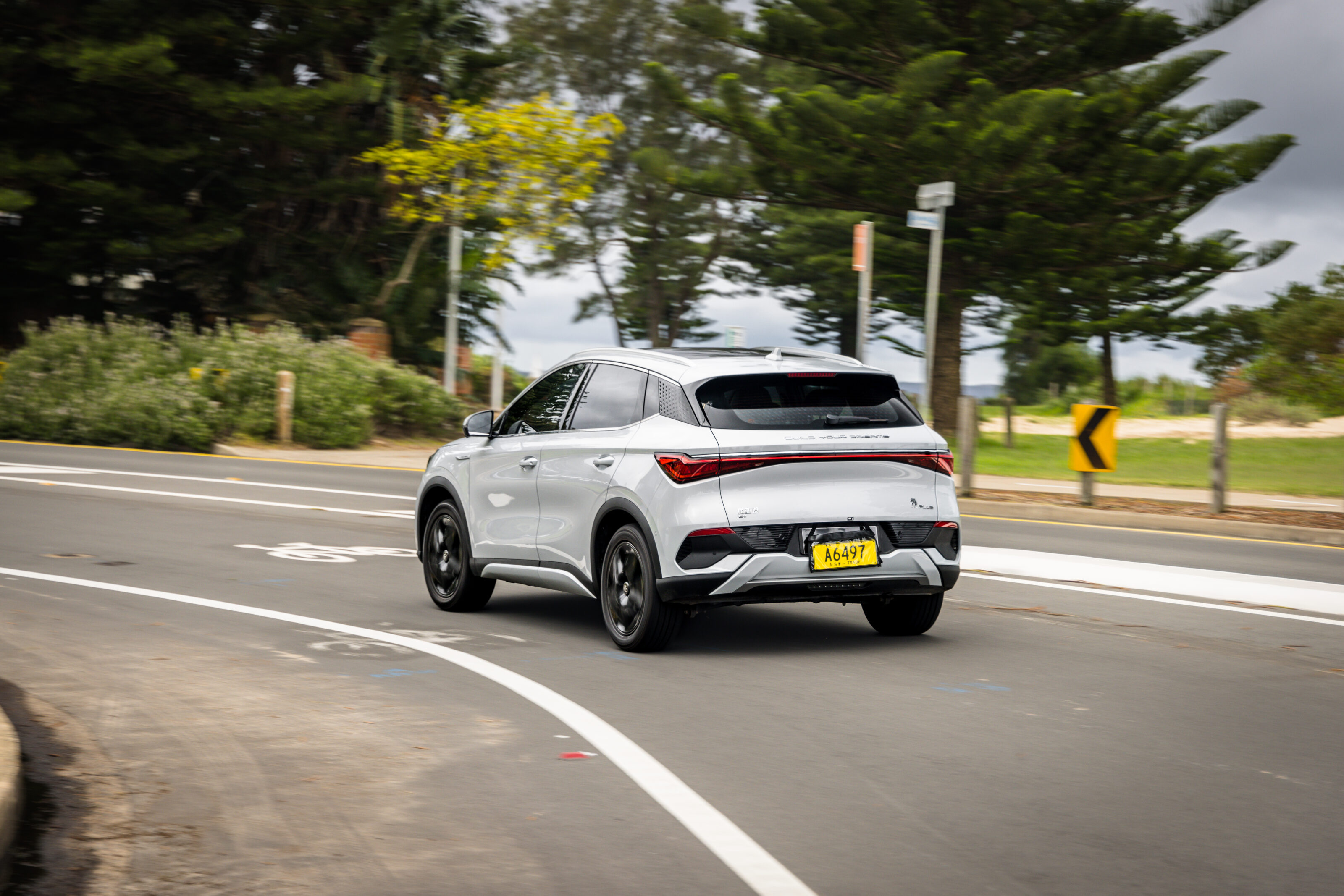
This has since been pushed back to August or September for the Extended Range, and November or December for the Standard Range.
In an email sent to customers, and shared to the BYD Atto EV Owners group on Facebook, the company said the more-expensive Extended Range variant was being prioritised for the Australian market.
“Unfortunately, we have received advice from BYD in China that the production of the Standard Range Atto 3 vehicles will not commence until estimated mid-October, with delivery to Australia scheduled to start in November – December,” the letter states.
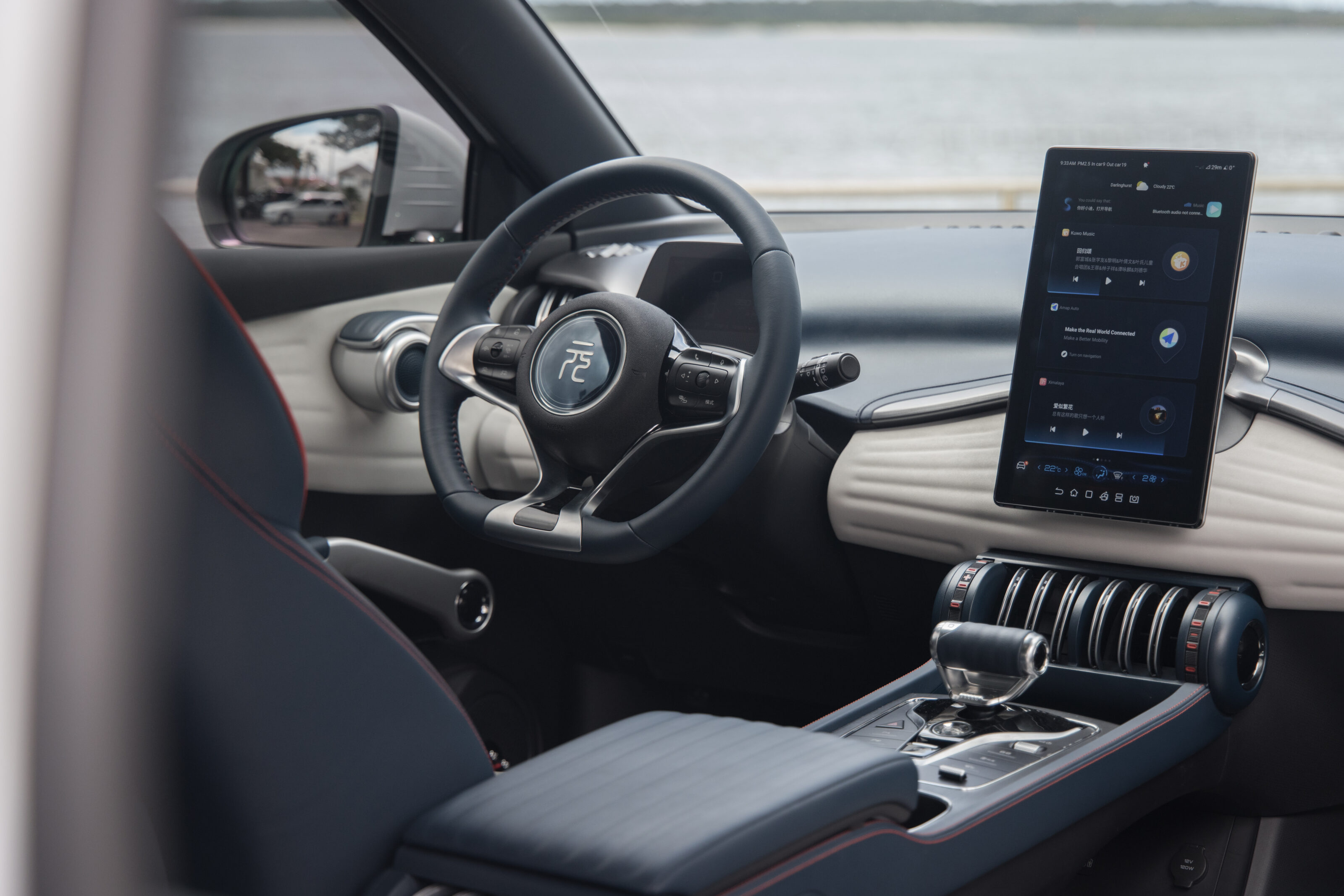
“This is due to the high-volume production requirements of the extended range option. We apologise for any inconvenience this may cause.”
EVDirect claims approximately 90 per cent of customers have pre-ordered the Extended Range version.
Standard Range customers who received correspondence from EVDirect earlier this week can upgrade to an Extended Range model in the same colour, while keeping their place in the queue.
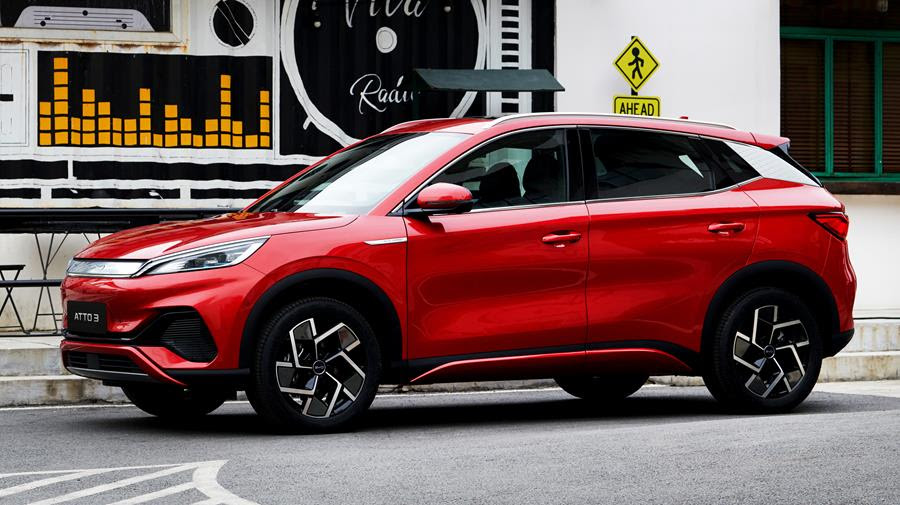
Buyers who decide to avoid the delay by opting for the Extended Range are likely to receive their vehicle within the next two months, according to EVDirect.
Those yet to join the queue for a BYD Atto 3 should expect delivery of the Extended Range before Christmas, or between December 2022 and January 2023 for the Standard Range, if ordered today.
The BYD Atto 3 will become Australia’s cheapest electric vehicle when it launches, with pricing as low as $44,990 drive-away in Tasmania.
However, as pricing is location dependent, it is undercut by the updated MG ZS EV Excite in several states. The ZS EV starts from $46,990 drive-away nationwide.
The pricing for the BYD Atto 3 remains unchanged at $44,381 before on-road costs for the Standard Range, or $47,381 plus on-roads for the Extended Range.
EVDirect says it will release warranty and servicing information in the coming weeks, while it expects a five-star safety rating, despite no crash testing by ANCAP or Euro NCAP thus far.
UPDATE, August 24, 2022: BYD warranty detailed
BYD’s Australian distributor has finally offered a full breakdown on what its warranty and servicing plan will entail. It’s not as long as originally described, and a number of items on the vehicle have an even shorter warranty.
Get the details at the link below, and watch our video below.
Story continues
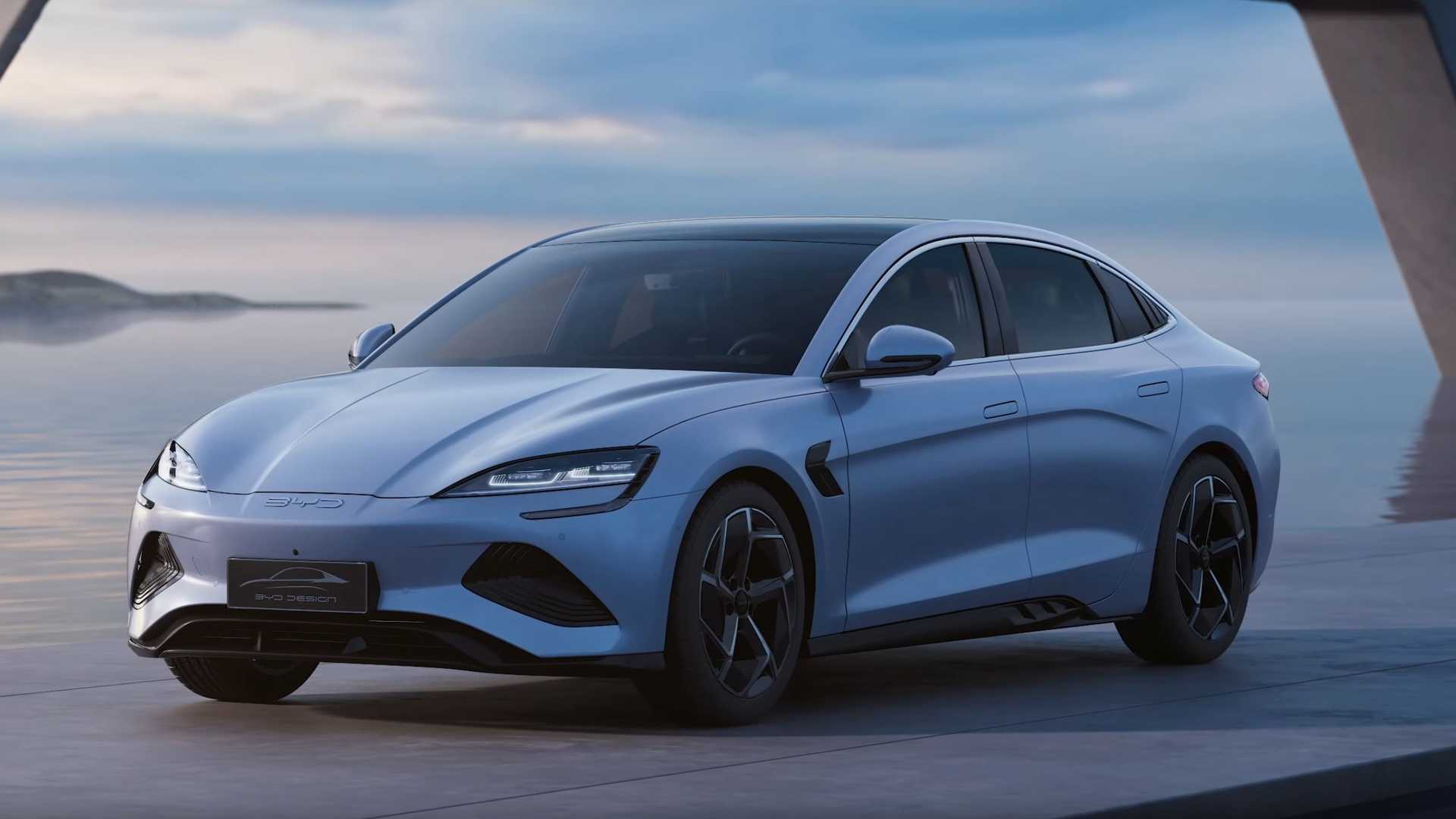
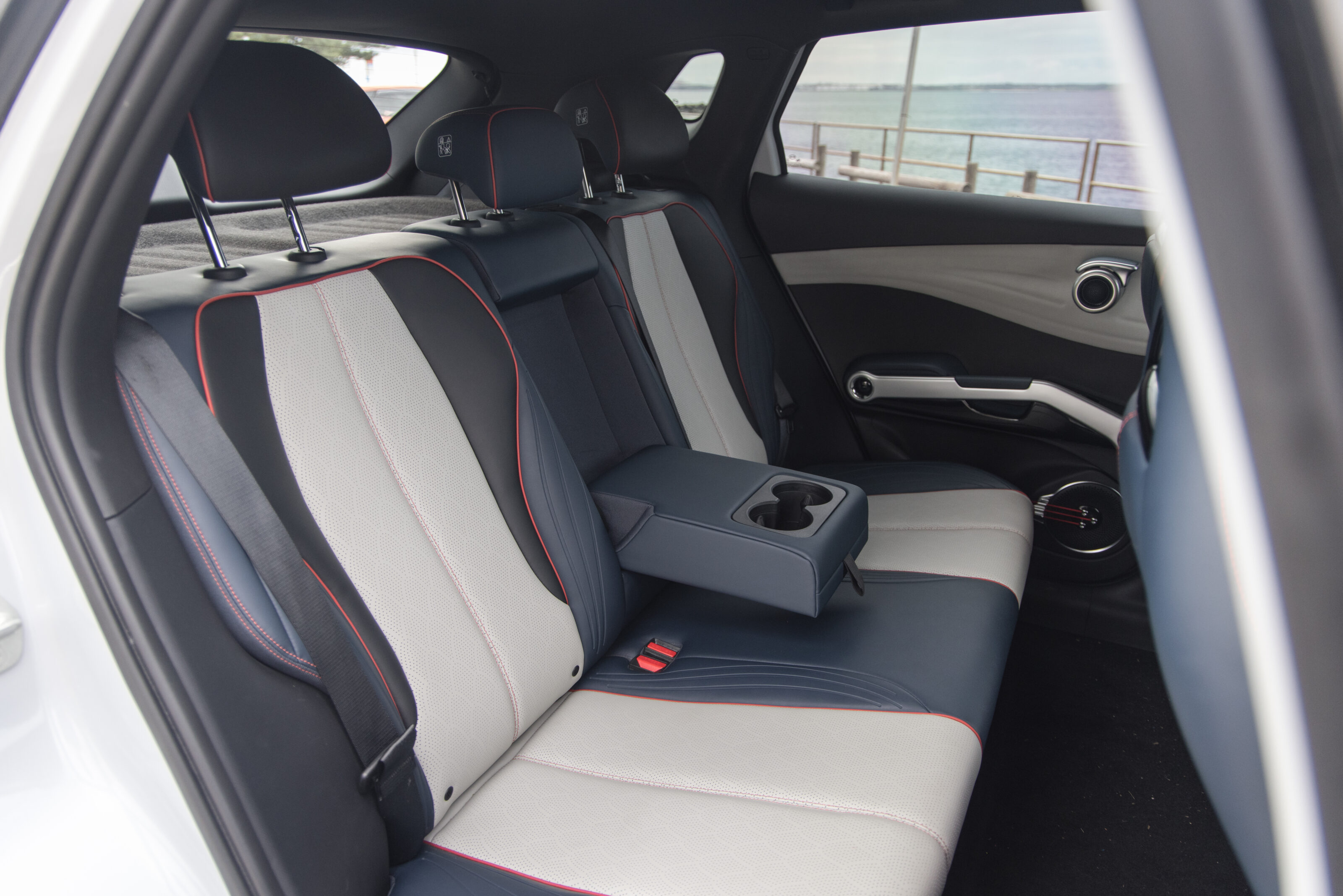
A number of BYD Atto 3 models docked in New Zealand late last week, ahead of test drives from late July and customer deliveries commencing at the end of August.
The 2022 BYD Atto 3 is expected to be joined by the Atto 1 small hatchback and Atto 4 mid-size sedan by the end of the year.
These models are known as the Dolphin and Seal, respectively, in the Chinese market.
One thing you can count on in the modern automotive market is the rate at which carmakers make changes to their most popular machines to keep pace with the ever-changing market. A case in point is the Hyundai Santa Fe; you can tell what’s doing well – or could do better – by the number of tweaks and changes with each passing year.
Hyundai has made yet another reasonably interesting update to the Santa Fe large SUV in the form of safety tweaks, partly to keep up with the competition and partly to keep up with ANCAP’s ever-evolving stance on five-star ratings.
We already know the Santa Fe is an excellent machine and particularly so in the Highlander diesel variant. Except that could be under threat later in the year with the hybrid Santa Fe finally making its way here.
Pricing and features
The MY22 Santa Fe has seen that scourge of the car buyer hit with some force – the price rise. Whereas a few short months ago you could purchase a Highlander diesel for $65,200, you’re now looking at $66,050 before on-road costs, although the absolutely-worth-it upgrade away from the front-wheel-drive V6 petrol is still $3500.
It’s always annoying when prices go up, but it’s for a good cause – safety – which I’ll cover in a bit.
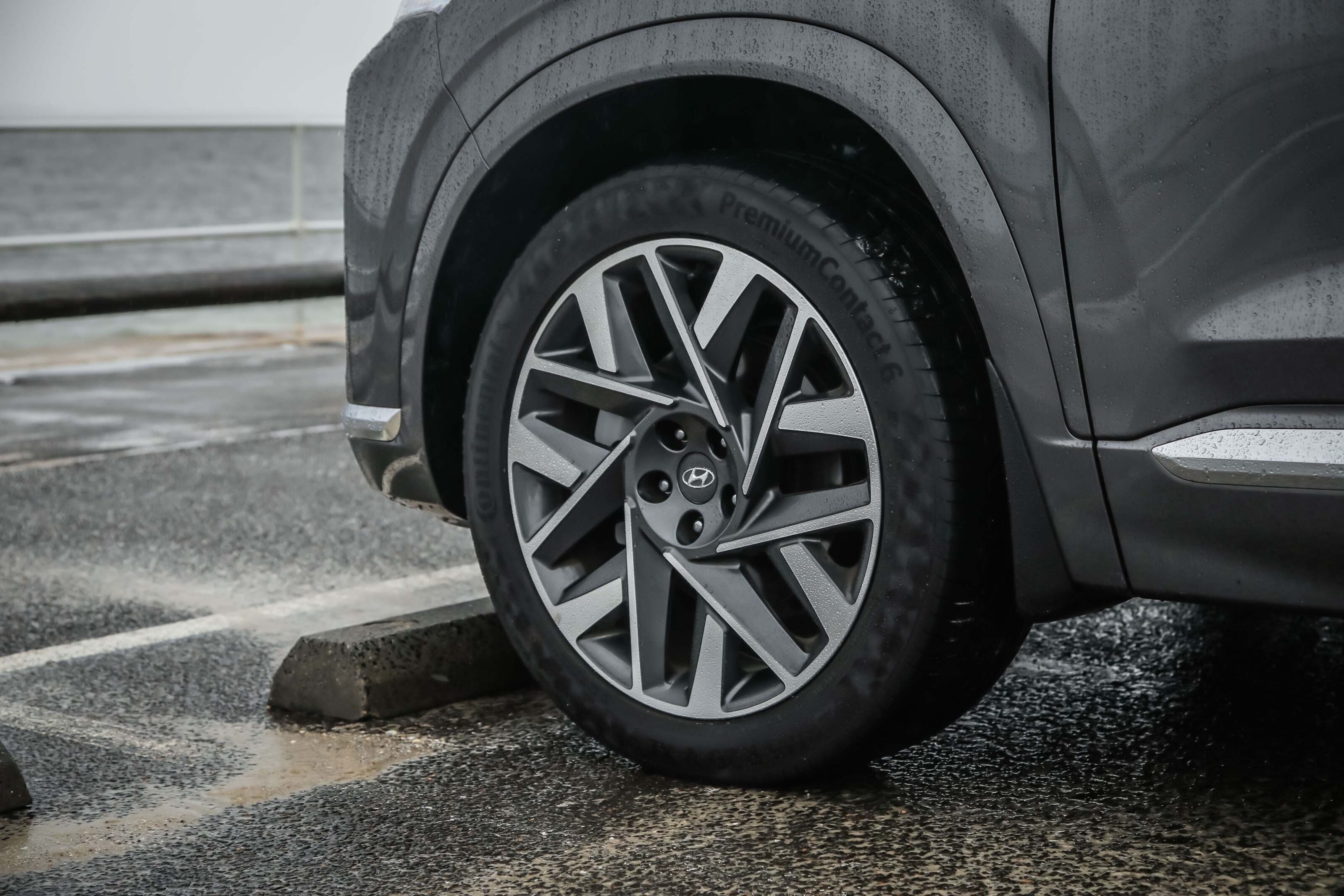
Anyway, to kick off you get 20-inch alloy wheels, the bigger 10.25-inch touchscreen, 12.3-inch digital dashboard, 10-speaker audio, sat-nav, power-adjustable front seats with heating and cooling, heated rear outboard seats, wireless phone charger, keyless entry and start, front and rear parking sensors, adaptive cruise control, power tailgate, panoramic sunroof, auto LED headlights, rain-sensing wipers and a full-size spare wheel.
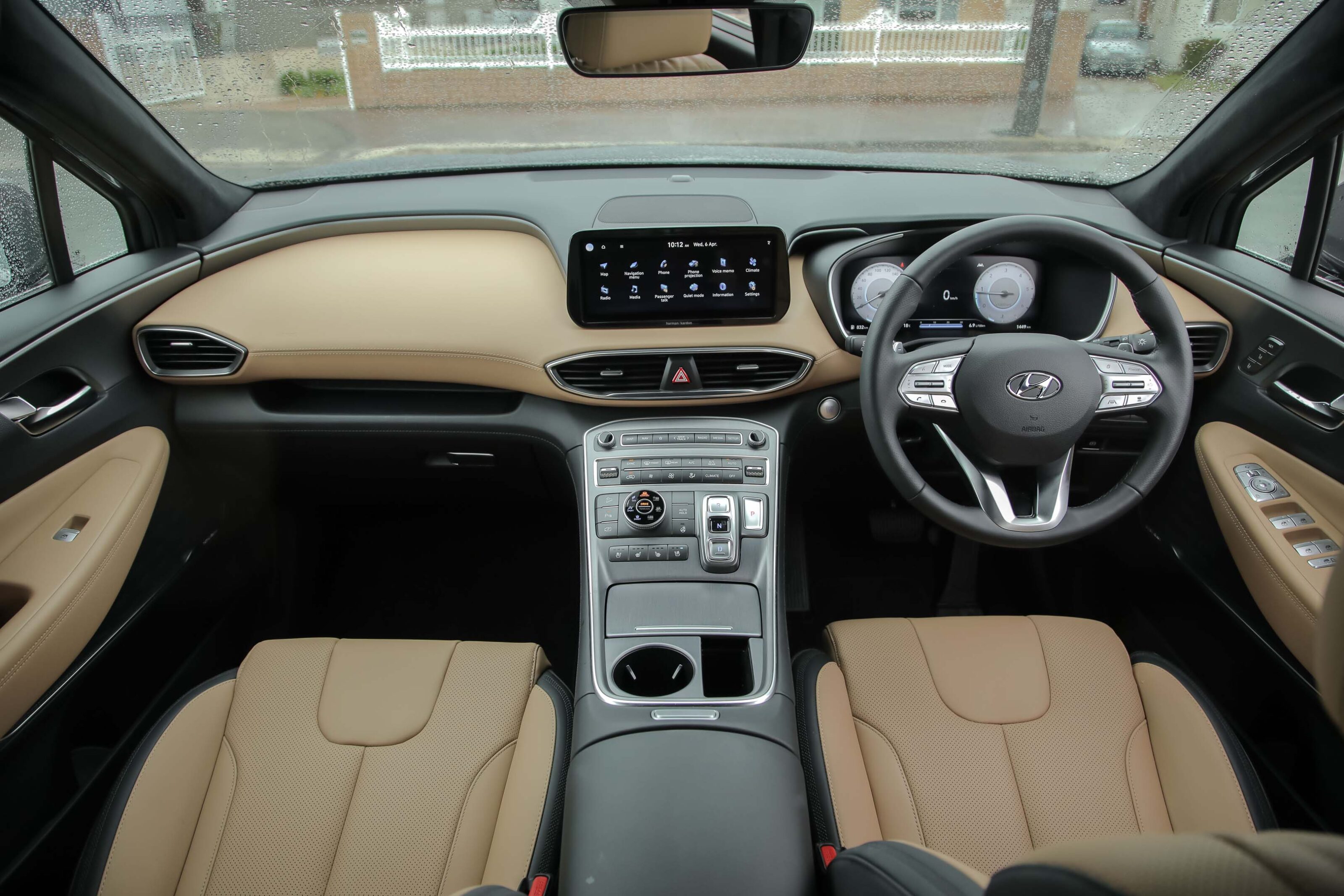
The big media screen features Hyundai’s (and Kia’s) very useful home-grown software full of both diverting and useful features, including the always-amusing ASMR audio feature called Sounds of Nature (including, for some reason, a noisy cafe) and the intercom to the third row. You also get Apple CarPlay and Android Auto in full widescreen glory.
You also get the remarkably useful remote control parking feature where you can roll the car forward and back using the key, particularly useful in tight parking spaces such as one I used to frequent in a dingy Sydney CBD basement (because it was cheap before you all start sniggering).
The centre airbag and multi-collision braking – where the car will automatically jam on the brakes after the airbags blow – are both standard across the entire MY22 range, which is welcome news.
On the safety front, you now get a seventh airbag (a new front centre airbag to avoid head clashes), ABS, stability and traction controls, forward auto emergency braking (10-65km/h for pedestrians and cyclists, 75km/h for cars), turn assist, rear cross-traffic alert, rear AEB, lane-keep assist and blind-spot monitoring.
The centre airbag and multi-collision braking – where the car will automatically jam on the brakes if you don’t after the airbags blow – are both standard across the entire MY22 range, which is welcome news. Less welcome is that the curtain airbags still don’t reach the third row.
Comfort and space
This Santa Fe’s cabin – first seen in 2018 – got a mid-life refresh seemingly twenty minutes after it was released (the pandemic has had a curious effect on my perception of time) in which some variants – including the Highlander – scored the flying console design.
It’s a bit of good and a bit of bad. The bad is a ton of buttons that take a while to learn, while the good is the enormous storage area between the seats on the floor underneath.
It is stylish, however, and everything is easy to use even if you need the hippocampus of a London cabbie. Or a Porsche owner (because Porsches have lots of buttons, you see).
The front seats are heated and ventilated and plush and comfortable and honestly, I nearly took the laptop out to work in this car during the week I had it. They seem too cushy to be supportive but it’s because the leather is surprisingly soft to the touch.
Yes, I know I’m sounding weird here, but ya gotta try to understand. The incredibly frustrating drive home on the day I collected this car was made much more bearable by these seats.
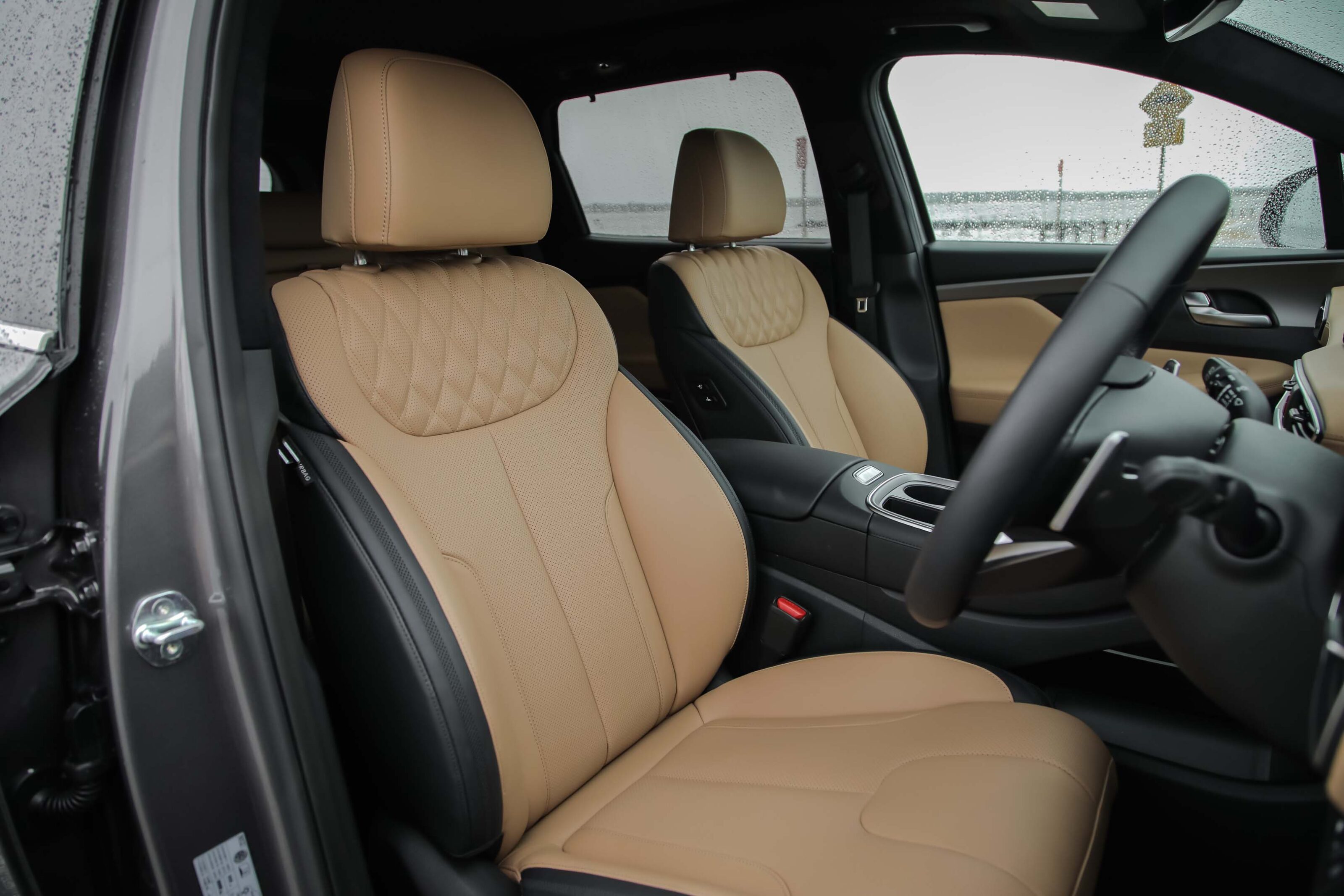
The incredibly frustrating drive home on the day I collected this car was made much more bearable by these seats.
For storage, there are two cup holders, a console bin and two bottle holders in the doors. There is also a spring-loaded slot for your phone that doubles as a wireless charging pad. It’s just a pity you have to string a USB cable from the base of the centre stack to make the CarPlay/Auto connection work. You have two of those, one USB-A and one USB-C.
The middle row is also uncommonly comfortable, the window seats featuring actual shape rather than being a flat bench and you have heating, too, as well as air vents and your own climate control zone.
Two USB ports supply charging and sun-shades in the side windows cut glare. The centre row can also slide forward towards the front seats for easier access/admonishment opportunities while also liberating more space for the third row.
Third-row dwellers score reasonably comfortable seats, USB ports, cup holders and little trays for small devices or whatever it is kids eat in cars now; I’m guessing it’s not jubes. Access is fair, with a lever on the middle row dropping the backrest forward and sliding the seat sort of out of the way.
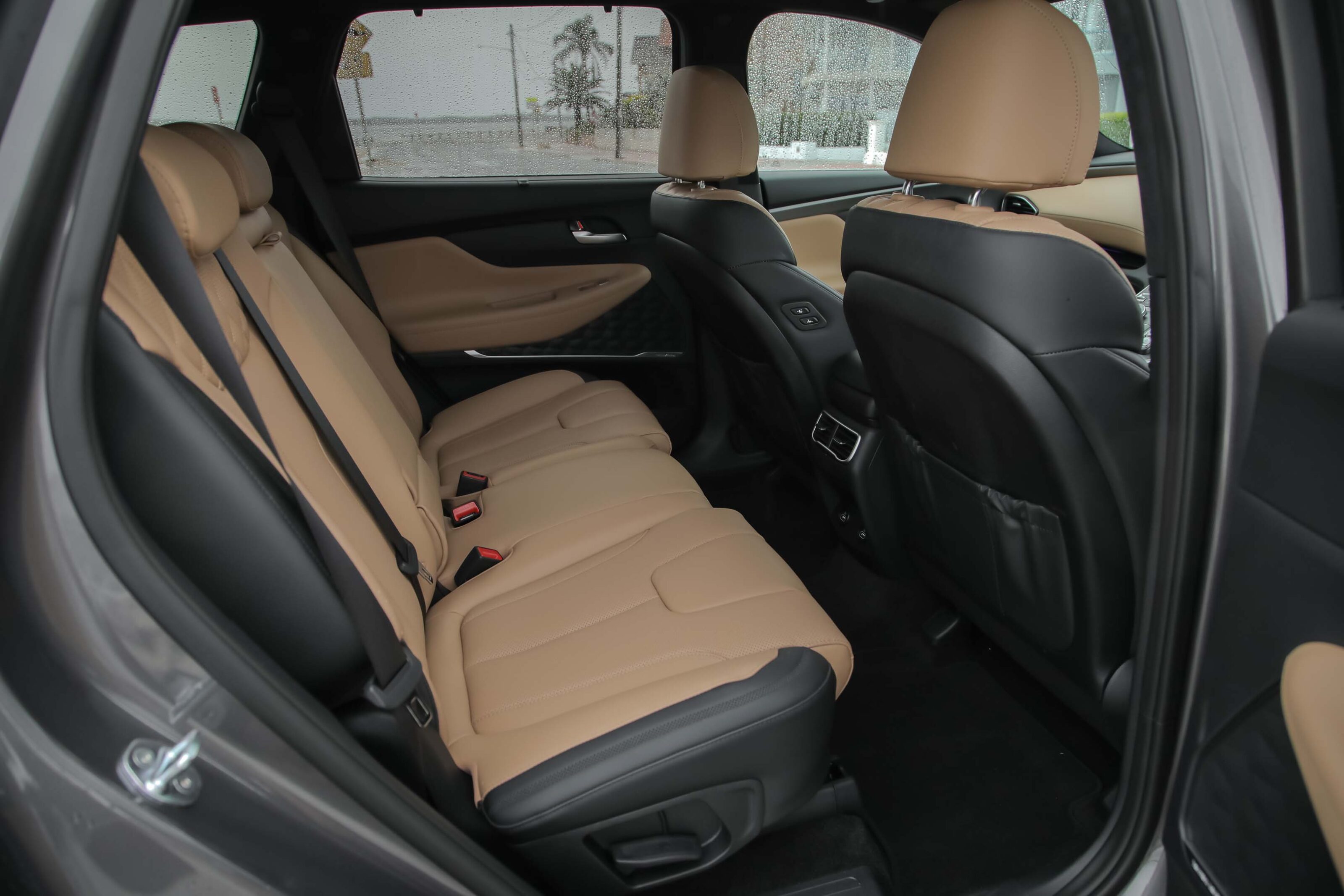
And just to repeat, the curtain airbag protection does not extend to the final row.
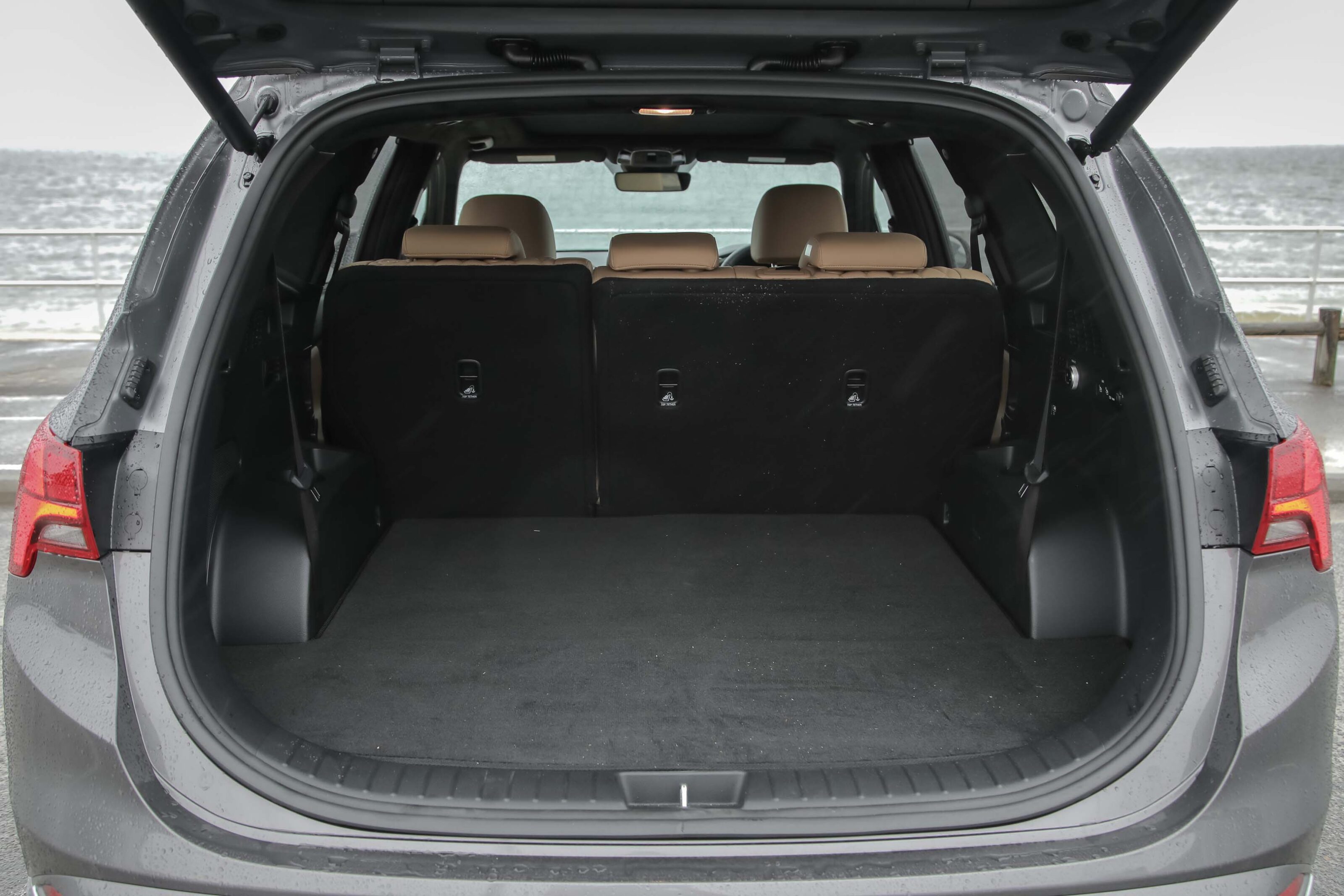
Boot space is impressive, starting at 130 litres with all seats in place. Push the third row down and you have between 571 and 782 litres depending on where you leave the middle row.
Hyundai still doesn’t offer an all-seats-down figure, but it’s probably closing in on 1600 litres. You could easily bunk in for the night, obviously to watch the stars through the giant sunroof.
Towing capacity is rated at 2500kg for a braked trailer, 750 unbraked and a maximum tow ball load of 200kg.
You could easily bunk in for the night, obviously to watch the stars through the giant sunroof.
On the road
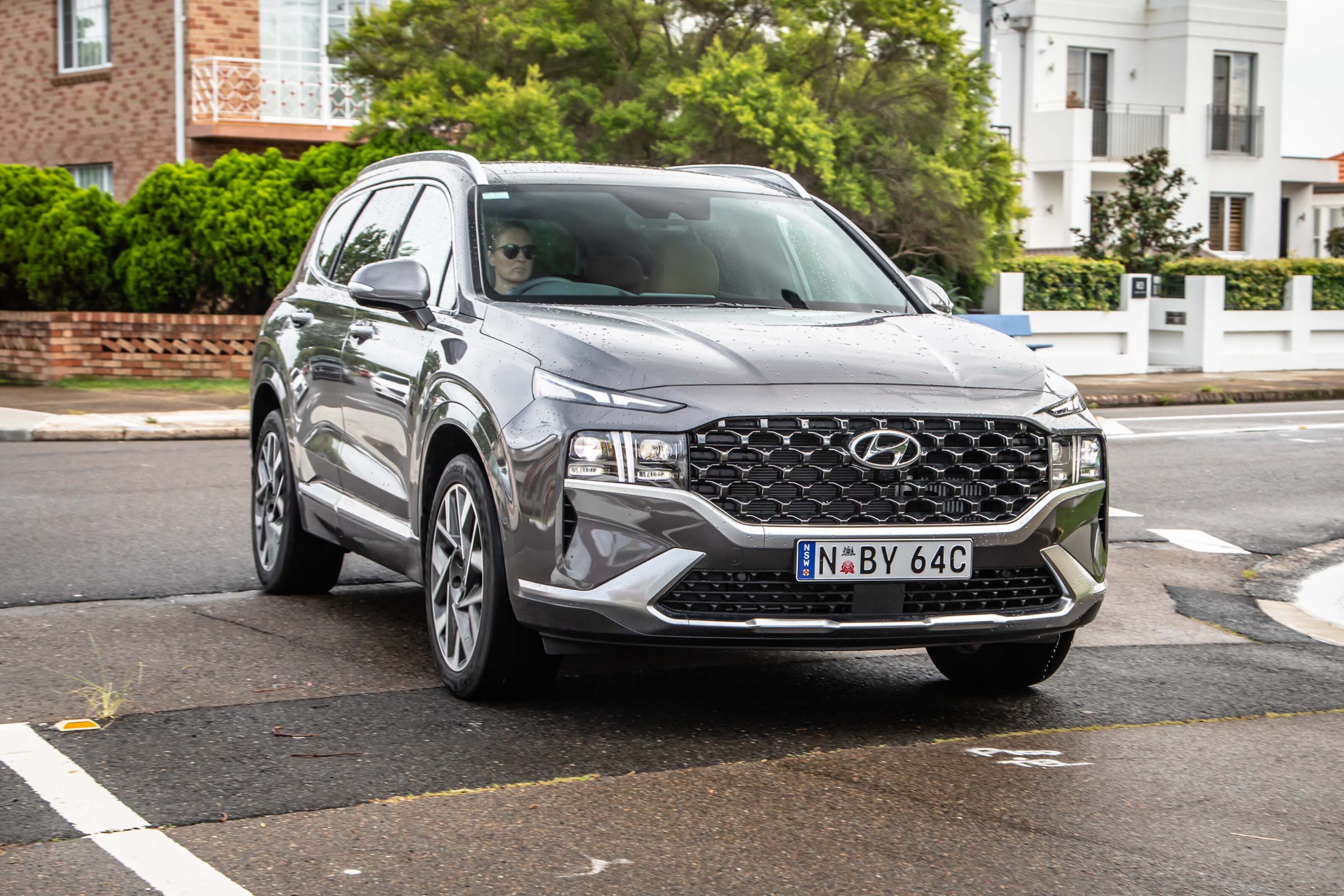
As with the MY21 and as it has been since the facelift, the Santa Fe has definitely skewed towards comfort. The 2018 original was obscenely good fun for such a big unit and we can thank our local friendly Hyundai handling team for that. It was, however, on the firm side.
So the team set to work and wound things back a little, delivering a much more comfortable ride while knocking the sharp edges off without sacrificing too much of the fun. The result is a superb ride that makes a trip of any length a genuine pleasure.
The steering remains the right weight and speed, no matter which of the (road-biased) modes you choose. I don’t know about the off-road modes because at the moment, anything off-road near Sydney is a lake. The body does move around a little more than the 2018 car, too, but it’s nothing unpleasant or unsettling for driver or passenger.
As with any large Hyundai, it’s the diesel that’s the best, the 2.2-litre four-cylinder turbo unit delivering 148kW at 3800rpm and 440Nm from a low 1750rpm before tapping out at 2750rpm.
The diesel is supported by the company’s own eight-speed dual-clutch transmission. It’s a belter of a gearbox and I wish it would find its way into the turbo-powered Tucson and i30 models (non-N versions, anyway) because it’s a pleasure to have it on board. Quick shifting and with the feel of a torque converter in almost every situation, it’s really excellent.
It’s not long now until we’ll see whether the diesel will be challenged by the hybrid, which will be cleaner in all kinds of ways. The diesel engine is torquey and once warm you’ll barely even know it’s there.
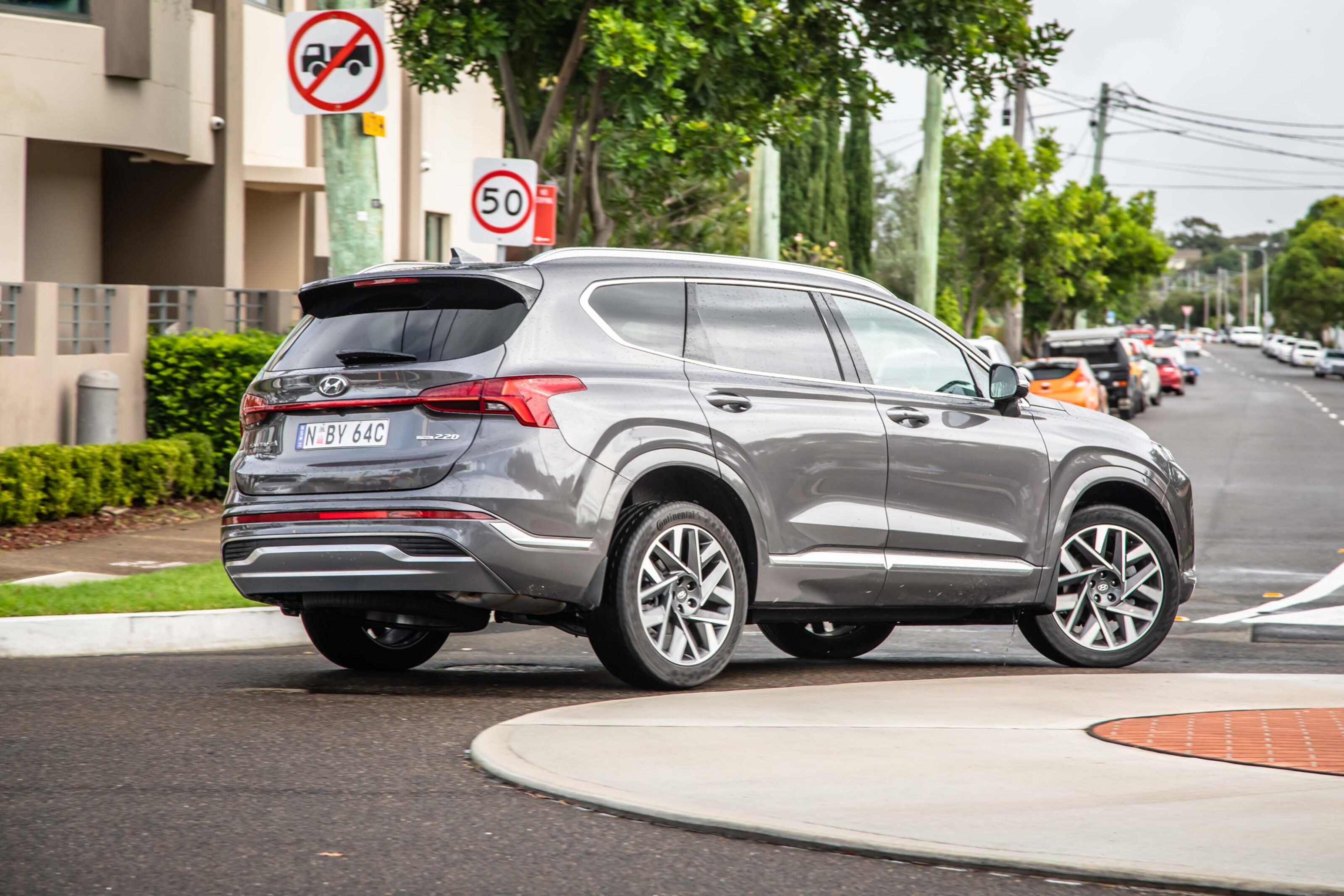
I picked up some people who hadn’t been in a Hyundai for some years and they were amazed at how quiet and comfortable they found the car as I acted as an impromptu Uber driver on a taxi-deficient wet Thursday morning.
Against Hyundai’s official 6.1L/100km fuel figure I got 8.2L/100km in a reasonably balanced city/highway split, which is not bad going for such a big chunky machine.
Ownership
Hyundai’s pace-setting five-year, unlimited-kilometre warranty does fall short of compatriot Kia’s seven years and is now the standard for most manufacturers.
Servicing costs no more than $459 per service for the first five years and you have to return to the dealer every 12 months or 15,000km.
Hyundai’s lifetime capped-price servicing scheme publishes costs out to a ridiculous 34 years or 510,000km and none of the services seem alarmingly expensive, which is comforting for your kids if they inherit the car upon your death.
VERDICT
Will the diesel be able to hold its own against the incoming hybrid? With an expected price gap of several thousand dollars, that’s going to be time to bust out the calculator, an easier task when fuel is so colossally expensive.
Safety upgrades to the MY22 range are also very handy additions for a fairly modest increase in price. It’s interesting to note that these additions have come when the global industry is in a very tight spot for parts, but Hyundai seems to have avoided the worst of it and not had to remove features – at least not on the Highlander.
The Santa Fe remains high on my list of SUVs to recommend, but the clock really is ticking for the diesel. The conundrum here is, of course, that the petrol V6 is also quite thirsty and front-wheel-drive only.
I’m hoping Hyundai is just sweating these ICE-y assets as long as they can until the company can go all-in on electric.
2022 Hyundai Santa Fe Highlander specifications
UPDATE, November 2022: Geely Radar RD6 on the cards for Australia
It seems Geely’s Radar RD6 electric ute could be on its way to Australia, and the previously Europe-only Lynk & Co brand might follow… get the full story at the link below.
The story to here
Snapshot
- Radar RD6 launches for the Chinese market
- Tipped to launch overseas with a 600km driving range
- No Australian berth confirmed
Geely is expanding its plans to take on every segment of the automotive world, launching Radar Auto for its lifestyle vehicles.
A sub-brand of Geely (which also owns manufacturers such as Volvo, Polestar, Lotus and Smart), Radar Auto’s brand launch coincided with the reveal of its first model, the RD6 – an all-electric dual-cab ute, based on the Sustainable Experience Architecture (SEA) underpinning the Lotus Eletre and Smart #1.
Just like the Lotus, the design of the RD6 was overseen by former Ford and Volvo stylist Peter Horbury, with the current Executive Vice President of Geely design saying: “The Radar product portfolio is focused on electric pick-up trucks and SUVs, this direction challenges us to mix functionality and usability with aesthetic form.
“Our aim is to let Radar users expand their horizons and explore nature in a sustainable way.”
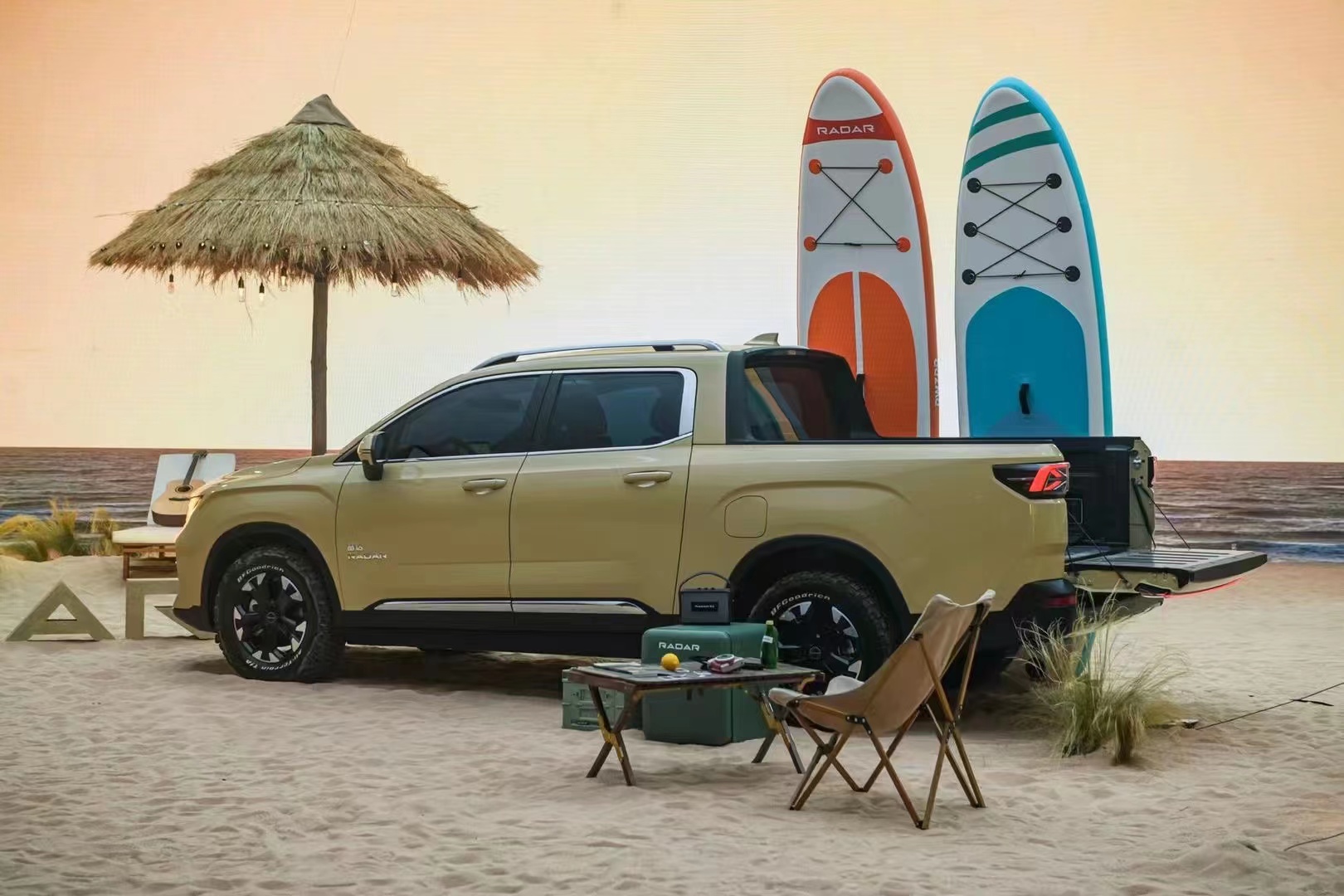
While Radar is keeping its cards close to its chest regarding official figures for the RD6, Car News China has reported it will boast a driving range of roughly 600 kilometres, depending on whether it’s specced in single-motor, 150kW guise, or its dual-motor, 300kW all-wheel-drive spec.
Details on dimensions and features are hard to come by, although it’s understood there will be ample room in the cabin for five passengers and enough space in the back for a plethora of accessories from Radar Weekends, the brand’s lifestyle apparel off-shoot.
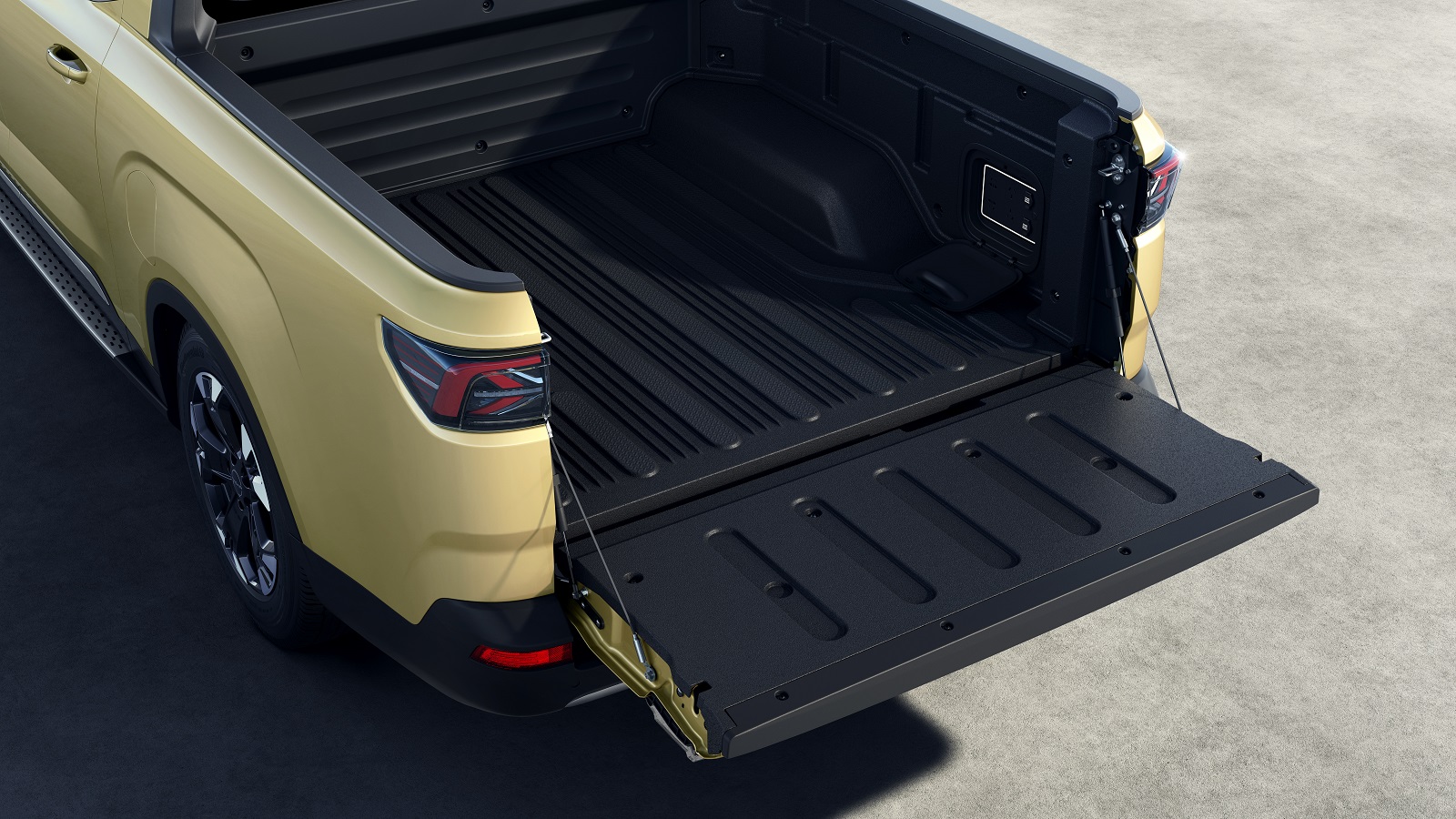
With utes like the Toyota HiLux leading the Australian sales charts and electric vehicle technology becoming more and more accessible to every-day buyers, we could well and truly see an electric Chinese ute in the local market over the coming years – although whether it’s embraced remains to be seen.
Further details about the Radar RD6 are expected to drop next month, although at this stage no Australian plans have been made.
