
The V6 engine is a versatile, if a tad unloved, bit of design. It comes in various shapes and forms and powers anything from affordable performance cars to high-end supercars.
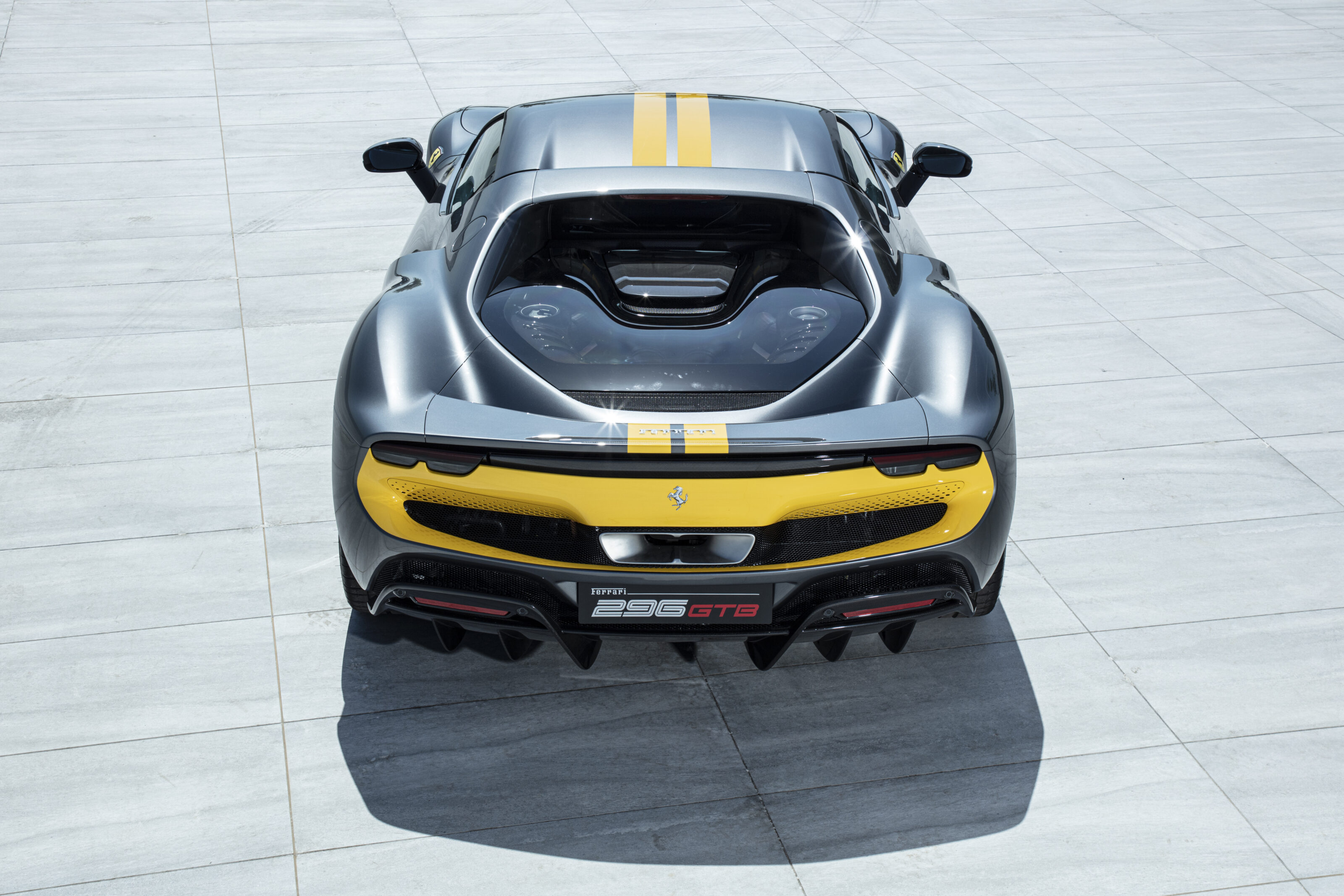
However, until recently, the banks of three-cylinders a piece had never been splayed at a 120-degree angle in a road car. Ferrari and McLaren are about to change that with their 296 GTB and Artura supercars. Both are going to be mind-bendingly fast and are set to utilise hybridised, twin-turbocharged 3.0-litre 120-degree V6s.
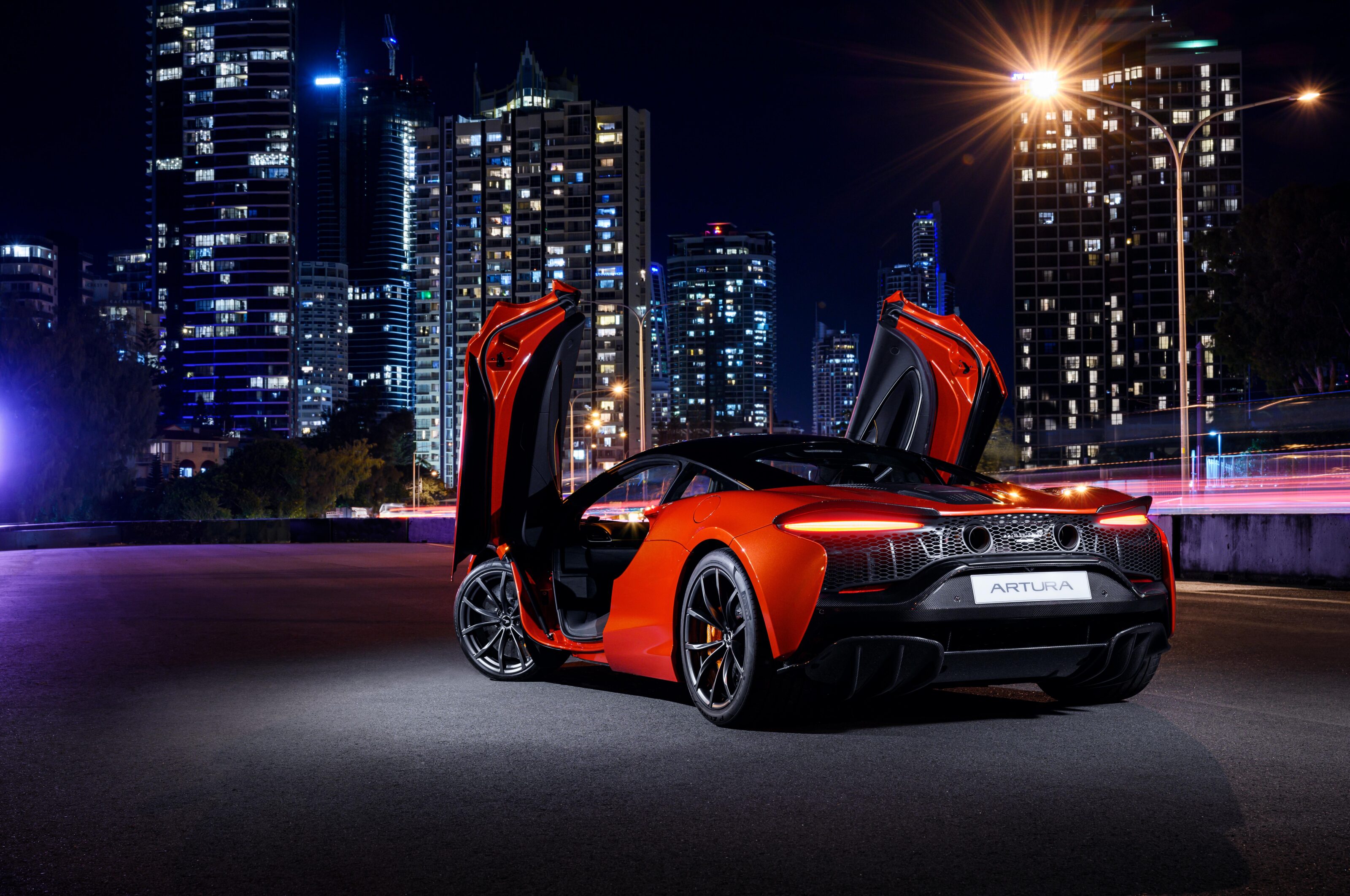
It’s a significant advancement for the humble V6. So it’s worth investigating and explaining why the two powerhouses have independently decided a 120-degree layout is the design they will utilise in their brand new models.
On paper, a 120-degree vee angle has plenty of merits. The layout means that opposing cylinders can share a crank pin, shortening the overall length of the crank. A shorter crankshaft is a stronger crankshaft and reducing the overall size of the engine saves crucial kilograms.
The wider angle also falls into a sweet spot for packaging. A flat 180-degree would be best for centre-of-gravity. However, the width makes fitting it, along with the requisite plumbing, a significant challenge. A 120-degree layout falls into the sweet spot between fully flat and 90-degrees to help keep the engine’s weight as low as possible.
McLaren Artura chief engineer Geoff Grose explains that finding the right compromise between height and width is important.
“One of the challenges of a narrower design is it pushes the engine height up, and we are trying to keep the engine really low. Going with the 120-degree angle means you can share a crank pin between two opposing cylinders which helps shorten the length of the crankshaft and ultimately the length of the engine,” he told MOTOR.
“It still needs to be compact enough to fit in the middle of the car, so it can’t be too wide either. We have really squeezed down the gap between the cylinders and pushed in the dimensions from every direction.”
But there is a catch. The 120-degree formation has a primary imbalance that requires balancer shafts to rectify. Not an insurmountable challenge, but not one to be overlooked either.
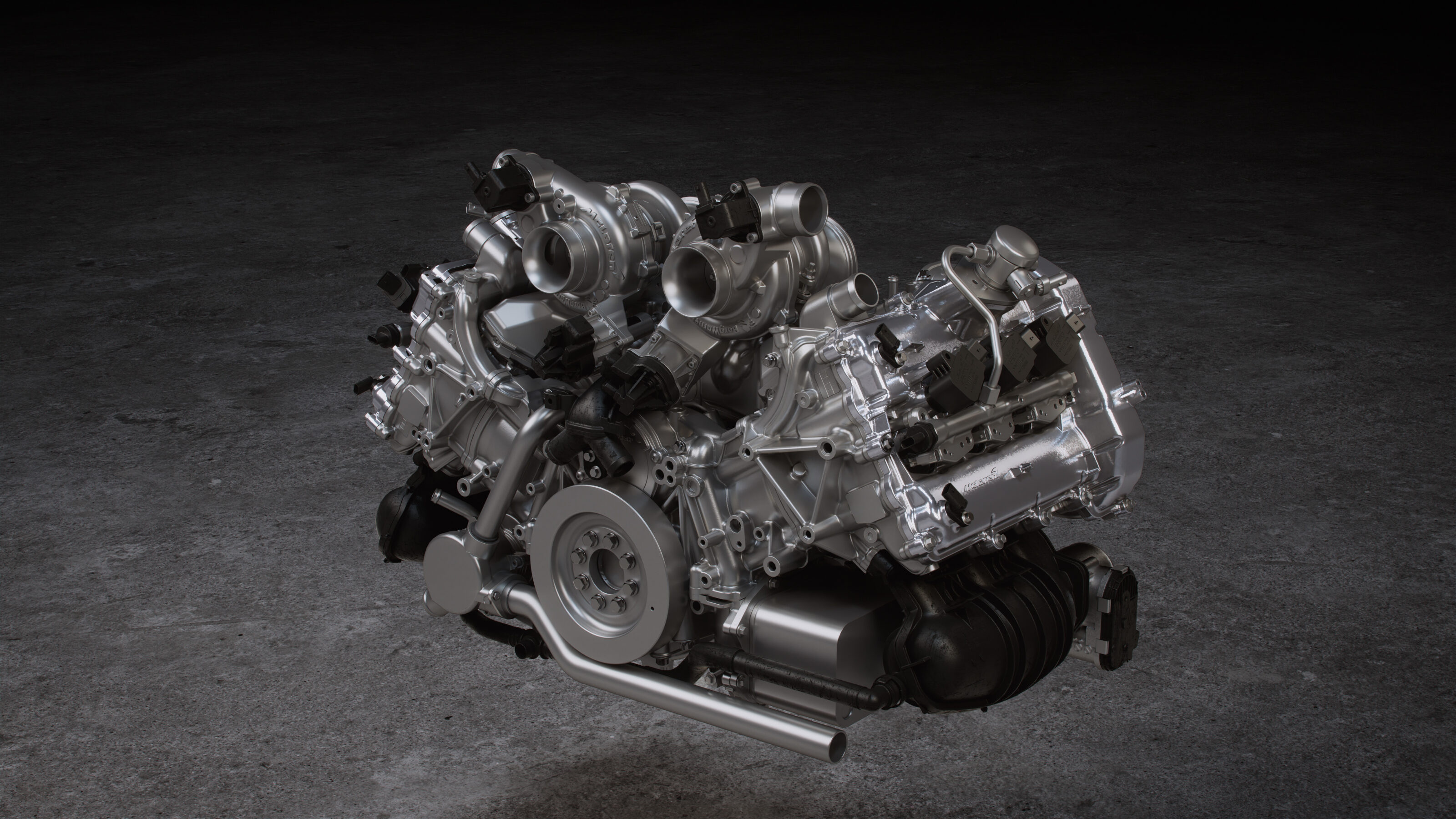
Codenamed M630, McLaren’s new V6 is an impressive piece of kit on paper. Developed by Ricardo, it revs to 8500rpm and produces 430kW/585Nm from three litres of swept capacity without the aid of the Artura’s hybrid battery pack.
By dropping two cylinders, the V6 is 40kg lighter than the outgoing twin-turbocharged M838 V8. It also sits 93mm lower in the carbon monocoque, while the hot-vee set-up means it is 220mm narrower overall. When packaging is key, the 120-degree V6 wears a sizeable crown.
The flow-on effect of this compact design is significant. It gave McLaren’s engineers the space needed to rework the Artura’s rear suspension design with a broken wishbone design.
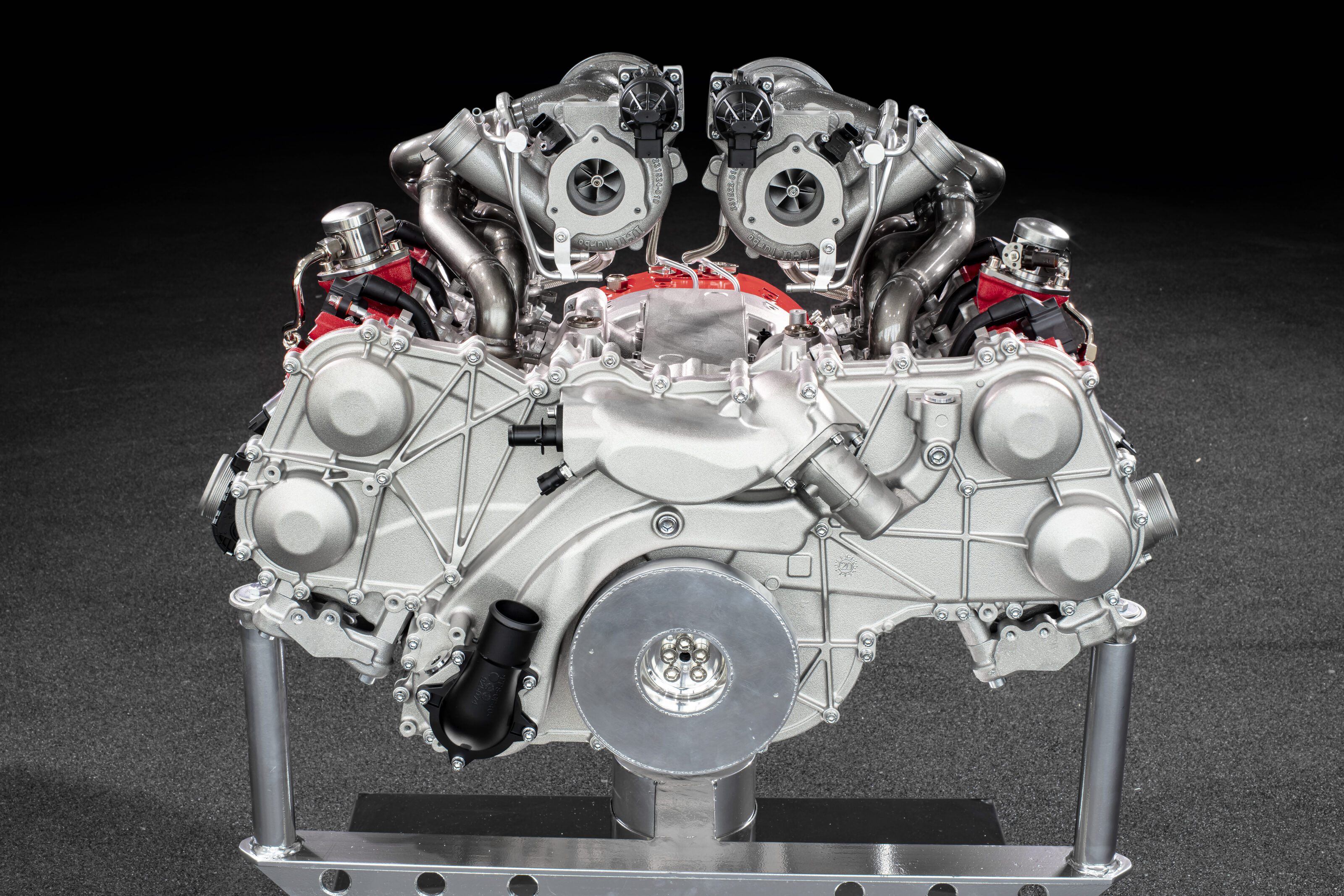
Ferrari has been at the forefront of 120-degree V6 engine design, using the layout in its dominant 1961 F1 campaign. But it hasn’t used the layout in a road car before. The 296 GTB changes that.
With a 3.0-litre capacity, the twin-turbo unit produces 488kW, or 163kW per litre – making it the highest specific output ever fitted to a road car. With the wide vee angle it was able to fit larger turbos in the hot vee set-up, while optimising exhaust length and direction to maintain engine response.
Power isn’t the only benefit, with Maranello also reaping packaging benefits from the 120-degree design, shortening the 296 GTB’s wheelbase 50mm compared to that of the F8 Tributo.
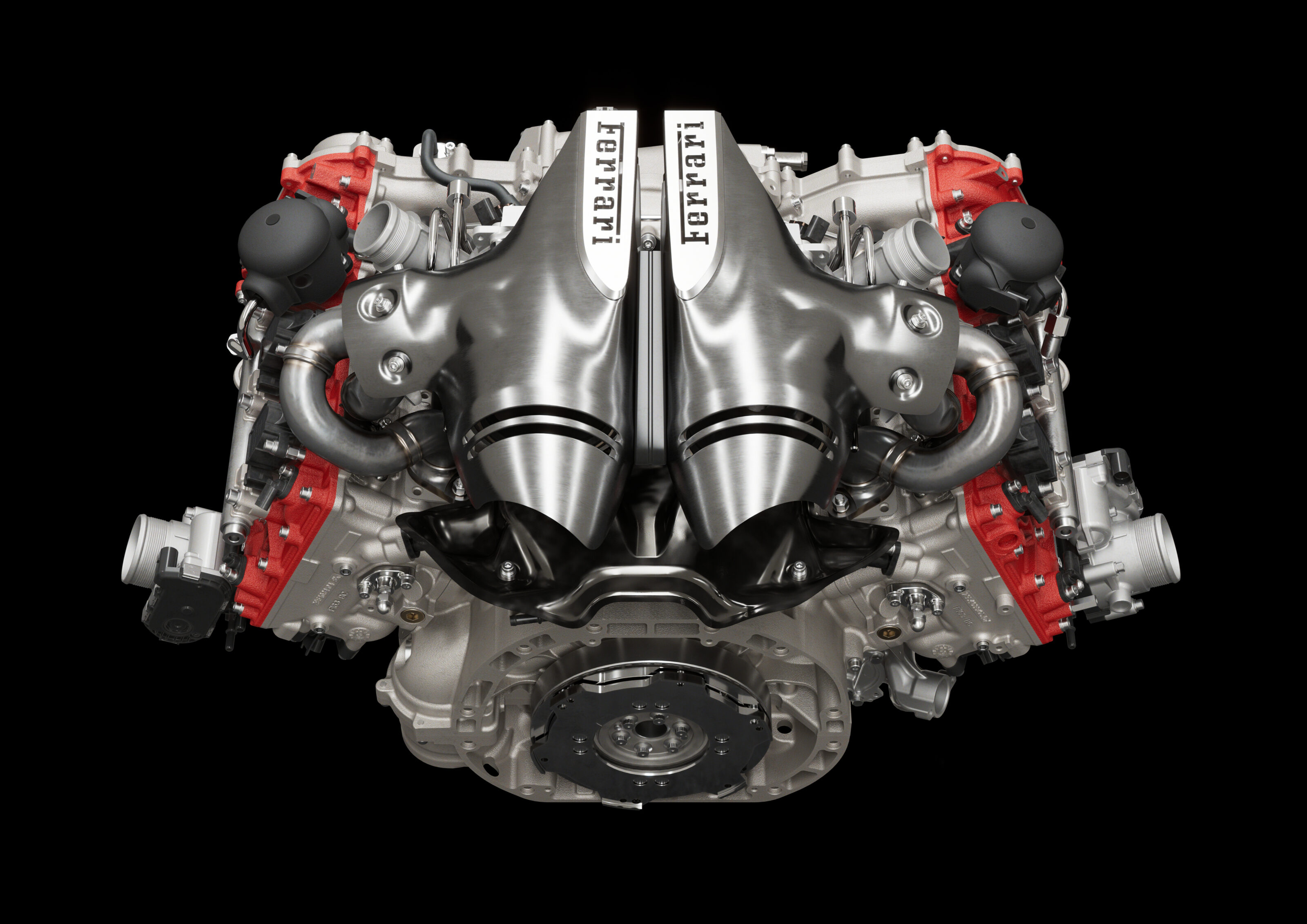
V6 engines haven’t always been adored for their acoustic talents, but the team at Maranello is so enamoured with the F136 that the unit is referred to as a ‘piccolo V12’ internally. We’ll wait until we hear it in person to back that claim up.
It’s important to note that the benefits McLaren and Ferrari have reaped with their new engines are also intimately linked with a mid-engine car design. The packaging benefit of a 120-degree engine becomes moot in a front-engined car.
Ultimately, you can expect the new, wider vee angle V6 to thrive in the performance car world in the coming years as downsizing and electrification continues unabated. However, being limited to mid-engined applications means it’ll remain an exclusively upmarket design – a piccolo V12 in more ways than one, then.
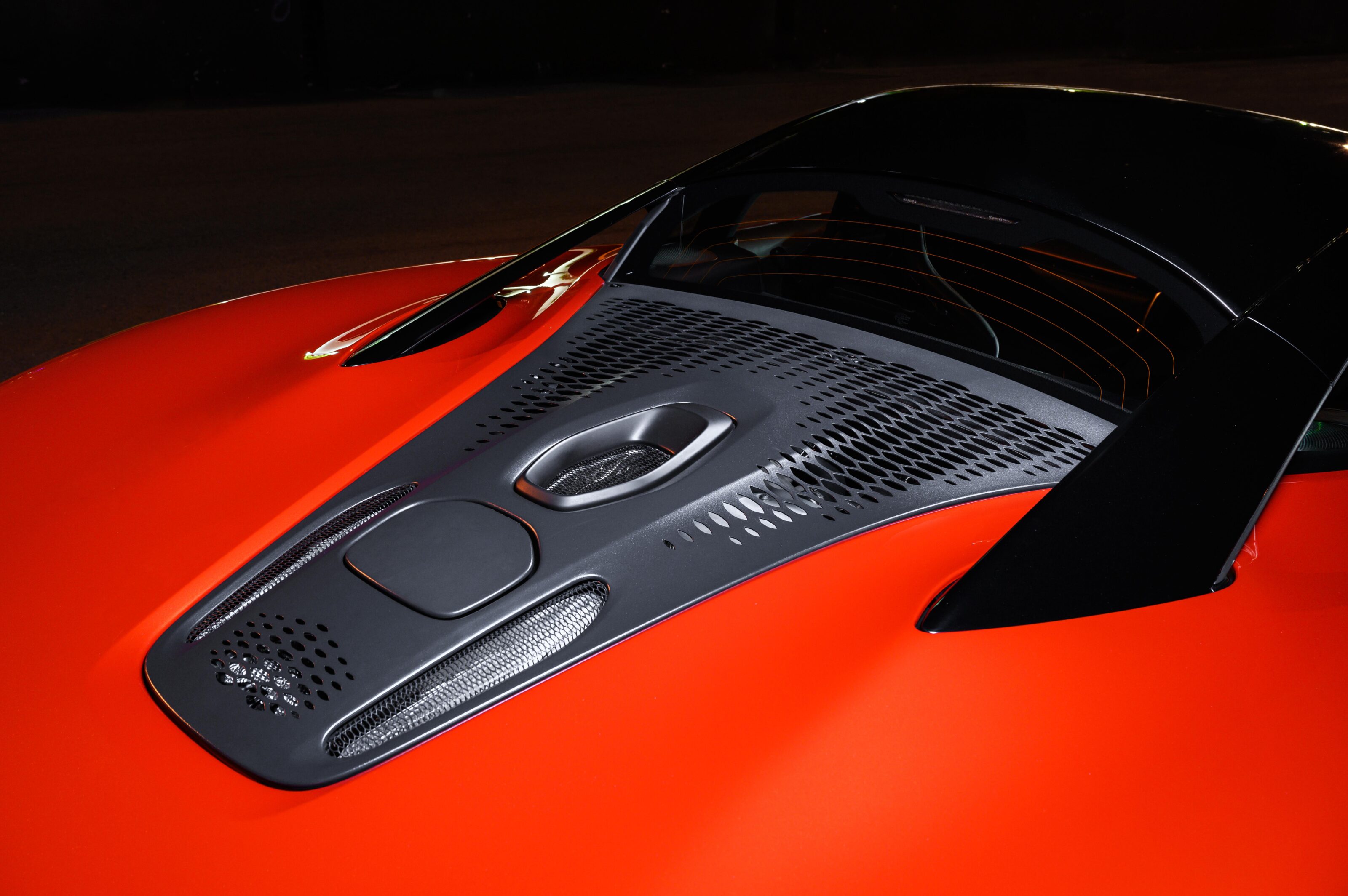
There’s a certain weight of expectation that follows when any manufacturer dusts off a bygone badge or nameplate and puts it back into production. We can’t think of a nameplate revival more ambitious than that of the legendary Lamborghini Countach and yet, 50 years later, The King returns for 112 lucky buyers.
In the latest edition of MOTOR, on sale now, we speak to the movers and shakers behind the project for further insight on their ethos in tackling one of the automotive world’s most ambitious revivals.

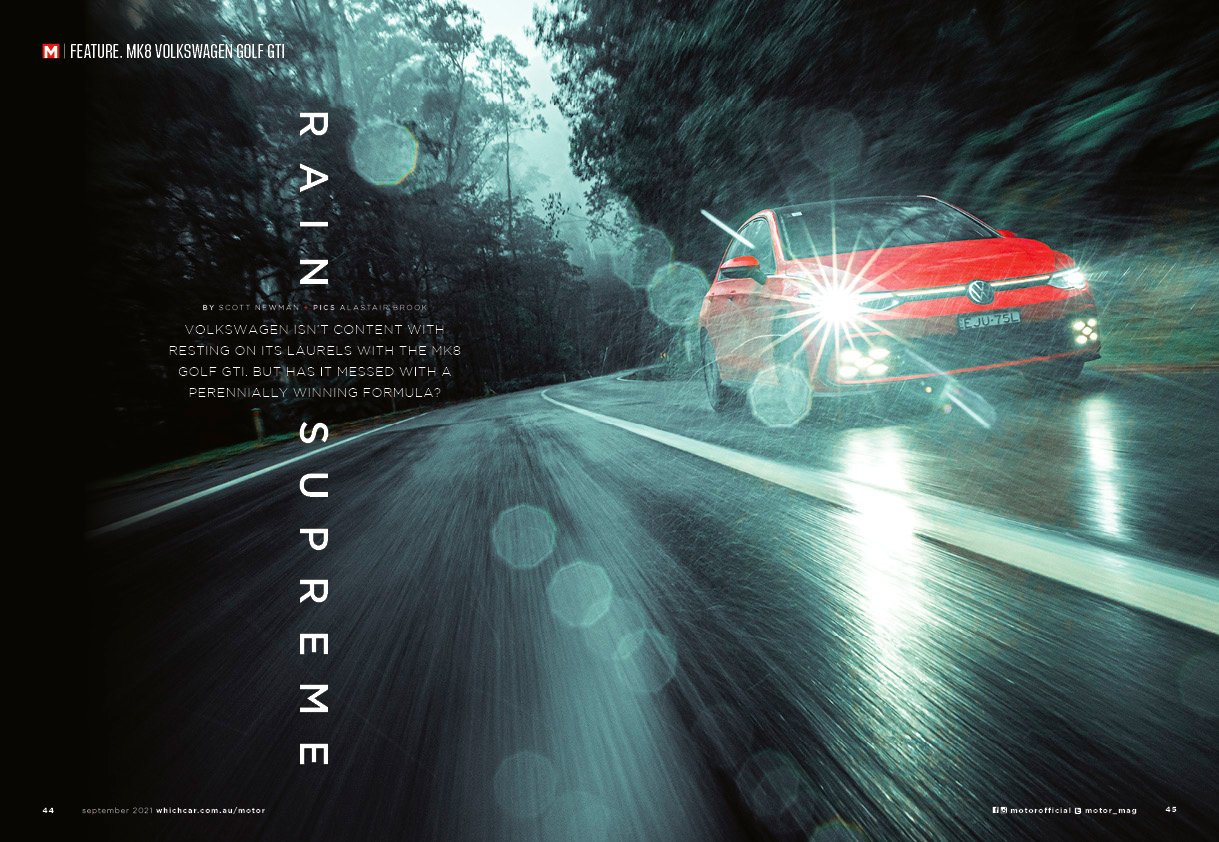
From hypercars to hot hatches, we put the new Mk8 Golf GTI through its paces on Australian roads. With the latest generation in hand, we want to know whether Volkswagen has messed with a winning formula? We endure sleet and rain through Victoria’s alpine region to find out.
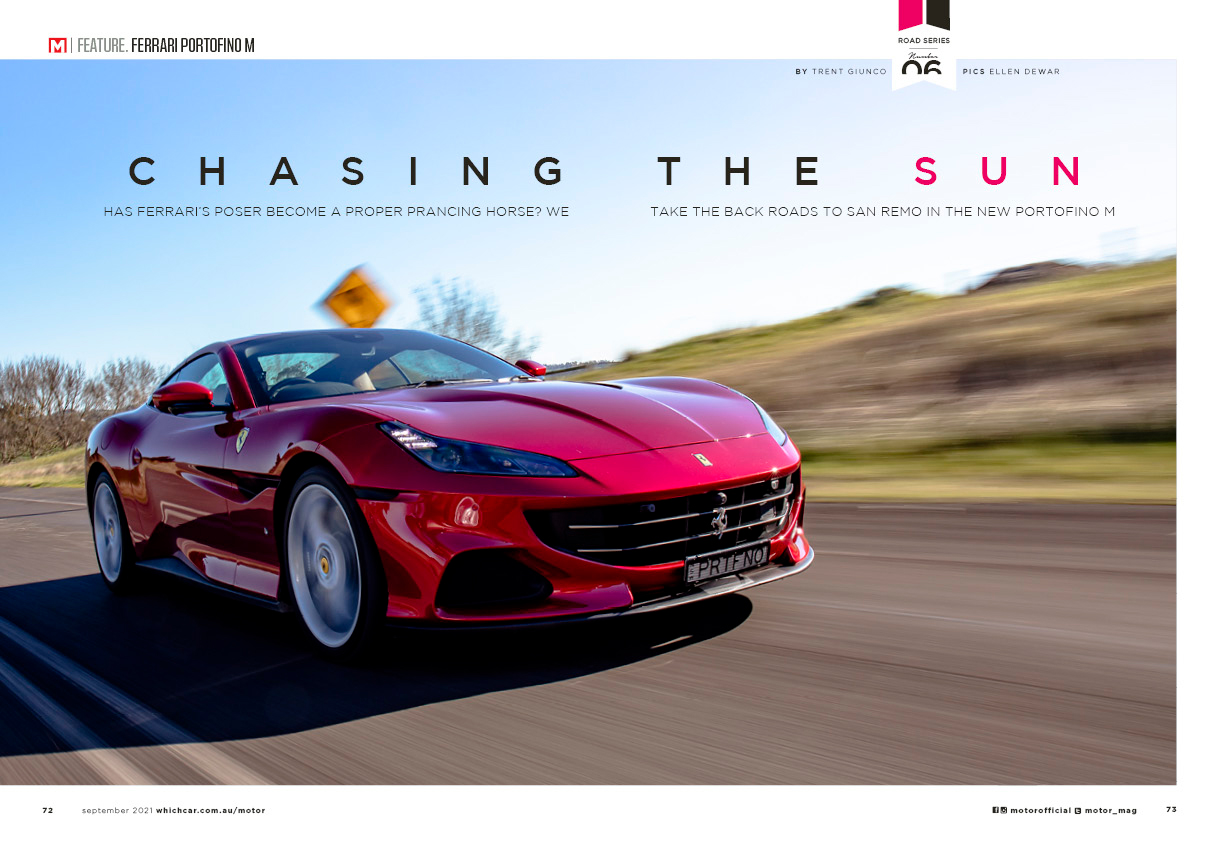
From the icy grasps of the High Country, we seek the sun from behind the wheel of Ferrari’s Portofino M. Maranello’s convertibles have traditionally been less celebrated than the brand’s hardtop mid-engined offerings but, then again, there’s never been one as poised and potent as this. Think Ferrari convertibles are just boulevardiers? The Portofino M is here to change that.
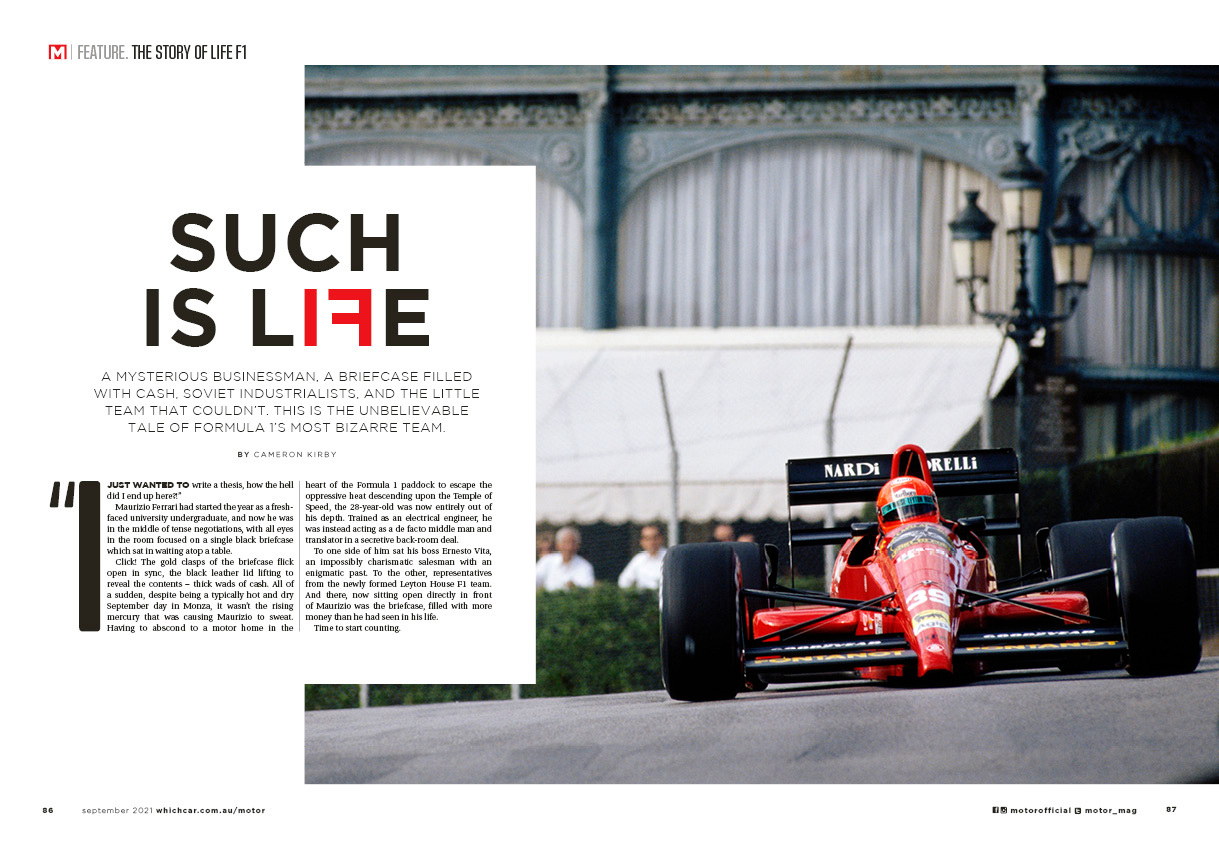
It’s not just the latest and greatest in hot metal, however, as we go back in time and get the inside line on the most unsuccessful Formula 1 team of all time. It’s a story that beggars belief, involving a mysterious businessman, a briefcase filled with cash, Soviet industrialists and a fascinating look at one of the last true privateer efforts of the sport.
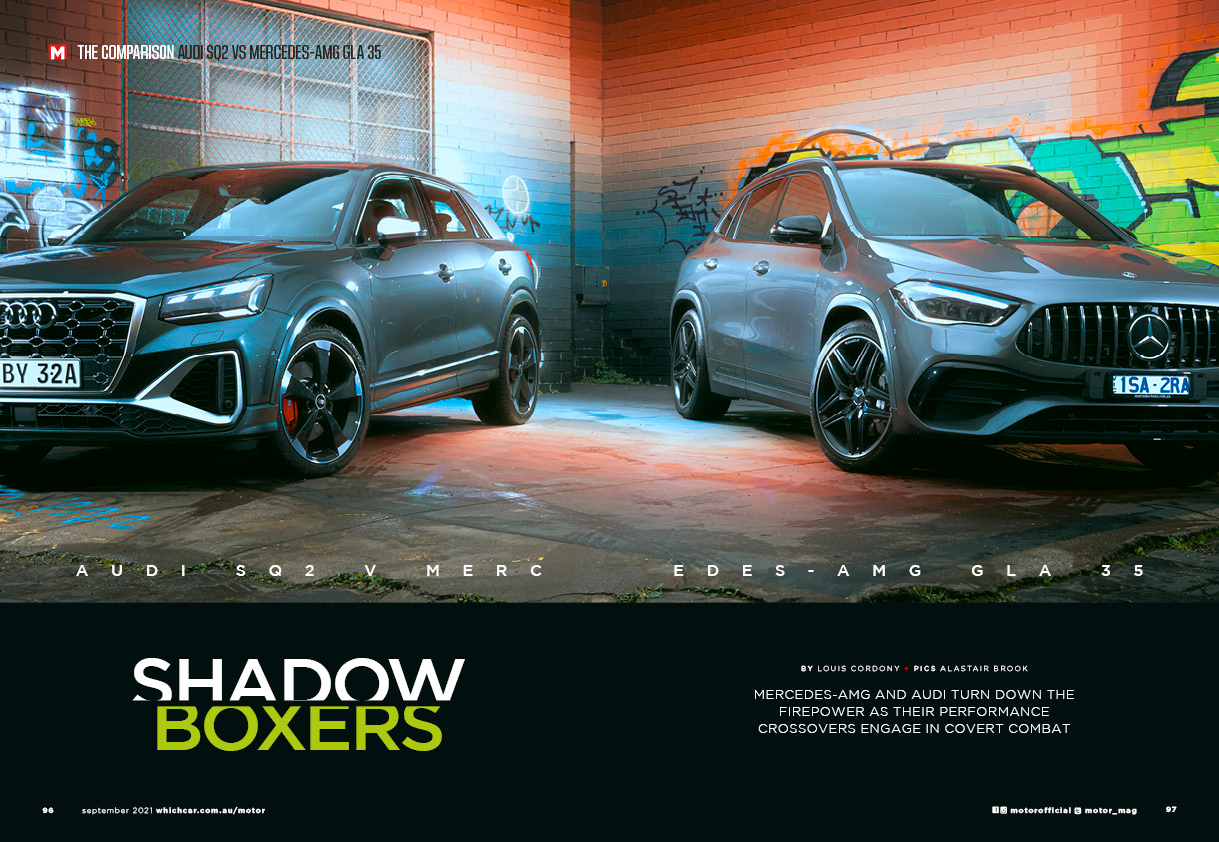
Further along, we pit the Audi SQ2 and Mercedes-AMG GLA35 against each other to see which Mustang-mauling micro SUV reigns supreme. This month’s Sweet Dream sees us imagine a modern reprisal of BMW’s quirky Z3 M coupe, while this month’s Top 10 list recounts the world’s most delectable restomods money can buy.
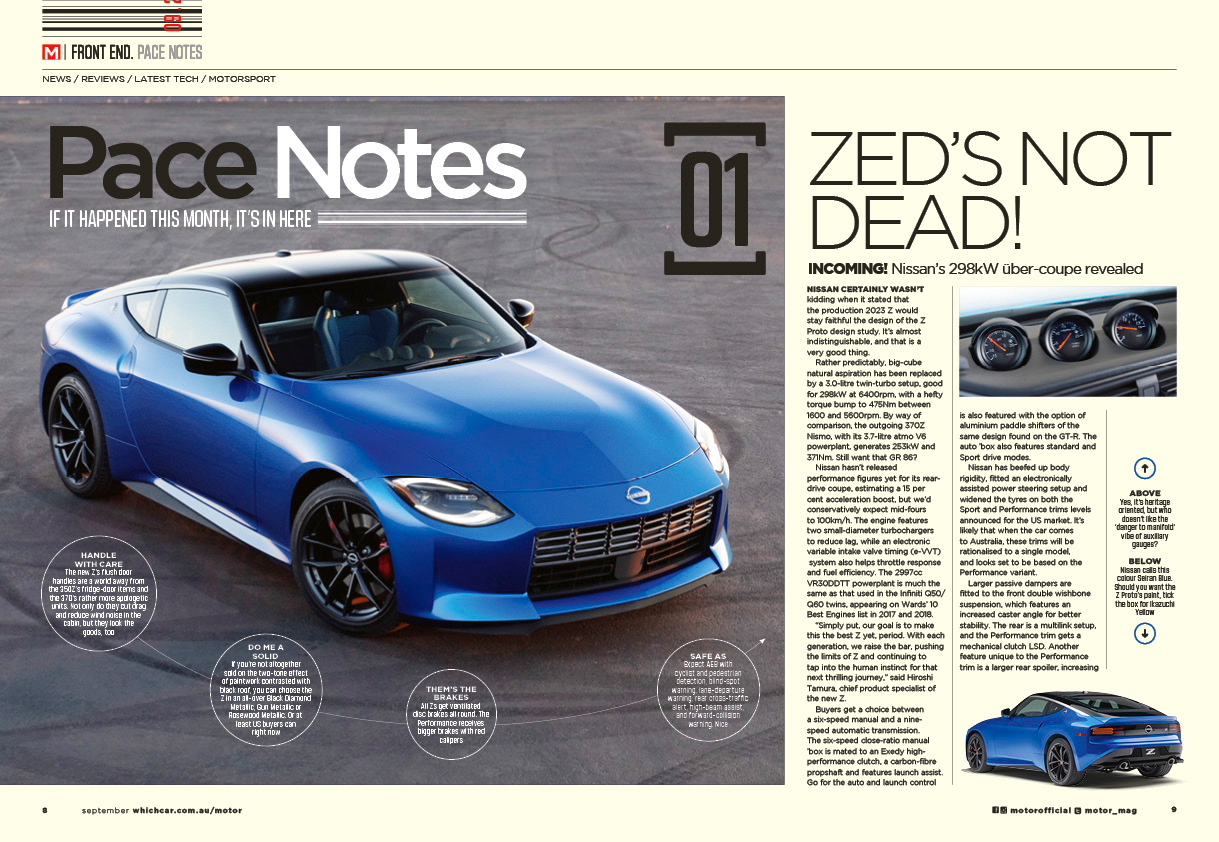
Of course, there’s also a raft of performance car news, including our first look at the production-ready Nissan Z. We also have our first steer in the Hyundai’s new Kona N, the Alpina B3, updated Alfa Romeo Stelvio Q and Jaguar I-Pace.
You can find the September edition of MOTOR Magazine in stores, or get them delivered straight to your door at motor.subscription.com.au
Snapshot
- Ultimate luxury version of Mercedes EQS SUV
- Vase holder and champagne goblet storage inside
- Release date not yet confirmed
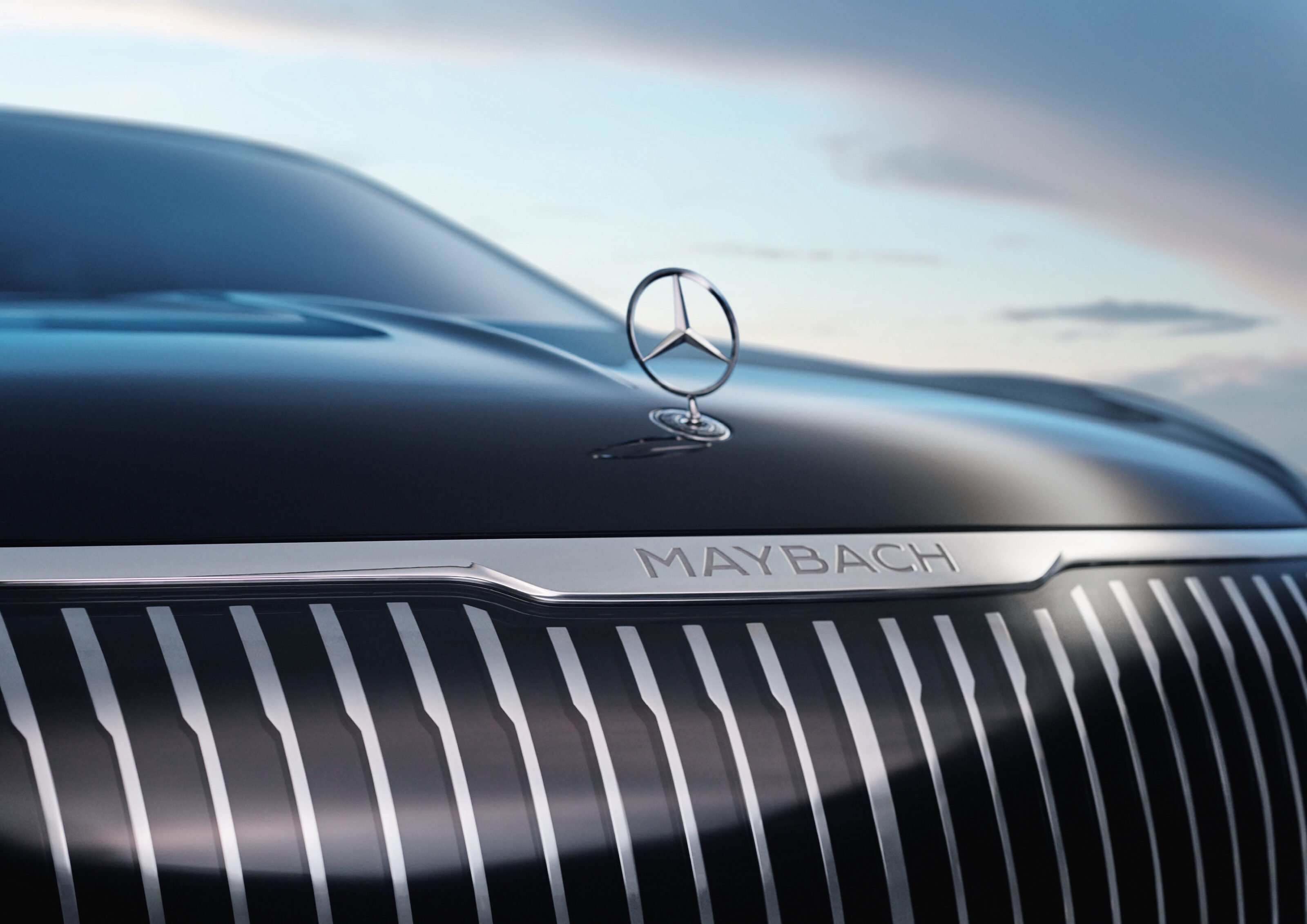
Ultra-luxury brand Maybach has offered a glimpse at its first all-electric vehicle – in the form of the Concept EQS SUV.
It’s based on the same modular architecture which will underpin the SUV version of parent company Mercedes’s EQS, which is due in 2022.
While the vehicle detailed here is technically a concept, Maybach is treating it as a “clear preview” of the production model.
“The Concept Mercedes-Maybach EQS represents the transformation of the tradition-rich luxury brand into a more progressive, all-electric future,” said AMG CEO Philipp Schiemer. “With the future all-electric SUV series model, we’re extending our leadership aspirations in the high-end segment to the area of electric mobility, too.”
Details of the SUV’s powertrain are yet to be confirmed, but Mercedes says driving range will be around 600km. It may use a drive layout similar to the top-spec EQS sedan – which will feature AWD via two electric motors for a 385kW output.
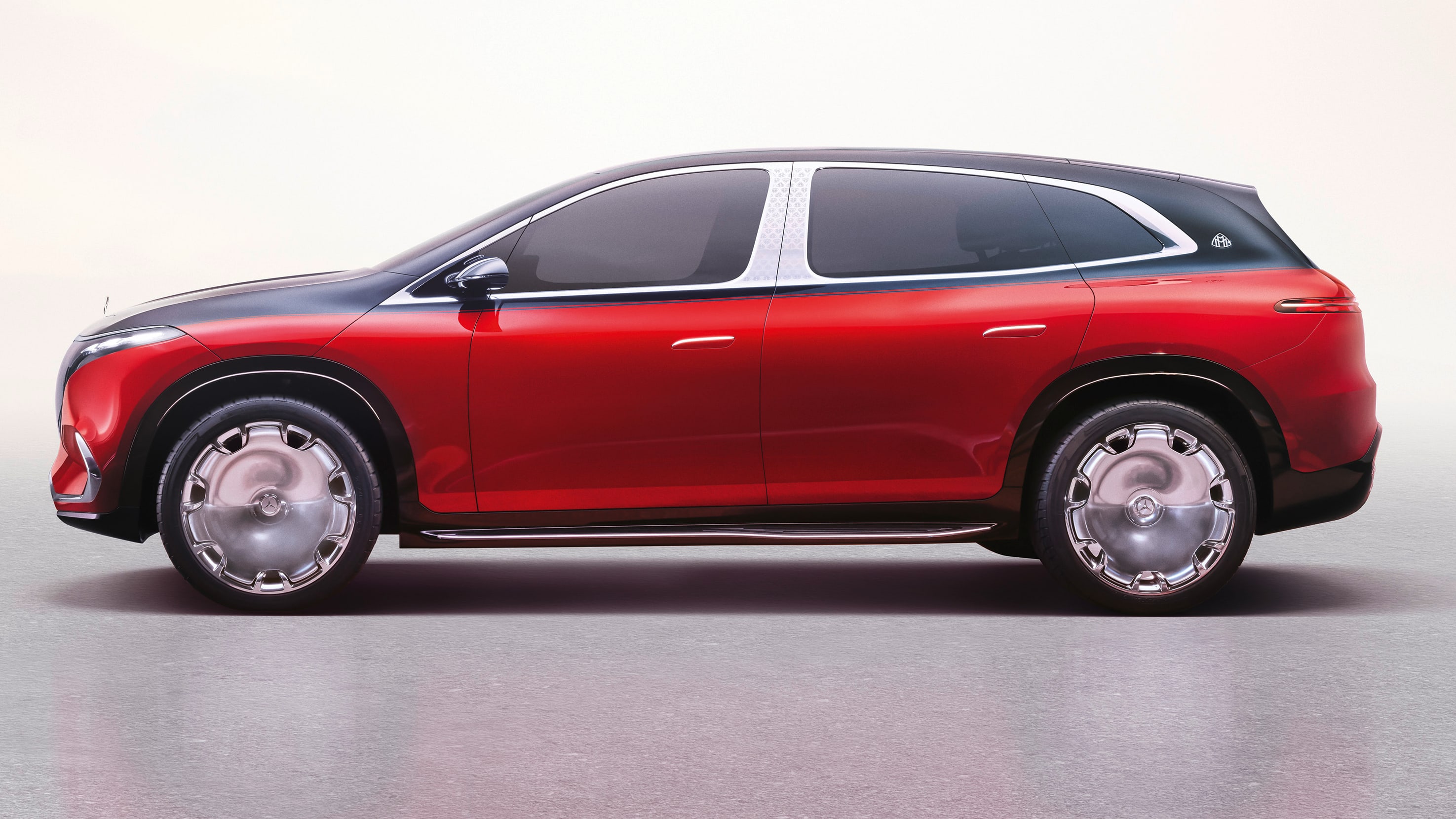
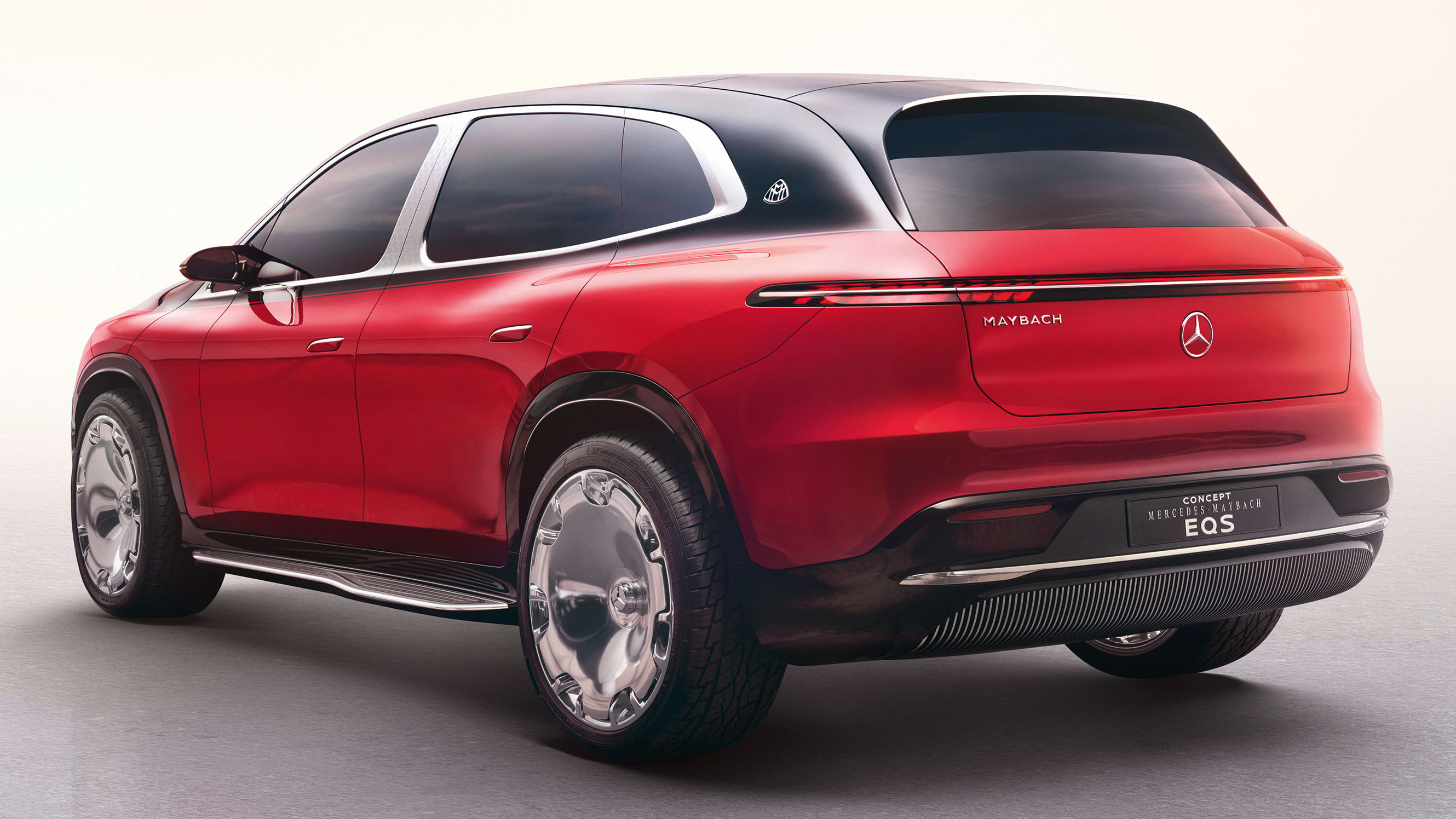
As is standard for Maybach, the Concept EQS features an exterior treatment different to its Mercedes counterpart. The SUV shown wears a black metallic on zircon red paint scheme, split by a chrome pinstripe. As with the Mercedes-Maybach S-Class, two-tone paint will presumably be an option offered to consumers.
Chrome accents feature prominently, appearing on the bumper, window surrounds, B-pillars, and roof spoiler. Wheels are 24-inch units with Maybach’s distinct ‘bowl’ design.
Automatic doors activate as the driver approaches, while the passenger doors can be operated remotely by the driver.
A Maybach-specific version of Mercedes’s MBUX Hyperscreen display appears up front, consisting of three screens encased behind glass.
The passenger seat gets its own 12.3-inch OLED screen, which automatically dims if the car’s interior camera captures the driver looking sideways.
Introduced in 2018, it uses machine learning and AI software to detect driver habits and reduce menu navigation time. The compact steering wheel comes from the Vision EQS concept, though it’s unclear if it will appear on the production car.
The front and rear seats draw inspiration from the S-Class. The passenger seats have received the two-seat Executive option, plus the Chauffeur Package for extra rear legroom. Both options will likely be standard on the production Maybach.
The larger SUV body has also allowed designers to enlarge the rear ‘calf rest’, letting passengers rest their feet above the faux-fur floor covering.
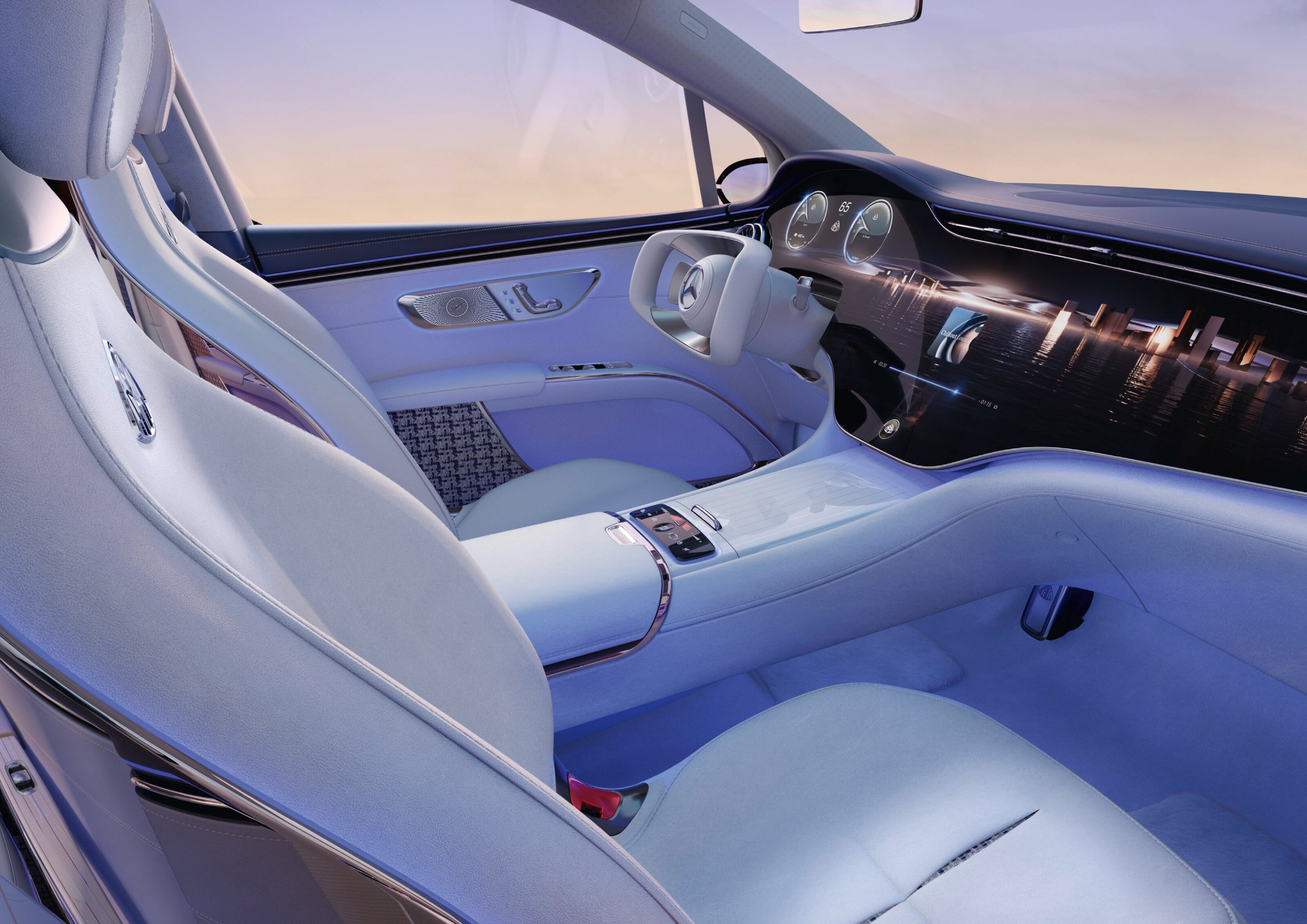
A floating console extends to the passenger seats. It features a vase insert as standard, with Maybach encouraging owners to bring “seasonally-appropriate floral decorations” into their car. Underneath is space for a variety of individual equipment options. Maybach suggests folding tables, a refrigerated compartment, or a box of champagne goblets.
There’s also an unspecified “fashion-inspired, progressive textive” used in the rear compartment, and the roof liner is a printed leather pattern.
No release date or pricing details for the Maybach EQS have been made public, but the Mercedes version will appear first. That car is expected to enter production next year.
Snapshot
- Dual-motor all-wheel drive system produces 484kW
- AMG Dynamic Plus package increases figure to 560kW
- 107.8kWh battery pack helps achieve a driving range of 580km
The recently-released Mercedes-Benz EQS now has a faster, sharper sibling – with Mercedes-AMG launching its EQS 53 at the IAA Mobility Show in Munich.
As the first all-electric offering from AMG, the EQS 53 builds on the S-Class’s electric spin-off and amps it up, with power and torque now increased from 385kW and 855Nm to 484kW and 950Nm in standard guise. Meanwhile, the optional AMG Dynamic Plus Package delivers 560kW and 1020Nm – enough to propel the 2655kg car from 0-100km/h in 3.4 seconds.
Utilising the same 107.8kWh battery from the EQS, the AMG EQS 53 is still able to deliver a WLTP tested driving range of between 526 to 580 kilometres, with DC charging allowing up to 200kW at fast-charging stations to provide an extra 300km in just 15 minutes.
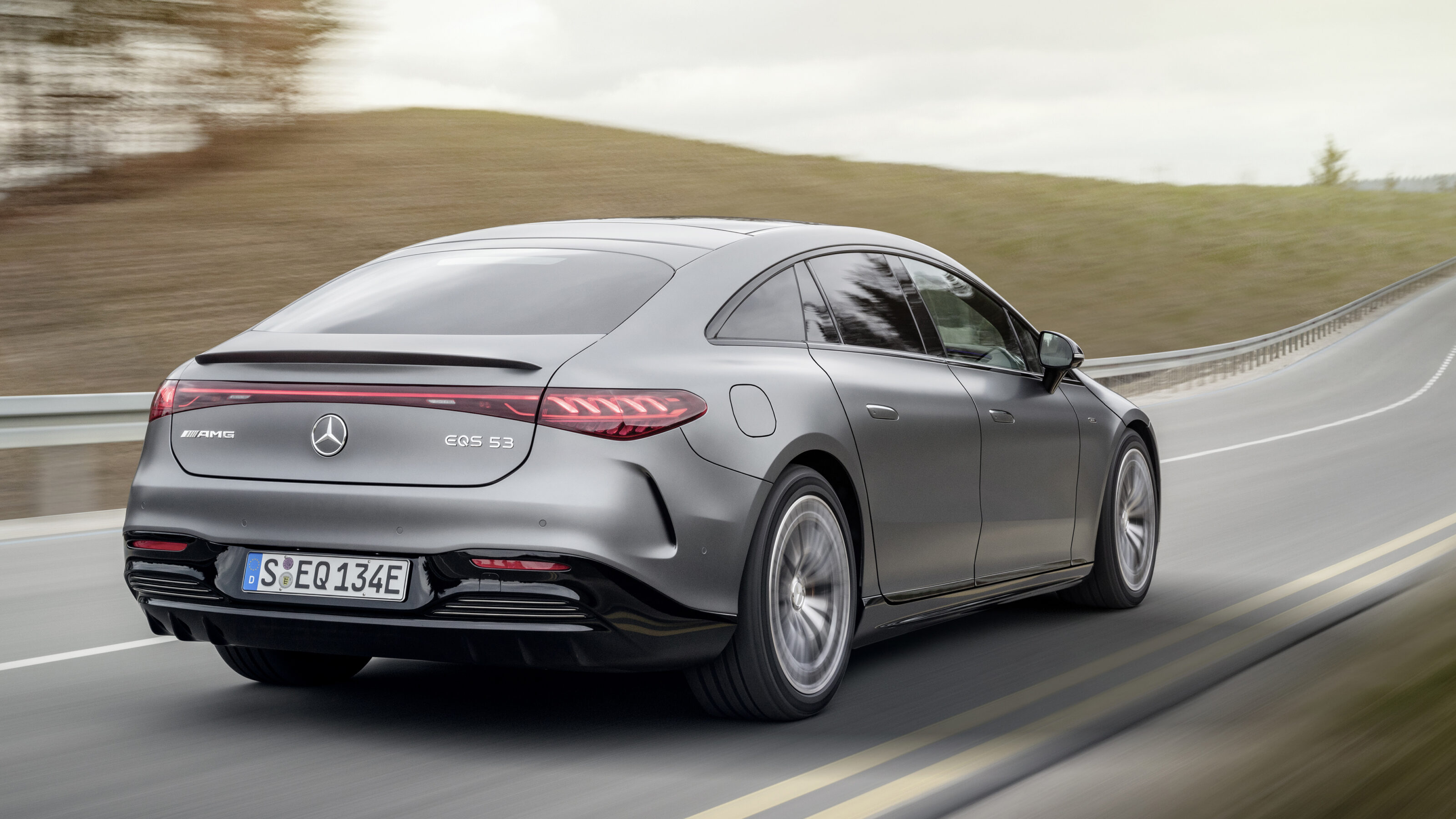
Aesthetic changes from the EQS set the 53 apart from its sibling, including a front splitter with chrome trim and AMG side sill panels in high-gloss black, fins on the air intakes, an aerodynamically optimised rear diffuser, larger rear spoiler and 21 or 22-inch AMG light-alloy wheels in aero or heritage design.
Prospective EQS 53 buyers can also order certain elements to let their car stand out from the crowd, with Mercedes-AMG offering red brake calipers, AMG carbon trim, AMG Nappa leather seats and the AMG Night Package Dark Chrome as a part of its options list.
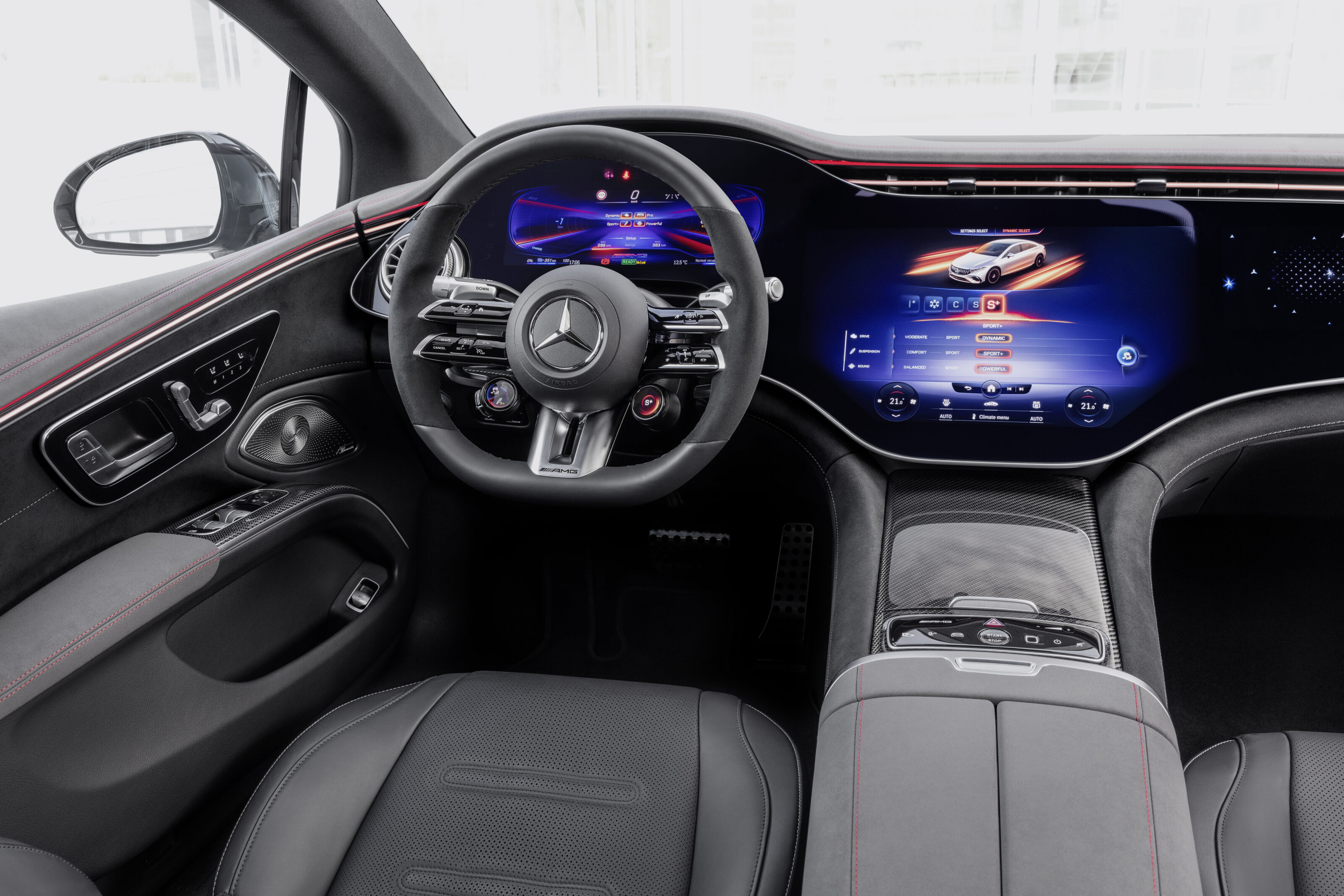
Moving in to the EQS 53’s cabin, the performance sedan scores the AMG treatment with Artico leather seats, featuring Microcut microfibre and red contrast topstitching – although, as previously mentioned, Nappa leather is also available.
The Artico leather treatment continues on the EQS 53’s instrument and door panels, as well as the centre console, while the AMG flat-bottom steering wheel is wrapped in Nappa leather – contrasting the metal AMG sports pedals and AMG logo-laden floor mats.
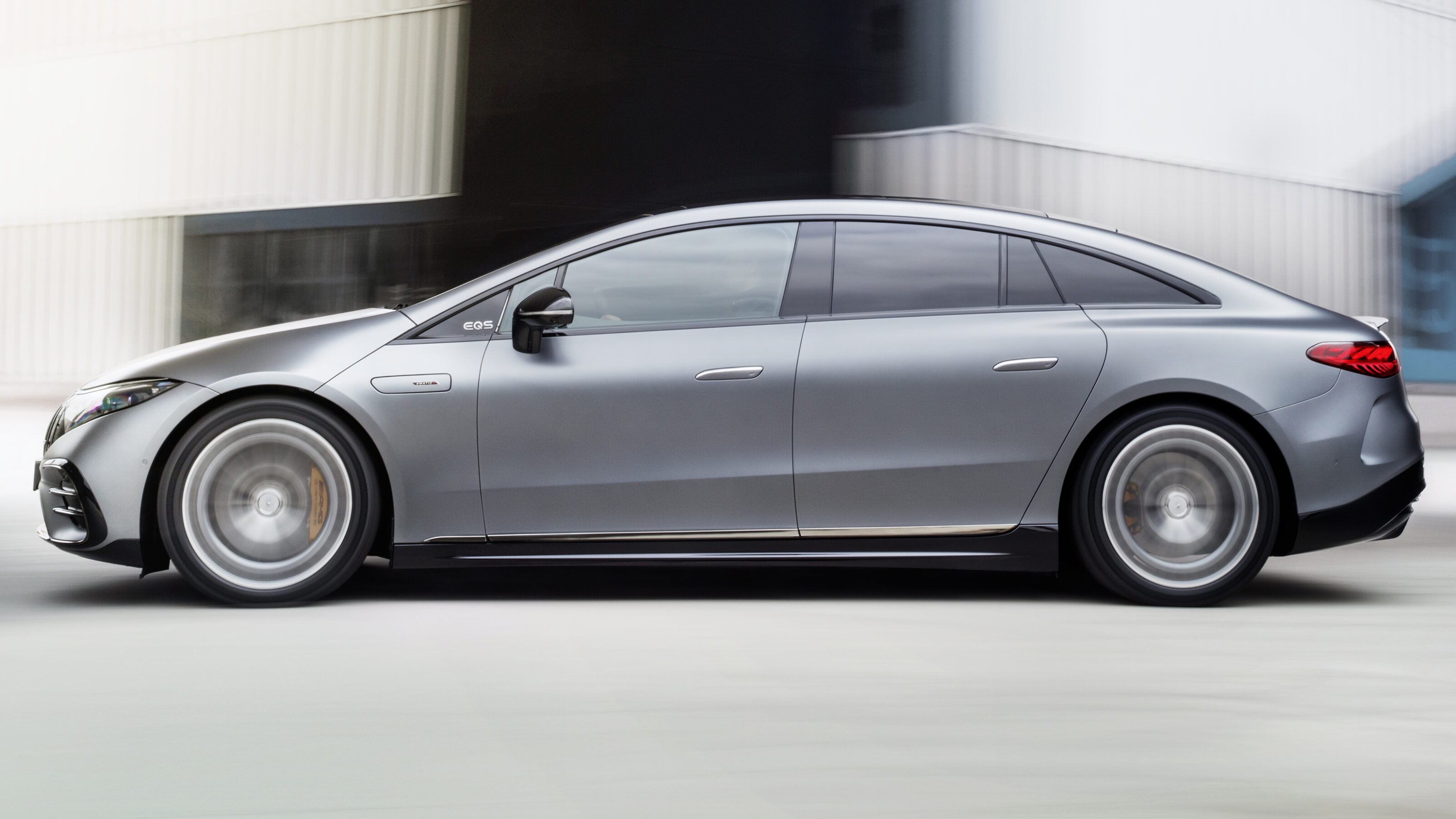
In the absence of a thumping V8 or crackling inline-four under the bonnet, AMG has added a sound system to the cabin, which uses “special loudspeakers, shakers and a sound generator to create a special sound experience in two versions – authentic or performance”.
The AMG Track Pace system is also available as an option, allowing drivers to record and track their times while on a race track, taking data from 80 different elements of the car to provide a motorsport-esque experience in the cabin.
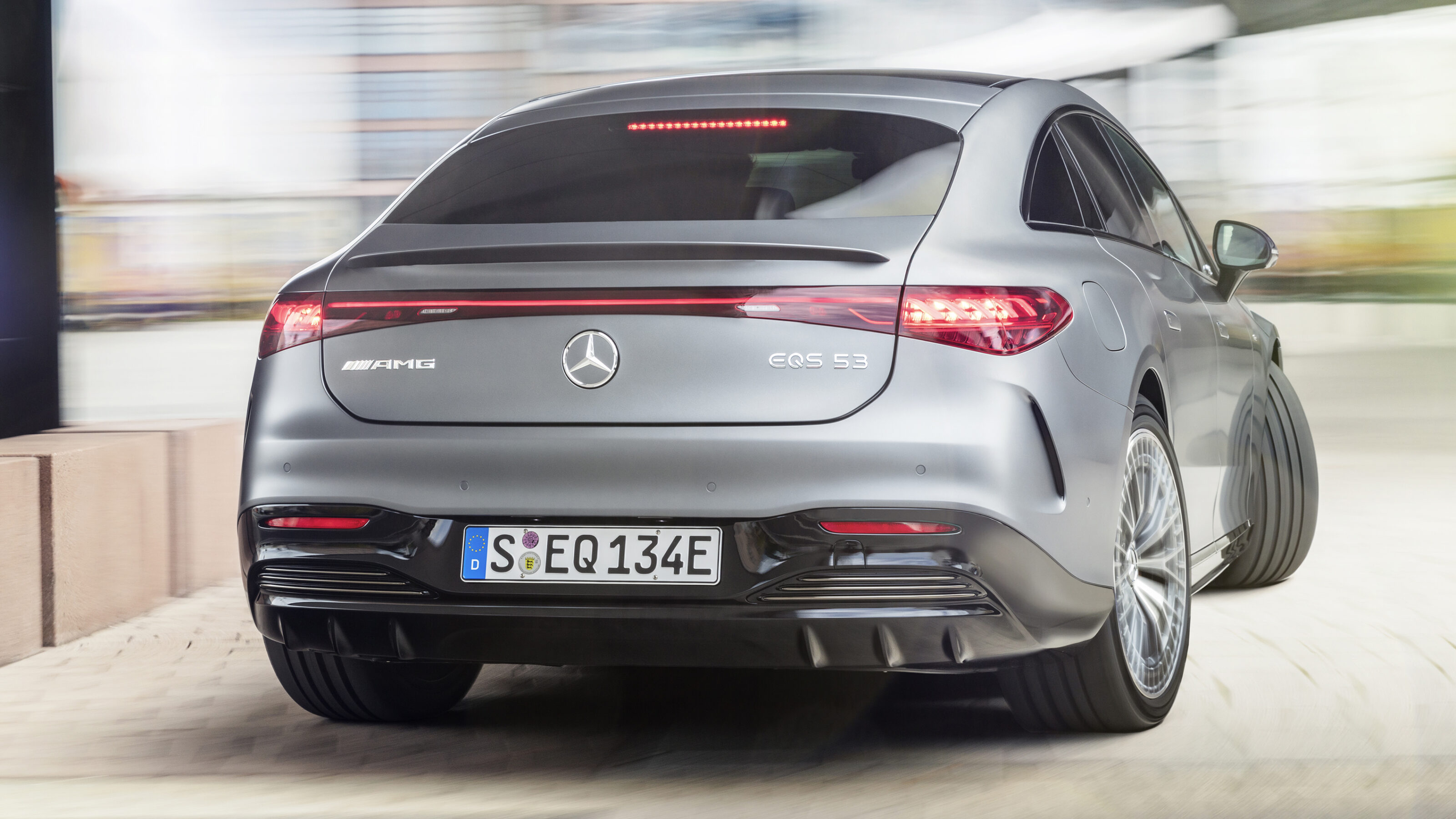
Just like with the EQS, the 53 features four-wheel steering with nine degrees of articulation unlocked from the factory – as opposed to the car its based on, which allows 4.5 degrees when it rolls out of the dealership. The full 10 degrees is available via a subscription.
With the Mercedes-Benz EQS estimated to cost around $330,000 in Australia, it wouldn’t be unreasonable to expect the Mercedes-AMG EQS 53 to land over $400,000 or higher when it does come Down Under in the first half of 2022.
Snapshot
- Lots of EQS-inspired tech
- Sleek aero contributes to a 660km WLTP driving range
- Kicks off with 215kW EQE 350
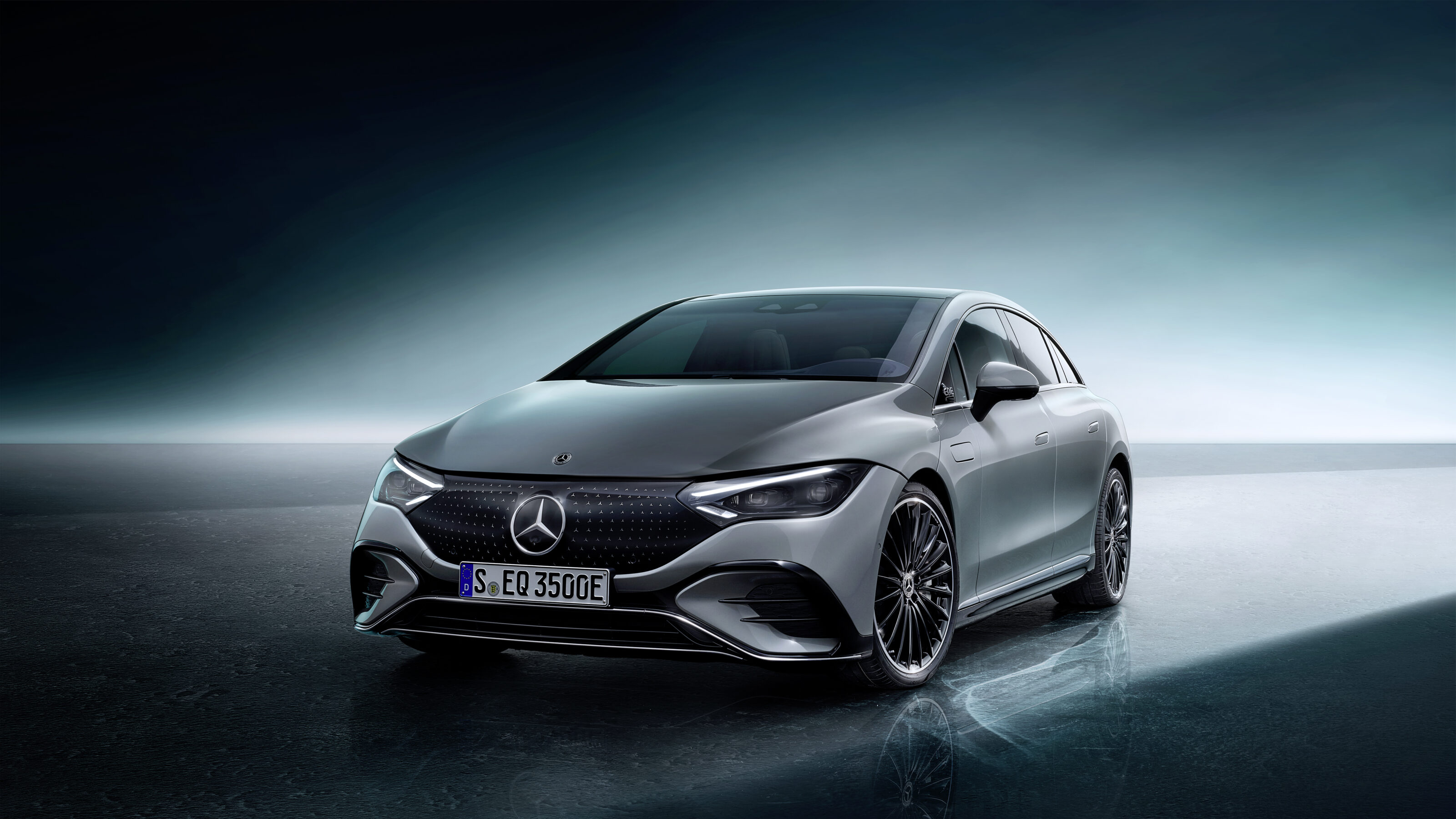
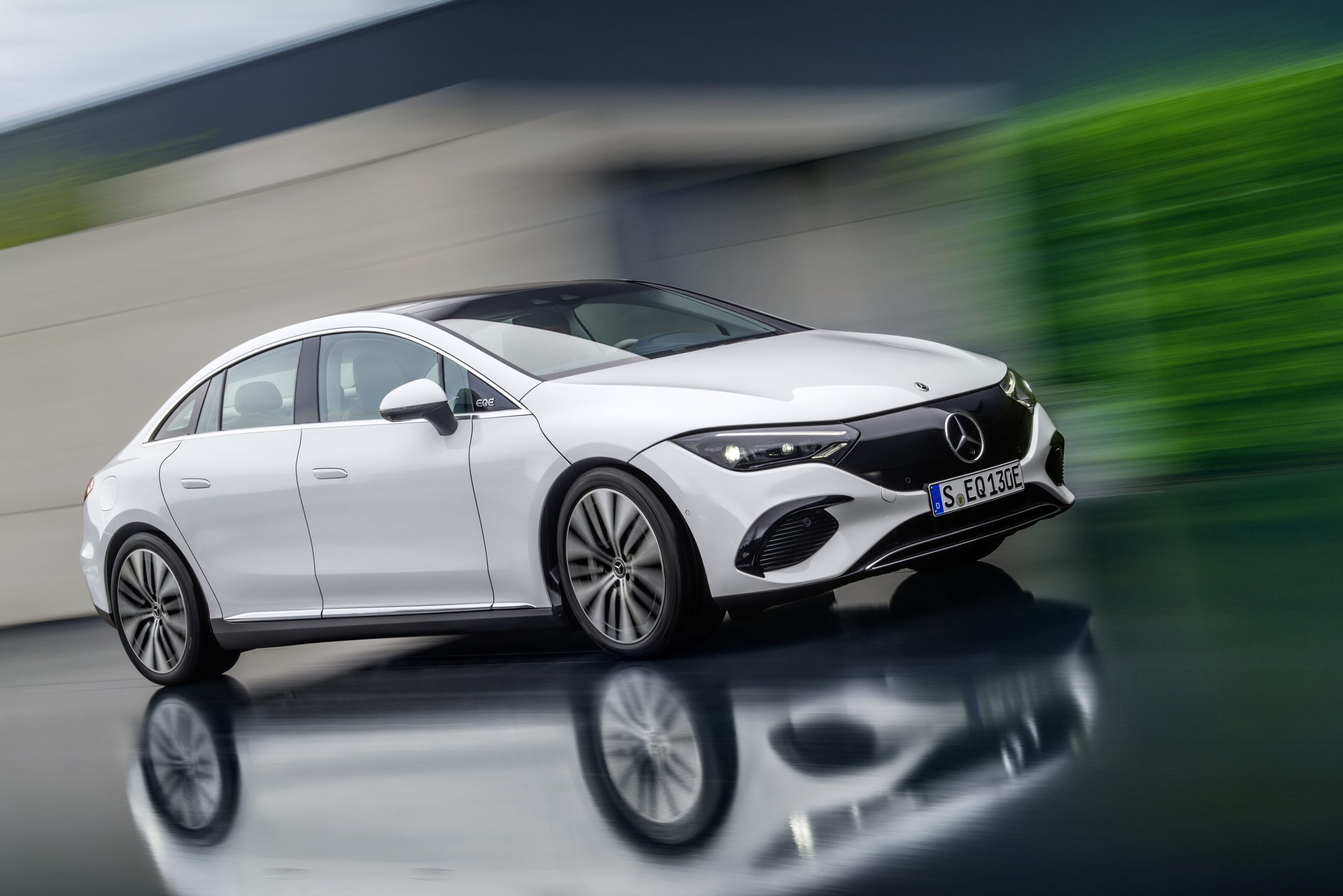
The Mercedes EV onslaught is picking up pace, with its second new executive sedan on its dedicated EV platform – the EQE.
It’s about the same size as the CLS and with a boot just like its ICE-powered brother, it’s yet another fully electric Benz as the company moves swiftly towards its electric future.
Shown at the Munich IAA Show, the new EV will launch with the EQE 350 – a rear-wheel drive, 215kW sedan. Its 90kWh battery is said to take the four door as far as 660km on the WLTP cycle. That is quite a distance, especially given the size of the battery, and is a significant improvement on the EQC 400’s 80kWh battery’s driving range.
The on-board 170kW DC charger allows for 220km (WLTP) of driving range in just fifteen minutes. Bremen-made cars will have the CCS plug type for European, US and presumably Australian examples, while Japan-deliveries will have CHAdeMo plugs for vehicle-to-grid capabilities. Chinese market vehicles will be made in Beijing and will also feature a CHAdeMo plug.
Domestic charging goes up to 22kW with a wallbox for slower recharging. The battery management software also has an option for slower, gentler charging to eighty percent for longer battery life.
Mercedes me charging customers are also assured by the manufacturer that every single electron put into the EQE is from renewable energy sources.
The company makes much of the EQE’s aerodynamic efficiency, echoing a lot of the EQS’s approach by delivering a tiny drag coefficient. The EQS’s is a mere 0.20 although the EQE’s is still a state secret.
While the EQE is based on the same EA2 EV platform as the EQS, its wheelbase is 90mm shorter and its overall length is similar to that of the current CLS four-door. Unlike many such coupes, it has a normal boot with a capacity of 430 litres, which matches the C-Class.
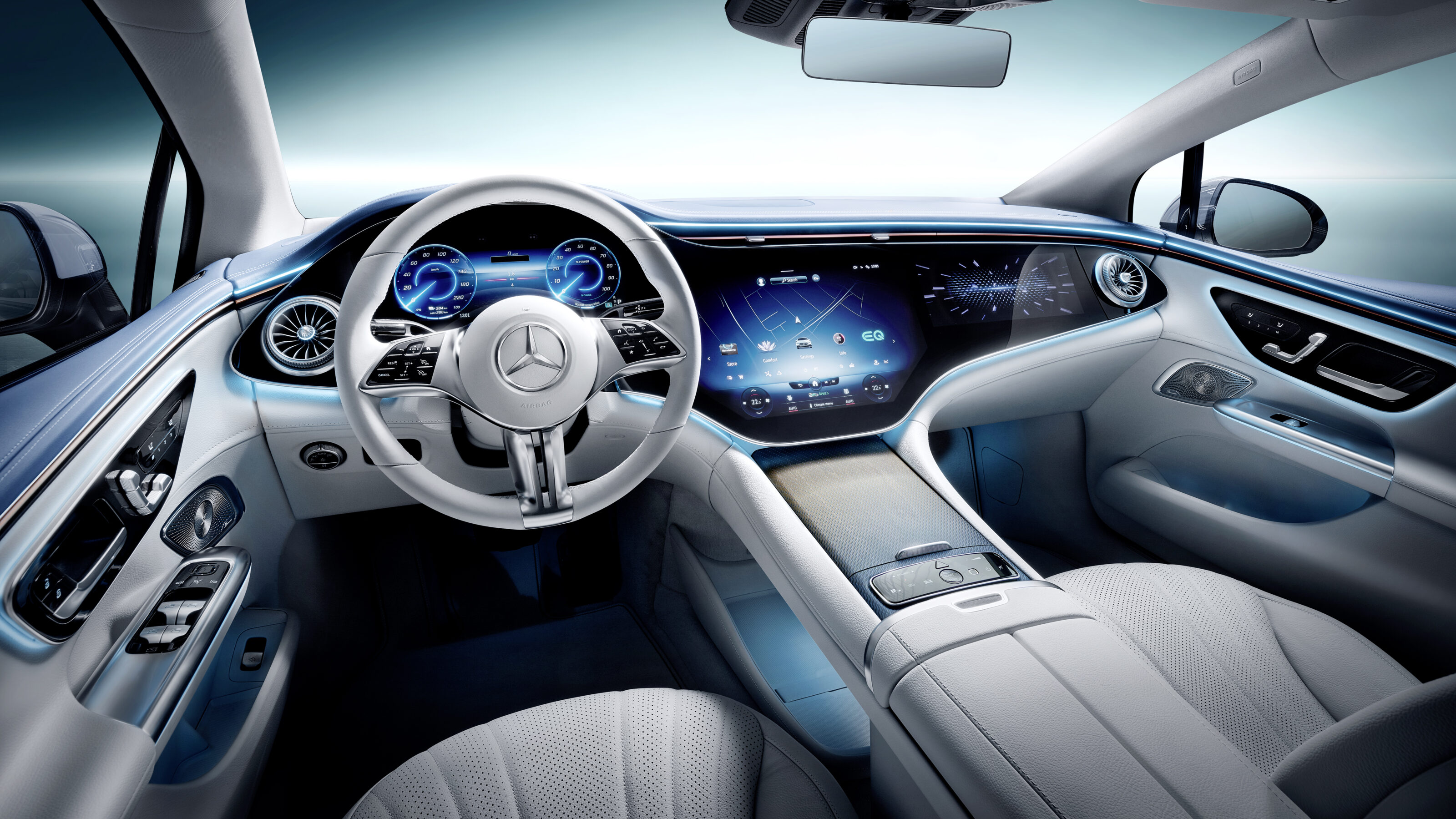
The advantages of the dedicated platform means that while the exterior dimensions are similar to the CLS, the cabin is appreciably larger. With more shoulder room in the front and another 80mm in length, the EQE is roomier for the same footprint.
As an option you can fit the gigantic MBUX full width screen layout, also seen in the EQS. As with the flagship, over-the-air updates will mean you can add new features to the EQE as you go.
Other extras include air suspension, and, over the next few months, we’ll see 4MATIC all-wheel drive variants – as well as presumably higher powered and sporty versions. Mercedes says the 4MATIC system monitors torque distribution 10,000 times every minute and says it outperforms mechanical all-wheel drive.
The EQE will start rolling out across globe in the second-half of 2022. Most Australian details are yet to be announced, however the German marque’s local arm has confirmed the model will land Down Under in the second half of 2022.
Snapshot
- New 7-seat family wagon rides on Renault-Nissan platform
- Petrol and LPG options matched to six-speed manual
Good news for European buyers seeking an affordable seven-seat SUV. Renault-owned Romanian manufacturer Dacia has unveiled the Jogger, its latest new-generation vehicle based on the Renault-Nissan-Mitsubishi CMF-B platform.
It’s bad news for Australian families looking for an affordable family car though, with the Dacia range currently off-limits Down Under.
A replacement for the Dokker, Lodgy and Logan MCV models, the Jogger is related to the smaller Sandero hatchback – but with a 300mm-longer wheelbase to accommodate third-row seating.

Combining van and wagon proportions with SUV styling, the Jogger is 4547mm long and sports 200mm of ground clearance, making it the largest vehicle in the Dacia range.
Despite the rugged looks, the Jogger will be available exclusively with front-wheel drive, leaving off-road duties to the Duster medium SUV.
With a cargo volume of 708 litres in five-seat configuration and 160 litres with all seven seats in place, as well as a slew of storage cubbies and cupholders, the Jogger should prove practical for most families.
Dacia has confirmed a hybrid powertrain will become available in the Jogger from 2023 – a first for the value-focused brand – combining a 1.6-litre petrol engine with dual electric motors for an estimated 40 per cent reduction in fuel expenses.

For now, a pair of internal-combustion petrol and LPG engines will be on offer. The petrol option comprises a 1.0-litre three-cylinder turbo engine producing 82kW/200Nm.
Meanwhile, a 74kW 1.0-litre turbo LPG engine is available, fitted with a 40-litre tank situated beneath the boot floor in place of the spare wheel.
Combined with the standard 50-litre petrol tank, the LPG claims a combined driving range of approximately 1000 kilometres, sipping an estimated 6.3L per 100km.
Both engines will be matched to a six-speed manual transmission, with an automatic version available in the hybrid, using Renault’s F1-inspired ‘multi-mode’ self-shifting, clutchless dog-type transmission.

The interior of the Jogger will be no surprise to those familiar with its smaller Sandero and Logan siblings, offering a tablet-style 8.0-inch touchscreen with wireless Apple CarPlay and Android Auto on flagship variants, plus satellite navigation and a six-speaker audio system.
The 2022 Dacia Jogger will go on sale in Europe later this year, with pre-orders available in the UK from November 2021. Pricing for the Old Continent is yet to be confirmed.
Past reports have pointed to an Australian launch for the Dacia brand, to be distributed by importer Ateco, but the company has yet to make any official announcement to support those reports.

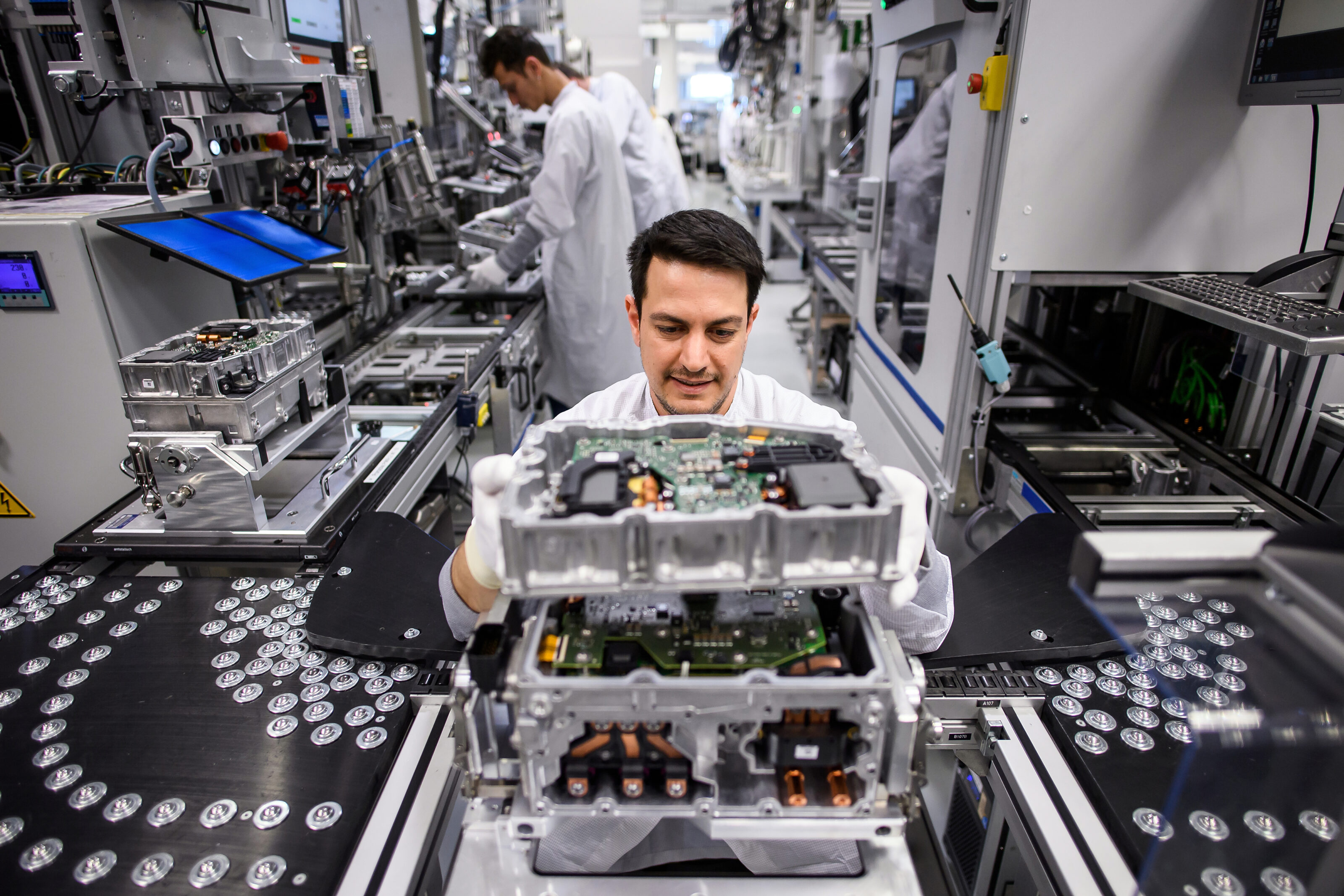
The global car industry is facing a production crisis due to the shortage of semiconductor chips, which are needed in just about every electronic device on the planet. It’s wreaking havoc on vehicle supply chains, leading to instances like the thousands of new Ford F-Series pick-ups parked in limbo at Kentucky Speedway, almost complete but missing crucial electronic components.
New cars can require thousands of these chips, but when COVID-19 outbreaks shut down automotive factories in 2020, carmakers cancelled semiconductor chip orders expecting not to need them. The tech industry, fuelled by a shift towards home life, absorbed that chip supply. Lockdowns ended, and the demand for cars skyrocketed, but there were far too few chips to meet it.

Globally, the car industry has suffered to the tune of more than €90b (A$141b) according to research firm AlixPartners.
In Australia, the local industry is feeling the effects of overseas delays, and waiting times for some vehicles have ballooned to many months as demand for new cars has increased in the wake of global lockdowns lifting.
Wheels understands the situation to be more severe than many insiders will admit. Behind the scenes, industry experts say companies are battening down the hatches for a lag in vehicle deliveries well into 2022, anticipating the effects will likely be felt even through 2023.
Nissan, for example, has reported a record annual loss of more than 150 billion yen, or almost A$1.8b, due to the pandemic and chip shortage. The company has had to suspend production at three plants in Mexico, and many other brands have responded in a similar way, including recently formed group Stellantis. Ford is estimated to be operating at 50 percent capacity globally. Its European plants are producing cars like Transit, Fiesta and Puma at far reduced rates.

New cars require thousands of chips, but when COVID-19 shut down automotive factories, carmakers cancelled their orders. But lockdowns ended, and the demand for cars skyrocketed.
But locally, companies are maintaining their brands are able to handle what might come, telling Wheels this is a challenge, not a disaster. While Australia’s geographical isolation means accessing products from overseas can take more time, brands here are used to planning ahead.
Toyota Australia’s sales VP Sean Hanley recently announced that the brand is less affected by the shortage than others, however a spokesperson told Wheels that “Demand for new vehicles, globally and in Australia, is recovering much faster than anticipated just a few months ago. Although our plants are increasing capacity, we are anticipating that wait times for high-demand models will be longer than usual in the coming months.”

Things aren’t looking as good for Hyundai, which is starting to become more affected by the shortage. As global delays for some models are estimated to be up to 11 months, Hyundai Australia’s PR boss Bill Thomas told Wheels they are in constant contact with Seoul to ensure dealers and customers remain up to date on the situation.
“Looking at the next couple of months, our stock pipeline is restricted, but not dramatically so. We don’t know how things might change as we progress through the year.”
Vehicles from Europe and North America are the most heavily impacted, according to Ford spokesperson Ben Nightingale, meaning Ranger customers should be in the clear for the very near future at least.
“The delays vary by vehicle and plant, and our teams are working closely with their overseas colleagues for regular updates and to mitigate the impact.”

All three company representatives say their dealer networks are able to keep customers informed regarding specific orders, but carmakers are all hesitant to say how long, and how badly, supply will be affected.
The global supply of semiconductor chips is incredibly difficult to increase quickly, with electronics companies like Japan’s Hitachi only just now being able to commence upgrading its capacity to manufacture chips in the US, a task it estimates won’t be complete until August 2022. The US will also see the government pour US$50 billion into “restoring American leadership in semiconductor manufacturing,” though this funding rollout won’t be complete until 2026. In Asia and Europe, similar endeavours are being made to improve availability.
For now, some premium car manufacturers have even removed the availability for optional top-tier comfort and advanced safety tech due to the shortage.
The problem isn’t going away, and it seems set to get worse before it gets better. Earlier this year, the same firm that calculated the €90b figure estimated 2021’s global vehicle output would be down by about 2.2 million. That estimation has since been revised to closer to four million.
What is a semiconductor chip and why do modern cars need it?

It’s a set of electronic circuits built on a wafer of the semiconductor material silicon. Chips or integrated circuits (ICs) can range from a simple circuit to a micro-computer. They allow the design of circuits many, many times smaller, more powerful and less costly than if they were built from individual electronic components, and make all the complex and powerful electronic systems in today’s cars possible.
We’ll forgive you if you’ve heard the news that the 24 Hours of Le Mans is getting lots of interest from car companies but are a little confused as to what is actually happening.
The flurry of releases and reports have been unrelenting in the past 12 months, with some of the biggest names in the automotive sector falling over themselves to get involved with the biggest endurance race in the world.
A lot has been happening, and it can be hard to keep track of, so we thought we’d give a top-line explanation, and simple rundown of who is who in the zoo.
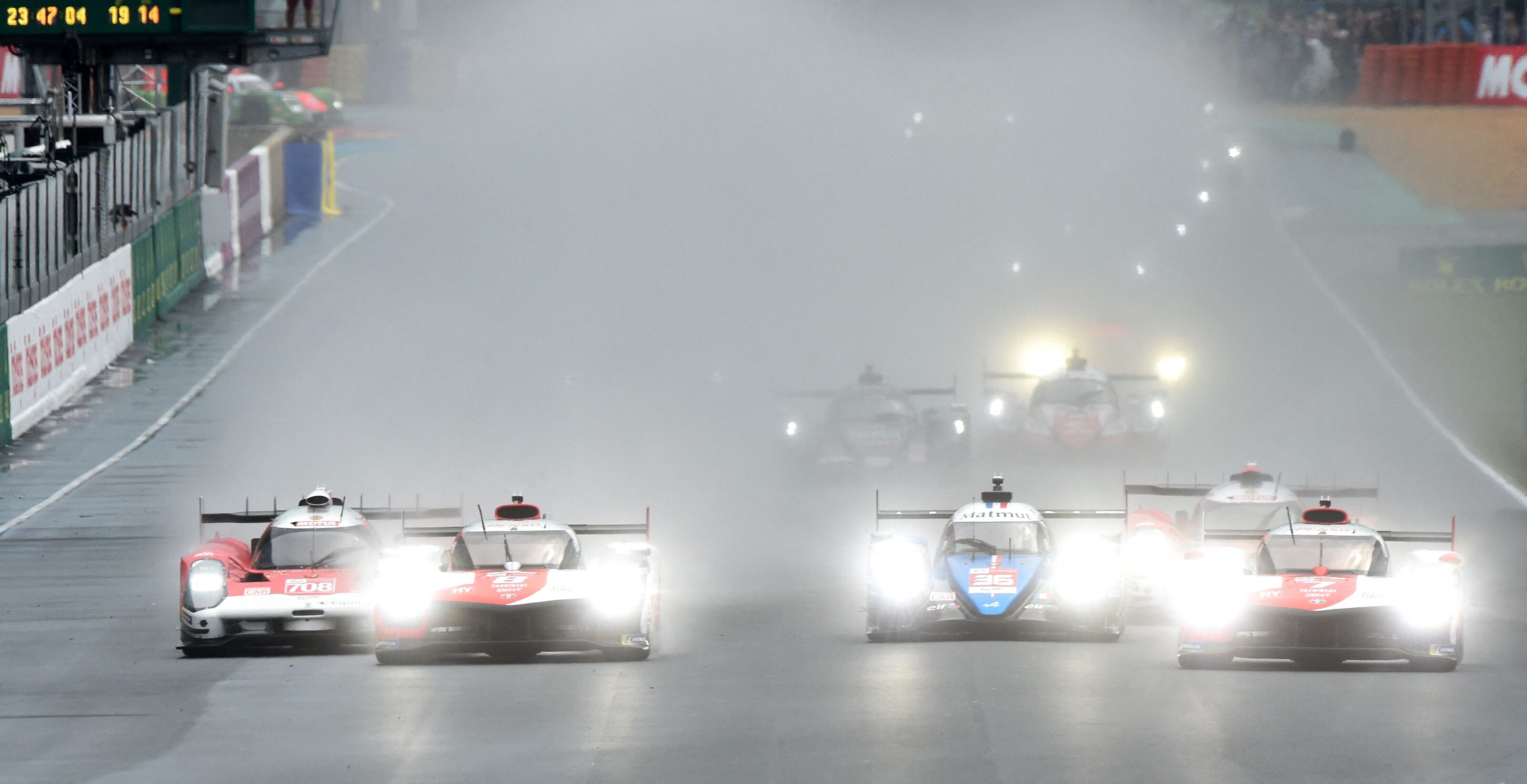
There are multiple factors at play here. Ultra-expensive LMP1 rules have been replaced by the slower but more affordable Hypercar (or LMH) ruleset in the World Endurance Championship, while the American-only DPi ruleset is evolving into what is known as LMDh (which is even cheaper than LMH) for the IMSA series.
Both LMDh and LMH will converge in 2023, allowing manufacturers multiple promotional opportunities across key markets at a relatively cheap price, with outright victories possible at the 24 Hours of Le Mans, as well as the Daytona 24 Hour and 12 Hours of Sebring.
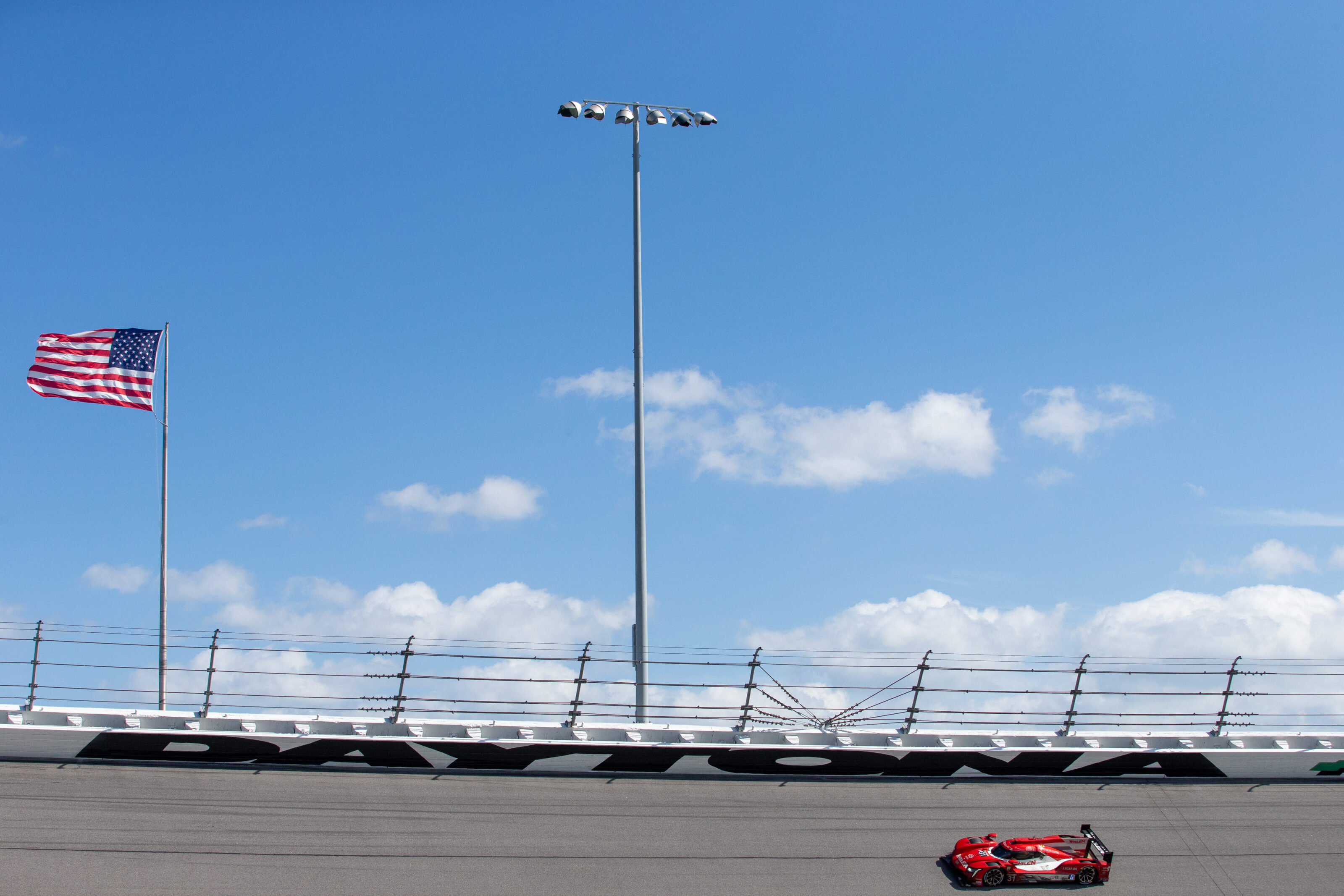
The low-risk, high-reward nature of the convergence has opened the flood gates for manufacturers to return in droves.
We’ve split everyone into three categories, those that are already taking part, the parties that have committed on paper but are yet to debut and those that remain officially unconfirmed but likely to make an announcement in the near future.
Already competing
Toyota
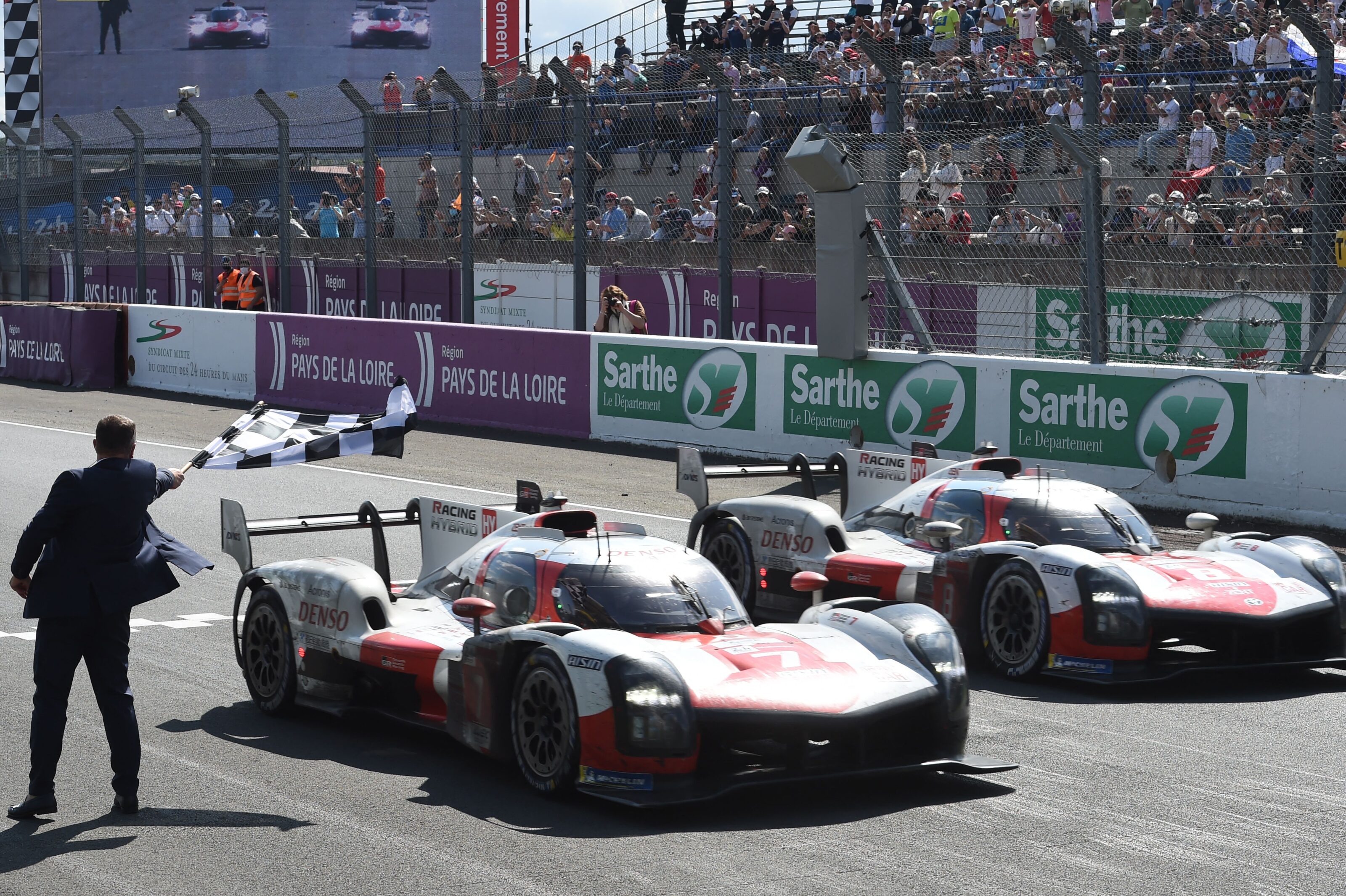
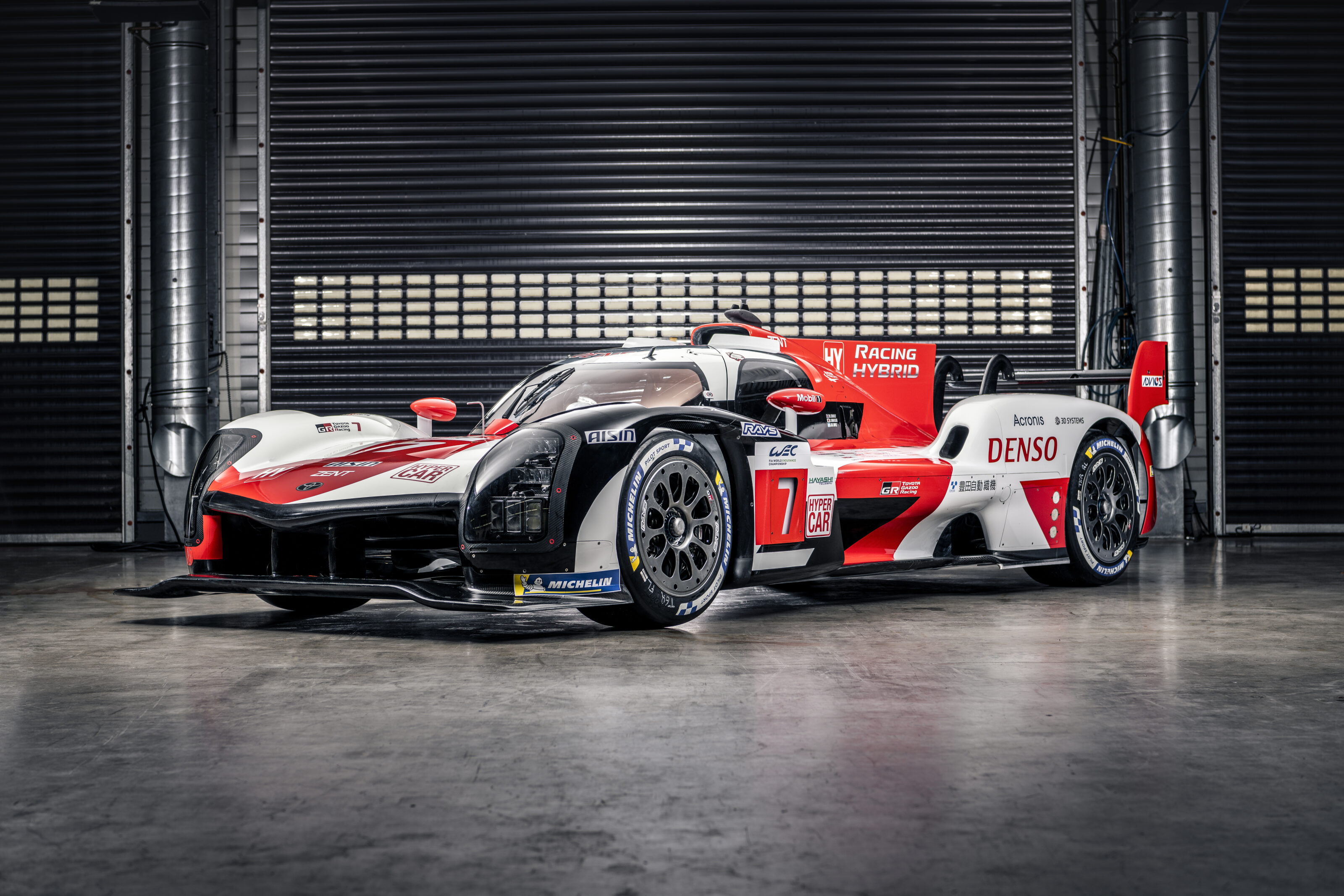
Locked, loaded and leading the Hypercar vanguard with its GR010 Hybrid. The Toyota team won the 24 Hours of Le Mans this year comfortably, and looks to go largely unchallenged until better-funded rivals take up the mantle in coming years.
Scuderia Cameron Glickenhaus
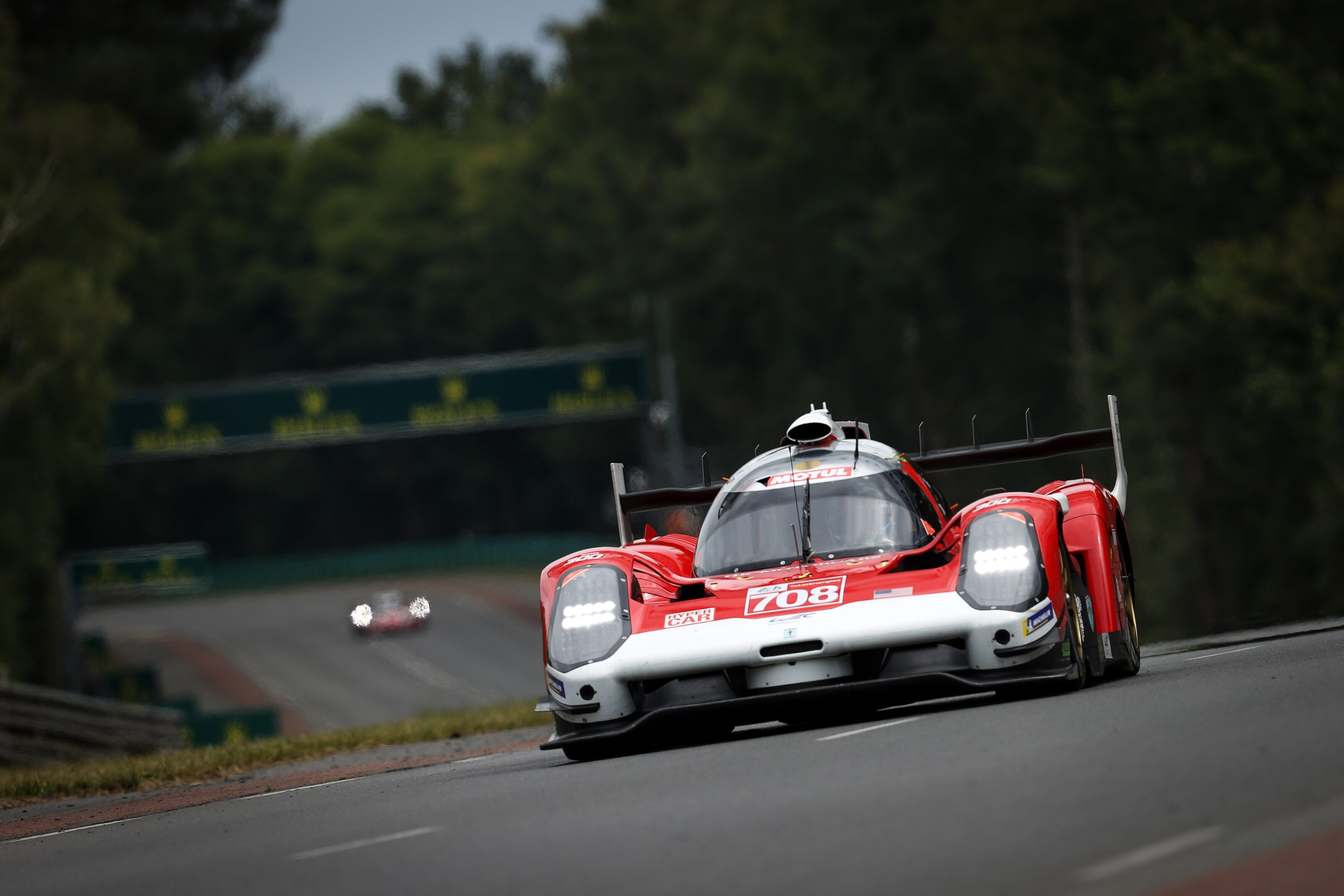
Privately funded and without traditional manufacturer investment, Scuderia Cameron Glickenhaus is the wildcard of the LMH field. Performance hasn’t been strong enough to dethrone Toyota yet, but it shows initial reliability and promise. Owner James Glickenhaus is fully committed to building a road-going version of the SCG 007 despite no rulebook impetus. You’ve got to respect the commitment to cool.
Alpine
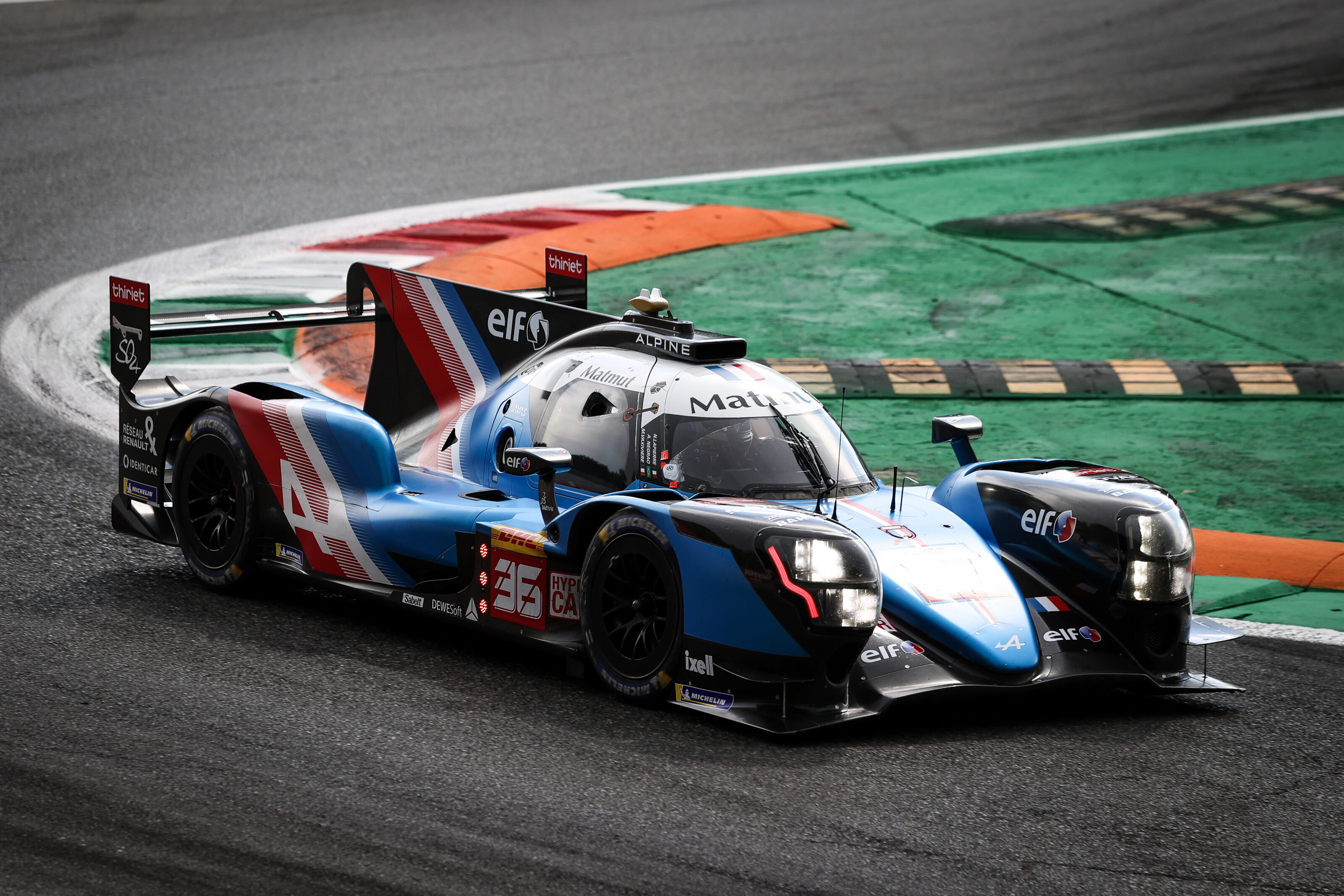
The French sportscar manufacturer is both competing and not competing in the World Endurance Championship at the same time. Respected sportscar squad Signatech is currently running an Alpine-branded car, with the plan to entice the Renault subsidiary to sign-on for a full factory effort.
Competing under the LMH regulations with a single grandfathered Rebellion R13 LMP1 car rebadged as an Alpine A480, Alpine finished a respectable third outright at this year’s 24 Hours of Le Mans behind the leading Toyota pair.
The A480 looks set for another year of competition before being kicked to the curb once Alpine confirm its commitment to either LMH or LMDh regulations.
Coming soon
Peugeot
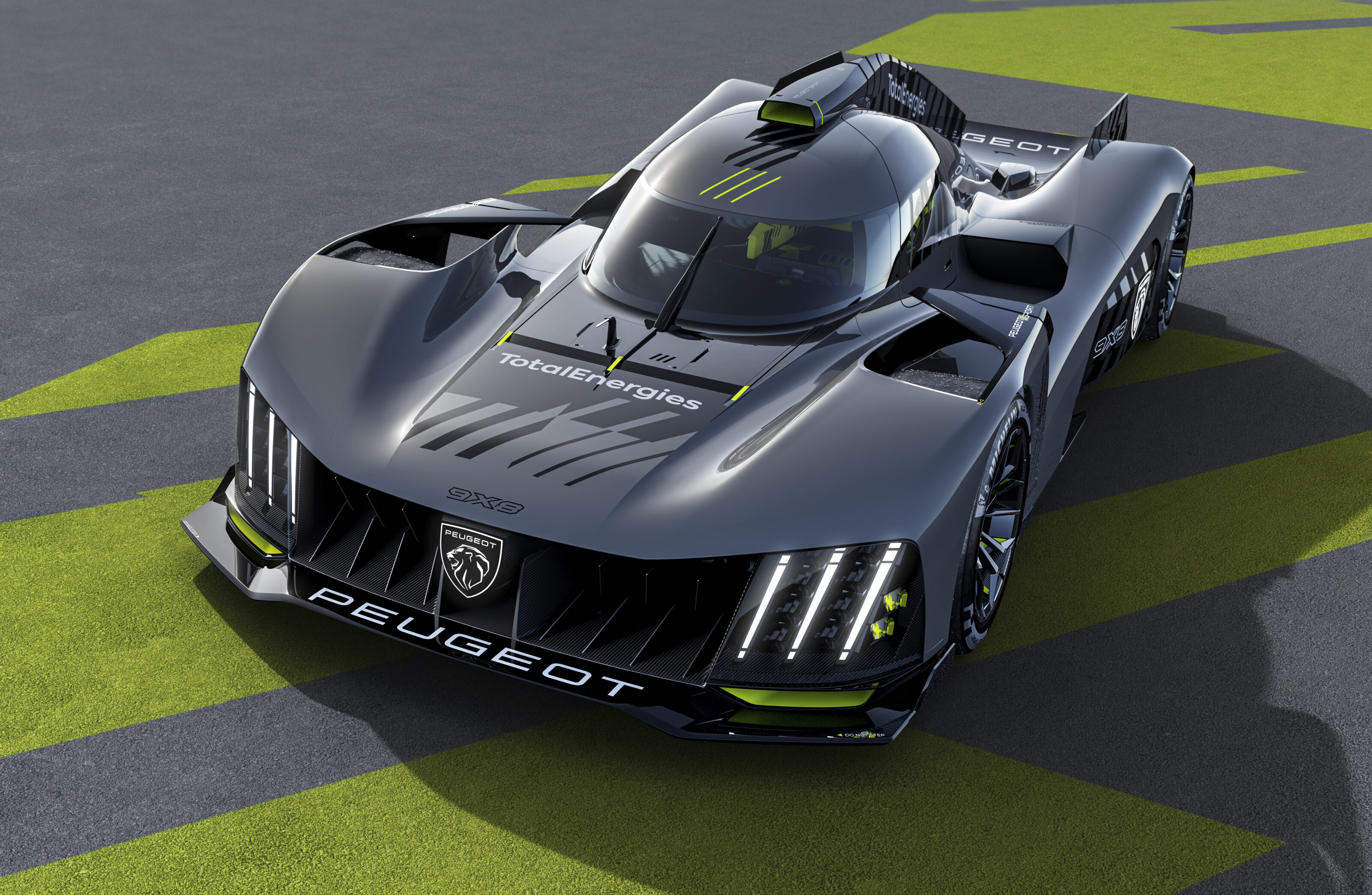
French manufacturer returning to France’s greatest race – the story writes itself.
Peugeot is committed to returning to La Sarthe under the Hypercar regulations with its 9X8 racer (featuring a radical wingless design). Testing for the project is slated to begin by year’s end once the engine has completed bench testing and the first chassis is constructed.
A 2022 debut is what was announced, but further delays, while disappointing, can’t be ruled out.
A badge-engineered version of the 9X8 could be spun off from the program for Stellantis-sibling Dodge.
Ferrari
We will need to wait a little longer for Ferrari’s Hypercar to appear at the 24 Hours of Le Mans, but the long-rumoured return is publicly confirmed.
A two-car team will spearhead the Scuderia’s return to prototype endurance racing under Hypercar regulations.
Ferrari will design and build the car, while pseudo-factory GTE team AF Corse will step up to run the cars on behalf of Maranello.
Porsche
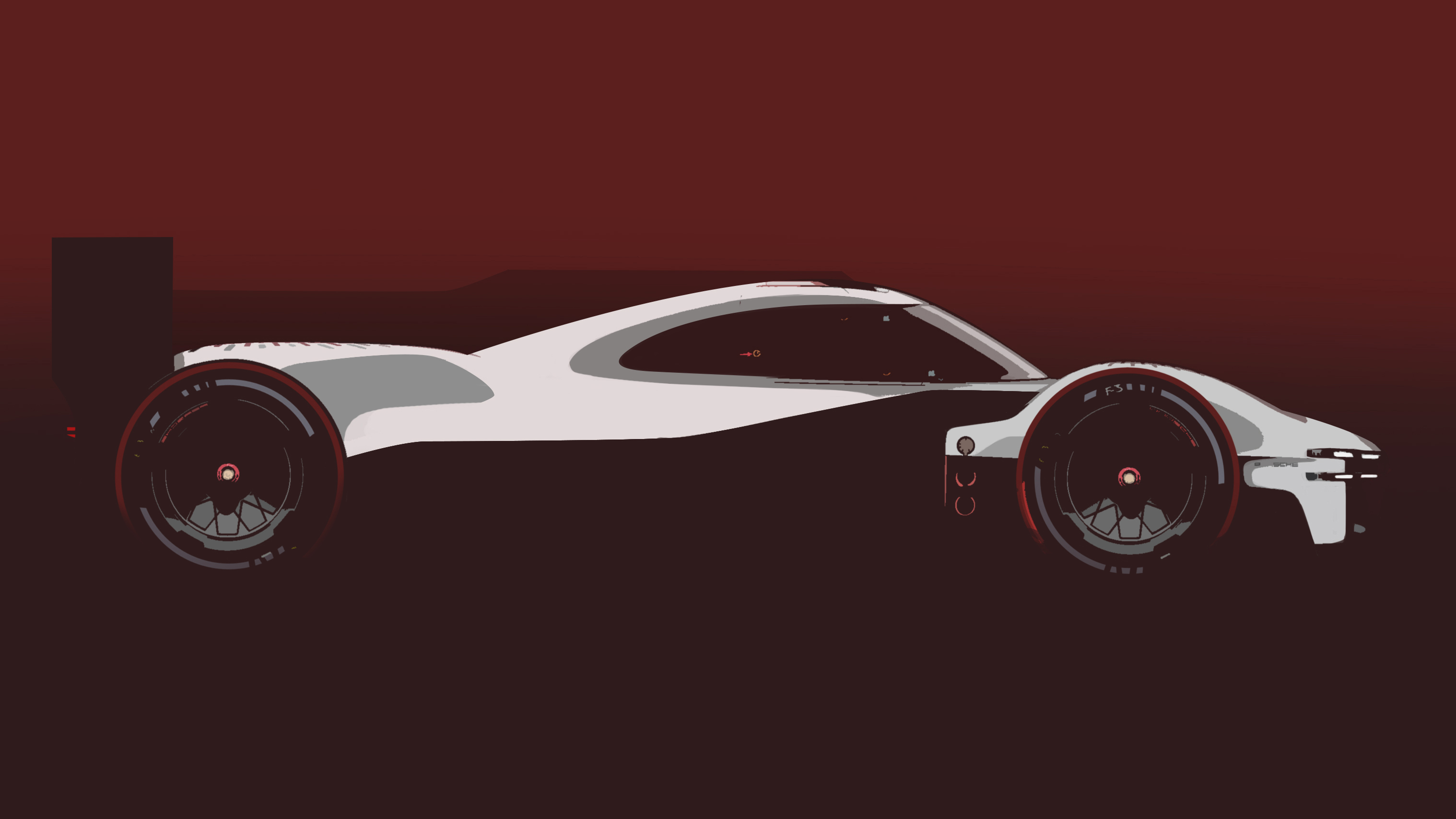
Next year’s 24 Hours of Le Mans will be a Hypercar-only affair again, but by 2023 the American interlopers will join the fray. LMDh is set to take top billing alongside LMH, with some big name factories committed. The biggest is Porsche.
It wouldn’t be a new Golden Age of endurance racing without Porsche’s involvement. Unlike Ferrari, Stuttgart is shunning Hypercar regulations for the American-led LMDh ruleset, and it’s using the biggest team in US racing to keep things ticking.
Motorsport powerhouse Penske is taking point on running both a factory World Endurance Championship and IMSA effort. Roger Penske’s involvement makes the Porsche LMDh program both a technical and political powerhouse. Any Balance of Performance shenanigans between LMDh and LMH won’t last long with these titans taking a seat at the table.
Unfortunately, there will be no mid-mounted, flat-six engine in Porsche’s LMDh racer. A 4.0-litre twin-turbo V8 is the current front-runner based on the engine found in Panamera and Cayenne models. Much like how the engine is shared across multiple production cars in the Volkswagen Group’s broad portfolio, it will also be used by other VAG brands at Le Mans.
In typical Porsche fashion the LMDh car will also be offered to customer teams with deep enough pockets.
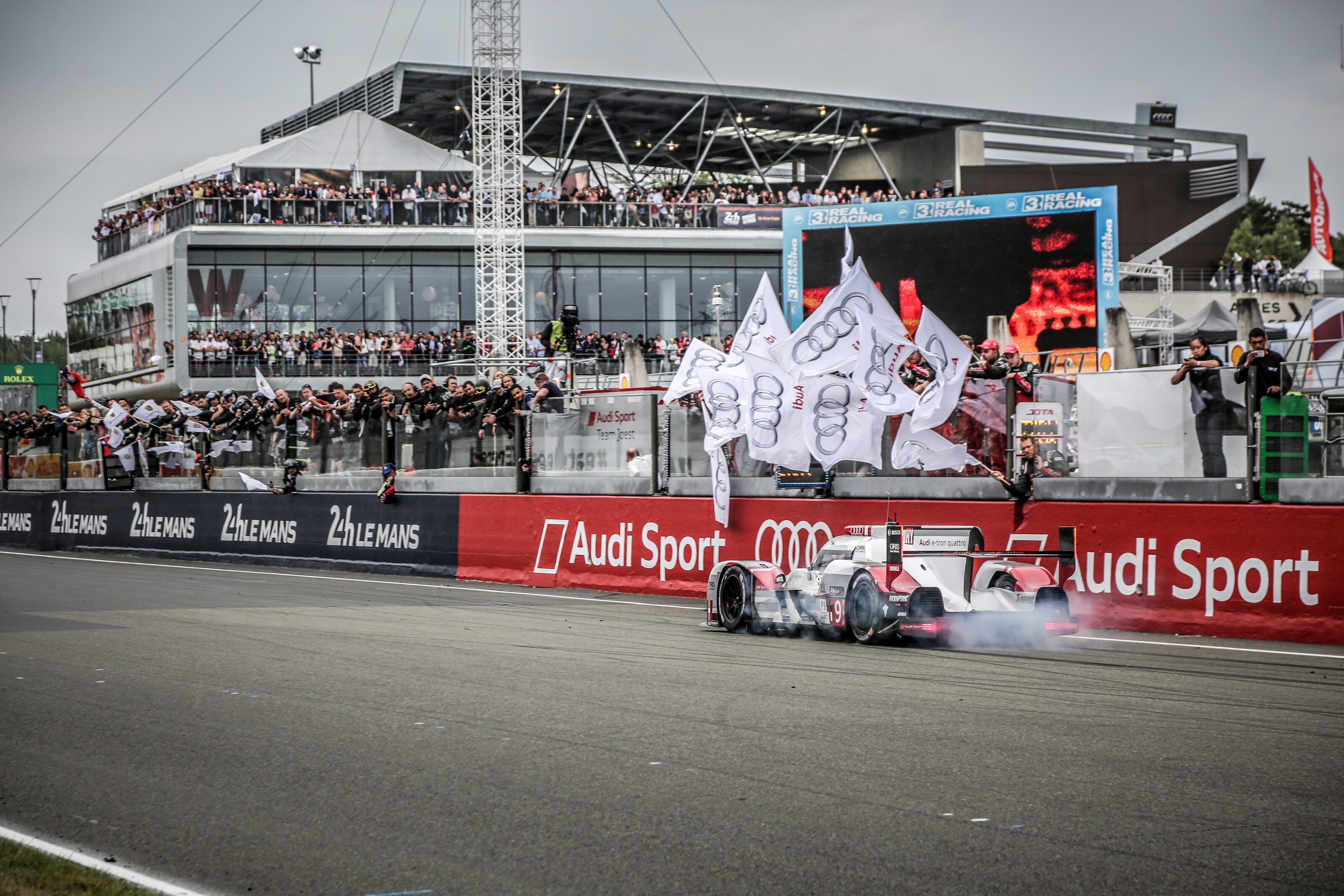
Audi
Speaking of other Volkswagen Group brands, the intra-boardroom rivalry between Audi and Porsche is set to be reignited in 2023.
Understandably, the Porsche and Audi programs are set to be remarkably similar with some important differences. They will share the same engine and chassis, and each will provide cars to customer teams, but Audi will only compete in WEC, with an IMSA campaign recently nixed.
The big unknown for Audi is which race team it will partner with.
BMW
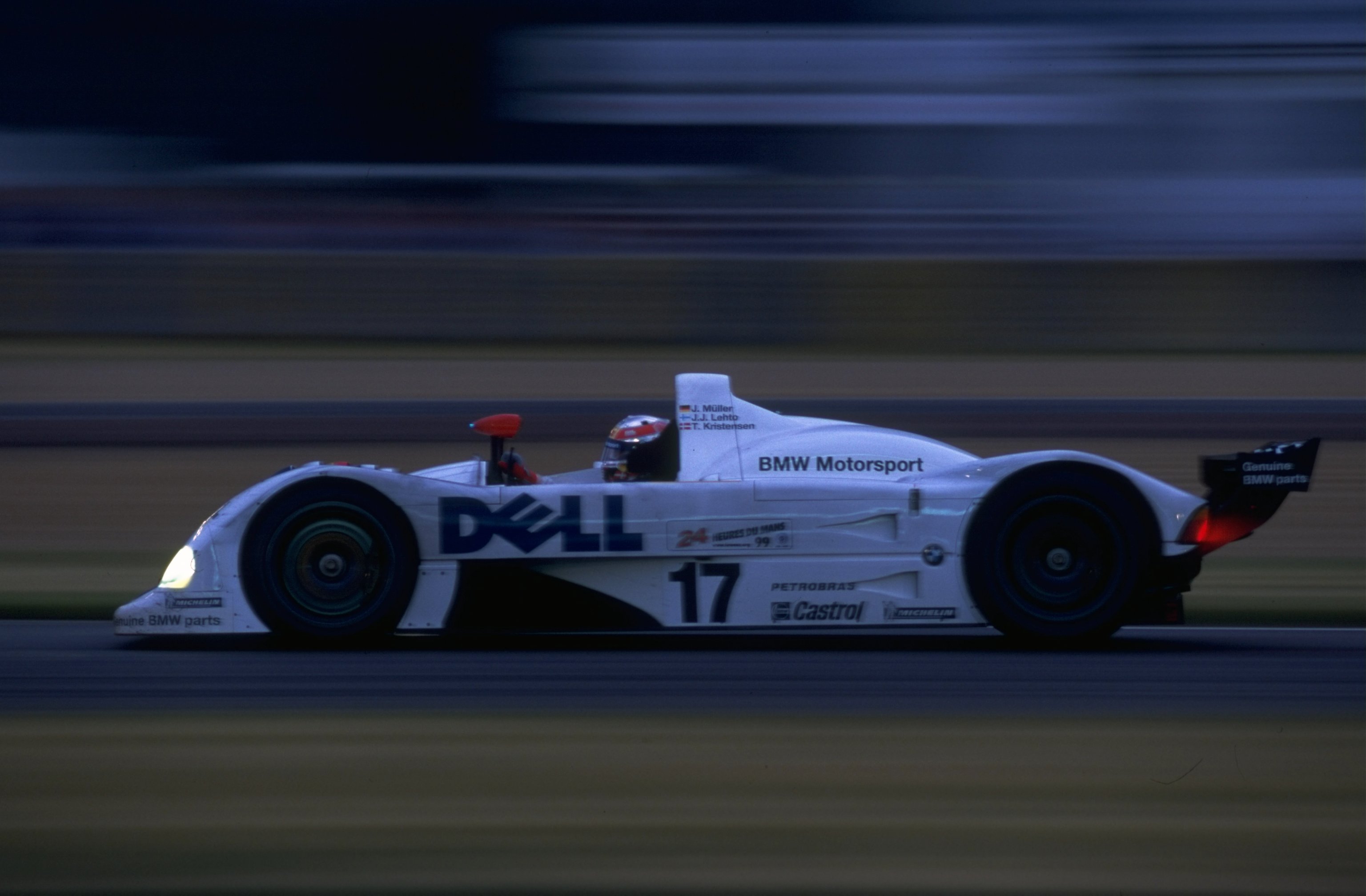
The LMDh and LMH split is most pronounced with BMW. The German manufacturer made an emphatic statement about its return to endurance racing when it announced its LMDh program using dramatic imagery of the ’99 24 Hour of Le Mans winning V12 LMR.
Thing is, BMW hasn’t yet confirmed it will be taking its LMDh program to Le Mans, having only locked in a factory IMSA campaign. That said, the brand’s return to La Sarthe remains heavily rumoured, with a semi-factory effort for two cars set to be announced imminently.
Cadillac
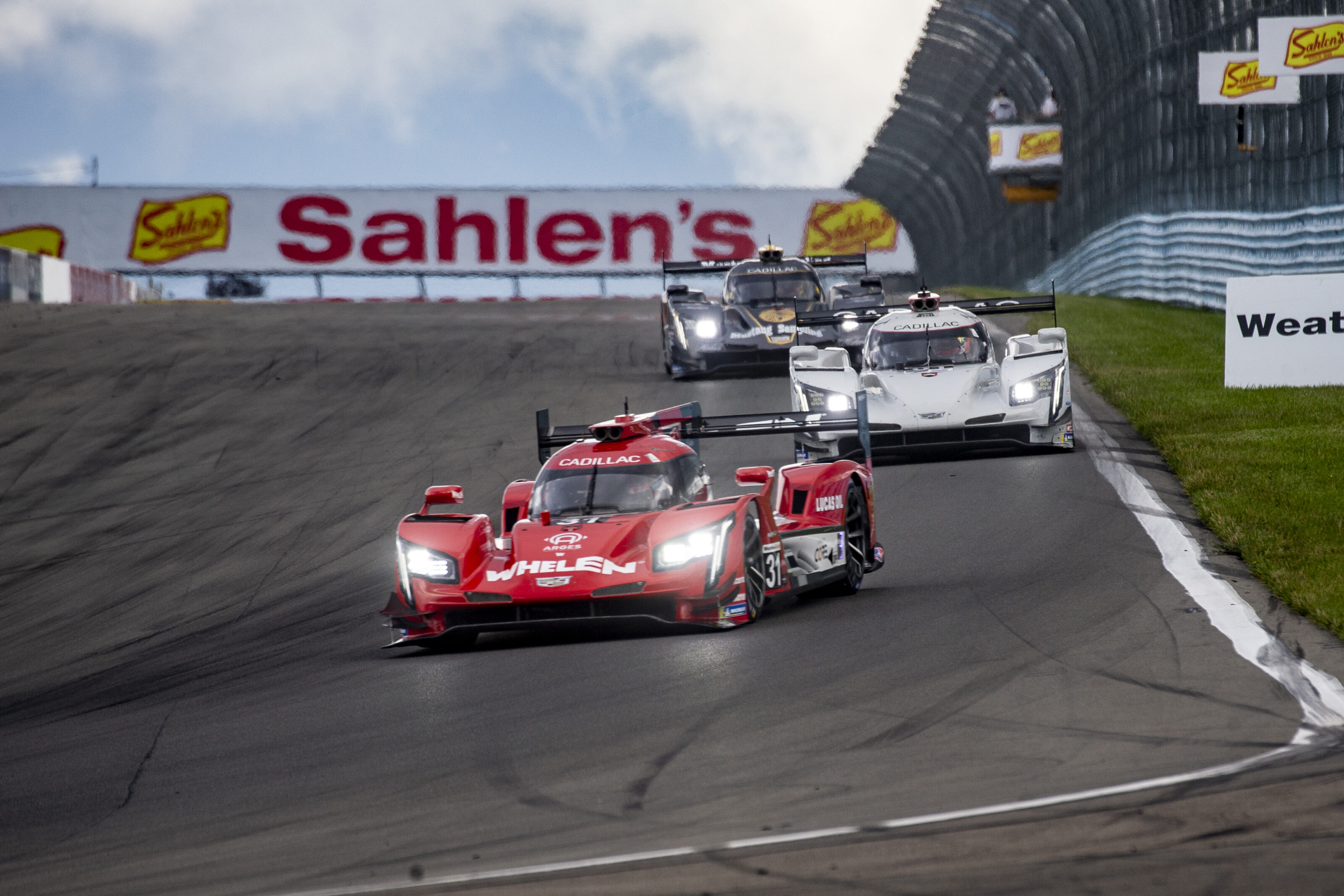
The American factory-backed cat among the European pigeons will be Cadillac. Ford seems uninterested in rekindling its rivalry with Ferrari, so GM’s sub-brand Cadillac will be fighting on behalf of Uncle Sam instead.
While it hasn’t competed at the 24 Hours of Le Mans since a middling effort at the start of the century, the American brand is returning in 2023 to complete its unfinished business. During IMSA’s DPi era (which LMDh is based on), Cadillac won four Daytona 24 Hours in a row, a pair of championships and currently leads the 2021 standings. Expect the brand to be an outright threat from the get-go.
Chip Ganassi Racing and Action Express have been named as the partner teams – the latter being a constant force in US racing that will make a trip across the Atlantic for the first time in 2023 – with Cadillac stumping up cash for fully funded efforts in both IMSA and WEC
Honda/Acura
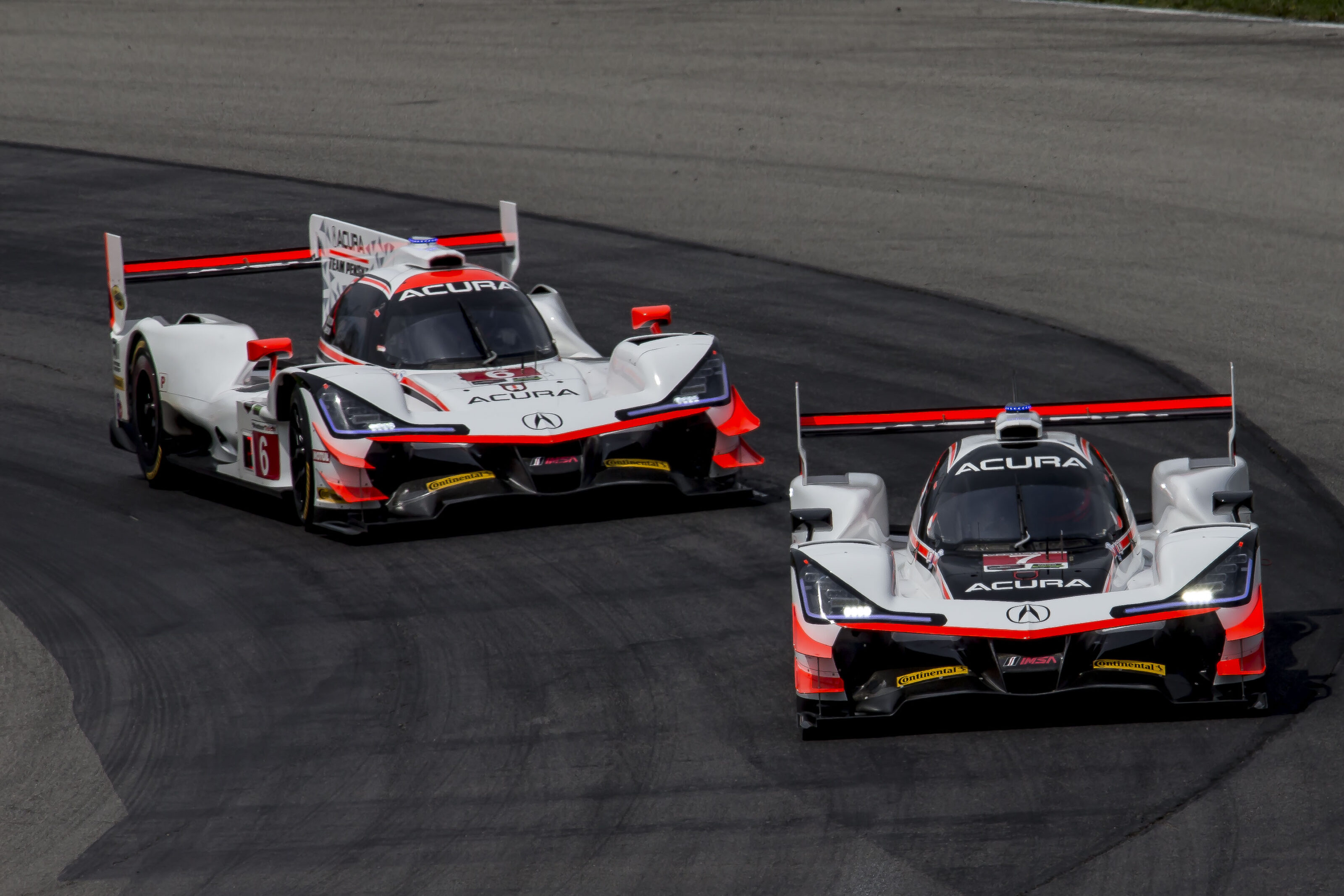
Much like BMW, Honda’s involvement at Le Mans is half-cocked at present. Acura currently competes in IMSA’s DPi category and is committed to LMDh. However, while it hasn’t yet locked in a Le Mans effort, the teams that field Acura prototypes in IMSA are keen to take part in the world’s biggest endurance race. A switch to Honda branding in Europe is likely but unconfirmed for now.
Watch this space
Lamborghini
Will it, won’t it? Rumours of a Lamborghini LMDh effort have been swirling for several months and have only got stronger following VAG siblings Audi and Porsche announcing their commitment.
We asked CEO Stephan Winkelmann what was going on, and while his words were coy, the broad smile gave the game away somewhat.
“It’s a good one, because in the last few days we were looking into this. It looks interesting but there is no decision taken and even if we decide, it’s going to be some years down the road before we’d be ready for something like this. But I have to tell you, it’s interesting and we’re looking into it.”
A factory effort won’t get off the ground until 2023 at the very earliest, so we may be waiting a while for an official announcement, but platform and engine sharing with Audi and Porsche makes any potential plan an easy one to justify for the Italian manufacturer.
Customer cars will lower budgets further, and mimic the same ethos Lamborghini utilises in GT3.
McLaren
Woking’s return to Le Mans has been long-rumoured, but ultimately movement from McLaren has been minimal. The brand’s GT3 program remains highly successful and is at a transition point as the 720S road car is replaced by the new V6 hybrid Artura.
This is proving a challenge for both its GT efforts, and any potential LMDh car is unlikely to come to fruition until 2024, with a decision deadline quickly looming by year’s end. Oreca is reported to have been commissioned with creating a concept for Woking, with customer teams expressing interest as well.
Nissan
We’ll be frank and state from the outset that Nissan’s Le Mans return is the shakiest rumour here.
Where other efforts on this list are open secrets, Nissan’s plans remain shrouded in mystery. What is known is Nismo purchased an LMP2 car for evaluation purposes. If that will become a full factory LMDh (or more unlikely LMH) program remains unclear.
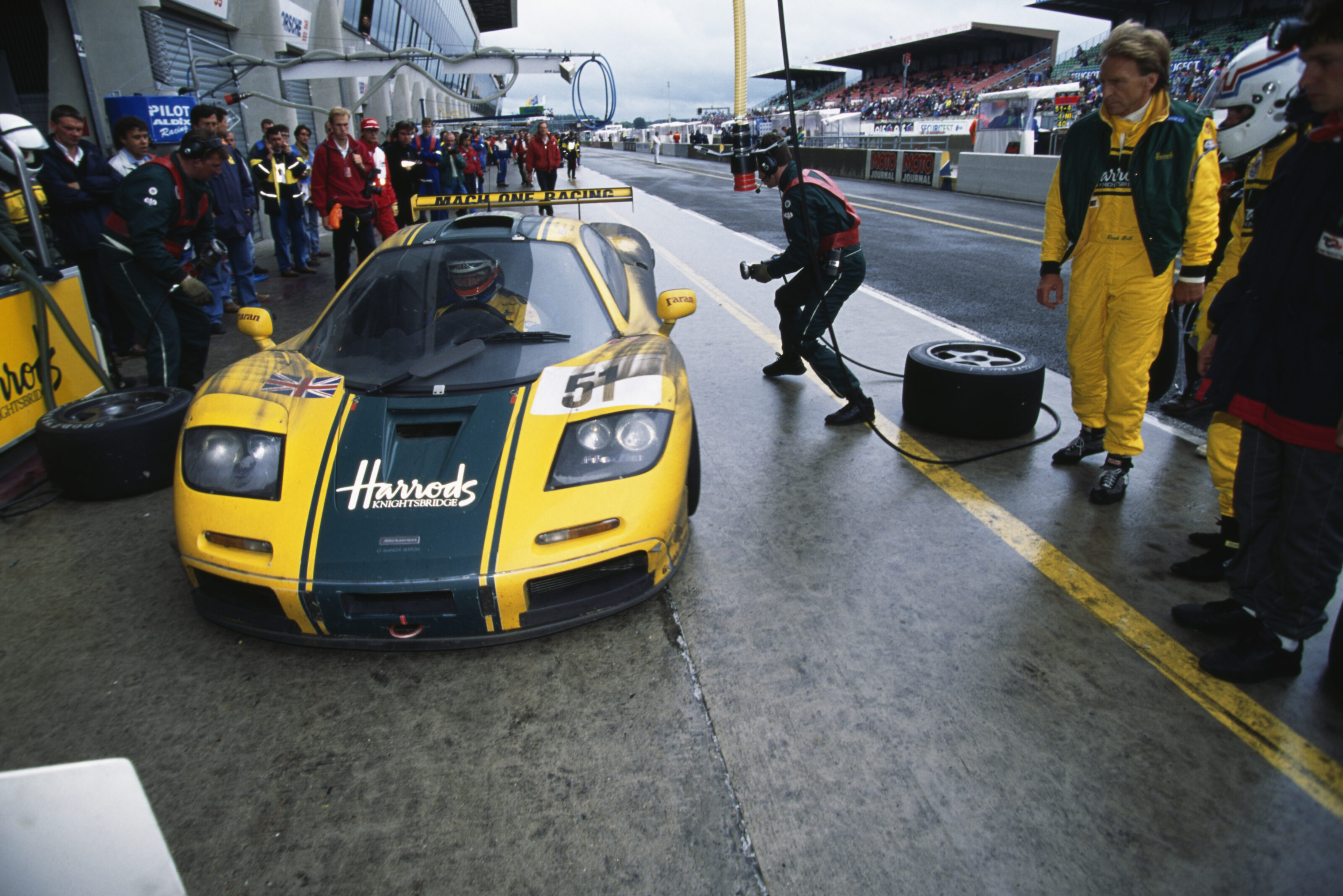
Nissan’s last Le Mans effort told a compelling story but was ultimately a performance failure. The GT-R LM program never fulfilled its many promises but was immensely innovative.
A more conventional return may do the job of offering the Japanese manufacturer redemption while simultaneously helping cover the unsightly memories.
Snapshot
- Robotaxi set to be tested on roads in and around LA
- IONIQ 5 is Hyundai’s first EV built from the ground up
- Will be used by ride-hailing firm Lyft
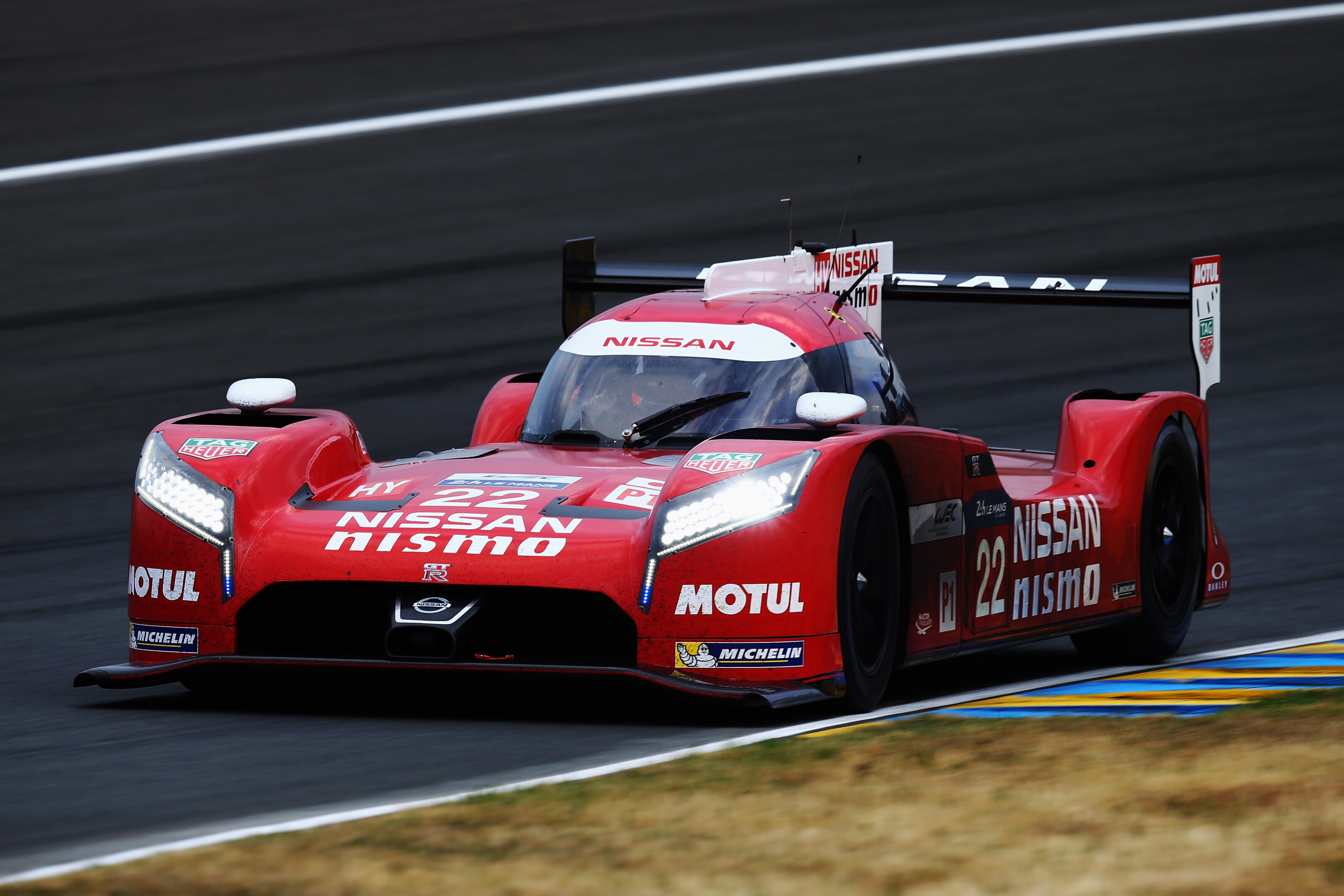
Hyundai has unveiled a robotaxi based on its electrified IONIQ 5 which is set for service in the United States.
Developed in partnership with Motional, a driverless tech firm based in the US, the taxi will offer Level 4 autonomous driving capabilities – allowing the vehicle to operate without a human being behind the steering wheel in certain conditions.
Set to be deployed in and around the Los Angeles area, the robotaxi joins a number of additional autonomous vehicles testing in California and other western US states – including Google’s Chrysler Pacifica-based Waymo self-driving taxi in Phoenix, Arizona, and GM’s Cruise autonomous vehicle service.

Thirty sensors, combining radar, lidar and camera technology as well as advanced machine learning, will allow the vehicle to construct a 360-degree field of vision, with high-definition images and the ability to detect long-distance objects.
“For the IONIQ 5-based robotaxi, we have applied various redundancy systems, in addition to a suite of essential technologies to ensure safety and convenience of the passengers”, said Woongjun Jang, Head of the Autonomous Driving Center [sic] at Hyundai Motor Group.
As part of the announcement, Motional confirmed it has struck a partnership with Lyft, a US-focused transportation service similar to Uber. From 2023, users of the Lyft application will be able to digitally hail the self-driving IONIQ 5 robotaxi across the rideshare network in several major US cities.
This deal follows a successful three-year partnership between the two companies, with Lyft currently utilising a fleet of Motional’s autonomous BMW 5 Series vehicles in Las Vegas, in operation since mid-2018. Lyft also has a similar partnership with Ford and Argo AI, an autonomous driving firm founded by veterans of the Google and Uber automated driving programs.
The Motional robotaxi will debut in the metal later this week at the 2021 IAA in Munich, ahead of testing commencing in the United States later this year.
Built on the new E-GMP modular vehicle platform, the IONIQ 5 is Hyundai’s first electric vehicle built from the ground up. It will go on sale in Australia towards the end of 2021 – offering a human-only driving range of approximately 480 kilometres with the long-range 72.6kWh RWD powertrain.
Passengers being chauffeured around in a Bentley Flying Spur or Bentayga will now be able to directly access digital content, with the British marque introducing a new rear-seat entertainment system for the ultra-luxury duo.
Simply dubbed Bentley Rear Entertainment, the system offers the ability for passengers to wirelessly stream content from their own device (provided the device is connected to the in-vehicle WiFi) onto a pair of high-definition 10.1-inch touchscreens, attached to the back of the front seats.
Similar in nature to Google’s Chromecast and Apple’s AirPlay, the streaming feature works with both iOS and Android devices.
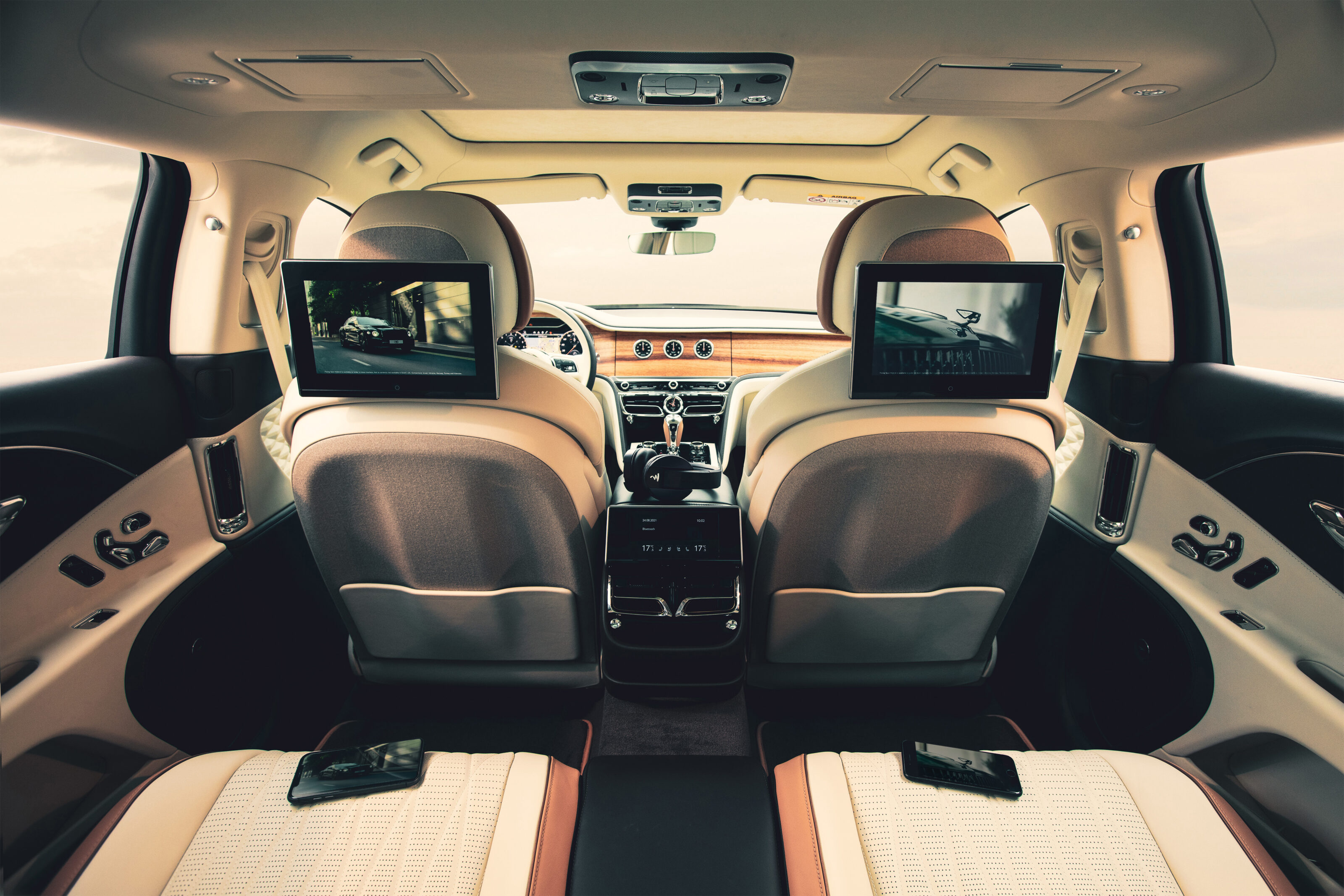
The built-in system also features Netflix – which comes pre-installed – allowing passengers to access this content without the need to link to another device.
In addition, sound can be streamed directly to the vehicle via Bluetooth, granting quick access to the high-end Naim audio system available in the Flying Spur and Bentayga or to a pair of headphones, while a HDMI port caters for the installation of a streaming device or gaming console in the rear.
The tablet-style displays can also be removed from the headrests for added convenience.
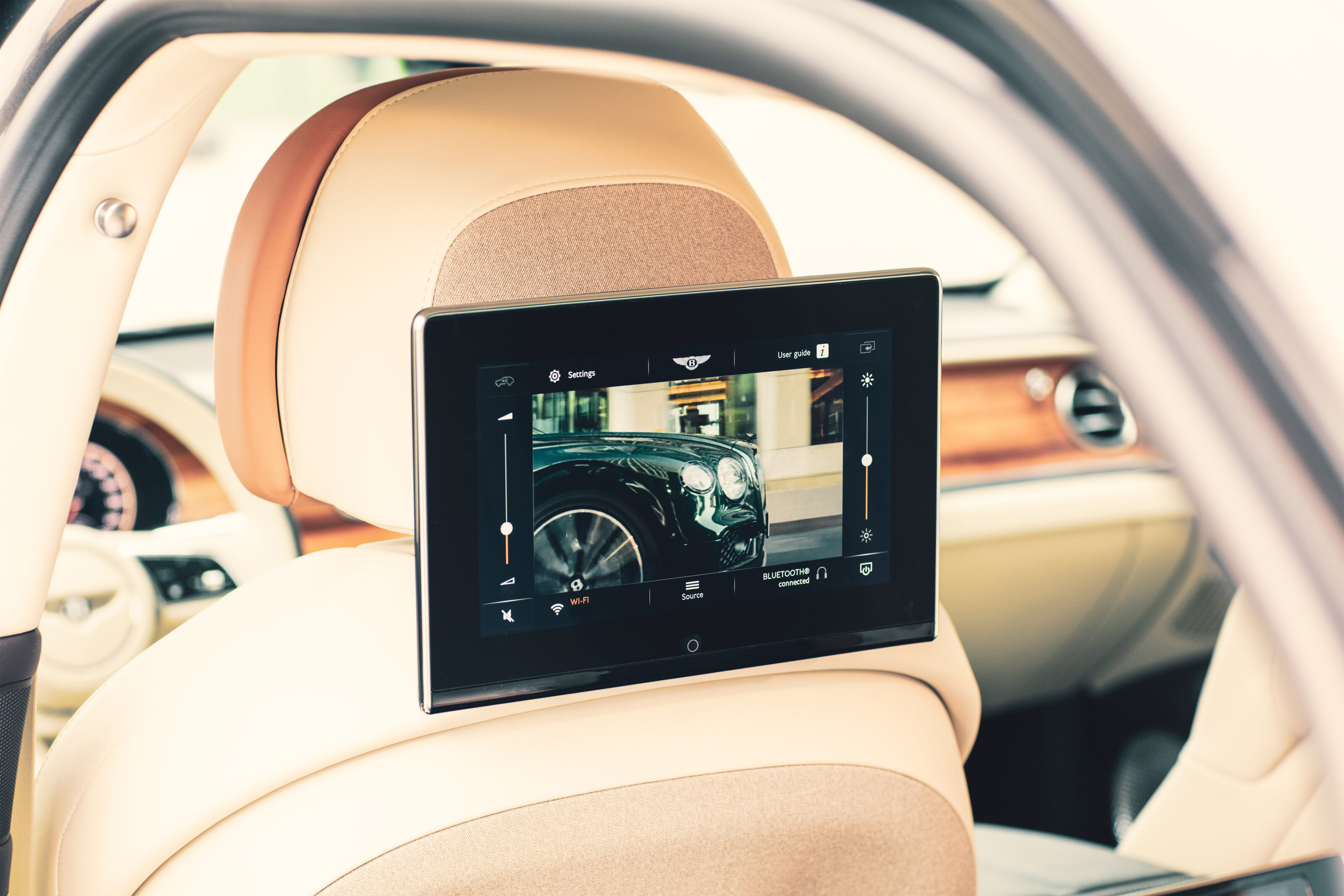
The system has been designed with over-the-air software updates in mind, while a pair of USB-C ports can charge devices or manually update the software.
Bentley is yet to confirm pricing details or local availability for its new rear-seat entertainment system, however, with pricing for both the Bentayga and Flying Spur starting upwards of $350,000 before on-road costs, don’t expect it to come cheap.
