
Features


Gallery 1
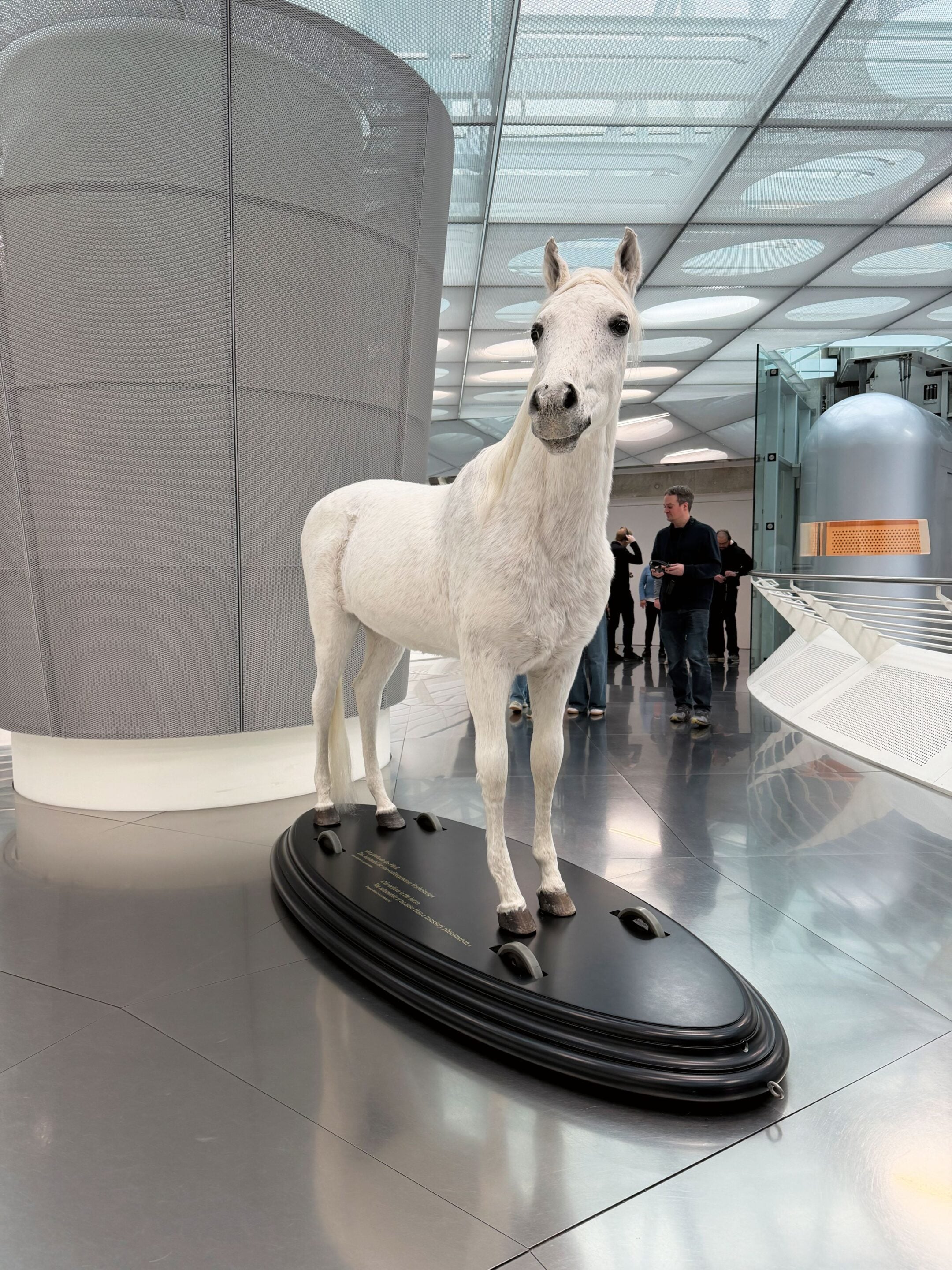
That a horse is the first exhibit in the stunningly immersive Mercedes-Benz Museum is no accident. A visual allegory? A nod to the history of personal mobility?
It’s arguably both, but there’s another, more defiant message, one that is engraved in gold at the base of the one-horsepower opening exhibit.
“Ich glaube an das Pferd. Das Automobil ist eine vorübergehende Erscheinung.” (“I do believe in the horse. The automobile is no more than a transitory phenomenon.”)
1
The words are attributed to then German emperor, Kaiser Wilhelm II who, it seems, remained unimpressed with the phenomenon of that new-fangled contraption, the automobile. The irony of the Kaiser predicting the downfall of the motor car isn’t lost on history buffs. Following his abdication in 1918, the German Empire – a constitutional monarchy – made way for the Weimar Republic, Wilhelm II thus the last ever emperor of Germany. “Transitory” indeed.
The stuffed white horse and its cheeky inscription are a fitting beginning for the Museum, a spiralling and compelling journey through not just the last 140 years of Mercedes-Benz, and by extension, the automobile, but history itself.
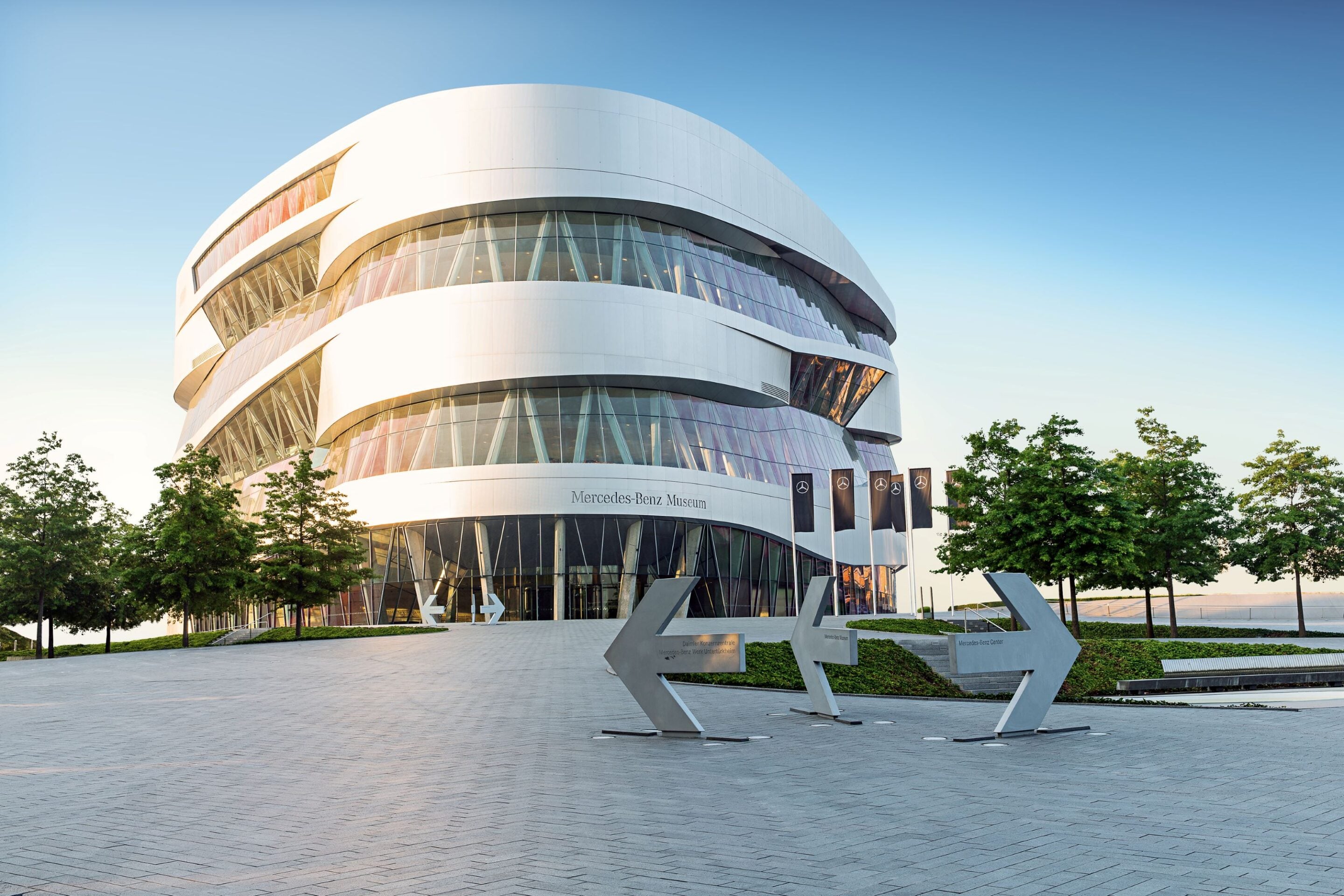
The building is a breathtaking piece of modern architecture, a nine storey structure of winding concrete and glass designed by Amsterdam-based architectural firm UNStudio van Berkel & Bos.
Inspired by the double-helix DNA spiral that carries the human genome, the open-plan building features no closed-off rooms or even a single straight wall. And no two pieces of the 1800 triangular sheets of glass that make up the Museum’s windows are alike.
The Museum’s central atrium, soaring all the way to the top of the nine-storey building, has entered the Guinness World Records. But not for any reason you might think.
As Mercedes-Benz explains, “The Mercedes‑Benz Museum has its very own practical tornado.
1
“In the event of a fire, the vortex drives the smoke upwards and out of the building. It is generated in the atrium. Arranged at an angle in the walls, 144 air vents combine with a turbine installed in the roof of the atrium to immediately generate a powerful column of air, swirling around its own axis at a high rate of speed. And ‘poof’, the smoke is gone from the museum.
“With a height of 34.4 metres, this is a world record for an artificially generated tornado. It was measured in 2007 by the Guinness Book of Records – shortly after the museum opened.”
Visitors to the Museum begin their journey by entering elevators that resemble pods from a 1950s sci-fi movie. It’s no coincidence, with Mercedes likening the elevators to a time machine and when passengers arrive at the ninth floor (and the doors open to that proud white horse) it is the year 1886 and the company’s founder, Carl Benz, has just patented his new invention – the automobile. The tour begins.
What follows is a chronological journey through 140 years of Mercedes-Benz, of the automobile, of social history told through the lens how it shaped innovation and technology.
1
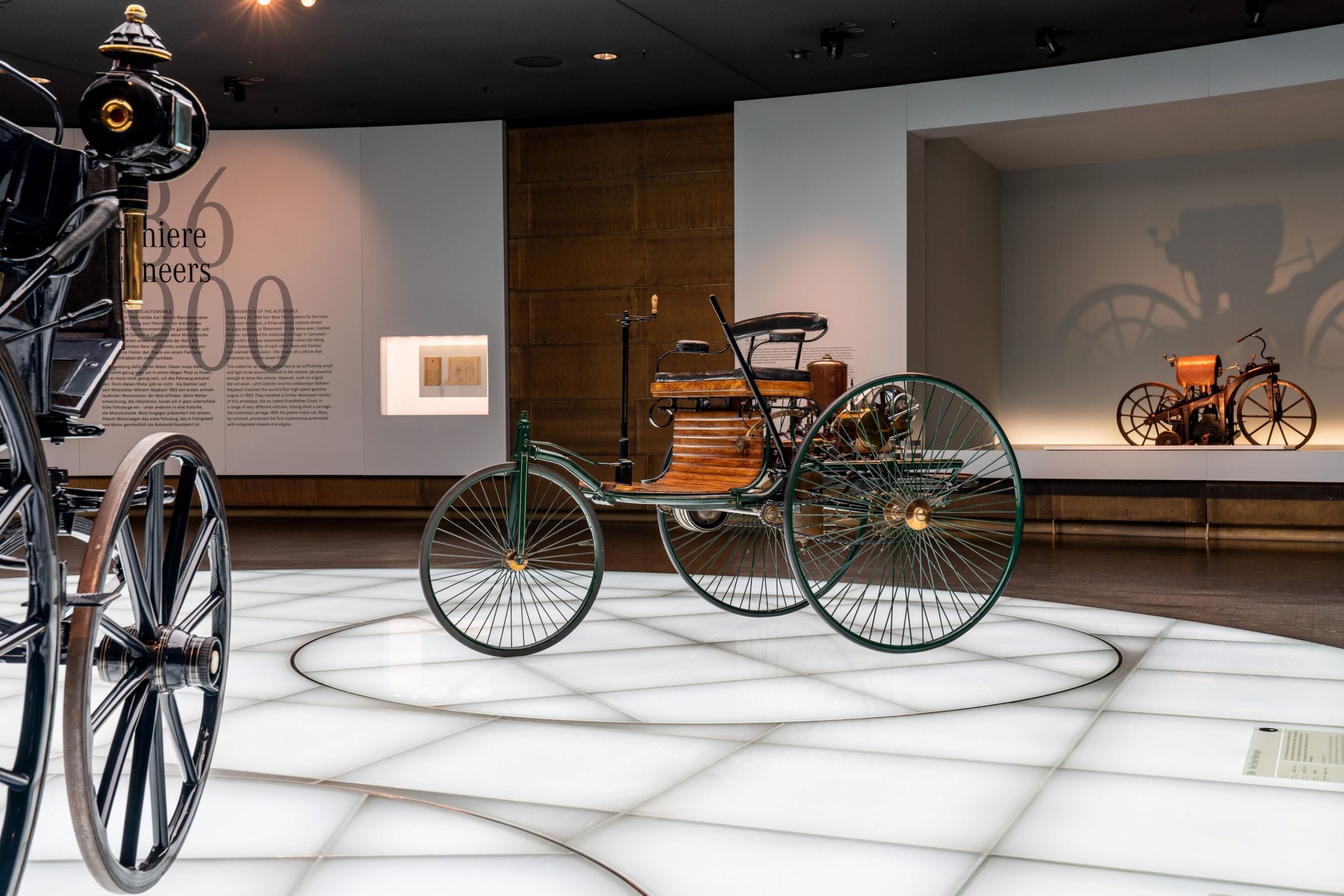
Unsurprisingly, the first car on display is the original automobile, Benz Patent Motorwagen. It’s a replica of the car Bertha Benz took on her famous road trip in 1888, a 106km journey from Mannheim to Pforzheim that is widely regarded as the first ‘road trip’.
A single-cylinder engine pumped out 0.75hp (0.55kW) at 400rpm, helping the first Benz reach a top speed of 16km/h. Yes, that is less than one horsepower. And yes, its top speed is less than that of a horse at full gallop, around 40km/h.
Bertha’s long drive is covered in detail, giving the wife of Carl her rightful place in history, not least of all for her technological achievements along the way such as when the wooden brakes on the Motorwagen began to fail. Enlisting the help of a cobbler, Bertha asked him to affix shoe leather onto the brakes to improve their durability. Bertha Benz had invented the brake pad.
Gottlieb Daimler’s achievements are not overlooked, either. Where Benz’s three-wheel Motorwagen today holds its rightful place in history, it was Daimler’s four-wheel motor carriage that shaped the car as we know it today.
Daimler had been working on what would become the Daimler Motorised Carriage at his workshop in Cannstatt, a suburb of Stuttgart. He was granted a patent for his invention in March, 1886, just three months after Benz was awarded his patent. Remarkably, neither Benz or Daimler were aware of each other and the similar paths they were taking, despite both working in Stuttgart. Even more remarkably, the two men who would eventually lend their names to the merged Daimler-Benz conglomerate in 1926, never met.
Daimler’s achievements extend beyond adding a fourth wheel to the automobile, illustrated starkly by a wood-framed two-wheeler that seems out of place in a museum about cars. But it was Daimler, along with his colleague Wilhelm Maybach, who had in 1885 created the first petrol-powered motorcycle, the Daimler Reitwagen.
3
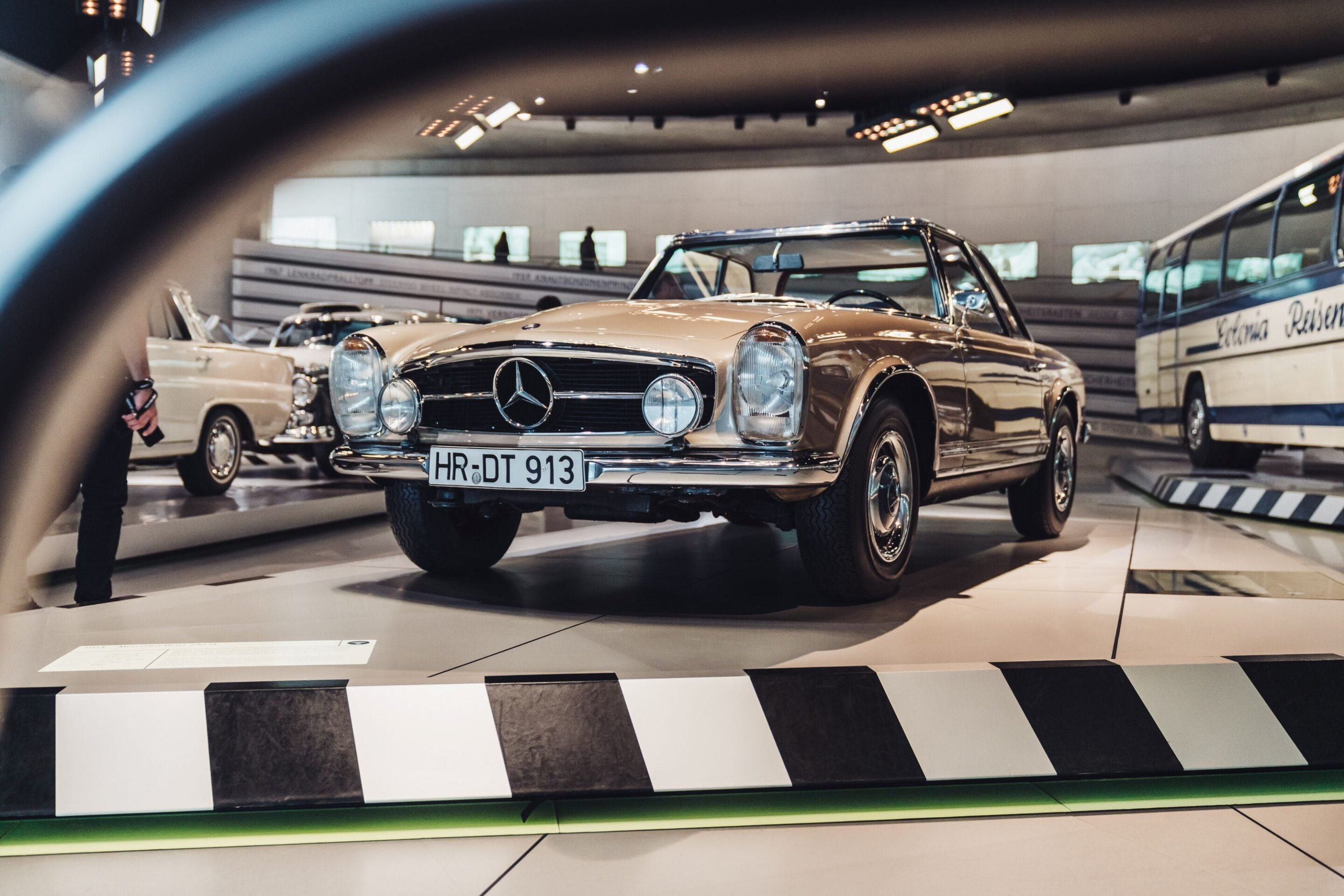
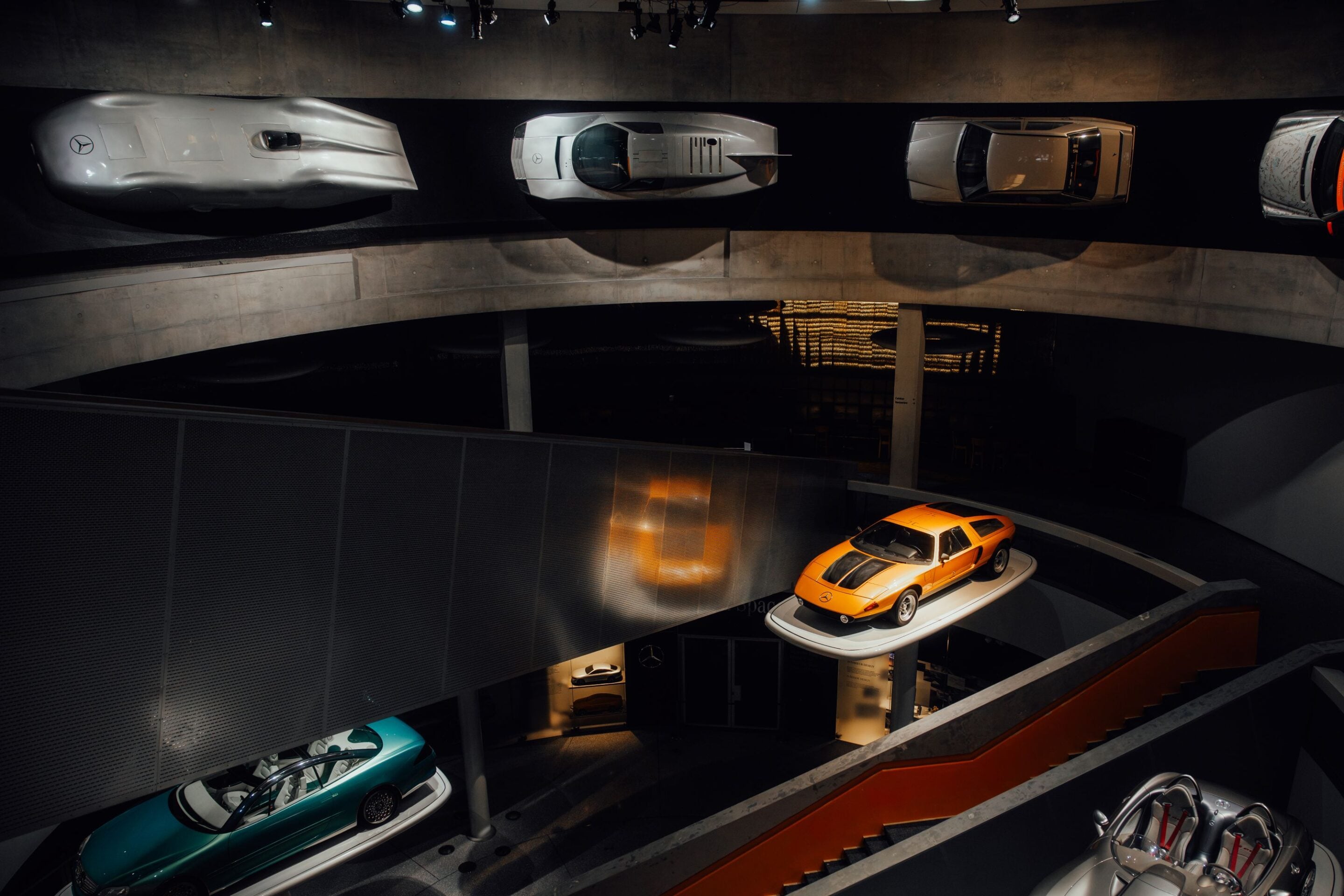
Around 160 significant vehicles form part of the Museum’s permanent collection that are housed over the nine floors that gently spiral downwards towards around the central atrium. There are only a handful of stairs, each level sloping gently to the next.
Interspersed between, are large rooms that showcase themed collections from Mercedes-Benz’s collection of around 1100 cars.
And the themes are as diverse as Mercedes’ back catalogue allows. From garbage trucks to emergency vehicles, snow ploughs, celebrity-owned cars and mass transportation, each themed room is a time capsule of the brand’s technological diversity.
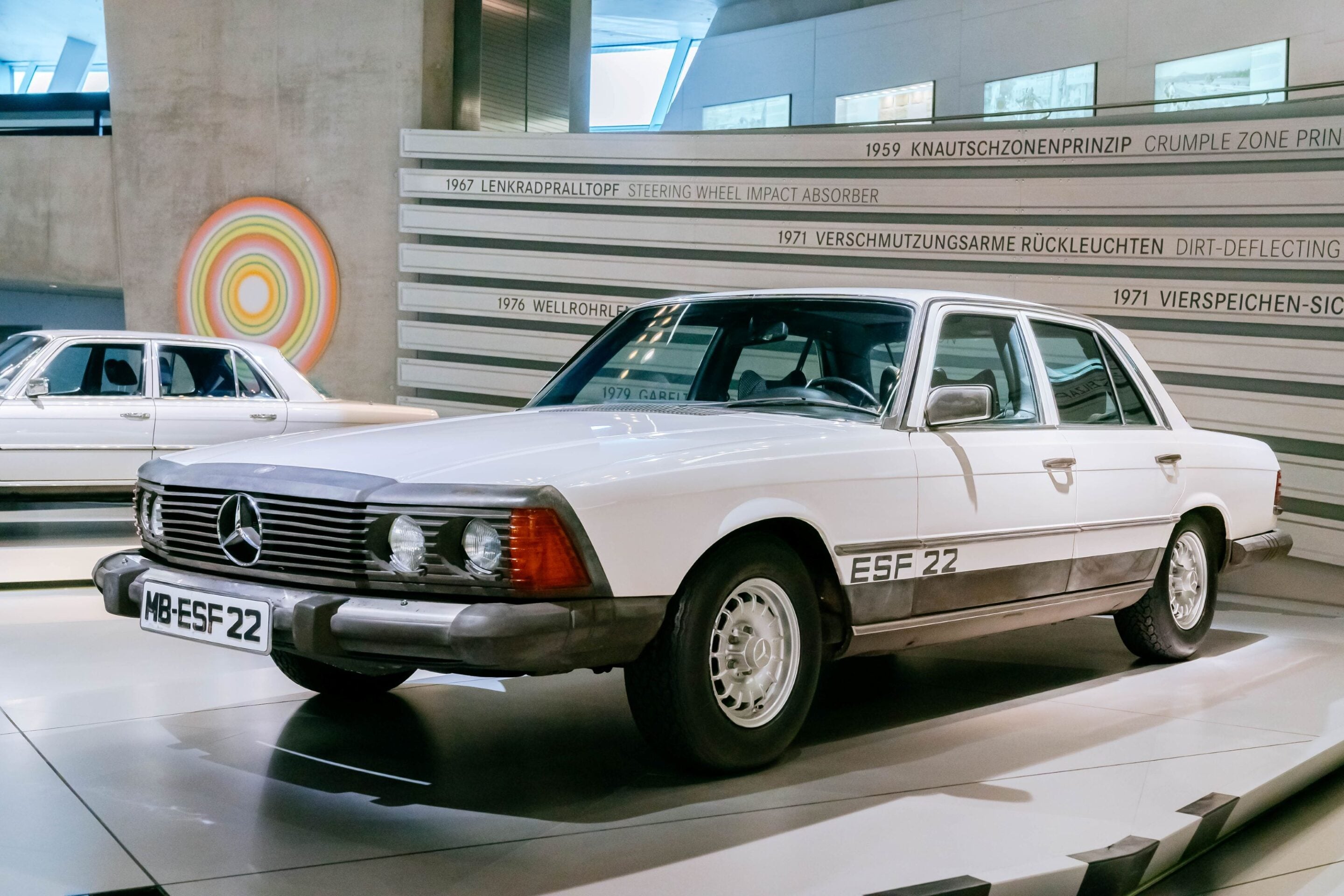
A particular favourite of my visit was the Young Timers room, an evocative and colourful display of cars from the ’90s and noughties. Highlights for me included the fearsome W124 generation Mercedes-Benz 500E (the last example that rolled off the Porsche – yes, it was built by Mercedes’ Stuttgart neighbour – production line in 1994) and a model that tugged at my heartstrings, an incredibly rare 6.0-litre-powered W210 series Mercedes-AMG E60. As a previous W210 owner (an E320 we named Bertha in honour of Bertha Benz… who doesn’t name their cars?) seeing that generation of E-Class celebrated felt vindicating.
2
But the Museum is not just about cars. As you spiral ever downwards, the walls tell the story of the world from the late-19th century through to the beginning of a new Millennium.
Social upheaval, cultural shifts, great (and some not-so-great) moments in history, are all embraced to provide context for the era while also highlighting advancements in technology.
Mercedes-Benz deserves recognition for not shying away from difficult topics either in its historical displays, covering both World Wars (and the part Mercedes played in them) and the rise of Nazism in the 1930s. The latter is starkly underscored by the 1939 German Grand Prix winner’s trophy on display, complete with the Nazi Swastika and Adolf Hitler’s name, not as a celebration of Rudolf Caracciola’s victory in a supercharged Mercedes-Benz W154, but as a reminder of the insidious hold the Nazis held over Germany during that period.
It would be easy to airbrush that era out of company lore, as many German companies from all manner of industries have done. Not Mercedes-Benz. Instead, it acknowledges the part it played in supplying transport, armaments and aero engines to the Nazi regime, along with using ‘forced labour’ for those war efforts. It’s a sobering and important display, one that deserves recognition.
While the pre-World War II displays prove fascinating, where the Museum really comes alive – as did Germany and the world itself – is after 1950. And it’s here where we see the Genesis of the brand as it is today.
With the German Economic Miracle (Wirtschaftswunder) in full swing, the label ‘Made in Germany’ took on a new meaning, no longer stigmatised by the decades that preceded it, but a symbol of technological innovation and quality engineering. No company embraced this shift more than Mercedes-Benz and the cars on display from this era typify that.
1
From the 1954 300SL ‘Gullwing’ to its smaller 190SL Roadster sibling, and the W100 ‘Grosser’ Mercedes-Benz 600, to see these cars in the metal, perfectly encapsulates the modern history of the brand.
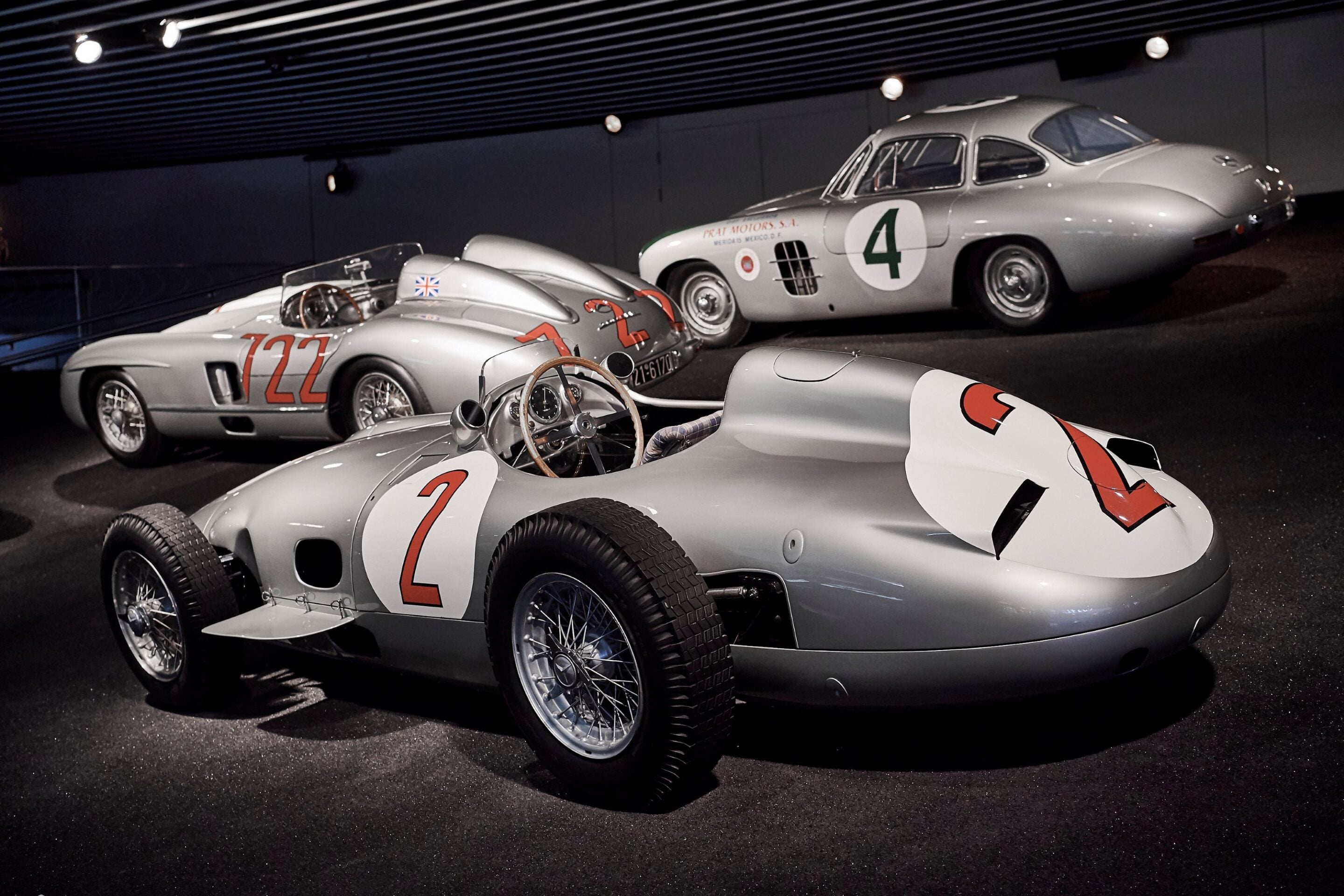
And tucked away in one of the themed rooms, Mercedes’ famous Blue Wonder, the one-off racecar transporter built to ferry the brand’s Silver Arrows racers around Europe, serves a breathtaking reminder of the brand’s motorsport history.
So too the 1955 Mercedes-Benz 300 SLR Uhlenhaut Coupé, essentially a roadgoing version of the famous Silver Arrow grand prix cars of the era. Named for its designer, Rudolf Uhlenhaut, just two examples were ever built. One sold at auction to an undisclosed buyer in 2022 for €135 million (A$219 million), the most expensive car in history. The other stands proudly in front of me, part of the Museum’s permanent collection.
Motorsport is a hugely important part of the brand’s history, and nothing exemplifies this more than the huge collection of racecars on permanent display. From the earliest grand prix racers, to current Formula One cars, from DTM touring cars, rally Mercs and even racing trucks, the Museum’s collection is like stepping through time. And forget Netflix’s Drive to Survive, the true heroes of grand prix racing drove supercharged monsters at speeds in excess of 300km/h, wearing no seatbelts, and on tyres as skinny as your wrist. Marvellous.
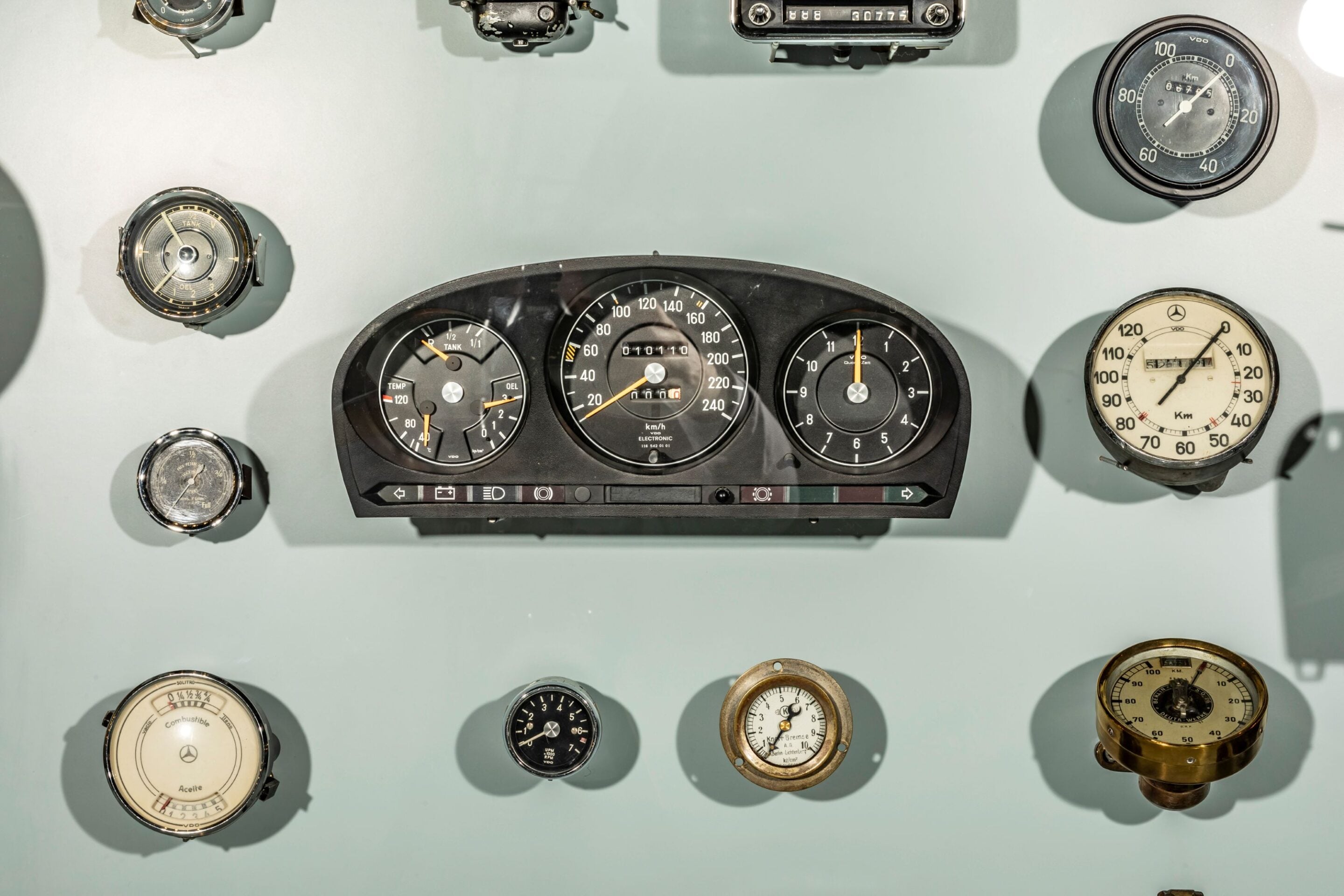
It takes around two to three hours to slowly traverse every level, ducking into each themed room and seeing not just vehicles, but ephemera, memorabilia, original artworks and the historical context in which they were created, in which they existed.
2
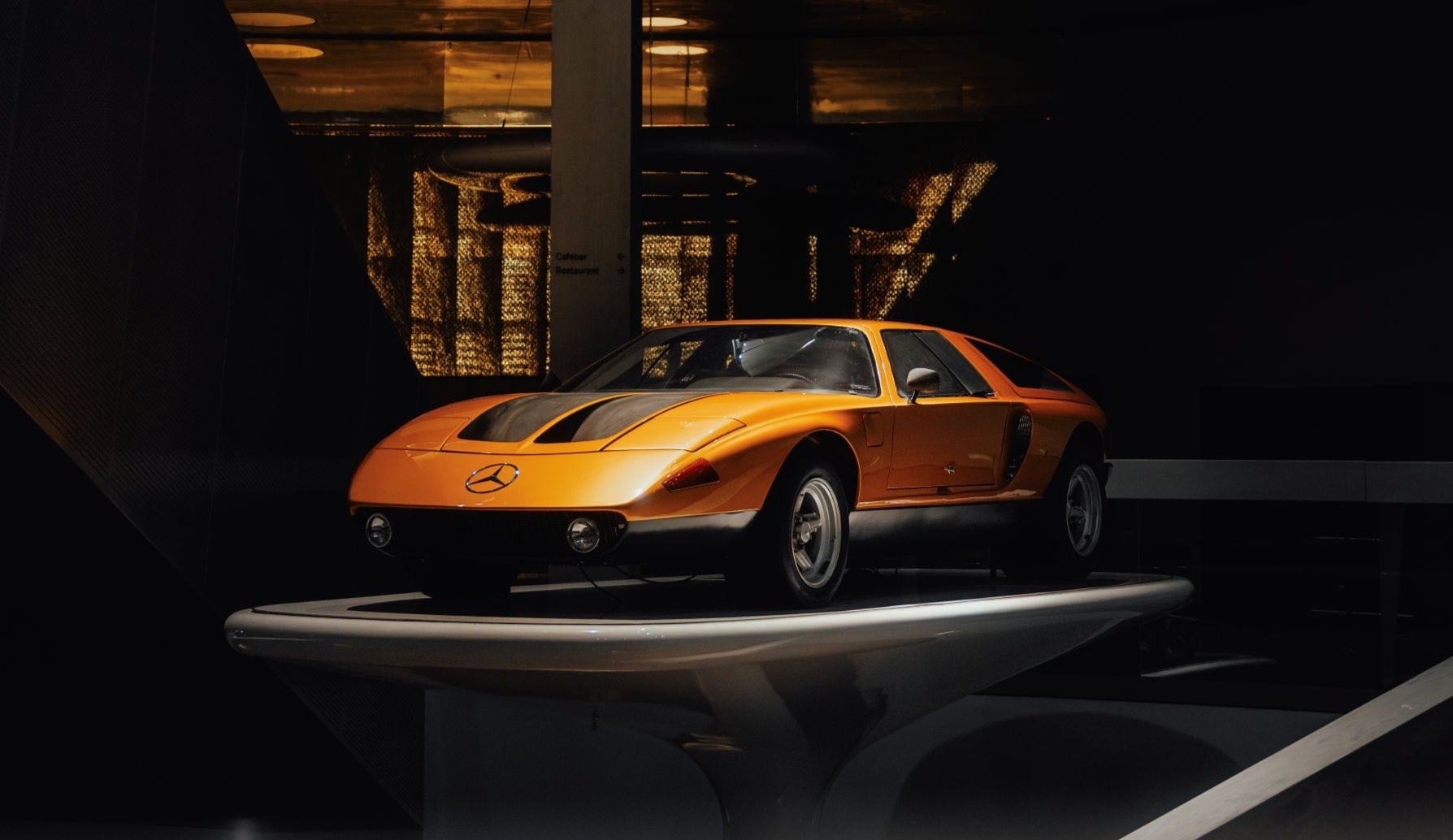
Towards the end, I spot one of my all-time favourite cars, the C111 ‘experimental’ sportscar and its stunning Gullwing doors and bright metallic orange (Weissherbst) paint. I had a model of one as a kid, photos of it on my childhood bedroom walls, and books about its history and development adorn my bookshelves to this day. But I had never seen one in person. And here it was, in all its orange glory.
It proved a fitting end to my time at what
I reckon is the best automotive museum in the world, not just for its impressive collection of cars, but also for the history, the feeling of time and place, that the Museum embodies and embraces.
I needed a souvenir and as I exited through the gift shop (of course), a bright orange metallic sportscar caught my eye. It now sits proudly on my bookshelf.
1
Need to know
Address: Mercedesstrasse 100, 70372 Stuttgart
Opening hours: Tuesday to Sunday 9am to 6pm (closed Mondays)
Tickets: €16 (A$26) Concession €8 (A$13)
Parking: P4 multistorey car park; €2 (A$3.25) per hour for the first three hours; €2.50 (A$4.05) per hour from the fourth hour
Public transport: From Stuttgart Hauptbahnhof take the S-Bahn line S1 in the direction of Kirchheim (Teck) to Neckarpark (Mercedes‑Benz)
This story first appeared in the July 2026 issue of Wheels magazine, now on sale. Subscribe here and gain access to 12 issues for $109 plus online access to every Wheels issue since 1953.
Follow WhichCar/Wheels on Google
Click the button below to make WhichCar by Wheels a preferred source for your news.

We recommend
-
 News
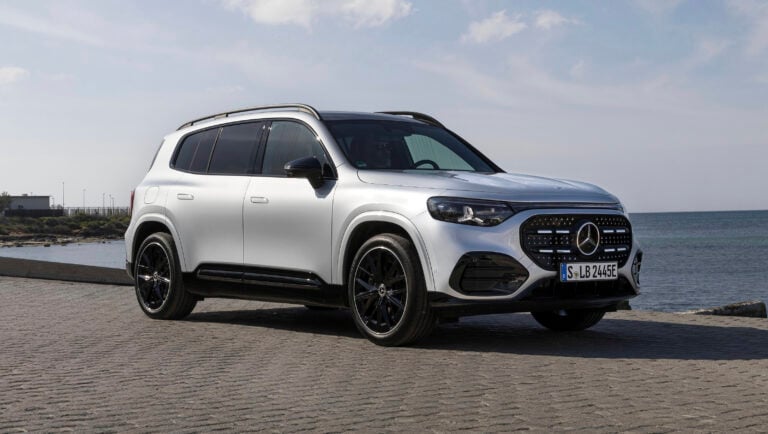
NewsSecond-gen Mercedes-Benz GLB confirmed for Australia; due in showrooms this year
Mercedes-Benz’s new GLB to arrive in Australia later this year with both petrol-hybrid and electric drivetrains.
-
 Features
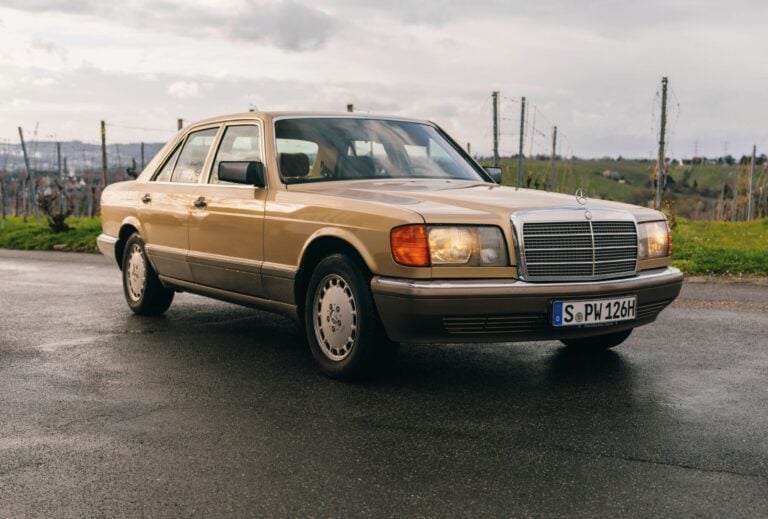
Modern Classic: Mercedes-Benz 300SE (W126), a graceful presence for 47 years
The W126 generation of Mercedes-Benz’s flagship S-Class encapsulates the very essence of the brand in a single restrained, yet powerful model.
-
 Features
Night at the Museum: Porsche turns 70
It’s a lock-in at the shrine of Porsche’s heritage: the company collection at Zuffenhausen
