Features

Gallery 1
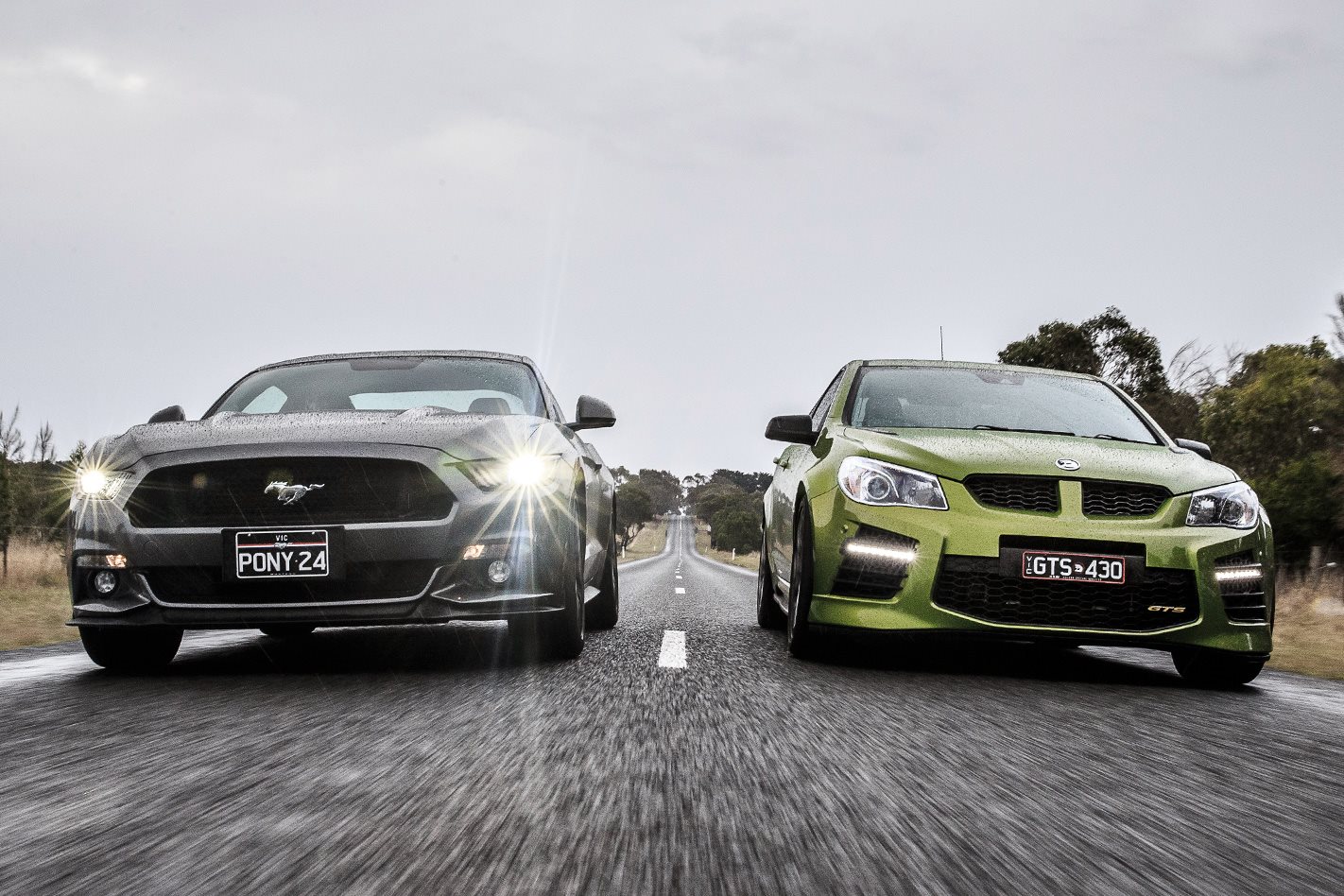
It’s crunch time, kids. It ain’t no news flash, but if you want to buy a brand-new muscle car for sensible money in the next couple of years, chances are it’s going to come from the US. Fact.
But is that the end of the world? Will a move to US-sourced iron rob us of everything that Aussie muscle has come to represent? Are US-made performance cars as bleak – in some aspects – as they used to be?
See, for those of us who buy razors rather than zit cream, the world of factory muscle cars has always drawn some pretty trustworthy lines in the hi-po sand. It’s a bit of an us-versus-them thing, and over the years several defining features of each have emerged and been subsequently set in stone.
But as the Aussie industry winds down and we look to the US of A for our next generation of boredom-beaters, do any of those old rules still apply? And, if so, which ones? Does an Australian muscle car still stand out from a Yankee one?
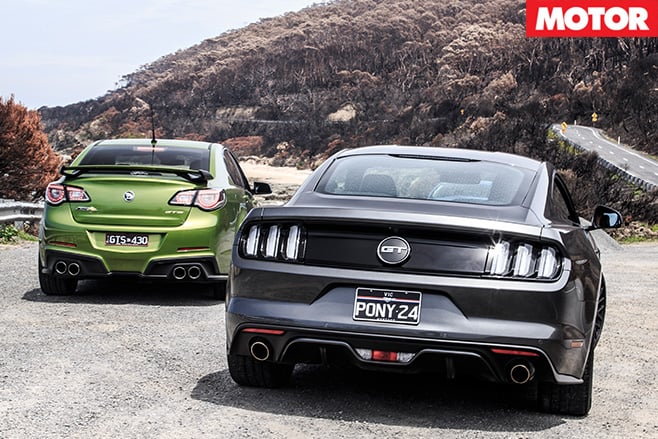
Holding the two brochures up together, it soon becomes clear that maybe some of those diehard rules of engagement no longer apply. I’ll start you off with an easy one: Engine displacement. Now, back in the good old days, the Septics dead-set had the wood on us in that department. As long as a Torana with a six-potter could win Bathurst, the local car-makers figured a small-block was as big as we needed to go. Not so in the US, where the big-block ruled the roads and, thanks to whole banks of carburettors and eight-plus litres, horsepower outputs in multiples of 100 were the order of the day. That, however, was then.
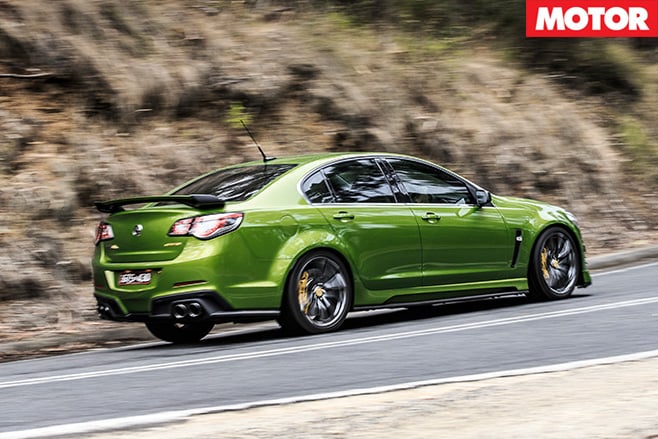
Oh, how we laughed when we first saw the specs for the VF HSV GTS. Not only was the engine embiggened over its Holden Commodore basis (although the Commy has caught up cube-wise in VF Series II trim) but those 6.2 litres were then blown by a dirty great twin-screw pump.
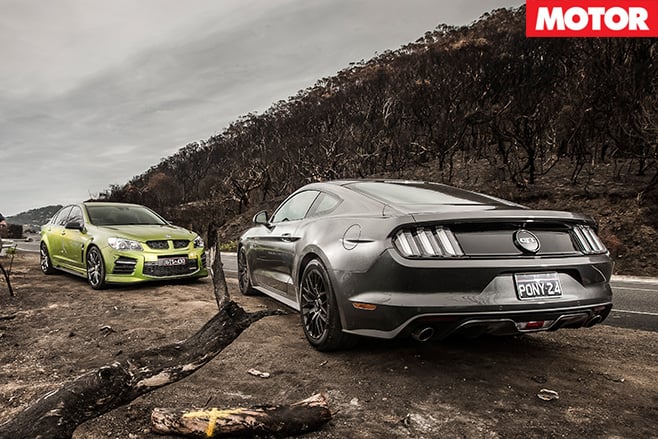
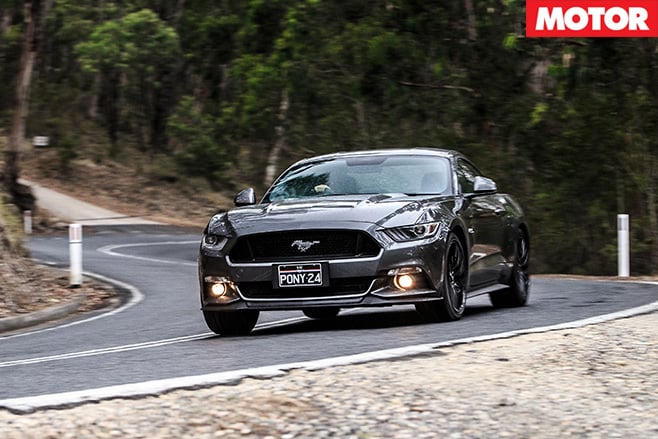
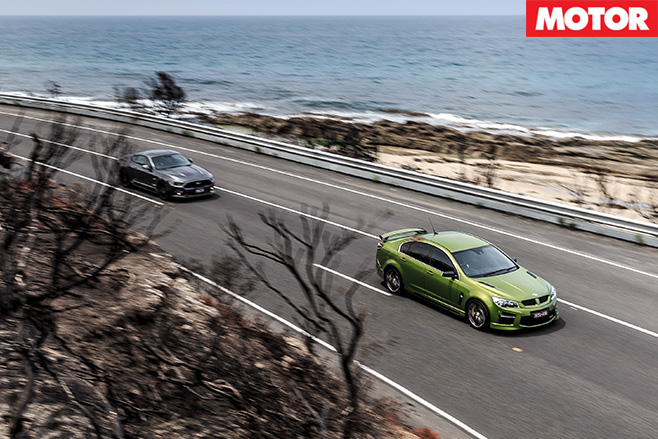
Tradition one shot to bits. That said, the V8 in the Mustang is a bloody good atmo 5.0-litre and it sounds and feels at least a litre bigger than that. It goes hard, too, and despite handing back 1.2 litres and nine psi, it’s less than a second slower across 400m.
Mind you, that 0.9 of a tick at the pointy end of a 12-second car (in the GTS’s case) is still a big deficit. And while the Ford does feel muscular and lively, it’s never the wrecking ball in the back of your strides that the GTS is. If the Mustang’s Coyote was all you could get your hands on, you’d still be chuffed. But knowing that the HSV’s LSA exists will always leave you wondering what might have been. You’ll get it in the neck at the pump, though, and while the Mustang is no sipper, with 13.8L/100km on test, the HSV gurgled away 16.2L/100km.
The HSV’s can’t be fiddled (but feels to be calibrated just-so anyway) while the Mustang’s launch function can be varied to set sail at anything from 3000 to 4500rpm. On the day, we found 3100 to be just right and 3300 was a tad too much. Yep, it’s that sensitive. Folks like AMG and BMW should take a long, hard look at how these systems work, because their own set-ups are pants by comparison.
So what about handling and ride? We’ve always been kind of proud of our Aussie engineers for their ability to turn a big heavy car into something with a decent sidestep. Similarly, the myth of the Yank Tank, the land-yacht, the boulevardier, is well entrenched, with plenty of proof to be seen in previous US makes and models.
The Mustang also has selectable drive modes, but they do bugger-all for the ride quality. But that’s okay, because the ’Stang’s ride is only a fraction sharper than the GTS’s Tour mode. The Ford is also less crashy, and ultimately, better damped, with less secondary jounce. And while really big lumps will launch the HSV on a successful search for its front bump stops, there’s no such carry-on from the Mustang. And just to rub salt into things, the ’Stang is a more natural steerer on those quickish secondary roads; the slightly more accurate helm also makes the Ford feel smaller and narrower (even though it’s really not).
All right, let’s talk tech. It’s often been noted that US-made cars don’t always encompass the cutting-edge techo stuff that other cars – Australian included – seem to embrace a lot earlier. In a way, that still holds true, because while the HSV gets driver-aid gizmos like lane-assist, blind-spot warning and forward-collision warning, the Ford has no such thing. Oh sure, the Mustang gets a total of eight airbags, including one each for the driver’s and passenger’s knees, but experience tells us that a car usually only gets knee-bags because it needs them.
In the HSV, it’s all contained in Track mode, while in the Ford it’s called Race mode. But since, in the ’Stang, the toggles only work one way, you need to cycle through Race mode to get back to the normal settings. And Race mode switches off the ESP, so for a split second you might find that ESP is disabled when all you wanted was to go back to a normal setting. And if the ducks-of-death happened to line up in that split second…
But surely, the Ford must follow Stateside tradition and offer up all those little luxuries that the average US tub-o-consumer has demanded for years? Well, maybe, maybe not. The Mustang’s convenience-item list might be a long one back in Detroit (where a stolen shopping trolley is now basic transport) but against the HSV, it can’t cut it.
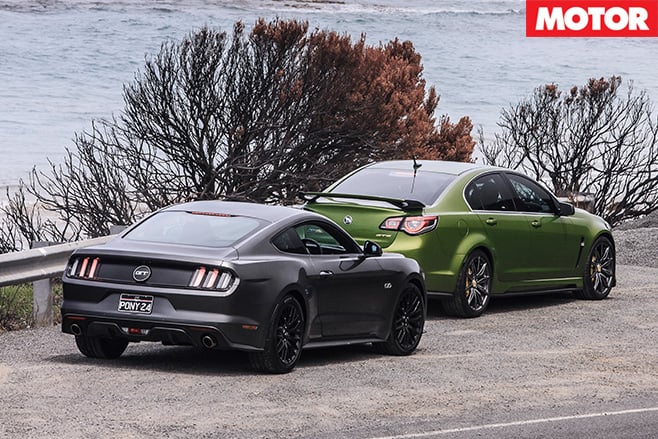
The Ford also suffers from a couple of cheap shots that hark back to its original left-hand-drive spec: The park-brake is on the passenger’s side of the console (but at least it’s not an e-brake like the HSV gets) and the tune and volume knobs on the stereo are the wrong way around.
Speaking of which, the Mustang’s interior also supports another widely held theory that US cars have rubbish interiors and can’t match the Aussie stuff for build quality. And we’d have to agree. The ’Stang has lots of hard, black plastic and the fit and finish is nowhere near the HSV’s. Both have some brightwork around the dashboard that’s just a reflective nightmare under the Aussie sun. And stowage space? Geez, both have gone backwards.
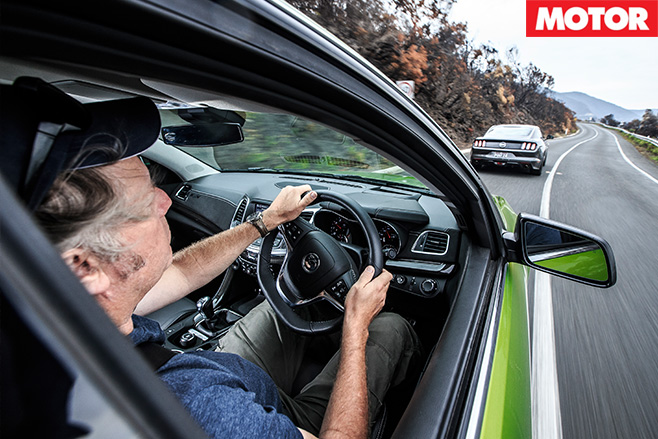
So where does this all leave us? Well, it shows that we’ll absolutely miss the wallop that only a supercharged engine with a capacity north of six litres can provide. And the loss of the local flavour as it pertains to interiors and packaging will likewise play a sad little tune on our heartstrings. But equally, the new Mustang proves that somebody on the other side of the Pacific has been paying attention and that there are at least some folks in white coats who are grooving to the same tunes.
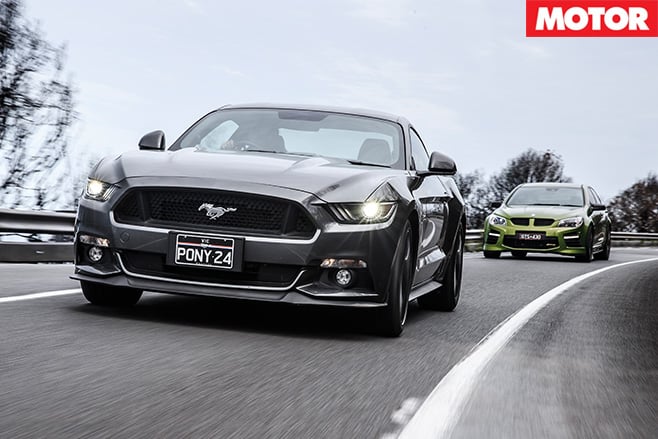
It is, of course, the least the Yanks can do. I mean, they gave us the Kardashians, right? They owe us.
| u00a0 | FORD MUSTANG GT | HSV GTS GEN-F2 |
| Body | 2-door, 4-seat coupe | 4-door, 5-seat sedan |
| Drive | rear-wheel | rear-wheel |
| Engine | 4951cc V8, DOHC, 32v | 6162cc V8, OHV, 16v, supercharged |
| Bore/stroke | 92.2 x 92.7mm | 103.1 x 91.95mm |
| Compression | 11.0:1 | 10.7:1 |
| Power | 306kW @ 6500rpm | 430kW @ 5900rpm |
| Torque | 530Nm @ 4250rpm | 740Nm @ 4200rpm |
| Power/weight | 176kW/tonne | 234kW/tonne |
| Transmission | 6-speed manual | 6-speed manual |
| Weight | 1739kg | 1841kg |
| Suspension(F) | struts, anti-roll bar | struts, adaptive dampers, anti-roll bar |
| Suspension(R) | multi-links, anti-roll bar | multi-links, adaptive dampers, anti-roll bar |
| L/W/H | 4784/2080/1381mm | 4943/1899/1467mm |
| Wheelbase | 2720mm | 2915mm |
| Tracks | 1582/1655mm (f/r) | 1586/1628mm (f/r) |
| Steering | electrically-assisted rack-and-pinion | electrically-assisted rack-and-pinion |
| Brakes(F) | 380mm ventilated discs, 6-piston calipers | 390mm ventilated discs, 6-piston calipers |
| Brakes(R) | 330mm ventilated discs, single-piston calipers | 372mm ventilated discs, 4-piston calipers |
| Wheels | 19.0 x 9.0-inch (f); 19.0 x 9.5-inch (r) | 20.0 x 8.5-inch (f); 20 x 9.5-inch (r) |
| Tyre Sizes | 255/40 R19 (f); 275/40 R19 (r)u00a0 | 255/35 R20 (f); 275/35 R20 (r) |
| Tyre | Pirelli P-Zero | Continental ContiSportContact |
| Price as tested | $57,490 | $95,990 |
| Pros | Sweet V8; excellent tourer; value | Stonking supercharged grunt; finely-tuned handilng |
| Cons | Flimsy build, lacks straight-line grunt; on-limit handling | Terse ride; fearsome thirst |
| Star Rating | 4/5 | 4.5/5 |
Follow WhichCar/Wheels on Google
Click the button below to make WhichCar by Wheels a preferred source for your news.