Features


Gallery 1
The Eighties, Nineties and Noughts were a thin time for American modern classics. You can make a case for the Corvette, certain hotter Mustang and Camaro variants, and the DMC DeLorean (more for its backstory than the quality of the car) but beyond that it’s thin pickings. Look at the avalanche of hot product that came out of Japan and Europe in that era and you begin to appreciate the paucity of America’s quality output during this period.
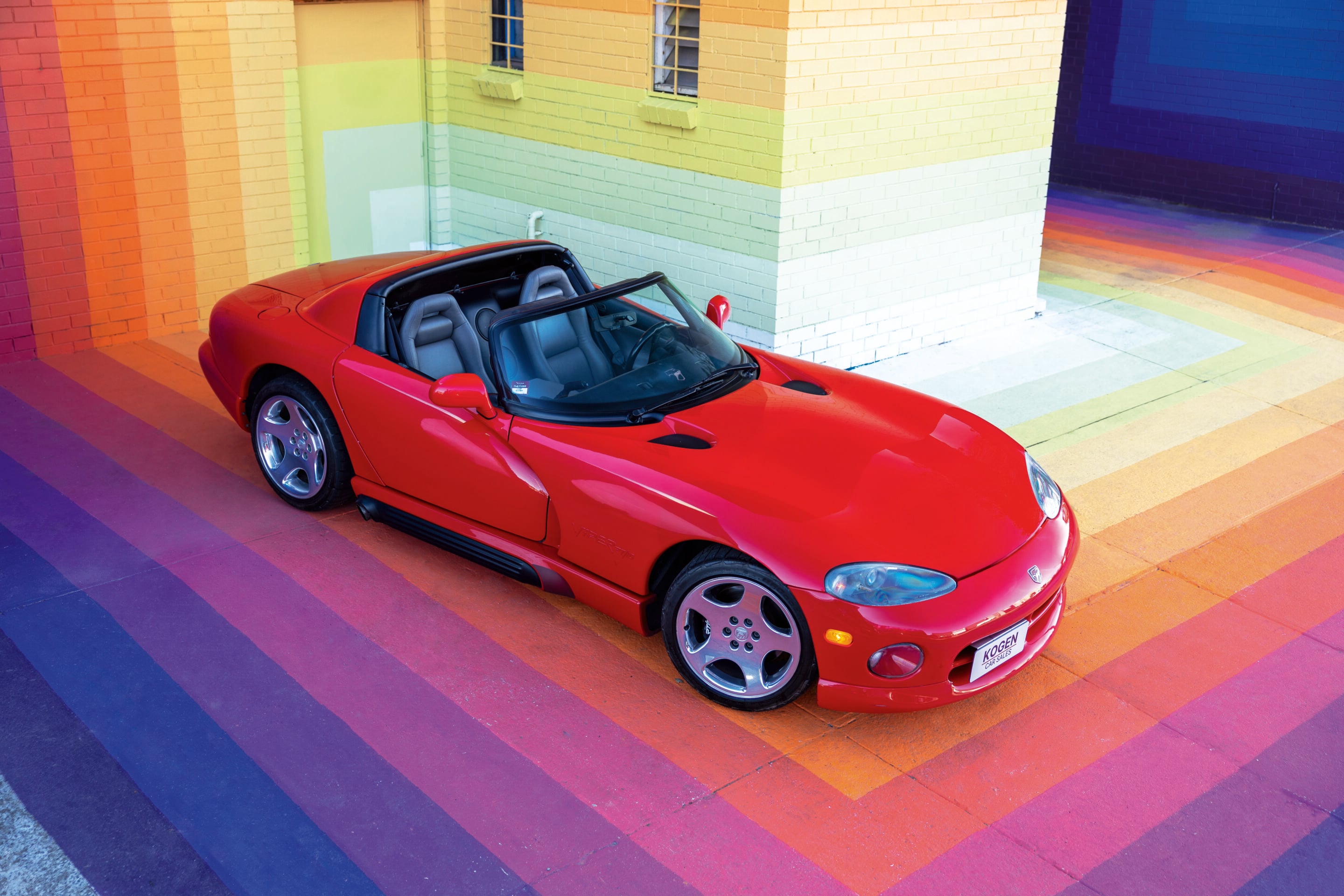
There is, however, one standout that qualifies on any measure you could choose to judge it by – the original Dodge Viper RT/10. It has a great backstory, the car itself was wild, charismatic and uncompromising, it spawned a legacy of successors, and it gave its manufacturer a massive shot in the arm, acting as a halo product for a subsequent range of sporting cars.
It’s hard to believe the Viper is no more, the last version having been sold in 2017. Enthusiasts argue over whether it was weak sales (only 485 cars were sold worldwide in 2017) or the cost of complying with FMVSS26 safety regulations, which required curtain airbags but, in truth, one probably begat the other.
The final nail in the Viper’s coffin was the closure of its Conner Avenue assembly plant in Detroit on August 31, 2017 where a team of 87 staff hand-built the trickle of cars. Times had certainly changed since the late 1980s when the Viper was conceived.

1
Maximum attack
We’ll start with Bob Lutz. You know him. Following tenures at GM, BMW and Ford, ‘Maximum Bob’ was recruited by Chrysler chairman Lee Iacocca as the product guru charged with making sense of a recent round of acquisitions that had seen AMC, Jeep, Lamborghini and later Maserati added to the fold.
Lutz was good friends with Carroll Shelby and his garage featured a gleaming Autokraft Mk IV Cobra replica. Shelby rarely missed the opportunity to remind Lutz that this formula was due for a reboot. At first Lutz blew it off as Shelby merely looking to earn a slice of the pie, but the idea got under his skin.
The logic was fairly straightforward. Iacocca’s K-car platform, introduced in 1980, had saved Chrysler from certain doom, spawning 50 different models from a single modular chassis. It was originally built around relatively fuel efficient four-cylinder engines on a space-efficient front-drive layout. Pragmatic and profitable it certainly was, exciting it definitely wasn’t. Lutz wanted something extra.
2
In truth, the successful K-car philosophy had probably run its course by the late 1980s, with so much squeezed out of it that the pips were squeaking. Iacocca couldn’t be convinced otherwise, however, and his idea of a halo car for the organisation was a K-car variant too far – the 1989 Chrysler TC by Maserati. The catalogue of woe that plagued this particular car would probably merit a separate feature of its own. With projected sales of 10,000 units per year, the TC eventually went on to sell a total of 7300 cars across three years before being quietly axed.
One day in February 1989, Lutz and design director Bob Gale got talking at the Chrysler Design Center.
A whole new series of cab-forward LH sedans was incoming, and there was a buzz in the building, with the new Dodge Intrepid and Chrysler Concorde boldly breaking from the old K-car straightjacket. Worried that this wouldn’t be enough to convince the world that the company hadn’t turned the K-car page, Lutz started recalling some of his conversations with Shelby. What if Chrysler could be the one to build a new Cobra? Bob Gale didn’t need asking twice.
Gale believed that every brand within the Chrysler stable needed a hero car to define the essence of that particular brand. With Jeep it was clearly the Wrangler. The forthcoming Prowler would do the job for Plymouth. But Dodge was floundering and Lutz’s proposal was probably the answer. And besides, some of the work had already been done. Gale and his team had worked on a sports car concept called the Izod, which had influenced the styling of the Dodge. Speak to Gale and he’ll tell you that the idea for a serious sports car had ruminated for some time within the business and that was why he had a number of design options ready to roll.
1
There was an instant sort of serendipity that surrounded the project. Carroll Shelby had been marketing go-faster Dodge products since 1986 and willingly offered his input, Gale had the design direction already mapped out and Lutz had a clear idea of the philosophy behind the car: modern materials but an old-school, raw focus. The fourth key personality in the development of the car was Francois Castaing, ex-head of Renault’s racing arm, and now head of Chrysler’s Jeep and truck engineering division.
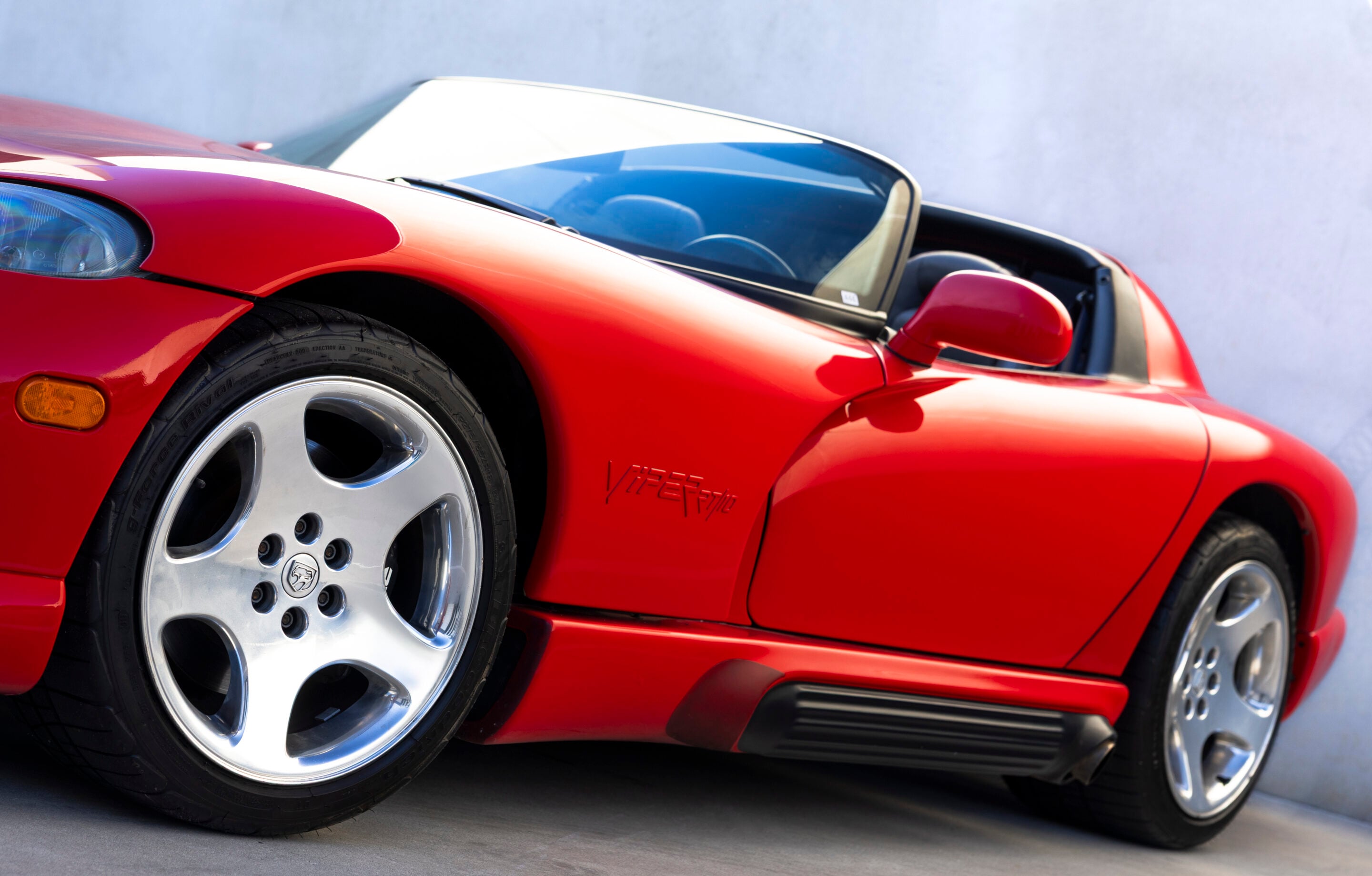
Castaing’s team had been working on a 10-cylinder version of the company’s rather ancient 5.9-litre V8 – the classic 360ci lump – and he managed to persuade Lutz that it was sufficiently refined to power a sports car. At that moment, Lutz and Castaing realised that they might have bottled lightning and quickly set Gale to work. One design in particular quickly grabbed the imagination: a wide, low-slung roadster with an exposed fuel filler cap, side pipes and deeply dished five-spoke wheels. The engine would be set as far back beneath a very long bonnet, creating what Gale described as “truly heroic proportions”. A half-scale clay model was quickly built up in order to be presented to Lee Iacocca.
Getting to production
Castaing estimated that a $70m budget would be needed to productionise the concept, chicken feed by modern standards. Costs would be shaved by utilising an existing gearbox, while cannibalising some Dodge Dakota components for the suspension and rear axle. The final element that was needed to convince Iacocca was a name. Lutz wanted Cobra, but was voted down by the others, who felt that Ford’s lawyers would play hardball. Challenger was another name that was floated but it was Viper that seemed an appropriate link to Cobra. A Viper badge, dubbed ‘Sneaky Pete’ by Chrysler insiders, was sketched and Iacocca got to deliberate on the project.
Francois Castaing was again instrumental in the process. He convinced Lee Iacocca that the worth of this model came via the technical opportunities that working with new materials and new workflows would realise. He and Lutz quickly realised that he needed two approvals from the boss: one for the fully worked-up production prototype and the other for the production vehicle. There were blips along the way. Carroll Shelby was unconvinced by the notion of the V10, feeling that a heavy truck engine was wrong for a roadster. He also assumed, wrongly, that Dodge would subcontract the build process to him if the car got the green light, unaware of Castaing’s arguments on building and retention of intellectual property in-house.
2
The initial concept appeared at the 1989 Detroit Show, the chassis and suspension built up by hot-rodder Boyd Coddington, the body prepped by Metalcrafters and under the bonnet was a lash-up of a V10, cobbled together by Roush from a couple of 360Ci V8s with a crudely fabricated crank. Yes, the concept could move under its own steam, but it couldn’t steer worth a damn and it sounded terrible. It nevertheless had the desired effect. Huge publicity followed, near universal approval and a palpable sense of excitement that America was going to build this incredibly exciting car.
How could Iacocca say no? Even at $70m, the publicity and halo effect was a bargain. As Jim Julow, Dodge VP, noted, “We needed to send a message that we had a new concept… something that was so outrageous, so cutting-edge, so purpose-built that it said we still had a lot of car nuts around here; people with the know-how to put the most outrageous street car ever on the road.”
The ‘official’ green light came in a typically Iacocca fashion; a publicity stunt before the press, on May 18, 1990, where he threw Lutz the keys to the Viper and barked, “Build it!”
It would come as a shock to Chrysler’s slow-moving and arthritic bureaucracies to get the Viper into production briskly. Castaing was moving mountains to shift the business from siloed, functional teams to a multi-disciplinary platform approach, and the production Viper appeared on the show stand at the 1992 Detroit Show, looking very little watered-down in terms of aesthetics when compared with the original prototype. Yes, the windscreen header rail height needed to be raised by three inches, the headlights were solidly mounted to the radiator rather than the hood to stop them shaking themselves to pieces, the mirrors were redesigned and – at Iacocca’s insistence – a hastily-conceived hood was also designed. But Iacocca’s speech to launch the vehicle spoke not of what the Viper could do, but what it had done for Chrysler.
“We want to show you what an American car company can do when we put our minds to it,” he said proudly as the wraps came off the Viper. “In 1989, this Dodge Viper was just a concept. In January, it’ll be rolling off a production line in Detroit, Michigan. Nobody in the country ever developed a car that fast,” he boomed, to huge applause.
“We’ve changed this company to give you even higher quality cars, faster and at lower cost. For those of us who forgot, it’s called being competitive,” he said. “From now on, every new car Chrysler makes is going to be built the way this one was, and that’s by a team: product and manufacturing engineers, designers, finance guys and marketers all working together with one idea, making a great car.” The crowd erupted.
1
The rounding error
Castaing had estimated a $70m budget to productionise the Viper. Newly appointed project leader Roy Sjoberg figured $60m might be enough. Chrysler’s Treasurer, Steve Miller had other ideas. Iacocca had been granted a $100m slush fund for miscellaneous development and had spent half of it on the Town and Country minivan. Sjoberg took a call from Miller where the senior accountant told him that “You’re going to do it for $49.9 million. In a billion-dollar corporation, that rounds out to zero, so no-one will see you or hear you or know you exist… The day you spend a dollar over $49.9 million, call me.”
There had been some internal pressure to look at a turbocharged V8 rather than the V10, but Iacocca resisted, reasoning that doing so would just turn the project into another hot rod. The V10 was different, the Viper appearing years before F1 switched to V10s in 1996 and, as a consequence, before the likes of Audi, VW, BMW and Lamborghini jumped onto that particular bandwagon. That said, there were solid technical reasons why V10s weren’t a natural extension of the popularity of American V8 engines.
For a start, tacking on an extra couple of cylinders means that the V8’s characteristically even firing intervals are lost. Firing with 90 degrees of crank rotation creates a cross-plane V8’s trademark and hugely endearing woofle, but a V10 engine will end up with firing intervals that alternate between 54 and 90 degrees. It’s not a particularly harmonic sound, and the V10 prototype’s syncopation at idle had more than an element of commercial vehicle to it.
Castaing hit on an idea. He recruited Mauro Forghieri, the brilliant engineer who had recently defected from Ferrari to Chrysler-owned Lamborghini to fettle the 10-pot. Forghieri ditched the truck’s cast-iron engine block for a lighter aluminium block with iron cylinder liners, designed aluminium heads fitted with magnesium valve covers and a forged crank and con-rods. Chrysler powertrain engineer Dick Winkles was the technical liaison between the US and Italy, and acted as a brake on some of Forghieri’s more extreme demands such as shorter water jackets around the cylinders and an aluminium bedplate for the bottom end. In production guise, and on Aussie fuel, the 8.0-litre engine realised a power output of 298kW at 4600 rpm and 610Nm of torque at 3600 rpm.
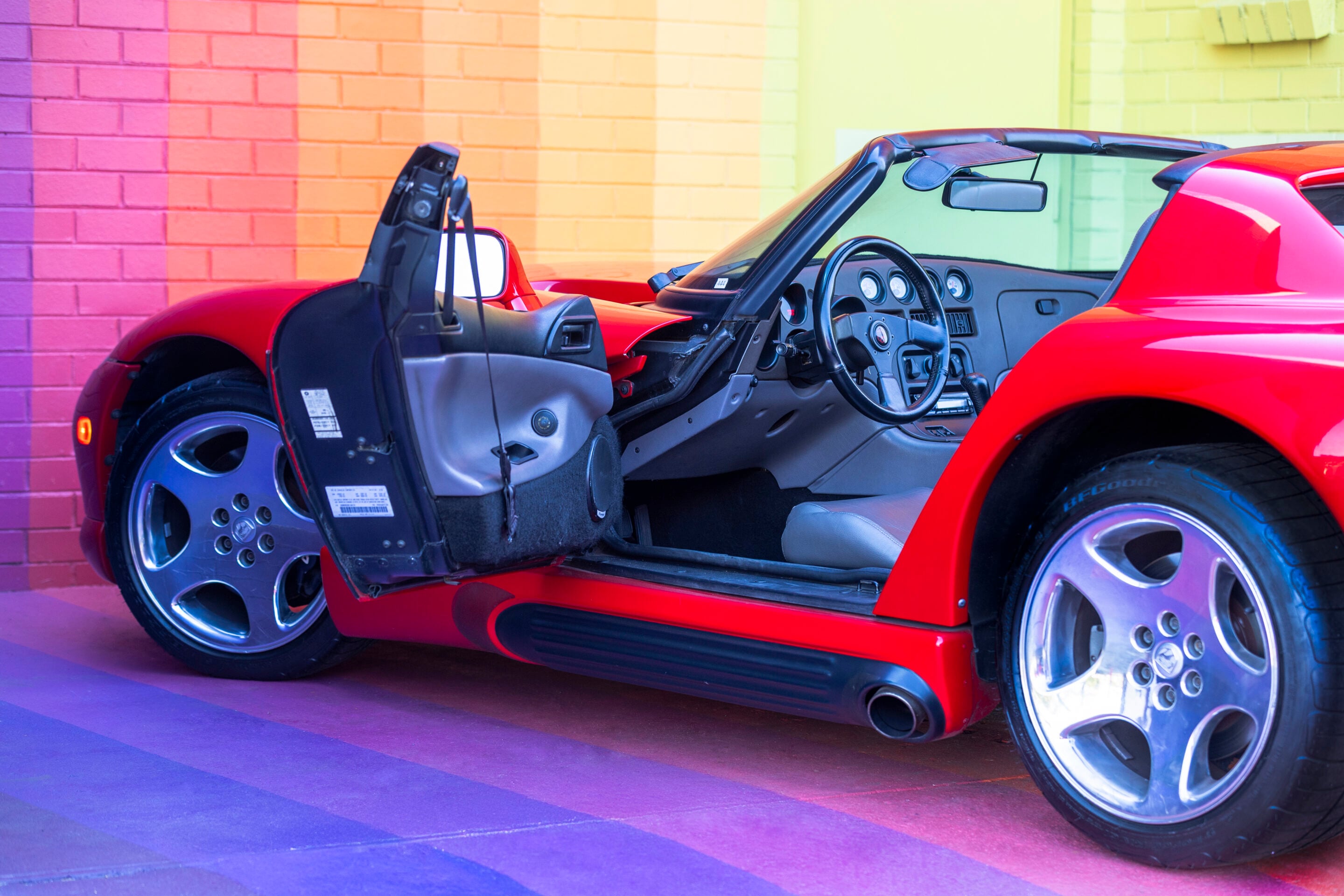
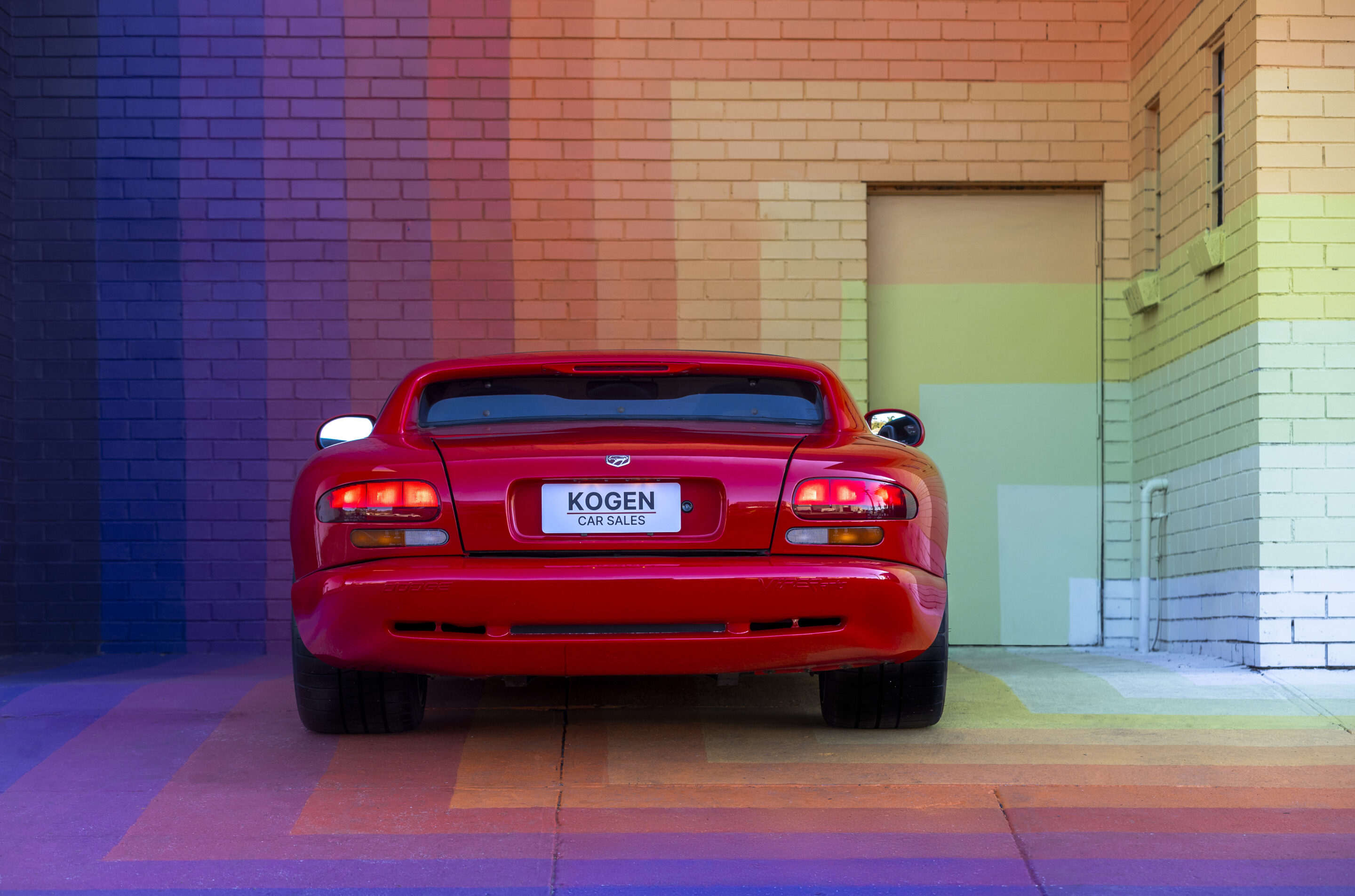
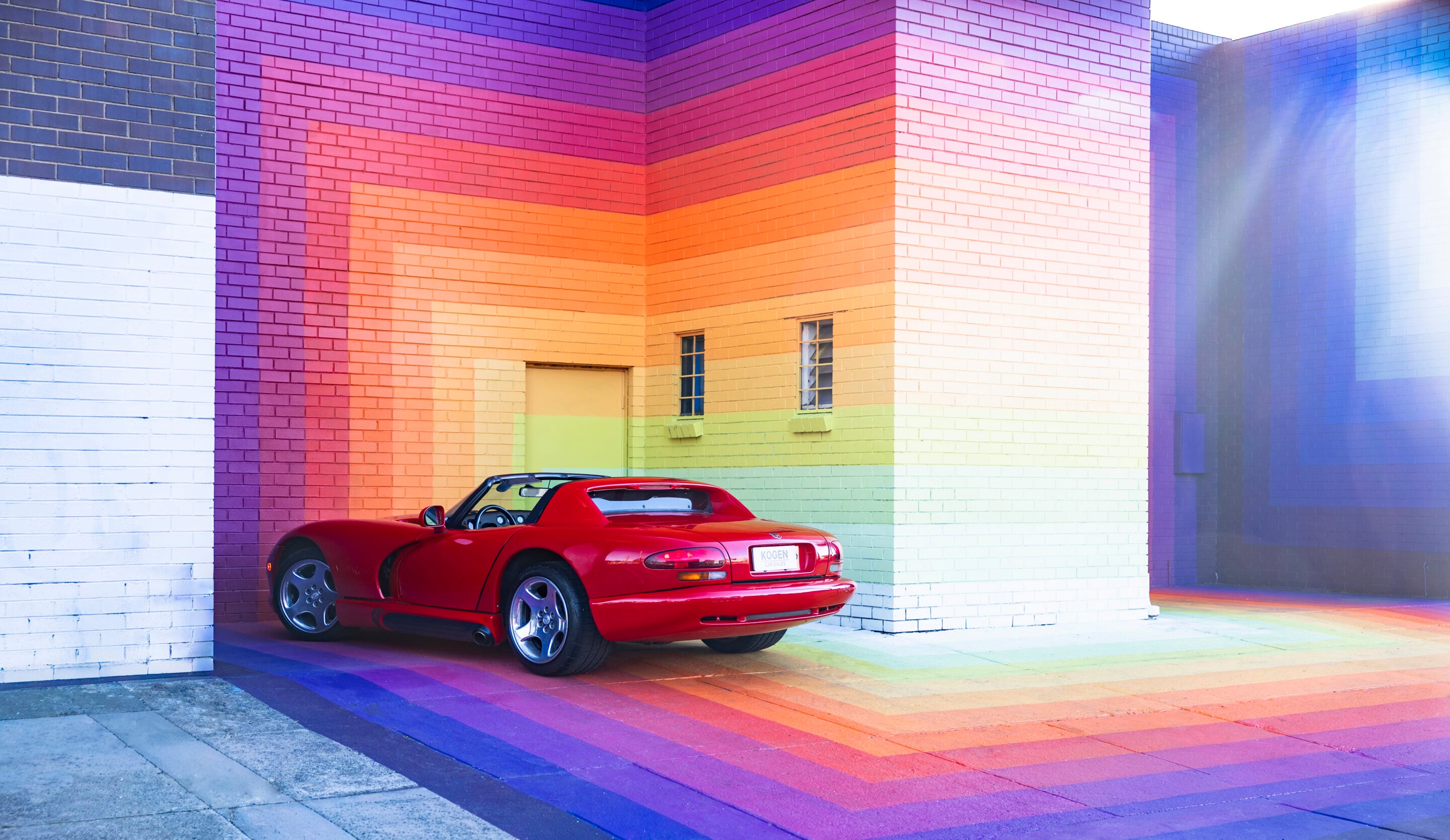
Production of the Viper RT/10, as it was badged, started at Chrysler’s New Mack Avenue plant in Detroit in January 1992. Output was around three cars per day, translating to a first year’s target volume of 400 cars. The gearbox was a beefy BorgWarner T56 unit after the original Getrag transmission proved too fragile. Michelin had won the tyre shootout versus Goodyear, but Chrysler’s bean counters shot that decision down, preferring an American brand, and it took Iacocca’s intervention before the French tyres were instead chosen. No air conditioning, no exterior door handles, no airbags, no anti-lock brakes, no traction control, no automatic transmission. Yes, the target weight of 1360kg was blown through, but by today’s standards, the final 1565kg result was hardly catastrophic.
2
The car
Wheels’ first test of the Viper on Aussie bitumen came in the December 1993 issue when Michael Stahl put it up against the Robnell SC 429, a 7.0-litre Aussie take on the classic Cobra theme. “Anyone who expected the Viper’s huge V10 to be even more V8 than a V8 is in for a shock,” he claimed. “It’s closer in character, and in sound, to something like Godzilla’s twin-turbo six – or to an Audi turbo-five as Kevin Bartlett pointed out.
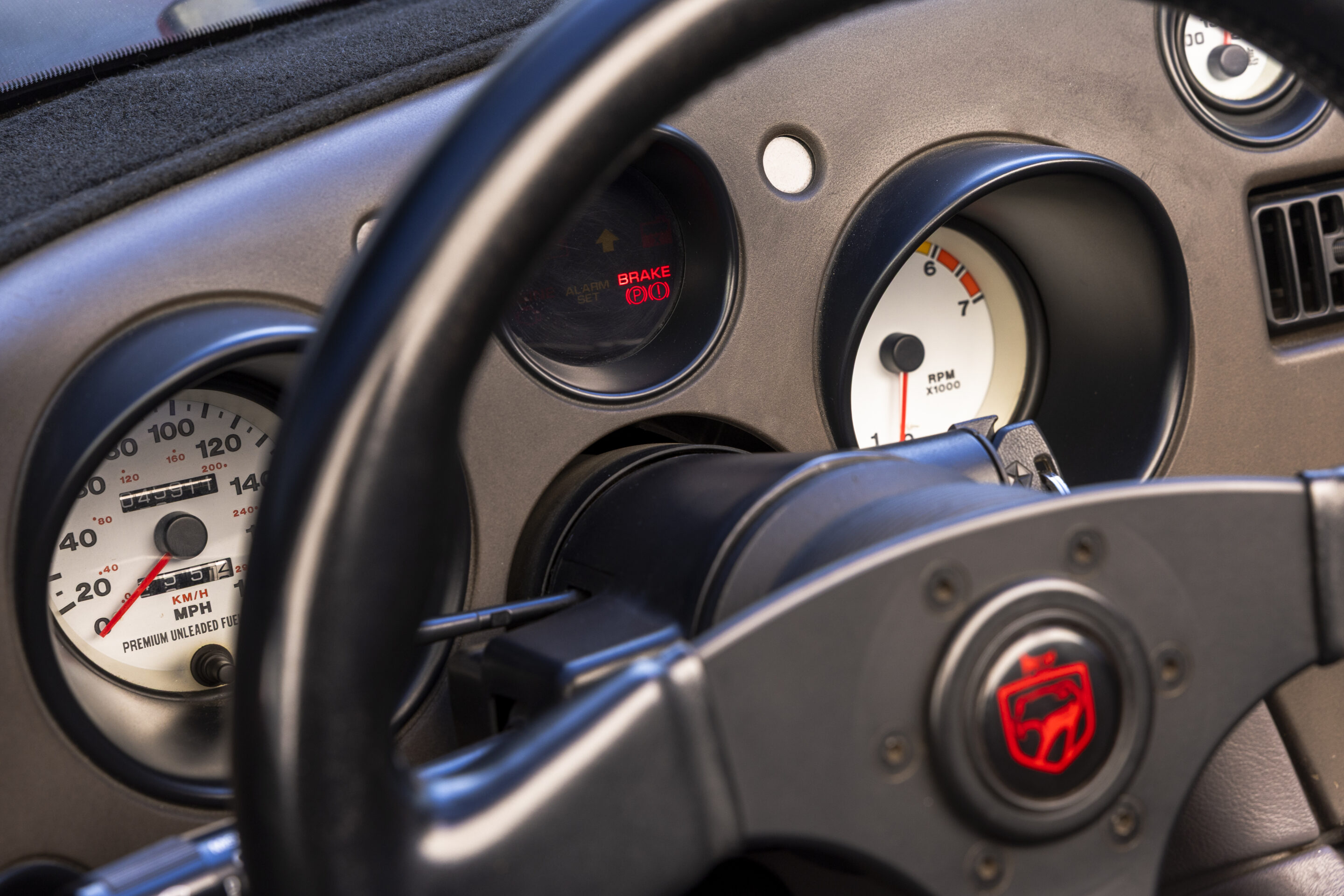
“Blessed with a more linear power delivery than either, the V10 likes to work closer to its 5600rpm yellow marking (redline’s 6000) to show its full potential. From the side-exit pipes, there’s just a whooshing sound like an industrial vacuum cleaner – one that’s cleaned Eastern Creek’s main straight at 220km/h,”
he noted.
Stahl was somewhat less enamoured by the interior execution of the big Viper, noting that “an MX-5 could probably fit under the Viper’s bonnet, yet it has more interior room. Everywhere you look, under the hood, around the cabin and in the boot, there are big slabs of plastic panelling where, I dunno, surely some useful stuff could go.” That’s likely a consequence of that crazily accelerated – for Chrysler – development cycle.
It was quick though. The Correvit data logger streamed out 0-100km/h in 5.3s and 400m in 13.6s at 169.3km/h, a trap speed fully 10km/h quicker than the R32 Skyline GT-R had recorded at the same venue.
We had another crack in February 1994 at our ‘Australia’s Fastest Cars’ event at Lang Lang and hotshoe Kevin Bartlett came away faintly terrified. “It’s indicated 260km/h at somewhere near 4000rpm but I couldn’t focus on the rev counter because of the wind buffeting. My head was moving around something dreadful… The chassis is very, very squirrelly with some nasty goings on over the joining strips… It’s not suited to this sort of top speed, banking and bumps situation at all. I’d like to know what my heart rate was. She’s a bit hairy… she’s an adventure, no risk about that!”
Bartlett came away with a top speed registered at 256km/h, the fastest 0-100km/h figure in the 16-car field at 4.88 seconds, and the second quickest run through 400m, the Viper’s 13.18s/171.9km/h showing beaten by a mere three-hundredths by the Porsche 964 Turbo.
Ultimately, this SR I generation of Viper wasn’t long for this world. In 1996, a second iteration model appeared, the SR II, which saw the end of the sidepipes, the introduction of a GTS coupe version and an uptick in grunt to 309kW/662Nm. This was in turn replaced by the new SRT/10 model (dubbed the ZB within Chrysler) in 2003.
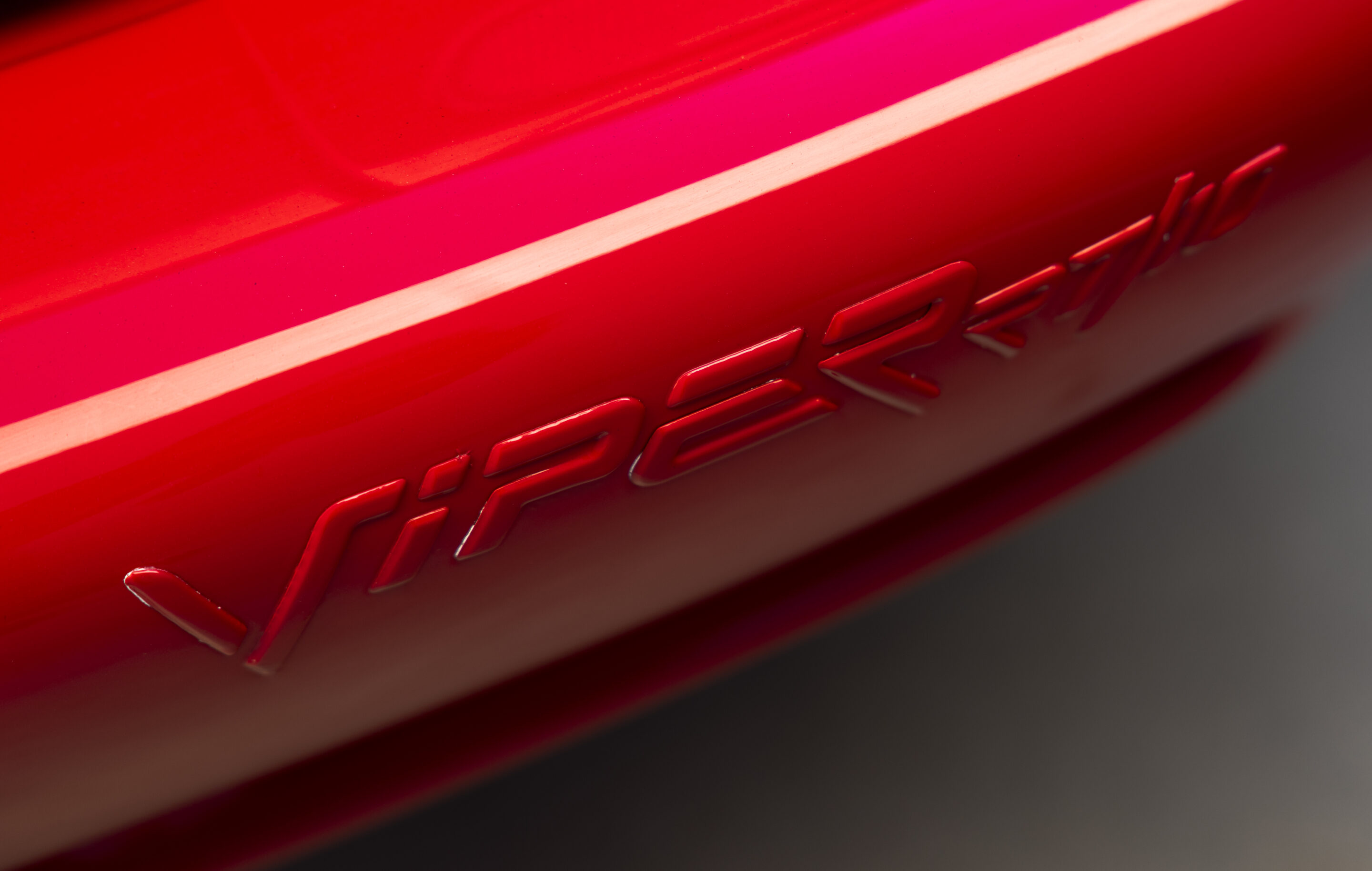
Only 6709 of these hand-built specials ever rolled out of New Mack Avenue and there’s significantly fewer surviving today. The breakdown per year is 285 in model year 1992, 1043 in 1993, 3083 in 1994, 1577 in 1995 and 721 in 1996. These early cars have achieved a certain cult status because you just don’t find anything like them any longer. They’re undeniably crude but seriously exciting, and, partly due to rarity, values are firming nicely. Opening book is around $100k, with low mileage cars topping out at around $150k.
1
The Viper achieved everything it set out to do. It changed Chrysler for the better and re-established the company’s sporting bona fides. Competition versions went on to win at Indianapolis, the 24 Hours of Nurburgring and the Australian GT Championship. Above all, it revived a moribund American sports car market.
The intervening years have done little to diminish its impact. Yes, the power output figure is now what you’d expect from a senior hot hatch, but the sheer charisma of the Viper RT/10 has, if anything, only amplified over more than three decades. It’s a bona fide hero.
This article originally appeared in the September 2025 issue of Wheels magazine. Subscribe here and gain access to 12 issues for $109 plus online access to every Wheels issue since 1953.
Follow WhichCar/Wheels on Google
Click the button below to make WhichCar by Wheels a preferred source for your news.

We recommend
-
 Features
Modern Classic: VL Commodore, 1986 ~ 1988
The stop-gap midsized sedan that ended up a significant success story for the Aussie brand.
-
 Features
Modern Classic: Renault Clio Williams
Touched with greatness, but also with controversy, this was the hot hatch that finally deposed the Peugeot 205 GTI.
-
 Features
Modern Classic: Peugeot 205 GTi
If you can’t innovate, imitate. That seemed to be the mantra behind the Peugeot 205 GTi. Then we drove it and realised that the french had both perfected the art of the hot hatch and created an icon