Reviews


Gallery 1
The hot hatch is dying. Discuss.
Almost all of the cornerstones of the hot hatch market are gone. Ford doesn’t build one, Renaultsport has thrown in the towel and Peugeot decided a long time ago that what we needed instead were overpriced and conceptually confused crossovers.
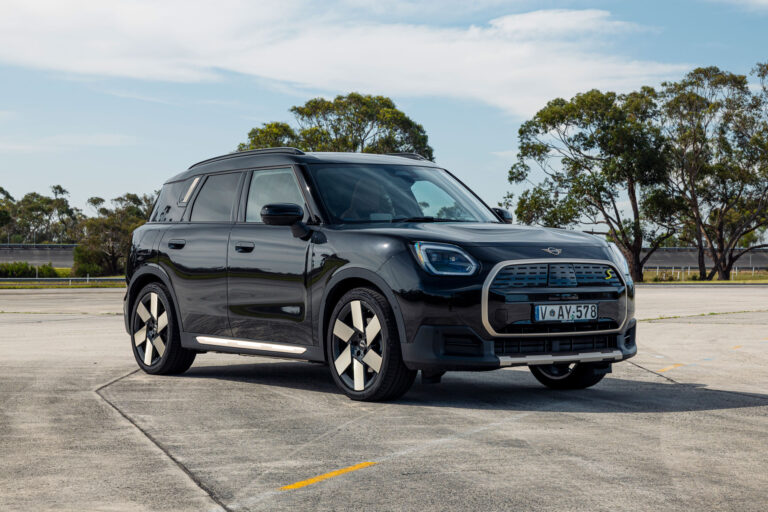
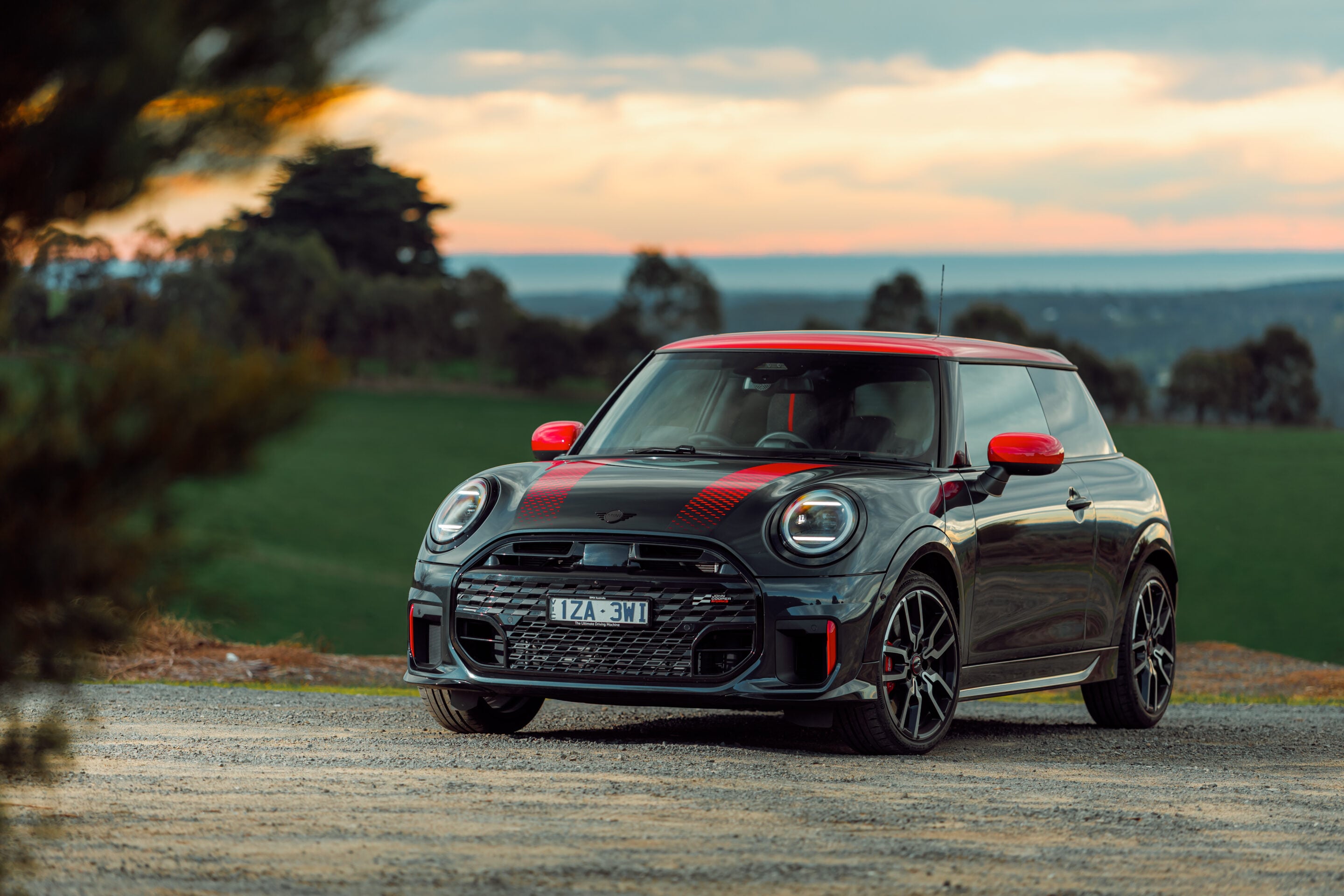
Yes, there are still holdouts. Hyundai, Toyota and Volkswagen, in particular, are still building brilliant sporting tots. Mini also offers something for the staunch hot hatch fan, and its hottest condiment is the Cooper JCW hatch, 170kW and 380Nm of attitude; yours for the princely sum of $60,990 in this Favoured trim.
It’s instructive to pause for a moment and figure out where that fits into the existing hatch hierarchy. Of course we have to start with a Golf GTI, the enduring benchmark in this sector. That’ll run you $58,990 for 195kW/370Nm, so you’re starting to see what BMW’s baby is battling against. Want something with a bit more attitude than the suave Volkswagen? Try the Yaris GR, available for $62,990 in flagship GTS auto trim, sending power to each corner and fronting up with a monster 221kW/400Nm.
In other words, in order to place this Mini onto your shortlist, you’ve probably got to be convinced of its charms in areas other than outright go, stop and steer. The opportunity to drive any new hot hatch is one to be relished and with Car of the Year looming, it seemed an ideal excuse to take the Cooper JCW down onto the roads of Wheels’ COTY test route and see if it’s made of the right stuff.
3
On the milk run
I have a headache right now and I could do with some paracetamol. Somewhat curiously, Mini decided to fit its most hardcore hatch with not one, but two glass sunroofs. Now we can back and forth as long as you like about the wisdom of placing weight right where the car needs it least, but my overriding concern is that the front sunroof places a hard plastic finisher about a centimetre above the top of my head. Hit a bump, or a pebble, or a fag-paper in the rigidly suspended JCW and you’re jolted skywards. And that gets old very quickly.
The issue is compounded by the sunroof robbing you of about 5cm of height, and the electrically
a options. You can tilt and slide the seat to a weird, gibbon-like driving position where your head misses the sunroof trim finisher, or you can hone your reflexes to crank your head forward every time you see what might be an oncoming bump. I end up with a blend of the two.
Because it was chosen, in part, to thoroughly test the ride quality of candidate cars, the Wheels COTY route is far from smooth. In fact, in some places it’s bloody awful, full of ruts, patches and scabs created by the passage down the years of countless Gippsland milk trucks. No car can win COTY if it can’t handle roads like these with some measure of decorum. The Mini is struggling.
On smoother roads, it’s a blast. It loves well-surfaced roundabouts, where it can come winging in on the brakes, the rear end getting a little mobile. Jump on the throttle and the front will grip tenaciously and the 2.0-litre four just pours on torque. It’s incredibly effective and, yes, great fun, despite not featuring a limited-slip diff up front. Mini supplies this car with a variety of OE fit tyres and the Continental SportContact 7s fitted to this one probably wouldn’t be my first choice. A Michelin Pilot Sport 4S or Pirelli P Zero would probably suit the car better.
The engine and gearbox combination at first seem pretty standard fare for a hot hatch, namely a 2.0-litre turbo four driving the front treads via a seven-speed dual-clutch transmission, replacing the old eight-speed torque-converter auto. So far, so conventional. But it’s the power delivery of the engine that’s so unusual. Leave the gearbox to its own devices and more often than not, its blatting around between 2500rpm and 4000rpm. Flick the ‘Experiences’ toggle into Go-Kart mode and things sharpen up a bit but it doesn’t like to hold a gear for too long. A second press on the gear selector puts the transmission into Sport and then you can ping up and down the ’box, but it’ll often deny you what seems a legitimate downshift because it doesn’t want you pinging the redline. Indeed, the 380Nm of peak torque (up 60Nm on the old car) arrives between 1500 and 4000rpm, and that’s where this 1330kg hatch feels happiest. Those pops and crackles on the overrun are coming from a speaker and not the exhaust.
2
At this point, it was clear that so many of the usual yardsticks of what makes a good hot hatch had been clearly ignored by the good folk at Mini. We usually want a vehicle that’s subtle, but which can be identified by those who know what to look for. The ride should be accommodating, but with a little tension to it. The focus should be on ability rather than raiding the dressing up box. Thing is, Mini also understands its audience extremely well and realises that the people looking for a Golf GTI, an i30 N or a GR Corolla aren’t cross-shopping a Mini Cooper JCW and vice versa.
Whereas a great hot hatch will reveal the light and shade of its chassis dynamics over time, the Cooper JCW delivers it all upfront on a giant platter. Have at it. The ongoing learning curve comes with its cabin, its infotainment system, the various drive experiences and such like. There’s a very deliberate richness about its interior finish that’s never been part of the traditional hot hatch milieu. I’ve got a certain respect for Mini for choosing to plough a very different furrow here.
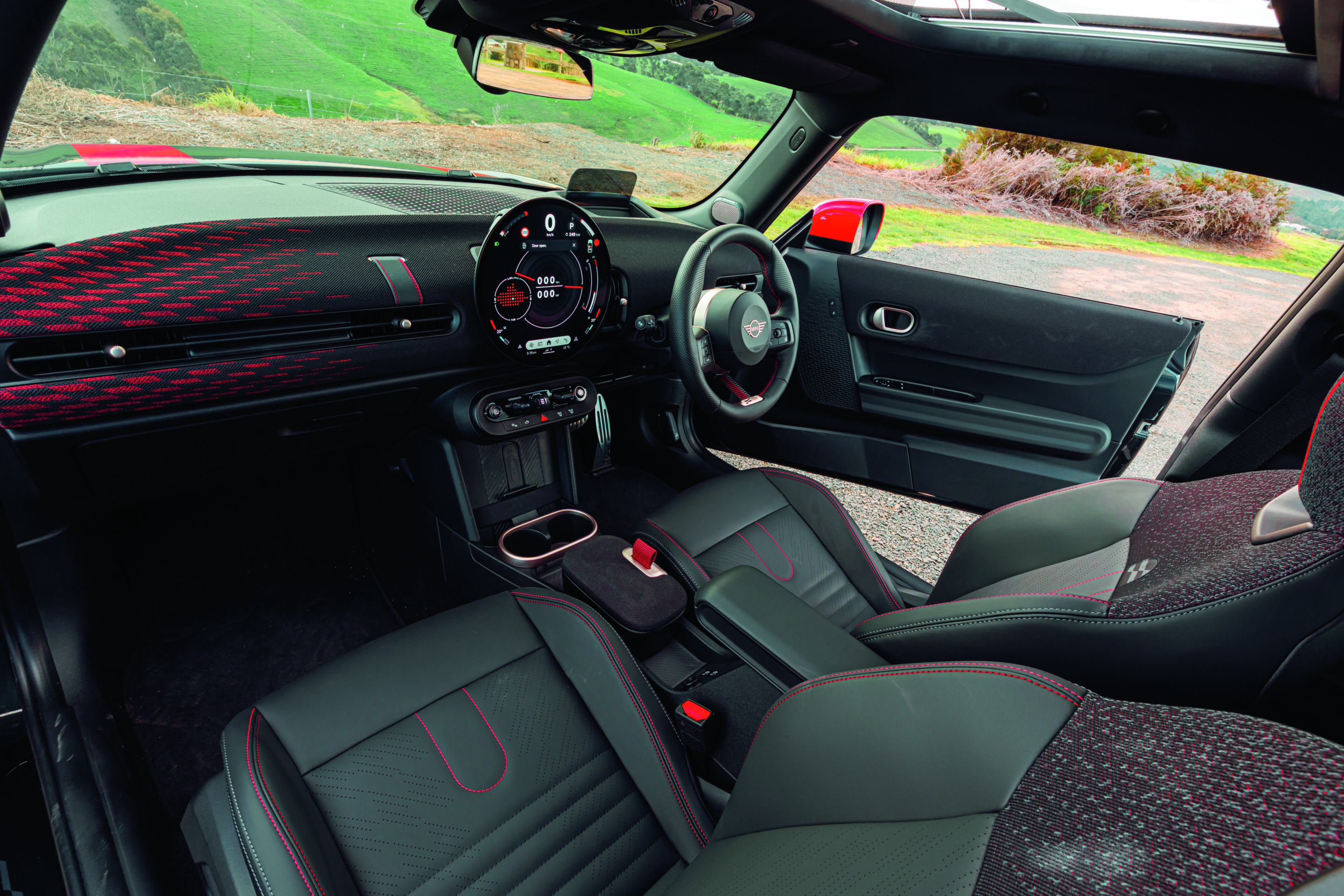
Drop inside and it’s hard to figure out what to focus on first. The obvious thing is the 240mm dinner plate screen in the middle of the dash, but then you get drawn to interesting dash fabrics, the seating materials, the textured centre box, the near vertical windscreen, the hilariously chubby steering wheel, the Harman Kardon speaker pods seemingly growing out of the A-pillars, or the row of toggles and switches that comprise the physical dash controls.
The screen is an odd ecosystem. Mini’s clearly very proud of it, and has ditched the instrument binnacle ahead of the driver as a result, but many of the controls are a little slow to react, and that matters when you’re adjusting virtually everything via the touchscreen. It also features some very odd functionality, such as displaying two fuel gauges and two rev counters when you flick to the retro Timeless display. I once had a chat with some of the designers of this system and they almost wept when the first thing I did was pair my phone to Android Auto, which displays as a crude square window in the middle of the circular display. The native ecosystem is so richly specified that their take is that phone mirroring robs you of functionality.
2
The JCW certainly doesn’t want for equipment, this Favoured trim variant featuring LED headlights, 18-inch alloy wheels, adaptive suspension, wireless Apple CarPlay and Android Auto, augmented-reality navigation, a head-up display, a heated leather steering wheel, dual-zone climate control, keyless entry and start, that dual pane sunroof, a 360-degree camera, performance tyres, power-adjustable front seats with memory and driver massage function and sun protective glazing.
Stereo upgrade aside (the standard system always sounds too mid-range muddy) it’s hard to think of any reasonable option you’d want to load into the JCW.
I was surprised and delighted to discover it even featured not one, not two, but three windscreen washer jets. Likewise the way that your mobile phone straps into the wireless charger is a great idea, making it impervious to even the most extreme cornering manoeuvres. The after-dark ambience in the cabin is particularly slick, with the red dash panels concealing illuminated panels beneath the fabric.
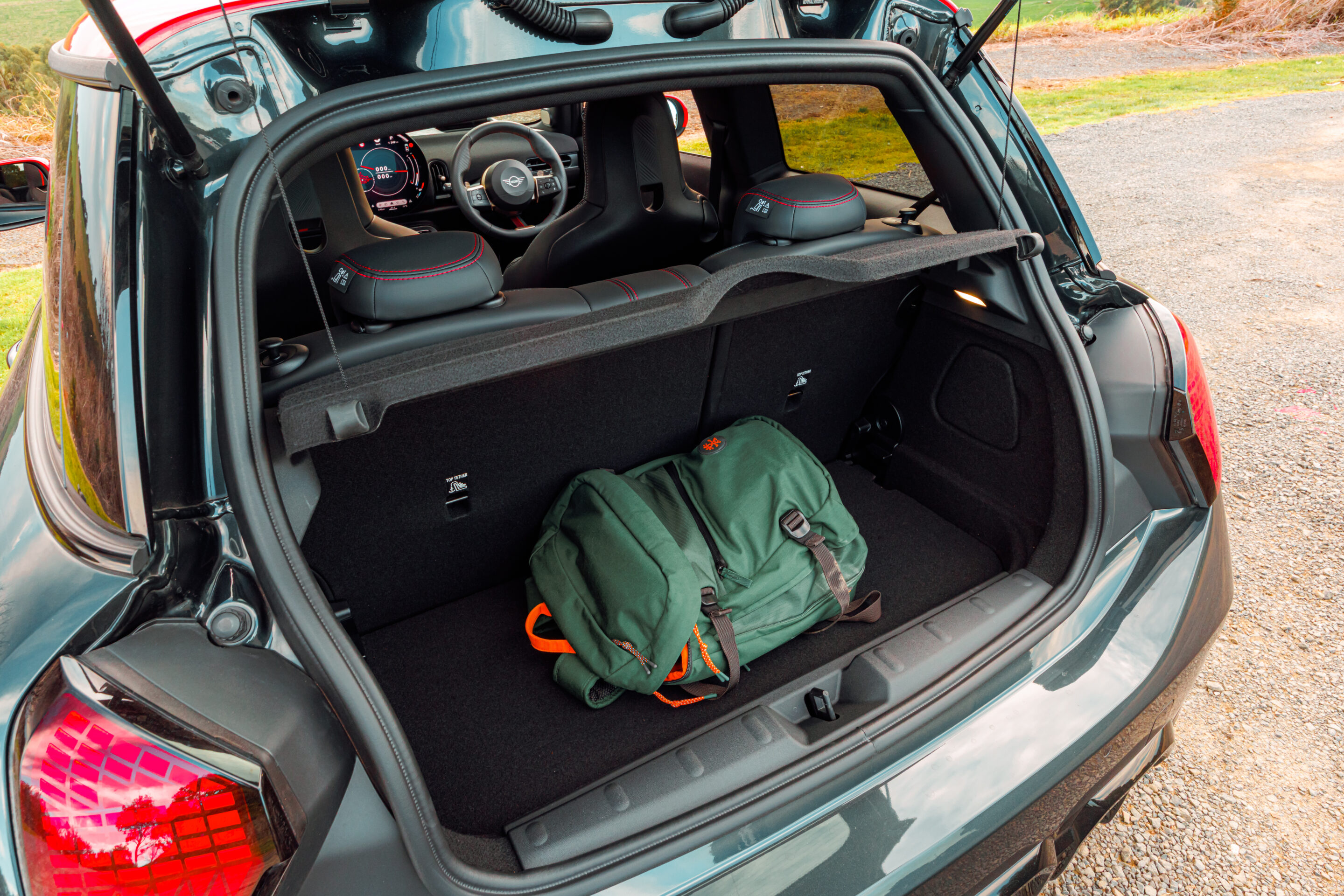
It feels fairly tight inside thanks to that pinched headroom, and there’s no way I could sit behind myself as legroom for two in the back is almost nonexistent. We constantly comment on how big modern Minis have become, but at 3876mm long, it’s 64mm shorter than a base model Toyota Yaris. It’s a little wider than the Toyota at 1744mm (vs 1695mm), but despite that added width, the big seats mean that space for the door pockets is still quite pinched. You do get a decent size glovebox, and there’s only 210 litres of space behind the rear seats or 725 litres with them folded. Somewhat reassuringly, a three-door Mini is still a compact thing, by today’s standards at least. It’s also packaged without a spare and it should be noted that the 70:30 split rear bench doesn’t fold fully flat.
Charming to a fault
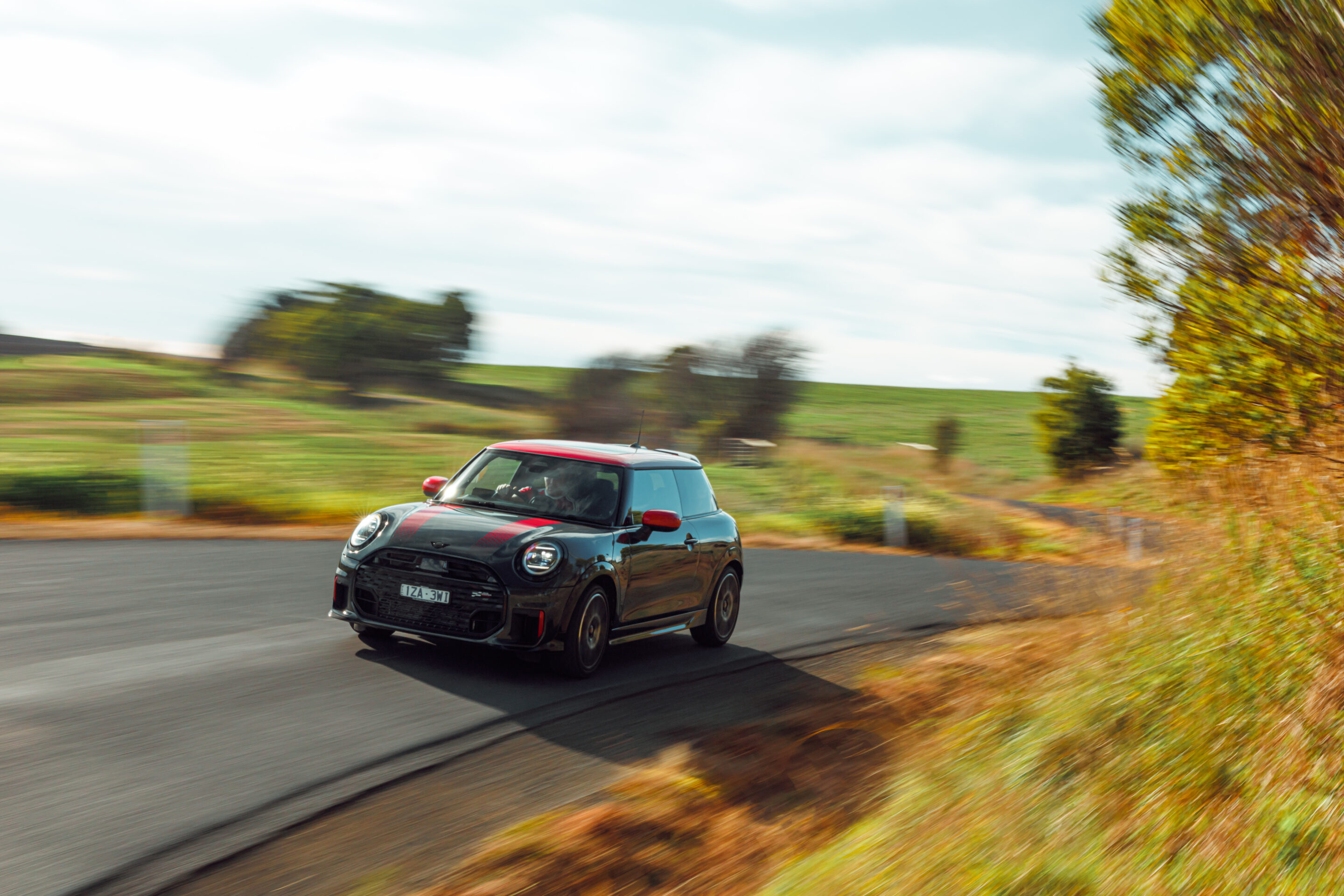
After lunch, we head for the series of sharply climbing twisties out of Kongwak. These corners have tripped over a few COTY contenders down the years, and while my lunchtime latte isn’t resting well after the car bucks and jolts along the rutted country roads, I back the pace off a bit and things settle a little. The JCW attacks the bends with relish, the well-weighted steering offering a reassuring feel for what’s going on at the front treads, despite the ridiculous girth of the steering wheel itself. It’s possible to place the car accurately and rely on its crisp turn-in and resistance to pitch and roll to give it the reactions to quickly take a set and attack the next corner.
2
Braking is reasonably good, despite Mini downgrading the JCW’s brakes from beefy four-pot front calipers to a weedier, single-piston floating caliper as seen in the rest of the range. In normal road conditions it doesn’t show up as an issue, but engage road testing mode and punch them hard on a series of corners and the pedal starts to go a little flabby. I suspect they’d be the JCW’s Achilles heel on track.
I don’t think it’s unfair to say that the JCW is not a hot hatch for the connoisseur of this class of cars. That much is apparent. While it is fun and does often feel pretty purposeful, it’s perhaps a little too much of a blunt implement, and too prescriptive in its skill set to appeal to very good drivers. Likewise, those who merely want the fastest and most expensive Mini hatch will rapidly tire of this car’s jittery ride quality, which grates after a while, skipping its rear over speed humps and smashing into potholes. I can see why Mini chose the billiard-table smooth RACQ Mobility Centre track in Queensland as the venue for this car’s press preview.
Out in the wild, it can feel a bit of a handful, offering the compromised ride of super-hatches minus their level of performance. The Cooper JCW would undoubtedly be a better car were its effective spring rates relaxed quite considerably, allowing it to work better with Aussie roads without having its driver wincing in anticipation at every oncoming bump or compression. As well as the firm springs, new anti-roll bars and bump stops have been engineered for the JCW, with an additional measure of camber dialled in.
2
The dampers are new frequency selective units that are cheaper and less complex than electronic dampers, using trick valving to differentiate between primary and secondary ride issues. There’s no magnetorheological fluid or anything fancy like that, merely a system where the valving helps soften the unit for smaller, rapid bumps and firm it to offer support on lower frequency yumps and rollers. They make a great advert for local suspension tuning.
The purists might sniff at its ride, the lugging nature of its motor, the underspecified brakes and the overwrought cabin, but there may well be a constituency of buyers who finds it extrovert, charming, endearing, cheeky and, having recently worn a three grand price haircut, acceptably good value. I can see both sides of the argument. I suspect that my more old-school colleagues may not.
As we grab a few pictures as the sun sets over the bay at Grantville, I realise I’m looking forward to driving the Cooper JCW home, plotting a route that takes in a series of roundabouts on the Koo Wee Rup Road. It may be flawed, and it’s almost the antithesis of the decathlete hot hatch, but sometimes a car just needs to do one thing well to make you want to drive it. The traditional ‘serious’ hot hatch may not be around forever, but emotional purchases like the Mini Cooper JCW might well be a formula with some legs yet.
1
This article originally appeared in the September 2025 issue of Wheels magazine. Subscribe here and gain access to 12 issues for $109 plus online access to every Wheels issue since 1953.
Follow WhichCar/Wheels on Google
Click the button below to make WhichCar by Wheels a preferred source for your news.