Reviews


Gallery 1
8.5
/10
Score
Score breakdown
8.0
Safety, value and features
8.5
Comfort and space
9.5
Engine and gearbox
8.5
Ride and handling
8.0
Technology
Things we like
- Heroic inline-six
- Practical boot space
- Friendly on the road, ferocious on track
Not so much
- $66k premium over M3 Touring Competition seems a stretch
- Carbon-fibre sports seats not ideal for long-distance touring
- Excessive road-noise
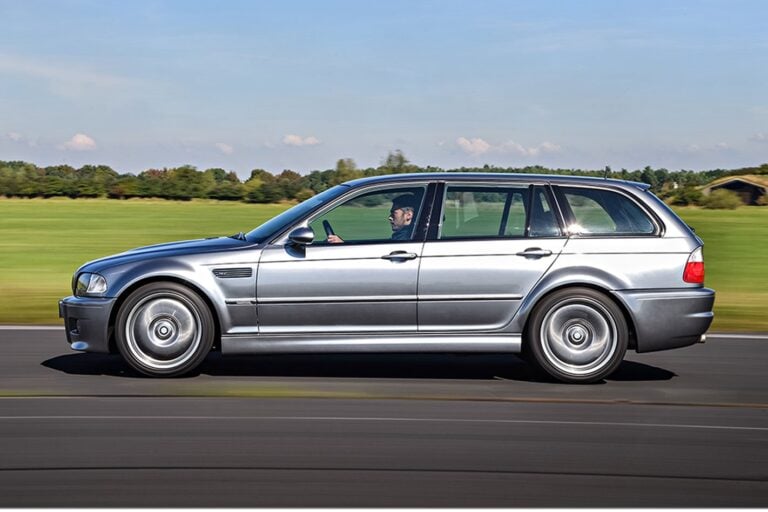
It’s almost 40 years since BMW – almost accidentally – launched its first ever station wagon.
BMW engineer Max Reisböck faced a personal conundrum – how to enjoy weekend road trips with his growing family, and their luggage, in comfort and style and without diluting the driving dynamics BMW had become renowned for.
His solution was to take an accident-damaged E30 3 Series sedan and over a period of six months in his home garage, Reisböck crafted it into a station wagon.
It looked good too. With his background as a bodywork engineer, the DIY 3 Series wagon looked factory-fresh and when he showed his creation to BMW’s board, they recognised the potential and commercial viability of having a wagon in their model line-up. The project was green-lit, and using Reisböck’s creation as the blueprint, the 1987 BMW 320i Touring, the first ever station wagon from the Bavarian automaker was born.
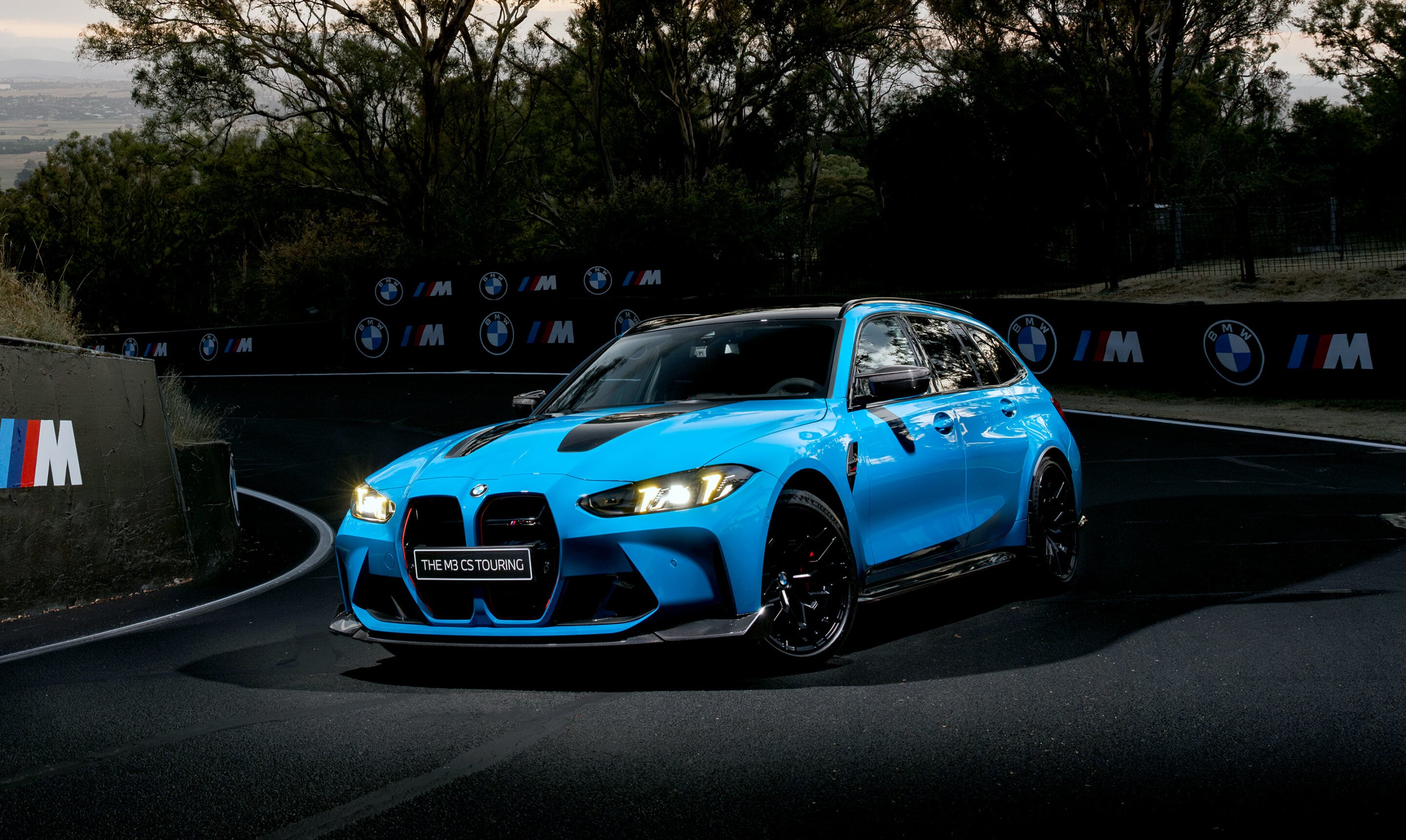
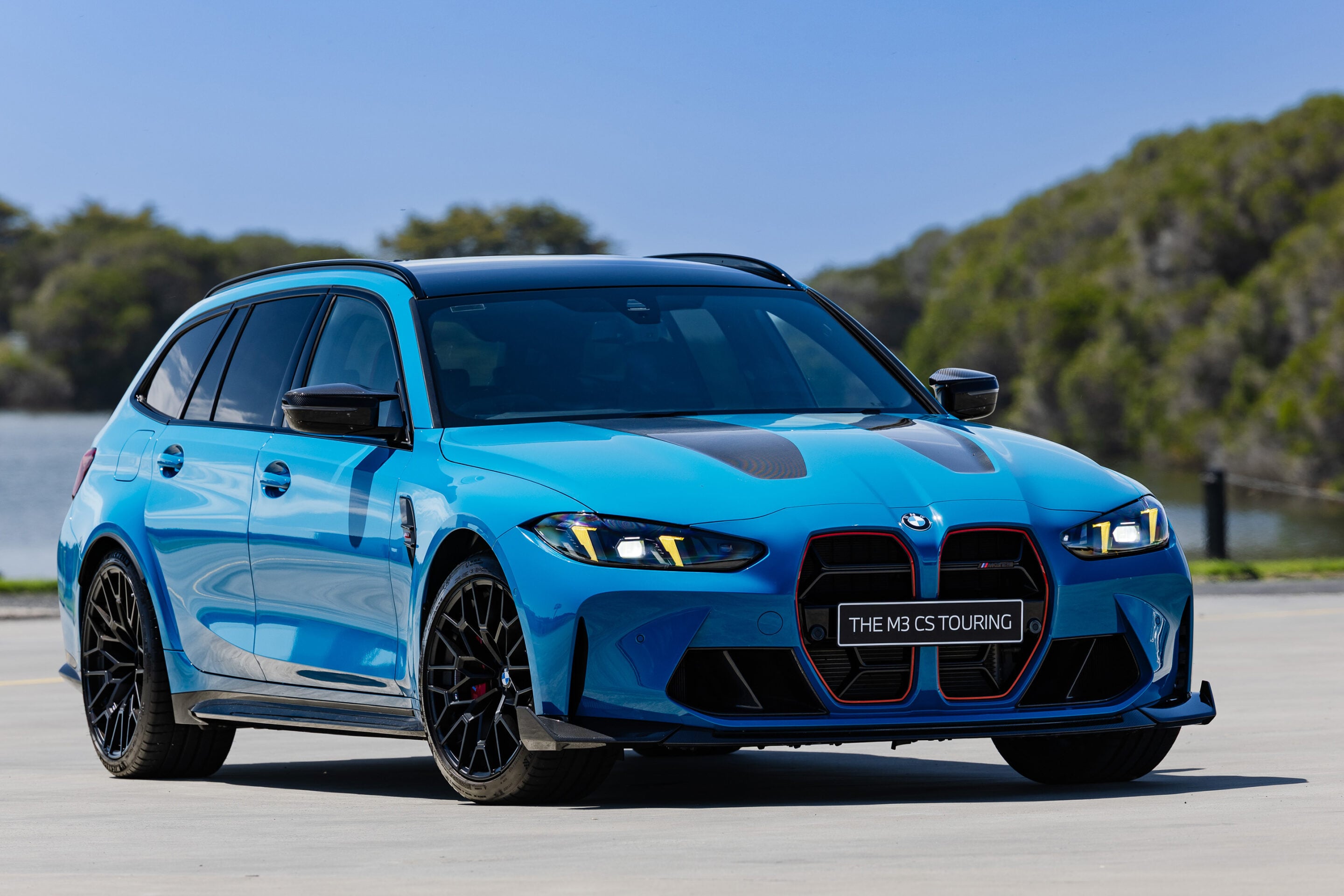
Reisböck’s vision is still keenly felt in the car we’re driving today, the 2026 BMW M3 CS Touring.
3
Taking what was already an other-worldly high-po station wagon in the ‘regular’ M3 Competition Touring, BMW’s M Division has woven its CS magic wand even further to create the undeniable apex predator of the line-up.
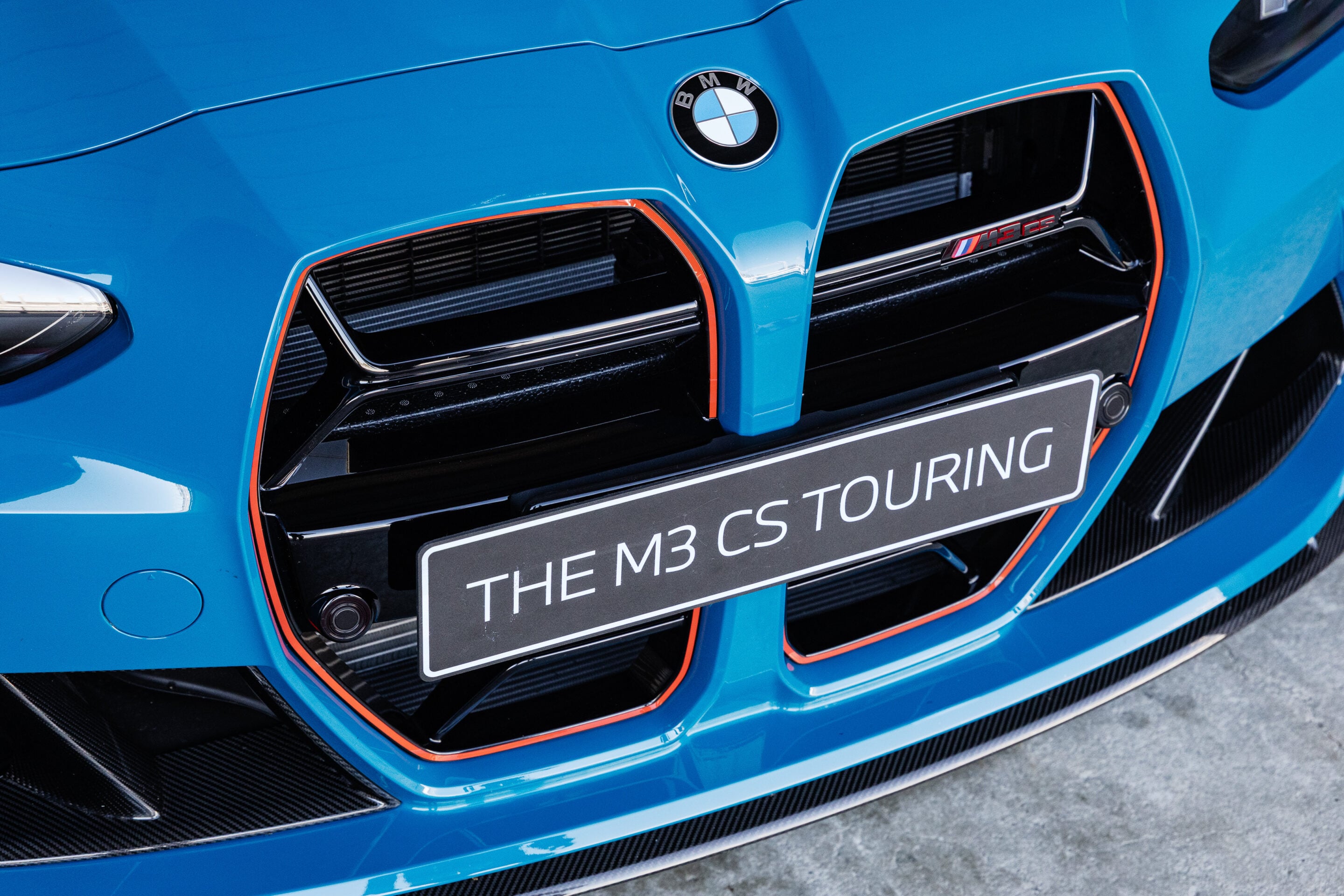
It doesn’t come cheap though, the M3 CS Touring asking for $253,900 before on-road costs and options. That’s a healthy $65,800 premium over the M3 Competition Touring, but you do get a whole lot more than merely a red-ringed, blacked-out CS on the bootlid for the extra spend.
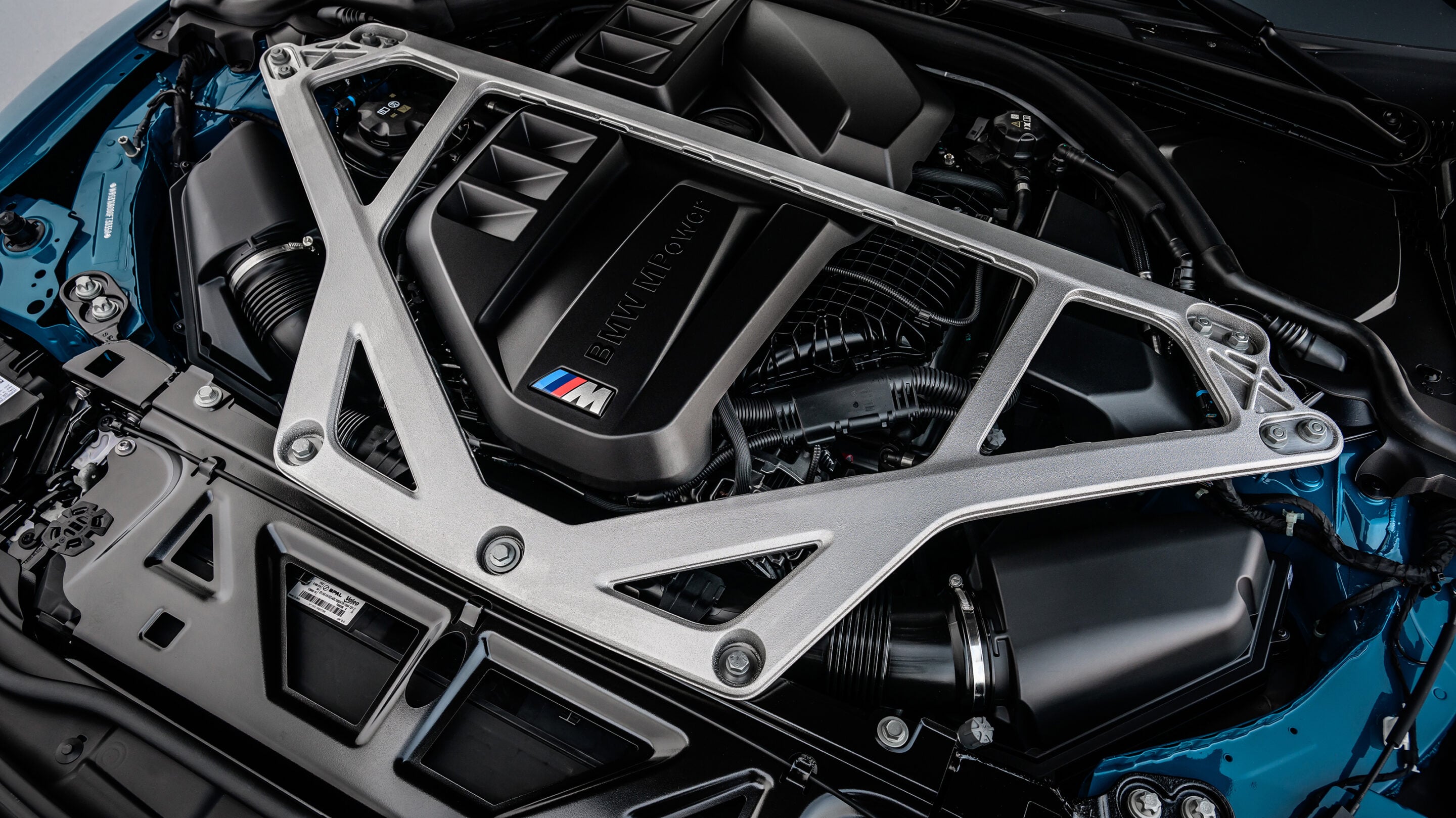
Under the bonnet, the same twin-turbo inline-six as found in regular M models does the heavy lifting. But a tweak to the twin-turbo’s boost pressure (increased by 2.1 bar) sees a lift in power, now rated at 405kW against the Competition’s 390kW. Torque remains unchanged at 650Nm but with peak available higher in the rev range (5950rpm) than the regular Competition’s 5730rpm. An eight-speed M Steptronic torque converter automatic transmission sends those outputs to all four wheels via BMW’s xDrive all-wheel drive system.
3
Stiffer engine mounts, a CS-specific tune for the stability control, as well as the adaptive dampers, steering and standard M brakes (carbon ceramic brakes are a $19,000 option) underscore the track-focussed dynamics of the CS Touring.
A carbon-fibre bonnet (the Competition is fitted with an aluminium front lid) helps shave weight although one common feature emblematic of M models in general and CS models in particular is missing in action – a carbon-fibre roof. BMW cites construction restraints and the cost of tooling for what is, ostensibly, a low-volume vehicle as the main reason.
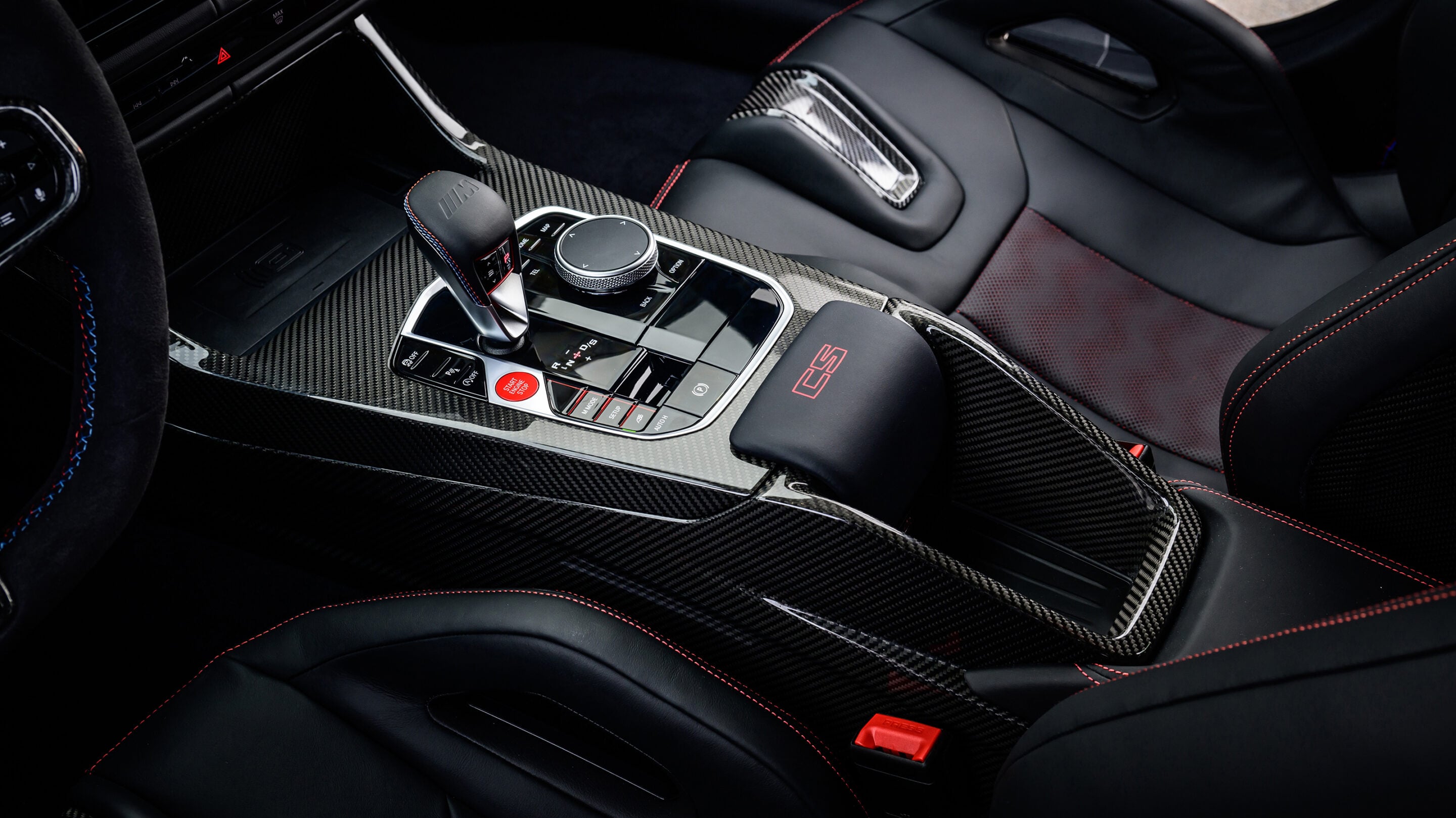
BMW has found other ways to shave some extra kegs, with carbon-fibre sprinkled liberally throughout the cabin – on the pared back centre console (there are no cupholders, but really, who cares?), bucket seats, paddle-shifters, and dashboard. All up the CS Touring tips the scale 15kg less than the regular M3 Touring.
Inside, the cabin prioritises performance with aggressively moulded carbon-fibre sports seats (heavily accented with red elements) that require a clamber to sink into but once ensconced, hold you firmly in place.
The centre console does away with a central storage bin, and the accompanying armrest as well as cupholders while there are no climate controls for the second row.
5
That’s not to say the CS Touring’s interior is Spartan. There’s the usual array of tech found in the broader M range highlighted by the in-your-face gently-curved single-frame widescreen incorporating a 14.9-inch infotainment display and 12.3-inch digital instrument cluster. It runs BMW’s 8.5 operating system. The standout feature, however, is the M Drive Professional software that brings a host of track-focused telemetry and data including lap times, a drift analyser and 10-stage traction control settings. It can be shown on the screen itself or on the CS Touring’s crisp head-up display. Or both.
Out back, the CS Touring underlines its family practicality with a cargo area measuring in at 500 litres. That expands to 1510 litres with the second row flooded away, more than enough for the average Bunnings run although the likelihood of lengths of timber and buckets of house paint seeing the inside of the M3 CS Touring are, I’d wager, pretty remote.
Because this is, first and foremost, a balls-out performance car with the chops to deliver both on the road and on the race track.
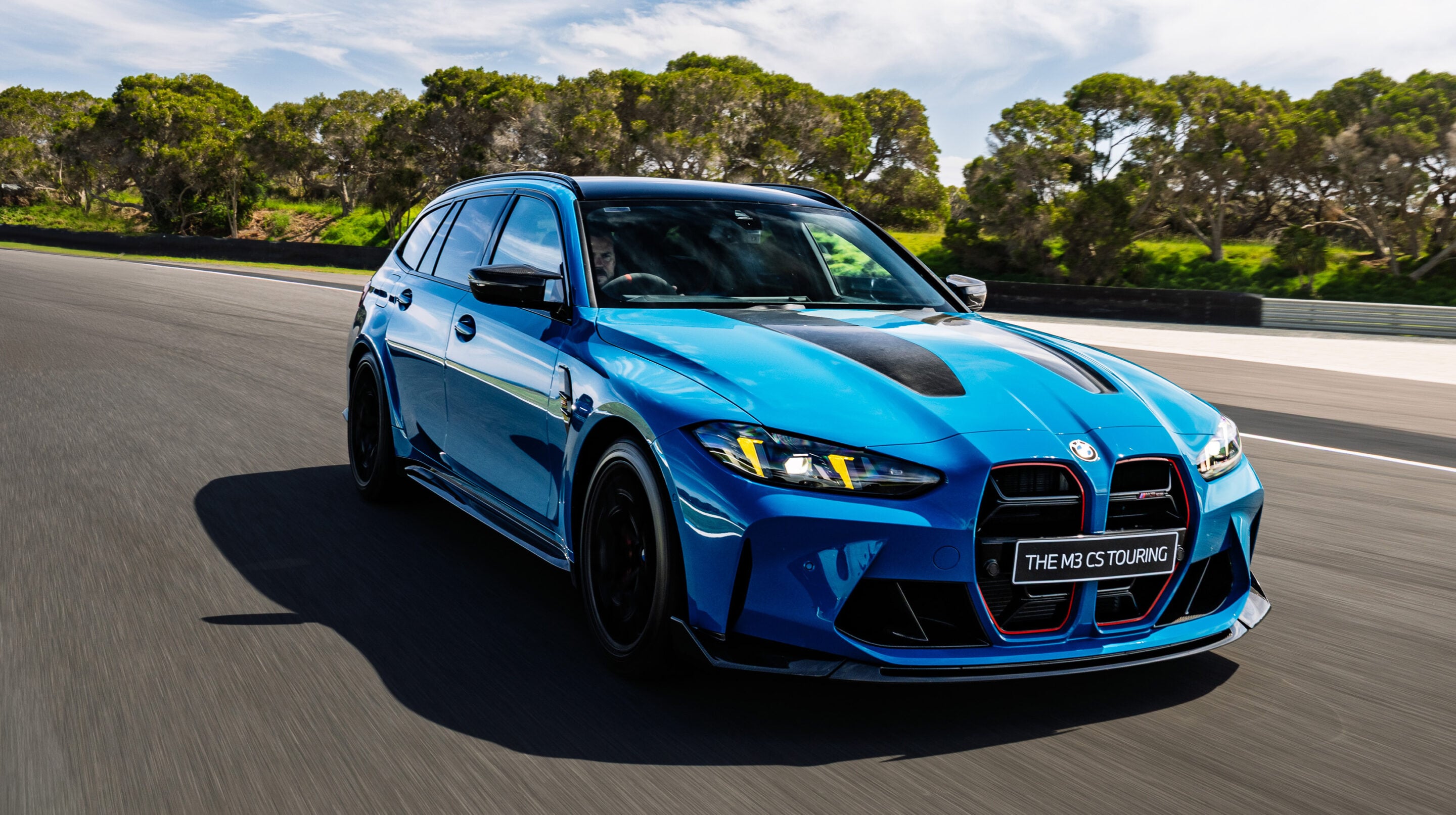
The likelihood of hitting the Touring’s performance ceiling out on the open road is zero-to-none, such is its breadth of ability. But that doesn’t mean you can’t have fun, because you most assuredly can.
3
That heroic inline-six grumbles angrily at start-up, a baritone tune that promises much. And then delivers.
BMW says the CS Touring is good for a zero to 100km/h sprint claim of 3.5 seconds and 0-200km/h in a scant 11.7s. Rural Australian backroads aren’t the right place to test those claims but what is apparent is just how focused the CS Touring can be. Yes, the suspension is sharp, especially in the CS’s sportier drive modes, but Comfort mode does provide a measure of everyday liveability not found in some other CS models.
Certainly, the Touring can feel a little taut as it bounces over corrugated surfaces and rutted roads but it does so with a measure of predictability that’s reassuringly felt through the steering and through the carbon-fibre buckets under your bum. The only downside is excessive road noise, those thin-walled Michelins and taut nature of the suspension transmitting plenty of roar into the cabin.
The inline-six is the undoubted hero, with plenty of punch out of corners as it sings angrily even way before the 7200 redline and cut-out is reached. But the reality is, the CS Touring is a lot of car for public roads and you need a race track to fully tap into its heroics.
2
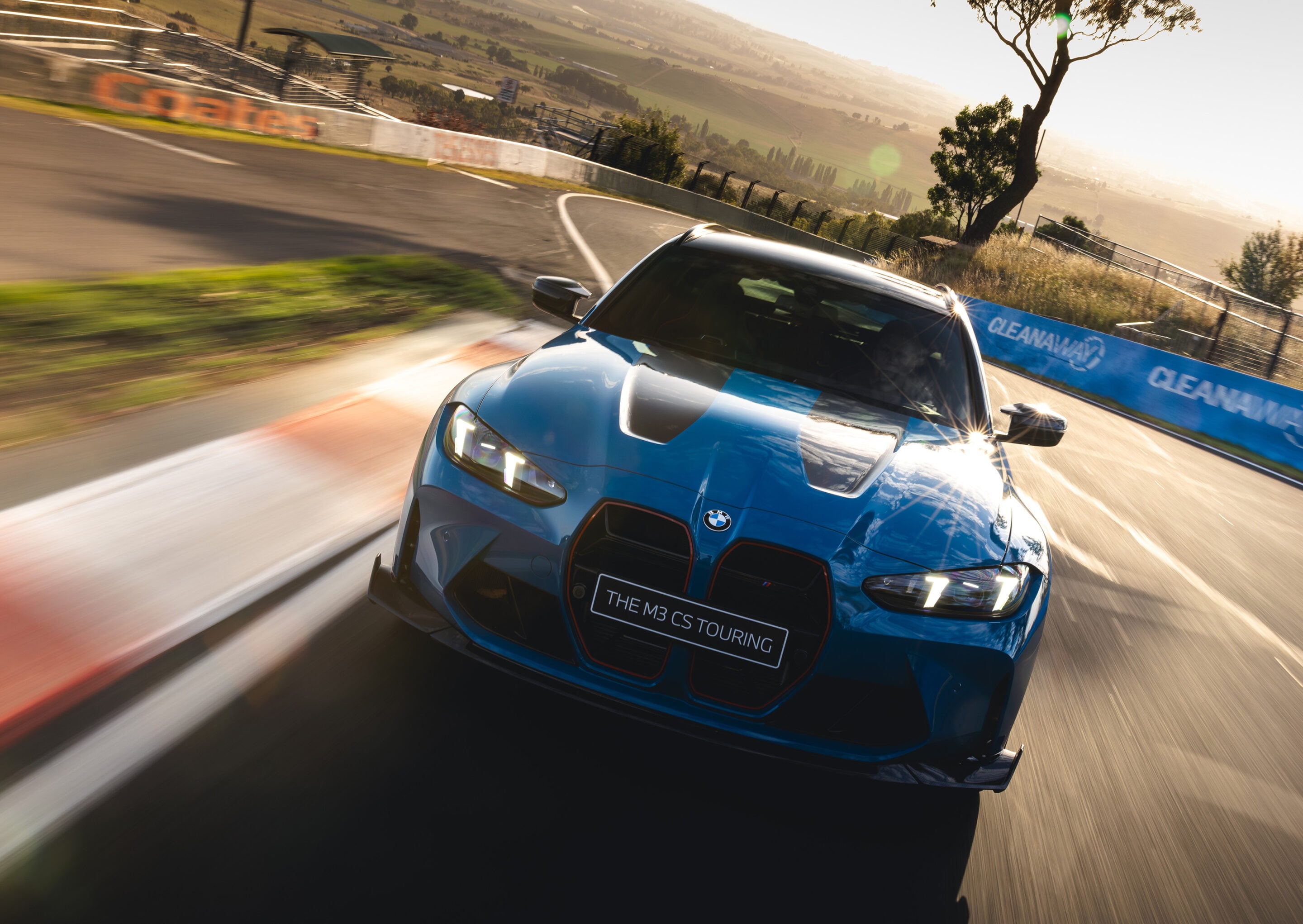
Helpfully, BMW did exactly that, and at Bathurst no less. Mount Panorama needs little introduction, suffice to say it’s arguably one of the world’s most challenging and demanding race tracks.
Here then, the M3 CS Touring, let off its chain, is able to showcase its true credentials, with a blistering explosion of performance that belies its ‘family-friendly’ nature.
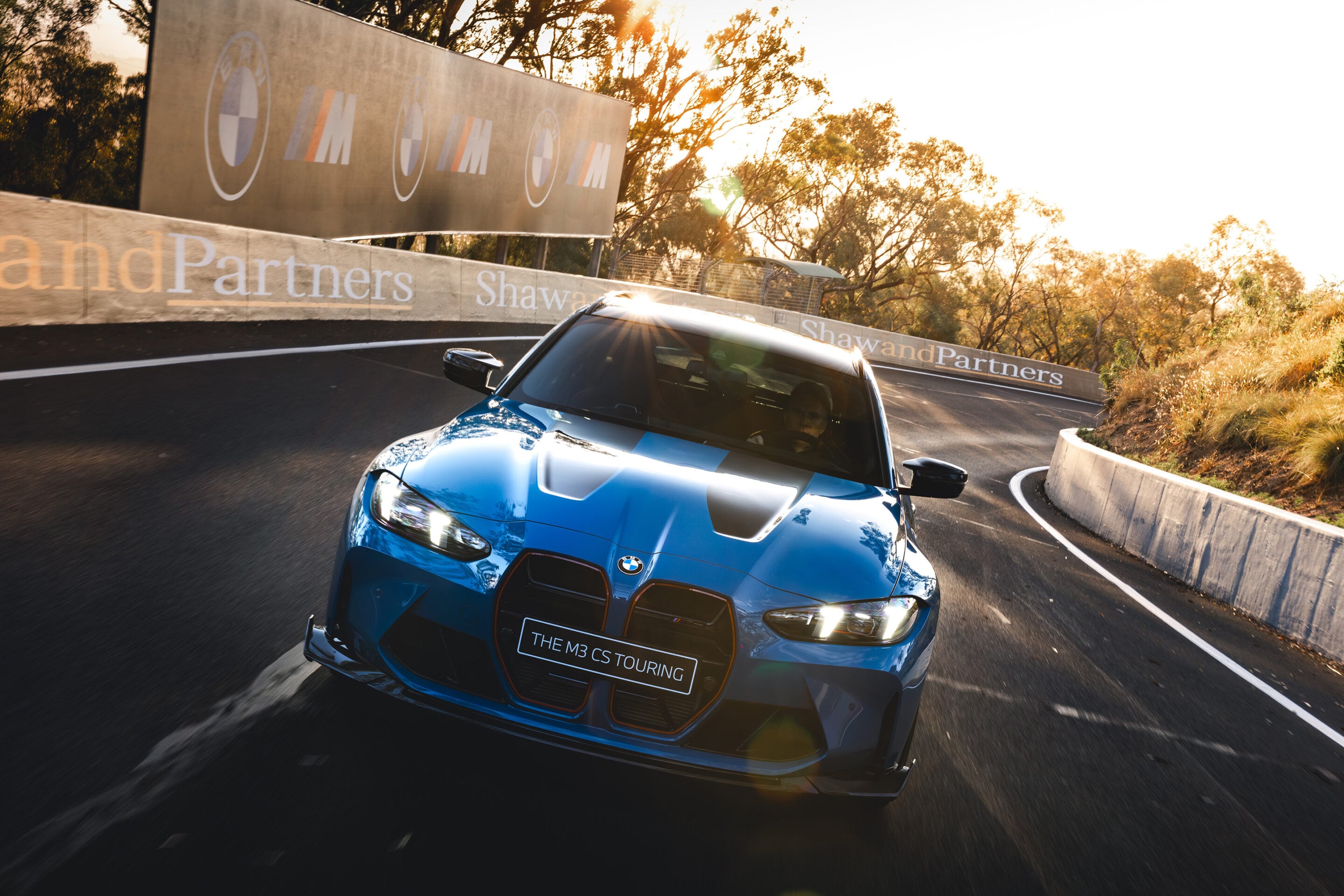
If the inline-six and its sonorous rumble out on the open road proved the hero, then it is here on the track where it can really sing for its supper. The wider torque curve of this, the CS model, is keenly felt with the M3’s relentless acceleration pushing you back into the grasp of those firm but comfortable carbon-fibre buckets.
The eight-speed automatic left to its own devices is up to the task, but really, switching to manual mode and controlling your own destiny via paddle-shifters is the more rewarding option, each up-shift met with a satisfying bang, each pull down an explosion of over-run from the exhaust.
2
The steering is nicely-weighted too and responds to inputs, even minor ones, with alacrity and precision. And Mount Panorama requires precision. From the tricky right-left combinations of the Cutting to the steeply downhill Dipper and Esses, there’s little margin for error from either the driver or the car. And this here, is where the CS Touring shines, with its combination of nicely-balanced chassis, all-wheel drive (although nicely rear-biased in Sport modes) grip and a reassurance that there’s a whole lot more this car can do that you or me, the average punter, can’t get close to.
It builds confidence too, as you learn its intricacies and sheer breadth of ability, each successive lap quicker than the one preceding it.
The brakes remain sharp and effective for lap after lap, and session after session, with no hint of fade despite working overtime on Mt Panorama’s more challenging sections.
Nudging 270km/h at the end of Conrod Straight as you approach The Chase grabs your attention but such is the sure-footedness of the xDrive system that even tipping in at a speed-washed 200km/h brings nothing but confidence that this ‘humble’ station wagon can handle whatever you ask of it. Lap-after-lap.
2
When Max Reisböck created his do-it-yourself 3 Series wagon back in the mid-1980s, one of his key requirements was that it must still feel like a BMW to drive. And while the 2.0-litre inline-six found under the bonnet of his self-made wagon lacked the ferocity of today’s CS Touring, there’s no question Reisböck’s blueprint remains firmly in place. Is it the best station wagon in the world right now? It just might be.
Specs
| Model | 2026 BMW M3 CS Touring |
|---|---|
| Price | $253,900 (plus on-road costs) |
| Engine | 3.0-litre twin-turbo in-line six-cylinder |
| Peak power | 405kW |
| Peak torque | 650Nm |
| Transmission | Eight-speed automatic, AWD |
| 0-100km/h | 3.5 seconds |
| 0-200km/h | 11.7 seconds |
| Top speed 300km/h (limited) | 300km/h (limited) |
| Fuel consumption | 10.5L/100km (claimed) |
| Fuel type/tank size | 98 RON unleaded/59L |
| Weight | 1850kg (kerb) |
| L/W/H/W-B | 4796/1918/1447/2857mm |
| Warranty | 5yr/unlimited km |
| On sale | Now |
8.5
/10
Score
Score breakdown
8.0
Safety, value and features
8.5
Comfort and space
9.5
Engine and gearbox
8.5
Ride and handling
8.0
Technology
Things we like
- Heroic inline-six
- Practical boot space
- Friendly on the road, ferocious on track
Not so much
- $66k premium over M3 Touring Competition seems a stretch
- Carbon-fibre sports seats not ideal for long-distance touring
- Excessive road-noise
Follow WhichCar/Wheels on Google
Click the button below to make WhichCar by Wheels a preferred source for your news.