Comparisons


Gallery 1
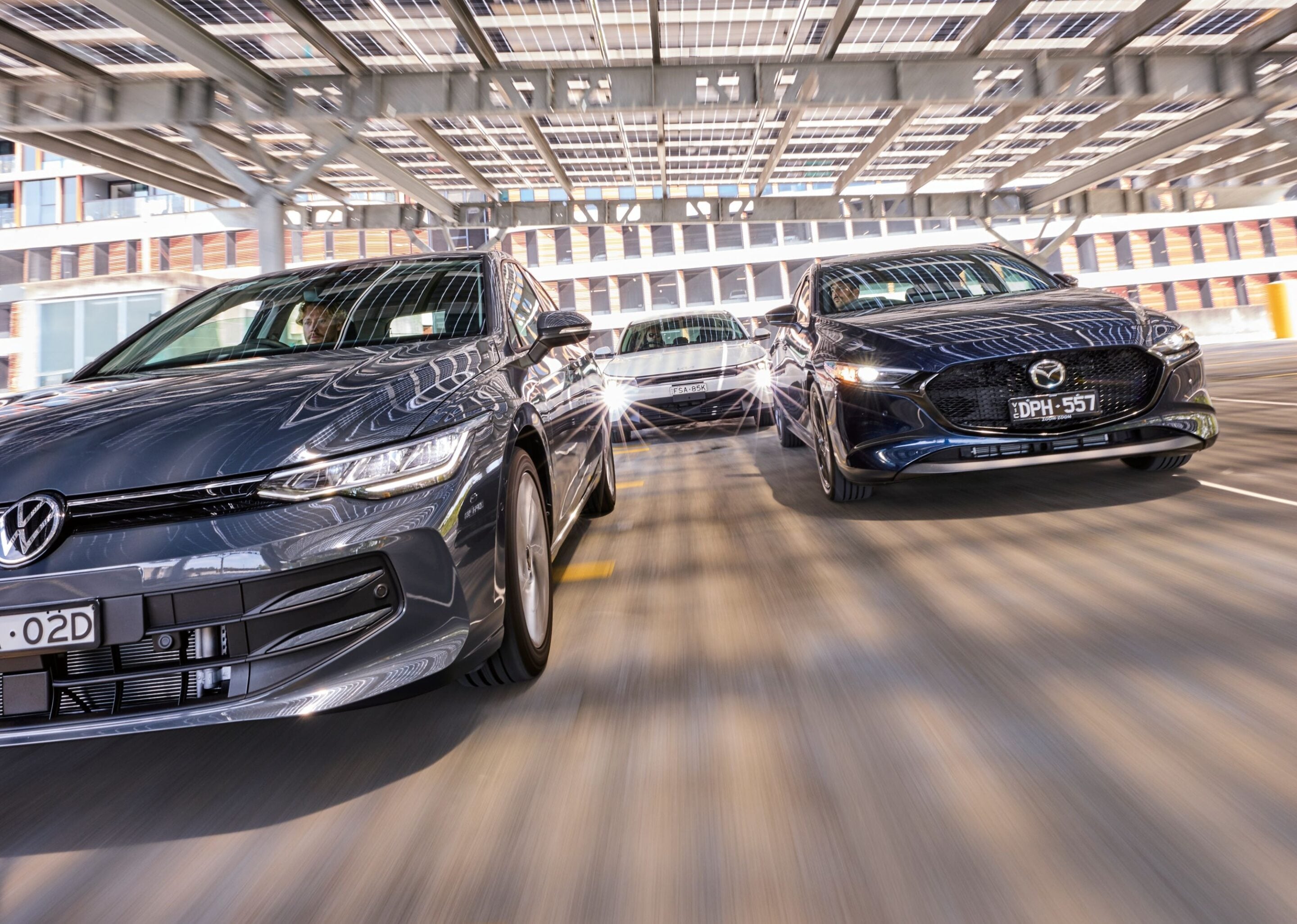
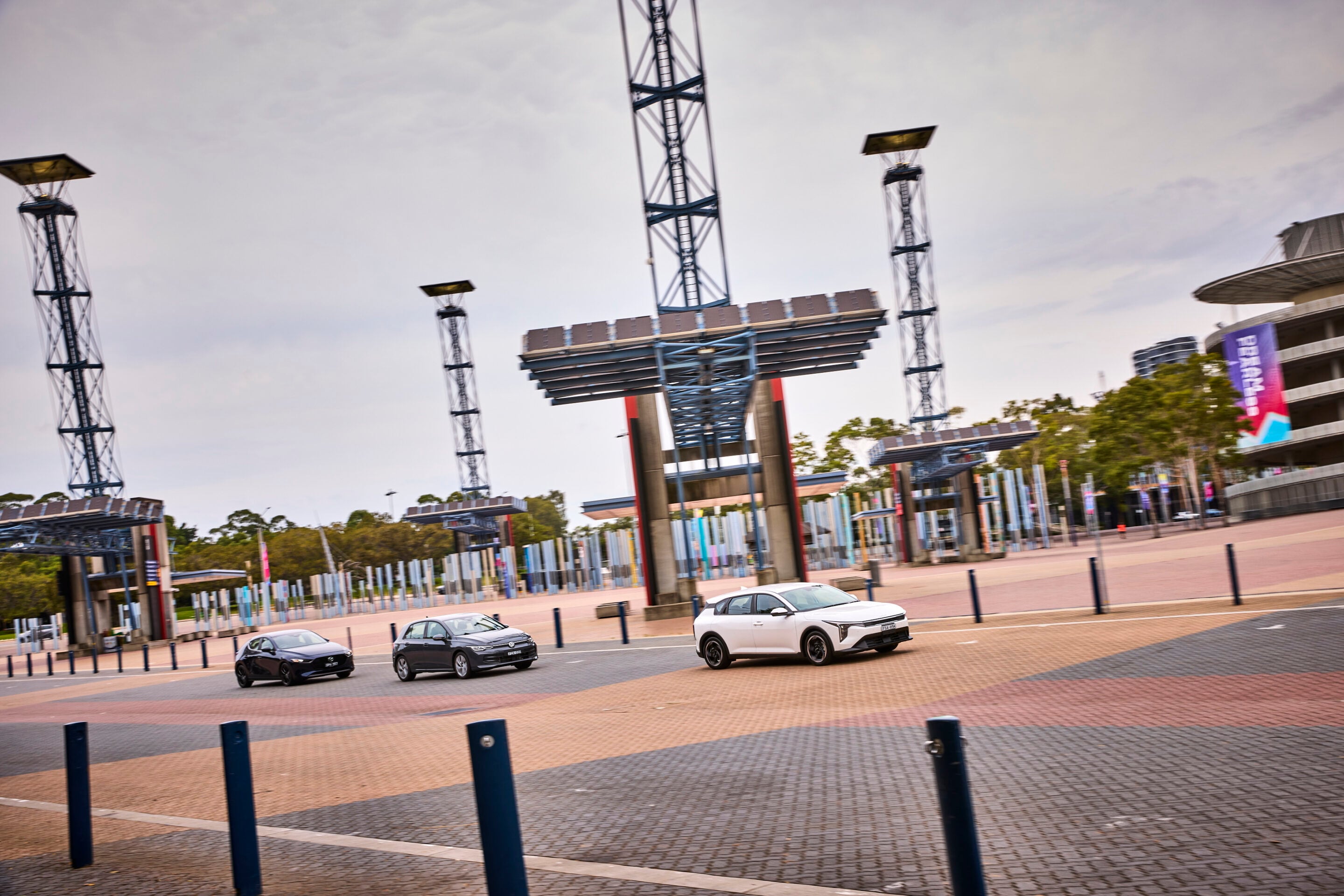
As ever, Wheels was there for the entry for all three of these cars as they first hit the road in Australia. In the case of the Volkswagen Golf, it was our road test in April 1976, while August 1977 saw our first test of the then-new Mazda 323. In December 2010, it was Kia’s turn, with its Cerato hatch. Wheels had tested the Cerato sedan in 2009, but the hatch arrived later.
And here we are decades later with the spiritual successors of those three vehicles – in the case of the Mazda and Kia, changed in name rather than objective. It’s worth revisiting Wheels’ first thoughts, too.
“Brilliant was the word that kept coming back to us during the full road test of the exciting new VW. Brilliant and versatile, and safe and fun… need we go on?” – Peter Robinson, April 1976.
“It’s a good little car. It’s fit to be judged in practicality on the same terms as the most advanced small cars from Europe and it yields nothing to them in economy and not all that much in road behaviour. The Mazda 323 is probably THE outstanding small car buy in Australia right now.” – Steve Cropley, August 1977.
“Cerato is an altogether more cohesive steer thanks to unique-for-Oz springs, dampers and anti-roll bars. For now, the five-door hatch is the better-driving, more versatile, arguably better-looking Cerato.” – James Whitbourne, December 2010.
1
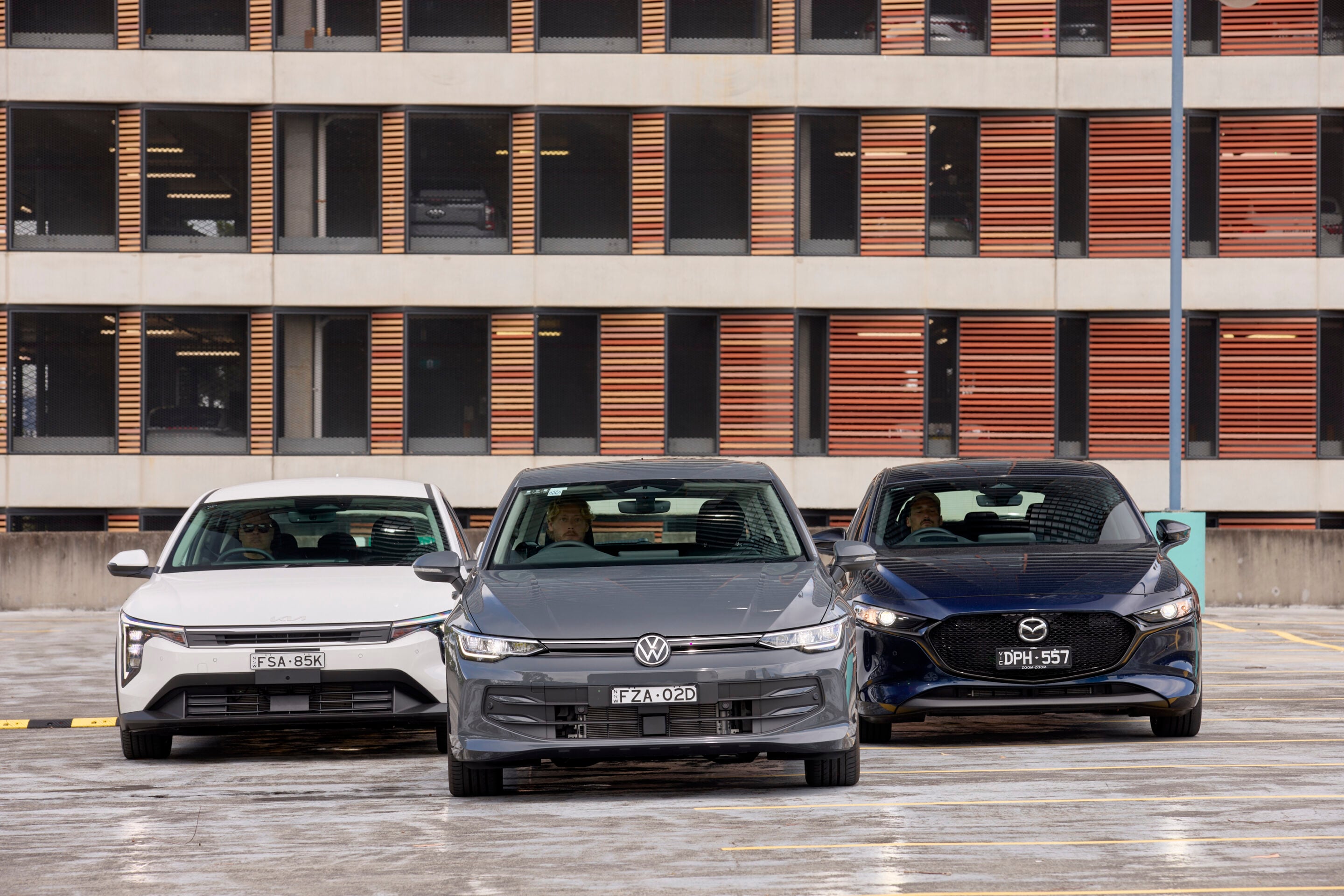
If you focus on sales figures, small hatches aren’t as influential as they used to be. In the case of some manufacturers, a hatch is no longer the entry point into the brand either. In 2025, there wasn’t a small car of any kind in the top 10 – which was dominated by dual-cab 4WDs and SUVs. However, for so many Australians, the small car, often in hatchback form, is the smartest way to start their driving journey, end their driving journey, or serve time as a second car in the family garage. In many ways, they remain as vital in a manufacturers’ showroom as they ever were. pricing of the trio
Wheels has assembled the three models as closely on price and standard specification as we could. That’s more difficult to do than ever before, too, as this segment has diverged widely as the manufacturers look to take advantage of their respective strengths. For some, tech is the key inclusion, for others it’s the way the vehicle is packaged and drives. And then there’s the ‘load it with as much standard equipment as possible’ theory for others.
Those differences have created a very broad church, where you can, in effect, part with a similar amount of money to get a significantly different vehicle. Looking at what you get for the money, though, provides the sharpest comparison you can make.
With that in mind, the way each variant sits in its broader range is slightly different as well. For example, the Volkswagen Golf 110TSI Life we have is the entry point to the Golf range, while the Mazda 3 G25 Evolve SP sits on the higher side of the middle of the range, while the Kia K4 Sport+ is second from the top.
The Golf starts from $39,290 before on-road costs and is covered by a five-year/unlimited kilometre warranty, with the first five years of servicing, setting you back $3094. Mazda’s 3 starts from $37,410 before on-road costs and also gets a five-year/unlimited kilometre warranty, with servicing across the first five years costing $2294. Kia’s new-gen K4 starts from $39,090 in this specification, before on-road costs, and wins the warranty battle with Kia’s standard-setting seven year/unlimited kilometre coverage. Five years of servicing for the K4 will set you back $2322.
Spec shakedown
Let’s first look at the features these three share. They include: automatic dusk-sensing LED headlights, automatic wipers, keyless entry with push button start, wireless Apple CarPlay/Android Auto, AM/FM/DAB+ digital radio, auto-folding mirrors, manual front passenger seats with height adjustment, rear air vents, rear central armrests with cup holders, smartphone app connected services, autonomous emergency braking with pedestrian/cyclist detection, adaptive cruise control with stop-and-go, adaptive lane guidance, traffic jam assist, blind-spot monitoring, rear cross-traffic alert, tyre pressure monitoring, front and rear parking sensors and rear-view camera.
1
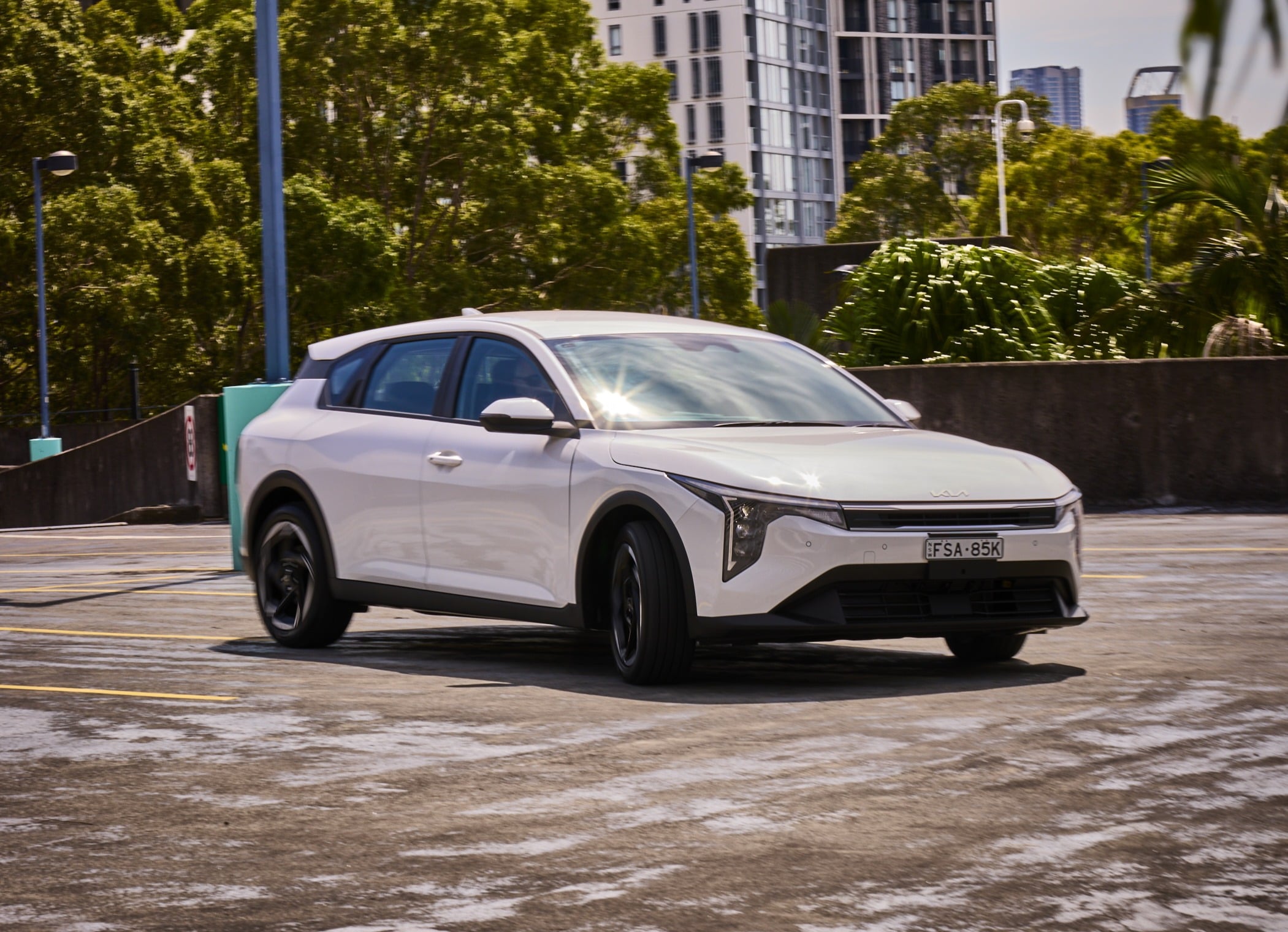
Standard K4 features that Golf and 3 don’t get include: front and rear LED daytime running lights, synthetic leather upholstery, heated front seats, larger 12.3-inch touchscreen, larger 12.3-inch digital driver’s display, ‘Eco’ driving mode, and over-the-air updates. Compared with the others, however, the K4 does miss out on a leather steering wheel, and wireless phone charging.
Move over to the Golf and the equipment it gets that you won’t find in the others includes: rear ski pass through, wiper-activated automatic headlights, Emergency Assist automatic slowing and stopping when driver is unresponsive, rear fog light, rear side airbags, 10-colour cabin ambient lighting, lumbar adjustment, semi-autonomous automatic parking (steering only), and an auto-dipping passenger mirror in reverse.
Compared with the others, Golf misses a few key functions, with only single-zone climate control, no native satellite-navigation, and no drive modes.
Mazda 3 doesn’t miss this battle either, and adds over the other two: 18-inch wheels, a 360-degree camera, head-up display, two extra speakers (eight in total), driver’s knee airbag, and front cross-traffic alert. Mazda 3 does, however, miss out on rear charging ports, only has halogen DRLs, no alarm, has a 7.0-inch part-digital driver’s display and no heated mirrors.
Power Struggle
You’d assume that some five decades after first releasing the Golf, Volkswagen knows a thing or two about packaging the right engine into this segment, and you’d be right.
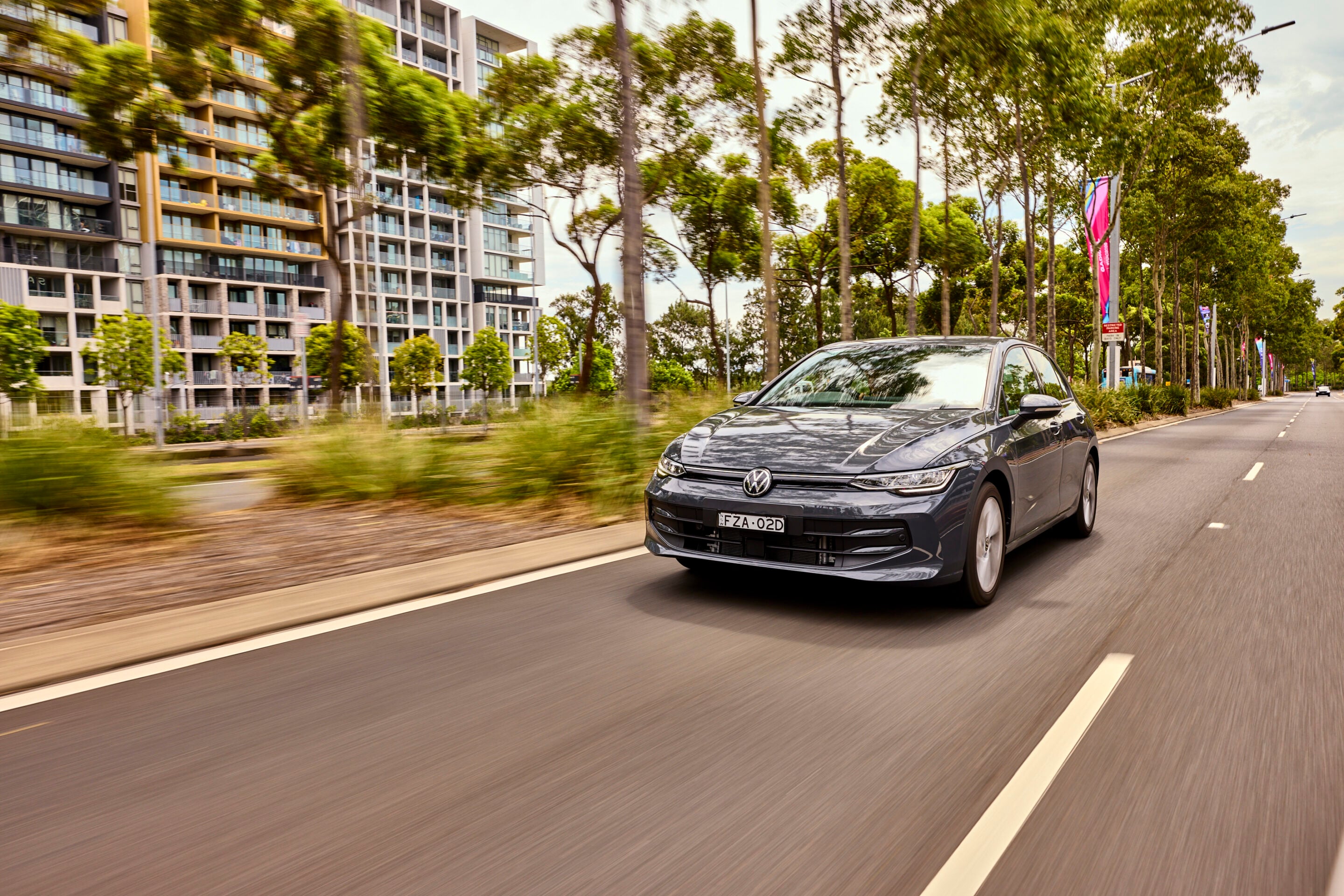
The 110TSI is so-named for its 110kW at 6000rpm and it also generates 250Nm between 1500rpm and 4000rpm. The 1.4-litre, four-cylinder is turbocharged and demands 95 RON petrol.
2
Driving through the front wheels, Volkswagen has opted for the excellent eight-speed automatic, a choice that’s far smarter when it comes to smooth driving than a sometimes-untidy DSG.
VW claims 8.5 seconds to make the 0-100km/h dash, and a combined fuel consumption of 6.3L/100km. On test, over more than 300km, the Golf used 8.0L/100km.
Interestingly, Volkswagen has fitted Nexen NFera Primus rubber to the Golf – 225/45/17 in size, where you might have expected a more premium offering.
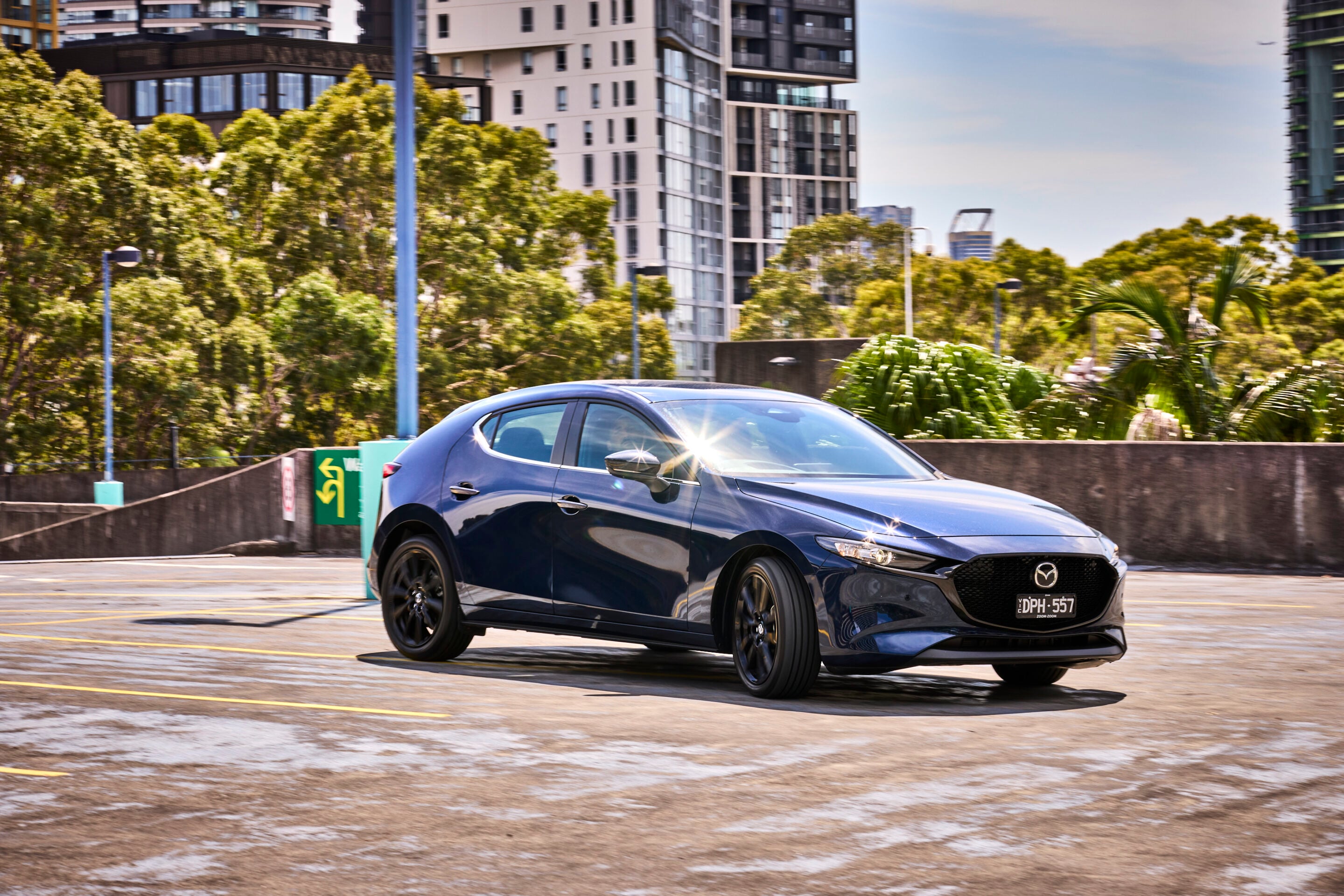
Mazda’s 3 has, like the Golf, been subtly tweaked and improved across its lifespan, making for a hatch that gets better with the launch of every new variant. The current G25 is powered by a naturally-aspirated 2.5-litre, four-cylinder petrol engine, generating 139kW at 6000rpm and 252Nm at 4000rpm. Mazda has opted for a six-speed automatic, and FWD, with a 0-100km/h time of 7.8 seconds and a claimed fuel use of 6.6L/100km on the combined cycle. Requiring only 91 RON, on test, the Mazda consumed 8.2L/100km.
Mazda has plumped for the best tyres of the three, with 215/45/18 Bridgestone Turanza rubber delivering quality feedback through the steering wheel.
Kia’s K4 engine is also naturally-aspirated, 2.0 litres in capacity, has four-cylinders and requires 91 RON fuel. Power and torque weigh in at 110kW at 6200rpm and 180Nm at 4500rpm, and while Kia doesn’t quote a 0-100km/h time, the estimate is 10 seconds.
Kia’s claimed fuel use is 6.1L/100km on the combined cycle and on test, the K4 used 8.5L/100km.
Like the Golf, K4 gets Nexen rubber, this time NFera Sport, sized 225/45/17.
All three hatches tested here have five-star ANCAP ratings, although the Mazda’s is the oldest, tested back in 2019. K4 has the most recent, tested in 2025, while the Golf was assessed in 2022.
1
Internal affairs
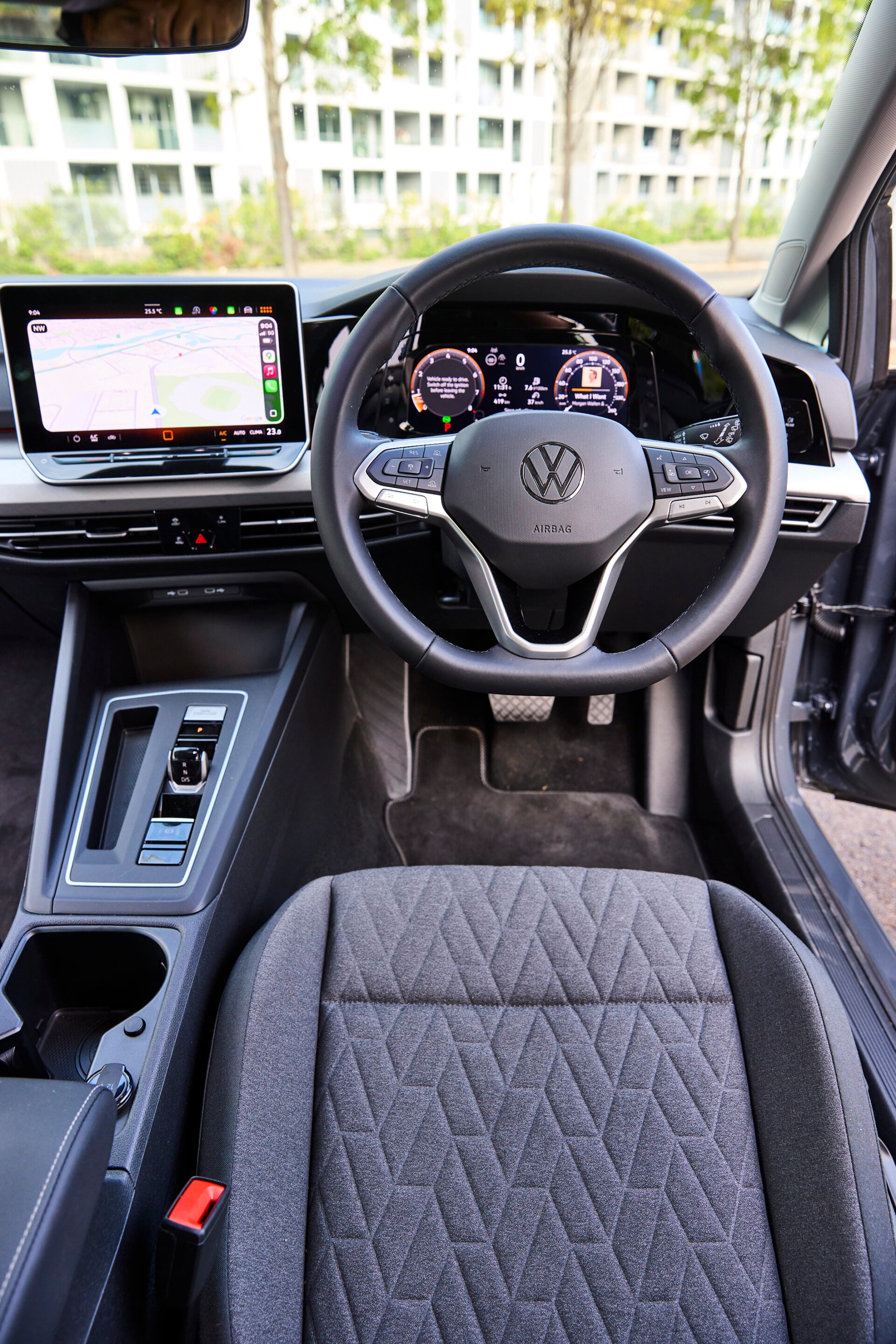
We’ll start with the K4 here, because even though its overall length and wheelbase are both shorter than the Mazda 3, it almost feels a quarter or even half a segment larger than it is. That’s especially so in the second row, where there is more room, despite the hard back of the front seats not feeling as plush as the other two.
I’m not a fan of fake leather trim and would rather quality cloth, but Kia’s choice isn’t a bad one, and it does – to the eye at least – add a premium layer of gloss to the otherwise conservative cabin.
Certainly once inside the K4, the cabin execution is nowhere near as edgy as the external design would suggest it might be. The heated front seats are comfortable, providing plenty of adjustment, but Wheels didn’t like the urethane ‘squircle-shaped’ steering wheel. When you’re approaching the forty grand mark before on-road costs, a plastic steering wheel is edging close to a deal breaker – certainly in this competition.
Under the 508L boot floor, there’s a space-saver spare, meaning the K4 is road-trip ready, an important consideration for most buyers in this segment.
Kia’s switchgear, in both layout and style, is as good as any, and when you need to make changes to any of the major controls on the move, it’s an intuitive exercise. The cabin design, in the main, is quite contemporary, despite the presence of some hard plastics, although the step from Sport to Sport+ brings with it the soft touch inserts.
Kia, despite the muted tones and feel of the cabin, delivers contemporary technology that works easily, and is a cinch to get comfortable with. Comfort is key, too, and it’s worth reiterating the extra room in the second row, especially to those of you who use it more regularly.
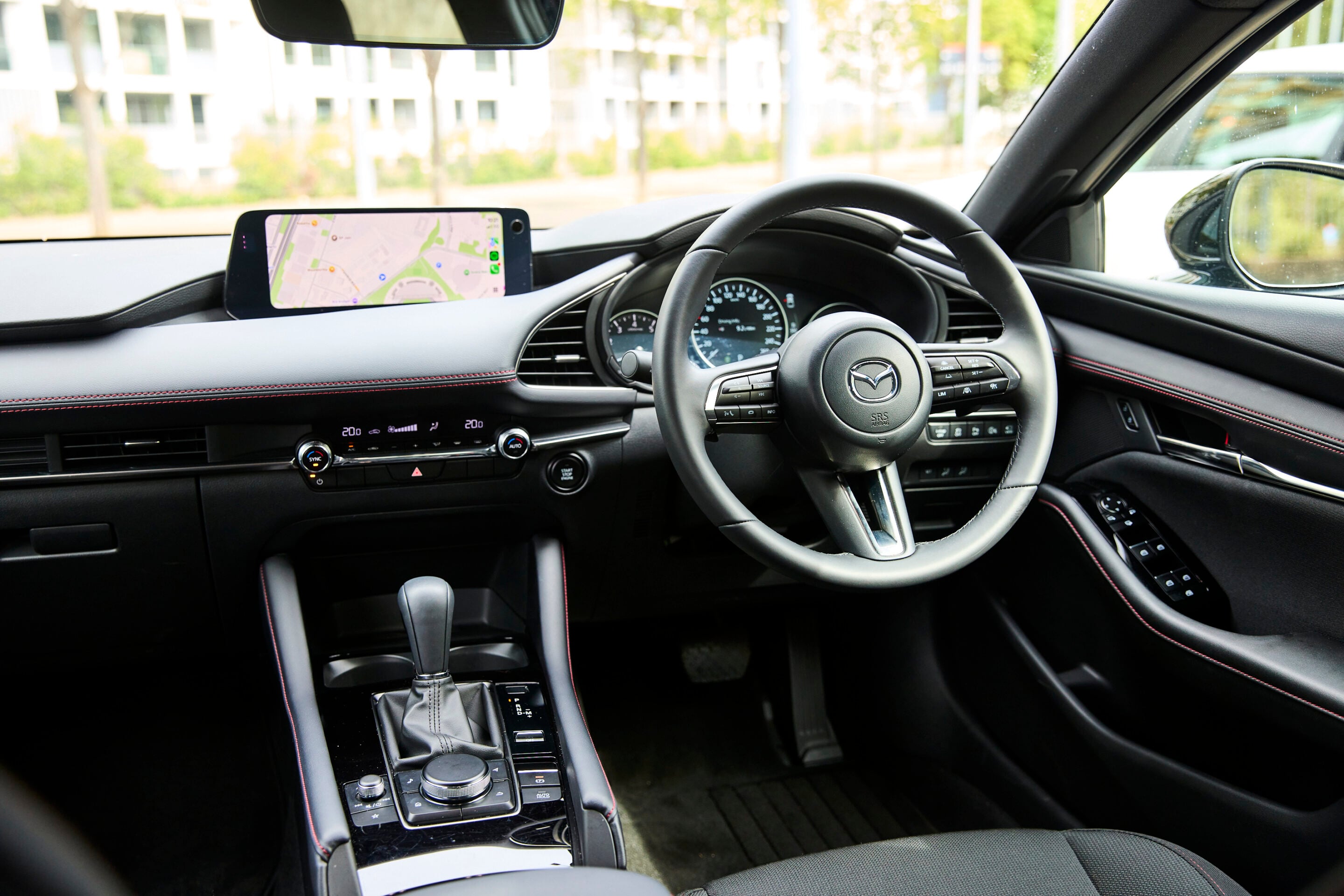
The Volkswagen Golf gets leather trim on the steering wheel, something we’d like to see on the K4,
especially given the fact it’s the one thing you interact with all the time when driving.
Golf’s second row is better than the Mazda, but can’t match the spacious K4, and the two-stage boot floor, which holds 374 litres at the top setting, also hides a space-saver spare.
4
While the second row isn’t as roomy as the K4’s, it’s still comfortable for adults on longer trips, adding to the real-world practicality.
We liked VW’s use of robust-looking grey cloth trim, but the brand isn’t immune to the inclusion of hard, scratchy plastics either, such is the way of this cost-cutting world we live in. The seats themselves are excellent, comfortable and easily set into a position that affords the best visibility for pretty much any driver.
While the Golf’s screen isn’t as large as that in the centre of the K4’s dash, there’s something premium about its appearance that is hard to define. VW’s latest-generation infotainment system is faster, easier to use, and more intelligent. The issue that still needs to be addressed is the depth of control functionality that must be accessed via the touchscreen, rather than physical dials or switches. Wheels could live with the smaller screen, if you had to use it to do less.
What’s most evident in the Golf cabin, is the insulation once you thud the door closed. There’s a muted calm with the windows up and the AC running, delivering a premium feel neither the Mazda nor the Kia can match. It’s always been a measure of Golf’s polish – cabin ambience and insulation – and this current model is no exception.
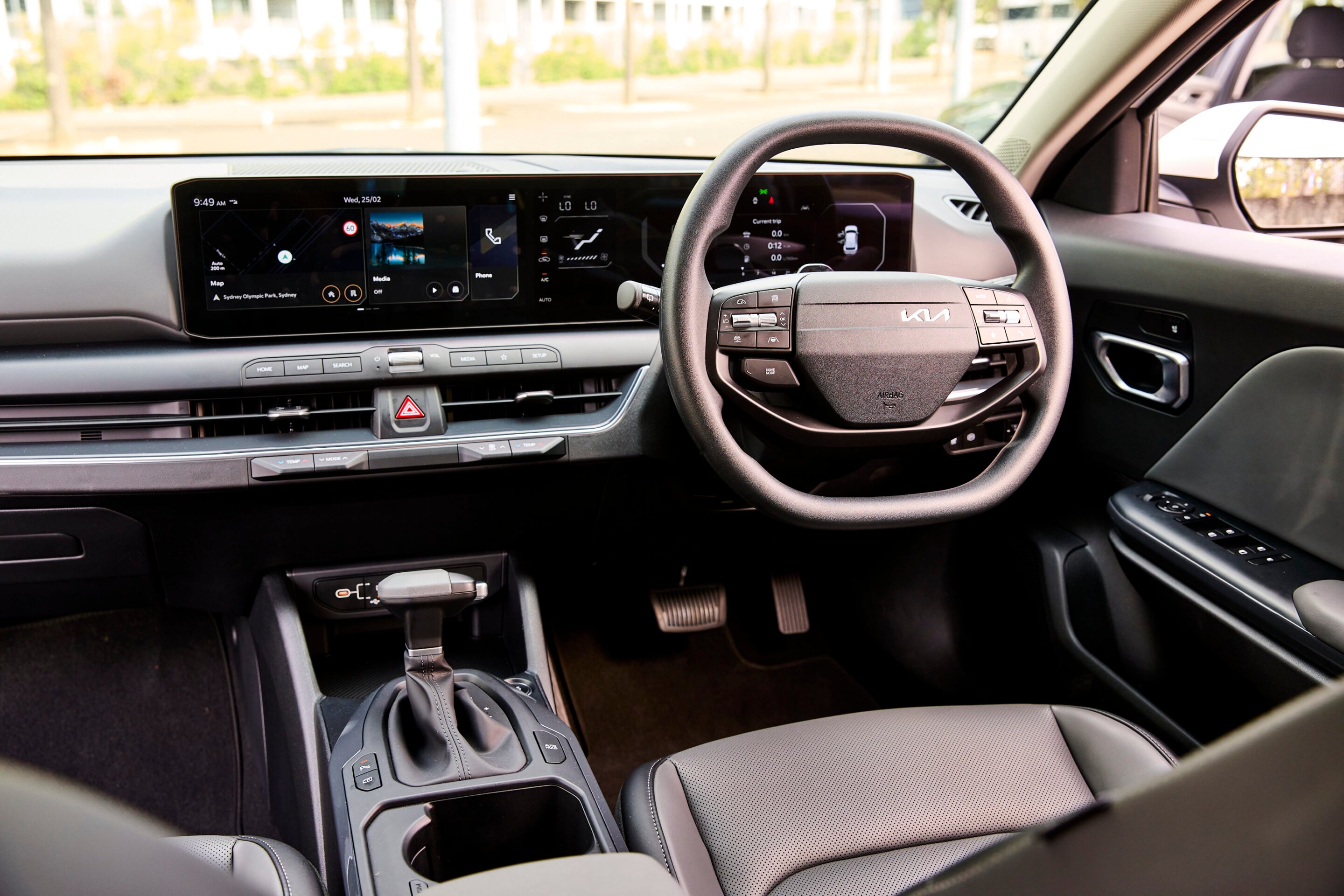
As one of the stalwarts of this segment, Mazda also knows a thing or two about packaging as much into as little as possible. Mazda’s second row, however, is unequivocally the tightest of the three, ensuring that it’s not as comfortable for taller occupants, noticeable even on short trips.
4
There’s a driver-focused sportiness to the Mazda’s cabin that rewards the driver with a feeling that the interior is focused on their amenity, wrapping around them. That’s not to say the rest of the cabin isn’t tastefully executed, just that Mazda manages to imprint its sporting DNA on anything, even if it isn’t an MX-5.
The Mazda 3 has always presented itself as a driver’s hatch, even if you’re looking at the least sporty model in the line-up. Like the Golf, the leather-trimmed steering wheel also beats the K4’s plastic offering.
Mazda’s 295-litre boot also hides a space-saver spare, and the quality and execution of the cabin entices the idea of road trips. Plenty of soft-touch surfacing is present, even the dash has a nicely padded covering, and all the touch controls and switches have a reassuring, mechanical click to them.
There is some hard, scratchy plastic in play, and the doors don’t deliver the hefty thud of the Golf’s, but once seated, the Mazda 3’s cabin delivers on the premium on a tighter budget vibe. Certainly at this end of the pricing spectrum, anyway.
Mazda’s seats are almost Euro-firm, similar to the Golf, but nicely supportive, and you won’t struggle to get comfortable before you set off. Electric seat controls are a nice touch in this company.
Mazda’s updated infotainment system is a good one, with the 10.25-inch screen once again not as large as Kia’s but crisp, easy to see in any light and, thankfully, features legitimate touch functionality. In this company, the head-up display is a notable inclusion, too.
5
On the road
The K4’s is a polarising design, of that there’s no doubt, with some loving it and others hating it. For what it’s worth, it grew on the Wheels team over our time with it. And it looks sharper as a hatch than it does as a sedan, in our opinion. At 1388kg, it’s a light car, and it feels light on its tyres, too; nimble, sharp and easy to work around town in tight spaces.
That light weight assists the 2.0-litre to do its best work, with 110kW and 180Nm ensuring you’ll have to work it harder than either the Golf or Mazda to keep up with them on a B-road dash. While the Golf makes the same power, for example, its heftier slab of mid-range torque – 250Nm versus K4’s 180Nm – means the Golf feels more effortless just about everywhere.
Mated to the CVT that Kia has chosen for Sport+, the engine has been polished over its lifespan, ensuring what you’re getting is as good as it currently gets from the South Korean manufacturer. However, some of its precision is dulled somewhat by the CVT – Wheels asserts the eight-speed auto offered further up the range is the transmission to have. And while the engine is no powerhouse, it’s very sharply positioned to deliver what the intended buyer will expect.
What that buyer might not appreciate is the level to which the Australian-tuned suspension system beneath the Kia has enhanced what might otherwise be an uninspiring ride and handling package. No matter how nasty the surface beneath the tyres, the K4 soaks it up, remaining settled and composed at any speed. The torsion beam rear end, especially, does an exceptional job, despite its packaging and budgetary focus, and the chassis is overall, controlled, stable and responsive.
In short, if you don’t try to drive the K4 like a hot hatch, it’s a fantastic car for the daily grind. Even though the steering is nicely weighted so as to attract more enthusiastic driving, that isn’t the K4’s strong point. Rather, its ability to traverse the urban road network, fuss and thud-free, well insulated and composed, sits it with the best in the segment.
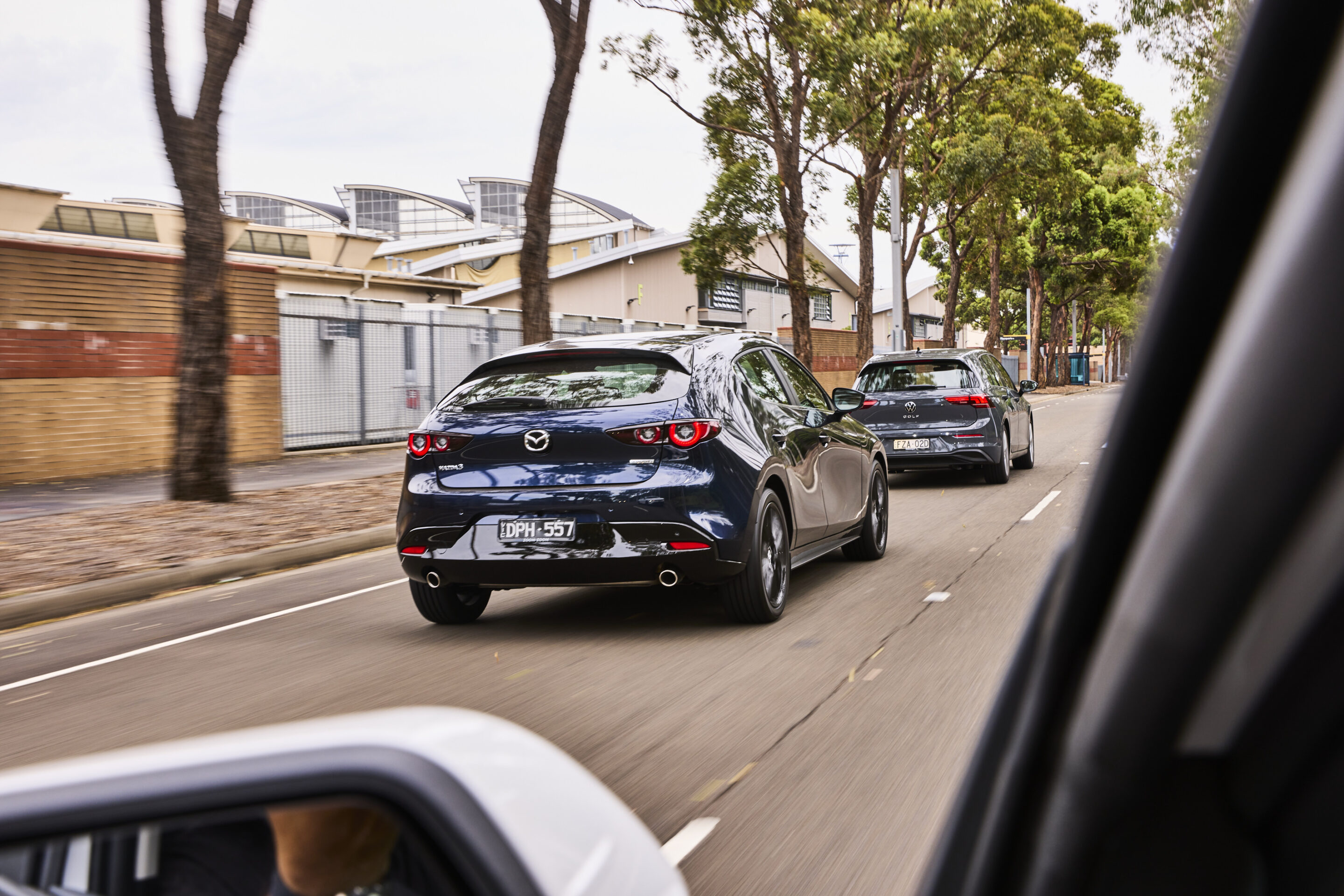
Mazda has, once again, delivered a driving experience that defies the otherwise mundane nature of this segment. Hot hatches aside, this segment could be boring, staid and the opposite of engaging, but hatches like the Mazda 3 ensure it isn’t. Some of this hints at the sporting DNA, but it’s also an intrinsically competent engine, in an intrinsically competent chassis – things that can’t be papered over with power and torque.
This is an engaging and enjoyable hatch to drive on any road, at any speed. It’s as competent hooking into a corner, as it is rolling around town negotiating the patchwork of speed humps and potholes of our major cities. If you’re looking to scoot away from the lights rapidly, you’ll need to work the 2.5-litre up to redline, but it loves that work, and delivers its power smoothly right up to that point.
Interestingly, the Mazda, taut and sporty as it is, does ride on the firmer side of the ledger compared to both Kia and VW. Kia has the advantage of local suspension nous, and there’s nothing tooth-chattering about the Mazda’s ride, but it is firm. Counter that, though, with the sharpness to all the inputs whether that be accelerator, steering or brake, and you’re getting a rewarding driver’s hatch that’s affordable. And what’s not to like about that?
1
At speed on the highway, the Mazda is the noisiest of the three, with more wind noise especially seeming to enter the cabin, but that’s us looking for fault. The 18-inch rubber insulates the cabin from as much noise as possible, a bugbear with previous Mazdas we’ve tested. Part of the refinement expectation is cabin ambience on the move, after all.
While the six-speed automatic Mazda has used isn’t as responsive and precise as the Golf’s eight ratios, it betters the CVT in the K4 in regard to kick down response and snappy shifting across the broad range of road speeds the city demands. And, while the Mazda 3 is undoubtedly at home in the city, it’s the type of hatch that settles easily into a fun drive on a twisty road when the mood desires.
Generationally, the Volkswagen Golf is a hatch that has evolved in the same way a Porsche 911 never veers too far from the brief, but just keeps getting better. “Well, it’s another leap forward from the old model.” That’s the most common first-up assessment you’ll hear from the Wheels judges every time they exit the Golf after the first taste.
Why it’s so good and keeps getting better is as much to do with legacy as it is engineering prowess and attention to detail. And, on the move, the Golf shines the brightest.
It’s punchy, effortless, quiet and refined, and seemingly at the ready to deliver exactly what the driver wants, all the time, at the right time. If you need to crawl through peak hour, it does so with ease, but it reaches its pomp on a twisty road when you unleash all of its 250Nm through the mid range.
The Golf, even at this entry point, delivers a layer of polish all other hatches aspire to. And as proficient as they get, the King still occupies the throne.
Numbers on paper only tell part of the story, and while the Mazda makes a fair dollop more power and slightly more torque, it never feels that way in the real world. The Golf always feels effortless, and the lightest weight on the throttle gets the roarty 1.4-litre cranking, and the speed piles on.
2
Ride quality is excellent, while bump absorption, ability to settle quickly, insulation into the cabin, and composure are all first-rate. There’s an intangible element to the way the Golf rides, steers, brakes, and turns that all come together to ensure you are impressed by it every time you drive it.
No car is perfect, nor is that likely to happen in an environment driven by everything except automotive perfection. Given emission constraints, barriers to development depth, and engineering and manufacturing limitations, it’s unlikely a petrol powered small hatch will ever get to that near-mythical state, certainly not now. As a package however, the Golf remains the standard by which all other small hatches should be judged. And that’s never more evident than from behind the wheel.
The Verdict
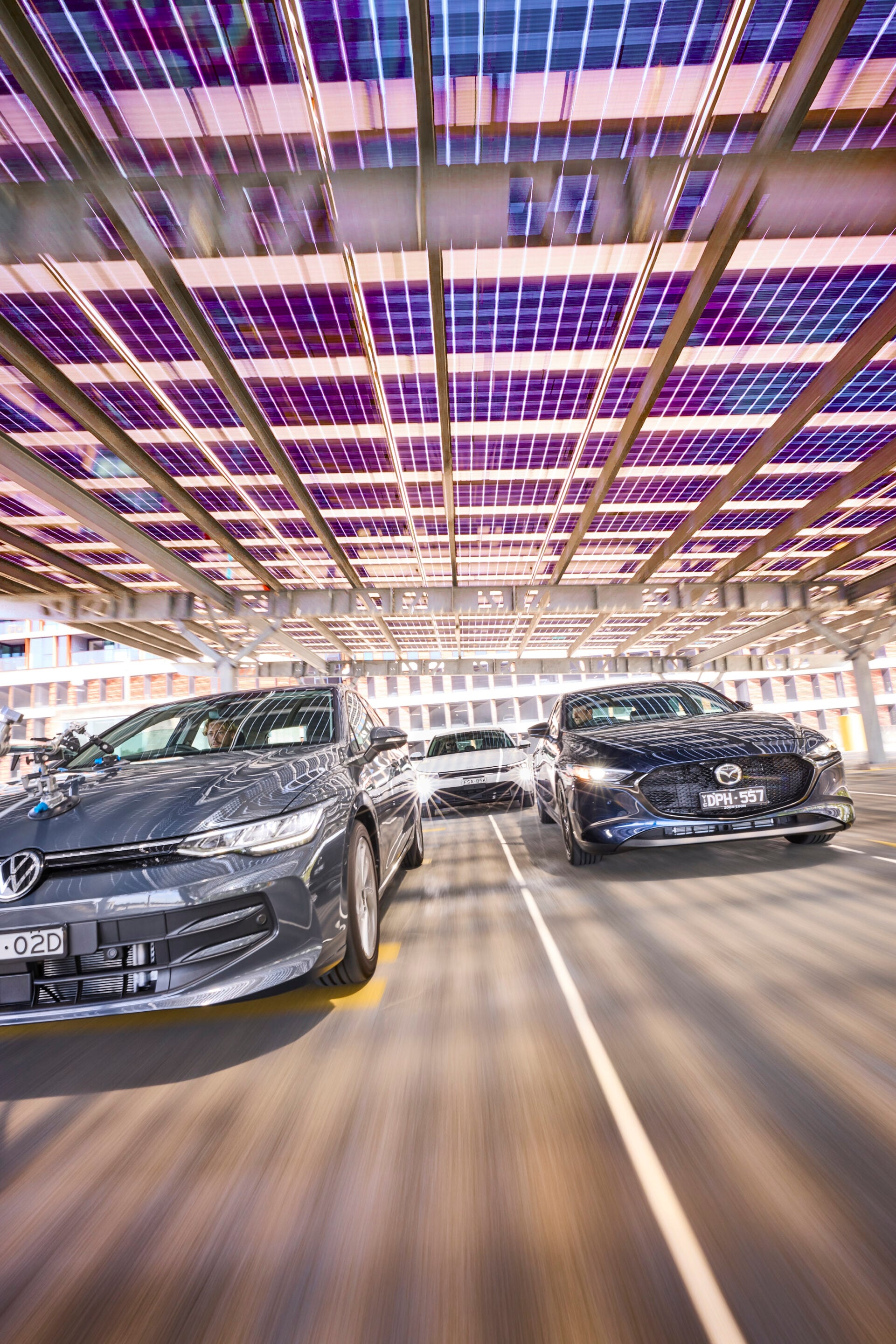
While all three approach the target in their own country-of-origin way, they all offer flexibility, space and driving ability that you’d expect of larger vehicles, despite their still-compact exterior dimensions. That’s a key factor that continues to ensure the hatchback’s popularity as a viable platform in this market.
However, as tight as this tussle is, it’s the Volkswagen Golf that edges the Mazda and Kia in this test. The Golf is a clear automotive case of evolution rather than revolution – each subsequent update is ever so slightly more polished than the model before. And it’s that polish that makes the Golf so appealing.
Volkswagen is already building on an exceptional platform, there’s a carved-from-stone sense to the Golf when you’re seated in the cabin, and the way it responds on the road is with the composure and sure-footedness of a larger, heavier car. Volkswagen has set the standard for decades with Golf now, and while the chasing pack are closer than they’ve ever been, they haven’t quite caught up.
Volkswagen’s Golf, at any price point, in any specification, is an exceptional car to drive, providing comfort, quality, and attention to detail. While there’s good news in this comparison, regardless which hatchback you prefer, it’s the Volkswagen Golf that gets the Wheels vote.
1
Specs
Kia K4 Sport+
| Price | $39,090 plus on-road costs |
|---|---|
| Engine | 1999cc naturally aspirated DOHC four-cylinder |
| Power | 110kW @ 6200rpm |
| Torque | 180Nm @ 4500rpm |
| Transmission | CVT automatic, front-wheel drive |
| 0-100km/h | 10 seconds (est.) |
| Combined fuel consumption (claim) | 6.1L/100km |
| CO2 emissions | 143g/km |
| Fuel required/tank size | 91 RON unleaded, 47 litres |
| Dimensions (L/W/H/WB) | 4440/1850/1435/2720mm |
| Boot | 438 litres (seats up), 1217 litres (seats folded) |
| Tare mass | 1388kg |
| Warranty | 7-year/unlimited km |
| 5-year service cost | $2322 ($465 per year) |
| On sale | Now |
| Rating | 7.7 |
Volkswagen Golf 110TSI Life
| Price | $39,290 plus on-road costs |
|---|---|
| Engine | 1395cc turbocharged DOHC four-cylinder |
| Power | 110kW (@ 6000rpm) |
| Torque | 250Nm (@ 1500rpm-4000rpm) |
| Transmission | 8-speed automatic, front-wheel drive |
| 0-100km/h | 8.5 seconds (est.) |
| Combined fuel consumption (claim) | 6.3L/100km |
| CO2 emissions | 143g/km |
| Fuel required/tank size | 95 RON premium unleaded, 50 litres |
| Dimensions (L/W/H/WB) | 4282/1789/1480/2631mm |
| Boot | 374 litres (rear seats up), 1230 litres (rear seats folded) |
| Tare mass | 1345kg |
| Warranty | 5-year/unlimited km |
| 5-year service cost | $3094 ($619 per year) |
| On sale | Now |
| Rating | 8 |
Mazda 3 G25 Evolve SP
| Price | $37,410 plus on-road costs |
|---|---|
| Engine | 2488cc naturally aspirated DOHC four-cylinder |
| Power | 139kW (@ 6000rpm) |
| Torque | 252Nm (@ 4000rpm) |
| Transmission | 6-speed automatic, front-wheel drive |
| 0-100km/h | 7.8 seconds (est.) |
| Combined fuel consumption (claim) | 6.6L/100km |
| CO2 emissions | 154g/km |
| Fuel required/tank size | 91 RON unleaded, 51 litres |
| Dimensions (L/W/H/WB) | 4460/1795/1435/2725mm |
| Boot | 295 litres (rear seats up), 1026 litres (rear seats folded) |
| Tare mass | 1340kg |
| Warranty | 5-year/unlimited km |
| 5-year service cost | $2294 ($458 per year) |
| On sale | Now |
| Rating | 7.8 |
This story first appeared in the May 2026 issue of Wheels magazine, now on sale. Subscribe here and gain access to 12 issues for $109 plus online access to every Wheels issue since 1953.
Follow WhichCar/Wheels on Google
Click the button below to make WhichCar by Wheels a preferred source for your news.

We recommend
-
 Comparisons
Honda Accord v Toyota Camry: Middleweight sedan showdown
Medium sedans might not be the flavour of the month any more, but as we discovered with two of the stalwarts of the segment, there is still plenty to like about these hybrid family haulers.
-
 Comparisons
Powertrain battle! Nissan X-Trail v Tesla Model Y v MG HS Hybrid+
Australian buyers love medium and large SUVs – and the choices have never been more broad than they are right now. The question is, which powertrain suits you? best? Regular hybrid, petrol generator electric, or full electric? Three very different combatants duke it out
-
 Comparisons
Hyundai Tucson Hybrid v GWM Haval H6 Ultra Hybrid: Front-wheel drive SUV showdown
Medium SUVs are Australia’s favourite way to move a family around, get to and from work, or head off on a road trip. That’s why every manufacturer wants a piece of the pie. If you want a medium SUV though, do you need AWD and all the extras? Wheels looks at two of the more affordable hybrid FWD models on the market.