
Reviews

Gallery 1
8.5
/10
Score
Score breakdown
8.5
Safety, value and features
8.0
Comfort and space
9.0
Engine and gearbox
9.0
Ride and handling
8.0
Technology
Things we like
- Practical and high quality throughout
- Excellent electric-only range
- Great value for money in Elegance form
Not so much
- No spare wheel, all-wheel drive or seven-seat layout
- Quite expensive to service
- Reduced boot capacity compared to other Tayron models
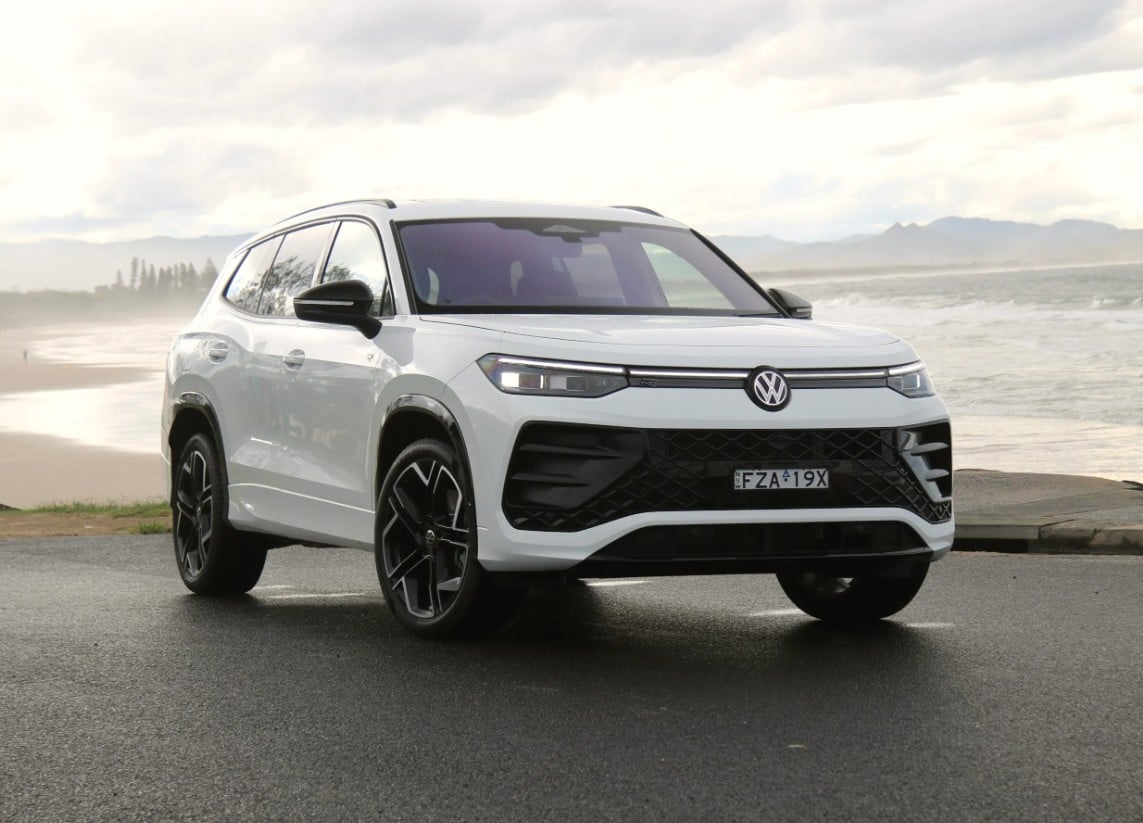
What is a Volkswagen Tayron, you might be asking. Taking the place in VW’s Australian line-up of the former Tiguan Allspace, the Tayron is essentially an extended length version of the Tiguan using the same drivetrains and with almost identical model ranges. Crucially for Volkswagen Australia, the Tayron’s extra length qualifies it to enter the large SUV segment, so it now competes against cars like the Kia Sorento, Hyundai Santa Fe and Toyota Kluger. Is the Tayron eHybrid a worthy large SUV option?
How much does the Tayron eHybrid cost to buy?
Volkswagen Australia is offering two eHybrid variants in the Tiguan range: the 150TSI Elegance that’s priced at $62,390 plus on-road costs and the 200TSI R-Line, which is yours for $76,550 plus on-road costs. Until June 30, 2026, the former is priced from $61,990 driveaway and the latter $75,990 driveaway.
Those who have read our Tiguan eHybrid review will note that the entry price for the Tayron is actually less than the smaller Tiguan. That’s because the Tiguan includes the contents of the $4200 Sound and Vision Package that’s optional on the Tayron Elegance, but will that confuse potential buyers? Potentially.
3
2026 Volkswagen Tayron pricing:
| 110TSI Life 2WD seven-seat | $48,950 |
|---|---|
| 150TSI Life AWD five-seat | $54,790 |
| 150TSI Elegance AWD seven-seat | $60,390 |
| 150TSI eHybrid Elegance 2WD five-seat | $62,390 (new) |
| 195TSI R-Line AWD seven-seat | $74,550 |
| 200TSI eHybrid R-Line 2WD five-seat | $76,550 (new) |
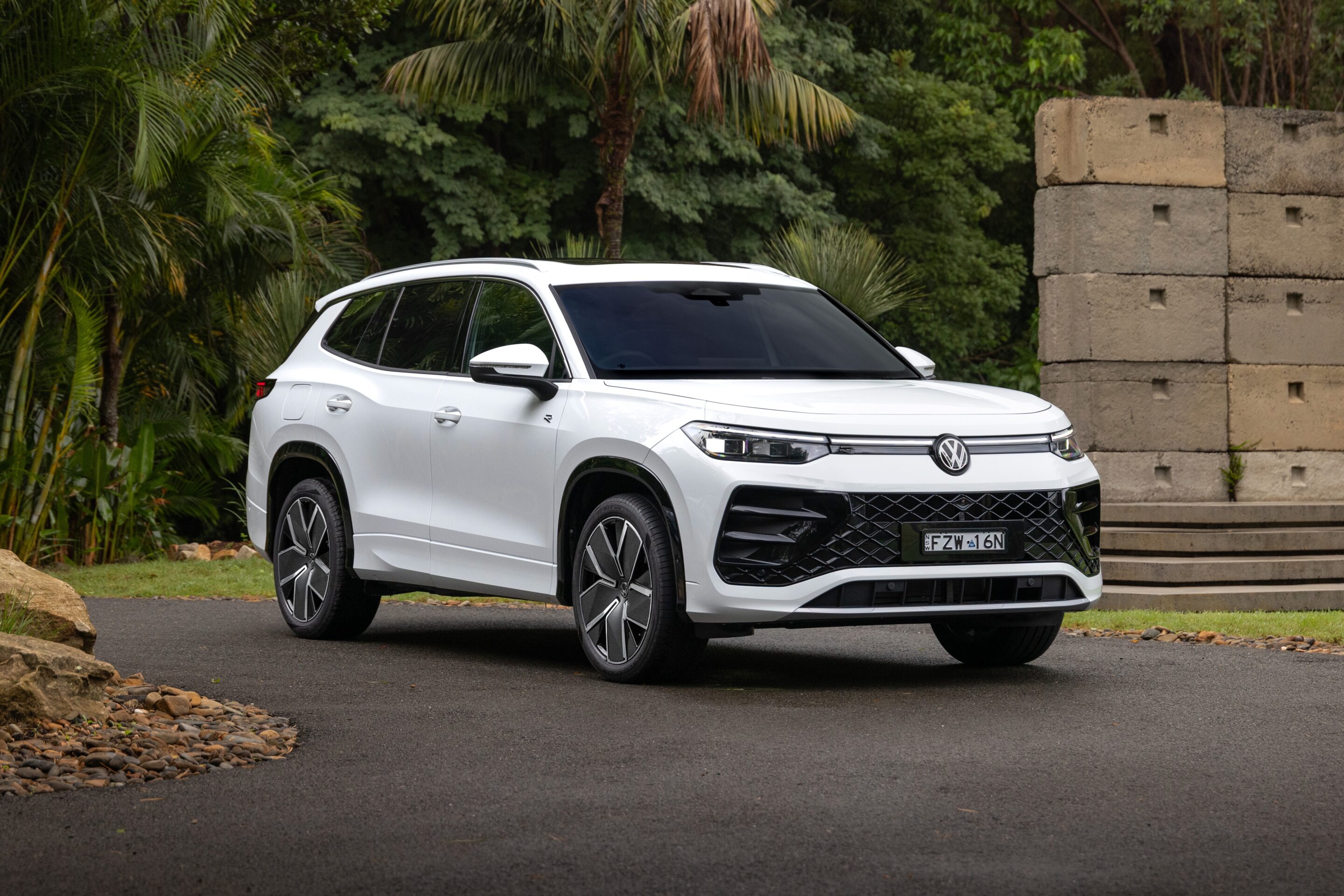
The Tayron eHybrid variants command a reasonable $2000 premium compared with equivalent petrol models, but like the Tiguan eHybrid, there are compromises thanks to the plug-in hybrid drivetrain: there’s no spare wheel, no all-wheel drive and like the Tayron 150TSI Life, they use a five-seat layout with the two extra seats that feature in the Tayron 110TSI Life, 150TSI Elegance and 195TSI R-Line not available.
There’s a full list of standard features at the bottom of the page, but both Tayron eHybrid variants are very well equipped. Options are limited to just the aforementioned $4200 Sound and Vision Package, $800-$1100 paint colour, a $2100 panoramic sunroof and, on the 200TSI R-Line, a $1500 Black Style Package with – as the name suggests – gloss black exterior detailing.
For its introductory $61,990 driveaway deal, we think the Tayron eHybrid Elegance is great value for money. A less practical and less well equipped Mazda CX-60 P50e Pure with its inferior electric driving range starts at $63,790 plus on-road costs, for example.
How practical is the Tayron eHybrid?
Those who have spent time in the current Tiguan will find the Tayron’s interior instantly recognisable as it’s pretty much identical, though the longer wheelbase and extra length make for a more spacious and practical cabin.
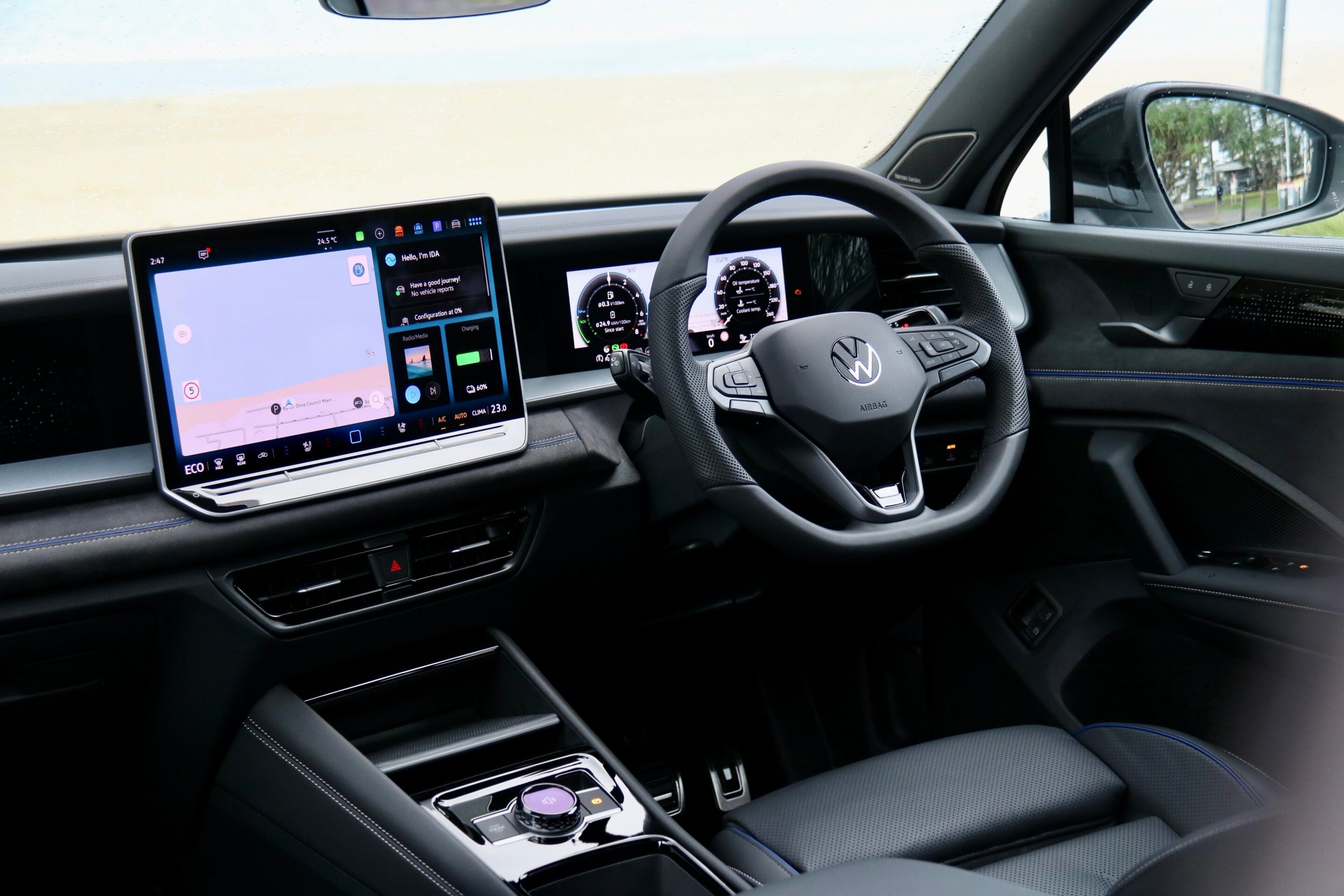
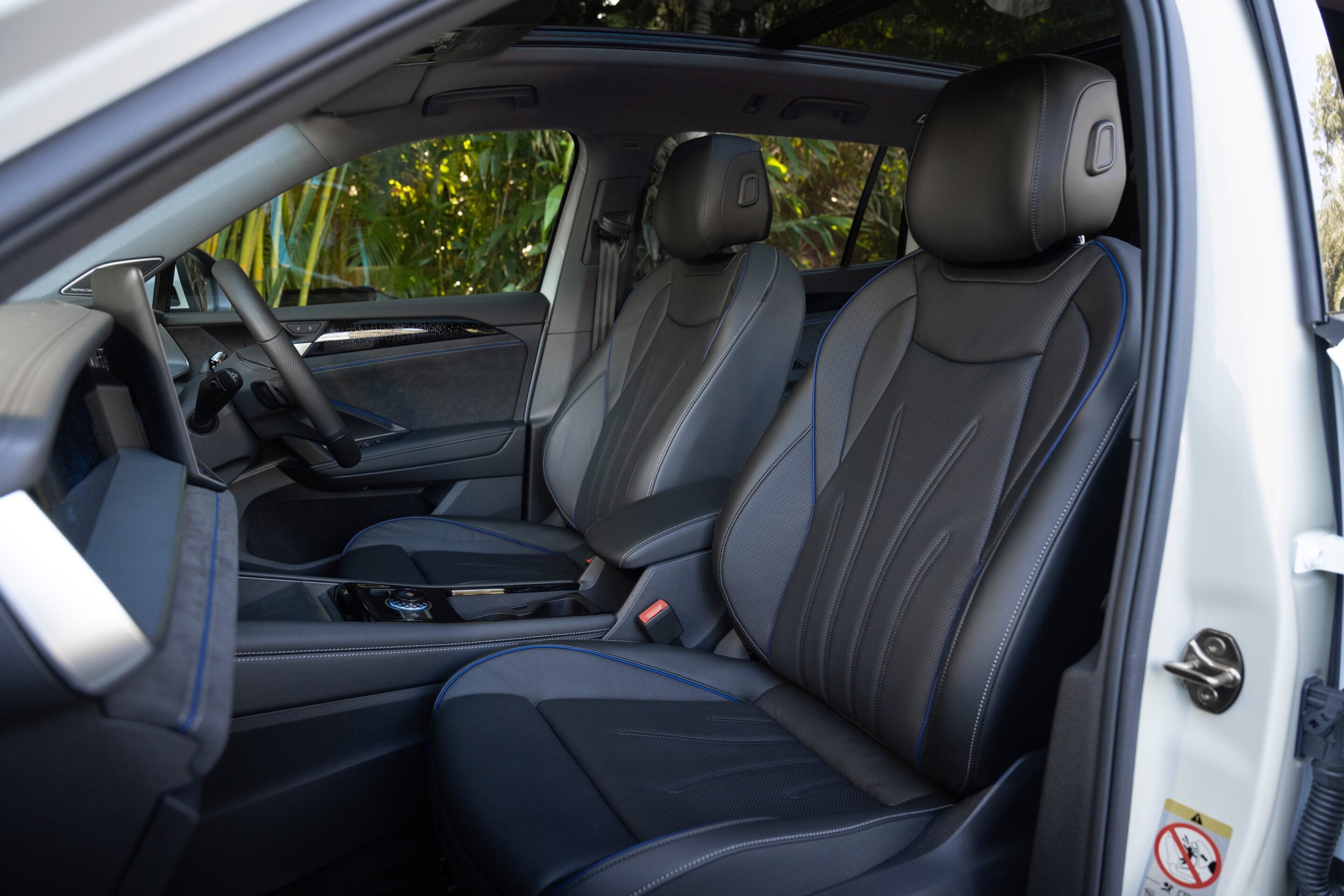
The quality inside the Tayron is higher than the Tiguan Allspace it replaced thanks to way more soft touch materials, more appealing hard materials, and more leather and suede dotted around. It’s also more high-tech with larger displays with more features. The Elegance trim featuring 12-way electric front seat adjustment with memory, massaging, heating and ventilation also elevates comfort levels.
3
A 15.9-inch touchscreen is standard on the Elegance, but the models we drove on the launch were fitted with the optional Sound and Vision Package, offering a larger 15-inch unit with bright colouring, sharp graphics and quick processor. It doesn’t feature the live services of European models like live traffic, but pairing Apple CarPlay is quite easy and the 10-speaker Harman Kardon sound system is a quality item that will please audiophiles.
The lack of physical climate buttons makes changing the temperature and other climate features a bit of a chore, though there is the multi-purpose physical control dial located on the centre console. It’s a volume knob, though if you press it, it cycles through features like drive mode selection. Volkswagen has also moved away from touch-capacitive steering wheel buttons, which has made it easier to interact with the steering wheel.
As for practicality, there are capacious flock-lined door bins, a big central box, moveable cup holders, two wireless phone chargers and a flap to cover phones while they’re charging for extra storage and to keep eyes on the road.
The Tiguan is already a spacious car in its second row, but the Tayron is even larger thanks to its longer wheelbase. Although the eHybrid doesn’t feature the seven-seat layout of some other Tayron variants, it does still have the sliding and reclining middle row, which enhances practicality even further. Other features include a separate zone of climate control, two USB-C chargers, heated outboard seats, a central armrest with cupholders, integrated sun blinds and large flock-lined door bins.
5
Behind the rear seats lies a large 705 litres of boot space, which expands to 1915 litres with the rear seats folded. Because of the battery location, that makes it smaller than the five-seat 150TSI Life (885/2090L) and seven-seat models, but the seats folded figure is 10 litres larger than the seven seaters. There are also some under-floor cubbies though as with the Tiguan, a tyre repair kit features in lieu of a spare wheel.
How fuel efficient is the Tayron eHybrid?
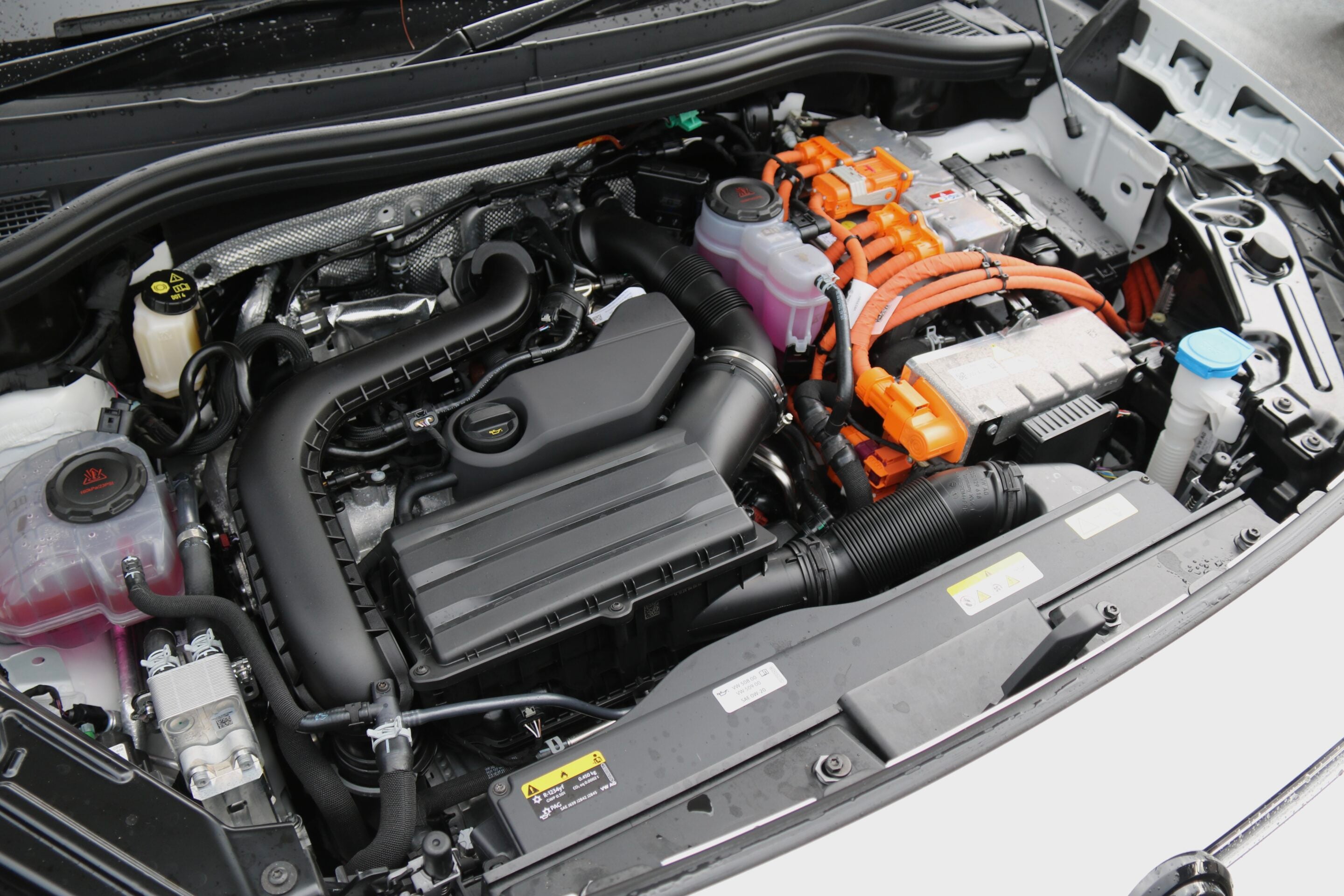
If you charge it regularly, the Tayron eHybrid will deliver more efficient petrol use. Both Tayron eHybrid variants use a new 1.5-litre turbo-petrol engine making either 110kW/250Nm (150TSI) or 130kW/250Nm (200TSI) outputs. That engine is mated to an 85kW/330Nm electric motor that’s sandwiched in the six-speed dual-clutch transmission, sending combined 150kW/350Nm (150TSI) or 200kW/400Nm (200TSI) outputs solely to the front wheels. There’s plenty of grunt, though we’d love to see a dual-motor set-up with even more performance. A potential Tayron R eHybrid, eh Volkswagen?
A 19.7kWh (net capacity) lithium-ion battery is located underneath the boot floor and provides an impressive 116km of range on the stricter WLTP cycle, meaning that you should achieve fairly close to that figure in the real world. Unlike rivals such as the Sorento PHEV, the Tayron eHybrid can be DC fast charged and up to a reasonable 40kW, with a claimed 10-80 per cent charge time of 26 minutes. AC charging is also available for a claimed 2.5-hour 0-100 per cent charge at 11kW, or 12 hours plugged into a wall socket. Impressively, unlike many PHEVs/EVs on the market where you must buy a separate cable, the Tayron eHybrid is equipped with both AC-to-AC and AC-to-wall socket charging cables.
5
As for fuel consumption, the Tayron eHybrid 150TSI is rated at 1.7L/100km and the 200TSI at 1.8L/100km, though like with all plug-in hybrids, both those figures were achieved with a full battery and achieving fuel consumption that low is only possible when regularly charged. We spent more time in the smaller Tiguan eHybrid on the launch event, which achieved a low 3.9L/100km highway consumption figure running in hybrid mode, so in similar conditions, we’d wager that the slightly larger Tayron would achieve low 4s, but we look forward to testing both in our regular testing environment soon.
Admittedly, the eHybrid models are slower against the clock compared with their petrol equivalents – 8.6 seconds versus 7.4 seconds for the 150TSI, and 7.3 seconds versus 6.1 seconds for the 200TSI – thanks to their extra weight, but they still feely appropriately punchy off the line because of the instant torque of the electric motor. The 1.5-litre petrol engine is more refined than previous iterations of the same engine, and has been tuned for a more appealing and snarlier noise, like the turbocharged 2.0-litre engine used in a plethora of Volkswagen Group products.
What is the Tayron eHybrid like to drive?
On the road, the Tayron impresses with its typical Volkswagen solidity, even if it is noticeably firmer than the petrol Tayron models. Despite not featuring the all-wheel drive system of some Tayron variants, it handles quite well – even on the poor road surfaces of the New South Wales north coast where the launch event was held after a month’s worth of rain in the few days prior to the event.
On some roads, the potholes were huge but the Tayron took it all in its stride with a generally comfortable and composed ride quality, even on the larger 20-inch wheels of the R-Line variant. That’s because Volkswagen’s ‘DCC Pro’ adaptive dampers are standard on the eHybrid models, which gives it a wide range of ride tuning to match different road surfaces.
Body control varies depending on which mode you’ve selected, from floaty in its softest mode to quite tight in the firmer settings, and we found the middle settings to offer a good mix, at least for the awful roads of the launch. The steering is also pleasingly direct, and offers a good amount of weighting and feel as well.
As for refinement, the Tayron is reasonably quiet at speed and the lack of engine noise at times in the eHybrid makes it even quieter. We also applaud Volkswagen’s subtle and effective active safety systems, which are far more trustworthy of their driver than some rivals. Even the over-speed noise is calm and collected in a typically German way, and unlike some rivals, can be permanently defeated.
How much does the Tayron eHybrid cost to service?
Servicing is a considerable cost, with the first five years/75,000km of servicing priced at $3570 or $714 annually. Buyers can lessen that cost slightly with a pre-paid service plan that costs $3391 for the first five years ($679 per year), but that’s still not what you’d call inexpensive. On the plus side, a Kia Sorento PHEV service cost over the same time period is $3409, though that’s only to 50,000km thanks to its lesser 10,000km service intervals.
3
The Tiguan eHybrid is covered by a five-year/unlimited km warranty with a separate eight-year/160,000km warranty for the hybrid battery, which is what we’d call the minimum in today’s market – Kia offers seven years, for example. Twelve months of roadside assistance is included too, which is extended a further 12 months with each dealer service.
Should I buy a Volkswagen Tayron eHybrid?
If you’re after an electrified large SUV but don’t need seven seats, the Volkswagen Tayron eHybrid is an compelling choice. It offers pretty strong value for money against its legacy competitors in Elegance form with only a modest $2000 increase over petrol models, as well as a long list of standard equipment across the range.
It’s not quite as capacious as the other five-seat Tayron model, but it’s still quite large and comfortable. Its 116km WLTP electric driving range is impressive too, plus it can be DC fast charged to 80 per cent in under half an hour, giving flexibility for those owners who don’t have access to regular charging infrastructure. Really, the only negatives are the lack of seven seats, no all-wheel drive and the reduced boot capacity. If they don’t matter to you, the Tayron eHybrid is excellent buying.
Tayron eHybrid Elegance standard features:
- 19-inch alloy wheels with a tyre repair kit
- Adaptive dampers
- Eco, normal, sport and individual driving modes
- Rain- and light-activated automatic LED exterior lighting
- Rain-sensing automatic wipers
- Heated and auto-folding mirrors with memory, passenger side dropping in reverse gear and puddle lamps
- Roof rails
- Rear privacy glass
- Keyless entry with push button start
- Electric tailgate with kick-to-open functionality
- Leather upholstery
- 12-way electric front seats with memory, heating, ventilation and massaging
- Heated leather steering wheel with paddle shifters
- Heated outer rear seats
- Tri-zone automatic climate control with rear air vents
- 10.25-inch digital driver’s display
- 12.9-inch touchscreen
- Wireless Apple CarPlay and Android Auto
- Satellite navigation
- AM/FM/DAB+ digital radio
- Bluetooth calling and audio streaming
- 2x wireless phone chargers
- Nine-speaker sound system
- Multi-colour cabin ambient lighting
- GoConnect connected services app with live technical status, vehicle location, recent trips, errors and warning lamps and direct dealership communication
- Type two-to-wall socket charging cable
- Type two-to-AC charger charging cable
- 9x airbags
- Autonomous emergency braking with pedestrian and cyclist detection
- Low speed front and rear automatic braking
- Adaptive cruise control
- Lane keeping assistance with adaptive lane guidance
- Blind-spot monitoring
- Front and rear cross-traffic alert
- Exit warning system
- Driver attention monitoring
- Traffic sign recognition
- Auto high beam
- Front and rear parking sensors
- 360-degree camera
- Anti-theft alarm
- Semi-automatic parking
- Tyre pressure monitoring
Sound and Vision Package ($4200) for Tayron Elegance adds:
- 15-inch touchscreen
- 700W 10-speaker Harman Kardon audio
- Head-up display
- Matrix adaptive high beam
Tayron eHybrid R-Line adds to Elegance:
- 20-inch alloy wheels
- Sportier exterior styling
- ‘Progressive’ steering
- Suede dashboard and door trim inserts
- 15-inch touchscreen
- 700W 10-speaker Harman Kardon audio
- Head-up display
- Matrix adaptive high beam
1
Tayron eHybrid specifications:
| Price | $62,390 (150TSI), $76,550 (200TSI) plus on-road costs |
|---|---|
| Drivetrain | 1498cc turbocharged four-cylinder petrol + electric motor |
| Engine outputs | 110kW/250Nm (150TSI), 130kW/250Nm (200TSI) |
| Electric motor outputs | 85kW/330Nm |
| Combined peak outputs | 150kW/350Nm (150TSI), 200kW/400Nm (200TSI) |
| 0-100km/h | 8.6 seconds (150TSI), 7.3 seconds (200TSI) |
| Transmission | Six-speed dual clutch, front-wheel drive |
| Battery | 19.7kWh lithium ion |
| Electric driving range | 116km (WLTP) |
| Charging speed | 11kW (AC), 40kW (DC) |
| 10-80% DC fast charge time | 26 minutes |
| Claimed energy consumption | 14kWh/100km (150TSI), 14.4kWh/100km (200TSI) |
| Claimed combined fuel consumption | 1.7L/100km (150TSI), 1.8L/100km (200TSI) |
| Claimed CO2 emissions | 38g/km (150TSI), 40g/km (200TSI) |
| Fuel type/tank size | 95 RON premium unleaded, 45 litres |
| Dimensions (l/w/h/wb) | 4792/1866/1674-1677/2791mm |
| Boot size | 705 litres (rear seats up), 1915 litres (rear seats folded) |
| Tare mass | 1928kg (150TSI), 1932kg (200TSI) |
| Braked towing capacity | 1800kg |
| Warranty | Five-year/unlimited km (car), eight-year/160,000km (hybrid battery) |
| Five-year service cost | $3570 (pre-paid service plan: $3391) |
| On sale | Now |
8.5
/10
Score
Score breakdown
8.5
Safety, value and features
8.0
Comfort and space
9.0
Engine and gearbox
9.0
Ride and handling
8.0
Technology
Things we like
- Practical and high quality throughout
- Excellent electric-only range
- Great value for money in Elegance form
Not so much
- No spare wheel, all-wheel drive or seven-seat layout
- Quite expensive to service
- Reduced boot capacity compared to other Tayron models
Follow WhichCar/Wheels on Google
Click the button below to make WhichCar by Wheels a preferred source for your news.

We recommend
-
 Best Large SUVs
Best Large SUVs 2025: Hybrid
Our pick of the Best Large SUVs 2025: Hybrid, combining fuel efficiency, power and practicality to meet the needs of modern families while lowering running costs.
-
 News
NewsVolkswagen leaves door open to bring smaller, more affordable electric cars to Australia
Australia has so far missed out on smaller electric Volkswagen products, but that could change in the future if demand is there and charging infrastructure improves.
-
 News
NewsVolkswagen: Electrified future will be driven by customer demand, not mandates
Volkswagen plans more electrified products for Australia but what type of vehicles will be driven by customer preference rather than government incentives, says the brand.
