Reviews
Gallery 1
7.5
/10
Score
Score breakdown
7.0
Safety, value and features
7.5
Comfort and space
8.0
Engine and gearbox
7.5
Ride and handling
7.5
Technology
Things we like
- Sharp performance
- Physical switchgear a winner
- Affordable servicing
Not so much
- Lumpy ride over patchy surfaces
- Regen braking not configurable
- Overall cabin design a touch busy
If you arrive late to a party then you really need to bring the best gift.
Toyota hopes that approach will work with its new RAV4 PHEV.
It’s coming late to the plug-in hybrid party, with Mitsubishi already well entrenched and BYD trumpeting six of the cars it calls ‘Super Hybrid’ in its line-up.
But Toyota has good numbers, vast experience in hybrids – second only to Honda in Australia – and a roll-out plan that will eventually put many PHEV vehicles on the road.
How much is the Toyota RAV4 plug-in hybrid?
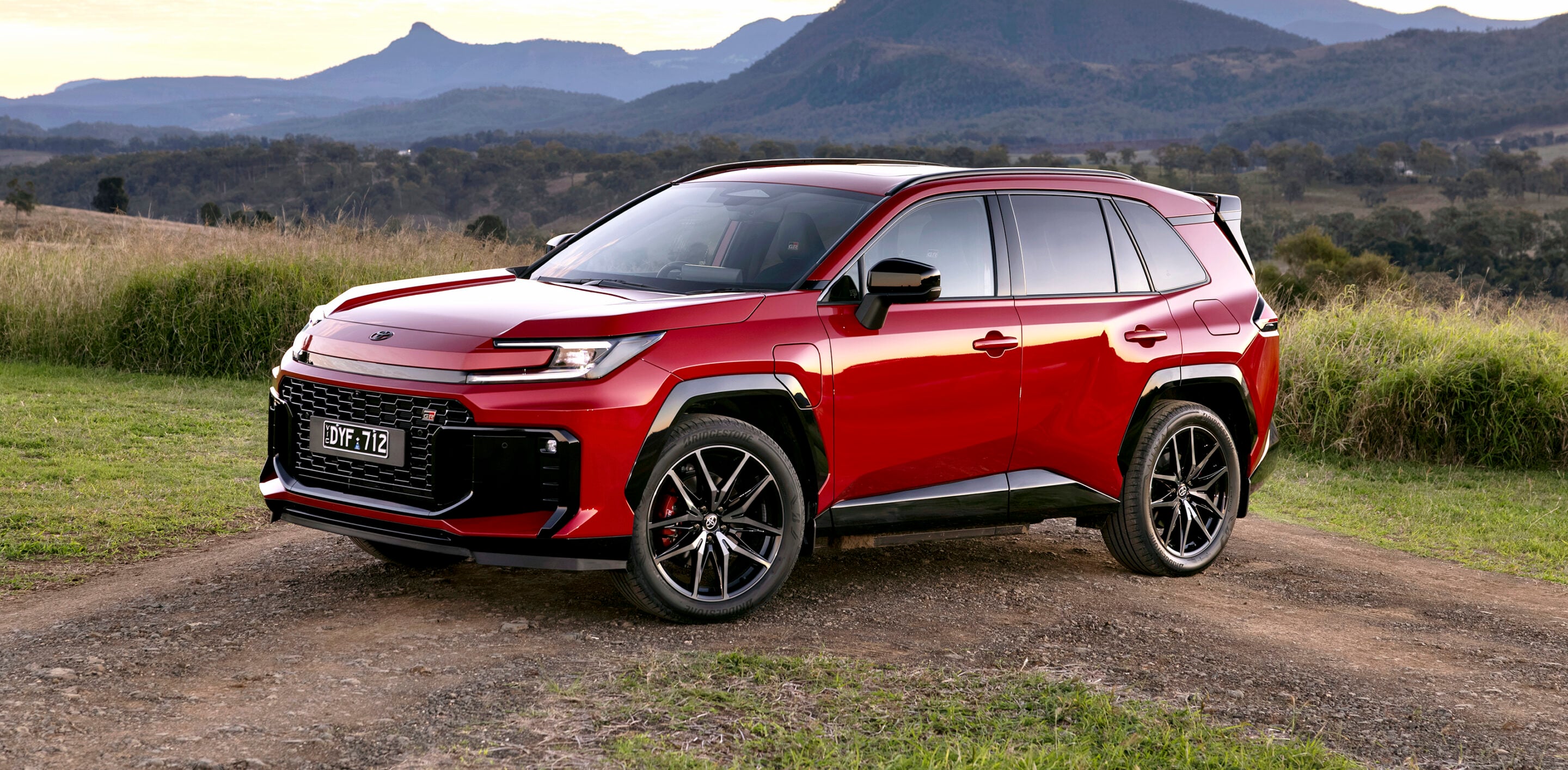
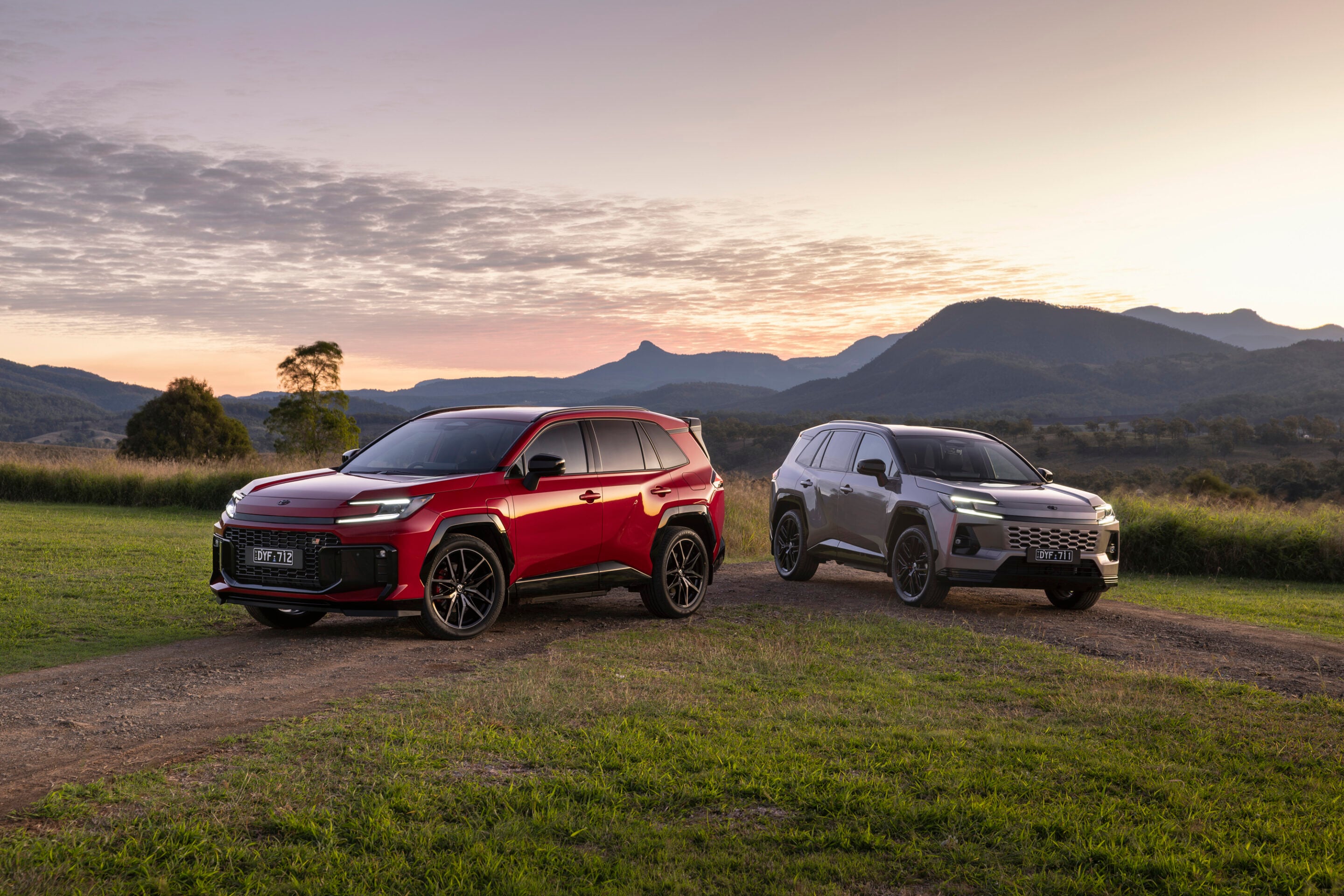
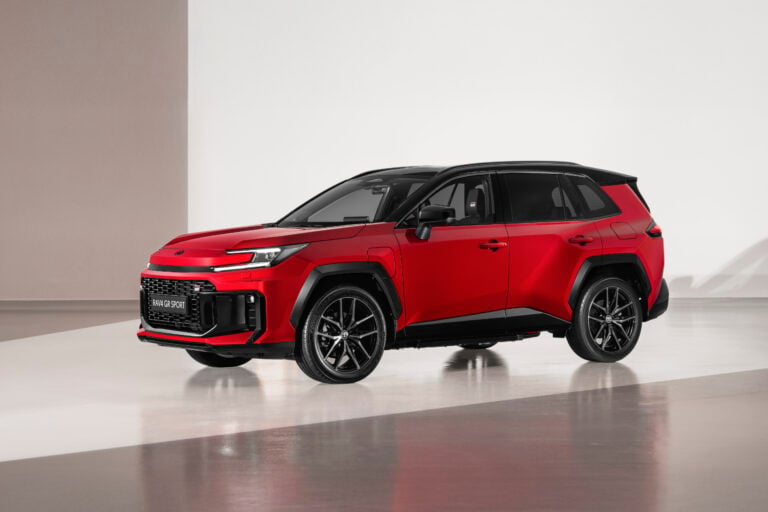
Apart from the RAV4 badge, and a solid story of success, the company’s first PHEV in Australia lands with a starting price of $58,840 and a choice of front- or all-wheel drive. There is even a sporty-ish GR Sport model, a first in RAV land, with all-paw grip and 227kW for $66,340. That makes it the most powerful model in RAV4 history.
1
To set the scene for the upgrade, the price of a regular RAV4 hybrid starts at $45,990 and the Cruiser flagship is $60,340. Toyota Australia is confident it will eventually be delivering one-third of its RAVs with the new hybrid system.
The headline number for anyone considering the PHEV newbie is 154 – the car’s best claimed full EV range – in a class where 100 kilometres is now the plug-in benchmark. But Toyota admits its 154 and 144 kilometre numbers – for the 2WD and AWD version – were recorded during testing to the easier NEDC standard and they fall to 121 and 113 on the stricter WLTP test which set the numbers in Europe. Either way, it’s a decent outcome and more than good enough for a daily electric commute in any Australian capital city.
The arrival of the RAV4 PHEV comes as Toyota mounts a giant push to regain the ground lost in showrooms through the first half of 2026. Despite continuing its stranglehold on top spot on the charts, sales fell by more than 25,000 cars, and four percentage points of market share, to the end of June.
Australian management has pressured headquarters in Japan into supplying an extra 30,000 cars for the second-half stoush and is also mounting a new showroom offensive – under the umbrella of its ‘multi-pathway strategy’.
2
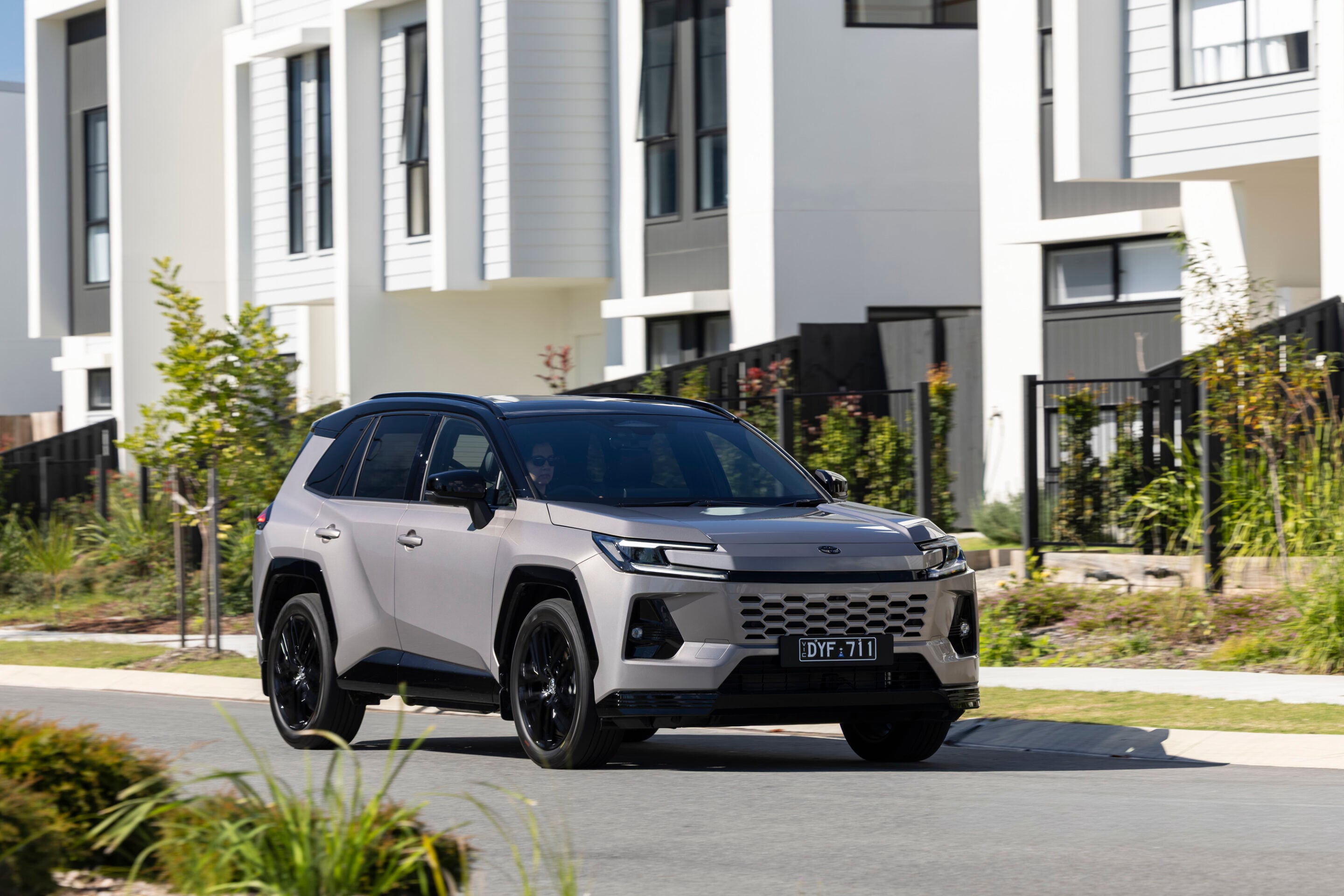
While again highlighting that it is not committed to any single energy system, it’s using the RAV4 PHEV, battery-electric HiLux, LandCruiser V6 ‘Performance Hybrid’ and new bZ4X Touring SUV to re-energise its showrooms. And, although no-one is admitting anything, it’s also part of a blocking action against the rampaging Chinese brands that are winning buyers with ‘all the bells and whistles’.
“People think Toyota is losing. We’re not,” Toyota’s vice-president of sales, marketing and franchise operations, John Pappas, told Wheels at the ‘multi-pathway’ event for media in early July. We’re catching up. We’re catching up on demand. We’ve been able to get the stock.
“We anticipate supply improving across our key models, average wait times reducing and we see customer demand remaining extremely strong.”
The RAV4 PHEV is one of the key players, as a growing number of mid-sized SUV buyers look for greener alternatives and defence against fuel-price rises triggered by turmoil in the Middle East. It’s no coincidence that publicising fuel choices and drivelines comes at a time when EV sales have jumped to a new high in Australia. But Pappas denies any panic at Team T, despite the brand only having the bZ4X as a pure electric model.
2
Right now, the RAV4 sales target is approximately 40,000 cars by December 31, still down considerably from the 51,947 total in 2025 and 58,718 in 2024.
However, the arrival of the sixth-generation RAV4 in April has sparked renewed demand – and long waiting lists – and Toyota believes it can grow its overall sales through the PHEV without cannibalising too much of existing demand for the regular – all hybrid – RAVs.
What is the range of the Toyota RAV4 plug-in hybrid?
The new plug-in Toyota takes the number of powertrain choices at the brand to seven – from commonplace diesel to unlikely hydrogen – with the RAV4 running a 2.5-litre petrol combustion engine combined with the battery-electric hybrid package.
The 105kW combustion engine gets twin electric motors on all-wheel drive models, one at either end, and a 22.7kWh lithium-ion battery pack. The total system output is 227kW. The two-wheel drive has a single electric motor on the front axle for 151.4kW with a 40.7kW motor at the back.
1
Toyota said the battery – water cooled with 104 individual cells – is stored under the floor in the rear of the cabin, to prevent any loss of interior space.
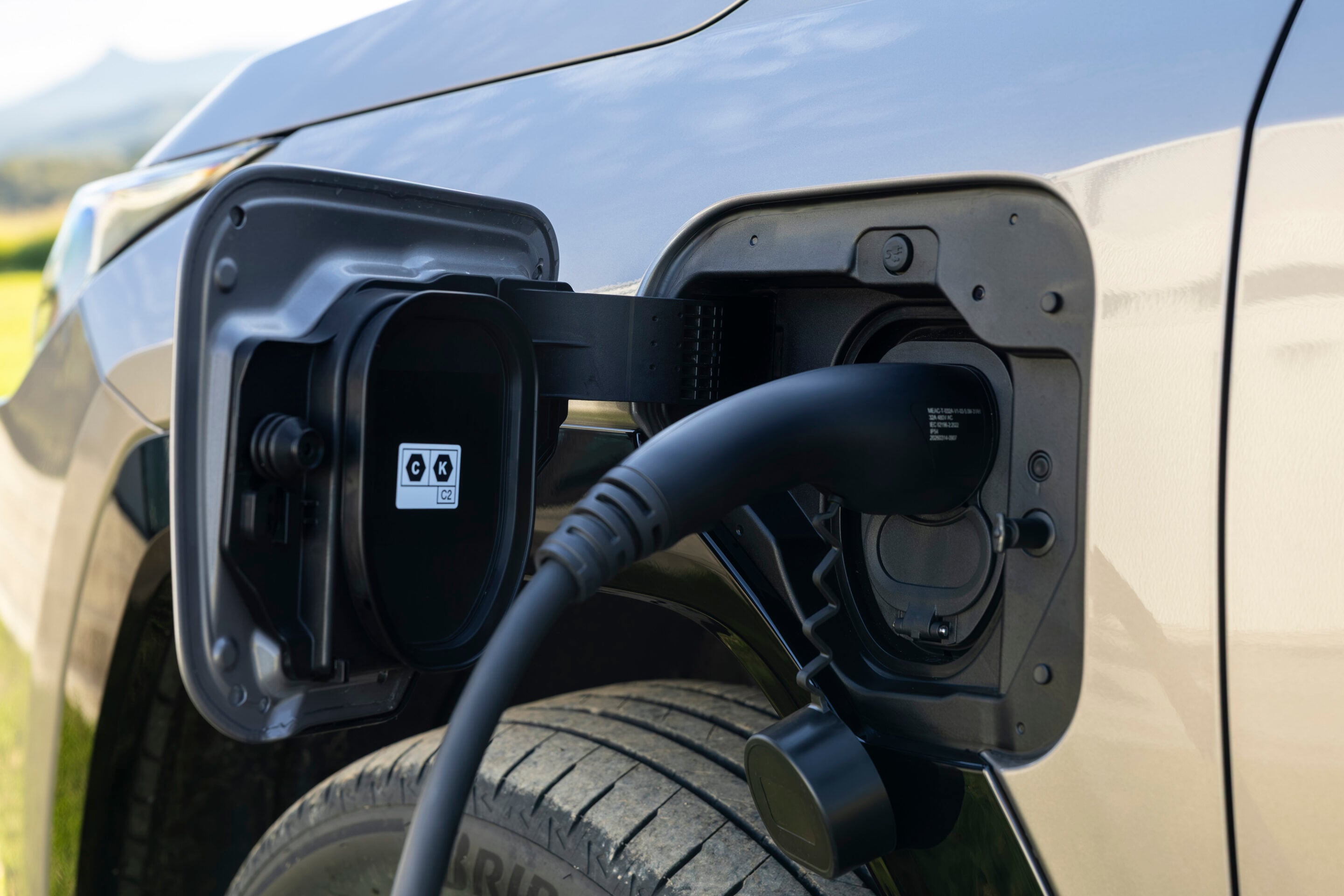
The battery pack supports 50kW DC charging and 11kW three-phase AC charging. Using AC, the time for a full top-up is around 2.5 hours and a DC fast charger can take the battery to 80 per cent in approximately 28 minutes.
The new PHEVs share the five-year/unlimited-kilometre of the other RAV4 models, with 12-month/15,000 kilometre services capped at $325 for five years. There is also eight years and 160,000 kilometres of coverage if the battery’s energy storage drops below 70 per cent.
What’s the Toyota RAV4 plug-in hybrid like on the inside?
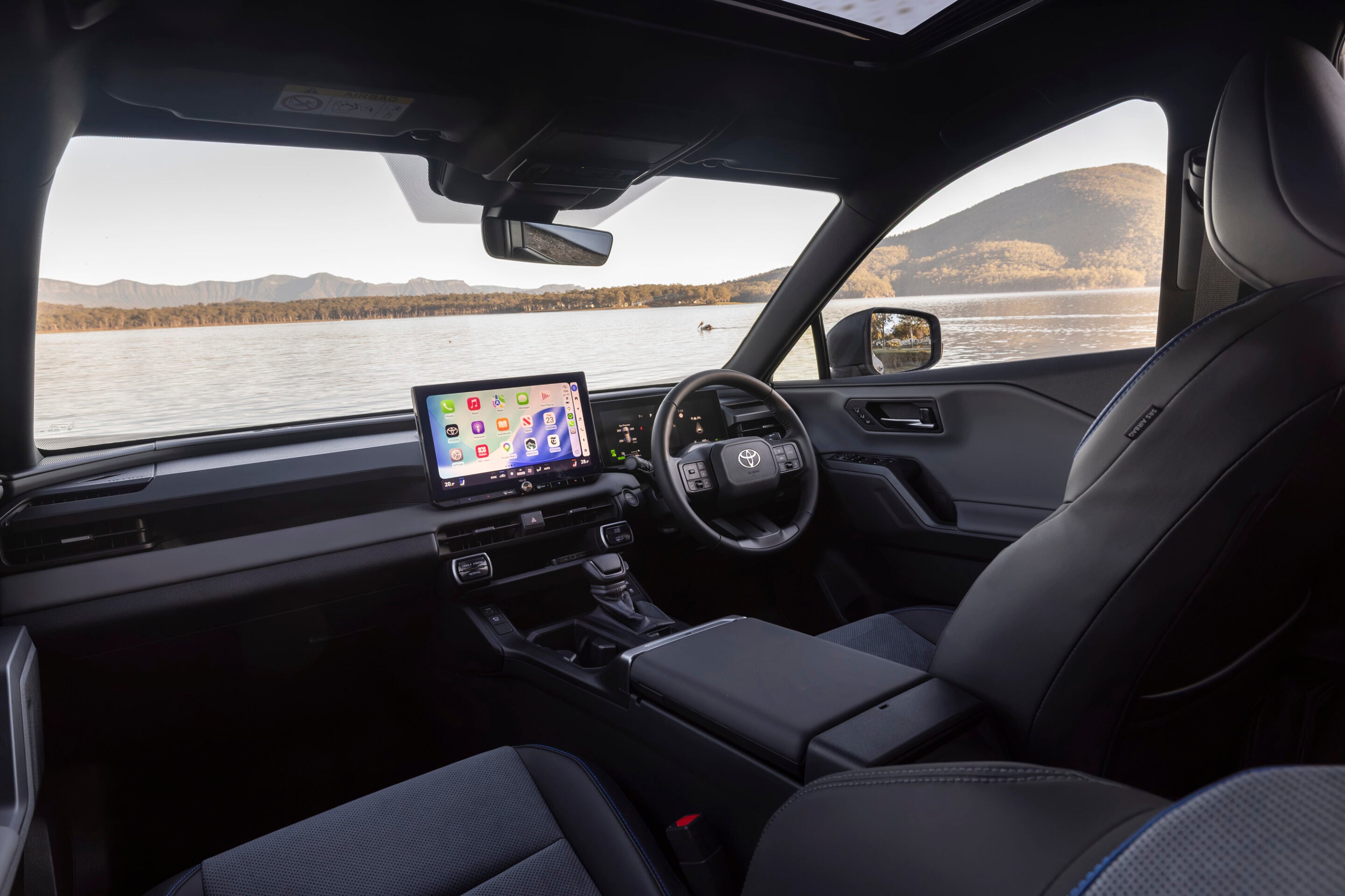
Sliding into the plug-in RAV4 was like coming home to an old friend. The sharper new look and upgraded interior from the sixth-generation car includes lovely buttons and not just a touchscreen, and the quality that’s still a benchmark for all affordable brands. Even so, the side-by-side pair of inductive charger panels look like a couple of burial plots at the local cemetery and things are a little busy in the overall layout.
2
One surprising thing is how much the RAV has grown. You notice it when parking, and also sitting in the back seat, as it feels more like a Prado from a couple of generations ago than the original compact RAV from the early days of family SUVs. It proves ‘bracket creep’ is real.
On the mechanical side, Toyota has brought bigger disc brakes – up from 305 to 328 millimetres – to cope with the extra weight of the bigger battery and the car’s additional performance.
In good news for families, the XSE models have a three-pin AC power plug suitable for small appliances – coffee anyone, or perhaps a warm bottle of milk? – thanks to a 1500-watt inverter.
Driving the XSE is relaxed and easy. It has a touch more punch than the regular RAV4 hybrid, but the two-wheel drive model is calm and measured.
There are three driving modes in the PHEV system, running from straight-out EV to auto – which keeps power at optimum – and hybrid EV for maximum driving range. There are also three driving modes: Normal, Sport and Eco.
The hybrid workings are as unobtrusive as you expect from a Toyota, with smooth throttle response in all modes. The car would be better with driver-adjustable regenerative braking, something that works through the ‘shift’ paddles on cars from Kia and Hyundai.
3
Quality is good, there is plenty of length and width in the back seat, and there is enough space in the tail for family travel. But there is only a space-saver spare.
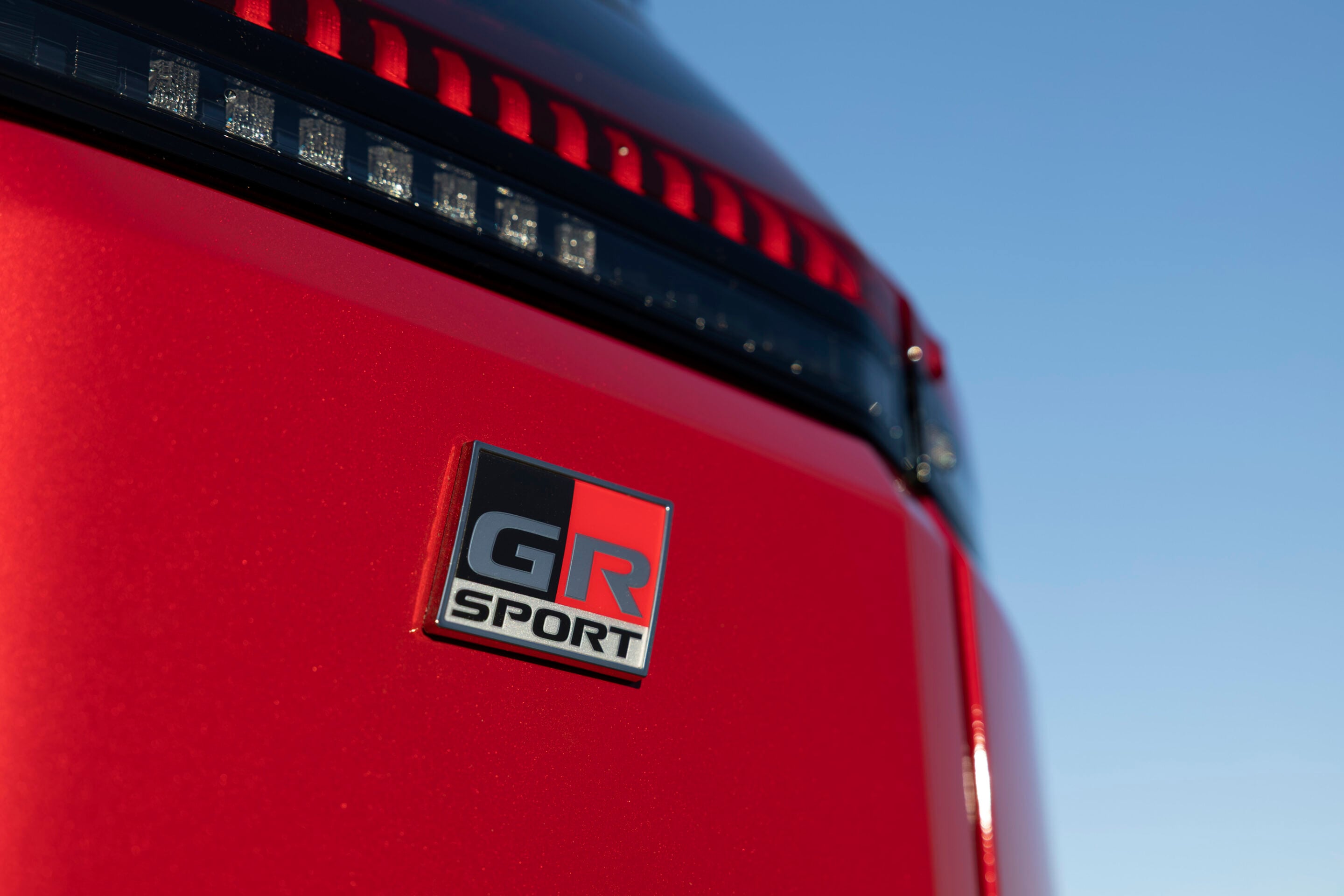
Things change in lots of ways as I jump up to the GR Sport model. It’s not just the wider track from wheels pushed out by 20 millimetres at each corner or the GR badges.
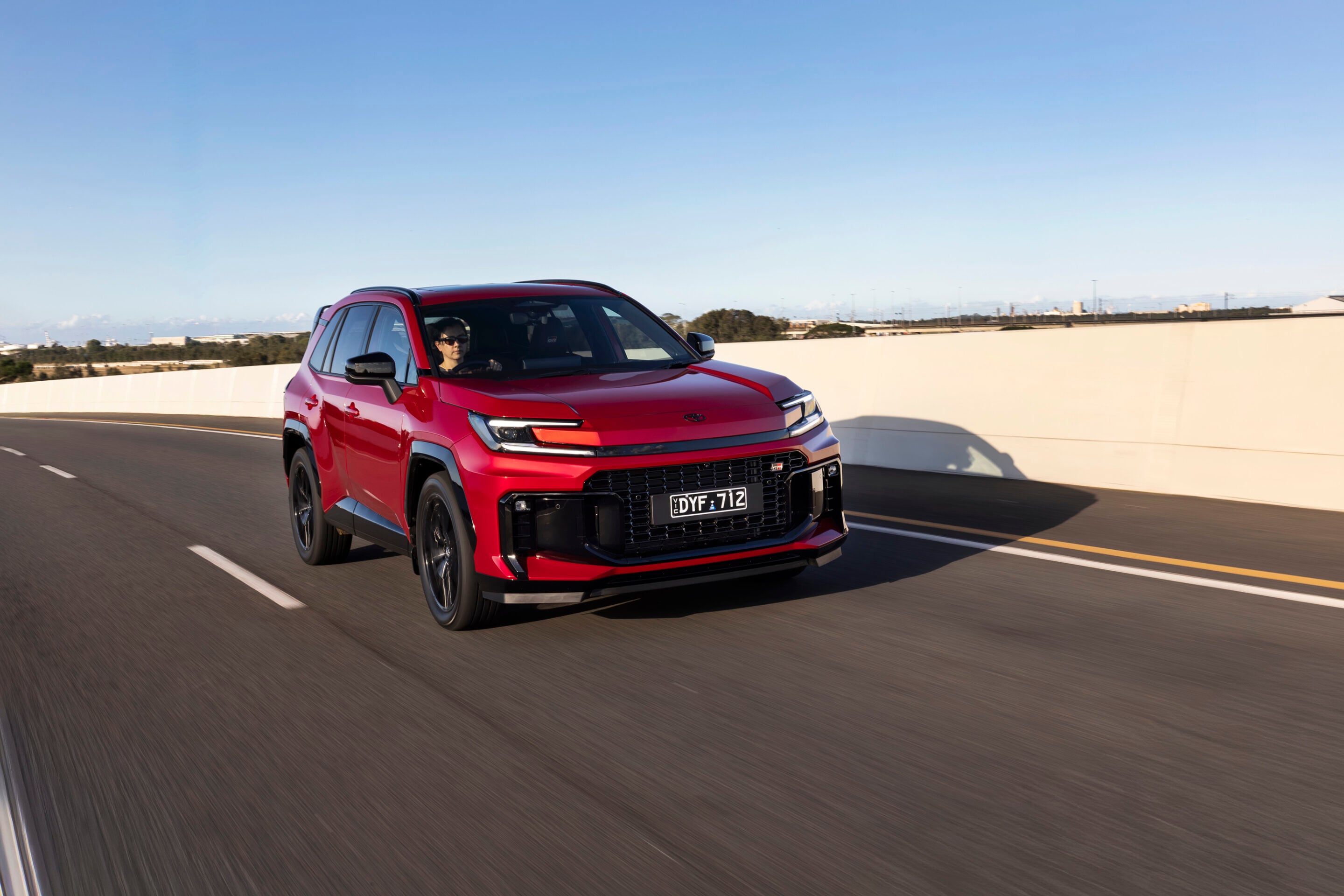
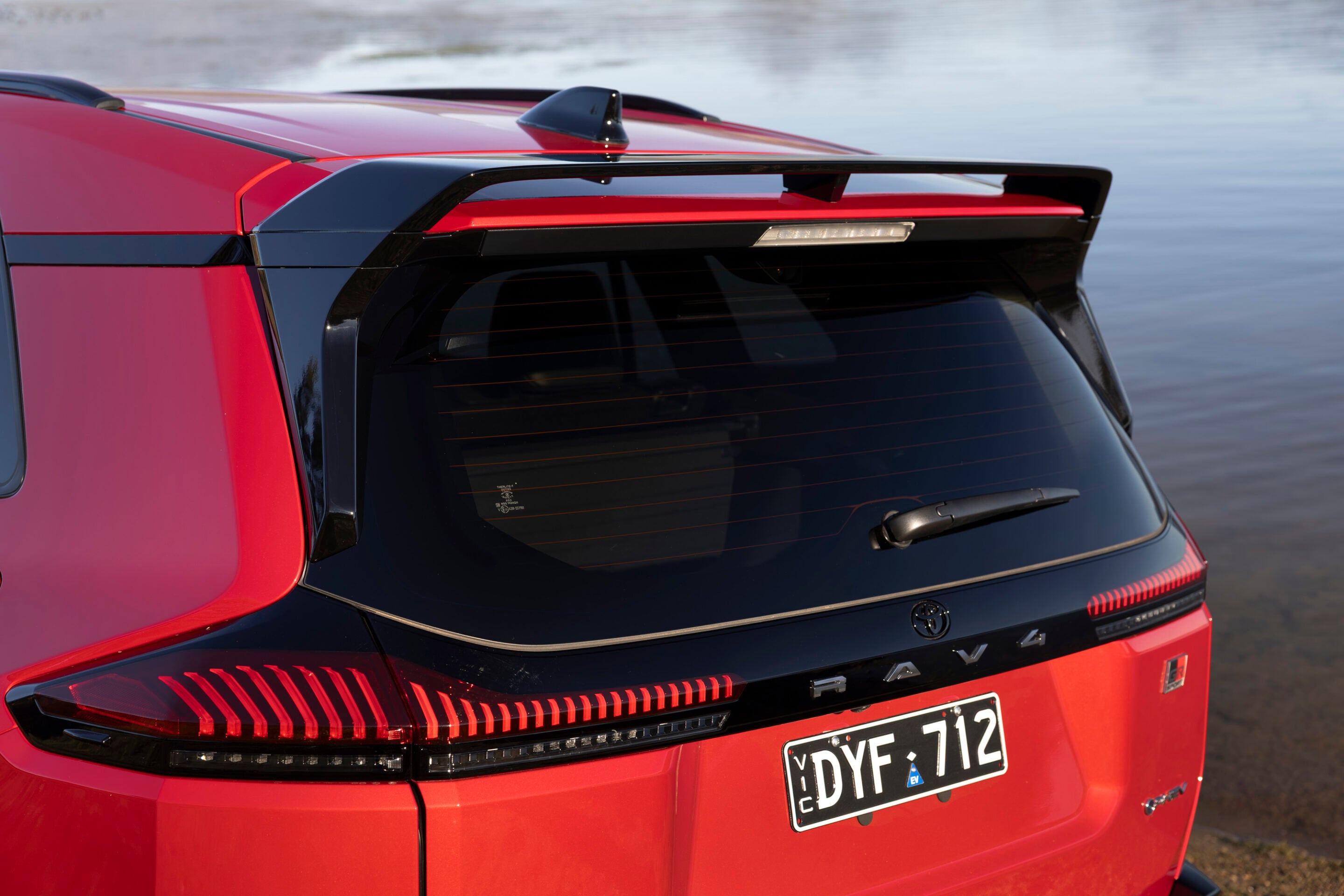
There are visual changes on the outside, with predictable black-coloured flares on the guards to cover the 20-inch wheels, extra air intakes in the nose, and a pair of spoilers set top-and-bottom on the tail. The glossy black alloys are wrapped by 235×50 tyres and – no surprise – sit over red-painted brake callipers.
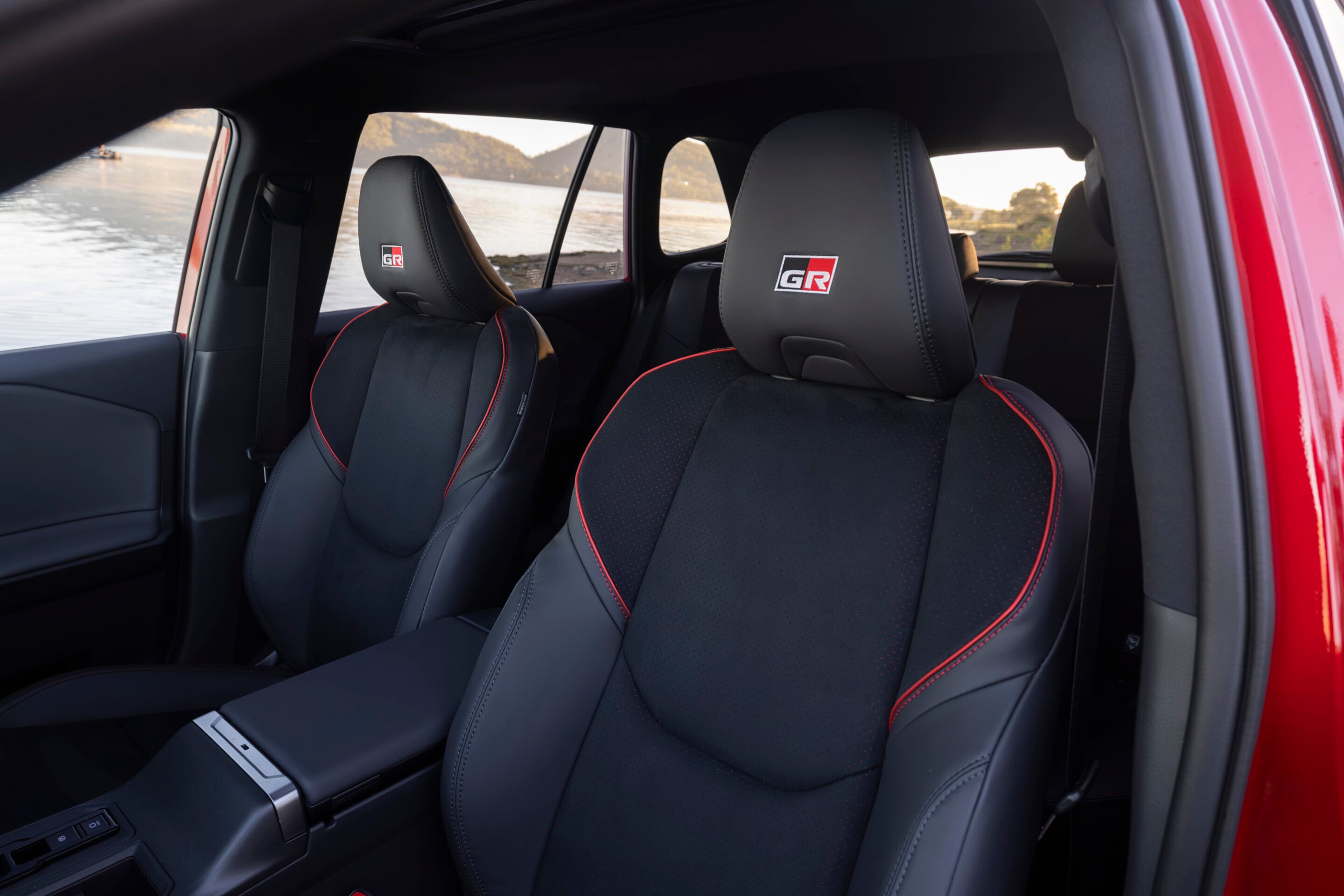
Inside, proving the GR Sport is for drivers, there are heavily-bolstered front seats, a leather-wrapped steering wheel with heating and suede kneepads for cornering support.
What’s the Toyota RAV4 plug-in hybrid like to drive?
The GR Sport should have been the highlight of the preview drive and the chance for some fun over the excellent twisting hills in the Gold Coast hinterland – except for one thing. Most of the early driving was in the countryside outside Brisbane and earlier enthusiastic drivers had depleted the battery.
So there was no chance for a genuine light-footed run in EV mode. The GR was not prepared to switch into EV mode, staying relentlessly hybrid. Maybe another day.
3
Still, GR Sport owners are likely to be keen drivers and the rest of the time with the GR was fun. It turns aggressively into corners, responds well to the throttle, and stops well. It only has a single-speed CVT transmission, but Toyota has managed to tune the latest so it’s not laggardly or unresponsive.
Unleashing full power gives more than enough punch for overtaking and twisty roads. It’s not as sharp as an N-badge SUV from Hyundai, but still far more enjoyable in the hills and valleys than a Nissan X-Trail.
Toyota has tuned the electric power steering for improved feedback in Sports mode and you can feel it, thankfully without any kicking or jerking over uneven surfaces. The sports seats give good support and the leather wheel feels great, although the suede pads alongside my shins were too firm for my liking.
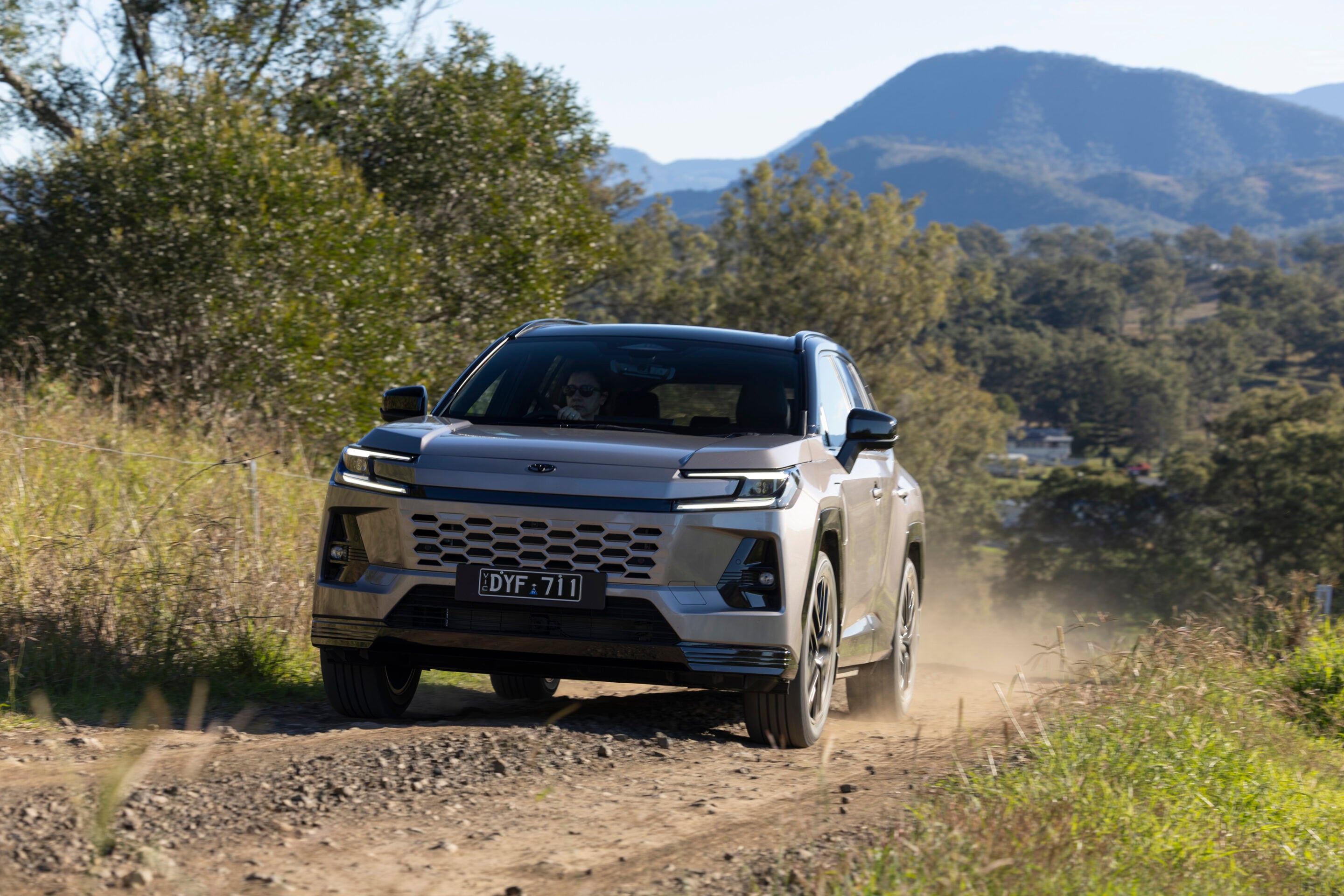
The ride quality on the 50-series tyres was pretty ordinary on some of the bumpy Queensland roads, with too much impact harshness. It’s not that the car was under-damped, just that potholes and broken surfaces were passed straight through to the cabin.
1
On the driver-assistance front, the RAV4 was nicely controlled. There were no false alarms and even when a narrow road triggered the lane-keeping system it was done without overly jerking the wheel.
Interestingly, the all-wheel drive models have a 1.5-tonne towing capacity, up from 800 kilos in the two-wheel drive version.
The verdict on the Toyota RAV4 plug-in hybrid
So the bottom line is simple.
1
The RAV4 PHEV does what it should as a family SUV and is certain to be a showroom winner with its new plug-in credentials. It is a solid 7.5/10 performer and that score could easily increase with genuine EV time close to home.
7.5
/10
Score
Score breakdown
7.0
Safety, value and features
7.5
Comfort and space
8.0
Engine and gearbox
7.5
Ride and handling
7.5
Technology
Things we like
- Sharp performance
- Physical switchgear a winner
- Affordable servicing
Not so much
- Lumpy ride over patchy surfaces
- Regen braking not configurable
- Overall cabin design a touch busy
Follow WhichCar/Wheels on Google
Click the button below to make WhichCar by Wheels a preferred source for your news.

We recommend
-
 Reviews
2026 Toyota RAV4 review: Early international verdict finds it sharper, smarter and sportier – but still playing it safe
In a new first drive our friends at Auto Express find the all new 2026 Toyota RAV4 (GR Sport variant) sharper and more refined – but too cautious to truly shake up the mid-size SUV class.
-
 News
NewsToyota boss predicts plug-in hybrid will account for a third of new RAV4 sales
Toyota Australia expects plug-in hybrid versions of its best-selling SUV to account for around a third of total RAV4 sales.
-
 News
NewsNew Toyota RAV4 goes on sale without ANCAP safety rating
Launch delays have resulted in the new Toyota RAV4 needing safety updates in order to achieve a 2026 ANCAP five-star rating.