Reviews

Gallery 1
7.9
/10
Score
Score breakdown
7.0
Safety, value and features
9.0
Comfort and space
8.0
Engine and gearbox
7.5
Ride and handling
8.0
Technology
Things we like
- Still an excellent all-rounder, just with added luxury
- Very well equipped in Lounge spec, including awesome second row seats
- High quality materials used throughout
Not so much
- Big price gap between Lounge and regular Staria models
- No child seat anchors in the third row seat
- Hybrid drivetrain unavailable in lesser Staria models and it can't tow
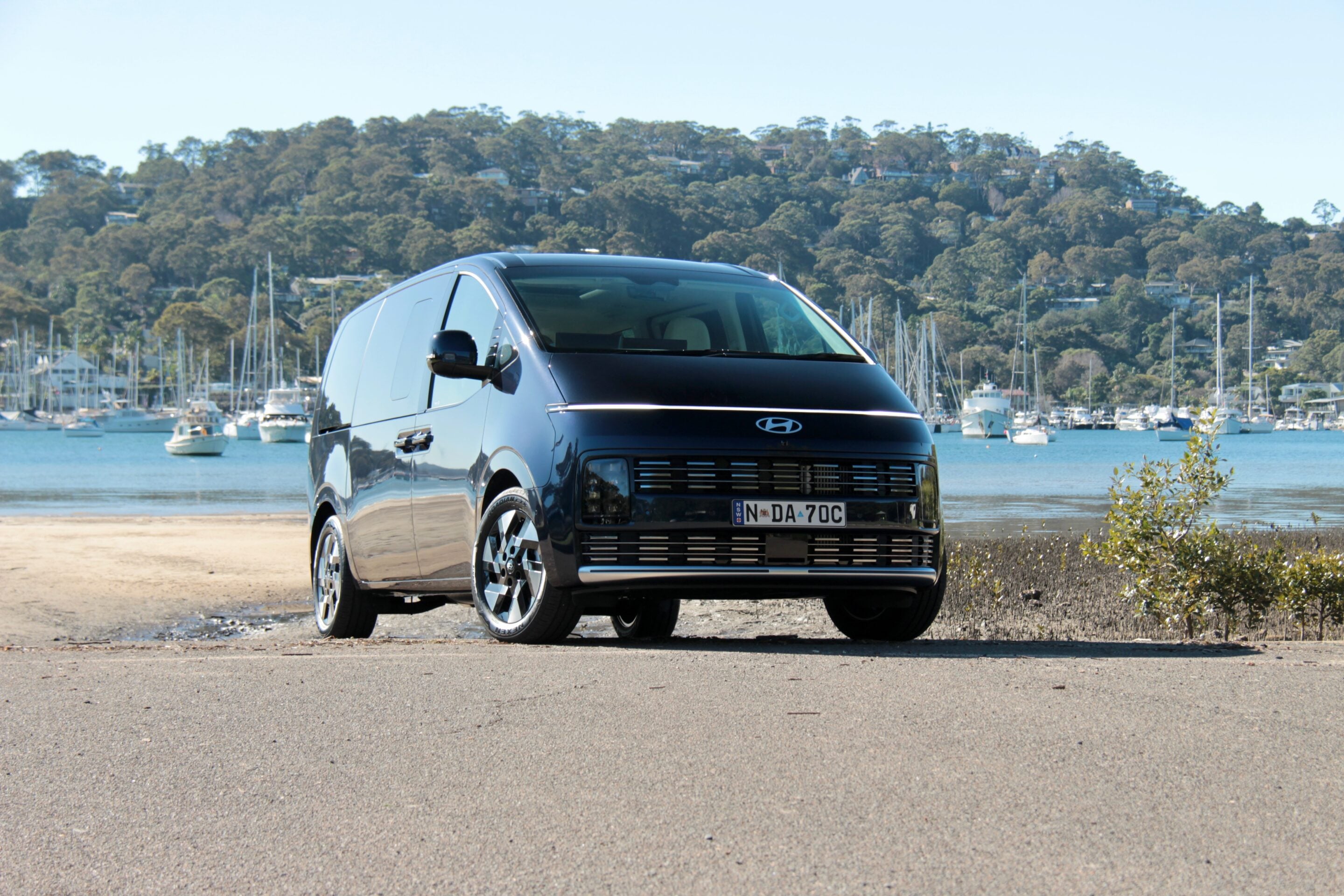
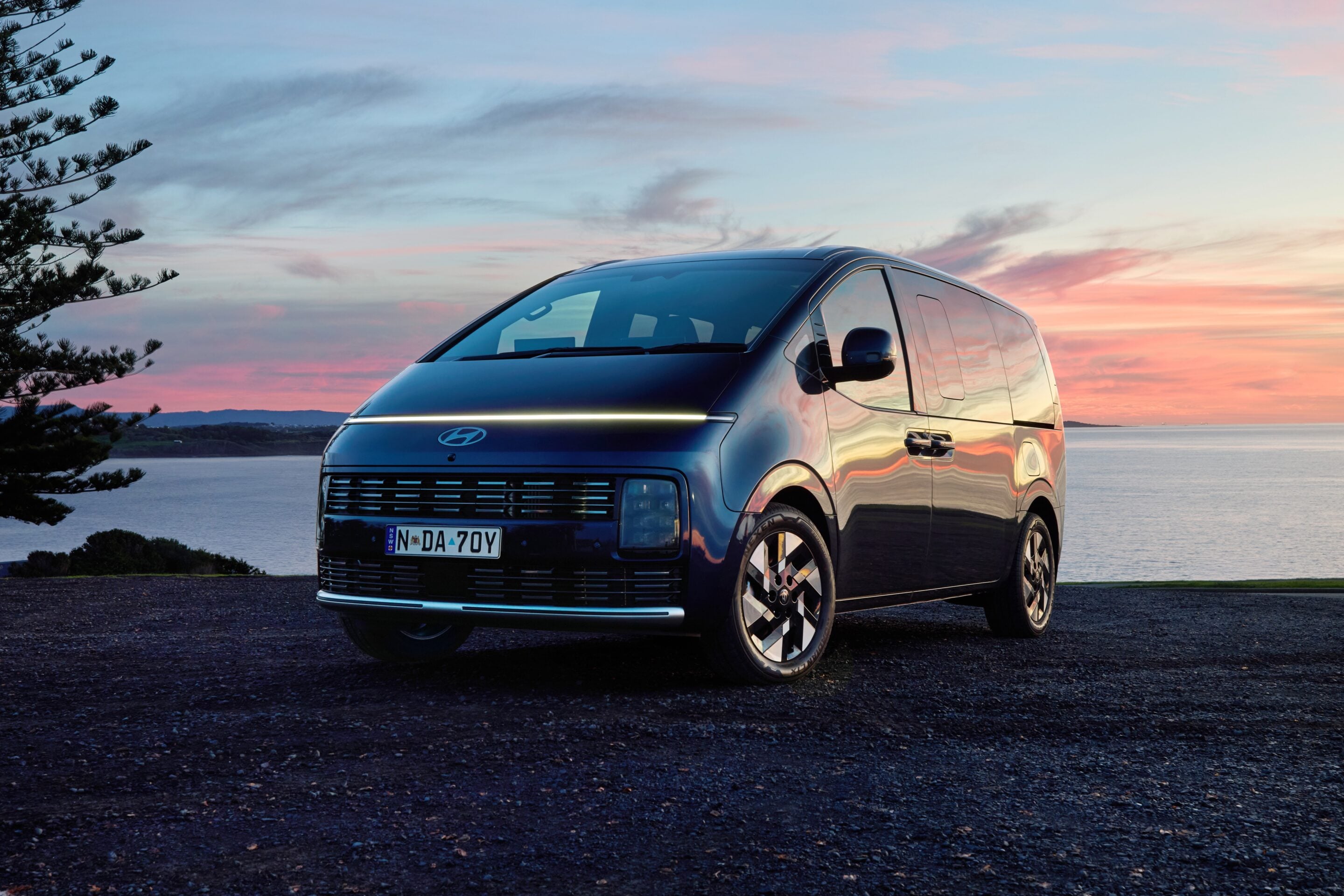
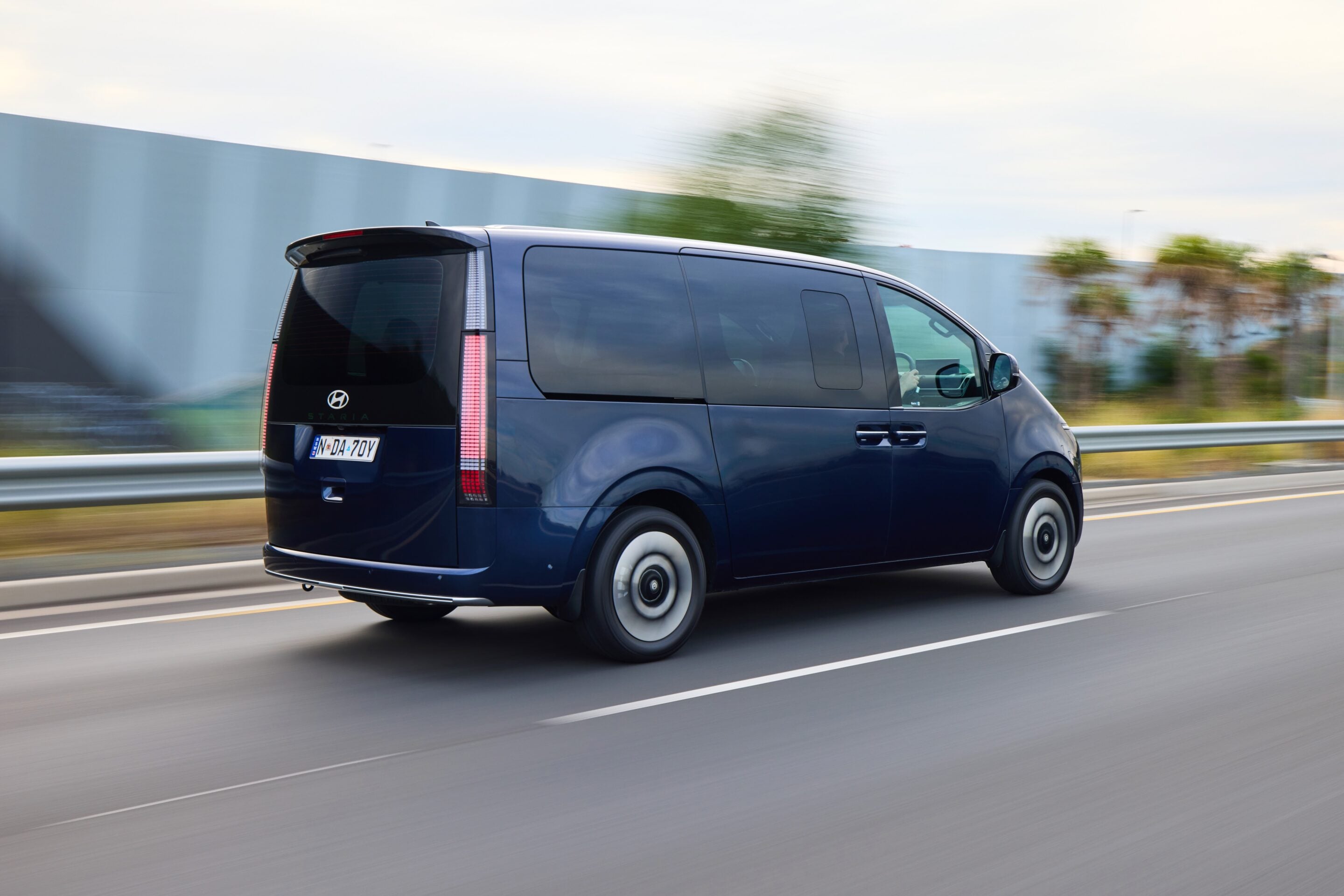
Thanks to their insane practicality, people movers have long been the smartest choice for large families, and while it’s not as popular as its Kia Carnival cousin, few do the job better than the Hyundai Staria. Already one of the segment’s standout offerings thanks to its cavernous cabin and cool futuristic styling, the facelifted model has introduced a luxurious new Lounge flagship.
It’s also the only Staria available with Hyundai’s 180kW 1.6-litre turbo-petrol hybrid powertrain, pairing greater efficiency with a more refined driving experience. But is this premium people mover the luxury family hauler to beat, or are buyers better served elsewhere?
How much does the Staria Lounge cost to buy?
The updated Staria range starts at $54,300 plus on-road costs for the entry-level model called just ‘Staria’, and that’s for either the 3.5-litre petrol V6 or 2.2-litre four-cylinder turbo-diesel. Above that sits the $73,740 +ORC Lounge, which is solely available in new hybrid form, and is the only hybrid model available.
4
Those familiar with the pre-updated Staria range will note that the previous mid-spec Elite is no longer available, while the previous top-spec Highlander is also gone with the new Lounge a step up on that. As a result, there’s a massive almost-$20,000 price gap between models, and an equally massive gap in standard equipment as well.
Compared to the base model, the Lounge adds a whole host of features, including dual sunroofs, Nappa leather upholstery, electric front seats, captain’s chairs in the second row with electric adjustment and heating and ventilation, cameras for the blind-spot monitoring and a 360-degree camera. Plus, the aforementioned hybrid drivetrain.
Staria Lounge standard features:
- 18-inch alloy wheels
- Dusk-sensing automatic LED exterior lighting
- Rain-sensing automatic wipers
- Keyless entry with push button start
- Dual sunroofs
- Heated/auto-folding mirrors
- Electric tailgate
- Dual electric sliding doors
- Rear privacy glass
- Dual-zone automatic climate control (one zone for the front and one for the rear)
- Heated leather steering wheel
- Nappa leather upholstery
- Heated front seats with 12-way driver/eight-way front passenger electric adjustment
- Heated and cooled second row captain’s chairs with eight-way electric adjustment
- Heated and cooled third row seats
- 12.3-inch digital driver’s display
- 12.3-inch touchscreen with over-the-air updates
- Wireless and wired Apple CarPlay and Android Auto
- Satellite navigation
- AM/FM/DAB+ digital radio
- Bluetooth calling and audio streaming
- 14-speaker Bose sound system
- Wireless smartphone charger
- 6x USB-C charging ports
- Ambient lighting
- 7x airbags
- Autonomous emergency braking
- Adaptive cruise control
- Lane keeping assistance with adaptive lane guidance
- Blind-spot monitoring with rear cross-traffic alert (with braking)
- Safe exit assist
- Driver attention monitoring
- Traffic sign recognition
- Auto high beam
- 360-degree camera
- Blind-spot camera
- Front, side and rear parking sensors
- Tyre pressure monitoring
- Anti-theft alarm
Competition to the Staria Lounge is not plentiful in Australia, with only the related Kia Carnival ($56,310 +ORC for the base model, but $76,840 +ORC in equivalent GT-Line spec) or the much more expensive Lexus LM ($163,520 +ORC) offering a hybrid drivetrain. If you’re willing to expand your drivetrain hunt to a plug-in hybrid, there’s the GAC M8 ($76,590 +ORC), while the electric Zeekr 009 ($115,900 +ORC) and electric or turbo-diesel Mercedes-Benz V-Class (from $120,000 +ORC) are also available.
As a luxury MPV, the Staria presents good value for money. For example, it’s better equipped and larger than the [eight-seat] Carnival GT-Line, but it’s also $3100 less expensive. Then compared to something like the V-Class or LM, it’s at least $45,000 less expensive, but more spacious inside. We think the price gap between the base model and Lounge is still too much — or there should be at least one model in the middle — but as before, the Staria still presents good value for money.
How fuel efficient is the Staria Lounge?
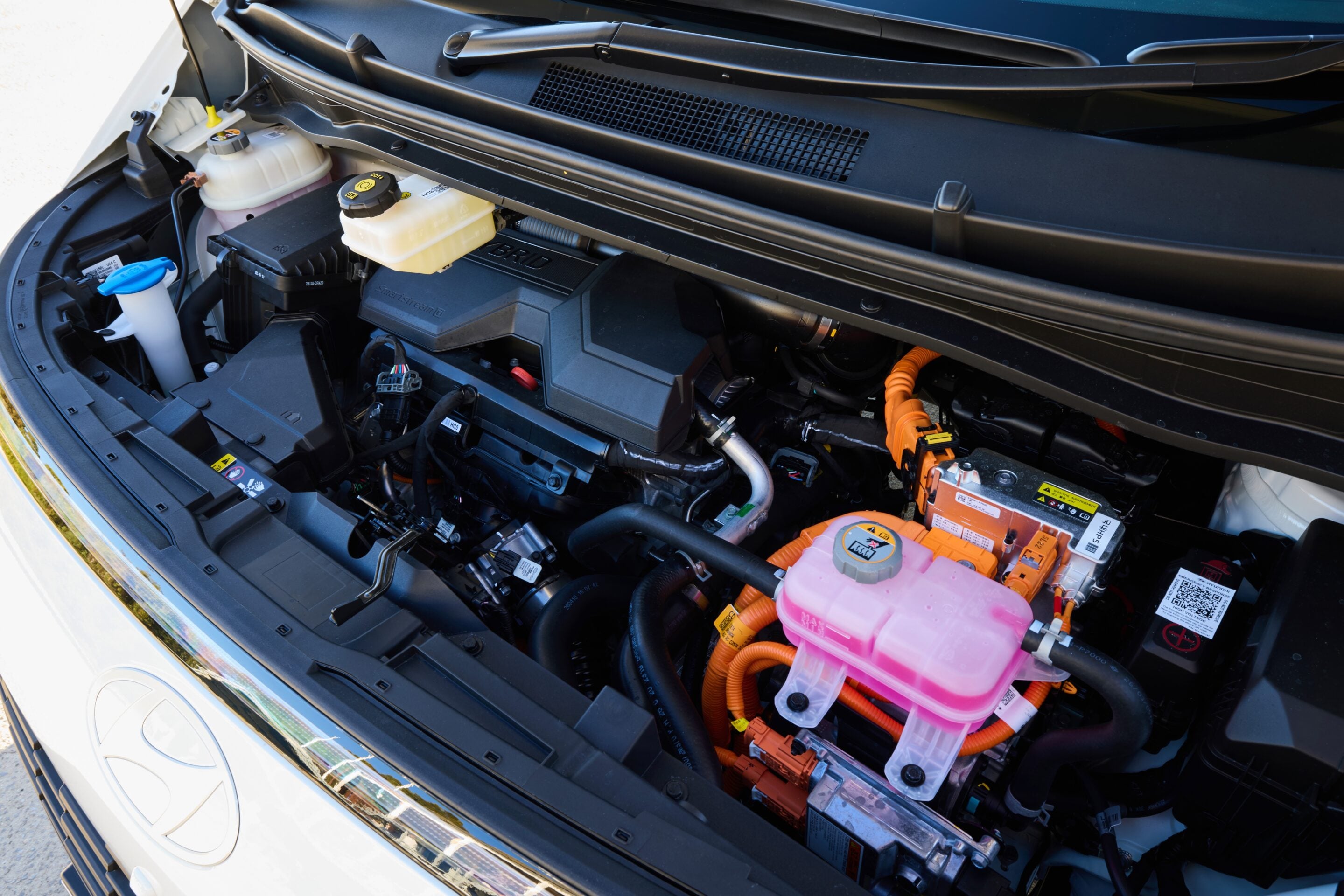
There are three drivetrains available in the Staria people mover range: the 200kW/331Nm 3.5-litre petrol V6 or 130kW/430Nm 2.2-litre turbo-diesel previously available, or a new 180kW/304Nm 1.6-litre turbo-petrol hybrid. Like the other drivetrains, the hybrid uses an automatic transmission (a six-speeder, like in the Santa Fe and Tucson) and is front-wheel drive.
The hybrid’s big advantage comes at the fuel pumps: while the petrol V6 is rated at 10.5L/100km on the combined cycle and the diesel 7.0L/100km, the hybrid improves fuel use to 6.5L/100km. In the real world, in a variety of driving on the launch program on Sydney’s Northern Beaches, we achieved 7.6L/100km. In a more run in car on flatter terrain, we’d likely get even better numbers.
4
The hybrid drivetrain is definitely the pick in the Staria range. People movers like the Carnival and the V-Class have traditionally used turbo-diesel engines, which provide ample performance and good fuel economy, but they’re hardly the most refined engines out there. The hybrid not only provides superior performance to the diesel — it makes 50kW more power, for example — but it’s also a lot more refined, with none of the turbo-diesel clatter we’ve become used to in people movers. If you’re looking to tow with your Staria, like the Staria Load van, the hybrid cannot tow, so V6 or diesel it is for you.
On the road, the Staria Lounge is impressively refined for road noise too and is quite serene, especially when running in electric mode, some of which is due to the enhanced noise insulation in the updated model. Part of the update also included retuned shock absorbers and we noticed that the front suspension is quite absorbent but the rear is a bit too stiff over even smaller bumps. It’ll likely soften with more aboard, and was still entirely comfortable, but just something to note.
How luxurious is the Staria Lounge?
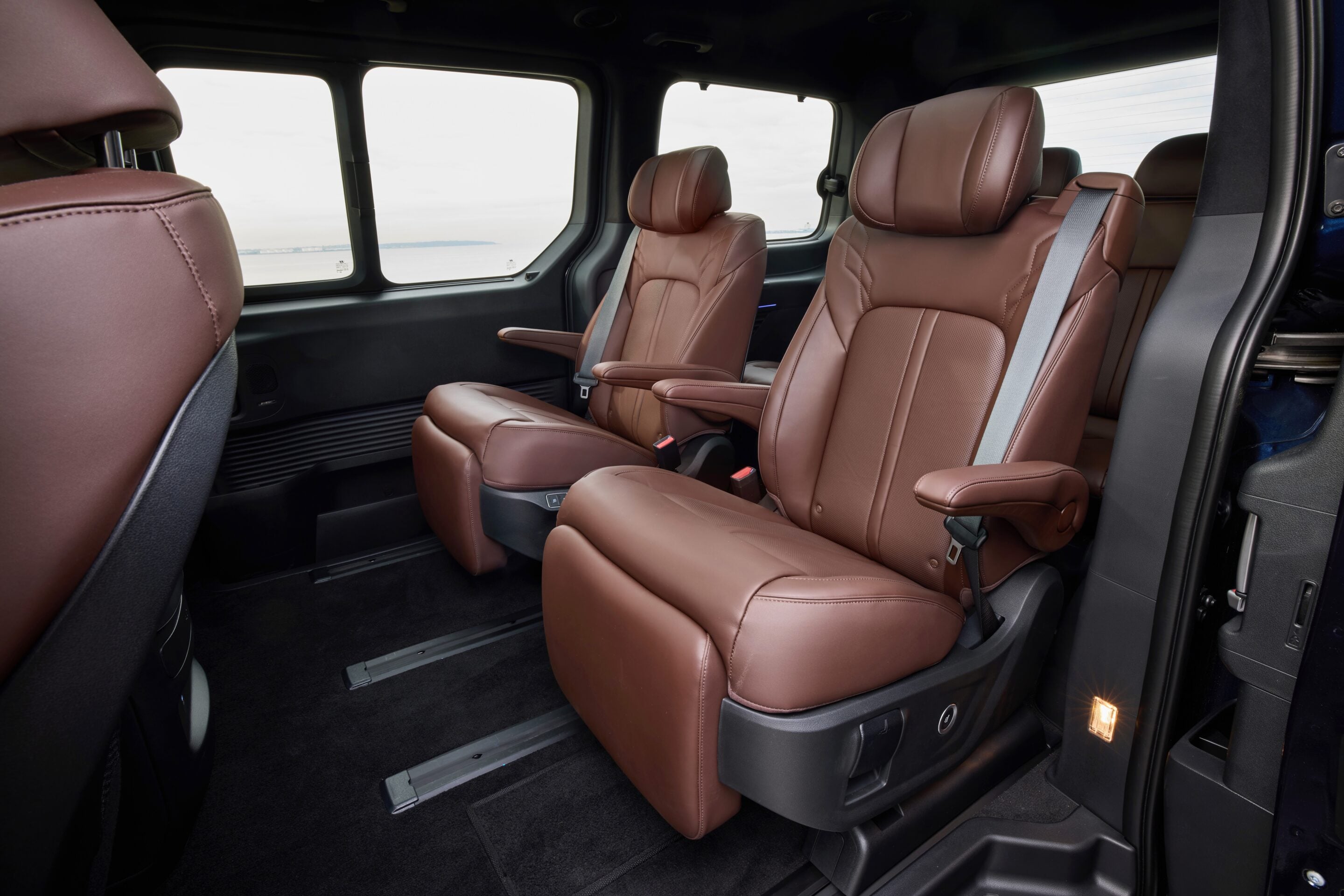
Firstly, let’s discuss the most obvious transformation point with the Lounge and that is the second row captain’s chairs. Called ‘relaxation seats’ by Hyundai, they’re very comfortable and highly electrically adjustable too. They also feature both heating and ventilation, and although there’s no rear-mounted display for business meetings, there is a huge panoramic glass roof to keep kids entertained.
4
If you’re a family and use child seats, those captain’s chairs will be used for child seat duty because — like the standard Staria models — there are no child seat points at all in the third row, which is disappointing. For reference, a Kia Carnival features child seat points in its third row, and it’s a missed opportunity for Hyundai to not do the same for the Staria.
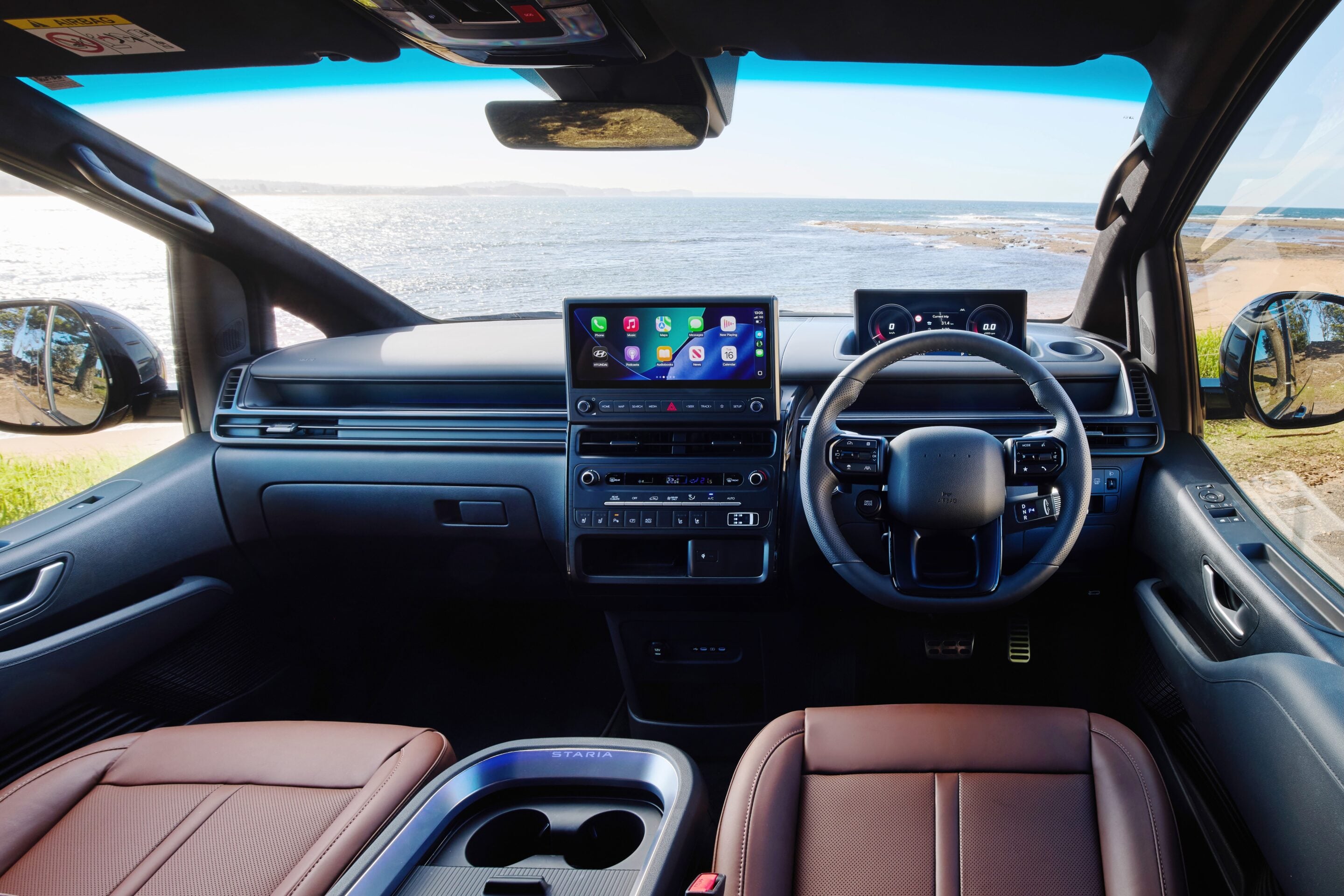
In the cabin front of the Staria Lounge is still such a spacious and practical space. There are plenty of storage spots around the cabin, including the massive centre bin and clever lower storage, like where the wireless phone charger is located, as well as the cool cup holder to the right of the driver’s display.
Thanks to 12 ways of electric adjustment, the driver’s seat comfort is excellent, and the high driving position is commanding. Visibility is good for a people mover, thanks to its large mirrors, big windows and — unfortunately only on the Lounge — very useful 360-degree and blind-spot cameras. The Lounge’s quality is also a nice step up compared to other Staria models thanks to the high quality Nappa leather trim, which is available in three colours, and even the suede pillar and roof lining. Lush!
7
Hyundai’s ‘ccNc’ infotainment software was another recent addition to the Staria range, and it’s really modernised the cabin nicely. Featuring on all models with kit like wireless Apple CarPlay and Android Auto, sat-nav, DAB+ digital radio and Bluetooth calling and audio streaming, it’s very simple to use. The 14-speaker Bose sound system is also punchy, and we appreciate features like the in-car camera so that parents can really see who hit who in the back.
How much does the Staria Lounge cost to service?
For private buyers, the Staria Lounge is covered by Hyundai’s five-year/unlimited km warranty, which can be extended to seven years in total if serviced through a Hyundai dealership. Having said that, if it’s used for commercial purposes, the mileage switches to 160,000km instead. Regardless of useage, the hybrid battery is covered for eight years or 160,000km.
Five years of servicing the Lounge costs $2439 ($488 per service on average), which is less expensive than the diesel but the diesel’s annual service intervals are 5000km longer at 15,000km.
Should I buy a Hyundai Staria Lounge?
It’s clear that Hyundai has tried to make the Staria as luxurious as something like a Palisade Calligraphy with the new Lounge model, and in some ways, it’s worked. The second row captain’s chairs are very comfortable and very adjustable and the Nappa leather used is high quality, making the Lounge certainly feel more special inside than a regular Staria, and indeed a Kia Carnival GT-Line.
4
The new hybrid powertrain also adds welcome refinement and impressive fuel efficiency to the overall package. Compared to rivals, the Staria Lounge is also good value for money as not only is it huge inside, but it’s very well equipped as well. Having said that, there is a huge gap in both price and equipment between regular Staria models and the Lounge, and the Lounge’s ride quality is a bit too firm. The Hyundai Staria is a great people mover, as it was before, but we’re now hoping to see the excellent hybrid drivetrain filter down to a lower-spec model in the range.
Staria Lounge specifications:
- Car: Hyundai Staria Lounge
- Price: $73,740 plus on-road costs
- Drivetrain: 1598cc turbocharged four-cylinder turbo-petrol hybrid
- Peak power: 180kW
- Peak torque: 304Nm
- Transmission: Six-speed automatic, front-wheel drive
- Claimed combined fuel consumption: 6.5L/100km
- Claimed combined CO2 emissions: 147g/km
- Fuel type/tank size: 91 RON regular unleaded, 65 litres
- Dimensions (L/W/H/WB): 5253/1997/1990/3273mm
- Boot capacity: 117 – 431 litres
- Kerb weight: 2378kg
- Warranty: Five-year/unlimited km or five-year/160,000km for commercial use (car), eight-year/160,000km (battery)
- Five-year service cost: $2439 (average of $488 per annum)
- On sale: Now
7.9
/10
Score
Score breakdown
7.0
Safety, value and features
9.0
Comfort and space
8.0
Engine and gearbox
7.5
Ride and handling
8.0
Technology
Things we like
- Still an excellent all-rounder, just with added luxury
- Very well equipped in Lounge spec, including awesome second row seats
- High quality materials used throughout
Not so much
- Big price gap between Lounge and regular Staria models
- No child seat anchors in the third row seat
- Hybrid drivetrain unavailable in lesser Staria models and it can't tow
Follow WhichCar/Wheels on Google
Click the button below to make WhichCar by Wheels a preferred source for your news.

We recommend
-
 News
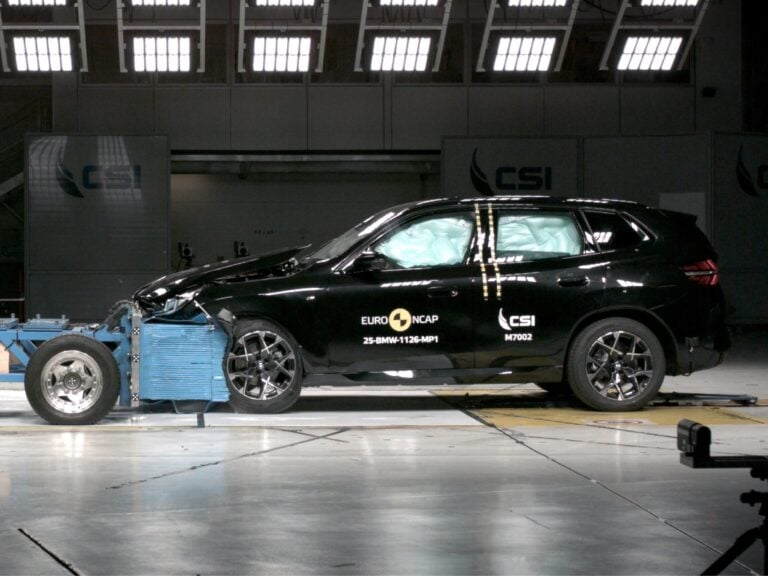
NewsNewest family SUVs from Mazda, MG, BMW and Cupra awarded five-star ANCAP ratings
Mazda and MG have scored five-star safety ratings from ANCAP for latest models, while BMW gets a backdated rating for models sold from 2024.
-
 News
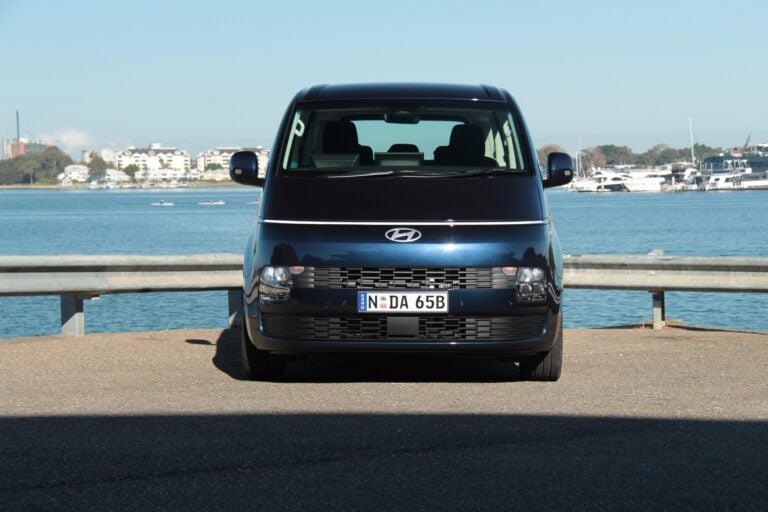
NewsHyundai committed to its last V6 in Australia despite emissions pressure
The last-remaining V6 in Hyundai's Australian lineup will remain on sale for the foreseeable future despite pressure from new emissions standards.
-
 Features
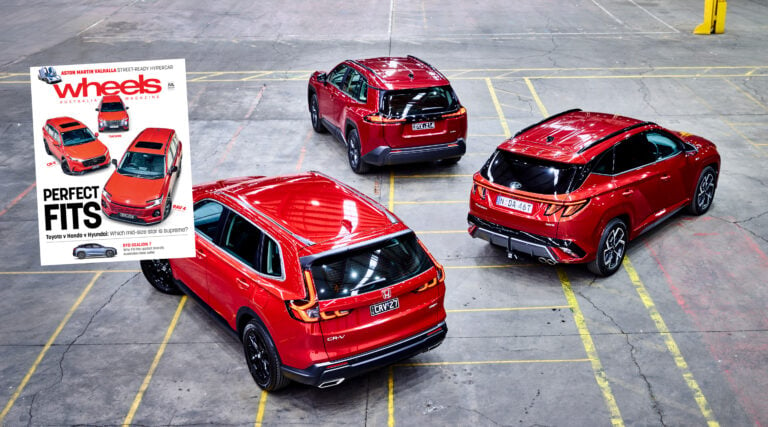
Wheels July 2026 issue now on sale!
Australia's favourite hybrid SUVs battle for supremacy, while we look at the new Aston Martin Valhalla and drive the new editions of the BYD Shark 6, Mazda CX-5, Lexus RZ, Ford Ranger, MGS6 and more.