Features


Gallery 1
The Toyota Celica in its mildest version was always a bit of a poseur’s car, a sporty-looking coupe that traded on style over some much-needed substance.
Launched in the dying days of 1970, the original Celica sat atop the humble Toyota Carina’s platform, the two models developed alongside each other.
More showpony than pony car, the Celica found a willing audience in those after a sporty-looking two-door with Toyota reliability and engineering underneath.
It wasn’t particularly fast, but it was comfortable and managed to turn heads thanks to its well-resolved design.
It wasn’t until the first front-wheel drive Celica hit the road in 1985 that Toyota’s erstwhile sports car really came of age, a proper driver’s car that, while not setting any land speed records, proved dynamically adept and engaging to drive.
1
But Toyota’s reputation for building solid, reliable but ultimately staid and conservative cars was never too far away. Something was needed to change the public’s perception. And that something came in 1986 with the release of the first Celica GT-Four, a homologated, turbocharged four-wheel drive that transformed the Celica into a genuine sports car and a World Rally Championship (WRC) contender.
Incidentally, although often annotated as Celica GT4, the correct nomenclature is GT-Four, the entire
ensemble an acronym of Grand Touring Fulltime On-road Uniquely Responsive. Only Toyota could get away with this word salad.
Making its WRC debut in 1988, it didn’t take long for Toyota’s newest rally weapon to hit its straps, with the great Finn, Juha Kankkunen, chalking up the Celica’s first win in Australia in 1989, to help the brand to second overall in the manufacturer’s championship.
By 1990, Toyota was on top of the world, with Carlos Sainz taking the WRC title while Toyota finished just behind Lancia in the race for the manufacturer’s crown. Suddenly, the Celica GT-Four was hot property, both in the dirt of the WRC and on the road.
The original ST165 Celica GT-Four was never officially sold in Australia. Instead, we had to wait for the launch of Toyota’s second-gen homologation special, the ST185, which landed in dealerships in March 1990. And we were smitten.
With a list price of $42,910 (incidentally, exactly on the luxury car tax threshold at the time), buyers were treated to a world-beating, rally-bred bundle of raucousness that demanded to be driven like Sainz at the Acropolis to extract maximum enjoyment.
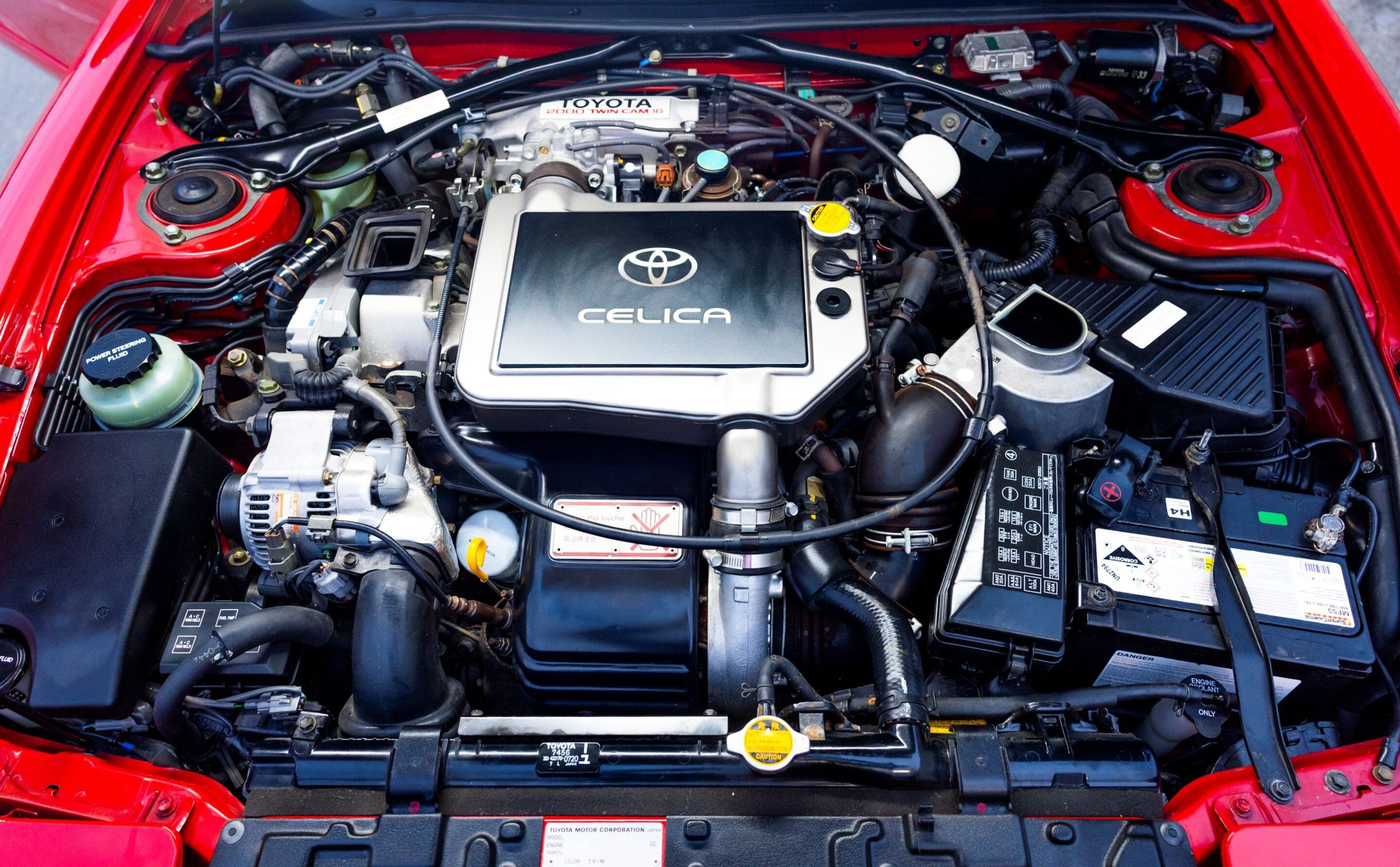
Power came via Toyota’s 3S-GTE 2.0-litre turbocharged-four, developed in conjunction with Yamaha. It made 153kW at 6000rpm and 281Nm, peaking at 3200rpm. At the time, it was the most powerful 2.0-litre engine ever sold in Australia.
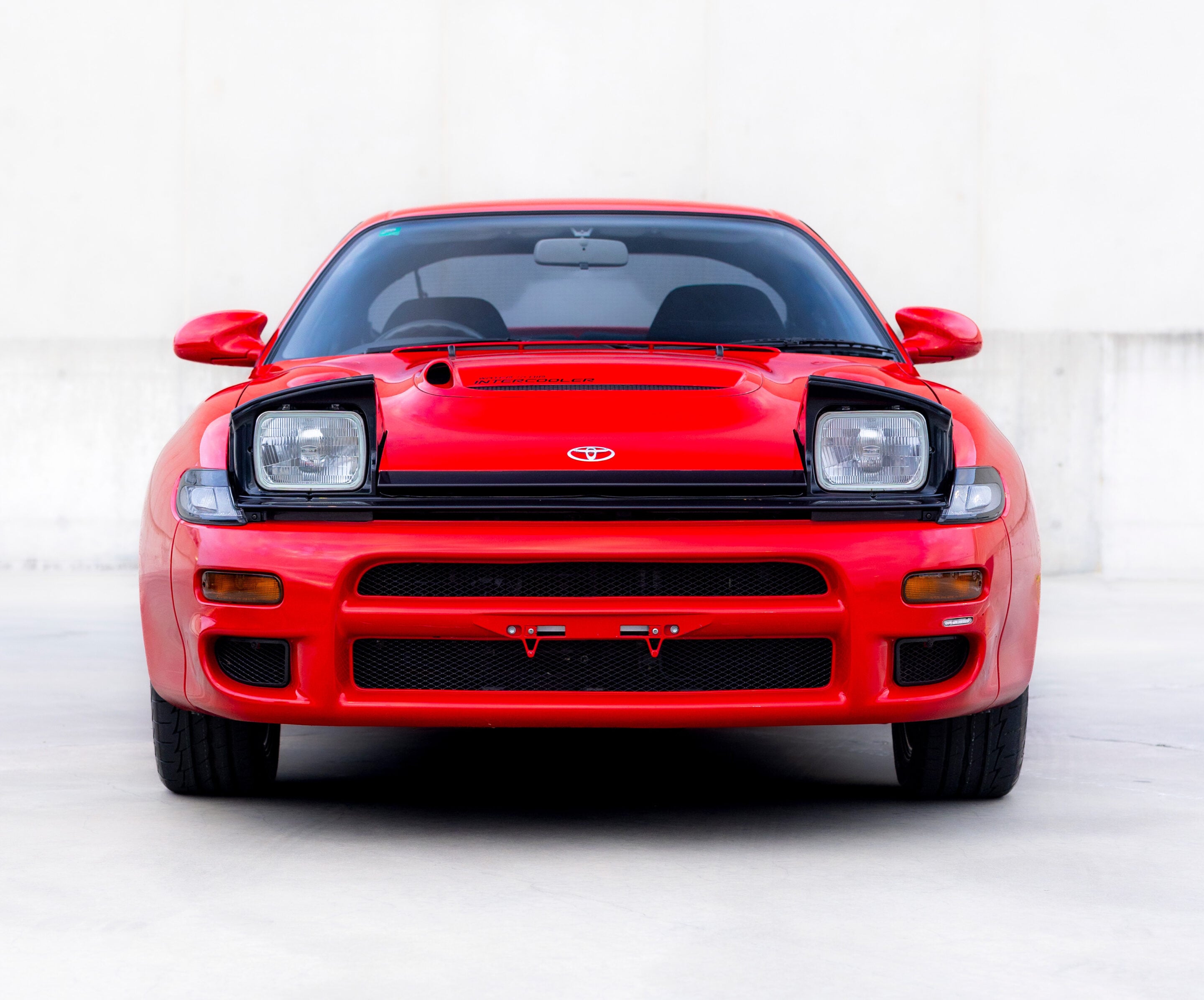
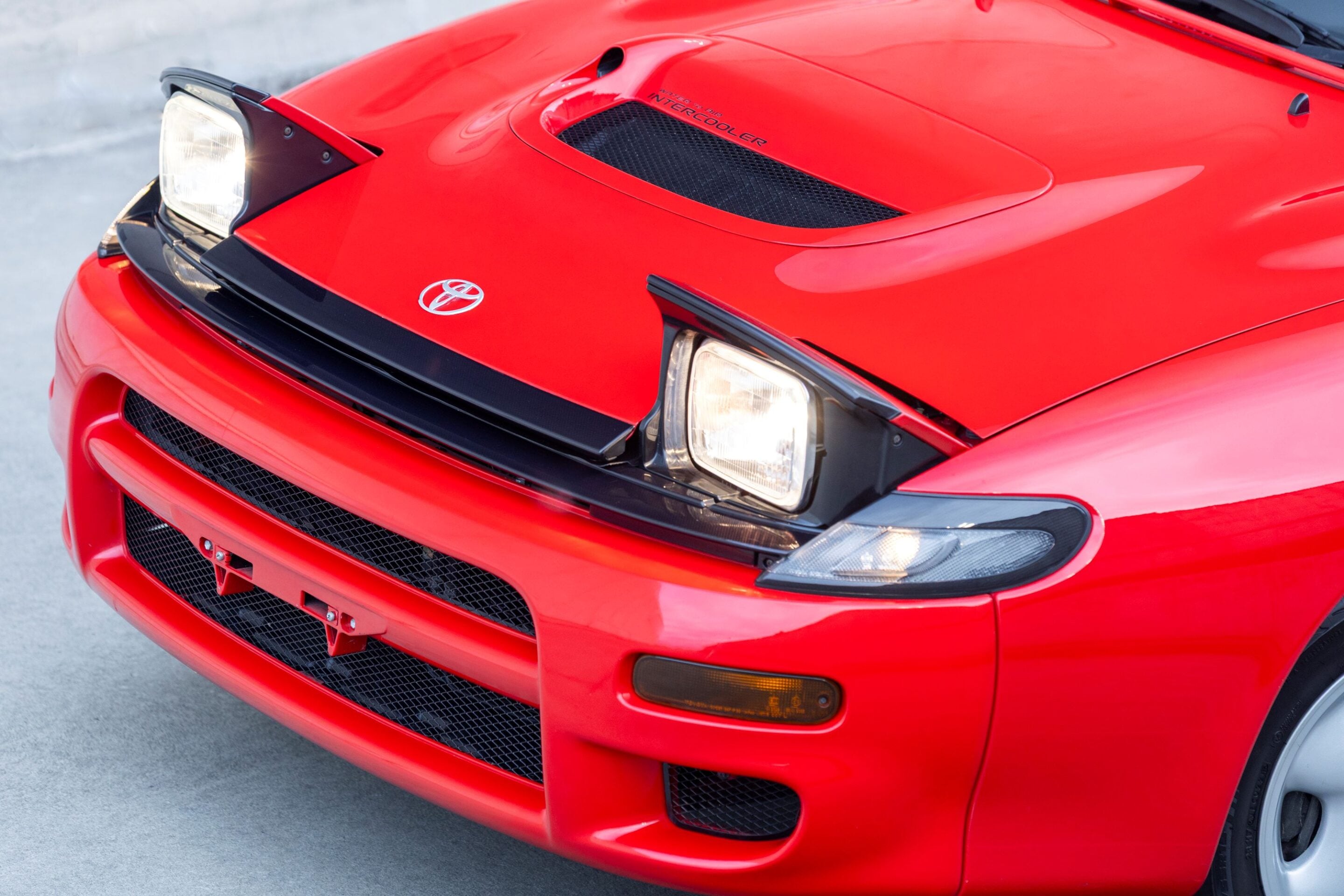
The secret to extracting that much power involved higher-lift cam profiles and a compression ratio of 8.8-to-1. To cope with the demands of the twin-entry turbocharger, Toyota strengthened the 3S-GTE’s block, and added a beefier intercooler that summoned air directly from the deliciously aggressive bonnet scoop.
The small but powerful turbocharger was fed by exhaust gases that entered the turbo-housing via a two-channel exhaust manifold, the resulting pulses improving turbo response.
A five-speed manual transmission delivered the 2.0-litre’s power to all four wheels, a setup that involved more than a touch of mechanical ingenuity.
2
Up front, a transaxle that incorporated the transmission itself, the front- and centre diffs, along with a hypoid transfer gear sent drive along the ST185 three-piece prop shaft back to the Torsen rear diff. If that all sounds a bit complicated and a touch fragile, Toyota engineered the drivetrain to ensure that each of the three individual differentials could handle the full-power onslaught of the turbo-four.
Keeping the GT-Four on the road and straight ahead was the work of MacPherson struts and coil springs, both front and rear, while heavier anti-roll bars kept body roll in check.
Wheels put the hottest Celica to date through its paces in our April 1990 issue, lauding the all-paw’s chassis refinements and simple driveability.
“It sure works, because the GT-Four sits far flatter and more confidently than the [regular SX Celica] and, apart from a slightly lumpy ride, is not much less comfortable,” we wrote. “The Four also tracks and turns in more crisply, and its speed-sensitive power rack and pinion steering has excellent weighting and pretty good feedback once at speed.”
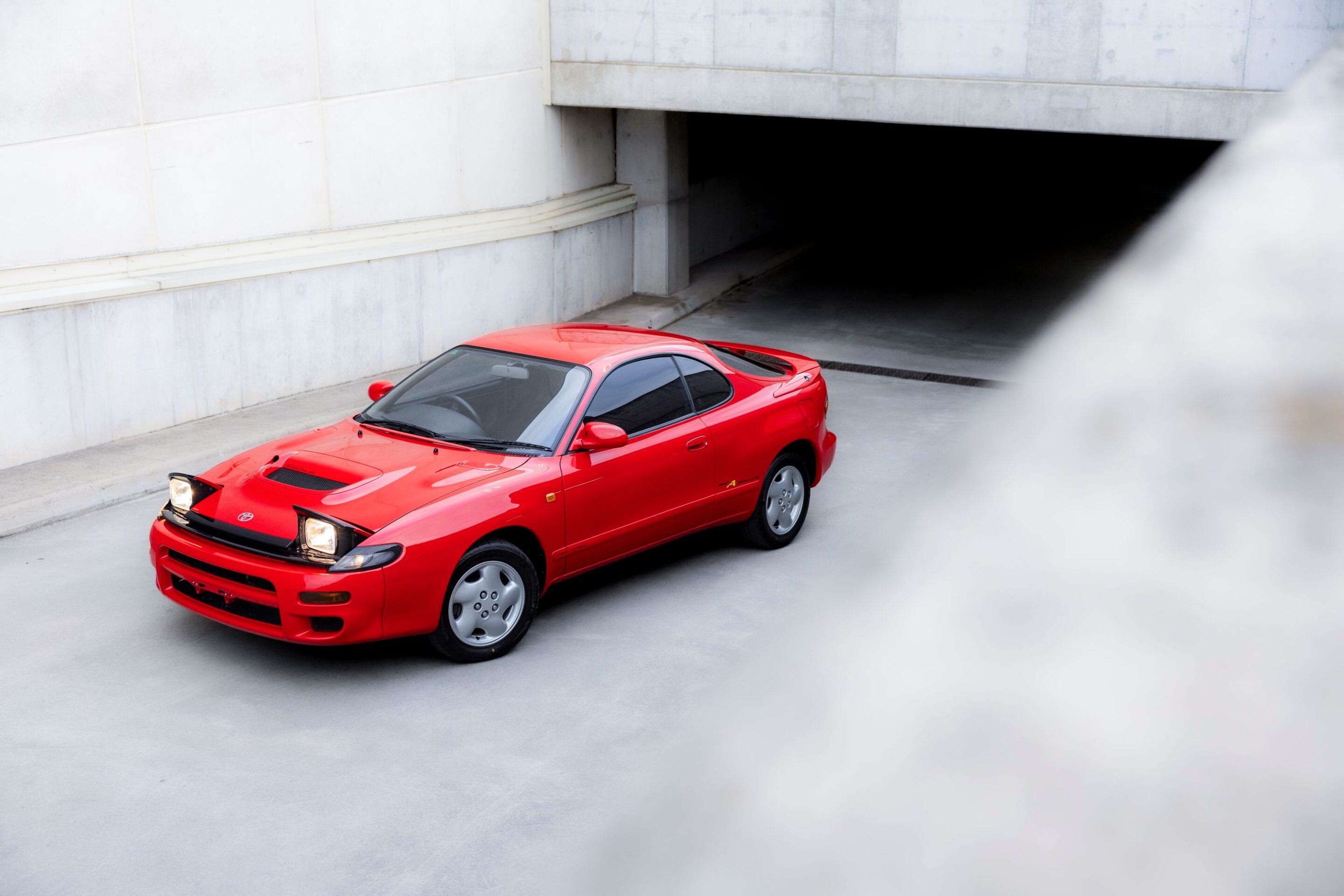
There was much consternation about the fifth-generation Celica’s rounded and softer design when it launched in 1989. Edges had been smoothed while body panels curved gently, a distance removed from its predecessor, which was all angles and straight lines.
But Toyota applied solid reasoning behind the new shape, with the fifth-gen’s designer Makoto Oshima revealing that the curved sheetmetal improved body strength when compared with the flat metal panels of its predecessor (which Oshima was also responsible for). That extra strength allowed for thinner and lighter sheetmetal to be used for some of the Celica’s body work.
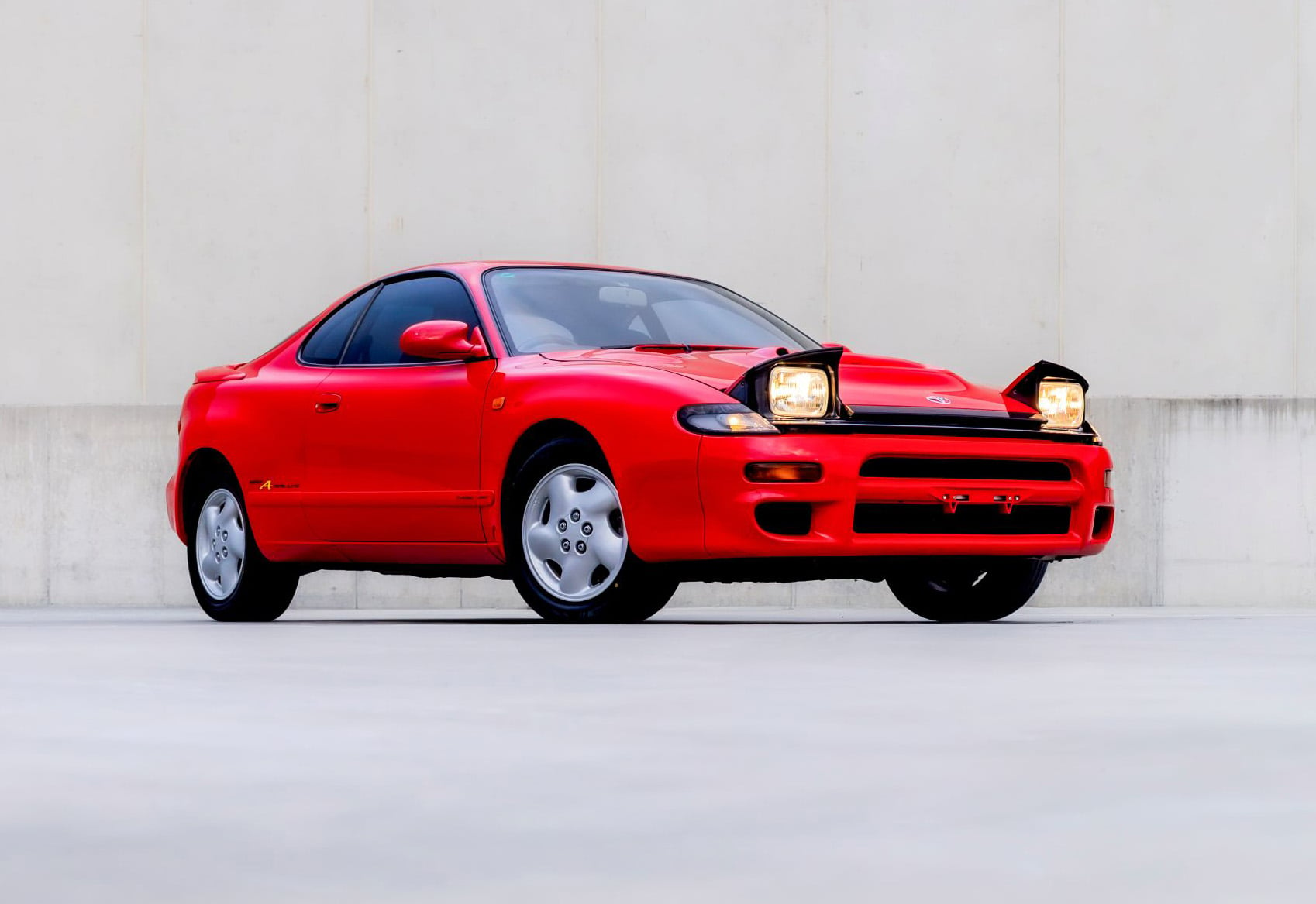
It might have looked soft in regular trim, but once Toyota’s homologation team had finished with it, the Celica GT-Four looked like a different beast, highlighted by a new front spoiler, that imposing bonnet scoop, extended wheel arches housing bigger and wider 15-inch alloy wheels, and larger brake discs to improve stopping power. It looked aggressive and purposeful, like something Carlos Sainz could drive around the streets of his hometown, Madrid, without embarrassment.
3
We loved the GT-Four’s performance back in April 1990, praising its straightline speed, deft handling and braking abilities.
Toyota claimed a 0-100km/h time of 6.9 seconds and the standing-quarter in 15 seconds flat. That might not seem especially fast today, but it was properly quick for 1990.
“It’s fully able to relate this performance to the real world, too, getting deeply into corners under its excellent brakes… and rocketing back out again with barely a trace of wheelspin or torque steer, even in the wet,” we wrote. “On tight hairpins, in particular, the GT-Four would understeer, but not really in the ploughing manner of most 4WD road cars. It was merely a great chassis telling us we’d gone too fast.”
That twitchiness, manageable as it was, coupled with a gearbox that “fairly romps through its five manual ratios” resulted in a car that was “busy” to drive. A driver’s car, in other words. No higher compliment could be paid to a vehicle of the GT-Four’s ilk.
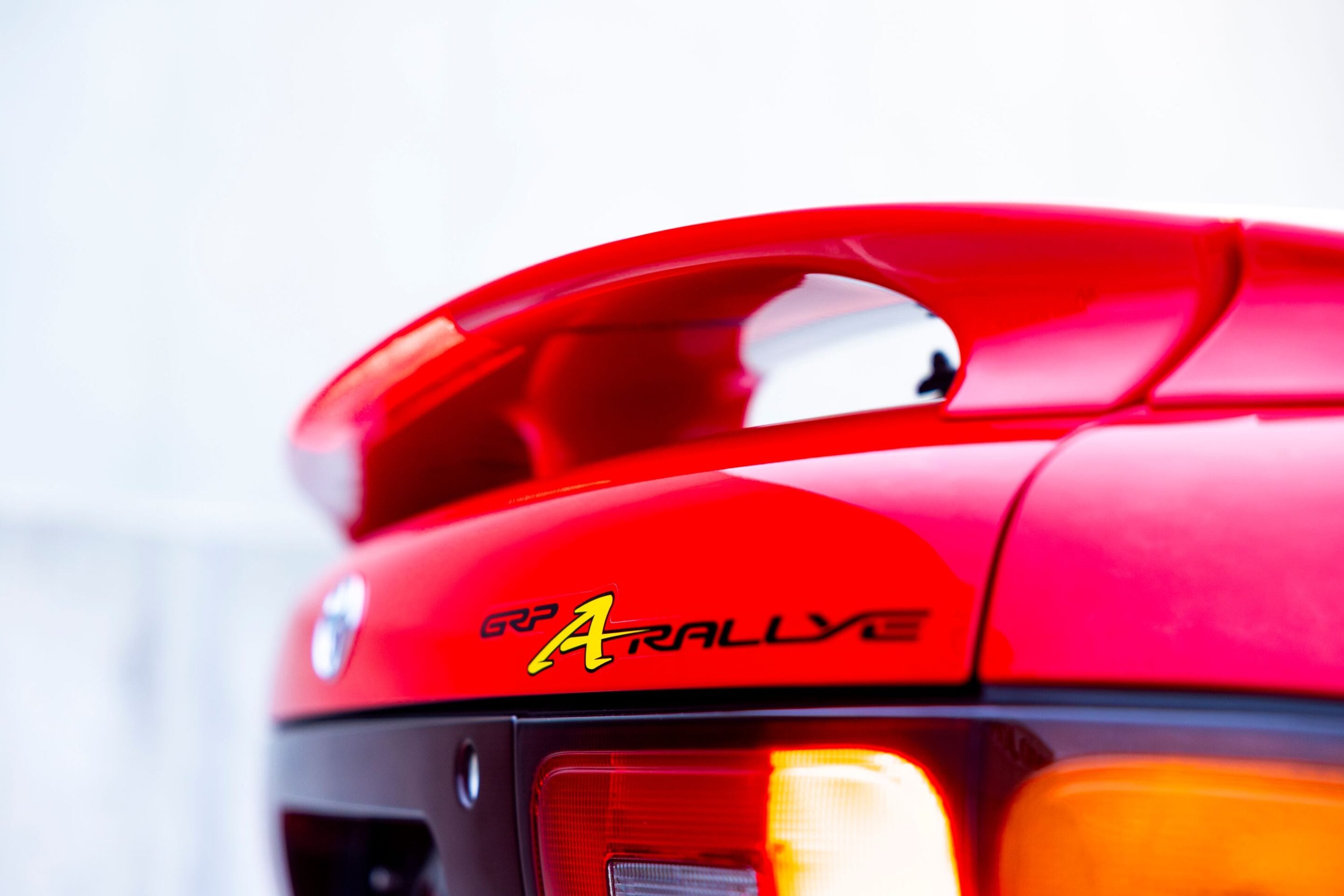
Toyota upped the ante in 1991, launching the Celica GT-Four Group A Rallye Edition, which brought competition upgrades, both mechanically and visually. Production was limited to 5000 cars, as per the FIA’s homologation rules for competition at the time, with just 150 earmarked for Australia, where it was sold and marketed as – and take a deep breath here – Toyota Celica GT-Four Group A Rallye World Rally Champion Carlos Sainz – Signature Edition. In Japan it was simply known as the GT-Four RC (Rally Competition).
While there was no power increase, the GT-Four Group A Rallye swapped out the incumbent’s air-to-air turbo intercooler for a more efficient water-to-air setup.
An additional oil cooler was added while a redesigned bonnet now featured a huge air vent designed to expel hot air from the turbo while a small round scoop channelled cooling air to the cambelt housing, addressing a problem found on older models where the housing would sometimes melt during high-performance driving such as… well, rallying. There was also a new front bumper with larger air intakes to further optimise airflow and cooling to the GT-Four’s internals.
2
A new gearbox – internal code E151F – brought shorter ratios while revised engine mapping upped boost and improved the GT-Four’s torque curve.
Out in the forests and gravel, there was no stopping the Celica, which romped to three straight WRC drivers’ titles – Sainz, Kankkunen and Didier Auriol – and two consecutive manufacturers’ championships in 1993-94.
Toyota was clearly on a rally roll and the launch of the new ST205 Celica GT-Four in 1994 brought with it even greater expectations of success.
Visually, the ST205 forged a new identity sitting on a longer platform (by 10mm) and with a wider track both front back, up 35mm and 50mm respectively. A new nose, with quad headlamps replacing the older model’s pop-up lights, lent the ST205 a mean face, a toughness backed up by significant power and torque bumps, now rated at 178kW at 6000rpm and a meaty 320Nm peaking at 4000rpm. Zero to 100km/h was a shade quicker at 6.6 seconds while the standing quarter was over in 14.9 seconds.
A change to the WRC’s homologation rules meant Toyota had to only produce 2500 cars to comply with the rules. Of those, 177 made their way to Australia with a lofty price tag of $81,690 when new. Even then, niceties like air conditioning ($2382) and an electric sunroof ($2000) remained optional items.
Wheels pitted the new ST205 GT-Four against a trio of like-minded turbocharged all-wheel drive monsters – Holden Calibra Turbo 4×4, Mitsubishi Lancer GSR, and Subaru Impreza WRX – in our August 1994 issue, and it came dead last. The caveat here is that 1994’s four-way comparison was focussed on the road, with the Mitsubishi taking the spoils.
But it wasn’t all bad news for the GT-Four, with the judges singing its praises loud and high.
“This is a car heavy to handle, sometimes coarse, always noisy, and very easy for pedestrian drivers to question,” we wrote. “But get it out where the going’s good, or bad, and the Celica’s an object lesson in what rally-bred performance and handling are all about. With awesome potential exploited, it’s a stirring experience.
1
“Worth the money? That depends on your view; but what is sure is that until someone else offers such a ballsy limited-production rally-replica for less money, the Group A Rallye is the best of its specialised, compromised kind.”
Ballsy the ST205 GT-Four might have been, but its future legacy was derailed in 1995 following a WRC cheating scandal that saw Toyota stripped of its 1995 championship points and banned from the sport for 1996.
Toyota was found to have breached the FIA’s regulations around turbo restrictor plates with a clever device that essentially bypassed the mandatory restrictor, allowing for greater airflow to the engine, thereby boosting the GT-Four’s outputs by as much as 30-35kW. The ingenuity of the device was that it was completely undetectable by WRC scrutineers, with then FIA President Max Mosley calling it “the most sophisticated and ingenious device I have ever seen in 30 years of motorsport”.
The scandal rocked world motorsport and left Toyota bloodied, but not cowed. After sitting out the 1996 season following its ban, the Japanese giant returned in 1997 with an all-new WRC-spec Corolla, winning the manufacturer’s championship in 1999 before bowing out of the sport.
It returned in 2017 with the GR Yaris and has gone on to add a further six drivers’ and manufacturers’ crowns to its tally.
3
Far from ruining the legacy of the GT-Four, the cheating scandal only added to its mythology, a car that through three generations showed that the Japanese giant was more than just a maker of sensible cars.
Our Celica GT-Four
The stunning car featured on these pages is a rare breed. Owned by Frank Gazzara, the ST185 GT-Four Group A Rallye is one of just 150 Carlos Sainz Signature Editions produced for the Australian market.
Produced in September 1991, build number 072 has been in the same family since it was bought new from Melbourne City Toyota in January 1992 for $51,795. Frank’s father, Natale, was the original owner, his name embossed on the original commemorative build plate.
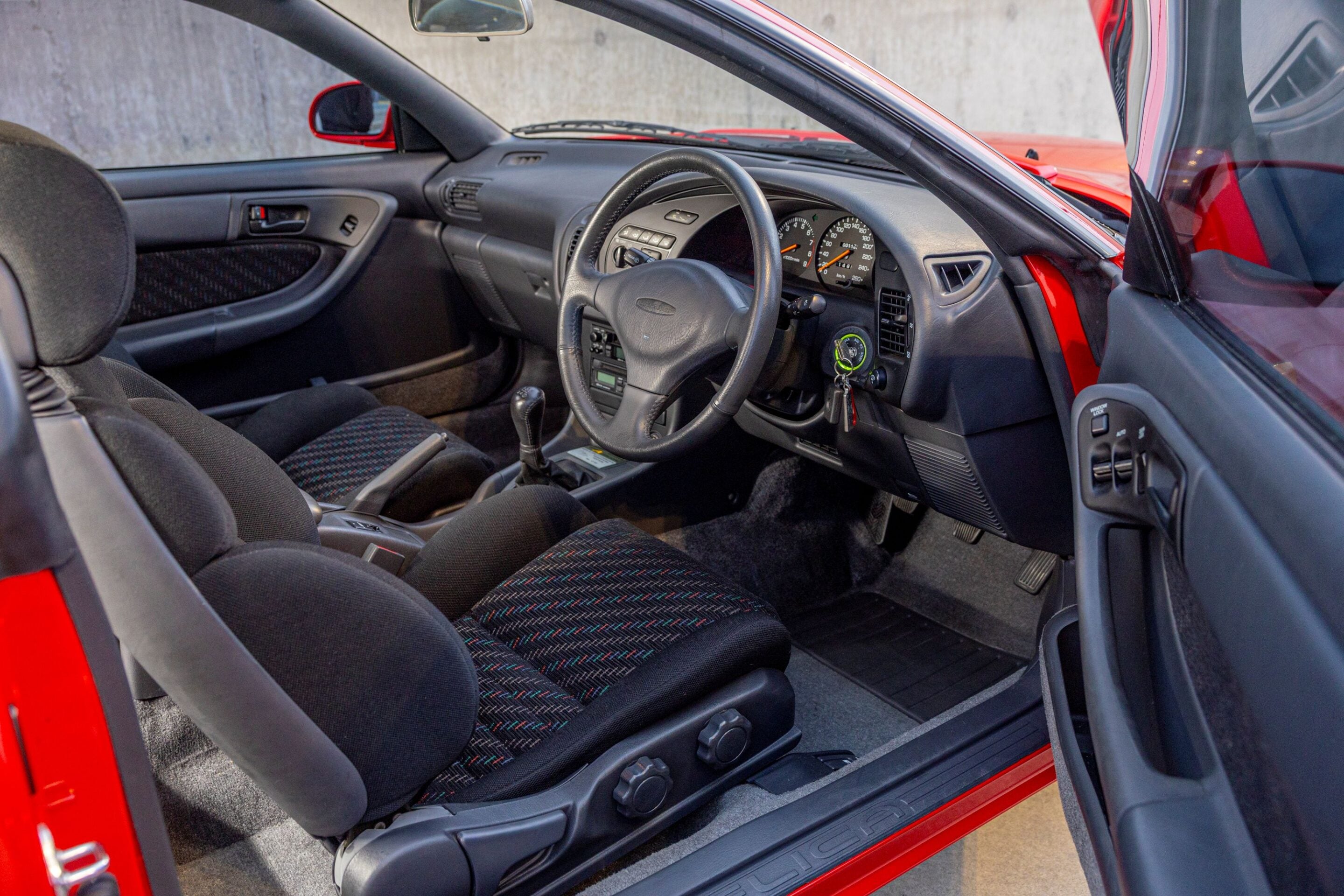
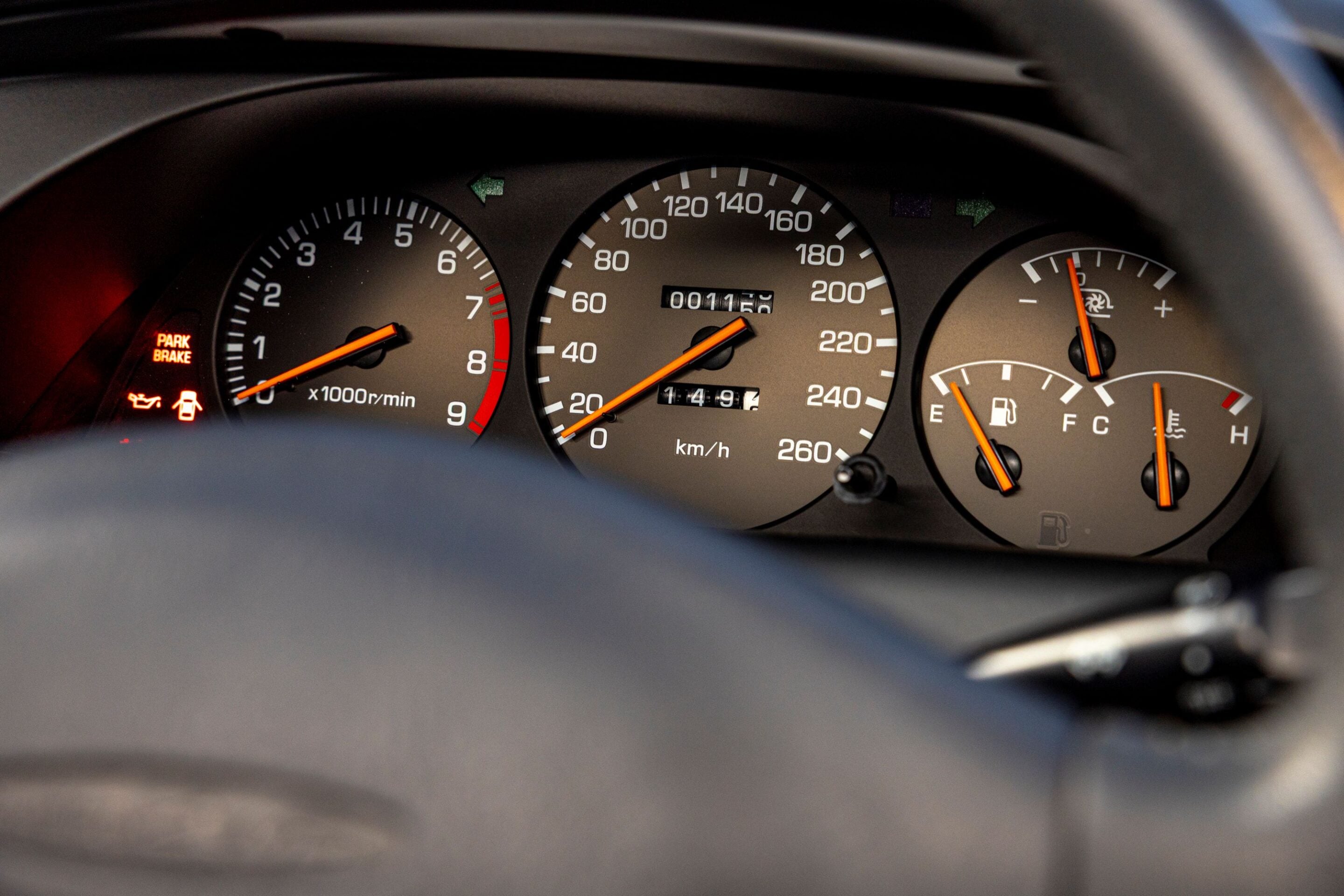
With a remarkable 1152km on the odometer, it’s arguably one of the lowest-kilometre GT-Fours in existence today.
“I first saw this model at the Melbourne Motor Show and immediately fell in love with the car,” Frank tells Wheels. “I inherited this prestigious car from my father in 2023, and it remains a registered motor vehicle.”
While it has spent most of its life garaged, Frank does admit to taking the rally-bred Celica for the occasional drive.
“It still drives with plenty of power and feels much like a new car,” he says, adding that other than regular maintenance, no major restoration work has been carried out on the 37-year-old GT-Four.
“My mechanic has inspected the vehicle and believes it remains in exceptionally good original condition and drives like a new car,” he tells Wheels.
The stunning Super Red (code 3DE5) example is currently for sale and comes with a swag of documentation verifying the car’s history and provenance. Anyone interested can email us at [email protected] and we’ll put you in touch with Frank.
2
Specs
| Model | 1991 Toyota Celica GT-Four Group A Rallye |
|---|---|
| Engine | 1998cc turbocharged four-cylinder (3S-GTE) |
| Power | 153kW @ 6000rpm |
| Torque | 275NM @ 3200-4800rpm |
| Transmission | 5-speed manual, four-wheel drive |
| 0-100km/h | 6.9 seconds |
| 0-400m | 15 seconds |
| Wheels | 15-inch alloys |
| Dimensions (l/w/h/wb) | 4410/1745/1300/2525mm |
| Kerb weight | 1446kg |
| Power-to-weight ratio | 110kW/t |
| Price (new) | $51,795 |
This story first appeared in the October 2026 issue of Wheels magazine, now on sale. Subscribe here and gain access to 12 issues for $109 plus online access to every Wheels issue since 1953.
Follow WhichCar/Wheels on Google
Click the button below to make WhichCar by Wheels a preferred source for your news.

We recommend
-
 Features
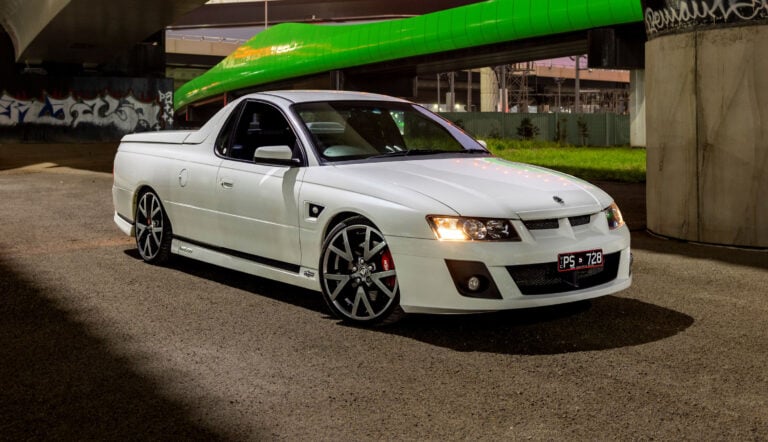
Modern Classic: HSV Maloo, the tradie 'supercar'
A modern-day cultural icon, and officially the fastest ute in the world, the HSV Maloo redefined what the humble Aussie workhorse could be.
-
 Features
Modern Classic: Mercedes-Benz R129 SL 500
The golden generation of Mercedes-Benz roadsters?
-
 Features
Modern Classic: BMW E36 M3, originally unloved, now legendary
For years it was the unloved M3, but hindsight has more than rehabilitated the magnificent E36’s reputation.