It will be a significant range expansion for what is Kia Australia’s cheapest and tiniest vehicle, which has so far only been available in a single specification since the nameplate arrived in 2016.
Speaking to WhichCar, Kia Australia chief operating officer Damien Meredith confirmed that the Picanto GT-Line is set to make its local launch in conjunction with the Australian Open tennis tournament, which begins on January 15.
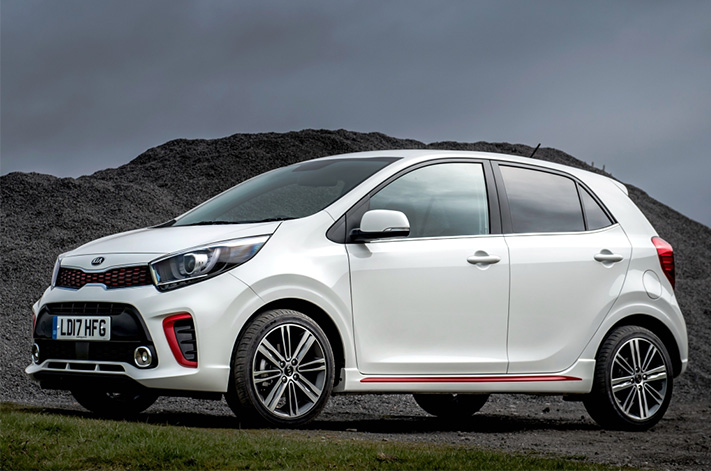
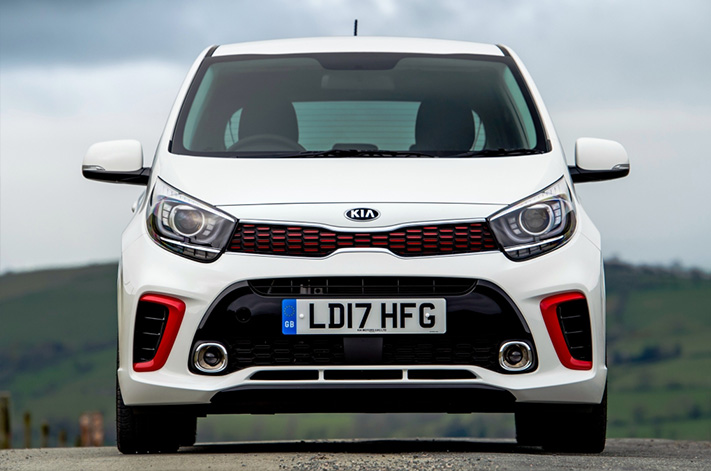
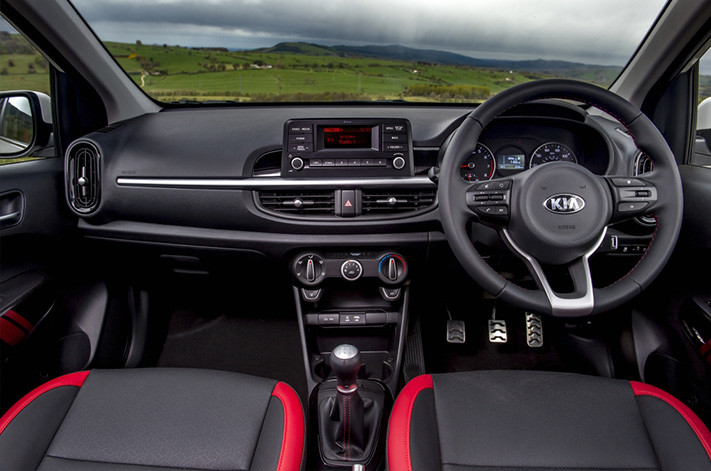
Joining the existing Picanto S, the Picanto GT-Line will wear a sportier bodykit with deeper front airdam, front foglamps, a reshaped rear bumper and be available with 16-inch alloy wheels.
What it won’t have, though, is any extra power. The GT-Line will be a styling exercise, with power to be supplied by the same 62kW, 122Nm 1.2-litre naturally-aspirated petrol four as the Picanto S. Like the S, the GT-Line will also be available with a five-speed manual or four-speed automatic.
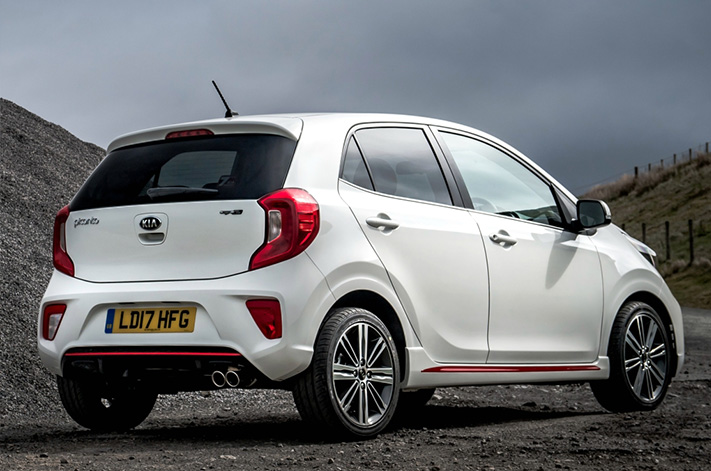
Those looking for a little more pep in their Picanto will need to wait until later in 2018, when the 74kW, 172Nm 1.0-litre turbo three-cylinder Picanto GT is due to arrive. The GT will wear the same body plastics as the GT-Line, but with 12kW more power and 50Nm extra torque – and an Australian-developed suspension tune that should sharpen up its handling – the GT should have something to offer driving enthusiasts on a tight budget.
But uptake may be small, given the GT will only be available in Australia with a five-speed manual. The Picanto GT’s Korean-market equivalent, the Morning Turbo, is available with a four-speed auto, but Meredith confirmed that Australia-bound GTs will only come with the three-pedal transmission.
“The GT is coming,” Meredith said.
“It’ll be manual-only, and we’re pretty confident of getting that [1.0-litre turbo] sometime in 2018.”
“We’re committed to having a top-end vehicle in each one of our segments”
Pricing for both cars will be announced closer to their launch, but with the existing Picanto S topping out at $15,690 drive-away in automatic form, the Picanto GT-Line is expected to arrive with a sub-$20K pricetag when it arrives in January.
It was sad to recently see Toyota end Australian production after 54 years in the business. However, there is a significant upside for anyone looking to buy an all-new Toyota Camry.
It goes without saying that an all-new model will be more advanced than its predecessor, but the new Japanese-built Camry represents a revolutionary leap in design and technology because the Aussie-built model it replaces was already a generation behind.
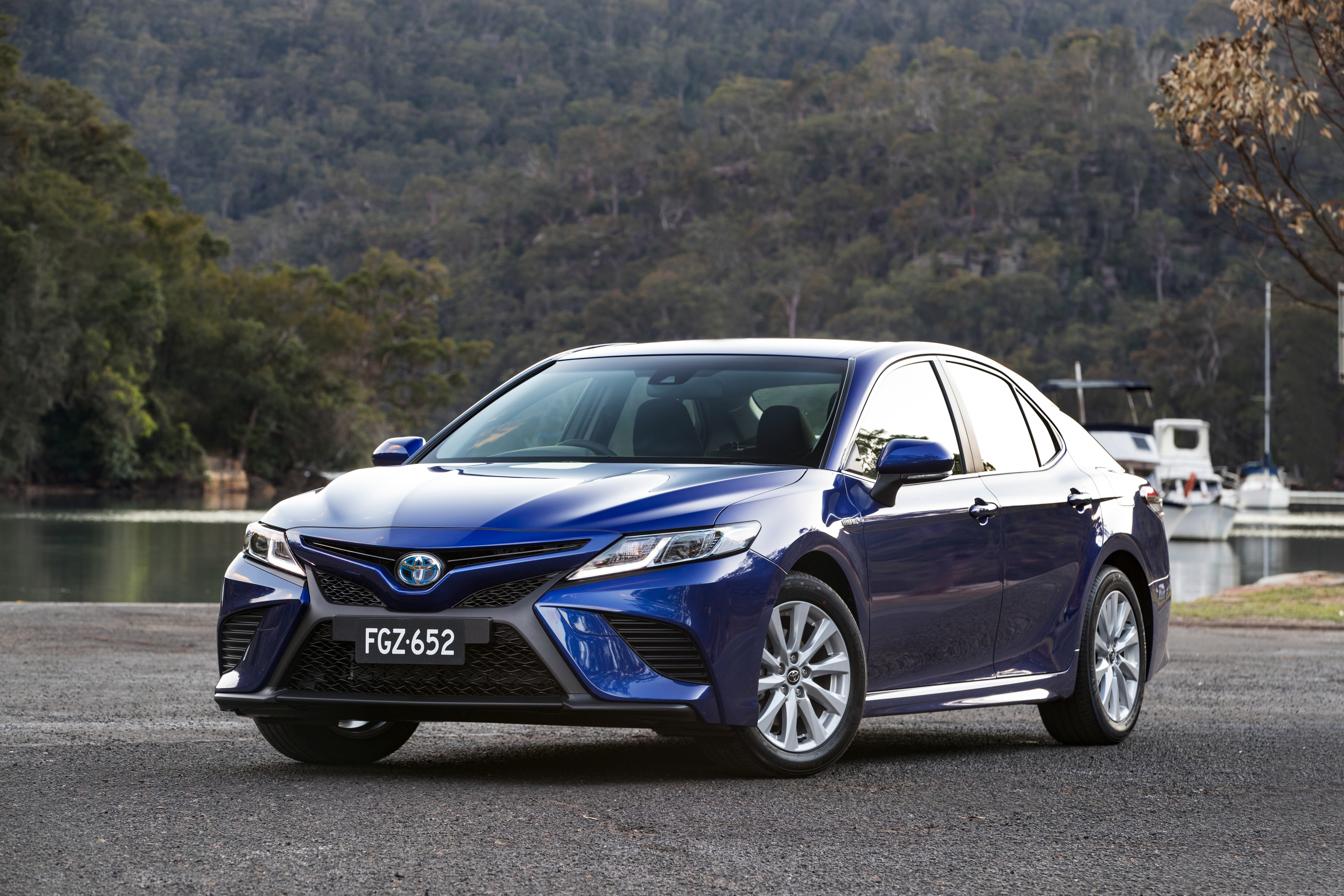
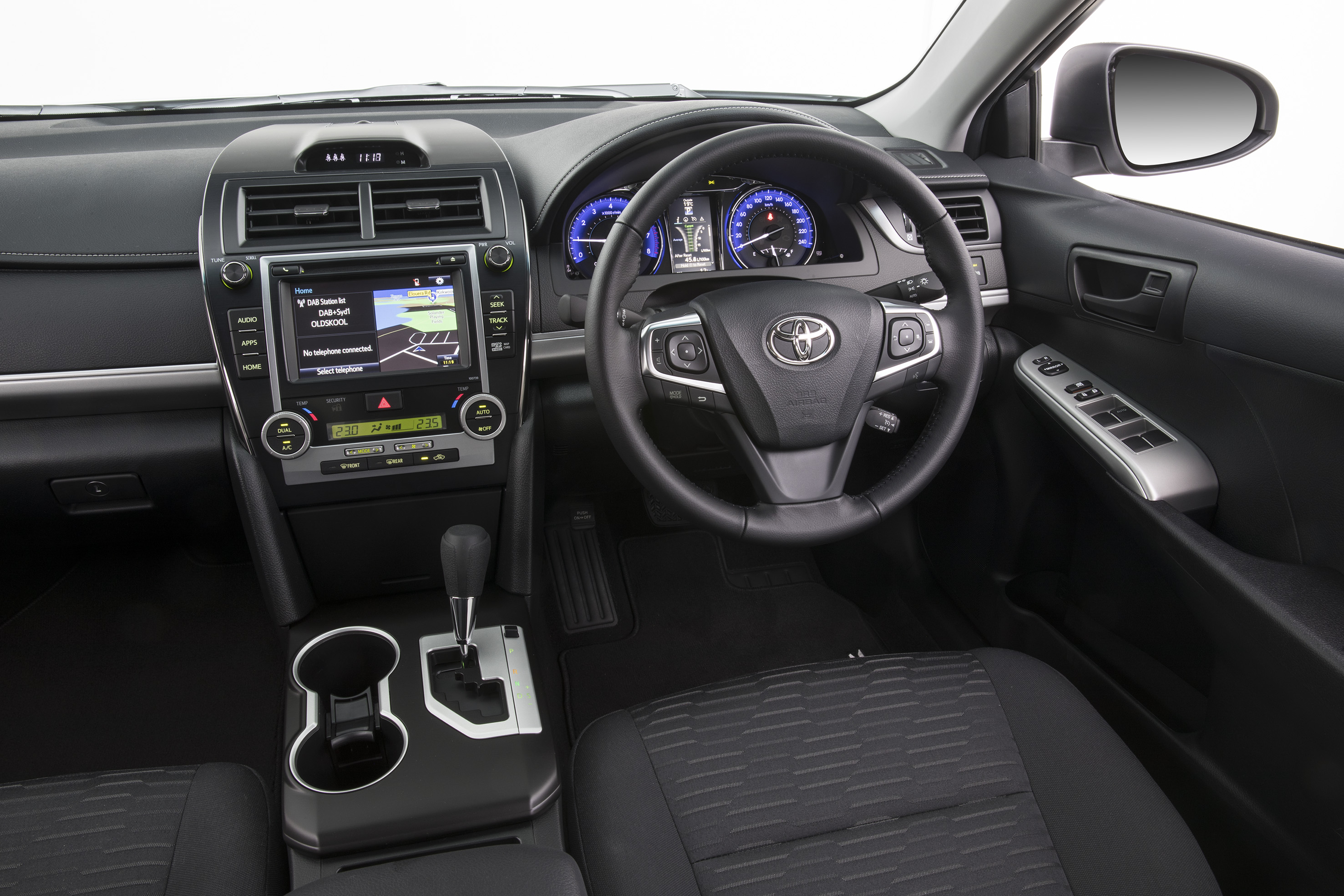
When Toyota Australia updated the Camry in 2015, it adopted the refreshed exterior of the US-developed international models, but budget issues here prevented the adoption of the fresh, more ergonomic interior and advanced driver assist functions such as automatic emergency braking (AEB) and adaptive cruise control (though AEB was later added to the upper-spec Atara SL).
This didn’t stop the Camry being the most successful medium car in Australia by a long shot, helped by fleet sales. However, it was starting to look pretty dated against sharper-looking imported rivals loaded with extra tech.
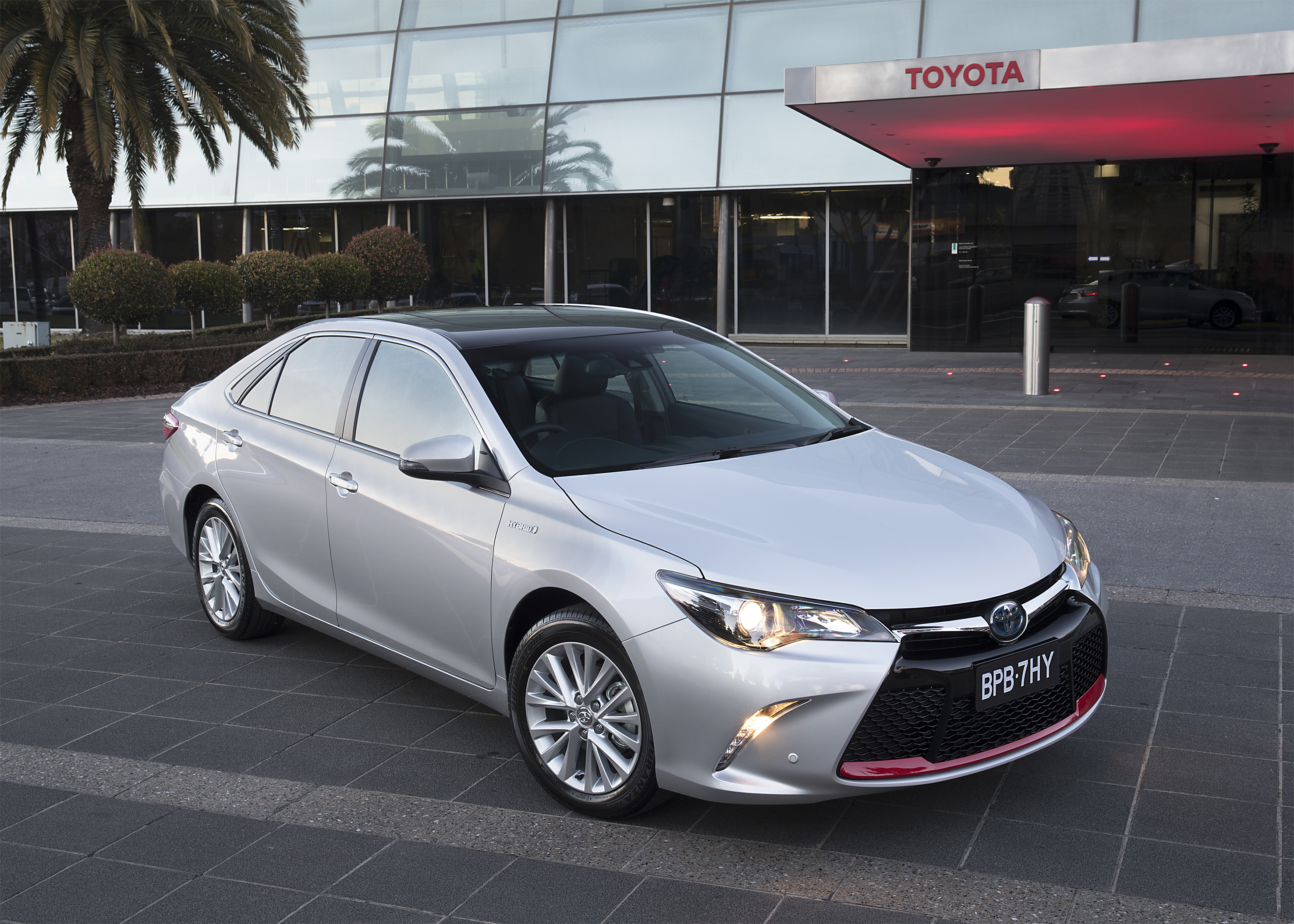
If Toyota wasn’t forced to close Australian production after Ford and Holden pulled the pin, making the local supply chain unsustainable, the locally produced 2018 Camry would have been two generations behind the one arriving in Toyota showrooms now.
The imported 2018 Camry bring brings AEB as standard across the range along with adaptive cruise control, lane departure warning and LED headlights with auto high-beam.
It has been totally re-engineered on Toyota’s new TNGA architecture, which also underpins the C-HR and Prius, and brings a higher quality chassis resulting in much improved steering.
It also accommodates double wishbone suspension for smoother, balanced and stable ride that’s now comparable with the Ford Mondeo and Mazda 6.
The longer and wider underpinnings bring a sleeker look, with slimmer pillars, a lower bonnet line and deeper glasshouse provide better vision.
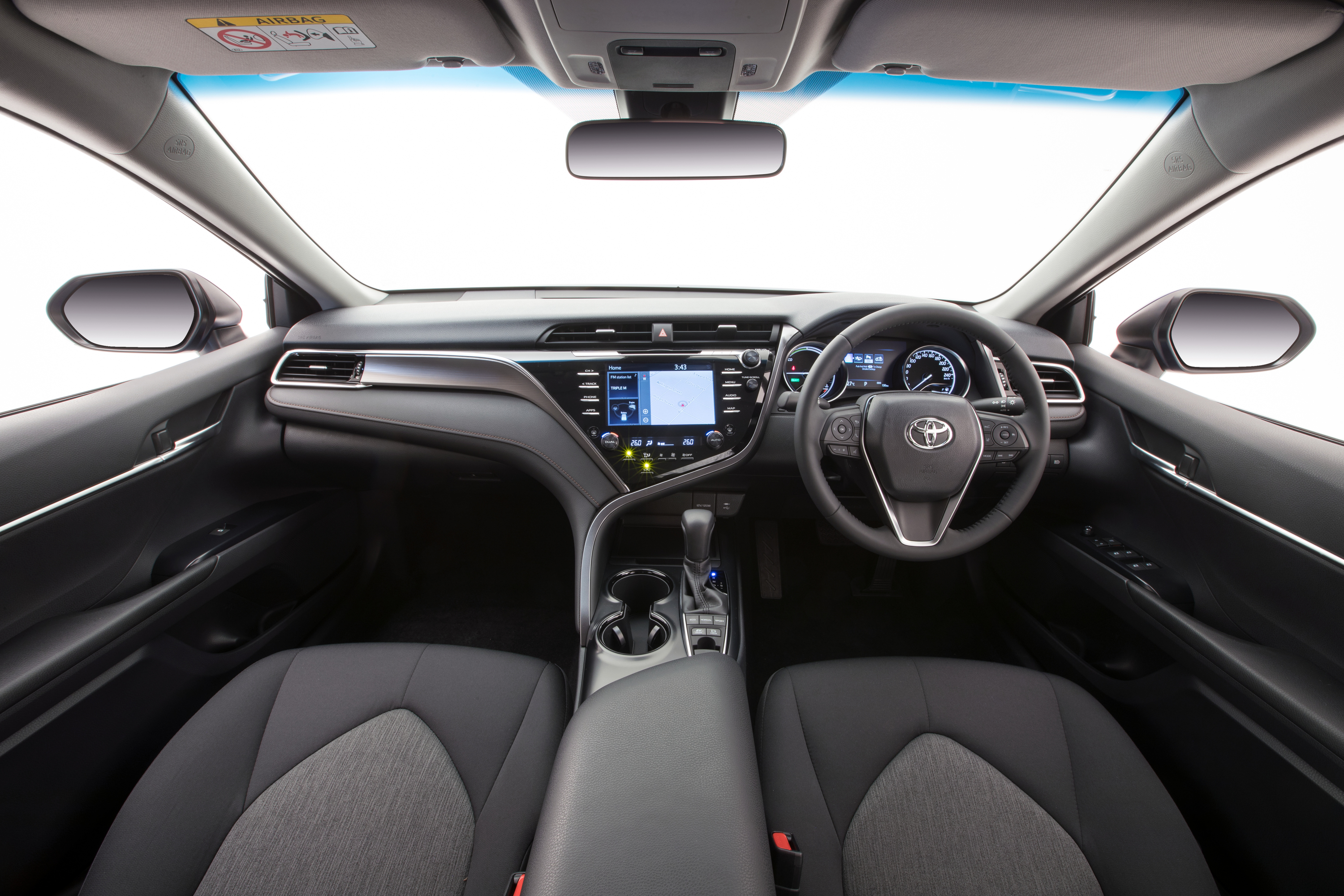
It also means a more spacious interior with a modern dashboard that better incorporates the infotainment system, comfier seating with improved driving position.
The 2.5-litre four-cylinder petrol engine models perform similarly to the previous model, but there’s a marked improvement with the 2.5-litre hybrid powertrains in terms of mid-range power and fuel economy, helped in part by a revamped CVT auto.
The new Camry also brings a V6 version, which will replace the Aurion that was arguably more outdated than the 2017 Camry.
Finally, the new model finally ditches the beige and should attract new private buyers to seeking more than just Toyota reliability. The fact that pricing hasn’t changed greatly, with some variants actually being a little cheaper, will add to its appeal.
Love the great outdoors? These high-riding family wagons will get you far away from the big smoke.
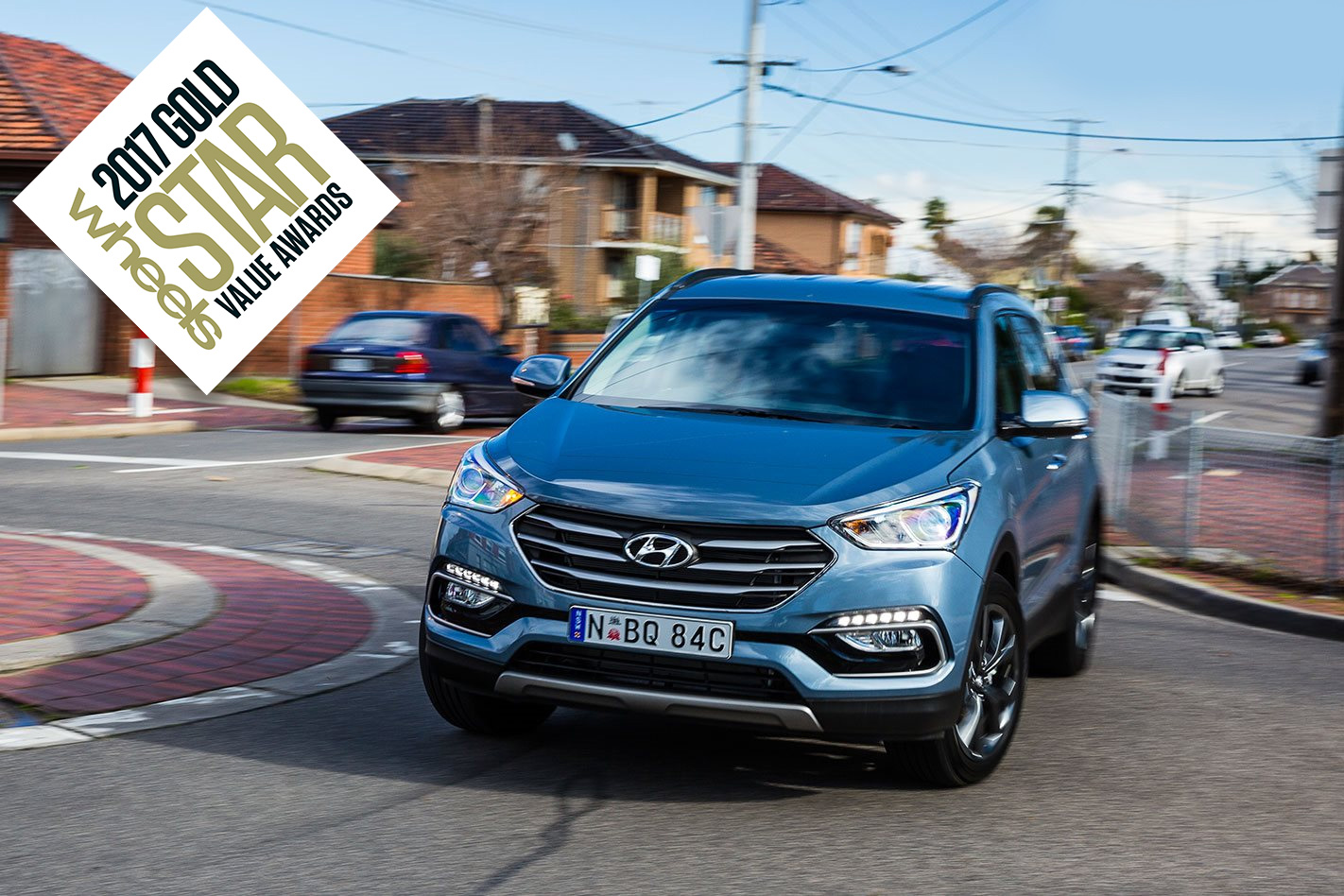
1st: Hyundai Santa Fe Active CRDi
A mix of ute-derived separate-chassis machines and upsized monocoque SUVs makes up the Large SUV/4WD grid, and it’s the latter style of big family wagon that fills the top two spots. The Hyundai Santa Fe is a flash machine in its upper spec levels, however the value case is at its strongest in the entry-level Active. The good build quality, decent dynamics and highly functional cabin come standard across the range.
The 440Nm turbo-diesel uses just 6.6L/100km on the official combined cycle – less than any rival within striking distance, and enough to offset the cost of diesel, which is higher, on average, than unleaded. The base manual Santa Fe also sheds less to depreciation than its competitors, by being a bit cheaper, with a superior three-year resale than most. A generous five-year warranty and Budget Direct insurance of $795 per year seals the win.
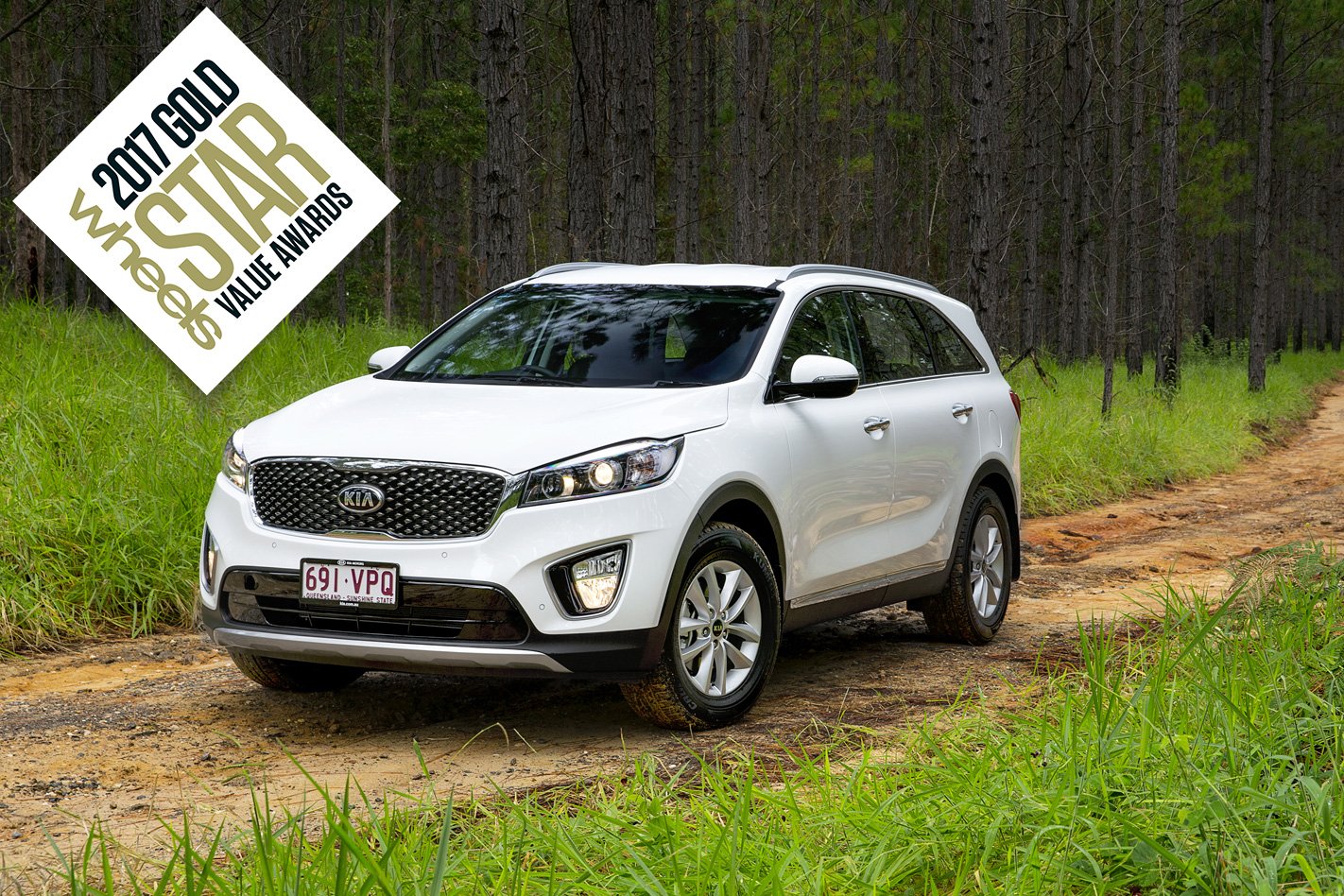
2nd: Kia Sorento Si CRDi
The turbo-diesel base Sorento uses a bit more fuel than its immediate Korean rival (which has virtually the same engine), but the standard auto contributing to this extra thirst will make for a nicer urban drive.
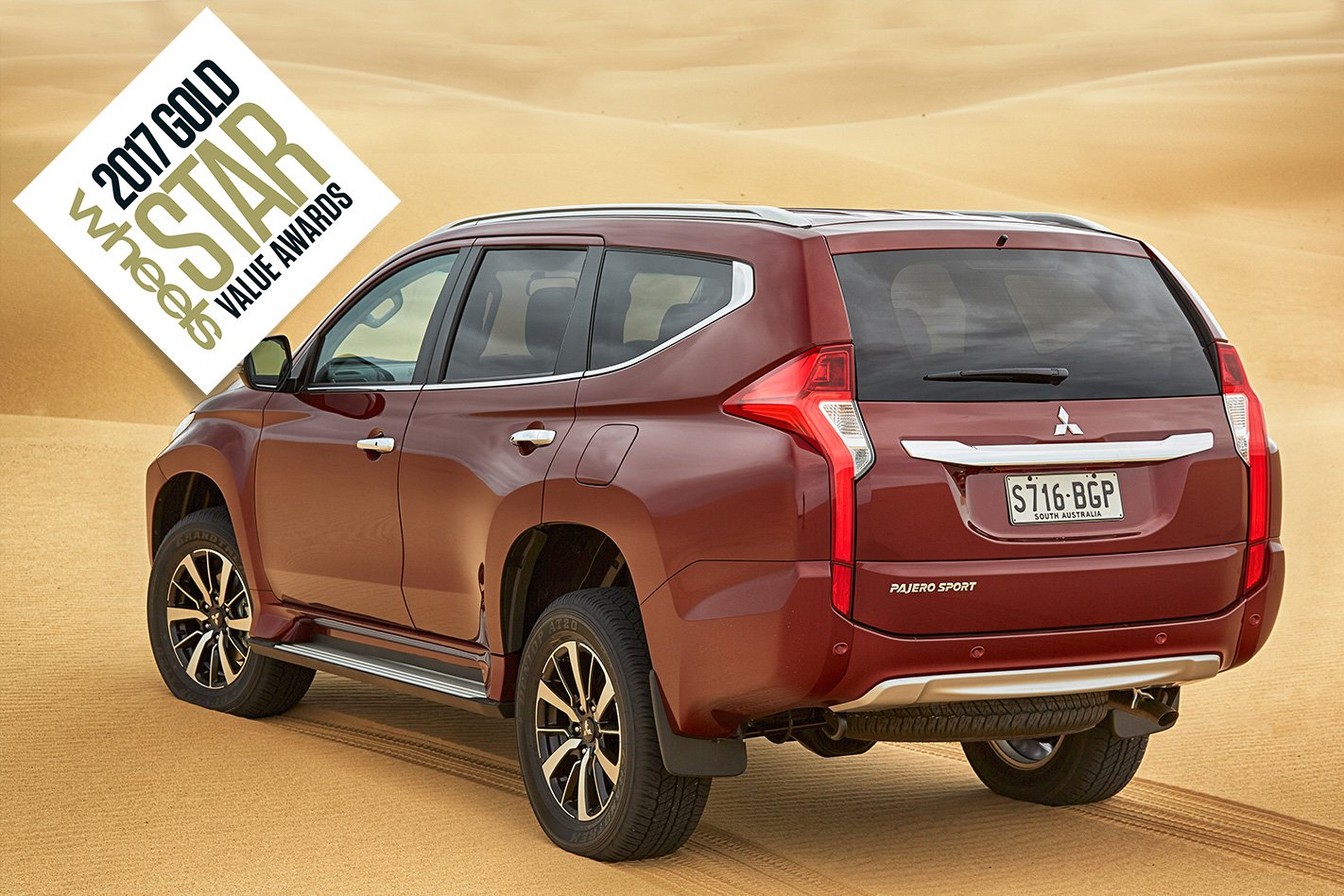
Mitsubishi’s base-spec, body-on-frame wagon has the value basics sorted, with sound 57 percent three-year resale, a crude but economical turbo-diesel with eight-speed auto, and a five-year warranty.
Whether you’ve got a big brood or just want a couple of “just in case” seats for when the in-laws visit, these three-row SUV options should fit the bill.
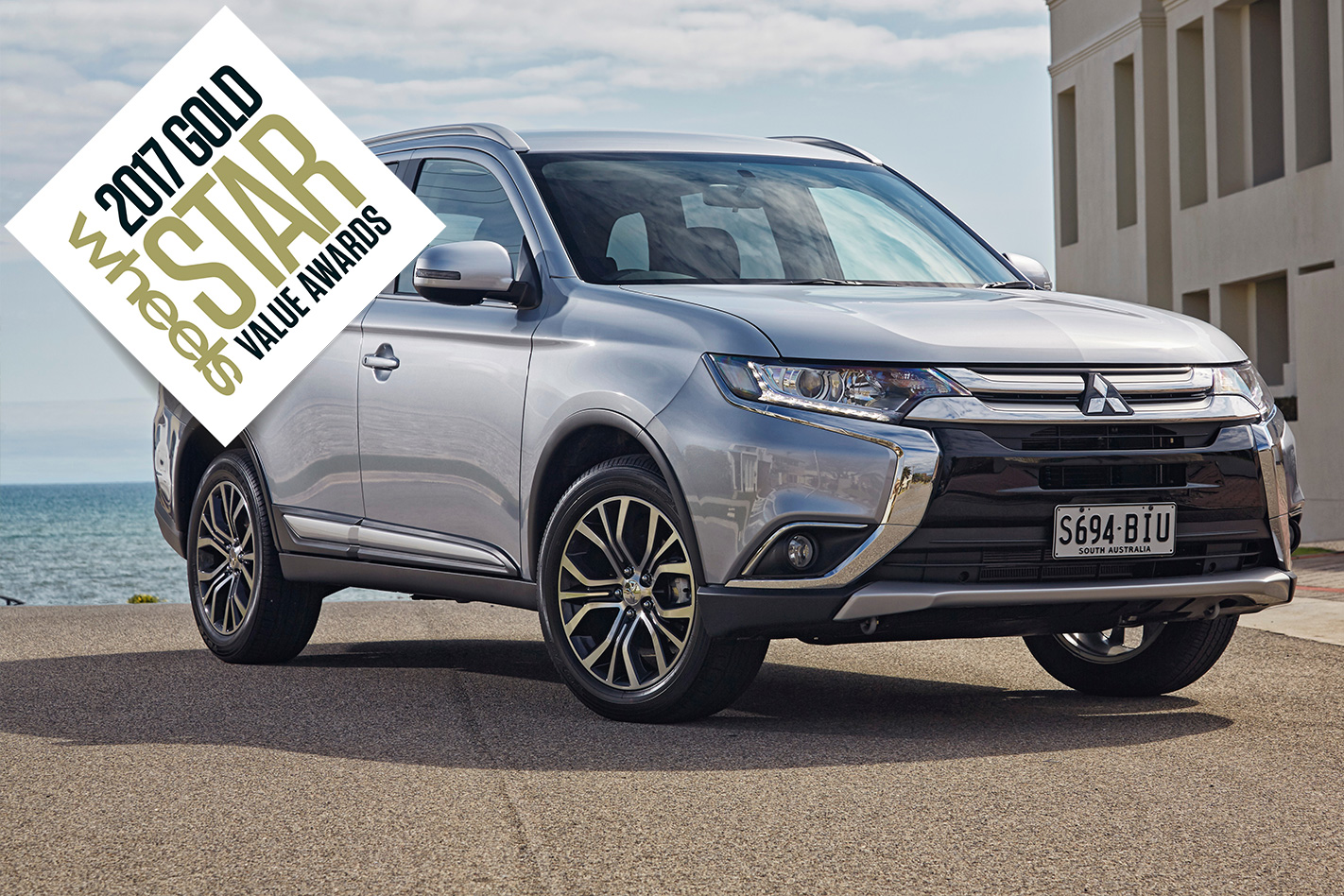
1st: Mitsubishi Outlander LS
Pricier larger seven-seat SUVs were edged out by more affordable entry-level variants in this category, with the Nissan X-Trail and Honda CR-V just falling short of earning a place on the podium. This year’s top step goes to the Mitsubishi Outlander, which at just over $30K and with a reasonable 48 percent three-year resale forecast, mounts the most convincing retained-value case.
Sure, the Hyundai Santa Fe can match its five-year warranty, and the Kia Sorento’s seven-year guarantee trumps it, while new seven-seat player, the fifth-gen Honda CR-V, can go close to the 6.6L/100km combined-cycle economy. But no model brings together the wide-ranging cash-saving credentials of the Outlander.
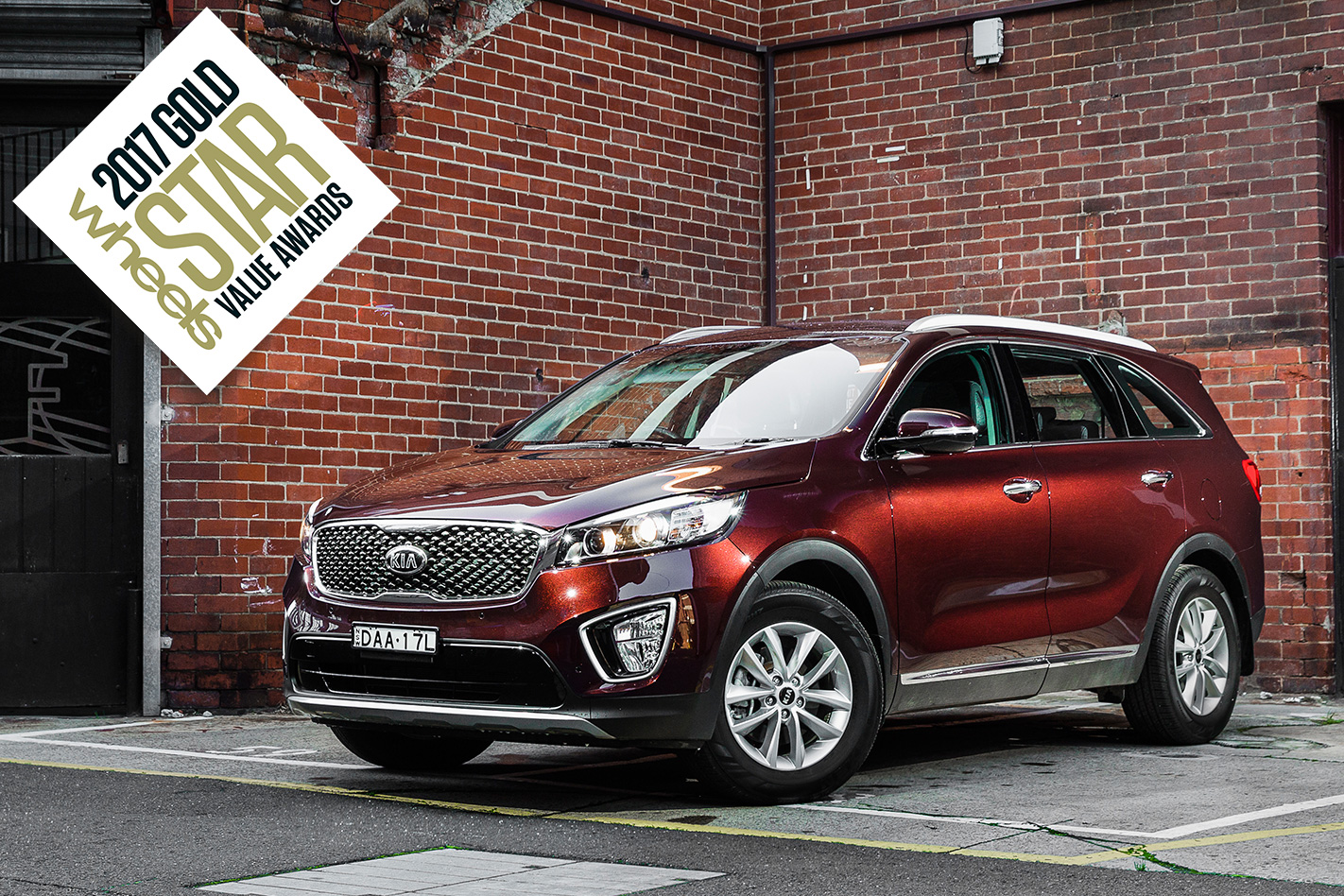
2nd: Kia Sorento Si
The Kia’s $41K price-tag is at the upper end of the seven-seat SUV players, but with a 54 percent three-year resale, the depreciation cost remains on the right side of $20K.
The Santa Fe steers a value middle course, with typical pricing, upper-end resale, okay economy, and a generous warranty, before finishing with an enticingly low $755 annual insurance premium.
The new Gen IV engine crammed into an R8 was always going to give this event a shake, and was a firm favourite for a top-six finish.
This article was first published in MOTOR magazine’s March 2005 issue.
ClubSports have traditionally done well, R8s have done even better and it’s good to see HSV hasn’t forgotten about the original design brief for the ClubSport model. This time, though, it really only scraped into the final six, filling the last space (on raw numbers) and edging out a couple of other worthy contenders.
Throw the judges’ verdicts into the mix, however, and the big Clubbie stepped up a rung to claim fifth spot. And that’s the thing with PCOTY; while bald numbers tell part of the story, there’s always that human element, influenced in this case by the fact that cars like the R8 get the wrinkles out.
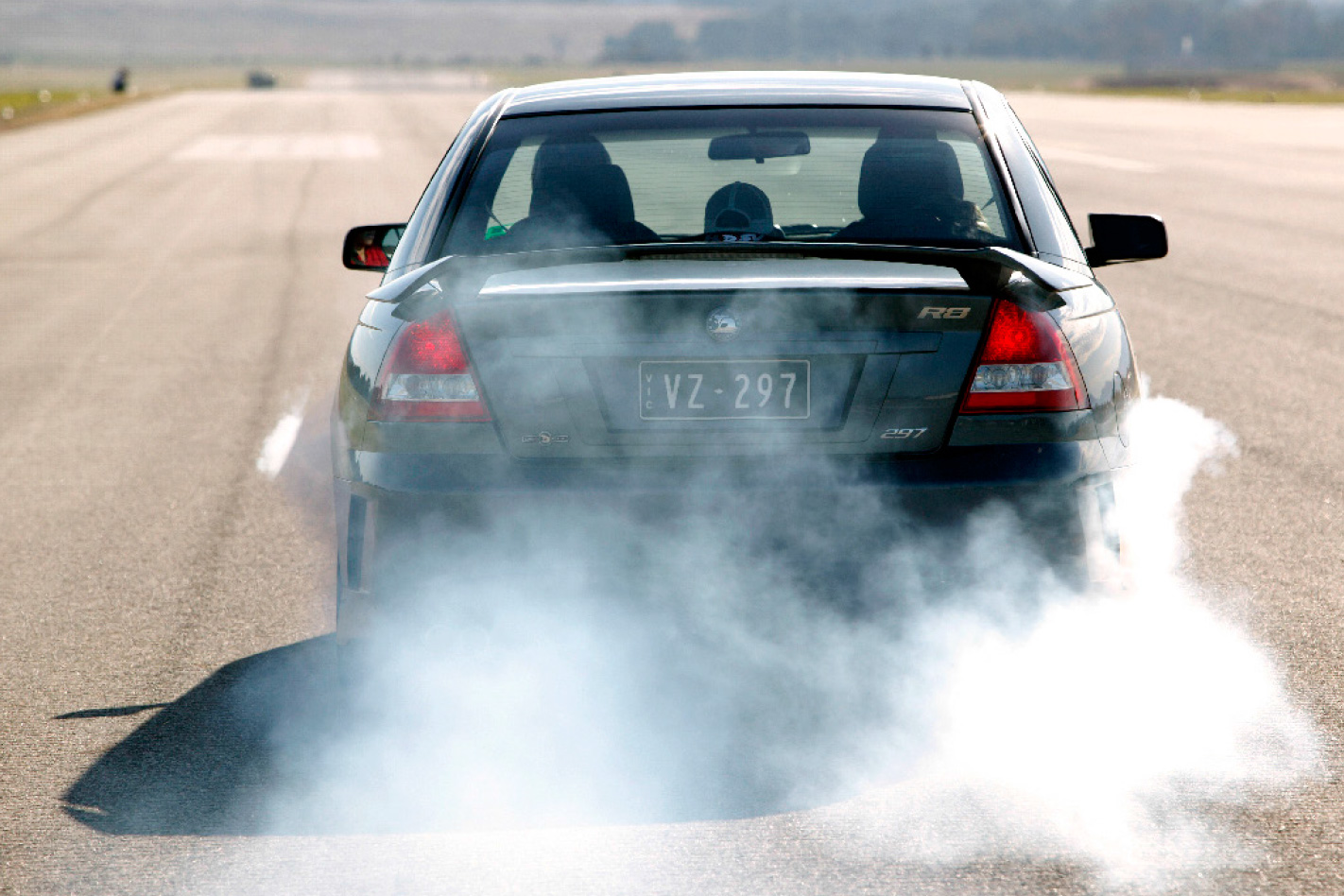
On the track there’s perhaps less difference between Gens III and IV than you might imagine, although there’s no doubt you’re fighting with a bigger stick nowadays. The thing is, because you’re keeping the powerplant revving hard all the time on a racetrack, the Gen III never really fell out of its powerband.
Nope, the big advantage of the Gen IV is most readily seen on the road where the new engine needs none of the wind up the earlier donk required. Similarly, it can be run down to low revs and still yodel when you open her back up.
At the Hillclimb, the Gen IV was a real revelation, storming from corner to corner and able to grunt up the steepest part locked in third gear.
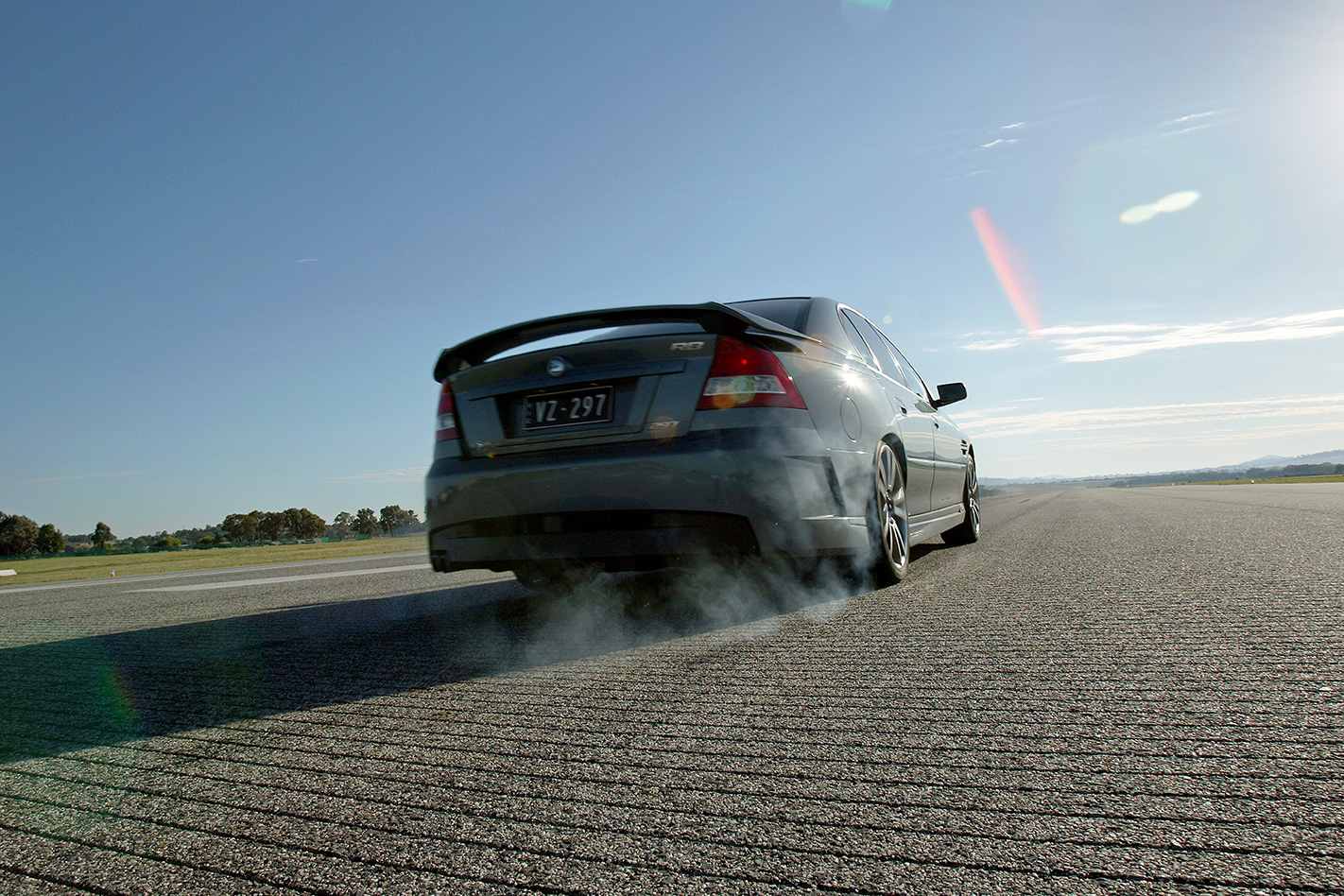
The fact the previous VY model Clubbie and the new VZ are very closely related means they feel otherwise the same. Throw in the fact the all-new VE shell isn’t far away, and you can see why HSV more or less left well enough alone.
But don’t go thinking the VZ feels old fashioned because the basic chassis can still cut it, even if the rear end now has its work cut out getting the torque to the road. Bitches are few and far between, but it remains a shame the R8’s previous excellent front pews have been replaced by chairs with much less side support.
Yes, they’re easier to get in and out of, but they are no longer the best in the biz. Pity.
Slow Tracked
Whither the ClubSport? Off the boil, pace-wise, or is there a deliberate corporate strategy of banging harder in a straight line while feeling nicer mid-corner? At their fastest, the Commodore-based cars leaned heavily on their outside front tyres, squatted notably on the tail and gave superb power down.
The ClubSport R8 of 2004 ran 1:43.50 and even said Munro ran 1:43.69. When HSV went from Bridgestone S02s to the harder S03s, the cars lost lap speed. They’ve lost more again with the switch to even harder Pirellis. About two seconds a lap, we reckon.
HSV Clubsport R8 Specs: Drive: rear-wheel Engine: front-mounted 6.0-litre pushrod 16-valve V8 Power: 297kW @ 6000rpm Torque: 530Nm @ 4400rpm Weight: 1696kg Transmission: six-speed manual Length/width/height: 4890/1842/1450mm Fuel Economy: 29.5 litres/100km (75L tank) Price: $70,990
Performance 0-100km/h: 5.83sec 0-400m: 14.01 @ 169.1km/h 0-1000m: 24.88 @ 223.2km/h Winton lap time: 1:44.07 Winton top speed: 173km/h
What stands out?
The Cherokee is a comfortable and powerful mid-sized SUV from Jeep that drives very nicely. The Cherokee Trailhawk – which has dual-range 4WD – will go much further off-road than most cars of this type. Auto braking is available.
What might bug me?
Babysitting the cabin’s climate control on a cold day. The automated heating and cooling is prone to wild swings, pumping out plenty of heat but then switching to cold, or vice versa.Getting your Cherokee serviced every six months. Most new cars can go nine or 12 months between services, but the Cherokee needs checking at least twice a year.Finding somewhere for your left foot, because there’s no driver’s footrest.
What body styles are there?
Five-door wagon only.The Cherokee is available in front-wheel drive, all-wheel drive, and dual-range four-wheel drive.All-wheel drive Cherokees drive only their front wheels most of the time, but engage the rear wheels automatically should a front tyre start to slip – an on-demand system that saves fuel. For tackling difficult conditions off-road, you can set them to drive all four wheels permanently.On Cherokees with dual-range 4WD you can select a second set of much lower gear ratios, which allow you to drive comfortably off-road at very slow speeds.The Cherokee is classed as a mid-sized SUV, lower priced.
What features do all Cherokees have?
Automatic transmission, cruise control, and a reversing camera.A sound system with an AM/FM radio and at least six speakers, operated from a 5.0-inch or bigger colour touchscreen with an SD-card slot, Bluetooth audio connectivity and voice control.Buttons on the steering wheel for operating the audio system, the cruise control and your phone.Wheels made from an alloy of aluminium, and a full-sized spare tyre. There are also tyre pressure sensors, which warn of a flat tyre and display the pressures in each tyre.Seven airbags. Electronic stability control, which can help control a skid and is mandatory on new cars. (For the placement of airbags, and more on Cherokee safety systems, please open the Safety section below.)The Cherokee is covered by a five-year, 100,000km warranty.
Which engine uses least fuel, and why wouldn’t I choose it?
The 2.0-litre four-cylinder turbo diesel is by far the most frugal of the three engines offered with the Cherokee, consuming 5.8 litres/100km on the official test (city and country combined). In real-world country cruising you may match or even better that figure, but expect to use 8 litres/100km around town.A reason you might not buy the diesel could be that you can’t get one: Jeep has ceased to import diesel Cherokees (but in July 2017, some remained on sale new). Another is that the diesel was available only in one of the more expensive Cherokees, the leather-trimmed Cherokee Limited.The most widely available engine in a Cherokee is a 3.2-litre petrol V6, which has become the only engine choice in the 2017 Limited, and which also powers the similarly luxurious but more off-road oriented Cherokee Trailhawk, and the less well equipped Cherokee Longitude.The petrol V6 is significantly more responsive and powerful than the diesel, but it also uses a lot more fuel – about 9.5 litres/100km on the official test. (In practice it will use nearly that much even on the freeway, while slurping up 13 litres/100km or more around town.)The least costly Cherokee, the front-wheel drive Cherokee Sport, has a smaller and less powerful petrol engine, a 2.4-litre four-cylinder. It uses 8.3 litres/100km on the official test but can easily dip into double digits in typical use.All Cherokees come with a nine-speed automatic gearbox.
What key features do I get if I spend more?
The least costly Cherokee, the Sport, comes with cloth-covered seats, a 5.0-inch touchscreen, 17-inch wheels, and the features in every Cherokee. It drives its front wheels only, with the less powerful, 2.4-litre, petrol engine.Spending more for a Cherokee Longitude brings you the 3.2-litre V6 petrol engine and all-wheel drive (which Jeep calls Active Drive). Headlamps switch themselves on in low light, and wipers operate automatically when it rains. There are rear parking sensors. Both front seats are power-adjustable, and include adjustable lumbar (lower back) support. The tailgate power-opens. Dual-zone climate control lets you set different temperatures for each side of the cabin. Ambient lighting generates a soft glow in the cabin when driving at night, and the steering wheel is wrapped in leather.There’s also Selec-Terrain, which allows you to adjust the way the car responds to you for different conditions – such as snow, sand, or sporty on-road driving. It affects when the auto gearbox shifts, how abruptly the car responds to the accelerator, and the behaviour of features such as traction control.Choose the Limited, the most luxurious Cherokee, and in addition to the Longitude features you get leather seats, with heating for the front seats. There is satellite navigation, and a better sound system with more speakers and digital radio, controlled from a much bigger touchscreen at 8.4 inches. Very bright bi-Xenon headlights dip automatically for oncoming vehicles, and front parking sensors are added.Wheel diameter increases an inch on the Limited, to 18 inches, and tyres are lower in profile for a racier look. A diesel engine has been available, but now all Limiteds use the petrol V6.If you want to tackle very steep, rough or boggy off-road tracks in your Cherokee, you can spend a bit more again for a Cherokee Trailhawk. It has the petrol V6 engine and most of the Limited’s equipment – leather trim and the bigger touchscreen, for example – but with more hardware for driving off-road. The wheel diameter returns to 17 inches and there are unique bumpers and other styling tweaks, including hooks for extracting your Trailhawk if it gets stuck.The Trailhawk gets better ground clearance (it rides higher, so that it is less susceptible to damage on rough ground), and its bumpers are better for off-road use. It also has a dual-range four-wheel drive system called Active Drive Lock. The Lock refers to the locking rear differential employed by this system, which helps the Trailhawk maintain drive even if only one wheel has grip. Metal skid plates protect its underside if you hit a rock or stump.The Limited and Trailhawk are available with an optional Technology pack, which includes several sensor-based driver-assistance and safety features. There is Adaptive cruise control, which will match the speed of a slower car in front automatically. Among the active safety features are a forward collision warning, autonomous braking that works at city and highway speeds, lane keeping assistance, blind spot monitoring, and a rear cross-traffic alert. (For more on these systems, please open the Safety section below.)Unlike petrol Limiteds, the previously offered Limited diesel came with a dual-range four-wheel drive system that Jeep called Active Drive II. It was much like the system on the Trailhawk, but it did not lock the rear diff.(The former Cherokee Blackhawk is a Longitude with cosmetic changes, plus bigger wheels and touchscreen like the more expensive Limited. The Cherokee 75th Anniversary is a similar remake of the Longitude, but with a cosmetically different theme.)
Does any upgrade have a down side?
Tyres on the Trailhawk are better suited to driving off road, but have slightly less grip on bitumen than the tyres on other Cherokees.White is the only standard colour, with the other nine costing extra.
How comfortable is the Cherokee?
The Cherokee is spacious, and it is easy to find a comfortable driving position. It also has clear, legible instruments, including a fantastic trip computer with multiple menu screens.The big, colour touchscreen on Limited and Trailhawk models is very easy to use on the move, with logical menus and large icons.Seats on all Cherokees are broad and comfortable, with good support.However there is no rest for the driver’s left foot, which detracts from comfort on long journeys.The Cherokee is fairly quiet inside, with passengers well shielded from tyre and wind noise. The suspension is well controlled and provides a comfortable and compliant ride.The V6 engine is energetic and punchy. (The diesel engine feels sluggish when you take off from a standstill but has strong pulling power once moving.)The 2.4-litre engine in the Sport needs to be worked hard for respectable performance, and therefore gets noisy.When cruising on a freeway or country road, the nine-speed automatic gearbox is busy shifting between sixth, seventh and eighth gears, but it is smooth and shifts quickly. Ninth gear is not used below 100km/h: it is there for higher speed cruising (in the Northern Territory, for example).
What about safety in a Jeep Cherokee?
All Cherokees have a full complement of airbags, the mandatory stability control, and a reversing camera.There are two airbags directly in front of the driver and front passenger; airbags outside each front occupant to protect from side impacts at chest level; and curtain airbags that protect front and rear occupants from side impacts at head level.The auto headlights and wipers on all but the Sport models enhance safety further, because they may activate sooner than the driver reacts.The optional Technology pack raises safety levels on the Cherokee Limited and Trailhawk. As well as adaptive cruise control, it supplies autonomous braking, lane-keeping assistance, blind-spot detection and a rear cross-traffic alert.The autonomous braking works with a forward collision alert and operates at city and highway speeds – Jeep calls it Full speed forward collision warning plus. It uses camera and radar sensors to scan for obstacles ahead – typically another car that has slowed suddenly. If it determines that a collision is likely, it warns you to brake. If you ignore the warning, it will pulse the brakes to wake you up. If you fail to react, it will apply partial braking to bring down your collision speed. At speeds under about 40km/h, it will apply enough brake pressure to stop the car, Jeep says.Lane departure warning plus monitors road markings and warns if you seem to be drifting wide of your lane on the highway – perhaps from distraction or fatigue. It will warn you and can apply gentle steering assistance to help bring you back on course.Blind spot and cross-path detection look rearwards. The former alerts you to nearby cars that might not appear in your mirrors. The latter works when reversing, checking for vehicles crossing behind you.The Australasian New Car Assessment Program (ANCAP) has not rated for safety current Cherokees with the V6 engine – which is most Cherokees.However, ANCAP has rated Cherokees with four-cylinder engines – the Sport and the former diesel-powered Limited – at its maximum five stars for safety, most recently in July 2016.
I like driving – will I enjoy this car?
The Cherokee’s V6 engine is a standout for those who enjoy good performance. It is very powerful, and brings you effortless overtaking and hill climbing.The 2.4-litre four-cylinder petrol engine is short on grunt up hills and when overtaking.Steering in the Cherokee is light but well weighted and accurate. It adds to the competent cornering ability and makes for a fun SUV through bends.The 18-inch tyres on the Limited provide slightly better steering accuracy and grip, translating to more confident cornering.The Sport is designed purely for on-road driving, while the Longitude and Limited can handle light duty tracks or slippery surfaces, such as snow and gravel.Even with its more advanced four-wheel drive system, the Trailhawk does not have the ability of a dedicated off-roader. That’s mainly because its car-derived suspension (it shares its architecture with an Alfa Romeo) is not as effective for handling very rough or rocky tracks.That said, its dual-range gearing (also fitted to the former diesel Longitude) helps in tricky conditions.In addition, the Trailhawk’s taller suspension and solid underbody protection adds ground clearance and confidence. And its smart traction control system and locking rear differential controls wheelspin, delivering drive to the wheels with most grip. While the Trailhawk won’t match the likes of a Toyota Prado or Jeep Wrangler off road, it is surprisingly capable across a broad range of surfaces and will easily out-perform key alternatives such as the Nissan X-Trail, Mazda CX-5 and Hyundai Tucson.
How is life in the rear seats?
The Cherokee has good head and leg room in the back, with decent space for big feet under the front seats. The central rear passenger sits slightly higher than those outside. If there are only two rear passengers, they can benefit from a fold-down arm rest with integrated cupholders.There are rear air-conditioning vents, and it is easy to get in and out through the big rear doors.
How is it for carrying stuff?
Storage is a strong suit for the Cherokee, starting with various binnacles and cupholders in the front centre console. Door pockets are short but useful.All Cherokees except for the Sport get a handy storage binnacle under the front passenger’s seat. You get to it by lifting the seat base.The boot is short but relatively wide. It has cubby holes in each corner for small items, and a retractable luggage blind.The rear seats fold in a 60/40 configuration and create an almost flat floor.Those looking to tow may lug up to 2000kg in the Cherokee Sport 2WD, while AWD and 4WD Cherokees can legally tow 2200kg.
Where does Jeep make the Cherokee?
All Cherokees are made in the USA.
What might I miss that similar cars have?
The ability to display some apps from your phone on the touchscreen and control them from there, via Apple CarPlay or Android Auto. The Ford Escape and Volkswagen Tiguan offer this, for example..Seven seats: the Mitsubishi Outlander and Nissan X-Trail each offer the option of a third row.Smart key entry, which unlocks the car when the key is nearby and someone grabs a door handle. It is available as an option on the Cherokee, but is fitted as standard to some CX-5s, Honda CR-Vs, X-Trails, Outlanders, and Subaru Foresters, for example.Other cars you might consider include the Hyundai Tucson and Kia Sportage.
I like this car, but I can’t choose which version. Can you help?
The Cherokee Limited. The additional features and larger screen on the Limited make it good buying, the V6 petrol engine is fun and powerful, and you can add advanced crash-avoidance features from the Technology pack.
Are there plans to update the Cherokee soon?
The Cherokee went on sale in Australia in 2014. By 2017 Jeep had dropped diesel versions of the leather-trimmed Cherokee Limited (although dealers continued to offer new Cherokee diesels from earlier years). About July 2017 Jeep lowered Trailhawk and Limited prices by $2000 and $3000, respectively. A facelift and update is likely for the 2018 model year.
What stands out?
Exemplary handling and performance, and a truckload of equipment, have made the Grand Cherokee very popular. The biggest Jeep four-wheel-drive wagon is good off-road and can tow a big caravan or boat. The Grand Cherokee offers excellent diesel and petrol engines, and is built on the same platform as the much more expensive Mercedes-Benz GLE.
What might bug me?
The parking-brake pedal. It resides on the left side of the narrow driver’s footwell, and might tend to rub against your left leg.That friends’ Land Rover Discoveries and Toyota Prados can carry more luggage, and look more comfortable and composed when off-road.That such a big car can’t seat more than five people.That you can’t listen to CDs – there’s no player.
What body styles are there?
The Grand Cherokee comes in a single body style, a five-door SUV-style wagon.The least costly Grand Cherokee, the Laredo 4×2, drives its rear wheels only. All other Grand Cherokees drive all four wheels all the time, with either dual-range or (on an SRT) single-range gearing.The Grand Cherokee is classed as a large SUV, lower priced.
What features come with every Grand Cherokee?
A smart key, which means you can unlock and start the car provided you have the key somewhere on your person (for example, in a bag or pocket).A sound system with a radio, Bluetooth phone and audio streaming, ports for USB, SD-card and Auxiliary media, and at least six speakers, controllable from a centre-console touchscreen.A reversing camera, and front and rear parking sensors. Cruise control.Height and reach adjustment for the leather-clad steering wheel, which carries controls for the audio system and paddle-shifters for the transmission.Power-adjustment and heating for the front seats.Dual-zone air-conditioning, which allows the driver and front passenger to set their own cabin temperatures.Extremely bright bi-xenon headlights that switch on automatically when it gets dark, and that also switch themselves between low and high beam at night as required. Windscreen wipers that operate automatically when it rains.Aluminium alloy wheels. Tyre Pressure Monitoring, which alerts you if a tyre has lost some air – a helpful feature that contributes to safety.Electronic traction control, which helps prevent wheelspin in slippery conditions and is a great help off-road.Trailer sway control, which helps prevent a dangerous oscillation from developing when you are towing.Seven airbags. Electronic stability control, which can help you control a skid. (For the placement of airbags, and more on Grand Cherokee safety systems, please open the Safety section below.)All Grand Cherokees come with a five-year, 100,000km warranty, and lifetime roadside assistance.
Which engine uses least fuel, and why wouldn’t I choose it?
The diesel, which consumes 7.5 litres/100km in official tests (city and country combined). This turbocharged 3.0-litre V6 is the most common engine across the range and offers strong power as well as good economy. It’s available in all Grand Cherokees except for the least expensive of them and the most expensive.In the real world, a diesel Grand Cherokee will use about 9 litres/100km on average, for mixed city and highway use.The main reason you would not choose a diesel Grand Cherokee is that it will cost a lot more to purchase than its petrol equivalent. As well, refuelling any diesel vehicle can be unpleasant at poorly maintained service stations, given that diesel is oilier and smellier than petrol.Two petrol engines are available in a Grand Cherokee, but only one is widely available.That is a 3.6-litre V6. This is the only engine you can get in the least costly Grand Cherokee, the Laredo 4×2, and it is standard in the Laredo 4WD and the Limited. It uses more fuel than the diesel – about 13 litres/100km in the real world – and for most driving conditions offers less power.The second petrol engine is a 6.4-litre V8. This gets you a lot of power, but it comes only with the Grand Cherokee SRT – a high-performance wagon that is not designed for off-road use.All engines are mated to sophisticated eight-speed automatic gearboxes, from the German transmission specialist ZF.
What key features do I get if I spend more?
The least expensive Grand Cherokee, the Laredo 4×2, comes with cloth-covered seats, a 5.0-inch touchscreen, 18-inch wheels, and the V6 petrol engine – which drives the rear wheels only.Spend more and you can have a Laredo 4×4, with four-wheel drive, dual-range gearing (which allows you to drive comfortably at very low speeds on rough terrain), and the option of the diesel engine. The Laredo 4×4 also has a much bigger, 8.4-inch, touchscreen, and receives digital radio signals (DAB+).Spend yet more for a Grand Cherokee Limited and you get, in addition, leather seats, which are heated for rear passengers also, and a power-adjustable, heated, steering wheel. The driver’s seat and exterior mirrors can remember your preferred settings, and the mirrors rotate down to show the gutter when parking. The Limited also has satellite navigation, and a high-output audio system with nine speakers – including a sub-woofer that boosts bass response. Wheels are bigger at 20 inches, and lower-profile tyres sharpen steering on smooth, paved surfaces.The most off-road ready Grand Cherokee is the Trailhawk, and it costs a bit more than a Limited diesel. Available only as a diesel, the Trailhawk reverts to more off-road friendly 18-inch wheels, and comes with tyres that work off-road as well as on the road. It has a more steeply chamfered front bumper, which is less likely to scrape on obstacles, and four steel plates underneath that protect sensitive parts such as the engine and fuel tank. Two hooks at the front make it easier to recover the vehicle if you get bogged. And it has Selec-Speed Control, which is like cruise control for off-road use: you can set a very low speed that the car will maintain up and down hills – all you need to do is steer.The Trailhawk has two other features that are very handy on rough terrain. One is Quadra-Drive II, a 4WD system that makes the Trailhawk much more effective off-road than standard Laredo and Limited models (these, confusingly, come with Quadra-Trak II). Quadra-Drive II’s advantage comes from its clever rear differential, which either sends most power to the wheel that has most traction, or in extreme situations locks and drives both rear wheels in unison.The second is Quadra-Lift, which can raise the car so that it can negotiate obstacles more easily (and lower it so that it performs better at high speeds on the road). It uses air springs that can extend or retract the suspension.On the luxury front, the Trailhawk has air-conditioned front seats trimmed with perforated leather.For a small price premium over the Trailhawk, you could have the similar Grand Cherokee Overland, which has a more on-road focus and a suite of sophisticated active driver aids. They include automatic cruise control – which will match your speed to that of a slower car ahead on the highway, resuming your set speed when the way is clear. There is also autonomous braking, a blind-spot warning, and rear cross-path detection.The Overland has seats trimmed in soft Nappa leather, extra leather trim in the cabin, and a self-parking system. Like the Trailhawk, it has Quadra-Drive II and Quadra-Lift. But it swaps back to 20-inch wheels and loses the Trailhawk’s underbody protection, chamfered nose, and tow hooks.The most expensive Grand Cherokee is the SRT, a bespoke high-performance model that has the 6.4-litre V8 petrol engine, a single-range 4WD system, sports seats, suspension that adjusts automatically for smooth and rough road conditions, Nappa leather trim, the Overland’s active driver aids, and distinctive styling inside and out.Optional on the Laredo 4×4 diesel is an Off-Road Adventure Group, which adds most specialist off-road features from the Trailhawk – including Quadra-Drive II, Quadra Lift, and the underbody protection. You can do the same for an Overland, in which case you get the absent features and 18-inch wheels and tyres.Optional on the Limited and Trailhawk is the Jeep Active Safety Group, which brings you the active safety features which come standard on the Overland and SRT.
Does any upgrade have a down side?
The lower-profile tyres fitted to Grand Cherokees with the 20-inch wheels produce a rougher ride than the 18-inch tyres on the Laredo and Trailhawk, because there is less cushioning air between the wheel and the road. These tyres are also more vulnerable to damage in rough terrain, and cost more to replace.The high-performance SRT, although happy enough on gravel roads and the like, is not suitable for off-road use.Only white paint comes at no additional cost: all other colours cost extra.
How comfortable is the Grand Cherokee?
The Grand Cherokee has the feel and ambience inside of a high-tech modern car, and the more expensive versions with leather seats also bring luxury. At all price levels, you feel that you are getting lots of car for your money. Front-seat passengers have plenty of space and good comfort.On the road, the Grand Cherokee feels like a big car to drive too – rather than a more cumbersome and rough-riding 4WD. It is quiet and smooth to ride in regardless of which engine is fitted, thanks in part to the silky automatic gearbox.The popular diesel engine runs smoothly, and the petrol V6 even more so. The petrol V8 delivers the most luxurious and effortless driving experience.
What about safety in a Grand Cherokee?
Grand Cherokees offer all the expected safety features of a modern car. The standard package includes anti-lock brakes, stability control, seven airbags, auto-on and auto-dipping headlamps, tyre pressure monitors, and a reversing camera.There are two airbags directly in front of the driver and front passenger; airbags outside each front occupant to protect from side impacts at chest level; curtain airbags that protect front and rear occupants from side impacts at head level; and an airbag to protect the driver’s knees and legs.In addition, a suite of sensor-based active safety features is standard on the Grand Cherokee Overland and SRT, and optional on the Limited and Trailhawk. It includes autonomous braking, lane departure warning, blind-spot detection and rear cross-path detection.The auto braking works with a forward collision alert and operates at city and highway speeds – Jeep calls it Full speed forward collision warning plus. It uses camera and radar sensors to scan for obstacles ahead – typically another car that has slowed suddenly. If it determines that a collision is likely, it warns you to brake. If you ignore the warning, it will pulse the brakes to wake you up. If you fail to react, it will apply partial braking to bring down your collision speed. At speeds under about 40km/h, it will apply enough brake pressure to stop the car, Jeep says.Lane departure warning plus monitors road markings and warns if you seem to be drifting wide of your lane on the highway – perhaps from distraction or fatigue. It can apply gentle steering assistance to help bring you back on course.Blind spot and rear cross-path detection monitor traffic behind you. The former alerts you to nearby cars that might not appear in your mirrors. The latter works when reversing, checking for vehicles crossing your path.The Australasian New Car Assessment Program awarded all V6 Grand Cherokees – diesel and petrol – five stars for safety, its maximum, in July 2015 (and reiterated the rating in March 2017).
I like driving – will I enjoy this car?
The Grand Cherokee is a great car to drive, in whatever form you prefer it. The 6.4-litre SRT offers more bang for your buck than any other high-performance SUV, and is a seriously rapid car by any measure.Diesel Grand Cherokees feel enthusiastic and effortless in general driving, and at highway speeds overtake without fuss. The petrol V6 engine also has a sting in its tail, but it needs plenty of revs to give its best.The Grand Cherokee’s chassis, which essentially is the same as that used for the Mercedes-Benz GLE (and former ML-Class), offers nimble, precise handing for a big 4WD wagon and excellent stability. Compared with similar cars at similar prices, the Grand Cherokee’s handing on sealed roads is almost sports-car like, underpinned by its independent suspension.Given how good it is on bitumen, you’ll also be impressed with just how capable the Grand Cherokee is off road in Trailhawk guise, or as a Laredo or Overland with Off-Road Adventure Group options.More often than not with 4WD vehicles, good on-road handing comes at the expense of off-road ability (and vice versa). The Grand Cherokee largely defies this trade-off, when equipped appropriately.One word of caution however: while the Grand Cherokee can be very capable off road, it won’t be as comfortable to ride in over rough terrain as similar vehicles such as the Toyota Prado and Ford Everest. The suspension that is so helpful on bitumen does not accommodate off-road humps and holes as fluently as the live-axle designs on most dual-range 4WD alternatives.
How is life in the rear seats?
The Grand Cherokee has a wide back seat, and comfortable leg room for all but the tallest adults.However, rear-seat passengers have less head and shoulder room than in the Land Rover Discovery and Toyota Prado.Upper-tether and ISOFIX anchors are fitted for child seats.
How is it for carrying stuff?
The Grand Cherokee does not have a big luggage area by the standards of big 4WD wagons.What’s more, the spare tyre is mounted under the cargo-area floor, which means unpacking the vehicle in the event of a flat tyre.However, the Grand Cherokee has a class-leading towing capacity of 3500kg (braked trailer) – and enough power to tow heavy loads.
Where is the Grand Cherokee made?
The Grand Cherokee is built in the USA, although the diesel engine comes from Italy and the 6.4-litre V8 engine is assembled in Mexico. The eight-speed gearbox used with the 3.6-litre petrol V6 is made in the USA under licence from German firm ZF, while the eight-speed gearbox used with the diesel and the petrol V8 is produced in Germany by ZF.
What might I miss that similar cars have?
Most of the Grand Cherokee’s main competitors, including the Isuzu MU-X, Holden Trailblazer, Ford Everest and Toyota Fortuner, offer seven seats.The Toyota Prado and the Land Rover Discovery offer seven seats and also more luggage space than the Grand Cherokee.Prado and Discovery are more comfortable in rough off-road conditions than the Grand Cherokee.If you are considering a Grand Cherokee, all of these alternatives are worth a look, as is the Mitsubishi Pajero Sport. But few will feel like they get you as much for the money.
Are there plans to update the Grand Cherokee soon?
This fourth-generation Grand Cherokee dates back to 2011, but a major revision in mid-2013 introduced the eight-speed automatic gearboxJeep added the Trailhawk in conjunction with a minor facelift in May 2017. About the same time, it dropped the 5.7-litre petrol V8 that had been optional on the Limited and Overland.There is no firm arrival date for a fifth-generation Grand Cherokee, but expect to see it before 2020.
I like this car, but I can’t choose which version. Can you help?
It’s hard to go past the Laredo 4WD diesel as the best buy here. It’s well equipped for the money and has most things you need. If you want sat nav or the luxury of leather you’ll have to move up to the Limited, or beyond.If off-road driving is on your agenda, you can add the Off-Road Adventure Group options to the Laredo – which get you the off-road ability of the Trailhawk but at a lower cost.Buyers of the more expensive Overland who want to head off road will also need to add the Off-Road option pack, but in this case the option merely swaps the 20-inch wheels for 18s and adds underbody protection. The Overland comes standard with the other important off-road features.
IN THE day and age of the internet, it is increasingly hard for car manufacturers to keep the lid on top of model reveals.
Leaks of vehicles before the world is meant to see them have been happening since photographers got long-distance lenses.
But now, all the hype and build-up can be ruined with an online leak, or in Lamborghini’s case, a poorly proofed video.
Eagle-eyed viewers picked up on a graphic which flashes on-screen during a teaser video for one of the Urus’s six (yes, six!) drive modes, showing a virtual representation of the SUV.
Lamborghini was swift to take down the offending video once the mistake was pointed out. But the internet did its thing, and like the mythical hydra, multiple versions of the deleted footage quickly surfaced online.
What we can see from the graphic is the best look at the exterior styling of the production Urus.
Along with a sharp coupe-like roofline, the icon reveals a bold front-bumper design, with a prominent and aggressive spoiler/chin.
Thankfully, the Urus shares much of the design of the striking concept first revealed at the 2012 Beijing auto show.
It’s expected the Urus will be powered by a 4.0-litre twin-turbo V8, and recent speculation suggests the SUV will have a 48-volt system.
This is thanks to the MLB platform it is built atop, shared with the Audi Q7 and Bentley Bentayga.
Let this be a reminder to all other car companies to watch your own videos carefully, especially when you are trying to tease the audience – you may just let something slip unintentionally.
Move over wagons and sedans, medium SUVs are the new family car of choice among Aussie motorists. A budget between $45-60K opens up a vast array of options – some of them bordering on premium – but here’s the cream of the crop.
1st: Kia Sportage GT Line CRDI
We can see the benefit of spending up on a highly equipped medium SUV. The typical owner spends plenty of time ferrying the kids in wagons of this breed, so they might as well enjoy it, and in kitted-out form these mid-size, high-rise wagons are a nice place to be.
More importantly, the upper versions get all the safety fruit, such as autonomous emergency braking. The Kia’s $45,990 sticker is typical and its 53 percent three-year resale about average. The standout performances, meanwhile, include the brand’s generous warranty, the pleasingly low insurance premium, and the 12-month service interval. The oiler isn’t the most economical, but 6.8L/100km is decent and 400Nm breeds effortlessness.
2nd: Hyundai Tucson Highlander
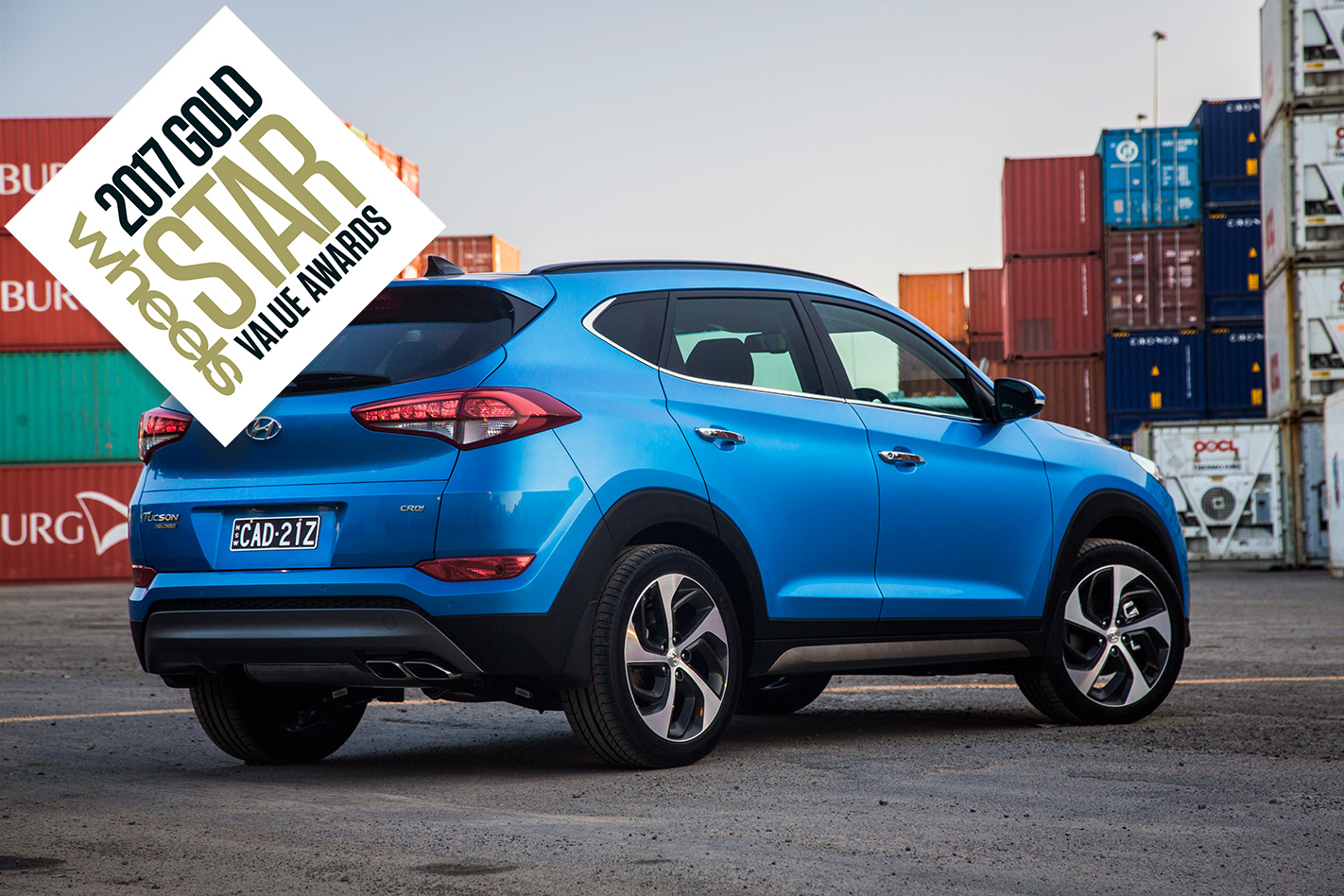
The top Tucson has something its rivals don’t – an efficient, small turbo-petrol engine tied to a dual-clutch ’box. The result is punchy performance and 7.7L/100km economy to take on diesels at the bowser and the traffic lights.
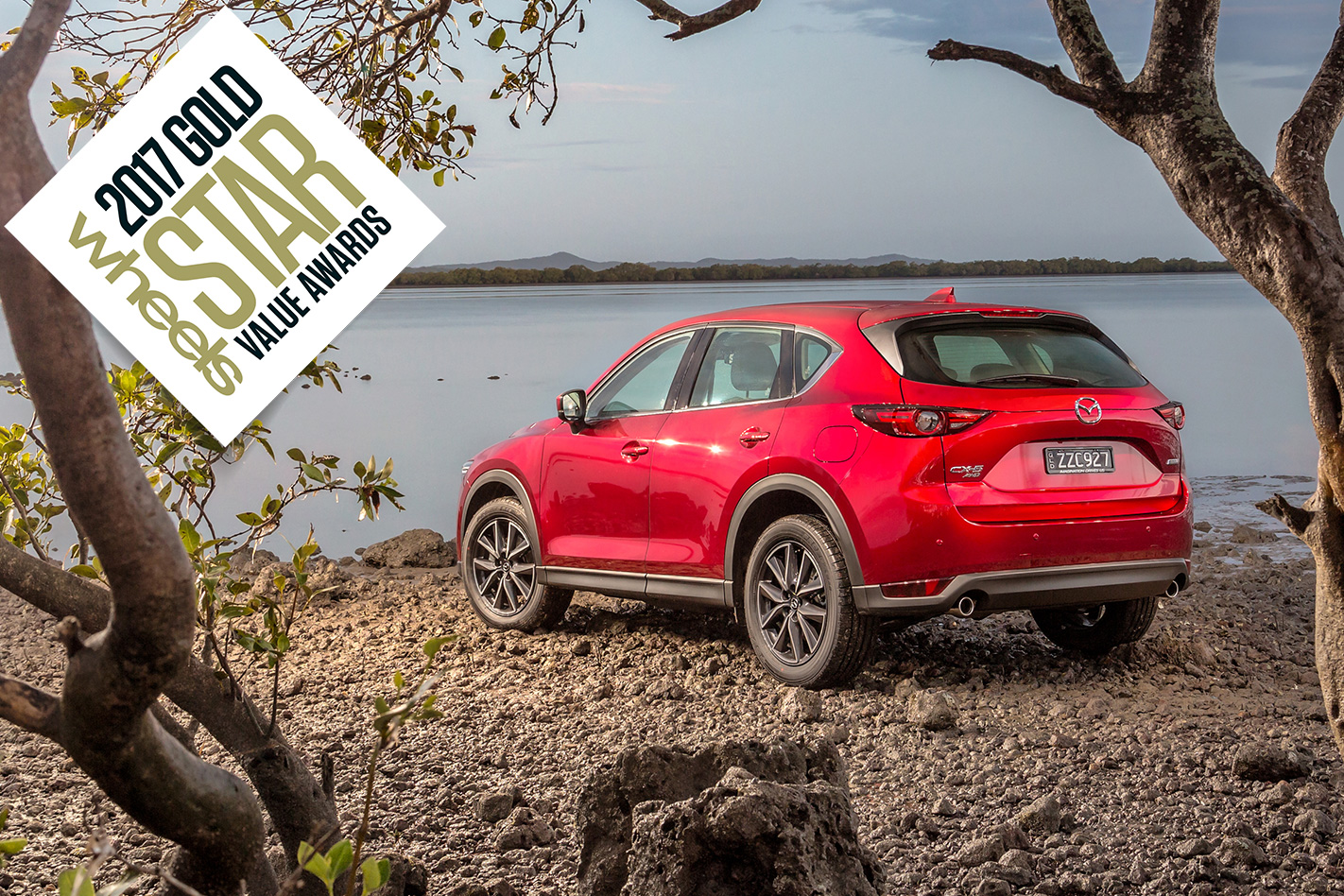
The well-equipped, diesel-drinking Mazda CX-5 GT AWD lets you enjoy turbo-diesel torque (420Nm) and thrift (6.0L/100km) at virtually the same price as the petrol top-spec Akera version, which doesn’t have quite so much of either.
Sub-$45k medium SUVs have grown their market share considerably in recent times – so much so that it’s the fastest-growing vehicular segment in Australia as far as outright sales are concerned. You’re spoiled for choice if you’re shopping in this segment, but here are the cars you should have at the top of your shortlist.
1st: Kia Sportage Si
The automatic-only, entry-level petrol 2.0-litre front-drive Sportage and the manual Mazda CX-5 go virtually head-to-head on price – and power output, at 114kW apiece – but the latter’s slightly better three-year Glass’s resale means the Kia needs to work harder elsewhere.
A neat interior, tidy dynamics and good refinement, with a pleasingly low annual insurance premium and a 12-month service interval, ensure the driving and value fundamentals are sound. But it’s the Korean brand’s seven-year, unlimited-kay warranty that springboards it to the top of the Medium SUV podium.
2nd: Mazda CX-5 Maxx
Sharp pricing and 56 percent three-year resale set the Mazda CX-5 Maxx’s Gold Star Value campaign off to a terrific start. And its 6.9L/100km combined-cycle economy and reasonable annual insurance bill seal a deserved silver.
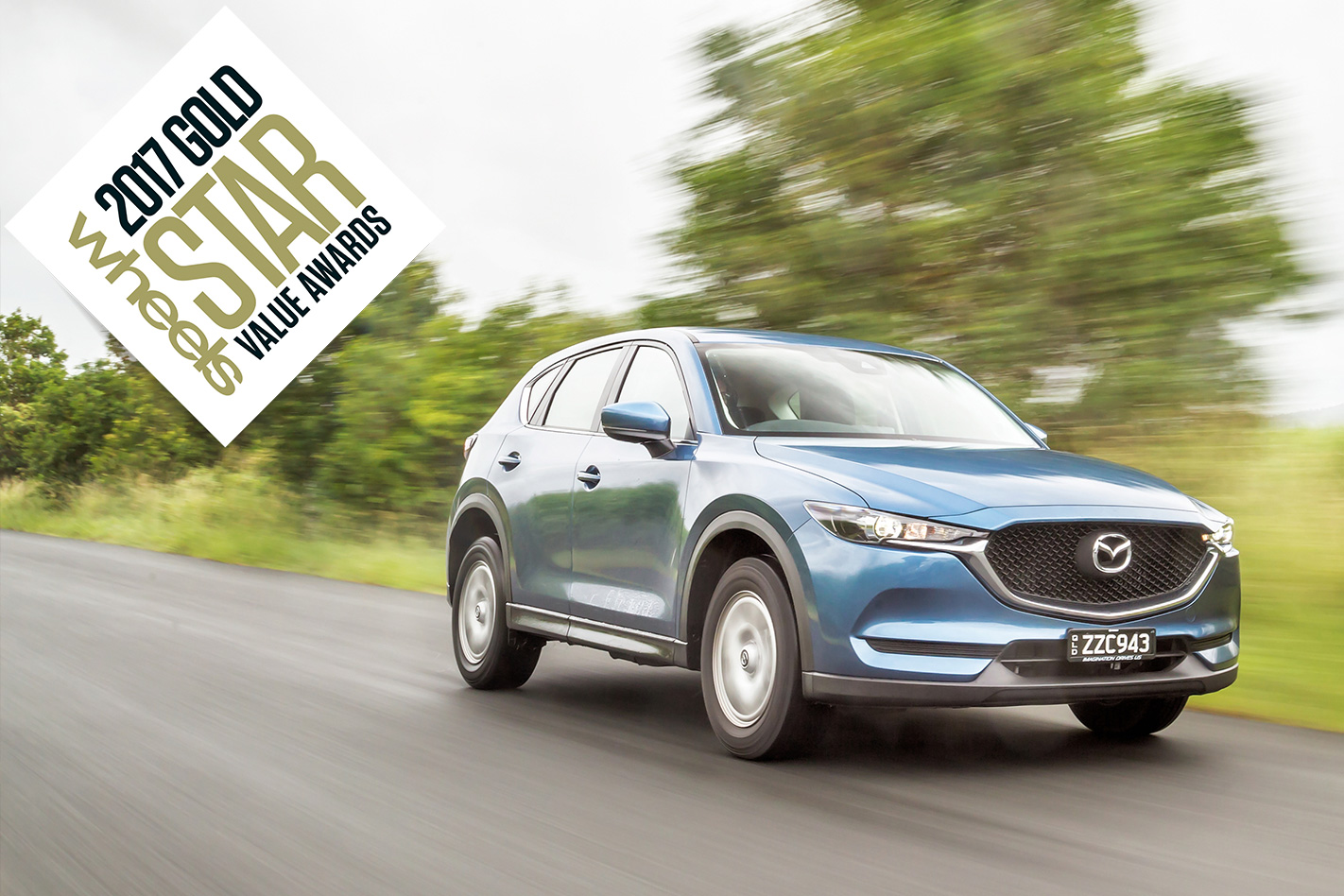
Mitsubishi’s medium SUV is the least costly to fuel among the placegetters, and most models considered for the class, while the brand’s five-year warranty matches Renault and Hyundai while elevating it above Japanese rivals.